Home Blog Page 209

Court remands 5 suspects in SSS custody over Owo church massacre

0

THE Federal High Court in Abuja has ordered the remand of five men accused of carrying out the deadly June 5, 2022, attack on St. Francis Catholic Church, Owo, Ondo State, in the custody of the State Security Service (SSS).

The presiding judge, Emeka Nwite,  issued the order on Monday, August 11, after their arraignment. 

The defendants, Idris Omeiza (25), Al Qasim Idris (20), Jamiu Abdulmalik (26), Abdulhaleem Idris (25), and Momoh Otuho Abubakar (47), pleaded not guilty to the charges brought against them by the Federal Government.

The prosecution, led by Calistus Eze, from the Federal Ministry of Justice, secured the court’s leave to proceed with the arraignment during the vacation period. 

Consequently, charges were read to the defendants, to which they pleaded not guilty.

While seeking a trial date, Eze urged the court to remand them in SSS custody

The defence counsel, Abdullahi Muhammad, did not oppose the remand request but asked the court to ensure the defendants have access to relatives and lawyers.

The suspects face nine terrorism-related counts, including membership of the Al Shabab terrorist group, planning and executing the Owo church attack, and detonating improvised explosive devices that killed over 40 worshippers and injured more than 100.

The court adjourned the case to August 19 for trial and ordered their continued detention at the SSS facility.

Recall that gunmen in June 2022, stormed St. Francis Catholic Church, Owo, Ondo State, killing many worshippers

The Federal Government said a terrorist group, the Islamic State West Africa Province (ISWAP) was behind the attack.

According to the News Agency of Nigeria, the suspects are accused of running a terrorist cell in Kogi State, an offence punishable under Section 25(1) of the Terrorism (Prevention and Prohibition) Act, 2022.

According to count two of the charges, between 30 May and 4 June 2022, they allegedly held meetings at Government Secondary School, Ogamirana, Adavi LGA in Kogi State, and behind Omialafa Central Mosque, Ose LGA in Ondo State. At these meetings, prosecutors say, they planned the attack carried out on 5 June 2022 at St. Francis Catholic Church, Owo, a violation of Section 12(a) of the same Act.   

It also noted that on the day of the incident, the defendants allegedly detonated improvised explosive devices (IEDs) with the intent to kill, resulting in the deaths of over 40 people, including Ajanaku John, Onuoha Deborah, Onileke Esther, and John Bosede.

They were also accused of storming the church, armed with IEDs and AK-47 rifles, holding worshippers hostage, and inflicting serious injuries on more than 100 others, including Onileke Ayodele, John Blessing, Nselu Esther, and Ogungbade Peter – acts punishable under Section 42(a)(ii) of the Act, among other provisions.

Regulator,MainPower electricity hold talks over lingering blackout in Enugu

0

The Enugu State Electricity Regulatory Commission (ESERC) stated that it has engaged MainPower Electricity Distribution Limited (MEDL), the successor to the Enugu Electricity Distribution Company (EEDC), to address the lingering power outage that has left parts of the state in darkness.

The EERC revealed this in a statement posted on its website on Sunday, August 10.

According to the commission, it had summoned MainPower Electricity to a meeting on August 7 to determine the reasons for reducing power supply and to address the vending challenges faced by customers.

The challenges had started when, on July 21, the EERC reduced Band A electricity tariff to N160/kWh from N209.

This, however, elicited worries among electricity distribution companies (DisCos) and electricity generation companies (GenCos).

On August 4, the management of Mainpower Electricity announced that various parts of the state were facing a power outage following the tariff cut.

This followed a public notice from MainPower that EEDC, its parent company, instructed the reduction of power supply to Bands B to E feeders, alongside vending difficulties being experienced by customers.

Intervening in the issue, the EERC said, “During the meeting, MainPower disclosed that they (MainPower and EEDC) were encountering difficulties in isolating Enugu State from other states within EEDC’s service area. This issue, referred to as ‘code coverage conflicts and related glitches,’ would, however, be resolved soon.

“The Commission, nonetheless, directed MainPower to formally inform customers about the vending challenges and the steps being taken to resolve them.”

The commission said further that, on power supply reduction and dissatisfaction over the tariff order,  it had reminded MainPower Electricity of the provisions in its business rules.

The rules require the company to submit a formal petition within 30 days of the order if dissatisfied, rather than resorting to power cuts.

“The petition will trigger a public hearing on the Tariff Order, and the outcome will be implemented. The Business Rules can be accessed by all stakeholders on the Commission’s website.

“The Commission is engaging relevant stakeholders at both state and federal levels and will apply the appropriate regulatory measures to ensure that developers, service providers, customers, and Ndi Enugu benefit fully from the evolving subnational electricity market in the state,” it said

The EERC also said it would ensure MainPower generates enough revenue to cover its efficient operating costs in Enugu, “along with a fair return on invested capital, as stipulated in section 34 (2)(b) of the Enugu State Electricity Law 2023.”

The ICIR reported that the Nigerian Electricity Regulatory Commission (NERC) had said EERC has no regulatory power to fix the electricity price when the power is generated and transmitted from the national grid.

NERC, an independent regulatory body with authority for regulating the electric power industry in Nigeria, clarifies that even though the 2023 Electricity Act gave states the power to regulate electricity in their domain, the power does not supersede that made by the National Assembly to regulate electricity in the federation.

Coroner orders hospital to release late journalist Pelumi Onifade’s record to MRA

0

A LAGOS State District Coroner, Temitope Oladele, investigating the death of a journalist, Pelumi Onifade, has ordered the Ikorodu General Hospital, Lagos State, to release necessary documents relating to the late journalist to representatives of the Media Rights Agenda (MRA).      

Onifade, a reporter with Gboah TV, reportedly died in Police custody during the #EndSARS protests in October 2020.

The court in a ruling ordered the Medical Director of Ikorodu General Hospital to provide the legal representatives of MRA with hospital records relating to the deposit, release or current status of his remains within seven days of receipt of the order.

According to a statement by the spokesperson of the MRA, the investigating magistrate issued the order on Friday, August 8, following an application made by MRA’s lawyer, Monday Arunsi and Jennifer Wala, of the law firm of Charles Musa and Co.

The lawyers have reported to the coroner that the medical director had refused to release the information on the ground that medical records were confidential.

The coroner’s inquest into the death of Onifade, a who was reportedly arrested by policemen attached to the Lagos State Taskforce while covering the #EndSARS protests in 2020, and whose body was subsequently discovered at the Ikorodu General Hospital mortuary, was convened on the orders of the Federal High Court in Lagos.

The order followed a wrongful death action instituted by MRA against the Nigeria Police Force (NPF) and the Lagos State Government, seeking, among other reliefs, a thorough investigation into the circumstances surrounding the late journalist’s death.

In July 19, 2024, the judge, Ayokunle Olayinka Faji, directed the state Attorney-General to take all necessary steps to ensure an investigation into the circumstances of Onifade’s death and conduct a coroner’s inquest to ascertain the cause of death as well as identify and prosecute those responsible for his death.

During Friday’s proceedings at the coroner’s inquest, Arunsi and Wala represented the Onifade’s family and MRA, while Adebola Araba represented the Attorney-General of Lagos State.

Addressing the District Coroner, who also sits as a Magistrate of the Lagos State Judiciary, Arunsi recounted that, pursuant to the court’s directive at the last session on July 8, 2025, he, in company of Johnson Agbakaba visited the Ikorodu General Hospital on July 31, 2025.

According to him, the purpose of the visit was to comply with the court’s order to obtain the hospital’s records indicating the date on which Onifade’s body was brought to the mortuary, the date of its release or its current status.

Arunsi then made an oral application to the coroner requesting her to direct the hospital’s medical director or any other relevant authority or person to produce the records regarding the deposit, release, or the status of Onifade’s remains.

The coroner granted the application and ordered that the medical director, or any other person with the authority or in charge of keeping the medical records, should disclose to the lawyers the records about the deposit, release or status of the body within seven days of receipt of the order.

The judge thereafter adjourned the matter to August 19, 2025, for mention.

Obasanjo Library demands apology from EFCC, threatens litigation over raid on premises

0

THE management of the Olusegun Obasanjo Presidential Library (OOPL) has condemned and demanded an apology from the Economic and Financial Crimes Commission (EFCC) for what it described as an invasion of its premises around 2 a.m. on Sunday, August 10.

According to the OOPL, the apology is for those whose rights were trampled upon and who sustained injuries during the incident, warning that it would take legal action if the commission failed to comply.

In a statement by its Managing Director, Vitalis Ortese, the organisation said the late-night operation disrupted a private gathering within the complex, leaving several persons injured.

Recall that armed operatives from the EFCC had stormed the Library and arrested some of those present.

The OOPL described the raid, which the EFCC claimed was a sting operation as a blatant violation of fundamental human rights and an affront to the Library’s rights as a corporate entity.

It condemned the anti-graft agency’s approach, stating that police officers were already on duty at the event and additional personnel had been deployed from Kemta Police Station, Abeokuta, none of whom, it claimed, had prior knowledge of the EFCC operation.

In addition to an apology, the management demanded an explanation on the raid.

“In the meantime, management demands an explanation of these impudent actions from the commission and an apology from the EFCC authorities for the infringement of its rights, to all those who gathered, and those who sustained serious injuries from the gangster-like induced chaos.

“Failure for which the management will be compelled to seek redress and sanctions as appropriate,” the management vowed.

It said it had started its own investigation into the incident and would direct the issue to relevant authorities, including the EFCC, Police, and the State Security Service (SSS).

Meanwhile, the EFCC on its official X handle on Sunday, confirmed the raid, during which operatives from its Lagos Zonal Office arrested 93 suspected internet fraudsters.

Ibom Air bans passenger for ‘assaulting’ crew, airport officials in viral video 

0

BARELY a week after a public altercation involving popular Fuji musician Wasiu Ayinde at the domestic wing of the Nnamdi Azikiwe International Airport, Abuja, another passenger, Comfort Emmanson, has been captured harassing workers at the Murtala Mohammed International Airport, Lagos.

The Ibom Air confirmed on Monday, August 11, that the female passenger assaulted many crew members and airport security staff in a series of violent outbursts that began shortly before take-off from Uyo on Sunday, August.

In a statement by the airline, the incident started when Emmanson refused repeated instructions to switch off her mobile phone in line with standard aviation safety rules. 

The airline noted that it took a fellow passenger seated beside her to collect the phone from her and switch it off.

“Shortly before take-off from Uyo, Ms. Emmanson was instructed in line with standard aviation safety procedures, to switch off her mobile phone. She bluntly refused to comply until the Pilot-in-Command made an announcement, after which a fellow passenger seated beside her took the phone and switched it off. This action prompted a verbal tirade from Ms. Emmanson. The situation was eventually calmed, and the flight departed as scheduled.

The disturbance appeared to subside during the flight, but tensions reignited after the aircraft landed in Lagos. The airline said Ms. Emmanson waited for other passengers to disembark before confronting the Purser, stepping on her, forcibly removing her wig and glasses, striking her with footwear, and slapping her repeatedly.

“Upon arrival in Lagos, Ms. Emmanson waited for all other passengers to disembark and then proceeded to confront the Purser who had earlier instructed her. She walked up to the unsuspecting Purser, stepped on her, forcibly tore off her wig, removed her glasses and threw it to the floor, and used her footwear to assault her. She slapped her several times and when the other cabin crew member tried to intervene, she slapped her too. She then attempted to forcibly remove a fire extinguisher to use as a weapon, an act that could have damaged and grounded the aircraft,” the statement added.

Although, The ICIR could not independently ascertain what triggered her behaviour, viral videos of the incident compounded most of the claims by the airline. 

It showed the visibly agitated passenger jabbing a flight attendant’s head with her finger and later clashing with security officials on the tarmac after being dragged out of the aircraft.

Another video showed how she was hitting one of the airline workers. Shortly after, she was dragged by four people, who appeared to be Ibom Air and the airport security staff, out of the aircraft. In the process of forcing her out of the plane, her two breasts were revealed after her white top loosened, and she promptly covered them with her cloth. 

The officers overpowered her and bundled her into an airport bus.

Ibom Air further captured the incident thus: “By this time, the Pilot-in-Command had alerted airport security. Before security could arrive, the Purser as seen on the viral video on the internet, prevented the passenger from leaving the aircraft until security arrived. The arrival of Ibom Air Security personnel, did not deter the passenger as she attacked them as well, lashing out violently at both Ibom Air and FAAN security.

She was then restrained and removed from the aircraft by force. Even after disembarking, she continued to assault both Ibom Air and FAAN security staff, and even slapped the ground supervisor. The passenger was removed from the ramp and taken into custody by FAAN security and handed over to the Nigeria Police Force for further investigation.

“Ibom Air has since submitted a report on the incident to the Nigerian Civil Aviation Authority, and placed a travel restriction on Ms. Emmanson, who will no longer be permitted to fly on any of our aircraft,” the statement added.

The ICIR reports that the altercation came just days after the NCAA suspended two ValueJet pilots over a safety breach during a row involving Wasiu Ayinde at Abuja airport, with the celebrity placed under an indefinite travel ban pending investigation.

The National Association of Aircraft Pilots and Engineers (NAAPE) has since urged the NCAA to punish the musician for “crude, unruly behaviour.”

The group also urged the NCAA to restore the ValueJet pilots’ licences, warning that passenger misconduct threatened both safety and security in the aviation sector.

Gbenga Daniel alleges vendetta as Dapo Abiodun moves to demolish properties 

0

A RECENT notice by Governor Dapo Abiodun-led Ogun State Government, warning of planned demolition of three properties belonging to the state former governor, Gbenga Daniel, is, again, fanning the embers of feud between the two leaders. 

The state government had in a letter reportedly dated August 8, 2025, through the State Planning and Development Authority, issued demolition notices on the former governor’s properties, indicating that the properties might not have regulatory approvals.

The affected properties include a private residence of the former governor, popularly called Asoludero Court, located along Obafemi Awolowo Road, Sagamu; the Conference Hotel Limited; and Conference Hotel Anex, all in the Sagamu Local Government area of the state.

The move has not gone down well with the former governor, who has described it as a political vindictiveness.

The ICIR reports that Daniel ruled the state for eight years, from May 29 2003 to May 29, 2011, and he is currently representing the Ogun East Senatorial District in the National Assembly.

Abiodun, the incumbent governor, who took over on May 29, 2019, is currently serving out his second tenure in office.

Daniel accuses Abiodun of vindictiveness 

In a statement on Saturday, August 9, by his media aide, Steve Oliyide, the former governor queried the Abiodun-led administration’s planned demolition of his properties.

He described the action as the highest level of political persecution, calling public and security agencies’ attention to the issue.

According to the former governor, about 4pm on Friday, August 8, some agents from the state government posted notices of contravention, quit and threats of demolition on his Asoludero residence, Conference Hotels, and Hotel Annex.

“We strongly condemn this latest act of political persecution by Governor Dapo Abiodun, as evidenced by the recent issuance of these notices which were dated August 8, 2025, as a clear demonstration of the governor’s malicious and vindictive abuse of power, hiding behind a newly enacted law retroactively to target a political opponent.

“The documents, concerning these properties cite ‘suspected’ offences related to construction without adequate permits (which is laughable),” Daniel said.

The former governor said the properties in question had been in existence for many years, hinting that the Asoludero Court was built in 2004, Conference Hotels in 2013, and Hotel Annex since 2015.

“The governor’s administration is now attempting to use the Ogun State Urban and Regional Planning and Development Law No. 61 of 2022 to demolish buildings that were legally constructed long before the law was even in existence.

“This action is not only politically motivated but also a blatant disregard for due process and the rule of law. The notices in themselves are clear breaches of procedures which allow adequate time intervals between notifications on contraventions, Quits and the penalties, if indeed there were any, are not a demolition or a threat of it,” Daniel claimed.

He insisted that the Abiodun administration had completely bypassed this procedure by issuing a ‘Notice of Contravention’ and ‘Notice to Quit’ simultaneously, with an immediate threat of demolition.

“This is not a legal process; it is a thuggish tactic designed to intimidate and inflict damage.

“It is worth noting that this is not an isolated incident. This latest act of persecution follows a similar pattern of illegal demolitions carried out by Governor Abiodun’s administration,” Daniel maintained.

He recalled how his wife’s, Yeye Olufunke, property, DATKEM Plaza Ijebu Ode, was demolished in the midnight of September 2023 by thugs believed to have worked on the orders of Abiodun, raising concerns over the relationship between the two political bigwigs.

Daniel noted that the matter was still in court, asserting that the Abiodun-led administration had already lost several applications at the Ogun State High Court and another at the Court of Appeal in Ibadan.

He believed that Abiodun was taking political vindictiveness without any regard for extant laws or common decency.

“We call on all well-meaning citizens, human rights organisations, and legal bodies to stand with us in condemning this egregious abuse of power.

“We will not be silent in the face of this injustice and will use all legal means at our disposal to ensure that Governor Abiodun is held accountable for his lawless actions,” Daniel vowed.

Abiodun gov’t debunks Daniel’s vindictive claim

In a statement on Saturday by the state government and an X post by the Special Adviser on Information and Strategy to the governor, Kayode Akinmade, the Abiodun-led administration countered the former governor’s claims.

The government said Daniel’s reaction was tailored to cause disaffection and foment chaos in the state, stressing that the notices were a routine procedure.

According to the government, contrary to Daniel’s claim of political vindictiveness, the state government is not in any way fighting him.

“The fact of the matter, quite simply, is that in his holistic approach to development efforts across the length and breadth of Ogun State, His Excellency, Governor Dapo Abiodun, has embarked not only on building new communities as exemplified by the affordable housing estates and the yellow roof revolution but also on the redevelopment of Ogun State’s towns and cities through urban renewal.

“This, he started with Ibara GRA in Abeokuta, the state capital, and is being extended to Sagamu and Ijebu-Ode GRAs. This initiative involves the auditing of existing developments within these areas to determine the permit status of all types of developments, including houses, schools, hospitals and other commercial buildings,” it said.

It insisted the government was following a statutory and due process, which it argued had formed its audit exercise currently being carried out simultaneously, both in Ijebu-Ode and Sagamu GRAs.

“Otunba Gbenga Daniel’s building happens to be within the Sagamu GRA and among those that were served notices as required under the Town Planning Law and Regulation of Ogun State. Many other structures were also similarly served.

“The exercise is a continuous one until the objective of the government for the exercise is achieved. This process is not new. It had been in existence and operated even during his tenure as Governor of the State. The GRA is a government-designed and allocated estate, and it is subject to regulatory and oversight functions of government in perpetuity.

“All Otunba Gbenga Daniel needs to do, like every other person in a similar situation that has been served with such notices in that neighbourhood, is to present his planning permit and land title to the relevant government agency office for verification within the time specified in the notices rather than resorting to cheap blackmail. There are no exemptions under the law except as permitted by that law,” the government stated.

The government said the former governor could not be bigger than the state.

“Nobody is bigger than the State. Senator Gbenga Daniel is distinguished no doubt, but he is not bigger than Ogun State.

“He should submit himself unreservedly to the same laws he once swore twice to uphold. He should refrain from elevating every issue of his contact with government institutions to a personal vendetta by the governor,” it added.

PDP accuses Abiodun of eying Ogun East senatorial seat

Meanwhile, the Ogun state chapter of the Peoples Democratic Party (PDP) has accused Governor Abiodun of embarking on a vendetta in his move to demolish the former governor’s properties.

The PDP believes that the growing feud stemmed from Daniel’s readiness to seek re-election for the Ogun East senatorial seat in the 2027 election, for which Abiodun is now nursing an ambition.

The governor, who lost the seat to the late Buruji Kashamu in 2015, was also interested in the seat after the expiration of his second term in 2027, PDP stressed.

But Abiodun had urged the PDP to focus on its internal crisis and stop meddling in state affairs, noting that government policies were guided by law and public interest, not partisan politics.

BBNaija S10: Twists, romance, evictions rock week two

TWO weeks in, the Big Brother Naija Season 10 house is already boiling over with suspense, romance, and high-stakes dramas.

Last week, all 29 housemates were told they faced possible eviction. This sparked frantic alliances, late-night heart-to-hearts, and even bolder romantic moves.

But in a dramatic reveal during Sunday’s live show, host Ebuka Obi-Uchendu confirmed it had all been a ruse, there were no votes, no evictions, just Biggie “in his menace era.”

He also revealed that the ₦80 million grand prize wasn’t guaranteed. Starting at ₦10 million, the pot will grow by ₦7.5 million each week, but only if housemates succeed in their weekly tasks. Failure could see the prize shrink.

Social media erupted, with fans praising the twist while others said it only cranked up the pressure.

Competition heats up

The Head of House (HoH) games took the centre stage this week. Thelma Lawson made history as the first female HoH of the season, winning immunity. The HoH lounge, and the power to select a guest, a decision that raised eyebrows after a suggestive moment with Isabella.

Her reign, however, was short-lived. Less than 24 hours later, Victory Okokon dethroned her in the Monday Challenger round, beating both Thelma and Ivatar in a contest of speed and precision. Victory chose Joanna as his deputy, a surprise move given his visible chemistry with Gigi Jasmine – a move that left Gigi in tears.

Romance and Risks

From steamy party moments to emotional entanglements, romance continued to dominate conversations inside and outside the house.

Isabella and Kayikunmi made headlines after a viral clip showed Isabella exposing her breasts to him during a private moment, sparking backlash and calls for sanctions.

Koyin and Sultana also stirred conversations when they joked about getting each other’s names tattooed, with Sultana suggesting her neck and Koyin hinting at a more private spot.

Meanwhile, Kola’s growing feelings for Dede, and her firm reminder that she’s in a relationship outside the house, reminded fans of love triangles from past BBNaija seasons.

Not all interactions were romantic. A heated clash came about when, when Kayikunmi told Bright Morgan to “go downstairs and use the mirrors,” then called him a ‘bitch’. Morgan reacted angrily, forcing housemates and eventually Big Brother himself to intervene.

In a shocking diary session, Zita confessed to stirring drama, from rubbing toothpaste on Kayikunmi’s bed to scattering clothes, proudly calling herself a ‘chameleon’. Viewers were split between admiration for her honesty and criticism of her antics.

Arena highlights & backlash

Joanna claimed victory in the debut Arena Games, completing the challenge in a record three minutes. Outside the house, however, controversy brewed. Lawyer Maduabuchi Idam petitioned the National Broadcasting Commission to ban or regulate the show, citing ‘obscene’ and ‘pornographic’ content.

Eviction shock

Sunday night brought the season’s first real eviction, with Danboskid exiting the house. His departure drew mixed reactions online, some viewers were stunned, others felt his gameplay made it inevitable.

The next big shock came with the eviction of housemate Ibifubara, making her the second to leave after Danboskid’s earlier exit.

The drama unfolded after a tense search for an envelope containing an immunity card left 27 housemates vulnerable. Despite their best efforts to secure safety, Ibifubara’s journey ended abruptly, sending ripples of anxiety through the house.

Head of House Victory, immune from eviction this week, used his veto power to save Kayikunmi, a move that has already sparked conversations about potential alliances and strategies brewing beneath the surface. 

With N150 million up for grabs and Biggie’s unpredictable twists in play, Week Three promises even more rivalries, romance, and surprises. In BBNaija Season 10, no crown, or connection, is safe.

The science of starvation: this is what happens to your body when it’s deprived of food

0

By Ola Anabtawi, An-Najah National University and Berta Valente, Universidade do Porto

HUNGER exists on a spectrum. On the one end is food insecurity, where people are forced to adjust to fewer meals. As food becomes scarce, the body consumes its own reserves. The journey from hunger to starvation starts with a drop in energy levels, then the body breaks down fat, then muscle. Eventually, critical organs begin to fail.

From undernourishment, to acute malnutrition and finally starvation, the process reaches a point where the body can no longer sustain life. In Gaza today, thousands of children under five and pregnant or lactating women are experiencing acute malnutrition. In Sudan, conflict and restricted humanitarian access have pushed millions to the brink of starvation, with famine warnings growing more urgent by the day.

We asked nutritionists Ola Anabtawi and Berta Valente to explain the science behind starvation and what happens to your body when it’s deprived of food.

What is the minimum nutrition a body needs to survive?

To survive, people need more than clean water and safety. Access to food that meets daily energy, macronutrient and micronutrient requirements is essential to preserve health, support recovery and prevent malnutrition.

According to the World Health Organization (WHO), adults require different amounts of energy depending on age, sex and level of physical activity.
A kilocalorie (kcal) is a measure of energy. In nutrition, it tells us how much energy a person gets from food or how much energy the body needs to function. Technically, one kilocalorie is the amount of energy needed to raise the temperature of one kilogram of water by one degree Celsius. The body uses this energy to breathe, digest food, maintain body temperature, and – especially in children – to grow.

Total energy needs come from three sources:

  • resting energy expenditure: the energy used by the body at rest to maintain vital functions such as breathing and circulation
  • physical activity: may vary during emergencies depending on factors like displacement, caregiving, or survival tasks
  • thermogenesis: the energy used to digest and process food.

Resting energy expenditure usually forms the biggest portion of energy needs, especially when physical activity is limited. Other factors including age, sex, body size, health status, pregnancy, or cold environments also influence how much energy a person requires.

Energy needs vary throughout life. Infants require approximately 95kcal to 108kcal per kilogram of body weight per day during the first six months and between 84kcal and 98kcal per kilogram from six to 12 months. For children under the age of ten, energy needs are based on normal growth patterns without distinction between boys and girls.

For example, a two-year-old child typically requires about 1,000kcal to 1,200kcal daily. A five-year-old needs about 1,300 to 1,500 and a ten-year-old generally requires between 1,800 and 2,000 kilocalories per day. From age ten onward, energy requirements begin to differ between boys and girls due to variations in growth and activity, and allowances are adjusted based on body weight, physical activity and rate of growth.

For adults with light to moderate physical activity, the average daily energy requirement for men aged 19 to 50 is about 2,900kcal, while women in the same age group require roughly 2,200kcal per day. These values include a range of plus or minus 20 per cent to account for individual differences in metabolism and activity. For adults over 50 years, energy needs decrease slightly, with men requiring about 2,300kcal and women around 1,900kcal daily.

In humanitarian emergencies, food aid provision needs to guarantee the widely accepted minimum energy intake to maintain basic health and function, which was set to 2,100kcal per person per day. This level aims to meet fundamental physiological needs and prevent malnutrition when food supply is limited.

This energy must come from a balance of macronutrients, with carbohydrates supplying 50 -60 per cent (such as rice or bread), proteins 10 per cent-35 per cent (like beans or lean meat), and fats 20-35 per cent (for example, cooking oil or nuts).

Fat requirements are higher for young children (30-40 per cent), as well as for pregnant and breastfeeding women (at least 20 per cent).

In addition to energy, the body requires vitamins and minerals, such as iron, vitamin A, iodine and zinc, which are critical for immune function, growth and brain development. Iron is found in foods like red meat, beans and fortified cereals. Vitamin A comes from carrots, sweet potatoes and dark leafy greens. Iodine is commonly obtained from iodised salt and seafood. Zinc is present in meat, nuts and whole grains.

When food systems collapse, this balance is lost.

What physically happens when your body is starved?

Physiologically, the effects of starvation on the human body unfold in three overlapping stages. Each reflects the body’s effort to survive without food. But these adaptations come at great physiological cost.

In the first stage, which lasts up to 48 hours after food intake stops, the body draws on glycogen stored in the liver to keep blood sugar levels stable.

This process, called glycogenolysis, is a short-term solution. When glycogen runs out, the second stage begins.

The body shifts to gluconeogenesis, producing glucose from non-carbohydrate sources like amino acids (from muscle), glycerol (from fat), and lactate. This process fuels vital organs but results in muscle breakdown and increased nitrogen loss, especially from skeletal muscle.

By day three, ketogenesis becomes the dominant process. The liver starts converting fatty acids into ketone bodies – molecules derived from fat that serve as an alternative fuel source when glucose is scarce. These ketones are used by the brain and other organs for energy. This shift helps spare muscle tissue but also signals a deeper metabolic crisis.

Hormonal changes – including reduced insulin, thyroid hormone (T3), and nervous system activity – slow the metabolic rate to conserve energy. Over time, fat becomes the main energy source. But once fat stores are exhausted, the body is forced to break down its own proteins for energy. This accelerates muscle wasting, weakens the immune system, and increases the risk of deadly infections.

Death, often from pneumonia or other complications, typically occurs after 60 to 70 days without food in an otherwise healthy adult.

As the body enters prolonged nutrient deprivation, the visible and invisible signs of starvation intensify. Physically, individuals lose substantial weight, and experience muscle wasting, fatigue, slowed heart rate, dry skin, hair loss, and compromised wound healing. Immune defences weaken, increasing vulnerability to infections, particularly pneumonia – a frequent cause of death in starvation.

Psychologically, starvation creates profound distress. People report apathy, irritability, anxiety and a constant preoccupation with food. Cognitive abilities decline, and emotional regulation deteriorates, sometimes leading to depression or withdrawal.

In children, long-term effects include stunted growth and impaired brain development. Both can become irreversible.

During starvation, the body adapts in stages to survive. Initially, it uses glycogen storage for energy. As starvation continues, it begins to break down fat, and eventually, muscle tissue. This gradual shift explains both the physical weakness and psychological changes like irritability or depression.

But starvation does not stop at the individual. It fractures families and communities. As energy declines, people are unable to care for others or themselves. In humanitarian crises like Gaza and Sudan, starvation compounds the trauma of violence and displacement, creating a total collapse of social and biological resilience.

What are the steps to break the cycle?

After a period of starvation, the body is in a fragile metabolic state. Sudden reintroduction of food, especially carbohydrates, causes a spike in insulin and a rapid shift of electrolytes like phosphate, potassium, and magnesium into cells. This can overwhelm the body, leading to what’s known as refeeding syndrome, which may result in serious complications such as heart failure, respiratory distress, or even death if not carefully managed.

Standard protocols begin with therapeutic milks called F-75, specially designed to stabilise patients during the initial phase of treatment for severe acute malnutrition, followed by ready-to-use therapeutic food, a specially formulated peanut-butter paste or biscuit with the power to bring a malnourished child from the brink of death to full nutritional recovery in just four to eight weeks, oral rehydration salts, and micronutrient powders.

These must be delivered safely. Consistent humanitarian access is essential.

Airdrops are not part of food security. Survival requires sustained, coordinated efforts that restore food systems, protect civilians and uphold humanitarian law. Anything less risks repeating cycles of hunger and harm.

When food assistance falls short in quality or quantity, or when clean water is unavailable, malnutrition rapidly worsens.The Conversation

Ola Anabtawi, Assistant Professor Department of Nutrition and Food Technology, An-Najah National University and Berta Valente, PhD candidate in Public Health at the Faculty of Medicine, Universidade do Porto

This article is republished from The Conversation under a Creative Commons license. Read the original article.


AI-generated video of cars on canoes in flooded Lekki sparks discussion on digital literacy

0

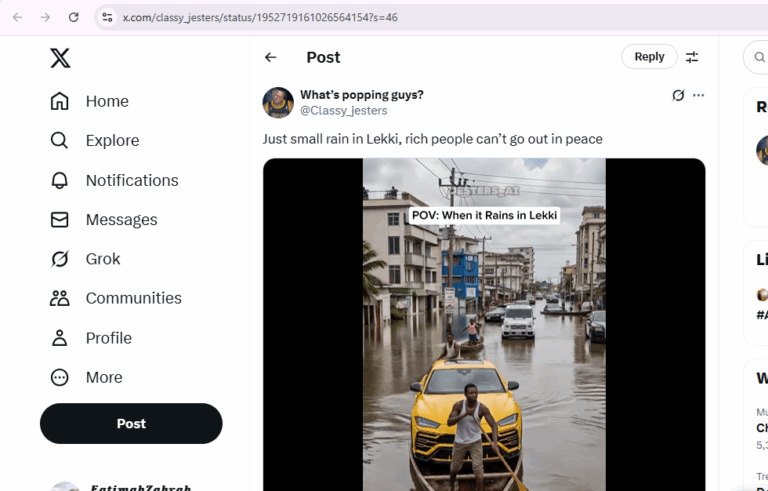
A recent post on X by user @classy_jesters has drawn attention for its hyper-realistic yet satirical portrayal of flooding in Lagos. The 19-second clip appears to show men paddling canoes loaded with luxury cars through a submerged street, until closer inspection reveals it’s AI-generated.

The caption read, “Just small rain in Lekki, rich people can’t go out in peace.”

Uploaded on Tuesday, August 5, 2025, the video has since racked up nearly one million views, 6,300 likes, and 1,500 reposts. While the creator labelled it as AI-generated satire, its realism could easily fool those unfamiliar with AI imagery, especially in a flood-prone area like Lekki, which has a history of severe rain-related disruptions.

The real flooding problem in Lekki

Lekki’s susceptibility to flooding has been the subject of growing environmental concern. Recently , Mahmood Adegbite, Permanent Secretary in Lagos State’s Office of Drainage Services and Water Resources, warned residents against indiscriminate drilling of boreholes. He cautioned that groundwater in the peninsula is already contaminated with faecal matter, posing serious public health risks.

Screenshot of the video from X

Comments under the video suggest many followers understood it was AI-generated, but that’s one half of the audience. Some believed it.

@chrisilems  wrote: When the streets are not smiling and are filled with tears, even the wealthy will feel the heat when nature intervenes.

@The_Ghost_on_X similarly wrote: This is hilarious, those that had their cars parked still faced same problem.

@thatmrT wrote: I don’t think anyone who worked hard for his money would invest it in Lekki. Do proper research.

Some worried about older relatives being misled. Even with labels, senior audiences remain highly vulnerable to AI-driven misinformation.

Even with labels, senior audiences are vulnerable

Research shows that many older people struggle to interpret AI labels or may not even know what “AI-generated” means. This is partly because they tend to trust visual media as authentic and may not be as digitally literate as younger users. Studies have shown that many seniors still fall for misleading or satirical content, even when it is marked.

To better protect older adults from being misled by AI-generated content, platforms need to go beyond just adding labels. Labels should be clearer and easier to understand, such as bold icons, simple captions, or even audio cues. Stronger measures recommended by experts include:

  • Bold, high-visibility icons instead of small text labels
  • Simple, plain-language captions explaining “This video was made using computer graphics”
  • Audio cues announcing content as AI-generated
  • Targeted media literacy workshops for older audiences, ideally run by trusted community figures such as local leaders or faith-based organisations

Why labelling AI-generated content matters

Labelling AI-generated content, whether it’s images or videos, is essential for:

  • Maintaining transparency,
  • Building trust,
  • And curbing the spread of misinformation.

This involves using clear indicators such as tags, bylines, disclaimers, or watermarks to signal that artificial intelligence played a role in creating or altering the content.

Major tech platforms have adopted different strategies to address this. These practices are especially critical in contexts like news, politics, and public health. Beyond technical transparency, AI labelling also contributes to digital literacy by making audiences more aware of how content is created in an increasingly AI-driven world.

Republished from FactCheckhub.

Police arrest 3 suspects in connection with murder of journalist found dead in Abuja

0

OPERATIVES  of the Federal Capital Territory (FCT) Police Command, attached to Mpape Division, have arrested three suspects in connection with the murder of Azubuko Nwakama, also known as Joel Waksi, a journalist with Liberty Radio.

Nwakama was attacked, robbed and killed on June, 14 2024, at Panteka Market, Mpape, Abuja.

Thr FCT Police Command in a statement, signed by its spokesperson, Josephine Adeh, and mailed to The ICIR on Sunday said following the incident in June 2024, detectives from Mpape Division immediately launched a comprehensive investigation.

The police said the suspects had dispossessed the victim of his mobile phone and other valuables but despite extensive tracking efforts, the device remained switched off, making it difficult to trace.

According to the police, the investigation team remained on the case for over a year, closely monitoring possible digital traces linked to the stolen phone.

“The breakthrough came on 2nd August 2025, when the victim’s phone, a Redmi 13C, was switched on.

“It was immediately tracked to one Mutari Lawal, 32 years from Kano State, who was promptly arrested.

“During interrogation, Mutari confessed to attacking and stabbing the deceased before making away with his valuables.

He named his accomplices as Dan’Asabe Ibrahim, a 22 year-old from Zamfara State, and Danjuma Ibrahim, an 18-year-old, both of no fixed address in Mpape.

According to the police, Mutari further disclosed that he took the stolen phone to Kano, kept it switched off for a year, and only powered it on in August 2025 to wipe data, insert his SIM card, and return to Abuja before he was arrested.

The Commissioner of Police, FCT Command, Ajao Adewale commended the diligence, resilience, and professionalism of the officers who ensured that justice prevailed despite the passage of time.

He warned all criminal elements within the FCT to repent or relocate as “the long arm of the law, which is patient, persistent, and resolute will definitely catch up with them.”

The FCT Police Command also reassured the residents that their security remained its  priority and urges them to remain vigilant and promptly report suspicious activities or emergencies.

The ICIR reported that Nwakama was found dead on Wednesday, June 19, five days after he was declared missing.

An On-Air Personality (OAP) with Atar Communication, owners of Liberty TV/Radio, the deceased reportedly left the office around 9 p.m. on Friday, June 14, and was supposed to return to work at the station’s Mpape office by 2 p.m. the following day.

The Group General Manager (GGM), Atar Communication, Balarabe Muhammad, said the police in Mpape Division had declared that Nwakam’s body was found near the Panteka neighbourhood and had been transferred to the morgue at Kubwa General Hospital.

According to Muhammad, the OAP was stabbed around his neck, and his phone could not be found.