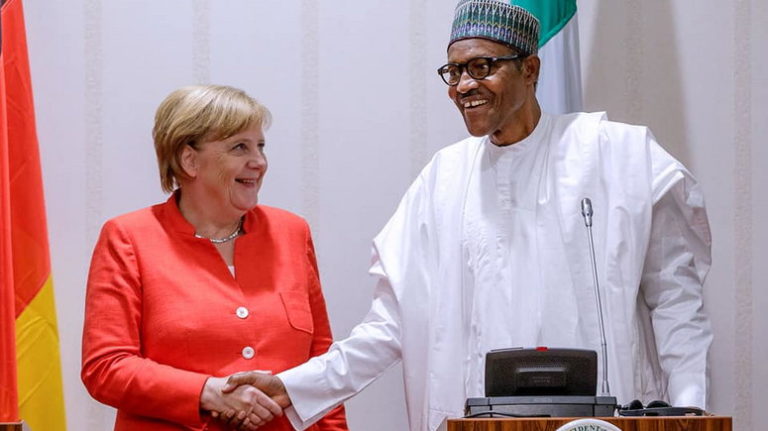
THE government of Germany says it is stepping up its humanitarian assistance in North-East Nigeria by providing additional financial support of 26 million Euros to the country.
A statement issued by the German Embassy in Nigeria on Monday stated that Germany continues to provide life-saving humanitarian assistance in Borno, Yobe and Adamawa aiming to support the Nigerian Government with a view to protecting the most vulnerable groups and meeting the humanitarian needs.
Building on existing programmes and cooperation, the statement said Germany is providing additional funding to the UN World Food Programme to the tune of over 8 million Euros, the International Committee of the Red Cross, over 7 million Euros, the UN Food and Agriculture Organization with over 5million Euros, Caritas International with over 3.5 million Euros and the Nigeria Humanitarian Fund with over 2.5 million Euros.
Commenting on the need for multilateral cooperation and coordination, Heiko Maas, German Foreign Minister stated: “The logic of the COVID-19 pandemic tells us that we either prevail over the virus worldwide or not at all.”
“And our success will be determined not with us, but among the poorest of the poor.”
In the UN Security Council, of which Germany is currently a member, as well as in other UN bodies, Germany is pressing for UN organizations to play a leading role at global level.
According to the United Nations the humanitarian crisis in North-East Nigeria after more than a decade of armed conflict is affecting the lives and livelihood of some 7.9 million people.
The threat of the COVID-19 pandemic in the states affected by the conflict is regarded high considering that around 35 per cent of health facilities have been destroyed or partially damaged due to the conflict.
In 2019 Germany was the third biggest bilateral donor of humanitarian assistance to Nigeria, enabling life-saving humanitarian assistance in the Lake Chad Region amounting to 67.5 million Euros.
The statement stated further that Germany is extensively engaged within the European Union (EU) and
participating actively in the global cooperation package focusing on Africa (“Team Europe”).
Tackling the COVID-19 crisis in Africa will be a key issue during Germany’s EU Council Presidency in the second half of 2020.
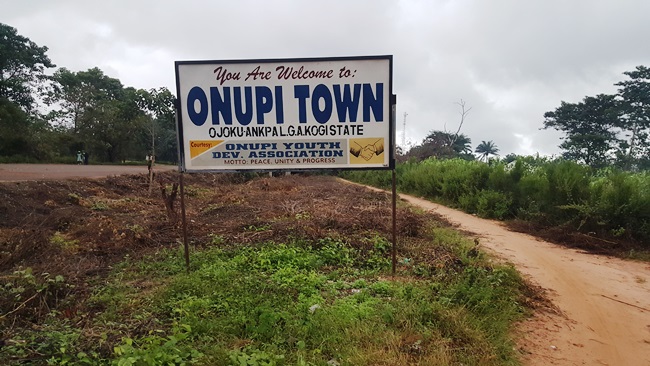
YOUTHS of Onupi Community, a coal-rich settlement in Ankpa Local Government Area, Kogi State, have forced Dangote Coalmine to stop mining operation in the area due to the firm’s non-compliance with the Community Development Agreement (CDA), The ICIR can report.
Alfa Stephen, Chairman of the Community Coal Mining Committee, told The ICIR that the firm was yet to fully vacate the site, but its workers have been prevented from operating since April 21.
“They have not totally moved out but they have shut down operations because they are not complying with the community development agreements,” Stephen said.
The community, he said, would uphold its decision until the firm honours the agreement signed by representatives from all the affected seven communities.
There are also growing concerns on the implication of abandoning the mine operated by the firm without possible reclamation for subsequent farming practice.
Dangote Coal Mine, one of the subsidiaries of the Dangote Group established on August 31, 2016, is owned by Aliko Dangote, Africa’s richest man.
The community development agreement contains obligations of the company to the host communities, some of which include the provision of health care facilities, primary school building, scholarships to students of the communities, among other terms agreed with the community.
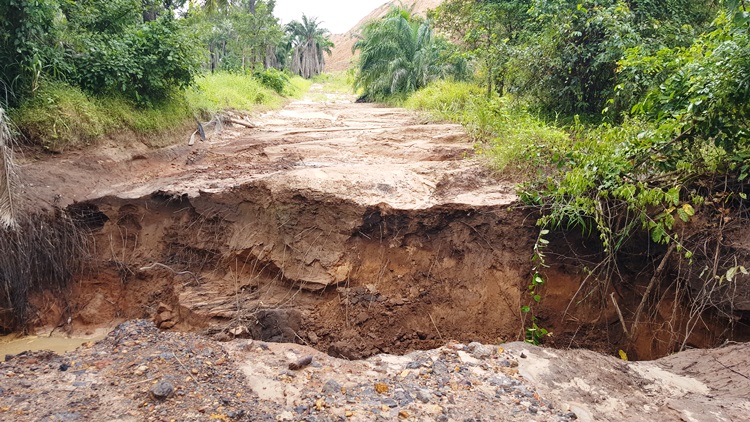
Effluent from the coalmine cuts an access road, creates large gully which flows down to the Onupi farmlands, Photo Credit Olugbenga Adanikin, The ICIR
Despite that Dangote had been mining in the communities years before the agreement was developed, its implementation was to commence three months from the date the new CDA was signed last April.
For instance, the construction of the primary school, according to the CDA, ought to have started in July 2019 while that of Primary Health Care Centre should have commenced five months from September 2019 when the agreement was signed.
The ICIR had earlier reported on illegalities of the Dangote’s firm which includes flouting Mining Act, Environmental Impact Assessment (EIA) Act, human rights abuses, and destruction of the ecosystem.
The two-part investigation by The ICIR exposed how the company falsified an EIA and presented it as an authentic copy to the rural community. It is expected that for any development to commence, the law says an EIA should be conducted to benchmark and mitigate the socio-environmental impacts to the host communities.
But, according to the locals in Onupi, managements of the coal mine should have started fulfilling their obligations since September 2019, but not a single block has been erected in the community at the time o this reporting.
The community chairman, who expressed worry on why it was difficult for the firm to satisfy their demands, cited an instance of a neigbouring community where a four-room Clinic had been at the foundation stage since March – a project he said could have been completed by the conglomerate.
“Dangote assured us in September last year that they would do their best to provide community borehole, community primary health care, and primary school,” a source said.
But that promise is yet unfulfilled, he said.
The source added that the youths got tired of the postponed promises, and decided to stop their work until they fulfill the promise.
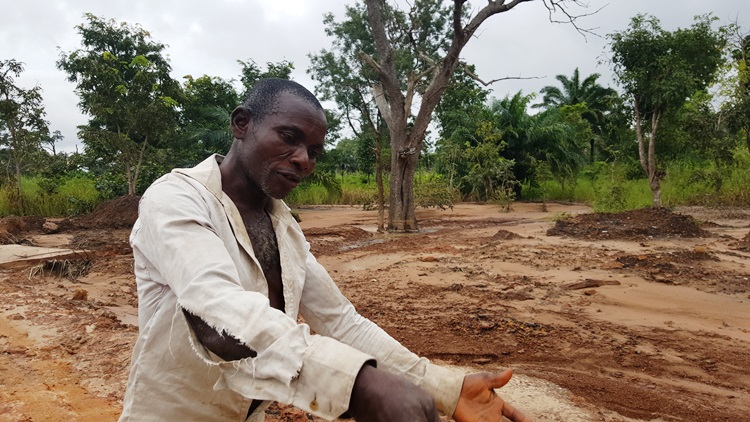
The source, who pleaded for anonymity revealed that wastes from the mining site such as coal shells and muds have been washed onto the community farmlands, contaminating the land and destroying farm crops.
Jibril, a farmer in Onupi community, demonstrates how part of his farmland was damaged to construct drainage without his permission Photo Credit: File Copy
He raised an alarm that parts of the mine currently opened are already creating a gulf that endangers the lives of the residents.
“…If you visit now to see the un-mined areas, the coal has been washed to other areas…coal-water leaks have travelled more than two kilometers and damaged people’s farms. These people are not compensated by Dangote and it is dangerous to our health.”
There is information that the firm is considering moving to a new location in Otukpa Local Government Area, Benue State to commence similar coal mining activity.
The ICIR contacted Usman Jibrin, representative of the Dangote Group in Ankpa to verify why the CDA was dishonoured as claimed by the community, and if there is a plan to reclaim the mined areas after the excavation process, but he declined to comment.
“I will not talk to you. You need accreditation with my company,” Jibrin told The ICIR reporter when contacted.
“Your company wrote all sorts of nonsense and printed all sorts of nonsense before about Dangote Group. I hope you are not ready for another one?” he queried insisting that he won’t speak with the reporter.
The reporter further asked how The ICIR could be accredited to get the company’s response but he refused to comment further.
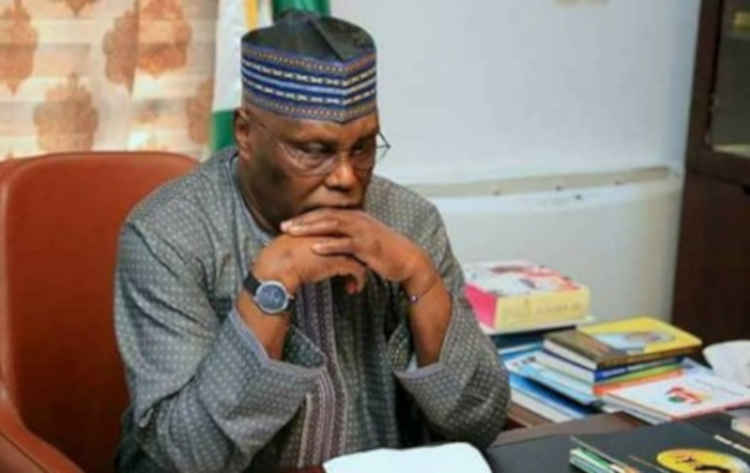
THE Peoples Democratic Party (PDP) on Monday said there has not been any discussion in the party over the candidature of Atiku Abubakar as its presidential candidate in 2023.
Kola Ologbondiyan, PDP National Publicity Secretary said this during a media briefing in Abuja.
He was responding to a question on whether the party was going to field the former Vice President as its candidate in the next general elections.
“The People’s Democratic Party has not turned to discussions in respect to it,” Ologbondiyan replied.
Adamu Abubakar, Atiku’s son, who is also the Commissioner for Works in Adamawa State had said his father would contest for the presidential post in 2023.
Atiku, was the presidential candidate of the PDP in 2019 general elections and lost to President Muhammadu Buhari.
Although he challenged Buhari’s victory at the Presidential Election Petition Tribunal, the Supreme Court dismissed his petition on lack of merit.
During the session, Ologbodiyan was also asked about rumours making the round that Godwin Obaseki, the Governor of Edo State has defected from All Progressives Party (APC) to the PDP.
He said he was unaware of Obaseeki’s defection to the PDP neither was he aware that Obaseki was asked to pay to defect to the party.
Ologbondiyan, however noted that if any member of APC defects to PDP it means they have realised that their party is a ‘wasteland’.
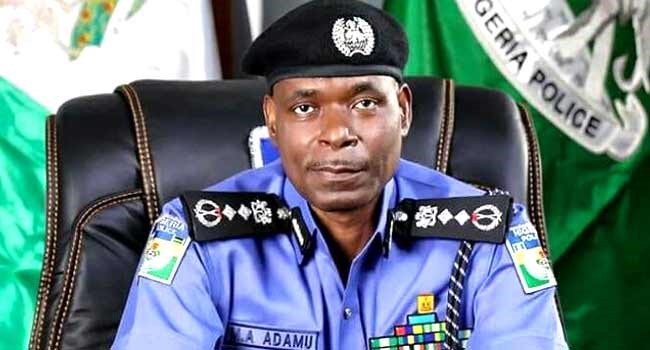
MUHAMMED Adamu, the Inspector-General of Police, has issued a new operational guidelines for the Police and other Law Enforcement Agencies on Coronavirus disease (COVID-19) pandemic prevention enforcement duties.
A statement issued by the police stated that Adamu unveiled the new guidelines on Monday, at the Force Headquarters, Abuja as part of measures to foster a more harmonious relationship between the police and members of the public.
The IGP explained that the guidelines would deepen respect for the rights of citizens and provide anew set of policing tools for tackling emerging crimes such as domestic violence, rape, child molestation and other incidents of Gender-Based Violence (GBV).
He expressed concerns about the increase in reported cases of domestic violence, rape, defilement, cybercrimes linked with the COVID-19 restrictions among others, adding that the new guidelines would also serve as a standard code of conduct for police officers in similar operations in the future.
Adamu also ordered the strengthening of the Gender-Desk Units and the Juvenile Welfare Centres (JWCs) across the country and the deployment of investigative assets to deal with gender related offences.
He added that the Cybercrime Unit of the Force has also been strengthened to deal with cybercrimes connected with the COVID-19 pandemic.
The IGP further stated that Assistant Inspectors-General of Police and Commissioners of Police in Zonal and State Commands as well as Heads of Police Departments/Formations have been directed to make the guidelines subject of departmental briefings and lectures.
In a report by Aljazeera in April, at least 18 persons were killed by security forces during the enforcement of measures to curb the spread of COVID-19 .
The most recent was the killing of 17-year-old Tina Ezekwe in Lagos.
Also, the National Human Rights Commission (NHRC) said in a release that it had received and documented “105 complaints of incidents of human rights violations perpetuated by security forces” in 24 of Nigeria’s 36 states and Abuja, the capital.
Of these complaints, the Commissiosn said “there were eight documented incidents of extrajudicial killings leading to 18 deaths.”
THE National Association of Resident Doctors (NARD) has reaffirmed its decision to embark on an indefinite strike if the Federal Government failed to address demands of its members within 14 days.
This is coming at a time Nigeria grapples with increasing cases of confirmed COVID-19 and attendant deaths.
According to Dr Aliyu Sokomba, National President of NARD, the strike would start from Monday, June 15, regardless of the current COVID-19 pandemic.
In a letter with reference number NARD/SG/2019-2020/070620/246, which was also shared through the Association’s official Twitter handle on Monday, parts of its demands included that the Federal and state governments should ensure access to appropriate personal protective equipment for all health care workers.
It also demanded for the immediate reversal of the illegitimate disengagement of all 26 resident doctors at the Jos University Teaching hospital, saying that payment of all salaries owed to them in accordance with the Medical Residency training Act must also be effected.
The Association called for immediate implementation of the revised hazard allowance and payment of the COVID-19 inducement allowance.
It asked the Federal Government to caution security operatives to desist from the harassment and assault of its members in the line of duty.
It will be recalled that the association had issued a the 14-day ultimatum to the Federal Government which took effect from May 30 having tabled its demands before the government.
The resident doctors’Association said failure from by government to meet its demands will amount to a total and indefinite strike nationwide.
“The strike shall, therefore, be total and indefinite. No service of any kind, be it emergency, care at COVID-19 treatment centres shall be exempted and members including all resident doctors, medical officers below the rank of principal medical officer, and house officers are expected to be part of the strike,” the letter read in part.
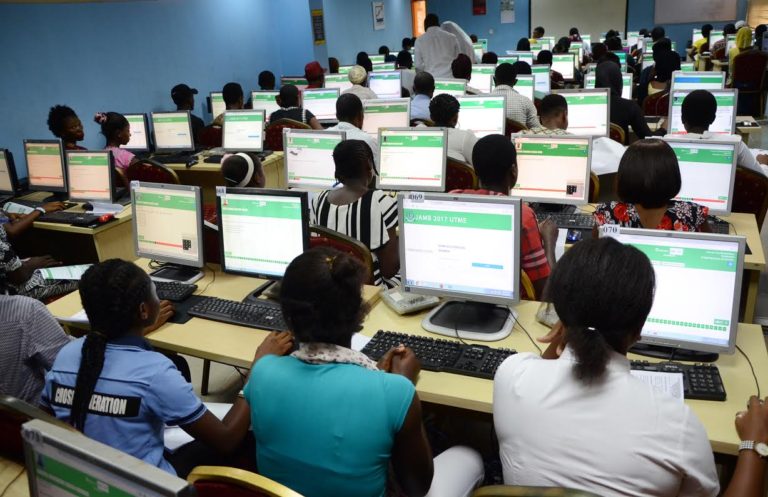
THE Joint Admissions and Matriculation Board, (JAMB) is set to hold the 2020 admission policy meeting with all tertiary institutions in the country on June 16, online following the lockdown imposed by the Federal Government to stop the spread of Coronavirus disease (COVID-19)
Fabian Benjamin, spokesperson of JAMB in a statement said the first virtual meeting would be chaired by Adamu Adamu, Minister of Education and would also have all the heads of tertiary institutions in the country in attendance.
“The meeting, in addition to other deliberations, would take a stand on concessional and acceptable minimum admissions standards to be applied in all admissions to be undertaken by all tertiary institutions in Nigeria,” Benjamin said in the statement.
Since the outbreak of the coronavirus in Nigeria, part of the protocols put in place by the government to curb the spread of COVID-19 is to limit the gatherings of people.
“Compliance with this directive has become imperative as no fewer than 4000 heads of tertiary institutions comprising degree, diploma, NCE and NID-awarding institutions and other stakeholders would normally be expected to congregate at a location but because of extant protocols, would now be expected to participate in the virtual meeting,” he explained.
The JAMB spokesperson stated that critical issues bordering on the advances made in the educational sector over the past year to setting the tone for the 2020/2021 admission exercise would be discussed at the meeting.
“The meeting would be streamed live on the Board’s website, www.jamb.gov.ng, its Facebook, JAMB Bulletin and other social media platforms,” he said.
He also disclosed that candidates in the recently concluded 2020 Unified Tertiary Matriculation Examination (UTME) would be able to print their result notification slips.
“The results which had earlier been made available through text to candidates on request by them sending RESULT to “55019” but are now requesting for a printed version can now be printed free from the board’s website.
“Candidates can print their result notification slip anywhere in the country even from the comfort of their homes once there is internet access,” he said.
Benjamin stated the Board restricted the printing of result notification slips and made it available to candidates only through SMS to avoid anxiety on the part of the candidates as well as to stop clustering at cybercafes with the attendant risk of COVID-19 all in a bid to print result notifications.
“This new development, however, is predicated on the gradual easing of the lockdown and resumption of economic activities in most parts of the country,” he said.
JAMB was set up to conduct entrance examination for prospective undergraduates into Nigerian universities, polytechnics, monotechnics and colleges of education.
Benjamin also advised candidates to desist from fraudulent practices warning that any attempt to forge the slip would attract stiff sanctions.
“Candidates are to note also that delegating this responsibility to third parties could result in willful manipulation of their results,” he said.
“Recall that last year some candidates who abused this privilege by attempting to manipulate their scores were caught and are currently saving various jail terms.”
THE Nigerian Presidency has said that the Indigenous People of Biafra (IPOB) has been running a ‘misleading campaign’ to prove that Christians in the country are being killed by the government.
In a statement by Garba Shehu, Senior Special Assistant to the President on Media and Publicity, the Presidency said the IPOB has convinced some members of the United States of America (US) Congress to push for a designated Special Envoy to curb Christian genocide in Nigeria.
Shehu stated that said this was revealed by a deep and wide investigation by the Nigerian government and her international partners.
“The campaign consists of producing articles in the names of the alleged Christian NGOs’ leaders (of campaign groups created at the time this PR contract with a US lobbying firm was signed) and letters to and from members of Congress to the White House,” Shehu said.
He said some members of the US Congress have been convinced that Christian genocide is happening in the country.
“Unfortunately, some Members of Congress have clearly been persuaded there is indeed a “Christian persecution” underway in Nigeria – and do so quoting the campaign – and they are known to be taking up the case directly with the White House to appoint the special envoy,” he stated.
He added that the presidency was aware that through an NGO/Charity, the ‘false campaign’ has been taken to the US Secretary of State, Mike Pompeo.
The Presidential spokesperson further stated that the investigation carried out further revealed that IPOB is being funded to divide Nigeria with $85,000 US dollars every month since October 2019.
However, he said the government’s investigation is yet to identify the source of the monthly funding.
Shehu said the campaign has also gained momentum with the United Kingdom House of Commons.
“They secured a MPs debate on the ‘Christian Genocide’ in the House of Commons in which staff member of the UK PR was referenced as the ‘private secretary’ to the leader of the UK-based Charity,” Shehu further stated.
THE Lagos State Government says security agencies including operatives of the Kick Against Indiscipline, Neighbourhood Safety Corps and LAWMA Monitoring Gang have been mandated to arrest anyone caught dumping refuse in drainage channels and canals.
Gboyega Akosile, Chief Press Secretary to the Governor of Lagos State made this known in a statement issued Sunday evening on behalf of Tunji Bello, the state Commissioner for Environment and Water Resources.
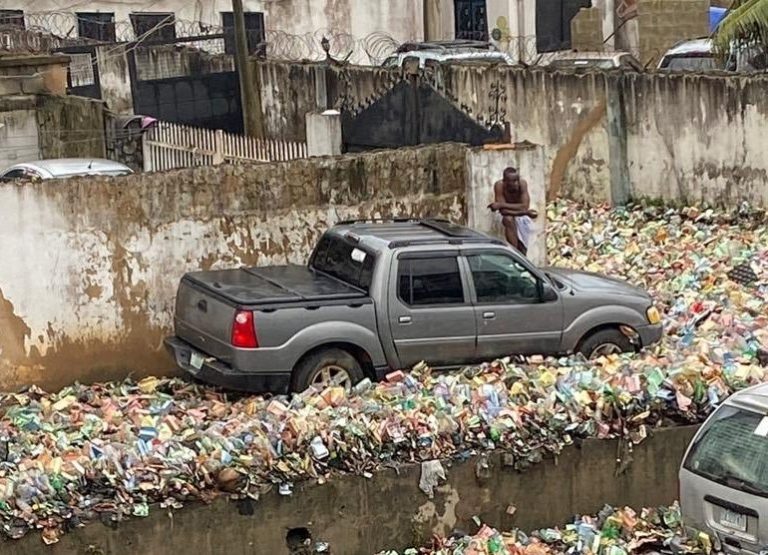
Akosile said the decision to go after residents who dump refuse indiscriminately into drainage channels and canals followed a video trending on social media showing refuse dump overtaking Akobi Crescent Surulere area of Lagos after an heavy rainfall.
He attributed the refuse on Akobi Crescent in Surulere after the recent rainfall to ongoing dredging work in the area, stressing that the convergence was due to dredging of system in some parts of the state.
The Governor’s spokesperson quoted the Commissioner as blaming the blockage at Akobi Crescent end on the nonchalant attitude of residents but gave an assurance that procedures have been put in place to facilitate the speedy completion of the dredging and clearing from LUTH in Idi-Araba by the contractor.
” The system 6c is from Cele to Agege Motor Road, through Idi-Araba and Akobi Crescent. Excavation and removal of dirt from the canal are being done simultaneously,” Bello stated in the statement.
“However, it should be pointed out that the canal had been completely blocked and solidified over time with age-old refuse dumped in the channel.”
The Commissioner explained that, as soon as it was realised that the refuse was swept to the area by the rain, the Ministry directed appropriate agencies to clear it immediately while imploring residents to desist from dumping refuse in the canals and drainage channels.
He expressed dissatisfaction that the Idi-Araba section which had been cleared was again littered by the residents, recalling that upon assumption of office, the present administration tackled the several years of decay by confronting the issue of blocked drainage channels, through dredging and clearance.
Bello said that the time has come for residents of the areas, through which channels run, to take up ownership of such infrastructure by preventing and apprehending people who dump refuse in them.
He added that negligence and recalcitrance lead to wastage of scarce state resources that should be deployed to other infrastructure renewal projects.
THE main opposition party, Peoples Democratic Party (PDP), has accused the Federal Government under the leadership of President Muhammadu Buhari of using Nigerian school children as cover to loot N679 million daily through the school feeding programme.
Kola Ologbondiyan, National Publicity Secretary of the party stated this in an interview published by The Punch.
Ologbondiyan noted that the PDP has always maintained that the school feeding programme by Muhammadu Buhari administration is a ‘monumental scam’.
“We have always said the whole school feeding programme as being carried out by this administration is a monumental scam,” he said.
According to him, the government and agencies handling the school feeding programme have refused to give adequate accounts about it.
Ologbondiyan argued that “it should beat anybody’s imagination that pupils are at home, in their parent’s houses, and the Minister of Humanitarian Affairs, Disaster Management and Social Development, Sadiya Faruq, is telling Nigerians that they are taking over the functions of parents by feeding school pupils right in their parents’ homes.”
“We are also being told that they are spending unbelievable sums of money on this programme.”
He added that the programme was designed by corrupt leaders in the All Progressive Congress (APC) to siphon public funds.
“The whole school feeding scam is a scheme designed by corrupt leaders of the APC in cahoots with some elements in the Presidency to siphon N13.5bn public funds to finance their wasteful lifestyles,” he added.
He noted that the government has failed to reveal to taxpayers how much is exactly being spent on the programme.
The PDP spokesperson wondered why the National Assembly has refused to ask relevant questions from the ministry concerning the programme.
“I do not understand why the National Assembly is not asking the relevant questions about claims that such humongous amount of money is being spent by a ministry on feeding children in their various constituencies without their inputs, I really can’t comprehend,” Ologbondiyan said.
Though Lagos State government has ordered that schools should be closed down as a means of keeping schoolchildren safe from contracting COVID-19 virus, there are children who cannot afford to stay at home because they have to earn income for their parents, even during the lockdown. Many of these children could be seen on Lagos streets hawking facemasks. Lukman ABOLADE reports about some of those children he met.
ON Wednesday, May 27th, when the Children’s Day was being celebrated worldwide, Ramon, a nine-year-old boy and primary five pupil of Saviour Primary School, Lagos was seen at Igando market with a handful of facemasks made with local fabric, seeking customers for his goods.
While his mother and sister who are tailors produce the facemask, he hawks the products at major bus stops in Lagos to make income for the family. It is a kind of division of labour, said the boy.
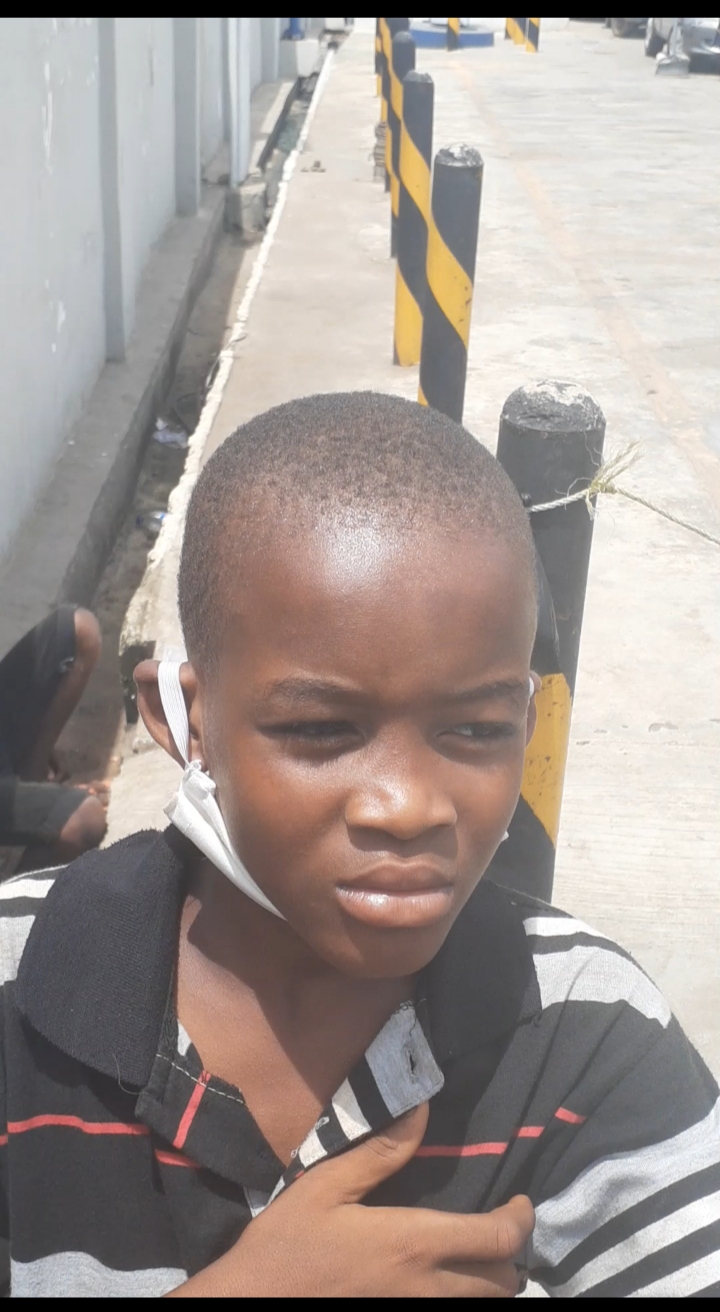
Ramon, a nine year old boy who hawks facemasks Lukman Abolade/The ICIR
Unlike Ramon whose mother and sister are tailors, Joseph Olayanju, a junior secondary school two (JSS2) student in Ajegunle sells facemasks produced by a company located in Ajegunle area in Lagos. He and his friend, Abraham Ishola, who attends the same school as Olayanju, purchase facemasks in bulk at the company at discounted prices .
“We buy 12 pieces at 1000, and sell each at N100,” said Abraham.
Abraham Ishola hawking facemasks Lukman Abolade/The ICIR
So from every dozen they sell, they each make a profit of N200.
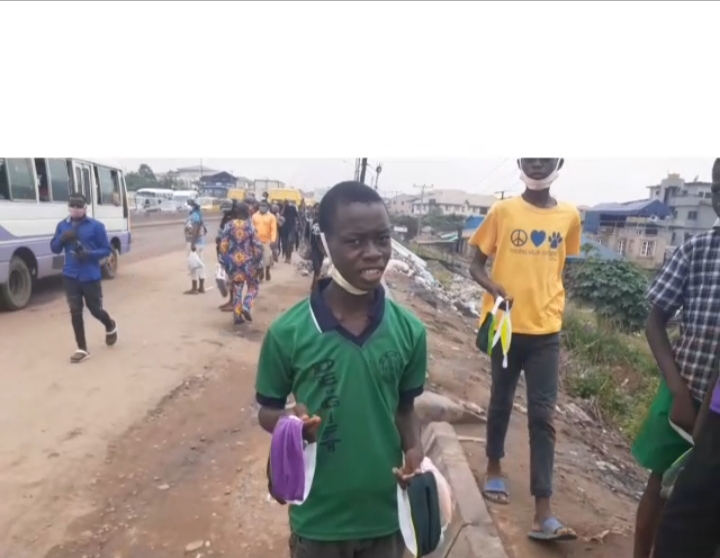
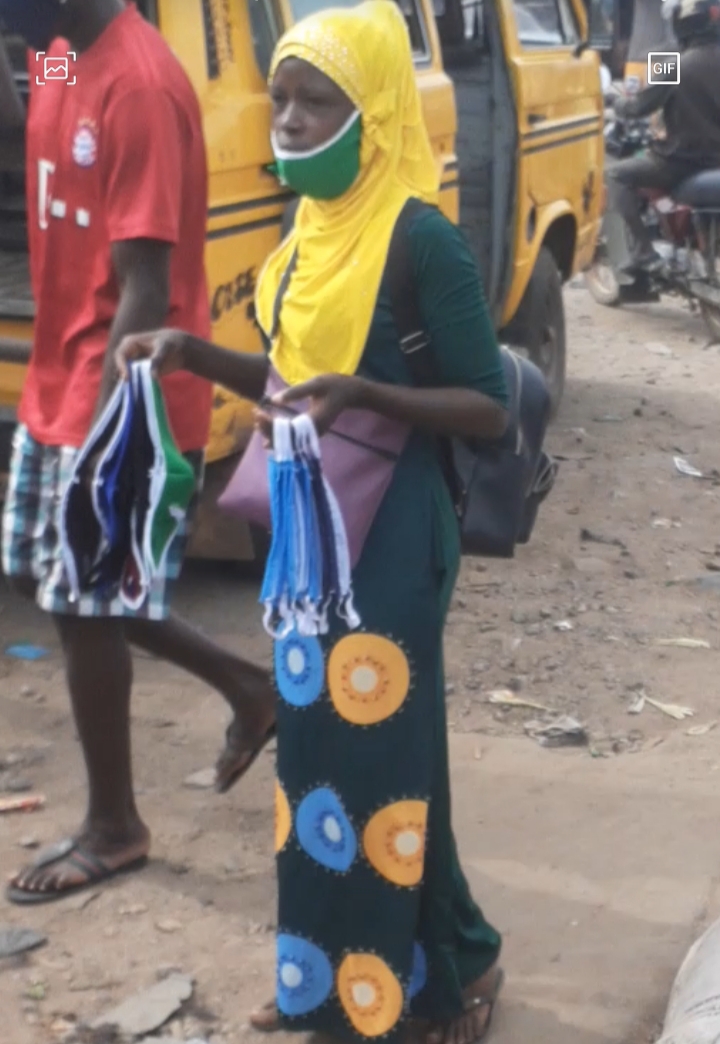
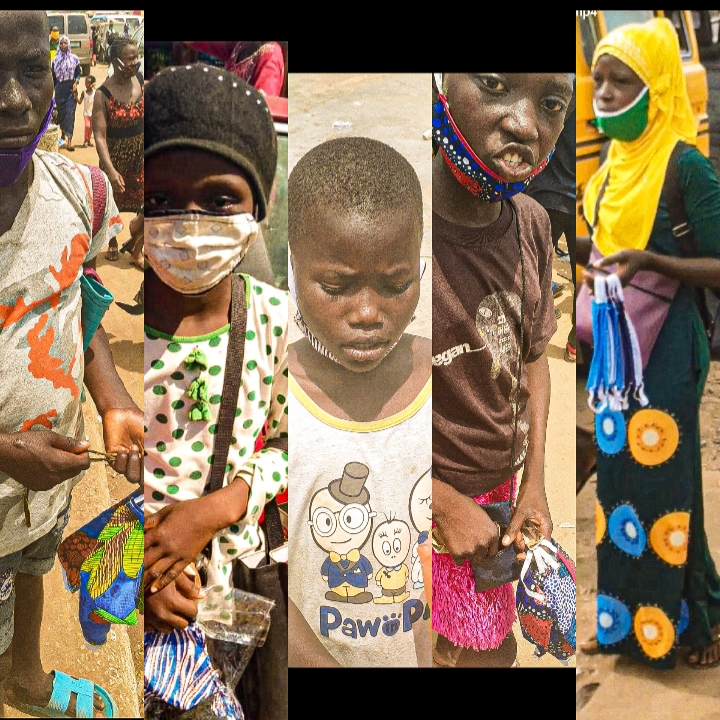
In Lagos markets and on the major bus stops, it is common to see many children selling facemasks.
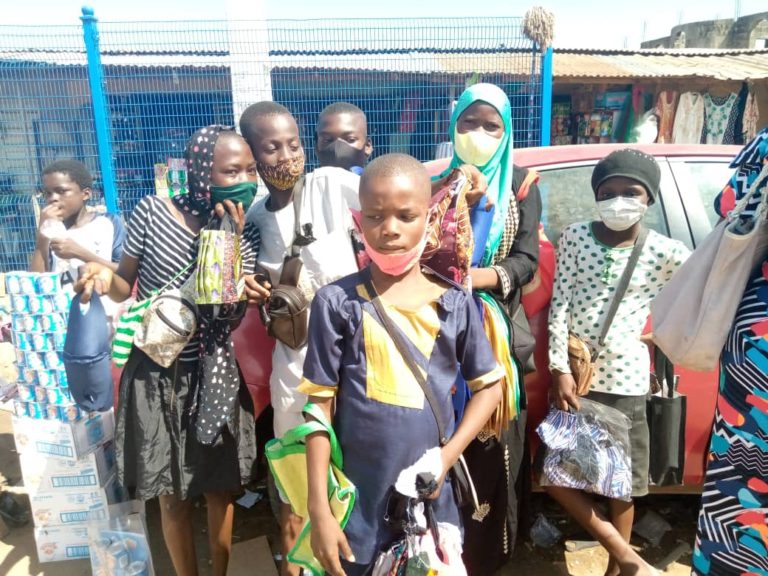
Apart from Ramon, Olanyaju and Ishola, The ICIR also met Rasheedat, Ayomikun, Adi and Stephen, all students of public schools, according to them.
A young girl selling facemask in traffic
The ICIR attempted to speak to their parents, but they declined for the fear of being identified and sanctioned by the government authorities for violating child rights act. Not that they know about the law though, but speaking to the press could mean trouble. In fact, one of the women chastised her son for speaking to a stranger who is not a customer.
But Esther Ajewole, a tailor and mother of Ayomikun, a 14-year-old boy told The ICIR that asking her son to hawk facemasks is a matter of survival for the family. She said the child has been sitting at home idly for weeks before she finally decided to ask him to help.
Since there is no provision for an online class for children in public schools, there is no point keeping the boy at home doing nothing, she added.
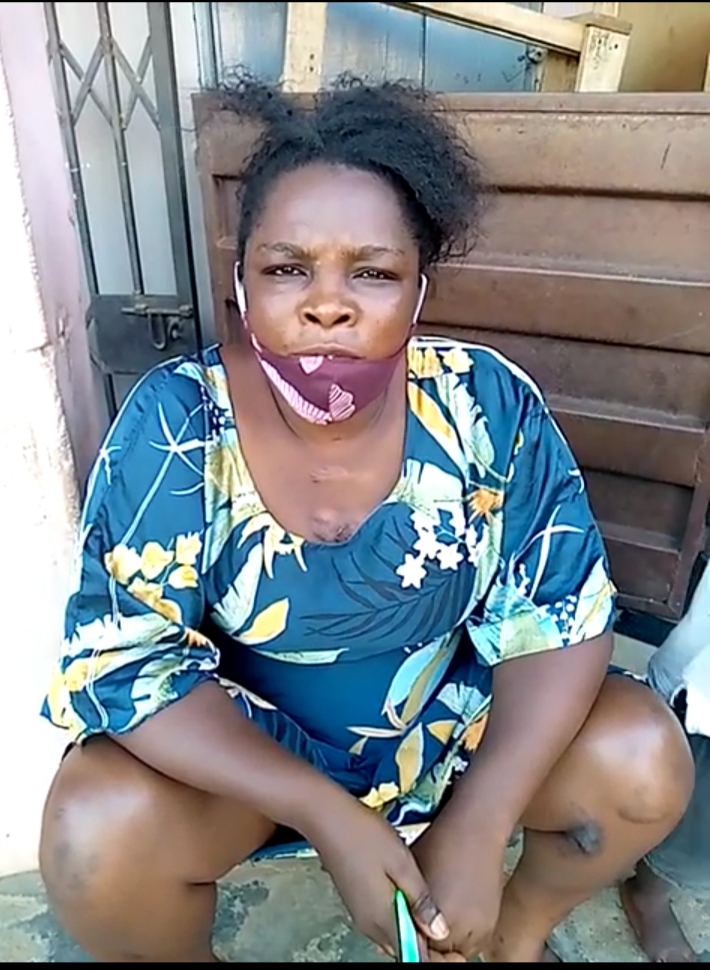
There is also Damilola, mother of two, who sells facemasks with her children in the market. She said she had to bring them with her because the facemask market has become very competitive.
Esther Ajewole, a mother who gave facemasks to her son to sell Lukman Abolade/The ICIR
“We sell it together to make enough profit because people selling it are now too many,” she said.
She added that living has been hard for the family, and that is why she brings them to the market to hawk.
Although she is aware that some schools have made provisions for e-learning, she said her children attend public school and the school does not operate online classes.
An offence overlooked
The Lagos State government during the administration of Babatunde Raji Fashola adopted the Child Right Act on May 27, 2007, to protect the rights of children in the state.
The act, however, is hardly implemented since it has been adopted three years ago. For example, there is no taskforce charged with the responsibility of enforcing the law.
Damilola, a mother of two who hawks facemasks with her children
Children hawking facemasks are not only found in Lagos state, but there are also reports of a similar trend in Ogun, Oyo, Ekiti and Abuja.
Only a few attend digital classes in Nigeria
Though Nigeria ranks 6th among countries with most internet users in the world, the country lacks online infrastructure to provide quality education for children
According to the internet world statistics , as of the first quarter of 2020 (Q1,2020), Nigeria has an estimated population of 206,139, 689 out of which 126,078,999 are internet users.
Infographic on Internet users in Nigeria
This represents that 61 per cent of Nigerians are active internet users, but this is not reflected in the Nigerian students’ access to online education.
Out of 36 states in the country, only five states have been able to provide minimum digital learning for their citizens, according to report by the federal ministry of education. The states include Lagos, Ogun, Kaduna, Edo and Ondo state
The Federal Government has announced provision for e-learning by collaborating with privately-owned digital learning platforms including Mobile Classroom application and Schoolgate.ng, but checks by The ICIR revealed many inadequacies of the government to actualise the plan.
Picture collage of some children selling facemasks
During the announcement, Minister of State for Education, Chukwuemeka Nwajiuba said the website and applications are free for Airtel users while arrangements were being made to bring other network providers on board.
Speaking to the Chief Executive Officer of Mobile Classroom, Akeem Salami, one of the partners with the FG on online classes, he said although there has been an increase of about 45,000 new registrants on the Mobile Classroom platform. This is less than 1 per cent of the 41.9 million students enrolled in public and private schools across the nation.
Salami, however said students are unaware of the digital platforms, despite collaborating with the FG, hence there is still a long way to go.
He said before the pandemic he had approached the FG, Osun, and Lagos to key into the idea of online classes but did not get a buy in of the government.
“We approached some states including the FG at the inception of our platform but we received a letter of appreciation but it was not supported,” Salami said.
According to him, the government’s failure to embrace the idea of digital classes before COVID-19 is partly responsible for mass failure in Nigerian schools.
Salami urged the government to provide community e-library with internet access in collaboration with private sectors so that students in or out of school could easily learn.
This would give room for revision for learners as videos and tutorials are available at any time for them, unlike the conventional classroom setting, he said.
Ogunmola Makanju, the CEO of Schoolgate, another partner with the FG on digital classes, also told The ICIR that he had approached the FG before the pandemic but the idea was not embraced because of funding.
Apart from this, he noted there is no national policy on digital education in Nigeria.
In spite of the initial difficulty, the platform can be accessed by students in Nigeria without internet charges, and nearly 100,000 students already have registered.
According to UBEC, Nigeria has a figure of 31,236,624 students/pupils enrolled in public schools across the federation, but less than one per cent of these children are currently engaged in online education.
The country’s inability to have a workable national policy on digital learning triggered a call from the House of Representatives recently.
On Tuesday, May 19, a member of the Green Chamber, Aniekan Umanah representing Abak/Etim Ekpo/Ika Federal Constituency moved a motion that was eventually adopted by the house to urge the FG to urgently develop a national framework for schools at all level.
The Director of the press, Federal ministry of education, Ben Goong while responding to questions from The ICIR on Thursday, 4th May also acknowledged that the nation’s ministry of education does not have a national policy on digital education.
Until Nigeria provides opportunities for children to learn both in the physical and digital classrooms, parents of children like Rahmon, Joseph and Abraham will continue to find reason to send them to the streets to hawk facemasks during lockdown while other children stay safe at home.