NIGERIA has recorded five new cases of coronavirus, bringing the number of confirmed cases to 51.
This new development was confirmed by the Nigeria Centre for Disease Control (NCDC) on Thursday. In its update, shared on Twitter, NCDC announced that Lagos now has 32 cases of coronavirus, making it the state with the highest number of cases in the country.
The Federal Capital Territory, FCT, has now recorded 10 cases, with one of them linked to the Chief of Staff to the President, Abba Kyari, who tested positive a few days ago and is currently receiving treatment.
Ogun State has recorded three cases, while Ekiti, Oyo, Edo, Bauchi, Osun and Rivers each has an index case.
The growing cases in Nigeria has raised concerns over an impending outbreak, for which NCDC and health experts maintain the need for citizens to practice social distancing and observe improved personal hygiene to curb the spread of the virus.
To further prevent the spread of the deadly virus which has killed over 20,000 people globally, institutions and examination bodies in the country have shut down operations and postponed services till further notice.
The ICIR earlier reported that the National Examinations Council (NECO) announced the indefinite postponement of the 2020 National Common Entrance Examination in compliance with regulations on COVID- 19, following the gradual spread of the virus in the country.
So far, Nigeria has recorded one death from COVID-19.
Globally, over 300,000 persons have been infected according to World Health Organisation, WHO.
Currently, there is no known cure or vaccine for the virus and the world remains at the level of managing and curtailing the spread of the virus till a solution is found.
When journalists cover crises, tragedies, and disasters, and interview people affected by them, they face a complicated task: to not cause additional harm to the victims, while at the same time taking care of their own mental health.
The Dart Center is one of the world’s leading authorities on journalism and trauma. At the 11th Global Investigative Journalism Conference, Dr. Cait McMahon, director of Dart Center Asia Pacific, discussed the psychological issues investigative journalists may face in the course of their work — and ways to minimize them. This week, GIJN also spoke with Dart Center Executive Director Bruce Shapiro and Dr. McMahon about how their trauma-reporting guidelines apply to the current global novel coronavirus pandemic.
During a natural disaster or outbreak of violence, a journalist — like a psychotherapist — often takes on the role of a witness, who at times may experience a horror, rage and despair that is almost like that of the victim’s, Dr. McMahon said. The journalist risks psychological harm at three different stages of his or her work: firstly, as a witness or participant in the event; secondly, while communicating and showing compassion to the victims; and thirdly, by telling their stories — allowing their experiences to pass through the reporter to an audience.
While many of the same risks apply, the current coronavirus pandemic also differs from a traumatic event like a tsunami or a bomb blast, Dr. McMahon said: “This is a creeping, invisible thing that everyone in the world is experiencing… we are all in this together for better or worse.”
Director of the Dart Center Asia Pacific Dr. Cait McMahon. Photo: Olga Simanovych
“It’s different to you going to work on a story that’s happened to someone else, which you may or may not have experienced,” she added. “We all have our own experience of this at the moment and we are all part of the story, albeit to different degrees. That means journalists need to be more in tune with what their anxieties are, and what the anxieties are of the people they’re interviewing.”
Dr. McMahon and Shapiro advise journalists to adopt the following strategies for mental health care before, during, and after tackling traumatic stories, including covering the COVID-19 outbreak.
Before: Preparing for a Traumatic Story
Don’t wait until you’re already immersed in a story, when you may be exhausted and overwhelmed by emotions. Draw up an action plan in advance that you‘ll be able to follow once the story is underway.
Investigative Marathon Plan
Plan your reporting schedule. Decide when you will do your toughest work, for example in the morning when you may have more energy.
Take breaks.
Map out the times that will require deep immersion in the situation or during in-depth interviews.
If possible, do as much of this emotionally intense work as early in the story as you can, when you are less tired.
Don’t consume traumatic content before you go to bed.
Make sure to plan for regular sleep and rest, such as swimming, yoga, or seeing friends.
Know your limits, triggers, and weak points.
Make it a rule that you evaluate psychological as well as physical risks before starting an emotionally demanding assignment.
Update your schedule if circumstances require so that you don’t miss a deadline, causing additional stress.
“The brain needs recovery time from stress in order not to get overwhelmed,” Shapiro said. “It’s important to plan now, for example to integrate positive actions into your day.”
Understand your triggers: You need to be aware of the topics that could provoke memories or powerful emotions in you.
Make regular psychological self-examinations. Dr. McMahon noted that if you have recently experienced stress, you may be more vulnerable. Take into consideration not only recent experiences but long-standing trauma as well. Dramatic events, inter-generational conflicts, and personal trauma that have impacted you or the people you care about — these past events can affect your present.
During an interview, you may feel the victim’s trauma more acutely. This can serve as a trigger, re-surfacing your trauma in the form of flashbacks or intense feelings of sadness, anxiety, or panic. Understand your triggers: You need to be aware of the topics that could provoke memories or powerful emotions in you.
Dr. McMahon suggested the following draft checklist of questions to ask yourself before scheduling an important interview.
Checklist for Evaluating Psychological Risk
Do I feel ready to survive other people’s high anxiety and distress? Yes No
Have I recently had any emotional or psychological problems?
Have I recently had personal losses?
Do my relatives have health issues?
Have any family difficulties, arguments, or illnesses forced me to change my plans?
Do I feel more vulnerable than usual?
Am I feeling physically healthy?
Journalists who are feeling vulnerable and anxious because of social distancing or other personal disruptions during the coronavirus outbreak should be aware of their own triggers and seek social connections and support.
Resilience for Reporters amid Social Distancing
Pay extra attention to structure and boundaries in your work day.
Look for opportunities for positive coping, such as through humor or social solidarity.
Examine your mission: A clear sense of purpose and ethics is helpful to making choices and feeling good about what we do each day.
Pursue attainable victories — both personal and professional.
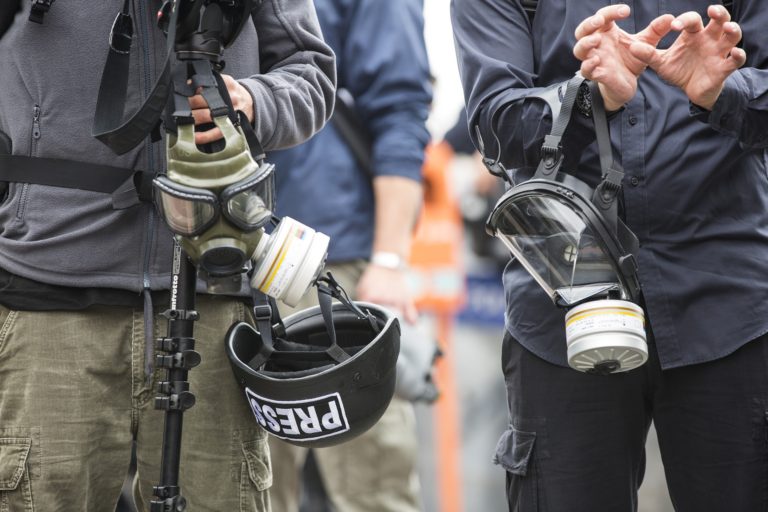
Physical preparedness is also crucial for covering the COVID-19 outbreak, including obtaining masks, gloves, and sanitizer for hands, equipment, and surfaces. Dr. McMahon noted that some journalists may feel uncomfortable or claustrophobic wearing protective equipment due to previous trauma; in which case they should speak to their managers.
During: Working with Traumatic Content
Due to COVID-19 protection measures, you may have to limit face-to-face interviews for your and your interviewees’ safety; Dr. McMahon suggests greater eye contact can help compensate for physical distance. Virtual reporting can still be traumatic.
Psychological trauma is first of all a physical condition. Learn to read your physical reactions to traumatic situations. Remember that journalists are not an exception to these rules, Dr. McMahon said. She advised journalists to get to know themselves, their reactions, and prepare in advance.
The Body’s Response to Trauma
Your body enters a state of alert, as if you were in danger. Your defense mechanisms are activated, affecting your brain chemistry.
You experience pain and distress — this is normal.
You will feel both a physiological and psychological reaction.
If you experience rapid heart palpitations, excessive sweating, crying, or even physical pain, psychologists advise you to take further measures to protect yourself.
Psychological Self-Defense Measures
Pause and breathe.
Take a step back. If possible, leave the room, at least for a short while. Do some exercise: jump or run. Movement and the change of location can help normalize your reaction.
If you can’t leave the room, change your body’s position, making sure to sit as comfortably as possible and straighten your spine. Try feel your body again. At moments of psychological discomfort, we often cross our legs or wring our hands without noticing. Stretch out your legs and unclench your muscles.
Ground yourself. Uncross your legs. Put both feet evenly on the floor, feeling the contact with the ground.
If you feel overwhelmed, do some exercise. Photo: Olga Simanovych
Do a breathing exercise. Inhale on the count of three, hold your breath on the count of five and exhale on the count of eight.
Journalists should also be prepared to encounter unexpected behavior during these unprecedented times. “People’s anxieties are coming out in all sorts of ways,” Dr. McMahon said. “You may not know what people’s triggers are. If you interview a grieving mother, you might be more aware of what her triggers might be, because it’s a contained situation. But this is a new situation.”
After: Recovering from Emotionally Taxing Stories
After reporting on a difficult story, ask yourself whether you have any of the following signs of psychological distress:
Anxiety
Confusion
Feeling isolated
Shame
Feelings of guilt
Passivity
Desperation
Self-condemnation
Feeling demoralized
Feelings of betrayal
Remember that in-depth stories are marathons, not sprints, Dr. McMahon said. Journalists need to pace themselves, vary their schedule and the content of their work, and make time for joy and laughter. Some helpful responses after reporting on a traumatic story include meditation, a session with a therapist, or exercise, according to the Dart Center.
Surviving Psychological Trauma
Do not rush to transcribe the interview immediately; put the traumatic material to one side if you can.
Vary your story angles, including stories of resilience and creative coping strategies, and provide context that includes death rates but also recovery numbers.
Return to your plan for rest and do something to switch off, like walking your dog, sports, meditation, or just having dinner with friends or colleagues.
Discuss any issues that arise with your colleagues. Social support is important. Help each other — find a person in the newsroom with whom you can share your experiences and look for solutions.
Support your colleagues if they have worked on a difficult story.
Take time to think over your response: why it impacted you and what you can do to cope.
“It’s really important to understand the nature of sustained stress,” Shapiro said. “If stress is unrelenting and protracted, eventually your performance falls off and you burn out. It’s important to take proactive steps to get our bodies and minds away from stress.”
Journalists are resilient people, but we are only human, Shapiro added. “Take the time our brains need to recover.”
AN Adamawa State High Court has sentenced Jinga Mayo, the Executive Secretary of the state Christian Pilgrims Welfare Board to five years in prison for embezzling N69 million belonging to the agency.
Mayo was arraigned by the Independent Corrupt Practices and Other Related Offences Commission (ICPC) on three count charges in 2016.
According to the ICPC, the charges border on false information and embezzlement.
One of the charges read that Mayo converted ₦69.2 million meant to execute pilgrims operation in Israel to his personal use and returned duly signed vouchers of payment and receipts by members of the committee which he did not pay.
Second count of the charges read that he conferred corrupt advantage upon himself while the third count said that he knowingly made false statement to an officer of the ICPC.
Delivering his ruling, Justice Nathan Musa found Mayo guilty of two of the charges and acquitted him of one.
A statement by the ICPC read that “Justice Nathan Musa, found him guilty only on two counts and acquitted him on one. He was sentenced to five years imprisonment on the 2nd count without an option of fine, and 6 months imprisonment on the 3rd count with an option of N50, 000. He is however to spend five years in prison, as the sentence is to run concurrently.”
The statement further read that after the judgement, the convict was transferred to officials of Adamawa State Correctional facilitY in Jimeta by the operatives of the ICPC.
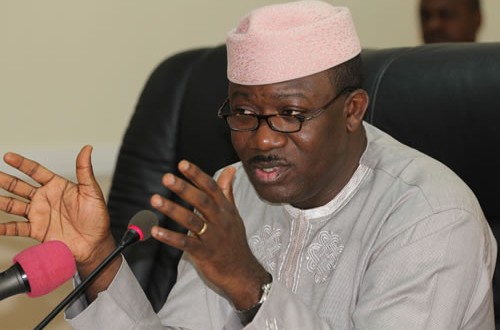
ABOUT 24 hours after the Lagos State government shut down markets in the state, Kayode Fayemi, the Ekiti State governor on Wednesday directed all markets in his state to suspend normal activities.
Those exempted are traders involved in essential goods such as food stuffs, water, medicine and pharmaceutical equipments.
The directive would take effect from Thursday, March 26 at about 5:00pm.
Fayemi described the decision as vital to prevent further spread of the disease and to ensure citizens of the state observe social distancing, among other precautionary measure.
He also encouraged staple food sellers to avoid price inflation of their commodities and produce. Pharmacies were also urged not to hike the prices of essential drugs.
“All medicine stores that are open to the public to make sure they do not sell or display any other items whatsoever, while those selling foodstuffs should not display or sell anything outside foodstuffs,” Fayemi stated in a statement issued by his Chief Press Secretary, Yinka Oyebode, in Ado-Ekiti, on Wednesday.
The governor appealed to commercial drivers and the leadership of National Union of Road Transport Workers (NURTW) and Road Transport Employers Association of Nigeria (RTEAN) in the state to reduce the outrageous fares being charged commuters, mainly students who have been returning home in large numbers, since the closure of schools in the state.
Meanwhile, he tasked the public to adhere to the ban on public gatherings that are above 20 persons either for social, communal or religious purposes, adding that a monitoring and enforcement task force had been dispatched across the state.
Citizens in the state were also urged to support the government and its agencies in the collective war against the coronavirus.
So far, 46 cases of COVID-19 have been recorded in Nigeria, out of which one person died, two were discharged and with 43 active cases.
From the active cases, one was confirmed in Ekiti State.
A Coalition of Civil Societies Organisations, CSOs, under the umbrella of Civil Society Alliance Against COVID-19 (CSAA COVID-19) has condemned the refusal of some Nigerian politicians who recently traveled overseas to self isolate in accordance with directives of the federal government.
Through a statement signed by the 38 member groups, the coalition lamented that their refusal to adhere to the government directive could further hamper efforts to curtail the spread of the deadly virus.
The group named the governors Godwin Ikpeazu, Hope uzodinma and Ifeanyi Ugwuani of Abia, Imo and Enugu states, as some of the politicians that have ignored laid down procedures for persons who have return from foreign traveled in the last 14 days.
“Most notably, the Chief of Staff to President Buhari, and the Governor of Bauchi State, have tested positive for Covid-19. We are also calling attention to members of the National Assembly and governors such as those of Abia, Enugu and Imo who have been seen at public events well within the period of 14 days since their return from overseas,” the coalitions statement read.
Applauding the efforts of Nigeria Centre for Disease Control (NCDC), the Federal Ministry of Health, and other medical professionals, the group said their prayers and support are with the agencies and individuals as they put themselves at risk for the benefit of all Nigerians.
Owing to the fast spreading nature of the disease, the CSOs said it stands by the many people who have been subjected to testing, isolation and screening due to the recklessness of some politicians who have refused to be tested.
“We also stand with all of those who have been in contact with politicians who have acted recklessly and must now endure testing, isolation, and probably repeated screening along with their families and loved ones,” the group said.
The group demanded that attention be paid to the most vulnerable people in the society and advised federal and state governments to take cognisance of measures against the virus so as not to harm low income earners in the society.
They emphasised the need for an all round support of all stakeholders in the country including the private sector and religious bodies
THE Nigerian Center for Disease Control (NCDC) earlier this morning has confirmed two new cases of the deadly pandemic coronavirus. The two cases are said to be from Osun and Lagos, the epicentre of the virus.
With the two new confirmed cases, Nigeria is currently battling with 46 cases of coronavirus.
The doctor who spoke to The ICIR under annonimity said the case was brought to Obafemi Awolowo University Teaching Hospital Complex (OAU THC), Ile-Ifr in Osun State.
NCDC confirmed that the index case arrived Nigeria in the last seven days from the United Kingdom (UK).
In the UK, the 422 patients who tested positive for coronavirus (COVID-19) have died.
Globally, the deadly virus has infected over 380,000 people and killed over 16,000 persons, according to John Hopkins Coronavirus Resource Centre.
THE video showing a woman who claimed that ingesting raw onions and garlics is capable of curing the deadly coronavirus in Nigeria has again gone viral on social media.
The video has been spreading mainly on Whatsapp mobile messaging application and Twitter.
As of 24 March, 375,498 persons have contracted the Coronavirus globally, while 16,362 deaths recorded in 196 countries, with no cure.
The anonymous woman claimed that once the onion or garlic is consumed or sliced and placed at room corners, people infected of COVID-19 will be cured.
She said the vegetables also could be blended into smoothes and ingested.
“I’m here to introduce another prevention for coronavirus across the globe. Please and please all the fathers and mothers, go and get your garlic and onions. It is good and it kills the virus. It is good for protection,” she said.
“Use it as many as possible; eat the raw one anytime, any day. It works. Please share and save someone.”
“E ran enikan lowo,” she said in local Yoruba language meaning help somebody.
“Use a knife to cut it and put it in your room. If you have 10 rooms, put it in your 10 rooms. Put it in your living rooms, toilets, kitchen at the corners my brethren.”
“Go and get your onions as many as possible. Get it and use it raw any day, anytime and any hour. Blend and use the water for protection,” she dramatically appealed to the public with strong self-conviction.
Findings
As at the time of this fact-check, COVID-19 disease has gotten no cure.
My mum has put an onion in the corner of every room in the house because whatsapp advised her to. This is the peak of the whatsapp mother’s cult. I am unable to can lmao pic.twitter.com/KF894u0aHt
Though several reports, for instance, the Times of India has reported that swallowing onions, garlic could help fight lung infections and reduce cholesterol level in the body, the report has no scientific backing.
Moreover, there are no verifiable or scientific proofs to affirm the claim that onions could stop people from contracting the COVID-19 virus.
Sanja Jelic, a Medical Doctor and expert in pulmonary diseases in a medically reviewed report also maintained that onion cannot stop flu or cold as claimed.
“There is nothing special about an onion that would kill these pathogens.”
But David Cooley, Raw Food Lifestyle and Wellness Consultant argued that consumption of some local foods could help better respiration. Ginger intake, he stated in his article titled foods that help the respiratory system, detoxifies the lungs, garlic is capable of cleaning the lungs while onions could safeguard the lungs linings.
“Onions — loaded with flavonoids (antioxidant), which help fight inflammation from asthma by strengthening the capillary walls. They also can protect the lining of lungs and bronchial tubes from damage caused by pollution,” says Cooley but never said their intake could cure the deadly disease. He did not also make reference to any particular study.
Verdict
There are no proven and scientifically-backed evidence to show that consuming onions and garlic can cure a victim of COVID-19.
There are also no proofs that the two identified vegetables could protect people from contracting the deadly disease, let alone placing sliced onions by the room corners as a preventive measure.
Therefore, the claims are false as they lack credible evidence.
AN Ethiopian Airlines Freighter carrying medical supplies donated by the co-founder of Alibaba. Jack Ma, landed on Tuesday afternoon at the Lagos International Airport.
The aircraft left Ethiopia on Tuesday morning to make deliveries to Nigeria, South Africa, Burundi, Rwanda, Togo, Zambia, Zimbabwe, Kenya, and South Sudan.
On arrival, the airline said it was pleased to deliver these much needed critical medical supplies and equipment to help in the global fight against the COVID-19.
“We appreciate the donation of the Jack Ma Foundation and the generosity of Jack Ma. We admire Abiy Ahmed, our Prime Minister, for his initiative and organization of the entire coordination of the process,” Firihiewot Mekonnen, general manager, Ethiopian Airlines, Nigeria said.
These donations which include 1.1million testing kits, six million masks and 60,000 protective suits were being distributed throughout Africa, with distributions already done to other countries like Egypt, Sudan, Eritrea and Djibouti on Monday just as the Abiy Ahmed Ethiopian Prime Minister promised.
THE Federal Government has warned Nigerians to be mindful of the existence of an Android-based malicious and fraudulent coronavirus ransomware application.
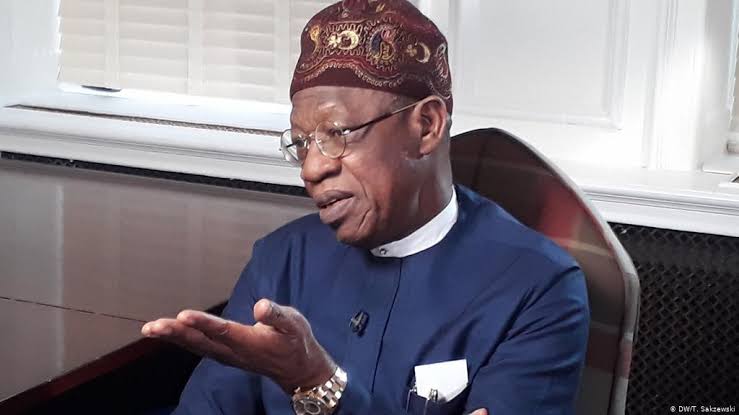
Lai Mohammed, Minister of Information and Culture, disclosed that the application claims to provide updates on the COVID-19 virus and infections near the users.
According to the minister, the ransomware blocks access to users’ personal data, and accounts and threatens to delete, except users pay $100 in Bitcoin within 48 hours.
In a statement signed by Segun Adeyemi, Special Assistant to the President, Office of the Minister of Information and Culture in Abuja, “the ransomware App, detected on the website http://www.coronavirusapp.site/, prompts users to download an Android App purportedly for coronavirus map tracking and heat map visuals.”
Website browser adopted by The ICIR to verify the website also issued a ‘dangerous’ warning, advising that the website contains a malware.
However, Mohammed noted that the developmentwas a confirmation of warnings against cybercriminals, seeking to exploit the growing spread of the virus for nefarious gains.
He, therefore, called on the general public not to download the ransomware App and to seek updates on the pandemic only from the appropriate authorities.
Nigeria, like every other nation globally, has been under threat due to the COVID-19 pandemic which currently has no cure.
So far, 42 cases have been officially announced by the Nigeria Centre or Disease Control (NCC). 39 active cases, two cases discharged and one death.
LAGOS State Commissioner of Health, Akin Abayomi says participants at the just concluded Africa Magic Viewer’s Choice Awards (AMVCA), are most likely to have been exposed to the deadly coronavirus infection.
Abayomi disclosed this on Tuesday afternoon via his official Twitter handle where he wrote
“I hereby notify you that all participants at the Africa Magic Viewer’s Choice Awards (AMVCA) at Eko Hotels may have come in contact with one of the confirmed cases in Lagos and most likely to have been exposed to the COVID-19 infection.”
The commissioner however, did not disclose the identity of the coronavirus contact.
Nigerian documentary producer, Ifeoma Chukwuogo, had some time last week warned those who attended the just concluded AMVCA to self-isolate themselves as a suspected carrier of coronavirus attended the event.
According to Chukwuogo, a Nigerian celebrity flew in from the UK to attend the event.
The patient identified as celebrity photographer, Seun O, submitted himself for a test at the NCDC on Sunday, March 22.
Some Nigerian celebrities in the likes of Banky W and wife Adesua, Alex Asogwa popularly known as AlexUnusual, Mercy Aigbe, and so on, have also taken to their social media pages to reveal that they have however been in self-isolation since after the event.