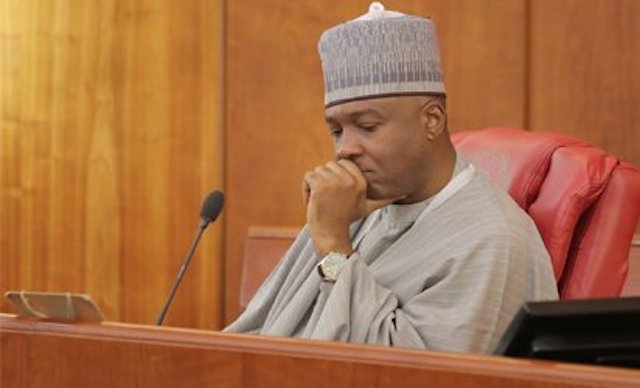
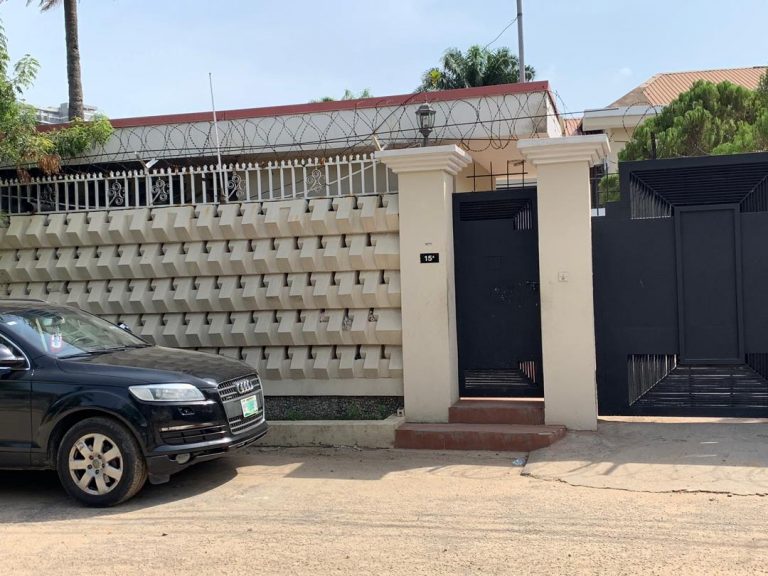
A FEDERAL High court sitting in Lagos on Monday has ordered that the properties of the immediate past Senate President of Nigeria, Bukola Saraki be forfeited to the Federal Government of Nigeria due to unlawful acquisition.
Economic and Financial Crime Commission through one of its counsel Nnaemeka Omewa approached the court to forfeit to the Federal Government Saraki’s properties in Ikoyi, Lagos state.
He alleged that Saraki acquired the properties through proceeds of unlawful activities.
Omewa prayed to the court to grant an interim forfeiture of the properties located at 17A McDonald Road, Ikoyi, Eti Osa Local government of Lagos State.
Saraki is alleged by the EFCC to have withdrawn over 12 billion in cash from the Kwara State Governmewnt account out of which some of the money was deposited into his domiciliary accounts in Access and Zenith banks through Abdul Adama, one of his personal assistants at different times.
While giving the order of the forfeiture, the sitting judge Mohammed Liman, read that “An order of this honourable Court forfeiting to the Federal Government of Nigeria landed property with appurtenances situate, lying and known as No. 17A McDonald Road, Ikoyi, Eti Osa Local Government Area of Lagos State found and recovered from the respondent which property is reasonably suspected to have been acquired with proceeds of unlawful activity”.
Liman also ordered that the EFCC publish the order in a national newspaper in 14 days so as to give room for anyone with interest in the properties to state why the properties should not be completely forfeited to the Federal Government of Nigeria.
While serving as the Senate President of Nigeria, Saraki was arraigned before the Code of Conduct Tribunal (CCT) over making an anticipatory declaration of assets as well as withholding information concerning his assets when he served as Kwara State governor between 2003 – 2011.
However, he was completely discharged of the case on July 6, 2018, by the CCT panel chairman, Danladi Umar who ruled that the evidence tendered by the prosecution was insufficient to make good the charges he was charged with.
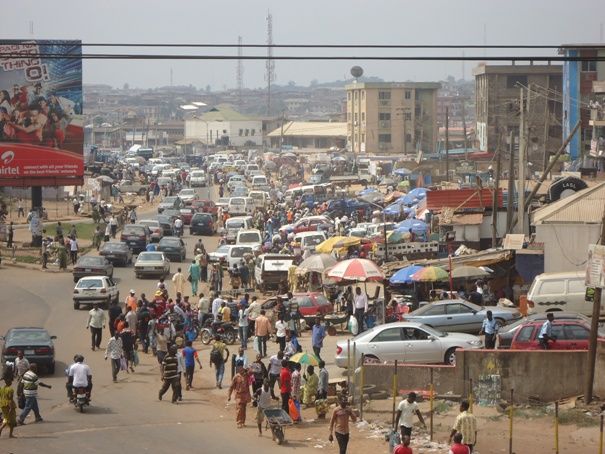
GOVERNOR of Oyo State, Seyi Makinde said his administration is set to spend about 8 billion naira for expansion of the Iwo road interchange, but his decision has attracted condemnation from the opposition party, All Progressive Congress (APC).
Makinde during his visit to Adogba Central Mosque at Iwo- Road appealed to the congregation that the mosque would be demolished so as to give way for the re-construction of the road. But he assured the congregation that land will be provided for the construction of another mosque.
The project scheduled to be completed in eleven months would cost the Oyo State government nearly N8 billion, the governor has said.
However, APC has criticized the plan as a misplaced priority and a means to squander public funds.
In a statement signed by Ayobami Adejumo, APC Oyo State publicity secretary, Makinde administration is depicted as incompetent, with an avowed desire for mismanagement of public funds.
The opposition said there is no record of the presentation of the project at the state executive council meeting.
PDP in a swift response to APC’s attack released a statement signed by Oyo state PDP publicity secretary Akeem Olatunji, who said that the criticism of the APC is borne out of their disregard of the impact of the several manhour wasted due to traffic congestion at the interchange.
PDP described the APC’s reaction as a show of shame, noting that the immediate past governor, Abiola Ajimobi spent eight years “romancing” the Iwo Road problem.
“Let us place it on record that Iwo Road is not just a segment of a road located within the Oyo State capital, it is an interchange that has become the melting point of all travelers within Nigeria as it brings those coming from the North face-to-face with travelers across the South West, South-South and South-East as well”.
THE Nigeria Communications Commission has announced the partial disconnection of Glomobile from Airtel Networks Limited (Airtel) by October 28.
NCC made the announcement in a statement by it Director, Public Affairs, Henry Nkemadu, stating that the disconnection was in accordance with Section 100 of the Nigerian Communications Act 2003 and the Guidelines on Procedure for Granting Approval to Disconnect Telecommunications Operators.
NCC noted that GloMobile was notified of the application and was given the opportunity to comment and state its case.
The statement read, “the Nigerian Communications Commission hereby notifies the general public and subscribers of Glomobile Limited (Glomobile) that approval has been granted for the partial disconnection of Glomobile from Airtel Networks Limited (Airtel) as a result of non-settlement of interconnect charges.”
“Glomobile was notified of the application and was given an opportunity to comment and state its case. The commission, having examined the application and circumstances surrounding the indebtedness determined that the affected operator does not have sufficient reason for non-payment of interconnect charges.”
“The Commission has approved the Partial Disconnection of Glomobile by Airtel in accordance with Section 100 of the Nigerian Communications Act 2003 and the Guidelines on Procedure for Granting Approval to Disconnect Telecommunications Operators.”
“At the expiration of 10 days from the date of this notice, subscribers on the network of Glomobile will no longer be able to make calls to Airtel but will be able to RECEIVE CALLS.”
“The Partial Disconnection, however, will allow in-bound calls to the Glomobile network. Please note that this disconnection will subsist until otherwise determined by the Commission.”
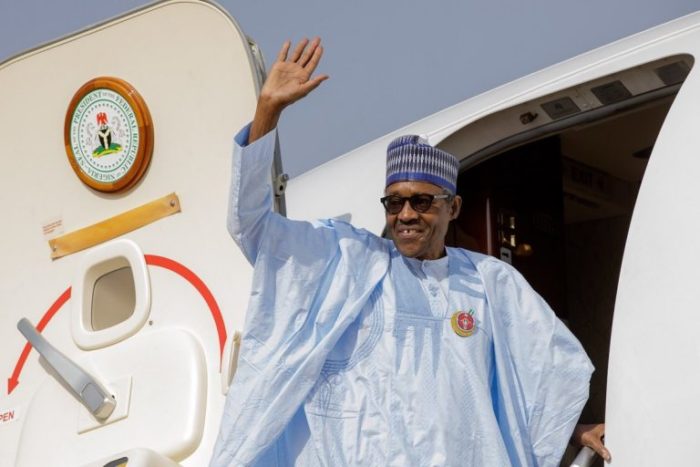
ON Monday, President Muhammadu Buhari departs the country for a three-day Russia-Africa Summit in Sochi, Russia. The meeting will focus on exploring and expanding opportunities in security, trade and investment, science and technology, and gas production, the presidency has said.
The Senior Special Assistant, Media and Publicity to President, Garba Shehu who made this known in a series of a tweet on Sunday, said the summit would hold from the 23rd – 25th of October.
According to him, the summit would bring fresh perspectives on some global issues and challenges like nuclear technology, energy development, digital transformation, environment, technical security, mining and steel, education, agriculture, infrastructure and development strategies.
“An African Business Forum, which will bring together African and Russian business leaders, will be held during the event to enhance Russian investments in Africa, and promote African business interest in the host country,” Shehu stated.
He said during the summit, Buhari would meet with President Vladimir Putin of Russia to further strengthen relations in security, trade & investment, while building a partnership to further enhance Nigeria’s huge gas potential, following Russia’s remarkable success in gas exportation
He noted that Buhari would be accompanied by some governors: Muhammad Yahaya of Gombe State; Bello Matawalle of Zamfara State and Kayode Fayemi of Ekiti State.
Also on the trip are the Minister of Foreign Affairs, Geoffrey Onyeama; Minister of Trade and Investment, Adeniyi Adebayo; Minister of Mines and Steel Development, Olamilekan Adegbite and Minister of State, Petroleum, Timipre Sylva.
“The President will return to the country after the summit,” Shehu said.
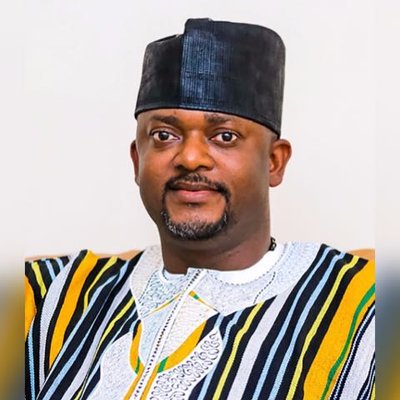
The committee headed by John Bayashea submitted its report to the Speaker of the House of Assembly, Mathew Kolawole who announced that the House of the Assembly after considering the reports, took the decision to impeach Achuba.
Achuba who defected from the People’s Democratic Party (PDP) to All Progressive Congress (APC) before he was sworn in as the Deputy Governor of Kogi state on February 9, was impeached over gross misconduct following several reports of a rift between him and the state governor.
Members of the state House of Assembly screened and confirmed the nomination of Onoja after which he was asked to take a bow before them giving way for the inauguration to take place.
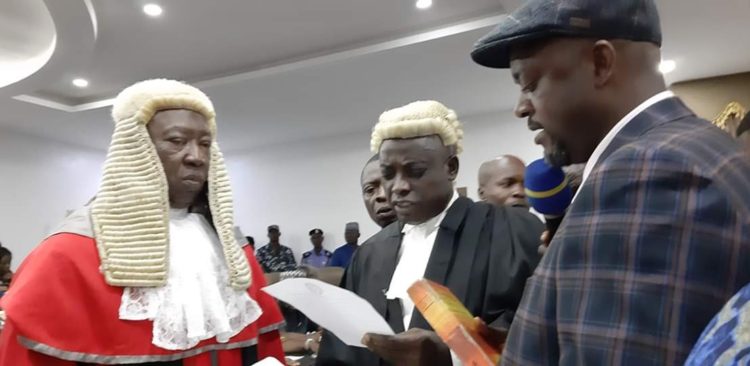
During the inauguration ceremony held at the state house in Lokoja, Onoja accompanied by his wife read the oaths as they were administered to him by the Kogi State Chief Judge.
Achuba has, however, described his impeachment as unconstitutional and that the impeachment process was contrary to section 181 of the 1999 constitution of Nigeria.
Edward Onoja being sworn-in as Kogi State deputy governor
Corroborating Achuba’s claim, the PDP through its National Publicity Secretary Kola Ologbodiyan, said the action has reduced the state to a butt of jokes among compatriots in other states.
“What it means is that Yahaya Bello can wake up tomorrow morning and shut down institutions of government, including the state legislature, the judiciary, and even the civil service and become a law unto himself,” the statement read.
However, two days before the confirmation of Achuba impeachment, Onoja had announced via social handle on twitter of his position as the new deputy governor of the state,
“I am handling over as chief of staff with confidence. Earlier this week I resigned from my post as the Chief of Staff to Governor Yahaya Bello of Kogi State.
“This is the requirement of law following His Excellency’s gracious nomination of my humble self as his running mate in the 2019 Kogi State Gubernatorial Elections.
“Today, my boss appointed Pharmacist Asuku Jamiu Abdulkareem, into the office I vacated. I wholeheartedly testify that my Successor as Chief of Staff is a proper fit for the office, having worked closely with me whilst we served His Excellency as Chief Of Staff And Director-General, Protocols respectively,” Onoja said.
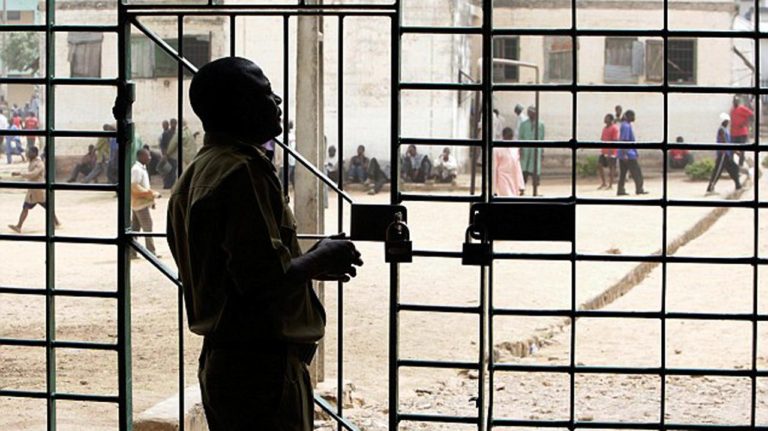
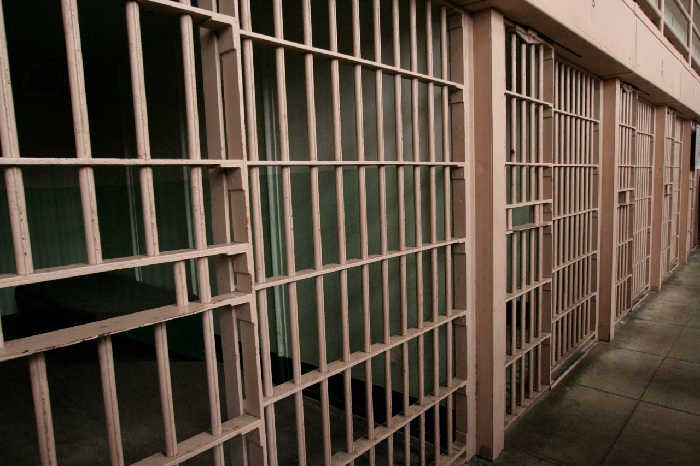
In the second report of a three – part undercover investigative series, FISAYO SOYOMBO exposes how the courts short-change the law, and the prisons are themselves a cesspool of the exact reasons for which they hold inmates.
TOO many unforeseen obstacles had sprung up against me by the time I arrived at the gates of Ikoyi Prison, Ikoyi, Lagos, on July 12: I’d had my most tortuous night in the police cell; I had been messed up by the typically ruthless Friday evening Lagos traffic; I had arrived under the cover of darkness, which wasn’t the plan. Even the few things that went well would later come back to haunt me.
Proceedings were well underway at Court III when we stepped into the Chief Magistrate Court, Yaba, Lagos, after my extrajudicial detention for five consecutive days at Pedro Police Station, Shomolu. It was a little after noon — or thereabouts. A funny but very contentious matter was ongoing. The protagonist, a woman, was being tried for, allegedly, illegally selling a piece of land belonging to a former associate of hers. This woman — ostensibly in her late 50s or early 60s — claimed, vehemently so, that the complainant indeed owed her millions of naira in accumulation of unpaid earnings for executed projects. She sold the land because she had been instructed to, to defray the cost of her service, she said. But the prosecutor insisted otherwise, arguing that the sale was fraudulent. The woman, irritated and incandescent, embraced and perhaps enjoyed every window to have a go at the prosecutor. Once, the prosecutor got under her skin by scoffing at how two of her high-profile witnesses were deceased. “Excuse you!” the woman fired back in protest. “Are you suggesting I killed them? Is it my fault that you’ve been dragging me from one police station to another and from court to court for more than 10 years?”
The magistrate — a dark, soft-spoken, middle-aged man whose eyes often evaded the lens of his pair of glasses when talking — adjourned the matter, as expected. And after two or three other cases, mine was mentioned. His orders: remanded in prison custody, two sureties in like sum of N500,000 each, N150,000 to be paid into the Registrar’s account by each surety, sureties to be from father’s side of the family. Not long after, the court rose, to be followed by my preparations for a long and difficult journey to the prison.
PRISON WARDERS ASK FOR BRIBES RIGHT IN COURT
Before the authorities take my freedom away from me, the first thing they do is give me a final semblance of it by unfettering my hands from the handcuff, as is the custom. That was just before entering the dock. Minutes later, the same man who released the handcuff returns to hand me over to a policeman who, accompanied by Zainab Sodiq, the lady posing as my sister, leads me downstairs. First stop on the ground floor is the office of the prisons service. Manning it, comfortably sitting opposite the entrance, is a gun-wielding prison warder, legs waggling, whose shirt hangs loosely on the wall inside, leaving his trunk scantily covered by a singlet. Inside that office are three more warders. The next room is a holding cell — for momentarily detaining inmates until the arrival of the prisons bus that conveys them to Ikoyi. I expect to be led to the holding cell, but I am taken into the prisons office and encouraged to “take a seat”. What manner of magnanimity is this? I was wrong!
The three officers summon my sister. “You can have a look at that holding cell and see if it’s the kind of place a human being should stay,” one of them tells her with feigned sympathy. “Your brother can stay in our office but it will cost you N10,000.” My sister takes a moment to peep into the holding cell, then returns to bargain. The negotiating parties reach an agreement of N5,000, collected by the singlet-donning warder.
Money in the bag, the warders’ initial measured disposition turns happy-go-lucky; I notice the ease with which they regale one another with tales of similarly shady financial dealings. “The day Naira Marley was billed to be taken to prison, I was on this chair making cool money,” says one of them. “I made some good money, I won’t lie. Transfers were just going up and down.” Naira Marley, the hip hop artiste whose original name is Azeez Fashola, had been arraigned at a Federal High Court in Lagos on May 20 by the Economic and Financial Crimes Commission (EFCC), on 11 counts of alleged Internet and credit card fraud.
A second warder describes how he facilitated the payment of N300,000 to a senior colleague of his in Abuja, by a man who wanted to ‘smuggle’ all his three children into the employ of the Nigerian Prisons Service (recently renamed the Nigerian Correctional Service) during a recruitment “some years ago”. Though unqualified, all three were eventually employed by the service. It suddenly dawns on the warder that an ongoing promotion exercise in the prisons service offers him fresh opportunity for corrupt enrichment. “Let me quickly call the man; he may be interested in a deal to facilitate his children’s promotion,” he adds, running his hand through his breast pocket for his phone.
‘IF YOU HAVE YOUR MONEY, YOU CAN NEVER SUFFER IN PRISON’
Holding Cell
Seeing the lack of restraint with which they discuss acts of bribery and corruption, I approach them for guidance on the allocation of accommodation in prison. Apparently, it’s a high-wire fraud involving prison officials in court and those in the yard proper.
“You can get a cell for N30,000,” one of the warders tells me. “You can also get for N100,000 or N150,000. You can even get a N1.5million cell.”
“A million and five hundred thousand?” I protest.
“Of course!” he insists. “When Ayodele Fayose was remanded in Ikoyi Prison, what kind of cell did you think he stayed in?” Fayose, the immediate past former Governor of Ekiti State, was remanded at Ikoyi Prison in October 2018 at the start of his N2.2billion fraud trial initiated by the EFCC.
Another warder cuts in. “Don’t worry, you can never suffer in the prison yard,” he says. “As long as you have your money.”
Patience, a third urges me. “The warders at the prison have warned us off striking deals with inmates while still in court,” he explains. “They’ve told us to leave them to push their own deals when the inmates get to the prison. So, when we get there, we will hand you over to the warders you will negotiate with.”
Emergency bail for sale by ‘the magistrate man’ and prison officials
Warder Collecting Bribe
Minutes later, one of the warders — dark, mild-mannered and diminutive — walks up to me to ask if I’m making progress with my bail conditions. The question confounds me. Who makes progress on bail application within two hours of a court hearing?
“My lawyer is working on it,” I reply, “but it’s too early to know since it’s just a few hours ago we left court.”
“No, no; it doesn’t mean,” he says. “I have a lawyer in this court who will help you perfect your bail ‘today today’. In fact, you will not get to Ikoyi Prison at all; you will go home straight from here. He works in concert with the court authorities. I can call him right now and he’d be here any minute if you want.”
Stunned and curious in one breath, I nod in the affirmative. In a matter of minutes, the lawyer, ostensibly in his late 40s or early 50s, shows up. He speaks in carefully considered and restrained patches, sporadically wiping the lens of his glasses with a silky piece of cloth.
“What exactly is your offence?” he begins, then proceeds to hearing my bail conditions. He assures me that the problematic components of my bail requirements would be waived, but the process would cost me money.
“Did the Magistrate order you to pay any money to the Registrar’s account?”
“Yes. N150,000,” I say in error. It should have been N300,000 — at the rate of N150,000 per surety.
“Okay, that’s no problem,” ‘Mr. John’, as he introduces himself, says. “Can you make everything N200,000?”
I tell John I can’t. That’s a lot of money. Fifty thousand naira on top of the N150,000 is a lot of cash. But he disagrees. “You see, I am very close to the Magistrate,” he says. “I am very close to the man; therefore, we will waive many of these bail conditions for you.” We haggle for a while: N180,000, N170,000, N180,000. We eventually settle for N170,000.
John takes a quick look at his watch; it’s a little past 3pm. “Hurry and get the money. It’s almost too late already — why did you wait till this long?” he laments. “Today may or may not be possible. If you had mentioned it immediately the court rose, say around 2pm, I would have been able to totally guarantee you that you would go home today without ever reaching the prison.”
We exchange numbers and I promise to call, but I never do (The plan, really, is to end up at Ikoyi Prison.). Instead, I fold my secret device and tuck it away carefully. Yes, I’d taped all the conversations held inside the prison office in the court premises. The original plan was to put the device away before going to prison, then retrieve it afterwards. I had been told that there was literally nothing I wanted to smuggle into the prison that I couldn’t; I only needed to grease the palms of warders and they would fetch it for me. But with accommodation negotiations set to take place on arrival at the prison, I began to nurse the ambition of smuggling in the device outright at point of entry. This was not the original plan. But if it works out, I would obtain more evidence of prison-yard corruption. If it fails, I’m doomed. Big risk, I know. But I do it all the same.
Physical pain in exchange for digging the story
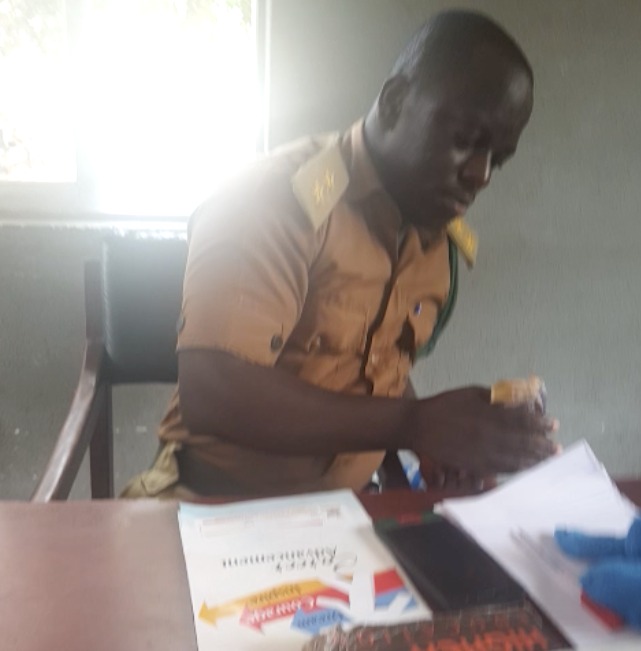
Sunkanmi Ijadunola, the Assistant Chief Warder
The prison warders do not quite know what to make of me when they find a hidden device on me, a supposed inmate, during the routine search at the entryway shortly after an Ikoyi Prison bus conveying the latest inmates pulled over at the prison gate. After a second, more thorough search during which nothing else is found on me, they hand me over to the ‘Section’ — a position occupied by the most senior convict in a cell — of the welcome cell. As I would later find out, this was under strict instructions: no phone calls, no out-of-cell movement, no frivolous interaction with inmates.
Very early the following morning, Sunkanmi Ijadunola, the third most senior warder in Ikoyi Prison, sends for me. They had seen the videos; they’d extracted the memory card from the device and watched footages of the five prison officials demanding bribes from me and the court official negotiating a premature bail with me. Sunkanmi, as he is widely known, asks me to confess: “Who are you and what is your mission here?” But he was asking the question a few hours too late. I’d spent half of the night deliberating on what to expect in the morning. I had imagined that in the best scenario, some senior official would have been thoroughly mortified by the sight of their bribe-demanding colleagues captured on tape, and would be keen to convince me about helping to further unravel the bad guys in the system. I didn’t deceive myself, though: this thinking was more or less illusory. I’d also thought that in the bad scenario, I’d be handed over to the Police; and in the worst, I’d be extrajudicially executed. After several hours of carefully considering all possibilities overnight, I resolved that even if they held a gun to my head, I would not disclose my true identity. I knew once I did, that was the end of the story. After five excruciating, emotionally and psychologically destructive days in a police cell, I wasn’t prepared to ruin everything so cheaply.
Seeing I am unwilling to offer any useful information, Sunkanmi, the Assistant Chief, accuses me of plotting a jailbreak. “You’re here to understudy the prison security so that you can send the videos to your gang members outside,” he says. “You’re planning a jail break. Or you’re working for Boko Haram; you’re a Boko Haram spy!”
I do not flinch. Instead, I stick to the original story line I’d preconceived to offer in the improbable circumstance that my cover was blown. At this point, Sunkanmi sends for a cane and orders me to remove my shirt and trousers, leaving only my singlet and boxer briefs. Then he descends on me. Three rounds of beating: the first with several lashes of the cane searing straight into my skin and leaving me with blood and blisters; the second in similar pattern, with my hands cuffed behind my back; and the last with a thick stick targeting the interior and exterior joints of my ankles, knees, hips, elbows and shoulders.
Still, I refuse to disclose that I’m a journalist. By enduring the beating, I succeed in buying myself at least another 24 hours of understudying the corruption seeping through the different layers of prison operations. Bearing the pain was worth it in the end; someone needed to expose the scale of criminal corruption going on in that prison.
The first benefit of enduring the pain is that I am still accorded the treatment of a regular inmate, therefore I am sent for registration and documentation. The documentation holds inside a building opposite the Assistant Chief Warder’s office. It’s a fairly big office with a small inner room littered with stacks of ragged files and paper, plus a narrow, hollow, open cell to the left where awaiting-documentation inmates sit without much latitude to stretch their legs. The inner room is manned by a warder easily noticeable by the ungracefulness of his chemical-bleached yellow skin. A light-skinned, heavily-built woman-warder spearheads the documentation process in the major office, assisted by three convicts. The documentation is both manual and digital, but to avoid compromising the security of the prison, I’ll skip the details. Prison warders are themselves the biggest threat to prison security, but I won’t aid them.
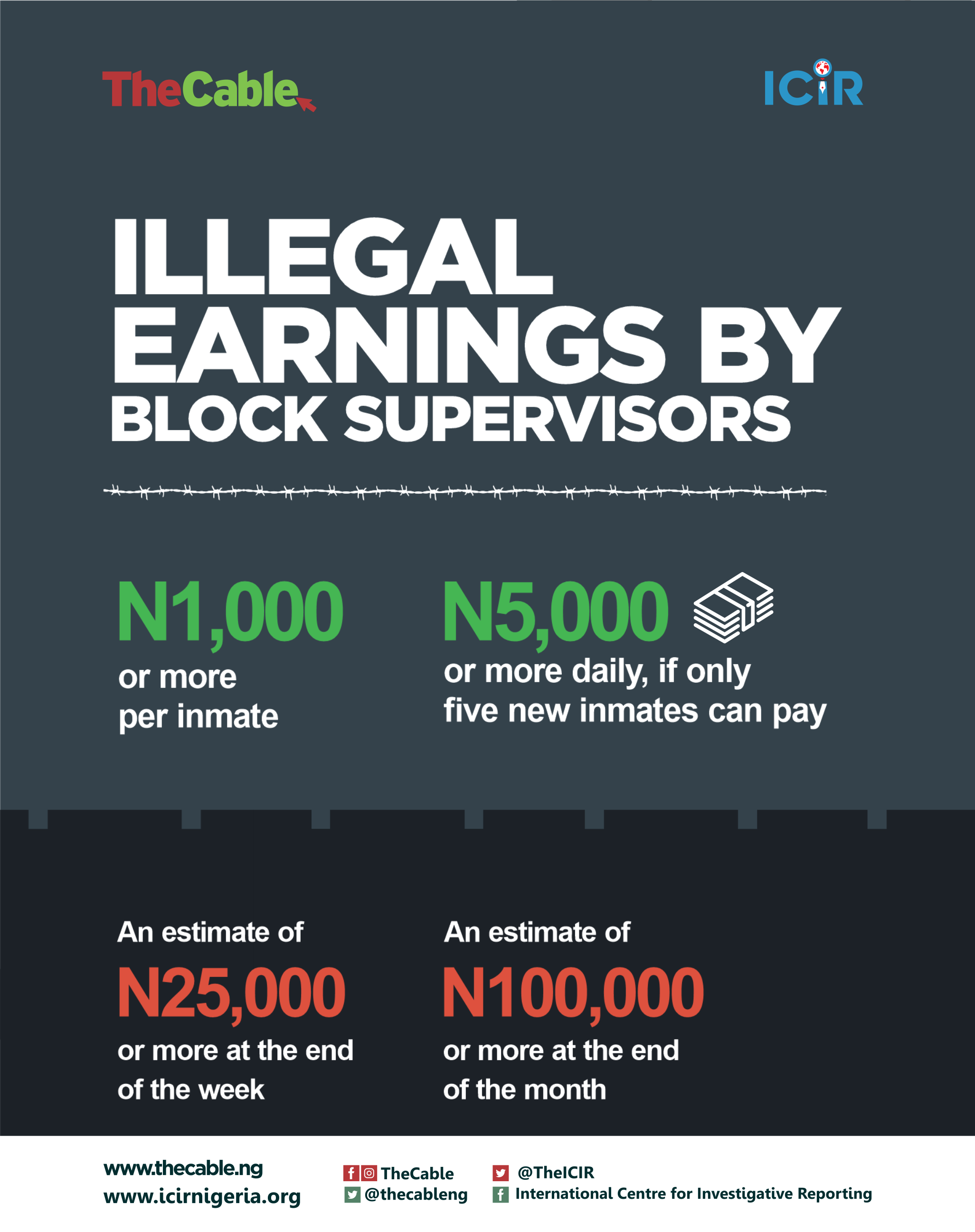
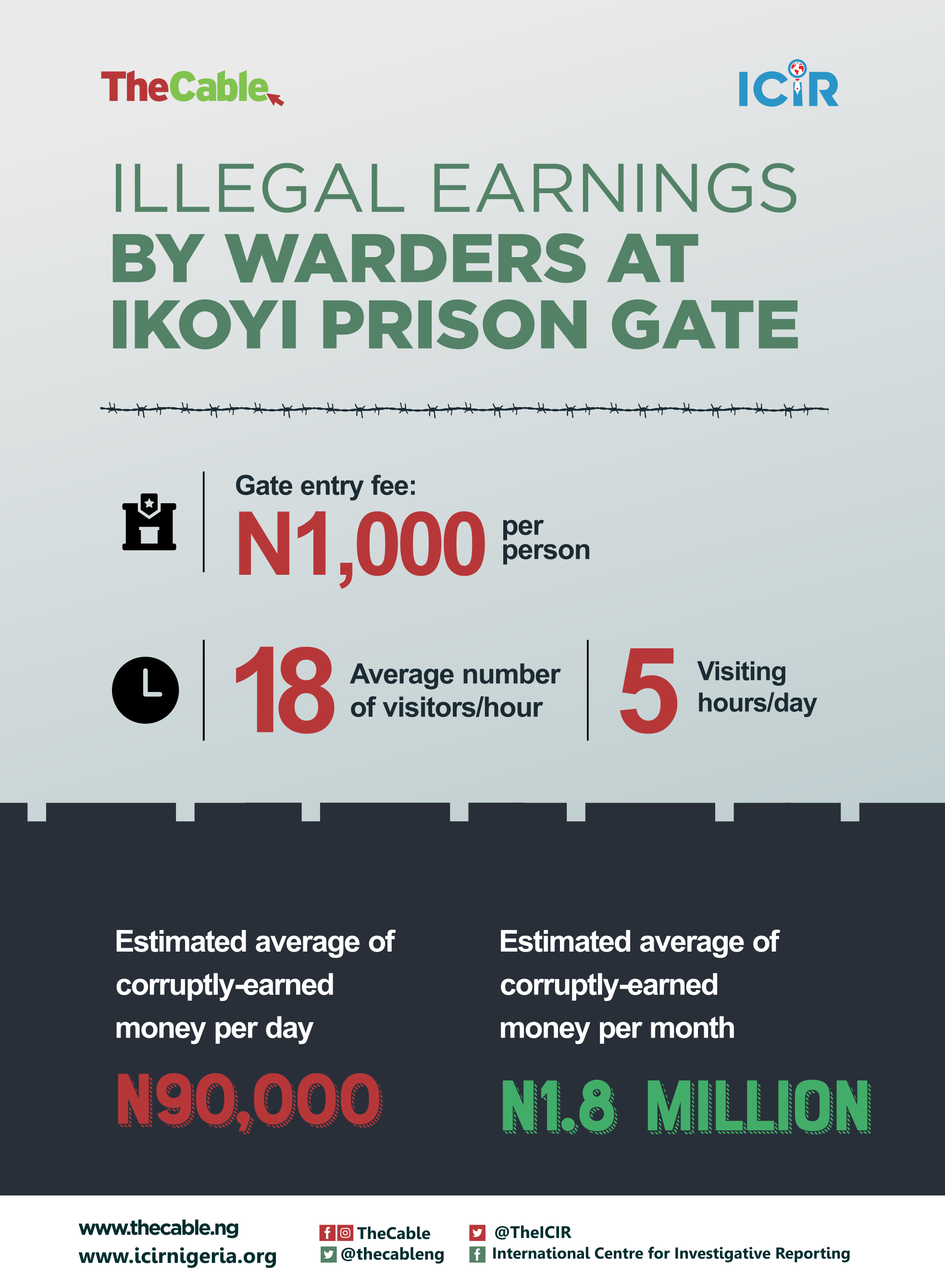
In the very final stage, a convicted inmate tells me to step forward for my cash. The procedure is always that an inmate turns in his possessions, including cash, at the gate. At the end of documentation, the money goes to the records department, from where he can retrieve a small sum every time it is required for a specific purpose. Just before I collect mine, one of the three convicts — they’re easily recognizable in their deep blue uniforms — whispers some instructions into my ears. “You will give that woman N1,000,” he tells me, “then you can have the rest.” It’s standard practice, I soon find out. Every inmate who comes in with cash must give up some of it at every registration point in bribes demanded through a proxy, but with the full knowledge of the receiving warder. It looks a small amount but by month end it could be some stash of notes in dubious earning. In my one week in that prison, there were 16 new inmates on the day with the least number of new inmates. One day, there were 45. If only five had enough cash to forfeit N1,000, that’s N5,000 daily, amounting to a little below or above N100,000 — depending on the number of court sittings in the month. Many honest, hard- working Nigerians do not even earn that!
I give up N1,000 of my N7,200 as instructed, and I receive a slip indicating my new cell will be D2 — that is, Block D Cell 2. I ask to be given the outstanding N6,200 but the convict tells me the money will be handed over to the warder overseeing the block — a happy-go-lucky albino who seemed very popular among inmates. Six thousand two hundred naira quickly becomes N5,200. Another N1,000 deduction, I am told, is to guarantee nobody in the cell lays hands on me. Again, if five inmates forfeit a thousand naira daily, that’s another N100,000 in corrupt earning by month-end. This is more than thrice the national minimum wage approved by President Muhammadu Buhari in April, but which still hasn’t taken off five months after!
Cover blown but too late to conceal corruption
IKoyi Prison
My stay at D2 is short-lived. Two members of my backup team show up as planned. They had been unable to reach me but they assumed all had gone well so far. With the extra scrutiny around me, it doesn’t take too long before they’re found out. It leaves me with no option but to admit I’m an investigative journalist and to fully disclose my mission. I just couldn’t see them endure the pain I had. This was a watershed moment in the investigation, as from then on, the prisons service bends over backwards to put its best foot forward while also eliminating my exposure to all ongoing ills. I remember overhearing a prisoner say even a death-row convict should still have the sense of self-worth to ignore the beans that was served that Saturday morning; but in my eight days at the prison, the warders ensure that I do not come in contact with the food served to inmates by the prison. The authorities relocate me from D2 to the welcome cell, with strict warnings never to leave the cell on my own under any circumstance.
Unfortunately for them, it was too little too late.
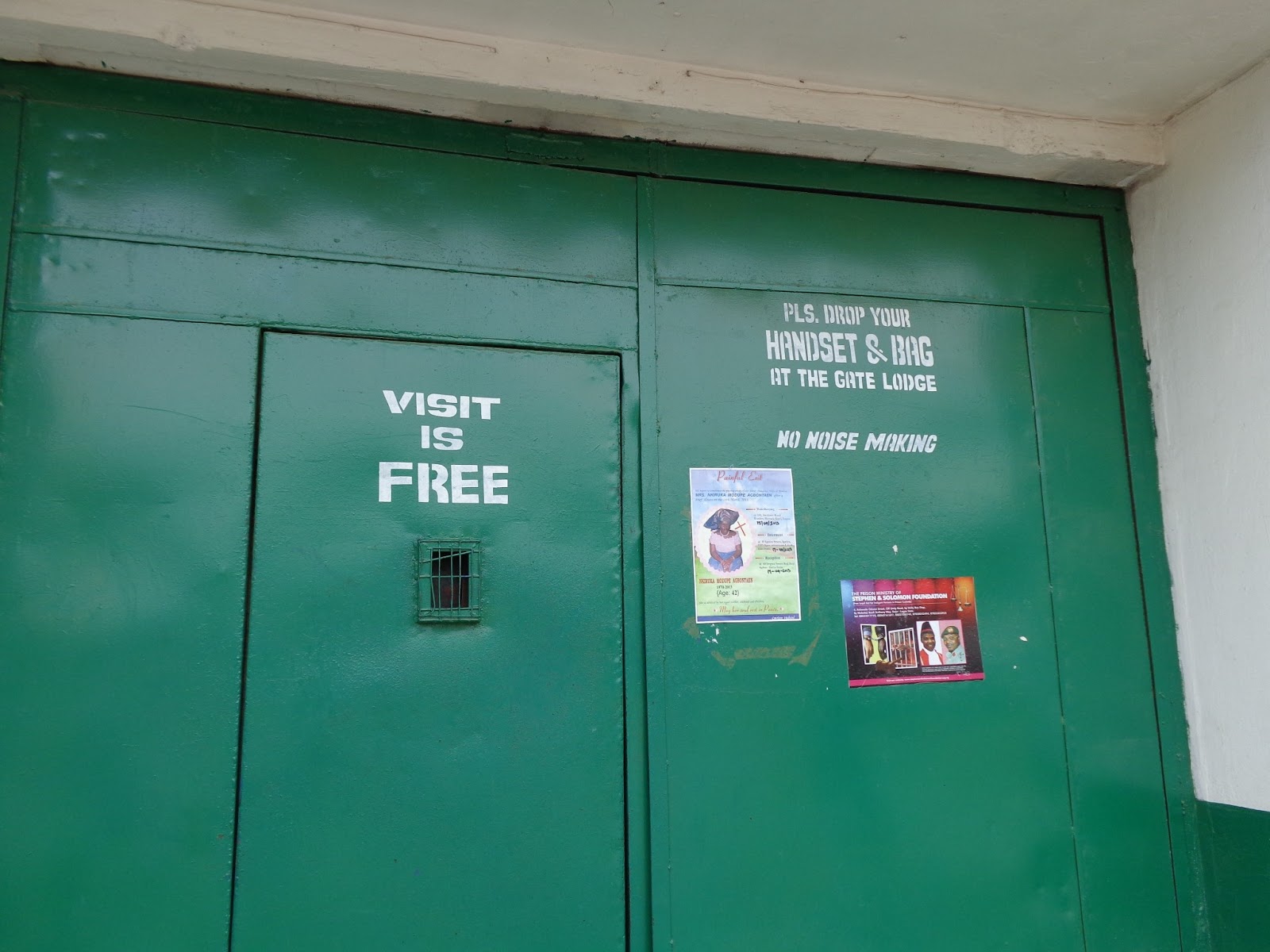
Before they knew who she was, one of my visitors had actually been made to pay a bribe of N1,000 at the prison gate before she could be allowed to see me, much like the setting at the police station. This wasn’t at the discretion of the visitor; it was no act of voluntary tipping. Rather, she was expressly asked to part with her money as a condition for access to me. On the surface, this looks a pittance, but not so when viewed in the context of the human traffic to the prison. On Saturday evening, I had managed to do a headcount of visitors: 18 of them in an hour. Do the math! This Ikoyi-visit corruption has grown in leaps and bounds, evidently; back in2016, a N200 bribe gave visitors access to an inmate. Not anymore!
Also, one of the few lawyers who visited me was nearly asked at the gate if he was willing to enter a deal to relocate me to a more enjoyable cell. “You look too clean for your client to be in D2,” a warder at the prison gate had told the lawyer, who, several years before his admission to the bar, had earned a reputation among colleagues for his clean shaves and bespoke suits. The warder waved the lawyer in, all smiles and niceties, and suspiciously keen to converse. Once a second warder turned up abruptly to announce the name of the client in D2, everything changed. The first warder slipped into jitters; his eyes became reddened, his face contouring into a frown. “You cannot sit there,” he said as the lawyer attempted to settle into a seat. “Come this way; remove your glasses; we need to thoroughly search you.”
N10,000 IS THE COST OF DELETING YOUR DETAILS FROM THE PRISON’S RECORDS
Until I was called to come receive my visitors, I made my every second in Block D count. Even before reaching the block, I knew I was on borrowed time. I was certain that it was only a matter of hours before I would have to reveal my true identity. So, in between registration, feeding and dispatch to D2, I mixed with inmates as often as I could. On one of those occasions, I overheard three inmates discuss a birthday celebration by a ‘Yahoo boy’ — Nigerian lingo for internet fraudster — in prison the previous week. “It was ‘lit’,” one of them said. A second, obviously the shortest-serving inmate of the trio, asked how some of the birthday items were smuggled in. “It’s the warders,” the third answered. “With N5,000 and above, most warders will help you smuggle anything you need into the yard.”
Elsewhere, I’d also run into a group of four inmates fielding questions from an inmate who was worried about the implications of his conviction. I was interested in it, knowing the consequences are long-lasting. Section 107(1)(d) of the 1999 Constitution of the Federal Republic of Nigeria (as amended) states explicitly that no person shall be qualified for election to a House of Assembly if “within a period of less than ten years before the date of an election to the House of Assembly, he has been convicted and sentenced for an offence involving dishonesty or he has been found guilty of a contravention of the Code of Conduct”. A similar provision in Section 137 (1)(e) makes it clear that a person shall not be qualified for election to the office of President if “within a period of less than ten years before the date of the election to the office of President he has been convicted and sentenced for an offence involving dishonesty or he has been found guilty of the contravention of the Code of Conduct”.
“What’s your business with that?” one of the inmates fires, irritated. “We will delete your name from the records. There will be no trace of you. Nobody will have any evidence that you ever came here, so forget whatever the implication is. My brother’s friend did it before and it cost him only N10,000. I’ll link you to the warder who did for him; he will help you too, but that will only be after you have regained your freedom.”
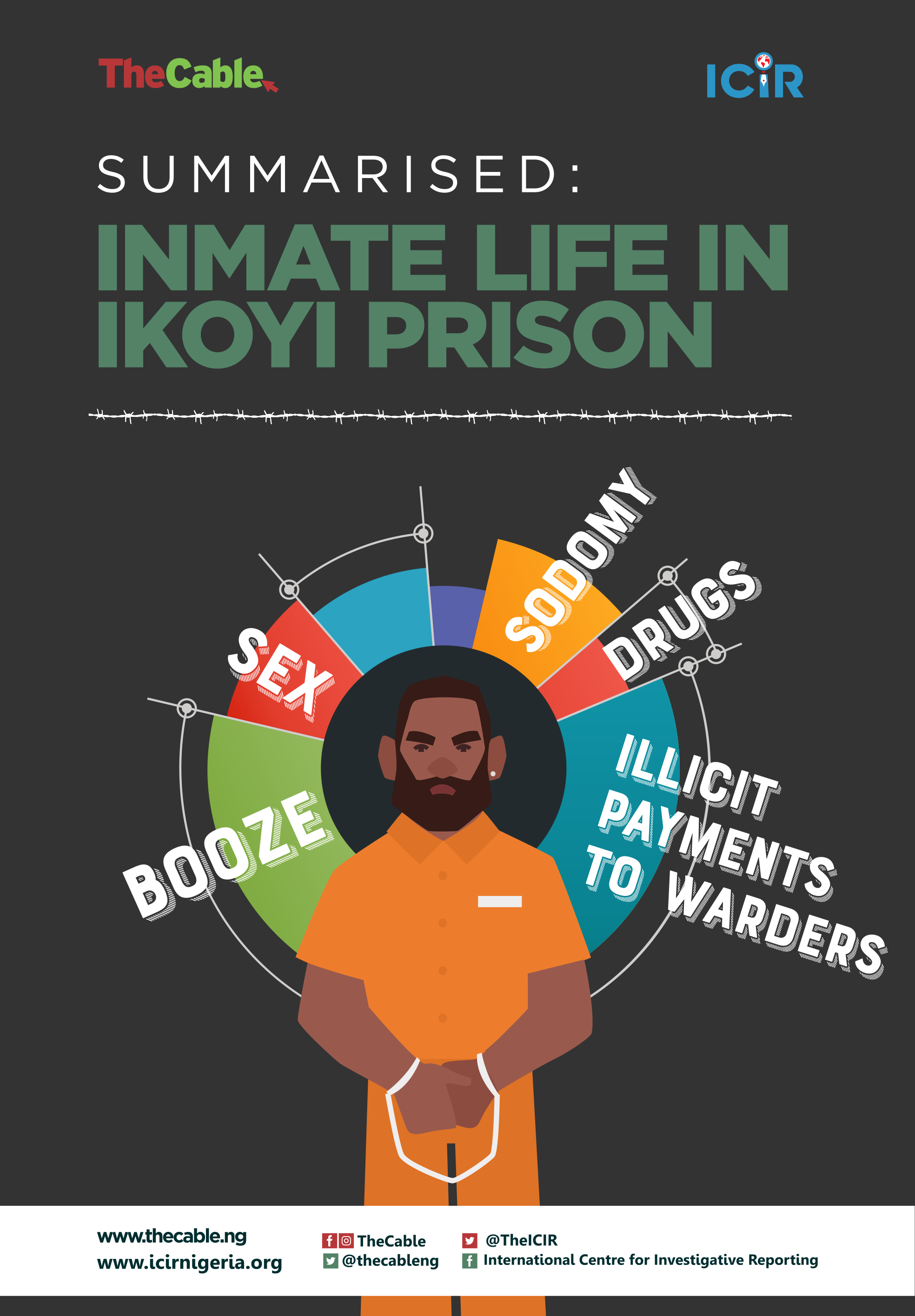
Sodomy, booze, sex and drugs…as long as you have your money
Colorado
While in prison, I’d exchanged contacts with an awaiting-trial inmate who had promised to reach out once he regained freedom. True to his words, he called on the day he exited Ikoyi Prison.
Weeks after, I drove about 340km out of Lagos to meet up with him.
“I saw how you were beaten up in prison and I didn’t want you to suffer in vain,” he says as we exchanged handshakes, each sizing the other up for elements of trust. “I’m going to help you by giving you additional information to what you already have. But this will be a very brief meeting, and this will be the only time ever you’d see me. That’s the best way for me to stay alive, because I know these bad guys will come after me if they trace any information to me.”
He explains that the special accommodation mentioned by the prison warders in court, which I was shielded from seeing, is called ‘Nicon Luxury’. It’s an apartment where inmates pay between N20,000 and N50,000 for a night’s sleep, plus access to cigarettes, drinks, Indian hemp, drugs and girls.
“The apartment has air conditioners, good couches and mattresses; meanwhile, 118 inmates are packed like sardines into one room that should normally hold 30 inmates. Those at Nicon are not only political prisoners or people of influence; just people who have the money.”
He describes the unfair world that the prison is, with only the poor truly imprisoned while the rich live fine.
“There is a lot of impunity in the prison,” he says. “An inmate, so long he is rich, can have almost everything, even sex. Inmates sleep with prostitutes. If you want to have sex, just tell the warders. They will bring a girl to the Nicon Luxury for you, set the two of you up; you f**k, you pay. It’s that easy,” he reveals.
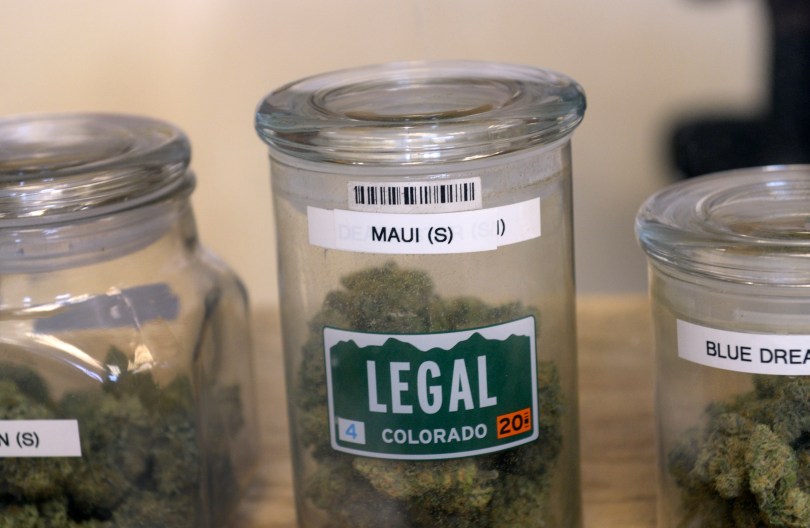
“There is free flow of drugs in prison, which is impossible without the facilitation or compromise of warders. You’ll find Colorado [a hard drug] in huge sale; I took it myself. I paid just N5,000 each time I wanted it. Tramadol and refnol are sold, too, but Colorado is the highest in demand.
“Look at Vaseline, it is a very scarce commodity in prison but it is available at expensive rates for use in sodomy. At Ikoyi Prison, the powerful inmates sodomise the others, and it happens right under the nose of prison authorities. They know that these things happen. But, you see, the warders are the problem — because inmates do not have access to the outside world, and those coming from outside are screened from head to toe. Therefore, nothing can enter the prison without the knowledge of warders.”
Nothing like reformation or correction in prison
Nurudeen Yusuf
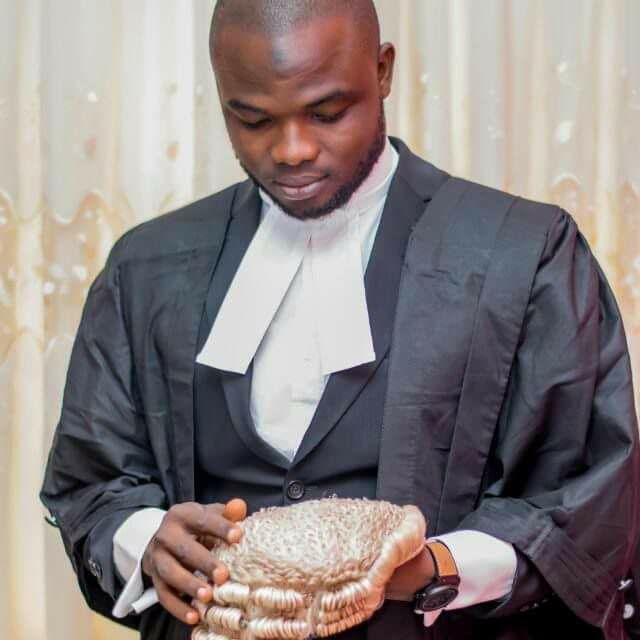
Despite the signing of the Nigerian Correctional Service Act 2019 into law by President Muhammadu Buhari, to reflect the new thrust of inmate reformation and correction, Nurudeen Yusuf, a Lagos-based legal practitioner and human rights activist, says any prison reforms that doesn’t kick off with warders is an “absolute waste of time”.
“With the sex, sodomy and abuse of drugs at Ikoyi and other prisons, there can be no reformation in the prison system. Under the law, inmates only have a right to one stick of cigarette a day, but look at the sheer availability of drugs to them,” he says.
“For instance, we got a guy out of Ikoyi Prison through our advocacy programme; we paid his bail sum of N100,000. We were shocked that he was desperate to go back. In less than three weeks, he got himself sent to prison — because of the big life he enjoyed there.
“The prison world is like an animal world. Inmates who have access to drugs, money and gadgets use that power to oppress the others. You see prisoners who have access to phones, they can extort outsiders right from inside the prison. Many prisoners convicted for fraud and murder are rich, and they live a big man’s life in there. Prisoners make cash transfers from their accounts while in prison.
“While in prison, inmates are supposed to learn new hands-on skills with which they can earn legitimate income after serving their time. But many of the workshop centres are not functioning, even in Kirikiri Maximum prisons; no materials, no resources to work with.”
Yusuf says he has had clients who were sodomised at Ikoyi Prison but the warders turned a blind eye because the victims were suspected Boko Haram members. “These people are innocent until proven guilty in court,” he noted. “Therefore, sodomising them is criminal; and this happens at almost every prison in the country.”
A 31-page piecetitled ‘Sodomy of Children in Maiduguri Prison and The ICRC Conspiracy of Silence’, released by imprisoned-for-life Independence Day bomber Charles Okah in March, details child prostitution, sodomy, abortions and even outright murder at the Maiduguri Maximum Security Prison, Borno State. Then Governor of Borno State, Kashim Shettima, subsequently set up a panel to investigate Okah’s claims, but its work was frustrated by Ja’afaru Ahmed, the Controller-General of the Nigerian Prisons Service and Sanusi Mu’azu Danmusa, the Maiduguri State Controller.
‘SET THE PRISONERS FREE, JAIL THE WARDERS’
Ikoyi Prison Warders
Prisons in Nigeria, exist to“take into lawful custody all those certified to be so kept by courts of competent jurisdiction, produce suspects in courts as and when due, identify the causes of their anti-social dispositions, set in motion mechanisms for their treatment and training for eventual reintegration into society as normal law-abiding citizens on discharge, and administer Prisons Farms and Industries for this purpose and in the process generate revenue for the government”.
The NPS continues to fulfill all these basic functions, bar two — identify the causes of misbehaviour, and kick off treatment and reintegration to society. Incidentally, these two are the most important of the lot.
Yusuf worries that prison sentence is turning a catalyst for more crime rather than the deterrence it was intended to be. “The implication is that inmates have no remorse over the offence for which they have been convicted,” he says. “They are willing to commit more crimes. They have just become terrors unto the society, either in prison or out of it. If you have money, you can live the life of a governor while in prison. The only difference is that you don’t have freedom to go out of the prison.”
My ex-inmate-friend sums it up more chillingly. “I was convicted for fraud but I left the prison knowing I was a better human that many of those warders,” he tells me. “You see those warders, they’re the ones who should be in jail. They’re far more fraudulent than I was. Their freedom should be in my hands, not mine in theirs!
* This investigation was published with support from Cable Newspaper Journalism Foundation and the International Centre for Investigative Reporting, ICIR.
You may read the other part through the following links:
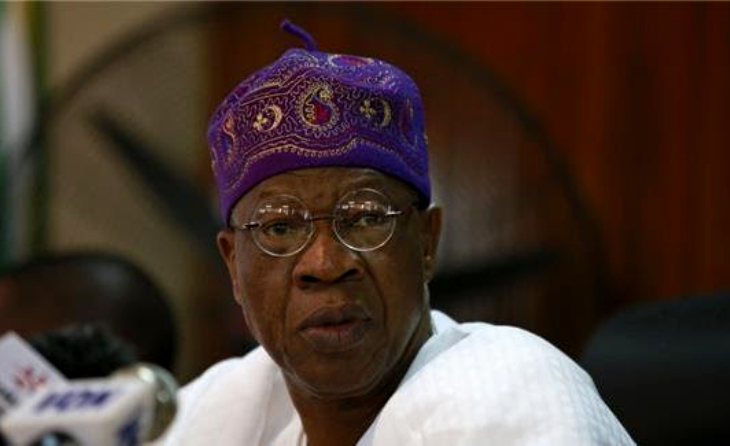
LAI Mohammed, the Minister of Information and Culture on Sunday restated commitment of the Federal Government to tackling fake news and hate speeches.
He told a group of online media publishers, Sunday in Lagos that a committee was already setup to implement the recommendations approved by President Muhammadu Buhari on the challenge of fake news.
Part of the recommendation, he stated is the upward review of the N500, 000 fine to N5, 000, 000 for the breach of hate speech regulation as well as full autonomy of the National Broadcasting Commission (NBC) to regulate the social media contents.
Describing hate speech and fake news as ‘Siamese twins of evil’, the Minister insisted that no responsible government would allow such to prevail in the society.
“Let me be clear: we didn’t think the issue will suddenly disappear, but we also didn’t think it will get worse, which is what it is now. In fact, it remains a clear and imminent danger to the polity,” says Mohammed, who is also believed to be a purveyor of fake claims and propaganda.
“No responsible government will sit by and allow fake news and hate speech to rule the airwaves, because of the capacity of this menace to exploit our national fault lines to set us against each other and trigger a national conflagration. That is why we will continue to evolve ways to tackle fake news and hate speech until we banish both.”
Government agencies such as the Department of State Security (DSS) and the Independent National Electoral Commission (INEC) have severally lamented about hate speech and its threat to democracy.
The ICIR has dispelled several fake reports made by politicians, businessmen and private individuals through its fact checks reporting.
The Minister also tasked the online publishers to support the nationwide campaign against the menace of fake news and hate speech.
According to a report by Channels, the committee is expected to also address the problem of monopoly in the broadcast sector.
“Let me be straight: No amount of attacks sponsored or otherwise will stop the implementation of the approved recommendations. And only non-patriots and anarchists will kick against measures aimed at putting an end to fake news and hate speech, especially in our broadcast industry.
“Only those who are guilty should be afraid of the efforts to sanitize the broadcast industry. Responsible broadcasters have nothing to fear. This is not a move to stifle free speech or gag anyone. But purveyors of fake news and hate speech should not expect to sleep easy.”
Meanwhile, the minister himself was exposed last year for selling a dummy to Nigerians about the ransom paid by the federal government to Boko Haram members who kidnapped female students in Dapchi, Yobe State.
‘’It is not true that we paid ransom for the release of the Dapchi girls, neither was there a prisoner swap to secure their release,” Mr. Mohammed told journalists in Maiduguri.
Contrary to this claim, the United Nations in a report confirmed that the Nigerian government paid a “large ransom.”
Mr. Muhammed has not denied that report since it was published more than a year ago.
KUNLE Adebajo of The ICIR and four other Nigerian journalists emerged winners in the 2019 West Africa Media Excellence Awards (WAMECA ) held on Saturday in Accra, Ghana.
The award themed “Social Media, Fake News and Elections in Africa” recognises exceptional journalists in the diverse field of journalism reportage within Africa while also celebrating and promoting media excellence in West Africa.
Adebajo emerged overall winner in the Telecommunication category to clinch the prize sum of $500 dollars for his report detailing the tardy response by federal ministries to email enquires from citizens, including journalists.
His investigation showed that out of the twenty-six addresses mailed, eleven were not available and of the fifteen which were valid, only three responded.
Other winners from Nigeria includes; Cletus Umoh Ukpong of the Premium Times who won the award for best investigative reporting and also won $500 dollars, Destiny Onyemihia of the Voice of Nigeria, VON, who emerged the overall winner for the Continental Journalism Award on AU Charter to win the prize sum of $2,000 dollars, Tunde Ajaja of the Punch also grabbed the $500 dollars prize for stories written on Business and Small Medium Enterprises.
Tobore Ovuorie of the Nation newspaper was the winner in the Human Rights category, with a prize of $500.
The event which started on October 17 held a two-day conference with panel discussions on protecting election integrity on the Internet, stopping fake news, accountability in journalism and other issues revolving around the media across the continent.
Amongst the editors, managers and influential media practitioners from across West Africa who deliberated on the different issues in journalism in the region was Dapo Olorunyomi, Publisher of the Premium Times, who expressed his dissatisfaction on the laxity of the Nigerian government to take action on corrupt practices perpetrated by the elite in the country.
He pointed out that although the country produced many journalism reports from the Panama Papers, it still remains the only country where nothing has been done by the government based on the findings in the illicit financial engagement by Nigerians indicted in the leak.
Journalists from the other West African states who came out on tops are Sama Jounwendsida Hugues Richard from Burkina Faso who was named the West African Journalist of the year,and Seriba Kone from Cote D’Ivoirewho won in the best anti-corruption category.
Nigeria has acquired new loan of $3bilion dollars from the World Bank to address transmission and distribution challenge in the power sector.
Zainab Ahmed, minister of finance made this known to journalists on Sunday during a side event at the annual meetings of the International Monetary Fund (IMF) and the World Bank Group held in Washington DC.
Ahmed said that inclusive of the request made to the IMF for technical assistance in Nigeria Electricity Regulation Commission (NERC), assistance on business continuity regulation the country asked especially for financing the power sector with loan in the range of $1.5 billion to $4 billion.
The request the minister said is expected to mitigate the huge gap between the current tariff and the actual cost of generating electricity while providing resource needed to settle accrued debts in the sector to ensure continuity of operations within the sector.
The loan is to be released in four tranches of $750 million each, with possible room for loan expansion up to $ 4 billion dollars.
“At the end of the day, it is like we would be looking at the funding size of $3 billion that will be provided in four tranches of $750 million each.
“Our plan is that the team will be able to go to the World Bank for the approval of the first tranche in April 2020,” she said.
Ahmed also revealed that if the government is able to grab a loan of $4 billion, the added $1 billion will be allocated to the distribution privately run Distribution Companies.
Based on the World Bank 2019 economic analysis in sub- Saharan Africa, 24 countries within the region will enjoy increase in their per capita income, however, Nigeria will see weak performance in its economic outlook.
In 2018, Nigeria had approached the IMF for fund in the power sector and a loan of $486 billion dollars was awarded to increase transmission. Currently, the country’s total external debt as at March 2019, stood at N7.8 trillion ($25.6 billion) while internal debt was N17 trillion ($55.6 billion).
NIGERIAN woke up on Wednesday, May 8, to a nationwide power outage that cut off power from many homes and factories leading to reduced load allocations to the distribution companies (DisCos).
At about 5:29 am the following day (Thursday, May 9, 2019), the grid collapsed again, compounding the nation’s energy challenge. Checks revealed that the country’s power grid had collapsed no fewer than nine times in 2019. In January alone, the country’s power grid collapsed twice while at least two major collapses were recorded in April.
Investigation shows that the nine power grid collapses witnessed this year were among at least 206 of such incidents that have been recorded since 2010. Scores of the ‘Total Grid System Collapse’ have occurred after the entire electricity grid goes off for several hours. There were also cases of ‘Partial Grid System’ Collapse’ when a section of the country was thrown into darkness for hours due to major transmission line trips.
Officials of the Transmission Company of Nigeria (TCN) who probe such incidents, traced the cause to high voltage level resulting from multiple tripping on the Alaoji-Onitsha transmission line, a power plant that shut down abruptly and a huge energy load rejected by the 11 Distribution Companies (DisCos).
206 collapse in 9 years
Between 2010 and 2019, Nigerian electricity consumers have had to contend with 206 power grid collapse, nine of which occurred in 2019, records obtained from the System Operator (SO), a section of TCN, indicate.
A breakdown of the 206 grid collapse which often led to a power cut for a whole region or even the entire country shows that 109 of the incidents occurred from 2010 to 2013; while 97 others were recorded from 2014 to 2019.
System collapse between 2010 and 2019
The country went into total darkness 22 times and recorded 20 partial outages in 2010. The grid had 13 incidents of total collapse and six partial incidents in 2011. By 2012, there were 16 total collapses and eight partial ones. In 2013 when preparations for the privatization were topmost, there were 22 total power grid collapses while partial trappings occurred twice.
The post-privatization era also had its fair share of system collapse. Although the situation improved in 2014 as records show, there were nine total collapses and four partial ones. By 2015, the trouble persisted with a record of six total and four partial collapses. It became worst by 2016 when the grid tripped for 22 times and went off partially six times.
Investigations further reveal that in 2017, there were 15 total, and nine partial collapses while last year, 12 total collapses were recorded with one partial collapse.
At least nine total collapses have been recorded this year; four of which occurred in January. The five others were spread across February, April, May, June, and August.
The total collapse on June 30, which dropped grid power to 127MW, was traced to a fire outbreak at the Benin transmission substation in Edo state. On August 30, the national electricity grid recorded another total collapse, throwing the country into darkness for about 10 hours. It was a total collapse as power generation on the grid dropped to 20MW.
Benin-TCN-substation
Grid outages highest during rainy season
Trend analyses of these collapses further indicate that national grid outages were worst during some months in the rainy season. The highest of such was in May, which had 30 collapses since 2010. June is next with 29 occurrences.
Another trend is the occurrence of more collapses in January. At least 19 incidents were recorded in the nine-year analysis. The negative trend of 17 occurrences per month was recorded in April, September, and October. It slid to 16 occurrences in November, 15 collapses in July, and 14 incidents in March and December. The least occurrences were in August (7 collapses) and February (10 collapses).
TCN on various occasions this year blamed the DisCos’ load rejection for the high frequency of grid collapses in the rainy season. It said once it rains, the DisCos due to their poor networks, shutdown many power feeders which denies customers of supply, and that when the grid voltages became too high for lack of consumption, a collapse or frequency disturbance became inevitable.
Grid limitations cut 17,500MW in 76 months
Records of power generation since the privatization in 2013 to December 2018 indicate that the GenCos have more capacity to deliver power than they had before the privatization.
Analysis of the historical generation data from the Association of Power Generation Companies (APGC) indicates that the GenCos had made available about 38,546 megawatts (MW) generation capability from November 2013 to December 2018.
While the national grid took only 20,960MW, a huge quantum of 17,582MW representing 45 percent of the total GenCos’ capability was stranded. They were not allowed to generate that quantum into the grid. APGC claimed the existing transmission network is inadequate, fragile and not reliable.
The System Operator (SO) is a department of TCN that controls the national power grid. The GenCos said while they made effort to increase their generating capacity, the SO has the right according to the Grid Code, to instruct them to reduce or cut down their nominated capacity, with which they must have made gas commitments.
Daily Trust found that the major constraints of transmission system disturbances, distribution, load rejection and the absence of spinning reserve to quickly stabilize the national grid when a collapse is being sensed are the factors against uninterrupted power supply in the country.
Current data from the TCN-SO show that at present, the country has 12,910MW installed power generation capacity. But 7,652MW is the highest generation capacity that can be called into operation from the 24 active GenCos.
Benin substation fire June 30, 2019
Onitsha, others hotspots for grid collapses
The Alaoji to Onitsha and Calabar transmission lines have been observed to be among the major lines where frequency disturbances have been recorded since 2010.
Daily Trust visited some of these hotspots to observe the lines and speak to residents around the areas. At the TCN 330/132 kilovolts (kV) Awada substation in Onitsha in Anambra state, our reporter observed that the huge facility connects the 330KV transmission line from Alaoji substation in Abia through parts of Imo to Onitsha.
Alaoji harbours a 500MW GenCo under the National Integrated Power Plant (NIPP). Nearby is the 140MW Ariaria power GenCo that is yet to be put on the grid.
Another 330kV line leaves the Onitsha substation through Asaba to Benin City substation. The 330kV Warri to Sapele line (Delta axis) joins the Asaba line at Benin substation. These are hubs for about five large power GenCos with over 2,00MW capacity. There is Transcorp Ughelli, Okpai , Sapele GenCo, Sapele NIPP, and the Ihovbor (Benin) NIPP.
The Benin line further moves to Ondo state to connect Omotosho gas and NIPP plants and extends to Olorunsogo Gas and NIPP plants in Ogun state.
Parts of the networks of Enugu, Benin, Ibadan and Port Harcourt DisCos are directly from fed from these trunk lines by TCN through its transmission substations to the injection substations of the DisCos.
Electricity customers are then fed from the DisCos’ substations through 33kV lines, and stepped down to 11kV and 415V that enters into household connections across the various communities and connected to the DisCos’ networks.
Infograph Timeline of burn transformer
When contacted, the Assistant General Manager (AGM) at the Onitsha substation, Engr. Mike Anigbo said he was not permitted by the Enugu transmission region to speak but after much pressure, he tersely said: “We have enough energy to serve our customers for 24 hours a day”, without explaining what that meant.
A senior official, however, said the Enugu and Benin DisCos reject load in the axis the substation covers across Anambra and part of Delta state. “DisCos just take only two megawatts of the energy when they are supposed to take 10MW,” said the official who wouldn’t want to be named.
Another official confirmed system disturbance on the Alaoji transmission, which he said, was not built by TCN but by the Niger Delta Power Holding Company (NDPHC) under the NIPP after they constructed the Alaoji NIPP plant.
“Most times because the line was not well built, there are occasional disturbances which affect a part of the national grid. The new management of TCN is making procurement to rehabilitate that line to stop that,” he said in confidence.
At Onitsha, it was observed that Tower No. 5 of the Onitsha-Asaba transmission line, which had gone down in 2017, causing system disturbance, has been fixed. The base of the tower was affected by fire from a nearby waste dumpsite.
The place has been partly cleaned up but residents are concerned that such an incident could recur if the TCN line patrol team does not monitor it often. Mr. Uche Okonkwo, a tricycle driver in Onitsha, said apart from common dumpsites around power lines, flood in the swampy terrain of the Niger River could pose a threat.
Burnt tower in Asaba in October 2018
Stretch of 132kV transmission lines in Edo, Zamfara, others
Experts in the electricity industry say the long stretches of the 132KV line could cause transmission losses and low voltage if more load points are connected to that line without a transmission substation or an injection substation.
Daily Trust observed that Benin City to Okpella in Edo State, stretching to Okene in Kogi state is on a 132kV line. TCN has four substations in Benin, Irrua, Auchi, and Okpella before the 132/33kV line stretches to Okene.
An expert in the electricity industry, Engr. Ibrahim Ganiyu, an ex-PHCN staff of the transmission section, who commented on the implication of this, says the long stretch of 132KV line could cause transmission losses and low voltage if more load points are connected to that line without a transmission substation or an injection substation.
Irrua TCN substation
Benin has a 330/132/33kV substation; Irrua substation has a 60-mega volt-ampere (MVA) and 30MVA transformer while there is a 40MVA transformer at Auchi. Okpella has a 15MVA transformer upgraded to 60MVA in September 2018, officials said. It was to compliment the rising demand for Bua and Dangote Cement companies in the area.
At Auchi, Okpella and its environs the situation is not different as residents and customers of Benin DisCo say they face epileptic power supply and high electricity bills. Muhammed Momoh in Auchi noted that electricity is unpredictable in the area as they hardly see the power supply a day. Mr. Felix Eze, who operates a drinking joint, said business operators in the area rely on generators to power their business.
Joseph Ovie in Okpella said, “The light situation is not completely different from other places with incessant power outage. At times, we get it beyond three hours in the day time and also three hours at night but it is not always regular.” Isaac Jimoh, a resident of Avielle town near Auchi said they are already frustrated with high bills and low voltage levels in the area.
The lack of mega 330kV transmission substation and a line is also affecting Ekiti state, as a long line of 132kV line stretches through it from Kogi state.
Vandalised tower in Katsina in May 2018
Surveys on the route from Sokoto state up to Gusau in Zamfara state and to Funtua in Katsina state, reveal long winding 132kV line that stretches through. A tower in that line collapsed in November 2018, threatening power supply in the axis. The situation is the same for Lafia to Akwanga, and from Keffi to Mararaba in Nasarawa state.
It was the same case of the north-eastern states until TCN commissioned two 330kV transmission substations in Yobe and Maiduguri early 2019. Officials of Yola DisCo said there is more bulk power to supply to customers.
Daily Trust reports severally that residents have been amazed at the improved power supply in Borno, Adamawa and Yobe states with some of them fearing they would be overbilled over the ‘abnormal’ supply.
Record of grid allocation in the current ‘Multi Year Tariff Order (MYTO) 2015’ shows that Yola DisCo which covers a major section of the Northeast region gets 3.5% daily allocation from the national grid.
However, the DisCo’s MD, Mustapha Baba Umara at the commissioning of the 330kV Damaturu substation in January 2019 said the previous line inadequacy had hindered enough bulk power distribution beyond the state capital of Yobe, which is similar in other states within its franchise area.
Official records also show that voltage instability occurs at another NIPP transmission line built by the NDPHC. The Ikot Ekpene (Akwa Ibom) to Ugwuaji (Enugu) to Apir (Benue) to Jos line has frequent disturbance, a TCN report shows. To arrest this, the TCN MD, UG Mohammed said three reactors are being installed in Ikot Ekpene and Jos to stabilize the line.
GenCos: Grid limitations deny consumers 17,500MW in 76 months
FG borrows N715bn to expand grid
Analysis of external funding for TCN alone according to its records, indicates that the federal government would have spent N715 billion by 2021 on electricity transmission projects that will raise the transmission capacity from present 8,100MW to 20,000MW. This excludes capital releases in the annual budgetary appropriations.
TCN got a $300 million dollar (N108.6bn) loan from the World Bank in 2010 to execute the Nigeria Electricity and Gas Improvement Project (NEGIP) by its project management Unit (PMU). The eight year programme ended in December 2018.
In April 2018, the Japanese Agency for International Cooperation (JICA) gave a grant assistance of 1.317bn Japanese Yen equivalent to $12.4m (about N4.5bn) for the installation of power capacitors and switchgears at the Apo (Abuja) and Keffi (Nasarawa State) transmission substations. The projects have since been concluded and commissioned.
TCN in September 2019 said it has obtained $1.661bn (N601.3bn) multilateral loans from five agencies which it said, it is using for the procurement and installation of projects under its Transmission Rehabilitation and Expansion Programme (TREP).
The breakdown of the fund obtained by this paper indicates that the World Bank is the highest donor with $486 million for a fresh Nigeria Electricity Transmission Project (NETAP), and $27m for transmission project tagged, North Core.
The African Development Bank (AfDB) has $410m for transmission expansion projects; the French Development Agency -AFD and European Union (EU) gave $330m for the northern corridor transmission project.
While JICA pegged 238m for Lagos/Ogun transmission project, AFD gave another N170m for the Abuja transmission ring scheme.
NERC fails to approve TCN spinning reserve in 13 months
In May 2019, TCN lamented that despite writing to the Nigerian Electricity Regulatory Commission (NERC) to quickly approve a 250MW spinning reserve procurement to tackle grid system collapse, NERC did not respond for 13 months.
Daily Trust gathered that TCN got initial bidding approval from NERC in July and called for bidders in August 2018. However, after bid evaluation, NERC only called for public comments on September 30, 2019, to consider the spinning reserve in an on-going extraordinary tariff review for TCN and the DisCos.
For over four years, the national grid has been left zero and at times 40MW of the spinning reserve to cushion system frequency disturbance before a collapse.
Explaining the essence of spinning reserve in the Transmission Rehabilitation and Expansion Plan (TREP), TCN said the power grid was still vulnerable to collapses without spinning reserve because of overvoltage when energy loads are rejected.
“We don’t have a spinning reserve to grapple with this, so we often use the manual control method when the frequency becomes high,” an official of TCN-SO told Daily Trust. The official said the spinning reserve would ensure fluctuations on the national grid are managed to prevent future system collapse.
TCN, DisCos bicker over load rejection
Recurring system collapse has been a source of conflict for TCN and the DisCos, our investigations reveal. After the June 30, 2019 system collapse, Bar. Sunday Oduntan, the spokesman for the Association of Nigerian Electricity Distributors (ANED) blamed the TCN.
“The DisCos remain available to offer their technical assistance to TCN, to ensure that our valued customers do not remain in darkness,” said ANED, adding that DisCos have invested over $1.4bn in their system.
The TCN on its part has canvased for the recapitalization of DisCos saying they need $4.3bn dollars to match the transmission network.
The TCN’s SO records in April 2017 say the DisCos rejected 10,200MW allocation in justone month. In the SO’s daily operational reports and document analyzed for over six months of 2019, Daily Trust reports that over 1,500MW energy is rejected by DisCos daily.
DisCos inhabit poor interface, obsolete networks
The DisCos’ association told this paper that the TCN analog system had caused 5,311 interface disruptions in a DisCo within 18 days of September 2019.
However, we found that DisCos’ networks are rife with obsolete and inadequate equipment. Documents accessed at the NDPHC reveal this inadequacy in many places including Kabba (Kogi), Lafia (Nasarawa) where DisCos fail to operate such networks that could boost power supply to Nigerians.
Checks show that in Abuja, it took over one year for Abuja DisCo to connect to the added 60MVA TCN Katampe transformer. Connecting to the additional 120MVA transformer at TCN Suleja substation was also delayed by Abuja DisCo; Ibadan DisCo also delayed connecting to the upgraded Abeokuta Substation.
A memo addressed to the erstwhile Minister of Power, Works and Housing, Mr. Babatunde Fashola on May 22, 2019, shortly before he left office indicted the DisCos’ network inefficiency.
TCN in the letter seen by our reporters said out of the 737 total interfaces where transmission facilities deliver power to distribution facilities, 421 have adequate protection but 316 others have not. “The DisCos should build new feeders and injection substations to take more supply from existing and new transmission substations,” the letter, which was also sent to, the Presidency, read in part.
Plan on course to remedy constraints-TCN
The Managing Director of TCN, Mr. Usman Gur Mohammed spoke to Daily Trust about efforts to improve the system. He said TCN has delivered 67 power transformers that added 3,100MW capacity to the transmission grid since 2017 after the new management reformed the company and positioned it for better performance.
Of the 67 transformers TCN said it installed, the Daily Trust tracked the locations for 59 of them which have a combined energy capacity of 3,399MVA, according to documentary records. TCN installed 14 transformers in the Southwest with total of 1,280MVA energy transmission capacity. In the South-south, it installed seven units with 490MVA capacity; another five units of 289MVA capacity were installed in the Southeast.
In the Northwest, TCN installed 14 transformers that could deliver 750MVA energy to the DisCos; it installed seven transformers with 590MVA capacity in Northeast and then added 12 units with 800MVA energy wheeling capacity in the Northcentral region.
The Transmission Company of Nigeria (TCN) said it has improved the power system stability, it hopes the efficiency will increase as its $1.6 billion donor-funded projects nationwide begin to materialize.
“We need to have a critical investment in lines and substations so that we put N-1 across the country, that will ensure that any equipment that goes out at any point in time will not affect supply on that area,” Mohammed added.
However, the General Manager, Public Affairs at TCN, Mrs. Ndidi Mbah, promised to get back to us over inquiries on curbing system collapse but failed to do so despite several reminders.
The DisCos under its Association – ANED have denied any wrongdoing. Its spokesman, Chief Sunday Oduntan said load rejection in some cases was a business decision, accusing the TCN of dumping load where the DisCos do not have much electricity customers to pay for energy.
The DisCos said TCN has never wheeled sufficient energy to meet the DisCos’ energy off-take assumptions specified under the Multi-Year Tariff Order (MYTO) 2015.
ANED referred to the Siemens “Electrification Roadmap for Nigeria” report of May 7, 2019, stating that, “Today, power distribution by the DisCos’ to end-customers is limited by power infeed from TCN.”
The General Manager, Public Affairs, Mr. Usman Abba-Arabi did not respond to the Daily Trust inquiries over NERC delay to approve for TCN to procure the needed 250MW to stabilize the power grid.
Arabi who promised to get back to our reporter never did so in spite of repeated calls thereafter.
Power system, network still fragile – Amadi
A former Chairman of NERC, Dr. Sam Amadi, Dr. Amadi said the frequency of outage in the electricity sector is evidence of the fact that the power system and its network are still very fragile, adding that it was the true test of the quantity and the problem of quantity in power.
He said, “Obviously, we don’t have enough reserve because we are jetting at a margin, meaning if we take off 400, 300 or 200MW regularly from available generation it will deplete the amount of power that is supplied to the grid. Ideally, we should have that reserve to be able to build a buffer against the system collapse.”
He also said some of the GenCos ought to be providing ancillary services like black start. “But this is applied and paid for, so there is little incentive among the generators.”
He said during his tenure at NERC, from 2010 to 2015, “We had a pricing mechanism that was part of the MYTO framework. The ancillary service market is still underdeveloped in the sector. That is the other contributor to the system collapse.”
He confirmed cases of energy rejection. “The DisCos often can’t take power and the system recognizes that when there is a disturbance in the DisCos it affects transmission.
“When we were there we set up a TASK FORCE to design a commercial regulatory solution to rejection of load by DisCos. The report came in a week before we left so we didn’t take action on that and I don’t know the current status on it.
“But essentially what we tried to do in that Task Force committee was to track those problems like issues around DisCos saying they (TCN) were dropping load where they could not easily pick them. Also, TCN saying they should drop the load in the network for system stability and that DisCos should improve their network,” Amadi explained
The energy expert advised that the situation requires close monitoring by NERC. “This requires close regulatory monitoring, incentive or forcing DisCos to make an investment in those regards. In the short term, this sector needs a Task Force for proper tracking,” he submitted.
This report is part of a collaborative investigative series by Daily Trust, the International Centre for Investigative Reporting (ICIR), Premium Times and TheCable, facilitated by the Wole Soyinka Centre for Investigative Journalism (WSCIJ) under its Regulators Monitoring Programme (REMOP) for the Electricity Sector, with support from the John D. and Catherine T. MacArthur Foundation.