A fire broke out on a pipeline belonging to the Nigeria National Petroleum Corporation, NNPC, along Ijegun axis of Igando-Ikotun local council development area of Lagos State on Wednesday allegedly caused by suspected pipeline vandals engaging in oil theft.
Firefighters from the National Emergency Management Agency, NEMA, and the Lagos State Fire Service were on ground to control the fire outbreak.
The immediate cause of the fire is yet to be ascertained officially until a post-disaster report is made available to the public.
Ibrahim Farinloye, South West spokesperson for National Emergency Management Agency, NEMA, confirmed to The ICIR that the fire had been controlled but putting out the fire entirely might take longer.
” I can assure you that the fire has been put under control by several responders who turned up to ensure that their timely intervention salvaged the situation. Though, it will take a couple of days before the fire is entirely put out.
“Security agencies have also placed restrictions in the area to prevent hoodlums from taking advantage of the situation to carry out criminal activities,” he said.
On the casualties from the fire, he stated that two persons were confirmed dead while eight others were injured during the fire incident.
“We have two persons confirmed dead so far, while eight others have sustained a varying degree of injuries that’s all I can say for now,” he said.
Two days ago, a petrol-laden tanker exploded at Ahumbe Village in Gwer East Local Government Area of the state after the tanker fell along the Aliade–Makurdi highway with several residents in the area feared dead.
Though there is no confirmed report on the number of casualties involved in the accident, several reports state that residents in the area were scooping fuel after the tanker accident before the explosion occurred.
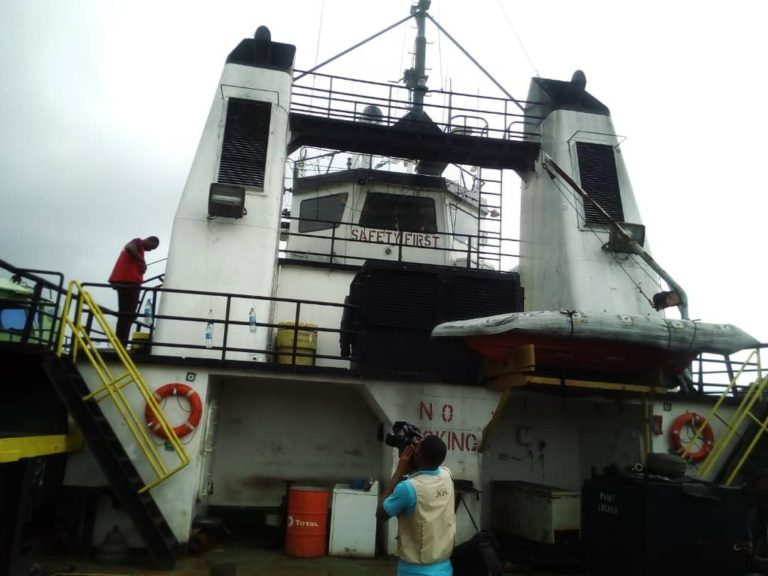
THE Nigerian Navy has handed over a Vessel, MV Messiah1 and Barge Miracle arrested for illegal oil bunkering to the Economic and Financial Crimes Commission (EFCC).
Tony Orilade, EFCC Ag. Head, Media and Publicity, said the arrest was made by Operation Delta Safe’s patrol team, Forward Operating Base (FORMOSO) of the Nigerian Navy in Yenagoa, Bayelsa State, and presented to the EFCC Zonal Office in Port Harcourt for further investigation and possible prosecution.
According to the statement, the Vessel and Barge were arrested by the team stationed at the Nigerian Agip Oil Company (NAOC), Brass Terminal, Port Harcourt, Rivers State on March 22.
The Naval Handing over Officer, Captain Suleiman Dantosho Ibrahim noted that both MV Messiah and Barge Miracle were each laden with 500,000 litres of products suspected to be illegally refined Automotive Gas Oil, (AGO).
Principal Detective Superintendent Shehu Jibrilla, who received the Vessel and Barge on behalf of the EFCC, assured the Navy of their diligent investigation and possible prosecution.
Similarly, the zonal office has commenced investigations of seven suspected oil thieves and two barges alleged to be involved in illegal oil bunkering.
The suspects were George John, Friday Kesiye, Longlife Adam Nanadighe, Ofuegbe Lukcy, Clement Abogha, Lawrence Brownson Kinanec and Kenneth Monday. The two other barges arrested by FORMOSO were Barge Kome XVIII (propelled by Tug Lady Virtue) and Barge Nicholas Marine (propelled by MV Aye).
According to the Naval Handing over Officer, Captain Suleiman Dantosho Ibrahim the two Barges were each conveying 500 metric tons of products suspected to be illegally refined Automotive Gas Oil (AGO), without necessary authorization.
“Four of the suspects were on board Barge Kome XVIII and the other three suspects were on board Barge Nicholas Marine when they were arrested.”
However, Principal Detective Superintendent, Shehu Jibrilla, who received the suspects and the Barges on behalf of the EFCC, assured the Navy of diligent investigation and possible prosecution of the suspects.
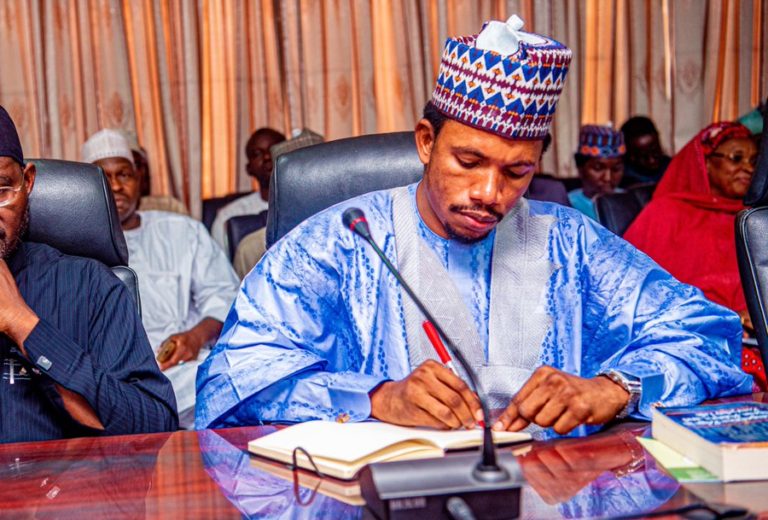
ELISHA Abbo, a lawmaker at the Senate, has been caught on a leaked videotape assaulting a woman at an adult toys store in Abuja after she pleaded on behalf of the store’s owner.
The video, published by Premium Times on Tuesday, also shows the senator inviting policemen to arrest the assaulted woman whom he accused of disrespecting him. In his response, the lawmaker said the event took place in March and that he was coordinating his team in order to properly respond to the allegation.
Since its release, Nigerians have continued to call for Abbo’s recall, arrest, and prosecution. Ahmed Lawan, the Senate President, also set up a committee to investigate the incident and the Inspector-General of Police likewise ordered his arrest.
Following the uproar, Abbo eventually tendered an apology “with a deep sense of remorse and responsibility”, and said the episode has taught him “a very great lesson both as a private citizen and a public officer”.
But who really is he? Here’s what The ICIR discovered.
Ishaku Cliff Elisha Abbo describes himself on Facebook as “an incorrigible optimist, fearless visionary, a generational blessing, intelligent and compassionate”. He married Ojukwu Uche Eucharia Cheche in September 2006 and has two children.
The 41-year-old is today representing Adamawa-North senatorial district at the ninth assembly, and he is reputed to be the youngest serving senator.
He is described as an Information and Communication Technology (ICT) expert, and his LinkedIn profile states that he is the chief executive officer of DTC Ltd.
Accused of plotting to rig Ekiti elections
Last year, in the build-up to the gubernatorial elections, the Kayode Fayemi Campaign Organisation (KFCO) alleged that former Ekiti State governor, Ayodele Fayose, was conniving with officials of the Independent National Electoral Commission (INEC) to rig.
The campaign organisation particularly named four INEC officials who it said were active participants in the plot: Egharevba John, Festus Aisien, Igidiogu Kelechi and Ishaku Abbo. Abbo, it said, led the team which had been lodging with the Fayose in the government house.
Bamidele Faparusi, KFCO’s Deputy Director General (South), in June 2018 said a secret meeting was held by all the parties at the government house and that “some sensitive INEC documents had been illegally produced” including stamps, result sheets, and accreditation forms.
“Curiously, these three top officials hold strategic positions in election management. One is from the Administration, one is from Stores and Distribution Dept while the other is ICT top official,” Faparusi said.
“For the reasons best known to them, only the Government House was their exclusive port of call; APC was never in the picture.”
Abbo soon after denied working with the former state governor to rig the election, describing the allegations as “blatantly false, malicious and a wicked attempt” to tarnish his reputation.
Discriminated against on the basis of HIV status
Academic papers published in 2002 and 2003 reported that Abbo, though he performed well after writing the recruitment test, was denied admission into the Nigerian Naval Training College, Port Harcourt, on account of his HIV status.
“According to his narration, he was admitted into the navy as a squadron leader and was then sent to Calabar for assignments. During the period a medical test was conducted without his knowledge of the reason of the test. He was later informed that he was HIV+ and was subsequently denied employment,” one study narrated.
In 2004, Abbo sued the college through a legal action instituted by Jude Okeke, then vice chairman of the Nigerian Bar Association, Abuja chapter. He asked the court to declare that his withdrawal was “illegal, unlawful and breach of his fundamental right to personal dignity”.
Jonathan’s political opponent until …
Abbo had, in 2015, been very vocal on his Facebook wall against the administration of former president Goodluck Jonathan and his policies, especially a perceived ethnic imbalance in his appointments. It’s also clear he publicly supported President Muhammadu Buhari’s policies during this period.
“No administration has used religion and ethnicity to divide Nigerians more than the current administration under the leadership of Mr Goodluck Jonathan. The ultimate test of any leader is looking at what has remained after he is gone,” he had written in March 2015.
However, in May 2018, Abbo wrote that he visited Jonathan, whom he described as “the father and Hero of democracy in Africa His Excellency Goodluck Ebele Jonathan (GEJ) the man that believed that his ambition is not worth the blood of any Nigerian”.
“I seized the chance to apologise to him for disagreeing with him politically in 2015,” he said. “In his usual characteristic manner, he opened his arms wide, forgave easily and received me with love. This man is the embodiment of humility and gentleness. We promise to redeem ourselves from our mistakes of 2015 come 2019.”
Elected senator
In February, Abbbo was elected as the lawmaker representing Adamawa North senatorial district on the platform of the People’s Democratic Party (PDP). He polled 79,337 votes, while Binta Masi Garba of the All Progressives Congress received 63,219 votes.
FOR a year and three months, Veronica Aloy Khenom worked tirelessly on her okra and cassava farm, just adjacent her home in Gokana, one of four local government areas in Ogoniland. One bright afternoon towards the end of January, she returned to finally gather the produce. But what she met was disappointing—though unsurprising.
Since constant spilling of oil has taken a great toll on the quality of soil in her community, making it less and less fertile, Veronica’s harvests have dropped in both size and quantity, despite the use of fertilisers. And she is no novice when it comes to farming. She learnt the work from her mother several decades ago and has since used it to sustain herself, feed her family, and sponsor her children’s education.
“Before the spill, when we farm sometimes, if it is okra, we can get four or five basins from one plot of land. But now, you will toil hard before you get one,” she laments.
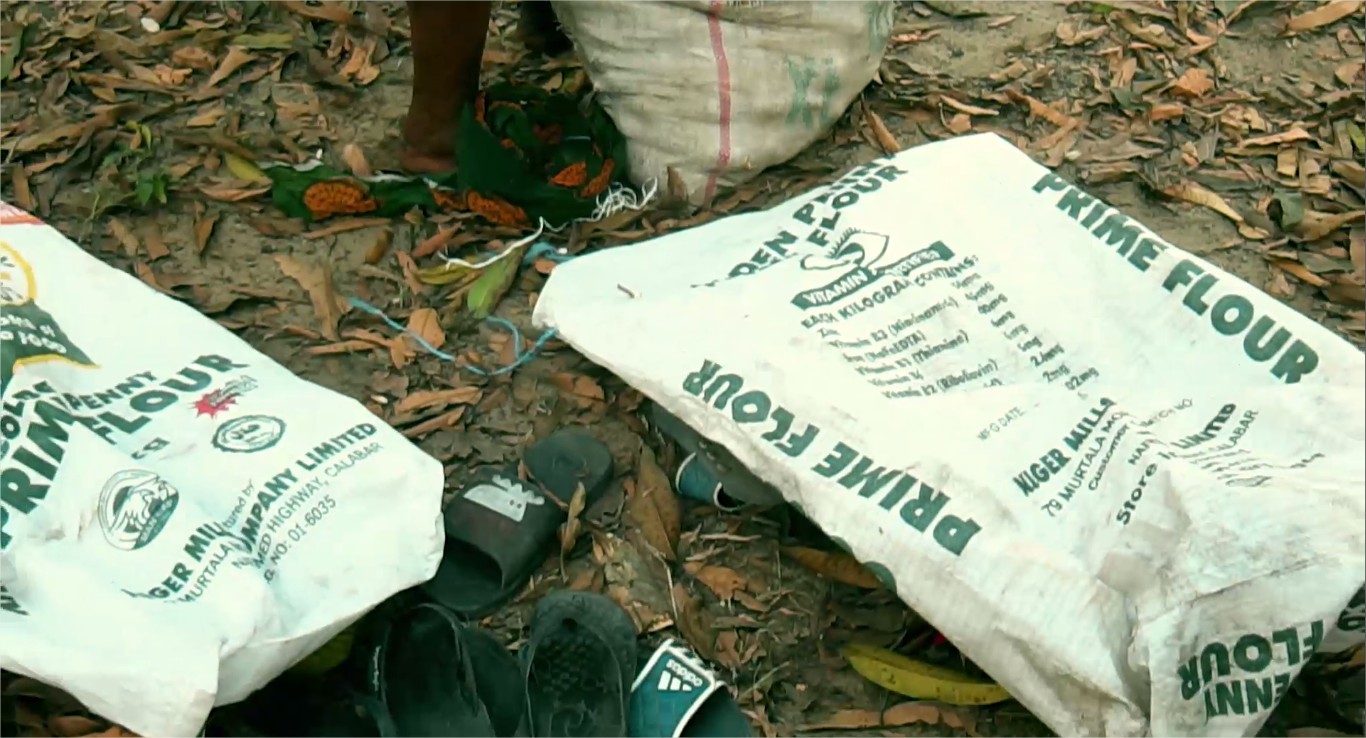
“You can see the cassava now. Before, we used to train our children with cassava, but look at it now. And this is harvest from all the farm,” the mother of four says as she points at empty sacks on the floor.
“In the past, today would have been our happiest day because we would have got money. But with this, you won’t get anything. Even if you try to sell this, nobody will buy because it is too small. The harvest is very poor.”
This has been the lot of Veronica for years and now she is considering a career shift to trading, which appears to be more profitable. Her children, one in JSS3, one in SS1, and the eldest, studying Surveyor and Geometrics at the Rivers State University of Science and Technology (RSUST), are all out of school due to financial constraints.
Kadi Aloy Khenom, 14, who hopes to become a naval officer, makes up for lectures missed by visiting her friends after school hours to learn from them.
“I hope to help the orphans when I grow,” she enthuses. “I won’t allow them to come the way I came—as in they won’t suffer these kinds of things. I have to give them a scholarship so that they can become something in the future.”
Veronica Aloy Khenom and her daughter, Kadi.
Besides the occasional produce harvested from their mum’s farm, the family’s only other source of livelihood is irregular writing gigs secured by the husband, a retired journalist. Aloy Khenom, who has worked with Sun Ray and Concord Newspaper, is often moved to tears by the thought of his children’s educational challenges.
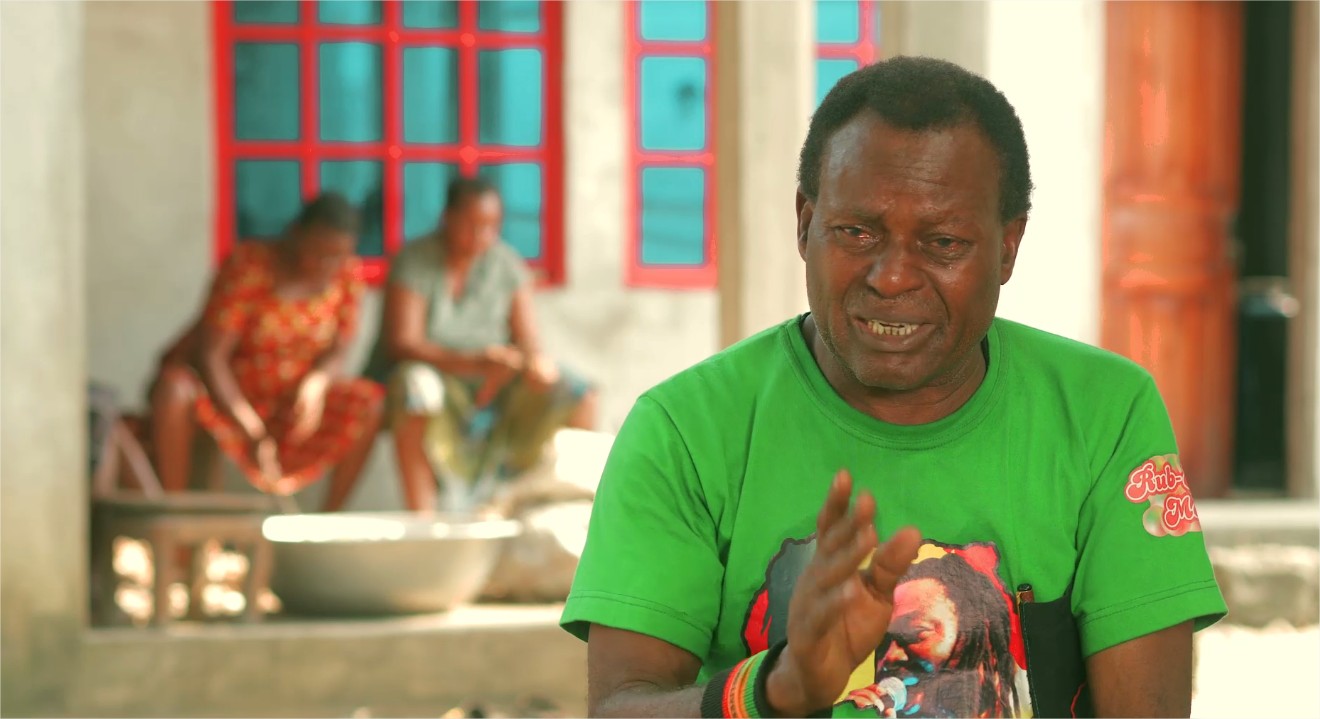
“That is my greatest concern,” he mutters, wiping tears from his left eye. “I am not always happy. Once a journalist, my colleague, came wanting to grant me an interview on this situation. What I did was put it into writing, because I don’t like talking about their condition.”
“Sometimes we will be in the house, they won’t know I am in my room lamenting,” he narrates tearfully. “I peep and look at them. Peep and look. They won’t know I’m lamenting—crying sometimes. It’s only them. They are my only problem. As for me, forget about the goodies of life. I’ve conquered that.”
“Only the children; their school,” he adds as he blows his nose with the help of a white handkerchief.
Sacks that should’ve been filled with tubers still empty after harvest.
The Aloy Khenoms are just one in hundreds of thousands of families in Ogoniland who have agrarian lifestyles and depend primarily on farming and fishing for a living. Communities where, in the past, the farmlands were lush and the fruits and roots blossomed have today become wastelands. Communities, where fish could previously be collected barehanded from rivers, have now become too polluted and dead to fishing.
“We are a people whose measure of economy is farming and fishing,” says Mene Steven Bari-ara Kpea, the paramount ruler of Mogho community. “But presently we are completely wiped out of that God-given gift. We are no longer farming, we are no longer fishing because of the pollution.”
Ogoniland, a vast community covering close to 1000 square kilometres in Rivers State, has been a hub of crude oil-related operations since the 1950s, and for many years has suffered from monumental pollution as a result oil spills and fire outbreaks.
In 2011, after it was commissioned by the federal government, the United Nations Environment Programme (UNEP) published what it called the Environmental Assessment of Ogoniland. It is a first-of-its-kind scientific study of the damages that contains operational guidance for repairing them.
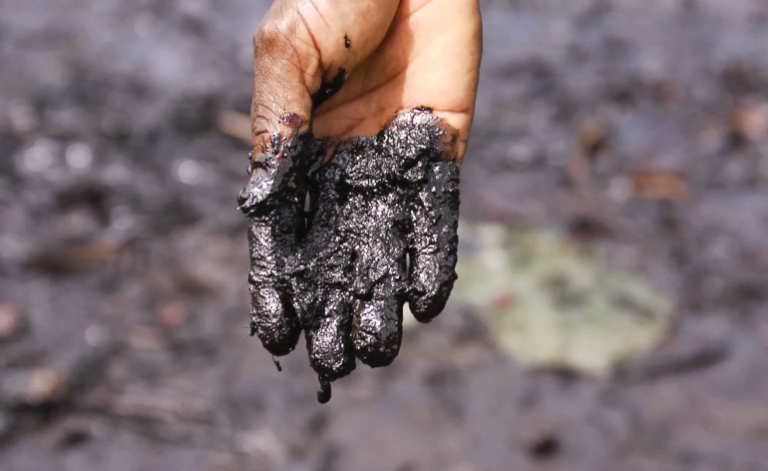
The study found that pollution by petroleum hydrocarbons is extensive in land areas and groundwater in Ogoniland. The pollution has led to the shrivelling of mangroves and killing of vegetation. Plants generally show signs of stress and yields are lower in impacted areas, the report said.
Floating layers of oil were found in surface waters, fish had deserted polluted areas in search of cleaner water, and community members were exposed to hydrocarbon emissions through air and drinking water.
“Hydrocarbon contamination was found in water taken from 28 wells in 10 communities adjacent to contaminated sites,” UNEP reported. “At seven wells, the samples are at least 1000 times higher than the Nigerian drinking water standard.”
In June 2016, the federal government finally flagged off the proposed cleanup and promised to set up the institutional framework necessary to drive the report’s implementation. Six months later, the Hydrocarbon Pollution Remediation Project (HYPREP) was reestablished to implement the UNEP recommendations.
The situation has, however, not improved eight years since the report’s publication and three since the cleanup’s launch. Among several other problems, people in Ogoniland often lament the unclean state of the water available for drinking. One resident of Goi community said the water always has tastes of salt and oil, but the villagers have no choice but to drink since there are no alternative sources.
Residents have reported constant visits to hospitals due to excess purging, prolonged urination, stomach biting and so on. “Normally we go to Bodo City General Hospital twice a month,” one resident discloses.
Aloy Khenom couldn’t contain his tears as he spoke of his children’s inability to attend school.
Where have the fishes gone?
Bad as it is, it is not only the farmers who have something to complain about. For people whose survival depend on fishing and fish sales, adapting has also been tough. Yvonne Peace lost her dad three years ago and, alongside three of her siblings, she has had to depend on her mum’s roasted fish business to carry on. But what used to be a booming trade is now an activity residents, middle-aged women especially, engage in for lack of alternatives.
Though the community has benefited from a cleanup exercise, residents say the river is still vastly polluted. Since nearby water bodies are no longer safe for sea life, Yvonne’s mum now travels to faraway places such as Calabar to buy fish to sell, spending the bulk of her capital on transport. Due to a lack of resources, Yvonne has written her secondary school certification examination but cannot proceed to a tertiary institution.
“I was having it in mind to engage in manual work because, for now, my mum does not have the means for me to continue my education,” she says, sitting at her mum’s tiny spot in the market, where she regularly helps with sales.
The story is not very different for Clara Ipepe and Tumbo Bovi, also fish vendors at the market. For the past five years, they have had to travel 25 kilometres to Bonny Waterside every three days to buy fish, spending an average of N6000 on the boat ride. A business that used to yield gross revenue of N20,000 to N30,000 on a daily basis now yields between N2000 and N5000.
Yvonne Peace.
For, Paul Nuvoo, a fisherman from Mwemuu community with a wife and two children, things have never been the same since the oil spills. As he fetches water from a well, which he says is only good for bathing, he complains of how fish have been scarce from the rivers.
He had been out to fish since nighttime. It was evening, but no fish had yet been caught. The last time he was lucky was the previous week and, with their austerity, the fish he got then should serve his family for a while—hopefully long enough to last till he gets lucky again. Nuvoo’s children have had to drop out of school because he hardly could earn enough from fishing to feed them.
The search for survival
The pollution has so much destroyed the riverine areas that thousands of Ogoni residents, both young and old, now migrate to cities in search of menial jobs.
33-year-old Nibari Burabari, who has spent most of his life in the rural environment in Tai Local Government, moved to Port-Harcourt in January with nothing but a t-shirt and pair of jeans. There was nothing left to do back home, he says. All the jobs are gone—including farming and bricklaying. He used to attend Bilabi Memorial Grammar School but had to leave after his father’s death because he could no longer afford the fees.
“I see that if I come maybe my help would come from somewhere,” Burabari says. “Even if it is clearing of gutters I would do if they pay me. I can’t just move about in the village doing nothing.”
Sitting outside a restaurant where he had come to beg for food, he says the last time he ate anything was 48 hours before the meeting.
He reveals that there are countless young boys like him at the village also aspiring to leave at the slightest opportunity, but they don’t have places to stay. But Burabari isn’t anymore privileged. Since he got to Port-Harcourt, he has been sleeping in odd places, open churches being one of his favourites. By dawn, he moves about the city again looking for where to work.
Burabari is not asking the government for too much, only stable employment and a chance to “become something” in life.
Nibari Burabari: “Even if it is clearing of gutters I would do if they pay me.”
Young men aren’t the only ones leaving Ogoni for the cities. NGOs that work on the migration of youth in the Niger Delta say a great population of girls also, who used to dwell in the villages, now find themselves in the cities—most of them surviving through sex work.
“People think because of industrial activities there are jobs in the cities, so they come and they become disappointed and stranded. They do a lot of things, and the young girls also fall into wrong hands,” explains Emem Okon, founder of the Kebetkache Women Development and Resource Centre.
“Most times they know what they are doing is wrong. It is not good for them, it is not good for the society, but they tell you they don’t have alternatives. Some have to sponsor themselves to school. They don’t want to go back home. They came to Port-Harcourt and they don’t have anything doing. So they just need to survive.”
‘Environmental refugees’
The increasing trend of youth, and general, migration can be observed in numerous communities. Mene Eric Barizaa Dooh, the paramount ruler of Goi, says his community could before boast of a population of 15,000, “but now everybody is in the diaspora”.
“We are environmental refugees,” he adds, briefly raising his eyebrows to stress the point. “Because of the disaster that has taken place here, this place is no longer habitable for human beings unless they want to die.”
The desertion can also be noticed easily by people visiting Mwemuu community. What used to be home to over 2000 people now barely has up to 300 on a good day.
“Most—at least half of this community—is living in the city there,” the community chief, John Nadabel, says. “Others followed their in-laws to nearby communities like Andole, Okrika,Bonny. So eventually the whole community became deserted.
“As a chief, I cannot desert my community. I have to be here. But even as I’m here, my family cannot stay with me because of the pollution. The air, the water, the fish, even the crops we planted in the farm were all contaminated.”
The contamination in Mwemuu is such that has led to death not only crops but animals too. Given its location close to an international water route, the mass departure has exposed the community to looting by opportunistic travellers. “There is another community we call Siato there, you can’t even see a single building. Every infrastructure has been looted,” Nadabel says. The few fishermen working in the community also often have their fish and foodstuff stolen by strangers.
The community chief foresees two sets of possible future events. If the cleanup takes place as planned, then life will be restored to Mwemuu and it will once again become a full-fledged community, capable of feeding itself and exporting crops to neighbouring cities.
On the other hand, if the cleanup is unsuccessful, he predicts, “even the few who are living here and coming to see us will be gone; all these buildings you see will collapse”.
Abandoned Goi community
Abandoned Goi community
Abandoned Goi community
Abandoned Goi community
Abandoned Goi community
Promises upon promises
Though many people have read that the cleanup exercise has started, residents of the affected communities have seen little or no changes and are increasingly losing hope in government. There are those who see the project as just one of such promises that have been made in the past, with nothing to show.
“The future that I’m seeing now is the future that only God will save for his people,” Veronica’s sister says, wearing a tired look as she slowly peels cassava tubers in front of her.
She explains: “Somebody can just come out now and promise he will do this, he will do that. By the time he is out of sight, that one is gone. We won’t hear anything about that story again. Promises upon promises from the government. They will come and clean up the environment, they will sanitise, they will do this, they will build hospital, they will do that—all are just in vain.
“The case of Bodo city is not a hidden one. The federal government knows about the situation of the Bodo people. A fisherman cannot go for fishing and bring back fish that will be enough for the family not to talk of to go and sell it. A farmer will spend all day on the farm and, at the end of the farming season, this is what he will see.
“Now tell me, how are we going to take care of our children in this kind of condition when it is the only source of income for most families in this village? How are we going to cope? That is why I said the solution is only in God. It is only God that can come and intervene for us.”
Pushed into crime
When the cleanup exercise was flagged off in 2016 by Vice President Yemi Osinbajo, he had assured that “the methodology for the clean-up will ensure job creation for young people”. Three years on, many youth are still jobless.
The staggering unemployment rates may have pushed many into crime, including artisanal refining. Many residents believe, since the government has neglected them, they have no option but to take matters into their own hands and benefit however they can from their resources.
Artisanal refiner: “This is the only way to survive in this environment because there is no government support”.
Former information officer of the Movement for the Survival of the Ogoni People (MOSOP), Bara-ara Kpalap, says the activities are condemnable and should be stopped as they have continued to lead to greater environmental devastation. But putting an end to them is not going to be easy.
“It won’t be easy for them to say they are going to leave it, or that they are not going to do it again when there is no alternative,” he explains. “And that is why we have advised that for you to effectively discourage that activity, we must have alternatives like providing training, among several other things.”
He urges the federal government to take the implementation of the modular refinery scheme more seriously in order to discourage the illegal refiners and provide them with a lawful alternative.
Chairman of the Ogoni Council of Paramount Rulers, Barisi Kpaama, says it is the “I-can’t-help-myself syndrome”, coupled with illiteracy and unemployment, that pushed people into artisanal mining. He also believes the activities may even be sponsored by the government.
Explaining, he says security agents are always glad to be deployed to Ogoniland because of the opportunity to make money from supporting the activities of illegal miners.
“The police are involved, the armies are involved, the civil defence are involved,” he asserts. “They are all collaborators and conspirators… Is the police not a representation of the government? That is why I said it is government-induced. What they are doing is they are pretending. There is no challenge in a nation that if the government wants to put a stop to it, it will not stop.”
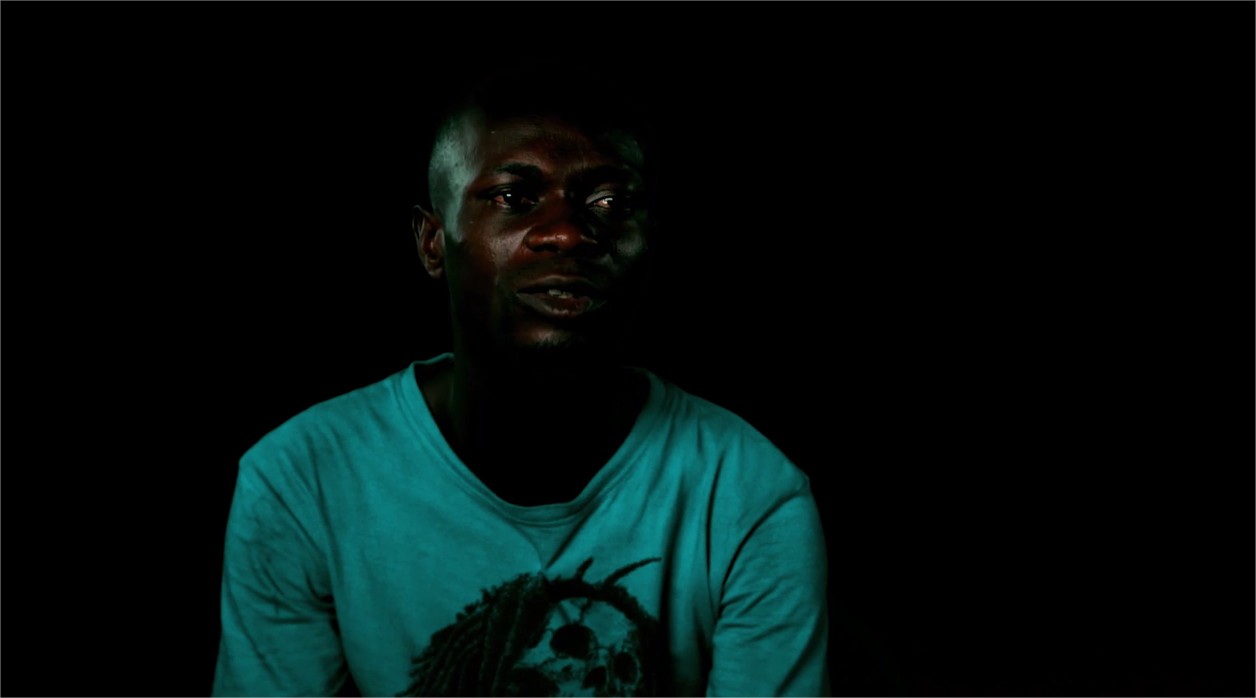
One of the local refiners who spoke to us says it is a dangerous undertaking but they have no choice but to continue as there are no other jobs available.
“This is the only way to survive in this environment because there is no government support, there is no company, there is nothing we can use to survive,” he says. “And since we have this oil, instead of us to die this way, we prefer to do this refining, to survive with our family.”
He advises HYPREP to leave them to their livelihood unless they are willing to clean the oil effectively in a way that benefits everyone. He also says he and his colleagues will not support the cleanup exercise except they are given jobs that will make them and their families comfortable.
From artisanal refining, many of them have built houses, bought cars, married, and taken care of many other needs. And unless government is replacing it with gainful employment elsewhere, he adds, it is only wishful thinking to expect them to go back of a life of untold hardship and poverty.
This report was developed using resources for a documentary produced by Oak TV.
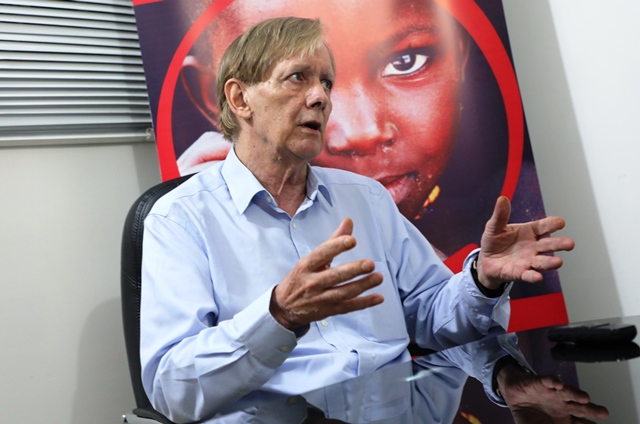
Ben Foot is the Country Director of Save the Children in Nigeria. The humanitarian organisation is currently working in Maiduguri, Borno State capital taking care of children who are victims of insurgency. In this interview with YEKEEN AKINWALE, Foot who was born in Nigeria and also married to a Nigerian says Save the Children has reached out to over a million children in the troubled areas in the past six years, but there are over one million people that are yet to be reached by humanitarian workers in the state due to insecurity. He laments that everyone claims that children are the future but are unwilling to invest in education and health services.
EXCERPTS
CAN you cast your mind back when you were coming to Nigeria to start Save the Children, what was the feeling like?
I was really quite excited about it because I was born in Lagos many years ago and my father was then the colonial administrator and acting governor. I was born here but left when I was just two or three and a half years old. So, I got this picture of myself in some chief’s outfit with my brother, he was bigger, standing somewhere in Lagos.
Anyway, I was very excited about it. I was coming from Ethiopia; Ethiopia at that time was the biggest programme of Save the Children in the world. I did eight years in Ethiopia. So, after that, maybe it was time to move on. So, where do you go from the biggest programme? So coming to the biggest country in Africa with no programme at all seemed to me to be a challenge I could take on.
By that time I knew very little about Nigeria and to tell you the truth, it has got a bad press in those days. There were stories of fuel crisis continually, long queues for fuel, there are things you read, customs men were very aggressive to you and there was always request for money and queuing on the line. In fact, I didn’t experience it at all, when I arrived in Abuja, it was a clear sail and everyone was very polite and extremely friendly and I found Nigerians generally to be so.
So, what you read in the press was actually different from what you saw on the ground?
Certainly, in terms of my arrival, the fuel crisis was certainly there. That is long queues of cars, having to buy fuels from boys on the road. But I have done two stays here now, that time I came in 2001, it was seven years and I went away for seven years and I have come back.
During that initial seven years, I like the country so much that I married to a Nigerian. Now, I have two Nigerian children /British but Nigerians. So, Nigeria is my second home. I have always found in the Nigerians ideal way to be extremely friendly, helpful, and polite and I have enjoyed it tremendously. So, coming to start from scratch was obviously very daunting, because it is such an enormous country, where do you start?
So, we chose to go to Kaduna because in 2000 you may remember, there was a major civil conflict in Kaduna where up to a thousand people were killed over a couple of nights of rioting. We decided to go there because also Kaduna is the cross between the north and south of the country and once you move out of Kaduna you are going into the deep north of Nigeria and I was aware from previous reading that northern Nigeria was much more under-developed than Southern Nigeria and as a home specter of problems related to children —putting it bluntly— worst in the world. I think if you put Nigeria together it is not the worst in the world but if you take out the North which is trying to disaggregate it, its indicators for children are worst.
You have seen it all, how would you describe the North-east humanitarian crisis?
Well, the North-east wasn’t in the crisis when I was here in the first time, because I left in 2007, Boko Haram was not around then. I arrived the second time which was in September 2014, I noted straight away that we were not doing anything in the North-east. It is the priority of Save the Children to respond where there are crisis and children are in need. We were aware that Boko Haram was making significant advances into Borno State, and people were moving out of the North of Borno State in very large numbers into Maiduguri. We thought we had to go in there and do something about it.
What I don’t know enough about is why did Boko Haram happen, and from what I heard from people talking to me was that the management of the movement in the early days was not done very well and while they try to engage with these people they (government) tried to stamp them out and that is not the way to deal with it. I understood they killed one of the leaders at the time.
I think you have to be very careful when you are talking about conflict because from my point of view, we don’t recognise one side or the other side. What we recognise is the suffering of children, and so whether they are children coming out of being captured by Boko Haram, whether they are children who are displaced, lost their parents, whether they are young girls displaced and raped or girls who have been taken away by Boko Haram, and in some cases when bomb is strapped on them and carrying explosives. So, that is always our focus and not the politics.
So I’m not going to sit here and condemn Boko Haram, I’m not going to sit here and condemn the government of Nigeria, that is not my job. My job is to try and reach out to the children in need. And that makes your life a lot easier because you are very focused on that.
Obviously, insurgency is against everything I believe in, but that doesn’t mean I’m not going to try to help people that are in need. We know that the Boko Haram come out of the community, most of them, there may be a few foreign fighters now, but they come from a community and they have some support in the community. It is important that people understand that we are not dealing with some external force that is invading Nigeria. We are talking about an internal force that is coming out and that needs to be recognised and again it’s not my job. It is the job of the government to see how they can reconcile the situation. And if you ask me bluntly what I think is the solution, there can be no solution until the government starts to engage with the Boko Haram.
So far so good, how many children have you been able to come to their aid in the North-east?
I might have to look at the exact figure, but we have been there for five years, so I think it is well over a million that we have reached out to in the North-east. We do a number of different things; we do what is called therapeutic feeding, what they called Out-Patient Therapeutics (OTP). What we do there is that we provide a monthly ration to each child so that they can eat very high energy stuff and regain their weight, so, that’s one thing we do.
We have a centre where will take severely malnourished children, they have intensive medical care until they are put back onto the therapeutic regime and then they get better, that’s one of the groups of children will do. The other group is what we called children at risk, they could be at risk for several reasons; they could be at risk because they were separated from their parents; they could be at risk because they are disabled; they could be at risk just because they are girls. What we do is that we identify these people, monitor them and refer them to other players who could support them like the government or we can continue to support them. We also try to identify potential foster parents for these children.
One of the three reports Save the Children launched on Tuesday, you talked about the huge number of teenage girls who have not gone to school and you also talked about children and caregivers who would need psychosocial support services, how do you think this can be addressed because they are actually at risk?
Well, it is very interesting actually because everywhere in the world where there is a conflict suddenly appearing or going up, the last thing that gets funded by the donor is education. They (donors) will fund food aid, they will fund non-food item, and they will fund water, but get money for education? If you look at the figures now, you will find out that education is the most under-funded sector. We struggle to get for education, but we have gotten some now and we are trying to work around an approach which is called Save the Schools Initiative.
So, the idea is that you actually start working more with the children themselves and the teachers in the school to make sure that the community can protect the school. And that we have early warning indicators that enable people to know when an attack might be made on that school.
Also, it is trying to keep the military out of school because if the military are in the school, even as a security man, he is a target for Boko Haram. So the military are not a protection for the people, because they are the main people fighting the war, they are going to be targets. For example, we have never used military escorts because we feel safer without them than we do with them. We think if we do that we try to attract problems to the people that are supposed to be protected.
There are about 50 agencies over there and there is what we call working groups- water group, education group and all that. They work and plan together. There is a coordination structure that exists.
The main thing that is actually stopping us from reaching everybody is the fact that a million people at least are stuck or are still inside Boko Haram’s territory. We cannot go there not because Boko Haram is stopping us but because the military is stopping us.
Do you have problems in assessing some areas where the insurgents control?
Yes, we do because we are not allowed to go, the military will stop you. The northern parts of Borno are more or less a no go area and even then you can even not go to somewhere in Konduga, which is just South of Maiduguri or any other areas under Boko Haram. To be fair to them, they are trying to make sure that we are safe and that we don’t go into where they are having a fight with these guys. But also that, they don’t want foreigners moving into an area where they are in combat and I totally understand that. But at the same time, we need to try and engage them more and get them to allow us to have access because we don’t feel that we are a threat to Boko Haram. We feel this is a war between the military and the Boko Haram, the fight is not between the Boko Haram and the humanitarian actors. Apart from the UN, no NGO has ever been targeted by the Boko Haram fighters in five or six years.
How do you think the federal government can solve this problem?
I just wish the politicians understood the future and didn’t care so much about the present. In Nigeria, we have this terrible rift between the very rich and the very poor, and there is enormous amount of money in this country. When I drive between here (my office) and my home, I see these palaces that were built, enormous buildings and then you go out to the shanty areas in the edge of town and you see ten people living in a room, not even a room, in a makeshift sack, I think Nigeria has to resolve that problem. I think if you look at the way the budget is structured, the amount of money that goes into services for children like education, health is a peanut. Everyone said children are the future but they don’t want to invest in it.
THE Economic and Financial Crimes Commission, (EFCC) on Tuesday arraigned a suspected serial fraudster, Scales Ishola, on a 45-count charge in Uyo, Akwa Ibom state.
The Uyo Zonal Office of the EFCC arraigned Ishola on charges bordering on impersonation, obtaining by false pretence, conspiracy and fraud.
The case was presided over by Justice A.A. Okeke of the Federal High Court sitting in Uyo, the capital city.
According to a statement from the EFCC, Uyo Zonal office, one of the charges reads:
“That you, Scales Olatunji Ishola ‘M’, Meraiyebu Charles ‘M’ (at large), Gabriel Adeyemi Olugbenga ‘M’ (at large), Ojomo Oluwatobi Ayodele ‘M’ (at large) and Adekola Oluwatoyin (at large), between January 2017 to October 2018, in Nigeria, within the jurisdiction of this Honourable Court with intent to defraud, did knowingly cause the loss of N525,172,580 (Five Hundred and Twenty-five Million, One Hundred and Seventy-two Thousand, Five Hundred and Eighty Naira) only, being property of the government and people of Norway and thereby committed an offence contrary to Section 14 (2) of the Cybercrimes (Prohibition, Prevention etc) Act, 2015 and punishable under the same Section.” The paper said.
Ishola and his accomplices, who are currently at large, had a speciality in impersonating people, using their identity to defraud unsuspecting victims by sending business emails with fake identities and duping them of several million in various currencies.
He pleaded “not guilty” to the charges.
The counsel for the EFCC, Nwandu Ukoha, in view of his plea, prayed the court to remand him in prison and fix a date for commencement of trial.
“The court had on July 1, 2019, granted an application made by the prosecution seeking an interim forfeiture of properties belonging to them. The properties include House No. 6, Road 2 Westend Estate, Ikota Lekki, Lagos State, and House No. 10, Donatus Odum Street, Ikate, Lagos State,” the paper read.
The matter was later adjourned to October 16 for the hearing of bail application.
Following a recent rape allegation against Biodun Fatoyinbo, senior pastor at the Commonwealth of Zion Assembly (COZA), one claim that has gone viral on the social media is that only 18 defendants have ever been convicted of rape since the start of Nigeria’s legal history. But checks by The ICIR show this to be inaccurate.
The statement originated from a speech delivered by human rights lawyer Evans Ufeli who reportedly said at an event in 2015 that, “The Nigerian criminal code recommends life imprisonment for rape convicts and 14 years for attempt rape, but only 18 people have ever been convicted in Nigeria.”
He has, however, denied saying this, in an interview with The ICIR, and attributed the error to the journalist who filed the report. But this has not stopped many, including academics and foreign organisations, from believing and restating the claim.
Ireti Bakare-Yusuf, the Principal Partner of NottingHill Media, repeated the statistic in a 2018 interview with the BBC Pidgin. “Since Nigeria was born, 58 years, we only get 18 rape convictions,” she said.
Google’s search engine returned “about 560 results” for online platforms where this claim has been shared, including Nairaland, Lawyard, Daily Advent, Medium, and Academia. It was also cited in this 2016 Country Information and Guidance report published by the United Kingdom Home Office.
When the scandal against the COZA’s pastor went viral on social media, many Nigerians dug into past records to resurrect the 2015 claim and it has again gone viral—as proof of everything that’s wrong with the Nigerian criminal justice system.
The claim was shared here on Twitter and has also been widely circulated on Facebook and WhatsApp. One of the tweets has been liked 205 times and retweeted by 316 users, and a similar post on Facebook had over 5,500 reactions.
“I heard something profound yesterday, which was confirmed to me by a lawyer today,” one Nigerian, Etin-Osa Imagbenikaro, tweeted. “In the history of Nigeria, we have only had 18 rape convictions so far. 18!! The law as it’s written on convicting a rape case is very archaic and does not do justice for the victims.”
Our findings
The lack of an aggregated record of sexual offenders in Nigeria makes it difficult to state with certainty how many convictions have been recorded over a period of time.
Some have clamoured for the country to introduce a Sex Offenders’ Registry for this purpose as is the case in Australia, Canada, USA, USA, and other countries. For now, only Lagos and Ekiti states are notable for having such a registry, but even these are not easily accessible and are said not to be regularly updated.
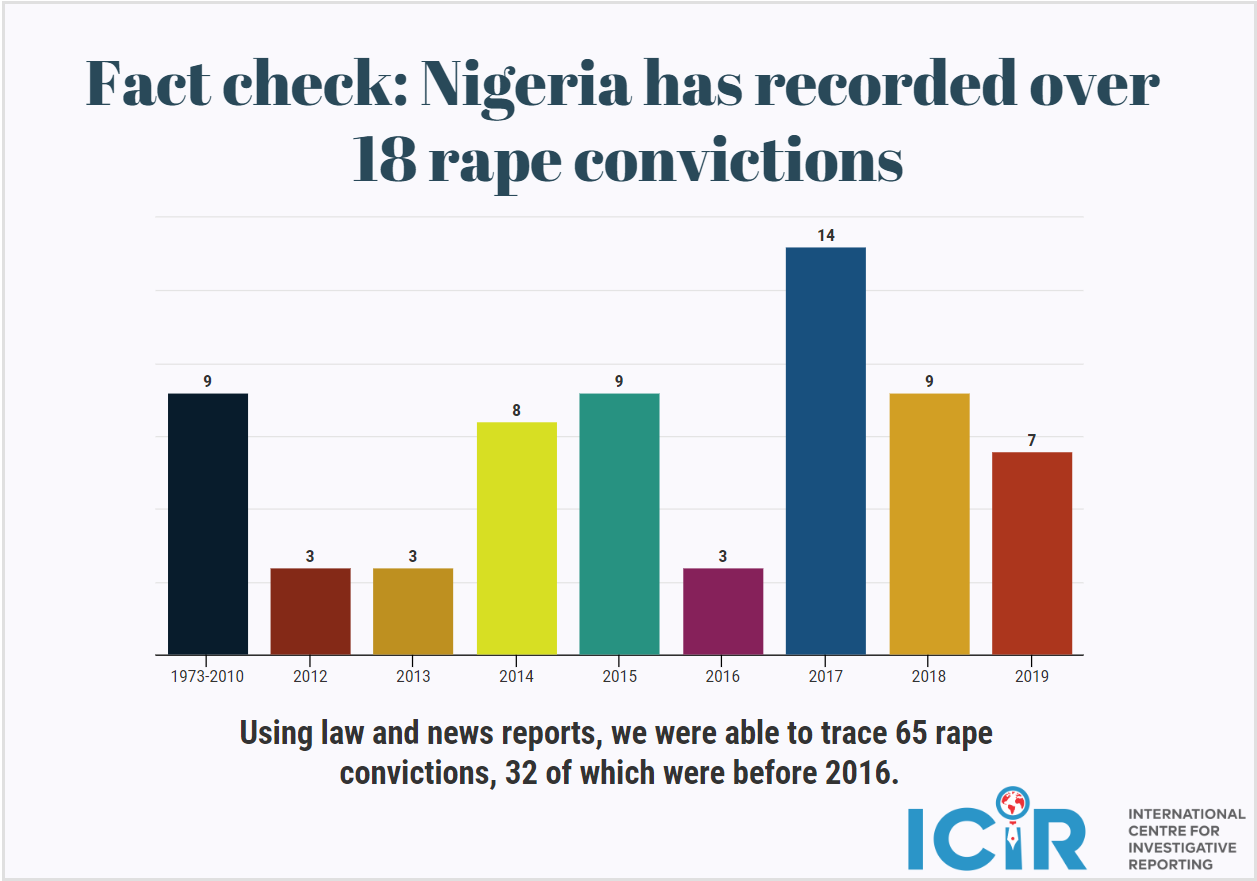
However, in fact-checking the validity of the claim, we mined both law reports and news reports focusing on court cases where there were rape charges, and we were able to trace and gather 65 rape convictions between 1973 and 2019.
Of all these convictions, 32 took place in 2015 and the years before, while 33 took place after 2015. Most of the verdicts were delivered by Magistrate, Sharia, Upper, and High Courts. The punishments range between seven lashes of the cane and death by hanging.
And this list isn’t exhaustive. It does not include all the cases mentioned in law reports or spotlit by reports from media organisations. Also, not all convictions secured against persons alleged to commit rape make their way into such reports in the first place.
This was confirmed by Chinedu Obianu, lawyer and Principal Partner at Zest Partners, who said though rape is an offence that’s difficult to prove in court, “that figure is too small” and not reasonable.
He said finding the accurate statistics will involve research into law reports, noting that the reports cover only judgments from the Court of Appeal and Supreme Court. Consequently, cases that are not appealed beyond the high court level will not be featured.
“But the truth is that the bulk of these cases are handled by the various state high courts and magistrate courts across the nation,” he added.
This is not to suggest that Nigeria does not have very low conviction rates when it comes to sexual assault cases. It has been noted that out of a total of 283 cases of child defilement reported in Lagos in 2011, only 10 were prosecuted and convicted, and studies suggest that “sometimes as much as 84 percent of the female population have experienced sexual assault or defilement in childhood”. This means there is a conviction rate of less than 10 per cent.
Wanda Ebe, the founder of Wanda Adu Foundation, an NGO aimed at eradicating violence against the girl-child, said she does not know the exact number but “a lot of times we don’t get justice on rape cases”. She blames this on victim-blaming and extortion by police officers as well as inefficiencies in the judiciary.
“I haven’t seen any case where justice is served that I have handled directly,” she told The ICIR. “And, even for my sister-colleagues, I just hear of reports, investigations, follow-ups, but we have never been successful in getting justice on any case of child defilement. So it is annoying and discouraging because the whole justice system is messed up.”
Verdict
Even though the exact figure is not available owing to poor record-keeping, available reports show that Nigeria has recorded well over 18 convictions for rape trials—even as of 2015. The claim is therefore not true.
‘I said 18 per cent, not 18 cases,’ Ufeli clarifies
Ufeli, whose reported statement is the origin of the misconception, has told The ICIR he never said what was reported in the online paper. Cadrell Advocacy Centre, where he is the executive director, had conducted a survey that focused on incidents of rape between 2005 and 2015.
The advocacy group, which provides legal aid to indigent sexual assault victims, had discovered that the alleged perpetrators were only convicted in 18 per cent of the cases studied.
“We did a survey looking at the conviction rates and then looking at possible causes and effects of the low rate of conviction,” Ufeli said. “We posed a lot of questions: is it that the rape incidents are low? Or is it that it is high but the legal system is weak? Or is it that both the legal system and the offence are both weak and low?”
“Then we conducted this survey and found out that from all the cases that have been conducted ten years to that time, there was a conviction rate of 18 per cent. Not even from 1960; Premium Times went to write that from independence,” he clarified.
“It was shocking. A lot of people called me. Even I was invited to the UK on that issue, and I had to explain to them that it is not 18 cases. It was 18 per cent and it was in a span of 10 years; 10 years to that event.”
He also said he has asked Premium Times to correct the error in the report, but “it’s still like that till today and a lot of people are doing research; they are making reference to it. And my name is there.”
President Muhammadu Buhari says he will sign the agreement establishing the African Continental Free Trade Area (AfCFTA) at the upcoming 12th Extraordinary Summit of the African Union.
The African Union Summit is scheduled to hold between 4 and 8 July in Niamey, Niger Republic’s Capital.
The President announced its position on the intra-African trade through his official Twitter handle on Monday, a week after he received the report of a committee assessing Nigeria’s readiness for the free trade.
“Nigeria is signing the African Continental Free Trade Area Agreement after extensive domestic consultations,” presidency tweeted.
He said that Nigeria focus will be on taking advantage of ongoing negotiations to secure the necessary safeguards against smuggling, dumping and other risks or threats.
Buhari, when he was receiving the committee’s report on June 27 that measured the impact on and readiness of Nigeria for the Africa free trade, noted that the Country’s will support as long as “it is fair and conducted on an equitable basis”.
He mentioned how the intra-African trade is only 14 per cent of Africa’s total trade, adding that the region consumed more of non-African countries’ goods. But he said his vision for AfCFTA is for the free movement of ‘made in Africa goods’ which is goods and services made locally with dominant African content in terms of raw materials and value addition.
African Continental Free Trade Area seeks to create a single market for goods and services, with free movement of people and investments across African countries. While it came into force on paper in May, Nigeria is one of three countries, including Benin and Eritrea that has not signed the business deal. But as Nigeria agreed to sign in a few days, the duty-free movement of goods in the region is a step closer. Once the deal is passed by all 55 nations recognised as part of the African Union, the agreement will come into full force.
THE Nigerian Senate has set up a committee to probe Elisha Ishaku Abbo of the People’s Democratic Party, representing Adamawa North Senatorial District, for an alleged assault of a woman at an adult toy shop in Abuja.
The Inspector General of Police, Mohammad Adamu, in the same vein, has ordered the arrest of the senator, according to Frank Mba, Police Spokesperson on Wednesday.
The 41-year-old Abbo, according to a video clip that went viral on the social media on Tuesday, was caught in a sex toy shop in May physically assaulting a woman after she pleaded with him not to abuse the shopowner whom the senator had earlier accused of insulting him. The Senator called a policeman to arrest the shopowner. While the senator was beating up the woman who had pleaded with him to calm down, the police officer made no attempt to stop him. Rather, he attempted to arrest the victim.
The incident happened months after the Abbo won a senatorial seat at the upper legislative arm and a month to his swearing-in in June 11 as a member of the 9th National Assembly. He had gone to the shop to make purchases of adult toys.
The assault has sparked outrage on social media where many Nigerians have called for justice for the victim.
In response to the incident, Ahmed Lawan, Nigerian Senate President has set-up a committee to investigate the issue. Lawan announced the bipartisan committee on Wednesday in Abuja following a point of order that was raised on the matter by Uba Sanni of the All Progressives Congress (APC), representing Kaduna Central Senatorial District.
The committee has two weeks to submit its report, Lawan mentioned. He added that the matter would be investigated and all sides would be given a fair hearing, even while it remains an allegation.
To also address the issue, IGP has also ordered the arrest of Abbo. The police said investigations are currently ongoing by an investigative team set up by the Police Force headquarters in Abuja.
Nigerian Police Force says “they are doing everything within their powers to restore dignity to the force”.
“Let me re-assure that the Nigerian Police will not sit back idly and watch the right of Nigerians trampled in any way. We hold our loyalty to the Constitution, law, and people of this country. And this we will defend,” said the Police.
SHORTLY after their inauguration on May 29, 2019, governors of Oyo, Ogun, Bauchi, Imo, Gombe and Zamfara have cried out that their predecessors have left huge debt profile for their respective states.
Each claimed that the former governors have plundered the states’ wealth and would be near impossible for them —the incumbents, to govern well with empty treasury.
Their predecessors have countered the claims of leaving debt behind.
While they exchange blames, none of them (incumbents and predecessors) have been able to make public, their complete debt profile . This has prevented the public from knowing the actual debt profile of each of these states.
However, The ICIR has compiled the debt profile of the six states and presents same viz-a-viz claims by the governors and their predecessors. The profile includes what each past governor inherited when coming to office in 2015 and the debt profile as of December 2018, according to the latest record of Debt Management Office (DMO).
Claims and counter claims by governors
Abiodun tackles Amosun
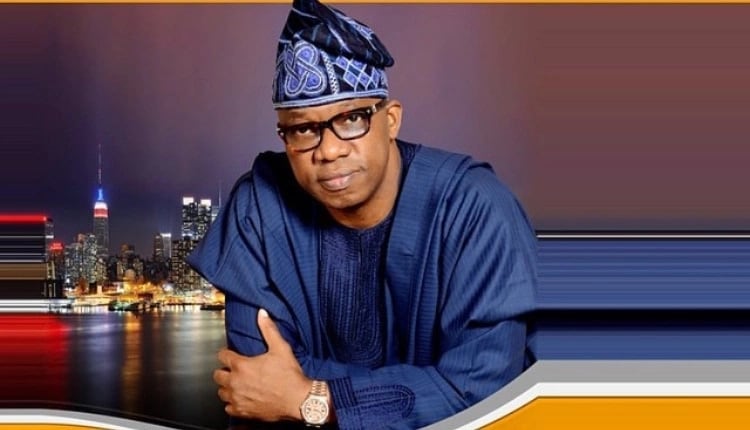
Governor of Ogun State, Dapo Abiodun
Almost a month after he took the oath of office, Ogun state governor, Dapo Abiodun, said he inherited a state treasury with “almost nothing” from his immediate predecessor, Ibikunle Amosun.
But Abiodun, who was silent on the amount he met in the state’s account, said he had to borrow money from his friends, who are Managing Directors in some commercial banks, in order to pay May salary, which he puts at over N7billion.
“I cannot begin to describe in the open to you the Ogun State that we inherited. I cannot begin to describe it to you. I will not because I have made up my mind that publicly and privately, I will not discuss anything about the past administration,” he said at a stakeholders meeting of the ruling All Progressives Congress (APC) held in Abeokuta.
But Amosun’s Allied People’s Movement (APM) faulted his claim by describing it as a concoction of lies and clear evidence of his lack of preparedness for governance.
While these claims and counter claims continue, search by The ICIR revealed that Ogun State domestic profile according to the Debt Management Office (DMO) as of December 2018 published in April 2019 was N98.8billion while its external debt for the same period was $105million. The domestic debt in December 2014 published in April 2015 when former governor Amosun was commencing his second term was N70.2billion while the external debt was $104million.
From these figures, Ogun State’s domestic debt profile increased from N70.2billion to N98.8billion while its external debt also increased marginally from $104million to $105million.
Ihedioha and Okorocha
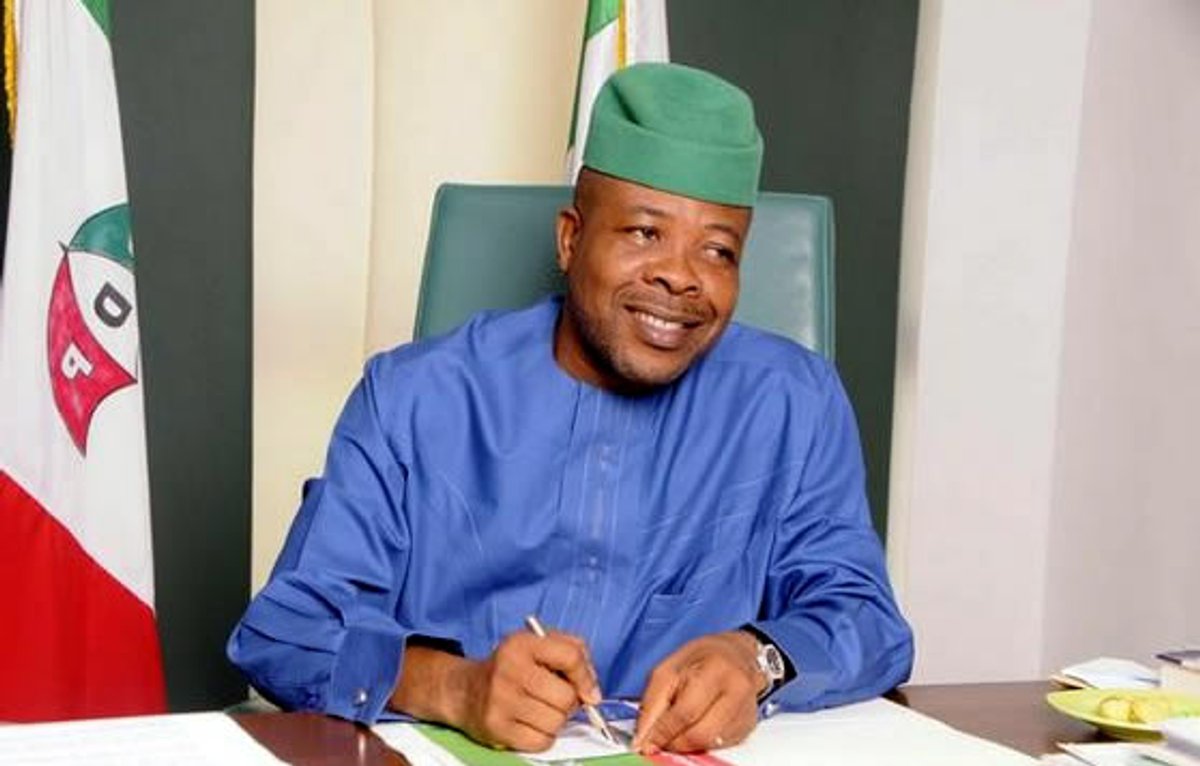
Governor of Imo State, Emeka Ihedioha
While the immediate past governor of Imo State, Rochas Okorocha claimed that he left a total of N42.5 billion in the coffers of the state’s treasury for his successor, Emeka Ihedioha, the latter insists that no money was released to his administration by the Okorocha-led past administration during the handover/swearing-in ceremony.
The available record of the state’s debt profile from DMO indicates that Imo State had a domestic debt profile of N29billion as of December 2014 and external debt of $53million. But as of when the former governor, Rochas Okorocha was leaving on May 29, 2019, the state’s domestic debt has grown to N98.7billion while its external debt rose to $61.3million.
Seyi Makinde uncovers N150b debt
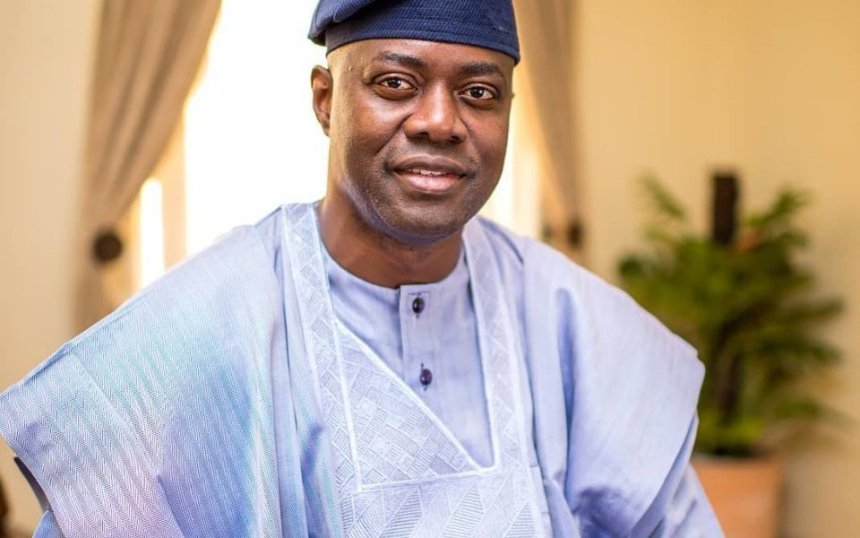
Governor of Oyo State, Seyi Makinde
Governor of Oyo State, Seyi Makinde like his peers who took over from the opposition has also cried out about a looted treasury. He announced that his government has discovered N150 billion debt within the first 30 days of his assumption in office. He summed up the debt to be around $500 million but said it would not stop his lofty programmes and electioneering promises to the people in four years.
Makinde said more debts are still being collated by government officials which would be made public soon.
Despite the governor’s claim of uncovering N150billion debt, DMO’s record show that Oyo State domestic debt as of December 2018 was N91.5billion with an external debt of $72.4million. The record also shows that the state’s domestic debt rose from N12billion in December 2014 to the current figure while its external debt was $72.3million for the same period.
In Bauchi, Mohammed laments N2.3b spent on burial
Governor of Bauchi State, Bala Mohammed
Governor of Bauchi State, Bala Mohammed cried out that his predecessor Mohammed Abubakar spent N2.3 billion on funeral materials in just five months. According to Mohammed’s spokesperson, Ladan Salihu, Abubakar spent N2.3 billion on funeral materials between January and May without proper appropriation by the legislative arm.
Salihu revealed that the expenditure was gathered from documents, vouchers, and payments made from the state’s treasury books.
But the former governor countered the claim, saying he only spent N1.2billion for the same purpose.
Abubakar, who spoke through a statement issued by his former media aide, Ali M. Ali, said financing burial of the dead was an inherited practice, which his administration upheld.
While Bala Mohammed has not come out clear on what he met in the state’s record as debt profile, the DMO record shows that Bauchi State has a domestic debt profile of N92.4billion as of December 2018 and external debt of $ 134.9million. In December 2014, the state’s domestic debt stood at N28billion and $72.3million as external debt.
Dankwambo’s financial recklessness in Gombe
Governor of Gombe State, Mohammadu Yahaya
Governor of Gombe Muhammadu Yahaya, accused his predecessor, Ibrahim Dankwambo of financial recklessness during his eight-year tenure.
Yahaya spoke against the backdrop of the report of the transition committee he set up, which revealed that the former administration left a debt burden of N119 billion.
But, Dankwambo, who attempted to fly the PDP’s presidential flag in the general elections, insisted in his valedictory speech that “as at May 28, we do not owe any commercial bank in the state. No single bank.”
On national and foreign borrowings and liabilities, Dankwambo said: “All the loans are loans that do not go to the consolidated revenue funds. We cannot be accountable for such loans because section 162 of the constitution says we are only accountable for loans in our consolidated revenue.”
The state’s debt profile as released by DMO in April 2018 revealed that it has N63.3billion as its domestic debt and $38.5million as external debt. With this figure, it might be that the state’s domestic debt profile has increased from N63.3billion to N119billion claimed by the new governor between December 2018 and May 29, 2019, when the former governor relinquished power.
As of December 2014 however, figures by DMO indicate that Gombe State had N29.6billion and $40million as external debt respectively.
Matawalle versus Yari
While Abdulaziz Yari, the immediate past governor of Zamfara State insists he left no debt or liability to the new administration under Bello Matawalle, the incumbent maintains that he inherited a huge debt profile. The former governor said he left N7 billion as a take-off for the new government.
The new governor had claimed that Yari administration left a debt of over N251 billion. It’s not clear if this figure is inclusive of external debt.
However, the state’s domestic debt profile in December 2014 stood at N13billion and $36million external debt profile for the same year. Its domestic debt according to DMO as of December 2018 which was published in April 2019 was N59.9billion, with $34.2million as its external debt.