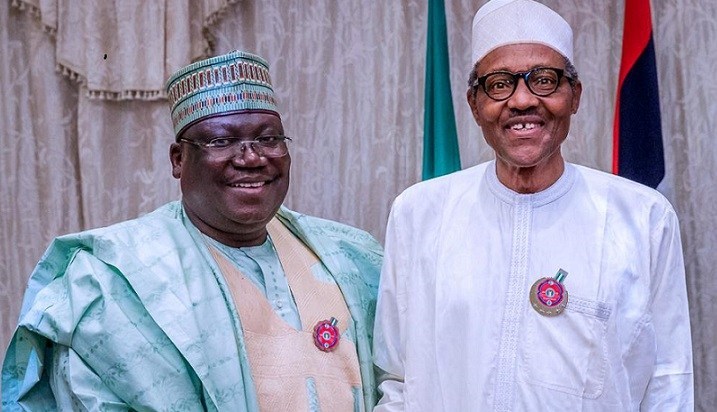
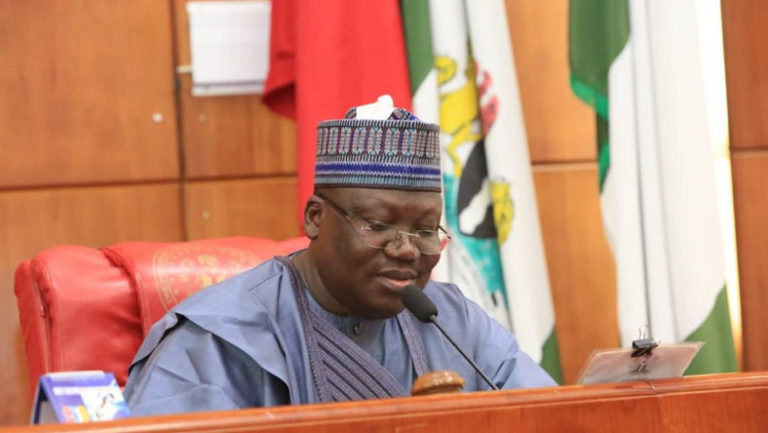
SENATE President, Ahmad Lawan, on Tuesday, said he would not compromise the integrity of the National Assembly, even as he expressed willingness to collaborate with President Muhammadu Buhari.
The chief lawmaker stated this at the plenary while reading his welcome address.
He promised to work closely with the president, for the interest of the country but not at the expense of the National Assembly, an independent arm of government with oversight powers.
He noted that such oversight powers as lawmakers’, constitute a powerful tool to enhance transparency and accountability.
He said the exercise of these powers, will not only review, monitor and supervise projects being implemented by the executive, but will evaluate its cost and how it aligns with national aspirations.
He noted that the progress of the projects would be monitored from conception to final stage when they are delivered to the people, “but we will do so with every sense of responsibility,” he said.
“The system of checks and balances which we practise in Nigeria today was enshrined to safeguard the values of justice and the rule of law and deliver public good.
Therefore, in a season when the majority of Nigerians are more concerned with outcomes that reflect their concerns, the best way to serve that interest is through cooperation and collaboration,” Lawan said.
He advised that in exercising their mandate, lawmakers should be cautious on how their actions will positively impact the greater majority of the citizenry.
“Each of us, as lawmakers, must also resolve that the exchange of views, especially within this hallowed chambers, will be constructive and that we will respect one another.
“On my part, I pledge to lead in a bipartisan [Senate] and in a unifying manner,” Lawan said.
The Senate president had earlier in May, pledged his loyalty to the Buhari administration if elected as Senate president.
He noted that the relationship between the legislature and the executive in the 8th Assembly was not a blooming one, disagreeing on every issue, but he would maintain a good relationship between the legislature and the executive, as president of the ninth Senate.
In this concluding part of the investigation into the Federal Government’s multi-billion naira unity schools’ security infrastructure project, CHINWE AGBEZE, makes more startling revelations.
Ebonyi State: Shoddy jobs everywhere
IT was 9 am on Thursday, May 9, 2019, when this reporter arrived at Federal Government Girls’ College, Ezzamgbo in Ebonyi State. She spent the next 45 minutes checking out the security gadgets that were installed in the school.
First, the reporter noticed that the school is perimeter fenced and barb wiring had been done. Close to the gate is a newly installed solar streetlight and opposite the administration block, which is a few seconds walk from the gate, is another solar streetlight.
Moving from the gate towards the ICT Centre, kitchen, dining hall, college clinic, staff quarters and dormitories, the reporter counted 10 solar streetlights. But no CCTV camera was seen. Also, there was no project signpost anywhere around the school.
To get more details about the security project, the reporter approached Mrs. Ngozi Onyekwum, the school principal. But, she said she had no idea.
“I don’t know anything about the project,” Onyekwum said. “I was transferred here about two months ago. The Principal that should know about the project has retired.”
Immediately, she rang the bursar to find out what he knew about the project, and in few minutes, he was in her office.
According to Mr. Dennis Ede, the school bursar, the contractor reported to the school in late December 2018, when the school was on holiday.
Ede said: “By the time we resumed, they have roofed the gatehouse, installed solar streetlights, and put little barbwire on the fence because part of our fence was barb wired. They did the project in a hurry.”
The principal chipped in that she “noticed that one of the streetlights didn’t function last night.”
Then, the bursar volunteered to take the reporter round the school to check the level of work done.
Now on site, Ede said: “The school constructed part of the fence and put barbed wires on it. The contractor only did a little portion. But, I don’t know the exact length they covered.
The wires on the fence mounted by the contractor were shabbily done.
“The workers used ordinary sand from the farmland without cement to hang the barbwires. When the wind blew, the wires fell off,” the bursar said.
He added: “The length of the barbwire is very small, they need to do something about it. But, we don’t have the contractor’s phone number.”
Mrs. Irene Ifejika, retired principal of the school, was contacted to garner more facts.
“The Ministry asked us to write all we need and forward to them through the Ministry of Works. One of the things we requested for is the completion of the fence and barb wiring, which was done halfway. The fence was old and very low. We needed to raise it because the school was porous,” she explained, continuing: “For two years, perimeter fencing and barb wiring of the school was awarded in the capital project, but it wasn’t completed. The third year, the fence did not show up in the budget. Then, I heard the ministry sent a contractor. But, when he came to school, I was away on a workshop. I have never met him.”
Ifejika referred the reporter to Benjamin Dawhare, the project officer at the school for official details.
According to the bill of quantities (BOQ) obtained by this reporter, N41,805,818.78 million was awarded to Blue Anchor Agency Limited, to provide 10 solar streetlights, complete the fence and barbwire at FGGC, Ezzamgbo.
Corporate Affairs Commission, CAC search on Blue Anchor Agency Limited, shows that the company which was incorporated on May 29, 1997, has seven directors— Agupusi Donatus, Agupusi Chioma, Agupusi Chizua, Agupusi Uzochukwu, Agupusi Chinenye, Okpala Nzubechukwu, and Okpala Ogechi.
An analysis of the company’s registration details revealed that the company has absolutely no business with building or security.
According to details filed in with the CAC, the main objective of the company is to “to carry on business of general contractors, importers and exporters of general goods, general merchants, suppliers of general goods, buying agents, clearing and forwarding agents, licensed custom agents, international trade, commission agents, manufacturers’ representatives and merchandise of every description whether consumable items or not.”
Also, no invitation for bids from prospective contractors was published, thereby violating section 25(2)(ii) of the Public Procurement Act (PPA) 2007.
The law says: “the invitation for bids shall be advertised on the notice board of the procuring entity, any official web sites of the procuring entity, at least two national newspapers, and in the procurement journal, not less than six weeks before the deadline for submission of the bids for the goods and works.”
Dawhare told Daily Sun: “The contractor hurriedly did the whole project in December 2018. Where we have an issue is in the number of solar streetlights. We complained about the number of streetlights, but the contractor said ours is 10.”
According to him, “we had an existing fence. The contractor raised 60 percent of the fence and completed the barb wiring. He did the coping, but it fell off. I complained to him two months ago, and he said he will come.”
This reporter reached out to Michael Aikpitanyi, the contractor for the project, to know when he plans to fix the coping.
“I did my job according to the scope I was given. I finished the job over four months ago, and I have been paid,” he told this reporter on May 27. “There is a retention of 5 percent, and in a month or two from now, it will be due. When retention comes, we will fix it before anyone will issue me a letter to clear my retention.”
He also hinted that: “The deputy director in charge of procurement at the Federal Ministry of Education is my friend, my personal friend. I will be at the ministry later today or tomorrow.”
Federal Government College, Okposi.
A stroll round the premises showed that the school is yet to benefit from the security infrastructure project. The fence is low and had no barbed wires. Also, there were no CCTV cameras anywhere in the school.
Solar streetlights were nowhere in sight. All the school has is an LED lamp fastened on an electric pole.
The school principal was not on seat when this reporter visited the school.
“We only have lights inside the hostels, and around the dining hall,” said a teacher who identified herself simply as Mrs. Obi. “We heard the ministry gave some schools lights and cameras. Maybe, they are doing it batch by batch. I believe they’ll get to our school soon.”
Another teacher said: “The problem is from the headquarters. After bidding, they will stay in Abuja and award the contract to another person. All the contracts are indirectly awarded to the directors and there’s nothing anyone can do about it.”
FGC Okposi CREDIT: Chinwe AGBEZE
Federal Ministry of Education, Abakaliki
FGC Okposi, this reporter heads to Federal Ministry of Education in Abakaliki for more details on the school security project.
On getting to the derelict building that serves as the ministry, the reporter was told that the “madam” was in Nasarawa for a seminar.
When Mrs. Patricia Okpalanze, the person-in-charge, was contacted on phone, she could not hide her irritation.
She said: “Any information you want to get about that project, you’ll get it from our office in Abuja or you go to the schools. I don’t think there is any need to come here and start asking me such questions.”
According to one of the staff, Okpalanze was furious because the “ministry neglected us and does not involve us in their activities.”
“You can see the kind of building they kept us. We don’t know if they have released the
A LED lamp at FGC Okposi CREDIT: Chinwe AGBEZE
money to crush this building down,” the staff said.
Imo State: Same old story
On Monday, May 13, 2019, this reporter made a stopover at Federal Government Girls’ College, Owerri in Imo State. Just like other schools visited, the school fence here also needs to be fortified. A walk round the school, the reporter counted about twenty solar streetlights and spotted seven CCTV cameras. But, no project signpost or worker was sighted.
According to the school principal, Mrs. Stella Azike, a total of twenty-five streetlights and 10 CCTV cameras were mounted.
But, Azike was not satisfied with the project.
“One of the cameras was focused on the road. I told them to remove it because it was of no use there. They removed another one, and put it in the classroom,” the school principal said.
“We told them to change the position of this camera,” Azike said, pointing at one of the cameras on the monitor in her office. “And we showed them where to install it, but they ran away.”
The vice principal, special duties, who introduced herself as Mrs. Ogueri, offered to show this reporter around the school to inspect the projects.
“They have just finished the installation of 25 solar streetlights,” said Ogueri, during the tour. “But we noticed that the light has one bulb per pole. We thought it would be two bulbs per pole so it can illuminate more areas.”
Documents seen by this reporter show that 50 units of 12W, 12V polycrystalline solar panel modules with supporting frame (two numbers per pole) was billed at N4.5million, 50 numbers 12V 300Ah deep life cycle batteries at N7.5m, and 50 pieces of lockable battery cubicle (two number per pole) at N4.75million.
“The lights are all working, but it’s centered on one area. The illumination does not go beyond the place it is installed,” the vice principal, special duties said, with a worried look on her face.
Ten cameras were installed with the control room in three places— the principal’s office, matron’s office and the gatehouse.
The monitor inside the principal’s office flashes in six locations, the matron’s focuses on two places—the road leading inside the dormitory and in front of her office and the monitor at the gatehouse captures the road immediately inside the gate and the road outside the gate.
“Someone from the procurement department in Abuja, came here with one Kehinde to tell us they had a project to do,” Mrs. Ogueri added.
When Daily Sun contacted Kehinde, the engineer-in-charge of the project, he said they had concluded the work.
“We finished the work on April 5, and the school is satisfied with the work done,” says Kehinde. “We have done what is on the paper.”
He then referred this reporter to Adeola Amodu, the manager, for more information.
“We installed 24 CCTV cameras, according to what we have in the bill, 25 poles of solar streetlight, 3KVA inverter and one 1.5KVA. What you see in the BOQ is what we have done,” Amodu said. “The school is satisfied with the work because it’s the principal of that gave our workers where they fixed the lights and camera.”
According to the BOQ obtained by this reporter, the sum of N39,662,437.50 million was awarded for the provision of 25 solar streetlights, 24 CCTV cameras, 3.5KVA inverter, complete with six batteries, and 1.5KVA inverter, with four batteries.
When asked the name of the company that secured the contract, Amodu said: “Dips XL Plus Limited.”
Again, a CAC search on Dips XL Plus Limited, showed that the company has nothing to do with building and construction.
Its registration details revealed the objectives for which the company was established were “to carry out all catering services and event management including but not limited to supply at event centres, corporate organiSation that includes hotels, NGO’s, Hospitals, public offices, and clubs.”
The company, which was incorporated on August 6, 2018, has Maude Nafiu, Sabo Hamisu Yunusa, Ahmed Aliyu Hamza, Garba Saifullahi Dawaki, and Bala Jibrin Sani as its directors.
Also, no invitation to tender was advertised for the projects, and this flouts section 25(2)(ii) of the Public Procurement Act of 2007.
“They went to the Ministry of Works and told them to certify the project. I told them that they are wasting their time because I have not accepted. They said I should sign, I said, I won’t,” said Mrs. Azike. “I have not certified them o! As we are here now, they said they have finished and they have gone, but I have not certified. We are waiting for them to come.”
The school bursar chipped in: “One morning, some people from the Ministry of Works came here. They told us they were here for certification so that our previous principal could sign. The principal said she can’t sign because the work according to her, hadn’t been completed.”
When asked how much out of the N39,662,437.50million awarded for the project had been paid, Amodu said he would get the information from the contractor.
The reporter requested for the contractor’s contact details but Amodu refused to give it.
“I handle this project and other education projects he has in Lagos and Ibadan. So, I’ll answer on his behalf,” Amodu said. “His name is Alhaji. That’s what we call him. I’ll ask him if he has received money and call you back.”
Amodu never called back as promised and he refused to pick calls when contacted again.
No security project in FGC, Okigwe
At Federal Government College, Okigwe, this reporter realised that the security infrastructure train was yet to arrive at the school. The school principal, Anastasia Opara, was not around when this reporter visited.
After waiting for over an hour, the reporter opted to see the vice principal, special duties, who identified herself as Mrs. Ajoku.
FGC Okigwe CREDIT: Chinwe AGBEZE
“The ministry said we should give them quotation of the security infrastructure that we wanted the government to do for us and submit to them before April 30, 2019,” she explained. “The ministry told us to get in touch with the Ministry of Works so they’ll give us the cost and drawing if need be. We did all that and submitted before the deadline. But, nothing has been done.”
According to Mrs. Ajoku, the principal and ex-students have been responsible for the facelifts in the school.
“The principal has been renovating everywhere in the school. During our inter-house sports, she painted the school just to make the event colourful,” she said. “The solar streetlights were done by ex-students who graduated in 2014. Our principal also installed floodlights around the classrooms, and the lights shine bright at night.”
She further stated: “Even before we came to this school, no capital project was going on here. It was when the principal was transferred last year that these projects started.”
Pointing at a newly renovated green roofs which are surrounded by rusty roofs, she said: “Look at the roofs and see the difference. All the renovated roofs were done in 2018. From 2017 backwards, nothing was done in this school.”
This investigation was supported by the John D. and Catherine T. MacArthur Foundation and the International Centre for Investigative Reporting, ICR.
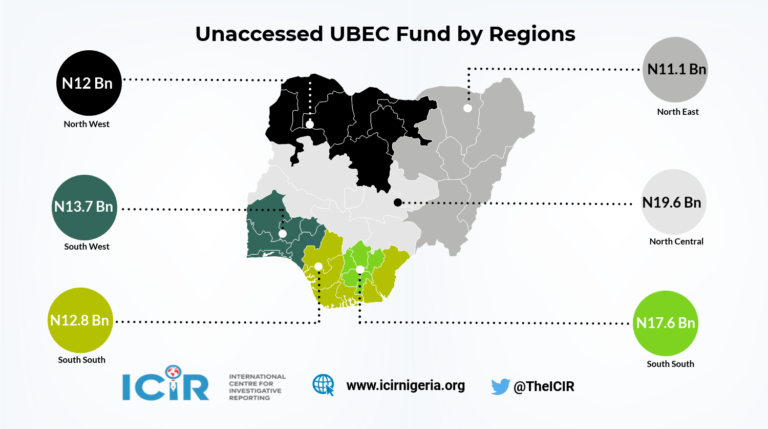
NORTH-CENTRAL ranks top among the regions that are yet to access the Universal Basic Education (UBE) matching grants with approximately N19.6 billion lying untouched at the Central Bank of Nigeria, despite its distressing educational sector.
According to the 2018 UBEC report of un-accessed matching grant, the region comprising six states –Kogi, Kwara, Plateau, Benue, Nasarawa and Niger, and the Federal Capital Territory (FCT) has a total of N19.58 billion to expend on basic education; but the pool of funds has remained unused over the years.
North-central was followed by South-east with 17.6 billion un-accessed matching grant.
UBEC’s matching grant is a counterpart funding between the federal and state governments earmarked for to eradicate illiteracy, ignorance, and poverty as well as stimulate and accelerate national development, political consciousness, and national integration.
The fund is deployed to improve the quality of basic education in all 36 states. The responsibility of a state government is to provide 50 percent to match the annual disbursement provided by UBEC. With the fund, UBEC seeks an uninterrupted and compulsory nine years of primary and junior secondary school education for all Nigerian children.
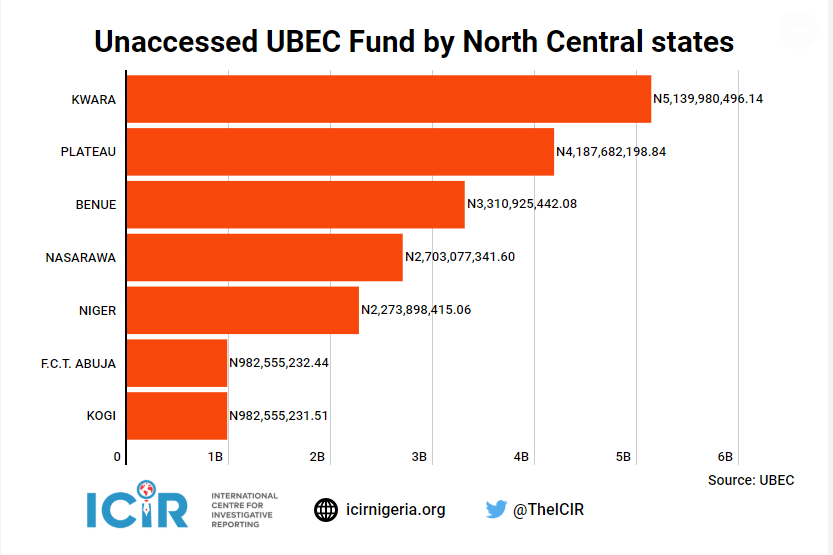
The breakdown of the un-accessed fund per state with the region shows that Kwara has the highest un-accessed fund of N5.1 billion, Plateau state N4.2 billion, and Benue State is yet to access N3.3b. Also, Nasarawa and Niger are yet to access N2.7 billion and N2.3 billion respectively. Kogi still has close to N983 million to be obtained, as well as the FCT.
As the money keeps piling at the Central Bank of Nigeria, the educational facilities of the six states and the federal capital have suffered distress. It is hard to ignore the obvious high rate of out-of-school children in the region.
The Northcentral region’s population of out-of-school children is the third highest in the country, based on the Multiple Indicator Cluster Survey (MICS) of 2017.
Out-of-school children, according to UNESCO, are children who are yet to be enrolled in any formal education, excluding pre-primary education.
According to MICS, the Northcentral is home to 23.8 per cent of the number of children not enrolled in basic education. The Southeast, Southsouth, and Southwest regions are better off as they consist of 11.3, 13.3 and 14.6 per cent sequentially. The Northcentral is only ahead of the Northeast and Northwest where the percentage is estimated at 39.8 per cent and 29.9 per cent respectively.
Apart from the number of unenrolled children, the results of the secondary school certificate examination (SSCE) of the North-central states also have been disturbing.
The result ranking of the 2018 West African Examination Council (WAEC) graded none of the Northcentral states among the best performing states that had a minimum of 70 per cent of students who passed the examination. In fact, none of the states made the top 10 in the ranking.
The FCT led the Northcentral by securing the 14th position, while Kogi and Benue follow closely at the 15th and 16th positions respectively. Kwara’s position was 18th. Plateau and Nasarawa’s positions followed as 22nd and 23rd. Niger came last in the region with the 27th position.
The ranking was measured by the performance of the candidates who passed five subjects including English and Mathematics in the examination.
Checking through the period of 2013 to 2018, each state in the region has failed to access the pool of fund at one time or the other. Kwara, since 2013, is yet to access its own share of UBEC fund. Nasarawa and Plateau did not claim the grant of 2015, while Kogi has N2.3 billion unobtained since 2015. Each of the FCT and Kogi State are yet to obtain the 2018 grants of N982.6 million.
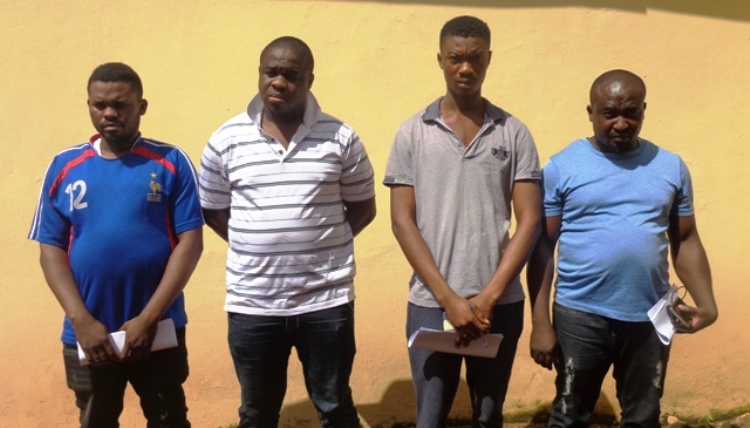
THE Economic and Financial Crimes Commission (EFCC), on Tuesday says its Enugu Zonal Office has secured five separate convictions involving the prosecution of Orji Uchenna, Chime Isaiah, Ogbu Obinna, Dunu Franklyn Tochukwu and Victor Patrick.
Justice N.I Buba, the presiding Judge of the Federal High Court, Enugu, Enugu State capital sentenced the fraudsters on five separate one-count charges, all bordered on internet fraud.
They were found guilty and sentenced to one-month imprisonment respectively. The court equally ordered that the iPhones and laptops recovered from the convicts be forfeited to the Federal Republic of Nigeria.
According to the anti-graft agency, the convicts were in the habit of using fraudulent names and emails to defraud unsuspecting citizens of foreign countries.
Further investigations by the EFCC revealed that Orji represents himself on the internet, as George Terry Williams, a British widower. He was reported to have knowingly sent his identity through his Whatsapp to Novelette Lothian.
Victor Patrick one of the convicts. Photo Credit: EFCC
Similarly, Dunu represented himself to be Rafiek Rafiek, Dimitri Folly-Adjo and Philipe Williams Paul, on the Internet and knowingly sent same through his Facebook account- Philipe Williams Paul to one Mrs. Galina Kabarcekov.
In a statement issued by Tony Orilade, Acting EFCC Spokesperson, Ogbu in his part, disguised to be Rev. Father Micheal Donatus, a priest on the internet and knowingly, sent a message through his email to one Kris Mohanpersad, while Chime who also represented himself as Russell March, an American deliberately sent a message through an email account:officialconsult775@gmail.com to several individuals.
However, the convicts all pleaded guilty when their separate one-count charge was read to them respectively.
Ernest Isiewu, the defense counsel, also, asked the court to temper justice with mercy on the grounds that the convicts were all first offenders.
However, Dalyop Eunice Vou, the prosecution counsel, in view of the guilty plea of the convicts, asked the court to sentence them based on the plea bargain agreement they entered with the Commission.
Senate President, Ahmed Lawan has on Tuesday announced the appointment of principal officers of the 9th National Assembly.
This was sequel to a letter sent to the red chambers from both parties dominant in the House.
The announcement features Senator Abdullahi Yahaya, as Senate Leader and Senator Ajayi Borrofice as its deputy Senate Leader.
Emerging as Chief Whip was Senator Orji Uzor Kalu, and Senator Abdullahi Sabi as Deputy Chief Whip of the upper chambers.
Accordingly, Senator Enyinanya Abaribe of the Peoples Democratic Party, (PDP), emerged as Minority Leader while Senator Emmanuel Bwacha, emerged Deputy Minority Leader.
Senator Phillip Aduda, however, emerged as Minority Chief Whip while Senator Sabi Yau emerged Deputy Minority Chief Whip.
Assigned legislative members are to reconvene on Tuesday, July 07, after a two-week recess.
Lawan, had earlierin June, approved the appointment of his Chief of Staff, Babagana Muhammad Aji and Special Adviser on Media and Publicity, Festus Adedayo, whom he later discharged.
He also set up a 12-man Ad hoc committee from six geo-political zones to communicate the welfare of the senators with National Assembly management, headed by Senator Abubakar Kyari.
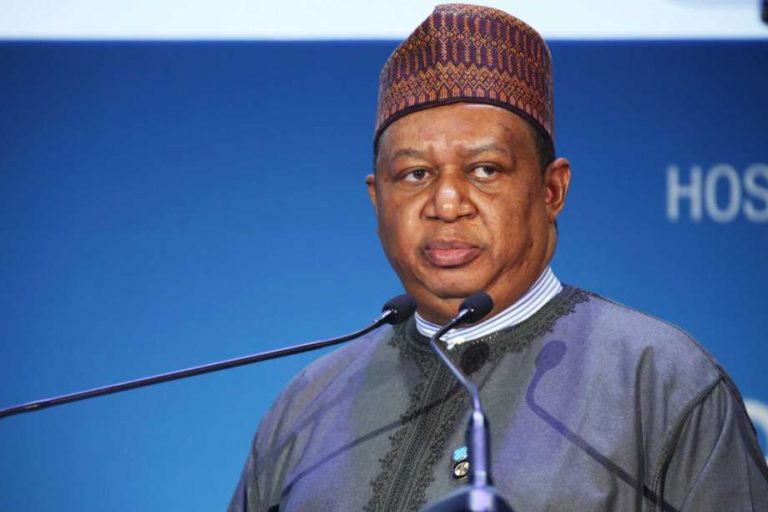
NIGERIA, alongside other member-states of Organisation of Petroleum Exporting Countries, OPEC, on Tuesday, agreed to extend oil production cuts until March 2020 to boost the prices of crude oil in the global market.
This was announced at the ongoing 176th meeting of the OPEC’s conference held in Vienna where the coalition of 24 member countries belonging to OPEC and OPEC+ blocs agreed to cut down 1.2 million barrels per day of output for the next nine months.
OPEC and a Russia led oil producing nations formed an alliance tagged as OPEC+ which had agreed to cut down inventories and remove 1.2 million barrels per day of crude oil from global markets on January 1, in a bid to raise oil prices.
Nigeria had been exempted of the OPEC/non-OPEC production cuts, for not adhering to its output ceiling, due to disruptions in the Niger Delta.
The Head of the Nigerian Delegation to the 176th Meeting of OPEC in Vienna, Austria, Folashade Yemi-Esan, defended the country’s position in improving its compliance with the deal according to a report.
“A higher quota is not the essence, If we wanted higher quotas, we would not have exited the exemption. We are working very hard to keep that ceiling, but if for any reasons the ceiling is increased, we will keep to whatever ceilings we get,” she said.
Saudi Energy Minister Khalid al-Falih claimed that extension of supply cuts for nine months instead of six months would allow the deal to cover the seasonally weak first quarter of 2020 and prevent a potential inventory build of 100 million barrels.
“The global economy in the second half of the year looks a lot better today than it did a week ago because of the agreement reached between President Trump and President Xi of China and the truce they have reached in their trade and the resumption of serious trade negotiations,” he said.
Anxiety over weaker global demand for crude oil as a result of a U.S – China trade war has added to the challenges faced by the OPEC/OPEC+ alliance according to a Reuters report.
Crude oil prices rose to $65 per barrel after OPEC approved the supply cut extension on Tuesday, the ongoing meeting will also discuss a charter for long-term cooperation between OPEC and non-OPEC producers.
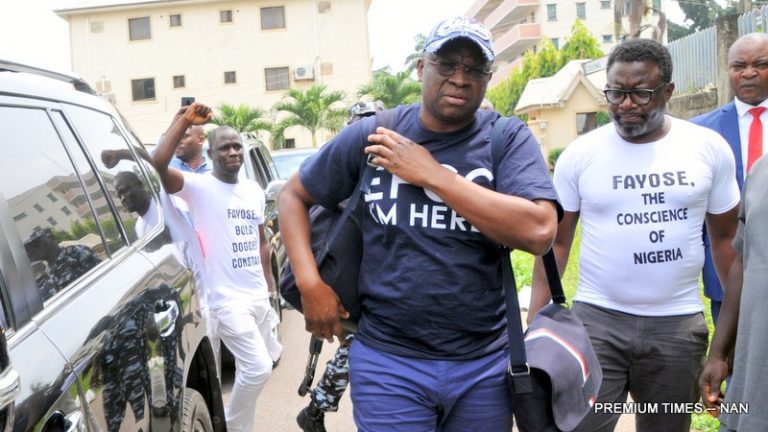
JUSTICE Chukwujekwu Aneke of the Federal High Court, Lagos on Tuesday, granted former Ekiti State Governor, Ayo Fayose permission to travel abroad for treatment.
Fayose got the court’s authorisation after being re-arraigned by the Economic and Financial Crimes Commission (EFCC) over allegations of laundering N6.9billion.
He told the court he was sick and needed to get medical attention abroad. The court eventually considered his application and ordered the immediate release of his international passport.
The Lagos FHC had on Friday adjourned his re-arraignment for today – July 2.
The Peoples Democratic Party (PDP) Chieftain and the ex-two-term governor was earlier prosecuted by Justice Mojisola Olatoregun before the case got re-assigned to Justice Aneke following a reported loss of confidence on Olatoregun as claimed by the anti-graft agency.
In June, the EFCC, in a petition to the former Chief Justice of the FHC, Justice Adamu Abdu-Kafarati had called for a change of Olatoregun.
Fayose was arrested six days after he completed his second tenure as the Ekiti State governor, over the allegation N2.2billion fraud.
The prosecutor, EFCC opened a trial against the governor on November 19, 2018, alongside his firm, Spotless Limited on 11-count charge bothering on theft, criminal breach of trust and money laundering.
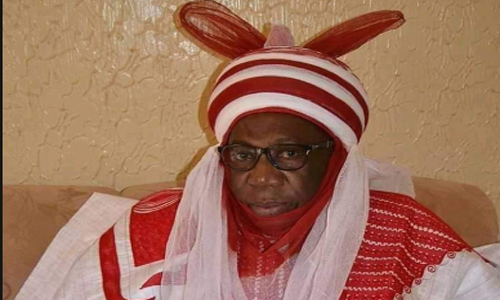
THE District Head of Daura, Alhaji Musa Umar-Uba, who was kidnapped from his residence three months ago, has been rescued by security agents in Kano.
Malam Tukur Umar, younger brother to the victim, told the News Agency of Nigeria (NAN) in Daura on Tuesday that the Magajingari Daura was rescued at about 7:25 am today.
He said that the district head was rescued by a combined team of security operatives after a serious gun battle with his captors who were holed up in a secluded house along Madobi road in Samagu quarters close to Sani Abacha Youth Center, Kano.
“He was rescued in good condition of health and any moment from now he may be in Daura to be reunited with his family. Alhamdulillah, God has answered our prayers,” Uba said.
He commended the security agencies for their tireless efforts which led to the rescue of the district head and said the family would remain grateful to them for their efforts.
Gambo Isa, spokesman of the Katsina State Police Command confirmed the development and said the police would issue details later.
NAN reports that Musa-Uba was abducted on March 1, 2019 and since then, no contact was established between his family and his abductors.
PRESIDENT Muhammadu Buhari on Tuesday announced the sack of the Executive Secretary, ES, of the National Health Insurance Scheme, NHIS, Usman Yusuf whose two -and-half-year-tenure had been embroiled in controversies with the agency’s governing board.
The Federal Ministry of Health in a post on Twitter signed by its director of media, Boade Akinola, he stated that the termination of Yusuf’s appointment was based on the recommendation of a panel of inquiry which had been set up to investigate fraudulent practices while he was in office.
“Following the recommendations of the report by the Independent Fact-Finding Panel on National Health Insurance Scheme NHIS, Buhari has approved the termination of the appointment of the of Yusuf who has been on administrative leave,” the release reads.
FG has terminated the appointment of the current Exec Sec. of NHIS Prof Usman Yusuf, who is on administrative leave. Prof Mohammed Nasir Sambo has been appointed in his stead.
— Federal Ministry of Health, NIGERIA (@Fmohnigeria) July 2, 2019
President Buhari also approved the dissolution of the Governing Board of NHIS while he directed the permanent secretary of the ministry of health to exercise full powers of the council pending the constitution of a new board.
Yusuf has been on administrative leave since October 2018. However, the announcement of his sack is coming ten months after he was suspended from office by the governing council of the agency.
Mohammed Sambo is set to take the reins of office as the new Executive Secretary of the agency following his appointment by the President.
President Mohammadu Buhari has approved the appointment of Dr. Chikwe Andreas Ihekweazu as the Director General, Nigeria Centre for Disease Control, NCDC, with immediate effect. PSH A.A Abdullahi handed over his letter to him this evening. @ehsquarepic.twitter.com/Bxo9W004FW
— Federal Ministry of Health, NIGERIA (@Fmohnigeria) July 1, 2019
In another development, Chikwe Ihekweazu was re-appointed as the Director General of the Nigeria Centre for Disease Control after he resigned his appointment last week following the expiration of his tenure.
President Buhari reappointed him to continue at the helm of the agency’s affairs stating that the reappointment of Ihekweazu is in line with the provisions of section 11(1)(3) of the Nigeria Centre for Disease Control (Establishment) Act, 2018.
PRESIDENT Buhari is a Northerner. He sees Nigeria essentially from a Northern perspective. Even El-Rufai, one of his more ardent supporters, admitted in the past that: “(Buhari’s) insensitivity to Nigeria’s diversity and his parochial focus are already well-known.”
Buhari favours the North in everything. According to Jim Yong Kim, the president of the World Bank, Buhari required that the bank’s development programs in Nigeria be skewed towards the North. During his tenure as Chairman of the Petroleum (Special) Trust Fund (PTF), he located over 70% of the Fund’s projects in the North, with less than 30% devoted to the South.
This tendency has continued in his presidency. Major appointments are reserved disproportionately to Northerners. As a result, the security architecture of the country is extremely lopsided.
The Minister of Defence, Brig.-Gen. Mansur Dan Ali (rtd.); the Minister of Interior, Lt.-Gen. Abdulrahman Dambazau (rtd); the Chief of Army Staff, Lt.-Gen. Tukur Yusuf Buratai; the National Security Adviser, Maj-Gen. Babagana Monguno (rtd.); the Chief of Air Staff, Air Marshal Sadique Abubakar; and the Commandant-General of the Nigeria Security and Civil Defence Corps, Abdullahi Muhammadu; are all from the North.
Said Yinka Odumakin of the Afenifere: “The pattern of the appointments today has not shown enough sensitivity to the diversity of Nigeria. That kind of arrangement is a situation from which genocide germinates because there is no balance in the security architecture of the country.”
But the president is obviously unconcerned about this. Last year, he yet again replaced the Northern Director-General of the Department of State Services, (DSS), Lawal Musa Daura, with Yusuf Magaji Bichi; another Northerner. This year, he again replaced the Northern Acting Inspector-General of Police (IGP), Ibrahim Idris, with still another Northerner; Mohammed Adamu.
Fulani president
President Buhari is a Fulani man. Although he is now president of Nigeria, he has yet to rise to the status of a national statesman. He has not stopped being, to all intents and purposes, a Fulani man. At his inaugural, he reassured Nigerians by saying: “I belong to everybody and I belong to nobody.” However, he customarily gives preferential treatment to the Fulanis.
Between 1983 and 1985, Peter Onu of Nigeria was Acting Secretary-General of the OAU. At the 1985 Summit in Addis Ababa, statesmen like Julius Nyerere, President of Tanzania, lobbied for Onu’s election as substantive Secretary-General. However, there was a major stumbling block to Peter Onu’s candidature: his Head of State, Muhammadu Buhari, was campaigning against him.
In the election of the OAU Secretary-General in 1985, Buhari voted against Nigeria and for Niger instead. He secured the election of Ide Oumarou, a Fulani man from Niger; as opposed to a Delta man from Nigeria. So doing, he became the first and only Head of State in the history of modern international relations to vote against his country in favour of his tribe.
Years later in 2000, General Buhari marched all the way from Daura to Ibadan to demand of Oyo State Governor, Lam Adeshina: “Why are your people killing my people?” Again, he was not referring to Nigerians as his people. Instead, he was an advocate for the rights of murderous Fulani herdsmen who killed Yoruba farmers that objected to their cattle grazing on their land and damaging their crops.
Indeed, President Buhari himself is a Fulani herdsman. In his asset declaration of 2015, the president revealed that he owns: “270 heads of cattle.” Not surprisingly, the Afenifere recently referred to him as “the grand patron of Miyetti Allah;” the Cattle Breeders Association of Nigeria (MACABAN).
Since his election in 2015, Fulani herdsmen have become a major menace in Nigeria. They invade other people’s lands with impunity and kill the owners. The British parliament observed that, under Buhari, the Fulani militia murdered more people “in 2015, 2016 and 2017 than even Boko Haram.”
No matter how long it takes for them to pillage and destroy their target communities, the police or military do not show up until they are done. It took them hours to kill more than 800 people in southern Kaduna in 2016 and about 200 in Plateau in June 2018. In both cases, neither the police nor the military intervened.
However, when the separatist Igbo group of Indigenous People of Biafra (IPOB) exercised their constitutional right to protest for the secession of Igboland from Nigeria, the government declared them a terrorist group and sent soldiers and police to deal with them. In the process, many Igbo youths were massacred.
Appeasement of killers
The Nigerian government’s approach to the marauding and pillaging of Fulani herdsmen has been that of appeasement. In the history of the Buhari administration, there is no record of the trial and conviction of murderous herdsmen. The president threatened to send soldiers to kill ballot-snatchers, but he does not proclaim such extra-judicial punishment on Fulani herdsmen.
Instead, they are molly-cuddled and sometimes given money. In his first national budget of 2016, he called for the allocation of money specifically to Fulani herdsmen. He proposed the establishment of Fulani cattle colonies in every state of the federation. That means the land of the indigenous people would be appropriated and given to Fulani herdsmen for their personal business.
When, in 2016, they killed over 800 people in the southern part of Kaduna State, the Governor of the state, Nasiru El-Rufai, a Fulani man himself, paid the killers and said he paid them so that they would not come back to kill more people in his state. He said: “there is a new governor who is Fulani like them and has no problem paying compensations.”
Just this year, a federal government delegation, led by the Minister of Interior, Abdul-Rahman Dambazau, met with the representatives of the Miyetti Allah. They were not arrested, as were the Shiites. Reports, denied by the government, claimed substantial monetary offers were made to the Miyetti Allah to persuade them to stop their marauding and killings.
However, there is a pattern to this allegation. In 2017, Buhari released some Boko Haram members who were in detention, as a trade for the release of some of the Chibok girls kidnapped in 2014. The people were allegedly released with a whooping amount of money paid by the government.
Alarm bells
Several factors have recently heightened concerns about the marauding activities of Fulani herdsmen in Nigeria. They are getting bolder and are moving further and further southward in search of grazing land. In the process, they are killing and pillaging with increased impunity.
Osai Ojigho, the director of Amnesty International Nigeria observes that: “the continuous failure to investigate gross human rights violations is fueling a dangerous disdain for the sanctity of human life in Nigeria.”
The situation has even raised international concern. Senior British parliamentarians have called for an immediate end to the killings, concerned that it can plunge Nigeria into a full-blown conflict that would destabilise the entire West African sub-region.
Lord Rambir Singh Suri said: “The situation has been exacerbated by inadequate government action which has enabled attacks to continue unabated. Beyond intermittent words of condemnation, the government has failed to formulate effective strategies to address this violence. This has entrenched impunity and emboldened perpetrators even further, leading to a growth in vigilantism and periodic retaliatory violence, as communities conclude they can no longer rely on government for protection or justice.”
In the middle of this crisis, the Commander of the Special Task Force (STF) in Plateau State, Major-General Atolagbe, was recently removed. The general served the Nigerian army for about 30 years, 27 of this with the United Nations. His problem started when he refused to allow the Fulani militia to have a field day in Plateau State. He arrested them and paraded them publicly, the first time this happened in Nigeria. He also arrested their financier.
But when he was ordered to transfer them to Abuja, he refused, suspecting they might simply be released. He insisted they should be tried in the area of jurisdiction where their crime was committed. He was ordered to stop arresting them and to release those he arrested to some ogas at the top. When he refused, insisting justice must be served, he was summarily dismissed.
Cattle settlements
In short, instead of impeding them, the Nigerian government seems to be the advocate of murderous Fulani herdsmen. The permanent secretary of the Ministry of Agriculture, Alhaji Muhammadu Umar, recently announced that the federal government would be establishing cattle settlements in 12 pilot states for the benefits of cattle rearers.
The government justified this by saying they are: “rural settlement in which animal farmers, not just cattle herders, will be settled in an organized place with provision of necessary and adequate basic amenities such as schools, hospitals, road networks, vet clinics, markets and manufacturing entities that will process and add value to meats and animal products. Beneficiaries will include all persons in animal husbandry, not only Fulani herders.”
But few in the South and Middle Belt believe the government anymore on this matter. Many see the government’s interest in cattle ranching simply as an insidious attempt to establish Fulani settlements all over the country.
The president had insisted the killer herdsmen are not from Nigeria, but from other West African countries. If so, why would he now want Nigerians to surrender or donate their ancestral land to immigrant herdsmen? Why is the government more focused on building ranches than on rebuilding plundered villages and compensating the victims?
Suspicions were further heightened by the discovery that the Federal Government has licensed a Fulani Radio Station, even though Fulani is not recognized as an official language in the 1999 Nigerian Constitution. This became further confirmation that it is promoting a Fulani agenda.
Other actions taken by the government have only complicated matters. The president announced by executive decree that he was revoking the license of all legal gun-owners in the country. But when people are getting killed by herdsmen carrying AK47 rifles, the response of the government should not be the revoking of legal gun-ownership.
This gives the cynical the impression that instead of dealing with the marauding herdsmen, the government is making it easier for them to attack farmlands with impunity. Where, in any case, do herdsmen get the money to purchase AK47 rifles? Surely, the poor herdsmen who walk their herds are not the owners of the cows they herd.
So who is supplying them with these arms and why is the government more concerned about those owning arms legally and not hurting anyone with them, than about those carrying arms illegally and killing innocent people with them? Why does the government want to disarm legal gun-owners, but shows no interest in disarming illegal gun-carriers?
CONTINUED: THE BETRAYAL OF APC YORUBA POLITICIANS.