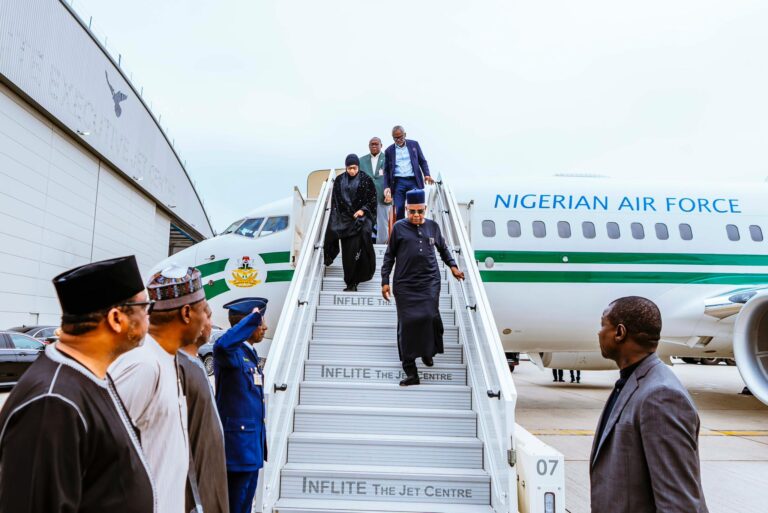
Acting on the directive of President Bola Ahmed Tinubu, Shettima is set to lead Nigeria’s official delegation in the repatriation of the former leader’s remains to the country for burial.
Upon arrival, the Vice President was received at the London airport by Nigeria’s Minister of Foreign Affairs, Ambassador Yusuf Tuggar, and the Governor of Borno State Babagana Umara Zulum. Also present was the Chief of Staff to the President, Femi Gbajabiamila, who traveled alongside the Vice President.
Former President Muhammadu Buhari, who passed away Sunday July 13, served as Nigeria’s head of state from 2015 to 2023.
Arrangements are already in place for the body to be flown to Daura, in Katsina State, where the late President will be laid to rest in accordance with Islamic rites and family wishes.
Shettima arrives London to accompany Buhari’s remains to Nigeria
Shettima arrives London to accompany Buhari’s remains to Nigeria
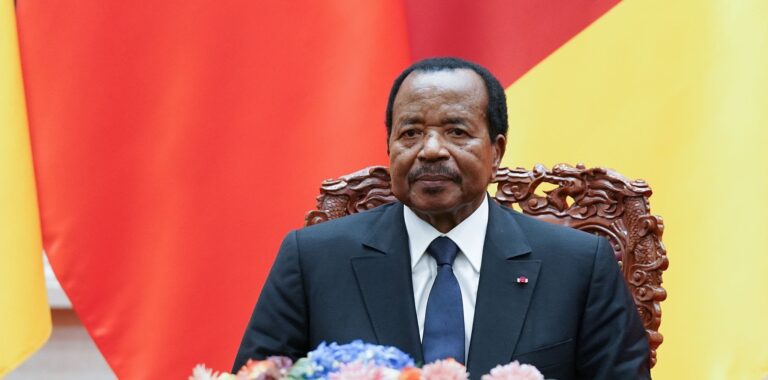
CAMEROON’S 92-year-old President Paul Biya has announced he would seek re-election in the upcoming election scheduled for October 12.
The world’s oldest serving head of state made the announcement in a post on his official X account on Sunday, July 13.
“I am a candidate in the presidential election. Rest assured that my determination to serve you matches the urgency of the challenges we face,” the post said.
His bid for re-election was widely expected, but not officially confirmed until his social media post on Sunday.
Members of the ruling Cameroon People’s Democratic Movement (CPDM) and other supporters had been publicly urging Biya to run for another term since 2024.
However, opposition parties and some civil society groups argued that his prolonged rule has hindered both economic progress and democratic growth.
Biya, who is aiming for another term that could see him remain in power until he is nearly 100, first assumed office in 1982 following the resignation of his predecessor, Ahmadou Ahidjo.
He is Africa’s second longest-serving president, after Teodoro Obiang of Equatorial Guinea. He has stayed in power for over 43 years.
In 2008, Biya removed presidential term limits, allowing him to seek re-election indefinitely. He secured victory in the 2018 election with 71.28 percent of the vote, although opposition parties claimed the process was marred by widespread irregularities.
However, his disappearance from the public for 42 days last year fueled rumours about his health and remains a frequent subject of speculation.
Later that year, in October, when Biya returned to Cameroon, the government insisted he was in good condition. It banned any public discussion of his health, declaring it a national security issue.
The ICIR reports that the country announced on July 11, 2024, that the presidential election was scheduled to hold on October 12.
Several opposition figures have also announced their candidacy, including 2018 runner-up Maurice Kamto of the Cameroon Renaissance Movement, Joshua Osih of the Social Democratic Front, lawyer Akere Muna, and Cabral Libii of the Cameroon Party for National Reconciliation.
Similarly, several of Biya’s longtime allies resigned from the ruling party to contest against their principal.
Most of the citizens have condemned Biya’s extended grip on power and are calling for electoral reforms to guarantee a free and fair vote in 2025.
The ICIR reports that the cocoa and oil-rich country, which has had only two presidents since gaining independence from France and Britain in the early 1960s, could face a turbulent succession crisis if Biya becomes too ill to govern or passes away.
Cameroon has grappled with economic challenges facing and multiple security threats under Biya’s leadership, including a prolonged separatist crisis in its English-speaking regions and persistent attacks by the Islamist insurgent group Boko Haram in the North.
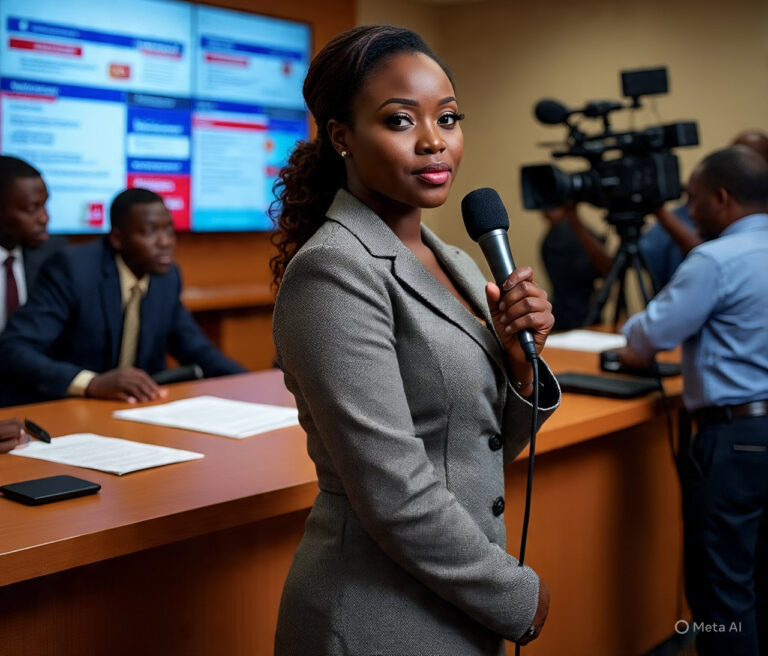
WHEN WikkiTimes reporter Victoria Ogechukwu sought budget documents in Bauchi, she says the official offered her cash, then a hotel room. “He kept asking how much I would accept per night,” she recalled.
“I am used to these advances. It has made me uncomfortable with meeting sources at their offices for interviews. I insist on phone interviews most of the time,” she added.
Last year, after repeated visits to the agency’s office, Ogechukwu was finally granted an interview. What she described as a routine journalistic inquiry became an uncomfortable exchange.
“He told me to come into his office. He tried giving me money at first, but I declined, informing him it is against my professional ethics. Then he started talking about how if I weren’t a journalist, he would have had me for the night.” Ogechukwu was livid with anger, but she was desperate to get the data requested.
In a separate encounter at a government ministry, she said she claimed to be married to deflect similar attention.
“I had a similar experience at a ministry in Bauchi. I had to lie that I was married to save myself because I realised people respect marriage a lot,” she added.
Ogechukwu also recalled a story she published in 2023 about a budgeted town hall project being relocated from the original community. Following publication, she said individuals who identified themselves as aides to a former Senator accused her of bias and threatened her safety.
“I interviewed the senator when I was doing the report, but after it was published, some people who claimed to be the Senator’s boys threatened me, saying I have been paid to make their senator look bad and that God will punish me and I won’t go scott free,” she recounted.
Vicotoria Ogechukwu.
Like Ogechukwu’s story, another WikkiTimes reporter, Hafsah Muhammed, learned early how swiftly official pushback can escalate. After her story pointed out police inactivity on social-media.
“I received eight missed calls on my phone from the spokesperson minutes after my editor published thereport. The frequency of calls panicked me, and I reported to my Editor, who asked me to call the officer back.
“Before I could call back, I started receiving a series of text messages from him accusing me of publishing false claims about the Police command. One of the text messages said he would find me, a direct threat to me.”
“That experience always made me feel anxious when contacting any Police Officer. I had to fight it, but it took a while,” she added.
In another instance, Muhammed said she narrowly escaped a robbery while heading to submit a Freedom of Information request in Gombe. Her tricycle was intercepted by machete-wielding men said to be campaigning for a major presidential candidate.
“Luckily, we narrowly escaped as the tricycle driver deftly drove away from the scene while we watched others being robbed,” she recalled.
Despite these experiences, Muhammed, says she remains committed to the work. “Investigative journalism is not for the weak. I have witnessed my superiors within the newsroom go through worse experiences and emerge stronger and better. I feel honoured to be part of this team. It’s a circle of brave journalists.”
Field violence and election coverage
During the 2023 general elections, TheCable reporter Bolanle Olabimtan said she was harassed while covering the polls. “They came and took my phone, went through my private chats… They threatened me, and this was under the rain, and I was shivering,” she recounted.
She was one of at least five female journalists who reported being attacked while covering Nigeria’s 2023 elections. Her phone was confiscated and footage she recorded was deleted by political thugs she noted. Olabimtan’s ordeal is part of a disturbing pattern: from physical assaults in the field to sexual coercion in newsrooms and vicious cyberbullying online.
Even routine assignments can turn violent. At the 2021 #EndSARS memorial, Adefemi Akinsanya of Arise TV wasfilmed shielding her crew from officers intent on seizing their drone. “Get away from me,” she pleaded. She later described the incident as traumatic.
Inside newsrooms, similar challenges persist. Fauziya Lawal-Dawai, a former contract announcer at Katsina State Radio, said she experienced repeated sexual harassment during her decade-long tenure which ended with hersudden dismissal in November 2023; the station blamed a missed meeting, while NAWOJ called the sacking retaliation, and Katsina’s governor ordered an inquiry.
In Abuja TV presenter *Khadija described a boss who piled extra chores on her, publicly berated her, and erupted when she declined weekend errands, forcing her eventual transfer and near exit from journalism.
In Kano, senior editors told veteran broadcaster Khadija Abdullahi that she appeared in the spotlight “too often.” “Does it always have to be Khadija?” she overheard before self-doubt and cyber-abuse pushed her off flagship programmes.
“I became used to doing roles that were expected to be carried out by him. I was overworked. Subsequently, I realised he was only using me to achieve his interest,” she narrated.
“One day, I came to the office on a day off to finish up some tasks, and he asked me to do something for him, and I declined. I said no, today is my day off, and I only came at will. He suddenly started screaming and hurling insults at me. I had to report him to the management, and my department was changed. But even at that, he later kept bad-mouthing me to whoever cared to listen,” she said.
The devastating experience significantly reduced her productivity, leading to poor morale.
“My advice to any female journalist out here facing any kind of harassment as such; don’t let anybody clip your wings or cripple you. Do not give room for manipulation,” she advised.
Despite making up 48.4 per cent of Nigeria’s workforce in 2024, according to the World Bank, women across sectors still face harassment, intimidation, and stigma despite ongoing advocacy for stronger legal protections.
Hafsah Muhammad
Online abuse: a growing battleground
Nigerian women journalists are fighting “hidden battles” online, facing torrents of cyber-abuse that can be as vicious as anyphysical attack. Women journalists, particularly those covering sensitive beats like politics or corruption, report being targeted with threats and derogatory comments.
A UNESCO-ICFJ study involving Nigerian journalists found that 73 per cent of female reporters had experienced online harassment. One in five respondents reported that online abuse had escalated into offline threats or attacks, while 18 per cent were threatened with sexual violence as a result of their reporting.
These findings echo the experiences of journalists like Kiki Mordi, who after reporting on sexual harassments in universities, became the subject of online smear campaigns. A report on state of safety of women journalists in Nigeria points out that story themes linked to women’s rights or politics & election often trigger attacks.
Those who persist often beef up personal security or seek psychological counselling to cope with relentless abuse. The mental toll – anxiety, depression, even PTSD – can be devastating. “I haven’t watched the video [of my assault] in years… it’s quite traumatic,” Akinsanya admitted.
Breaking barriers amid stigma, stereotype and harassment
For over a decade, Khadija Abdullahi carved a place for herself in northern Nigeria’s broadcast journalism scene, defying a deeply patriarchal newsroom culture. Yet, her rise wasn’t without pain.
From the onset, family disapproval shadowed her career. “They felt the exposure that came with the job wasn’t meant for women,” she told WikkiTimes.
She added that her confidence faltered as male colleagues viewed her growing visibility as a threat. They said she was in “too often.” After a meeting she once overheard the remark “Does it always have to be Khadija?”
“They felt I was always in the spotlight, and it shouldn’t be so. That particular incident broke me. I felt I was the problem; maybe I was taking one too many steps at a time. It took a lot of counselling to redeem my self-confidence,” she said.
Online, the attacks continued. Inappropriate messages and sexualised compliments about her voice disrupted her on-air focus. Eventually, she stepped down from anchoring shows that triggered such reactions.
She urged women journalists to maintain professionalism and integrity because, “There are people out there waiting to take advantage of you as a woman. It is left to you to decide whether to maintain your integrity as a woman or otherwise, for worldly gains.”
Hadiza Musa Yusuf, an investigative journalist, encountered similar abuse in 2021. An elderly source in Kano’s civil service repeatedly dodged her interview requests. When she returned alone the next day, he proposed to her instead of answering questions. “Hard as I tried, he avoided my questions on the report and diverted the conversation, complimenting how pretty I was and my willingness to be his girlfriend…I was shocked because this man was obviously in his 60s. I eventually had to give up the interview.”
For Sadia*, gender and ethnic bias were daily realities. Newly hired at a television station, she noticed how the newsroom’s default greeting—”Gentlemen of the press”—excluded her. She added that her editor, a middle-aged man, routinely dismissed her work while making stereotypical assumptions based on her background. When she requested to host a show that had run for 12 years she met resistance. She said she was told she can’t because she is a woman. She persisted, broke the barrier, and was finally recognised. Over time, more women joined the newsroom, slightly easing the discrimination. But another challenge lingered: sexual harassment. Editors often tied professional opportunities to personal favours.
Ruqayya Yusuf Aliyu, a scholar and former journalist, emphasises that both institutional policy and individual conduct are important. “It is obvious that female journalists most often face harassment outside the newsroom, especially. They need to improve in conducting themselves responsibly and professionally to avoid being taken advantage of.
“There should be policies that cater for them to protect them from such vices. Measures should be taken to protect them against such scenarios,” she said.
Bauchi-based lawyer, Maryam Zailani, explained that legal redress is possible “Section 42 of the Nigerian constitution clearly states that no gender should be discriminated against. People need to be aware of the consequences attached to harassment or intimidation,” she said.
Names with asterisks were changed.
This report republished from WikkiTimes is produced by WikkiTimes in collaboration with the Centre for Journalism Innovation and Development (CJID) as part of a project documenting issues focused on press freedom in Nigeria.
PRESIDENT Bola Tinubu has ordered all national flags across Nigeria to be flown at half-staff, following the death of former President Muhammadu Buhari, who passed away in London on Sunday, July 13.
He was aged 82.
The directive is part of official mourning protocols and signifies national respect for the late leader’s contributions to the country.
Flying a flag at half-staff, sometimes referred to as half-mast, is a solemn tradition observed globally to honour the death of significant public figures or to mark national tragedies.
In Nigeria, the practice is authorised by the presidency and typically reserved for heads of state, military officials, or in the aftermath of national disasters.
When a flag is flown at half-staff, it is first raised to the top of the pole, then lowered to the midpoint.
The gesture symbolises a collective pause, between pride and sorrow, service and sacrifice and serves as a visual expression of mourning.
Buhari, who ruled Nigeria first as a military head of state between 1983 and 1985, and later as a democratically elected president from 2015 to 2023, was a significant figure in the country’s post-independence politics.
The ICIRreported that Buhari died in a London hospital, where he had been receiving medical care.
The nature of the illness leading to his death is still sketchy as of press time, but the president had reportedly travelled to London since April for what was described as a routine medical check-up.
The ICIR recalls that throughout his presidency, Buhari frequently travelled to London for medical treatment. Particularly, during his first time as civilian leader, from 2016 to 2018, Buhari spent extended periods in London for undisclosed medical treatment, fuelling speculation about his health and capacity to govern.
His election marked a historic moment in Nigeria’s democratic journey, the first time an incumbent president lost an election and peacefully handed over power.
He was nominated as the APC’s flagbearer by a coalition of opposition figures, including President Bola Tinubu, former Senate President Bukola Saraki, Nasir El-Rufai, among others, to contest against Jonathan, who had seemingly fallen out with several key figures in his party – the Peoples Democratic Party (PDP)
During his campaign, Buhari touted anti-corruption as one the key agenda of his administration, although experts have since argued that his tenure was marred by corruption.
His supposed anti-corruption war was also often criticised for being selective and politically motivated.
TRIBUTES are pouring in as global and Nigerian leaders mourn the passing of former President Muhammadu Buhari.
Some Nigerians are also expressing disappointment that the former leader could not build a world-class hospital that could cater to his health needs, but chose to travel to London, where he had sought care many times.
As a mark of national honour, President Bola Tinubu has directed Vice President Kashim Shettima to travel to London and accompany the body of the former leader back to Nigeria.
This was disclosed in a statement by the presidency.
Additionally, the president directed that all national flags be flown at half-mast throughout the country and at Nigerian embassies abroad, as a sign of national mourning and respect for the late president.
“This is a mark of respect for the departed leader who served our country with dedication,” the president stated.
The ICIRreported that the late president’s spokesperson, Garba Shehu, announced his death in a statement.
Reacting to the news, Director-General of the World Trade Organisation, Ngozi Okonjo-Iweala, wrote, “Unbelievable! I did not know just how ill HE President Buhari was, and minutes after sending my get-well wishes, I have just learned that he passed away. I am so very sad. May the soul of HE @MBuhari rest in perfect peace. My deepest condolences to the entire Buhari family and his close aides and associates.
The Senate President, Godswill Akpabio, commiserated with the former leader’s family. He wrote, “A true patriot has left us. The former president’s work and love for our dear country was (sic) undeniable. His death is a sad reminder of our mortality. He will be remembered as a hero who fought the good fight.”
Similarly, the Labour Party (LP) presidential candidate in the 2023 election, Peter Obi, remarked that Buhari’s death marked a solemn moment of reflection, not only for his family and close associates but for the nation.
“President Buhari has always comported himself in a dignified manner as a leader. To his wife, children, extended family, and to all Nigerians, I extend my deepest condolences.
May Almighty Allah, Most Gracious and Most Merciful, forgive President Buhari’s shortcomings, reward his efforts in service to the nation, and grant him Aljannatul Firdaus.” Obi wrote.
The outgoing President of the African Development Bank, Akinwumi Adesina, also shared his pain. He wrote, “I am greatly saddened by the passing of Nigeria’s former President @MBuhari. Thank you for your leadership, patriotism and selfless service to Nigeria. Thank you for your love and support for me. May God comfort your dear wife and family. May your soul rest in peace.”
Buhari Minister of Communications and Digital Economy, Isa Pantami, reacted to his former principal’s passing. He wrote on X, “Inna lil Laahi wa inna ilaiHi Raaji’un!
The eyes shed tears, and the heart is grieved, but we do not say anything except what pleases our Lord. O Baba Buhari, we are grieved by your separation.
May Allah forgive his shortcomings and admit him into Jannatul Firdaus.”
Similarly, renowned Muslim cleric Mufti Menk also shared his condolences with the family of the late president.
“The passing away of a legend, the former Nigerian President Muhammadu Buhari, May Allah have mercy on his soul, brought me to tears!
“He was an upright man who never missed his prayers and a very disciplined believer who served his people to the best of his ability,” part of his statement read.
Human rights activist and former federal lawmaker Shehu Sani also wished the former leader an eternal rest. “President Muhammadu Buhari, may Allah forgive his soul and grant him Aljanna firdausi.Amin. Inna lillahi wainna Illayhir rajiun,” wrote Sani.
Meanwhile, other Nigerians have taken to social media to mourn the late president.
President Buhari….very unfortunate.@Ladexdomain wrote.
This is so sad, May the good Lord rest his soul, wrote @rasak_sala27815
However, some citizens have also used the moment to express criticism of his administration, particularly over allegations of human rights violations during his tenure. These include his handling of the End SARS protests, the controversial Twitter ban, and broader concerns about repression and lack of accountability.
Critics also expressed disappointment that the former president died in a foreign hospital, highlighting the poor state of the Nigerian healthcare system under his watch.
A UK based medical practitioner, Olufunmilayo Ogunsanya, popularly known as @OurFavOnlineDoc on X wrote.“A whole former president couldn’t build one hospital that could attend to him – not one hospital in his state. Not anywhere in the whole country – after spending a whole eight years in office – and still end up dying in a London hospital bed. What a shame. What an utter disgrace.”
Human rights lawyer, Inibehe Effiong, also penned his thoughts about the former leader, “As president, Buhari had eight years to offer selfless leadership and change the country for the better. He abused and missed that golden opportunity. Buhari had all the power and resources to build a standard hospital in Nigeria that would have catered for his medical needs, but he failed to do so.
“As Buhari faces the judgment of his maker, it is my prayer that those currently in power who are making lives miserable for us will realise that they will also face their eternal judgments.” Effiong opined.
@bapphah also shared his thoughts, “Wallahi, before he died, I didn’t think I could ever forgive him because of what I went through during his time as president of Nigeria. But after hearing of his passing, I felt some pity and forgave him completely.”
Buhari served as Nigeria’s Head of State from 1983 to 1985 and later as a democratically elected president from 2015 to 2023.
Further details regarding his funeral arrangements are expected to be announced by his family in due course.
TWO years before his death, Nigeria’s former President Muhammadu Buhari publicly asked Nigerians for forgiveness.
The appeal has again resurfaced, following his passing in London at the age of 82 on Sunday, July 13.
On April 21, 2023, with just over a month left in office, Buhari had addressed a gathering of dignitaries, ministers, and residents of the Federal Capital Territory during an Eid-el-Fitr Sallah homage at the Presidential Villa in Abuja.
While delivering what would become one of his most reflective speeches as president, he thanked Nigerians for the honour to serve for two terms, 2015-2023, while also seeking their forgiveness.
Buhari also stated that he welcomed all complaints and criticisms in good faith, acknowledging them as part of the responsibility he had prayed for and willingly accepted from God.
“God gave me an incredible opportunity to serve the country. We are all humans. If I have hurt some people along the line of my service to the country, I ask that they pardon me.
“All those that I have hurt, I ask that they pardon me,” he said.
The former president also used the occasion to look back on more than four decades of service to the country, from his days as a young military officer to his time as military Head of State (1983 to 1985), and later, as a democratically elected president (2015 to 2023)
He recounted the trials he endured, including his imprisonment after being overthrown in a coup, three failed presidential campaigns, and his eventual comeback in 2015.
“I dared the politicians and ended up at the Supreme Court three times. They laughed at me, and I responded, ‘God dey’,” he recalled, adding, “God sent technology to my rescue, with the Permanent Voter Card (PVC). The fraudulent people became unemployed.”
The former president also spoke about how he had endured criticism throughout his years in power but accepted it as part of the burden of leadership.
“I think it is a good coincidence for me to say goodbye to you, and thank you for tolerating me for almost eight years,” Buhari stressed.
He was succeeded by Bola Ahmed Tinubu on May 29, 2023, after serving two terms in office.
FORMER Nigerian President Muhammadu Buhari has died at the age of 82, his former media aide, Garba Shehu, said on Sunday, July 13.
Buhari, who served as Nigeria’s military Head of State from December 1983 to August 1985 and as a two-term civilian president from May 2015 to May 2023, died in a London hospital, where he had been receiving medical care.
The nature of the illness leading to his death is still sketchy as of press time, but the president had reportedly travelled to London since April for what was described as a routine medical check-up.
The ICIR recalls that throughout his presidency, Buhari frequently travelled to London for medical treatment, a pattern that attracted widespread criticism and reignited conversations about the state of Nigeria’s healthcare system.
Particularly, during his first time as civilian leader, from 2016 to 2018, Buhari spent extended periods in London for undisclosed medical treatment, fuelling speculation about his health and capacity to govern.
The government’s reluctance to disclose details about his condition drew backlash, especially as the nation’s public health sector continued to deteriorate.
Before Buhari returned to Nigeria on August 19, 2017, following nearly three months of medical treatment in the United Kingdom, the leader of the Indigenous People of Biafra (IPOB), Nnamdi Kanu, alleged that the president had been replaced by a clone named Jibrin from Sudan.
To confirm how worse Buhari’s health was while he ruled the country as president, just a few days ago, Garba Shehu revealed in his new book, “According to the President: Lessons from a Presidential Spokesperson’s Experience,” that the story about rats invading the Presidential Villa was fabricated as a distraction from Buhari’s health issues and the allegations by the IPOB.
The book, launched on Tuesday, July 8, in Abuja, highlighted how he brought the idea of the Villa rat invasion story to divert public attention away from concerns about Buhari’s health and capacity to govern.
In his valedictory speech on May 28, 2023, Buhari said he “cannot and will not forget the millions who prayed for me during my illness in my first term of office.”
Buhari’s life
Born on December 17, 1942, in Daura, Katsina State, Buhari’s public life spanned more than six decades. He joined the Nigerian Army at the age of 19, in 1962, and trained at several international military institutions, including the Mons Officer Cadet School in the United Kingdom and the United States Army War College.
At just 20 years old, he was commissioned as a second lieutenant in January 1963 and took up his first post as a Platoon Commander with the Second Infantry Battalion in Abeokuta.
Later that year, he enrolled in the Platoon Commanders’ Course at the Nigerian Military Training College in Kaduna, completing it in early 1964.
He went on to attend the Army Mechanical Transport School, where he trained as a Mechanical Transport Officer.
Between 1965 and 1967, Buhari served as the commander of the Second Infantry Battalion before being appointed brigade major of the Second Sector under the First Infantry Division, a position he held from April to July 1967.
In the wake of the 1966 coup d’état that led to the assassination of Northern Premier Ahmadu Bello, Buhari joined other Northern officers in orchestrating the July 1966 counter-coup, which resulted in the removal of General Aguiyi Ironsi and the installation of General Yakubu Gowon as Head of State.
Buhari first ruled Nigeria as a military leader after taking power in a coup that ousted the civilian government of Shehu Shagari on December 31, 1983.
His regime, though short-lived, was defined by a rigid anti-corruption stance and the controversial “War Against Indiscipline,” a campaign that sought to instil public order through military-style enforcement.
While some Nigerians viewed his approach as necessary in a time of economic decline and widespread graft, others criticised the period for human rights violations and suppression of press freedom.
He was eventually overthrown by his Chief of Army Staff, General Ibrahim Babangida, in August 1985.
Several years later, Buhari reemerged in Nigeria’s democratic space, contesting the presidency in 2003, 2007, and 2011. He lost in those periods under the All Nigeria Peoples Party (NNPP)
However, he finally secured victory in 2015 under the newly formed All Progressives Congress (APC), defeating incumbent Goodluck Jonathan.
His election marked a historic moment in Nigeria’s democratic journey, the first time a sitting president lost a general election and peacefully handed over power.
He was nominated as the APC’s flagbearer by a coalition of opposition figures, including President Bola Tinubu, former Senate President Bukola Saraki, Nasir El-Rufai, among others, to contest against Jonathan, who had seemingly fallen out with several key political stakeholders in the PDP.
During his campaign, Buhari championed anti-corruption as the cornerstone of his administration’s agenda, although experts have since argued that his tenure was marred by widespread corruption.
His supposed anti-corruption war was also often criticised for being selective and politically motivated.
The former president also came to power on the promise of defeating Boko Haram and restoring order. His eight-year tenure witnessed the rise of multiple armed groups, including bandits in the North-West, secessionist agitators in the South-East, and continued insurgency in the North-East.
Despite increased military spending and multiple operations, many Nigerians lived under a daily threat of violence during his presidency.
Buhari left office on May 29, 2023, after completing his second term and was succeeded by President Bola Tinubu.
To prove how corruption was rife under the late president’s watch, the Central Bank of Nigeria’s governor, Godwin Emefiele,stole public funds to build 753 duplexes in Abuja, which the court has confiscated for the Federal Government.
THE All Progressives Congress (APC) has taken an early lead in the ongoing announcement of results from the July 12 local government elections in Lagos State, as the exercise was reportedly overshadowed by low voter turnout and allegations of irregularities in some areas.
The Lagos State Independent Electoral Commission (LASIEC) began announcing official results on Sunday, July 13, across the state’s 20 Local Government Areas and 37 Local Council Development Areas (LCDAs).
According to reports, the APC has so far dominated both the chairmanship and councilorship positions.
Although the elections were largely peaceful across the 13,325 polling units in the state, they were marred by low voter turnout, raising concerns about democratic participation at the grassroots level.
Also, former Lagos State Deputy Governor, Kofoworola Bucknor-Akerele, on Saturday, alleged irregularities in the elections, calling for the cancellation of the exercise.
Bucknor-Akerele expressed frustration over her inability to vote at her polling unit while speaking in an interview with Nigeria Info on Saturday.
Parties’ participation
The ICIR reports that 57 chairmanship and vice chairmanship seats, along with 376 councillorship positions, were contested in the polls.
Of the 19 registered political parties, 15 fielded candidates, according to the News Agency of Nigeria.
The APC contested all available seats, while its closest rival, the Peoples Democratic Party (PDP), participated in 45 councils and 259 wards.
The Labour Party (LP) had a presence in 22 LGAs and 130 wards, with the remaining parties, including ZLP, AAC, AA, and YPP, fielding a smaller number of candidates.
The newly adopted coalition party, African Democratic Congress fielded candidates in the 20 Local Government Areas.
The Lagos State Chairman of ADC, George Ashiru, stated that the party’s decision to field candidates in all 20 local government areas was influenced by the 2024 Supreme Court ruling on local government autonomy.
According to him, the judgment reaffirmed the constitutional status of the 774 local government areas in Nigeria, including the 20 councils in Lagos State.
“In line with the Supreme Court ruling on local government autonomy, we chose to focus our campaigns and field candidates only in the 20 constitutionally recognised local government areas,” Ashiru said.
APC sweeps early results
In Odi-Olowo/Ojuwoye LCDA, Seyi Jakande of the APC was reportedly elected with 58,446 votes, nearly 57,000 votes ahead of his PDP and LP challengers, who polled 1,743 and 1,464 votes respectively.
Also, the APC’s Taiwo Oyekan was declared winner of the chairmanship seat in Lagos Island LGA, with 28,385 votes. The PDP’s Ajibade Olusegun garnered only 1,271 votes, having come second.
Amuwo-Odofin LGA also saw a landslide win for APC’s Lanre Sanusi, who polled 24,926 votes, outpacing LP’s Seyi Ipinlaye, who secured just 1,962 votes.
In Agege LGA, APC’s Tunde Azeez won the chairmanship with 31,503 votes. His closest challengers, from APM and ZLP, received only 86 and 10 votes, respectively.
Also, Yisa Abiola Jubril of the APC was declared the elected Chairman of Iba Local Council Development Area, LCDA. According to LASIEC, the APC candidate secured a total of 31,547 votes, having satisfied all legal and electoral requirements.
Similarly, Kareem Azeez Abiodun was announced as the winner of the 2025 local council election in Oto-Awori Local Council Development Area (LCDA). He won a decisive victory with 19,874 votes, having contested under the umbrella of the APC.
Opposition faults process
However, the opposition parties in the elections have alleged widespread irregularities, including voter suppression during the voting exercise.
In an interview with Sunday PUNCH, the Secretary of the Labour Party in Lagos State, Sam Okpala, described the election as a “complete sham.”
Okpala stated that no voting occurred in numerous polling units across the state.
“As far as the Labour Party in Lagos State is concerned, there was no election today (Saturday). The level of malpractices we witnessed today is unprecedented in the history of elections in Nigeria,” he said.
“Where there is a semblance of voting, it’s all about ballot box stuffing and LASIEC staff coming with already thumb-printed ballot papers. The ruling party chieftains also came with thumb-printed ballot papers and stuffed them in the boxes,” he added.
This was as the Accord Party in the state, through its chairman, Dele Oladeji, asked the National Assembly to scrap the State Independent Electoral Commission.
According to him, the states’ electoral commissions were not independent, and their duties should be transferred to the Independent National Election Commission to enhance democracy and ensure healthy political participation and competition at the grassroots.
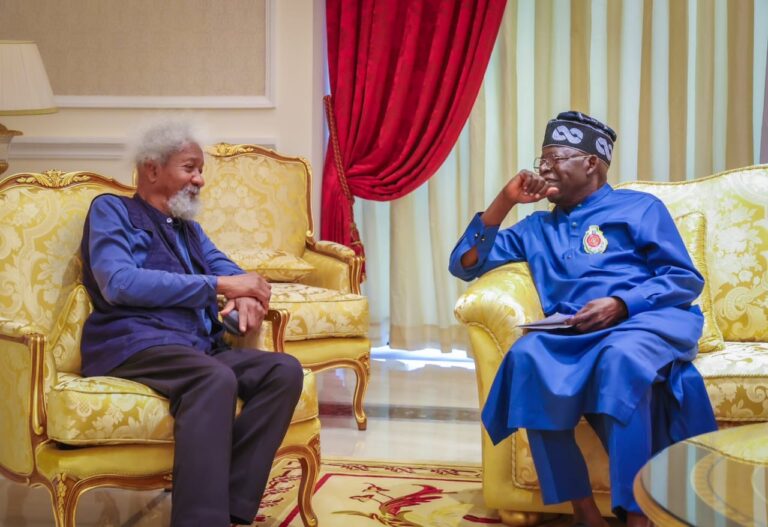
PRESIDENT Bola Tinubu has paid glowing tributes to Nobel Laureate Wole Soyinka, a professor, on his 91st birthday, calling him a lasting source of inspiration to both Nigeria and the world.
In a statement released on Sunday, July 13, by his Special Adviser on Information and Strategy, Bayo Onanuga, Tinubu commended Soyinka’s lifelong dedication to literature, human rights, and national development.
He described the renowned playwright, poet, and essayist as a towering figure whose impact spans generations and global audiences.
“President Bola Tinubu has extended his good wishes to Professor Wole Soyinka, the globally renowned literary icon and Nobel Laureate, as he celebrates his birthday today.
“Professor Soyinka, a well-decorated literary giant, activist, cultural icon, and public intellectual who turns 91, is known for his extraordinary creative and artistic talent, evident in his plays, poems, memoirs, essays, and other artistic productions,” the statement read in part.
The president also recognised Soyinka’s long-standing contributions to education, cultural diplomacy, and Nigeria’s pro-democracy movement, highlighting his role in shaping national discourse and advocating for justice over the decades.
“President Tinubu notes the contributions of the first African to win the Nobel Prize for Literature in 1986 to education, pro-democracy and human rights movements, cultural diplomacy, and nation-building over the last several decades.”
Reflecting on their relationship, the president praised the celebrant for his consistent efforts to advance national progress, expressing gratitude for Soyinka’s lifelong service to the country and humanity.
Tinubu also wished the renowned playwright continued good health and mental clarity as he began the journey into the final decade before his centennial.
AIR Peace has confirmed that its Flight P47190 from Lagos to Port Harcourt veered off the runway after landing at the Port Harcourt International Airport on Sunday morning.
In a statement issued by the airline’s spokesperson, Osifo-Whiskey Efe, the airline stated that the aircraft had a runway excursion following a safe landing.
“Air Peace confirms that its Flight P47190, operating from Lagos to Port Harcourt this morning, had a runway excursion after landing safely at the Port Harcourt International Airport.”
The aircraft veered slightly off the runway without any damage, and all passengers on board disembarked safely and calmly. No injuries were reported”, the airline said.
The airline also reiterated its commitment to safety, assuring the public that it remained dedicated to upholding the highest operational standards.
“We reassure the flying public of our unflinching commitment to maintaining the highest standards of safety in all our operations,” the statement added.
On May 11, an Air Peace aircraft was reportedly grounded at Asaba International Airport in Delta State after striking a large antelope while taxiing on the runway. The collision severely damaged the animal and left the aircraft unable to continue operation, leading to flight delays.
Confirming the incident on his official X account, Director of Public Affairs & Consumer Protection at the Nigerian Civil Aviation Authority (NCAA), Michael Achimugu, explained that while such incidents were typically beyond an airline’s control, they did not exempt operators from their obligations to affected passengers.