PRESIDENT Muhammadu Buhari, Thursday departed Abuja to attend the Summit of the Organisation of Islamic Cooperation (OIC) in Makkah, Saudi Arabia few hours after inauguration into the office for a second term.
Buhari’s visit follows an invitation by King Salman Bin Abdulaziz, the ruler of Saudi Arabia and Custodian of the Two Holy Mosques.
Garba Shehu, the spokesperson to the president, tweeted: “President Muhammadu Buhari departs Abuja to attend the summit of the Organisation of Islamic Cooperation in Makkah, Saudi Arabia.”
The 14th session of the Summit Conference of the OIC, scheduled to hold on Friday will be hosted by King Salman bin Abdulaziz Al Saud and attended by heads of state and governments of member states.
President Muhammadu Buhari departs Abuja on Thursday to attend the Summit of the Organisation of Islamic Cooperation (OIC) in Makkah, Saudi Arabia.
President Buhari is expected to address the forum and underscore the need for member countries to unite and work together to combat common challenges such as terrorism and violent extremism.
In addition, he would push forward themes that have been at the forefront of his domestic and international priorities, including reviving the Lake Chad Basin, investing in Nigeria to create jobs and financing for development.
President Buhari, who is expected to return to the country on June 2nd, will be accompanied by Governors Mohammed Badaru Abubakar of Jigawa State, Gboyega Oyetola of Osun State and Abubakar Sani Bello of Niger State.
President Buhari, who is expected to return to the country on June 2nd, will be accompanied by Governors Mohammed Badaru Abubakar of Jigawa State, Gboyega Oyetola of Osun State and Abubakar Sani Bello of Niger State.
Former President, Olusegun Obasanjo and 393 others aboard an Ethiopian Airlines plane, escaped crash on Wednesday at Murtala Mohammed International Airport.
Obasanjo who was absent from the inauguration ceremony of President Muhammadu Buhari for a second term was reportedly coming from Addis Ababa.
Other prominent Nigerians in the Ethiopian airline passenger aircraft, Boeing 777-300, included the Director General of Nigerian Association of Chambers of Commerce, Industry, Mines and Agriculture (NACCIMA) Amb. Ayoola Olukanni.
Also in the plane was Prof Samson Tunde Adebayo, the Director of Ports Inspection, National Agency For Food And Drug Administration And Control (NAFDAC) as well as scores of Nigerians and other nationals.
The passenger aircraft, ET-901, had departed the Bole International Airport, Addis Ababa, at about 9:10 a.m., Ethiopian time; 7 a.m Nigerian time.
A NAN correspondent, who was among the passengers, reported that the almost 5-hour flight from the Ethiopian capital to Lagos had been smooth until the pilot attempted to land at the Murtala Mohammed International airport.
Rather than landing on the first touchline of the runway, the pilot over short it, due to rain and heavy wind, landing on the third touchline.
NAN reports that on realising this, the pilot quickly manoeuvred the plane back air, flying out of the Lagos airport.
After hovering between Lagos and areas suspected to be in Ogun, causing panic in passengers and crew members, the plane finally landed in Lagos airport, some 20 minutes after the initial false landing.
The atmosphere in the airbus upon landing was a replica of what is obtainable in some Nigerian worship centres, as many passengers broke out into worship songs and clapping, while some fell to their knees in prayer.
Officials of the NCAA were unable to confirm the incident as the General Manager, Public Relations of the agency, Mr Sam Adurogboye, said there was no report of any incident in Lagos so far while the General Manager, Public Relations, Accident Investigation Bureau, Mr Tunji Oketunbi, said he had not received any incident notification from any airline.
NAN checks from the Control Tower also gave the same report.
But the Duty Manager and Chief Customer Service (Nigeria) of the airline, Mr Otori Otan, told NAN that if the pilot had continued taxing down after landing on the third touchline, he would have overshot the runway.
“But this is an experienced pilot. He realised this immediately.
“Fortunately, the distance between when he realised the situation still permitted him to take off and renegotiate landing,” Otori said.
He added that the incident was not out of place while confirming that the wind obscured the pilot’s vision.
Otori also disclosed that most of the aircraft that flew out of the Murtala Mohammed International Airport had to fly against the midday heavy wind.
“These things happen. That is where the sophistication of the aircraft and experience of the cabin crew members come in.
“The aircraft is one of the best you can have around and we are fortunate to have pilots who know their onions,” he said.
Furthermore, Mr Ikechi Uko, Media Consultant to Ethiopian Airline, confirmed that the aircraft had a “missed approach” while about landing due to poor visibility caused by inclimate weather.
“The aircraft thereafter made an air return before it proceeded to land successfully .”
He said the pilot’s effort was in line with the Safety and Recommended Practices (SARPS) in aviation
Obasanjo and Olukanni had both attended a Stakeholders Dialogue on Continental Trade and Strengthening Implementation of the African Continental Free Trade Agreement (AfCFTA) which ended on Tuesday in Addis Ababa. (NAN)
THE Federal Government has directed the Nigerian National Petroleum Corporation, NNPC, its oil holding firm to cut down its stakes in Joint Venture oil assets to less than 40 per cent within the 2019 fiscal year by selling its stakes which would boost its finances.
In a tweet on the official Twitter handle of the Presidency, the Minister of Budget and National Planning, Udo Udoma, disclosed the government’s plan to reduce its stakes in the assets.
“President @MBuhari has directed that immediate action be commenced to restructure the Joint Venture Oil Assets so as to reduce @AsoRock shareholding to not less than 40 percent and that this exercise must be completed within the 2019 fiscal year.” — Budget Minister Udo Udoma
The NNPC currently holds shareholding interest in six joint ventures with foreign oil firms operating in Nigeria. Apart from the Joint Venture, with Shell Petroleum Development Company of Nigeria Limited which NNPC holds a 55 per cent stake, but holds a 60 per cent stake in the other joint ventures.
The others include Nigerian Agip Oil Company Limited, Mobil Producing Nigeria Unlimited, Texaco Overseas Petroleum Company of Nigeria Unlimited, Elf Petroleum Nigeria Limited and Chevron Nigeria Limited.
Under the JV arrangement, both the NNPC and private operators contribute to the funding of operations in the proportion of their equity holdings and generally receive the produced crude oil in the same ratio.
All parties share in the cost of operations. The operator is the one to prepare proposals for the programme of work and budget of joint expenditure on an annual basis, which shall be shared on a shareholding basis
The Economic Recovery and Growth Plan released in 2017, revealed that Nigeria was set to earn $115 million from giving up its stake in JV oil assets, refineries and other downstream subsidiaries such as pipelines and depots according to a report.
The ICIR had earlier reported that the outstanding cash call debt owed by the Federal Government in its JV operations with the foreign oil firms are worth $3.6 billion after paying off $1.5 billion.
THE Kaduna State government on Wednesday disclosed that it has approved 6-month maternity leave for lactating mothers in the state.
The state Governor, Mallam Nasir El Rufai made this known at his inauguration ceremony held at the state capital for his second term in office.
According to him, the consensus decision was approved just yesterday to encourage six months exclusive breastfeeding recommended by the Federal Ministry of Health, World Bank and other medical experts.
“Just yesterday the council approved six months maternity leave for our pregnant women to encourage exclusive breastfeeding,” says the El Rufai.
“Children up to the age of five will get free medical care in our hospitals so that they are entitled to free regular medical check-ups in all public hospitals. Please take advantage of this. Continue to take your children to hospitals for regular checks from time to time.”
Nigeria is a signatory to the Sustainable Development Goals (SDGs) of the United Nations aimed to achieve set goals, especially reducing infant mortality and maternal mortality significantly by 2030.
For instance in Nigeria, according to the latest World Health Statistics, under-five mortality is pegged at 100.2 per 1, 000 live births, far from recommended reduction to 25 per 1000 live births.
Maternal death in the country is also ranked 814 per 100, 000 live births compared to the acceptable 70 per 100, 000 live births – a statistics higher than Somalia and Sudan.
The last National Demographic Health Survey (NDHS) conducted in 2013 by the National Population Commission ranked infant and child mortality 69 and 128 deaths per 1,000 live births.
However, the governor further emphasised that the medical service is free in all public hospitals within the state.
Citing one of his achievements in the last four year, he said government under his leadership was able to complete the “long-delayed Zaria water project,” adding that the state government would continue to build, expand and maintain infrastructure projects to promote the wellbeing of the people.
He assured residents of continuous investment to the states and need to create jobs to address unemployment, thus increasing the revenue.
FORMER president Goodluck Jonathan has continued to recognise May 29 as democracy day, despite the act of parliament that affirms democracy as June 12 in commemoration of the election considered to be freest and fairest in Nigeria.
In his tweets hours ago, he wrote that May 29 marks the introduction of democractic rule in Nigeria and ‘signalled the end of a long spell of military dictatorship.’
“Our celebration of democracy is, therefore, a mark of our commitment to the virtues of liberty, justice and the people’s freedom to daily engage government on how best to achieve our national goals.
“Democracy has come to stay. So let us stay in the creed and virtues of justice, equity, and love which makes democracy a solid ground of freedom, good governance, peace and hope. Happy Democracy Day Nigeria,” he tweeted Wednesday morning.
However, the incumbent government led by Muhammadu Buhari had last year June 2018 declared that Democracy Day would henceforth hold on June 12th of every year.
The pronouncement was later approved in the Senate by an act of parliament after the lawmakers considered the bill seeking to amend the Public Holiday Act six months after the president’s declaration.
The pronouncement was made in honour of the acclaimed winner of the 1993 presidential election–the late Chief Moshood Abiola with posthumous conferment of the highest national award, Grand Commander of the Federal Republic on the deceased.
Even with the new amendment, it seemed the former president, Jonathan, would rather acknowledge May 29 as Democracy Day. He further urged Nigerians to stand firm as a nation and continue to strive for improvements in the electoral processes in the series of messages he shared on social media.
7. Democracy has come to stay. So, let us stay in the creed and virtues of justice, equity, and love which makes democracy a solid ground of freedom, good governance, peace, and hope. Happy Democracy Day Nigeria! -GEJ
“There is a need to deepen the gains so far attained by advancing frontiers of credible electoral processes, fidelity to the rule of law and adherence to constitutionalism.
“A credible electoral process is no doubt fundamental to making democracy work for us as a people, as it sufficiently empowers citizens to freely choose or reject their political leadership, thereby serving as an incentive for good governance,” Jonathan wrote.
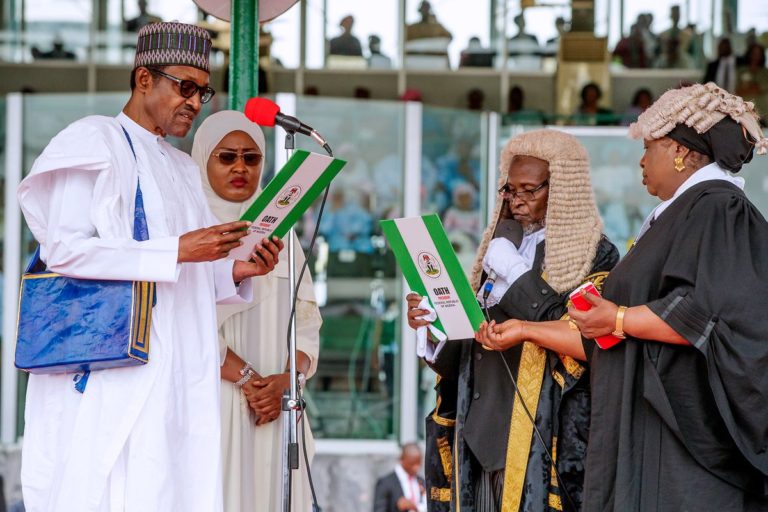
MUHAMMADU Buhari, candidate of the All Progressives Congress in the 2019 general elections, has been sworn in as Nigeria’s president for another four-year term.
The inauguration took place at the Eagle Square, Abuja, on Wednesday. The inauguration was celebrated low-key as earlier announced.
Therefore, the president did not deliver an inaugural speech as was the practice in the past. Also, unlike in 2015, only invited persons attended the ceremony and were seen around the venue.
Buhari defeated 72 other presidential candidates at the polls according to results declared by the Independent National Electoral Commission in February.
While he got 15.2 million votes, candidate of the People’s Democratic Party (PDP), Atiku Abubakar, polled 11.3 million.
The PDP has however petitioned the Presidential Electoral Tribunal in a bid to nullify the declared results.
Buhari is the second president to be elected twice into office. The first was Olusegun Obasanjo, president between 1999 and 2007, who was absent at the inauguration. Goodluck Jonathan, Buhari’s predecessor, also did not attend.
DESPITE its absence from the U.S., Huawei retained its ranking as the No. 2 smartphone vendor worldwide and continued to reduce the gap with Samsung research and advisory firm Gartner reported.
In a global IT report released on Tuesday by the firm, it showed Huawei continued to reduce the gap with Samsung, however, Gartner warned that growth could be limited in the near future.
The United States on May 15 blocked Huawei from buying U.S. goods, saying the company was involved in activities opposed to national security. The Trump administration last week softened its stance by granting Huawei a license to buy U.S. goods until the 19th of August.
Gartner said Samsung retained its top spot in worldwide smartphone sales, achieving a 19.2 per cent market share in the first quarter of 2019, while Huawei achieved the highest year-over-year growth among the world’s top five – Samsung, Huawei, Apple and Chinese smartphone makers OPPO and Vivo.
“Huawei did particularly well in two of its biggest regions, Europe and Greater China, where its smartphone sales grew by 69 per cent and 33 per cent, respectively,” said Anshul Gupta, senior research director at Gartner
The report showed that Huawei sold 58.4 million smartphone units in the quarter, with growth across all regions.
In addition, Gupta said demand for utility smartphones declined as the rate of upgrading from feature phones to smartphones has slowed, given that 4G feature phones give users great advantages at a lower cost.
Huawei’s continued dominance in Greater China, where it commanded a 29.5 per cent market share, helped it secure the No. 2 global smartphone vendor ranking in the first quarter of 2019.
Although it is expected that the impact of the U.S. action against Huawei is likely to affect the buyer’s commitment as Huawei handsets were drawing fewer clicks from online shoppers.
“Unavailability of Google apps and services on Huawei smartphones, if implemented, will upset Huawei’s international smartphone business which is almost half of its worldwide phone business,” Gartner revealed.
Companies that have either shunned Huawei completely or restricted buying from the company include Google, Softbank’s ARM, Analog Devices, U.S. chipmakers Intel Corp, Qualcomm Inc, Xilinx Inc, Broadcom Inc, Japanese electronics maker Panasonic Corp and BT Group’s EE.
The report also showed that global sales of smartphones to end users declined 2.7 per cent in the first quarter of 2019, totalling 373 million units.
GHANA is facing a serious risk of an environmental catastrophe due to the high level of environmentally unfriendly human activities such as illegal logging, illegal mining, and illegal farming within its forest reserves.
While these activities are not new, evidence shows that the extent at which they are being perpetrated might sooner than expected, wipe away all of the country’s forests.
Illegal mining in particular has done extensive damage to almost all of the country’s existing forests.
Although some licensed mining companies have been given concessions within some forests [and those areas later declassified as forest reserves], their activities are easily monitored and controlled by the mandated state agencies unlike illegal miners, whose footprints are widespread across the country, especially in the southern part.
Several hectares of fertile forestlands across the country have been destroyed due to the activities of illegal miners, especially within the last decade. The Desiri, Kutukrom, Kobro, Oda, Jimira, Atewa, and Tano-Offin forests in the Ahafo, Western, Ashanti, Eastern regions have all suffered from the illegality.
Many rivers, including the Birim River in the Eastern Region and other water bodies, that take their source from these forests have as a result been left heavily polluted depriving residents in nearby communities of a source of fresh water and putting at risk the lives of over five million other people in major cities in the south whose potable water are sourced from the forests.
Decline in forest cover over the years
In 1901, Ghana’s total forest reserve cover stood at 8.2 million hectares but is now estimated to be less than 1.6 million hectares according to the Forestry Commission.
The rate of deforestation based on the trend has been pegged at an unsustainably high rate of 65,000 hectares per annum.
Given the prevailing rate of deforestation, it is estimated that there will be no natural forest in Ghana by the year 2035.
Why this is a problem
Ghana is already facing the consequences of the fast depletion of its forest reserves. Temperatures in the country are generally rising with the Northern part of the country recording temperatures as high as 43 degrees Celsius. The rainfall pattern has also become unpredictable as the volume of rain has reduced by about 20% since the 1960s according to the Environmental Protection Agency (EPA).
The decline is expected to continue to an estimated 20.5% by 2080 according to Ghana’s National Climate Change Adaptation Policy if things remain the same and this poses a threat to the country’s agricultural sector in which farming is largely rain-fed.
The existence of forests has huge benefits in terms of absorbing atmospheric carbon dioxide, which is the main driver of climate change.
In the local context, the existence of forests helps create the suitable microclimate for crops such as cocoa, which is one of Ghana’s major export products to be grown in the country.
The crop generates about $2 billion in foreign exchange annually to the country.
Tano-Offin and Atewa forest under threat
The Atewa and Tano-Offin forests are among the many forest reserves in the country whose existence are threatened by illegal mining.
Located in the Eastern and Ashanti Regions respectively, the two forest reserves have been invaded by illegal miners who on a daily basis desecrate the forest in their quest to mine gold.
Ghana’s Minerals and Mining Act of 2006 requires that anyone who seeks to exploit the mineral resources obtains a license from the Minerals Commission, but illegal miners do not follow this requirement.
“We have been struggling for potable water for some time now. Our source of water has turned brown because the illegal miners in the forest have polluted the water,” a resident of Asiakwa, a town that sits at the feet of the Atewa forest in the Eastern region said.
The tale is same for communities such as Kwabeng, Sagyimase, Asiakwa and Kibi, which are all towns close to the Atewa forest in that region.
Although the Tano-Offin and Atewa forest reserves are recognized as Globally Significant Biodiversity Areas (GSBAs) that serve as home to some of the world’s endangered animal species, including pangolins, rare frogs, birds and butterflies, not much has been done by the State to protect them in the face of the threats of illegal mining.
More than 12 hectares of the Tano-Offin forest have been destroyed by illegal miners while about 15 hectares of the Atewa forest have reportedly been lost to illegal mining.
The illegal miners presently use pickaxes, water-pumping machines, gold detector machines, among other low specification implements to pull down trees and dig several deep pits within the forest in search of gold hidden underneath the surface of the earth.
Although some use excavators to carry out the crime, that has reduced significantly over the past few months.
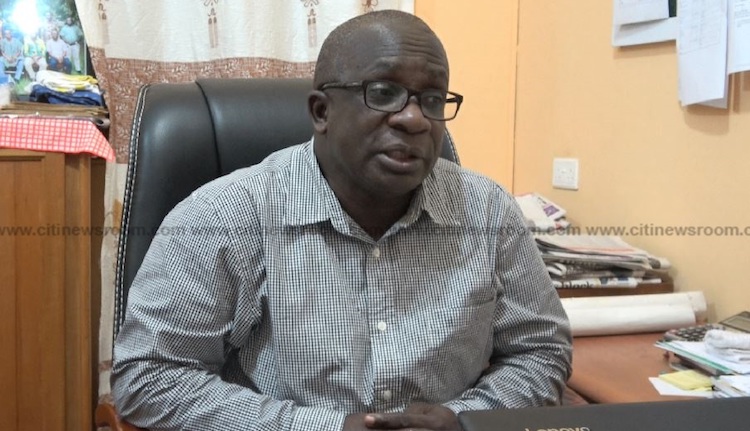
“As for the illegal people [illegal miners], it is greed that is creating all those things. Apart from greed it is more or less about livelihoods,” William Baah, the Ashanti Regional Forestry manager said.
From his office in the Ashanti Regional capital, Kumasi, Mr. Baah admitted that the health of the forest is threatened by the pervasive activity of illegal mining, although his outfit, the Forestry Commission, which is tasked with regulating the use of forest and wildlife resources as well as conserving and managing those resources, has been planting several trees within the forest to increase density.
“We are doing more plantations. Last year, we planted about 790 hectares using the Modified Taungya System. For direct plantation, we did about 360 hectares. We are planting, but we have the illegal farmers going in to farm, the chainsaw operators, we have illegal loggers and in the same Tano-Offin, we have illegal miners too. As we plant, people are destroying,” he lamented.
Illegal mining in the Tano-Offin forest
The Tano-Offin forest which covers a land size of about 41,392 hectares has several points of entry hence it is very easy for anyone to encroach into the forest to carry out an unauthorized activity such as illegal mining at the blindside of forest guards and other authorities.
The result is the death of water bodies, fast decline of forest cover and destruction of land resources.
Thirty-two-year-old Kwame Asante, a cocoa farmer at Nyinahini a town in the Atwima Mponua District of the Ashanti Region where the Tano-Offin is located, said the activities of illegal miners in the forest leaves him frustrated because their activity is negatively affecting his cocoa farm.
“We have noticed that because of the illegal mining, the weather that previously made our cocoa farms do well has changed. Our harvests are not as before and we know it has something to do with the illegal mining, cutting down of trees and the rainfall,” he said.
River Offin and River Tano are two major rivers that flow through the Tano-Offin forest and both have not been spared from the negative repercussions of illegal mining in the forest.
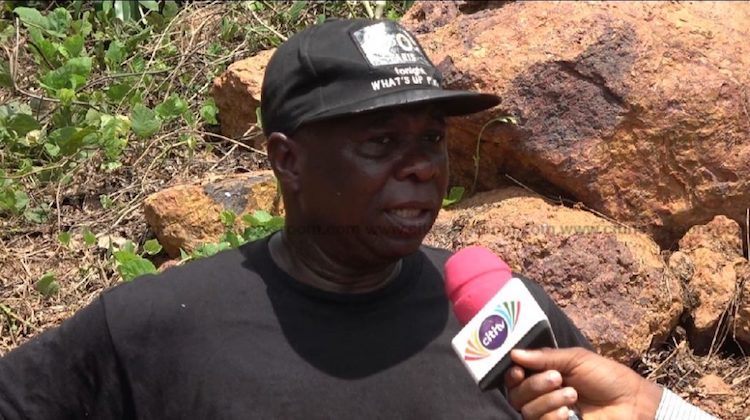
Samuel Nkansah Twum, the Assistant Director of the Atwima Mponua District Assembly within which the forest reserve lies, says the current state of affairs concerning illegal mining in the area is far better than it used to be before 2017 when the government of Ghana, after intense civil society and media pressure, announced a ban on all small-scale mining activities to sanitize the sector and allow water resources to naturally regain their quality.
Being the Secretary of the District Committee Against Illegal Mining, Twum said the District Assembly has been working to deal with the menace due to the negative impact on people in the local community.
Illegal mining in the Tano-Offin forest
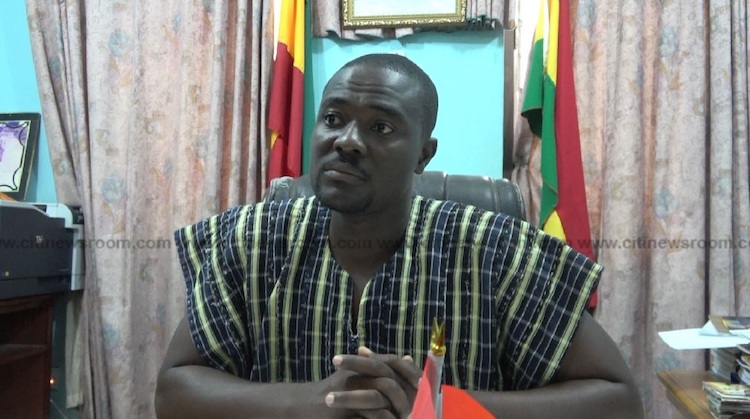
Samuel Nkansah Twum, the Assistant Director of the Atwima Mponua District Assembly
“Before 2017, we had some illegal miners who went into the forest. The Offin river flows through the forest so they mould a machine called the ‘changfang’ machine and they go,, and hide the machine on the river and they mine directly on the river,” he said.
“Legal mining encouraging illegal mining”
An illegal miner who claimed to have stopped the activity and spoke on condition of anonymity said the permission granted to some small-scale mining companies belonging to non-indigenes to mine in the area, pushes them to go into the forest to mine since they are poor and cannot sit aloof as others make wealth from mineral deposits “on our lands.”
As at March 2019, three months after the government lifted the ban on small-scale mining, 23 small-scale mining companies had been cleared to mine on various concessions within the Atwima Mponua District.
Although not all of them are actively mining, the operation of the few, according to the District Assembly, is constantly being monitored to ensure that they conduct their activities in a safe and sustainable manner.
The claim could not be immediately verified.
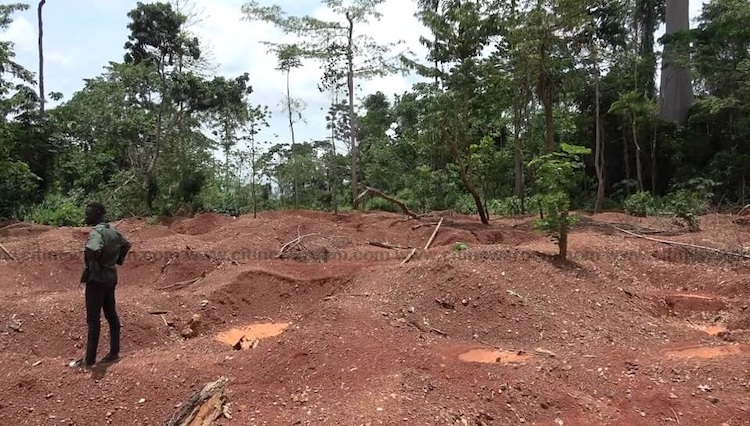
The havoc being wreaked in the Tano-Offin forest by some illegal miners was very evident during a site visit in March 2019.
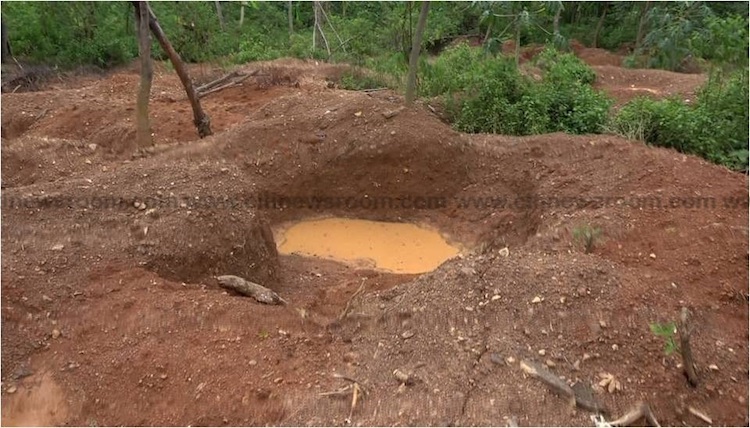
There were many visible signs of degraded lands, pockets of turbid brownish water, and lands from which trees were cleared in the forest for illegal mining.
Pocket of water in an illegal mining pit in the Tano-Offin forest
Some of the illegal miners have also taken to mining directly on the Offin River which flows through the forest.
The river has become polluted as a result.
Inadequate forest guards
The Ashanti Regional Forestry Manager, Mr. William Baah, said dealing with the situation has been challenging.
He blames the lack of forest guards and other resources for the height at which the illegality is being perpetrated.
There are barely twenty forest guards manning the entire Tano-Offin forest and the number is woefully inadequate to ward off the illegal miners, who could easily pitch camp deep within the forest where guards can barely visit.
“If they go in the middle of the reserve, you might not know and there are so many routes to enter the forest so they may enter through a point and if they are there doing the mining, unless somebody inside there hints you or if the guards maintaining the boundaries see footpaths, they follow it and get to that point. Some work under the cover of darkness but even in the daytime they do it. The forest guard cannot be everywhere at the same time. [He will be moving so they may study him and operate at his blind side.] It is not an easy job. We do our best but the people always try to outwit us,” Mr. William Baah said concerning the illegal miners in the forest.
Arrests for mining in Tano-Offin forest
Although there is a popular belief that arresting the illegal miners will deter others from carrying out the crime, the challenge persists.
The local assembly says the arrests, not just those carried out in the forest, has helped to reduce the incident of illegal mining with a few notorious persons still mining illegally.
The Nkawie District Forest Manager, Ebenezer Mensa, who oversees the Tano-Offin forest said only eight illegal small-scale miners have been arrested since the beginning of the year.
“What we are encountering now are those using shovel and pickaxes and periodically we go in to arrest some of them and bring them to the police and then to the court. Now, you don’t see excavators…Basically, it is just small guys who are inside the forest, deep inside the forest… this year [2019] eight people have been arrested. All of them were using shovels and pickaxes but with the excavators we have arrested only one,” Mr. Mensa said.
‘Seized equipment’
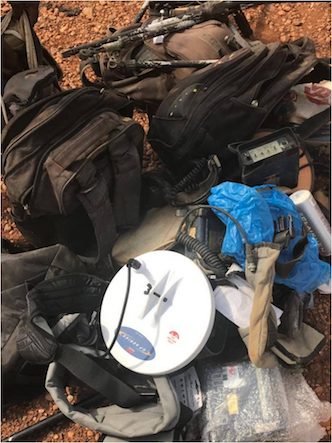
Seized gold detector
Equipment of illegal miners is in almost all case seized.
A November 2018 audit of seized equipment from a report of the District Committee Against Illegal Mining in the Atwima Mponua District Assembly indicated that 40 gold detectors, 20 mobile phones among others equipment were retrieved from various operations in the district.
Indeed, the commitment of the culprits to spend days desecrating the forest even with the simple tools they wield gives a clear indication of how much their activities within the forest cannot be underestimated.
Drone technology to fight illegal mining
The government in September 2017 announced plans to procure drones worth $3 million to help fight the illegality, especially in hard-to-reach areas.
According to Samuel Twum Ampofo, the Atwima Mponua District Assembly has taken delivery of its drones and assigned pilots to fly them to gather information about the movement of illegal persons within the forest and enable the assembly and security officials take action.
“The district has received the drones. We have two drones and drone pilots allocated to the Atwima Mponua district. They will be flown into the sky to see where people are flouting the mining laws. It will give us an indication as to where an illegality is being conducted so that the task force can be alerted and they can go into the place to remedy the situation,” he said.
Atewa forest’s slow death
About 62 kilometers from the Eastern Regional capital of Koforidua is the Atewa Forest Range.
Like the Tano-Offin Forest, it is fast declining in coverage.
The moving in the forest range is a daunting task due to the steep-sided hills, however, the knowledge of the large deposits of gold and low-grade bauxite underneath the forest reserve, with the level of poverty and unemployment in the area, has driven many young people into the forest to mine illegally.
Abraham [not his real name], is 19 years of age and a final year senior high school student.
He was spotted alongside two other friends illegally mining at the foot of the Atewa forest in an already dug out pit.
Like his friends, school was on vacation and so he decided to “do the illegal mining to get something [money].”
He said there were no jobs in the community hence his decision to go to the site to mine.
Although he admitted that his action was illegal and had dire negative effects on the environment, he said the monetary reward was a motivating factor.
Illegal mining
“My friends just brought me here and told me that if I come here, by all means, I’ll get something to put in my pocket. If you come, you will get what you want. A day you can get GH¢ 100 ($20). Anytime we come, we get something…. It is good to ban it, it is destroying the land and the water so if it is banned it is good but for us, we are just students and we don’t do this all the time,” he said.
Together with three other they sometimes make as much as GH¢ 500 ($100) a day, digging up old pits left behind by more sophisticated illegal miners.
“How these illegal miners are operating in our community is making us suffer. It they mine and cover the pit afterwards, we’ll not have so much problem with them but they leave the pits uncovered, endangering our lives. They take this same attitude into our forest and destroy that place,” Maame Akua, a cocoa farmer said.
Emmanuel Akyeanor Tabi, the Assemblyman for Sagyimase, a community at a foot of the forest reserve, said the problem of illegal mining in the Atewa forest is getting out of control because of many more youths from within and neighbouring communities are attracted to perpetrate the crime due to the possibility of high profits.
Emmanuel Akyeanor Tabi, Assemblyman for Sagyimase
“They are everywhere in the forest and it is very difficult [for forest guards] to get there. They are able to go there and stay there for days, using manpower…They can take an acre of land in a day because they are many. As they dig, the trees will fall and they mine around them. You will see a lot of devastation, a lot of areas in the forest have been mined and that is our worry. In the past, it was very few of them in the forest but now it is serious,” he said.
He added that due to the monies many of those who are involved in the illegality make, they are never satisfied if they are convinced to shun the activity and take up alternative legal jobs.
“Unemployment is one of them. Some of them are arrested and released so people think that if you are well connected you can easily get released and that has motivated them. The money that they are getting, they get a lot of money and that is the motivation so they are not afraid of the risk. If someone can get GH¢300 ($60) a day and he cannot find that money in another job that he goes to do, if you give them another job, they wouldn’t like to do it,” Mr. Tabi said.
With the fewer number of forest guards and other resources available to man the Atewa range, it is easy for illegal miners to hide in the forest and pitch camp for days digging up the precious mineral illegally.
They take to obscure locations that will ordinarily not be visited by any forest guard or state security apparatus unless in the few occasions of targeted operations after a tip-off from informants including hunters.
It will take nearly two hours, climbing up the steep hills to reach the closest illegal mining site in the forest.
Further activities of illegal mining take place farther away from each entry point of the natural reserve.
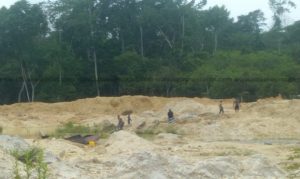
Illegal mining – Atewa
Illegal mining – Eastern
Politicians encouraging illegality
Some community leaders pointed accusing fingers at top politicians and local chiefs as persons sabotaging the fight against illegal mining in the Atewa forest.
They cited instances where illegal small-scale miners were released back into the community hours after they were arrested after intervention from top state actors, including those in the current New Patriotic Party (NPP) government.
Besides the example of politicians helping to free arrested illegal miners was the instance of those who recruit known illegal miners to run the illegal business on their behalf.
That claim could not be immediately verified.
Evidence gathered from happenings within the forest however is indicative of some perpetrators connected directly or indirectly to sources of political power and local authority.
Indeed, some of the illegal miners, use the names of influential persons including politicians they have some relationship with to get unfettered access to the forest and also intimidate local vigilantes to enable them carryout the act without hindrance.
One of the many abandoned mined spots in the Atewa forest
Abandoned bowl and carpet used by illegal miners in the Atewa forest
While some of these perpetrators may have received blessings from influential persons they are connected to, others use their names without their knowledge.
Also, there are claims of the police and the government’s anti-illegal mining taskforce compromising their ethics by taking bribes to free persons caught mining in the forest but the those accused, including the joint military-police taskforce, Operation Vanguard, have denied the allegations.
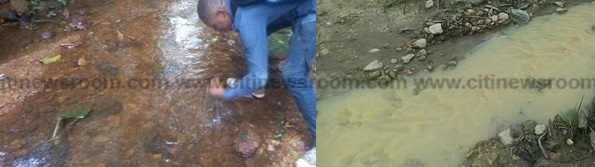
Water closer to source in the Atewa forest vs. when it’s intercepted for illegal mining
Government giving boost to illegal mining
The government’s decision to trade the Atewa forest reserve for $2 billion worth of infrastructural development from China has severely undermined the efforts of environmentalists and locals fighting for the conservation of the mineral-rich natural forest.
Per the agreement, the Sinohydro Group Limited of China will provide infrastructure of Ghana’s choice including hospital, roads, electricity, housing and sanitation projects and in return be allowed to mine bauxite in the forest.
Ghana has already been given access to $646.6 million being value for the first batch of projects all across the country, and that may be the final nail in the coffin for the Atewa forest.
“This forest cannot be saved, if the government’s interest to mine bauxite is not rescinded,” Daryl Bosu, Executive Director of A-Rocha Ghana explained.
He explains that to the extent that the government has consented to the destruction of the forest in the Sinohydro deal bauxite batter deal, there is now very little consideration given to the protection of the forest.
Bauxite ore retrieved from the Atewa enclave
“That declaration is having a toll on the level of care and vigilance that even the state agencies are applying to manage the forest. People are thinking that it s going to be mined anyway so let me see what I can salvage before the big players come to hack it away,” he added.
More surprisingly, the environmental impact of bauxite mining far exceeds what small-scale illegal mining causes. Bauxite mining has a direct impact on the environment by polluting air, water sources and soil and may require resettlement of nearby communities due to the potential health hazard.
The mining of bauxite is however yet to commence but advocates within the communities say while fighting illegal mining in the forest is important, the purpose is defeated if the government is giving up the sanity of the forest reserve in a trade deal for bauxite mining.
Lenient court sentences
A-Rocha Ghana, a nongovernmental organization, has been campaigning actively for at least four years for the protection and preservation of the Atewa forest.
The organization believes that the lenient sentences have been a great disincentive to the fight against illegal mining in the forest.
Some convicted illegal miners are fined as low as GH¢ 1,000 ($200) and this is a great source of worry for all persons concerned about the conservation of forests in the country.
It is worthy of note that some illegal miners make that money out of the illegal trade in a matter of hours.
“On the punishment, yes, some are not deterrent enough which is also a reflection of the low value we place on the impacts caused by such illegal activity. There need to be a review of the current mining regulations, not only to serve as a deterrent but also to internalize the true costs of mining in every permit, that way I am not sure, miners will find mining to be as lucrative as they see it now. Currently, miners destroy the land, make their money and leave public to deal with the mess,” Daryl Bosu of A-Rocha Ghana said.
The government’s joint police and military anti-illegal mining team, Operation Vanguard, has also had the cause to complain about what they described as “weak” sentences for persons they arrest for illegal mining.
Ghana’s president, Nana Akufo-Addo, expressed the same sentiments in October 2018 when he urged judges to consider the highest form of punishment whenever they are to exercise their discretion in handing sentences to suspects in any of such crimes.
President Akufo-Addo
The Eastern Regional Manager of the Forestry Commission also expressed worry about the situation.
“It continues to be a source of worry, that persons caught in the act of destroying our environment and polluting our water bodies, the inheritance of our future generations because of the phenomenon of illegal mining, popularly referred to as galamsey, get away with lenient sentences. As it is at certain places, the discretion must be exercised for the upper end, for the maximum,” he said while swearing into office four new Supreme Court judges in Accra.
He said his outfit is helpless as its powers only end at the point of effecting arrest and assisting the police to pursue the matter in court.
“We arrest them and take them to the police [but] when it comes to prosecution, we don’t have control. Ours is to try and arrest the people and get them there for the judiciary to do their part,” he said.
The complexities involved in getting illegal miners arrested, prosecuted and sentenced by a court has been a great disincentive to most locals who feel it is a fruitless venture.
A resident who spoke on condition of anonymity revealed that his life was once threatened by an illegal miner who he reported to the police.
He said the miner was arrested but released after a day.
“He came to my house and threatened to kill me if I try to report him again,” the resident said.
Data from the office of the Kyebi Range Manager of the forest reveals that 102 illegal miners have been arrested from the forest since 2017. 88 of them have been convicted, jailed or fined while 13 are in prison custody. One other suspect jumped bail and is on the run.
The Range Manager, Jones Agyei Kumi, said to the extent that only four have been arrested so far this year, the incident of illegal mining in the forest can be said be declining.
The lack of proper coordination among the various state-backed security task forces means that the figures may be much higher.
Conclusion
The government and other state actors including the Forestry Commission have said they are stepping up efforts to tackle the incidence of illegal mining in Ghana’s forests which if left unchecked, could spell doom for the country’s forest resources, but they seem to be losing the fight through the complicity of some officials supposed to be guarding the interest of the state.
The conspicuous lack of coordination between various security groups established to deal with the menace and firefighting approach of tackling the problem must changed.
Although continuous planting of trees to replenish the forest is important, it must not be prioritized over the foremost duty of ensuring that no single act of illegal mining is undertaken within the country’s forest reserves.
The environmental impact of illegal mining in Ghana’s forest reserves and the effects of climate change the country is currently confronted with should serve as a wake-up call to the government to quadruple its efforts to save the dying reserves.
This investigation was supported by Ford Foundation and the International Centre for Investigative Reporting, ICIR.
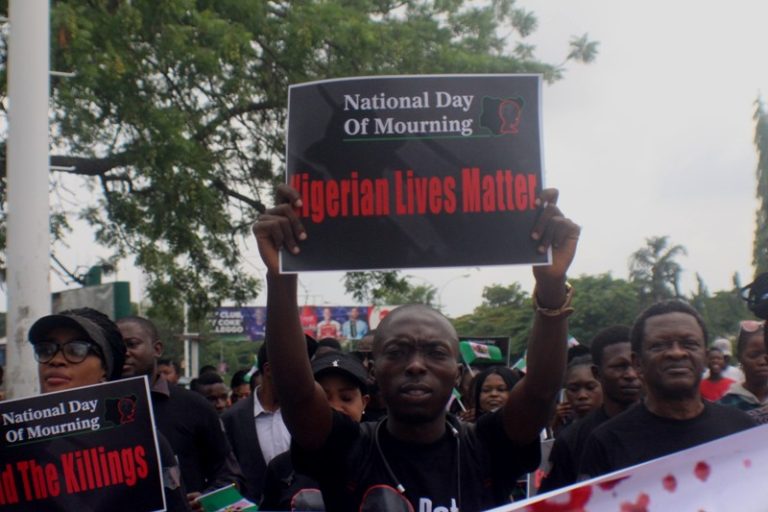
NIGERIAN’S took to the streets of Abuja on Tuesday to mourn the victims of violent deaths across the country as a result of heightened insecurity, especially in the North West region.
A coalition of Civil Society Organisations and Human Rights Activists have designated every May 28 as a day of national mourning for Nigerians who died as a result of the activities of terrorists, kidnappers, bandits, cultists etc, especially those whose bodies could not be retrieved for a decent burial, whom only their immediate families are left to bear the mental and emotional torture of their demise.
It is also a date where the activists make a collective demand on the federal government for more proactive actions to be taken towards strengthening the internal security structure of the country.
“This (march) is about people from every part of this country who have died because they did not need to die,” says Chidi Odinkalu, former Chairman of the National Human Rights Commission, who is also a co-convener of the march.
Odinkalu called for the adoption of a community policing system where the security agencies pay more attention to securing the lives of the ordinary people rather than concentrate almost all their attention to guarding the rich and powerful in the society.
“At the moment we do VIP policing,” he said. “Over 33 per cent of the police assets we have are deployed to protect big men. That means we don’t have the policing assets we need at the points of need, which is the communities. Instead, the politicians are calling for state police so that they can control it and divert it away from us.
“The medium between state police and what we have at the moment is community policing. It will enable us to put police in the communities where ordinary people are, where they can get support and help and where it is possible for them to provide utmost service, and that is what we are asking for.”
Jaiye Gaskiya, an activist-political office seeker who is also a co-convener of the march, agrees that community policing was the way to go even though the decentralisation of the Nigeria Police would achieve more results.
Chidi Odinkalu, former Chairman of the Natl Human Rights Commission, and Jaiye Gaskiya, a human rights activist, both are conveners of ‘Nigeria Mourns 2019’.
“This (insecurity) crisis has become an opportunity for us as a country. The most fundamental reform that this country needs with respect to insecurity is that we need to reform governance at the local level,” he said.
“Our communities are ungoverned spaces, there is no governance at the community level. Let us restore democratically self-governance to our communities, and let communities then handle their own security system. We can then put in place processes for coordination and synergy.”
The march which took off from the Unity Fountain in Abuja to the premises of the Ministry of Justice, saw hundreds of Nigerians, comprising mostly young people, bearing placards and chanting solidarity songs and demanding for justice for the victims of violent crimes.
During the ‘Nigeria mourns’ event of 2018, the CSOs were unanimous in the call for the sack of all the service chiefs, as well as all those who play a part in the security architecture of Nigeria, including the Ministers of Defence and Interior.
“That remains our demand (for the security chiefs to be sacked). It has not been acceded to,” Odinkalu said.
“The police chief has gone, and for that we are thankful, because we can see some change in the policing. The new Inspector-General of police (Adamu Mohammed), I think, deserves some commendation. We are not saying he’s done everything, but we can see that some things are changing.
“We are not asking for miracles, we are asking for evidence that the leaders care. We have given the service chiefs and the cabinet members enough time… We should thank them for their services and disengage them and bring in new people with new ideas.”
It must be pointed out, however, that the former Inspector-General of Police, Ibrahim Idris, was not removed from office as a consequence of the rising insecurity in the country, rather he retired ceremoniously after having served for 35 years in keeping with the public service rules.
The highlight of the march was when the names of some of the deceased victims of violent deaths were called out at the Ministry of Justice premises as protesters echoed “Rest in Peace”.
More photos of the Nigeria Mourns protest:
The protesters at the premises of the Ministry of Justice.
NIGERIA is among the top 10 worst conflict-affected countries to be a child and it is currently ranked behind Somalia, South Sudan, Mali, Chad, Niger and Central African Republic in cutting under-5 child deaths, a new report by Save the Children has shown.
Save the Children in the report released on Tuesday titled 2019 Global Childhood Report evaluated 176 countries on children’s access to health care, education, nutrition and protection from harmful practices like child labor and child marriage.
The report said Nigeria is ranked in the bottom 10 of the index rankings.
“The country is ranked 170 out of 176 doing slightly better than countries like Somalia, South Sudan, Mali, Chad, Niger and Central African Republic in number 176.”
Other worst conflict-affected countries to be a child are Afghanistan, Central African Republic, Democratic Republic of the Congo, Iraq, Mali, Somalia, South Sudan, Syria and Yemen.
“Large numbers of children in these countries are living close to high-intensity conflicts marked by grave violations of children’s rights (killing and maiming, recruitment, sexual violence, abduction, attacks on schools and hospitals and denial of humanitarian access).”
However, the report showed that West and Central Africa have cut under-5 child deaths by nearly half in a generation.
It said the likelihood of a child dying before their 5th birthday in West and Central Africa has been reduced by 47 percent since the year 2000.
The report pointed out that children living in or fleeing conflict zones across the region remain among the most disadvantaged
It found out that children born currently in West and Central Africa have a better chance than at any time in history of surviving and thriving. Just a generation ago, a child born in the region was nearly 90 percent more likely to die before reaching the age of 5 and more than 20 percent more likely to be married, malnourished or out of school.
While noting that the world has made remarkable progress in protecting childhoods, it attributed the feat to strong political leadership, social investments, and the success of the United Nations Millennium Development Goals (MDGs).
In the year 2000, it said an estimated 970 million children were robbed of their childhoods due to ‘childhood enders’ – life-changing events like child marriage, early pregnancy, exclusion from education, sickness, malnutrition and violent deaths.
“That number today has been reduced to 690 million – meaning that at least 280 million children are better off today than they would have been two decades ago,” the report indicated.
“Together, China and India account for more than half of the global decline in stunting alone.”
It added that progress in many African countries has been too slow to keep up with population growth.
“As a result, even though marriage rates have dropped, the absolute number of child brides has risen by more than 100,000 in eight countries.”
In Nigeria, an estimated 465,000 more girls aged 15 to 19 are married or living in union now compared to 2000. The other countries with over 100,000 more child brides today compared to 2000 are Chad, Madagascar, Mali and Mozambique.
Globally, if current trends continue, there will be more than 70 million babies born to teenage girls between now and 2030. In addition, Nigeria is expected to overtake India as the country with the largest burden of adolescent births.
Eric Hazard, Save the Children’s Campaign and Advocacy Director for West and Central Africa, said:
“A hundred years ago, following one of the most destructive wars in human history, Save the Children’s founder Eglantyne Jebb drafted the Declaration on the Rights of the Child. Today children are healthier, wealthier and better educated than ever before.
While progress has been remarkable, millions of children continue to be robbed of a childhood. We now need to continue to push to reach every last child and ensure they receive the childhood they deserve.
Governments can and must do more to give every child the best possible start in life. Greater investment and more focus is needed if we are to see every child can enjoy a safe, healthy and happy
Launched ahead of International Children’s Day on June 1st, Save the Children’s Global Childhood Report includes the annual End of Childhood Index, which finds that circumstances for children in the majority of countries across West and Central Africa have improved since 2000.