Home Blog Page 238

US slashes visa validity for Nigerians

THE United States Department of State has announced that non-immigrant visas issued to Nigerian citizens will now be single-entry and valid for three months.

In a statement released on its official X handle on Tuesday, July 8, the US Embassy in Abuja noted that the new visa restrictions took immediate effect.

“The U.S. Department of State updated its reciprocal nonimmigrant visa policy. Effective today, most nonimmigrant & non-official visas for Nigerian citizens will be single-entry with 3-month validity,” it said.

The embassy also clarified that all US non-immigrant visas issued before July 8, 2025, would remain valid and unchanged.

“Nigerian travellers are encouraged to respect and adhere to the terms of their visas, and ensure travel documents are authentic, accurate, and up to date,” it said.

The statement highlighted that the change was part of the Department’s global visa reciprocity process, which the embassy described as an ongoing exercise subject to review at any time, including changes to the number of permitted entries and the length of visa validity.

“US visa criteria and standards are designed to protect the integrity of US immigration systems; these standards are based on global technical and security benchmarks,” it explained.

The embassy stressed that the US Mission was collaborating with Nigerian authorities to meet the required benchmarks.

“These standard criteria include: secure travel documents, ensuring countries issue secure travel documents with verified traveller identities, Visa overstay management: Implementing measures to limit overstays by travellers on US visas, and Information sharing: Sharing relevant security and/or criminal record information to protect public safety.

“The United States values its longstanding relationship with Nigeria and remains committed to expanding our partnership based on mutual respect, shared security priorities, and economic opportunity, keeping both our countries safer and stronger,” it added.

The ICIR reported that President Donald Trump signed a proclamation last month prohibiting citizens of 12 countries from entering the US, citing the need to safeguard the nation against “foreign terrorists” and other potential security threats.

The order was to take effect on June 9, 2025, at 12:01 a.m. EDT (0401 GMT). Visas issued before that date would remain valid and would not be revoked.

2025 UTME: 9 out of 10 candidates with highest scores applied for engineering courses

NINE out of 10 candidates who sat for the 2025 Unified Tertiary Matriculation Examination (UTME) intend to study engineering courses in Nigerian universities. 

Similarly, three candidates with the highest marks in the examination applied for Mechanical Engineering, according to data released by the Joint Admissions and Matriculation Board (JAMB) on Tuesday, July 8, in Abuja.

The top scorer, Okeke Chinedu Christian, got 375 and seeks to study Mechanical Engineering at the University of Lagos (UNILAG)

Okeke, who hails from Anambra State and wrote the exam in Lagos State, led the ranking announced during JAMB’s 2025 Policy Meeting on Admission, held in Abuja on Tuesday.

Trailing him is Ayuba Simon-Peter John from Ogun State, who scored 374 and selected Afe Babalola University (ABUAD) as his preferred institution. He also seeks to study Mechanical Engineering.

Tied in third place is Jimoh Abdulmalik Olayinka from Kwara State. He scored 374 and applied for Mechanical Engineering at UNILAG.

While the top three of the 10 leading candidates chose Mechanical Engineering, others selected disciplines such as Electrical/Electronics Engineering, Petroleum & Gas Engineering, Computer Science, and Aerospace Engineering; all of which are rooted in the engineering and technology.

Other leading candidates include Roberts Damiete Ayibo from Rivers State, who scored 373 and applied to study Electrical/Electronics Engineering at UNILAG. Also with 373 marks is Ononugbo Chigozirim Chibueze from Enugu, who selected Electrical/Electronics Engineering at the University of Ibadan.

Another candidate, Olawepo Gertrude Tunmise, from Kwara State also scored 373 and listed Computer Science at UNILAG as her preferred course.

Afonata Ofeoritse Leslie from Delta State garnered 372 and chose Aerospace Engineering at Obafemi Awolowo University.

Meanwhile, Azoyenime Samuel Chukwumemeka, also from Delta, scored 372 and opted for Mechanical Engineering at Covenant University.

Oyebade Oluwapelumi Emmanuel from Ogun State secured 372 and applied to UNILAG for Petroleum and Gas Engineering.

Omigie Osaigbovo Cecil from Edo State rounded off the top 10 scorers chart with 372, also applying for Mechanical Engineering at the University of Ibadan.

In total, four of the ten top scorers listed Mechanical Engineering as their intended field of study.

This year’s UTME also recorded a significant improvement in candidates’ performance, with 80.69 per cent of the 1,945,395 candidates scoring 160 and above — the highest percentage recorded in the past six years.

Additionally, 29.45 per cent of candidates scored 200 and above, marking a steady increase in performance compared to the previous years.

The ICIR reported that the Federal Government pegged the admission age to universities and other tertiary institutions to 16 years during the JAMB’s 2025 Policy Meeting on Admission on Tuesday.

This organisation also reported that JAMB set 150 as the cut-off mark for admission into universities in the country.

Akwa Ibom governor approves N20,000 monthly allowance for ‘corpers’

AKWA Ibom State Governor, Umo Eno, has approved ₦20,000 monthly allowance for all National Youth Service Corps (NYSC) members of Akwa Ibom origin serving in any part of Nigeria.

This initiative followed the recent increase in allowances for corps members serving in Akwa Ibom State, which was raised from ₦5,000 to ₦20,000, effective August 1, 2025.

The latest announcement was made in a statement by the Government House in Uyo on Tuesday, after a State Executive Council meeting held on Monday, July 7.

The governor stated that the initiative was part of his administration’s Renewed Hope – ARISE Youth Support Initiative, aimed at easing the cost of living and supporting the welfare of Akwa Ibom youths in national service.

“This decision aligns with the Renewed Hope, ARISE Youth Support Initiative. It is intended to cushion living expenses and promote the well-being of corps members. The grant is subject to periodic review based on prevailing circumstances,” the statement read.

In a related development, the governor recently approved the reconstruction of the NYSC Orientation Camp in Ikot Itie Idung, Nsit Atai, “further demonstrating his commitment to improving the service experience for corps members.”

The government described Akwa Ibom as one of the safest and most accommodating states for corps members, lauding their continued contributions to key sectors such as education, healthcare, agriculture, and rural development.

The governor’s move, the statement said, is a reflection of “compassionate and inclusive leadership” focused on investing in the next generation.

Recall that the Federal Government recently began the payment of N77,000 to corps members across the country, in conformity with the new national minimum wage.

The new allowance raised the corps members’ stipend by 100 per cent, from N33,000 they were previously paid.

JAMB sets 150 as minimum cut-off mark for varsities

THE Joint Admissions and Matriculation Board (JAMB) has set 150 as the minimum cut-off mark for admissions into Nigerian universities for the 2024/2025 academic session.

JAMB, in a statement on its official X handle, revealed that education stakeholders reached the decision during the policy meeting held on Tuesday, July 8.

The body set 100 as the minimum cut-off mark for admissions into polytechnics and colleges of education.

It also stated that the minimum cut-off mark for colleges of nursing sciences was set at 140.

JAMB Registrar, Ishaq Oloyede, said the approved scores were baseline requirements and no institution was permitted to admit candidates below the thresholds.

“This policy reflects the reality of our education system and the need to align admission processes with merit, equity, and capacity,” Oloyede stated.

He added that institutions were expected to complete their admission processes according to the approved schedule and submit their lists to JAMB for central processing.

The ICIR reported that the Federal Government announced 16 years as the minimum age for admission into tertiary institutions in Nigeria during the policy meeting on Tuesday.

The latest policy was announced by the Minister of Education, Tunji Alausa.

The annual policy meeting establishes the guidelines for admissions into universities, polytechnics, and colleges of education.

Loan exposure: CBN directs banks to submit recovery plan

THE Central Bank of Nigeria (CBN) has directed banks with unresolved ‘forbearance exposures’ to submit a Capital Restoration Plan as part of a regulatory measure.

Forbearance exposure refers to the temporary postponement of loan payments. Lenders and other creditors grant forbearance as an alternative to forcing a property into foreclosure or leaving the borrower to default.

The apex bank gave the order in a circular signed by its Director of Banking Supervision, Olubukola Akinwunmi, released on Monday, July 7.

The Capital Restoration Plan is to complement CBN’s measures, including termination of forbearance exposure and Single Obligor Limits waivers, suspension of payment of dividends, bonuses, and investment in foreign subsidiaries for affected banks.

“To complement the above measures and ensure forward-looking capital planning, all affected banks are required to prepare and submit a comprehensive Capital Restoration Plan to the CBN on or before the 10th working day following the end of the quarter, with effect from June 30, 2025.

“The plan should detail the management’s proposed strategies to restore full regulatory compliance, including (but not limited to) cost optimisation initiatives, risk asset reduction, significant risk transfers, and necessary business model adaptations,” it stated.

A check by The ICIR shows that a Capital Restoration Plan is a formal roadmap that outlines how a bank plans to return to full financial health, specifically, how it intends to meet all regulatory capital and asset quality requirements.

The apex bank had, in a notice on June 13, instructed all the banks with unresolved forbearance exposures to halt dividend payments, defer executive bonuses, and suspend all new investments in offshore subsidiaries, The ICIR reported.

The directive is aimed at strengthening capital buffers and ensuring adequate provisioning against impaired loans, especially those that risk breaching the regulatory Single Obligor Limit (SOL).

It is to remain in place until affected banks have fully provisioned for their forbearance exposures and phased them out entirely.

According to the CBN, the recovery plan must cover the entire period until full normalisation of capital and asset quality indicators is achieved.

“Plans submitted will be subject to regulatory review and approval, and will form the basis for continuous supervisory monitoring and engagement throughout the transition,” it said.

The apex bank also directed the banks to submit quarterly disclosures on key metrics to aid regulatory transparency and support supervisory oversight.

It said effective June 30, 2025, banks are to disclose “detailed provisioning status and reconciliation of affected credit exposures. CAR [cash reserve ratio] calculations with and without transitional reliefs. Classification migration data for restructured or impacted loan facilities and comprehensive disclosure of AT1 [additional tier 1] instruments, including issuance terms, usage, and related conditions.”

“The measures represent a firm but supportive framework for the final phase of exiting the regulatory forbearance regime, and reflect the CBN’s focus on macro-financial stability, responsible banking practices, and standards,” the CBN added.

Coalition: Abure-led Labour Party faction vows to expel Peter Obi

0

The Labour Party (LP) faction, headed by Julius Abure, has revealed its plan to expel its presidential candidate in the 2023 poll, Peter Obi, from the party over his involvement in an opposition coalition launched recently to remove President Bola Tinubu from office in the next election.   

 The faction’s National Publicity Secretary, Abayomi Arabambi, disclosed this when he appeared on Channels Television’sThe Morning Brief’ on Tuesday, July 8.

According to him, Obi’s continued engagement with the coalition while still identifying as a Labour Party member is unconstitutional.

Recall that as part of strategies to dislodge the ruling All Progressives Congress (APC) in the 2027 elections, leading opposition figures, including former Vice President Atiku Abubakar, former Rivers and Kaduna state governors, Rotimi Amaechi, and Nasir El-Rufai, respectively, and Obi, led others to launch the coalition in Abuja last week.

The coalition finally settled for the African Democratic Congress (ADC) as a key opposition party that will challenge Tinubu’s APC in the 2027 elections.

Speaking on his membership in the coalition, Obi had said he was serious with the group and would run for the presidency in 2027.

Reacting, the LP spokesperson said the party would convene a National Executive Council (NEC) meeting where Obi would be expelled.

He said it was unconstitutional for Obi to belong to two political parties simultaneously, adding that the former Anambra State governor had been deceived into joining another group and would remain there.

Arabambi said the NEC would recommend Obi’s expulsion, to be ratified at the party convention according to the party’s constitution.

“Obi will be expelled from our party. He is no longer a member. It is not within his right to claim,I am still a member of the Labour Party,and at the same time be hobnobbing with what we call theyahoo yahoo’ coalition. We are not going to accept that,Arabambi stated.

He criticised the notion that Obi built the Labour Party, arguing that the party’s integrity and goodwill propelled Obi to prominence. He attributed the presidential candidate’s popularity to the frustration of Nigerians with past administrations.

Arabambi emphasised that the party made Obi. He accused him of starting the current crisis within the party.

He also criticised Obi for alleged authoritarian tendencies, saying he wasn’t fit to lead the party if he couldn’t work with members.

The LP has been experiencing a prolonged leadership crisis, with multiple factions and individualsincluding Abure, Nenadi Usman, and Lamidi Apapaeach claiming to be the legitimate leader of the party.

The ICIR reports that the Supreme Court, in a judgment on Friday, April 4, set aside the judgment of the Court of Appeal in Abuja, which recognised Abure as chairman of LP.

The apex court, in a unanimous judgment, held that the Court of Appeal lacked the jurisdiction to declare Abure as the national chairman of the LP.


‘Tinubu reforms need time to work’, presidency tells IMF

PRESIDENCY has countered the International Monetary Fund’s (IMF) suggestions on how the government could lift millions of Nigerians out of hunger, emphasising that economic reforms under President Bola Tinubu need more time to produce the needed results.

On Monday, July 7, the IMF has suggested three key priority areas Nigeria could focus on to address its current challenges of high inflation and widespread poverty,  among others.

The suggestions included that the Nigerian government sustain economic growth, implement an effective budget framework, and increase domestic revenues to lift millions of its citizens out of poverty and food insecurity, The ICIR reported.

Speaking at Channels Television programme, ‘The Morning Brief’, on Tuesday, July 8, the Special Adviser to President Bola Tinubu on Economic Affairs, Tope Fasua, kicked against the IMF’s advice.

He argued that the Bretton Woods financial institution has, in recent times, issued statements on Nigeria, which he said could put everybody in a state of confusion.

Fasua believes the government needs time to drive its policies and not for the IMF to be issuing statements that kind of pitch the government or pitch the people against the government.

“This administration under President Tinubu has done some of the deepest reforms that we’ve seen in a while. I mean, we only just got the tax bill signed into an act, and that tax bill, a pro-tax bill, that gives a good break to people who are earning very little amount of money, that increases by 100% the threshold for tax-free for small businesses,” Fasua argued.

He maintained that the IMF advisory business and its lending business units appear to be clashing on their advice to Nigeria.

“We don’t know which one to believe, you know. So, I would think that the statement went into overdrive.

“Whereas they acknowledge that we have done the right thing, they want more of the things that will hurt the people,” Fasua said.

He also accused the IMF local teams of having a more nuanced view about the Nigerian economy than the European economy.

“Give us a break. Let us be able to know where we’re going with that particular policy before coming at us at every angle and generally throwing us off work,” the presidency adviser said.

He believes the government could make things right in another year.

“Give us a year and let’s see what happens in this next year. As we close on the third year, let’s do another analysis,” Fasua added.

The President of the Nigerian Economic Society, Adeola Adenikinju, however, took a contrary view, saying that the government does not have to agree with the IMF or wait for it to speak, but should see through the reality on the ground.

Adenikinju, who was also a guest speaker at the Channels Television programme, commenting on the budget framework, said the assumptions derived from the current budget, to a very large extent, would be difficult to implement.

“The price of oil has collapsed, the inflation rate is a little bit above the assumptions,” he said.

According to Adenikinju, the reality is that the implementation of the budget is not realistic, and revising it can help to ensure that it is in alignment with reality.

He explained, “Because if you want to spend, you know, against a budget that the revenue projections are not realistic, then you’re going to have more problems.

“Your budget deficits will go up, and you then have to borrow more. And that has a lot of implications for the economy.”

He believes that the IMF suggestion makes sense as regards its worries about the Nigerian budget framework.

He explained that if the government does not realise its projected revenue, it should not cut down expenditure; its debt would increase.

He noted that the government has done a lot in putting critical reforms in place, but the reality is that deficits continue to be an issue.

FG pegs admission age to varsities, other tertiary institutions at 16

THE Federal Government has announced 16 years as the minimum age requirement for admission into tertiary institutions in Nigeria.

The latest policy was announced by the Minister of Education, Tunji Alausa, on Tuesday, July 8, during the 2025 policy meeting of the Joint Admissions and Matriculation Board (JAMB) held in Abuja.

The ICIR reports that the annual policy meeting establishes the guidelines for admissions into universities, polytechnics, and colleges of education for the upcoming academic session.

Alausa stressed that the age requirement was official and non-negotiable, warning that any admissions conducted outside the Central Admissions Processing System (CAPS) would be deemed illegal.

He stated that heads of institutions found guilty of admission fraud or bypassing the CAPS system would face prosecution in accordance with the law.

The ICIR reported that JAMB disclosed earlier this year that more than 11,553 underage candidates registered for the ongoing 2025 Unified Tertiary Matriculation Examination (UTME). 

According to JAMB, some parents register their children due to peer pressure.

The surge in underage registrations has sparked intense debate over the appropriate admission age for Nigeria’s tertiary institutions.

In 2024, the Minister of Education, Tahir Mamman, faced criticism for his initial directive to bar candidates below 18 from admission—a policy later revised to admit candidates aged 16 and above following appeals from stakeholders.

Mamman, at the 2024 admission policy meeting organised by JAMB, in Abuja, directed JAMB and tertiary institutions to stop admitting under-18-year-old candidates into higher education programmes.

During the review of the memorandum for the same 2024 policy meeting on the year admissions, Mamman eventually agreed with the adoption of 16 years.

He acknowledged that many of the underage candidates had already taken the UTME without prior knowledge of the directive.

Scholarships available for Sulzberger Executive Leadership programme

COLUMBIA Journalism School is offering its 2026 Sulzberger Executive Leadership Programme.

To support the programme, Columbia Journalism School is sponsoring up to four scholarships for news leaders to attend.

The programme helps senior leaders in journalism and media to develop strategic clarity, an innovation mindset, and cultural leadership tools to tackle their organisation’s most pressing challenges — and lead lasting change.

The programme trains news leaders to lead innovation and solve strategic business challenges in a time of rapid transformation, uncertainty and opportunity.

Fellows in this five-month low-residency programme spend three weeks at Columbia Journalism School in New York City, starting with a 10-day residency in January 2026.

Underrepresented news leaders are eligible for scholarships to attend a leadership programme.

Fellows then work on their projects and assignments back at their organisations and attend a weekly virtual cohort meeting. Fellows return to New York for one final week of residency.

The scholarship covers tuition. Fellows selected for the placements will be responsible for their travel and lodging during the New York campus residencies.

The submission of the application is October 12, 2025. Interested applicants can apply here.

Old video used to depict Buhari’s burial amid illness rumours

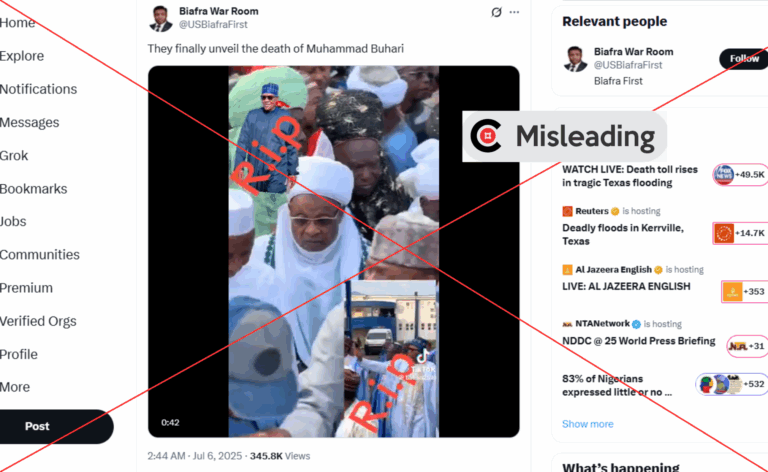
An X account, @UDBiafra1st, posted a video showing Northern dignitaries gathered at a funeral, claiming it showed the burial of former President Muhammadu Buhari.

The video circulated amid viral rumours that the former president is critically ill.

The account shared the video with the caption: “They finally unveil the death of Muhammad Buhari.”

As of July 7, 2025, the post has generated over 300 reposts and more than 800 likes.

The claim was also shared here on Facebook.

 CLAIM 

The video shows the burial of former President Muhammadu Buhari.

screenshot of the viral post

THE FINDINGS 

Findings by The FactCheckHub show that the claim is MISLEADING.

Reports emerged last week that former Nigerian President Muhammadu Buhari was critically ill and has been admitted to the Intensive Care Unit. However, Bashir Ahmad, who was a digital media aide to former President refuted the claim.

The FactCheckHub analysed keyframes from the video using Google Reverse Image Search, the result shows that the video depicts the funeral of funeral of Safara’u Umar Radda, mother of Katsina State Governor, Dikko Umaru Radda who was buried on Sunday 23-03-2025.

Earlier versions of the video can be seen here, here and here.

The funeral was attended by Kano State Governor Abba Kabir Yusuf, Governor of Jigawa State, Umar Namadi, Speaker of the Katsina State House of Assembly, Nasir Yahaya Daura.

Daily Trust also reported the event, publishing photos showing the same dignitaries at the burial.

The burial rites, which took place at Radda Village in Charanchi Local Government Area and were attended by prominent government officials and traditional rulers.

THE VERDICT 

The claim that the video shows the burial of President Muhammadu Buhari is MISLEADING, as findings showed that the video depicts the burial rites of the Katsina governor’s mother.

This report is republished from The FactCheckHub.