Home Blog Page 250

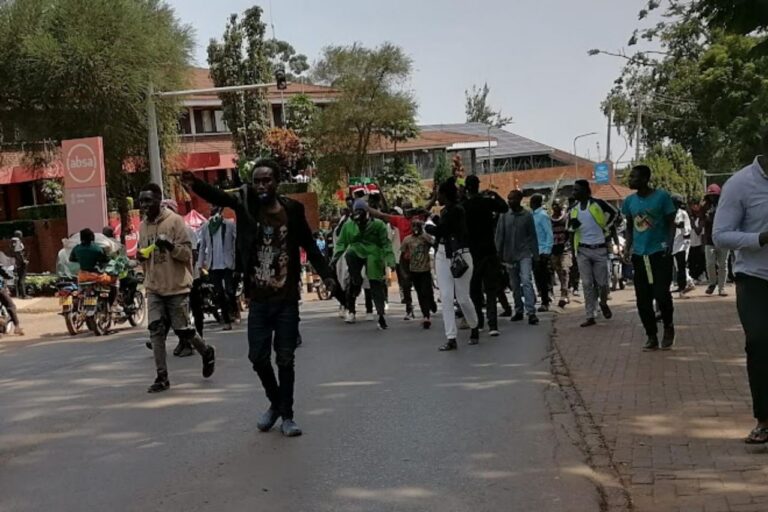
Police clash with protesters in Nairobi, other Kenyan cities

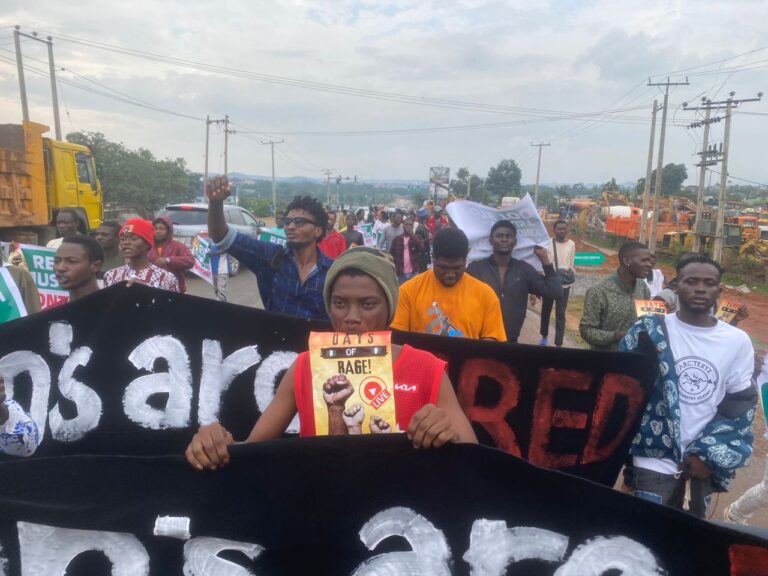
POLICE clashed with thousands of protesters across Kenya’s capital, Nairobi, and other major cities on Wednesday,  June 25.

The protests marked one year commemoration of anti-Finance Bill demonstrations, which began at the country’s Parliament last year and spread to different parts of the country.

The ICIR reported that many protesters were killed in the country last year, with aggrieved citizens demanding for the resignation of President Williams Ruto.

Eight people were killed on Wednesday following the clash between the police and the protesters, according to the BBC

Doctors and human rights groups reported that at least 400 others were injured.

The country’s youth trooped into the streets en masse to honour the victims of the 2024 protests but they met stiff resistance from the police,.

Meanwhile, the Kenyan government had banned media coverage of the protests. 

In a directive issued on Wednesday, the Communications Authority of Kenya (CAK) warned media outlets against broadcasting the protests, citing constitutional and legal justifications.

The directive, signed by the Director General of the Communications Authority, David Mugonyi, reminded media houses of their responsibilities under current broadcasting laws.

The authority cited Article 33(2) and Article 34(1) of the Constitution, along with Section 46I of the Kenya Information and Communications Act of 1998.

“This is therefore to direct all television and radio stations to stop any live coverage of the demonstrations forthwith. Failure to abide by this directive will result in regulatory action,” the government warned.

Schools and businesses have been closed for fear of violence, even though the Police warn against attempts to storm the President’s Office and Parliament.

2027: Obidient Peoples Party, 109 others seek INEC registration

THE Independent National Electoral Commission (INEC) said it had received letters of intent from 110 associations seeking registration as political parties ahead of the 2027 general election.

The chairman of the electoral body, Mahmood Yakubu, a professor, disclosed this on Wednesday, June 25, during INEC’s second quarterly consultative meeting with media executives in Abuja.

The commission said as of June 23, it had received letters of intent from 110 associations seeking to register as political parties and was processing the requests according to the law and guidelines.

“We have acknowledged all requests received so far except six of them received recently, which will be done before the end of the week,” the INEC chairman stated.

He promised that the commission would treat all requests equally, regardless of whether the promoters were ordinary or prominent citizens.

The INEC leader dismissed allegations of compromising independence, citing similar claims in 2013.

He noted that all but six of the letters received had been acknowledged and would process the remaining ones by the end of the week.

He also informed that the handbook containing the 2022 Regulations and Guidelines for Political Parties was available on the commission’s website.

Besides, he announced that a list of the 110 associations, including their details, would be published on the commission’s website and social media platforms for transparency.

Yakubu said the commission was prepared to conduct pending by-elections and resume continuous voter registration across the country.

“The commission met yesterday and we are finalising the details of the two activities, which will be made public in the next 24 hours,” he added.

He also said the primaries for the Area Council elections in the Federal Capital Territory were ongoing and scheduled to conclude on June 30..

Some of the associations that are seeking registration as a political party include Key of Freedom Party (KFP), Absolute Congress (ABC), All Grassroots Party (AGP), Congress Action Party (CAP), United Social Democrats (USDP) and National Action Congress Party (NACP).

There are also Great Alliance Party (GAP), New Nigeria Congress (NNC), United Peoples Victory Party (UPVP), Allied Conservative Congress (ACC), Peoples Freedom Party (PFP),, All Nigerians’ Party (AND), Abundant Social Party (ASP), Citizens Party of Nigeria (CPN), National Freedom Party (NFP) and Patriots Party (PP).

The list also includes the Accelerated African Development Association (AADA), Obidient Peoples Party (OPP), the Movement of the People (MOP), Peoples National Congress (PNC), the African Union Congress (AUC), Alliance of Patriots (AOP), Socialist Equality Party (SEP), About Nigeria Party (ABNP), and African Reformation Party (ARP)

Tempers flare in Abuja court during trial of #EndBadGovernance protesters

0

TEMPERS flared at the Federal High Court (FHC), Abuja, on Wednesday, June 25, during the trial of August #EndBadGovernance protesters.

The court became tense when Ibrahim Mohammed, the counsel to the Inspector General of Police (IGP), Kayode Egbegbokun, asked the judge, Emeka Nwite, for adjournment of the case so he could prepare, because, according to him, he was just taking over the matter from the previous counsel.

The request from the prosecuting counsel angered some of the defence counsels, who immediately protested against the proposed adjournment.

One of the defence counsel, Deji Adeyanju, who vehemently opposed the application, said the matter had lingered for too long because of the lack of diligence on the side of the prosecution team.

He argued that postponing the case would cost the defendants, whom he described as ‘poor,more suffering. “These are poor Nigerians who protested against bad governance in Nigeria,” he stated.

He therefore asked the judge to strike out the case.

In addition, the human rights lawyer asked for compensation for the defendants to alleviate the suffering they had gone through since the beginning of the case.

On his part, another defence counsel, Abubakar Marshall, said he was taken aback that the prosecutor attempted to raise adead issue.”

He said both the Director of Public Prosecution (DPP) and Attorney-General of the Federation (AGF), and several other state actors had called and pleaded that the case be closed.

“We have agreed and orders were made that the charges be withdrawn, and they informed us that all the charges will be withdrawn,he stated.

He argued that the defendants appeared before the court willingly, the prosecution failed to prove its case in court, and the case should be discontinued.

He, however, asked for compensation of N500 thousand each for the defendants.

Other defence lawyers aligned with all the submissions put forward by their colleagues and asked for the case to be struck out.

Responding, the prosecuting counsel, Ibrahim, submitted that the defence counsels were trying to whip up sentiments with their submission, a position that further angered the defence team.

The judge succeeded in calming the tensions after a lot of arguments.

In his ruling, the judge, Nwite, said that although justice delayed is justice denied, it is important that the case be properly heard.

Nwite, however, warned that if the prosecution team failed to present its case at the next adjourned sitting, the case would be struck out.

“We will only adjourn this matter on the condition that if, on the next adjournment, they are unable to go on with this matter, this case will be struck out,the judge stated.

He thereafter adjourned the matter to October 9, 2025, for trial.

The eleven defendants, namely Akande Daniel, Adaramoye Michael Lenin, Mosiu Sodiq, Angel Love Innocent, Adeyemi Abiodun Abayomi, Buhari Lawal, Bashir Bello, Suleiman Yakubu, Opaoluwa Eleojo Simon, Nuradeen Khamis, and Abdulsalam Zubairu, were charged before Nwite by the IGP.

They are facing charges bordering on alleged treason, intent to destabilise Nigeria, conspiracy to commit a felony, and inciting mutiny.

Recall that between August 1 and 10, 2024, Nigerians took to the streets to protest against the country’s rising cost of living and widespread corruption.

During the protest, many of the protesters were arrested and charged with treason.

The ICIR reported that Amnesty International (AI) had, in a report on November 28, stated that at least 24 people were killed and over 1,200 others, including minors, were detained during the protest.

Media Rights Agenda hails Reps over proposals on FOI compliance

0

MEDIA Rights Agenda (MRA) has commended Nigeria’s House of Representatives for its proposals aimed at strengthening the Freedom of Information (FOI) Act, 2011.

The proposals which were made on Tuesday, June 24, by the Reps Speaker, Tajudeen Abbas aim at improving compliance by public institutions with the FOI Act and ensuring its effective implementation.

In a statement sent to The ICIR on Wednesday, June 25 and signed by its communications officer, Idowu Adewale, MRA described the proposals as “a renewed opportunity to institutionalise transparency in public affairs and strengthen citizens’ trust in Government.”

It also commended the Speaker’s call for mandatory and enforceable budgeting for FOI compliance by all Ministries, Departments, and Agencies (MDAs) of government.

It noted that during the annual appropriation process, the organisation urged the National Assembly to take urgent and concrete steps to implement the proposals.

The MRA’s deputy executive director, Ayode Longe, further commended the Speaker for his “clear recognition of the critical role that access to information plays in ensuring transparency, accountability, and participatory governance.”

“We consider his proposals, which are in total alignment with similar recommendations by Media Rights Agenda over the years, to be a timely and important step towards addressing the persistent culture of secrecy and non-compliance that has undermined the effectiveness of the FOI Act for over a decade,” Longe said.

The Speaker had on Tuesday at the opening ceremony of a workshop titled ‘Upholding Accountability and Transparency in Governance: A Comprehensive Review of FOIA Law for Public and Corporate Organizations’, assured that the 10th House of Reps might consider FOI compliance as a condition for budgetary considerations for MDAs that are reluctant to FOI Act compliance.

Longe had decried that the financial allocations for FOI-related activities in the Federal Government’s budget, which is less than 0.0005 per cent of the national budget, are negligible and unacceptable.

“We are in complete agreement with the Right Honourable Speaker that transparency cannot be treated as a marginal expense, which is consistent with the point we made in our report titled ‘A Vote Against Transparency: A Report on Allocations for Freedom of Information Implementation in 2025 Federal Budget’, released on January 15, 2025.

“We are particularly encouraged by the Speaker’s acknowledgement that many public institutions fail to implement the FOI Act due to a lack of dedicated resources,” the MRA deputy director said.

He also said the Speaker’s recommendation that compliance with the FOI Act should be institutionalised through budgetary provisions is a practical and impactful intervention that aligns with international best practices on open governance.

He believes that the Speaker’s proposals, if implemented, will ensure resources are allocated specifically for the setting up of FOI units or desks in public institutions; staff training on implementation of the Act and proactive disclosure obligations; the proper maintenance of records, including digitisation, as well as preparing and submitting mandatory annual FOI compliance reports.

“We urge the National Assembly to take concrete legislative and oversight measures to actualise the Speaker’s proposals. These could include amending relevant appropriation regulations, guidelines or practices to include FOI compliance lines and incorporating performance indicators tied to transparency, proactive disclosures and responsiveness to requests for information,” Longe said.

He argued that an effective implementation of the FOI Act should not be simply a legal obligation but a governance imperative, with the Speaker’s proposals providing a renewed opportunity to institutionalise transparency and strengthen citizens’ trust in Government.

Longe noted MRA and other civil society organisations have consistently drawn attention to the MDA’s reluctance to honour FOI Act requests.

The ICIR has, in several reports, documented how the government and its agencies flout the FOI Act without recourse to the law.

Bertha Challenge seeks investigative journalism fellows

The Bertha Foundation is accepting candidates for the Bertha Challenge, which seeks to support collaborative investigations of one pressing social justice issue.

For the 2026 challenge, investigative journalists and activists will spend a year focusing on protecting democratic accountability.

Investigative journalists and activists can apply for this full-time, non-residential fellowship.

The fellowship offers income for each Bertha Challenge Fellow for one year, not exceeding USD 64,900 and commensurate with the applicant’s current or equivalent salary at the host organisation.

It also comes with a Project Fund of up to USD 10,000 for each Bertha Challenge Fellow to produce a culminating body of work that responds to the Bertha Challenge question.

There is an access to a Connect Fund of up to USD 5,000, specifically designed to encourage collaboration between Fellows, among others.

The deadline for the submission of  application is July 28, 2025. Interested applicants can apply here.

Lagosians face 110-day traffic diversion as gov’t repairs Ogudu/Ifako bridge

0

RESIDENTS of Lagos State and other road users will face a 110-day traffic diversion to enable the state government to carry out repair works on the Ogudu/Ifako bridge.

The state Commissioner for Transportation, Oluwaseun Osiyemi, made the planned diversion known in a statement on Tuesday, June 24.

He said the repair work on the bridge had been rescheduled to start from June 28 and end on October 15.

He noted that the 110-day repair work is expected to be carried out in eight phases on both lanes.

“The first to fourth phases, covering the stretch of Ogudu/Ifako Bridge inbound Alapere, will commence from Saturday, June 28 and end on Saturday, Aug. 16.

“Phases five to eight, covering the stretch of Ogudu/Ifako inbound Oworoshoki, will be fixed between Saturday, Aug. 16, and Sunday, Oct. 5,” Osiyemi said.

He urged motorists to use alternative routes during the partial closure of the bridge.

He explained that the alternative routes for Phase One would allow motorists coming from Iyana Oworo to go through Gbagada to connect with Anthony and access Ikorodu Road, after which they would have free movement to their desired destinations.

“One lane will be used near the work area (50 miles before and after).

“For alternative routes for phase 2, motorists from Eko Bridge will go through Funsho Williams Avenue to connect Ikorodu Road,” Osiyemi further explained.

He gave the assurance that officers of the Lagos State Traffic Management Authority (LASTMA) would be on the ground to minimise inconveniences and manage traffic on the routes.

“Motorists are implored to be patient during the partial bridge closure (50m before and after the repair site), the commissioner added.

MultiChoice cuts DStv decoder price to N10,000 to regain customers

MULTICHOICE Nigeria has slashed the price of its DStv decoder to N10,000 from N20,000 to regain subscribers.

The company announced the 50 per cent reduction in a statement issued on Tuesday, June 24, by its chief executive officer, John Ugbe.

It cited the economic hardship Nigerians face as the reason for the price reduction.

It further stated that the move aimed to attract more customers and curb declining subscriptions, even as the offer was a way of rewarding customers’ loyalty.

“We want to ensure our customers feel appreciated and have access to the best entertainment every day. The ‘We Got You’ campaign is about making premium content more accessible and showing that DStv offers something for everyone, not just football fans.

“By repositioning itself as a platform for daily value, DStv aims to encourage content discovery across a wider array of genres, including movies, drama, kids’ programming, and news,” the company stated.

The ICIR reports that the reduction in the DStv decoder price comes after the company had reportedly lost about 1.4 million subscribers between March 2023 and March 2025.

The company is also offering a promotion that gives subscribers a free upgrade to the next DStv package tier when they pay for their current plan in full between June 16 and July 31, 2025.

According to Multichoice, the price slash and the free upgrade initiative are a response “to the noticeable economic impact on the everyday lives of Nigerians.”

MultiChoice Nigeria had increased its DStv and GOtv bouquet prices three times within 12 months.

In April 2023, it increased its subscription prices, followed by another hike in November 2023, and also in April 2024 that took effect on May 1, The ICIR reported.

At the time, the Federal Competition and Consumer Protection Commission (FCCPC) had summoned MultiChoice Nigeria over the increases in its subscription packages.

Entries open for Pulitzer Center’s AI Accountability fellowships

THE Pulitzer Center is seeking entries for its AI Accountability Fellowships.

The programme seeks to support journalists working on AI (artificial intelligence) accountability stories that examine governments’ and corporations’ uses of predictive and surveillance technologies to guide decisions in policing, medicine, social welfare, the criminal justice system, hiring, and more.

Staff and freelance journalists can participate in a fellowship and receive up to US$20,000 to pursue a reporting project.

Journalists need to apply with a reporting project they wish to pursue during their Fellowship. The organiser encourages enterprise and accountability projects that utilise a variety of approaches – including data analysis, record requests, and shoe-leather reporting – to examine the real-world impact of algorithms on policy, individuals, and communities.

This year, the programme seeks to support at least one project that examines transparency and governance in relation to AI.

The 10-month fellowship will provide journalists up to $20,000 to pursue their reporting project. The funds can be used to cover expenses such as record requests, travel, data analysis, and stipends.

In addition, the fellows will have access to mentors and relevant training with a group of peers that will help strengthen their reporting projects.

Successful applicants will be expected to join a mandatory 1.5-2 hour meeting held every month, contribute to at least one community call during the fellowship and engage with other fellows in virtual meetings and on the community’s dedicated online platform.

They are also encouraged to attend a monthly virtual training session.

The deadline for the submission of the application is August 11, 2025. Interested applicants can apply here.

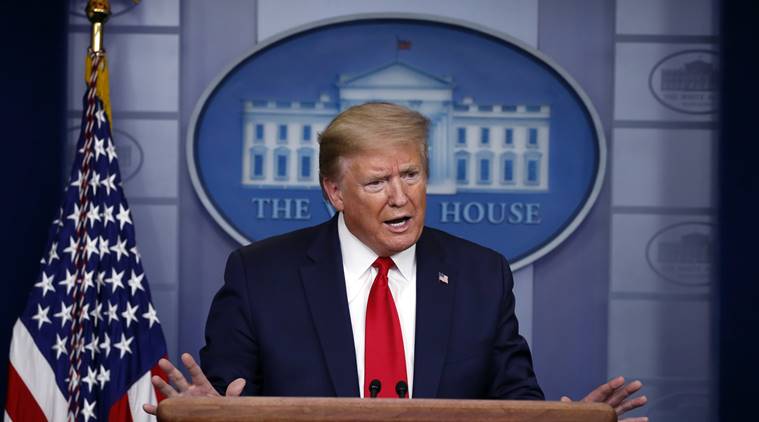
Trump-brokered Iran, Israel ceasefire effective – Envoy

The ceasefire brokered by United States President Donald Trump between Iran and Israel appeared to be holding on Wednesday, June 25, just a day after both nations indicated that their aerial conflict had come to a halt.

Both sides declared victory on Tuesday following 12 days of conflict, during which the US intervened with airstrikes in support of Israel, targeting Iran’s uranium-enrichment facilities.

Trump’s Middle East envoy, Steve Witkoff, said late Tuesday that discussions between the United States and Iran were ‘promising,’ expressing optimism that a long-term peace agreement could be reached.

“We are already talking to each other, not just directly but also through interlocutors. I think that the conversations are promising. We are hopeful that we can have a long-term peace agreement,” Witkoff said.

“Now it’s for us to sit down with the Iranians and get to a comprehensive peace agreement, and I am very confident that we are going to achieve that,” he added.

Over the weekend, Trump claimed that US stealth bombers had ‘obliterated’ Iran’s nuclear weapons programme. However, Iran has maintained that its uranium enrichment efforts were solely for civilian purposes.

The ICIR reports that Trump’s claim was reportedly contradicted by an initial assessment from one of his administration’s intelligence agencies, according to three sources familiar with the matter.

One source stated that Iran’s stockpile of enriched uranium had not been destroyed, and that much of the country’s nuclear programme was located deep underground.

The White House dismissed the intelligence assessment as “flat out wrong.”

According to the report by the Defense Intelligence Agency, the strikes blocked the entrances to two facilities but failed to collapse the underground structures, one source familiar with the findings said.

A Washington Post report said some centrifuges remained intact, citing an anonymous source familiar with the report.

Meanwhile, the Trump administration informed the United Nations Security Council on Tuesday that its weekend airstrikes had degraded Iran’s nuclear programme, falling short of Trump’s claim that the facilities had been ‘obliterated.’

Similarly, Israeli Prime Minister Benjamin Netanyahu said on Tuesday that the attack had removed the nuclear threat against Israel, and he was determined to thwart any attempt by Tehran to revive its nuclear weapons programme.

Tinubu in the eye of the storm over ‘longtime friend’ Alex Zingman

DESPITE lingering controversies over his past, President Bola Tinubu has described, Belarusian businessman, Alexander Zingman, a figure linked to arms dealings and murky international business deals as a longtime friend.

Speaking at the launch of the Renewed Hope Mechanisation Programme in Abuja, Tinubu pointed to Alex Sigman and described him as his longtime friend and very good neighbour from Chicago State University, Illinois, the United States.

Tinubu said, “My dear very good friend, the story must be clear here. Alex Sigman. We were together at the Chicago State University.

“To all of you, Alex was my very good neighbour, and we went to the same school with me in Chicago.

“Never did we dream that I would be in this position as the President of the Federal Republic of Nigeria and that Alex will be a successful businessman from Belarus to bring about a very successful collaboration and bilateral relationship that would promote economic prosperity for the future of our two countries.

“I believe our university will be very proud that we are doing this here today.”

Although Tinubu attended Chicago State University in the mid-1970s, records indicate that Zingman was enrolled at the University of Illinois at Chicago and would have been only around 12 years old during Tinubu’s college years making Tinubu’s claim unlikely.

Litany of allegations against Zingman across Africa

Beyond the suspicious timeline, Zingman, like Tinubu, is no stranger to controversy. His international dealings and political connections have drawn mounting scrutiny over the years. He has faced allegations of arms brokering, corruption, and questionable business transactions across Africa.

In March 2021, he was briefly detained in Lubumbashi, Democratic Republic of Congo, after meeting with former President Joseph Kabila.

Local authorities suspected him of involvement in arms trafficking, and some media outlets went as far as branding him an “arms dealer” with alleged links to a coup plot.

Though no formal charges were filed and he was released after 12 days, the incident cast a shadow over his operations in the region.

In Zimbabwe, questions have also been raised about his influence. According to a 2023 exposé by the civic group @PacheduZW, Zingman reportedly secured more than 54,000 hectares for gold mining as far back as 2018.

Four years later, he was tied to a fire engine procurement deal that saw local authorities compelled to purchase trucks from his company at an inflated unit cost of $464,296—fueling speculation of collusion with President Emmerson Mnangagwa.

His name has also been linked to a controversial arms deal in Zambia. A 2020 report by Digger News featured photographs of Zingman alongside then-President Edgar Lungu and top military officials. The outlet claimed he played a role in brokering a meeting with Rosoboronexport, Russia’s state-owned arms exporter, ahead of Zambia’s 2017 acquisition of five Sukhoi fighter jets.

Zingman denied the allegations, distancing himself from the arms trade and asserting that his interests lie in agriculture, even threatening legal action over the reports.

Drawing on documents accessed through the Pandora Papers leak, the Organised Crime and Corruption Reporting Project(OCCRP), also found that Zingman, co-owned a Zimbabwean gold mining venture, Zim Goldfields, with the son of a senior Belarusian official. His company, Aftrade denied at the time that Zingman had any involvement with the gold venture.

Zingman’s name has also been linked to an online disinformation campaign. In 2020, some of the thousands of fake social media accounts controlled by a notorious disinformation software promoted favourable stories about Zingman and his business in a concerted and automated campaign. Zingman’s lawyer said at the time that his client had never engaged in disinformation campaigns.

Tinubu’s Chicago link and the drug forfeiture case

Zingman’s growing profile in Nigeria comes at a time when Tinubu himself is still facing questions over his past financial dealings in the United States. In the early 1990s, Bola Ahmed Tinubu, now Nigeria’s president, was linked to a U.S. investigation into a heroin trafficking network operating out of Chicago.

The case focused on a syndicate led by Adegboyega Akande and others, who were suspected of distributing white heroin sourced from Southeast Asia. U.S. authorities discovered that Tinubu, then a Nigerian national residing in the United States, had several bank accounts in his name into which large sums of money had been deposited. Some of these deposits were flagged by investigators as being potentially tied to the proceeds of drug trafficking activities.

As the investigation unfolded, the U.S. government filed a civil forfeiture case targeting Tinubu’s bank accounts, particularly one held at First Heritage Bank in the United States. The authorities alleged that the funds amounting to over $1 million were either proceeds of narcotics trafficking or were involved in financial transactions connected to drug-related activities.

Tinubu, through his lawyers, reached a settlement with U.S. prosecutors in 1993. Under this agreement, he forfeited $460,000 to the U.S. government while denying any wrongdoing. Crucially, the forfeiture was not the result of a criminal conviction but a civil action that did not require proof beyond reasonable doubt.

The case resurfaced repeatedly in Nigeria’s political discourse, especially in the buildup to major elections. Critics and political opponents cited the forfeiture as evidence of Tinubu’s alleged involvement in criminal enterprises, while supporters argued that he was never indicted, tried, or convicted of any crime. 

Atiku raises questions

The ICIR reports that a former Vice President Atiku Abubakar has urged President Bola Tinubu to clarify his alleged relationship with Alex Zingman, a Belarusian businessman reportedly involved in multiple criminal activities.

In a statement released on Tuesday, June 24, Atiku’s Media Office questioned the validity of Tinubu’s claim, citing inconsistencies in his public records and demanding more explanation on the issue.

Abubakar, who contested against Tinubu in the 2023 presidential poll on the Peoples’ Democratic Party (PDP) platform, expressed concern over Tinubu’s connection with an individual whose global reputation is marred by controversies.

He said a basic review of publicly available information immediately called the president’s claim into question.

He noted that Zingman had been linked to controversial deals in Africa, including arms trafficking and financial impropriety.

He added that various reports listed Zingman as being born in 1966.

“By the year 1979, when President Tinubu claims to have graduated from CSU, Zingman would have been only 13 years old.

“Are we now to believe that the Guinness Book of Records missed the story of a 13-year-old Belarusian prodigy graduating from an American university alongside Bola Ahmed Tinubu?” the former vice president queried.

He added, “Were you taught in the same classroom or different decades? Mr. President, Nigerians deserve to know if the Alex Zingman of global infamy — the arms-linked tycoon — shares the same seat in your memories or only in a script of fiction,” the Adamawa-born politician submitted, demanding answers from Tinubu.