NIGERIA’s average daily crude oil output fell to 1,453 million barrels per day (bpd) in May, below the Organisation of Petroleum Exporting Countries (OPEC) quota.
OPEC revealed this in its monthly crude oil report released on Monday, June 16.
The oil cartel had, in November 2023, approved a daily production quota of 1.5 million bpd for Nigeria.
But despite a bogus crude oil production benchmark of over 2 million bpd in the 2025 budget, the country has been struggling to meet the OPEC quota and is far from its projected target, a situation many analysts say puts the implementation of the target at risk.
According to the latest OPEC data, Nigeria’s crude oil output fell by 33,000 bpd. That is a decline to 1,453 million bpd in May from 1,486 million in April.
The oil cartel stated that the crude oil production was based on direct communication with the member countries. Nigeria is a member of the OPEC body.
In the data, it noted that Nigeria’s growth outlook remains positive, as inflation eased to 23.7 per cent in April from 24.2 per cent in March, with food price growth cooling marginally as well as core inflation.
It noted also that the Central Bank of Nigeria (CBN) has, in the meantime, kept its policy rate unchanged at 27.5 per cent and the cash reserve ratio at 50 per cent during its meeting held on May 19 and 20, citing persistent inflation and currency weakness as key concerns.
However, OPEC pointed out that though inflation had briefly eased following a rebase of the consumer price index in January, it has since remained high.
“With rising fiscal challenges and a likely higher-than-targeted 2025 budget deficit, the central bank’s ability to sustain its strict anti-inflation stance will be tested,” it stated.
It is submitted that despite inflationary pressures and other challenges, businesses remained optimistic about the near-term outlook.
THE Federal High Court on Monday, June 16, rejected an application by the Federal Government (FG) to issue a bench warrant against the suspended senator representing Kogi Central Senator, Natasha Akpoti-Uduaghan.
The government is prosecuting Akpoti-Uduaghan in an alleged defamation case on behalf of Senate President Godswill Akpabio andformer Governor of Kogi State Yahaya Bello.
At the trial on Monday, the prosecuting lawyer, D.D. Kasue informed the court that the case was for arraignment but that the defendant was not in court.
Kasue informed the court that although the defendant had been served through her counsel that morning, she was absent from the proceedings. The prosecutor argued that the absence indicated the defendant was aware of the case but chose not to attend. He then applied for a bench warrant due to her failure to appear and enter her plea.
Reacting, counsel to Akpoti-Uduaghan, Jacob Usman, a senior advocate, narrated to the court that he found the prosecution’s application weird and uncourteous.
Usman informed the court that upon learning of the suit, he contacted the prosecutor to arrange for his client to receive the charge in her absence.
The counsel stated that he was served the charge at 9:15 am in court and questioned how the defendant could be aware of the matter when she hadn’t seen the charge.
“I find the application strange, and it should be dishonoured. If the defendant has not been served, she cannot be in court,” he said.
He urged the court to reject the application, calling it an abuse of the court process.
The judge, Musa Umar, questioned the prosecutor if he had served the charge on the defendant, to which he answered in the negative.
Umar argued that a bench warrant couldn’t be issued since the defendant hadn’tbeen properly served.
The court denied the bench warrant application but allowed substituted service through the defendant’s counsel.
The judge adjourned the matter till June 30 for further hearing.
The ICIR reported thatthe Federal Government, through the Director of Public Prosecutions, Mohammed Abubakar, filed criminal charges against Akpoti-Uduaghan, accusing her of making defamatory remarks during a live television broadcast and in a private telephone conversation targeting Akpabio and Bello.
According to the charge filed on May 16, at the Federal Capital Territory High Court, with case number CR/297/25, Akpoti-Uduaghan is accused of making a statement during her appearance on Politics Today on Channels TV on April 3, 2025, in which she was said to have said Akpabio and Bello conspired to assassinate her.
The government also accused the female lawmaker of making defamatory statements during a telephone conversation on March 27, 2025.
Akpabio, Bello, and four others are named as key witnesses in the trial.
The ICIRreported that the case comes amid mixed feelings surrounding Akpoti-Uduaghan, who was suspended from the Senate earlier this year. Her suspension sparked widespread criticisms and allegations of political persecution.
Akpoti-Uduaghan had accused Akpabio of targeting her after she rejected his alleged sexual advances, claiming that her suspension was orchestrated to silence her.
She made the allegations after she refused to accept a new seating arrangement in the Senate Chamber, which led to Akpabio ordering the sergeant-at-arms to eject her from the chamber.
She is challenging her suspension at the Federal High Court, where the hearing has been scheduled for June 27.
AN X user, @fonyokapondoka, has claimed that Blackberry has made a comeback with a new phone model.
He posted an image that shows a gray smartphone with a distinctive logo of Blackberry, a brand which was once a leader in the smartphone market, indicating it’s likely a concept or prototype of a new device from the brand.
The post was also accompanied with a caption that read: “Blackberry has made a huge comeback.”
As of June 12, 2025, the claim has garnered over 1 million views, plus more than 14,000 likes and over 1,500 reposts. The claim was also spotted here and here.
CLAIM
BlackBerry has launched a new phone model.
THE FINDINGS
Findings by The FactCheckHub show that the claim is FALSE.
Screenshot of the claim as retrieved from X. Insert: FALSE verdict.
When a Google lens search was conducted on the image, it lead our researcher to numerous results, some of which were other appearances of the claim.
Other search results mostly showed images of iPhone products, particularly the iPhone 16, including a phone case branded with the BlackBerry logo.
A closer look at the image reveals inconsistencies typical of manipulated visuals. The phone’s design, particularly the dual-camera layout and overall finish, closely mimics Apple’s iPhone series.
Image of an iphone 16 PC; XtremeSkins
Additionally, the Blackberry logo appears artificially placed, suggesting that the image is either digitally altered or depicts an unofficial product. The packaging also displays irregularities that raise questions about its authenticity.
Further checks show that the last smartphone developed by BlackBerry was the BlackBerry Key2 LE. In August 2020, BlackBerry signed a licensing deal with OnwardMobility, a US-based startup, to produce a new device, but the project was abandoned after the company shut down in 2022.
BlackBerry also discontinued its proprietary mobile software services, on January 4, 2022, a development widely reported by both local and international media. The company has since shifted its focus to secured communication services including cybersecurity as seen on its official website.
THE VERDICT
The claim that BlackBerry has launched a new phone model is FALSE; the image is digitally manipulated and the company now focuses on providing secure communication solutions for businesses, governments, and automobile industry.
AT least 8 people were killed and 100 others injured in Tel Aviv and the port city of Haifa during a series of retaliatory attacks by Iran, launched in response to Israeli strikes on its nuclear and ballistic missile programme.
Officials said the attack occurred before dawn on Monday, June 16, destroying several homes.
Emergency services said search and rescue operations were ongoing in Haifa, where around 30 people were injured, as dozens of first responders rushed to the impacted areas.
The ICIRreported that Israel’s military targeted Iran’s nuclear and military sites through airstrikes last Friday.
Israel announced on Monday that it had killed four senior intelligence officials, including the head of the Revolutionary Guards’ intelligence organisation.
Meanwhile, Iran’s Revolutionary Guards claimed that the latest attack used a new tactic that caused Israel’s multi-layered defence systems to interfere with one another, allowing Tehran to strike numerous targets successfully.
While there were no confirmed reports of interceptor missiles colliding, Israeli officials acknowledged that their defence systems were not foolproof and cautioned that more difficult days lay ahead.
Israeli Defence Minister, Israel Katz, said in a statement: “The arrogant dictator of Tehran has become a cowardly murderer who targets the civilian home front in Israel to deter the IDF from continuing the attack that is collapsing his capabilities.”
“The residents of Tehran will pay the price, and soon.” Katz later issued a separate statement saying that Israel had no intention of deliberately harming Tehran’s residents.
Israeli authorities reported that out of the fewer than 100 missiles fired by Iran overnight, only seven landed in Israel. A military spokesperson added that Israel had destroyed over one-third of Iran’s surface-to-surface missile launchers.
THE North-East stakeholders of the All Progressives Congress (APC) have protested what appeared as a planned replacement of Vice President Kashim Shetima as President Bola Tinubu’s running mate in the 2027 poll.
At a meeting of the party’s stakeholders in the region on Sunday, June 15, the party’s leaders endorsed Tinubu for re-election but was silent about Shettima, a former governor of Borno State.
Protest erupted at the meeting venue, in Gombe State, after the APC National Chairman, Abdullahi Ganduje, and National Vice Chairman (North-East) Mustapha Salihu endorsed only Tinubu.
Multiple reports claim Ganduje and Salihu were escorted out of the venue by security operatives due to protests from delegates over their failure to endorse Shettima.
The APC Deputy National Chairman (North), Bukar Dalori, who later addressed the gathering, endorsed both Tinubu and Shettima for a second term to douse the tension.
Despite his address, the charged atmosphere persisted, and Dalori, too, had to be escorted out of the venue by security operatives.
An eyewitness, Danburam Danladi, told Punch that the incident highlighted crises brewing within the APC as internal politicking intensifies ahead of the next general elections.
Recall that Nigerians protested against Tinubu-Shettima’s candidacy in 2023 because both leaders are Muslims.
Though no major crisis has been reported between the leaders since they assumed office on May 29, 2023, many Nigerians doubt if both politicians will fly the party’s flag in 2027, given that Tinubu had no record of working with a deputy while he led Lagos State as governor, and the need to resolve the imbalance created by the Muslim-Muslim ticket – the first in the country’s history.
THE killing of infants remains a tragic and largely hidden practice in some communities across Nigeria. The ICIR reports that among the Bassa Komo community of the Federal Capital Territory, children are often labelled as “evil” and left to die under deeply entrenched cultural beliefs.
Surviving infanticide
Olufemi Stephen almost had his life and childhood stolen from him when his mother died during his birth. He may not have been alive today, if his community had succeeded in following the age-long ritual of burying a new born baby along with a mother that died at childbirth.
Now 20, Olufemi grew up in the orphanage, where he was named just like all the other babies brought in. When he turned 18, his world shifted when a man claiming to be his father surfaced at the home, seeking to take him away.
“One Sunday afternoon, my biological father appeared out of nowhere and introduced himself. I told him straight – ‘I don’t know you as my dad’. He claimed he wanted to make amends, but it felt hollow. I’d already bonded with the man who raised me from birth,” he said.”
Olufemi Stephen. PC Fatimah Quadri/ The ICIR
“I once wished I had parents who would drop me off at school, bring me food, and be there for me. But I came to understand that while people call us less privileged, we in this home are actually very privileged.”
Olufemi dreams of becoming a gospel musician and a lawyer, using his voice and legal knowledge to advocate for abandoned children like himself.
Godiya Stephen, another survivor of infanticide, believes that lack of medical access plays a significant role. She lost her mother during childbirth. Children whose mothers die during childbirth, as well as twins and those born with genetic conditions like albinism, are often targeted for infanticide in some communities within the Federal Capital Territory (FCT).
“If there was healthcare, my mother wouldn’t have died, and the practice wouldn’t still be happening,” she said.
For survivors like Godiya, the journey does not end with being rescued. Even after growing up in a safe environment, the stigma remains.
“When my siblings found me in 2021, I was already doing my A-levels. They told me that after my father abandoned me, they had been looking for me. They had no idea where I had been taken,” she recounted.
Despite this reunion, she is not in a hurry to return to her village, Baribari, in Abaji Area Council of the FCT.
“For years, they’ve been asking me to come back, but I don’t want to go. Maybe one day, but not yet,” she said.
She now sees herself as a testament to the fact that these children are not evil after all. “If I go back, they will see that I am fine, that the stigma was wrong.”
Godiya Stephen. PC: Fatimah Quadri/ The ICIR
“Unfortunately, some survivors never got the chance to confront their past. “I wanted to prove to my biological father that I had made a life for myself, but he passed away last December,” he said.
A journey into the deep end
In rural FCT villages like Dagiri Bassa, the grim practice of infanticide persists, fuelled by entrenched cultural superstitions. These old-age beliefs continue to haunt the community.
To witness the harsh realities in Dagiri Bassa, a remote area in the Kwali Area Council, this reporter embarked on a rugged journey. The 50-minute motorcycle ride from the council centre along a dusty, unpaved road set the tone for the challenges that lie ahead.
A cloud of red dust enveloped the landscape, dotted with scrubby vegetation. Approaching the village, there was scant sign of life. A worn signboard, almost imperceptible, marked the entrance. The glaring absence of healthcare facilities underscores the community’s struggles.
Tukura Barnabas, a villager, acknowledged that infanticide occurs in the community but declined to elaborate. He disclosed that villagers rely on local birth attendants due to limited healthcare access. He said the nearest primary health care centre, located at Leleyi community, is nearly 30 kilometres away from Dagiri Bassa.
Barnabas stated, “The distance is about 30 kilometres, but transportation is a significant challenge. Many can’t make the journey, even if they want to. Sometimes it feels like getting there is left to God’s mercy.”
Shugaba Rizame, another resident, spoke about the risks and uncertainties of home births in the community.
“You never know if a woman will deliver safely at home or if complications will arise. If things go wrong, the baby’s life might be lost too.”
“Surviving infants are typically taken to an orphanage. We have sent several children there-two or three, I believe. Most of our kids are sent there. Unfortunately, I can’t recall which exactly, but I believe we have about two or three children from this community in an orphanage.”
Shugaba Rizame, a resident of Dagiri Bassa
Bearers of misfortune?
Beyond the tragedy of losing mothers, another grim reality unfolds as infants left behind are often seen as bearers of misfortune. The absence of basic healthcare and the deep-rooted reliance on traditional practices underscore the urgent need for intervention in Dagiri Bassa. In a village where medical facilities are non-existent, maternal deaths during childbirth are all too common.
With no access to medical examinations, age-old superstitions take precedence, fuelling the belief that some children are cursed and must not be allowed to live.
In this isolated and underserved community, tradition is not just a way of life; it is the lens through which survival is understood. Without urgent efforts to provide healthcare and education, practices like infanticide will continue to thrive in the shadows of cultural preservation, trapping the people of Dagiri Bassa and other communities alike in a painful cycle between the past and the present.
The Vine Heritage Home Foundation, an orphanage sheltering such children, has been at the forefront of rescuing and rehabilitating them.
Entrance of Vine Heritage Home Foundation, Kuje Abuja. PC: Fatimah Quadri/The ICIR
Stephen Olushola, the Head of Operations at the Vine Heritage Home Foundation, has spent years documenting these cases. He highlighted that most of the children rescued from these acts are from the Bassa Komo tribe in the FCT.
Olushola is the person after whom children brought to the orphanage without names are named.
“Ninety-five per cent of the children we rescue come from the Bassa Komo tribe. This practice is embedded in their culture, and cultural beliefs are difficult to challenge,” Olushola noted.
The Bassa Komo are one of the indigenous ethnic groups in the Federal Capital Territory (FCT) of Nigeria, alongside other groups such as the Gbagyi, Ganagana, Igbira, Gede, Gwandara, and Nupe. They are primarily found in areas such as Gwagwalada, Abaji, the Airport area in Abuja Municipal Area Council (AMAC), Dagiri Bassa in Kwali and Rubochi in Kuje.
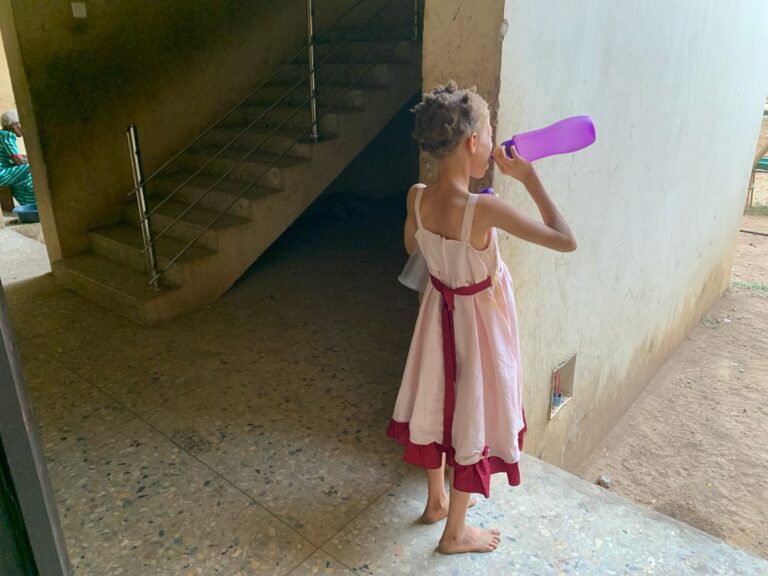
For many years, infants who were born twins, albinos, or whose mothers died during childbirth have been seen as omens of misfortune. Families fear that keeping these children alive will bring death or disaster upon them. One such child is Gloria Stephen, a 7-year-old girl living in the orphanage, who was affected and abandoned due to this genetic condition.
Children born with albinism often face significant challenges, including social stigma and abandonment. PC: Fatimah Quadri/The ICIR
Albinism is a genetic disorder inherited from parents, characterised by a reduced or absent amount of melanin, the pigment responsible for skin, hair, and eye colour. The two main types are: Oculocutaneous Albinism (OCA); the most common form, affecting the skin, hair, and eyes. And Ocular Albinism (OA) which primarily impacts the eyes, with minimal effects on skin and hair.
Alkali Magaji, the then spiritual leader of Kaida, provided insight into the community’s belief system regarding infanticide. In a 2017 report by Voice of America (VOA), Magaji explained that the people view certain children as being linked to malevolent forces and, as a result, reject them.
According to him, the community believes these children are associated with evil spirits and are considered potential witches or wizards. To rid themselves of this perceived threat, they offer the children as sacrifices to a deity known as Otauchi.
Beyond cultural beliefs, a major factor fuelling infanticide is the high maternal mortality rate in these rural communities.
“In these communities, there is no primary healthcare centre where pregnant women can access antenatal care. When complications arise during childbirth, many mothers die. It’s not just about culture; people are reacting to their harsh realities,” Olushola explained.
With no means to care for a newborn who has lost its mother, families resort to killing the child, convinced that it caused the death. Without access to infant formula or wet nurses, families see no other option but to dispense with the child.
“This is why we tell the government that tackling maternal and child health will directly reduce infanticide, if more mothers survive childbirth, fewer children will be labelled as evil,” Olushola emphasised.
Stephen Olushola, Head of Operations, Vine Heritage Home Foundation. PC: Fatimah Quadri / The ICIR
Challenging deep rooted beliefs
Changing centuries-old beliefs is no easy feat. Those who question cultural traditions often face backlash.
Olushola points out that cultural traditions are often so deeply rooted that people accept them without questioning their origins. He explains that since these practices have existed for generations, no one can pinpoint when they began. However, those who dare to challenge them often face rejection from the elders.
This was the tale of Ayuba Baka, a father of twin girls, in Kaida, a remote village in the Gwagwalada Area Council of the FCT.
Baka made a courageous choice to go against long-standing cultural beliefs in order to save his daughters. Haunted by what he had seen happen to relatives in the past, he refused to let history repeat itself. Today, his twin girls now fifteen are safe and thriving under the care of the Vine Heritage Home.
He revealed that both his mother and aunt had given birth to twins, but none of the babies lived to see the next day. Baka noted that their deaths remain unexplained, as the families would simply wake up to find that the twins were gone.
“My mother told me she gave birth to twins, and they died the following day. Two of her sisters also gave birth to twins — they are also no more. When they give birth to them, the next day they were no more. After witnessing this, I figured out there is something wrong. Though I did not go to school, I can think on my own,” he noted.
The unexplained death of twins was also corroborated by Andrew Tonak a christian missionary in the village that The ICIR spoke with. Tonak clarified that when people talk about the killing of such children, it isn’t always a direct or visible act. Rather, he said, the children were often found dead under mysterious circumstances, with no clear explanation as to what happened.
He added that while some reports have claimed the children were hanged, such accounts are false. What is consistent, he noted, is that the child simply ends up dead, and the cause remains unknown.
What further prompted Baka’s decision was after visiting other communities and seeing twins being accepted and alive, he began to question why his own community had rejected them.
“Because I go to other places and I see there are twins in their communities, I wonder why we don’t have twins in my own community. I made up my mind that if I would ever have my own twins, I would do everything in my power to protect them. Then I spoke with daddy (referring to Tonak) and he told me not to worry.
As God would have it, I had my own twins and then with the help of daddy, I took the babies to the orphanage home,” Baka explained.
He recalled that the decision was far from easy, as he faced backlash not just from the wider community but also from his own family. He shared that some community members were openly hostile, while a relative went as far as accusing him of selling his children because they had not set eyes on them since they were born.
Despite the accusations which he described as hurtful, he said he stood his ground, firmly insisting that he had done what was necessary to protect their lives.
“During festive periods, they come home, and everyone keeps wondering if they were the same children from years ago,” he further highlighted.
Missionaries push for change
In the past, activists and missionaries who tried to end infanticide encountered strong resistance. However, the Vine Heritage Home Foundation has taken a different, more inclusive approach.
Speaking with Andrew Tonak, a religious leader in the village, he recounted that when he first arrived as a missionary and began interacting with the locals, he noticed a deeply rooted belief among them that it was unnatural for a woman to carry two babies at once.
He explained that this perception often fuelled fear and suspicion. In cases where a woman died during childbirth, especially while giving birth to twins, the surviving child was often labelled as evil or cursed, further reinforcing the community’s resistance to accepting multiple births.
Andrew Tonak PC: Fatimah Quadri/The ICIR
“In a situation where a woman delivers and dies in the process, they also believe that that child is an evil child and is not supposed to live,” Tonak explained.
“When we came to realise the practice, we started intervening by rescuing those children. For example, if a woman delivers and we know it is twins, we quickly rush to the family and demand for those children.
And of course, to some extent, they were conflicted from here and other communities, we have up to 20-30 children in the orphanage,” Tonak noted.
Tonak explained that once they understood the reality of what was happening, they knew it was time to take action. He said they began a process of enlightenment, engaging with the villagers and emphasising that twins were not evil but rather normal human beings, even blessings.
“Gradually, they were getting to understand that our belief is wrong. Our concept about twins is wrong. And, to some extent, that enlightenment, that awareness is gradually growing.”
He recounted an experience involving another set of twins delivered in Ike, a village in the Kwali Area Council. Upon arrival, he discovered that two different families in the village had each welcomed a set of twins.
Concerned for the safety of the babies, he attempted to intervene and offer protection. He noted that one of the sets of twins was in the village chief’s house, so he approached the chief to discuss the situation. However, the chief assured him that there was no cause for concern, insisting that the children were fine and there was no threat to their well-being.
He noted that the issue of infanticide in the community is closely tied to the lack of maternal healthcare. He explained that in many cases, women endure prolonged or complicated labour without access to proper medical support, which sometimes led to death during childbirth.
He shared the example of a woman who was in labour for nearly two days and, after eventually delivering, suffered excessive bleeding and lost consciousness.
“A woman who had a long labour, I think she was in labour for close to two days, and she couldn’t deliver. When she finally did, the blood was so much that she became unconscious.
And there was not any nearby facility, no medical missionary, nor government health worker. So, we had to mobilise and carry that woman to the then specialist, now teaching hospital. So, by the grace of God, she was saved.”
He also recounted another tragic case where a woman died during childbirth due to a lack of medical care, the baby was saved and has completed her university studies.
Tonak emphasised that such tragedies are rooted in the absence of medical guidance and education, highlighting the need for proper maternal healthcare to prevent both maternal deaths and cultural practices like infanticide
Samuel Tanko, another missionary who oversees a medical facility donated to the community by a faith-based NGO, explained that the services were limited due to a shortage of staff, with only two trainees assisting him. He emphasised that there were no fixed working hours, as villagers sought help at any time.
Samuel Tanko PC: Fatimah Quadri The ICIR
He explained that, in addition to overseeing delivery cases, they also handle various other health issues within the community. However, when the medical needs surpass their capacity, they refer patients to more equipped medical facilities for further treatment.
This arrangement, while essential, highlights the limitations of their small clinic and the ongoing struggle to provide comprehensive healthcare in the remote area.
“The hospital has been able to serve the community and the surrounding environment. During the outbreak of cholera, we were able to curtail cases, measles cases, and cases of delivery, to the best of our knowledge. Where we have difficulty, we referred patients to the nearby hospital for emergency.
He explained that the facility is in a dilapidated state, though a portion of it had been recently renovated. However, he emphasised that a major challenge they face is a lack of funding, which hampers their ability to improve and expand the services they provide to the community.
Efforts to speak with the Agoma of Kaida, Musa Lakai the traditional leader of the community were unsuccessful, as he was unavailable during the reporter’s visit.
Exterior view of the Medical facility
Instead of blaming the community, Olushola says they encourage them to witness the transformation of the children they once feared. By seeing these children healthy, happy, and excelling in school, community members begin to question their previous beliefs.
He said the approach has led to a shift in perception, with some families realising their abandoned children were never cursed. Many have chosen to take them back.
So far, the foundation has successfully reunited 31 children with their families, giving them a second chance at life.
Rescuing these children is a race against time. Many are abandoned immediately after birth, left without food or water for days.
Olushola recounts how they sometimes receive distress calls about newborns who have been left unfed for days. In some cases, by the time the foundation arrived, the baby’s condition is already critical.
Some children are willingly surrendered by their families. Some parents, believing they cannot care for the child, brought them directly to the foundation in the hope of finding an alternative solution.
Providing urgent medical care is often the first step. Many of the infants arrive severely malnourished, dehydrated, or with infections. Once they regain their health, they are integrated into the orphanage, where they receive education and care.
Unlike traditional orphanages, the foundation does not arrange adoptions. Olushola emphasises that their mission is not to place children with new families but to reunite them with their biological families once harmful beliefs and stigmas have been addressed.
The fight against infanticide is far from over. Though organisations like Vine Heritage Home Foundation continue to rescue children, the root causes are cultural beliefs and lack of healthcare.
For now, the orphanage remains a sanctuary for those lucky enough to be rescued. With 212 children currently under their care, the organisation continues its mission to prove that no child was born evil.
PRESIDENT Bola Tinubu has condemned the continued bloodshed in Benue State and directed security chiefs to enforce his orders to end the carnage.
The President, in a statement released on Sunday by his Special Adviser on Information and Strategy, Bayo Onanuga, described the killings as “inhuman and anti-progress.”
He directed security chiefs to fully implement his earlier orders to restore peace to the state.
The directive followed a fresh wave of attacks that reportedly left over 200 people dead in the North-Central state.
Tinubu also tasked the state Governor Hyacinth Alia to convene a reconciliation meeting for stakeholders to end the violence and promote peaceful coexistence among farmers, herders, and local communities.
He urged political and community leaders in the state to refrain from making unguarded statements that could escalate tensions.
“The latest reports of wanton killings in Benue State are deeply distressing. We must not allow this carnage to continue unchecked. Enough is enough. Our people deserve to live in peace, and this is achievable when leaders on all sides collaborate in fairness, openness, and justice,” the president said.
Meanwhile, Pope Leo XIV has condemned the recent killings in Benue State, describing the incident as a “terrible massacre” in which mostly displaced civilians were murdered with “extreme cruelty”.
Delivering his remarks before the Sunday Angelus prayer at the Vatican, the pontiff expressed deep concern over the ongoing violence in Nigeria and the suffering of affected communities.
The Pope prayed for security, justice, and peace to prevail in the country. He offered special intercession for the rural Christian communities in Benue, whom he described as “relentless victims of violence.”
The latest attack in the state occurred in Yelwata, a border town between Benue and Nasarawa states, where suspected herdsmen reportedly stormed the community late Friday night.
The ICIR reported that youth and other residents protested sustained killings in the state on Sunday, June 15.
Alia condemned the attacks, saying that nothing should warrant taking innocent lives.
He assured the state that more tactical teams from the Federal Government had started arriving in the state, and additional security deployments were being made for vulnerable areas.
The ICIR reported on Saturday, June 14, that fresh attacks on two local government areas of the state resulted in the death of 26 persons.
The victims were killed in overnight attacks on communities in the Makurdi and Katsina-Ala local government areas.
Hours later, about 200 people were reportedly killed again in the state.
These attacks came shortly after top military leaders, including the Chief of Army Staff (COAS), Olufemi Oluyede, visited the state and promised to restore peace.
THE Israel-Iran war has already added a troubling dimension to the challenges of an already struggling global economy, and portends several risks for the Nigerian economy, according to renowned economist Muda Yusuf.
Yusuf, who is the director and chief executive officer of the Centre for the Promotion of Private Enterprise (CPPE), made his position known on the evening of Sunday, June 15.
The risk exposure comes at a time when economies around the world are currently grappling with elevated geopolitical tension triggered by the Russian-Ukraine war, the Israel-Hamas conflict, as well as the disruption from the United States President Donald Trump’s imposed tariffs.
On Friday, June 13, Israel launched an air strike, hitting Iran’s main nuclear enrichment facility at Natanz, as well as its air defences and long-range missile facilities, The ICIRreported.
The attack immediately caused global crude oil prices to jump over seven per cent for the first time in over four months.
In his statement, Yusuf highlighted a combination of risks and upsides it could have for the Nigerian economy.
Dr. Muda Yusuf, the CEO of Centre for Promotion of Private Enterprise
Downsides for Nigeria’s economy
– Energy cost escalation
A major driver of energy prices in Nigeria is the global crude oil price, and following the attack, crude oil prices surged to $75 per barrel from $65 per barrel a week before, he noted.
“This is a 15 per cent jump within days. This has obvious implications for petroleum product prices globally. Economies worldwide [Nigeria inclusive] would witness a surge in the price of petrol, diesel, jet fuel, gas, and related products in the near term.
“This would have far-reaching implications for many economies and businesses.
Implications,” Yusuf pointed out.
– Inflation
As energy cost is a major factor in the Nigerian inflation equation, it impacts production cost, logistics cost, transportation costs, and the cost of power generation, he said.
These costs are eventually passed on to final consumers, depending on the degree of their resistance.
“There is also a global inflation dimension. Energy prices have global inflationary implications. Therefore, there is also an expectation of imported inflation in the unfolding geopolitical scenario,” the CPPE boss added.
– Interest rate
Yusuf also pointed out that high inflation drives interest rates as the monetary authorities respond to the inflation outcomes of current geopolitical headwinds.
He said a tighter monetary policy regime is expected in Nigeria and other monetary jurisdictions, as the expectation is that economies around the world may experience renewed pressures on interest rates.
“Higher global interests could adversely impact portfolio flows with implications for foreign reserves,” he noted.
– Profit margins
The renowned economist further noted that a combination of high energy costs, elevated inflationary pressures, and a spike in interest rates is all headwinds that could undermine the profitability of businesses in the economy.
He said specifically that investors in the non-oil sector are likely to be more vulnerable in the present situation.
He further stressed that Nigerian firms with strong business links in the Middle East and those with strong supply chain linkages in the region would be vulnerable at this time because of the current instability in the region.
– Money supply growth
Yusuf added that there is also a risk of high monetary growth with an increase in revenue from the oil sector.
He explained this to mean that money supply increases as oil revenue increases because of the monetisation of oil receipts, which could pose additional inflation risk and exchange rate depreciation risk.
“This may provoke a tighter monetary policy stance, which could result in difficult credit conditions for businesses in the economy,” he maintained.
Upsides for Nigeria’s economy
On the positive side, Yusuf noted that if the current conflict persists and escalates, the Nigerian economy might record upsides in some areas.
– Forex inflows
The surge in crude oil prices would impact foreign exchange earnings, oil being the biggest forex earner for the country.
He said this would be even more impactful if output performance improves.
“Crude oil price has surged to $75 per which is about 15 per cent higher than before the outbreak of the Israeli–Iran conflict.
“This development would also positively impact the country’s foreign reserves, ensure better forex liquidity and ultimately the stability of the naira exchange rate,” Yusuf explained.
– Revenue effect
He noted oil sector currently accounts for about 50 per cent of Nigeria’s revenue, and that an improvement in crude oil price would therefore have a significant impact on government revenue.
“An improvement in revenue would positively impact fiscal consolidation and hopefully moderate the growth of the fiscal deficit,” the CPPE boss said.
– Oil and gas investment effect
He also pointed out that investments in the oil and gas sector would post better returns if the conflict persists.
“High oil price is good news for upstream oil and gas investors,” he added.
Risk for the global growth outlook
According to Yusuf, the global economy will be adversely impacted by this new geopolitical crisis.
He noted global stock markets reflected this ominous outlook as the Dow Jones, S&P, and Nasdaq stock markets trended downwards.
“There is a flight by investors towards ‘haven assets’ as global uncertainty heightens,” he said.
He noted, however, that in Nigeria, there has historically been a positive correlation between crude oil prices, gross domestic product (GDP) growth, and stock market performance.
“The outlook for the Nigerian stock market is therefore likely to be positive in the current context,” Yusuf anticipated.
DANGOTE Petroleum Refinery said it would begin a nationwide targeted distribution of premium motor spirit (PMS) and diesel to marketers, petrol dealers, manufacturers, telecoms firms, aviation, and other large users across the country.
The firm has also initiated a credit facility support to woo deep-pocket buyers and sustain its market dominance with a new logistics support strategy for easier movement of PMS and diesel products.
The company announced its plan in a statement on Sunday, June 15, stating that the move, designed to transform Nigeria’s petrol distribution landscape, would take effect from August 15.
It said the initiative comes with free logistics to boost the distribution network, hinting that it had procured 4,000 brand-new compressed natural gas (CNG)-powered tankers to ensure smooth take-off of the scheme.
“This phase of the programme will continue over an extended timeframe,” it stated.
The 650,000 capacity-built refinery also hinted at investing in CNG stations, commonly referred to as daughter booster stations, supported by a fleet of over 100 CNG tankers across the country to ensure seamless product distribution.
“This strategic programme is part of our broader commitment to eliminating logistics costs, enhancing energy efficiency, promoting sustainability and supporting Nigeria’s economic development.
“It affirms our dedication to improving the availability and affordability of fuel, in support of broader efforts to strengthen the economy and improve the well-being of all Nigerians,” Dangote Refinery stated.
It noted that under the initiative, all petrol stations purchasing PMS and diesel from the Dangote Refinery would benefit from its enhanced logistics support.
“Key sectors such as manufacturing, telecommunications, and others will also gain from this transformative initiative, as reduced fuel costs will contribute to lower production costs, reduced inflation, and foster economic growth.
“Players in these key sectors and others can purchase directly from the Dangote Petroleum Refinery,” it said.
According to the refinery, it will offer a credit facility to those purchasing a minimum of 500,000 litres, allowing them to obtain an additional 500,000 litres on credit for two weeks, under a bank guarantee.
“This pioneering effort marks a major milestone in our vision to revolutionise Nigeria’s energy sector.
“Dangote Refinery is dedicated to ensuring that no place is left behind. Our goal is to provide equitable access to affordable fuel for all Nigerians, regardless of location, making energy more accessible and sustainable for everyone, wherever they may be,” it assured.
The initiative is also expected to revitalise previously inactive petrol stations, thereby driving job creation, stimulating small and medium-sized enterprises (SMEs), increasing government revenue, improving fuel access in rural and underserved communities, and strengthening investor confidence in Nigeria’s downstream petroleum sector.
“This initiative is in line with the Renewed Hope Agenda of His Excellency, President Bola Ahmed Tinubu, reflecting our shared commitment to economic progress, stability, and inclusive development,” the refinery stated.
It further noted, with thanks to the federal government, that the naira-for-crude scheme has helped stabilise fuel supply amid global price volatility.
It also stated that it marked a major revolution in the midstream and downstream sectors and stands as a key example of Tinubu’s economic policies.
“We invite marketers, petrol dealers, manufacturers, telecom companies, and all key stakeholders to embrace this landmark initiative. The registration process, including Know Your Customer (KYC) verification, will take place from 16 June to 15 August, spanning a total of 60 days,” it added.
The ICIR reports that the Dangote refinery’s list of retail outlet partners includes MRS, AP (Ardova), Heyden, Optima Energy, Techno Oil, and Hyde.
The oil firm, since the commencement of petrol products refining in January 2024, has established its market dominance in the downstream sector, frequently moderating its ex-depot price and compelling its retail outlets partners to adjust the pump prices of its refined products.
Its most recent pump price reduction to its partners’ retail outlets nationwide saw the pump price of petrol fixed at N875 per litre in Lagos and N885 in other southwest states.
It fixed it at N895 per litre in the northwest and north-central, and at N905 per litre in the north-east, south-south and south-east states, The ICIRreported.
THE Akwa Ibom State chapter of the Young Progressives Party (YPP) has expelled its state secretary, Kelvin Umoh, over allegations of gross misconduct, blackmail, and actions deemed detrimental to the unity and integrity of the party.
In his place, the party appointed Moses Antigha as the acting state secretary. This development was announced in a communiqué issued at the end of a general meeting held on Sunday in Uyo, the state capital.
The meeting, chaired by the Acting State Chairman, Elder Wisdom Udoka, accused Umoh of allegedly holding secret meetings with selected members to incite violence during party gatherings, thereby undermining the party’s cohesion and operational effectiveness.
The communiqué signed by Udoka and 125 executive members of the party stated that the expulsion followed due consultation with relevant party organs in line with the provisions of the party constitution, which empowers the Executive Committee to take disciplinary action against members whose conduct undermines the party’s values and objectives.
It was stated that the meeting expressed disappointment with Umoh for publicly contradicting official party decisions through unauthorised media appearances, thereby allegedly bringing the party into disrepute.
The party also condemned Umoh’s refusal to sign key financial documents, including a cheque meant for remitting 10 per cent of proceeds from the sale of nomination forms following the 2024 Local Government Elections—an action he reportedly took only after being compelled.
According to the communiqué, these actions violate Section 36.7 of the YPP Constitution, which prohibits the unauthorized disclosure of internal party affairs, the formation of parallel structures, disobedience to lawful directives, and any conduct likely to cause internal disaffection or undermine party discipline.
“In light of these developments, the Young Progressives Party has appointed the Deputy State Secretary, Mr. Moses Antigha, as the Acting Secretary of the YPP Akwa Ibom State Chapter and directed Ambassador Kelvin Umoh to return all party documents and property in his possession to the YPP State Secretariat within 24 hours. ” the communique partly read.
It reaffirmed commitment to the leadership of Udoka as the Acting Chairman of the party in upholding internal discipline, transparency, and unity, urging members to remain focused and committed to the party’s rebirth agenda and democratic mission.
In his address, Udoka described the gathering as a defining moment in the party’s history, a moment of rebirth, a renewed sense of purpose, and an unwavering commitment to the core ideals of social democracy, inclusive governance, and accountability, which form the foundational pillars of the YPP.