Home Blog Page 2644

INVESTIGATION: How corruption, cultural barrier worsen primary healthcare delivery in the north


By Olugbenga Adanikin

Kuraye is a rural community that is a few kilometers off Katsina city. It is located in Charanchi Local Government, near the state capital. It is home to a large population of rural dwellers, mostly farmers and artisans. After spending over 45 minutes on hired motorcycle, scouting the village to locate the Primary Healthcare Centre (PHC), lo and behold, the only PHC in the community was an eyesore. The project is a constituency intervention built in 2010, but it had never been put to use.

The PHC, investigations reveal, has always been under lock, and local groundnut farmers had taken over the compound and turned it into  an assembling point for their farm harvest as they tiredly separate the groundnuts from the plant roots.

“This is a hospital built for lizards because there are no activities here. We address it like that because lizards, rodents have made it their abode,” Umar Bello, an adult in his early 30s, said of the operations of the facility, adding in Hausa:“hosipitu kadangaru”.

From all indications, the hospital appeared inactive, as it was under lock during the visit. There were no signs of power, neither was the water facility operational. It was already covered by weed, and it lacked perimeter fencing.

In front of the facility was a traditional, hand-powered borehole surrounded by children.

“The three staff don’t come. There are few casual staff, so they don’t come as well because it is not mandatory for them to visit the PHC,” said Mallam Bashiru Al-sa’adu, another resident. “The state government supplies them with drugs but it always get missing somehow.”

It is a worse scenario in Turaji and Tsageru, two neighbouring communities in Rimi Local Government of the state.

In 2013, under President Goodluck Jonathan, a lawmaker representing both communities in the constituency, through the National Primary Health Care Development Agency (NPHCDA), awarded a contract for the construction of a PHC in Turaji at the sum of N21 987 893,95. Incidentally, the construction firm, Greensols Energy Revolution Nigeria Limited, with Corporate Affairs Commission (CAC) registration number 805958, commenced work but never completed the project. Residents attributed the non-completion to change of government but investigation revealed otherwise.

A visit to the contractor’s corporate address at House 13, Road 15, Efab Estate, Jabi, Abuja, revealed that the corporate address was merely a warehouse for a different organization involved in entertainments and corporate services. A lady simply identified as Miss Chidinma said she had been managing the business for over five years on the same property. Asked if she knew the major shareholder, Mr. Anuwe Charles Olaosebikan, she said, “That name you called, I really don’t know anyone or company bearing that.”

From further investigations at the CAC, it was gathered that the firm was registered to execute jobs on renewable energy and had no relationship with construction of PHC projects.

“To carry on the trade of business as a renewable electrical company, consultants, erection and installation, sales of solar products, wind- turbine and electrical appliances and services of any kind connected for the practice of renewable energy projects,” the company objective read.

Even though the uncompleted project was not sited at the right location, both communities, Turaji and Tsagero, were left seeking medical help at the Rimi General hospital about three kilometers away from the Tsagero districts. The general hospital  is situated along Lambo rimi through Kano road. It was gathered that in extreme conditions, patients are taken to Katsina General hospital, which is about 21 kilometres away from Tsagero and Turanji. A source, who doesn’t want his name in print explained that the rimi general hospital has few doctors unlike the Katsina hospital, where there are many experts. “Before you enter rimi, you see the hospital. It’s about three kilometres from here.”

“We don’t know anything about it. The contractor just came and started building. We were not carried along but later we heard it is a PHC,” a group of youths who were obviously disgruntled told our reporter. They lamented over the abandoned project saying it should have been sited at Turaji but taken to the border point between the two communities to avoid conflicts. Though, Tsageru community residents wanted the project constructed in their settlement but Abdullahi Umar, a resident, said Tsageru had an existing facility that was built by successive governments and later completed after years of neglect. However, it has never been equipped.

Uncompleted Primary health care Project in Tsageru

Located adjacent to  the unequipped PHC in Tsageru lies a completed and fenced health centre but of no value to the people due to its emptiness. It had neither furniture nor medical equipment. It was already covered with weeds like other similar projects while pests and other insects had taken refuge in the doors, gradually eating deep into it such that it could hardly serve its main purpose. A school teacher living close to the facility who pleaded anonymity, told this reporter that an Ex-lawmaker in the House of Representatives, Mohammed Dalhatu  completed the project but did not equip it.

The local guard securing the abandoned PHC, Mr. Ayuba Majidi, who expressed  concern over the gradual degeneration of the facility said the 2013 project was facilitated by former Senator Ibrahim Idah but remained uncompleted until interventions by successive governments. Majidi has been guarding the facility for over six years with irregular stipends of N5, 000. .

Efforts to reach the lawmaker to enquire on reason for the delay were unsuccessful.

To Abdul-bashir Sa’adu, a farmer who grows groundnut, millet, sorghum and guinea-corn in one of the rural communities in Cheranchi, Katsina the NPHCDA could do more to ensure the PHCs are built to standard and functional as expected. He appealed to the government to consider their needs and rescue them from the pathetic situation. To him, the future is not certain as most of their wives lack access to ante-natal  care while the children suffer from tuberculosis.

“We want government to engage health practitioners that will be committed to delivering health service to our people. I mean those that won’t exploit the people and sell off the drugs supplied.”

Obviously, these are the realities in major PHCs in the remote part of the country, especially in the north. The PHC projects are either not executed or built below standard, thus contributing adversely to healthcare delivery in the country. For instance, in Kadasaka community, Gada local government of Sokoto state, the PHC project was no different from others. Already covered by bushes and suffered neglect, it was a complete rot and proof of government ineffectiveness in ensuring successful project standardization and delivery.

Abandoned PHC in Kadasaka village, Gada, Sokoto state.

The project has  been abandoned since 2009. The roof is almost completely blown away while the ceilings are falling off by the day. It showed that it was perhaps earlier roofed but got damaged due to either poor execution or harsh weather. It was really a complete waste of asset and resources. While inspecting the abandoned project, one could see the large cracked walls, damaged hospital beds, cabinets as well as frames dented due to severe weather impacts. Aside, there were also new delivery beds, still wrapped-up but wasting away, completely covered with dusts among other donated hospital equipment, all yearning for usage.

The experience of residents in Kadasaka community was pathetic. Hope of these underprivilege rural settlements seemed dashed as there are no signs of contractors return to the project. Donated items by the United States Agency for International Development (USAID) including refrigerators, super industrial fans among others are wasting away in a leaking store already damaged by rainfall.

Health official, Nuru Abdullahi said they had to manage other facility and still take delivery of pregnant women in the small room directly at the frontage of the abandoned project. The dispensary is so small that it could hardly take a handful  of people at a time. Pregnant women from the 14 villages just like in Kalenjeni town, often make use of an extremely small room in the dispensary, sizeable enough to be a kitchen store for child delivery.

Delievery room in Kadasaka community, Gada Sokoto state

The dispensary was constructed by the Sokoto state government and serves about 14 other rural communities.

Incidentally, the uncompleted PHC would have smoothly served over 600 people conveniently. In a chat with a health attendant in the dispensary, he narrated how they had to scout for water for delivery and medical use, saying in most cases they had to use donkeys to convey water from the nearest borehole which according to him, is miles away to the clinic.

“We need equipment and more staffs. We don’t have water at all. The borehole is no longer functioning. We used donkey to transport water from a far place to the centre,” he said.

Actually, this was a constituency project sponsored by former Senator Abubakar Umar Gada, who represented the constituency in 2009. These are the  challenges aside from other common problems such as inadequate staffs,  insecurity, poor access to potable water and unstable medical doctors. During the investigation, a visit to all the PHCs in selected states revealed inadequate health officers in the facilities. The least in the number of workforce is between two and five.


Unfortunately, the summation of these circumstances has threatened the nation’s health sector. The few functional ones have been overstretched to compliment the neglected projects which each PHC, according to Prof. Eyitayo Lambo ought to serve 70 per cent of rural communities it is situated. For instance, in Garko local government of Kano State, Dal ward, a single PHC in Dal town serves about 42 villages because of its proximity to other neighbouring councils. These include areas such as Garko town, Sumaila and Tudunwada. This PHC centre attends to approximately 40 patients daily and within nine months (January – August) took delivery of 92 pregnant women as at 25th August this year. According to statistics made available by Gambo Edidal, the health official in-charge, 27 births were recorded in January, 13 in February, eight in March, Seven in April, Four in May, 10 in June, 10 in July and 13 in August. Also, in Kalenjeni town, there are 14 villages only subjected to use four health dispensaries and not PHC centre. The only PHC that could have met health needs of the people remained under construction, thus abandoned. Unfortunately the officials were reluctant to disclose number of casualties.

Statistics of maternal deaths and infant mortality in the country is saddening.According to UNICEF, the North West is second highest in maternal mortality, recording 1,026 women from 100, 000 live births followed by the North East, having 1,549 deaths from 100, 000 live births.

“Every 10 minutes, one woman dies on account of pregnancy or childbirth in Nigeria, giving a total of 53,000 per year. This means about 800 women die in every 100,000 live births,” it stated.

Budgetary allocation to Primary Health Centres in North West Nigeria (2004-2015)

In the latest report jointly released by the World Health Organisation, WHO, United Nation Population Fund, UNFPA, United Nations Children Fund (UNICEF) and World Bank this year, the nation recorded 58,000 deaths arising from complications during delivery in 2015.

In Sokoto state, health care delivery is considered to be on priority list of the government. The government successfully partnered with relevant local and international organisations to deliver effective health care to its people. There were innovations specially tailored to reduce maternal mortality and other measures to encourage pregnant women attend Anti Natal Care (ANC). First timers in the state would certainly presume a high standard of health care delivery because you are welcomed with bill boards of health programmes and partnerships with health bodies such as World Health Organization (WHO), Department for international Development (DFID), and National Primary Healthcare Development Agency (NPHCDA) to mention but few.

However, it appears the services are one sided mainly in the urban areas. A visit to remote parts of the state gave a contrary impression as constituency projects were largely abandoned or never executed.

In locations such as Kalenjeni Town, in Tangaza Local Government, among others were constituency projects that were uncompleted. In Dange Shuni town, Dange local government of the state, a constituency project worth N19 million  awarded in 2009 could not be  located, as it never existed..

Moreover, the only PHC according to  health officials and volunteers, was built in 2005 by the Sokoto State Primary Health Care Development Agency (SSPHCDA) as MDGs project. This position was also supported by Abubakar Mohammed, a volunteer PHC worker, who graduated from Sultan Abdulraheem College of Health Technology, Gwarabawa, Sokoto state.

Mohammed described how patients had to struggle to access health care in the community even at the General Hospital due to the distance. The community had reportedly lost high number of residents to untimely deaths.  “From  2015 till date, about 20-30 people have lost their lives due to lack of ambulance. It is a very serious problem.” He said, adding that, “we will be very  happy if they can provide it for us.”  According to the workers, each time there is an emergency, they strived to rush victims to the hospital but often lose them due to the closing period of the general hospital. It allegedly closes at about 2pm daily and any emergency  are not attended to.

“There is no other PHC aside from this one built in 2005 but rehabilitations have taken place since 2009, 2014. Others are dispensaries. From Danbo to Damaki, there are no federal PHC,” He said, adding that “the closest general hospital is in Amanawa. They close 2 o’ clock, even if we refer patients there, they will not attend to them once its 2pm.”

The health workers asked for procurement of Ambulance to convey patients, to the Sokoto State Specialist Hospital, in the town, especially during emergencies. This is about 30-minute drive from Dange town.

In Kalenjeni Town, Tangaza, Shehu Umar a commercial motorcyclist serves as the health attendant in the oldest drug dispensary in the community among other three dispensaries serving over 10 communities in the area. “Our pregnant women deliver here or we move them to Tangaza town in extreme situations. Since the project has not been completed, we want the government to expand and equip the dispensaries,” Umar pleaded.

Abandoned PHC in Kalenjeni town, Tangaza, Sokoto

The deplorable state of the PHCs has resulted into a number of deaths that are largely unreported.. But investigations revealed that  intervention projects  by development partners, especially USAID saved  not less than 6,313 women and new borns between 2010 to 2015. But the traditional ruler, Majagi Yahaya claimed there have never been casualties. But in order to salvage the situation, lawmaker representing the constituency, Hon. Isah Bashir Kalenjeni facilitated, in 2012, the construction of Type II PHC project. It was awarded at the sum of N33 million and expected to serve all the communities far away from the General Hospital.

However, five years down the lane, the project is still uncompleted. The project contractor, Umairatu Nigeria Consults Limited only built the hospital up to the lintel level and left.

During a visit to the contractor’s registered office in 106B, Old Airport Quarters, Minna, Niger State, the major shareholder Muhammed Abdullahi Muye, was inaccessible to explain reasons the project became moribund.

The registered corporate address was now occupied by the Niger State Supply Company Limited. Residents in the quarter claimed ignorant of the Umairatu Consults stressing that the only organization recognized with the above address belongs to the State government. The firm has no company secretary registered in the CAC document and there was no indication of a change of company address.

The security personnel, who directed this reporter to other senior staff in the organization, to ascertain authenticity of the company claimed ignorant of the firm. Other residents could also not locate the firm.

After much  efforts, this reporter could not locate the contractor’s address.

“I am not sure there is any company bearing that name. In fact this is my first time Walahi,” a worker in the state supply company added.

Even though core area of this firm’s activities include the business of pouldiversiotry, animal husbandry, fish farming and agricultural farming in its entire ramification including food production and distribution, it also embark on haulage and transportation business and by extension, “business of general contractor on any building and construction including buying and selling of building and construction material.”

It appears to lack the right experience in project construction relating to health care delivery.

The project management consultant at B&B Partnership, Flat 8, NSITF estate, Abuja, could not also be reached. The project was also supervised by Nasraj Integrated Services Limited, Abuja.

Tired of poor performance and limited capacity of the dispensaries, Kalenjeni traditional ruler, Majagi Yahaya appealed to relevant individuals while tasking the federal government to rescue the community from the situation. Even though, he denied there were cases of child or maternal mortality since inception of the community, it was gathered that three drug dispensaries in the community were not fully functional  while the general hospital is far  away from the people.

“In Kalenjeni there are four dispensaries and the most functional is the newly rehabilitated one built in the town. But they are all small. Our women have their antenatal in these dispensaries and give birth in the recently repaired facility but we want bigger PHCs that will cater for our people.”

When this reporter visited the NASS official website to get the lawmaker’s contact(he was a legislator from 2007-2015), it was discovered that Bashir Kalenjeni had omitted his mobile contact as well as his email. So he could not be reached.

The situation was not different in PHC, Gada town, Gada Local Government. Gada is a stone’s throw to Niger Republic. The PHC project was a N19.6 million scheme but left uncompleted. According to Ashimu Musa, Kydawa-Kalaba community leader, accessing good health care had been a serious challenge. But the residents were fortunate that a small dispensary built in 1991 by  Taminu Galadima, a former chairman of the local government and a serving member of the state House of Assembly is still functional. It is a distance of 20 meters opposite the abandoned project.

Bashir Umar, one of the residents, who is a pastoralist described the project completion as vital to the locals. Beside the forgotten facility was another abandoned water project. Umar said pregnant women do more of home delivery.

When Hon. Musa Serikin Adar, the House of Representative member from the constituency was contacted, he said he was not in office.  All efforts to contact him outside the NASS building were unsuccessful. He was not also responding to messages sent thereafter.

In Sumaila local government, Kano state, the situation is not different. The project was built but unused due to poor execution. When the reporter visited the facility, a health official, who sought anonymity, was busy attending to a pregnant women, and other women who brought their children for healthcare sat  under a tree within the compound the facility was built on. Upon request, the official  opened the facility which appeared large enough to address the health needs of the people. However the PVC ceiling had fallen off. The entire facility was covered with dust and remains from termite infestation on the woods. The toilet facility was no exception as well as hospital beds.

PHC Sumiala Town, Sumaila LGA, Kano State

However, the N18.9 million (2007) PHC project in Dal town, Garko local government of the state relatively met needs of the rural dwellers. It only opens for 12 hours due to security reason and within this period, it is expected to serve villagers from over 42 settlements. Though, it is short of staff, especially medical doctors but the dental optician often come to the rescue when need be. “We do get drugs through the Drugs Revolving Fund (DRF), from the state central medical store but we need nurses and midwives.

“Because our PHC is close to the boundary of Garko, Sumaila, Tudunwada, all the people around use the clinic,” says Mallam Gambo Edidal, Director of the PHC. Other challenges identified by him is the leaking roof, damaged door, need for ambulance and general renovation.

Abandoned ambulance in PHC, Garko LGA, Dal Town.

Kaduna State has about 5,854 villages and 390 districts. In Zaria local government,  two PHC projects in Zaria Dutsen (N18.98 million) and Zaria Damari (N18.90 million) could not be located. All efforts to locate them were fruitless. Available information also showed that there was no place called Zamari under the local government. Representative of the traditional ruler, Zaria Dutsen Abba, who is addressed as the Chief of Staff, Abdulmumin Abubakar was glad to join this reporter in the search for the projects awarded in 2007 to Mantleview Interbiz.limited at the sum of N18.98 million and Toddlers Nigeria Limited respectively.

Abubakar denied knowledge of such PHC constituency project built in 2007 in his community except for another built by a different contractor in 2009. He further said he had never heard of Zaria Damari. He went as far as consulting other elders in the community to inquire but no one had knowledge of such constituency projects.

But just opposite the Chief’s house is a PHC built by the state government and was under reconstruction as at the time of visit. It was said to be serving about 15 villages and used to provide immunization to the wards.

Having searched in vain for the location of the project, the Deputy Director, Zaria Local Government Health Authority, Aliyu Ibrahim Abdul was contacted to assist with both projects locations. According to him, there is only one PHC constituency project in the area, which is the one in Kugu aside from the Leprosy Specialist Hospital. However, he was quick to say there was no place called Damari in the local government.

Though he noted that some of the facilities are often rehabilitated and may not necessarily have the same structure as at the period it was built.

“Different NGOs do come to repair the PHCs. Even the chair you are sitting upon is not provided by the state or federal government but different NGOs. So that facility you mentioned is the one built by the federal government. The second one is located in Kugu,  Kaura ward and Dutsen Zamari is not in Zaria local government.”

However, with CAC registered number 484405, Mantleview Interbiz.limited, which only has two directors, has no company secretary. It was not also licensed for project construction, especially relating to health facility but to “carry on the business of trading, sales, marketing, distribution of general goods be they manufactured or not, commission agents, manufacturer’s representatives, importers, exporters, general suppliers, general contractors, general merchants, to buy, sell, manufacture and deal in all articles, substances, products, systems and appliances.”

Effort to locate the registered corporate address at 16A Uyo Street, Area 2, Garki II was unsuccessful. The address did not exist. The search was also extended to Oyo Street, perhaps the Uyo was a typographic error for Oyo, but only 17 and 19 exist and not 16A. Ex-Senator, Dalhatu Seriki Tafida was not also reachable for reaction.

Implications of absence of PHCs in rural communities

At the moment, Nigeria bears witness to some of the worst healthcare data in the world and often found close to the bottom of virtually every development index. In February 2017, the World Health Organization ranked the Nigerian health system in 187th place out of 190 countries evaluated. Although, recent report from the United Nations Development Programme (UNDP) says life expectancy has increased to 53 years but remain lower than many poorer African countries.

Malaria kills more Nigerians than any other disease, and yet barely one-twentieth of its population has access to insecticide treated nets proven to be effective in preventing malaria. Added to this is the appalling statistics where one in every 30 Nigerian women die from child birth every year compared with one in every 30,000 in Sweden. Nigeria currently accounts for a quarter of the total number of deaths of children under five. This implies that from 5.3 million children born in the country annually, one million of these children die before the 5th year birthday. For Nigeria to witness better Health System Ranking there is need for government to spend more than the present five percent of its public expenditure on health.

However, the meager amount made available to the sector does not make appreciable impact as most of the funds are either diverted or mismanaged by corrupt politicians and highly connected top government officials. In worse scenarios, the approved budget is not totally released to the ministry for implementation. For instance, in 2014, about 6 per cent representing N262 billion was allocated for health but 82 per cent of the money went for recurrent expenditure.  In 2015, the sector got N237 billion. As for 2016, stakeholders in the sector had expected about N900 billion for the sector but  it got  only N221.7 billion from N6.08 trillion total budget. This was far below the World Health Organisation (WHO) recommendation that government should spend N6, 908 per head on health care for their citizens. The global body recommended at least 13 per cent of annual budget to the health sector.

In 2017, stakeholders appealed for 6 per cent allocation to the sector but eventually, the sector got budgetary allocation of N304,190, 961, 403 representing only 4.17 per cent. In other words, a meagre sum of N1, 688 is being spent on each of the  about 180 million Nigerians for the year.  A number of African countries such as Rwanda, Botswana, Malawi, Zambia even Burkina Faso reportedly set aside double digit allocations to their health sectors. Incidentally, Nigeria in 2001 signed an Abuja Declaration where it was agreed by African Union (AU) member countries that 15 per cent of their annual budgets should be dedicated to the health sector but 16 years after, it’s still a mirage.

The  NPHCDA is saddled with the vision of providing PHCs services to all Nigerians. It mobilizes resources locally and internationally to develop primary health care nationwide. So, since healthcare is a necessity and basic health care service is a right, government and elected public officials channel resources here to provide health care service to their electorates especially at the grassroots. To a large extent the nation’s primary health care system has so far become one of the most attractive government agencies where corrupt public officials ply their trade. Even though it has the mandate to monitor and provide annual reports on PHC implementation across the country, it is obvious that that this has not been the case as majority of the PHCs projects remained uncompleted.

In the north western part of the nation, contracts for the construction of primary health centers have not translated to any direct impact on the health care index of the region and the country. It is believed that healthcare corruption is the reason why the nation’s health system is in the present gloomy state.

“The implication is so enormous because primary healthcare is the closest to the people in the community. The farther they are to the PHCs, the more distant they are to the health care services,” an experienced mid-wife in Kagarko local government, Mrs. Pricilla Avong, with a 21-year experience said.

Women Apathy to Delivering in PHCs

Religious and cultural practices in the region, which make families choose to do home delivery instead of going to a primary health centre, has also worsen the problem in the North, especially in rural areas where an increasing number of pregnant women continue to die or lose their child during or after  Home delivery is a common practice  except in extreme conditions, where they had to visit nearest PHC.“They don’t like going out to seek help regardless of anything. That is why; maternal mortality in the north is higher than the south even if there is PHCs they will not visit.,” said a female medical attendant.

“In a comprehensive health care centre, you may find about 50 women coming to ANCs, on daily basis but in three weeks, you may have only one delivery,” a health official in Kalenjeni said.

Narrating her experience, she said, “When I was pregnant with my first son, Hammed, (not real name), I was there for Anti-Natal Care (ANC). During one of the visits, someone was asking of her pregnant friend and the next person responded that she had given birth and that she was lucky to have given birth at home without subjecting herself to public ridicule.”

“It is better to come to the hospital because you can’t predict anything. Regardless of the number of previous successful deliveries, you can’t predict if the delivery will be of high risk or otherwise.”

A senior health professional, who doesn’t want her name revealed, during an interaction with our correspondent said stakeholders in the health sector had to introduce community midwifery when the trend persisted and maternal mortality kept soaring.

“The community midwifery is only in the north where community midwives are rooted in the communities. They don’t have to come out to town or must not necessarily work in the PHCs.

“Each local government will send women volunteers for training. They will purchase delivery kits for them, so the community midwifery are always in their midst. Whenever there are complications in deliveries, she will be invited to attend to the situation. They were taught to recognize emergencies and respond,” She said.

Incidentally, the women and traditional rulers in the communities deny prevalence of maternal mortality in the PHCs. Even though they keep demanding for more PHCs and provision of medical equipment, the perceived attitude to delivering in the PHCs remained low.

Outcomes of refusal to deliver at PHCs

“Prolonged obstructed labour often causes problems. If you are at the PHCs during labour and the cervix is already dilated and they noticed the fault is from the passage and the baby cannot be delivered, you should know the solution is caesarian session but they will still be praying hoping on God.”

Narrating  her experiences in a hospital in Sokoto state, she said, “There was a time I went to a specialist hospital. One of the patients had cord prowlers. The umbilical cord was out before the baby but the baby was already dead because of spasm. So we were using air fresheners to reduce the smell. I never knew a worst case will emerge.

“When they brought this patient, she was 14 years old; the ward was almost empty because we had to go out because of the smell. The lady had been in labour one week and they have strived to do home delivery but unsuccessful. Head of the baby was out with the hand but the remaining part of the body was still in her womb so it was a challenge delivering because the baby was not well positioned.

“She had labored for long and the baby was subjected to so much distress as much as her mother. The baby was already dead and oozing unpleasant smells. When doctor came, he attempted to pull out the baby with force, all to save the mother’s live, and at that point the hand broke.”

According to her, if a Mallam tells you his wife has been laboring for three days, from experience, then she must have spent a week at home trying to deliver.

“The smell was undiluted. Dettol, Gik, Air freshener and several items were used to suppress the odious smell. I didn’t know if the mother survived or not. But hardly will she survive because she would have been infected.”

She said a destructive surgery should have been carried out on the baby without necessarily cutting her mother but she was taken to the theater for surgery. Based on position, the body system will have been infected.

She said early marriage had nothing to do with maternal mortality but access to PHCs and usage of PHCs.

Government to sanction erring contractors

Director of Media and Public Relations, Ministry of Health, Mrs. Boade Akinola could not be reached for comments as to efforts of the Federal Ministry of Health towards ensuring successful project implementations of PHCs. Text message sent to her mobile phone was not replied as at the time of filing this report.

Dr. Faisal Shuaib is the newly appointed Executive Secretary of the National Primary Health Care Development Agency (NPHCDA). He was one of the notable Nigerians who played remarkable roles to assist the nation during the Ebola outbreak. Incidentally, he became the new ED of the agency after he was appointed by President Muhammadu Buhari January this year.

When this reporter met the DG for an interview, he admitted the flaws in the sector and disclosed that the situation led to recent decision by President Muhammadu Buhari to commence rehabilitation of all the abandoned PHCs in the country. “Have you met anyone who is satisfied with the state of PHC in Nigeria? Obviously not, right? Clearly there has been some progress in the last few decades in terms of where we are coming from but we are far short from where we need to be in terms of delivering quality primary health care services.” He said adding that, “If you go to a lot of PHC centers, its either they don’t have right infrastructure, human resources, drugs, commodities, power, water and ambulances that will ensure there is prompt referral of cases. This is the realities in a lot of health facilities in a lot of PHCs in the country.”

On the years of multiple abandoned PHC project scattered round the north and by extension, other nations, he said, “You are absolutely right.”

He emphasized ongoing plans to list names of contractors who have failed their contractual terms on PHC project implementations in various locations across the country. According to him, names of the contractors would be submitted to the national assembly for proper sanctioning and where necessary, additional finances could be raised for the contractors to ensure completion of the various projects. “Why can’t we start up by saying in each of the 9556 wards that we have in Nigeria, almost 10, 000 wards, why don’t we have functional PHC centre so that no matter where you live within a ward, it is possible for you to trek short distance and you will have access to a functional PHC.

“The Minister is clear on that and as an implementing agency, NPHCDA has taken it upon itself to ensure its realization. But what the minister did first was to start with one health facility per senatorial district to be renovated. That comes to about 109 plus 1 where we have a case of lassa fever few years ago. So that makes it 110. We are focusing on renovating, equipping, putting the right human resources, drugs and equipment in these 110 health facilities,” Said the ES.

Dr. Shuaib told this correspondent of plans to launch a new initiative called Community Health Influencers, Promoters and Services (CHIPS) programme. He described it as a community health programme to identify influential women who will be trained and thereafter help preach antenatal to the women and render little medical supports.

He unfolded plans to monitor in partnership with State PHCs performance and efforts of the PHCs to encouraging women to attend antennal.

“We are working with the State PHC agencies to develop indicators to track how states are doing on awareness creation about the need to attend antenatal and child care.

“We are also launching what we called Community Health Influencers, Promoters and Services (CHIPS) programme. It is a community health programme to identify influential women in communities that have basic elementary and sometime secondary education. We will be training them for six months on how they can provide quality information, influence women in their communities to go for antenatal care, to take their children for immunization and to do first aid if someone is injured in their community.”


This investigation is supported by the John D. and Catherine T. MacArthur Foundation and the International Centre for Investigative Reporting
EFCC traces 38 houses to Ngozi Olojeme, ex-NSITF chairman


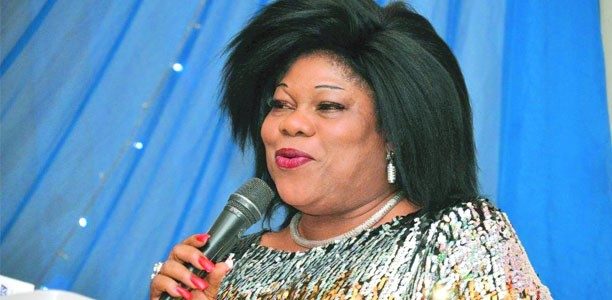
The Economic and Financial Crimes Commission (EFCC) says it has identified 38 houses allegedly belonging to Ngozi Olojeme, a former Chairman of the Nigerian Social Insurance Trust Fund (NSITF).

The Nation reported that the houses are scattered across the Federal Capital Territory (FCT), Abuja.

EFCC is investigating Olojeme, who was NSITF Chairman between 2009 and 2015, for alleged diversion of $48 million out of the N62.3 billion reportedly missing from the account of the fund.

Of N62.3billion fraud discovered in NSITF, $48,485,127 is allegedly credited to her.

She was also Deputy Chairman of the Finance Committee of the Goodluck Campaign Organisation in 2015.

While the Commission said it had obtained an interim forfeiture order from the court to seize the properties until the conclusion of the case against her, it also has a warrant authorising her detention for two weeks for further interrogation.

This, the Commission explained, will allow it to complete the first round of the investigation and her arraignment.

But Olojeme has reportedly taken ill and is in a private hospital in Abuja, where she’s being watched by EFCC operatives.

“EFCC recovered over 40 properties, out of which 38 belong to the ex-NSITF chairman, including the property at No. 51, Kainji Crescent, off Lake Chad Crescent in Maitama District,” the paper quoted a source as saying.

“The Kainji Crescent property is said to have housed some foreign leaders when they came visiting. It is a multi-billion-naira mansion.

“We have invoked Sections 28 and 34 of the EFCC (Establishment Act) 2004 and Section 13(1) of the Federal High Court Act, 2004, which empower the agency to apply the Interim Assets Forfeiture Clause.”

Section 28 of the EFCC Act reads: “Where a person is arrested for an offence under this Act, the Commission shall immediately trace and attach all the assets and properties of the person acquired as a result of such economic or financial crime and shall thereafter cause to be obtained an interim attachment order from the Court.”

According to the anti-graft agency, the mansion at No. 51, Kainji Crescent in Maitama was rated as a “multi-billion-naira piece with some foreign leaders occasionally staying there when they come visiting”.

The golden mansion was at the weekend sealed off by the EFCC.

The EFCC already arraigned Umar Munir Abubakar,a former Managing Director of NSITF,  and four others for alleged diversion of N18billion.

The others are Henry Ekhasomi Sambo, Adebayo Adebowale Aderibigbe,  Richard U. Uche and Aderemi Adegboyega.

The money was said to be the Federal Government’s contribution to the take-off grants and Employees Compensation Scheme (ECS) for Ministries Departments and Agencies (MDAs).

EFCC’s report on preliminary investigation said in part: “That through this process, Dr. Ngozi Olojeme, the then NSITF board chairman, has collected a total sum of $48,485,127 from Mr. Chuka Eze (her account officer at FBN), which cash he collected on her behalf being the dollar equivalent of monies paid to BDCs by NSITF contractors.

“She and others also diverted huge cash allocated for allowances of its staff and compensation to contributors. Detectives actually traced some of the NSITF funds in the personal accounts of Olojeme and the former MD, Umar Abubakar.

“For instance, Abubakar and others dishonestly converted to N18billion, being contribution from the Federal Government of Nigeria as take-off grants and Employees Compensation Scheme (ECS) for MDAs.

“The said sum was diverted into personal accounts by an e-payment mandate jointly signed by Umar Munir Abubakar and Henry Ekhasomi Sambo.”

The report added: “It was discovered that the NSITF accounts in First Bank of Nigeria and other banks have witnessed a total turnover of over N62, 358,401,927 between 2012 and 2015 from the Employee Compensation Scheme contributions.

“That out of the N62bn, the Federal Government contributed N13,600,000,000 while the sum of N48,758,401,927.80 was contributed by the private sector. That there were several payments to individuals and companies from the NSITF bank accounts for purported contracts or consultancy services.

“That some individuals and companies that received these payments, in turn, transferred part of the monies directly to the NSITF officials while others transferred huge sums to bureau de change operators who changed them to dollars.”

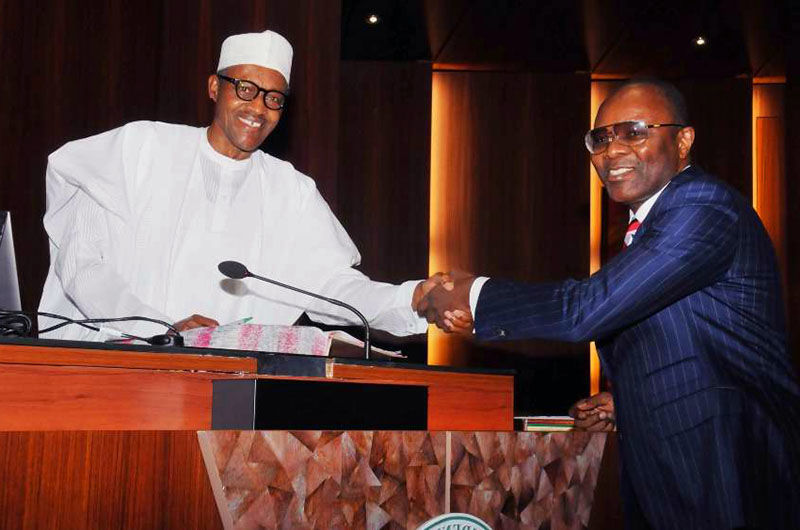
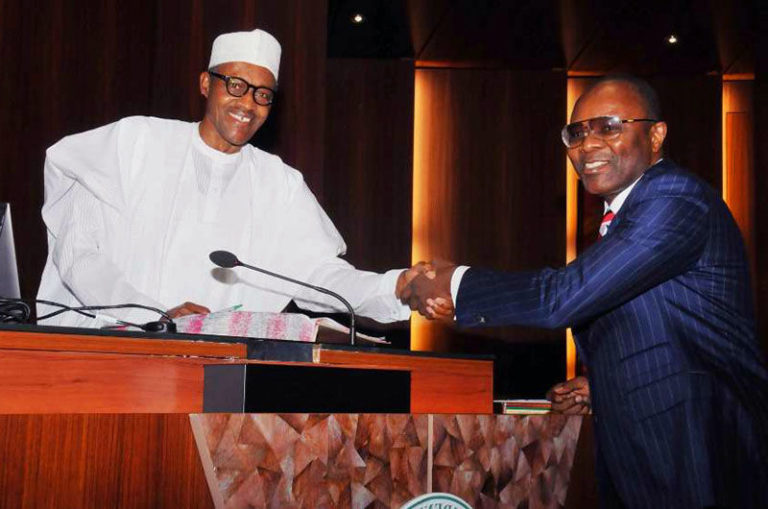
Petroleum Minister Buhari and ‘Fuel Scarcity Minister’ Kachikwu

0

At home we face enormous challenges. Insecurity, pervasive corruption, the hitherto unending and seemingly impossible fuel and power shortages are the immediate concerns. We are going to tackle them head on. Nigerians will not regret that they have entrusted national responsibility to us. — Muhammadu Buhari May 29, 2015.


Nigerians are already regretting entrusting leadership to President Muhammadu Buhari. Although on assumption of office in 2015, he promised to tackle the problem “head on”, Buhari the President will only take secondary seat in the apportioning of blames for the raging fuel scarcity. But, as you will find out if you read the next few paragraphs, this does not in any way excuse the man from culpability in the mess.

In what we were made to believe was his determination to clean up the notoriously opaque and corrupt oil industry, Buhari refused to appoint a Petroleum Minister, consequently ensuring that while he can escape immediate blame for the farcical goings-on in other ministries, he will be primarily held responsible for the oil ministry’s shortcomings. This is why this piece is about Muhammadu Buhari the Minister — not Muhammadu Buhari the President.

With the benefit of hindsight, Buhari didn’t quite understand the intricacies of the ministry he appointed himself to oversee. As has already been seen of his party, the All Progressives Congress (APC), Buhari was desperate for power but wasn’t desperate to govern. That is why, for example, it took him six months to appoint ministers. How does a man run the full length of an electioneering cycle without already identifying the core of the people he would work with?

At the risk of committing reductionism, Buhari needed to answer two questions that were critical to the continuous availability of petrol: does the government rehabilitate the refineries or privatise them? And how do we strengthen the purchasing power of marketers, given the weak value of the naira?

On the first, Kachikwu, then Group Managing Director (GMD) of the Nigerian National Petroleum corporation (NNPC), never hid his belief that the refineries should be sold, as they were working at 30percent capacity. But Buhari overruled him. Two-and-half years after, what do we have? None of the refineries operates at 60 percent capacity; and all, combined together, only produce 5percent of the country’s daily petrol need of 30million litres/day. So, on the score of raising in-country refining capacity, there has been no progress.

On the second, fuel marketers are in a worse situation now than they were in May 2015: The naira isn’t stronger against the dollar. When Buhari assumed office in 2015, the naira traded at 199 to a dollar at the inter-bank market. Today, it is 359, courtesy of a string of questionable moves, including stubbornly refusing to devalue the currency when self-devaluation was already evident at the parallel market and arresting BDC operators in a failed military-style effort to control the currency (which boomeranged, anyway). The naira is far more unstable now than it was in 2015, no thanks to the operation of at least five exchange rates: the official CBN rate, BTA rate stipulated by CBN for banks, parallel market rate, investors and exporters window, and the inter-bank rate. Confusing!

At the black market — arguably the most important given the difficulty of accessing the dollar at official rates — the dollar currently sells for N367. With all these figures, compared with the N197 exchange rate of the naira back in May 2016 when the pump price of petrol was raised to N145/litre, and coupled with the greed of fuel marketers, it was only a matter of time before the fuel scarcity of March 216 returned.

Now, having teleguided the Central Bank of Nigeria (CBN) all tenure, and having arrogated the leadership of the petroleum ministry to himself, Buhari, as Petroleum Minister, should be taking responsibility for the crisis; and his sycophantic Federal Executive Council (FEC) should be giving him, not Kachikwu, the marching orders to resolve the crisis. Worryingly but unsurprisingly, Buhari has remained aloof, watching in the background — maybe not even giving a damn — as Kachikwu and Maikanti Baru deal with the mess of discussing the scarcity with the media and the larger public.

From the beginning of the crisis till at least December 23, when he finally held a meeting with Baru, it can be argued that Buhari was unaware of the severity of the fuel crisis. The interpretation is that he abdicated his self-set responsibility as Petroleum Minister. Unless Buhari really thinks Kachikwu is Fuel Scarcity Minister, it is improper for him to name himself Minister yet disappear and push kachikwu forward in periods of PMS scarcity. That’s not leadership. At this point, Buhari the Minister should not be waiting for briefings from Kachikwu or Baru. What would it cost him to get on a helicopter and fly round three sample states, for example, to see the sufferings of the people and feel their fury with his government — to see the failings of a ministry he oversees?

To further heighten the grief of the people, Buhari released a Christmas Message to Nigerians without mentioning the fuel hardship. The 12-paragraph statement talked about the joy of Christmas but evaded the pain of the scarcity. Terrible if Buhari didn’t know about the scarcity at the time, unforgiveable if he deliberately ignored us.

When he finally spoke, it was under suspicious circumstances. At 7:58am on December 24, Atiku Abubakar — and this should not be misconstrued as an endorsement of the candidature of Nigeria’s most partisanly unstable politician — tweeted to assuage the fuel scarcity-induced pains of the people. More than five hours later, Buhari made his first public utterance on the scarcity. So, what changed between Saturday, when the President released his Christmas Message, and Sunday? If Atiku, likely his number-one challenger in 2019, didn’t talk, would the President have spoken?

And what did he say? Buhari the Minister said he was “being regularly briefed” by the NNPC; briefed about his own ministry! He “sympathised with all Nigerians”, as though we are all beggars whom his administration is distributing petrol to without charge. And, finally, he told us not to expect any more comments on the matter from him; this is how he disguised it: “Let me also assure that the relevant agencies will continue to provide updates on the situation.”

Buhari cannot be approving multi-million-dollar Crude term and Direct Sale Direct Purchase (DSDP) contracts in his capacity as Petroleum Minister and then vanish into thin air in moments of fuel scarcity. It’s nothing other than cowardice, and is least expected of one with the reputation of military might. He must ask himself, too, what he really wants to do with the first-class brains and innovative governance approach of Kachikwu. Is fuel supply management all Buhari needs Kachikwu to do? It’s time Buhari manned up to the numerous and enormous responsibilities of the Petroleum Minister or appointed someone else — whether Kachikwu or someone else from the North as usual — to do the job!


Soyombo, Editor of the International Centre for Investigative Reporting (ICIR), tweets @fisayosoyombo
INNOSON VS GTB: Facts behind figures: How the battle between Innoson and GTB started (I)

0

By Cornel Osigwe

The perfection of a man is based on his ability to distinguish between facts and fiction through deductive reasoning — Socrates

There have been many counter narratives on the reason why EFCC arrested Innoson and equally we have seen GTB response on its running battle with Innoson and his company Innoson Nigeria Ltd.

According to C.P Scott “Comments are free but facts are sacred”. Now that this fight has become an open issue and the public is yearning to know the truth concerning the issue Innoson has with GTB, I will in a three (3) part series of articles reveal to Nigerians and the world what really happened.

In a saner society, the company secretary of GTB should have resigned by now and apologize to the Board of Trustees and Shareholders of the bank, because every legal advice and decision it gave to GTB backfired, thereby putting the bank in harms-way.

The battle between Innoson and GTB started from a dispute between Innoson and customs when GTB decided to cry more than the bereaved by appealing a valid court ruling ordering GTB to pay Innoson judgment debt of N2.4B being the cost of his goods unlawfully seized and auctioned by The Nigerian Customs.

THE GENESIS OF INNOSON VS CUSTOMS COURT CASE

Innoson established the first indigenous motorcycle assembly plant in Nigeria and based on this effort, the Federal Government, through the Federal Ministry of Finance gave a concession to him to pay 5% on his imported motorcycle CKDs (Completely Knocked Down parts). The approval is in form of a certificate. The certificate runs for 12 months after which it is renewed.

Between October and December 2004, Innoson imported about 25 containers of motorcycle CKDs, his certificate was yet to expire. The certificate expiration was on 12th July 2005.

When the goods arrived in Nigeria, Innoson made efforts to clear the goods. He paid the required duty as calculated by COTECNA- the inspection agent and he was issued a Clean Report of Inspection (CRI) which showed the duty he was expected to pay.

After receiving the CRI from COTECNA, he paid the duty by issuing cheque to be drawn in favour of the Federal Government of Nigeria. His bank, GTB paid the money to the Federal government. And then he was issued with a Customs Revenue Receipt. The Receipt was issued by GTB that made the payment. The original copies were handed over to the customs.

After the payment of the duty, Innoson submitted all relevant documents to the Nigerian customs but the customs failed to release the goods. The goods were not released because they alleged that Innoson under paid the duty. The Customs said he was to pay 30% duty rate. When Innoson learnt of this, he referred them to the concession certificate which allowed him to clear his goods based on 5% duty rate.

In spite of showing the certificate to them, Customsrefused to release the goods and showed his clearing agent a circular which didn’t mention the name of Innoson among the list of companies enjoying such concession.

Upon receiving the letter, Innoson protested by sending a written protest to the Minister of Finance. The Minister of Finance gave a directive through a letter to The Nigerian Customs to allow Innoson clear its goods. The Nigerian Customs then instructed their officers to allow Innoson clear its goods at the concessioned rate of 5%. The directive was also done in writing via a letter dated 13/12/2005.

With the letter from the Minister of Finance as well as The Nigerian Customs, Innoson re-submitted its documents to the Nigerian Customs officials to enable him take delivery of the goods.

After the submission of the documents, they still delayed in processing the documents. After the delay, Innoson was given approval to take its goods as overtime cargo through a written approval dated 1st Feb 2006, 2nd Feb 2006 and 9th Feb 2006 for the three bill of laden respectively.

After receiving the written approvals, Innoson made attempts to clear the goods. After customs had passed the entry, Innoson could not locate the goods at the wharf. His clearing agent continued searching for the goods at the wharf until the 1st of March, 2006 when they learnt that 18 of the 25 containers had been sold by the customs.

Upon hearing that the goods had been sold by the customs, Innoson contacted its solicitors to write to the Ministry of Transport, Finance and the Comptroller-General of Customs which they did.

After sending the letter, the Minister of Finance invited Innoson to a meeting. At the meeting, Innoson was referred to the Chairman of the Presidential Special Committee on Port Decongestion and the Comptroller-General of Customs, the meeting between the three parties was held on 12th May, 2006 at Customs office in PZ Complex, Ikorodu Town, Lagos.

At the meeting of 12th May 2006 with the Hon. Minister of Finance, Transport and the Assistant Comptroller General of Customs and other stakeholders, the Chairman of the Presidential Special Committee on Port Decongestion referred Innoson to the Assistant Comptroller-General of Customs. The Assistant Comptroller-General directed Innoson to forward all relevant documents to his office so that he can be compensated.

On 18th May, 2006, Innoson forwarded the documents requested for by the Assistant Comptroller General of Customs through his solicitors.

The Customs ignored the documents that was forwarded and sold the remaining containers. Innoson is yet to come to terms why customs sold his containers. First of all, he was not notified that his container was seized. He was not informed that his containers were to be sold.

His containers never contained any contraband goods but contained motorcycle CKDs. He did not at any time abandon the containers containing the motorcycle CKDs at the port. He was never taken to court. Innoson was not aware that there was a court order to sell his goods. The Federal Government gave him a concession to pay less duty because he owns an automated assembly line and as a result of the promise to increase the local output. The assembly line had a workforce of about 750 workers.

The questions that remained unanswered include:

• Whether the Customs has the right to refuse the release of the goods as stated in the CRI? The CRI reflected the 5% concession.

• How long do goods stay before it is declared as an overtime cargo? Do goods stay in the port for 3 months and thereafter become overtime

• Were the Customs Officials actually carrying out their official duties or was there a conspiracy to destroy Innoson by some people?

• There was a time lapse between the period the goods were to be cleared. Innoson never appliedfor an overtime clearance at any time. His goods were never gazetted before they were sold.

Innoson tried without success to pay the duty stated on the CRI but was rejected by the customs. The customs insisted that Innoson must pay 30% but Innoson still referred the Customs to his concession certificate.

Innoson was not given any notice to the effect that its containers were to be sold as overtime cargo after the approval granted to him to clear the containers as overtime cargo.

Even as an overtime cargo, there are procedures to be followed in selling it. These procedures were not followed. The usual procedure when there is conflict of figures for payment, a protest is lodged.

Innoson is not aware that any committee was set up to sell his containers. The customs equally did not advertise the sale of his container in any newspaper.

The procedure the presidential Special Committee on Ports and the Customs for selling good by auction is as follows;

(a) To notify the owner of their intentions to sell the goods by auction.

(b) To give notice of the intended auction sale to the public through newspaper publication.

(c) Set up a joint disposal committee to sell the goods by auction.

None of these provisions of the law was adhered to in auctioning his goods for sale. Therefore the Presidential Special Committee and Ports decongestion had no basis for auctioning Innoson’s goods after all genuine efforts by him to clear its goods.

Based on the damages that were incurred by the seizure and subsequent auction of his goods by the customs, Innoson through his solicitors sued the Nigerian Customs to the Federal High Court, Ibadan division with the following pleas;
1. Judgment for the sum of N1 billion

2. 22.5% interest for the sum of N1 billion

3. 22.5% on Judgment debt from the date of judgment until the liquidation of the debt

4. Judgment for any other claim as per the amended statement of the claim.

THE COURT VICTORY

The legal tussle between Innoson vs Customs lasted for some years. After Innoson had presented his case to the trial judge by providing all available facts and evidences to the trial judge and having the Defendants presented its own arguments and defenses.

The trial court therefore ordered the Custom to pay Innoson the sum of N2.4B being the cost of his goods and damages incurred.

Furthermore, Innoson got a garnishee order from theCourt ordering GTB to pay the judgment debt of N2.4B to him. GTB refused to pay this money.

Innoson had a loan he was servicing with GTB at the time he got the judgment. Innoson had expected that GTB would deduct their money and pay him the balance. The reason why GTB refused to pay Innoson his money to ease him off from the damages and loss he suffered was unclear to Innoson.

GTB decided to cry more that the bereaved by appealing the court ruling on the garnishee to the Court of Appeal, Ibadan Division.

However in a unanimous judgment, delivered on 6thFebruary 2014, the Court of Appeal dismissed the appeal and affirmed the judgment of the trial Court and ordered the Defendant (GT Bank) to pay the said sum of N2.4B to Innoson.

Still aggrieved, GTB appealed to the Supreme Court. The Supreme Court is yet to deliver its judgment. Today that judgment debt is above N5B.

THE QUESTIONS NIGERIANS SHOULD ASK GTB

1. Why did it not pay Innoson the Judgment debt as ordered by the court?

2. Does The Customs money ordered by the court belong to GTB?

3. With N10B of Customs money in GTB, why did it-GTB not pay this money, why did they decided to appeal the judgment since The Customs never pretested the judgment?

To be continued…….

Cornel Osigwe is the Head, Corporate Communications of Innoson Group.

Buhari sympathises with Nigerians over fuel scarcity

President Muhammadu Buhari has “sympathised with Nigerians” for theirs pains over the ongoing fuel scarcity,

In a statement released on Sunday, almost three weeks since the latest fuel crisis surfaced, Buhari assured the public that everything was being done to bring the situation under control.

Buhari also doubles as the substantive Minister of Petroleum Resources, and personally oversees the activities of the Nigerian National Petroleum Corporation (NNPC).

“The fuel scarcity being experienced nationwide is regrettable. I sympathize with all Nigerians,on having to endure needless fuel queues,” the statement read.

“I’m being regularly briefed, especially on the NNPC’s interventions to ensure that there is enough petrol available during this period and beyond.

“I have the NNPC’s assurance that the situation will improve significantly over the next few days, as new shipments and supplies are distributed across the country.

“I have also directed the regulators to step up their surveillance and bring an end to hoarding and price inflation by marketers.

“Let me also assure that the relevant agencies will continue to provide updates on the situation. I thank you all for your patience and understanding.”

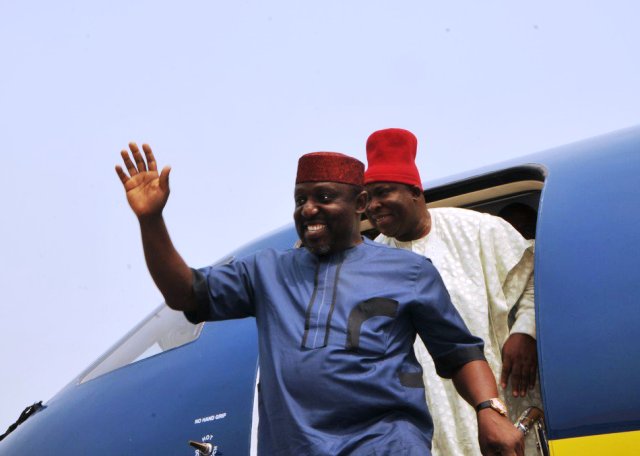
Okorocha: I’m bigger than Nigeria… don’t put me in a small hole like a rat


Rochas Okorocha, Governor of Imo State, says he is bigger than the state and Nigeria.

The controversial governor said he is not bothered when people accuse him of running a family government, because the image he has built of himself is so huge and popular that every one associated with his administration is said to be his family member.

Okorocha said this while trying to explain the reason he appointed his biological sister as Commissioner of Happiness and Purpose Fulfillment.

“Everyone from Imo State is a member of my family. I see the whole of Imo State as my family. Rochas is bigger than Imo State. I am bigger than Nigeria,” Okorocha said in the interview with Vanguard Newspaper.

“When I say ‘bigger’, I mean that this is not the only place I belong to. I mean I have gone beyond being an Imo man, beyond being a Nigerian. I am now an African. So, don’t put me like a small rat in a small hole.

“I have a bigger image than what people see. If you say I run a family government, that means I run a very big government. I have 30 commissioners. All of them are members of the same family with me. What a fantastic family!

“I have 27 Special Advisers and 30 Special Assistants. They are all members of my family. I have Perm Secs, all are members of my family. Without running a family government, you cannot make progress.

“The young lady (the happiness commissioner) is my sister. She has committed no offence. My predecessor appointed his brother as Chief of Staff; same mother, same father. There was nothing wrong with that.

“This young lady has been with me for the past seven years as my Deputy Chief of Staff. She does not take salary as Commissioner; she takes salary as Deputy Chief of Staff.

“She will supervise the new ministry until a substantive commissioner is appointed. She is a Deputy Chief of Staff (Domestic), which is even higher than a Commissioner.

“The young lady is qualified. Because she is the governor’s sister, she should not play a role? So, if my son wants to run for governor he cannot run because he has committed the offence of being the governor’s son?

“What is important is delivering the goods. She is just a supervisory Commissioner for a new ideology, new vision I bring to bear when I make pronouncements on the cardinal points of happiness, for people to fulfill their purpose in life.

“This is the ministry that deals directly with the ordinary people on the streets. It is the pivot upon which the missions of other ministries must revolve. The yardstick of every government is to provide happiness to the people.”

The Imo State House of Assembly has also endorsed Uche Nwosu, Okorocha’s son-in–law, as the preferred candidate to succeed the Governor in 2019.

‘The human side of President Buhari’

0

By Fredrick Nwabufo

The header of this article is the title of a 55-minute documentary on President Muhammadu Buhari. The documentary has been scheduled to air on NTA this evening.

The presidency says “the documentary portrays the president in a light that majority of Nigerians have not seen him”.

I find this – ‘human side of Buhari’ – farcical and puerile. Does it mean the president has an animal side? What other human side could he have than his much vaunted “sense of humour”?

Buhari’s “sense of humour” has been elevated by his media handlers to a national diadem. His media handlers are always quick to play on this harp – “Buhari’s sense of humour” – whenever there is citizen angst.

A presidential spokesman once said: “… President Buhari’s sense of humour is one of his most distinguishing characteristics….”

More importantly, I find the timing of the scheduled comedy broadcast a bit disturbing. Nigerians across the country are currently walking on molten magma to get fuel, where it is not available. Where it is available, they pay twice as much the price for the product.

Really, it smacks of default insensitivity that the presidency has scheduled a broadcast on “Buhari’s human side”, in essence, “his sense of humour” while Nigerians sleep at petrol stations, and without electricity at home.

Perhaps, the presidency is not reading the mood of Nigerians right. Nigerians at this point will not be swayed by theatrics. There must be some sensitivity to governance.

By the way, about 7.9 million Nigerians became unemployed between 2016 and 2017. What is the government doing to address this problem?

Nigeria’s current unemployment figures from the National Bureau of Statistics are jarring. More frightening is the figure of the unemployed in the north-east.

In Borno state, more than 800,000 of the labour force population are unemployed. In Yobe state, out of a labour force population of 1,037,277; 602,535 are unemployed. And in Adamawa state, 515,732 are unemployed out of a labour force population of 1,489,492.

The government will take $1 billion from the Excess Crude Account to fight Boko Haram in 2018. This is like using a placebo for cancer, instead of surgically removing the tumor.

Joblessness and criminality share an umbilical cord. The fact is, Boko Haram cannot be asphyxiated as long as an army of youth in the north-east is unemployed.

In conclusion, there must be gravitas and urgency to governance. Nigerians do not need presidential comedy now; they need fuel, electricity and jobs!

Fredrick is a journalist. He can be reached via Twitter: @FredrickNwabufo, Facebook: Fredrick Nwabufo


READ ALSO:

Okorocha: Those criticising Zuma’s statue can’t even be his tea maker

Rochas Okorocha, Governor of Imo State, has taken a swipe at those criticising his decision to erect a statue in honour of Jacob Zuma, stressing that many of the critics are not even fit to make tea for the South African President.

Okorocha said this in an interview with Vanguard newspaper on Sunday, saying that Zuma visited the state out of compassion for the thousands of children benefiting from the free education being offered by the Rochas Foundation.

“Zuma came here because he appreciates something good. He heard about Rochas Foundation Schools,” Okorocha said.

“Since I established the Rochas Foundation Schools, there is no local government in Nigeria that I don’t have children [from], over 15,000 children.

“No Governor, no President has heard about this school and visited it, except Vice President Yemi Osinbajo who visited recently. It’s been there for more than 15 years. Nobody, no big man, has thought it wise to come and see what we are doing.

“This man heard we had a school where we were providing free education, he wept and said in his life he never saw a classroom; he never went to school in his life.

“He spent most of his time in prison. He wept here in Owerri. He said ‘I wish I had met you earlier, my brother; I would like to partner you’. That was why we brought him.

“What is wrong with all of you? None of you has visited this school. These are children of poor people, children who have nobody.

“Then the man came all the way from South Africa to appreciate something good and they could not see that. They could not see the industrial park; they could not see the cargo airport. All they could see was the statue, that he is facing corrupt charges. Some of those making noise cannot even be teamakers for Zuma.”

Okorocha added that Zuma assured him that no Nigerian would be killed again in South Africa, stressing that since Zuma’s visit, no report of any Nigerian being killed in South Africa has been heard.

“Tell me one instance,” Okorocha quizzed the reporter. “If it happened it would be all over the Internet. When he came he said he would ensure no South African would kill a Nigerian and no Nigerian would kill a South African.”

Okorocha further explained that Zuma did not visit Imo State just because of the Rochas Foundation, clarifying that the visit was also in connection with certain projects being pursued by the state.

“Before you take any action, ask yourself, to what extent will this action make people happy? If not, it will be a waste of people’s resources,” he said.

“What is wrong with Zuma coming to Imo State? When you leave here, take a picture of our cargo airport. President Zuma came here to discuss the procedure of the South African Airways coming here to take over the Sam Mbakwe Cargo Airport alongside the Federal Government of Nigeria. He came with the Chairman of the South African Airways.

“Zuma came here for three things: One, the Imo Industrial Park, which we signed an MOU on, do a gas industrial park in Ohaji-Egbema, because all I have is gas.

“Two, Zuma came here for the issue of the International Cargo Airport.” And the third was because of the Rochas Foundation.”


Fuel marketers: It costs us 167/litre to import fuel… we can’t sell at N145

The Independent Petroleum Marketers Association of Nigeria (IPMAN) says it is impossible to sell Premium Motor Spirit (PMS) at the government-approved price because the costs and margins of importing the commodity stands between N160 and N167/litre.

The group said only a special intervention from the government to enable them access foreign exchange at a special rate will make the N145 pump price of fuel viable.

Mike Osatuyi, National Operations Controller of IPMAN, said the problem became more pronounced following the increase in the international price of crude oil to $59 per barrel.

Osatuyi made these comments while explaining the fuel scarcity currently being experienced across the country.

“The problem is that the importation (of petrol) is being handled almost 100 per cent by the Nigerian National Petroleum Corporation as private importers have backed out because the increase in crude price has made the landing cost enter subsidy,” Osatuyi said.

“When the crude price hit $59 per barrel, we could not sell petrol again at N145 per litre if we were importing on our own. It is only the government (NNPC) that is importing and can warehouse the subsidy.

“Right now, the landing cost of the PMS is N154. If you are importing at N305 to the dollar, by the time you add bank charges, it comes to N307 to the dollar.

“If you apply that to the current crude price, the landing cost is N154-N155. By the time you add all the margins, the pump price is about N160-N167.

“Before private importers can resume importation, the exchange rate to a dollar must be N250 and we can sell at the price of N145 per litre.”

Similarly, Obafemi Olawore, Executive Secretary, Major Oil Marketers Association of Nigeria, agrees that only a special exchange rate will enable them resume importation.

“I am told that some people have special rates. If they do, fine; let them give to us also. We will prefer a situation where we have access to forex exchange and we can import.”

Also speaking on the issue, Muda Yusuf, Director General of the Lagos Chamber of Commerce and Industry (LCCI), said the problem of recurrent fuel scarcity is due to a fundamental problem with Nigeria’s downstream sector.

“It’s unfortunate that fuel queues have returned. But there is a very fundamental problem with our petroleum downstream sector, and the problem is that it is over-regulated,” Yusuf said during an interview with The Punch.

“You cannot have a sector as big as that serving our size of population and we expect only the government provider to be supplying fuel. It is not a sustainable model.

“So, there is an urgent need to push back the role of government in the issue of retailing fuel, importing fuel and all of that.

“Right now, it is only the NNPC that is importing the PMS. Such a thing cannot be efficient; it creates room for all manner of abuses; some of which the marketers cannot disclose because of their own businesses.”

The ongoing fuel scarcity has led to a more than 100% increase in the transportation prices.

Before now, the bus fare from Abuja to Onitsha, Anambra State, was between N4,500 and N5,500, but as of Sunday it was hovering between N12,000 and N15,000.

Reports say petrol sell for between N250 and N350 per litre in almost the cities of Nigeria except Lagos and Abuja, where queues stretch for several kilometres.

President Muhammadu Buhari, who is also the substantive Minister of Petroleum Resources, is yet to make any comments on the issue.

FIGURES: Buhari’s State House is more expensive than Jonathan’s

Additional reports by Damilola Ojetunde and Victoria Nwaziri


For three consecutive years, President Muhammadu Buhari has presented budgets that are more reckless and ridiculous than his predecessor’s.

Buhari did not only adopt the budget template of Goodluck Jonathan, whom his administration has consistently accused of financial profligacy, he has presented more outrageous budgets than the defeated PDP leader did while at the helm.

The most inexplicable item in the 2018 budget is the reappearance of N5.4 billion for repair and rehabilitation of office buildings at the State House headquarters, Presidential Villa, Abuja.

In 2016, Buhari earmarked N4.5 billion for the repair and rehabilitation of residential and office buildings, while in 2017, N5.6 billion was budgeted for repair of residential houses in the Presidential Villa.

In three years of budgeting, Buhari has earmarked over N15 billion to repair and rehabilitate buildings in the State House.

This outrageous expenditure on repairs of buildings is unbelievably coming from Buhari, who had just five houses and two mud houses in Kaduna, Kano, Daura, and Abuja before he became President in 2015.

In contrast, Jonathan earmarked N2.1 billion in 2014 for repair of both residential and office buildings, and N1.1  billion in 2015 for all repairs and rehabilitation at the State House.

Buhari’s first budget for 2016 attracted public outcry but he blamed the inflated figures on “budget padding” by unnamed civil servants. However, the 2017 and 2018 budgets are not better than the “padded” 2016 budget.

Buhari’s State House is more expensive than the Jonathan’s. The 2017 budget for State House headquarters was N11 billion, lower than N11.5 billion in 2016 but N11.5 billion again for 2018. The same budget under Jonathan in 2015 was only N5 billion and N8.7 billion in 2014.

Comparing Buhari and Jonathan’s budgets in figures may not be realistic because of naira devaluation. However, Buhari has nearly doubled the figures on all the budgetary items in the State House and made provision for suspicious items.

Buhari has earmarked N66 million to the ever-changing residential rent in the Presidential Villa. In 2017, the rent was N77 million and only N27 million in 2016. The same residential rent in the last two years of Jonathan’s presidency was N22 million in 2015 and N41 million in 2014. It seems there is nothing as fluctuating and elusive as this annual rent paid to the Presidential Villa landlord or probably a landlady.

The 2018 budget is as disappointing as the two previous budgets under the leadership of Buhari who came to power riding on a reputation of integrity based on years of living an austere and “Spartan” lifestyle. His lifestyle contrasted sharply with many of his contemporaries who occupied public offices and relished ostentatious living.

Buhari was known for his simplicity of taste, clothing and living standard, spawning the notion of Buhari as a more financially prudent and disciplined political leader who would bring positive change into public finance.

But it appears that times may have changed, as the President’s austere lifestyle has given way to opulence and ostentatious living.

Buhari, who obviously enjoys travelling, has earmarked over N1 billion for local and international travels in 2018. That is a presidential privilege because he did not even have N27 million to buy his party’s nomination form for the presidential contest in 2014, which he said he borrowed from his bank.

In 2016, nearly N1 billion was budgeted for vehicles at the State House but Buhari is again earmarking almost N1 billion for the purchase of motor vehicles in 2018.

Since Buhari moved to the Presidential Villa, the cost of services have been rising at an alarming level. Although electricity charges have reduced from N319 million in 2017 to N274 million in 2018, it was only N45 million in 2016. Jonathan budgeted N36 million for electricity in 2016 and N68 million in 2014.

Water rates have also risen from N18 million in 2016 to N76 in 2017, but have slightly come down to N65 million for 2018. The same water rates were N15 million in 2015 and N28 million in 2016.

Following wide criticism, sewerage charges have reduced from N52 million in 2017 to N45 million for 2018. The same service was N6 million in 2016, N4 million in 2015 and N9 million in 2014.

Upon assumption of power, Buhari made a grand gesture by announcing N50 percent cut in his salary. But this gesture is insignificant when he has earmarked N164 million for his honorarium and sitting allowance in 2018.