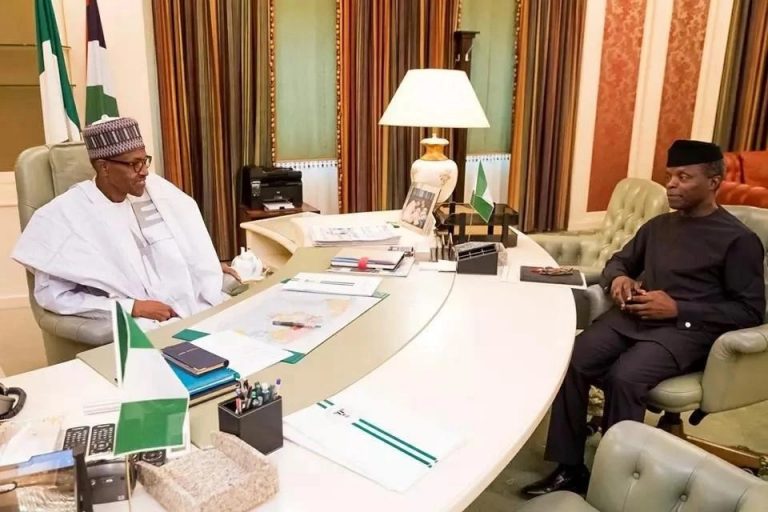
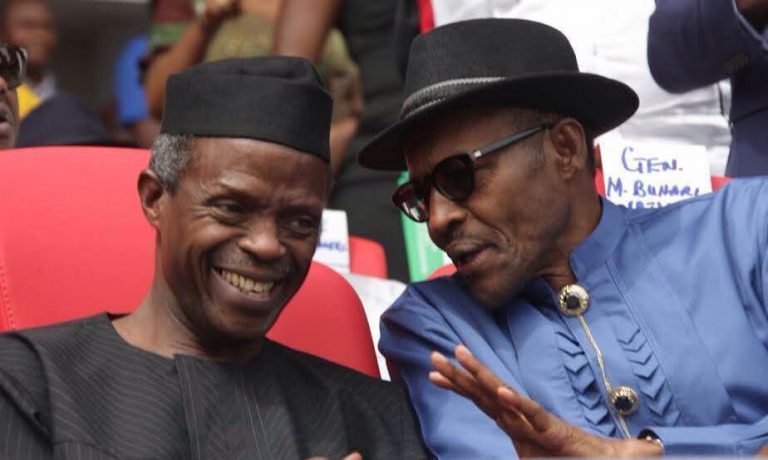
Acting President Yemi Osinbajo says President Muhammadu Buhari is recuperating very quickly and will return to the country “sooner than you expect”.
Osinbajo made this known to State House correspondents shortly before heading in to preside over the weekly Federal Executive Council (FEC) meeting.
He said he had been speaking with Buhari over the phone but needed to visit him in person to brief him on happenings in the country.
Although he said he and the President discussed “wide-ranging issues”, he said they didn’t touch the swearing in of the two newly-appointed ministers from Gombe and Kogi States.
“As you know I went to see him to check up on him, find out how he was doing,” Osinbajo said.
“I had, of course, been speaking with him on the phone, and I thought it would be a good thing to go and see him and check up on how he is doing and also to brief him on developments back home.
“So we had a very good time, we had a very good conversation on wide-ranging issues and he is in very good spirits; he is recuperating very quickly and he is doing very well.
“We spoke for well over and hour, and his humour is all there and he is doing well.”
On when the President could return, Osinbajo said: “I think very very soon, very soon. I think we should be really expecting him back very soon. Like I said he is recuperating very fast.”
Asked what specifically their discussion centred on, he said: “Wide-ranging issues, wide-ranging issues, I really can’t go into specifics of all that we discussed.
“We didn’t discuss swearing in (of newly appointed ministers) or anything… I am not in a position to say exactly … but I’m sure we will do that very very soon.”
On whether the President could be back before the 90th day of his travel, Osinbajo said: “No no, deadlines aren’t a very good thing, but he is, as I said, recuperating fast, and we expect him very shortly, much sooner than you would expect.”
It may seem the end of the road for Carl Ikeme’s football career last week after the Nigerian International was diagnosed with acute leukemia, a form of cancer that affects the white blood cells and the bone marrow.
But the Wolverhampton Wanderers’ number one has said that he intends to give his all in the fight against the disease, and perhaps return to the field of play.
That is a realistic target, as there are a number of football stars who have battled cancer successfully and gone on to enjoy eventful careers.
ÉRIC ABIDAL — FRANCE
When the news broke that Eric Abidal, the great French and Barcelona left full back, was diagnosed with liver cancer in March 2011, it appeared it was all over.
But by May of the same year, Muamba, as Abidal was popularly called, had undergone treatment and was able to play full 90 minutes in Barcelona’s Champions League final triumph over Manchester United.
In March 2012, however, he relapsed and this time, had to undergo a liver transplant. But yet again, he made a quick recovery and returned to football in March 2013.
Abidal then left Barcelona and returned to France where he helped Monaco qualify for the Champions League in his debut season. He later signed for Olympiacos before eventually retiring in December 2014.
ARJEN ROBBEN — THE NETHERLANDS
Arjen Robben, the mercurial Dutch forward, may not be as famous as he is today if he had not braved the odds when he was diagnosed with testicular cancer at the tender age of 20.
He overcame it and went ahead to write his name in gold for club and country.
Robben became a cult hero in Chelsea from where he moved to Real Madrid and eventually Bayern Munich. He also helped The Netherlands to the world cup final in South Africa in 2010.
Of the cancer scare, he once told Chelsea FC magazine: “I found a little lump and went to the doctor. He told me I needed an operation.
“I then had to wait for the results and I didn’t know if it was going to be good or bad news. The waiting was terrible for a few days. I didn’t know what was going to happen to me….
“At that time football was no longer important – the most important thing is to be healthy and for your family to be healthy. Football is my life but my family’s health is the most important thing in the world.”
JONÁS GUTIÉRREZ — ARGENTINA
Gutiérrez also suffered from testicular cancer, which is believed to have developed after the ball hit him hard in the crotch during a match between Newcastle and Arsenal in May 2013.
But after undergoing treatment to remove his left testicle in his country, Argentina, he made his return to the Newcastle United first team on March 4, 2015, coming on as a substitute in home match against Manchester United.
After his recovery, Gutiérrez had the words “I am alive again, more alive than I have been in my whole entire life” tattooed onto his arm.
CARLOS ROA — ARGENTINA
Roa was in an important moment in his career when he was diagnosed with testicular cancer; he had helped second division side Albacete Balompié regain promotion to La Liga after a seven-year absence but midway through the top-division season, cancer came calling.
He was forced to stop playing to have an operation, after which he spent an entire year between chemotherapy and rehabilitation.
After keeping his fitness with amateurs CD Constancia and CD Atlético Baleares, both in the Majorca area, Roa returned to professional football in his country, joining Olimpo de Bahía Blanca and retiring after one top division season.
LUBOSLAV PENEV — BULGARIA
Penev missed Valencia’s entire 1993/94 season to treat testicular cancer. It also cost the Bulgarian forward a place in the USA 1994 World Cup team. But he returned to the game soon enough in 1995 to sign for Atletico Madrid, who won the domestic league and cup double that season.
EBBE SAND — DENMARK
Nigerians need little introduction to Sand — the Dane had only been on the pitch for 16 seconds at France ’98 when he scored one of the World Cup’s greatest goals against Peter Rufai in goal for Nigeria. It was not only his debut goal for Denmark, it was the fastest World Cup goal ever by a substitute.
After that World Cup, Sand was diagnosed with testicular cancer and there was significant fear it would force him to retire prematurely. But he had surgery and was back on the pitch within a few weeks.
Sand spent eight more years with Schalke, during which he was the Bundesliga top scorer (2001) and he won the DFB-Pokal (2001 and 2002). He also represented Denmark at the 2002 World Cup, as well as the 2000 and 2004 European Championships.
STILIYAN PETROV — BULGARIA
Stiliyan Petrov fought and won the battle against acute leukemia even though on his return, he could not secure a contract from his former club Aston Villa, thus forcing him into an early retirement.
Four years after his diagnosis, Petrov went to train with the Villa first team during the pre-season, but the comeback was short-lived, as the club felt the Bulgarian had not done enough to merit a fresh contract.
However, Petrov remained in football, going on to enjoy coaching spells at smaller non-league clubs.
The Supreme Court has declared Ahmed Makarfi the authentic Chairman of the Peoples Democratic Party (PDP).
The judgement brings an end more than a year of chairmanship tussle between Makarfi and Ali Modu Sheriff, former Governor of Borno State.
In the judgement delivered on Wednesday, the apex court conferred validity on the PDP convention held in Port-Harcourt in May 2016, which ousted Sheriff as the party’s Chairman.
Walter Onnoghen, Chief Justice of Nigeria (CJN), presided over the five-man panel but it was Rhodes Vivour who read the judgement, saying all PDP members are bound by the decisions of that convention.
It held that the convention was not in breach of any aspect of the PDP Constitution by setting up a National Caretaker Committee led by Makarfi.
The judgement sparked jubilation among Makarfi and his loyalists, who were led to the court by the likes of Ayodele Fayose, Governor of Ekiti State, and Nyesom Wike, Governor of Rivers State.
Yemi Osinbajo, the Acting President, will travel to London this evening to meet with President Muhammadu Buhari, according to Laolu Akande, his spokesman.
Making the disclosure in a tweet on Tuesday, Akande said Osinbajo will return to Abuja “immediately afterwards”.
Buhari has been receiving medical attention in London since May 7, prompting speculations about his abilities to continue leading the federal government.
However, at different times, key officials of his cabinet and the party have attempted to play down the speculations.
On Monday, his wife Aisha tweeted a cryptic message suggesting he was recovering fast and would be back in the country soon.
AgP Osinbajo meeting with President Buhari in London today, and returning to Abuja immediately afterwards.
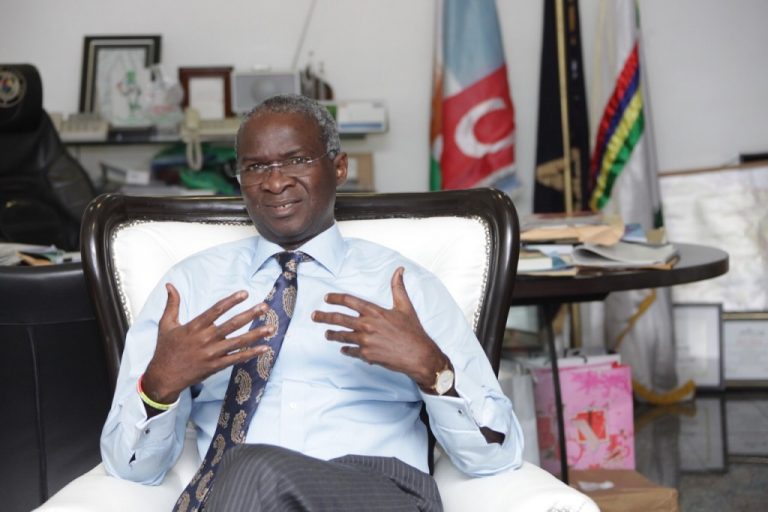
Babatunde Fashola, Minister of Power, Works and Housing, says the Kainji Dam will run dry and the whole nation will be in blackout if the Federal Government stops selling electricity to the Republics of Benin and Niger.
According to a message on the Presidency’s official Twitter handle, Fashola spoke in Abuja at the State House during the 4th Presidential Quarterly Business Forum.
Explaining why Nigeria sells electricity to the two neighbouring countries despite not generating enough to meet domestic demands, he said “Nigeria sells the power in exchange for a guarantee that they won’t dam the rivers that sustain Kainji dam”.
The dam was designed to have a generating capacity of 960 megawatts (1,290,000 hp); however, only eight of its 12 turbines have been installed, reducing the capacity to 760 megawatts (1,020,000 hp).
It generates electricity for all the large cities in Nigeria.
In May 2017, the Federal Government disclosed that the Republics of Benin and Niger paid a total of $159,773,116.61 (N48.84 billion at the official exchange rate of N305.7 to a dollar) as electricity charges to the Nigeria Bulk Electricity Trading Plc (NBET).
It also stated the two countries had a combined balance of $92,315,986.20 (N28.22 billion) to pay to the NBET, adding that the payments were remitted to the power generation companies and service providers in Nigeria.
According to the tweet, Yemi Osinbajo, Acting President, presided over the Forum where Fashola also said work was progressing on eight power projects across the country: 450MW Azura Power Plant, 10MW Katsina Wind Power Plant, 240MW Afam Power Plant, 40MW Kashimbilla Hydro Power Plant, 215 Kaduna Power Plant, 40MW Gurara Power Plant, 29MW Dadin Kowa Hydro Power Plant and 700 MW Zungeru Hydro Power Plant
Orji Uzor-Kalu, former Governor of Abia State, says he will only support secessionist calls by Nnamdi Kalu, leader of the Indigenous People of Biafra (IPOB), if he goes nuts.
According to Kalu, who was speaking as a guest on AIT’s ‘People, Politics and Power’, it would be madness to endorse such move.
He said that rather than support the breakup of the country, he would push for the amalgamation of the Republics of Chad and Niger to be joined to Nigeria and called ‘The United States of Nigeria’.
“What I can’t understand is some intellectuals, some people supporting Biafra… It disturbs me because I have gone to the deepest part of the US government and they said they will never allow the country (Nigeria) to disintegrate,” he said.
“I have gone to the deepest part of the UK government and they told me that they will never allow the country to disintegrate. So why are we wasting our time?
“You need a government to back you up on whether you are disintegrating or not. These are world powers; it’s true, it’s world politics, it is true.”
Uzor-Kalu recalled that he predicted that former President Goodluck Jonathan may not win the 2015 election because some western countries didn’t back him. “They can influence anything,” he said.
On the ultimatum by some northern youths for south-easterners to leave the North by October 1, Uzor-Kalu said Nigerians should not take them seriously.
“The quit notice means absolutely nothing because the people that gave the quit notice are just side-by people who don’t know what this country means,” he said.
“Nobody should be disturbed. I am not disturbed. I’m still investing in my farm in Maiduguri till tomorrow morning. So this quit notice is not in agreement with the convention that guides the existence of Nigeria.”
He commended the governors from the northern and the south-eastern states, as well as Acting President Yemi Osinbajo, for their handling of the development.
Uzor-Kalu also pointed out that it was wrong to say that the ultimatum to the Igbo was supported by the northern elders. He insisted that no reputable northern elder endorsed the call, except for a few who were “looking for cheap popularity”.
“No reasonable northern elder will do that,” he said.
“Did Adamu Ciroma do that? Did you question Adamu Ciroma? So I don’t know which people you call northern elders.
“Did Jibril Aminu say so? Did Ibrahim Babangida say so? Did (former) President Abdulsalami (Abubakar) say so?
“Did other young northerners who have a lot to do with the North and the South say so? Will Aliko (Dangote) support that? Nobody, no reasonable man will support that; only people who are looking for cheap popularity.
“It’s just like seeing me supporting secession of the country, you’ll know that from that day, you’ll know that my head has gone nuts. So that is what it means. The unity of the country is not negotiable by anybody.
“So when you say northern elders, I don’t know whether the Sultan, Emir of Kano, Emir of Zazzau are telling you that we should quit. If all these people tomorrow morning come out and ask us to quit, we will quit.
“We are not afraid of quitting and nobody should threaten us with quitting. We can build the best place to live, but Nigeria’s unity is more important.”
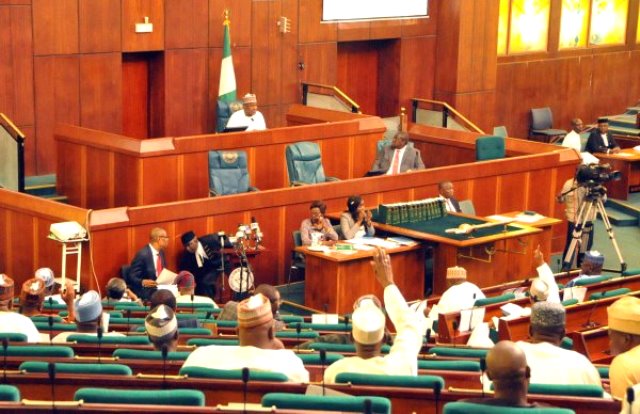
The House of Representatives has waded into the controversies surrounding the revised secondary school curriculum by asking the ministry of education to remove the religious components of the subject, Civic Education.
There have been arguments over the merging of Islamic Religious Studies (IRS) with Christian Religious Studies (CRS) and other components into a subject called Religion and National Values (RNV), with the Christian Association of Nigeria (CAN) particularly screaming foul play.
When the matter came up at the plenary on Tuesday, Beni Lar, a Peoples Democratic Party (PDP) lawmaker representing Langtang North and South Constituency of Plateau state, argued against the compulsory inclusion of religious education in the revised curriculum.
In its order paper posted on its official Twitter handle, the House noted “that under the previous Secondary School Curriculum which brought a lot of discontentment, Civic Education was not a compulsory subject and Religious Education was taught as Islamic Religious Knowledge (IRK) and Christian Religious Knowledge (CRK), both of which were optional subjects;
“that the Federal Ministry of Education introduced a revised curriculum without due consultation with parents and stakeholders and the new nine-year Basic Education Curriculum on Religion and National Values consolidated Religious Education and Civic Education under National Values and made Civic Education a compulsory subject for Senior Secondary Certificate Examinations;
“that the curriculum for Primary 1 to 3, which is the formative stage of a child, does not provide for adequate teaching of the religious beliefs of the people but rather destructive half-truths which destroy the fundamentals of the religious beliefs and erode the essence of such religion being taught the children.”
It expressed concerns “that the new curriculum, which is in conflict with certain religious beliefs, also makes the teaching of those beliefs compulsory”.
It recalled that Section 10 of the constitution of the Federal Republic of Nigeria, 1999 makes Nigeria a secular state, and therefore religion should be separated from national values
Adopting a motion on the matter, the House resolved to “call on the Ministry of Education to remove the religious component from civic education as a subject”.
After Samson Ayokunle, President of CAN, claimed that CRS will no longer exist as a subject on its own while Islamic/Arabic Studies and French had been introduced, ICIR published a fact-check that revealed tat he was wrong, as CRS and IRS had only been merged together as part of Civic Education.
Motion adopted.
The House resolves to call on the Ministry of Education to remove the religious component from civic education as a subject.
The House is now debating a motion by Hon. Beni Lar, on the compulsory inclusion of religious education in the revised curriculum; pic.twitter.com/ShZBZI6i3z
At just 29 years old, Ahmad Alhendawi was the first-ever United Nations Envoy on Youth, appointed by Secretary-General Ban Ki-moon on January 17, 2013, making him the youngest senior official in the history of the UN. Conquering that feat, he has embarked on another development civil leadership role at age 33: serving as the youngest Secretary-General of the World Organization of the Scout Movement (WOSM). He spoke with ADEDAYO FASHANU to reflect on his four years as the former UN envoy on Youth and discuss his new role at WOSM.
How is your new role as Sec-Gen of the WOSM different from your previous role at the United Nations?
My role as the Secretary-General of WOSM is an opportunity to serve an organization that I joined when I was very young at the age of 12. It’s been a part of my life, practically where my activism started. Now, after almost 20 years since the first time I joined the WOSM of Scouting, I have the opportunity to come back again to this massive movement.
The World Organization of the Scout Movement (WOSM) is 110 years old, founded by Lord Robert Baden-Powell in the UK. Since then it has attracted over 500 million young people over the decades, 40 million active participants globally and 165 national member organizations — serving as an umbrella for young people to enjoy the magic of Scouting.
It is an educational method that allows people to develop themselves spiritually, intellectually, physically, emotionally and experience by learning and doing the importance of serving others and governing others. This organization is the house of the Scouting Movement.
My previous role as the Envoy on Youth was a unique position for advocating for the interest of young people, supporting policies and different intergovernmental (IGO) processes with the UN and engaging with member states, which was a unique and powerful position. After observing the SDGs and other developments, my current role is all about action and working with young people directly in the front-lines of conflict, facing difficulties, responding to the hardships and working with member organizations — supporting the Scouts of the countries.
As the UN Envoy on Youth, how exactly did you help millennials?
The things I am proud of was the team I worked with. We have managed to elevate youth issues at the UN. We have engaged with so many member states to develop policies and discuss the importance of direct investment, designing new policies compared to very little that was captured in the MDGs is a main achievement for the security council to adopt the 2250 Youth Peace and Security agenda — a great achievement for the youth sector!
My job was to be a catalyst to support all the different youth movement issues — climate change, peace and security and development giving youth the help they need to get their message across. I am proud that I spent considerate amount in the fields visiting over 80 countries, meeting so many people, meeting with leaders of governments and championing the causes of young people facing difficulties — like starting businesses in Zambia, championing the rights of young people to be elected to public office in Nigeria through the campaign of Not Too Young to Run or working with government working for Uganda young girls’ rights to be girls and not mothers, preventing early child marriages. I hope my role was helpful because how the UN and other development agency works is if you don’t have a seat around the table, your issues get ignored so I tried to make sure that people have a seat around the table.
Given that you have become a role model, a voice of this generation and being at one of the highest seats at the table, what are some of the things that were beyond your control or sphere of influence as the Envoy on Youth?
Like any international civil servant, you are confronted with the limitations of your ability to influence big events. Example, I come from a region that has seen lots of suffering, one would hope you can do more to bring sanity to decision makers or decision making processes and policies but there are limitations like financial constraints, ability to mobilize enough or fast enough.
Being surrounded with people who have the goodwill and passion to do more has been great but the reality for our work is that nobody can do everything but everyone can do something. The key is to focus more on what that thing you can offer to make the world a better place. The UN is an IGO working with member states— I always say that succeeding with this position is a balancing act between frustration management and expectation management. One should never be intimidated by the forces trying to curb you down but to keep the momentum going. There are limitations with every role but I learned how to do things with what I have — not only with what I need. When you look around you will find what you have is massive. The most important thing is rallying to work with others and partnerships with youth organizations and now I am in the leadership of an amazing youth organization with the WOSM and it is a continuation of my beliefs. There is no one organization that can do it all but rather we need to work together and get the work going.
What else would you have liked to do to help youth, that you didn’t get a chance to accomplish?
I think I have done justice to a lot of the commitments I was faced with. There is always unfinished agenda business but I think it was a good time for me to step down after four great years! I have given my best — I can always think of so many more things I could do but for the realities and fact that it was the first time ever for the UN to have this office, a lot of the work went into establishing the space for young people globally, and I am glad that the space is not shrinking but expanding. Hopefully it will continue to expand in the future.
What advice do you have forJayathma Wickramanayake, the newly appointed UN Envoy on Youth who has taken the baton from you?
I congratulate her and I am excited for her. She is an amazing youth advocate. I know she will do a great job. She is committed and smart.
I don’t really have that much advice but I think she has what it takes to go far and I am sure she will find her voice. The realities are different and I have done it in such realities — I think she doesn’t really need much of my advice. I would not go in the path of offering public advice but she will be able to do great things by herself and we will all support her.
United Nations Secretary-General António Guterres appointed Jayathma Wickramanayake of Sri Lanka as his next Envoy on Youth.
There is an air of either serious motivation or total exhaustion with the state of things in the world. How can millennials stay motivated and engaged?
We just cannot afford to not engage or afford to not care and follow up on what is happening around us. The world is not in a great shape with the conflict and challenges facing us. A lot of these challenges are existential ones, like climate change, terrorism, peace and security issues that are affecting the lives of so many. When young people show up and raise their voices they are able to bring some good change.
Look at the recent French election, two-thirds of the parliament coming are young women and minorities, even when we think the situation is difficult we are always reminded that when young people come forward they can bring some good news. The lesson here is for any young person not to be discouraged or unmotivated. The challenges will always be massive but so are the opportunities especially when it comes to political practices, economic activities and job creation. Young people are changing a lot and changing the way things are being done in different sectors. I have great faith in young people. I understand the frustration, we need to renew our resolve to do well in the world. In my current and previous role I remained very worried about the situation of young people affected by conflict and I hope we will be able to do much more to help those who are in pain.
My message is, being unmotivated or discouraged is not the way forward! We need to keep each other focused on the bigger picture and on the fact that we can do great things when we are at the table.
What practical advice can you give millennials who want to tackle the SDGs? Why should young people follow you on this new path as the Scouts SG?
It is very difficult for me to hide my excitement when it comes to the SDGs. I have the SDGs framed in my office to serve as a reminder of the vision. Part of my job is to make sure we honour the commitment that has been made and we are very committed in the Scout Movement to do everything in our power to make the SDGs a reality.
Our conferencein August is preparing to adopt the SDGs and our national organizations to take actions on the SDGs.
The exciting thing is that the WOSM will become the world’s largest youth member-based movement, we are talking about a growing network that will reach 50 million to work for the SDGs.
When I was leaving as Envoy, Secretary-General Ban Ki-moon made a joke: “The UN will lose one but gain 40 million through the Scouts for the SDGs”.
I am seeing the commitment around me from my colleagues — we are determined to have the Scouts playing a role as the largest youth organization. Our theory is to invest in education, which enabled me 20 years ago and others to realize our potential by experiencing Scouting. That is what we are seeing today, determined to invest more in education for SDGs and human rights through that to unlock the power of young people to tackle the other 16 Goals.
Our focus is Goal 4: Education. We are also exploring partnerships. We will work with big partners to support and finance local projects and get support by funding a lot of the local projects. We have great experience there like with our flagship initiative called Messenger of Peace, we have founded and supported hundred of projects around the world and we have contributed over 750 million hours of service. We can do more of that for the SDGs going forward.
We are very excited and sure about the possibilities of us going out and doing the work even while there might be some challenges ahead of humanity to achieve these goals.
Seventeen goals to be achieved in 13 years, which means more goals than years. My theory is that we have no time to waste. We have to to roll up our sleeve and get to business doing everything in our power. I am excited about the endless possibilities by working with the Scouts and getting the goals translated to realities in the local context to reach them!
How do the Scouts help curb youth unemployment?
Here is a public secret: we are just concluding important research on the impact of Scouting in different areas and we are looking to the values, employable, soft and hard skills among the Scouts. We are coming to a conclusion with the Scout research in three countries that Scouts have scored at least 20% more than non-Scouts in a lot of the areas at a young age because the method you learn in Scouting, just as the UK Scout slogan says, are “skills for life.” Skills you carry everywhere you go that brings more resilience, innovation and self reliance — that is what Scouting is about in the end.
Realising that you will do your best at all times and and never take NO as an answer, innovate and battle hardship and difficulties — is the attitude, winner mentality and the collaboration we need in our world today while being mindful of your surrounding and environment.
On employment, while we focus on education, we get to learn that Scouting offers good handy skills not just the degree but interpersonal skills. When we invest in informal education in Scouting movement, we are able to unlock the real power of the individual to become better employees and become better employers. A lot of the Scouts go out to start their own businesses.
You may read up Adedayo’s past interview with Mr. Alhendawi on Forbes and TANTV and contact her via: globalsolutionstv@gmail.com, IG @globalsolutionstv @adedayojournalist.
Ike Ekweremadu, Deputy Senate President, has ripped into Ibrahim Muhammad, Kogi State Attorney-General, for ill-advising Yahaya Bello, the state governor, to take up paid advertorials in major newspapers to criticise him.
The Kogi State government had placed a three-page advertorial in the newspapers, castigating Ekweremadu for his contribution on the floor of the senate during the debate of Dino Melaye’s recall process.
“I want to advise that the people of Kogi state and indeed his (Yahaya Bello) constituents to better apply their time to more useful ventures in view of the very difficult conditions of recall of parliamentarians,” Ekweremadu said.
“And in reference to the attorney-general, I did say that my learned friend may not have advised the people or indeed the government appropriately.
“So this morning Kogi state government took an advertorial to respond to me and I understand that every page cost about N700,000. For these alone, they spent about N2 million and I understand that it is an about five other papers so we are looking about N12 million spent on responding to my comment.
“I pity the people of Kogi state that hired this kind of attorney-general and it is unfortunate that they are paying a public servant and he is unable to do a simple work looking at the constitution.”
Ekweremadu pointed told Muhammad to respect him because he has a doctorate degree in Constitutional Law, hence deserves more respect from the Kogi AG.
“I don’t know where he went to law school, anyway. If he has been properly educated, I believe he should have been conversant with the basic provisions of the constitution,” he said.
“I’m even his senior at the bar, he ought to show some respect because that is what we are taught at the law school… to respect our senior.
“For the avoidance of doubt, I want to believe I have better credentials in the legal profession and my interest was constitutional law, I have a doctorate degree in law and my area is constitutional law, I have been chairman of the constitutional review committee in this national assembly since 2010.
“I expect the attorney-general, instead of displaying his ignorance, to call me and I will educate him on the correct position of the law.
“So I take exception to this and I believe that he needs to refund the amount spent on this to the people of Kogi. I call on the house of assembly to institute an enquiry on who paid for this and find a way of receiving the money back to pay salaries of Kogi state.”
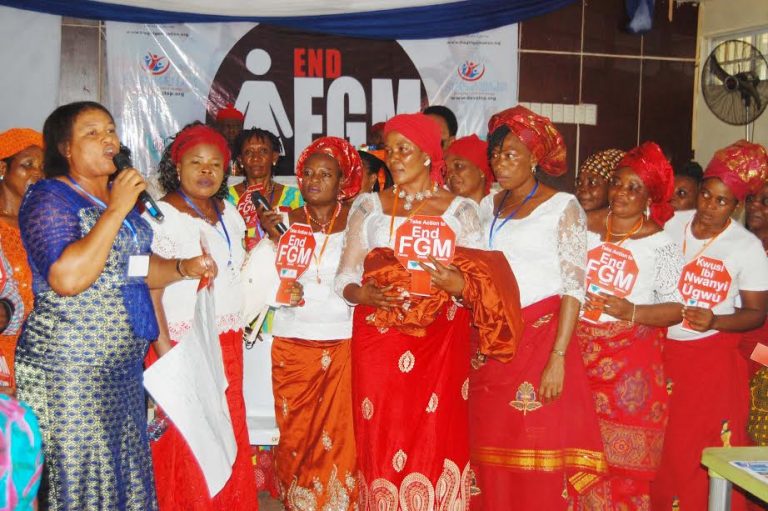
One hundred and fifteen community activists have been trained and empowered in Imo State to deepen the campaign to end Female Genital Mutilation (FGM) in the grassroots.
Imo State is one of the six states where the practice of cutting parts of female genital organs for non-medical reasons is still very high.
An estimated 20 million women and girls in Nigeria have gone through FGM, representing the highest number in the world.
In May 2015, Goodluck Jonathan, former President, signed a law that banned FGM, but it is still being practised in certain parts of the country.
According to a statement by Joseph Osuigwe, Executive Director of Devatop Centre for Africa Development, which organised the training, health workers, teachers, youth leaders, community leaders, National Youth Corps members and religious leaders from six local government areas in Okigwe Zone of the state were trained to take the campaign to rural communities where the practice is still prevalent.
The trainees, Osuigwe said, will be at the forefront of ending FGM in more than 60 communities in the state.
“The trained advocates were given small/sub-grant and awareness materials to carry out community projects such as workshop/seminar, market awareness, talk show, community outreach, One-on-One sensitization, town hall meetings, market awareness, and school outreaches,” he said.
He described FGM as human rights abuse, adding that each of the advocate is expected to sensitise 100 community members on the dangers of the practice, before September 2017.
Devatop Centre for Africa Development is youth-driven human rights, non-profit organization that has carried out projects on ending FGM in more than seven area councils in Federal Capital Territory and Imo State.
The two-day training and empowerment in was supported by the Girl Generation.