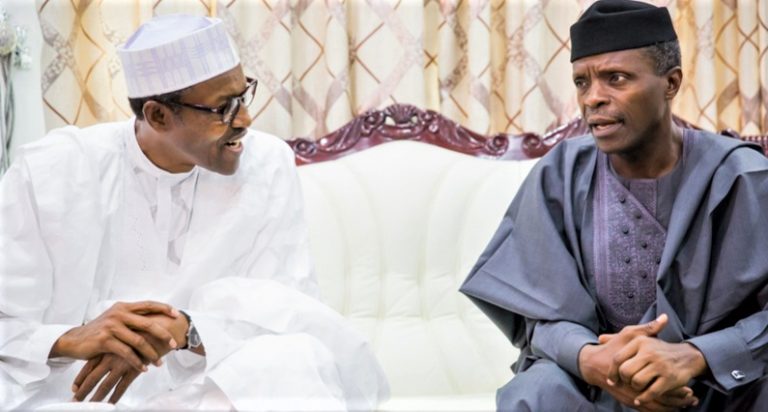
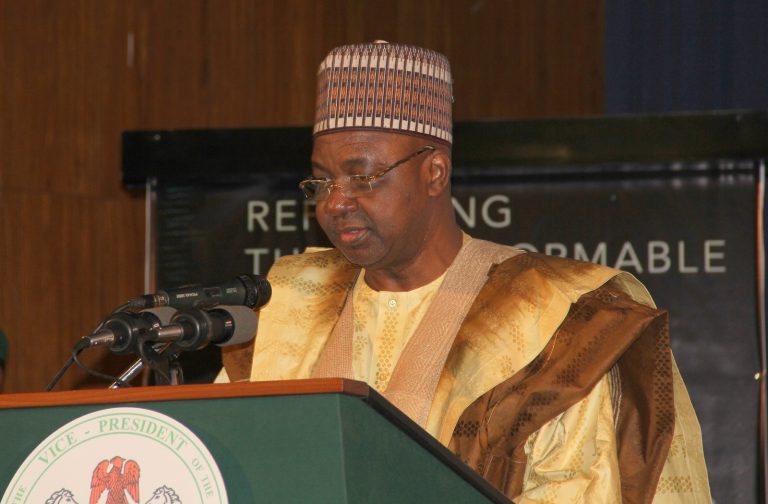
John Oyegun, National Chairman of the All Progressives Congress (APC), says President Muhammadu Buhari is “recovering in a robust manner” from his illness.
Oyegun was speaking two days after Ayodele Fayose, Governor of Ekiti State, claimed that the President was on life support.
“We are glad to inform you that President Muhammadu Buhari is recovering in a very robust manner,” NAN quoted him as telling journalists at the end of a meeting between the party’s National Working Committee (NWC) and state governors elected on its platform.
“We hope he takes it easy and when he comes back, I have no doubt at all that we will have a new and active period of activities.”
He refused to directly respond to Fayose’s claim but said only the President’s doctors abroad could decide when he would be fit to return to the country.
“If I respond (to Fayose), I will be dignifying him,” he said.
“At the appropriate time, people will answer him; at the appropriate level; at the appropriate time. He is in a different world altogether.”
Oyegun said the party leadership continues to place confidence in Buhari.
He added that the meeting discussed the nation, particularly the ongoing agitation for restructuring and inciting statements from different parts of the country.
“Such inciting statements are not good for the health of the nation so they have to be stopped,” he said.
Two years after PREMIUM TIMES revealed that four South-South states were running illegal surveillance programmes to intrude into privacy of their residents and target opposition, latest findings by this newspaper suggest that the states have not backed down on the controversial operation.
Akwa-Ibom, Bayelsa, Delta and Rivers States were named in the 2015 investigation that uncovered how governors in the four states, which are specifically located in the Niger Delta, procured cutting-edge spying devices to play the role of Big Brother over residents of their respective states, especially politically active opponents.
Rivers State then under Rotimi Amaechi was the first state to deploy surveillance equipment.
Former Governor Emmanuel Uduaghan also ran the programme in Delta until the end of his administration in 2015, and there are indications that he handed it over to his appointed successor, Ifeanyi Okowa.
In Akwa Ibom, former Governor Godswill Akpabio deployed the programme in Uyo, the state capital.
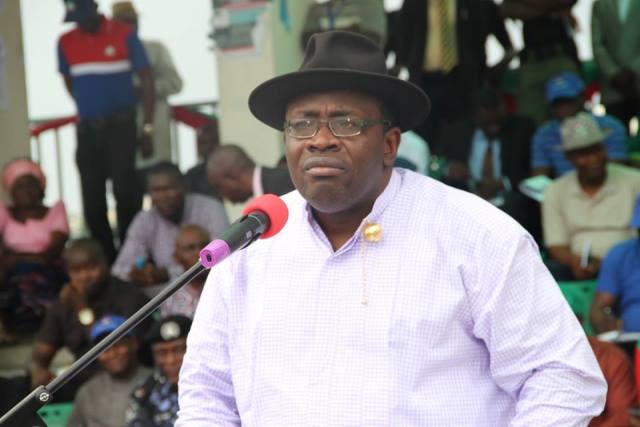
Governor Seriake Dickson of Bayelsa State was exposed as running perhaps the most ruthless of the spying policies at the time.
Of the four states, three have had change of leadership, while Mr. Dickson is now in his second term. Of the three governors that vacated office, only Mr. Amaechi of Rivers handed over to an opposition candidate.
PREMIUM TIMES gathered from official sources in Akwa Ibom, under Emmanuel Udom, and Rivers, under Nyesom Wike, that the two states still have their respective programmes in place, but there were no immediate signs that Mr. Okowa still spies on residents in Delta.
National Security Agency sources said none of the states received approval to deploy the surveillance equipment.
The subsisting policy of the Nigerian government requires that any public or private organisation with an intention to purchase surveillance equipment must secure End User Certificate from the NSA before doing so.
The unrestrained exploits of the politicians underscore the susceptibility of private phone conversations of Nigerians.
The revelations, our previous report said, highlight how easy it could be for individuals and organisations – with enough financial and political clout— to acquire and deploy hi-tech hacking tools and illegally collect private data from targeted Nigerians.
Section 12 of the Cybercrime Act (2015) prescribes a prison term of not more than two years, a fine of N5 million or both for anyone convicted of the illegal surveillance activities of the governors.
The police at state and federal level deny knowledge of all the intrusive operations by governors.
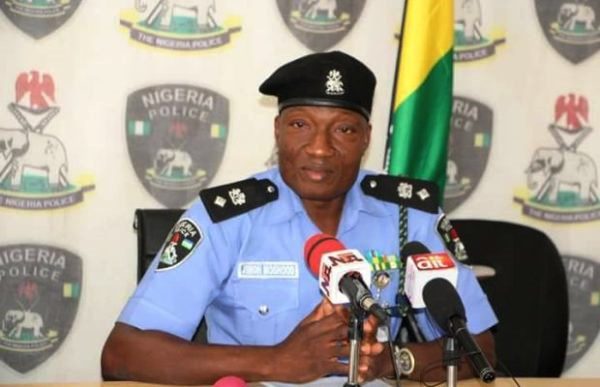
“We’re not aware of such,” the Nigeria Police spokesperson, Jimoh Moshood, said.
Jimoh Moshood, Police Public Relations Officer (PPRO)
“If any citizen has genuine complaints about possible intrusion on his or her privacy, such individual should contact the nearest police station”.
“We have our technical means to stay above criminals, but we’re not tapping people’s private conversations and the police will not condone such,” he added.
RIVERS
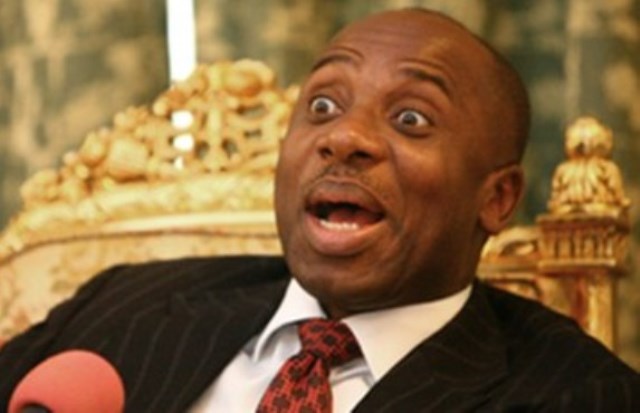
Former Rivers State Governor, Rotimi Amaechi, who is now Nigeria’s transport minister, was the first Nigerian politician to demand a Circle 3G’s telephone tracking technology as far back as 2010.
Rotimi Amaechi, Minister of Transportation
In a June 30, 2010 offer letter, signed by the then Secretary to the State Government, Sovens Okari, the Amaechi administration invited V&V Limited to supply the gadgets for N2.3 billion.
But the deal failed after the relationship between Mr. Amaechi and V&V Limited became strained.
When contacted at the time, Mr. Amaechi said he was unaware of the project. He argued that there was no record of fund releases for the project.
Two years earlier, Mr. Amaechi, now Minister of Transport, had picked up a similar gadget, the C4i (Command, Control, Communications, Computers, and Intelligence) technology deployed by an Israeli military security firm, MPD Systems.
Mr. Amaechi had described the C4i as a tool to aid federal security in combating militancy and kidnappings within the state. But it was more than that. C4i was considered the perfect federal cover under which Mr. Amaechi’s political spying was carried out.
But Ibim Semenitari, Mr. Amaechi’s Commissioner for Information, told PREMIUM TIMES in the previous report that the administration did not on its own deploy the tools to spy on anyone.
She cited Mr. Amaechi’s political fallout with former President Goodluck Jonathan as a clear hindrance for the governor.
“Given the well-publicised infractions between the Rivers State Government and the GEJ (Goodluck Ebele Jonathan)-led federal Government the state would not have been able to embark on the issues raised without the security agencies clamping down on its officials,” Ms. Semenitari said.
She admitted that the state government was running the programme, but said it secured the authorisation of the NSA under former President Umar Yar’Adua.
She also said the program was being run by a joint-team of police and the State Security Service in the state.
LATEST
Recent findings by PREMIUM TIMES during a recent visit to Port-Harcourt suggest that Mr. Wike continued running the surveillance programme when he came to office in May 2015.
A source close to the administration said the program was still running as at April 2017, but said it was on a lower scale.
“Governor Amaechi started the surveillance policy and the Wike government inherited it when he came to the office,” the source said. “But I think it has now been scaled down significantly.”
Nyesom Wike, River State Governor
The source said the programme had helped combat criminal activities in the state, adding that it was the reason behind its procurement.
But Commissioner for Information, Austin Tam-George, said the state does not intercept residents’ phone conversations.
“As a matter of ideology, this state does carry out illegal surveillance against residents.” Mr. Tam-George said. “It would be unfair to conclude otherwise.”
(Mr. Tam-George was interviewed in his capacity as commissioner. The interview was conducted before he resigned last week.)
Similarly, Rivers police spokesperson, Omoni Nnamdi, denied knowledge of any surveillance program.
“We only have joint patrol that includes the Nigerian Army and others,” Mr. Nnamdi said. “But I’m not sure I know of any spy programme or that I could confirm it.”
David Iyofor, media aide to Mr. Amaechi, said his principal left the equipment for Mr. Wike.
“It was a state property, not Amaechi’s own,” Mr. Iyofor said. “So, all security agencies that were involved can confirm that the state still has it.”
Hacking Team, notorious for equipping governments with tools to hack computers and phones, was hacked in July 2015 and 415 gigabytes of internal data leaked to the public.
Documents seen by PREMIUM TIMES show that the Dickson administration paid Hacking Team N98 million to carry out Internet attacks, in what appears to be the most ambitious hacking project by a Nigerian state government, the earlier report said.
The contract was signed in late 2013, leaked Hacking Team’s internal documents showed.
Mr. Dickson’s programme was not known even to the NSA until after the publication of the leaked documents.
Only the federal government has the power to intercept communications or act to suspend rights in the face of national security.
LATEST
There is no evidence anywhere that the Dickson administration disposed its hacking equipment. Officials also preferred to stick to earlier narratives that it never had one.
PREMIUM TIMES’ efforts to get updates from officials with knowledge about the Bayelsa State’s surveillance activities were unsuccessful.
In Yenagoa, some officials that initially agreed to an off-record conversation in person later backed out at the eleventh hour, citing the sensitive nature of our investigation.
Boma Spero-Jack, Mr. Dickson’s special adviser on security, however, restated the administration’s earlier claim, despite overwhelming evidence, that it never had any intrusive surveillance equipment in place.
“We’re not interested in such materials,” Mr. Spero-Jack said of hacking tools. “We’re not in such business.”
He said “eavesdropping or illegally obtaining people’s conversation is illegal.”
He said, like most states in the country, Bayelsa has a joint-security committee in place, which he said Bayelsa had been using to deal with crimes across the state.
“We have a joint-security group of police, Army and SSS.
“We have equipment for tracking of vehicles and we have equipment for distress calls,” Mr. Spero-Jack said.
He said his office oversees running of the equipment.
DELTA
As governor, Mr. Uduaghan, doled out N1.5 billion state funds to sign up for Circles 3G tools in February 2012. He also paid a yearly service fee of N31.9 million, our earlier investigation showed.
Emmanuel Uduaghan, former Governor of Delta State
Upon expiration of his two-term tenure in May 2015, he handed over the tools to his successor, Ifeanyi Okowa, who immediately signed a two-year contract to extend the maintenance of the service.
Although the police in Abuja own a Circles 3G communication interception service which they pay N63 million annually to maintain, Delta State government argued its gadgets were bought for the police, at the time.
“My boss has no need to monitor any politician,” Ehiedu Aniagu, chief press secretary to Mr. Okowa said.
PREMIUM TIMES investigation shows that the gadgets are run by V & V Limited and employees of the governor, rather than public security agents.
LATEST IN DELTA
PREMIUM TIMES could not ascertain the status of the equipment in Delta State.
Officials of the state government said the government was not monitoring anyone’s messages or conversations while the police in the state gave a non-committal response.
The Delta police spokesperson, Aniamaka Andrew, said there is a joint-team of security agencies in the state, and he “cannot say they do not have the capabilities” to monitor phone conversations.
“But I am sure they put issues of individual rights in mind and they will not infringe on the privacy of individuals,” he said.
Mr. Andrew said what he could speak definitely on was that the state government procured closed-circuit television equipment for active monitoring of major black spots in the state.
“It is a proactive means of preventing crimes across the state,” he said.
AKWA IBOM
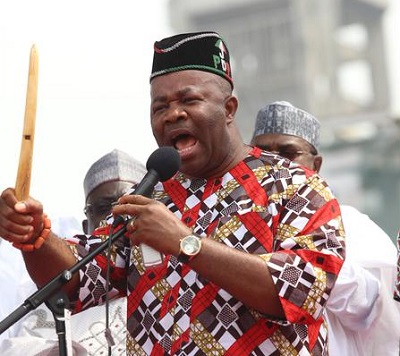
Mr. Akpabio, now a senator from Akwa Ibom, purchased cyber warfare equipment when he was governor.
Even though the National Security Adviser, in 2012, declined to issue Mr. Akpabio an End User Certificate to buy Hacking Team’s cyber warfare tools, the former governor went ahead, anyway.
Top politicians in Akwa Ibom then accused Mr. Akpabio of procuring the equipment to target them.
“We knew that he (Godswill Akpabio) acquired a device to monitor people’s telephone calls but there was absolutely nothing we could do,” Umana Okon, an estranged ally of Mr. Akpabio who was secretary to the state government when the device was installed, said. “The device was acquired at the time kidnapping was quite high in the state. But after kidnapping abated, it was used to monitor telephone calls of private citizens and government officials.”
Godswill Akpabio, former Akwa Ibom state Governor
The period when Mr. Akpabio used the phone hacking tools in Akwa Ibom also coincided with a period that was fraught with political assassinations, kidnapping and intimidation.
Like its counterparts in other states, the Akpabio regime in Akwa Ibom then denied operating the hacking facility.
Aniekan Umana, Mr. Akpabio’s Commissioner for Information said his principal never ran any intrusive operation.
Officials of that government who spoke to PREMIUM TIMES in confidence, however, confirmed the existence of the spying facility at the time.
Like Rivers, Mr. Akpabio’s spying facility was also installed and run from the governor’s office rather than the SSS or police department.
But Mr. Umana insisted that everything security was run by the SSS and police.
Mr. Umana further stated that when the state sought the Hacking Team’s tools, it was to help the security agencies.
Politicians who felt their privacy had been breached complained to the National Security Adviser, but said nothing was done.
LATEST
PREMIUM TIMES learnt during a recent trip to Uyo, the state capital, that Mr. Udom continued the controversial program when he assumed office in 2015.
A security source who spoke under strict anonymity said Mr. Udom declined to discontinue the program, citing security implications of such move.
The source said Mr. Udom praised the effectiveness of the surveillance operation, which was placed under joint-supervision of police and State Security Service, during one of the state security council meetings in 2016.
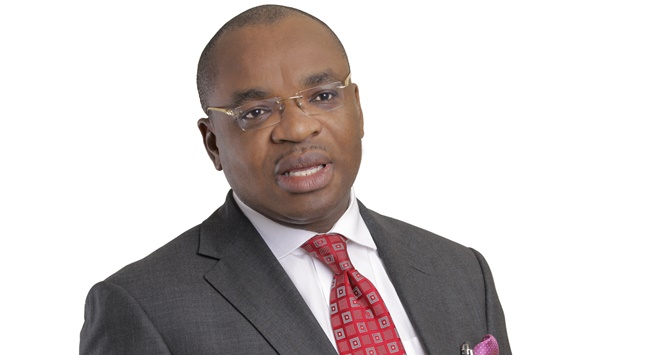
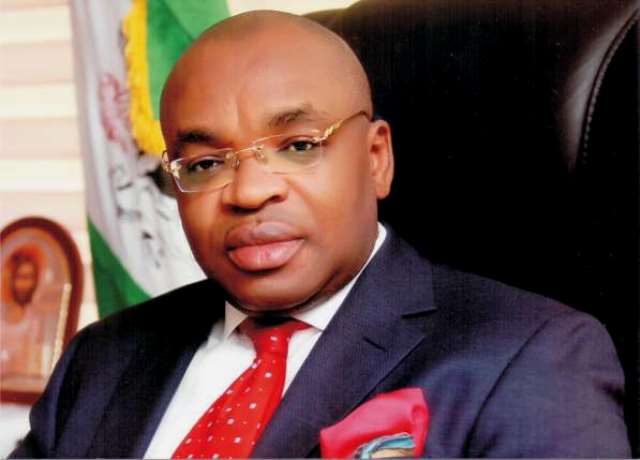
Emmanuel Udom, Akwa Ibom State Governor
“The governor said he won’t ignore the security benefits of the operation,” the source said.
Our source further stated that the spy operation aided the police work for the time they were allowed to use it.
“The police cannot deny the significant contribution that the surveillance tools made towards their activities,” the source said.
The source said Akwa Ibom witnessed a noticeable reduction in capital crimes, such as homicide, armed robbery and kidnapping, although no scientific statistics were provided.
Crime prevention had also been robust in the state in recent years, as spying capabilities made it easier for law enforcement authorities to learn of potential crimes before they’re committed, he said.
Yet, the source said the police had been removed from the program because of incessant leaks allegedly traced to police officers.
“We noticed some leaks happened last year and it was eventually recommended that the police be removed from the operation,” the source said.
The source said SSS remained the only security outfit the state allowed to keep running the program on its behalf.
The SSS, which is clearly involved in running the hacking program in Akwa Ibom and other states, has no spokesperson and has refused to make itself accountable to the public for questions.
PREMIUM TIMES could not, however, confirm that the Udom administration targeted political opponents in recent times.
Also, the Akwa Ibom Commissioner of Police, Don Awunah, denied knowledge of any surveillance operation that had links with the state government.
“I have no knowledge of such operation,” Mr. Awunah told PREMIUM TIMES inside his office in Uyo, the state capital. “And you know I have been in this state for several months.”
Mr. Awunah was named police commissioner for Akwa Ibom in January.
He said he had relied on the surveillance platform run by the police from their headquarters in Abuja.
The police chief declined to comment on claims that the state government dropped his organisation from the security agencies that were running the program.
Despite the strong indications that his government kept the intrusive surveillance program, Mr. Udom dug his heel in, stating categorically that no surveillance operation is underway in his state.
In a response to a series of questions about the program, Charles Udoh, the Commissioner of Information, said the Udom administration respects the privacy of all residents in the state,
“We do not intercept people’s private conversations,” Mr. Udom said. “It’s the work of security agencies to track criminals and bring them to justice.”
Mr. Udoh said previous claims from opposition figures that they were being targeted were mere “campaign ruse”.
Mr. Okon, now Managing Director, Oil and Gas Free Zone Authority, turned down all PREMIUM TIMES’ entreaties for his latest position on the surveillance program —if he still believes the operation hasn’t ceased or his calls are still being eavesdropped.
Samuel Udobong, spokesperson for the All Progressives Congress in Akwa Ibom, said he had no reason to suspect that Mr. Udom was targeting him.
Mr. Udobong said the activities of the APC as the major opposition party in the state had not been hindered in any way.
“We make our plans and challenge the governor in the open without any reason to be apprehensive,” Mr. Udobong said. “I don’t believe he’s targeting us, and, if he is, we’re not doing anything criminal.”
PRIVACY RIGHTS ACTIVISTS REACT…
But privacy rights advocates say they are not leaving anything to chance with respect to eavesdropping activities in Nigeria, which they described as “rudderless” and “proliferated”.
“We have time and again raised alarms that governments at all levels are increasingly deploying surveillance equipment that specifically target citizens’ communication,” said Adeboye Adegoke, program manager at Paradigm Initiative Nigeria, a public policy think-tank. “We know they do this with little accountability and very few citizens are alarmed.”
The apparent lack of water-tight regulatory framework in the deployment of surveillance tools has gripped privacy activists who warned of grave consequences should the status quo linger for much longer.
“We must not wait until someone as highly placed as the president is wiretapped and his secret conversations are uploaded on the Internet before something drastic will be done,” Mr. Adegoke said.
In recent years, some highly placed persons, including incumbent governors and judges, have had to endure public ridicule after their phone discussions were uploaded on the Internet.
Last December, phone conversations of Governor Ayo Fayose of Ekiti State and his Rivers State counterpart, Nyesom Wike, were leaked.
In one of such recordings, Mr. Wike appeared to be threatening an official of the Independent National Electoral Commission, INEC, over the state’s re-run elections that month.
PROPOSED DIGITAL RIGHTS AND FREEDOM LAW
As 2019 election approaches, some desperate governors in states where the tools have not yet been deployed might consider replicating the intrusive program to monitor opposition and maintain their hold on power, activists believe.
“They would sense the success of the ones deployed by their counterparts in the Niger Delta and procure their own equipment,” Mr. Adegoke said. “But that’s assuming they haven’t already done so.”
To reverse the proliferation of surveillance tools, Mr. Adegoke’s non-profit is championing a legislation it says will significantly curb privacy rights abuses and introduce sanity to the dark side of modern communication.
The Digital Rights and Freedom Bill has scaled the second reading in the parliament, where it has been proceeding at snail speed for about two years.
The bill proffers solutions to crucial surveillance questions, such as transparency, safeguards for deployment and modalities.
“We hope the bill’s passage will be expedited because it provides clear guidelines on the use of monitoring equipment,” Mr. Adegoke said. “Every Nigerian is entitled to unfeterred privacy”.
It is a pity that the body of the anti-graft war of President Muhammadu Buhari’s administration has been interred. The anti-corruption war expired on 14th June, 2017 when one of the celebrated cases of the war fizzled out. The Code of Conduct Tribunal discharged and acquitted Dr. Saraki on all counts preferred against him while at the same time it seriously lampooned the prosecution for ignorance in little matters of the law.
It was a no-case verdict. And Dr. Saraki left the courtroom into a tumultuous embrace of his accomplices who recline in the chamber that is meant to be hallowed which has unfortunately being made hollow. The chamber has become hollow by the number of fugitives from law perching on the seats reserved for distinguished people. It has been hollowed by demagoguery and unelevated discussions and the pursuit of personal interests above that of the country. The 8th Assembly sat on a forged foundation. And what a hollow foundation it was!
Although the war has been gasping for breath for quite some time, apprehensive citizens were hopeful that the onslaught against sleaze would manage to survive the vicissitude of inclement environment and toxic managers.
The anti-corruption war has died. And it died at a time the President is sick, even though the nature of his sickness is shrouded in mystery and secrecy. The war died at the point of initiation in the hands of the initiator. It died when the President began projecting nothing other than his famed body language and disdain for primitive accumulation, which have failed to douse the stench of official corruption. But corruption is a monster that must be fought with brilliance, technicalities and ruthlessness.
Behold, the war died when President Buhari began to exhibit ambivalence, provincialism, dualism and even nepotism in his appointments and approach to critical political and governance issues. The war died when the President began harbouring criminals, dubious deal makers and sophisticated grass cutters in his council of the elect.
The dirge of the anti-sleaze war was sung mournfully when the cardinal anti-corruption agency elevated theatrics and sensationalism over rigorous prosecution and hard-nosed investigations. To be fair, the EFCC has managed to haul back into the nation’s vaults, large cache of stolen wealth. This even is shrouded in secrecy.
In nation-building or in the efforts to reclaim a crumbling state, not everything must be approached with political correctness. Logging the reclaimed assets with the names of the thieves who stole them in a public register would have shown that the administration is serious about the war and that it has nothing to hide.
Creating special courts for the prosecution of corruption-related cases would have gone a long way in facilitating the duel against sleaze. If corruption will fight back because it is the lifeblood of Nigerians, the prosecutors, investigators and all those working with the agency should have been equipped with cutting-edge forensic skills that will be at par with international best practices.
Going to court with fanfare yet without adequate preparation and thorough investigation only for the nose of Magu to be bloodied by the bandits is an elixir for the enemies of the nation. When Magu’s nose is bloodied, it is the nation that is being raped. We shouldn’t gloat because we are being viciously stabbed by the custodians of our treasures.
The court in this administration has taken an adversarial position. Nothing will change this in the foreseeable future. Is Walter Onnoghen taking his own pound of flesh, telling Buhari to go to hell with his hollow puritanism that made him delay his appointment until the nation rose against his highhandedness?
Yesterday, malfeasant priests of the temple of justice were recalled even with the blemishes on their wigs and gowns. Today, a famous and highly-placed criminal was let loose to continue to pontificate on national issues. What else will happen tomorrow under the watch of Justice Onnoghen or should we say in Onnoghen’s courts?
Perhaps, Buhari lacks social skills, which, for politicians, include building bridges and alliances. Critical cooperation and synergy could have been formed and cemented over a dinner in the Villa at the instance of the President. The anti-corruption war has died, at least in this administration. Saraki’s case is a litmus test for the integrity of Buhari’s war and the test has failed.
Saraki and his cohorts can continue to mock the nation but the Lord of the Senate gains no redemption in the public court. Depositors who lost their money in financial inferno that gutted Societe Generale Bank know that another inferno has just gutted our temple of justice. Paris Club refund that was allegedly shared by the governors and fronts of the political medical doctor is not yet forgotten.
The pauperisation of Kwarans and their metamorphosis to amala eaters who can no longer think about their existence is known to all. Though, the mental colonisation of the emirate preceded the Oloye’s heir who in haste to mount the throne committed patricide. The dossier of the several assets fraudulently acquired and irregularly declared is quite open to all.
A governor like a dynamite who reportedly promised to testify about some property belonging to the accused and yet undeclared suddenly kept mute while the court is in need of evidence to nail him. Maybe it is a form of elite solidarity. While the court of money doublers, gluttonous attorneys and dollar-softened judges may acquit Dr. Saraki, he stands convicted in the public court.
The people must not lose hope when there is not the faintest reason to be hopeful. Despondency battles with optimism in the minds of true patriots. Yet, hope must we re-ignite in our fatherland. This time around, the people are helpless and they have no helpers. In this is a lesson for them to help themselves. Help yourselves, ye heedless people! Stone them and exile them before Nigeria is stolen out of existence while the court proclaims no guilty verdicts.
Nigerians, the ball is in your court. God bless Nigeria.
Additional reports by Oluwadamilola Ojetunde and Victoria Nwaziri
The sharing of N12.84 trillion, (12,846,756,475,008.90) to 774 local governments in the country shows gross marginalisation of some states and inequality in the distribution of the nation’s wealth.
The money was the total monthly allocation from the federation account to local governments from January 2007 to March 2017.
Despite the fact that Udi Local Government Area (LGA) in Enugu State is more populated (by 291 persons) than Bagudo LGA in Kebbi State, the latter receives a higher allocation from the federation account.
Based on the 2006 census, the population of Udi is 238,305 while Bagudo’s is 238,014. Between January 2007 and March 2017, Bagudo received N17, 760,612,529.61 from the federation account — higher than Udi with N17, 423,721,536.36.
That Bagudo received N336 million more than Udi over a 10-year period seems insignificant but the disparity in allocation widens when the states are compared.
Just as Udi is ahead of Bagudo in population, Enugu State is also more populated than Kebbi State by 11,296 people. However, Kebbi has 21 LGAs while Enugu has just 17 LGAs.
The 17 LGAs in Enugu received N274.9 billion from the federation account, representing 2.14 percent of the total allocation to all the LGAs in the country, while the 21 LGAs in Kebbi with lesser population have been allocated N326.1 billion, representing 2.54 percent of the total allocation to LGAs over the 10-year period.
The N51 billion gap in allocation between Enugu and Kebbi is significant enough for those in Enugu to ask why the state is being treated differently in the distribution of national income.
Both states were created on August 27, 1991, by Ibrahim Babangida, the former Military Head of State. Enugu was carved out of Anambra State while Kebbi was created from Sokoto State.
This unequal distribution of the nation’s wealth through the LGAs is replicated across several states, with states in the South-East being the most short-changed.
Niger and Anambra States were created on the same day in 1976. Niger has 25 LGAs while Anambra has 21 LGAs.
In 10 years, the 25 LGAs in Niger received N413.8 billion from the federation account, representing 3.22 percent of total allocations to LGAs. But Anambra received a far lower allocation of N334.6 billion, representing 2.6 percent of total allocation to all LGAs. However, Anambra population’s of 4,177,828 is bigger than Niger’s, which is 3,954,772.
The case of Anambra is unfair when compared with other states that have almost equal population but have a far higher allocation on the basis of LGAs.
Jigawa State, which was created from Kano State in 1991, has a population of 4,361,002 with 27 LGAs. The LGAs in the state have been allocated N408.4 billion in 10 years.
But Rivers state, with a population of 5,198,716 and just 23 local governments, received N397.8 billion — far lesser than Jigawa that has a lower population.
Rivers’ neighbour, Akwa-Ibom State, received 441.6 billion, representing 3.44 percent of total LGAs allocation, but Akwa-Ibom has just a population of 3,902,051; it also has 31 LGAs.
What is the justification for Akwa-Ibom to have 31 LGAs and receive more allocation while Rivers with higher population has only 23 LGAs with a lower allocation from the federation account?
However, having more LGAs does not mean a state will have more allocation. The 20 LGAs in Lagos State have been allocated more money from the federation account than any other state, except Kano.
The 20 LGAs in Lagos received N704.4 billion from the federation account, representing 5.8 percent of the total allocation to LGAs.
The population of Lagos is 9,113,605 — a little lower than Kano with a population of 9,401,288, according to the 2006 census.
Although Kano has more than twice the LGAs in Lagos, the total allocation to 44 LGAs in the state is N728.7 billion, representing 5.67 percent of the total allocation to all the LGAs in the country.
The difference in allocation between Kano and Lagos is just N24 billion over the 10-year period despite the fact that Kano has more than twice the number of LGAs.
This case of allocation between Lagos and Kano is not the same as that of other states with similar population and different number of LGAs.
Anambra State is more populated than Niger State but Niger gained N79 billion more than Anambra in the allocation to LGAs from the federation account.
SKEWED FEDERAL SYSTEM
The country’s earnings are kept in the federation account. Every month, this money is shared by the three tiers of government.
The sharing among the federating units is vertical — the federal government takes the lion share of 52.68 percent, states follow with 26.72 percent while the local governments receive the remaining 20.60 percent.
Each month, the Federation Account Allocation Committee (FAAC) determines how much from the federation account is to be shared, depending on how much the country makes for that particular month.
However, the imbalance and unfairness are observed in the horizontal sharing of the 26.72 percent allocated to the 36 states and 20.60 percent to the 774 local governments from the federation account.
Just as the analysis of the sharing of 20.60 percent from the federation account among the local governments has shown much disparity and unfairness, the sharing of 26.72 percent of the states also uses the same template of local governments.
The implication is that states which have fewer numbers of people are getting more money from the federation account than states with higher population.
These exploitative conditions were created by military administrations that exhibited blithe disregard for due process and equity in the creation of states and local governments. States and local governments were created at the discretion of military leaders.
States and local governments were arbitrarily created by military dictators, starting with the creation of first 12 states out of the four regions of the country on May 27, 1967, by Yakubu Gowon, the former Head of State.
Murtala Mohammed increased the states to 19 on February 3, 1976, with the addition of Federal Capital Territory, Abuja.
Ibrahim Babangida created two states on September 23, 1987, and another nine states on August 27, 1991, bringing the total number of states to 30.
Sani Abacha increased the states to 36 on October 1, 1996.
These structures of states and local governments created by the military have remained unchanged since the return of democratic rule in 1999.
A CASE FOR RESTRUCTURING
Efforts to redress the imbalance in the creation of states and local governments have been thwarted mainly by states favoured by the current federal system, while others that are marginalised in the creation of states have been demanding for more states and local governments to increase their chances of receiving more allocation.
The national conference of 2014 recommended the creation of 18 more states, which will bring the total states in the federation to 54, in addition to a certain number of local governments.
Creation of more states and local governments are unlikely because the existing states are not viable and most of them cannot function with the monthly allocation from the federation account.
But if the present structures are retained, the unfairness and inequality in the allocation of money to the federating units will continue.
A new kind of agitation for the restructuring of the federation is now gathering momentum with the persistent call for Nigeria to return to fiscal federalism.
A true federal system will enable states or regions to have more autonomy and control their resources, rather than depending on the monthly allocation from the federation account. This will be similar to the political arrangement before the creation of states and local governments when Nigeria had only four regions.
The promoters of restructuring have not clearly articulated whether the country will return to a regional system with the present six geo-political zones or maintain the current 36 states where each state will have more autonomy and resource control.
But the argument for restructuring is sensible and it is pivotal for development in the country. There will not be the need for the monthly allocation from the federation account and no state will be short-changed in the sharing of the allocation. Each state will develop according to its own pace.
With this restructured Nigeria, those in Udi LGA in Enugu State will no longer wonder why Bagudo LGA in Kebbi State will be getting more money from the federation account despite Udi having more population.
And the only way Bagudo will be getting more money than Udi in a restructured Nigeria is if its people work harder than those in Udi, rather than the currently unjust ‘feeding bottle’ federalism.
Chris Okorie, a special assistant to Governor Emmanuel Udom of Akwa Ibom State, has quit his appointment, citing months of inactivity.
In his resignation letter to the Governor, dated June 28, Okorie noted that 20 months after he was appointed SA to the Governor on Electoral Matters (Ikot Ekpene Senatorial District), he was yet to be assigned any duties.
“I am yet to be … provided with basic work tools, not even an office space,” Okorie stated, adding that “Worse still, there is no hope that this situation will improve in the nearest future.”
“Therefore, your Excellency, I do hereby resign my appointment as Special Assistant on Electoral Matters with effect from today, 28th June, 2017, to enable me channel my energy into other activities which I believe will ultimately be to the benefit of our beloved State,” he said.
Stuart Symington, the US Ambassador to Nigeria, has called on Nigerians to resist the temptation to divide the country, describing Nigeria as a country whose unity lifts Africa and the rest of the world.
“The sight of a United Nigeria’s light lifts Africa, and with it, the World,” Symington stated in Abuja on Thursday in a speech to celebrate the 241st anniversary of American independence.
He compared US to Nigeria, saying “I’m reminded, however, that, throughout the history of the U.S., the diversity we prize, and share with Nigerians, has been a source of tension and, at times, even a challenge to our union.
“George Washington warned that those who sought to weaken and defeat us would first attack our unity of government, and Abraham Lincoln made preserving the union his life’s work.”
He said the US overcame the challenge of diversity because it had visionary leaders who were committed to union and citizens committed to ensuring justice for all.
Symington said Nigeria is now fortunate to have such leaders and citizens who were dedicated to keeping Nigeria united
He emphasised the need to ensure that every Nigerian is heard and taken into account and treated fairly.
“This is crucial; every one of you is crucial. Together those Nigerians will overpower any call to divide this Nation. Thanks to them, thanks to you, the lamp of unity and justice burns brightly in both our nations tonight.
“Whenever I meet a Nigerian, I ask, ‘What do you like the most about your country?’ The invariable reply, from more than a thousand Nigerians, is ‘I like the Nigerian people’, ‘I like our diversity, our resilience, our energy, our warmth, our spirit, our food’…
“Just like the United States, Nigeria is a wonderfully diverse nation whose differences and diversity are sources of strength and reason for pride.”
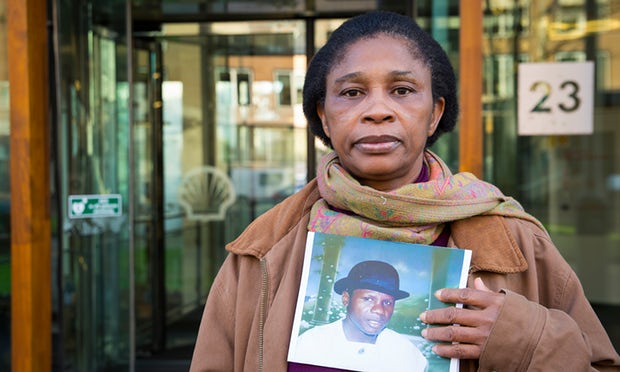
Four widows of men who were hanged along with Ken Saro-Wiwa in 1995 by Nigeria’s military government have launched a civil case against Shell in Netherlands, accusing the oil giant of complicity in their husbands’ execution, reports the Guardian UK.
Esther Kiobel, the widow of Dr Barinem Kiobel, and three other women served a writ in a Dutch court this week, following a 20-year battle with Shell.
Kiobel accused Shell of complicity in the unlawful arrest and detention of her husband, the violation of his personal integrity and the violation of his right to a fair trial and his right to life. Her case will also accuse Shell of the violation of her own right to a family life.
Kiobel is bringing the case along with Victoria Bera, Blessing Eawo and Charity Levula, whose husbands were also executed. The women are seeking damages and a public apology for the role they allege Shell played in their husbands’ deaths.
Their husbands were executed along with the writer and human rights activist Ken Saro-Wiwa, and other men, who became collectively known as the Ogoni nine.
A military tribunal set up by Sani Abacha, the former Military Head of State, found them guilty of killing four Ogoni leaders who were against the peaceful protest they were leading against the pollution caused by Shell.
Following their execution, which attracted international outcry, Nigeria was suspended from the Commonwealth.
According to the Guardian UK, Amnesty International, which has supported Kiobel’s legal team, has accused Shell of complicity in the state executions.
“In a briefing published on Thursday, Amnesty alleges that Shell encouraged security forces and military authorities to stop the protests, even though the company knew this would lead to human rights violations,” the paper said.
“Amnesty also claims to have seen internal Shell documents proving that the company knew the trial of the Ogoni nine was unfair, and demonstrating that the firm was informed in advance that Saro-Wiwa was highly likely be found guilty.”
Shell has, however, branded the allegations “false and without merit”.
In a statement, Shell Petroleum Development Company of Nigeria Limited said: “We have always denied, in the strongest possible terms, the allegations made by the plaintiffs in this tragic case.
“The executions of Ken Saro-Wiwa and his fellow Ogonis in 1995 were tragic events that were carried out by the military government in power at the time. We were shocked and saddened when we heard the news of the executions.”
Wednesday’s raid by security and anti-corruption operatives on the house of Namadi Sambo, former Vice President, did not yield anything incriminating, ICIR can exclusively report.
Sambo, who was Vice President from 2010 to 2015, had his house searched by a combined team of operatives from the Independent Corrupt Practices and other related offences Commission (ICPC), the Special Anti-Robbery Squad (SARS) and the Department of State Services (DSS).
FALSE ALARM
But a source very close to one of the operatives who executed the search warrant on Sambo’s home confirmed to ICIR that the search team had been misled by a whistle-blower.
The source, an operative of Nigeria’s highly secretive security agency, said that they had gotten intelligence of illegal activities bothering on financial crimes in the former Vice President’s house and had obtained a search warrant before proceeding to his home in Kaduna.
“In the end, it turned out a false alarm because several hours of search yielded nothing,” he said.
“You already know that if we found something, it would have been in the media by now. We found nothing incriminating in the ex-VP’s house.”
THE FLIP SIDE OF WHISTLE-BLOWING
In December 2016, the Federal Government announced a policy of rewarding people who blow the whistle on corrupt people.
“The whistle-blowing policy is a programme designed to encourage anyone with information about a violation, misconduct or improper activity that impacts negatively on the Nigerian people and government to report it,” Kemi Adeosun, Minister of Finance, had said at the time.
“If there is a voluntary return of stolen or concealed public funds or assets on the account of the information provided, the whistle blower may be entitled to between 2.5% (minimum) and 5.0% (maximum) of the total amount.”
And it has yielded results. Between that time and April 2017, the Federal Government recovered at least N73 billion looted funds (using then then exchange rate of N306 to a dollar.
The amount comprises $151 million seized from a fake account in an unnamed commercial bank, N8 billion looted funds, $9.777.8 recovered from Andrew Yakubu, former Group Managing Director of the Nigeria National Petroleum Corporation (NNPC), recovery of $38 million, £27,000 and N23 million from an apartment in IKoyi, N448,850 million taken from a Lagos plaza and N250 million hauled from the popular Balogun Market in Lagos and N49million recovered by the Economic and Financial Crimes Commission (EFCC) at the stopgap Kaduna Airport.
But the policy has come with its own problems.
The security operative who spoke on Thursday blamed the “false alarm” on a whistle-blower.
“The monetary incentive predisposes the public to passing off unverified information as suspected loot. The whistle-blower’s anxiety to make money brings a lot of complications for security and anti-corruption agents.”
Nasir el-Rufai, Governor of Kaduna State, says the people canvassing political restructuring of Nigeria are political opportunists.
“Those that are talking about restructuring see it largely as a political opportunism in my opinion rather than practical realities” said el-Rufai on Thursday when he featured on Channels Television’s morning show, Sunrise Daily.
He particularly carpeted former presidents advocating for restructuring of the country now, saying they were in power but never believed in restructuring adding that restructuring was part of the manifesto of All Progressives Congress (APC).
Goodluck Jonathan and Ibrahim Babangida, who are former presidents, are among prominent Nigerians who recently joined the call for restructuring.
“This administration under President Buhari has done more in practical terms not rhetoric about federalism, than previous administrations put together. And I give examples: as a state government, we are now much more involved in economic policy-making at the federal level than ever,” he said.
“We meet every month under the auspices of national economic council and working together with federal government; we chart directions economic policy.
“That is part of shifting the federal-state balance. We have been involved in the investigation of the finances of excess crude account and things that were always hidden are now much more open.
“That is one practical step; others include mining. The Minister of Solid Minerals, Fayemi, has done more in involving states in trying to exploit mineral potentials. Before this administration, licenses were issued for mining in Abuja and you just see people drop in your state for mining. That has changed dramatically.”
Operatives of the Economic and Financial Crimes Commission (EFCC) have arrested Lucy Jumeyi Ogbadu, Director-General of the National Biotechnology Development Agency (NABDA), for her alleged involvement in criminal conspiracy and diversion of public funds to the tune of N23 million.
Her arrest was announced on Thursday by the Commission via its Twitter handle @officialEFCC.4
According to the post on Twitter, Ogbadu was arrested on Wednesday in Port Harcourt, Rivers State, following her alleged linkage with Josiah Habu ,the Bayelsa State Director of Bioresources Development Centre, who is being investigated by the EFCC in a case of fraudulent diversion of the sum of N75 million.
Investigations by the EFCC showed that Ogbadu allegedly received the sum of N23million through a bank account belonging to one Esther Habu, Habu’s wife and admitted same in a voluntary statement made to the EFCC.
“Further investigations have also shown that, Esther Habu is one of the contractors with Bioresources Development Centre, Odi, Bayelsa State, and a total sum of N603,000,000.00k has been traced to her, in different deals involving over 20 Directors of Bioresources Development Centres across the country,” EFCC said.
Ogbadu’s linkage with all these scams is being investigated.
She has been duly served with bail conditions while investigations continue.