THE Nigerian Economic Summit Group (NESG) said headline inflation could drop to 24.7 per cent in 2025 should there be improvements in fiscal and monetary policy alignment.
The economic advocacy group similarly forecasts the foreign exchange rate to stabilise at an average of N1,300 to the dollar.
It projected this in its 2025 macroeconomic outlook report, themed, ‘Stabilization in Transition: ‘Rethinking Reform Strategies for 2025 and Beyond,’ released this January.
It maintained that the anticipated reduction in inflation and improvement in the exchange rate could be achieved with better coordination between fiscal and monetary policies.
According to NESG, by aligning government spending with targeted monetary interventions, policymakers aim to curb the inflationary pressures that have plagued the Nigerian economy in recent years.
“Inflation is projected to decline to 24.7 per cent, signalling an improvement in the country’s macroeconomic stability. The exchange rate is projected to strengthen, averaging N1300/US$1 in 2025 under the ideal stabilization pathway.
“The effective coordination of fiscal policies with monetary policy measures will drive this anticipated reduction in the inflation rate,” NESG stated.
Nigeria’s inflation has surged to 34.8 per cent as of December 2024, and the exchange rate depreciates hover above N1,500/$1.
The inflationary pressure has continued to plague the Nigerian economy in recent years, especially since President Bola Tinubu’s fuel subsidy removal and foreign exchange rates unification, The ICIR can report.
In its forecast, the NESG highlighted that disciplined government spending, strategic interventions in critical economic sectors, and measures to mitigate the effects of global economic uncertainties on Nigeria’s domestic economy were among the key measures responsible for its projected improvement.
It stated that the expected strengthening of the naira is tied to a combination of favourable economic conditions, which includes higher crude oil sales, the resurgence of oil refining, and expansion in agricultural production.
“This anticipated improvement reflects the combined impact of higher crude oil sales, expanded manufacturing output due to resuscitation of oil refining sub-sector, and increased agricultural production, all contributing to enhanced foreign exchange (forex) earnings,” NESG said.
The group’s inflation projection came close to the 27 per cent forecast by the Financial Derivative Company, chaired by renowned economist Bismarck Rewane, but far apart from the 15 per cent projected by President Bola Tinubu-led federal government.
The ICIR earlier reported that some analysts have argued that the federal government’s inflation projected to drop to 15 per cent in 2025 was unrealistic as economic indices do not support such an assumption.
The President, during the presentation of the budget estimates to the joint session of the National Assembly last December, said the federal government will prune down inflation to 15 per cent in 2025.
THE Socio-Economic Rights and Accountability Project (SERAP) has filed a lawsuit against the Federal Government and the Nigerian Communications Commission (NCC) over the recent 50 per cent increase in telecom tariffs.
The rights group, in a statement on Sunday, January 26, described the hike as arbitrary, unconstitutional, and a violation of citizens’ rights.
The lawsuit, filed last Friday at the Federal High Court in Abuja, challenges the NCC’s decision to raise the average cost of calls from N11 to N16.5 per minute, increase 1 gigabyte (GB) of data from N287.5 to N431.25, and raise SMS charges from N4 to ₦6.
SERAP is arguing that the decision was made without proper consultation and is inconsistent with legal and constitutional standards.
According to SERAP, the increase breaches the Federal Competition and Consumer Protection (FCCPC) Act 2018, the Nigerian Constitution, and international human rights standards, including the African Charter on Human and Peoples’ Rights and the International Covenant on Civil and Political Rights.
In the suit filed by Ebun-Olu Adegboruwa,Senior Advocate of Nigeria (SAN), on behalf of SERAP, the organisation is asking the court for “a declaration that the unilateral decision by the NCC to authorise telcos to hike telecom tariff by 50 percent is arbitrary, unfair, unreasonable and inconsistent and incompatible with citizens’ freedom of expression and access to information, and therefore unconstitutional and unlawful.”
SERAP said it has also sought an order of interim injunction restraining the NCC, or any other person acting on its instructions from further implementing, and enforcing a telecom tariff hike by 50 percent.
“The NCC is required under the legal provisions on consumers’ rights and constitutional and international standards on freedom of expression and access to information to base its decision on reasonable interpretations of its enabling statutes and guidelines and other relevant legal frameworks, and to follow due process.”
“The exercise of the statutory powers of the NCC in approving the telecom tariff hike is a grave violation of the provisions of the Federal Competition and Consumer Protection Act 2018, the Nigerian Constitution 1999 [as amended], and the African Charter on Human and Peoples’ Rights to which Nigeria is a state party,” the statement added.
The group further contended that the tariff hike disregards the financial realities of Nigerians, citing the National Bureau of Statistics (NBS) report that over 133 million Nigerians live in poverty, with more than half of the population relying on wood, dung, or charcoal for cooking due to rising energy costs.
The organisation also noted that the increase comes amid a cost-of-living crisis marked by unemployment, high inflation, and the lingering effects of the fuel subsidy removal and electricity tariff hikes.
SERAP, meanwhile, asked the court to declare the NCC’s approval of the tariff hike unconstitutional, unlawful, and a violation of citizens’ rights.
It further asked to set aside the decision as unfair and extortive and to issue an order restraining the NCC and telecom companies from implementing the hike.
The ICIR reported on Monday that the NCC approved a 50 per cent tariff increase for telecommunications companies as telephone subscribers in Nigeria would have to pay more for data and airtime.
In a statement by the NCC spokesman, Reuben Muoka, the commission the price adjustment was considered taking into account ongoing industry reforms that would positively influence sustainability.
The NCC said it approved the increase, under Section 108 of the Nigerian Communications Act, 2003 (NCA), to regulate and approve tariff rates and charges by telecommunications operators.
“Tariff rates have remained static since 2013, despite the increasing costs of operation faced by telecom operators,” the commission said.
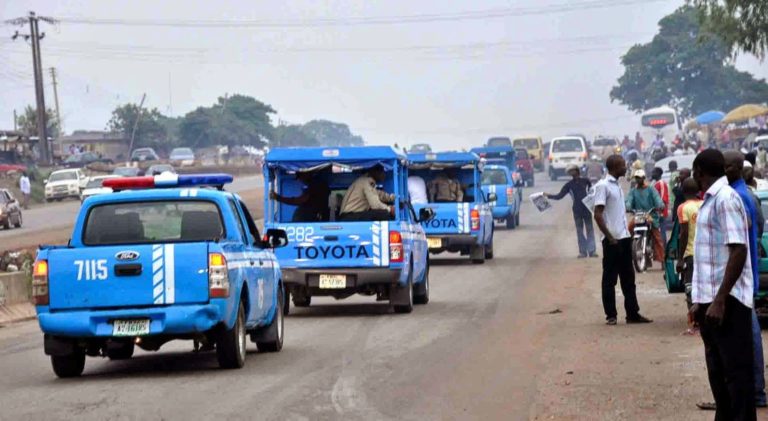
THE Federal Road Safety Corps (FRSC) have confirmed the death of 18 and the survival of 13 people in the fire incident involving a petroleum tanker that happened in Enugu State on Saturday, January 25.
It was confirmed in a statement posted on its X handle on Saturday night and signed by the Assistant Corps Marshal, Corps Public Education Officer, Olusegun Ogungbemide.
It said the crash, which resulted from a break failure, involved 17 vehicles in the category of one petroleum tanker, one water tanker, 15 other cars, and 1 tricycle.
“A total of 31 people were involved in the crash. 10 were rescued with different degrees of injuries while 3 got rescued unharmed.
“Unfortunately, the 18 remaining victims were burnt beyond recognition,” the FRSC confirmed.
According to the statement, preliminary report received by the Corps Marshal, Shehu Mohammed, the tanker which was loaded with premium motor spirit (PMS), otherwise known as petrol, experienced brake failure, and the driver lost grip of the wheels before crashing onto the 17 vehicles leading to a fire outbreak that left 11 vehicles burnt.
“The Executive Governor of Enugu State, Bar. Dr Peter Ndubuisi Mbah, Honourable Commissioners for Transportation and Health, Enugu State Commissioner of Police, FRSC Zonal Commanding Officer in charge of RS9 ENUGU, the Sector Commander Enugu and State Director Department of State Services all participated in the rescue operations,” the FRSC stated.
To ensure ease of movement along that route, the FRSC said traffic has been diverted to the inward Enugu lane. While the evacuation of burnt vehicles is ongoing.
“The Corps Marshal has therefore called on motorists plying the said road to exercise caution and use the alternative routes for safety and ease of vehicular movement while he commiserates with the families of the victims and wishes the injured quick recovery,” it added.
The Enugu tanker incident occurred barely a week after a similar incident in Suleja, Niger State, claimed over 98 lives.
In the Suleja inferno, a tanker carrying 60,000 litres of petrol overturned at Dikko Junction, spilling its contents as residents gathered to scoop fuel and leaving 98 residents killed.
Former vice president Atiku Abubakar has gone to his social media X page to sympathise with the families of the victims.
He said, “Oh dear, not again! My thoughts and prayers are with the families and friends of all the victims of the fuel tanker explosion in Enugu state. May their souls find eternal rest.”
He expressed worries that the incidents of tragic tanker explosions have reached emergency levels, calling on the government to establish an inquiry into this issue.
SUSPENDED speaker of the Lagos State House of Assembly, Mudashiru Obasa, has declared that he remained the speaker despite his replacement by his deputy, Mojisola Meranda.
He further denied the allegations levied against him that led to his suspension, describing the allegations as “fictitious and unsubstantiated.”
He said this on Saturday, January 25, during a welcome rally at his residence in GRA, Ikeja.
“My status in the house? I believe strongly I am still the speaker until the right thing has been done. If you want to remove me, remove me the proper way and I will not contest it.
“I’m a Muslim and I believe in fate. But let’s do it the way it should be done, Obasa said.
On January 13, Obasa who had served for nearly 10 years as the state speaker from June 2015 to January 2025, was suspended by more than two-thirds of the 40-member legislative house over alleged misconduct and sundry offences, The ICIRreported.
Obasa believes he was not immune to suspension but that due process should have been followed.
“I am not afraid of being removed, after all, it is not my father’s chieftaincy title. I am representing my people and they have returned me six times. If you want to do anything, do it well.
“They did the removal all because I was out of the country. Lagos is a special place, we cannot denigrate the state,” the former speaker maintained.
He accused the state commissioner of police of aiding the process of his suspension while he was out of the country.
He asserted further that security agents, led by the police commissioner, invaded the assembly complex and his homes in Agege and Ikeja, locking his family indoors with over 200 officers present.
Dismissing the allegations of misappropriation against him, Obasa mocked the allegation of a gate construction said to have cost N16 billion.
He asked, “Is it the Wall of Jericho?”
Citing the case of a former speaker, Jokotola Pelumi, who was removed, he said, “We did not invite policemen.
“When my sister, former deputy speaker of the house, Hon. Adefunmilayo Tejuosho was removed, we did not invite the police.”
Obasa challenged his critics to provide proof of allegations showing exactly what he had done.
“The Lagos State House of Assembly is above common standard of excellence.
“I appreciate the members of the governance advisory council and Governor Babajide Olusola Sanwo-Olu of the state. He is my brother and he always calls me his younger brother,” he added.
Following his suspension on January 13, his deputy, Meranda, was immediately elected the new speaker.
She became the first female to lead the legislative body of the Lagos state chamber, representing the Apapa 1 constituency.
At the time when Obasa was impeached, The ICIR contacted the former as well as the elected speakers for comments, however, neither of them responded to calls, WhatsApp, and email messages sent to them.
NIGERIAN President Bola Tinubu will, on Sunday, January 26, travel to Dar es Salaam, Tanzania, 2025, to participate in the Africa Heads of State Energy Summit.
The two-day event, scheduled for January 27-28, 2025, is being hosted by the Tanzanian government in collaboration with the African Development Bank Group (AfDB) and the World Bank, according to a statement by the president’s special adviser on information and strategy Bayo Onanuga.
The statement released on Saturday, January 25, noted that the summit is aimed at advancing Mission 300, an initiative to provide electricity access to 300 million Africans by 2030.
It noted that the summit will bring together African leaders, private sector representatives, development partners, and civil society groups to strategise on expanding energy access across the continent.
According to the statement, discussions at the summit will focus on accelerating energy access in underserved regions, renewable energy development, energy efficiency, and fostering private sector investment.
“On the first day, at the ministerial level, participating countries, including Nigeria, will present their national energy strategies, termed compacts, detailing their approaches to achieving universal energy access within five years.
“On the second day, Heads of State will endorse the Dar es Salaam Energy Declaration, outlining a unified roadmap for Africa’s progress towards the Mission 300 objectives,” the statement added.
Meanwhile, Onanuga stated that the president is expected to deliver a national address, reaffirming Nigeria’s commitment to universal energy access and its leadership in the African energy sector.
The President will be accompanied by key officials, including the Minister of State for Foreign Affairs, Ambassador Bianca Odumegwu-Ojukwu; the Minister of Power, Adebayo Adelabu; and the Special Adviser to the President on Energy, Olu Verheijen.
Tinubu is scheduled to return to Abuja following the conclusion of the summit, but the date was not mentioned.
This latest trip is coming a few days after the president returned from the United Arab Emirates, where he participated in the 2025 Abu Dhabi Sustainability Week (ADSW).
The ICIR reported how Tinubu and his vice president, Kashim Shettima, pocketed N1.7 billion respectively as honorariums outside their regular salaries as of September 2024.
This was according to data from GovSpend, a portal tracking the government’s expenditures.
The ICIR findings showed that the N1.7 billion could cover a month’s salary of 24,511 civil servants, based on Nigeria’s national minimum wage of N70,000.
In addition, the president and his vice, including the first lady, have spent N6.8 billion on foreign trips and related expenses this year. The data which was accessed by The ICIR on October 11, 2024, captured money spent by the government till September 15, 2024.
These expenditures were recorded amid nationwide frustration due to economic hardship triggered by President Tinubu’s economic policies, including the removal of fuel subsidies and the unification of exchange rates.
Kwara, which prides itself as a State of Harmony, has long been considered one of Nigeria’s most peaceful places. The ICIR reports how violent attacks have disrupted the tranquillity in the southern part of the state, where armed men now terrorise and force farmers off their lands.
Lukman Balogun welcomed his newborn child in September last year. The night before the naming ceremony, his home was festive, filled with cooking and guests trooping in. He was at his frontage entertaining people when he received a distress call that kidnappers, believed to be herdsmen, had attacked a nearby village in Igbaja, Ifelodun Local Government Area, and abducted three people.
As the leader of the community’s vigilante group, Lukman hurriedly excused himself, entered the room and fetched his gun. His family members, terrified, wished him well as he stepped out of the house. Unfortunately, that was the last time they saw him alive.
Lukman Balogun was killed on the eve of his child naming ceremony. The ICIR/2024.
Lukman was killed in a fierce gunfight with the criminals, leaving his wives widowed and his newborn child fatherless. The joy of the naming ceremony morphed into mourning as his family and the community grappled with the loss. The festive drums fell silent, replaced by the cries of grief in a home that should have been celebrating new life.
“Lukman was more than a brother to me; he raised me. I grew up in his care, and he loved me deeply, just as he loved everyone around him,” said Lukman’s younger brother, Azeez Balogun who described his death as a wound that will never heal.
“Lukman was more than a brother to me; he raised me”, said Azeez Balogun, who lost his brother in an armed attack. The ICIR/2024.
“That day, we had spoken in the morning,” he recalled. “He asked if I was going to the farm, but I told him I needed to work on the car first. When I came home later, I was exhausted and went straight to bed. We didn’t always get to see each other because of his visitors and responsibilities, but that night, they woke me around 10:30 p.m. to tell me he was gone. It felt like the world had ended.”
Muritala Adedayo, a 35-year-old hunter and one of Lukman’s loyal followers, shared his heartbreak, describing the news of his death as devastating, stressing that the late Lukman was his boss and benefactor.
“He didn’t have to go that night,” Muritala expressed his regret. “But it was in his nature to act when his community was in danger. On the eve of his child’s naming ceremony, he stood up to defend others. He was killed during the rescue mission, leaving us all in sorrow.”
Lukman’s death stirred protests by youths in the community some days after. The youths who trooped out in their numbers threatened to pull the community down and accused the cattle herders of perpetrating the heinous crime.
Residents in Igbaja and other villages in the southern part of Kwara State have been living in fear due to a surge in attacks by local terrorists who have transformed the once-peaceful communities into a hub of violence. Despite the state’s reputation as one of Nigeria’s most tranquil states, crime rates have emerged in this region with incidents of kidnapping, murder, assaults, looting, rape, maiming, and extortion, becoming alarmingly frequent.
Located in the North Central region of the country, Kwara shares a long border with the Republic of Benin while it also shares borders with some other Nigerian states. Niger to the north, Kogi to the east, and Ekiti, Osun, and Oyo to the south. These are the five entry points into the state.
The violence plaguing these communities can be categorised into two, based on findings by The ICIR. The first involves attacks allegedly orchestrated by local bandits, whom residents believe have taken refuge in nearby forests following military operations in the north. In other cases, residents accuse the neighbouring “Bororo,” also known as Fulani herdsmen who allegedly raid their farms and cart away their harvests.
While local vigilantes like Lukman were working together to fight back, they were often outnumbered and under-resourced, allowing the kidnappers to continue their reign of terror unchecked. Residents, who had once lived peacefully in these communities say they now feel abandoned by the government, which they believe has failed to address the crisis adequately. Due to the persistent attacks, some of them have relocated to Ilorin, the state’s capital. Despite assurances from the state government, many residents argue that little has been done to protect them.
Farmers at risk
That Abdulmumini Mahmoud is alive today, if you ask him, is nothing short of luck. The 40-year-old farmer and father of four survived two harrowing encounters with armed attackers in 2024.
The first incident happened on a market day after he left Babanla market in Ifelodun local government area of the state. Early in January 2024, Abdulmumini, his car loaded with corn, maize, and soya beans, was driving to a nearby village when he began to hear sporadic gunshots.
Abdulmumini Mahmoud, a 40-year-old farmer and father of four survived two harrowing encounters with armed attackers in 2024. The ICIR/2024.
“When I looked ahead, I saw someone carrying a gun, furiously shooting,” he recalled. “I told those with me that we shouldn’t go further and instead look for an escape route. But we were eventually captured.”
Abdulmumini tried to resist, but the attackers, whom he identified as ethnically Fulani, outnumbered him. They injured him, stole the ₦15,000 he had and carted away his belongings.
“That day, someone had sent us money to buy food at the market, but one of my boys noticed someone following him when he went to collect money from the POS. Not long after, they attacked us around the ‘Ọlọhun-ẹwọ’ area.”
The second attack happened just the night before The ICIR’s visit on November 6. Around 6 p.m., Abdulmumini was ambushed by armed attackers while returning home on his motorcycle.
“Suddenly, I was hit, and the motorcycle fell. They came out and beat me from both sides,” he recounted. “I was begging them in Hausa but they didn’t answer. I struggled to stand up and run away, but they stole my motorcycle and cut my head with a machete.”
The challenges Abdulmumini faces go beyond these attacks. Armed men frequently destroy farms in his area. “Sometimes, they beg afterwards, and we forgive them,” he said, his voice heavy with frustration.
For Abdulmumini, these attacks have been a bitter experience. An indigene of Ilorin, he said struggles brought him to Kwara South. His family had begged him to return home, but he cannot leave his means of livelihood behind.
“I want to urge the government to help us,” he pleaded. “It’s not just me; it’s happening to many of us here. If I’m forced to leave farming, what will my children eat? The government should come to our aid.”
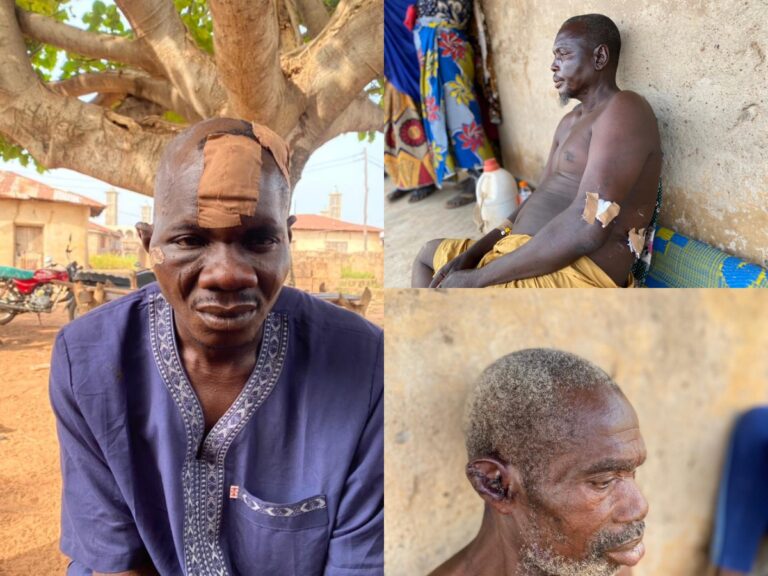
Ibrahim Wakili, a farmer and father of two, still struggles to understand why he was targeted in a brutal night attack that left him with deep wounds and rendered him debilitated.
“It happened around 10 to 11 p.m.,” he recalled. “I saw three of them, but I didn’t drag anything with anyone. I couldn’t see their faces clearly because they flashed light in my eyes.”
The attackers struck while he was asleep. “They hit me with a machete,” he continued, adding, “I tried to protect myself with my hands, but they cut both my back and my hand. They didn’t even steal anything.”
Ibrahim Wakili
Wakili was rushed to safety by midnight, where his family and friends gathered to comfort him. The police have been informed, but the deed had been done and no justice is in sight.
Getting out of hands
Over the past years, banditry has spread extensively across the North-Western states of Zamfara, Katsina, Sokoto, and Kaduna. In response, the Nigerian government has intensified military operations to combat these armed groups, pushing many southward into Niger, Kogi, and the Federal Capital Territory (FCT).
As the violence expands into the North-Central region, Kwara State has begun to feel its effects, with non-state armed groups exploiting ungoverned spaces in the remote areas of the state.
Residents attribute this to bandit groups fleeing military pressure in the North-West, who are now continuing their activities such as kidnapping for ransom and cattle rustling.
Also, Kwara has experienced violent crimes linked to disputes over land and water resources in rural communities and gang clashes in urban areas. The escalating violence in Kwara mirrors patterns seen in other states in the region, with militants Fulani frequently accused of instigating the unrest.
The state is increasingly becoming a target for disparate militant groups, including herdsmen seeking new territories.
According to data gathered from Armed Conflict Location & Event Data(ACCLED) and analysed by The ICIR, the number of violent attacks recorded in the state was very low until 2021 when the state recorded 84 incidents and 45 deaths. Since then, things have not come back to normal for some residents in the volatile parts of the state.
In 2024 alone, the state has recorded 60 incidents and 19 deaths based on the data gathered by the platform as of November 15 which excluded many cases that were not reported.
A 2022 report by SBM Intelligence, an Africa-focused geopolitical research firm, highlighted the worsening security situation in Kwara. The report notes a troubling rise in kidnappings, gang violence, inter-communal conflicts, targeted attacks, cattle rustling, and killings, resembling trends in other North-Central states where Fulani militants are often blamed for escalating violence. It also describes a consistent operational pattern among these militants, replicated across other regions of Nigeria where herder-resident clashes have occurred.
The ICIR’s findings reveal that the security situation in Kwara has persisted, with a surge in terrorist activities. Since the beginning of last year, the state has recorded numerous incidents of attacks, kidnappings, and other violent crimes.
For instance, kidnappers ambushed a group of farmers returning from their fields in Igbaja. Armed men, reportedly linked to herdsmen, opened fire on the farmers before abducting two individuals, demanding a ransom of N5 million for their release. The incident sent shockwaves through the community, causing many farmers to abandon their crops for fear of future attacks.
Similarly, three women, including a pregnant mother, were taken while fetching water from a nearby stream. The kidnappers, who demanded a ransom of N2 million, threatened to harm the women if their demands were not met. The incident left families devastated, and the community rallied to raise funds for the ransom, illustrating the desperation and fear gripping residents.
In August, the town of Ajase-Ipo was shaken by the assassination of a prominent community leader who had been vocal about the rising insecurity. Eyewitnesses reported that armed men invaded his home in the early hours, shooting him in front of his family. This violent act was perceived as a warning to others who might oppose the kidnappers and their activities, causing further anxiety among residents.
These persistent attacks have resulted in widespread panic, with many villagers abandoning their farmlands, fearing for their lives. The insecurity threatens farmers’ livelihoods and risks disrupting the region’s food supply as agricultural activity grinds to a halt.
Findings by The ICIR indicate that many residents have fled the region while farmers have abandoned their crops due to safety concerns.
More victims narrate horrific experience
Abdulqodir Ajia still bears the scars of a brutal attack that has left his family shaken and his livelihood threatened. The 70-year-old and father of eight has spent decades farming yam, maize, corn, and soya on his land, even sharing parts of it with herdsmen to cultivate. But what started as a dispute over stolen farm produce escalated into violence.
Abdulqodir Ajia still bears the scars of a brutal attack that has left his family shaken and his livelihood threatened. The ICIR/2024.
“The incident happened on Thursday midnight, October 31, 2024. Before then, the herdsmen had stolen the yam I planted. We caught them, and their fathers came begging. But I told them I didn’t want begging—I wanted my money. They agreed to pay ₦200,000 and promised to bring it, he said.”
However, the promises turned into betrayal. Just three days later, the same herdsmen returned to steal again. “Four days after, they came to my house around 1 a.m. with cutlasses and macheted me. I was taken to the hospital, and I am much better now. But they attacked me after I had even given them space to farm on my land.”
The attack left Abdulqodir deeply wounded. His youngest son, Salman Adam Ajia, vividly remembers about the assault. “I wasn’t living with them,but around midnight, I got a call that some people had attacked Baba.
“I asked how bad it was, but they couldn’t answer, so I rushed to the hospital with a companion. When I saw him, I was shocked and deeply saddened. His ears and mouth had been macheted,” Salman recalls.
The herdsmen injured Abdulqodir, stole his phone and farm produce, including yam. While the police have visited to gather evidence, Abdulqodir has yet to see any action taken.
Abolarin Job, a 70-year-old farmer and father of eight, has lived through many challenges, but nothing prepared him for the night his son returned home, injured and terrified.
The incident began late in the night when his wife called out to him with a voice filled with trepidation. “She said our son had been attacked, and they had blinded one of his eyes,” Abolarin recalls.
“I rushed inside and found him with a swollen eye. When I called his name, he answered with only one eye open—the other was completely blocked.”
His son, Lawale Abolarin, recounts the terrifying ordeal. He had been sleeping near a Fulani settlement when the attackers struck. “They told him to stand up and demanded the key to his motorcycle,” Abolarin says. “Before he could get to his feet, they hit him hard in the face. He screamed and ran, and the others who were there also fled. When he got home, his eye was swollen, and he was in severe pain.”
The memory of that night continues to haunt Abolarin and his family. “Anytime my children go to the farm, my heart is never at peace. Even at home, we live in constant fear.”
For Abolarin, farming has always been his family’s way of life, but the growing insecurity in the area is threatening their survival. The fear of another attack weighs heavily on him, yet he knows that abandoning their farms would leave them with nothing.
Segun Janafa, the leader of hunters in Idẹra land, Irepodun local government spoke about the situation in his community, where insecurity has reached alarming levels.
“What we are facing these days is terrible and bitter to say. If not that you came and we see you like this, we thought the government intentionally abandoned us for them to kill us all,” Janafa said, referring to the scale of violence faced by the community.
Segun Janafa, the leader of hunters in Idẹra land, Irepodun local government spoke about the situation in his community, where insecurity has reached alarming levels. The ICIR/2024
He lamented the disparity in weaponry between the community’s defenders and the attackers, stressing that the attackers wield powerful guns while the community only has small arms for protection.
“The amount of people they kill these days is alarming. I remember how they lured the Jagun of Igbaja land and killed him. It was painful,” he said. He also spoke about the killing of a community security guard named Shola, further highlighting the toll of the violence.
“These invaders are not from our side. If we complain to the security personnel, they will say we are all Nigerians,” he said.
He also recounted an incident where the police arrested a welder who helped fabricate the guns used by the attackers but later released him. “The police arrested the welder that helped weld the gun, and we were the ones that bailed him with funds,” Janafa revealed.
As a hunter working with other communities, Janafa emphasised the collective efforts of local hunters to safeguard their areas, but he urged the government to do more. “We are hunters from different communities and work together most times, but we need more support,” he said.
Community leaders seek government’s intervention
Several community leaders from Kwara South who spoke with The ICIR raised alarm over the increasing wave of insecurity in their region, primarily due to kidnappers and armed Fulani herdsmen.
The leaders, in separate interviews with The ICIR, highlighted how insecurity has crippled farming activities and led to fear among residents, calling for a stronger government response, including the establishment of security posts in the forested areas that criminals use as hideouts.
The king of Babanla town, Yusuf Aliu Alabi lamented the persistent insecurity in the region and attributed its cause to the vast forested areas as havens for criminals.
Yusuf Aliu Alabi, the king of Babanla town, lamented the persistent insecurity in the region and attributed its cause to the vast forested areas as havens for criminals. The ICIR/2024.
“What is happening is that we had problems with armed attackers around this district and also Fulani herdsmen. What we thought was causing it was that they were being chased from the north and were looking for space to stay. Our place, for example, has a lot of forest, and the Fulani can settle anywhere. The forest can easily serve as their hideout,” he explained.
The monarch recounted that the government had previously deployed soldiers to patrol the forests in an attempt to curb the violence, but once the soldiers left, insecurity returned.
“It has been happening for over five years now. The forest is the problem, and many areas have access to the forest, especially from places like Kogi, Patigi, and others,” he said.
To address this issue, he suggested that the government should consider building an army barracks within the forested areas.
The King of Sagbe land, Isiaka Lawal, shared his community’s struggles with rising insecurity, which has severely impacted local farmers.
he King of Sagbe land, Isiaka Lawal. The ICIR/2024.
“The security issue is a very concerning matter to us. Before, there was nothing like that, but now, the pressing issue has been frustrating us because the farmers can’t go to their farms anymore, and even we that are at home, we are afraid,” Lawal said.
The monarch acknowledged that while the Kwara State government had made efforts to address the security challenges by providing motorcycles, hunters, and local guards for community protection, the measures have proven ineffective.
“Our hunters and security members have small guns compared to the ones the attackers are holding,” he added. Lawal stressed the urgency of government intervention, particularly in addressing the forest areas, which are seen as the hideouts of the criminals. “We need government intervention. How will these people leave this space? The forest is their hideout,” he said, calling for stronger security measures.
The chairman of the Oke Ode c ommunity in Kwara South, Daniel Adeniji, voiced his concerns about the inability of the police to tackle insecurity in the forested areas.
“I don’t think the government remembers we still exist. Police can’t enter the forest; they only guard their office or the highway. They can’t enter the forest, and it is inside the forest where these people are hiding,” Adeniji said.
He also mentioned that even when attackers were captured, they were often released by the police, leaving the community vulnerable.
Hospital where victims of November 2024 attack were admitted in Babanla community.
“Even if we caught the attackers, the police, in some ways, do release them, leaving the person that caught them in trouble after they release them,” Adeniji said.
He expressed deep concern over the continued loss of lives in the community, citing the murder of the Jagun of Igbaja as an example.
“We cried when Jagun of Igbaja died because he was a very good man. They lured him outside and killed him,” he explained.
“What we want the government to do is to secure our forests. The attackers are probably not from Nigeria,” he said.
Adeniji, like the other leaders, emphasised the need for stronger security forces and greater support from the government to restore peace to the area.
What are the authorities doing?
In October, the Kwara State Police c is ommand, led by the police commissioner, Victor Olaiya, convened a high-level strategic security meeting at the Police Officers Mess, GRA, Ilorin, as part of efforts to enhance the state’s security.
The meeting brought together the major stakeholders in the state, comprising the 16 local government chairmen, traditional leaders in various communities, vigilante and hunter leaders in the 16 LGAs, and the SSA Security to the governor of Kwara State, to address the security challenges and enhance coordination across the state.
Speaking at the meeting, the police commissioner addressed the reoccurring incidents of criminal activities in parts of the state and also sought to strengthen the synergy between various local security outfits.
Olaiya emphasised the importance of collaboration among the Vigilante Group of Nigeria, VGN, local hunters, the Miyetti Allah and Gaa Allah, stressing that unified efforts are key to safeguarding communities from criminal elements.
He further urged security operatives to remain honest and vigilant, warning them against conniving with kidnappers or becoming complicit in criminal activities within their communities.
The police commissioner beckoned on the local government chairmen to enhance security operations in their areas by ensuring that recruitment into the various security groups is conducted thoroughly.
“Background checks should be performed to ensure that new recruits have no criminal history. Once this careful selection process is completed, the Kwara State Police command will organise specialised training sessions to better equip the recruits to carry out their duties effectively.”
The ICIR contacted the spokesperson of the Kwara state police command, Ejire Adeyemi Toun, she asked this reporter to send questions as texts. However, she had not responded as of the press time despite reading the message.
Meanwhile, speaking with The ICIR, the Chief Press Secretary to Governor Abdulrahman Abdulrazaq, Rafiu Ajakaye explained that the state government continues to work with all stakeholders, especially traditional rulers, security agencies, local vigilantes, and community leaders, to roll back the security breaches in part of the region.
“This has recorded appreciable success, even as more efforts are being put in place,” he said, adding that, “The government has well-funded security initiatives to check the activities of some criminals who take advantage of the developments in parts of the country to hibernate in our local forests and engage in criminal activities.”
“These security initiatives, such as raids and show of force operations, have succeeded in pushing back the criminal elements. For instance, the government has standby military Forward Operations Bases (FOBs) in Kaiama, Ifelodun, Ekiti, and Patigi.”
Ajakaye added that there are policing initiatives deployed in different parts of the state and fully funded by the government.
“Besides other community-based initiatives, each local government has been directed to form vigilante groups to neutralise such threats, and they are doing great already.”
He said the state government is also supporting the permanent stationing of anti-kidnapping squads in the region and standby tactical teams for prompt response to critical security issues.
“There is also the Nigeria Air Force reconnaissance surveillance operations to ascertain features of security interest,” he added.
“There are also at least 200 local hunters who are being mobilised for specific operations in Baruten and Kaiama.”
He urged the residents to furnish security agencies with adequate and actionable information from time to time.
“The state government is fully funding these security operations, apart from other commitments that we may not discuss in this space,” he concluded.
Way forward
Speaking with The ICIR, Gbemisola Animasawun, a professor at the Centre for Peace and Strategic Studies, University of Ilorin, highlighted the need to examine the root causes of violence in Kwara South.
“So, are we now having a kind of spillover effect of insecurity from other places, or criminals from other areas in and out to perpetrate evil and flee? We need to ask ourselves what factors are responsible for the upsurge in this kind of environment,” he said.
He added that environmental factors, state incompetence, or neglect might be contributors.
Animasawun emphasised that Nigeria is fundamentally under-policed, noting that insecurity in rural and hard-to-reach areas manifests as banditry, kidnappings, and abductions.
Gbemisola Animasawun
“This is because the further you move away from the state capital, the weaker the state becomes, thereby yielding grounds for alternative sovereigns or criminally governed spaces inaccurately described as ungoverned spaces,” he explained.
He pointed out that limited state presence is evident in the concentration of policing infrastructure in urban centres, leaving rural areas vulnerable. “Even when distress calls are made, these communities are hard to reach. Where such a situation exists, criminality thrives.”
In the specific case of Kwara South, Animasawun attributed the insecurity to the proximity of forest reserves and the state’s neglect of these areas, which have become havens for criminals. “For example, people are kidnapped in these areas and moved across states like Ekiti, Ondo, Kwara, Kogi, and Edo through these forests,” he said.
He warned that the implications for development and citizens’ well-being are severe. “When there is no security, neither the government nor the people can prosper,” he said, adding that rural security is essential for enhancing food security and attracting foreign direct investment.
While local vigilantes are making efforts to address the insecurity, Animasawun noted their limitations, particularly in firepower and the legal inability to bear arms.
He expressed optimism about the federal government’s commitment to state policing, citing the complementary relationship between the Police and Amotekun in the Southwest as a model.
“With sub-national or plural policing, personnel can be trained and deployed based on informed evaluations of security needs,” he said.
He urged the government to implement confidence-building measures, improve intelligence-sharing mechanisms, and enhance logistical support for rapid responses to distress calls. He also called for functional security cooperation among states with shared borders to tackle cross-border criminal activities effectively.
On her part, a security analyst with SBM Intelligence, Antoinette Onyekwelu, said the security situation causes disruption to the daily lives of the citizens, particularly for rural residents who are losing access to farms, businesses, schools, and healthcare, which she noted is worsening poverty and social dislocation.
Onyekwelu emphasised the psychological toll on communities, stating that living under constant threat erodes trust and social cohesion.
“For the state, this growing instability erodes governance and economic prospects, deterring investment and creating a climate of uncertainty. Security agencies operating in Kwara face increased pressure, stretching already limited resources,” he said.
“Many residents, particularly those in rural areas, are losing access to their farms, businesses, schools, and healthcare,” she said, adding that this has deepened economic hardship.
Onyekwelu attributed the rise in violence partly to Kwara State’s geographical location and its proximity to conflict-prone zones, which she said makes it a transit and haven for criminal groups fleeing intensified security operations in other regions.
“Its rural and forested areas offer ideal hideouts for bandits and insurgents, while porous borders facilitate the unchecked movement of arms and illegal activities,” she noted.
She recommended enhancing border security through surveillance technologies, establishing well-equipped checkpoints, and promoting intelligence-sharing networks between Kwara and neighbouring states.
“Investing in community-based security initiatives, such as training and integrating vigilante groups into formal structures, can strengthen local defences,” she said. adding that addressing the root causes of insecurity like poverty and unemployment would help mitigate the problem.
“There should be a surge in security forces to key hotspots and intelligence-led operations to dismantle criminal networks,” she said.
She further urged investments in education, healthcare, and job opportunities in rural areas, alongside regional collaboration for better intelligence sharing, to create sustainable peace and prevent recurring violence.
A Facebook page, Don Pom Polye, has published a sponsored post featuring an image purportedly showing a popular Nigerian TV host, Kadaria Ahmed, in handcuffs.
The image was placed on a fake Vanguard newspaper webpage with a headline that reads:
“Kadaria Ahmed didn’t know the microphone was on. We say goodbye to him forever. This is a sad day for all of Nigeria.”
The post has generated over 3,700 likes and some comments as of January 22, 2025.
However, upon clicking the attached link, it redirected to a different webpage with a headline that read thus:
“Central Bank of Nigeria sues Kadaria Ahmed over statements she made on live television.”
This suggested an alleged legal dispute between the renowned media personality and Nigeria’s central bank.
CLAIM
Vanguard’s report says Central Bank of Nigeria sues Kadaria Ahmed.
THE FINDINGS
Findings by The FactCheckHub show that the claim is FALSE, as the report is a phishing article advertising a ponzi scheme.
First, the original Vanguard website places its logo at the top-left corner of the page layout, whereas the fake link positioned the logo at the top centre.
Additionally, the authentic Vanguard website includes features such as the publication date, a “News” section, and social media account links on the left-hand side of the page, while the right-hand side displays the latest news updates. These features were notably absent on the fake webpage.
A look at the fake webpage’s content showed that it misrepresented Ahmed, portraying her as endorsing a trading platform called PrimeAuroraPlatform. When users clicked the Vanguard logo on the fake webpage, it redirected them to the platform, further proving it was a phishing scam which The FactCheckHub has debunked over the years aimed at harvesting people’s details to carry out phishing attacks.
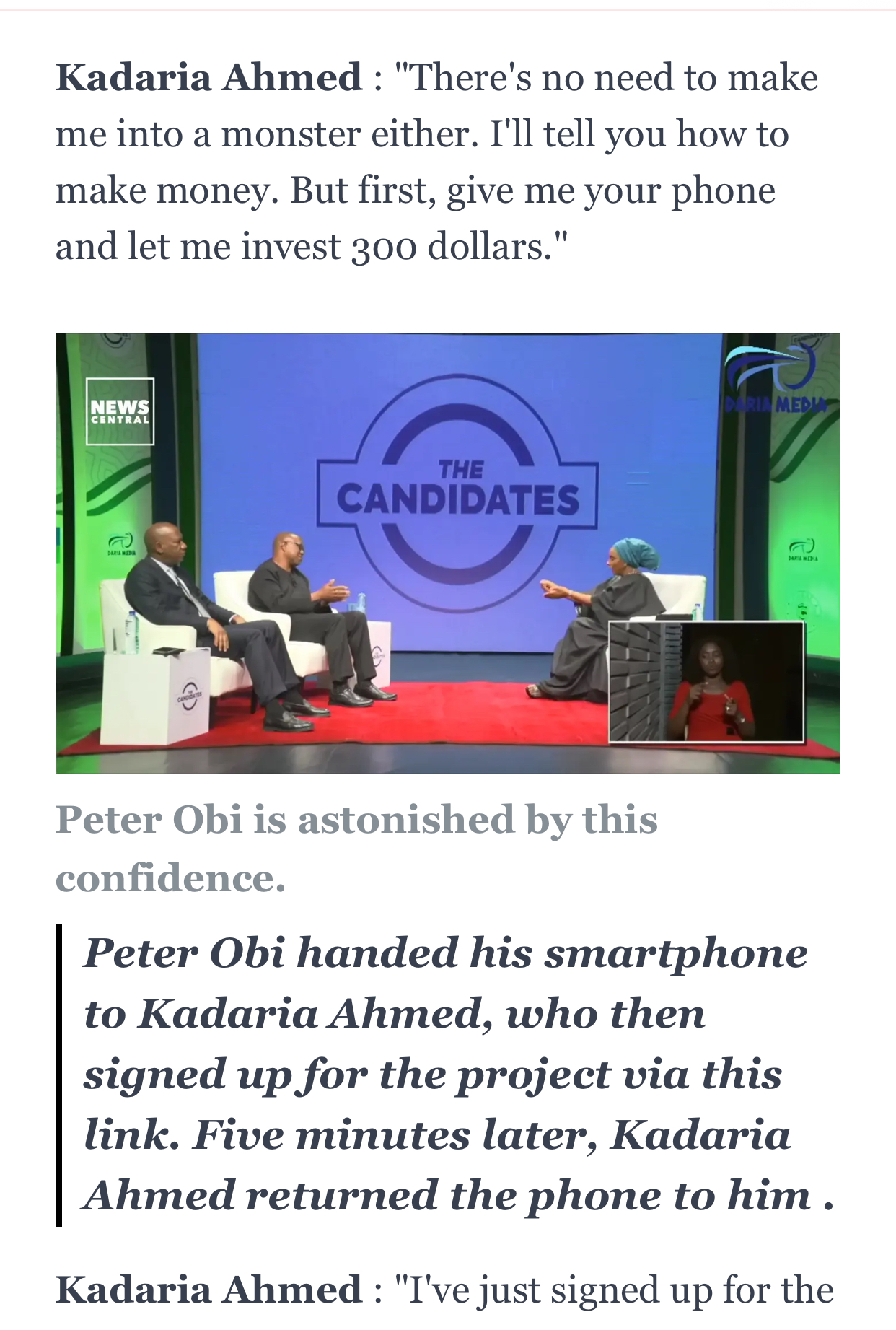
Post purportedly showing Peter Obi endorsing the fake ponzi platform.
The website frequently displays fabricated interviews between Kadaria Ahmed and public figures such as Peter Obi, the 2023 Labour Party’s presidential candidate; Rabiu Kwankwaso, former governor of Kano State and others where they purportedly endorsed the platform.
However, Vanguard newspaper has urged people to avoid the platform.
Further findings by The FactCheckHub show that many Nigerian public figures such as TV host, Seun Okinbaloye, have been used to lure people to invest in this Ponzi scheme.
The FactCheckHub also searched the Central Bank of Nigeria’s (CBN) website and credible media reports for any record of litigation involving Kadaria Ahmed but found none.
Similarly, a review of Vanguard and other credible news platforms yielded no evidence of the alleged incident, thus showing that the story is a mere attempt to lure people into investing on the ponzi platform.
Recall that the FIJ had in December 2024 published a similar fact-check which showed one Arcane Trade used Kadaria Ahmed’s name and photos in a fraudulent online advert.
Earlier in September, CDD Fact-check also published a fact-check on the same claim falsely attributed to Vanguard newspaper.
THE VERDICT
The claim that Nigeria’s central bank is suing Kadaria Ahmed is FALSE. The interview is fake, and the claim is a mischievous attempt to promote a phoney trading platform named PrimeAuroraPlatform.
THE Kano State Government has rejected a recent terror alert issued by the Nigeria Police Force (NPF), alleging it is part of a plot to disrupt religious gatherings in the state.
The state’s commissioner for information and internal affairs, Ibrahim Waiya, expressed this position during a press briefing at the Emir’s Palace on Friday, January 24.
Waiya criticised the deployment of security operatives to the venue of the National Tijjaniyya Maulud at Kofar Mata Stadium.
He described the move as unnecessary and baseless, stressing that there is no credible security threat in the state.
“Kano State, as a historical centre of Islamic scholarship and religious harmony, remains committed to upholding and supporting activities that promote peace, unity, and spiritual growth.
“This action is not only unnecessary but also unjustified, as there has been no report of any security threat in Kano State that would warrant such an extreme measure. The presence of security operatives at the venue of this significant religious activity is unwarranted and unacceptable,” the commissioner said.
Waiya further reaffirmed the state’s commitment to peaceful religious activities, vowing that the event will go as planned.
“The National Tijjaniyya Maulud will be held as planned from 8:00 am at Kofar Mata Stadium. This religious gathering is organised by a legitimately registered and recognised body, and any attempt to obstruct it would be a violation of the citizens’ right to lawful assembly and religious practice in Nigeria.”
While calling on the federal government to withdraw its security forces from the venue, he insisted that any disruption to the gathering would infringe on the rights of citizens to assemble and practice their religion.
The ICIR reports that the Kano State Police Command had raised concerns about potential terror threats in the state.
In a statement on Friday, the command’s public relations officer, Abdullahi Haruna, urged residents to exercise caution and avoid crowded places, citing intelligence reports of suspected terrorists planning attacks.
“The Kano State Police Command, in liaison with other security agencies, has received intelligence reports of suspected terrorists planning to launch attacks on public gatherings in strategic locations within Kano State.
“In response, we hereby urge residents to exercise caution and avoid crowded places and environments until further notice as a preventive measure to enable security operatives to identify and dislodge possible attackers,” Abdullahi said.
He also assured the public that necessary security arrangements had been put in place, with specialised teams deployed to critical areas.
THE Chief of Defence Staff, General Christopher Musa, has said that the power of notorious terrorist leader, Bello Turji, had been significantly weakened, following a recent military onslaught on his foot soldiers.
Musa disclosed this during an interview on Channels Television’s ‘Politics Today’ on Friday, January 25, where he discussed ongoing military efforts against terrorists in Northern Nigeria.
The CDS explained that the military had neutralised key figures within Turji’s network, leaving him increasingly isolated.
He noted that the sustained offensive has left Turji with limited options.
“I can tell you that, we have taken out his second in command, we have taken out most of his lieutenants he is forced now to release most of the people under him.
“I am telling you that recently, he is beginning to say that he doesn’t want anything, he is ready to surrender. We want to take everybody out. Anybody who has killed people should go” he added.
On Wednesday, January 22, the Nigerian Military disclosed that troops of Operation Fansan Yamma neutralised the Turji’s second in command Aminu Kanawa.
According to a statement by the Defence Spokesperson, Edward Buba, the troops also inflicted terminal injuries on some of Turji’s close allies identified as Dosso (Bello Turji’s younger brother) and Danbokolo (one of Turji’s closest allies).
The statement further revealed that the troops eliminated several of Bello Turji’s top commanders, including Abu Dan Shehu, Jabbi Dogo, Dan Kane, Basiru Yellow, Kabiru Gebe, Bello Buba, and Dan Inna Kahon-Saniya-Yafi-Bahaushe, among others
Turji, one of the most prominent terrorist leaders in the Northwest, has been linked to numerous kidnappings, violent attacks, and killings across the region.
However, the CDS acknowledged the success of military operations in undermining his operations and weakening his influence.
Commenting on challenges faced by the military in tackling insecurity, Musa said terrorists operating in the Northwest rely on difficult terrain and community ties to evade security forces.
“Northwest is over 200,000 square kilometres, it’s a massive area with a large forest area. Once they go under the forest, it’s difficult to take them out.
He explained that terrorists often blend into communities, making it harder for security operatives to act swiftly.
“They (terrorists) are within the communities; the people know them. So, sometimes when they see them, before you get the information, it’s like two hours – the man has moved. So, when the information gets to you before you move, he has left that area” he said.
When asked about the terrorist funder, Musa stressed that criminal activities such as kidnapping and robbery provide a significant source of revenue but hinted at external support.
“Sometimes they got funding from kidnapping, robbery, and all these things they do. But again we can’t rule out…like I told you in the northeast, when we arrested some of them, they had hard currency to change. How did they get those monies?”
He reaffirmed the military’s commitment to eliminating all terrorist threats in the region and holding perpetrators accountable.
Musa said the Nigerian military is determined to eradicate any group or individual involved in killing innocent people.
The ICIR also reported that troops from Sector 2 of the Joint Task Force North-West, Operation Fansan Yamma, have last December, arrested a 25-year-old suspected female ammunition courier, Shamsiyya Ahadu.
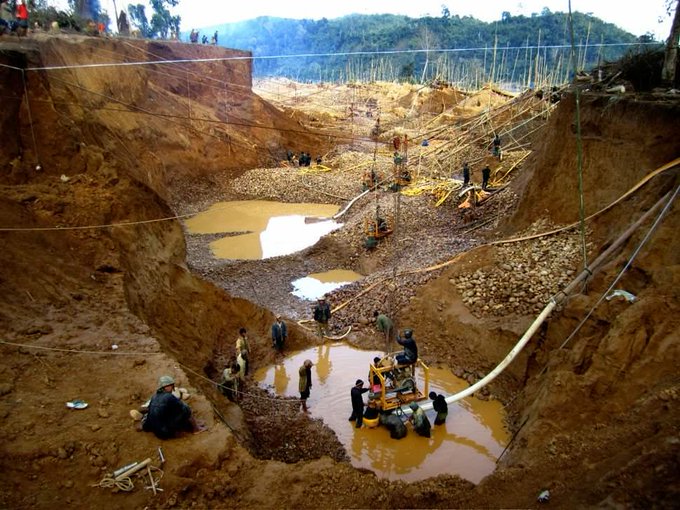
THE Chairman Senate Committee on Interior, Adams Oshiomhole, has alleged that some retired military generals might be responsible for illegal mining activities across Nigeria.
He made the allegation during a budget presentation by the senate committee chairman on Solid Minerals Development, Sampson Ekong, to the committee on appropriation.
“The ongoing illegal mining across the country is being carried out by retired generals, and we know them. They use helicopters to cart away gold, making billions of dollars, while the country suffers,” he said with naming names.
Oshiomhole, a senator from Edo North senatorial district, expressed frustration with the federal government’s inaction to deal decisively with the menace which continues to undermine the country’s efforts to diversify its economy.
He, therefore called on President Bola Tinubu to address the alleged illegal mining activities by the military generals.
He stressed that the situation compares to the government’s robust measures against illegal oil bunkering in the Niger Delta, urging similar enforcement in the mining sector.
He hinted that during his tenure as national chairman of the All Progressives Congress (APC), he wrote to former President Muhammadu Buhari about the situation.
Oshiomhole said he detailed how illegal miners arm local groups and use sophisticated equipment to exploit resources.
“This issue has been left unchecked for too long. We have the data and surveys showing where these activities are happening. It’s time for the government to deploy Joint Task Forces, just as it has done in tackling oil theft,” the former Edo State governor and labour leader added.
Meanwhile, Ekong presented his committee’s recommendation for the Ministry of Solid Minerals Development’s 2025 budget.
It showed that the committee proposed an increase from the N9 billion capital vote initially allocated by the executive to N539 billion.
In one of its reports, it documented how the Civil Society Coalition on Nigeria’s Mining Sector had called on the federal government to prosecute sponsors of illegal mining in the country and stop giving them preferential treatment.