PRESIDENT Donald Trump’s decision to halt U.S. foreign aid funding for 90 days has sparked global concerns, particularly for life-saving health programmes like the President’s Emergency Plan for AIDS Relief (PEPFAR).
The funding freeze puts millions of people, including Nigerian HIV patients, at immediate risk, with fears of treatment disruption and possible deterioration of the health of people with the virus.
The PEPFAR, established in 2003 under former President George W. Bush, provides antiretroviral therapy (ART) for over 20.6 million people worldwide. Its interventions also help to prevent mother-to-child transmission of HIV and have saved an estimated 26 million lives.
Nigeria, one of the countries most reliant on the programme, faces severe crises if the pause continues.
The ICIR reports that Nigeria bears the heaviest HIV burden in Sub-Saharan Africa, with over about two million people living with HIV in the country. In 2020 alone, AIDS-related deaths in Nigeria were estimated at approximately 49,000 across all age groups.
The National Agency for the Control of AIDS (NACA), Nigeria’s contribution to HIV fight is less than 20 per cent of its required funding.
According to the World Health Organization, WHO, an estimated 39.9 million people lived with HIV at the end of 2023.
The agency noted that 65 per cent of these people were in the WHO African Region. In the same year, about 630,000 people died from HIV-related causes and an estimated 1.3 million people acquired the virus.
While there is no cure for HIV infection, access to effective HIV prevention, diagnosis, treatment and care, including for opportunistic infections, has made HIV infection a manageable chronic health condition and enabled people living with HIV to lead long and healthy lives.
The funding freeze stemmed from an executive order signed by Trump on January 20, 2025, directing a review of all foreign aid programmes to align with his “America First” policy.
According to a report the State Department spokesperson, Tammy Bruce, stated that “Consistent with President Trump’s executive order on reevaluating and realigning United States foreign aid, Secretary Marco Rubio has paused all U.S. foreign assistance funded by or through the State Department and U.S. Agency for International Development (USAID) for review,”
He added that Trump “is initiating a review of all foreign assistance programmes to ensure they are efficient and consistent with U.S. foreign policy under the America First agenda.”
According to NPR, while PEPFAR, funded solely by the U.S. government with a $6.5 billion annual budget, was not specifically mentioned in the announcement, a source at USAID confirmed that the stop-work order applies “100 per cent to PEPFAR.”
It, however, noted that the State Department, on Sunday, January 26, confirmed the halt in an email to NPR, stating that the United States “is no longer going to blindly dole out money with no return for the American people.
The freeze has also been projected to impact USAID staff, with many contractors at risk of losing their jobs during the review.
“This is a matter of life or death,” warned Beatriz Grinsztejn, president of the International AIDS Society (IAS). “PEPFAR provides lifesaving antiretrovirals for more than 20 million people – and stopping its funding essentially stops their HIV treatment. If that happens, people are going to die and HIV will resurge.
“It makes no sense to suddenly stop this incredible catalyst of our global progress towards ending HIV as a threat to public health and individual well-being.”
FORMER Vice President Atiku Abubakar and former Kaduna State Governor Nasir El-Rufai have raised alarm over what they described as a growing threat to Nigeria’s democracy.
Speaking at a national conference on strengthening democracy in Abuja on Monday, January 27, the leaders warned that if urgent action was not taken, the country could lose its hard-fought democracy.
Abubakar highlighted the erosion of democratic values, arguing that Nigeria was at a crossroads.
He criticised the growing influence of the judiciary in determining electoral outcomes, arguing that the courts, not the people, decided candidates and winners.
“We really are at a crossroads in this democratic experiment. We either decide we want to be democratic or we decide to abandon it,” he said.
Abubakar also expressed frustration with the National Assembly, calling for legislative reforms to empower political parties and ensure the people determine who governs them.
He further accused the Federal Government of undermining opposition parties through financial inducements, adding that some political party leaders were given N50 million each.
“I want to say it here publicly. I met with a political party leadership in the present opposition, and they told me flatly that this government gives them N50 million each.
“Where do we go from here? This means that if we are not careful, we are talking to some of you here, but you are recipients of the N50 million from the APC government.
“Do we really want to fight for democracy? If we don’t, we all go back to our homes. But if we do, I have been in this struggle for over 30 years, an attempt was made on my life, and I escaped. I went into exile, but I never gave up. My businesses were taken over, and I am still surviving. So, you need to make up your mind. I am not doing it for myself. For me, I have lived my life. I am doing it because of you,” the former PDP presidential candidate said.
On his part, El-Rufai said he shared similar concerns with Atiku, describing the current situation in the country as a “national emergency.”
He warned that the opposition risks extinction unless it unites.
“The way and manner opposition political parties are being targeted for destruction and the style and quality of governance in this country today is a national emergency. It should concern everyone. And I think this is a problem for all of us to think about and play a role in changing it because, as His Excellency (Abubakar) said, we stand the risk of losing democracy itself,” he said.
El-Rufai cited alarming voter apathy, referencing a poll that indicated 75 per cent of registered voters do not intend to participate in the 2027 elections.
He called on opposition parties to form a united platform to challenge the ruling party and save the nation’s democracy.
“We know what it is, and we don’t want a military rule, but we also don’t want civilians behaving like the military in their ‘babarriga‘ and suits. So, this is a national emergency,” he warned.
The former Kaduna state governor further claimed that there was a deliberate effort to destroy parties like the People’s Democratic Party (PDP) and the Labour Party (LP).
He urged opposition leaders to prioritise internal democracy and adopt stricter standards for party delegates and candidates.
“The problems are still there. However, I no longer believe that my party believes in confronting those problems. So, the distance between me and APC is widening, but I remain where I am because these problems remain the living problems of Nigerians and they have to be addressed. The only way to address them is through the instrumentality of the political parties,” he added.
THE Central Bank of Nigeria (CBN) has asked participants in the foreign exchange market to submit compliance reports to the Nigeria FX Code on or by January 31.
The directive is contained in the FX Code document it released on Monday, January, 27.
It stated, “Market Participants will be required to conduct a self-assessment and submit to the CBN a report on the institution’s level of compliance with the FX Code by January 31, 2025.
“All Market Participants will thereafter be required to submit to CBN a detailed compliance implementation plan that is approved and signed by its Board along with the extracts of the Board meeting.”
The apex bank had on Wednesday, January 22 approved the release of the FX code to promote market participation and ethical conduct in the Nigerian FX market, The ICIR reported.
The code is also intended to offer clearer directives on the expectations for market participants and ensure that the market operates fairly and transparently.
It is to be formally launched at the CBN Head Office Auditorium in Abuja on Tuesday, January 28.
In the document released on Monday, CBN reiterated that its directive is part of efforts to strengthen ethical practices, governance, and transparency in the market.
The FX Code, which became effective on December 2, 2024, sets out principles of good practice to ensure a robust, fair, and transparent foreign exchange market.
It applies to authorised dealers licensed under the CBN Act of 2007, the Bank and Other Financial Institutions Act of 2020, and other entities engaged in wholesale FX business in Nigeria, the apex bank stated.
It further mandated market participants to conduct a self-assessment and submit detailed reports on their level of compliance with the FX Code.
It said the reports must be endorsed by their bank’s board of directors and include an implementation plan for addressing any gaps in compliance.
Part of the directives also is that market participants will be required to file quarterly compliance reports with the Financial Markets Department of the apex bank.
The reports are to be submitted within 14 days after the end of each calendar quarter, starting from March this year.
To ensure adherence to the code, CBN outlined enforcement mechanisms, including monetary penalties as provided under the CBN Act of 2007 and the BOFIA Act of 2020.
The measures are designed to address any non-compliance and to promote integrity in the foreign exchange market.
The code is modelled on the Global FX Code and incorporates global best practices while addressing the specific dynamics of the Nigerian FX market.
It covers key areas such as ethics, governance, execution, information sharing, risk management, and settlement processes.
It expects market participants to maintain high ethical standards, establish sound governance structures, handle transactions fairly, protect confidential information, and implement robust risk management frameworks.
A FORMER African Action Congress presidential candidate, Omoyele Sowore, said he rejected a stringent bail condition offered to him by the Nigeria Police Force (NPF) on Monday, January 27.
The NPF had invited Sowore to its headquarters in Abuja following his confrontation with some of its officers on the Lagos Airport Road.
The police said the invitation, dated January 23, 2025, was in connection with allegations of “resisting and obstructing public officers, disobedience to lawful order, acts intended to cause grievous harm or prevent arrest, compelling action by intimidation, reckless and negligent acts, refusal to assist public servant, and cyberstalking.”
The invitation letter, signed by Ibitoye Rufus Alajide, requested Sowore to report to the Force Intelligence Department (FID) at 10 a.m. on January 27.
But in a tweet on his X handle, hours after he honoured the invitation, the activist said the NPF requested that he deposit his international passport and provide a level 17 civil servant as a guarantor for bail.
He said he rejected the conditions and opted to remain in police custody.
“I have rejected a bail condition asking me to present a level 17 permanent secretary. Instead, I have offered to remain in police custody pending when the joke is over,” he posted.
The ICIR reports that the police action followed a video posted by Sowore on January 9, in which he confronted some officers for blocking the Airport Road.
In the video, some gun-wielding policemen directed the vehicle conveying Sowore to park.
The activist declined the order and said it was wrong for the police to block an airport road.
“We are not parking. You are not supposed to be here. We are not parking. You are not supposed to be causing traffic on the Airport Road. We are not parking. Go and bring your Oga. You people should calm down.”
However, despite Sowore’s objections, the officers stood in front of his car, demanding he park, but the activist refused and insisted they clear the road.
Eventually, one of the officers standing by the roadside instructed his colleagues to let him proceed.
The activist is known for his outspokenness on governance and social justice through his #RevolutionNow movement.
BANDITS attacked the Chikakore community in Kubwa, Abuja, on Sunday, January 26, and abducted five residents.
According to Vanguard, police sources said the bandits raided the Health Centre extension area of Chikakore at around 11 pm, abducting a family of four, including one Adesiyan Akinropo, his wife, their son, and a person who visited them. A neighbour to the abducted family was also whisked away.
Reports say a woman was brutally hit with a gun butt during the attack, leading to a severe head injury that left her bleeding profusely, and she had to be rushed to the hospital for treatment.
By the time police operatives from the Byzahin Division arrived at the scene, the bandits had escaped with their hostages.
The FCT Police Command confirmed the incident in a statement through its spokesperson, Josephine Adeh, a superintendent of police.
Adeh said the command received a distress call from the community at about 1:00 am on Monday, January 28, and promptly deployed its operatives to the area.
“Preliminary investigations revealed that seven unknown men, disguised as vigilante members and armed with machetes and sticks, attacked the residence of the victim. The suspects deceived him into opening his gate, after which they abducted him and three members of his family. A neighbour who attempted to intervene sustained injuries during the attack and was promptly rushed to Kubwa General Hospital for medical attention.
“The FCT Police Command has commenced a comprehensive search and rescue operation aimed at securing the safe recovery of the abducted victims and apprehending the perpetrators of this criminal act.”
It urged the public to help with any useful information that could help to apprehend the abductors.
The ICIR reports that the incident is just one of several recent attacks in the area, including a similar kidnapping in neighbouring Bwari town where police officers were injured.
Kidnapping for ransom in Nigeria, including the FCT, has been a major problem, with kidnappers targeting highways and apartments and even snatching pupils from schools.
In January 2024, the abduction of five young Nigerian sisters in Bwari sparked a national outcry and raised fears about insecurity in the country’s capital.
According to a family member, the sisters were kidnapped by armed men who burst into their home.
The attackers later killed one of the sisters, 21-year-old Nabeeha Al-Kadriyar, after they failed to meet the ransom deadline.
The FCT police commissioner, Olatunji Disu, said the command dealt with a significant number of crimes, including 104 kidnappings and 268 armed robberies in the nation’s capital in 2024.
Disu said this while addressing journalists in Abuja on Wednesday, January 1, 2025.
The CP said 216 kidnapping and 132 armed robbery suspects were arrested during the year.
DESPITE billions of naira spent on the reconstruction of federal highways across the country, many of the projects have either been stalled or abandoned. Ironically, authorities have failed to hold to account contractors or the supervising ministries. Investigation reveals that one of such projects, the Nung Udoe-Etinan-Ekom Iman Federal Highway in Akwa Ibom State, has remained a pipe dream for over a decade, even though the Federal Government claims it has been 100 per cent completed.
In the morning of April 13, 2022, a 33-year-old sculptor and designer from Mbak Ekpe in Ibesikpo Asutan Local Government Area of Akwa Ibom State, Akaninyene Eyo, woke up like every other day with high hopes. He prepared to go out in search of his daily bread without the faintest inkling of what lay ahead. As he rode on his motorcycle to work, tragedy struck along the Nung Udoe-Etinan-Ekom Iman Federal Highway.
An approaching vehicle, attempting to dodge potholes on the road swerved out of its lane and knocked down Eyo. His motorcycle was badly crushed. But that was the least of the damage from the accident. Eyo was left soaked in a pool of blood and gasping for breath. Although the car which hit him drove off immediately, he was rushed by good Samaritans to the Federal Teaching Hospital in the state capital, Uyo.
After he was stabilised and his wounds attended to, Eyo woke up to confront other serious injuries that he would have to deal with for the rest of his life. The accident had left him with a broken his arm and leg. He was informed that the nerves on this part of the body had been seriously damaged and would take time to heal.
Since then, Eyo had been bedridden, unable to walk or use his right arm despite treatment at a government owned hospital, including other private hospitals.
His brother, Innocent Eyo, recalls that his treatment had gulped up to N3.9 million as the family was forced to sell off their piggery, and plots of lands to save him.
“I even had to withdraw my four children from a private school to public school just to have money to take care of him. He is my only sibling,” he said.
Innocent Eyo pointing to the piggery farm they sold to save Eyo.
Eyo only returned home in September 2024 after spending 30 months receiving treatment even though one of his legs remained swollen and twisted, depriving him of standing on his feets beyond a few minutes.
“I cannot work because of my condition. I am now a burden to others, and my life ambitions are all buried. But I still thank God for my life because I am aware of at least five people who died instantly due to similar accidents on the Nung Udoe-Etinan Road,” he said with tears dripping down his cheeks.
Eyo showing his swollen leg
During a visit to a private orthopedic hospital, called Efi-Ekpaha Bone Specialist Hospital, along the highway, there were several survivors of accidents. Six victims who were receiving treatment either due to fractured legs or arms were sighted among them. Some blamed their accidents on the Nung Udoe -Etinan- Ekom Iman Highway.
The head of the hospital, Aniefiok Ekpaha, said in 2024 alone, he treated 16 accident victims from the highway. He noted that there was consistent inflow of victims during the rainy season when the ditches and potholes became multiplied.
Signpost of the orthopaedic hospital
A death trap
Eyo and others who recounted their close encounters with death on the Nung Udoe -Etinan Highway were among the lucky ones who survived. Several others were not so fortunate.
On the evening of October 2, 2024, a 45-year-old man from Mbak Ekpe, Aniedi Udonnwa, while taking a walk along the road to a meeting, was hit by a speeding vehicle. The accident occurred as the vehicle attempted to dodge a pothole and lost control, hitting Udonnwa. He died, leaving behind two teenage daughters that have become orphans as they lost their mother eight years earlier.
A family member pointing to the grave of a deceased.
Also, Mary Udoh, a pregnant woman from Afaha Offiong, which is along the Nung Udoe-Etinan highway, did not survive to tell her story. In June 2023, on her way from the farm directly at the market where she went to sell produce to take care of her family, a vehicle knocked her down from behind. It was trying to avoid a ditch around Afaha Offiong roundabout along the highway.
Insight into FG reconstruction contract award
In December 2013, the Federal Executive Council (FEC), awarded the contract for the reconstruction of the Nung Udoe-Etinan-Ekom Iman Federal Highway in Akwa Ibom State to Mothercat Limited. According to a Freedom of Information Act (FOIA) request response by the Federal Ministry of Works, Akwa Ibom State office, the commencement date of the project was January 30, 2014.
The project, which cuts across three local government areas, namely Ibesikpo Asutan, Nsit Ibom and Etinan, is 33.5km long, and 7.3m wide.
According to the information on the job, as contained in the contract document, the contract was awarded at N2.38 billion and the contractor was expected to clear the existing road, carry out earthworks, improve pavement, provide 200mm lateritic sub-base on the carriageway and shoulders, provide 200mm crushed rock base, provide prime coat on carriageway and shoulders and provide surface dressing on shoulders (2.75m on each side).
Others include provision of 60mm asphaltic concrete binder course and tack coat, provision of 40mm asphaltic concrete wearing course, provision of culverts and concrete lined drains, provision of kerbs along high embankments as directed, and construction of 1 No.30m (2X15m span) bridge.
Project abandoned five years after contract award
The FOI response by the Principal Civil Engineer, Madaki Illyasu, on behalf of the Controller of Works, Federal Ministry of Works, Akwa Ibom State office shows that the project was to commence on January 30, 2014 with a 14-month duration to be completed on April 29, 2015.
The FOI response revealed that the contract was further extended for 38 months with a completion date of June 30, 2018. Again, the project was not not executed. According to the Federal Ministry of Works, the contract deadline was extended by the ministry for Mothercat for another 18 months with a completion date slated for December 30, 2020.
It was only in 2019 that the contractor mobilised to site for the construction of a bridge as part of the project, it was gathered
Billions spent on project
In response to a FOIA request to the Federal Ministry of Works, Akwa Ibom State office in March 2024 seeking information on payments made to Mothercat Limited on the project, it said its office in Abuja was in possession of the information.
A request made to the works and housing, minister, David Umahi, in March 2024 on the payment was not responded to.
This left this medium with no option than rely on payments published on the Federal Government’s Open Treasury Portal which provide public access to collated data on government spending at the federal level for Ministries, Departments and Agencies (MDAs). The portal launched on December 9, 2019 does not have information on payments made before 2018.
Analysis of the day to day payments on the portal shows that between 2020 through 2023, Mothercat Limited received N1.096 billion for the reconstruction project. The payments breakdown is:
April 20 2020: N174.19m
May 31, 2021: N89.29m
July 24, 2021: N218.17m
Dec 2, 2021: N125.67m
Feb 4, 2022: N219.93m
June 2, 2022: N179.5m
June 15, 2023: N89.77m
Data on the portal also shows that the company received additional payment of N376.97m on March 18, 2020 and N172.4m on June 24, 2022 although it is not indicated for which project it received the payments.
However, information on what the company had been paid between 2014 when they were expected to commence work and 2017 could not be accessed. A request for information to the company seeking clarification on the total amount they have so far received was not honoured.
The Federal Government has also spent millions of naira on the supervision of the project.
Checks on the Open Treasury Portal show that on June 15, 2022 and November 3, 2022 the sums of N8.65m and N10.7m respectively, were paid Amana Consortium Limited as part payment for the consultancy services supervision for the reconstruction of the road project.
Project Status Report
The Federal Ministry of Works, Akwa Ibom State office in its FOI request response noted that the reconstruction project was 100 per cent executed.
The ministry noted that the following had been done; earthworks for pavement improvement, 200mm thick lateritic sub-base on carriageway and shoulders – executed to 1.943Km, 200mm thick crushed rock base course executed to 2.328km, priming of carriageway and shoulders with bitumen emulsion, 60 mm thick asphaltic concrete binder course executed to 1.220km
Others are, bituminous tack coat on carriageway executed to 1.220Km, 40mm thick asphaltic concrete wearing course executed to 1.695km, surface dressing of shoulders 12.2km (on both sides of the road), concrete lined drains 11.5km, 1 No. 30m (2x15m span) bridge, road marking executed to 2.1Km, and signages 16Nos installed.
Status Report exposes 100 per cent completion as misleading
An analysis of what the government said has been done with the scope of the work raises questions on its 100 per cent completion claims. For instance, according to the scope of the work, the road must be cleared and earth work must be carried out. Yet, in the status report, the government said earthworks were only done for pavement improvement.
The general state of the road.
Although the scope of the work states that there will be provision of 200mm lateritic sub-base on the carriageway and shoulders on the 33.5km long and 7.3m wide road, the status report said this was executed to 1.943km.
While the scope of work provides that there will be provision of 200mm crush rock base on the stretch of the road, the status report said this was executed to 2.328km
While the scope of the work noted that there will be provision of surface dressing on shoulders (2.75m on each side), the status report said this was executed up to 12.2km on both sides of the road.
The scope of the work provided for a 40mm asphaltic concrete wearing course. Yet, the status report said this was executed to 1.695km.
While the scope of the work provided for culverts and concrete lined drains, the status report claimed this was executed to 11.5km.
The scope includes provision of kerbs along high embankments as directed. This was not included as executed in the status report.
Government claims versus what is on ground
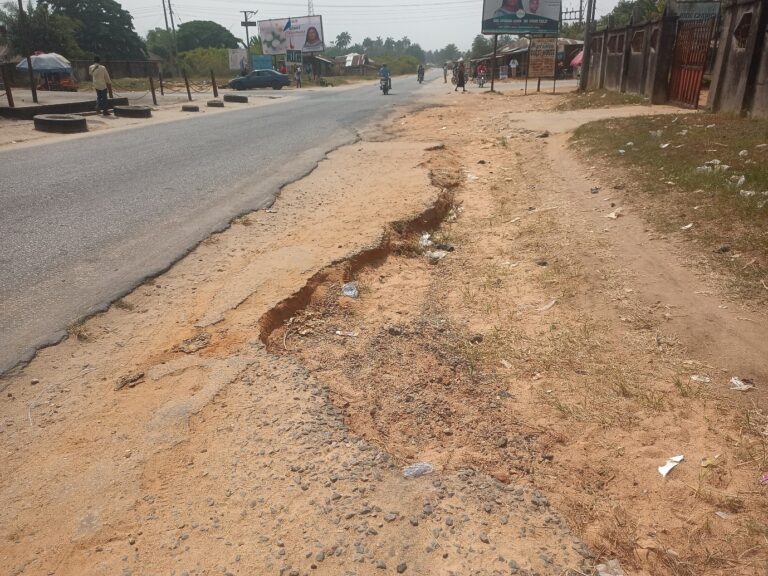
When our reporter visited the entire stretch of the road, it was observed that a few sections were stable but, in most parts, it was characterised by alligator cracks, portholes, eroded shoulders and pavement failures.
The portion of the road from Nung Udoe to Afaha Offiong roundabout is riddled by potholes and ditches.
It was observed that a bridge has been constructed by Mothercat at the river that separates Ikot Obio Etan and Ikot Iwud in Nsit Ibom local government area.
The road was only well constructed around the bridge. Google Map, an Open-Source App, was used to measure the kilometers of work implemented.
The bridge constructed by Mothercat
From the bridge facing Etina, the road was asphalted to the drains at 500 metres while the asphalted portion which the width does not reach the drains was 300 meters.
There was surface dressing on the shoulders with crushed rocks on this portion.
Down the bridge facing Nung Udoe road, the asphalted portion with width to the drains was measured 600 metres while the asphalted portion without width to the drain was measured at 200.6 meters. The total kilometers of work executed aligns with the status report by the ministry but with discrepancies on the width not covering up to the length.
The crown Prince of Ikot Iwud, Akpaobot Isong, who hails from one of the villages where the width of the asphalted road is not executed to the drains said when they noticed the standard was dropped and the road was becoming thin in width, they approached Mothercat over it but nothing was done.
Also, while the government claimed that the drains have been provided up to 11.5km which would have been 34.3 percent of the stretch of the road, what was actually measured through the use of the Google map app was 6.5 kilometers. The drain covers intermittent stretches from Afaha Offiong down to the bridge and from Afaha Offiong roundabout to the road leading to the council secretariat still at Afaha Offiong.
There were a few remnants of some crushed rocks poured by the shoulders of the road around Ikot Annung and Ikot Ediom villages along the highway. However significant portions of the rocks have been washed away suggesting shabby execution.
Residents of these areas said that the construction of the bridge by Mothercat commenced in 2019 while they carried out other works in 2021.
State government intervenes
Due to the poor state of the road, the government of Akwa Ibom State under the Udom Emmanuel administration had to intervene on the Etinan-Ekom Iman section of the road project. The road project completed by the state in 2023 has being dualised. This leaves the Nung Udoe -Etinan section still characterised by alligator cracks, several portholes, eroded shoulders and pavement failures leading to accidents that claimed many deaths.
Etinan-Ekom Iman section dualised by the government of Akwa Ibom State
Due to the significance of the road in connecting other parts of the state including Governor Umo Eno’s hometown; Nsit Ubuim, the state government in November 2024 intervened on the road by filling the potholes that riddled the road in preparation of the burial of the late Governor’s wife, Patience Umo Eno.
The state government has announced plans to dualise the Nung Udoe -Afaha Offiong section of the road to link with Eket -Etinan-Ekom Iman highway which has already been dualised. This project, as captured in the 2024 approved state budget, cost N1.5bn.
Government claims contract review affected project completion
When the findings of this investigation were shared with the Principal Civil Engineer of the Federal Ministry of Works, Akwa Ibom State office, Madaki Illyasu, an engineer, that the stretch of the road has not been completed against government’s status report of the project which claimed 100 per cent completion, he admitted that only about 15 kilometres (km) out of 33.5km stretch has experienced various forms of intervention by Mothercat.
Going by the about 15km intervention admittance, it implies that only 44.7 percent of the entire stretch received attention from government.
While noting that Mothercat had initially surveyed the entire 33.5km stretch, did bush clearing for shoulder improvement on the road, the Principal Civil Engineer said that the failure to complete the reconstruction of the stretch of the road stemmed from the ministry’s decision in Abuja to review the Bill of Engineering Measurement and Evaluation (BEME) thrice. BEME is a list of work items, their quantities, and their estimated costs. He said the review was caused by the variation of prices and inflation.
Illyasu, whom investigations reveal had worked as a staff of the contractor, Mothercat Limited between April 2009 to January 2013 before his work with the Federal Ministry of Works, said the main target of the project was the provision of the bridge as the project was facilitated by Senator Ita Enang. He added “The level of work executed on the road is based on the quantity of items provided on the Bill of Engineering Measurement and Evaluation. We have reviewed that BEME up to three times. The contractor worked based on the last review. Our directors from Abuja came and confirmed that those items as provided for in the last reviewed BEME are there. They had a one-year maintenance period and they used it to maintain the road. After one-year maintenance period, the contractor is not liable again.”
The claim by the government is questionable. In March 2024 this medium had requested for all the contract documents and information associated with the project. The documents on the BEME reviewed thrice were not shared. It only came into the picture when the newspaper queried how the ministry said the work was100 percent completed as against the provisions in the scope of the work provided by the ministry.
Also, the ministry’s claim of 100 percent completion of the “Reconstruction of the Nung Udoe Etinan-Ekom Iman Road in Akwa Ibom State” is misleading as less than a half of the stretch is worked upon and consequently diverted federal government attention on the need to complete the project.
When contacted, Senator Ita Enang who facilitated the project said it was not correct that the main purpose of the reconstruction was the bridge as claimed by the ministry. He said the reconstruction was to cover the entire 33.5km stretch.
Enang said he has observed that the project is not yet completed hence he plans to meet the Minister of Works, David Umahi, over the abandoned part and assured that even though the project is not captured in the 2025 budget of the federation, he hopes to explore other sources of funding to ensure the road is revisited and completed.
Mothercat silent over discoveries
Findings show that this is not the first time Mothercat Limited has failed to follow its scope of work in project execution. For instance, the contract for the dualisation of the Obajana-Benin Road awarded to Mothercat and two other companies in 2012 was recently terminated for non-performance.
A release signed by the the Minister for Works, David Umahi, said Mothercat and other contractors abandoned the project, showing no genuine commitment or good faith towards executing the projects.
Checks into the Open Treasury Portal show that between October 2018 and February 2022, Mothercat Limited alone had received N1.28bn for the road project yet showed no commitment in implementation as reported by the works minister.
In mid, late December 2024 and January this year several attempts were made to reach Mothercat Limited for response to the findings in this investigation. Mothercat currently does not have an office in Akwa Ibom State. The two phone lines provided on its website were not reachable. A mail sent to the Managing Director of the company through its official mail address on December 27, 2024 sought the company’s response on the findings.
The request specifically sought to know when the company plans to complete the project as captured in their scope of work, how much the company has so far been paid for the project and what is limiting the completion of the project and any other remarks from the company. This was not responded to before press time despite a reminder on January 13, 2025.
As stated earlier the Federal Government had also spent N19.35 million to Amana Consortium Limited to supervise the work which is expected to give a report about the state of the project.
When the company was reached through the phone lines provided on its website in mid and late December for information on their report about the status of the road, the phones rang unanswered. Text, WhatsApp messages, and mail sent to the company on December 27, 2024 were not responded to. This newspaper visited their Ewet Housing Estate office in Uyo on January 13, 2025. Throughout the two hours of waiting at the security post of the company, no one attended to the reporter after filling the visitor’s note.
Despite its deplorable state coupled with the 100 per cent completion report, checks into the 2024 Appropriation Act and 2025 proposed bill of the Federal Government, the Reconstruction of Nung Udoe -Etinan- Ekom Iman Federal Highway is no longer captured, implying that attention is no longer on the road having been adjudged as completed in the books.
National Assembly to investigate project
The National Assembly has assured that the controversies in the contract execution of the project by Mothercat Limited will be investigated.
The Senator representing Akwa Ibom North-East, Aniekan Bassey, assured that he will undertake findings and ensure the Senate investigates it.
Also, the member representing Uyo/Ibesikpo Asutan/Uruan, Nsit Atai Federal Constituency, Mark Esset, expressed shock over the fact that the reconstruction of the road was awarded and money paid without impact.
He assured that he will personally undertake on-the-spot assessment and cause the project to be investigated by the House of Representative if he discovers issues of concern.
A GOSPEL singer Timilehin Ajayi, charged with the murder of Salome Adaidu, a 24-year-old National Youth Service Corps (NYSC) member serving in Abuja, has pleaded not guilty despite his earlier confession to the crime.
Ajayi, 32, was arraigned at the Nasarawa State High Court on January 17, on charges of culpable homicide punishable by death under Section 221 of the Penal Code.
The court ordered Ajayi’s remand at the Lafia Correctional Facility, pending further hearings.
Ajayi was arrested on January 12 in New Karshi, Karu Local Government Area, while transporting Adaidu’s severed head in a polythene bag.
The ICIR reported that police investigations revealed he had dismembered the victim’s body into more than 50 pieces after killing her at his residence, allegedly driven by jealousy over suspicions of infidelity.
During his parade at the Nasarawa State Police Command headquarters, Ajayi confessed to the crime, claiming jealousy and suspicions of infidelity drove him to kill Adaidu during her visit.
He admitted to using a knife and machete to dismember her body, placing the remains in polythene bags.
“I killed her because we don’t have each other all the time. It’s not something I planned. It happened on that day and it happened. Not that I had the plan in mind, she was cheating.
However, during his court appearance on Monday, January 27, Ajayi pleaded not guilty, prompting public outrage and calls for justice from advocacy groups and Adaidu’s family.
THE founder of Afe Babalola University, based in Ado, Ekiti State, Afe Babalola, has agreed to drop the defamation cases he instituted against activist and lawyer, Dele Farotimi.
This followed the intervention of the Ooni of Ife, Adeyeye Ogunwusi, and other top traditional leaders in the South-West.
Babalola had petitioned the police commissioner in Ekiti State that Farotimi defamed him in a book he authored. The police arrested Farotimi in Lagos State and whisked him to Ekiti state where they arraigned him before two courts. The courts eventually detained him for weeks.
However, in the early hours of Monday, January 27, Babalola, who spoke at ABUAD after the monarchs’ intervention at midnight of Sunday, January 26, said he had agreed to withdraw the litigations.
The senior lawyer said he would tell his lawyers to withdraw the case.
Among the monarchs who joined Ooni at the meeting hosted by Babalola were the Olojudo of Ido Ekiti, Ewi of Ado Ekiti, Ajero of Ijero Ekiti, Ogoga of Ikere Ekiti, Oloye of Oye Ekiti, and the Alaaye of Efon Ekiti.
During the meeting, Babalola said he emphasised the significance of the Yoruba traditional institution and stressed its importance.
“The monarchs are here; they have appealed to me over a criminal charge involving somebody who said I was corrupt,” Babalola stated.
The nonagenarian said that he felt so bad that Farotimi accused him of winning all his cases through corruption, the reason he said he rejected all earlier appeals to him to withdraw the cases from courts.
Babalola said other prominent Nigerians had reached out to him to drop the case against Farotimi, including former President Olusegun Obasanjo, Catholic Bishop of Sokoto Diocese, Mathew Kukah, and the Ewi of Ado Ekiti, Oba Adejugbe.
He said it was the intervention of the Ooni of Ife, Oba Ogunwusi, and other top Yoruba monarchs that ultimately led to his decision to withdraw the suits.
Babalola stated that Farotimi’s book contained personal attacks on many judges, including Supreme Court judges, but he was particularly bothered by the attacks because of his humble beginnings.
He explained that he was not motivated by a desire for personal gain, such as wealth or damages, but rather by a desire to use his resources for the benefit of others. Babalola said he found happiness in givingand that he would not benefit from Farotimi’s imprisonment or seeking damages.
The Ooni, who spoke on behalf of Yoruba monarchs, requested Babalola to withdraw the case in court, assuring him that “nobody can tarnish your name. Your name is more than silver and gold and you have stood for your name with the message that nobody can joke with your name.”
Ogunwusi acknowledged Babalola’s significant contributions to the development of Yoruba, Nigeria, and the world.
“We are using our race because some of our elders in Yorubaland and even beyond Yorubaland have spoken, but combining forces with the traditional institution. We have heard you enough, enough, and enough. Your name is intact. We have resolved the matter in our way; we have done the needful.” the revered traditional ruler said.
The ICIR reports that a Magistrate Court in Ado-Ekiti, Ekiti State granted N30 million bail to Farotimi on Friday, December, 20.
The bail conditions granted him by the court’s judge, Abayomi Adeosun, include two sureties, who must be responsible citizens, and the defendant’s international passport seized by the court.
As part of the bail condition, Farotimiwas restricted from media interviews during the pendency of the case.
Farotimi, renowned for his criticism of human rights abuses and advocacy for justice, was arrested following a petition filed by Babalola.
Babalola claimed the accused defamed him in his book titled: ‘Nigeria and its Criminal Justice System’.
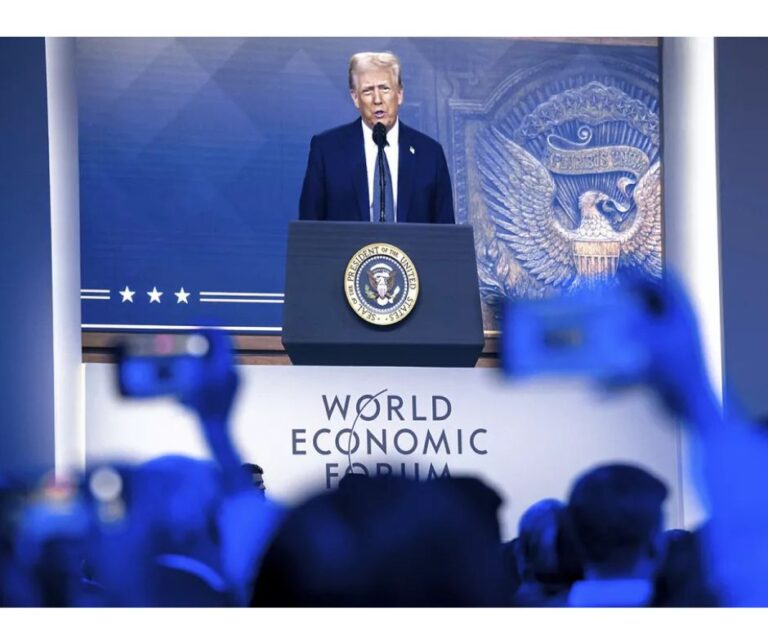
FOLLOWING his inauguration as the 47th US President, Donald Trump, addressed the audience virtually at the World Economic Forum (WEF) in Davos on Thursday last week.
The WEF‘s 2025 annual meeting took place from January 20-24 in Davos, Switzerland, as hundreds of notable public figures, including scores of heads of state and government as well as global CEOs gathered for the event. The forum provides a unique opportunity for global leaders to exchange ideas, forge partnerships, and explore solutions to these complex issues.
This year’s WEF centres around the theme: “Collaboration for the Intelligent Age.” The theme highlights the growing divisions in the global community and emphasises the need for collective action to address critical challenges like the climate crisis, economic inequality, and geopolitical instability.
At the event, Trumpspoke on various global issues including the US economic situation under the previous administration and his plans for the United States going forward. In this fact-check, we scrutinise some of the claims he made to check their accuracy and provide context.
CLAIM 1
Over the last 4 years, the immediate-past US government racked up $8 trillion dollars in wasteful deficit spending.
THE FINDINGS
Findings by The FactCheckHub show that the claim is MOSTLY TRUE.
A look at the data curated by Bipartisan Policy Centre show that the budget deficits under the Biden administration were $2.8 trillion, $1.4 trillion, $1.7 trillion, $1.8 trillion and $710 billion for the fiscal year (FY) 2021, FY 2022, FY 2023, FY 2024 and so far in FY 2025 respectively. This amounts to $8.41 trillion.
However, we could not independently verify if the deficit spending in the last four years was actually wasteful or not.
THE VERDICT
The claim that the immediate-past US government spent $8 trillion dollars in deficit spending is MOSTLY TRUE, according to publicly available data.
CLAIM 2
Inflation currently stands at 50 per cent higher than the historic target.
THE FINDINGS
Checks by The FactCheckHub show that the claim is MOSTLY TRUE.
The US Federal Reserve, the central banking system of the United States, set a long-term inflation target of 2 per cent. This target aims to promote price stability and sustainable economic growth. By aiming for inflation that averages 2 per cent over time, the Federal Open Market Committee (FOMC) seeks to ensure that longer-run inflation expectations remain well-anchored at this level.
However, according to the Bureau of Labor Statistics’ monthly consumer price index (CPI) report, the United States’ annual inflation rate was 2.89 per cent as of December 2024, up from 2.75 per cent in November – 45 per cent higher than the target. The current rate for the month of January 2025 is yet to be published; as such we can’t categorically determine its percentage as at today.
THE VERDICT
The claim that inflation currently is 50 per cent higher than the historic target is MOSTLY TRUE; findings show that it is currently 45 per cent higher than the target.
CLAIM 3
National energy emergency declared as part of the executive order Trump signed on his first day as US President.
THE FINDINGS
Findings by The FactCheckHub show that the claim is TRUE.
Immediately after his inauguration on January 20, 2025, one of the executive orders signed by Trump (according to the list of Presidential actions on The White House website) include declaring a national energy emergency. In the order, he noted that the United States’ capacity for identifying, leasing, developing, producing, transporting, refining, and generating energy and critical minerals is insufficient to meet the nation’s requirements.
Multiple media reports from The Washington Post, Reuters and The Guardian quoted Trump saying that the nation’s inadequate energy supply and infrastructure was attributed to the harmful and shortsighted policies of the previous administration, and thus exacerbates high energy prices that severely impact Americans, especially those on low and fixed incomes.
THE VERDICT
The claim that Trump declared a national energy emergency as part of the executive order he signed on his first day as US president is TRUE, according to the list of presidential actions and multiple media reports.
CLAIM 4
The United States has the largest amount of oil and gas of any country on earth.
THE FINDINGS
Findings by The FactCheckHub show that the claim is FALSE.
According to the United States Energy Information Administration, the US became the leading global crude oil producer in 2018 and maintained this position through 2022. U.S. oil refineries process crude oil sourced both domestically and internationally, with various types of companies contributing to the global crude oil supply.
A 2024 report by Vox noted that the United States is the world’s largest crude oil producer, reaching an all-time high in 2023 by averaging nearly 13 million barrels per day, as reported by the US Energy Information Administration.
Further checks revealed that Venezuela and Saudi Arabia hold greater oil reserves than the United States. Venezuela leads as the country with the highest oil reserves, followed by Saudi Arabia; Nigeria ranks 10th while the United States ranks 11th.
Specifically, Saudi Arabia’s proven crude oil reserves are estimated at 267 billion barrels, significantly exceeding the United States’ nearly 36 billion barrels, according to the US Energy Information Administration.
THE VERDICT
The claim that the U.S. has the largest amount of oil and gas of any country on earth is FALSE; while the U.S. is the largest crude oil producer, Saudi Arabia and Venezuela have more oil reserves than the U.S.
CLAIM 5
Biden administration imposed $50,000 in additional regulatory costs on the average American household over the last four years.
THE FINDINGS
Checks by The FactCheckHub show that the claim is HALF TRUE.
A report by the United States House Committee on oversight and accountability noted that the Biden-Harris Administration imposed regulatory costs nearly double those of the Obama Administration, despite having only four years to do so compared to Obama’s eight.
The study estimates that the total regulatory burden could amount to $47,136 per U.S. household, which critics argue could negatively impact American families and the economy.
Another article by City Journal highlighted the intensity of the regulation under ex-President Biden as some estimates suggest that Biden’s regulations could lead to a lifetime cost of $47,000 per family.
Furthermore, the study highlights concerns over the regressive nature of these regulations, with low-income households reportedly bearing a disproportionately high share of the costs. In fact, the study suggests that low-income families could pay seven times more in regulatory costs compared to wealthier households, adjusting for their ability to pay.
Another report from Unleash Prosperity highlighted that, based on its main findings, the Biden-Harris administration is set to impose $47,000 in net present value regulatory costs per household from rules finalized during its first term.
THE VERDICT
The claim that the Biden administration imposed $50,000 in additional regulatory cost on the average American household over the last four years is HALF TRUE; while reports confirmed that the immediate-past US administration truly imposed additional regulatory costs, it also showed that the figure is around $47,000. That’s a difference of about $3,000.
CLAIM 6
Trump signs executive order to end government censorship saying the citizen speech will no longer be labeled as misinformation or disinformation.
THE FINDINGS
Findings by The FactCheckHub show that the claim is TRUE.
On the day of Trump’s inauguration as the 47th US president, dozens of executive orders were signed by him shortly before his official inauguration ceremony. These orders revolve around immigration, civil rights, trade, the hiring of federal workers, and U.S. foreign aid to demographic diversity.
Some of the executive orders have sparked concerns mostly among US residents and online. For instance, the order to end birthright citizenship has stirred public debates especially among immigrants in the country. Media reports also indicated that a US federal court has halted the execution of that particular order.
To verify the claim, our fact-checkers reviewed the list of presidential actions signed by Trump as published on the White House website and found out that actions to end government censorship was on the list.
The claim that Trump signed an executive order to end government censorship on citizen speech is TRUE; the order was among the US presidential actions signed on January 20, 2025.
CLAIM 7
NATO defence spending was at 2 per cent.
THE FINDINGS
Checks by The FactCheckHub show the claim is TRUE.
The North Atlantic Treaty Organization (NATO) is a military alliance formed in 1949 to provide collective defence and promote stability and security among its member countries.
Established to counter the Soviet Union during the Cold War, NATO‘s mission includes a broader range of security concerns. NATO has 32 member countries as of January 2025, spanning from North America to Europe. These countries, called NATO Allies, are sovereign states that come together through NATO to discuss political and security issues and make collective decisions by consensus.
Defense spending is the payments made by a national government (excluding regional, local and municipal authorities) specifically to meet the needs of its armed forces, those of Allies or of the Alliance.
To verify the claim of the percentage they remit to the alliance, our fact-checkers reviewed the report of NATO Alliance obtained from its official website. It was discovered that 2 per cent of all the members countries’ annual GDP is collectively agreed as the payment terms for NATO allies since 2014 and it is still the benchmark as of January 2025.
THE VERDICT
The claim that the defence spending of NATO countries is 2 per cent of their annual GDP is TRUE; data obtained from NATO website revealed.
A SUICIDE attack in northeastern Nigeria has claimed the lives of at least 27 soldiers, including a commanding officer, AFP reported on Sunday, January 26.
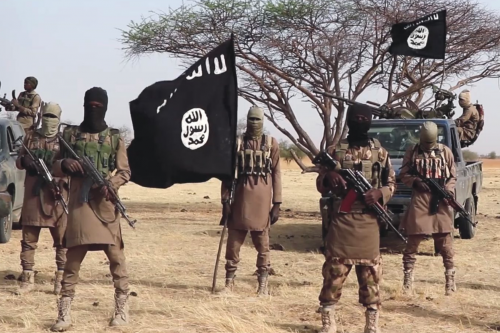
The attack reportedly occurred on the night of Friday, January 24, as troops of the Nigerian Army launched an offensive against Islamic State-affiliated militants.
According to the military sources who spoke with AFP on the condition of anonymity, the suicide bomber rammed an explosives-laden vehicle concealed in thick vegetation into a convoy of advancing troops in the Timbuktu Triangle, a notorious hotspot for activities by the Islamic State West Africa Province (ISWAP).
One of the sources noted that the suicide attack killed 27 soldiers, including the commander.
The source noted that several others were seriously injured during the attack.
“It was dark, which made it difficult for the troops to have a clear view of the surroundings,” another security source was quoted to have said.
He said the death toll could rise as some of the wounded were in a “critical condition”.
The Nigerian Army and the Defence Headquarters have, however, not officially confirmed the incident or commented on the report, as calls placed to the Army’s spokesperson, Clement Onyeama Nwachukwu, were not connecting, and messages sent to his line were not returned.
This incident makes it another deadly incident where the Nigerian lost a significant number of personnel to attacks from militants and terrorists.
In March 2024, The ICIR reported how 15 military personnel, consisting of two Majors, one Captain, and 12 soldiers were said to have been killed by some youths in Okuoma community in Bomadi Local Government Area (LGA).
The incident occurred on Thursday, March 14, 2024, when the troops responding to a crisis between Okuama and Okoloba communities in Delta State, were ambushed.
Similar tragedies have occurred in recent years, where terrorists and armed groups have killed significant number of soldiers.
In 2023, The ICIR reported how 36 military personnel were killed in a series of attacks in Zungeru and Chukuba communities of Niger State.
The incident which happened in Zungeru and Chukuba, both in Niger State, resulted in the death of three officers and 22 soldiers in an ambush in the Zungeru general area while seven personnel were injured.
Also, the Nigerian Airforce (NAF) helicopter which was on a mission to evacuate the deceased and wounded troops was allegedly taken down by bandits at Chukuba area of Shiroro Local Government Area of the state on August 13, 2023.
The crashed helicopter, was carrying 14 of the 22 bodies of the previously killed soldiers and seven wounded ones, two pilots and two crew members, resulting in a total loss of 36 lives.
Beyond that, The ICIR has reported how terrorist groups, particularly ISWAP has been terrorizing the northern part of Nigeria, including offensive attacks on Kuje correctional Centre and attacks on military checkpoints.
The group has killed and displaced thousands of civilians since their emergence.