THE Nigerian Electricity Regulatory Commission (NERC) has issued an order to transfer regulatory oversight of the electricity market in Ogun State from the Commission to the Ogun State Electricity Regulatory Commission (OGERC).
This was disclosed in a statement released by NERC on X on Monday, December 30,2024.
This transfer follows a comprehensive process that aligns with the requirements outlined in the Electricity Act (EA) 2023 as amended, which allows states to assume regulatory control over their intrastate electricity markets, provided they notify the NERC and meet the necessary conditions.
The Act also mandates any state that intends to establish and regulate intrastate electricity markets to deliver a formal notification of its processes and requests NERC to transfer regulatory authority over electricity operations in the state to the state Regulator.
The Commission, however, in accordance with the provisions of the EA 2023, retains the role as a central regulator with regulatory oversight on the inter-state/international generation, transmission, supply, trading and system operations.
The EA also mandates any state that intends to establish and regulate intrastate electricity markets to deliver a formal notification of its processes and requests NERC to transfer regulatory authority over electricity operations in the State to the State Regulator.
Based on this, the government of Ogun State complied with the conditions precedent in the laws, duly notified NERC and requested for the transfer of regulatory oversight of the intrastate electricity market in Ogun State.
Following the request, NERC directed the Eko Electricity Distribution Company (EKEDP), Ikeja Electric PLC (IE) and Ibadan Electricity Distribution Company (IBEDC) to incorporate subsidiaries: EKEDP SubCo, IE SubCo and IBEDC SubCo respectively to assume responsibilities for intrastate supply and distribution of electricity in Ogun State from EKEDP, IE and IBEDC.
The Commission said the EKEDP, IE and IBEDC shall complete the incorporation of EKEDP SubCo, IE SubCo and IBEDC SubCo within 60 days from 24th December 2024.
It said the sub-companies shall apply for and obtain licences for the intrastate supply and distribution of electricity from OGERC, among other directives.
NERC said all transfers envisaged by this order shall be completed by 23rd June 2025.
The ICIRreported that the state governments could attract more investments into Nigeria’s power sector and improve access to electricity in their respective states with the 2023 Electricity Act that President Bola Ahmed Tinubu signed into law on Thursday, June 8.
The Electricity Act consolidates all legislation dealing with the electricity supply industry to provide an ideal institutional framework to guide the post-privatisation phase and encourage private sector investments in the sector.
States like Enugu, Ekiti, and Oyo have also set up their regulatory bodies, marking a significant shift towards decentralised grid-power management which has been experiencing collapse.
ABOUT 300 primary healthcare centres (PHCs) and clinics provide medical services to 44 local government areas (LGAs) in Kano State. Almost every year, the state government celebrates its accomplishments in the health sector even as residents still suffer from poor access to basic healthcare.
A Kano budget performance review shows that the state recorded only 18 per cent of budget execution for its health ministry between 2021 and the first quarter of 2024.
That is despite the fact that the state government spent its highest amount for the health sector in 2023 when the sum of N26.3 billion (44.7 per cent) was expended out of the N59 billion budgeted.
In 2022, the Kano State Primary Healthcare Management Board (KSPHMB) awarded N90.1 million to Dankwadoko Company Limited to renovate and maintain PHCs in the state.
Yet, rather than improving, most PHCs in the state have deteriorated as residents endure difficult health situations, including fatalities due to poor facilities and services.
This reports documents the substandard state of PHCs in Kumbotso, Warawa, and Kunchi; and also exposes a state-wide violation of the Public Procurement Law by the Kano Primary Healthcare Management Board.
Poor PHCs in Kumbotso LGA
Zara village is a remote and hard-to-reach community in the Kumbotso Local Government Area (LGA) of Kano State. It hosts a small and dilapidated Primary Health Care Centre (PHC), which has a gaping ceiling in almost every room.
The facility has been in very bad condition for over five years. And, for the residents, accessing basic healthcare is both arduous and expensive because they have to travel from their community to the capital city, Kano, about 18 kilometres away, where the government-owned Murtala Muhammad Specialist Hospital, the main option for specialised care,is located.
The PHC in Zara village, a remote and hard-to-reach community in the Kumbotso Local Government Area (LGA) of Kano State.
Many women in Zara, especially those who are pregnant, are often deterred from seeking prenatal treatment at the distant specialist hospital, due to the high cost of transportation to Murtala Muhammad Specialist Hospital, with a return fare of about N1,500.
The village’s patent medicine store, referred to locally as the “chemist,” is the most reliable option for residents of the settlement and those of nearby communities. Zara Health Centre, aside from its very poor physical state also lacks the most basic amenities and medicines, a situation made even worse by the absence of medical staff, particularly in the evenings and at night.
According to Hasiya Haruna, 45, a mother of five, the Zara health centre is like “an abandoned building. Whenever we have serious emergency issues, we either take our patients to a private clinic or Murtala Muhammad General Hospital.”
Usman Na’ina, 57, father of 8 lamented that the bad condition of Zara PHC is costing him a lot in out–of–pocket spending.
“Yesterday, two of my children were suffering from malaria but the PHC had no drugs to administer to my children. I have to spend N14,200 to treat them at a private chemist in Panshekara which is about five kilometres away,” he recalled.
“Apart from the medication cost I have to spend N500 daily to take my children for injection in the evening hours.”
The Village Head of Zara, Abdullahi Aminu, lamented that their PHC is not operating up to standard.
“Patients who come to this facility for care are frequently treated in poor surroundings, with leaking roofs and no restrooms. Patients’ dignity is violated in these appalling conditions, and there are major health hazards as well.”
Just like the Zara facility, Garu PHC, also in Kumbotso LGA, has been in a dilapidated state for over a decade, lacking basic amenities and services.
A 66-year-old resident of Garu, Umar Habibu, revealed that about 25 women between the ages of 22 and 55 were victims of maternal mortality in the community between January 2022 and December 2024, including Umar’s 45-year-old wife, who died during childbirth.
66-year-old resident of Garu, Umar Habibu.
“We had to make the agonising trek of almost 14 kilometres to Kano town to receive medical attention. My wife suffered the unforgiving travails of childbirths on the road and her life was cut short before reaching the hospital” he lamented.
Musa Nura, 32, father of three decried that the non-functioning of their PHC is causing so many residents to embrace traditional healing methods, including pregnant women who increasingly patronise traditional birth attendants.
He said “For instance when my wife was about to give birth in August 2023, she was at the point of delivering, so due to her condition I could not drive her far to Murtala Muhammad or Aminu Kano Hospital due to the bad road at that time.
“I have no option than to call a traditional birth attendant to help my wife deliver her child because I do not have the funds to patronise private clinics.”
Data indicate that Kano State has since 2020 allocated up to 15 per cent of its budget to healthcare. Further, the state has also introduced innovative funding mechanisms such as the State Health Trust Fund and the Kano State Contributory Health Care Management Agency (KSCHMA). KSCHMA is a social health programme system of advance financing of health expenditure through contributions, donations, grants, or taxes paid into a common pool to pay for all or part of health services as specified by the state law. Yet, healthcare delivery remains very poor, especially among PHCs in rural areas.
Kunchi Woes
Just as with Zara and Garu, the Karofawa community in Kunchi LGA, bears its primary healthcare woes. It is the same tale of dilapidation at the Karofawa facility going back several years, so much so that residents barely rely on it for the most basic health support.
The physical neglect is such that the building had cracked ceilings that leak badly whenever it rains. The facility also lacks toilets as patients practice open defecation.
Cap: Korafawa PHC. PC: Stallion Times
A 30 year old resident, Usman Bala said most people in Karofawa and neighbouring villages “drive to Bichi (25 kilometres) or Kazure in Jigawa, which is over 48 kilometres away, for their healthcare needs, because relying solely on their PHC may inevitably lead to death.
“We have only one doctor who takes care of the PHC from Monday to Friday which he opens from 9:am to about 2:pm.
On Saturday and Sunday, the PHC remains locked. So, in case of an emergency, we have to travel far,” he explained.
On July 23 2024, around 2:16 pm, when this reporter arrived at the facility, it had already closed and all of the staff had left for the day.
Despite its appalling condition and very bad networks of roads to access it, the neighbouring communities of Tigali, Tibi, Tashar Mai Unguwa, and Center Dole primarily rely on the Karofawa PHC for their healthcare needs.
How a standard PHC should be
Yet, the Nigeria Health Facility Registry set the minimum standards for primary healthcare facilities in Nigeria for a minimum of eight hours every day.
As stated in the document, primary healthcare should have human resources for PHC which include; Community Health Officer (CHO), Nurse/Midwife, Community Health Extension Worker CHEW), and Junior Community Health Extension Worker (JCHEW).
According to the Nigerian Health Facility Registry, a PHC should have a minimum land area of 2,475 square meters which would cover 2,000 to 5,000 people.
It stated that a PHC should be a detached building with at least 5 rooms, walls and roof must be in good condition with functional doors and netted windows.
Functional separate male and female toilet facilities with water supply within the premises with at least a motorised borehole.
A PHC should be connected to the national grid and other regular alternative power sources. Also have a sanitary waste collection point, a waste disposal site, and a clearly signposted visible from both entry and exit points.
The document also stated that a PHC must be fenced with gate and generator houses, and staff accommodation (2-bedroom apartments) provided within the premises.
The building must have sufficient rooms and space to accommodate clients, an observation area, consulting area, delivery room, first stage room, an injection and dressing area, lying-in ward (4 beds), pharmacy section, record section, staff station, store, toilet facilities (or VIP Toilet) and waiting/reception area.
Despite these criteria, PHCs in Kano are yet to meet the requirements for minimum standards for primary healthcare facilities.
Similarly, the Yandadi PHC in Kunchi LGA suffers from understaffing, outdated medical equipment, dilapidated infrastructure including leaky roofs, lack of essential medications, and inadequate restrooms, among others. Not only do patients get subpar care, but the appalling conditions pose health hazards to them.
Yandadi PHC.
A volunteer staff member, Abubakar Sagir, said that the facility has no water at all.
“Sometimes we bought sachet water or trek a kilometre away to fetch water. So, early in the morning, the hospital must make sure it has reserved water in case of emergency.
He further revealed, “We also do not have toilets, the ones we had are not functioning as most of them are dilapidated and damaged. For over four years, the PHC’s soak away has been submerged and has not been fixed”, a claim the reporter also observed.
Abubakar Sagir, a volunteer staff member. PC: Stallion Times
PHCs in Imawa suffering neglect
The same dilapidation and abandonment were evident at the Imawa PHC in Warawa Local Government when during a visit around noon on July 10, 2024. In fact, the facility was locked with no single healthcare worker around.
A resident, Khadija Bazallahi, 56, however, told him that most residents of the community “buy drugs from the local patent medicine stores (chemists), and if we require urgent attention, we go to Wudil (another LGA about 15 kilometres away) to receive care’’.
Khadija Bazallahi. PC: Stallion Times
“This PHC does not always open”, she added ruefully. From the outside view, the PHC is visibly dilapidated without windows, zero restrooms, cracked walls and falling ceilings.
Even in that terrible state, Nasiru Magaji, the Officer-in-Charge (OIC) of the PHC said that the facility opens everyday but has lacked funds for well over a year to hire staff to run the facility.
The Imawa PHC, is another PHC in Warawa LGA with serious operational and structural issues that make it difficult for the community’s most vulnerable members to receive the vital services they need.
PHC
The Imawa PHC is abandoned to the extent that the compound has been converted into farmlands and a processing site for rice grains and the veranda a marketplace where young girls sold street food to farmers.
The Council Chairman, Balarabe Haruna, agreed that the facility needs renovation and maintenance.
“Because of the bad condition of the PHC, it’s difficult for staff to stay, most especially during rainy seasons when the PHC usually becomes fully abandoned.
He claimed to have reached out in 2021 to the state government about the very poor condition of the facility but nothing was done.
The Village Head of Jigawa community, Kabir Abdullahi, lamented that their PHC is so bad that sometimes you cannot get basic drugs.
According to him, “Residents in this community prefer traveling to Wudil LGA which is about 22 kilometres or go far to Ringim in Jigawa State which is about 40 kilometres.
“But we hope this new administration should consider us and renovate our PHC.”
Nigeria’s National Primary Health Care Development Agency (NPHCDA) specifies that all functional PHCs should be built on 4,200 square meters and with at least 13 rooms, with good roofing, netted windows, functional toilets, clean water supply from a motorized borehole, a disposal site, staff accommodation, and be painted in green color.
None of the PHCs in Kano State visited by our reporter comes close to meeting these standards.
How violation of Kano State public procurement law worsens the State’s primary healthcare crisis
On May 6, 2022, an invitataion to tender for the procurement of capital projects which inlcuded bid contract for the maintenance and renovation of PHCs in the state was closed.
Invitation of Tender
A document accessed using a wayback machine under the https://kano-eproc.eurodyn.com revealed that on May 18, 2022, the Kano State Primary Healthcare Management Board (KSPHMB) awarded a contract at the sum of N90,100,000.00 million to one Dankwadoko Company Ltd, to renovate and maintain primary health care facilities in the state .
Document obtained from wayback machine
According to the document, the bidding adopted a national restricted approach featuring four companies- Absolue Consult Limited, Abidine Limited, Vagare Investment Limited and Dankwadoko Company Limited in which Dankwadoko emerged as the winner
The unsigned contract award notice featured the name of Bashir Sanusi as the Head of Procurement Department Unit (HPDU), of the KSPHMB.
Contract award notice
When contacted Bashir Sanusi, who was surprised to see his name in the contract award document noted, that he is not and has never been the Head of Procurement Department Unit of KSPHMB but instead the Director Planning, Monitoring and Evaluation of the Agency.
He noted that “Since 2020 the KSPHMB has not executed any renovation project of PHCs in Kano or called for any bidding regarding PHCs projects, adding that KSPHMB is not aware of the contract to Dankwadoko Limited and that he has never heard of such a company name.
According to Sanusi, “The KSPHMB does not adopt the national restricted bidding but we adopt the national competitive bidding by advertising our bidding in two national dailies (Daily Trust and The Guardian) making it open for eligible and registered companies.
“So, I am not aware of such a contract, maybe someone else just designed the document, but the KSPHMB did not execute any renovation in 2022.”
The Head of Procurement Department at KSPHMB, Muhammad Sagir Nasir, also claimed that the Board “have never uploaded any contract award notice or called for bidding on the Kano state procurement portal.”
“All I can remember was we underwent training by the World Bank on how to use the procurement portal but we have never used it.”
Both officials of the Board were of the view that the contract award document may have been forged.
Investigations shows that Dankwadoko Company Limited which purportedly won the contract does not exist under the law as it is not incorporated by the Corporate Affairs Commission (CAC).
Interestingly, the other three companies – Absolue Consult Limited, Abidine Limited, and Vagare Investment Limited – which lost out in the bid process, according to information on the procurement portal, are all duly registered with the Commission.
To verify their participation in the bid process, a trip on Monday, December 16 was made to the addresses given by two of the companies Vagare Investment, Plot 145, Adetokunbo Ademola Crescent, Wuse 2, Abuja FCT, and Abidine Limited, no 8, Owerri Street, Gwarinpa, FCT. However the offices could not be located on the said addresses.
At Wuse 2, the location had over 50 shops. A search round all the shops/business offices around the building which took hours showed that there is no business with the name Vagare Investment in the building.
One of the security men who helped in looking for Vagare Investment on the building confirmed he had never heard such a name before.”I am not sure of that name, never heard it before here,” he said.
At no 8, Owerri Street the purported office of Abdine Limited, it took several hours to locate the street, tucked inside National War College Estate in Gwarinpa.
Number 8, Owerri Street, Gwarinpa, FCT, Abuja
Number 8 was a residential bungalow. A knock at the gate of the building brought out a woman, who looked like a domestic staff and a security man. Upon inquiry, it was discovered that the building is a residential building and the security man confirmed that he had never heard of the name, Abidine Limited before.
In conclusion, the verification could not be done as they offices do not exists ata the said locations.
The residential building at Number 8, Owerri Street, Gwarinpa, FCT, Abuja
Furthermore, awarding of the contract to Dankwadoko Limited is a clear breach of Section 31 (2b) of Kano State Public Procurement Law (KSPPL) which states that “All bidders shall fulfill all their obligations to pay taxes, pensions, and social security contributions.”
Isah Abdulazeez, a lawyer and procurement expert, observed that the award of contracts to unregistered companies like Dankwadoko Limited is a clear violation of Kano State Public Procurement Law, a practice which he lamented procurement entities use to siphon public funds.
Apart from violating procurement laws, the non-execution of PHC renovation projects by unregistered companies undermines the objective of Sustainable Development Goal #3- Good Health and Well-Being for All. Besides, its grave implications are evident for all to see in the PHCs in Kano covered in this report.
The World Bank estimates that for Nigeria to meet the goals of SDG 3 by 2030, it needs to allocate 14 percent of its Gross Domestic Product to the Health sector.
On June 19, 2024, this reporter visited KSPHMB, the awarding entity, to enquire why the contract of renovation was awarded to a nonexistent company. After about two hours of waiting, the reporter was told that the Executive Director was not in the office.
On July 4, 2024, a Freedom of Information (FOI), request was sent to KSPHMB, but it has been greeted with silence from the agency, despite repeated calls and follow-ups made. The FOIA request specifically asked for details of the contract award, procurement process, and verification of the company’s existence.
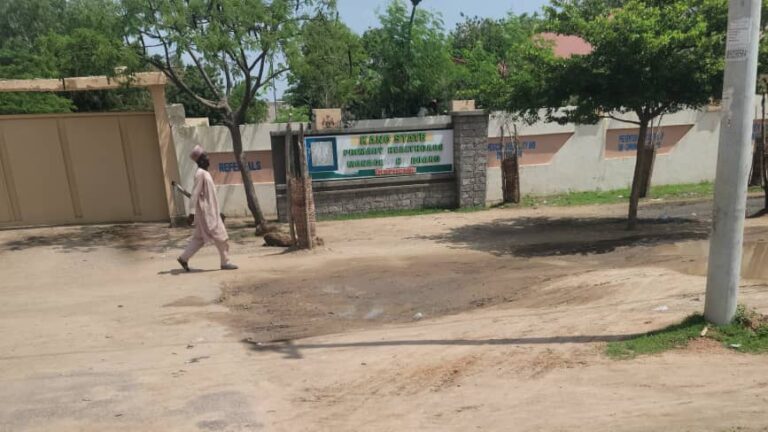
Kano State Primary Healthcare Management Board. PC: Stallion Times
On July 22, 2024, this reporter tried to get in touch with the Board again but was sent from one office to another. However, a staff member who sought anonymity advised the reporter not to waste his time as “nobody will answer your FOIA, they will keep you waiting till you get frustrated”.
In response to the reporter’s question about awarding a contract to a non-existent company in clear violation of the state’s procurement laws, the source claimed that awarding contracts in breach of the state procurement law was “normal” at the agency.
“I have seen situations where contracts are awarded to ineligible contracting entities just to loot public funds, so nothing can be done, awarding contracts to nonexistent companies is normal. Therefore, my friend, don’t waste your valuable time; nobody will answer your request for information or give you an interview to discuss your claims”, he added.
Kano Ministry of Health keeps mums
On December 3, 2024 a visit to the Kano State Ministry of Health, which is supposed to supervise the activities of the KSPHMB, the ministry’s Public Relations Officer, Ibrahim Abdullahi, said he has no power to speak on the contracts.
However, Abdullahi told this reporter that he will brief the Kano State Commissioner of Health, Dr. Labaran Yusuf Abubakar, on the contract for the renovation and maintenance of PHCs. After a series of follow-ups, the PRO told this reporter that he does not know when the commissioner will respond.
Numerous phone calls were placed to the commissioner on December 4 and 5 to discuss the contract that KSPHMB awarded to Dankwadoko Company Limited, but none of the calls were answered.
This investigative report was done with support from the John D. and Catherine T. MacArthur Foundation and the International Centre for Investigative Reporting, ICIR.
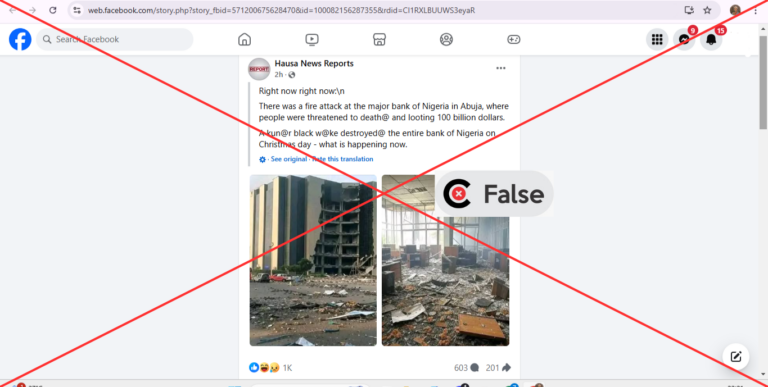
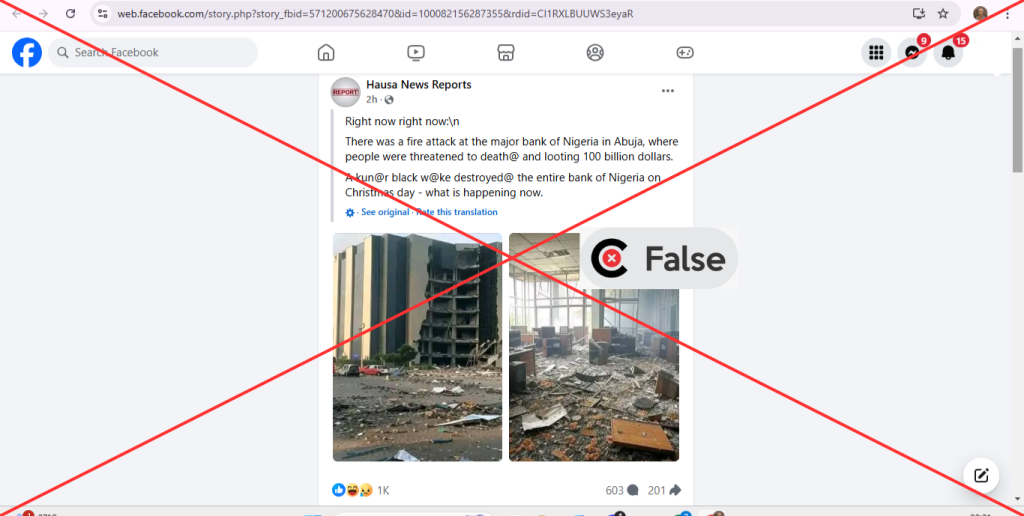
The claim, written in Hausa language, was made by Hausa News Reports, a Facebook user on the social media platform. It originally read thus:
YANZU YANZU:
An kai harin kunar bakin wake a babban bankin Najeriya da ke Abuja, inda ake fargabar mutuw@ mutane da dam@ tare da lalata dala biliyan 100.
Wani dan kun@r bakin w@ke ya lalat@ babban bankin Najeriya gaba daya a ranar Kirsimeti – abin da ke faruwa a yanzu.
Using Google Translate, the claim was translated into English language thus:
“A suicide bomber has struck the Central Bank of Nigeria in Abuja, with fears of casualties and the destruction of $100 billion. A suicide bomber completely destroyed the Central Bank of Nigeria on Christmas Day – what’s happening now.
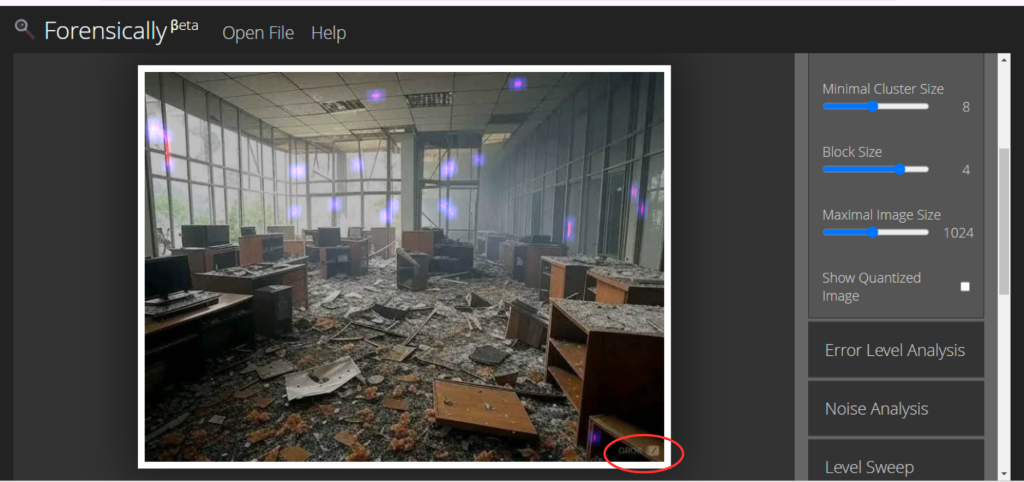
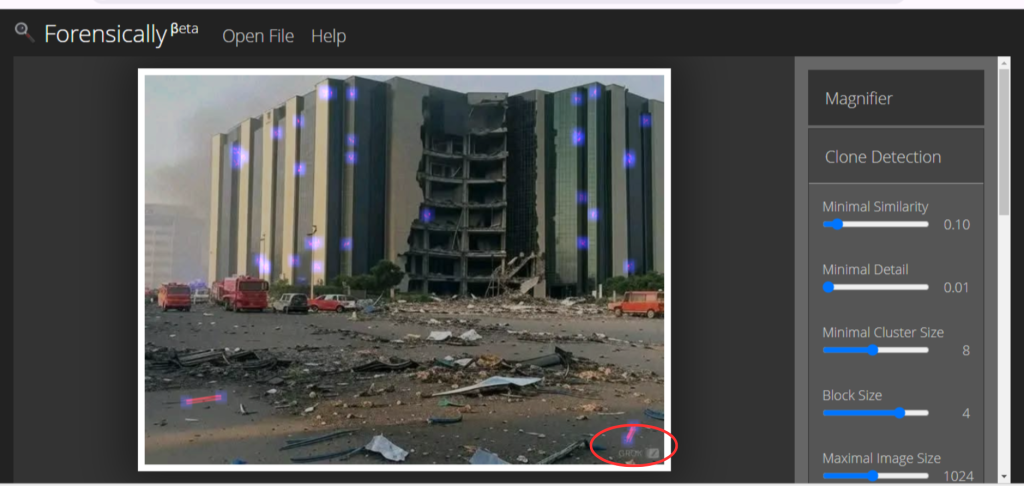
Two images purportedly showing the aftermath of the destruction were also attached to the post.
The post has garnered over 1,500 likes, with more than 800 comments and over 200 shares as of December 28, 2024.
CLAIM
Images show aftermath of damaged CBN headquarters in Abuja.
THE FINDINGS
Findings by The FactCheckHub show that the claim is FALSE!
Screenshot of the claim extracted from facebook; INSERT False verdict
A Google Reverse Image search conducted on both images did not provide any visuals depicting the exact posted images. It, however, show images of the CBN headquarters in Abuja, Nigeria’s capital city.
Checks by our fact-checker show that the image had elements of manipulation. Using the clone detection feature in Forensically, an image detection tool, it pinpointed areas on both images that might have likely been manipulated as seen below.
Images showing Clone detection areas and AI watermark being highlighted.mages showing Clone detection areas and AI watermark being highlighted.
Further findings show that both photos have an AI watermark which shows that the images were AI-generated.
A keyword search on Google search engine on the words, “CBN Destroyed” did not provide any related media report, as such incident would be widely reported by local and international media platforms.
THE VERDICT
The claim that images show aftermath of damaged CBN headquarters in Abuja is FALSE; the images are AI-generated.
MOST Nigerians are celebrating the end of 2024, not necessarily because they achieved the significant economic success they desired at the start of the year, but for scaling through a year marked by acute hunger, inflation, deaths, and other ills.
President Bola Tinubu’s policies aimed at reviving the nation’s economy worsened household economies, as millions of Nigerians struggled to feed during the year.
Tinubu’s policies include fuel subsidy removal and exchange rate unification. The fuel subsidy removal alone more than quadrupled the price of petrol.
Since most economic activities depend on energy and transportation, the sharp rise in the litre price of petrol pushed the prices of virtually all commodities beyond the reach of the common man.
Efforts by the citizens to compel the government to alleviate the pains ended in a fiasco, as the #EndBadGovernance protest held nationwide from August 1 and 10 only led to the attack on demonstrators by security operatives with scores of the protesters hounded and remanded.
The level of chronic hunger in Nigeria was exposed to the world with three successive stampedes at venues of food distribution in Oyo and Anambra states and the Federal Capital Territory (FCT) a few days before Christmas.
About 75 people died in the stampedes.
On December 18, a deadly stampede occurred during a children’s funfair in Ibadan, Oyo State.
The event, meant to bring joy to children, turned tragic when 35 children were killed in the chaos.
The Oyo State Police Command arrested eight persons, including Naomi Silekunola, the former wife of the Ooni of Ife, Abdullahi Fasasi, the principal of Bashorun Islamic High School, and the chief executive officer of Agidigbo.FM, Oriyomi Amzat, following the stampede.
The suspects were subsequently arraigned in court and remanded at the Agodi Correctional Centre.
Olabisi Ogunkanmi, a chief magistrate, ordered their detention pending further investigation into the incident.
In Okija, Anambra State, the Obi Jackson Foundation’s rice distribution event turned deadly, with at least 20 people losing their lives in a stampede.
Similarly, on December 21, a stampede erupted during a food distribution event organised by the Holy Trinity Catholic Church in Maitama, Abuja, which led to the death of 10 people.
The event, aimed at providing food to vulnerable, elderly members of the community, saw a large crowd of desperate individuals attempting to receive aid. The surge of people overwhelmed the event, which consequently resulted in a fatal crush.
THE Centre for the Promotion of Private Enterprise (CPPE) has highlighted key risks businesses would worry about as they craft their strategies for 2025.
The business advisory organisation, which focuses on promoting, protecting, and advancing private enterprise in Nigeria, noted that exposure to risks would vary across sectors.
It said businesses would need to adjust their strategies according to the risks they face.
The CPPE expressed the concern in its ‘Nigeria 2024 Economic Review and 2025 Outlook,’ signed by its director/chief executive officer, Muda Yusuf.
It listed forex volatility, interest rate, inflation, financial and monetary policy, and regulation as critical risks businesses would have to grapple with in 2025.
Other business risks will include cybersecurity insecurity, political, environmental/climate change and corruption, especially concerning public sector transactions and contracts.
However, it said there seemed to be a silver lining in the current reforms by President Bola Tinubu-led government. The gains include opportunities for import substitution across all sectors and the provision of domestic alternatives to medical, education, tourism and vacations abroad.
Also, it said high food prices offer new opportunities and incentives for investment in agriculture and the outlook for export business appeared positive because of the weak naira, which offered bigger opportunities for diaspora Nigerians to invest at home.
“There should be a deliberate policy to promote legal migration abroad to fill skill gaps in many of the countries in Europe and North America, especially the United States and Canada.
“Many of these countries are also experiencing an ageing population, which offers opportunities for our youths, many of whom are currently unemployed,” CPPE stated.
It predicted brighter prospects for outsourcing business for foreign companies and bigger investment opportunities in petroleum refineries and related industries following the deregulation of the sector.
Others are growing opportunities in renewable energy investment, use of compressed natural gas (CNG), liquefied petroleum gas (LPG) in transportation, and decentralisation of electricity provision to open up numerous opportunities in the electricity value chain.
The centre said business managers and owners needed to prioritise a couple of strategies to ensure resilience in 2025.
These include leveraging technology to reduce cost and ensure competitiveness, deepening backward integration to reduce forex exposure, and lowering debt financing to reduce the burden of high interest rates.
It added that businesses must ensure cost optimisation, adopt efficient energy solutions to reduce the pressure of high energy costs, and domesticate supply chains as much as possible.
The CPPE urged businesses to focus on talent retention, especially in specialised job functions and incorporate a scenario planning framework to manage uncertainties and volatilities.
It noted that the real economic sector remained subdued in 2024, with agriculture posting GDP growth of 1.14 per cent and manufacturing 0.92 per cent as of the third quarter, while air transport, quarry and minerals, petroleum refining and textile sectors remained in recession.
It further noted that the huge disparities in the growth of financial services and other sectors of the economy were a reflection of the growing decoupling of the financial services sector from the real economy.
“There is a need for appropriate policy measures to correct the huge disparity in the profitability between the real economy and the financial economy,” it stated.
The ICIRreported that the monetary authority’s hawkish policy boosted growth for financial institutions but stunted operations for manufacturing companies and other businesses within the year.
The CPPE said high interest rates and inflationary pressure were major concerns in 2024.
In 2025, the centre expects inflation to moderate slightly on the back of an expected reduction in exchange rate volatility and a possible rebound of the naira amid other domestic and global economic headwinds.
It pointed out, however, that following notable drivers, inflation might not completely dissipate in 2025 as CBN might maintain its orthodox monetary policy with a lesser degree of tightening measures.
The centre also urged the Nigerian government to expedite action to boost the capitalisation of the development finance institutions, including the Bank of Industry, Bank of Agriculture, and Nigerian Export-Import Bank, to deepen development finance interventions.
THE First Bank of Nigeria is yet to officially make its position known over the alleged layoff of 100 of its senior staff in its bid to restructure and reposition the bank ahead of 2025.
Already, several media outfits have reported shakeup in the bank which resulted to the sack of its senior staff numbering 100.
On the heel of the development, The ICIR reached out to the bank’s head of corporate communications, Folake Ani-mumuney, but she did not respond to calls, texts and WhatsApp messages sent to her.
“It’s confirmed now, about 100 of them, including some top executives,” an investment and portfolio analyst, Abel Ezekiel, who knows the layout, said.
“The bank is trying to do a kind of reorganisation. I think they want to manage it not to have some negative effects. They want to play it down and to manage the aftermath effect of that kind of massive layoff.
“Although they have not yet confirmed it, the news is already within incredible sources,” Ezekiel maintained
He said the bank would want to manage the negative effect to avoid backlash it might have on its image.
Laying off such numbers of staff indicates there is an internal crisis within the bank, Ezekiel stressed.
A shareholder who commented anonimously said FirstBank should have concentrated more on its recapitalisation.
In 2024 alone, the bank recorded several incidences of shakeup.
The chairman of the parent company, FBN Holdings, Femi Otedola, has spearheaded the shakeups to reposition the oldest bank in Nigeria, which boasts about 13 executive members, six general managers, 33 deputy general managers, and 37 assistant general managers.
Notably, the bank had faced further restructuring since Otedola’s chairmanship began with the appointment of five directors.
In April, the bank’s former managing director/chief executive officer, Adesola Adeduntan, resigned abruptly which raised some concerns as it goes against the Central Bank of Nigeria (CBN) guidelines.
The ICIRreported that Adeduntan’s resignation eight months before the expiration of his tenure flouted the Central Bank of Nigeria (CBN) corporate governance guidelines.
In May, the chairman of FirstBank, Tunde Odukale, exited his role, and Ebenezer Olufowose was appointed.
In June, the bank further reshuffled its executive leadership, confirming the appointment of Olusegun Alebiosu as managing director and Ini Ebong as deputy managing director.
In October, the momentum continued with the appointment of a new group managing director, Wale Oyedeji
The ICIR can report that at the close of the market on Monday, the share price of the holding company appreciated by 10 kobo to N28.20 as investors gained N990 billion with the market capitalisation closing at N62.9 trillion.
AS most banks gear up to meet banking recapitalisation targets, the Central Bank of Nigeria (CBN) and the Securities and Exchange Commission (SEC) have approved FCMB Group’s N147 billion rights offer.
This was disclosed in a statement signed by the company’s secretary, Olufunmilayo Adedibu, on Monday, December 30.
According to the statement, the offer was oversubscribed by 33 per cent, attracting 42,800 investors, with 92 per cent subscribing via more convenient digital channels such as the bank’s mobile app and ushering in over 39,000 new investors to the FCMB Group.
The total amount raised and verified by the regulators is N147,508,464,568.60, while N144,559,788,701.30 was absorbed through the issuance of 19,802,710,781 ordinary shares at N7.30 per share, bringing the total post-offer issued shares to 39,605,421,562 shares.
FCMB said that it also obtained regulatory approvals to use the net proceeds of the public offer to strengthen the capital base of its banking subsidiary – First City Monument Bank.
With the new fund injection, FCMB’s new capital base stands at over N240 billion, which exceeds the minimum requirement for a national banking license.
The firm said it was aiming to retain its international banking licence and would be able to achieve that target with the subsequent phases of the FCMB Group’s capital programme.
Commenting on the successful completion of the public offer, the group’s chief executive officer, Ladi Balogun, said, “We are grateful to our existing shareholders and new investors for coming out strongly to support this offer. The success of the public offer reflects significant investor confidence in our strategy and growth potential as well as trust in the board, leadership, and our people to fulfil our commitments and realise this potential.
“We also extend our profound appreciation to the Central Bank of Nigeria, the Securities and Exchange Commission, and the Nigerian Exchange Limited for their continued foresight, innovation, guidance, and support, which has been instrumental in achieving this significant milestone.
“This marks an important step forward in our journey to unlock new opportunities, create value for our shareholders, and contribute to the economic growth of Nigeria and Africa. We remain committed to executing the subsequent phases of our capital-raising programme in 2025.”
At the group’s recent extraordinary general meeting, shareholders approved plans to raise N340 billion as additional capital.
The ICIRreported that as the Nigerian banking sector gears up for recapitalisation, the CBN released the list of licensed deposit money banks (DMB) operating in the country.
The list was made public on the CBN’s official website on Tuesday, May 8, to provide insights into the country’s banking landscape.
According to the CBN, banks with international authorisation include Access Bank Limited, Fidelity Bank Plc, First City Monument Bank Limited, First Bank Nigeria Limited, Guaranty Trust Bank Limited, United Bank of Africa Plc, and Zenith Bank Plc.
TELECOMMUNICATIONS operators have threatened to shut down services in some parts of the country should the Nigerian Communications Commission (NCC) refuse to consider their demand for tariff review.
The operators issued the warning in a statement signed by the chairman of the Association of Licensed Telecommunications Operators of Nigeria (ALTON), Gbenga Adebayo, on Monday, December 30.
The operators are demanding a tariff review to reflect the Nigerian economic realities and enable telcos to deliver optimal services.
“If nothing is done, we might begin to see in the new year grim consequences unfolding, such as service shedding; operators may not be able to provide services in some areas and at some times of the day leaving millions disconnected. There will be significant economic fallout because businesses will suffer from a lack of connectivity, stalling growth and innovation.
“There will also be national economic disruption where key sectors like security, commerce, healthcare, and education which rely heavily on telecom infrastructure, will face serious disruptions,” Adebayo said.
He stressed that the operators could not continue to guarantee service availability without the tariff review.
He explained that even though the challenges faced by the telcos were not new, they had become more acute and more threatening as the year passed.
Adebayo argued that rising operational costs, skyrocketing energy costs, inflationary pressure, and volatile exchange rates, amongst others, had placed an unsustainable burden on network operators.
He said despite these mounting pressures, tariffs had remained stagnant, leaving operators trapped in a financial quagmire.
He said the resources needed to maintain, expand, and modernise the operators’ networks were no longer available, adding that without intervention, the future of the sector could be at grave risk.
“However, let me be clear: our work is far from over. It is not enough to have kept the sector afloat; we must now focus on securing its future.
“The sustainability challenges we face today are not just a passing storm – they are a clarion call for decisive action to ensure that this industry thrives for generations to come,” he said.
He added that despite the ‘dire’ warnings, the operators still believed that a better 2025 was possible only if the NCC took necessary action.
“Let this be the moment when we come together, acknowledge the urgency of the situation, and commit to saving this sector,” he said.
The ICIR reports that telco companies have since last year been clamouring for an increase in tariffs and that the demand is coming after 11 years of stability in tariffs.
In January this year, the telecommunications companies sought the Federal Government’s nod to increase telecom tariffs.
In April and May, the operators also renewed the call for an upward tariff review which they claimed would help offset the soaring costs of operation and investment in the sector.
In an analysis of the sector, The ICIRreported how MTN Nigeria Communications widened losses in its operation due to the concentration of funds outside its core business operations, indicating that the telecommunications giant was in financial distress.
THE Nigerian National Petroleum Company Limited (NNPCL) has announced the commencement of operations at the 125,000-barrel-per-day Warri Refining & Petrochemicals Company in Delta State.
This development followed the recent restart of operations at the 60,000-barrel-per-day Port Harcourt Refinery.
Mele Kyari, the group chief executive officer of the NNPCL disclosed this during a facility tour on Monday, December 30.
He was accompanied by key stakeholders, including the chief executive officer of the Nigerian Midstream and Downstream Petroleum Regulatory Authority, Farouk Ahmed.
The Warri Refining & Petrochemicals Company, situated in Ekpan, Uwvie, and Ubeji, also produces petrochemicals, with an annual output of 13,000 metric tonnes of polypropylene and 18,000 metric tonnes of carbon black.
Speaking during the tour, Kyari explained that the inspection aimed to provide transparency on the progress made at the refinery.
He noted that while repairs on the facility were not fully complete, production had already commenced.
He said, “We are taking you through our plant. This plant is running. Although it is not 100 per cent complete, we are still in the process. Many people think these things are not real. They think real things are not possible in this country. We want you to see that this is real.
“I must congratulate our team for their determination and extreme belief that this company can restart this plant.
“This has brought the result we are seeing in collaboration with our contractors. We have proved that it is possible to restart a plant that you deliberately shut down. We have proved this.”
He highlighted that the Warri refinery’s first phase, known as Area 1, is operational, producing high-quality products such as diesel, kerosene, and naphtha.
“This plant has three stages. We have started stage one which is called Area 1, able to produce AGO (diesel), Kerosene, naphtha and others. These are brands of high-quality products required in the country. We will also be able to export them. This country will make money to meet the promises of Mr president that this country will be an exporter of petroleum products.
“I must put on record the development was as a result of the charge by Mr President that we must get all three refineries to work. It is already happening. We have successfully started the Port Harcourt 65, 000 barrels per day refinery. We have also started the area 1 of the Warri refinery. The other plants that will produce PMS will also come alive,” he added.
In November 30, The ICIRreported that the NNPCL management faced a deluge of questions arising from the operations of the newly rehabilitated Port Harcourt Refinery Company (PHRC).
Questions dogging the refinery’s operation include the veracity of petroleum products loading at the refinery as claimed by the NNPCL when it conducted stakeholders around the facility when the refinery resumed operations on Tuesday, November 26.
The NNPCL had announced the resumption of business at the PHRC which raised hope for Nigeria’s meeting up with local petroleum needs.
However, the operational capacity of the refinery came under intense scrutiny hours after its reopening.
The scrutiny followed controversies that petroleum products loaded from the facilities were not newly refined but products stored in the storage tank of the facility in the last three years.
For instance, in a monitored interview at Arise Television, the secretary of the Alesa Community stakeholders, Timothy Mgbere, who appeared as a guest alleged that the 60,000 barrels per day had yet to become fully operational, contrary to the position of the NNPCL.
Mgbere also alleged that the refinery only loaded six trucks of petroleum products on the day of its reopening despite the NNPCL stating that 200 trucks would be picked up from the refinery daily.
THE World Bank has said it has given the Federal Government of Nigeria $1.5 billion loan for removing fuel subsidies and carrying out other reforms, including the ongoing tax reform bills.
According to a report issued on Sunday, December 29 by the bank, the loan facility was in support of some of the reforms initiated by the Bola Tinubu administration.
World Bank had in June 2024, approved the $1.5 billion loan under its Reforms for Economic Stabilisation to Enable Transformation (RESET) Development Policy Financing (DPF) initiative.
At the time, it also approved a $750 million Accelerating Resource Mobilisation Reforms (ARMOR) Program-for-Results for Nigeria.
The combined loan of $2.25 billion is to help stabilise the Nigerian economy and scale up support to the vulnerable people in the country.
It is also to support the country’s ambitious, multi-year effort to raise non-oil revenues and safeguard oil revenues, promote fiscal sustainability and provide sufficient resources to deliver quality public services.
According to the report, the $1.5 billion loan disbursed to Nigeria was structured in two tranches with different maturity periods.
The first tranche was a $750 million credit from the International Development Association, featuring a 12-year maturity and a six-year grace period, while the second tranche of a $750 million loan from the International Bank for Reconstruction and Development has a 24-year repayment period with an 11-year grace period.
The first tranche of $750 million is said to have been disbursed on July 2, 2024, while the second tranche, tied to the fulfilment of specific economic reform conditions, was disbursed in November 2024.
The World Bank disclosed in the report that “Confronted with a fragile economic situation, Nigeria recognised the urgency of changing course and embarked on critical reforms to address economic distortions and strengthen the fiscal outlook.
“Initial critical steps to restore macroeconomic stability, boost revenues, and create the conditions to reignite growth and poverty reduction have been taken.”
It said the reforms include unifying the multiple official exchange rates and fostering a market-determined official rate, as well as sharply adjusting gasoline prices to begin to phase out the costly, regressive, and opaque gasoline subsidy.
“The Central Bank of Nigeria (CBN) has refocused on its core mandate of price stability and is tightening monetary policy including by increasing interest rates, as is appropriate to reduce inflation.
“A targeted cash transfer programme is being rolled out to cushion the impact of high inflation on the poor and economically insecure households,” it added.
The International institution hinted that Nigeria had satisfied the conditions for the release of the second tranche consisting of the $750 million loan, as outlined in the Loan Agreement and described below.
It stated further that the government had successfully carried out the programme as outlined in the Letter of Development Policy, dated May 3, 2024, with progress along all areas supported by the DPF.
“We have embarked on bold and necessary reforms to restore macroeconomic stability and put the country back on a sustainable and inclusive economic growth path that will create quality jobs and economic opportunities for all Nigerians.
“We welcome the support of the RESET and ARMOR programs as we further consolidate and implement our macro-fiscal and social protection policy reforms, consistent with accelerating investment and redirecting public resources sustainably to achieve development priorities,” it quoted the Minister of Finance and Coordinating Minister of the Economy, Wale Edun, to have said.
Commenting, its vice president for Western and Central Africa, Ousmane Diagana, said “Nigeria’s concerted efforts to implement far-reaching macro-fiscal reforms place it on a new path which can stabilise its economy and lift its people out of poverty. It is critical to sustain the reform momentum and continue to scale up and expand protection to the poor and economically at risk to cushion the effects of cost-of-living pressures on citizens.
“This financing package reinforces the World Bank’s strong partnership with Nigeria, and our support towards reinvigorating its economy and fast-tracking poverty reduction, which can serve as a beacon for Africa.”
The ICIR can report that President Bola Tinubu during his inauguration speech on May 29, 2023, declared that fuel subsidy was gone.
But financial statements from the Nigerian National Petroleum Company Limited (NNPCL) revealed the federal government paid approximately N3.57 trillion in subsidy on petroleum products in 2023, The ICIRreported.