THE Arab Fund for Arts and Culture and the Netherlands’ Prince Claus Fund, in partnership with the Magnum Foundation, is seeking entries into the Arab Documentary Photography Programme.
The programme provides up to eight photographers with a US$7,000 grant to work on their projects.
The grantees will benefit from mentorship provided by programme mentors and will be required to attend three specialised workshops to help them develop and produce their projects and consider avenues for distribution.
Photographers working on documentary projects in the Arab region can apply for the programme.
The organiser says, “Documentary photography sheds light on important neglected and unknown narratives.
“The Arab Documentary Photography Programme has been dedicated to supporting unconventional, compelling, non-stereotypical visual documentation of social issues and narratives relevant to the Arab region”.
The programme has proved itself to be a major springboard to emerging Arab photographers, granting access to the needed resources and adequate professional support to initiate and complete compelling documentary photography projects.
The deadline for the submission of application is September 12, 2024. Interested applicants can apply here.
THE Oyo State government introduced the Sustainable Action for Economic Recovery (SAfER) project in February 2024. Despite being a N1 billion initiative targeted at providing financing and farming inputs to 10,000 smallholder farmers in the state, investigation shows that women farmers in the state are yet to fully benefit from this initiative, which is now in its fourth phase.
The first phase of the SAfER initiative, the Oyo government provided a ₦460 million loan to farmers to grow their businesses. It also distributed 24,000 bags of 50 kg of maize to 2,000 poultry farmers, as well as fish feeds to 1,000 farmers.
The second phase saw the distribution of 3,000 bags of 15kg of fish feed to 1,000 farmers, along with ₦550 million disbursed to various farmer categories.
The third phase, which commenced in April 2024, was purportedly focused on distributing agricultural inputs to farmers, including supporting 1,000 pig farmers across the state with two bags of 50 kg of feed and two bottles of disinfectants each.
A SWOFON farmer.
Bottlenecks
Despite these interventions, the Oyo State chairperson of the SAfER, Atinuke Akinbade, highlighted three major problems encountered, particularly faced by her members.
These are; impersonation, bottlenecks in accessing SAfER and other loans/grants, and weak budget formulation and implementation in the agricultural sector that should support small holder women farmers.
According to Akinbade, the main issue with the SAfER initiative is the government’s distribution mechanism, which leaves room for impersonation and has restricted many women farmers’ access to the intervention.
She disclosed that only one farmer from their group was selected to benefit from the farming input distribution during the third phase, saying, “Even this particular farmer was subsequently disqualified due to irregularities in the name she submitted.
During the second phase, Akinbade said, a pack of day-old chicks, two bags of starter feeds, and two bags of fish feeds were distributed to three members of Small-scale Women Farmers Organization in Nigeria (SWOFON).
However, she emphasised that this level of support is not enough to significantly impact the livelihoods of the thousands of small holder women farmers in the state.
According to her, even more futile are the efforts made by the farmers to access loans under the initiative due to the stringent requirements associated with the application process.
“Only two out of our women farmers got the form to apply for loans under the SAfER initiative, and they have been unable to submit the forms due to the clause demanding a guarantor from the civil service,” Akinbade said.
As a security measure, the state government mandated that loan applicants under the initiative must provide a guarantor from the civil service from grade level 07 or above.
However, this requirement has only created barriers, making the loan application effectively inaccessible to the women farmers who need it the most.
Women farmers lament
A small holder farmer based in Oyo East Local Government Area, (LGA), Oluwatoyin Oyedeji, said she was lucky to get the application form, but her joy was short lived when she could not get a willing guarantor to support her application.
“Only two of us were lucky to have the forms, but neither of us could get a guarantor. I think they (potential guarantors) were afraid of standing in for us; that was how I couldn’t submit the form till now,” Oyedeji said.
swofon farmers
Another small holder farmer based in Akinyele LGA, Zainab Irekeola, said she successfully filled the loan application form but could not complete the process because nobody in the state civil service had attained the level to qualify as a guarantor.
Zainab Irekeola
In an attempt to address this bottleneck, the state government in April 2024 reviewed the clause, allowing the chairperson or any executive of a registered small holder farmers group to stand as guarantor for its members.
However, this move was rather late, according to the women farmers, as they could no longer access the application forms.
For Oyedeji, being unable to access the loan halted her plan to cultivate more than one hectare during the planting season.
“I was planning to cultivate about seven hectares of land if I got the SAfER loan, but now I can only do one hectare,” Oyedeji said.
Another farmer, simply identified as Irekeola, suffered a similar fate, stating that she had meagre funds to sustain her farm. “This is a huge setback for me. I had planned to buy farm inputs with the loan to cultivate on the farmlands that I got through the help of my husband, but I don’t have the money to do it now,” she said.
With one of her children currently on the mandatory National Youth Corps Service (NYSC) in Aware State, she expressed worry that she would not be able to support him now that he is far away from home.
Similarly, a woman farmer in Oyo town, Fatimo Sulaimon, who didn’t get the loan, lamented how getting the loan would have been because she was unable to cultivate her five hectares farmland due to a poor return on investment made in the last farming season.
“If I was able to access the loans, it would have helped my farming venture. What we do is local contribution in which each person takes turns getting the money to plant crops.
“If the loan from the Oyo State government had come, we would have shared it so that more than one person would use it for farming. Sadly, only one person from Oyo town in got the form, and the person couldn’t submit it due to the guarantor issue,” Sulaimon said.
Sulaimon, who is pregnant with her third child, expressed how difficult it would be to survive and fend for herself and her children, given that her husband is a peasant farmer like herself.
Fatimo Sulaimon, a farmer
For Khadijat Toyosi, from Iseyin LGA, said if she and other fellow farmers had access to the loans from the government, life would have been much easier as they were still struggling to recover from the effects of COVID-19 and the pressures from the present economic situation, which had made some women stop farming, due to the insecurity on farmlands.
“Two women cannot go to farm alone because of the kidnapping that is rampant now. If we have loans, we won’t be able to farm. So, one thing is to have access to money; the other is to be able to cultivate our land with the money. So, it is not small suffering that farmers are going through,” Toyosi said.
Toyosi, who narrated how women farmers go to farms in groups owing to the insecurity bedeviling the area, said many farmers who could not get government loans and had succeeded in doing so from microfinance banks but are now afraid of losing their investments because of irregular rainfall at the beginning of the farming season as well as insecurity.
They have benefitted – Oyo government insists
Despite their cries, the Oyo State commissioner for agriculture, Olasunkanmi Olaleye, claimed that many small holder women farmers have benefited from the SAfER loans.
However, the commissioner’s office did not provide any data or figures to substantiate this claim when speaking to this reporter through the desk officer for women in agriculture, Abimbola Agbaje.
On how beneficiaries of the SAfER initiative were drawn, Agbaje said they were drawn from the 33 LGAs, including youths.
Agbaje said, “My unit is ensuring we register women farmers into groups and cooperatives because the government wants to interact with groups instead of individuals.”
According to her, only four out of the 33 LGAs in the state have small holder women farmers who have benefited from other loans and initiatives, and this came as a result of collaboration with partners such as the Global Alliance for Improved Nutrition (GAIN).
Agbaje said there was yet to be data on the number of women who benefited from SAfER initiative as the implementation was ongoing, adding, “It would be difficult to give data because SAfER initiative is for everyone, male and female, who are into small scale businesses.”
Agbaje also stated that the government’s policy allocates 50 to 60 percent of the farming supplies to women and youths.
When informed that SWOFON members reported not having access to support, especially loans and farming inputs, Agbaje said, “We have officers on the field that disseminate information about our support programmes to these women so they can apply. But the problem is that it is easier for women who are in clusters to access the money than individuals.”
Agbaje further explained that each of the 33 LGAs in the state is covered by one state-appointed extension officer, a ratio that most experts would describe as abysmal given the large geographic size and high farming population across the different council areas.
To increase their chances of accessing necessary support in the future, Akinbade stated that SWOFON is now stepping up efforts to develop a database of its members and ensure the state government has access to it.
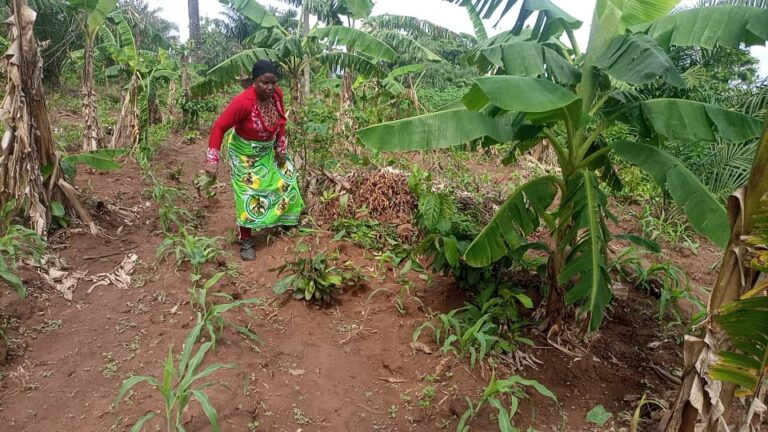
Zainab Ireokeola working on her farm
Meanwhile, the SWOFON chairperson in Oyo State Atinuke Akinbade confirmed that their members only received support from the Small and Medium Enterprises Development Agency (SMEDAN), created by government to support small and medium scale enterprises.
She added that oftentimes this does not go round every women farmer in the association but they had to make do with what is available.
She stated that ten people were trained by SMEDAN on procurement, packaging, managing business ventures, book keeping, and record keeping to ensure profitability and self-reliance.
On efforts to access other loans and grants from the Bank of Industry (BOI), African Development Bank (AfDB), and Bank of Agriculture (BOA), Akinbade said the attempt to get credit facilities from the BOA was unsuccessful because it had yet to register with the Oyo State Trade and Investment to obtain a certificate of incorporation, a major criterion for processing the loans.
The lack of the required certificate has been another stumbling block inhibiting the association from getting interventions from the government, even as the Nigeria Bureau of Statistics (NBS) report showed that only seven percent of women have access to loans from banks.
Investigation has shown that there are limitations in accessing loans and grants such as collateral and certificates of incorporation, among others. Out of the seven per cent, there is no data to show the number of small holder women farmers who have access to loans from banks either directly or through government agencies’ programmes or initiatives.
Akinbade said the association has been working on registering with the Oyo State Trade and Investment Commission to have a certificate that it could use to get grants and loans from BOA and others.
Other FG loans Interventions for SMEs
Oladipo Falana, the Ibadan coordinator of the Nigeria Incentive-Based Risk Sharing System for Agricultural Lending (NIRSAL Plc.), a non-bank financial institution wholly owned by the Central Bank of Nigeria (CBN), said he could not say if there is any intervention for women farmers.
“For now, there is no programme for small holder women farmers, but we are working on one. I can’t speak authoritatively on it but when it is out it will be in the news,” he said.
Another federal government agency, SMEDAN, in Oyo State through its coordinator, Mrs Iyabo Ojogbede, said about 55 to 60 per cent of their interventions are targeted at small holder women farmers.
“At SMEDAN, we have some special programmes for women in small businesses. They include women in self-empowerment, the conditional grant scheme, and agri-business development empowerment.
“Others are entrepreneurship development training and cluster intervention programme for women in agriculture business in cooperative groups,” Ojogbede said.
The Oyo State chairperson of SWOFON said there is a limiting factor that has been identified and being worked on so that women can fully access loans from the government.
Some beneficiaries speak
Two SWOfON members who had benefited from interventions from the government, Nike Fajinmi and Bolatumi Oyelakin, said it had minimally impacted their livelihoods.
“I received a dryer for Garri processing, but we need funds from the government, though we have been assured that we will get loans when we follow the right process.
“The process is that we should form a cooperative so that the government can give us loans,” Fajinmi, a middle-aged small holder woman farmer at Ona-Ara LGA, said.
She said she and her husband, a cocoa farmer, have been into farming and it was the proceeds from their venture that they have been living on and using to send their children to school up to tertiary level.
According to her, loan intervention from the government would enhance farming as the cost of cultivating farmland has increased significantly.
On her part, Oyelakin, who said she benefited from phase two of the SAfER initiative, said, “Two members of SWOFON got a pack of day-old chicks and we divided it into half. A pack has 42 chicks of the day old and we divided it, so each of us took 21 chicks home.
“When I returned to my LGA, I took 10 out of the chicks because I was the one that went to get it using my money for transportation, and I shared the rest with four other members as well as the leader of SWOFON in Ona-Ara LGA.
“The chicks were viable, and they contributed to our livelihoods, though the quantity was small, by the time the bottleneck to accessing SAfER loans was removed, it was too late for many of us who wanted to get it to improve farming businesses and enhance our livelihoods,” she said.
Oyelakin said her husband was into farming and that they have raised their children with the proceeds from agriculture.
Investigation also reveals that there is a need for a review of how the budget is being formulated and implemented so that clear cut benefits can be earmarked for women farmers, and small holder women farmers in particular, who have contributed significantly to food production in Nigeria.
For instance, the 2022 approved budget for the state under the ministry of agriculture, Oyo State Agri-Business Development Agency, and Agric Credit Corporation didn’t spell out what percentage goes to men, women, youth, and the other vulnerable groups who are small scale farmers.
Also, there are overlapping programmes and initiatives from these agencies that could be of great service to the good of every citizen if they were harmonised.
A budget analyst, Anthony Oyedeji, said under normal circumstances there should be consultation before any formal document of budget estimate is prepared.
Oyedeji, who is from the governance and policy unit of the Justice Development, and Peace Commission, (JDPC) stated that people from different zones and local governments, under budget consultation, present their needs according to their priorities.
“That is one of the best ways to gather projects and needs assessments from people, including those in the agricultural sector.
“But the most important thing is to look into databases to know the records of genuine farmers in the state or in the country as a whole – in terms of sex, people with disabilities, and so on.”
Also, a financial consultant, Tunji Adepeju, said that regarding budget preparation and management, it has always been at the administrative end that what goes to who or which gender is factored.
A study of the budget estimate of Oyo State from 2022 to 2024 showed that its budget consultative meeting done yearly under the present government had little or no impact on the actual budget in terms of having a breakdown of how much goes into each category of beneficiaries of whatever programmes or initiatives it has for small holder women farmers.
While stakeholders differ in opinion on the above, some believe that the actual distribution of who gets what is at the administrative level during implementation, while others think otherwise.
This report was made possible with support from the International Centre for Investigative Reporting, ICIR.
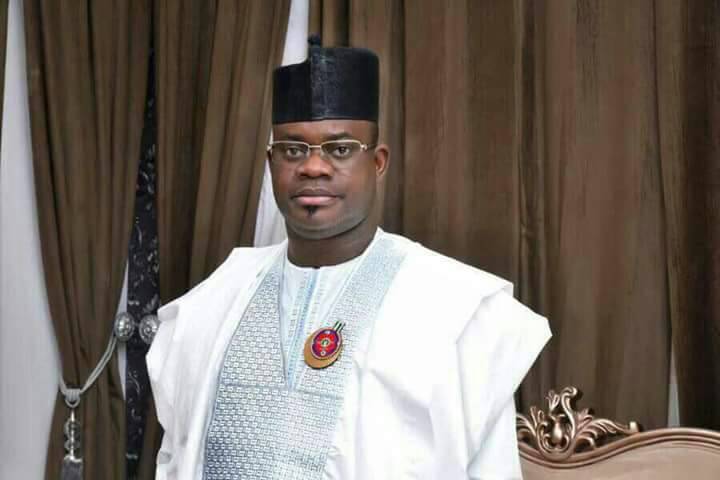
The Court of Appeal in Abuja has ordered Kogi State former governor, Yahaya Bello, to present himself for trial.
The appellate court in a unanimous judgment delivered on Tuesday, August 20, by Ken Amadi, the appeal filed by the Economic and Financial Crimes Commission (EFCC) against the judgment of Isah Abdullahi Jamil, a judge of the Kogi State High Court in a fundamental right case filed by Bello in February 2024.
The court declared that the appeal by Jibrin Okutepa, a senior advocate, on behalf of the EFCC was valid and described as scandalous the lower court’s judgment.
In reaching its verdict, the appellate court adopted the two issues raised by the respondent.
The court held that the trial judge had the charge in FRN VS. ALI BELLO & ANOR, FHC/ABJ/CR/550/2022 at his disposal, but still set Bello free, under the cover of enforcing his fundamental rights.
The court also relied on the earlier decision of Olubunmi Oyewole JCA in EFCC vs. Yahaya Bello, CA/ABJ/CV/413/2024 to reiterate that “No court has the power to stop a law enforcement agent from performing its statutory functions.”
On the whole, the court agreed with the EFCC’s submission and held that the appeal was meritorious and was thereforeallowed.
The court further held, that: “In view of the provision of Section 396(2) of the Administration of Criminal Justice Act, ACJA, the respondent in this appeal, Alhaji Yahaya Adoza Bello is hereby ordered to appear for his arraignment in charge No.: FHC/ABJ/CR/550/2022, FRN VS ALI BELLO & ANOR, before taking any other step in this matter.”
In February, the former governor approached the Kogi State High Court to stop his arrest.
In April, the judge, Jamil had specifically issued an order prohibiting the EFCC from detaining or attempting to arrest the former governor.
The judge issued the order in a two-hour ruling handed out in suit no. HCL/68/M/2020 in Lokoja, the Kogi State capital,
The EFCC is prosecuting Bello and others on an amended 17-count charge of money laundering, breach of trust and misappropriation of N84 billion.
After failing to appear in court, the EFCC declared Bello wanted.
The ICIR reported that EFCC operatives stormed Bello’s Abuja home on Wednesday, April 17, to arrest him.
However, the arrest was unsuccessful, as multiple reports say the Kogi State governor, Ahmed Usman Ododo, smuggled out the former governor.
HUMAN Rights lawyer, Femi Falana, has told the Nigeria Police Force (NPF) that his client and president of the Nigeria Labour Congress (NLC), Joe Ajaero, would honour the police invitation immediately, as demanded.
Falana, a senior advocate, in a letter addressed to the inspector general of police (IGP), Kayode Egbetokun, through the deputy commissioner of police (DCP) Mohammed Ahmed Sanusi, explained that Ajaero had fixed a meeting for August 20, before the police invitation was sent to him on Monday, August 19.
He promised that Ajaero would be available at the police headquarters on August 29.
Falana also requested the police to provide him with details of the allegations of criminal conspiracy, terrorism financing, treasonable felony, subversion and cybercrime levelled against the NLC president.
.The letter partly read, “Comrade Ajaero is prepared for your interview on Wednesday, August 29, 2024. Furthermore, in accordance with the provisions of section 36 of the Constitution of the Federal Republic of Nigeria, 1999 as altered, comrade Ajaero requests for the details and nature of the allegations of criminal conspiracy, terrorism financing, treasonable felony, subversion and cybercrime levelled against him.”
The ICIR reported that the NLC on Tuesday, August 20, threatened to shut down the nation’s economy following the police’s invitation to Ajaero.
Earlier, on Monday, August 19, this organisationreported that the police asked Ajaero to appear at the force headquarters on Tuesday, August 20, by 10 am for alleged terrorism financing.
In an invitation letter signed by Adamu Muazu, an assistant commissioner of police (ACP) on behalf of the deputy commissioner of police, Intelligence Response Team, the police requested Ajaero’s presence for questioning.
It further warned that an arrest warrant would be issued if he failed to make himself available.
Recall that the NLC had accused officers from the police and the State Security Service (SSS) of invading its Abuja national office – the Labour House – on Wednesday, August 7.
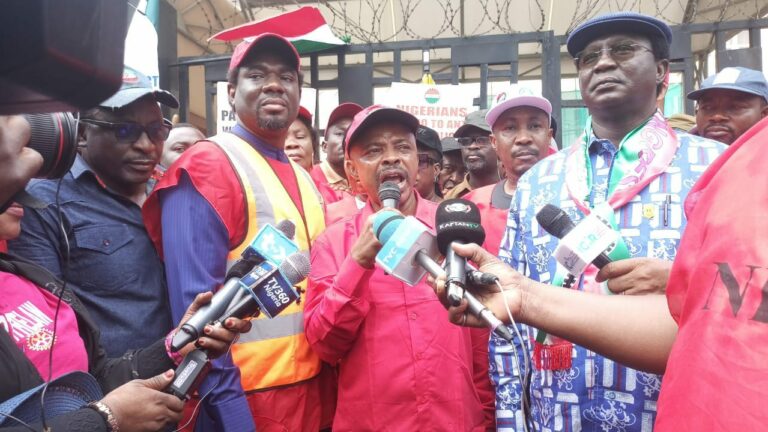
At its emergency national executive council meeting held on Tuesday, August 20, the NLC resolved that Ajaero would honour the invitation but warned to mobilise workers across the country to disrupt the nation’s economic activities if the police detain him.
A STUDENT of Kwara State College of Health Technology, Mojisola Awesu, has been found dead at a refuse dump in Aleniboro, Ilorin, the state capital.
The 21-year-old lady was allegedly contracted by her friend to act as a girlfriend for another private varsity student at a party for N15,000
In a statement made available to The ICIR by the Kwara State police public relations officer, Toun Ejire-Adeyemi on Tuesday, August 20, the police command in the state had commenced an investigation into the death.
According to the statement, an Ilorin resident, Olorunoje, had reported to the police on August 12 that some labourers approached him on his way back from the mosque and told him about a dead body they found at a refuse dump in the metropolis.
The PPRO noted that a team of detectives were sent to the scene for investigation, after which the dead body was identified to be Awesu Mojisola.
“A team of detectives was immediately dispatched to the scene. Upon arrival, the scene was carefully examined and photographed. During the initial investigation, traces of blood were found near the left ear of the deceased.
“The body was subsequently taken to the General Hospital in Ilorin, where a medical examination confirmed that she was dead. The body has since been deposited in the hospital morgue. The deceased was later identified as Miss Awesu Mojisola.”
Ejire-Adeyemi added that the deceased’s roommate in the Gbomi area of Offa town in the state later filed a report of a missing person, indicating that the roommate had been missing since Friday, August 9.
The missing roommate was said to be the late Awesu Mojisola who had received a call from another person and was invited to a party organised by some students of two private universities in the state.
“Miss Mojisola received a phone call on August 9 from one Miss Timileyin, who informed her about an event organized by students of Summit University and Al-Hikmah University in Ilorin.
“Miss Timileyin introduced Mojisola to one Mr. Adebayo Happiness, a student of Summit University, who allegedly invited her to the night party under the pretence of having her act as his girlfriend for a fee of fifteen thousand naira (N15,000.00).
“Upon her arrival in ilorin, Miss Mojisola informed her roommate that she felt uncomfortable in the hotel she was lodged by Adebayo Happiness and noted that there was no party at the said location. Shortly after this communication, her phone was switched off and all subsequent efforts by miss Blessing to reach her were unsuccessful, the police said in the statement.
The police, however, noted that they had arrested the suspects in connection with the case, adding that the case had been transferred to the State Criminal Investigation Department (SCID) for further discreet investigation.
THE world’s oldest person, Maria Branyas Morera, from Spain, has died at the age of 117, her family disclosed on Tuesday, August 20.
“Maria Branyas has left us. She died as she wished: in her sleep, peacefully and without pain,” her family wroteon her X account.
“We will always remember her for her advice and her kindness,” the family added.
The World Guinness Record also confirmed Branyas’ passing on Tuesday in a post, stating “Guinness World Records is saddened to learn that the world’s oldest person, Maria Branyas Morera (USA/Spain), passed away yesterday, 19 August. Her death was confirmed by the Gerontology Research Group.
“Aged 117 years 168 days, she was the eighth-oldest person (with a verifiable age) in history. Maria passed away peacefully at the nursing home in Catalonia, Spain, where she resided for the past two decades.”
Branyas was born in San Francisco on March 4, 1907 in San Francisco, after her family moved to the United States from Mexico.
She lived for 117 years and 168 days and lived through two world wars, the First and Second World Wars and Spain’s civil war.
She also lived through the 1918 flu. In 2020, she caught Covid a few weeks after her 113th birthday.
Her long life, according to her youngest daughter, Rosa Moret, is attributed to ‘genetics’.
“She has never gone to the hospital, she has never broken any bones, she is fine, she has no pain,” Moret had said.
In January 2023, she was acknowledged by Guinness World Records as the world’s oldest person after the death of French nun Lucile Randon, aged 118.
Following Branyas’s passing, the next oldest living person in the world is Japan’s Tomiko Itooka, who is 116 years old. Itooka was born on May 23, 1908.
The oldest verified person to have ever lived was Jeanne Louise Calment, a Frenchwoman who died in 1997 at the age of 122 years and 164 days.
THE Nigeria Labour Congress (NLC) on Tuesday, August 20, threatened to shut down the nation’s economy following the police’s invitation to its president, Joe Ajaero, over allegations of terrorism financing, subversion, and related offences.
According to a report by Punch, the workers’ union, resolved to embark on the nationwide strike should the police detain or arrest its national president.
The ICIR reported on Monday, August 19, that the Nigeria Police Force (NPF) summoned Ajaero over allegations of terrorism financing, treasonable felony, and related offences.
In an invitation letter signed by Adamu Muazu, an assistant commissioner of police (ACP) on behalf of the deputy commissioner of police, Intelligence Response Team, the police requested Ajaero’s presence for questioning on Tuesday, August 20, in Abuja by 10 am.
It further warned that an arrest warrant would be issued if he failed to make himself available.
Responding, the NLC resolved that Ajaero honour the invitation.
It, however, warned to mobilise workers across the country to disrupt economic activities, if he is detained.
This resolution was reached at the end of its emergency National Executive Council meeting held Tuesday morning.
The NEC meeting started around 8:30 am with all heads of affiliates and state chapters of NLC in attendance.
Recall that the NLC had accused officers from the police and the State Security Service (SSS) of invading its Abuja national office – the Labour House – on Wednesday, August 7.
According to a statement by the NLC spokesperson, Benson Upah, the operatives arrested the security guards on duty. They forced them to hand over keys to the office on the building’s second floor.
Upah added that the operatives broke into the floor, ransacked the bookshop, and stole hundreds of books and publications.
THE sales of crude oil to the Dangote Refinery in naira will begin on October 1, 2024, the minister of finance and coordinating minister of the economy, Wale Edun, has said.
Edun disclosed this at the implementation committee meeting on the transition to crude oil sales in naira in Abuja on Monday, August 19, according to a statement posted on the ministry’s official X handle.
“The meeting reviewed progress on key initiatives, including the upcoming commencement of naira payments for crude oil sales to the Dangote Refinery starting October 1, 2024,” Edun said.
In addition, the executive chairman of the Federal Inland Revenue Service (FIRS) and the chairman of the technical sub-committee, Zacch Adedeji, hinted that the Dangote Refinery was likely to deliver its first petrol product in September.
“The first PMS delivery from Dangote is expected next month under existing agreements,” Adedeji said.
At the meeting, key roles were outlined for stakeholders, including the Nigerian Midstream and Downstream Petroleum Regulatory Authority, the Central Bank of Nigeria (CBN), the Nigerian Upstream Petroleum Regulatory Commission, and the African Export-Import Bank.
Although the roles were not disclosed, the involvements were aimed at ensuring a smooth implementation of crude oil sales to local refineries.
“The minister emphasised the need for transparency and directed the Technical Sub-Committee to finalize details and prepare a report for the President, confirming that his directives are on track for implementation from September,” the statement added.
President Bola Tinubu had on July 29, directed the Nigerian National Petroleum Company Limited (NNPCL) to sell crude to Dangote refinery and other upcoming refineries in naira.
He approved 450,000 barrels meant for domestic consumption for the Dangote refinery.
The directive came after the Federal Executive Council (FEC) intervened in the accusations and counter-accusations between the Dangote refinery and the regulatory authorities in the oil sector over the selling of crude to the refinery.
The ICIR reports that management of the Dangote refinery has lamented not getting crude oil supply to its refinery, forcing the company to source crude from the United States and other countries to serve its 650,000-capacity nameplate refinery.
In a related development, the publicity secretary of the Crude Oil Refiners Association of Nigeria (CORAN), Eche Idoko, noted there were uncertainties around the regime of supplies, sales, and pricing of PMS, the reason why the domestic refineries have not started getting crude in naira, The ICIRreported.
THE Nigerian National Petroleum Company Limited’s (NNPCL) indebtedness denial may have stirred up a hornet’s nest over the company’s undisclosed records and delay in listing on the Nigerian stock exchange.
A media report had alleged that the NNPCL owed $6.8 billion to international oil traders which the company denied but contradicted itself.
In a statement on Sunday, August 18, its chief Corporate communications officer, Olufemi Soneye, claimed that the NNPCL does not owe the sum of $6.8 billion to any international trader(s).
“In the oil trading business, transactions are carried out on credit, and so it is normal to owe at one point or the other.
“But NNPC Ltd., through its subsidiary, NNPC Trading, has many open trade credit lines from several traders. The company is paying its obligations of related invoices on a first-in-first-out (FIFO) basis,” Soneye stated.
While Soneye’s quote appeared contradictory, it begged the questions about the disclosure of NNPCL’s financial records and delay in listing on the stock exchange.
In March 2024, the group chief executive officer of NNPCL, Mele Kyari, raised public anticipation for the listing of the company’s shares on the stock market as provided for in the Petroleum Industry Act (PIA), after earlier promises, without giving a definite timing.
He said the company would list soon when he participated at the international oil and gas players meeting at the 2024 CERAWEEK in Houston, United States.
Earlier in July 2023, at the Nigeria Oil and Gas Energy Conference and Exhibition held in Abuja, Kyari said the NNPCL planned to issue its Initial Public Offer(IPO) to investors soon.
The ICIR can report that at the unveiling of the NNPCL as a commercial entity in July 2022, Kyari had said the company would be ready to list its shares on the stock exchange by the middle of 2023.
His yet-to-be-fulfilled promise came shortly after the NNPC became a limited liability company on July 1, 2022, after former President Muhammadu Buhari signed the PIA.
In the statement on Sunday, Soneye also refuted the report’s claim that it has not remitted revenues to the federation account since January, among other issues.
He claimed it was incorrect to say that NNPCL has not remitted any money to the Federation Account since January, asserting that NNPCL and all its subsidiaries remit their taxes to the Federal Inland Revenue Service (FIRS) regularly in addition to payments of company income tax (CIT) to road contractors under the Road Investment Tax Credit Scheme.
“In all, NNPC Ltd. is the largest contributor to the tax revenue shared every month at the Federation Account Allocation Committee (FAAC),” he said.
NNPCL contradicts self
Commenting on the NNPCL’s statement, an energy expert, Kelvin Emmanuel, said that the state-owned firm contradicted itself over the alleged debt.
NNPC’s failure to pay either through cash or equity in feedstock drills a hole into Nigeria’s purse
He noted that in the oil business, transactions are carried out on credit and it is normal to owe at one point or the other.
“In one breath, you’ve denied owing traders, and in the same statement, you’ve acknowledged owing,” Emmanuel pointed out.
He explained that it takes 60 trading day transactions for NNPCL’s balance sheet to read as payables to international traders for crude oil swap deals.
He said based on the modified carry agreements signed, there’s a clause that specifies that if payments were not made in 60 days, the trader is to apply a London Interbank Offered Rate (LIBOR) of between 1.5 to two per cent and add a country risk premium of five per cent (based on the risk profile of Nigeria).
“I did that calculation and it came to $ 476 million per annum for 7 per cent of $6.8billion. If we prorate that annual rate, you’ll arrive at $1.3million in interest per day as demurrage for not paying your T-60 when due.
“Can you now see that the failure to pay either through cash or equity in feedstock will drill more holes in the finances of the country you’re supposed to be supplying with royalties based on sections 64(c) of the PIA,” Emmanuel explained.
He maintained that the NNPCL had not remitted royalties to the federation account since January, stating that taxes to FIRS were different from royalties to the federation account.
“If you want to be transparent to the media, let your board order for an external forensic audit of your accounts for the last 20 years,” Emmanuel made the call on the NNPCL to prove its transparency and accountability.
Nigerians react
A mixed reaction has however trailed NNPCL’s denial of the allegations.
An X user, Baluma Bukar, said, “NNPC Limited’s proactive and transparent response to the allegations is a breath of fresh air! Their willingness to address concerns and provide accurate information shows a genuine commitment to accountability and integrity.”
On the other hand, another X user, Agbalaka, queried, “Why would they owe any money when they have been selling the oil well in advance since Buhari was the petroleum minister?”
Another user, @Farouq_SG, tweeted, “The rate of damage control you guys are putting out these days is embarrassing. Too much damage control only means that you are not being transparent enough. You need to do better.”
THE #EndBadGovernance protest in Nigeria from August 1 to August 10 took a rather unexpected dimension when some protesters in Kano and Kaduna states, both in the country’s north-west region, were seen waving and sharing Russian flags on the streets. In reaction, Nigeria’s President Bola Tinubu met with the country’s security chiefs and the police made a number of arrests. The Russian embassy in Abuja denied any meddling in Nigeria’s internal affairs. The concern is that Nigeria’s northern region shares a poorly policed 1,497km border with Niger Republic, where a pro-Russia military junta currently holds sway.
The Conversation Africa asked Olayinka Ajala, an international relations expert who has researched the region for over a decade, what this means for Nigeria.
Why were some protesters waving the Russian flag?
One possible explanation is that the protest was infiltrated by some Nigeriens to register their displeasure with the Nigerian government attitude towards the military junta in Niger and also to embarrass the government. The Nigerian President, Bola Tinubu, who also doubles as the chairman of the Economic Community of West African States (ECOWAS), imposed sanctions on Niger when the military took over in 2023. This argument about foreign infiltration confirms my previously stated view that the withdrawal of Niger, Mali and Burkina Faso from the regional grouping, Ecowas would lead to the exodus of citizens to other countries in the region, threatening their stability.
It is very difficult to police the Nigerian borders, but more should have been done to prevent infiltration, given the long notice provided by the protest organisers.
What risk does Wagner’s presence in Niger pose to Nigeria?
Seven Nigerian states share borders with the Republic of Niger. For decades, people from Niger and northern Nigeria have freely travelled between the two countries for work and family related issues. This also comes with security challenges. Violent non-state actors are able to move freely, as seen with groups such as Boko Haram.
With the expanding relationship between Niger and Russia, the Wagner group – a private military organisation fronting for Russia and involved in fighting terrorism in the Sahel – poses a threat to the entire region, especially Nigeria. There is no effective border between the countries and people can easily move in and out.
The Wagner group, like any other private military organisation, operates with impunity and is not accountable. It has been accused of gross human rights abuses on several occasions. While Russia does not openly back the group, it is common knowledge that it is sponsored by Russia.
In addition, the Wagner group has been identified as a potential threat to security and democracy in Nigeria. This is because of their mode of operation and interests in exploiting natural resources. A recent study has shown that foreign criminals are involved in gold exploration and insecurity in Zamfara, one of the states sharing borders with Niger. The Nigeria security agencies therefore need to keep an eye on the activities of the group in neighbouring Niger.
There is no evidence yet of Wagner operating in Nigeria, but there is a risk it could infiltrate the porous borders and undermine Nigeria’s security.
Should Nigeria be worried about Russia meddling in its internal security?
Yes, Nigeria should be worried. Waving foreign flags in a country undermines the country’s sovereignty and internal security. Russian flags were waved in Mali, Burkina Faso and Niger after the military took over. The protesters waving the flags in Nigeria openly called for a coup and Russian intervention in the country. Nigeria’s chief of defence has labelled this a treasonable offence.
Although the Russian embassy in Nigeria denied any involvement, there is evidence that Russia is keen to expand its influence in the Sahel region. It is important to understand that the security and stability of the Sahelian states has an impact on Nigeria and other coastal countries in west Africa.
During the protest in Kano state, seven Polish citizens were arrested for raising Russian flags. The spokesperson of Nigeria’s State Security Service said the Polish citizens were arrested while participating in the protest. The Polish government argued they were only in the country to study the Hausa language.
This further raises the suspicion of foreign interference in the country, which could destabilise the already fragile security architecture.
The recent attacks in Mali which led to the death of Malian soldiers and Wagner fighters were supported by Ukraine special forces. This is already raising concern of a new proxy war in the region. ECOWAS has rightly condemned “outside interference” in the region. This is another reason why Nigeria should be worried about any semblance of foreign influence within its borders.
How should Nigeria protect itself from Russian influence in its neighbourhood?
Nigeria has a fairly strong relationship with Russia but must act to prevent any form of interference. In 2021, Nigeria signed a military agreement with Russia and currently buys weapons from Russia.
Despite that, the country should be wary of private militia groups, including Wagner. A better relationship with its neighbours, especially those where Wagner is operating, would enable it to monitor the activities of the group.
The government also needs to quickly identify, arrest and prosecute individuals trying to destabilise the country.
Furthermore, the Mali attacks are an indication of increased foreign influence in the west African region. Nigeria should use its position as the chair of Ecowas to strongly condemn such activities.