THE National Agency for Food and Drug Administration (NAFDAC) said it recovered fake products worth N50 million during a raid on some stores in the Abuja area of Nigeria’s Federal Capital Territory (FCT).
NAFDAC conducted the raid in areas including Garki, Wuse, Utako, Kugbo, Nyanya, and Mararaba.
The agency disclosed this via a statement on its official X handle on Saturday, April 20, 2024.
Fake Nivea products comprised a huge part of the goods seized, valued at N45 million by NAFDAC.
“During the operation, counterfeit cosmetics were discovered and seized at Sahad Stores, H-Medix, and various markets, while fake drugs were confiscated at Utako market.
“Counterfeit NIVEA products, cosmetics, Jik bleach, Harpic toilet cleaner, and Airwick room freshener were all confiscated. The total value of the seized goods amounted to N50 million, with fake NIVEA products alone valued at N45 million,” the statement read.
According to the statement, NAFDAC Head of Investigation and Enforcement/Federal Task Force in Abuja Embugushiki-Musa Godiya stated that the fake goods, especially NIVEA products, were sold at higher prices than approved products and expressed concern over the development.
“He emphasised the health risks posed by such counterfeit goods, including the potential for cancer, kidney damage, and skin rashes. NAFDAC reaffirms its commitment to rooting out counterfeit syndicates and safeguarding public health,” the statement read.
The production and sale of fake products have raised concerns for many Nigerians, some of whom have blamed the recurring problem on economic realities in the country.
In March, NAFDAC uncovered illegal factories producing and distributing various brands of alcoholic beverages at the Trade Fair Complex in Lagos State.
MULTI-NATIONAL food company Nestle has denied adding sugars to milk, cereal, and other infant products sold to some low and middle-income countries, including Nigeria, despite laboratory results to the contrary.
This was contained in a statement released on Thursday, April 18, following an investigation by Swiss investigative organisation Public Eye in collaboration with International Baby Food Action Network.
“Baby food and infant formula are highly regulated categories. We apply the same nutrition, health, and wellness principles everywhere in the world which are aligned with both international and local guidelines and regulations. This includes compliance with labeling requirements and thresholds on carbohydrate content that encompasses sugars.
“Regarding cereals, there may be slight variations in recipes around the world. In Europe, Nestle’s range of cereals comes with and without added sugars. Like everywhere in the world, in Nigeria, we do not add sugars (sucrose and glucose) to infant formulas for children aged 0-12 months. In Nigeria, our growing-up milks have no added sugars. Our milks and cereals for young children are fortified with vitamins and minerals such as iron to help tackle malnutrition,” the statement read.
Laboratory tests conducted on Nestle’s baby food sold in Asia, Africa, and Latin America during the investigations revealed added sugar in products like Cerelac and Nido.
However, baby food sold for children between one and three years in Europe had no added sugars, according to the results of the tests which were conducted in a Belgian lab.
“In Nigeria, one product tested had up to 6.8g, but in Nestlé’s main European markets, including the UK, there is no added sugar in formulas for young children. While some cereals aimed at older toddlers contain added sugar, there is none in products targeted at babies between six months and one year,” the report partly read.
This is contrary to the World Health Organization (WHO) guidelines against adding sugar to foods for babies.
The WHO warned that high levels of sugar in baby foods might result in chronic diseases, obesity and addiction to such additives.
The National Agency for Food and Drug Administration and Control (NAFDAC), responsible for the regulation of such products, also denied being aware of added sugar in the products being imported for children’s consumption on Thursday.
This is not the first time Nestle has been indicted in such activities in Nigeria.
In 2019, The ICIRreported that Nestle’s water factory in Manderegi, a community within Nigeria’s Federal Capital Territory (FCT) was contaminating the people’s water source, leading to a lack of potable water for the residents and environmental degaradation.
The company also failed to keep its promise of providing access to water, which it made to the residents upon commissioning the factory. This promise was later redeemed following The ICIR’s report.
RIVAL supporters of two aspirants of the Ondo State All Progressives Congress (APC) stirred up violence on Saturday, April 20, 2024, at Ward 1, Stella Maris College, Okitipupa, during the party primaries being held ahead of the state’s governorship elections.
According to the News Agency of Nigeria (NAN), the violence between two groups of supporters disrupted the voting process, leaving voters who had gathered at the Ward scampering for safety even before the accreditation process began.
Eyewitnesses also told NAN that a party agent had arrived on the scene, snatched accreditation documents and run away, leading to the unrest in the area.
Meanwhile, some aspirants have called for a cancellation of the process over issues with the distribution of materials.
Some of the aspirants led by Gbenga Edema alleged that the APC Electoral Committee led by Kogi state governor Ahmed Usman Ododo was not being transparent in discharging his duties and asked the leadership of the party to replace him immediately.
“That they should come to BON Hotel to collect the materials and that accreditation will start by 10 a.m., to be completed by 1 p.m. while voting proper will start by 1 p.m. and end by 2 p.m., then the announcement of the results.
“As I am talking to you now, this is 10:40 a.m. We’ve been here since 6 a.m., believing that our people would collect the materials, but unfortunately, at about 9:30 a.m., His Excellency Governor of Kogi State, Usman Ododo, came out to tell us that materials had been distributed. At what time? In what places? We don’t know!
“Unfortunately, for him, the returning officers and electoral officers of my ward, Mahin Ward II in Ilaje local government are here and unable to collect any material. What we are asking for is a credible election. So, we are asking the leadership of the party to look into this. If they’re not ready for this election, they should postpone it and the right thing should be done,” Edema was quoted as saying.
The Ondo state governorship election is scheduled for November 2024. One of the aspirants under the APC is the incumbent governor Lucky Aiyedatiwa. He became governor four months ago following the death of his principal, Rotimi Akeredolu.
Managing Director (MD) and Chief Executive Officer (CEO) of First Bank of Nigeria (FBN) Adesola Adeduntan has resigned from his position at the organisation.
Adeduntan has occupied the position for the past nine years.
Although his tenure would be completed in December 2024, Adeduntan stated in his resignation letter that he was proceeding with retirement earlier than the date.
“As you are aware, my contract would be expiring on 31 December 2024, after which I would no longer be eligible for employment within the bank, having served as the Managing Director/Chief Executive Officer of First Bank for a record time of nine years.
“I have, however, decided to proceed on retirement with effect from 20 April 2024, to pursue other interests,” he noted in his resignation letter.
Adeduntan’s tenure should have ended in 2021.
Shortly before his tenure expired, former FBN Chairman Ibukun Awosika removed him from the position, a decision she described as being taken in the bank’s best interest.
The bank announced Gbenga Shobo as its new MD in April 2021, but the intervention of the Central Bank of Nigeria (CBN) under the leadership of its former governor Godwin Emefiele, cut Shobo’s regime short and led to Adeduntan’s reinstatement.
“We were not informed of any misconduct, neither were we informed of any query. We suspect –I like to use the word suspect –that it was because he had stood his grounds on certain decisions that are not in favour of major shareholders of the bank, that they felt and thought he should be removed,” Emefiele had said of his removal.
The CBN Governor ordered the removal of the FBN Chair and other directors and reinstated Adeduntan, who served as MD/CEO for a third time.
THE All Progressives Congress (APC) in Ondo State is set for a significant showdown today, April 20, as 16 aspirants, including Governor Lucky Aiyedatiwa and the senator representing Ondo South, Jimoh Ibrahim, Olusola Oke, compete for the party’s governorship ticket.
On Saturday, April 13, the party cleared the 16 aspirants seeking their ticket to contest the November 20 Ondo State Governorship election.
The ICIR reports that the seven-man screening committee, led by a senator Joshua Lidani, gave all the aspirants the nod to contest the April 20 primary election.
They are Governor Lucky Aiyedatiwa; the Senator representing Ondo South, Jimoh Ibrahim; a Senior Advocate of Nigeria, Olusola Oke; former President of Nigerian Medical Association, a professor. Francis Faduyile; a doctor Funmi Waheed-Adekojo and the APC National Vice Chairman (South-West), Isaacs Kekemeke.
Others are Soji Ehinlanwo, Akinfolarin Samuel, Okunjimi Odimayo, Adewale Akinterinwa, Olugbenga Edema, Gen. Ohunyeye Olamide, Morayo Lebi, Garvey Oladiran Iyanjan, and Ifeoluwa Oyedele.
Following the clearance, the ruling party announced that 171, 922 members drawn from the 203 wards of the 18 local government areas of the state will take part in the primary election.
The party’s National Organising Secretary, Muhammad Argungu, disclosed that the Independent National Electoral Commission (INEC) had sent the party the Certified True Copy of the 173,181 membership register, and the party’s revalidation brought the number down to 171,922.
Governor Ahmed Usman Ododo of Kogi State is slated to chair a seven-member committee tasked with overseeing the electoral process, while the former Bauchi Governor Mohammed Abubakar is expected to lead the five-member Primary Election Appeal Committee.
As stated by the Organising Secretary, the duo will play a crucial role in maintaining fairness, transparency, and inclusivity throughout the process.
According to reports, Aiyedatiwa and Jimoh Ibrahim ace the contest due to the power of incumbency, and the latter banking on his relationship with President Bola Tinubu and two former senators from the state.
The ICIR reported that Aiyedatiwa was sworn in as Ondo State governor on Wednesday, December 27, 2023, following the death of his predecessor, Rotimi Akeredolu, who passed away in the early hours of the same day after a prolonged illness.
Since then, he has garnered support from numerous party members and stakeholders despite Gbenga Edema, one of the aspirants, alleging certificate forgery against Aiyedatiwa.
The vetting committee headed by Abdulkarim Kana, a professor, dismissed the petition, noting that Aiyedatiwa presented a genuine academic certificate to the party.
THE Nigeria Police Force (NPF) detained Aide-de-Camp (ADC) to former Kogi State Governor Yahaya Bello along with his other security details on Friday, April 19, 2024.
According to a report by Saturday PUNCH, the ADC and other police officers attached to the former governor are being detained at the State Criminal Investigation Department at the Federal Capital Territory (FCT).
Sources within the police who spoke anonymously disclosed that the officers were apprehended on the orders of the Inspector-General of Police (IGP) Kayode Egbetokun over suspicions that they assisted Bello escape arrest by the Economic and Financial Crimes Commission (EFCC) earlier in the week.
“Yahaya Bello’s female ADC and other police officers attached to him were brought to the command this morning, and they’ve been detained for aiding and abetting (the governor’s escape),” Saturday PUNCH quoted the source as saying.
The ICIR reached out to the Public Relations Officer (PRO) of the FCT Police Command Josephine Adeh to confirm the arrests.
She told The ICIR that she has yet to be briefed on the issue.
“I have not been briefed, but I will confirm and get back to you,” she noted in a text message.
The EFCC declared Yahaya Bello wanted on Wednesday, April 17, over allegations of fraud totaling N80.2 billion.
A notice declaring him wanted was posted via the EFCC’s official social media handles following the Commission’s botched attempt to apprehend him at his Abuja residence the previous day.
The arrest was unsuccessful, as the current Kogi State Governor, Ahmed Usman Ododo, was reported to have driven into Bello’s home and smuggled him out.
The federal government also placed Bello on a watch list for breach of trust, money laundering, and conspiracy.
This was contained in a memo signed by the Nigeria Immigration Service, which also copied the Nigeria Customs Service, State Security Service, Police, and some other security agencies.
“I am directed to inform you that the above-named person has been placed on a watch list. Suffice it to mention that the subject is being prosecuted before the Federal High Court Abuja for Conspiracy, Breach of Trust, and Money Laundering vide letter Ref; CR; 3000/EFCC/LS/EGCS.1/TE/V 1/279 dated April 18, 2024.
“If seen at any entry or exit point, he should be arrested and referred to the Director of Investigation, or contact 08036226329/07039617304 for further action. Please, accept as always the Comptroller-General’s warmest regards and esteem,” the document read.
Following the failed arrest, the IGP ordered a withdrawal of all police officers attached to the former governor on Friday morning.
MOST Nigerians have taken to their social media handle to celebrate a renowned Nigerian chess player, Tunde Onakoya, as he completed his attempt at the Guinness World Record (GWR) for the longest chess marathon.
Although the Guinness World Record has not officially confirmed the new record, many Nigerians, including President Bola Tinubu’s minister and other influential figures who have initially drummed support for the chess master, took to social media to celebrate his successful attempt.
Onakoya surpassed the previous world record set at 56 hours, 9 minutes, and 37 seconds by Norwegians Hallvard Haug Flatebø and Sjur Ferkingstad in 2018.
He exceeded this record at 7:39 PM EST (12:39 AM WAT), since the start of the chess marathon at 11:30 AM EST (4:30 PM WAT) on Wednesday, April 17, 2024. He further chose to extend his effort to 60 hours instead of the originally planned 58 hours before commencing.
He attempted, hoping to raise $1m (£805,000) for charity to support chess education for millions of children. However, as of the time of writing this report, he had only raised $101,673.36 through his Tiltify account.
Onakoya had on Thursday, April 12, 2024, posted on his X handle that he would attempt to set a new chess record by playing chess for 58 hours without losing a game.
“On the 17th of April 2024, I will attempt to break the Guinness World record for the longest Chess marathon in the heart of Times Square, New York City, for 58 hours without losing a game. Doing this for the dreams of millions of children across Africa without access to education.” Onakoya wrote.
Although the Guinness World Record has not officially confirmed the new record, many Nigerians, including President Bola Tinubu and other influential figures who have initially drummed support for the chess master, took to social media to celebrate his successful attempt.
Announcing his successful attempt, Onakoya wrote, “WE HAVE DONE IT,” on his X handle.
Nigerians jubilate, and applaud Onakoya for his perseverance
Following the record-breaking chess Marathon event, Nigerians across the country have showered praise upon Onakoya for setting a new record and his remarkable display of perseverance.
Most of them, particularly X, took to their social media handles to applaud his new feat and also called for donations to his charity project.
Some also claimed that his recent achievement has not only captured the attention of the nation but has also become a source of inspiration and pride for many.
The Minister of Communications, Innovation and Digital Economy, Bosun Tijani, celebrated the achievement of Onakoya, stating, “What an achievement!! Followed this Guinness World Record attempt with keen interest. Congratulations to@Tunde_OD”
Niyi Oyedeji, a renowned journalist and fact-checker, wrote, “Congratulations to Tunde Onakoya@Tunde_OD for displaying grit and tenacity. You’re an inspiration to many young people out there, and I celebrate you for the sterling work you do.”
Also, another user, with the username Nkechi First, posted, “Oh wow! I love resilience. Congratulations Tunde Onakoya@Tunde_OD for your Chess marathon and your new Guinness World Record. You are an inspiration.”
Several other Nigerians have flooded different social media channels, expressing their pride and admiration for Onakoya’s extraordinary accomplishment.
IN the afternoon of Monday, April 15, Abdulrazaq Jeje was hanging out with friends and members of the National Association of Nigeria Students (NANS) factional group at Area 3 in Abuja when he saw an attack that almost snuffed life out of him.
He had gathered with the group led by Pedro Chibuzor Obi to plan Obi’s inauguration as one of the NAN’s factional presidents.
The inauguration was scheduled for Tuesday, April 16.
Jeje served as the secretary of the inauguration committee.
Soon after the brief meeting, they noticed a black car which drove by; not long after, a group of assailants arrived and descended on them.
At least 20 individuals armed with axes, cutlasses and sticks pounced on them, say eyewitnesses who spoke with The ICIR.
Even after sustaining several cuts, Jeje attempted to flee, but he could not because of multiple wounds on his body.
Family and eyewitnesses who spoke with The ICIR confirmed that the incident happened around 1 p.m., a few minutes after they had come into the garden.
Jeje identified his attackers to include Emonefe Lucky, NANS factional leader, who was said to have led the group that carried out the attack. Others he mentioned are Babatunde (Babatee), Akaba, who was said to be Lucky’s chief security officer and Decimal.
However, Babatunde has denied the allegations, noting that the accusers should involve the police.
When The ICIR reached out to Lucky for his reaction to the allegations, he neither picked up calls placed on his line nor replied to messages sent to him.
Backstory
The attack was said to have been prompted to stop Obi’s inauguration as the NANS president.
Speaking with several sources, The ICIR gathered that the national students’ body currently has two factional leadership, resulting from the election held late last year.
It was also gathered that the body initially planned to hold an election at the Old Parade Ground in Abuja, but security operatives stopped it and forced it to move it to another location.
The ICIR observed that while some section of students, including some NANS’ past leaders, held the election at Agura Hotel that same night, another group, which allegedly enjoyed the support of the Senior Special Assistant to the President on Student Engagement, Asefon Sunday, later held its election at the Old Parade Ground on the same night.
The election held at the Old Parade Ground was reported to have been riddled with crisis. This led to the death of some students, while many others were severely injured.
The election at the Old Parade Ground produced Lucky, while the election at the Agura Hotel produced Obi as the president of the student body.
At separate media conferences in Abuja after the elections, Lucky and Obi said their emergence had given NANS a new lease of life.
However, the senior special assistant to the president on student engagement, Asefon congratulated Lucky and the other new executives and charged them with working with his office to benefit Nigerian students.
In a statement posted on his X handle, Asefon said, “I extend my sincere congratulations to you, Comr. Emonefe Lucky of College of Education Warri, Delta State, Comr Akinteye Babatunde Afeez (Babtee) as the new President-Elect and Senate President-Elect, respectively.
“Let your actions and decisions reflect high standards of NANS and always strive to serve its members with dedication and integrity. May your tenure be filled with success, collaboration, and transformative initiatives that uplift the entire student body.”
Since then, the two factions have been at loggerheads for recognition by the authorities.
Jeje undergoes surgery, treatment worth over N200,000
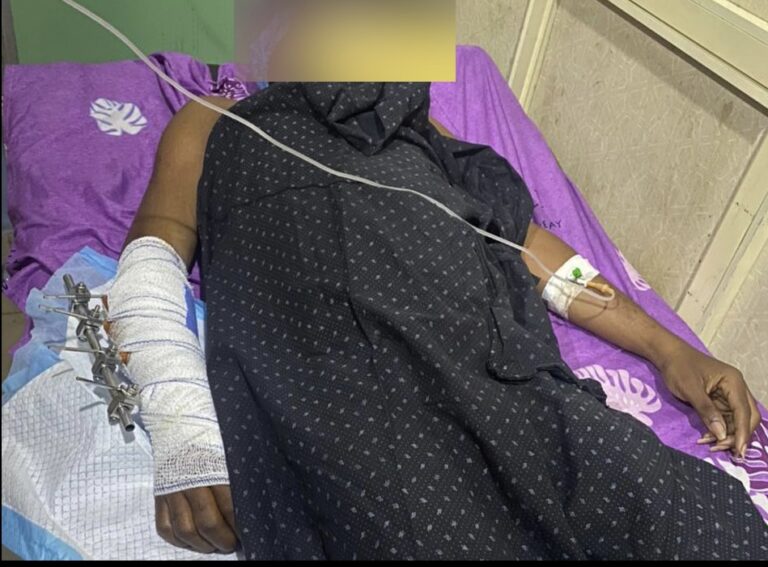
AbdulRasaq Jeje at the Garki Hospital after his surgery
According to Jeje’s wife, Yaqub Salmat Abolore, although the surgery went well, her husband is still in a lot of pains.
“Yesterday (Wednesday April 17), the surgery was concluded around 2 a.m.. Not until they finished the surgery, he could not sleep because he was feeling pain all over his body, he was seriously crying.
“The surgery cost N140,000, but we have been paying for other treatments before the surgery. Also, about three blood pints were donated.”
Family seeks justice
In an appeal to the authorities and the police, the family and friends of Jeje urge them to ensure that justice is done by unravelling his attackers who made attempts to kill him.
Jeje’s wife stated that since the incident, no suspect had been arrested or prosecuted for the crime despite the promise by the police.
“I really want Nigerians to help me because I don’t know what I can do. I don’t have anybody. That’s why I am calling everybody who can help me so that Jeje can get justice for what they did to him.
“I am calling on the police and the Nigerian government to help us and get justice.”
Although The ICIR reported that the Federal Capital Police Command vowed to investigate the incident on Tuesday, April 16, no details of the investigations have been communicated to the public as of the time of filing this report.
When The ICIR contacted Josephine Ade to inquire if any arrests had been made, she stated that ‘the investigation is still ongoing.’
ON March 7, over 100 students were kidnapped in Kuriga town in Kaduna state. While the incident generated public outrage among Nigerians reports barely covered the details of the incident, including how and why the students endured such a life-threatening ordeal. In this report, The ICIR’s Mustapha Usman speaks with the victims and parents of the abducted children.
Three weeks after gun-blazing bandits freed her abducted son, Hauwa’u Haruna still feels despair resulting from the incident that led to the abduction of 137 schoolchildren in the remote town of Kuriga in Kaduna state. The shock in her is apparent, and her teary eyes betray her grief, even as she struggles to hold back the tears cascading down her cheeks during the interview.
When the bandits kidnapped the schoolchildren, her husband, Abubakar Isah, who happened to be the school principal, was taken along but would not return alive as he died in captivity, succumbing to the torture and continuous beating inflicted on him by the bandits.
Hawa’u, wife of the late secondary school principal, Abubakar
Haruna says she remembers her forty-year-old husband anytime she sets her eyes on her son, Isah Abubakar, who witnessed the gruesome killing of his father. “When I heard the news that the terrorists kidnapped the students, including my first child and my husband, I was really shocked. I was in this difficult situation when I learnt that my husband died in the hands of the bandits,” Haruna says.
The couple has five children together, and the burden of responsibilities has now completely shifted to her despite being a full housewife with no means of income.
A photograph of Abubakar Isah, who died in captivity. Photo: The ICIR
“I do not have any business when my husband is alive as he took care of the family, but I am thinking of continuing with my husband’s business, which is selling cosmetics products,” she adds.
Lying close to her is her son, a fourteen-year-old Abubakar. He had seen firsthand the brutal assault and torture inflicted upon his father by the bandits until his very last gasp.
Just like other abducted students, he was terrified of the masked assailants. He wouldn’t dare speak of relationship to his principal (father) during the incident that saw them hurtled out of school and led into the wilderness along Birnin Gwari, down to Zamfara at gunpoint.
He now wonders if he can continue his education in Kuriga, which will be a constant reminder of the trauma he faced.
How did the abduction happen?
On Thursday, March 7, students had begun to gather for their morning assembly when they started to hear gunshots from every corner of the unfenced school premises. While the students tried to flee in different directions for safety, it was unknown to them that they had been cornered.
There was no means of escape. The local security and some of the residents, despite quickly arming themselves, could only watch the bandits go away with their children due to the fear of shooting down their wards. During the attack, the bandits shot a local security man dead and scared away other residents with sporadic, relentless and indiscriminate shooting.
Side view image of the Kuriga primary and secondary school in Kaduna. Photo: Mustapha Usman/The ICIR
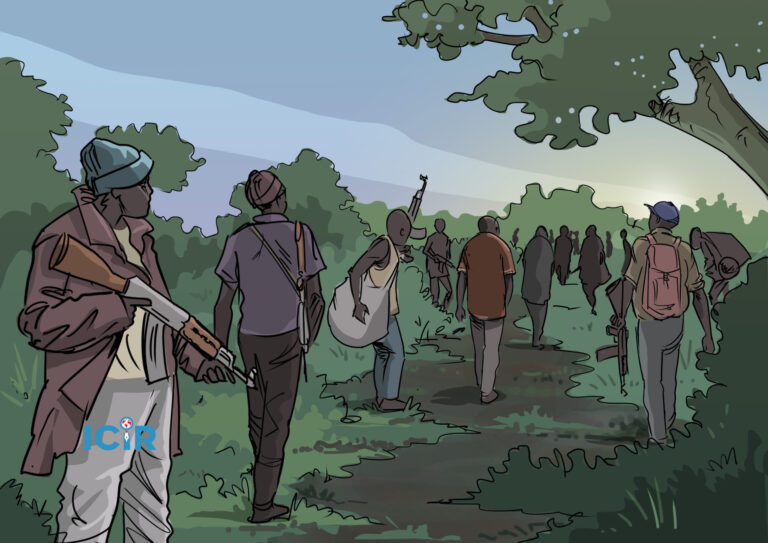
The terrorists who came through the forest leading to Birnin Gwari, bordering Zamfara state, gathered all students and some of the teachers in the school premises and had them in a couple of lines. When everyone was in the same place, they escorted them into the forest, with some bandits leading the way with motorcycles.
“As we were coming out of the principal office, we saw several bandits around the school premises and found out that there was no way we could run to the town. They asked us to enter the bush that they wanted to ask us few questions, and then we followed their instruction and entered the bush, with cane and gun in their hands,” says one of the secondary school teachers, Abdullahi Sani.
Another picture of Kuriga primary and secondary school in Kaduna. Photo: Mustapha Usman/The ICIR
The LEA Primary and Secondary School sit by the road just at the town’s entrance, tucked in the middle of forests. The primary and secondary schools initially had separate buildings, but in 2021, the school authorities made a bold step to merge the school after receiving an order from the state government to either move the school from the outskirts of the town to the main town or shut it down. This, the teachers said, was to keep the hope of their students alive.
Contrary to the reported abduction of 287 schoolchildren from the LEA Primary and Secondary School in Kuriga, Chikun Local Government Area (LEA) of Kaduna state, authorities gave the number of abducted children as 137. Additionally, the abducted students and parents who spoke to The ICIR confirmed the number to be 137.
Before the incident, there had been a series of attacks and abductions in Kuriga and some other neighbouring villages, including the kidnapping of one of the abducted student parent, Hama Abdullahi, before she was released after a ransom was paid.
Although, unlike the previous mass abduction of Federal Government College (FGC) Birnin-Yauri, Kebbi state, where letters were delivered to the school, teachers and residents said they received no letter but have always taken precautionary measures and, most times, have their men outside on a night watch.
For the past seven years, Kaduna state has become a hub of insecurity, facing relentless attacks by bandits, with reports indicating that a tleast 10 out of the 23 Local Government Areas (LGAs) have been targeted.
While the attacks subsided last year, the state still accounted for massive figures in both the death and kidnappings of residents in the country, as about 200 were reportedly killed, 700 residents kidnapped alone in the first quarter of 2023, and unconfirmed numbers of people were displaced.
The Journey from Kaduna to Zamfara
A pathway that stretches from the school building to the forest, where both the bandits and the students ventured towards Zamfara. Photo: Mustapha Usman/The ICIR
The journey into the terrorist camp said to be Dan Sadau, in Zamfara state, was a nightmare for the abducted schoolchildren. For gruelling two days, the students journeyed through various villages and towns in the deep forest under the scorching sun that drained their energy each passing hour on empty stomachs.
With the hope that they would be at the destination soon after the invasion, thirteen-year-old Fatima Muhammad kept heeding the bandits’ instructions, but the journey would not end until after over 40 hours of trekking.
She and other captives were marched onward without access to food or water, and any attempt to slow their pace, possibly due to exhaustion, resulted in whipping.
Fatimah narrates her sad experience at the hands of terrorists. Fatimah, alongside others, was maltreated and treated to poor meals for 16 days. Photo: Mustapha Usman/The ICIR
Muhammad, who is a Jss 2 student hoping to become a medical practitioner, says it was impossible for her and her colleagues to run away as they were heavily surrounded, “we tried our best to run away, but it was impossible, the terrorists went away with us on known destination. We spent two days walking with our feet before we went to where they kept us in a forest around Zamfara state, we suffered because of these long days. There is not a day that we do not cry because of the hardship”.
During the long hours of the journey to Dan Sadau, about five students who spoke with The ICIR say there were no attempts by the security operatives to rescue them from the hands of the bandits.
Findings by The ICIR reveal that Kuriga, where the kidnapping occurred, is approximately 45 kilometres away from Birnin Gwari and about 90.6 kilometres from Zamfara state.
The terrorists avoided the usual roads and moved the children through the dense forest, likely extending the journey beyond the estimated 90.6 kilometres. Using Google Maps for estimation, the journey from Kuriga, Kaduna state, to Dan Sadau—a distance of about 90.6 kilometres—would take approximately 20 hours and 13 minutes on foot, travelling nonstop.
The estimated distance from Kuriga town, where the students were abducted, to the area where the students might have been held captive by bandits, according to Google map
However, the students said it took them two days to get into the camp, probably due to their large number.
This means that for an approximately 48-hour journey, the Nigerian security operatives couldn’t locate or intercept the abducted students or chose to allow the assailants to carry on with activities, despite the extensive time frame and the considerable distance covered.
Besides, there are about 13 military checkpoints along the Kaduna-Birnin Gwari road, with the closest checkpoint just about 5-minute drive away from the school. The ICIR also gathered that there is a military camp near Udawa, which is about an hour’s drive away from Kuriga.
The estimated distance from Kuriga town, where the students were abducted and the nearby military camps. There are about three military bases that are less than 100km (less than an hour’s drive) to Kuriga. Credit: Sanusi Olayinka
Likewise, in Birnin Gwari, which is about 45 kilometres away from where the abduction took place, there is a military base that’s barely a 30-minute journey on a drive from the town.
Aside from a military base in Udawa and Birnin Gwari, there are other military establishments in the state, which include the Nigerian Defence Academy (NDA), 1 Infantry Division, Jaji; Command and Staff College and Nigerian Army School of Infantry (NASI) Jaji; Nigerian Army School of Artillery (NASA), and the Nigerian Navy School of Armament Technology, both at Kachia.
In past kidnapping incidents, the government and the military had given excuses that the bandits were using civilians as shields to allow them to carry on with their activities unhindered.
Life in captivity: feeding on dog food, sleeping in dense bushes
When the students eventually reached the bandits’ camp on Saturday, March 9, where they would spend 14 days, some of them had already given up on any possible freedom.
Although their arrival at the camp meant they would have enough time to rest, recuperate from the long journey, and get something to eat, the students still found it hard to adjust to the deep forest, even though they had met some people in captivity.
Fatimah Muhammad, alongside other freed Kuriga schoolchildren. Photo: Mustapha Usman/ The ICIR
Fatima Muhammad says the bandits treated them to dog food and sometimes fed them handfuls of Koko (the local name for pap) twice a day. “We drank what the dogs drank; they fed us with Koko two times a day, which they assigned some among us to cook for us,” she explains, noting that it was an unforgettable period of her life.
“When we got there, we met some people who were also abducted by the terrorists, but women were the majority among them, but they had to collect the ransom money for some of them before moving there…
“They put us in a place that surrounded is with grass, we stayed there, and the terrorists did not let us make eye contact with them and most of them were wearing military uniforms and covered their faces with face masks,” Abdullahi adds.
Nura Haruna, one of the abducted students of Kuriga. Photo: Mustapha Usman/The ICIR
Also, fifteen-year-old Nura Haruna, a JSS 2, says the experience in captivity was unprecedented as they were maltreated every day and made to do some hard chores.
“I was in the classroom when I heard some of my colleagues running around shouting. I don’t know the bandits had surrounded the school. I tried to run out but was not able to because there were too many. Without any options, we followed them to Dan Sadau forest around Zamfara state, where they kept us for sixteen days without bathing or washing. There was no good food,” he says, struggling to articulate the ordeal.
The experience was similar for a few other students, including Abubakar, Sadiyyah Muhammad, Suleiman and Faimah, who spoke with The ICIR.
A rescue or paid ransom?
It was on the 16th day that the military announced the release of the schoolchildren. However, there were concerns as to whether the government or families of the abducted children paid ransom to the bandits for the release of the children due to vague statements by the military and the state government.
While all the parents, teachers and community leaders The ICIR spoke to said that no ransom was paid to the terrorists from their end and received no calls instructing them to pay such, some of the students who were in the bandits’ camp pointed out that they were ‘picked up’ by the military where they sat without any sort of gun-duel or resistance from the terrorists.
Fatimah tells The ICIR that “it was our 16th day, and we saw some soldiers coming where we were staying and said we should leave and follow them today that they would take us home.
Continuing with a beam of a smile on her face, she says, “We happily followed them to where the cars were parked, and all of us were 137, except for our principal, who died as a result of beating because they broke his nose and he was bleeding, and he died. After that, we landed in Kaduna and the government of Kaduna state took responsibility for caring for all of us, changing our clothes, giving us food and good oysters, and checking our health.”
Isah Abubakar, one of the abducted school children in Kuriga, is also the first son of the late school principal, Abubakar Isah. Photo: Mustapha Usman/The ICIR
Having lost his father to the torture inflicted on them by the bandits, Abubakar, the principal’s son, says he had given up until he saw some soldiers arrive at their camp and asked them to follow them to a village in Zamfara state.
“On the road before we left, we had a lot of trouble with those terrorists because we walked down to Zamfara state with our legs, and they kept us outside in the grass. The food we give to the dog is what they give us twice a day, and the kind of water that cows drink is what we take.
“One day, we were sitting until some soldiers arrived on Saturday, and they told us to leave today and go home. But then we started walking to a village in Zamfara state, the name of which we do not know. Then we were taken in cars to Gusau town. And then Kaduna, where we spent at least five days,” he adds.
However, when The ICIR contacted the Defence Headquarters spokesman, Tukur Gusau, to confirm whether the children were released or rescued, he directed the reporter to the Kaduna State government, which refused to comment on our findings.
Community police station closed down due to severity of insecurity – residents
Long before the attack, Kuriga had been witnessing a series of attacks from bandits who mostly stopped by the community anytime they were on a mission to ravage some communities. The town, which is very close to Zamfara, a state that has suffered banditry attacks in recent attacks, from the hands of Dogo Gide’s men and ISWAP, has seen some of the prominent sons lose their lives to incessant attacks.
Location of Chikun LGA, where Kuriga town falls to in the Kaduna state
When the bandits abducted the schoolchildren, the community was still reeling from the brutal killing of the former principal of Government Secondary School, Kuriga, Idris Sufyan.
The terrorist had fatally shot him in his home and also abducted his wife and their infant in January before the two were later rescued in a joint military operation on 3 February.
The attack that claimed Sufyan’s life was not an isolated event, as the community youth leader, Salis Musa Abdulsalam, notes that the continuous attacks on the community have led to the shutdown of major markets, such as Birnin Gwari, Udawa Buruku, and could not go back to farming.
“As a result of this banditry, many have high blood pressure, many become very poor, and many women divorced as such we calling on the state and the federal government to continue providing security agencies to our community so as to end activities those terrorists In the area,” he tells The ICIR.
Sufyan was the principal replaced by Isah after his demise. With the two, the bandits have now killed no fewer than five teachers in the town.
However, despite the severity of the attacks, residents said the police station in Kuriga closed down in 2021 when the attacks became too frequent and demanding, leaving them to deal with the bandits themselves.
They also noted that the lack of minimal security presence in the area and the disconnection of telecommunication services in 2021 exacerbated the challenges faced in calling for security help.
The ICIR reports that on September 29, the Kaduna government announced several restrictions, including the shut mobile communication in some parts of the state, aimed at addressing the deteriorating security, including the shutdown of telecom services in parts of the state.
Although The ICIR could report the return of police officers in the area, as this reporter counted 13 military checkpoints and five other checkpoints when touring the dangerous 89-kilometre road running from Kuriga town to the city of Kaduna, the network service in the area is still very poor.
Residents also confirmed the return of dozens of police officers to the town since the recent abduction.
Serial school abductions impede education in Northern Nigeria
Data from the United Nations Educational, Scientific and Cultural Organization (UNESCO) 2020 Model Estimates on out-of-school children, published in 2022, shows that the secondary school out-of-school population has grown by 61 per cent, from 6.3 million to 10 million since 2010, while the number of primary school-aged children who are not in school also increased by 50 per cent, from 6.4 million to 9.7 million since 2010.
According to the data, almost 20 million Nigerian children are out of school, putting Nigeria as the country with the third-highest number of children deprived of education, only behind India and Pakistan.
Insecurity, as reported by UNICEF, stands out as a major reason for this humanitarian crisis. In many regions battling with insecurity, particularly Kaduna, some communities have been deserted, leaving schools shuttered and interrupting the education of countless children at both the primary and secondary levels.
In 2021, following the mass abduction of students of the Bethel Baptist High School in Kaduna, the state government ordered the closure of schools in the state.
According to the state Ministry of Education’s Annual School Census Report 2018/2019/February 2020, the closure affected over 5,000 pre-primary to senior secondary schools, both private and public.
However, while many schools resumed school activities a few months later, some in the insecurity-ridden areas remain shut down. The ICIR also gathered that some of the neighbouring villages’ schools are shut down.
Speaking with a school teacher, Abdulmeen Abdulazeez, highlights that the continuous attacks on schools in Nigeria have remained a big problem that deserves the utmost attention of both the federal and state governments.
“Insecurity over the last decade has been a serious threat to the Nigeria education system, particularly in the north. We have seen over five mass abductions of students from schools, while several teachers have been killed due to the onslaught.
“It’s very important to note that the Nigerian government needs to e proactive and make our schools safe for children. They need to find solution to the lingering insecurity and make sure children are returned back to schools.”
Safe School Initiative falters
The Safe Schools Initiative (SSI) is a multi-donor programme aimed at promoting safety in Nigerian schools and rebuilding infrastructure, especially in the northern part of the country.
While the total amount raised for the project was not yet known, the project received over N100 billion in donations in 2014 and 2015. The Presidential Committee on North-East Intervention raised about N80 billion and, in the same year, received a donation of $1.5 million from Norway, $1 million from the African Development Bank (AfDB), $50,000 from the AfDB President and £1 million from the British government.
In 2015, Switzerland and the US pulled in $8 and $2 million, respectively, as well as Qatar ($2 million) and the Nigerian business community ($10 million).
This was aside the N15 billion budgetary allocation by the Federal government in 2023.
However, according to a report by Save the Children, a charity organisation,over 1,680 students and teachers have been kidnapped from schools majorly in the North since 2014.
Infographics: Mass school kidnappings in Nigeria
Also, analysis by The ICIR shows that over 1,000 students have been kidnapped within the past three administrations, with the abduction of school children generating millions in ransom for kidnappers.
Media sources collected by The ICIR detail at least 15 attacks across 10 northern states. Further findings also showed that Kaduna state has experienced more schoolchildren abductions than any other affected state in Nigeria that made it to mainstream media.
In 2023, the Committee on the SSI said it has begun the implementation of the project in 18 states, with the expectation that all the states will provide 48 states for the project. While Bauchi Gombe had identified the 48 schools, some states, including Kaduna, have not been reported to take off the project.
Efforts by The ICIR to reach out to the Kaduna State Commissioner for Education for comments on some of its findings proved abortive. Several calls and SMS sent to the Kaduna State Chief Press Secretary, Muhammad Shehu Molash, were not picked up or replied to.
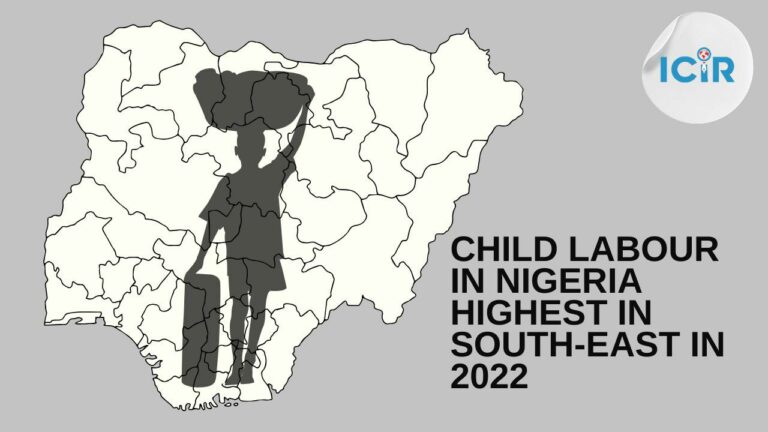
A new survey on Nigeria’s child labour has shown that the menace was highest in the South-East in 2022.
The National Bureau of Statistics carried out the survey in collaboration with the International Labour Organization and the Federal Ministry of Labour and Employment.
It showed that 24.67 million children in the country were engaged in labour activities that were injurious to their physical and mental development that year.
This figure represents 39.23 per cent of the total 62.90 million children population in Nigeria as of that year.
However, in 2023, the federal government said the figure could have increased to 43 per cent.
The data showed that more boys (39.6 per cent) were in child labour than girls (38.8 per cent). Also, children living in rural areas were more likely to be engaged in labour than children in urban areas.
Table showing the breakdown of child labour prevalence in 2022/ Source: NBS
The term “child labour” is defined by ILO as work that deprives children of their childhood, their potential and their dignity, and that is harmful to physical and mental development.
By ILO’s general convention, the minimum age for admission to employment or work is 15 years (13 for light work) and the minimum age for hazardous work is 18 (16 under certain strict conditions).
Nigeria, an ILO member since 1960, is a signatory to 40 ILO conventions, including child labour.
The report noted that aside from child labour, 31.76 million children were involved in one form of economic activity or the other, and 14.39 million children were in hazardous labour.
By geopolitical region, the South-East region had the highest prevalence of children involved in child labour that year.
However, the states with the highest child labour were Cross River (67.4 per cent), Yobe (62.6 per cent), Abia (60.1 per cent) and Plateau (58.9 per cent).
Zone
Child labour prevalence
North Central
43.10%
North East
49.40%
North West
34.60%
South West
27.50%
South East
49.90%
South South
43.10%
Table showing child labour prevalence by geopolitical zone in Nigeria/ Source: NBS report 2022
The states with the least children involved in child labour were Ogun (30.4 per cent), Kano (27.9 per cent), Benue (26.5 per cent), Rivers (20.7 per cent) and Lagos (8.9 per cent).
When broken down by age group, 60.8 per cent (14.99 million) of child labourers that year were between the age of five to 11 years old, while 20.8 per cent (5.13 million) were between the ages of 12–14 years. Also, 4.55 million, representing 18.4 per cent, were between the ages of 15–17 years.
Investigations by The ICIR ( here, here and here) exposed how child labour has become prevalent in the country due to insecurity or economic challenges.
In 2023, The ICIRreported how the Minister of Women Affairs, Uju Kennedy-Ohanenye, was criticised for saying that school days should exclude Fridays to enable children to get involved in production activities to boost urban development.