Home Blog Page 630

FG approves N7.76bn not proposed in 2024 budget for traditional rulers

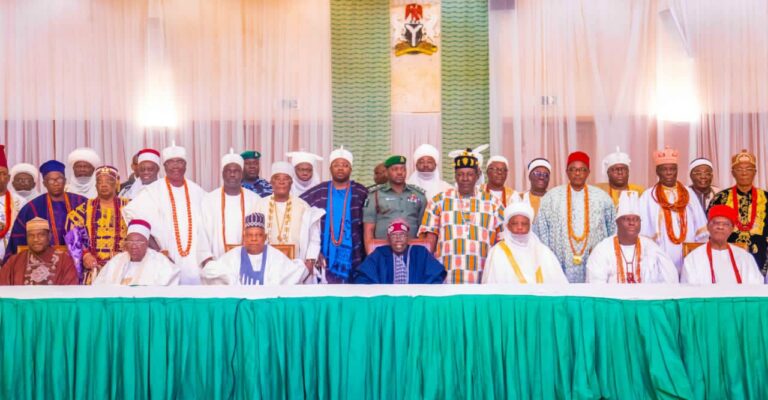
FINDINGS from the 2024 budget have revealed that the Federal Government approved N7.76 billion to cater for 16 capital projects for traditional rulers in Nigeria. 

The ICIR analysis showed that the projects are to be implemented by eight federal ministries and departments.

The ministries are Information and Orientation, Agriculture and Food Security, Industry, Trade and Investment, Labour and Employment, Health and Social Welfare,  Ministry of Science, Technology and Innovation, and Secretary to the Government of the Federation,

Some of the projects are the provision and supply of SUVs and cars for traditional rulers, which will gulp N400 million; training and empowerment of council of traditional rulers for N100 million; and training of traditional rulers on conflict resolution, which takes N50 million. 


Read Also:


Categorising the project by location, three of the projects are for monarchs in Lagos, two projects each for leaders in Katsina and Ogun states, and one project each for monarchs in Akwa Ibom, Ondo, Oyo, Kogi, Plateau and Kaduna states.

In all, there are 13 projects with direct locations, and there are three others without specific locations.

The three projects without specific locations are procuring and distributing official vehicles to selected rulers in the six geopolitical zones for N5 billion and a N40 million allocation to support traditional rulers and chiefs.

Also, N447.09 million was budgeted for the partnership, strategy engagement and field operational support of traditional leaders to transform primary healthcare services. 

These findings emerged weeks after the National Assembly was accused of alleged padding of the 2024 budget, which led to the suspension of Senator Abdul Ningi.

Analysis by The ICIR explained the allegation by juxtaposing it with the approved budget. 

2024 budget for traditional rulers

Scary misappropriation in the budget

The ICIR filtered the 2024 budget, focusing on traditional rulers’ allocations. 

The  findings showed that the N7.76 billion allocation is more than the budget approved for the Nigeria Football Federation (NFF) and Nigerian Institute of Sport (NIS). In the 2024 budget, the NFF has N2.05 billion, while the NIS has N1.72 billion.

Also, the N7.76 billion for the monarchs is almost half the total allocation for the Federal Ministry of Women Affairs, which has N14.48 billion as budget.

The ICIR compared the projects for which the N7.76 billion was approved with the ministries’ mandates. The findings showed some appropriations might not have been appropriately done.

For instance, the Ministry of Agriculture and Food Security is expected to carry out the provisions and supplies of SUVs and cars to monarchs in the Ikeja Federal Constituency in Lagos State and the unspecified location of N40 million for support of traditional rulers by the same ministry.

Another is the procurement and distribution of vehicles for traditional rulers for N5 billion by the Ministry of Industry, Trade and Investment, whose mandate is to implement policies and programmes to attract investment and boost industrialisation.

Also, the Ministry of Labour and Employment is expected to construct and furnish the Takkas traditional ruler’s palace and cultural arena in Plateau State with N100 million. 

The ICIR dug deeper, checking the eight ministries and departments’ proposed budget when President Bola Tinubu presented it to the National Assembly. Findings showed that the allocations made to the traditional rulers were not captured anywhere under these ministries in the proposed budget. 

This means that the addition of N7.76 billion for monarchs was one of the reasons the proposed budget jumped from N27.5 trillion to N28.7 trillion, signed by the President.

The ICIR published several reports on the proposed 2024 budget. 

This organisation also reviewed the approved budgets for previous years to compare the amount allocated for traditional rulers using the same filtering method. 

In the 2023 approved budget, N721.31 million was allocated for seven projects across five ministries for monarchs.

Also,  in the 2022 approved amended budget, the Federal Government earmarked N326.65 million for three projects, while in the 2021 budget, N607.37 million was for six capital projects for the monarchs. 

Years Amount
Number of Projects
2024 N7.22 billion 16
2023 N721.31 million 7
2022 N326.65 million 3
2021 N607.37 million 6

Table showing the capital projects and amounts budgeted for traditional rulers between 2021 and 2024. Source: Budget Office 

Who takes care of traditional rulers?

While no constitutional provisions limit the capital projects that could be captured in the budget, the budgetary provisions for traditional rulers are usually captured at the subnational level. 

The ICIR observed that most states provide a commission for traditional rulers or transfer the responsibility of traditional leaders’ welfare and related matters to the Local Government Commission. 

A legal practitioner, Lukman Raji, who spoke to The ICIR, said it was a misplaced priority for the Federal Government to make provisions for traditional rulers in the budget when the state government budget takes care of it. 

He said, “The traditional rulers are not even directly under the state government but under their local government. It is wrong, and it will be a misplaced priority for the Federal Government to jump the bridge by saying they want to take care of traditional rulers without necessarily amending the Constitution for that.”

Also, a senior research & policy analyst for BudgIT, Vahyala Kwaga, posited that it would be very difficult to end the inclusion of vague, frivolous, duplicated items in the federal budget because the scope of powers of the National Assembly over the budget is not clearly defined. 

Kwaga said, “The budget proposal itself has not been demonstrated to have come from an analytically and fiscally rigorous process that takes into consideration revenue constraints and long-term plans. It is simply an incremental budget that allows business as usual.”

The ICIR reported how over N512 billion of frivolous items were passed in the 2024 appropriation budget.

Climate change: Kwara gov’t warns against charcoal production, threatens sanctions

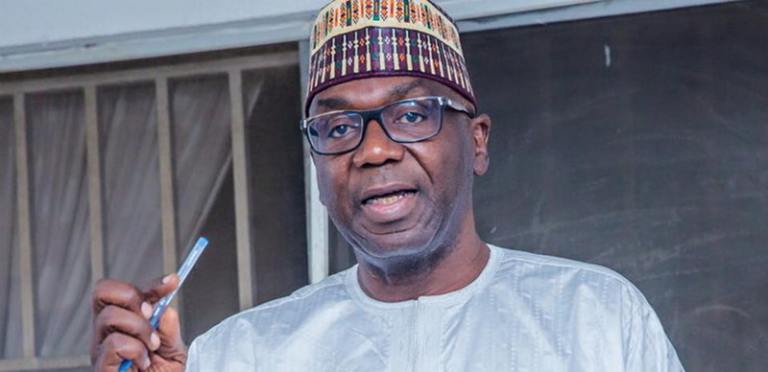
KWARA state government has reiterated its warning against charcoal production and threatened to sanction those violating the existing ban on the activity.

The state Commissioner for Environment, Shehu Ndanusa, disclosed this during a briefing in Ilorin, the state capital, on Friday, April 5.

“The law banning the production of charcoal in Kwara is still intact. Whoever is caught violating the law will be sanctioned accordingly”, he said.

Read Also


He noted that a task force on charcoal production had been ordered to enforce compliance and seize vehicles conveying charcoal out of the state.

“Do not collect money from violators, make sure you confiscate the charcoal and the trucks and bring them to the Ministry of Environment for necessary actions,’’ he urged the enforcement team.

In 2018, Kwara state banned charcoal production and trade to protect the environment and preserve natural resources.

The state’s former governor, Abdulfatah Ahmed, signed an amendment bill prohibiting the production, transportation, storage or sale of charcoal into law.

The law also provides that offenders are liable to a fine not exceeding N100,000 or imprisonment for a term not exceeding two years—or both upon conviction.

Despite this law, The ICIR reported that tree felling has continued to thrive in the state.

The report also disclosed that between 2001 and 2018, 23,474 hectares of tree cover, representing 22 per cent, were lost to deforestation in the state.

Of this figure, 17,169 hectares were destroyed between 2011 and 2018.

The activity has persisted largely because of the hike in the cost of gas, which is forcing many Nigerians to turn to charcoal and other alternatives for their cooking needs.

Court convicts Bobrisky, reserves judgment till April 9

0

A FEDERAL High Court in Lagos has convicted crossdresser, Idris Okuneye, popularly known as Bobrisky, but reserved its judgment till April 9.

The judge, Abimbola Awogboro, in his ruling on Friday, April 5, ordered that Bobrisky be placed in the custody of the Economic and Financial Crimes Commission (EFCC) pending the judgment.


Read Also:

Awogboro convicted the accused after reviewing the facts of the case.

In his response, Bobrisky told the court that he was unaware of the law regarding abusing naira.

He informed the court that he is a social media influencer with over five million followers.

Bobrisky in court on Friday, April 5, 2024. Picture courtesy of Channels TV news
Bobrisky in court on Friday, April 5, 2024. Picture courtesy of Channels TV

The judge, Awogboro, then told him that ignorance of the law was not an excuse.

“I would do a video on my page and I will educate people about spraying money.

“I will not repeat it again (sic). I regret my actions,” he said.

Bobrisky was arraigned on four counts of naira abuse preferred against him by the EFCC.

The crossdresser, who prides himself as “Mummy of Lagos”, pleaded guilty to the charges.

However, before the charges were read, the EFCC’s counsel, Suleiman Suleiman, asked the court to strike out counts five and six concerning money laundering allegations.

Awogboro subsequently struck them out.

This paved the way for the arraignment of the accused on only counts one to four.

A lawyer, Ayo Olumofin, appeared for Bobrisky.

The EFCC witness, Bolaji Temitope, an assistant superintendent of the EFCC, said that during the investigation, the team discovered a video in which the defendant was seen mutilating the naira notes, which led to the EFCC inviting him.

According to him, the defendant honoured the invitation. When he arrived at the EFCC office, he was cautioned and then volunteered to make a statement.

The witness told the court that the defendant was then shown a video where he was spraying money on an artiste called Segun Johnson, adding that the defendant confessed and admitted that he was the person in the video.

He said that the defendant was also shown a video of him at Circle Mall Lekki, where he sprayed N400,000 at a movie premier, adding that the defendant again admitted he was the one.

He told the court that the defendant was also shown other videos of him spraying money at Ajah and Ikorodu junction in Lagos, and the defendant still admitted he was the one who did it.

The court, consequently, admitted the exhibits and marked them A, B1 and B2.

The prosecutor, then urged the court to convict the defendant as charged based on the case as presented by the EFCC.

The crossdresser, who had been in the EFCC detention since Wednesday, April 4, failed to meet the administrative bail offered to him on Thursday.

The ICIR reported that the EFCC arrested and detained Bobrisky in Lagos State for naira abuse and currency mutilation.

Media reports said EFCC spokesperson Dele Oyewale confirmed that Bobrisky had been arrested, not for his lifestyle as a crossdresser but for abusing the naira.

Over the past few days, Bobrisky has been on the news for several controversial reasons, including winning the ‘Best Dressed Female’ at a movie premiere in Lagos.

While there was an outcry by Nigerians for his arrest, a report by The ICIR showed that there is no law in Nigeria yet that criminalises cross-dressing.

The Nigeria Police Force Public Relations Officer (FPRO), Olumuyiwa Adejobi, also confirmed in a report by The ICIR that the country had no law allowing the police to arrest and charge crossdressers in court.

NERC fines AEDC N200m for over-billing non-Band A customers

0

THE Nigerian Electricity Regulatory Commission (NERC) sanctioned the Abuja Electricity Distribution Plc (AEDC) on Friday, April 5, for overbilling customers not originally classified in Band A.

The sanction followed non-compliance with the Supplementary Order of the April 2024 Multi-Year Tariff Order (MYTO) 2024 from NERC, which said only customers in Band A were affected by a tariff increment.

Recall that NERC approved a 300 per cent hike in the electricity tariff to N225 ($0.15) per kilowatt-hour from N68 for customers categorised under Band A of its service-reflective tariff. This increase took effect on April 1.


Read Also:

The AEDC consequently went on to bill customers not captured under Band A, forcing NERC to impose the ₦200 million sanction on it.

The regulatory enforcement decision was signed by NERC commissioner Dafe Akpeneye, who oversees legal licensing and compliance.

It noted that the sanction followed a detailed review and customer feedback, which revealed that AEDC had applied the new tariff to all customer bands, contrary to the Order, which was designed to ensure fair billing practices.

In line with the sanction, NERC mandated the  AEDC to ensure the following:

  •  Reimburse all customers in Bands B, C, D, and E, respectively, that were billed above the allowed customer categories/tariff bands provided in the order.
  •  Reimburse through the provision of the balance of customer tokens that the affected customers would be entitled to receive at the applicable rates and all token reimbursements shall be issued to the affected customers by 11 April 2024.
  • Pay the sum of ₦200 million as a fine for the flagrant breach of the commission’s order.
  •  File evidence of compliance with the commission’s directives in a & c by 12 April 2024.

The NERC explained that its action underscored its commitment to protecting consumer rights and ensuring equitable practices within Nigeria’s electricity sector.

On Thursday, April 4, The ICIR reported that the AEDC apologised to customers in its franchise areas who were overbilled and were not originally categorised for Band A, as they cited a system glitch for the error.


Reject electricity tariff hike, Northern Elders urge Nigerians

0

THE Northern Elders Forum (NEF) has condemned the Federal Government’s increase in electricity tariff and urged Nigerians to reject it. 

In a statement by the NEF spokesperson Abdul-Azeez Suleiman, the group noted that the hike was a blatant disregard for Nigerians’ welfare.

“By implementing such exorbitant electricity tariffs, the government is effectively perpetuating a form of economic oppression that will only serve to widen the gap between the rich and the poor in Nigeria. It is imperative that this act of exploitation be firmly rejected and not be allowed to stand unchallenged,” the statement read.


Read Also:


According to the NEF, the new tariff plan would result in over N5,400 daily and nearly N2 million in electricity bills alone.

“Under the new tariff plan, 24 hours of electricity per day will cost a staggering N5,400, amounting to an unbearable monthly total of N162,000 and an astounding yearly total of N1,971,000.

“These exorbitant amounts are simply unaffordable for the majority of Nigerians, who are already grappling with economic hardship and trying to make ends meet,” the group stated.

The Forum urged Nigerians to reject the hike, as it is a form of economic oppression aimed at worsening the gap between the rich and the poor.

“The decision to implement these tariffs without considering the impact on the average citizen is not only callous but also short-sighted. The resulting consequences could potentially lead to internal security threats as the disparity between the haves and the have-nots becomes more pronounced.

“The NEF strongly believes that this decision was made without carefully considering the economic realities faced by the majority of Nigerians, and it highlights the government’s lack of empathy towards its citizens,” the NEF stressed.

Noting that the move by the Federal Government was a betrayal of the people, the group called on the government to reconsider its decision given the social and economic hardships confronting Nigerians.

The ICIR reported that NERC approved a tariff hike for Band A customers, who enjoy up to 20 hours of power supply.

The affected customers, who earlier paid N68/kilowatt-hour, will now pay as high as N225 for electricity.

This is in spite of the fact that many electricity consumers in Nigeria do not get a commensurate power supply for the tariff bands they are placed on.

Economic reforms worsening hardship

Since the inauguration of the current government under President Muhammadu Buhari, Nigerians have been confronted with hardships occasioned by certain economic reforms, which have led to a steady increase in the cost of living.

On May 29, the day he was sworn into office as president, Tinubu announced the removal of petrol subsidy, while delivering his inaugural speech, after which fuel prices surged by about 200 per cent.

The surge in fuel costs resulted in some hardship for Nigerians, as transport costs and other businesses were affected by the hike.

The following month, Nigeria officially floated her currency, which resulted in a drastic fall of the naira against the dollar, further pushing up the cost of goods and services.

On several occasions, after these decisions were taken, Tinubu promised to ease Nigerians’ sufferings through certain interventions, including an increase in the minimum wage, which currently is N30,000.

While most of these promises have yet to be implemented, including the wage increase, the government has again hiked the cost of electricity for citizens.

NDLEA seizes 29,789 drugs, convicts 684 traffickers in 60 days

0

THE National Drug Law Enforcement Agency (NDLEA) said it seized 29,789 drugs between January and February 2024.

Cannabis accounts for the most significant number of seizures, with 26,876, while 68 kilogrammes of cocaine were confiscated.

The anti-drug trafficking agency also arrested 2,744 drug traffickers within the period.


Read Also:

Among those arrested, 805 cases were charged to court, 684 persons, including 636 males and 48 females, were convicted, and 316 persons were rehabilitated.

These figures were contained in data covering January and February 2024, which the Agency, through its spokesperson, Femi Babafemi, sent to The ICIR on Tuesday, April 2.

According to the data, 2,437 males and 307 females were arrested within the period.

Previous data

The NDLEA said in February that it prosecuted 3,412 drug offenders in 2023.

The agency’s chairman, Marwa, said among those prosecuted were 15 drug kingpins who bagged 168 years jail terms collectively.

“According to our statistics, we recorded 13, 664 arrests leading to the seizure of 1,606, 799.09 kilogrammes of assorted illicit drugs and 3,412 convictions with a total of 5, 570 offenders charged to court in 2023. It’s indeed a year that at least 15 drug kingpins bagged 168 years of imprisonment collectively,” Marwa said while addressing journalists at the agency’s headquarters in Abuja.

In previous data obtained from the agency at the end of 2023, the NDLEA said it arrested 12,061 drug traffickers between January and November 2023.

The agency also stated that it secured 3,132 convictions within the period. 

The data showed that 10,903 males and 1,153 females were arrested.

On February 27, The ICIR reported the NLDEA intercepting the largest consignment of heroin at the Murtala Muhammed International Airport (MMIA), Lagos State.

The agency also said it arrested some members of the cartel who owned the drugs.

According to the agency, the group specialised in trafficking heroin across Nigeria, South Africa, Mozambique, Europe and America.

Earlier, in January, the agency declared an ex-beauty queen, Aderinoye Queen Christmas, wanted after she fled her residence in Lagos during a raid.

In a statement signed by the agency’s director of media and advocacy, Femi Babafemi, on Sunday, January 28, NDLEA operatives had raided her apartment at Oral Estate, Lekki, on Wednesday, January 24, following credible intelligence that deals in illicit substances.

Aderinoye was Miss Commonwealth Nigeria Culture 2015/2016 and founder of the Queen Christmas Foundation.

How customers can seek compensation over poor power supply – NERC

CUSTOMERS under Band A can seek redress should their respective Electricity Distribution Companies (DisCos) fail to supply the minimum of 20 hours of power supply they should enjoy under the band following the latest tariff increment.

Already, the Nigerian Electricity Regulatory Commission (NERC) has directed all 11 DisCos to publish customer care numbers on their websites and send out bulk text messages regarding complaints that could arise from the tariff increment.

Recall that NERC approved a 300 per cent hike in the electricity tariff to N225 ($0.15) per kilowatt-hour from N68. This increase took effect from April 1.


Read Also:


Accordingly, power distribution companies can raise the electricity tariff to N225 ($0.15) per kilowatt-hour for those on Band A from April 1.

NERC, in response to consumers’ concerns about the increment, clarified that consumers in Band A were eligible for compensation should the distribution companies default in their power supply service commitments to them.

“NERC has put in place several measures to ensure compliance and service delivery under the new tariff structure,” NERC Commissioner Consumers Affairs, Aisha Mahmud told The ICIR.

“Please note that persistent failure to meet service levels of at least 20 hours daily for seven consecutive days will result in the automatic downgrade of the feeder. Affected customers will be eligible for a 50 per cent increase in compensation, as stipulated by NERC regulations,” she emphasised.

In a further clarification through a NERC supplementary Order on the Multi-Year Tariff Order MYTO, issued on Thursday, April 4,-the regulator directed that “the DisCos shall set up a rapid response team to ensure effective service delivery on the committed minimum hours of supply to each service Band commencing with Band A feeders effective from April 3, 2024.

“The MYTO Order also directed that the team shall ensure timely response to customers’ complaints, faults clearing, and alignment with Transmission Company of Nigeria-TCN regional teams for effective load management and optimized dispatch to respective feeders, “the regulator said.

It further stated that DisCos should publish the contact numbers of the rapid response team from each customer cluster/business unit on its website and circulate them to the customers via bulk SMS, commencing with Band A no later than noon on Friday, April 5.

“Where the Disco fails to deliver on the committed level of service on Band A feeder for two consecutive days, the Disco shall on the next day by 10.00 am publish on its website an explanation of the reasons for the failure and update the affected customers on the timeline for restoration of service to the committed service level,” it added

The ICIR reported that the Discos were ripping customers off through the tariff band methodology, as customers were not being supplied with hours of electricity commensurate to their bands.

Despite not receiving the required hours of electricity, customers, mostly those on higher bands, pay higher tariffs for power supply, which is mostly epileptic across Nigeria.

“There have been issues of distrust between the DisCos and consumers. I’m still worried about how the DisCos can grow this trust with the consumers. You can see the rip-off of customers using estimated billing. How can they be trusted to deliver at this point? NERC needs to monitor this increment and sanction defaulting companies, otherwise, Nigerians may react angrily, “a customer with the Abuja DisCo, Kingsley Obiakor, told The ICIR.

Viral free flight tickets’ offers from airlines are phishing scams

0

A claim that the British Airways is giving out free tickets to its customers has circulated on social media, particularly on WhatsApp.

The message has been shared widely on multiple WhatsApp groups with a call to action to click a particular website or link in the forwarded message.

Similarly, text messages allegedly from few other airlines promising freebies such as Ramadan giveaways like Saudia and Qatar Airways are also being circulated on multiple social messaging platforms.


Read Also:


All the WhatsApp messages retrieved contain only links to some websites which have similar features with most phishing links The FactCheckHub had earlier debunked.

CLAIM

Multiple airlines are currently offering free flight tickets.

THE FINDINGS

Findings by The FactCheckHub show that the claim is FALSE!

Photo collage showing the phishing links

When one of the web links – the Saudia Airline website promising Ramadan welfare subsidy – was clicked to check the authenticity of the website, it prompted our fact-checker to answer four questions, after which it asked her to click on a box to retrieve her gift with which only three trials is allowed.

Screenshot of the Image showing the questions

After clicking on the second box, it stated that this fact-checker had won a cash prize of N366,762 and in order to claim the prize, the link has to be shared to five WhatsApp groups or with 20 friends till ‘the green bar is full’. It prompted the user to fill their contact details including their address after which they would receive the gifts in a few days, a typical feature of most phishing scams.

Image of the boxes from the Phishing Websites links

Image of the Prize money from the Phishing Website link

The FactCheckHub conducted the same check on the web link promising free British airways tickets and the website had the same instructions as the Saudia phishing website.

Further checks show that after a few days, two of the three websites sharing the free tickets freebies were no longer available online.

This is synonymous with most phishing scams The FactCheckHub has debunked over the years, as they harvest people’s details to carry out phishing attacks.

THE VERDICT

The claim that multiple airlines are currently offering free flight tickets is FALSE; the links were found to be phishing websites used in carrying out online scams.

Republished from the FactCheckHub.

Red gold: the rise and fall of West Africa’s palm oil empire

0

By Pauline von HELLERMANN, Goldsmiths, University of London

FOR thousands of years, the oil palm – indigenous to West Africa – has had an intimate relationship with people. An explosive expansion of oil palm groves throughout western and central Africa in the wake of a dry period around 2,500 years ago enabled human migration and agricultural development; in turn, humans facilitated oil palm propagation through seed dispersal and slash-and-burn agriculture.

Archaeological evidence shows that palm fruit and their oil already formed an integral part of West African diets 5,000 years ago.

With the exception of “royal” oil palm plantations, established in the 18th century for palm wine in the Kingdom of Dahomey, all of West Africa’s oil palms grew in wild and semi-wild groves.


Read Also:


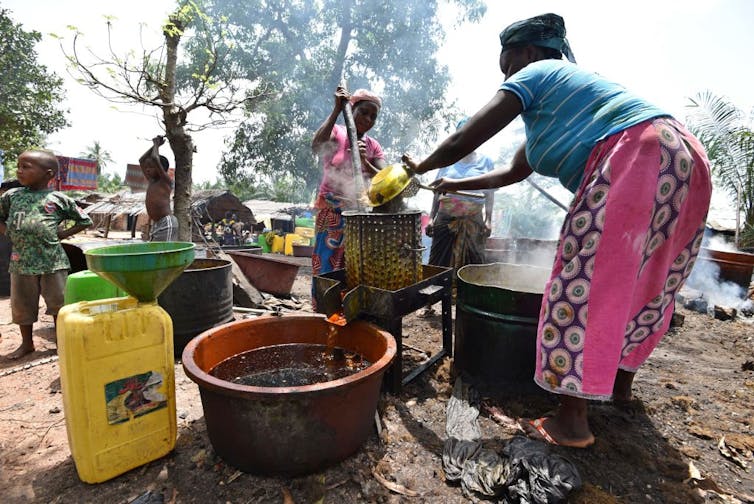
Women and children collected loose fruits from the ground, while men harvested fruit bunches by climbing up to the top of the palms. The fruit was then processed into palm oil by women, through a time-consuming and labour-intensive process involving repetitively boiling and filtering the fresh fruits with water. Similar methods are still widely used throughout West Africa.

Women prepare palm oil in Cote d’Ivoire.
Photo by SIA KAMBOU/AFP via Getty Images

While pure red palm oil was derived from the palm fruit’s fleshy outer mesocarp, women also, often with the help of children, cracked the palm kernels to make brown, clear palm kernel oil.

Palm oil was, and remains, a key ingredient in West African cuisine, including the simple dish of boiled yam, palm oil and Kanwa salt, and Banga soup.

Throughout West Africa, palm oil was also used in soap making; today Yoruba black Dudu-Osun soap is a trademark Nigerian brand. In the Benin Kingdom, palm oil was used in street lamps and as a building material in the king’s palace walls. It also found hundreds of different ritualistic and medicinal uses, in particular as a skin ointment and a common antidote to poisons. In addition, the sap of oil palms was tapped for palm wine, and palm fronds provided material for roof thatching and brooms.

Early 19th-century boom

Palm oil has been known in Europe since the 15th century. It was Liverpool and Bristol slave traders who, in the early 19th century, began larger-scale imports. They were familiar with its multiple uses in West Africa and had already been buying it regularly as food for slaves being shipped to the Americas.

With the abolition of the slave trade to the Americas in 1807, British West Africa traders turned to European markets and natural resources as commodities, in particular palm oil. At the time, the main sources of fats and oils in northern Europe were animal-based – such as lard or fish oils -– products for which it could be a challenge to secure regular supplies. There was a ready market for palm oil.

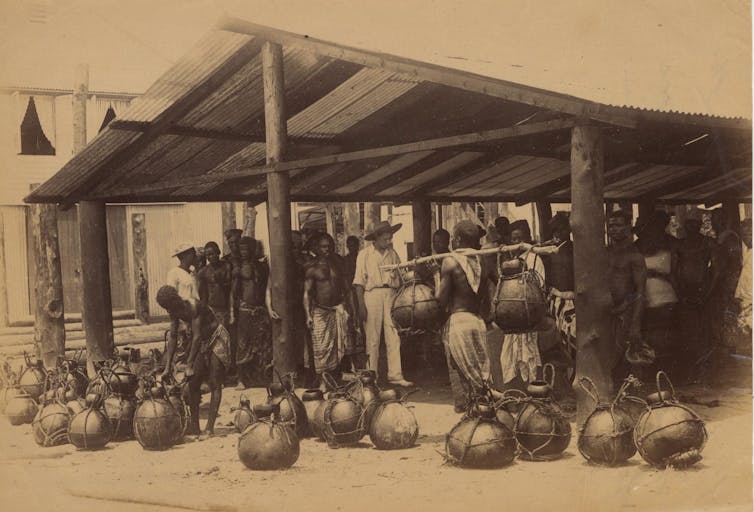
Igbo men in the Oil Rivers area of present-day Nigeria bring calabashes full of palm oil to sell to a European buyer, c. 1900.
Image © Jonathan Adagogo Green / The Trustees of the British Museum, CC BY NC SA

Palm oil was used as an industrial lubricant, in tin-plate production, street-lighting, and as the fatty semi-solid for candle making and soap production. Breakthroughs in chemistry, in the 1820s facilitated a change to large-scale, industrial soap production.

Ever larger quantities of palm oil – increasing from 157 metric tonnes per year in the late 1790s to 32,480 tonnes by the early 1850s – were brought to the UK by small-scale West African traders.

The trade was not for the faint-hearted. Once a year, traders would spend up to six weeks travelling in small schooners to one of the many trading stations on the West African coast. There were several dozen trading stations in the Oil Rivers area of today’s Niger Delta -– the heartland of the West African palm oil trade.

European traders lived and traded entirely on abandoned sailing ships. This was partly to try and avoid deadly diseases, such as malaria and yellow fever, but also because local authorities didn’t let them build on land. Inland trade was controlled tightly by local brokers and village chiefs.

European traders gave these brokers European goods such as cooking utensils, salt and cloth. Then the traders waited on board their ships for them to return, sometimes for months at a time. Many of the African brokers were themselves former slave traders. The slave trade in the Niger Delta did not immediately stop with abolition but continued alongside the palm trade until the 1840s. Palm brokers and European traders continued to use the same network and system developed for the slave trade.

While waiting, the European traders’ coopers would assemble large casks to hold palm oil.

It was largely West Africa’s existing wild and semi-wild groves that furnished European demand. In the hinterland of the Oil Rivers and many other areas, there was an abundance of wild oil palm that could be harvested. Some planting did take place; the Krobo in southeastern Ghana, where fewer oil palms were growing naturally, began systematic cultivation in response to European demand.

In Dahomey, too, more plantations were set up. Some parts of southeastern Nigeria focused so much on the production of palm oil that they became completely reliant on yam imports from further north. However, there was no large-scale, radical transformation in land management, ownership or ecology.

The rise in oil palm brokers

West African producers successfully responded to growing European palm oil demand through the modification and expansion of existing small-scale production methods.

Young men did the dangerous work of harvesting fresh fruit bunches. In palm oil processing another, far less labour-intensive method, developed. Fresh fruit was left to ferment and then stamped on in large pits dug in the ground, or sometimes in old canoes. The resulting oil was much dirtier and inedible. It also fetched lower prices, but the new technique enabled much larger-scale production than before.

There was plenty of work in transporting palm oil, carrying calabashes filled with oil along forest paths to the nearest river and working on canoes. This brought some cash income for young men, but it was generally older, already wealthier men, and in particular chiefs, who were able to profit most from “red gold”, through the labour of their wives and slaves and from control of trade.

It was through brokerage that most wealth and power could be gained, and local power structures were deeply enmeshed with trade in palm oil. A particularly powerful broker at this time was William Dappa Pepple, the amanyanabo (king) of Bonny (in today’s southeastern Nigeria) from 1837 to 1854.

Colonial takeover

In the late 19th century, chemists discovered that hydrogenation could be used to process vegetable oils into margarine. Margarine played an increasingly important role in supplying fats for the diet of Europe’s growing urban working class. While the volume of imports of West African palm oil into the UK levelled off between the 1850s and 1890s, large-scale production of this new edible product stimulated renewed demand for palm oil in the early 20th century.

Between 1854 and 1874, France and Britain had already started to create formal European colonies in Senegal, in Lagos, and in the Gold Coast. British West Africa eventually included Sierra Leone, the Gambia,the Gold Coast, and Nigeria (with the British Cameroons).

In the 1930s, British West Africa exported around 500,000 tonnes of palm produce annually. Palm produce continued to play a significant role in West African rural economies, but local control of the trade eroded under colonial administration; the opportunities for wealth and power palm oil had offered local people were no longer available.

Moreover, as the colonial powers continued expanding their reach elsewhere in the tropics, a game-changing development was slowly beginning: the rise of the oil palm plantation.

Within a few short decades, expanses of Southeast Asian forest had been cleared, creating a fast track to industrial-scale monoculture plantations, thus ending West Africa’s position as the global hub of palm oil production.

A version of this piece was originally published on China DialogueThe Conversation

Pauline von Hellermann, Senior Lecturer, Anthropology, Goldsmiths, University of London

This article is republished from The Conversation under a Creative Commons license. Read the original article.

Tariff hike: AEDC apologises to customers over wrong charges

0

ABUJA Electricity Distribution Company (AEDC) has apologised to its customers for wrongfully charging them following the tariff increase approved by the Nigerian Electricity Regulatory Commission (NERC).

This was contained in a statement posted via the organisation’s official X handle on Thursday, April 4.

According to the statement, the error resulted from a glitch in the reclassification of some Band A customers to a lower band.

“This was due to a system glitch caused by the reclassification of some Band A customers who have now been downgraded to Band B due to the number of hours of electricity supply enjoyed over the past few weeks. These erstwhile Band A customers who vended were charged the new tariff of N225 per kilowatt hour,” the statement noted.

AEDC also disclosed in its statement that efforts were being made to identify those affected, adding that some Band A customers were also charged at the old rate rather than N225/kilowatt.

“Once the glitch is resolved, this category of customers will now recharge their metres at the new rate of N225, which will ensure they enjoy a minimum supply of 20 hours daily,” the statement read.

The ICIR reported that NERC approved a tariff hike for Band A customers, who enjoy up to 20 hours of power supply.

On Tuesday, April 3, the NERC’s vice-chairman, Musliu Oseni said the increase would not affect customers on other bands, and it had taken effect from April 1.

On Tuesday, April 2, Bloomberg reported that Nigeria would triple energy costs for 15 per cent of energy users, a move aimed at attracting investors into the sector.

Quoting sources in the presidency, Bloomberg reported that the tariff would be increased from N68 to as high as N200/kilowatt-hour, while subsidy would remain for those consuming less electricity.

In 2021, The ICIR reported that electricity Distribution Companies (Discos) were ripping customers off through the tariff band methodology, as customers were not being supplied with hours of electricity commensurate to their bands.

Despite not receiving the required hours of electricity, customers, mostly those on higher bands, pay higher tariffs for power supply, which is mostly epileptic across Nigeria.

Poor power supply in Nigeria contributes majorly to poor industrialisation, high unemployment, and stagnating rural development.