BRITISH-NIGERIAN boxer Anthony Joshua defeated mixed martial arts star Francis Ngannou-a Cameroonian after second rounds of their heavyweight clash.
The much anticipated fight saw the two boxers exchange fists and punches in early hours Saturday, March 9 2024.
Despite Ngannou’s boast before entering the ring, his punches were far from reaching the former heavyweight champion whose precise right hand punch took off the standing of the Cameroonian, lying flat on the ground.
The punch left Ngannou on the ground for a few seconds, returning to his feet after the referee counted to eight.
At the commencement of the second round, Joshua displayed confidence as he gave no breathing space for Ngannou as the fight ended with the Cameroonian on the ground.
It took up to eight seconds before Ngannou stood up.
It was a stroll in the park in the third round as the third knockdown threw Ngannou straight down which kept him on the ground without strength to stand up.
Then the bell rang signaling the end of the fight and Joshua’s win was rung.
Parker beats Zhang by majority decision
In another fight between Joseph Parker versus Zhang, it was an amazing result for Parker as he was knocked down on two occasions in the fight but still got the win.
Parker who was joined in the ring alongside WBC heavyweight champion, Tyson Fury and his crew, claimed the WBO interim heavyweight title.
Parker’s victory added to his record of winning five fights on the bounce with an overall record of 35 wins and three defeats.
Also,in the fight between Nick Ball versus Vargas, it ended in a split decision draw with a rematch expected to come soon.
THE Executive Director and Convener of Power Up Nigeria, Adetayo Adegbemle, spoke with The ICIR’s Harrison Edeh on why the nation’s power sector under President Bola Tinubu is drifting away and performing sub-optimally.
The ICIR: What’s your appraisal of the current power sector situation in the country?
Adetayo Adegbemle: The present situation of the power sector in Nigeria has been poor over and over, so it’s not surprising.
From lack of general policy direction to the serious lack of liquidity to debts to gas suppliers, and to debts to generation companies, which has now led to a dip in power available to Nigerians.
Adetayo Adegbemle, Executive Director, and Convener PowerUp Nigeria.
The ICIR: Are you not worried that there’s no proper framework/template yet for the power sector since the new minister came on board?
Adetayo Adegbemle: Of Course, I am, and I have used every possible platform available to express this.
You heard the minister calling a stakeholders meeting in the second week of December 2023, and as we speak, nobody who attended the event at Transcorp Hilton can say specifically what they discussed, nor has the minister come up with any policy direction.
You heard the minister speak of the Presidential Metering Initiative but as we speak, nobody has seen details of the so-called initiative.
We have had multiple grid collapses that the minister has promised to investigate. He even formed a committee that nobody knows the constituents. The Minister has been speaking of buying gas in local currency, but have you seen any order or letter to the National Assembly? Right now, the power sector is adrift, and it is unfortunate.
The ICIR: Which key areas would you want him to focus on and address in light of serial problems we’re having in the sector?
Adetayo Adegbemle: It’s a double-edged sword. It’s good that the minister himself has agreed that subsidy is not sustainable. So what I would have expected from him was to see how to effect mass metering immediately, source the funds from the savings from fuel subsidy removal, and graduate to electricity tariff subsidy removal.
With that, we can now easily focus on ensuring gas suppliers are paid and improve the quality of service delivery to homes in the sector.
Ministries, departments and agencies of governments’ (MDAs) debts are another quick means of improving the sector liquidity, I would have expected that the minister would have focused on the payment of that debt, instead of borrowing to pay subsidies and other CBN interventions.
I also mentioned in the agenda that I set for the sector before this administration was sworn in that the government review non-performing agreements like the Siemens deal.
A quick win reference for the minister would have been to review the Power Sector Recovery Programme by the former minister, instead of just jettisoning the body of work like that.
The ICIR: Most DisCos are not meeting the obligations of the service reflective tariff-SRT of bands A, B, C, and D. Can we say the service reflective tariff is non-existent for now and why?
Adetayo Adegbemle: There is no way DiCcos will meet up with the obligation of SRT because they’re not also receiving enough power to distribute. So unless the situation at the Gencos improves considerably, the situation will continue.
We will still come back to the issue of liquidity to resolve this. Even the debt portfolio to Discos is staggering.
The ICIR: Why are we always failing with the issues of mass metering despite several interventionist initiatives? Any lessons for that?
Adetayo Adegbemle: Let me say this, we have refused to first of all see and treat the power sector as proper business, so many of the interventions, like the mass marks, are still being seen as patronage.
Once the planning fails due to the mental approach to it, the scheme has been doomed from inception. We have seen portfolio companies that have been involved in mass metering, and we have seen companies that don’t have capacities taking more than they can chew.
The important lesson here is that first thing, any intervention in mass metering that just throws money at the problem will never work.
We need to build checks and balances into any scheme we want to run, I would expect that we focus on funding production end, building a proper ecosystem with the funds available, creating meaningful employment for Nigerians through such intervention, and not just funding a company in China in the name of mass metering.
The ICIR: Many Nigerians want metering, why is it so difficult for Nigerians to access metering with concerns over arbitrary charges?
Adetayo Adegbemle: I have highlighted reasons I believe the prior efforts failed. We don’t manufacture these Meters in Nigeria, so basic things like forex affect prices. Poor implementation of policies is another major challenge we have. We also have a major problem with enumeration in Nigeria. We don’t even have an idea of how many people are connected to the national grid.
We need to sort our priorities out first.
The ICIR: The Minister of Power held a meeting with his counterpart in the gas industry on gas pricing in naira, does this solve the perennial gas problem concerns?
Adetayo Adegbemle: It is a good idea, but it is not one we can just parrot, there are long drawn-out actions that should be followed before we can even get to that point. Is the minister bringing in investment in naira as well? Why would he think people who invested in dollars would want to sell in naira?
Hope we won’t also be playing with legal tussles. Let the minister approach the right offices and the National Assembly to see what can be done legally. But we will still have to pay the over N3.5 trillion debt being owed to the gas suppliers first.
Buying gas in naira is however not an immediate solution.
The ICIR: What’s new with the amended Electricity Act and how can this develop the sector further at the sub-national level?
Adetayo Adegbemle: I will skip this. it can’t be covered in this interview; it will be an interview on its own.
The ICIR: What’s your general perspective on the Siemens deal? Are you not worried that Nigeria could see a repeat of failed power projects despite some investment commitments?
Adetayo Adegbemle: My position is known in the power sector on the Siemens deal. It was a badly put-together idea. It was never intended to be a good one for Nigeria, and nothing has changed about it till now. The Federal Government should just cut our losses and pull out of that deal.
IN the 1800s, British colonists in India set about trying to reduce the cobra population, which was making life and trade very difficult in Delhi. They began to pay a bounty for dead cobras. The strategy very quickly resulted in the widespread breeding of cobras for cash.
This danger of unintended consequences is sometimes referred to as the “cobra effect”. It can also be well summed up by Goodhardt’s Law, named after British economist Charles Goodhart. He stated that, when a measure becomes a target, it ceases to be a good measure.
The cobra effect has taken root in the world of research. The “publish or perish” culture, which values publications and citations above all, has resulted in its own myriad of “cobra breeding programmes”. That includes the widespread practice of questionable research practices, like playing up the impact of research findings to make work more attractive to publishers.
It’s also led to the rise of paper mills, criminal organisations that sell academic authorship. A report on the subject describes paper mills as (the) process by which manufactured manuscripts are submitted to a journal for a fee on behalf of researchers with the purpose of providing an easy publication for them, or to offer authorship for sale.
These fake papers have serious consequences for research and its impact on society. Not all fake papers are retracted. And even those that are often still make their way into systematic literature reviews which are, in turn, used to draw up policy guidelines, clinical guidelines, and funding agendas.
How paper mills work
Paper mills rely on the desperation of researchers — often young, often overworked, often on the peripheries of academia struggling to overcome the high obstacles to entry — to fuel their business model.
They are frighteningly successful. The website of one such company based in Latvia advertises the publication of more than 12,650 articles since its launch in 2012. In an analysis of just two journals jointly conducted by the Committee on Publications Ethics and the International Association of Scientific, Technical and Medical Publishers, more than half of the 3440 article submissions over a two-year period were found to be fake.
It is estimated that all journals, irrespective of discipline, experience a steeply rising number of fake paper submissions. Currently the rate is about 2%. That may sound small. But, given the large and growing amount of scholarly publications it means that a lot of fake papers are published. Each of these can seriously damage patients, society or nature when applied in practice.
The fight against fake papers
Many individuals and organisations are fighting back against paper mills.
The scientific community is lucky enough to have several “fake paper detectives” who volunteer their time to root out fake papers from the literature. Elizabeth Bik, for instance, is a Dutch microbiologist turned science integrity consultant. She dedicates much of her time to searching the biomedical literature for manipulated photographic images or plagiarised text. There are othersdoing this work, too.
Organisations such as PubPeer and Retraction Watch also play vital roles in flagging fake papers and pressuring publishers to retract them.
These and other initiatives, like the STM Integrity Hub and United2Act, in which publishers collaborate with other stakeholders, are trying to make a difference.
But this is a deeply ingrained problem. The use of generative artificial intelligence like ChatGPT will help the detectives – but will also likely result in more fake papers which are now more easy to produce and more difficult or even impossible to detect.
Stop paying for dead cobras
They key to changing this culture is a switch in researcher assessment.
Researchers must be acknowledged and rewarded for responsible research practices: a focus on transparency and accountability, high quality teaching, good supervision, and excellent peer review. This will extend the scope of activities that yield “career points” and shift the emphasis of assessment from quantity to quality.
Fortunately, several initiatives and strategies already exist to focus on a balanced set of performance indicators that matter. The San Francisco Declaration on Research Assessment, established in 2012, calls on the research community to recognise and reward various research outputs, beyond just publication. The Hong Kong Principles, formulated and endorsed at the 6th World Conference in Research Integrity in 2019, encourage research evaluations that incentivise responsible research practices while minimise perverse incentives that drive practices like purchasing authorship or falsifying data.
These issues, as well as others related to protecting the integrity of research and building trust in it, will also be discussed during the 8th World Conference on Research Integrity in Athens, Greece in June this year.
Openness
Practices under the umbrella of “Open Science” will be pivotal to making the research process more transparent and researchers more accountable. Open Science is the umbrella term for a movement consisting of initiatives to make scholarly research more transparent and equitable, ranging from open access publication to citizen science.
Open Methods, for example, involves the pre-registration of a study design’s essential features before its start. A registered report containing the introduction and methods section is submitted to a journal before data collection starts. It is subsequently accepted or rejected based on the relevance of the research, as well as the methodology’s strength.
The added benefit of a registered report is that reviewer feedback on the methodology can still change the study methods, as the data collection hasn’t started. Research can then begin without pressure to achieve positive results, removing the incentive to tweak or falsify data.
Peer review
Peer reviewers are an important line of defence against the publication of fatally flawed or fake papers. In this system, quality assurance of a paper is done on a completely voluntary and often anonymous basis by an expert in the relevant field or subject.
However, the person doing the review work receives no credit or reward. It’s crucial that this sort of “invisible” work in academia be recognised, celebrated and included among the criteria for promotion. This can contribute substantially to detecting questionable research practices (or worse) before publication.
It will incentivise good peer review, so fewer suspect articles pass through the process, and it will also open more paths to success in academia – thus breaking up the toxic publish-or-perish culture.
This article is based on a presentation given by the lead author at Stellenbosch University, South Africa on 12 February 2024. Natalie Simon, a communications consultant specialising in research who is part of the communications team for the 8th World Conference on Research Integrity and is also currently completing an MPhil in Science and Technology Studies at Stellenbosch University, co-authored this article.
“I’m a happy man today,” Rotimi Akeredolu, then governor of Ondo state, south-west Nigeria, told investors on June 10, 2021, when he launched the Red Gold Project, an oil palm development initiative.
“I call on investors to come. This is a haven for industrial development. We cannot do without palm oil. We are taking the Red Gold project seriously. It will help us reduce our reliance on crude oil.”
Ondo is not just a top agricultural state producing major cash crops; it is also one of the major states producing crude oil, the country’s major source of revenue. With the dwindling oil revenue came the realisation to diversify into agriculture, the nation’s former cash cow before the oil boom of the 1970s. The government began to look inward towards generating more foreign exchange revenue through the promotion of agricultural exports by encouraging states to come up with initiatives.
Akeredolu died on December 27…Photo credit: Twitter
The Central Bank of Nigeria (CBN) created a window for states to develop useful commodities for import substitution. Palm oil topped the table. The apex bank said it would return Nigeria to being one of the leading global producers of palm oil.
In 2019, the CBN launched the Oil Palm Development Initiative to close the existing palm oil supply gap of 1.25 million MT annually, develop the oil palm value chain, increase productivity, create jobs, and diversify the economy away from crude oil and volatility in crude oil prices. The national bank set up an intervention fund for state governments to participate in the scheme.
A few months later, the CBN said it had committed about N30 billion ($33.6 million) to the initiative.
“Our target is to ensure that a minimum of 1.4 million hectares of land is put under oil palm cultivation in three years. As a step in this direction, the bank met with 14 state governors who pledged to make available 100,000 hectares of land in each state,” Godwin Emefiele, the former CBN governor, said, adding that Nigeria spends $500 million on oil palm importation annually.
“We currently have a total of 904,624 hectares available in the states for allocation and investors have been matched with the states of interest to process the necessary documentation and titling requirements. The investors are to be funded from the bank’s intervention programme.
“Our ultimate vision is to overtake Thailand and Columbia to become the third largest producers over the next few years.”
Ondo was among the states that bought into the CBN initiative with its Red Gold Project. The state allocated thousands of hectares of land at the Oluwa Forest Reserve (OA3A) in Odigbo LGA for this purpose. The land allocation was handed over to SAO Agro-Allied Services Limited, a private agro-investor, for palm oil cultivation.
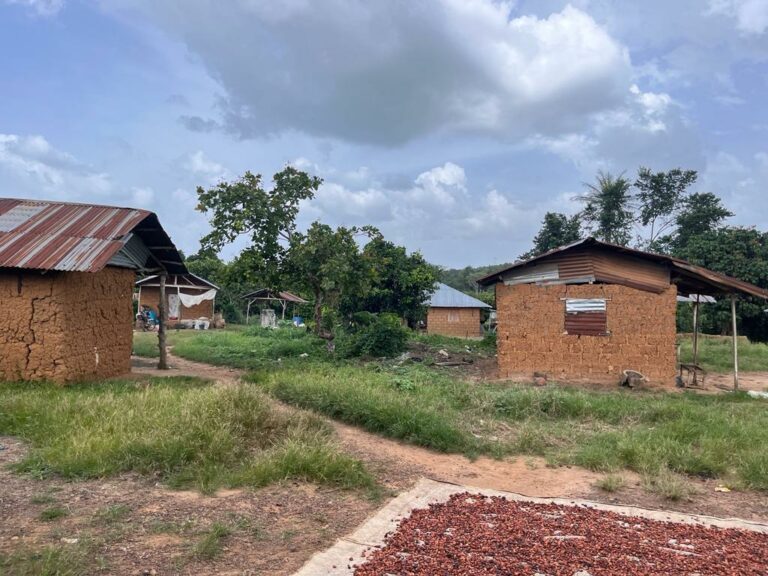
Cocoa pods sun-dried outside one of the huts in a camp in the Oluwa forest reserve… Photo credit: Taiwo Adebulu
But here is the problem. The forest reserve already had occupants—smallholder farmers who had cultivated the land for about 30 years. They were primarily cocoa farmers who had built camps with clay and rusted roofs in the forest. Inside the cocoa farms were kolanut trees, cassava, yam, maize, and plantains.
Nevertheless, SAO Agro moved into the forest with full force and left trails of blood and devastation. Decades of sweat were brought down in a few hours as thousands of cocoa trees were flattened.
Sorrow, tears from the forest
On April 18, scores of soldiers, police officers, and local security guards, armed to the teeth, descended on the once-peaceful forest. The officials from SAO Agro waved documents at the farmers, saying the state government had sold the land to the company and anybody who stood in their way would be crushed.
Abiodun and her husband abandoned their home in the forest after the death of their daughter… Photo credit: Taiwo Adebulu
Abiodun Idowu was tending to cocoa with Esther, her one-year-old daughter, strapped to her back when the revving engines of the bulldozers jerked into her farm. Her mind went ablaze and tears flowed. While scampering around the farm, begging, hoping the invaders would show mercy, Idowu slipped and fell on her back. Her weight rested on the infant. But the bulldozers did not stop. They continued to scrape the cocoa trees on Abiodun’s farm.
By the time Kehinde, Abiodun’s husband, and other farmers took her to the hospital in Ore, a nearby town, the baby was pronounced dead on arrival. The child was buried the next day. With nothing to fall back on, they left the forest and moved to town to search for jobs. Their next-door neighbour, Kole Akinde, whose farm was also destroyed, also left the forest. His wife left him when his means of survival vanished, and he found solace in alcohol.
When Oyelayo Isiaka returned to his farm and met the big machines pulling off cocoa trees he had planted since 2007 from their roots, he slumped. Other farmers who were running around to save their farms quickly picked him up and doused him in water. He started harvesting pods from the farm in 2010 and had looked forward to profiting for another four decades.
Isiaka slumped when he heard that his cocoa farm had been destroyed… Photo credit: Taiwo Adebulu
“I didn’t know I could come out alive from that incident. I didn’t see the people around me. It was as though I was seeing angels in white. I was revived. You would have come here today to see my burial ground,” Isiaka said.
“I have lost a lot on that farm. Feeding my two wives and seven children has become difficult. Some time ago, I returned to the farm and shed tears. Now I’m a labourer working for my colleagues, whose farms are still intact. I have to beg other farmers for everything I need, including yams. It’s more like from grace to grass.”
Gabriel Oladuni suffered a similar fate. He had an accident while on his way to the forest in 2015 and has been bedridden since then. His wife, Alice, would take care of him and also attend to their farm. When the news of the destruction of his cocoa farm got to him, he slumped and had a stroke.
Alice used to make about N3 million ($3,363) from her farm annually. Now, she begs other farmers for food… Photo credit: Taiwo Adebulu
He has relocated to his hometown, while his wife stayed behind and had to beg other farmers for leftovers.
Akintayo Adeolu’s face still oozes pure pain. When he had an accident on his farm ten years ago and his dominant right hand was amputated, it did not stop him from going back. The farm was his only means of survival. With aged parents and children in higher institutions of learning, Adeolu expanded his farm to make more profit. In less than one hour, the bulldozers knocked down the cocoa trees.
“We begged them, but our appeals fell on deaf ears. The soldiers flogged me mercilessly. I cried, and my children joined. They didn’t care,” Akintayo told TheCable.
Adeolu…Photo credit: Taiwo Adebulu
“In a year, the least I make from that farm is N15 million ($16,816). My child at the polytechnic had to stop because I couldn’t pay the fees again. The company has planted palm trees on my farm. I cannot return there again because the evil is done. We practically beg to be fed, yet we cannot leave here. My years of labour are gone.”
‘The government tricked us’
Some of the farmers at the Oluwa forest reserve… Photo credit: Taiwo Adebulu
The 60-year-old chairman of the farmer association in the forest, Abayomi Isinleye, said the settlement used to be very lively. Petrol generators would light up the camps in the evening, there was more than enough food, and farmers were able to send their children to universities across the country. But the crisis changed everything, and the camps were getting deserted after occupants lost their farms.
“I came here in 1996 and I met some people who were already cultivating cocoa in the forest. The king of Odigbo was the one who assigned the forest to the farmers. We sold the proceeds of our cocoa farms to the Ondo state government until the crisis started two years ago,” Isinleye told TheCable.
“Before the crisis started, the government invited farmers to Akure, the state capital. We went there and the government officials asked about our location and what we planted. They welcomed us and commended us for feeding the population. They said it was because of our efforts that the state has one of the best grades of cocoa in the country.
“During the meeting, they said the reason they called us was because they wanted us to pay taxes for the land to the government. Before, the forest guards used to collect taxes from us. It wasn’t a fixed price. They collect up to a million naira or less. The governor said we needed to have an association as Ondo state farmers. They made three identity cards for us. We were charged N3,000 ($4) for the first one, N5,000 ($6) for the second, and N7,000 ($8) for the third one. The government officials later came to survey the farmlands in the forest and we were given a document stating that we had become recognised farmers in the state.
“Thereafter, they said we’d be paying N10,000 ($11) tax per hectare. We cultivated over 518 hectares of land in this camp. So, we have been paying about N6 million ($6,726) in taxes to the government as and when due, and we have the receipts for this year. When the governor wanted to go for a second tenure in 2020, he had another meeting with us and said that he wanted to take our names to the national assembly so that we could become ‘federal-registered farmers’. He asked us to vote for him, and that he would do everything he had promised us.
“After we voted for him and he got re-elected, that was when we overheard he had sold all the lands in the forest to agro-investors and all farmers were asked to leave. The government did not dialogue with us on the plan to send us out of the forest reserve. When the investors came to tell us, we told them we had nowhere else to go and we were ready to resist the quit notice. But they came with 16 bulldozers and overwhelmed us with security officers.”
As the investor jumped from one farm to the next, tearing down cocoa trees to spread its tentacles across the forest, the farmers wailed. They ran from pillar to post, begging the community and traditional leaders to intervene. Nothing came out of it. They proceeded to court and filed a lawsuit against the state and the agro-allied company.
Isinleye showing this reporter bullet holes in one of the buildings in the camp after the farmers were allegedly attacked by thugs… Photo credit: Taiwo Adebulu
In May last year, a justice, Aderemi Adegoroye of the Ondo state high court granted an interim injunction restraining the state government and others from further grading or continuing to grade the cocoa plantations, which he described as an act of anarchy as the farmlands were the only source of survival for the farmers.
The farmers felt some respite. But it did not last long. Despite the injunction, the investor graded more cocoa farms and planted palm trees in their stead. The farmers mobilised to resist the expansion, but thugs attacked them and riddled the camps with bullets. The farmers stood their ground, overpowered the assailants, and recovered guns and motorcycles. Yet, the attacks on the farms continued.
‘We have nowhere else to call home’
A cocoa plantation at the Oluwa forest reserve… Photo credit: Taiwo Adebulu
“We have more than 3,000 farmers in our camp and there are more than 14 camps in the forest. Farmers, who were making millions of naira annually, are now begging for food. We have nowhere to call home. We are suffering,” Nurudeen Oladipupo, who had farmed in the forest for two decades, told TheCable. His voice beamed with anger and frustration.
“We went to court because that is where our only hope lies. That is our last hope. We know the government owns the court, but no one is above the law. If not, it is going to be another Agbekoya revolt. We are ready to face the guns and die.”
The Agbekoya uprising of the late 1960s in south-west Nigeria was orchestrated by peasant cocoa farmers to agitate against excessive taxation by the government. The armed struggle led to violence and bloodshed across the region.
A 40-year-old farmer, Yemi Ilesanmi, said she was ready to join the men in the resistance against the takeover of their farms by the government and investors. Ilesanmi graduated with a degree in business administration from Lagos State University in 2003. Armed with her credentials, she walked the length and breadth of Lagos, Nigeria’s commercial city, for a job, but she could not secure a reliable one. She left Lagos, got married, and joined her husband in the forest to till the soil.
For Ilesanmi, leaving the city and its allure to embrace farming in the forest of a rural community was a very difficult decision she had to take. But when the farm began to yield produce, life became better. She could laugh all the way to the bank and fend for her four children comfortably. The only place you can call home is where you have peace and a job to keep life going, she said.
Ilesanmi joined her husband on the farm after years of job hunting in Lagos without success… Photo credit: Taiwo Adebulu
“This forest is our home. We don’t want any alternative land. Do you know what it means to leave your home, enter the forest, plant food, and nurse it until it starts yielding fruits after some years? We have been doing this for about 30 years,” Isinleye told TheCable.
“How do we start afresh when you displace us from here with the thought that resettlement can solve it? What if another government decides to chase us away from the new settlement? Are we going to be displaced all our lives because we want to provide food for a nation battling with food insecurity and inflation? Farmers are the last hope in the world. Or is it a crime to be a small-scale farmer? The forest reserve is so massive that it will contain the smallholders and the big investors. The question we keep asking them is: Why our cocoa farms?
But conservationists are asking a different question: why is no one talking about how the conflict between the farmers, investors, and government is encroaching on the reservation of the forest, which is a sanctuary for the endangered Nigerian-Cameroonian chimpanzees and other animals on the verge of extinction?
The chairman of the farmers’ association at the Oluwa forest reserve, Abayomi Isinleye, put the losses incurred from the destruction of the cocoa plantations at N500 million ($560,538) or more.
“Just one cocoa tree is generational wealth. You keep profiting from it until you age and hand it to your children. On a plot of land, you can harvest two thousand cocoa seeds annually. Right now, SAO Agro-Allied Services Limited has graded up to 2,000 hectares of cocoa farms,” Isinleye told TheCable.
Isinleye: One cocoa tree is generational wealth… Photo credit: Taiwo Adebulu
“In a year, one can make up to N10 million ($11,210) from a cocoa farm, sometimes N20 million ($22,421), depending on how big your farm is. At the moment, cocoa is N3,800 ($4.3) per kilo. A ton is N3.8 million ($4,260). Some harvest six, eight, or ten tons annually. Aside from that, we have other produce on the farm, like yam, kolanut, cassava, and vegetables that we sell to people. So, when a farm is destroyed, the loss is unquantifiable. It is the major source of wealth for many farmers in the state.”
Nigeria is the fourth-largest producer of cocoa in the world, according to the Nigerian Export Promotion Council (NEPC), making the country a leading player in the global cocoa industry.
Data on the NEPC website shows that the major destinations for the country’s cocoa are the Netherlands, Germany, Belgium, Malaysia, and the United States, where it is used to produce chocolate.
Nigeria’s cocoa export destinations… Source: Nigerian Export Promotion Council (NEPC)
According to the Ondo State Development and Investment Promotion Agency (ONDIPA), the state is the largest cocoa producer in Nigeria, and it is responsible for over 40 per cent of all cocoa exports in the country. The agency noted that the current cocoa production volume in the state stands at 240,000 metric tonnes per annum.
The National Bureau of Statistics (NBS) report also shows that cocoa-related exports in 2023 totalled N230 billion (about $258 million), which makes the cash crop the highest-earning agricultural export in Nigeria. This emphasises the significant role cocoa exportation plays in the country’s foreign exchange earnings.
The 2023 third-quarter report of the NBS stated that the export of agricultural products was dominated by superior-quality cocoa beans valued at N42.2 billion ($47 million), which were exported to Indonesia and the Netherlands.
On the other hand, the first and second quarter reports of the NBS show palm oil was only imported into Nigeria from Malaysia, Indonesia, and Cameroon. In the first six months of 2023, Nigeria imported crude palm oil worth N27.8 billion ($31 million) from Malaysia.
From 2017 to 2022, Nigeria imported N300 billion ($336 million) worth of palm oil, making it one of the top five imported agricultural products into the country.
In summary, while Nigeria earns a lot of money from cocoa exportation, it spends a lot more to import palm oil.
Cocoa vs Palm oil: Conflict in a reserved forest
According to a PwC report, in the early 1960s, Nigeria was the world’s largest palm oil producer, with a global market share of 43 per cent. But today, it is the 5th largest producer, behind Columbia, Thailand, Malaysia, and Indonesia, with less than 2 per cent of the total global market production of 74.08 million MT.
“In 1966, Malaysia and Indonesia surpassed Nigeria as the world’s largest palm oil producers. Nigeria is the largest consumer of palm oil in Africa, with a population of over 197 million people. To meet the supply gap for palm oil, the country had to depend on importation over the years. From being one of the leading exporters of crude palm oil in the 1960s, Nigeria is now a net importer,” the PwC report stated.
“According to the Central Bank of Nigeria (CBN), if Nigeria had maintained its market dominance in the palm oil industry, the country would have been earning approximately $20 billion annually from the cultivation and processing of palm oil as of today.”
As things stand, both cocoa and palm oil are key to the agricultural policy of the government in terms of foreign exchange earnings and meeting local market needs. But the question begging for answers is: why is there an onslaught on cocoa plantations for industrial palm oil cultivation when smallholder farmers and big investors can plant separately on the land?
Cocoa trees uprooted to pave the way for the Central Bank of Nigeria’s agricultural initiative in a forest reserve… Photo credit: Taiwo Adebulu
The senior special assistant on agriculture to the Ondo governor, Akin Olotu, provided the answer as to why the cocoa farmers were asked to leave the forest reserve for SAO Agro-Allied Services Limited to grade and plant palm trees in line with the CBN initiative.
“They have done incalculable damage to the cocoa business in Ondo state. In the global market, it has been observed that cocoa in Ondo state is planted in the forest reserve, and the EU is of the opinion that they don’t want any chocolate product that is coming from forest reserves. Those that will bear the brunt are the real cocoa farmers that are farming on community land,” Olotu told journalists.
But the government is issuing licences to investors to plant palm trees on the same forest reserve, Tope Temokun, the farmers’ legal counsel, queried. The lawyer said if the government was sincere with the Central Bank scheme, it would revive the abandoned palm tree plantations and palm oil processing companies across the state to redeem its lost glory as the number one producer of palm oil in the world—instead of promoting industrial cultivation in a forest reserve.
A depleting forest reserve
The palm trees recently planted by SAO Agro in the forest reserve… Photo credit: Taiwo Adebulu
Ondo is said to be the richest state in forest resources in south-west Nigeria. When the state was created in 1976, it had sixteen forest reserves of about 308,000 hectares. Presently, they have depleted to about 250,000 hectares, as some have been completely encroached on. The Oluwa forest is one of the last remaining forests in the area.
The Oluwa Forest Reserve, covering about 678.06 km2, is a tropical rainforest and one of the most important reserves in the country because of its rich biodiversity.
A map showing the forest reserves in Ondo state… Oluwa forest used to be part of the Omo-Shasha-Oluwa forest reserves until they were separated.
A 2007 Nigerian Conservation Foundation report showed elephants and chimpanzees still inhabit the forest. Some researchers from the Federal University of Technology Akure (FUTA) in the state, who were conducting a survey, were said to have had four sightings of chimpanzee groups in the forest between September 2011 and February 2012. The 2007 conservation report made a recommendation that protected areas should be established in the natural forest.
One of the companies licensed to plant palm trees in the forest reserve… Photo credit: Taiwo Adebulu
According to satellite data from the University of Maryland visualised on Global Forest Watch, Oluwa Forest Reserve lost about 14 per cent of its primary forest cover between 2002 and 2020, and preliminary data showed forest loss likely surged higher in 2021.
The researchers from the university said an axis of the forest reserve has been completely cultivated for farming, and there is pressure to convert other parts of the natural forest into farmlands, which would make it difficult for the chimpanzees to inhabit the forest.
The spokesperson for the Wild Africa Fund, an international wildlife conservation organisation, Mark Ofua, said cutting down forests to make room for agriculture is one of the major drivers of deforestation and habitat loss in Nigeria.
“Forest reserve clearing results in the felling of iconic trees that have taken hundreds of years to grow and may be endemic to these areas. This means some of these can never be recovered. The loss of forest cover on these reserves also means we may forever lose some of the iconic animals that inhabit these forests,” Ofua said.
“This biodiversity loss is a major driver of climate change and fosters hardships in our environment. Nigeria as a country has over the years lost a significant portion of its biodiversity, and this unprecedented level of forest reserve clearing, as is happening in the Oluwa forests in Ondo state, the Agodi area of Oyo state, will drive what’s left in these areas to the brink of extinction.
“A state of emergency should be declared in the effort to save our forests and forest reserves. The current law that puts the powers/ownership of these forests in the hands of state authorities, who make it their primary objective to amass as much wealth as possible, even if it means driving our forests to extinction, must be reviewed. The Oluwa Forest Reserve in Ondo state must be protected at all costs. It is a natural habitat for pangolins, bats, and other fauna and flora, and a travel path for our few remaining elephants.”
The presence of agro-investors poses a threat to the natural forest… Photo credit: Taiwo Adebulu
On his part, a conservationist and founder of Greenfinger Wildlife Initiative, Chinedu Mogbo, said aside from the fact that revenue will be generated from the cash crops, there are a lot of disadvantages to using the forest reserve for large-scale farming.
“It leads to the loss of large land masses of forests, rendering numerous animals vulnerable, losing carbon sinks, fostering more human-wildlife conflicts, and breaking the threshold for disease transmission from wildlife to humans. This large-scale farming will favour the use of chemicals, which will affect soil and disrupt the ecosystem and other nutrient cycles,” Magbo said.
“Many of our flora and fauna are listed as threatened or critically endangered species. The consistent destruction of forests that house many of these species will ultimately lead to their extirpation.”
Magbo attending to pangolins
Meanwhile, the Idanre forest reserve (OA5) in the state is also facing the same conflict as the Oluwa forest – with the same investor, SAO Agro-Allied Services Limited.
The farmers in the reserve took the state government to court over the alleged sale of their cocoa plantation to the investor. The farmers, who had cultivated cocoa in the forest for over two decades, took to the streets to protest after their farms were graded for the firm to plant palm trees.
The Idanre reserve is a protected natural forest and an important conservation area for the local flora and fauna.
Farmers accused SAO Agro of mounting a toll gate in the forest making access to farmlands difficult… Photo credit: Taiwo Adebulu
Information on the website of SAO Agro, the company at the heart of the conflict in the forest reserves, stated that the firm is the lead investor developing the Ondo Special Agro Processing Zone supported by the African Development Bank (AfDB) and the Ondo government in the bid to increase state IGR through national and international agricultural trade.
This reporter reached out to SAO Agro through its corporate emails, website, and phone calls, seeking information on the agricultural activities of the investment company in the forest reserves in Ondo state and whether it is aware of its negative effect on the conservation of the depleting forest. Further questions were asked on the alleged involvement of the company in the assault of farmers in the forests. But there were no responses from the company.
In his reaction, the chief press secretary to Lucky Aiyedatiwa, the new governor of Ondo, Ebenezer Adeniyan, said the issue was inherited from the past administration in the state. He said he was unsure if the matter had caught the attention of Aiyedatiwa, who was the deputy governor in the previous administration.
This report republished from TheCable was produced with support from the Rainforest Journalism Fund in partnership with the Pulitzer Center.
At least 287 students and a principal, Abubakar Isah, were abducted on Thursday, February 7, when bandits invaded the Local Education Authority (LEA) Primary and Junior Secondary School, Kuriga, in Chikun Local Government Area of Kaduna State, a school teacher, Sani Abdullahi, has said.
Abdullahi revealed this during the visitation of Governor Uba Sani and some other state government officials to the school hours after the incident, noting that 187 students were abducted from the secondary school section and 125 from the primary school section, totalling 312 students.
The ICIR, on Thursday, reported how the assailants invaded the school and reportedly kidnapped over 100 children, alongside some staff of the school.
Abdullahi, who escaped the abduction along with others, said 25 of the pupils from the primary section had returned, leaving the number of abducted to 287.
“At GSS Kuriga, 187 students are presently missing. In the primary school, 125 pupils were initially missing, but 25 of them escaped and retired home,” Abdullahi told the governor.
He also said a member of the Kaduna State Vigilante Service (KADVS) was killed by the bandits during the attack.
While narrating how the assailants invaded the school, Abdullahi said it was around 7:45am when he entered the acting principal’s office to sign his attendance.
“All of a sudden, the Acting Principal asked me to look at my back and when I turned, we discovered that bandits had surrounded the school premises. We became confused. We didn’t know where to go. Then, the bandits ordered us to enter the bush, so we obeyed them because they were many.
“So, when we entered the bush, I was lucky to escape alongside many other people. I returned to the village and reported what happened to the community. Immediately our vigilante and personnel of Kaduna Vigilante Service (KADVS) followed the bandits, but the vigilante did not succeed. The bandits killed one of the vigilante, we just buried him a short while ago.
“It was when we came back that we briefed the Village Head and we started making efforts to find out the actual number of pupils and teachers taken by the bandits,” Abdullahi told the Governor.
Governor Sani vows to rescue all abducted children
Meanwhile, reacting to the tragedy during his visit, the state governor, Sani pledged that the state government has started making efforts to rescue all abducted children.
“Before coming here, I spoke with the National Security Adviser (NSA), Malam Nuhu Ribadu, and we are making efforts. The security forces have swung into action, and by God’s grace, we will rescue the children,” the governor said.
“We will do whatever we need to do to ensure the safe return of these children, even if it means coming to Kuriga to stay with you.
He, however, emphasised on the importance of state police, noting that when he was in the Senate, he moved the motion for the creation of state police having realised that there were not enough boots on the ground.
According to him, with state police, every community like Kuriga would have people in the police, and they would be armed with AK47 rifles to protect the lives and property of the citizens.
NIGERIA’S U20 men’s national team, Flying Eagles began their campaign at the 13th edition African Games on an unimpressive note after losing 1-2 against Uganda.
The match was played at the Accra Sports Stadium in Ghana.
The Flying Eagles, who emerged as bronze medalists at the continental multi-sports event held in 2019 in Rabat, Morocco, conceded the first goal in the 33rd minute after kickoff.
The Ugandans got the lead through a finish by Kiza Arafat Usama, inspiring confidence in the team.
But four minutes later, the Flying Eagles, led by Ladan Bosso, restored parity to level up in the 37th minute through Sadiq Muhammad Isiyaka.
The match ended 1-1 into the break.
The resumption of the second half saw both teams creating chances to double their lead.
The tenacity of the Ugandans paved the way for them as Ivan Irinmabozi’s long-range goal in the 81st minute sealed the victory for his country.
Earlier before the match, Senegal pipped Sudan, 1-0.
The other matches to be played on Friday, March 8 2024 will see the host nation Ghana lock horns against Congo while Gambia will slug it out against Benin Republic.
In football games, eight countries are participating in the competition. The country’s U20 men’s national teams include the hosts Ghana, Benin, Congo, Gambia, Senegal, South Sudan, Tunisia and Uganda.
Meanwhile, in the women category, there are six participating countries. They include the hosts Ghana, Nigeria, Morocco, Tanzania, Ethiopia, and Uganda.
Ahead of the kick-off in the women’s category, Nigeria will face Morocco on Friday, March 8 at the Cape Coast stadium.
The Africa Games is a multi-sport event. It is usually organised by the African Union (AU), the Association of National Olympic Committees of Africa (ANOCA), the Association of African Sports Confederations (AASC), and the Supreme Council for Sport in Africa (SCSA).
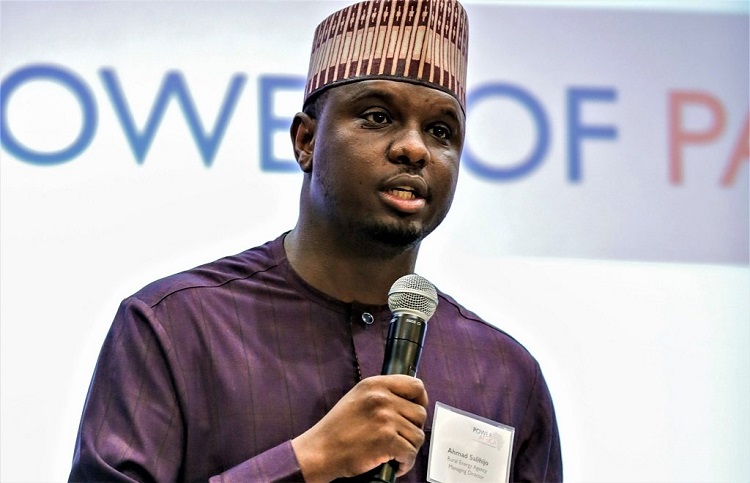
PRESIDENT Bola Tinubu has suspended the Managing Director/CEO of the Rural Electrification Agency (REA), Ahmad Salihijo Ahmad, alongside three Executive Directors of the Agency, over N1.2 billion fraud allegation.
The three suspended Executive Directors are Olaniyi Alaba Netufo-Executive Director of Corporate Services; Barka Sajou-Executive Director of Technical Services; and Sa’adatu Balgore-Executive Director, of Rural Electrification Fund (REF).
The suspension was confirmed in a statement by presidential spokesman Ajuri Ngelale, on Thursday.
The statement also revealed that the President has ordered a wider investigation into the conduct of the aforementioned officials, who are alleged to have engaged in fraudulent expenditure amounting to over N1.2 billion over the past two years, some of which has already been recovered by anti-graft agencies.
Following the suspension, Tinubu appointed five officials to serve in the agency’s new management team in an acting capacity.
Abba Abubakar Aliyu was appointed as Managing Director/CEO, Ayoade Gboyega as Executive Director of Corporate Services, Umar Abdullahi Umar as Executive Director of Technical Services, Doris Uboh as the Executive Director of Rural Electrification Fund (REF) and Olufemi Akinyelure as the Head of Project Management Unit, Nigeria Electrification Project.
The President urged the new appointees to uphold the highest standards of transparency and accountability in the discharge of their duties.
He also reiterated his determination to elevate the yearnings of Nigerians for good governance and qualitative service delivery above the narrow interests of individuals who are entrusted to provide critical services to the Nigerian people.
The ICIR has in the time past reported how Justice Adebukola Banjoko of the Federal Capital Territory (FCT), High Court sitting in Gudu,Abuja has convicted and sentenced former directors of the REA to various jail terms for their culpability in the N5.2 billion scam.
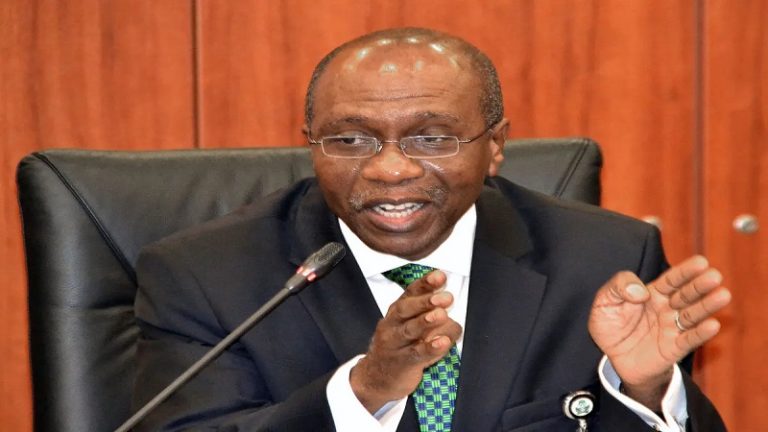
A FORENSIC analyst has confirmed before a Federal Capital Territory (FCT) High Court in Abuja that the documents used by former Central Bank of Nigeria (CBN) Governor Godwin Emefiele to request the payment of $ 6.2 million to foreign election observers were forged.
The analyst, Bamaiyi Meriga, spoke while he appeared as a witness to the Economic and Financial Crimes Commission (EFCC) at the trial of Emefiele on Thursday, March 7.
Meriga, who appeared before Judge Hamza Adamu,told the court that following forensic analysis of the discussed documents, he discovered clear evidence of forgery of signature and seal of execution different from the original version.
Meiriga further verified that the former Secretary to the Government of the Federation (SGF), Boss Mustapha, and former President Muhammadu Buhari did not sign the document.
The trial court, Muazu, admitted the two documents—Presidential Directive on Foreign Observer Election and Presidential Directive on Foreign Observer Election—as evidence.
On cross-examination by Emefiele’s lawyer, the witness claimed that he was not a team member of the EFCC and that the Nigeria Immigration Service (NIS) was the source of his salary rather than the anti-graft organization.
Counsel for Emefiele, Matthew Burkaa, expressed his sadness over the witness’s behavior, claiming that the witness deceived the court by dodging questions.
However, the prosecution’s attorney, Rotimi Oyedepo, said he was pleased with the witness.
The trial has been postponed until March 11 for continuation.
The ICIR reported that at the last court sitting in February, a former SGF, Boss Mustapha, claimed that Emefiele presented fake letters to the presidency, headed by former President Buhari, to approve $6.2m for foreign election observers during the 2023 general elections.
Mustapha stated this on Tuesday, February 13, while giving evidence in Emefiele’s trial at the Federal Capital Territory (FCT) High Court.
He exonerated himself and Buhari from the alleged fraud.
In his appearance as prosecution witness 2, Mustapha stated that although having served for five years and seven months, he was unaware of the transaction until the end of May 2023.
He claimed that two letters that were signed by Buhari and said to have come from the President were fake, while the letter credited to Buhari as the author did not come from the presidency.
He added that he was unaware of the SGF’s staff member named Jubrin Abubakar, who is said to have collected the $6.2 million cash on February 8, 2023, while being supervised by Emefiele.
According to the EFCC, which is presently prosecuting Emefiele, the former CBN Governor allegedly falsified the letters to deceive the Federal Government.
Emefiele is standing trial before Justice Muazu on 20-count amended charges bordering on conspiracy, criminal breach of trust, forgery, and obtaining by pretenses to the tune of $6,230,000.
He was accused of impersonating the SGF to obtain a sum of $6.2m illegally.
During the Monday, February 12 hearing, the first prosecution witness (PW1), Onyeka Ogbu, described how Emefiele allegedly authorised the payment of $6,230,000 in cash for foreign election observers for the 2023 general election.
Ogbu, the Deputy Director of Branch Operations at the Apex Bank, evaluated and approved the $6.2 million payment request for release.
BANDITS have abducted scores of students, alongside some teachers of Local Education Authority (LEA) Primary School, Kuriga (1), Kaduna state, Daily Trust reports.
The incident occurred around 8:30 am on Thursday, March 7, while the students assembled for their morning brief.
Although the number of persons abducted hasn’t been ascertained as of press time, locals who spoke to Daily Trust said they were at least 100.
The Headteacher of the school and some other staff were reportedly among the victims. According to Shitu, a resident of the town, most of the pupils ran out of their classes when they sighted the bandits on the school premises.
Another resident, Lawal Kuriga, also told Daily Trust that abducted victims were marched into the forest.
The State Police Command Public Relations Officer, Mansir Hassan, couldn’t be reached on the phone and is yet to reply to a text message sent to him too.
Similarly, the state government hasn’t yet reacted to the incident as of the time of filing this report.
This is not the first case of abduction and kidnapping in Northwestern Nigeria, as bandits incessantly rampaged several communities in the region.
In 2019, armed bandits attacked the Government Girls Secondary School, Moriki, in Zurü local government area of Zamfara State, kidnapping several students and teachers.
This attack was the second when hoodlums attacked a secondary school and abducted students in President Muhammadu Buhari’s first term in office, despite the administration’s claim of having improved security across the country, according to the report.
The first was in February 2018 when 110 school girls were abducted by Boko Haram from their school dormitory in Dapchi, Yobe State. Some of the girls, numbering 104, were released a month later following negotiations between the government and Boko Haram.
However, five died in custody while one, Leah Sharibu, is still being held because she refused to convert to Islam.
There were many other cases of bandits’ attacks in Kaduna and other northern states that have claimed several lives. Despite the security operatives repelling some of the attacks, the terrorists have managed to record many feats.
MULTIPLE award-winning Nigerian singer and producer, Innocent Idibia known as 2Baba has exited ‘Now Muzik’ 20 years after partnering with the music company.
This was made known on Wednesday, March 6, via Instagram where the CEO of Now Muzik, Efe Omorogbe expressed appreciation to 2Baba for the years of friendship and trust.
“I am grateful to 2baba for the trust, and for the friendship. I am proud of the brands we built together, the music we made; the fans we entertained.
“2Baba is one of the greatest Nigerian musicians of all time and it is an honour to have had the opportunity to walk side by side with him, watching and helping him make magic over the past two decades.
“My team and I look forward to now supporting from the sidelines,and continuing to advocate for any and everything 2Baba”, he wrote.
In his response, 2Baba admitted that the Now Muzik team and Omorogbe played a vital role in the success of his music career, stating that they brought his talent and vision to life.
“I know it’s a cliche but every good thing must come to an end. I owe a lot of my career success to Efe and his team at Now Muzik. Everything I’ve been able to achieve is as a result of the support of so many people and organisations working with me to bring my talent and vision to life. Now Muzik is one of such companies and I couldn’t be more grateful to them,” he said.
2Baba started his music career in mid 1990s and adopted the stage name “Tuface (2face) which he eventually changed in 2016 to 2Baba.
In the early stage of his music career, himself alongside Augustine Obiabo known by his stage name, Blackface and Chibuzor Oji, known as Faze formed a band known as ‘The Plantashun Boiz’.
The group got disbanded in 2004 after which 2baba went solo and then joined the ‘Now Muzik’ management.
After partnering with Now Muzik, 2Baba has put out eight albums and amassed over 400 million listens on various digital platforms, including, Spotify, Boomplay, Apple Music, YouTube, among others. He has received over 60 awards, including the Lifetime Achievement Award at the 2023 Trace awards.
He will now be represented by his own company,Hypertek Digital.