Home Blog Page 67

Relief as Dangote cuts fuel prices

0

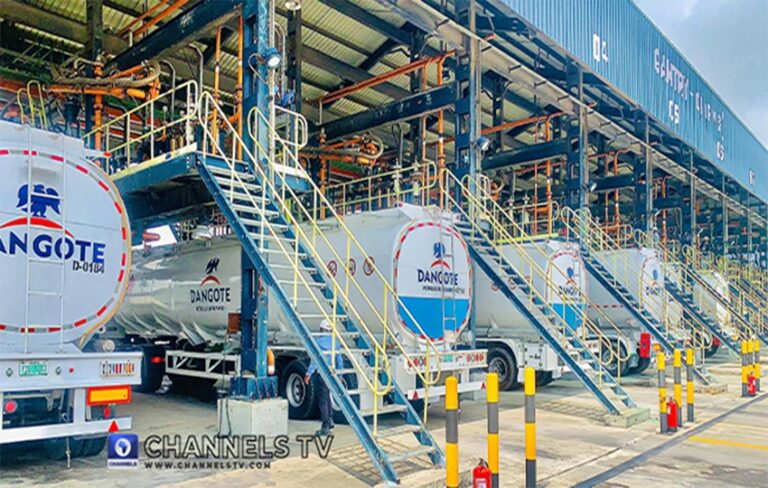
Dangote Refinery has lowered petrol and diesel prices by N100 as costs are expected to decrease further with oil prices falling below $90 on Tuesday, March 10.

The slash is not unconnected with President Donald Trump’s latest signals confirming the de-escalation of the United States-Iran conflict.

In the latest pricing template issued by Dangote Refinery on March 10, the price of petrol at the gantry was reduced by ₦100, bringing it down to ₦1,075 per litre from the earlier price of ₦1,175 per litre.

The refinery said petrol price for coastal supply would be set at ₦1,050 per litre, due to maritime distribution expenses.

Similarly, the cost of diesel has been lowered to ₦1,430 per litre at the gantry. This marks a reduction of ₦190 from the previous price of ₦1,620 per litre.

The refinery pointed out that the prices at the gantry did not include fees from the Nigerian Midstream and Downstream Petroleum Regulatory Authority (NMDPRA).

Earlier on Monday, Trump signalled the conflict with Iran could end “very soon.”

Despite selling over $100 on Monday, oil prices plunged as much as 10 per cent on Tuesday before paring losses, as investors assessed comments from Trump on the conflict in the Middle East and on oil flows through the critical Strait of Hormuz.

Initial price hike had pushed petrol price above N1,300 at retail outlets in several parts of the country while diesel sold for N1,700.

Nigerians have had to endure intermittent price surges of fuel which triggered higher transportation fares across the country.

However, the drop below $90 per barrel of Brent crude on Tuesday could signal lower gasoline prices in several parts of Nigeria.

“There’s the trading and distribution aspect of the refining, and if the war de-escalates, it will impact pricing,” the President of Petroleum Retail Owners Association of Nigeria (PETROAN), Billy Gillis-Harry, told The ICIR.

He stressed that increased local refining could have also helped to cushion the pricing effects on Nigerians.

The Chief Executive Officer (CEO) of Financial Derivatives, Bismarck Rewane, also said that the slump in the global oil price should reflect on the local pricing.

“We expect the prices to gradually begin to go down further with the same push that the prices were raised over the past few days to lessen the burden on the people,” he said.

Meanwhile, Trump, who had signalled on Monday that the conflict with Iran could end soon warned later in the day that Tehran would be hit “twenty times harder” if it attempted to halt oil flows through the Strait of Hormuz.

Located between Oman and Iran, the Strait is a vital transit route for global energy markets.

Roughly 13 million barrels passed through the waterway in 2025, accounting for about 31 per cent of global seaborne oil flows, according to Kpler.

It connects major Gulf producers, including Saudi Arabia, Iran, Iraq and the United Arab Emirates, to the Gulf of Oman and the Arabian Sea.

“This is a gift from the United States of America to China, and all of those nations that heavily use the Hormuz Strait. Hopefully, it is a gesture that will be greatly appreciated,” Trump said in his post.

The comments come as a spokesperson for Iran’s Ministry of Foreign Affairs warned on Monday that oil tankers transiting the Strait of Hormuz “must be very careful.”


Nursing students protest after school hiked tuition by over 500%

0

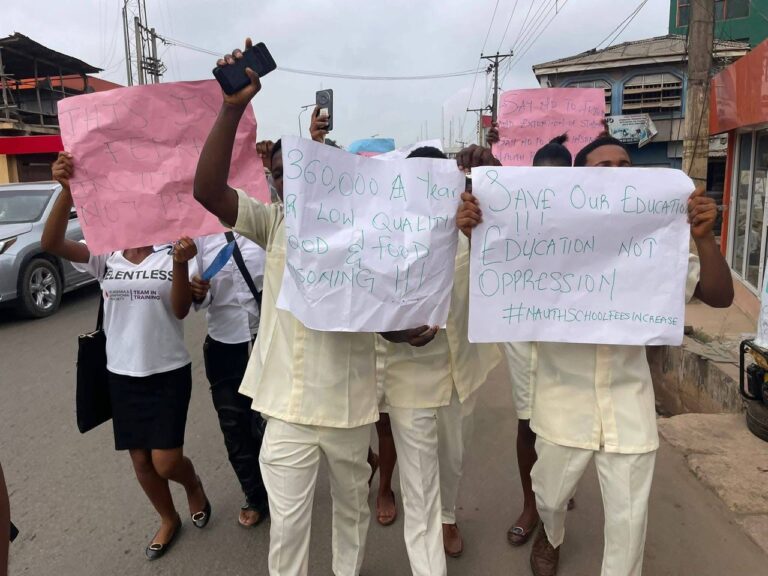
STUDENTS at the College of Nursing Sciences, Nnamdi Azikiwe University Teaching Hospital (NAUTH), Nnewi, Anambra State, on Tuesday, March 10, staged a peaceful protest over a sharp increase in tuition fees.

Videos circulating on social media showed how the students marched through parts of the town, chanting and carrying placards while calling on the school management to reverse the increment.

“Save our education. Education is not oppression,” some of the inscriptions on their placards read, while others had “No to fraud and extortion of students.” 

The students alleged in one of the placards that the school fee was increased from about ₦90,000 to ₦580,000, placing a heavy burden on them and their families.

Internal memo confirms fee increment

The protest followed an internal memo issued by the management announcing the hike in school fees across all levels of the College of Nursing Sciences.

The hike, reported by Daily Sun on January 23, 2026, showed that the adjustment was part of efforts to upgrade the institution.

“The hospital management and the Board of College of Nursing, in an ongoing effort towards upgrading the institution to a reputable monotechnic, has approved an upward review of students’ school fees across all levels in the college,” the memo, signed by the Chairman of the Board of the college, O. I. Ezejiofor, read.

Memo, announcing the upward review of school fees
Memo, announcing the upward review of school fees for NAUTH students, Credit: Daily SUn

It added that the new fee structure would take effect immediately for the 2025/2026 academic session.

According to Daily Sun, previously, a 100-level student’s total fees amounted to N250,000, which included a N100,000 tuition fee, combined maintenance and caution fees of N30,000, a N10,000 library fee, and N60,000 for medical exams and services. Other costs under the old structure included an examination fee of N20,000, and a portal fee of N10,000, as well as a N10,000 hostel maintenance fee.

However, under the new “annual regular fee” structure, the total has risen to N580,000.

The new breakdown consists of a N250,000 tuition fee, a N50,000 maintenance/caution fee, and a N50,000 library fee. Examination fees have tripled to N60,000, while the portal fee has doubled to N20,000. 

Breakdown of the annual regular fee. Credit: Daily SUn

Additionally, the school adjusted charges including a N30,000 medical fee, a N30,000 transport fee, a N50,000 accreditation fee, and N40,000 accommodation maintenance fee.

However, students argued that the revised fees are unaffordable and come amid existing financial pressures.

US warns citizens in Nigeria of terror threat

0

THE United States Government has warned its citizens in Nigeria of a possible terrorist threat targeting US diplomatic facilities and American-affiliated schools, as tensions continue to soar amid ongoing Middle East crisis.

In a security alert issued late Monday, the US Embassy in Abuja advised American nationals to exercise heightened caution when visiting US facilities, including the embassy in Abuja and the US Consulate General in Lagos, as well as schools and institutions associated with the US.

“Threat to US facilities and schools: The US Embassy in Abuja informs US citizens of a possible terrorist threat against US facilities and US affiliated schools in Nigeria.  The Embassy recommends that US citizens take additional precautions when traveling to the US Embassy, the US Consulate General in Lagos, and US affiliated schools, to include varying times and routes.

“Increasing awareness of your surroundings, avoiding predictable routines, and reviewing general security precautions with your family can help reduce your risk,” the statement read.

The embassy said the warning was prompted by intelligence indicating a potential terrorist threat against US interests, though officials did not disclose specific details about the nature of the risk. It urged American citizens to remain vigilant, limit unnecessary movements near US government facilities and monitor local media for updates as the situation evolves.

“Be aware of your surroundings, keep a low profile, review your personal security plans, vary your regular routes, keep your cell phone charged in case of emergency, stay alert in public places, avoid crowds and demonstrations, familiarize yourself with emergency exits when entering buildings. For additional information about threats and risks to travelers in Nigeria, please visit the Nigeria Country Information page   on travel.state.gov,” it added.

This alert comes amid heightened global tensions following coordinated strikes by the US and Israel against Iran, which have raised fears of retaliation or unrest in several countries.

Diplomatic missions in Nigeria have been on increased alert since the escalation of hostilities, with security officials monitoring possible demonstrations and threats that could target Western interests.

The warning also follows a series of pro-Iran demonstrations in parts of Nigeria, particularly in the northern region where there is a sizable Shi’ite Muslim population with ideological ties to Iran.

On Tuesday, March 3, members of the Islamic Movement in Nigeria, commonly referred to as Shi’ites, staged a peaceful protest in Potiskum and Nguru Local Government Areas of Yobe State. The protesters condemned the reported killing of Ayatollah Khamenei, describing him as a revered spiritual leader.

The group also protested in Niger, Sokoto, Kaduna, Bauchi, Gombe and Lagos states, condemning what it described as joint US–Israel aggression against Iran. During a procession in Niger State on Sunday, led by IMN leader Ibrahim El-Zakzaky, demonstrators waved Iranian flags and chanted solidarity slogans, vowing continued resistance.

The ICIR reported on March 4 that security was tight across Nigeria’s capital following a planned protest by Shi’ite members. The IMN had announced plans to stage demonstrations in Abuja in solidarity with Iran following coordinated US–Israel strikes that Iranian media confirmed led to Khamenei’s death.

Lagos building collapse puts Sanwo-Olu’s safety reforms under scrutiny as hundreds of students escape death

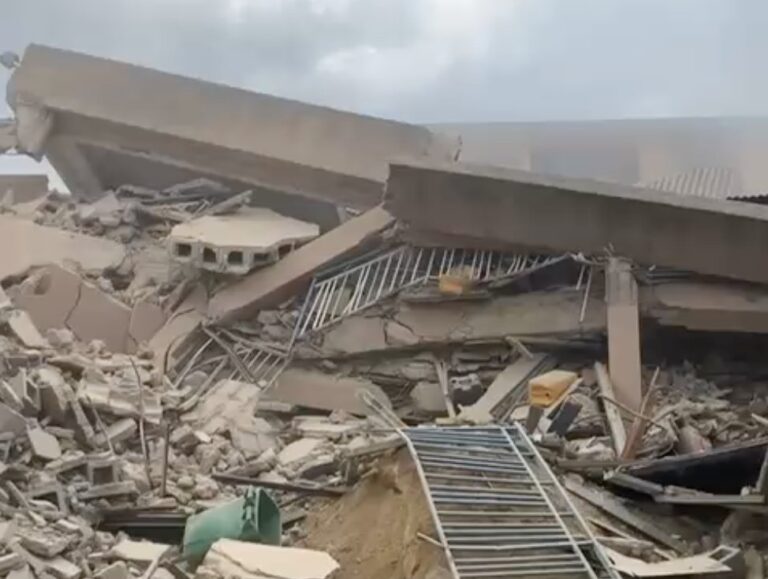
DESPITE repeated assurances on building safety by the Lagos State Government, weak inspection and regulatory lapses nearly cost the lives of hundreds of students in the Ogba area of Lagos State on Monday, March 9.    

According to reports, hundreds of pupils and teachers of Yemco Nursery, Primary and Comprehensive College narrowly escaped death after a resident noticed signs of distress on the building housing their school and raised the alarm.

This promptly forced an emergency evacuation of the children and their teachers. The building collapsed a few minutes later.

The building, located at 11 Adudatu Street in the Aguda axis of Ogba, collapsed around midday, barely three minutes after students and staff vacated the structure.

Reports indicate that an elderly man called the attention of the school authorities when he realised that the structure showed signs of distress.

“At first, the house started cracking little by little. The window frames had already fallen apart. After some minutes, the cement body of the house began peeling off. Not long after that, the building just sank,” TheCable quoted a source to have said.

Officials of the Lagos State Fire and Rescue Service later arrived at the scene and secured the area.

No casualty had been reported as of the time of filing this report.

Gaps in building inspection by government

The narrow escape has renewed concerns over weak monitoring of buildings in Lagos, where the Lagos State Building Control Agency (LASBCA), the Lagos State Physical Planning Permit Authority (LASPPPA), and related institutions often fails in their responsibilities.

Experts say the latest incident highlights persistent failures in inspection and enforcement by LASBCA and other building control agencies.

In 2025, The ICIR reported how building collapse remained a recurring tragedy in the nation’s commercial hub despite several regulatory reforms reportedly introduced over the years.

The ICIR investigation revealed that Lagos accounted for over 55 per cent of all building collapses in Nigeria since 1974.

Between October 1974 and January 2025, at least 640 incidents were recorded nationwide, with more than half occurring in Lagos.

The building collapses were attributed to the weak enforcement of building regulations, corruption within oversight agencies, non-compliance with safety standards and the use of substandard materials.

In April 2025, a three-storey building housing the Equal Rights Restaurant and Bar collapsed in Ojodu-Berger during business hours, killing two people and injuring more than 20 others.

In May, a two-storey structure under construction in the Idi-Araba area of Mushin collapsed during the early hours. The incident claimed the life of one labourer, while three others narrowly escaped. Residents said the building was like a bomb waiting to explode.

Later that month, the Ota-Ona community in Ikorodu was thrown into mourning when a two-storey uncompleted building collapsed, killing three members of the same family: 16-year-old Maleek, his 13-year-old sister Ameerah, and their uncle Bolaji.

In September 2025, a similar incident occurred in the Yaba district of Lagos, where a three-storey building under construction gave way, killing one person and injuring several others.

One of the deadliest incidents occurred in 2021 when a 21-storey luxury high-rise crumbled in Ikoyi, killing 46 people, including the developer, Femi Osibona.

Investigations later revealed that the structure exceeded the number of floors originally approved by regulators.

More recently, in February 2026, The ICIR reported how police barracks are in decrepit state right under LABSCA’s nose in the Ikeja area of the state.

Sanwo-Olu’s reforms face scrutiny

To address the recurring disasters, Sanwo-Olu launched the Certified Accreditors Programme in March 2025, bringing private sector professionals into the building inspection process.

CAP, which arose from recommendations by a 2021 advisory panel, allows accredited experts to review project drawings, monitor construction stages, and flag illegal structures in coordination with regulators.

This initiative aims to strengthen building regulations and ensure stricter compliance with safety standards.

The Lagos government also said it had intensified enforcement operations and strengthened collaboration among regulatory agencies responsible for monitoring construction activities.

Sanwo-Olu’s Chief Press Secretary (CPS), Gboyega Akosile, said the government was committed to ensuring strict adherence to building regulations and would continue to penalise those who flout the law.

Despite these measures, experts believe that without sustained political will, transparent enforcement, and public accountability, Lagos might continue to record preventable building disasters.

Petrol inches to N1,500 per litre as Dangote hikes price to N1,175

0

A LITRE price of petrol in Nigeria may soon hit N1,500 after the Dangote Petroleum Refinery raised its ex-depot (gantry) price of petrol to N1,175 per litre on Monday, March 9.

The hike, the third recorded in a week, comes shortly after reports indicated that another rise in petrol prices was likely, especially after the refinery briefly stopped petrol sales on Sunday.

On Monday, fuel marketers were notified that petrol gantry price at the refinery had moved from N995 per litre to N1,175 per litre. The new rate represents an increase of N180, which is roughly 18.1 per cent in just three days.

The refinery also updated the price of diesel, fixing it at N1,620 per litre.

A senior staff member of the refinery, who spoke anonymously because he was not authorised  to speak, confirmed the development.

“Yes, the gantry prices have been adjusted. PMS is now N1,175 per litre while Automotive Gas Oil is N1,620 per litre,” the official said, adding that “the market has been extremely volatile, and replacement costs have shifted significantly in recent days. These adjustments reflect prevailing market fundamentals and the cost environment we are currently operating in.”

Information obtained from the petroleum pricing website Petroleumprice.ng showed that the new figures had already been reflected on depot pricing systems used by operators in the downstream sector.

The current increase follows earlier changes that moved the depot price of petrol from N774 per litre to N995 per litre within a week.

Following these changes, many filling stations in different parts of the country have already adjusted their pump prices, with petrol selling for about N1,200 per litre in some locations, adding to the financial burden faced by many Nigerians.

Industry observers say the higher fuel cost could push up transport fares and the cost of moving goods, which may eventually affect prices of items and services across the country.

The development also comes despite attempts by the Federal Government, through the Nigerian National Petroleum Company Limited, to help the refinery secure crude oil supplies through foreign trading partners in order to maintain local refining.

However, officials say the move may not quickly translate to cheaper petrol for consumers, as the country continues to experience rising fuel costs.

African Liberty Writing Fellowship seeks entries

AFRICAN Liberty is seeking applications for its 2026-2027 cohort of the African Liberty Writing Fellowship.

The fellowship is a 12-month programme designed to identify, train, and amplify emerging African writers who are passionate about advancing the ideas of freedom, individual rights, and limited government.

Applications opened on March 1, 2026, and will close on April 30, 2026.

Through the fellowship, selected participants will work closely with experienced editors; receive a monthly stipend as top contributors; gain opportunities for television and radio features; get published in leading African newspapers; and participate in a structured, year-long writing development programme (July 2026 – July 2027)

Organiser says, “An applicant has to be enrolled in, or must have graduated from, an African institution of higher learning, or be an African pursuing higher education outside the continent.”

Application deadline is April 30, 2026. Interested applicants can apply here.

Stranded Nigerians in Middle East seek help amid US-Israel-Iran tensions

0

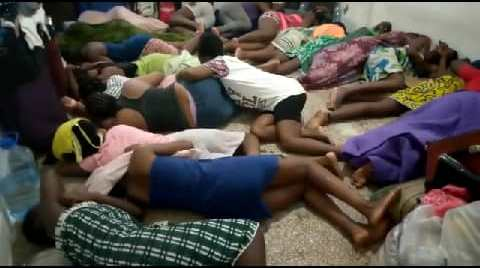
NIGERIANS stranded in Qatar are seeking help after the country temporarily closed its airspace due the ongoing conflict between the United States, Israel, and Iran.  

One of the victims who requested for help on X narrated the plights of elderly passengers and children at Hamad International Airport.

“Never been this helpless before in my life. Nine days stuck in Qatar with my family and other Nigerians who were on transit. Countries have picked up their citizens from here, it’s mostly Nigerians that are left! We have called Embassy and Consulate, yet no positive response”.

Qatar Airways had said it was offering rebooking for affected passengers, while the National Emergency Management Agency (NiDCOM) and other authorities urged stranded Nigerians to remain calm.

Officials confirmed that emergency protocols were in place to ensure the safety and repatriation of citizens affected by the ongoing conflict in the Middle East.

With partial reopening of airspace on March 9, there are hopes that more flights will depart soon, allowing stranded Nigerians to return home safely.

There are concerns that more Nigerians are trapped in other Middle East nations due to the conflict.

The ICIR reported that Iran appointed Mojtaba Khamenei as its new supreme leader, replacing his father Ali Khamenei, who was killed in a US–Israeli strike on February 28.

The appointment, announced on Monday by Iran’s powerful clerical body known as the Assembly of Experts, signals that hardline factions remain firmly in control of the Islamic Republic even as the conflict intensifies.

Before the appointment was confirmed, Trump had opposed the emergence of 56-year-old Mojtaba, a Shi’ite cleric with a power base among the security forces and their vast business empire.

Israel had warned that it would kill whoever replaces the late Khamenei unless Iran changes what it describes as hostile policies, as Trump repeated on Sunday in an interview with ABC News that Washington should have a say in Iran’s leadership.

“If he doesn’t get approval from us, he’s not going to last long,” Trump said, adding that ​ending the war would be a ‘mutual’ decision with Israeli Prime Minister Benjamin Netanyahu.

THE ICIR reported on Wednesday, March 3 – the fifth day of the conflict – that casualties were mounting across the Middle East.

Fresh strikes were widening the conflict beyond the original battle lines.

The Iranian Red Crescent Society said that at least 787 people had been killed, including 165 schoolgirls and staff in a strike on a primary school in Minab, southern Iran, on the first day of the war.

It noted that it remained unclear whether the toll included members of the Islamic Revolutionary Guard Corps (IRGC).

According to ambulance service Magen David Adom, ten civilians were killed in Israel including nine in an Iranian missile strike on Beit Shemesh near Jerusalem on March 1.

Meanwhile, global crude prices have surged above $100, up from about $60 on Friday, February 27, as the conflict continues.

The sharp rise is due to disruptions in global supply and attacks on several oil facilities in the Middle East.


Appeal Court dismisses PDP’s case, affirms judgment barring Ibadan convention

0

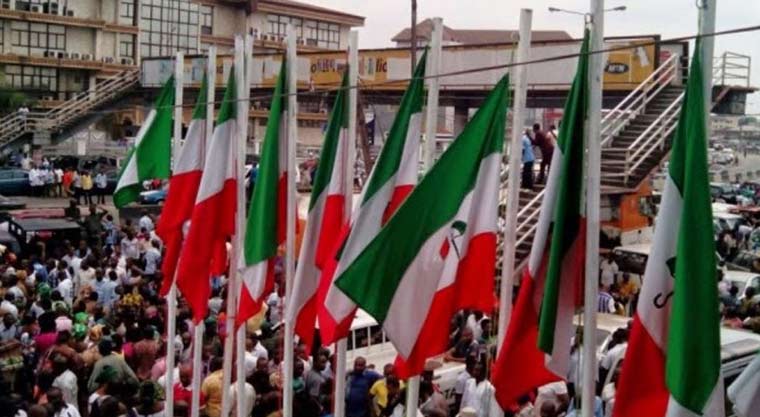
THE Court of Appeal in Abuja has dismissed an appeal filed by the Peoples Democratic Party (PDP) challenging a judgment that barred the Independent National Electoral Commission (INEC) from recognising the outcome of the party’s national convention in Ibadan, Oyo State.

Delivering judgment on Monday, March 9, a three-member panel of the appellate court unanimously upheld the earlier ruling of the Federal High Court delivered on October 31 by James Omotosho. 

The trial court had restrained INEC from giving effect to the outcome of the convention held on November 15 and 16, 2025, in Ibadan, Oyo State.

The appellate court resolved all four issues raised by the appellants against them, ruling that the appeal lacked merit.

It also dismissed the PDP’s argument that the lower court lacked jurisdiction to entertain the case on the basis that it concerned the internal affairs of the party. 

According to the appellate court, the plaintiffs had the legal standing to institute the suit as part of efforts to protect their democratic rights.

The court further rejected the PDP’s claim that it was denied fair hearing during the proceedings at the trial court.

As part of its ruling, the appellate court ordered the PDP faction led by Kabiru Tanimu Turaki to pay N2 million as costs, describing the appeal as frivolous.

Background

The ruling is the latest development in the prolonged leadership crisis rocking the PDP following its controversial national convention in Ibadan.

The convention produced a leadership team led by Turaki. However, some members loyal to the Minister of the Federal Capital Territory (FCT), Nyesom Wike, were suspended during the convention. The suspended members challenged their sack in the court.

On December 22, 2025, the Independent National Electoral Commission (INEC) rejected requests by the Turaki-led team that the commission recognise the party’s new National Working Committee (NWC), citing existing court judgments and unresolved legal processes.

The INEC referenced two Federal High Court rulings in Abuja in October and November 2025, which restrained it from giving effect to the outcome of the Ibadan convention.

The electoral commission noted that pending appeals did not automatically stay the execution of these judgments and emphasised that it remained bound by the law. A letter signed by INEC Secretary, Rose Oriaran-Anthony, explained that, in light of the suits, the commission could not update or recognise the list of national officers elected at the Ibadan convention.

Meanwhile, in a similar development, the Federal High Court sitting in Abuja, in January 2026, nullified the convention and barred Turaki and other officials who emerged from the exercise from acting as national officers of the party. 

The Turaki’s PDP caucus aslo insisted there was no cause for alarm and maintained that its leadership structure remained intact.

Following the decision, the party announced that it had instructed its lawyers to file an appeal and pursue all available legal options to defend its position.

PDP deepening crisis

The crisis in the party traces back to the build-up to the 2023 general elections when a rift emerged between supporters of former Vice President Atiku Abubakar and a group of governors led by Wike.

During the party’s presidential primary, a powerful bloc of governors led by Wike, demanded that the party’s presidential ticket be zoned to the South following the eight-year administration of former President Muhammadu Buhari, who was from the North.

However, Abubakar secured the PDP presidential ticket after defeating other aspirants, including Wike, at the party’s primary election.

The outcome deepened divisions within the party. Wike and some of his allies withheld their support for Abubakar during the 2023 presidential election.

The election was eventually won by Bola Tinubu of the All Progressives Congress (APC), after defeating Atiku and Peter Obi of the Labour Party.

After the election, Tinubu appointed Wike as Minister of the Federal Capital Territory, a move that further intensified internal disagreements within the PDP. Although Wike accepted the ministerial position in an APC-led administration, he retained his membership in the PDP.

Some party leaders, including Oyo State governor Seyi Makinde, Bauchi State governor Bala Mohammed, and PDP chieftain Bode George, have publicly criticised Wike’s role in the party and accused him of engaging in anti-party activities.

The crisis has contributed to a series of defections by prominent members of the PDP to other political parties.

Among them was Abubakar, who left the PDP in 2025 and joined the African Democratic Congress (ADC), where he is widely believed to be preparing for another presidential bid ahead of the 2027 elections.

World awaits Trump’s response as Iran appoints Khamenei’s son Mojtaba as supreme leader

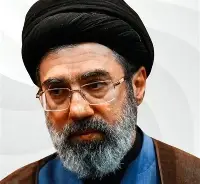
THE world is awaiting a formal response from United State President Donald Trump after Iran appointed Mojtaba Khamenei as its new supreme leader, replacing his father Ali Khamenei, who was killed in a US–Israeli strike earlier in the escalating Middle East war.

The appointment, announced on Monday by Iran’s powerful clerical body known as the Assembly of Experts, signals that hardline factions remain firmly in control of the Islamic Republic even as the conflict between Iran, Israel and the United States intensifies.

Before the appointment was confirmed, Trump had opposed the emergence of 56-year-old Mojtaba, a Shi’ite cleric with a power base among the security forces and their vast business empire.

Israel had warned that it would kill whoever replaces the late Khamenei unless Iran changes what it describes as hostile policies, as Trump repeated on Sunday in an interview with ABC News that Washington should have a say in Iran’s leadership.

“If he doesn’t get approval from us, he’s not going to last long,” Trump said, adding that ​ending the war would be a ‘mutual’ decision with Israeli Prime Minister Benjamin Netanyahu.

Following the announcement, Fox host Brian Kilmeade said he spoke with the president and quoted him as saying “I’m not pleased,” but Trump has not yet issued a formal public statement on the new leadership.

Meanwhile, Iranian institutions quickly moved to pledge allegiance to the younger Khamenei after the announcement, as officials from the government, parliament and security forces issued statements backing the new leader as the war entered its second week.

Reuters quoted the Defence Council as saying “We will obey the commander-in-chief until the last drop of our blood.”

A Senior cleric, Sadeq Amoli-Larijani, was quoted as saying Mojtaba Khamenei’s appointment was “a balm for the spiritual suffering of our people and an emphasis on the need to continue the luminous path of the late Imam (the elder Khamenei).”

The appointment makes Mojtaba Khamenei the third supreme leader of the Islamic Republic, a position that holds ultimate authority over the military, judiciary and government.

The succession marks a historic moment in Iranian politics. It is the first time since the 1979 Islamic Revolution that leadership has passed directly from father to son, raising debate among analysts about whether the Islamic Republic is moving toward a dynastic model of power.

The ICIR reported that Mojtaba Khamenei, a mid-ranking cleric who studied in the religious city of Qom, has long wielded influence behind the scenes, particularly within the powerful Islamic Revolutionary Guard Corps.

The leadership change comes as military strikes continue across the Middle East. Israel has launched new attacks in central Iran and targeted infrastructure linked to the Lebanese militant group Hezbollah in Beirut.

Iran and its allies have also responded with drone and rocket attacks targeting US and allied positions in Iraq and elsewhere in the region.

Meanwhile, Pope Leo XIV warned that the escalating violence could become “a tragedy of enormous proportions,” calling for dialogue and an end to the “climate of hatred and fear” spreading across the region.

Hunger crisis is set to get worse in west and central Africa – why and what to do about it

0

By Oliver Kiptoo Kirui, International Food Policy Research Institute (IFPRI) and Chibuzo Henrietta Nwagboso, CGIAR

COUNTRIES in west and central Africa are facing a food crisis with multiple causes. Estimates in late December 2025 suggested that 41.8 million people were already in crisis or worse in October-December 2025. The number was expected to rise to 52.8 million in June-August 2026. Researchers Kirui Oliver Kiptoo and Chibuzo Nwagbosu explain how serious the situation is.

How severe is food insecurity in the region, and where are the hotspots?

Food insecurity has three aspects:

  • chronic hunger
  • constraints to food access
  • acute crises.

West Africa, the Sahel and Cameroon are in crisis, according to the World Food Programme. It is increasingly concentrated in conflict-affected corridors where markets fragment, farms are abandoned, and humanitarian access is constrained. Key areas include the Central Sahel/Liptako-Gourma region and the Lake Chad Basin.

The problem is strongly shaped by the global humanitarian financing squeeze. The World Food Programme has warned that funding shortfalls are forcing ration reductions in countries like Mali.

Between October and December 2025, it was estimated that 41.78 million people faced food insecurity. For the June-August 2026 lean season, it is projected 52.78 million are at risk. The Food and Agriculture Organisation’s January 2026 regional update aligns with this projection.

The World Food Programme, covering a broader “west and central Africa” framing, has warned that June-August 2026 could see 55 million people endure “crisis hunger or worse”.

What is driving the crisis?

The crisis is best understood as layered risk:

  • conflict and governance shocks create vulnerability
  • climate events and price spikes trigger acute deterioration
  • weak safety nets make recovery fragile.

Conflict, insecurity and governance fragmentation:

Conflict and insecurity are repeatedly identified in analysis as determinants. They shut down markets, restrict movement, displace households, and limit humanitarian reach.

The Democratic Republic of Congo and Central African Republic Integrated Food Security Phase Classification analysis clearly describes persistent crisis-level food insecurity. This is linked to conflict dynamics and associated economic stressors.

Governance shocks can amplify market disruption. Observations noted the role of border closures and disrupted financial flows linked to Ecowas sanctions on Niger. Political events can transmit into food access constraints.

Climate shocks and environmental stress:

Cadre Harmonisé (a regional framework used for the analysis and identification of areas at risk and populations affected by food and nutrition insecurity) flagged floods as determinants as early as the 2023 cycle. It noted heavy rains damaging crops in parts of Ghana, Niger and Chad. In a region where livelihoods remain heavily dependent on rainfed agriculture and pastoral systems, even “good production years” can coexist with acute food insecurity when insecurity blocks access to fields and markets.

Economic shocks, food price inflation and market disruptions:

The State of Food Security and Nutrition in the World (2025) highlights how elevated inflation undermines purchasing power and access to healthy diets. It emphasises that food price inflation is not just a macroeconomic variable but shapes nutrition and food security outcomes.

Displacement and disrupted livelihoods:

Displacement is both a symptom and a driver. It reduces household production and income, increases dependency, and strains host-community services and markets. The current displacement burden is massive across the region’s key hotspots. United Nations High Commissioner for Refugees operational data shows that the DRC has about 6.47 million internally displaced persons, Nigeria has 3.54 million, Cameroon 1.0 million and Niger 0.59 million.

What is the impact of a reduction in food aid?

In late 2024 and early 2025, several major humanitarian donors – including the United States and a number of European governments – announced reductions or delays in aid disbursements amid domestic fiscal pressures and competing global crises. The effects were immediate in the Sahel. By early 2025, only about 50 per cent of the funding required for humanitarian operations in the region had been mobilised.

Funding shortages are no longer just a logistical problem for aid agencies. They are now directly contributing to rising hunger and malnutrition. When funding falls, fewer people are reached, food rations are reduced, and nutrition programs are interrupted, especially during predictable seasonal peaks when needs are highest peaks.

The World Food Programme’s evidence from the central Sahel is unusually explicit. It reports that in Mali, where rations have been reduced due to funding shortages, the population facing crisis-level hunger has surged by 64 per cent since 2023. In areas where full rations were maintained, the population facing crisis-level or worse hunger declined by 34 per cent.

This suggests aid makes a big difference.

Funding constraints also reduce the region’s ability to prevent malnutrition deaths. The World Food Programme warned in January 2026 that the region could see 13 million children suffering malnutrition and described how assistance and nutrition programming would have to be scaled down without urgent funding.

Unicef’s Burkina Faso situation reporting is similar. It notes that food is being delivered “despite funding constraints”, even as insecurity and displacement rise.

At the system level, UN Office for the Coordination of Humanitarian Affairs reporting illustrates that Sahel humanitarian operations have repeatedly run with major gaps. It notes that only about half of the required funding has been mobilised for targeted assistance. A Sahel regional needs overview for 2025 warned early in the year that only 8 per cent of required funding had been received. This very low funding at the beginning of the year makes it more likely that food and nutrition supplies will run out before the lean season begins.

What should be done?

The evidence points to an approach that combines short-term emergency response, medium-term recovery measures, and long-term structural reform.

Short-term actions:

Governments and regional bodies should treat the lean season as a predictable hazard. They must allow markets to work and aid to reach people who need it.

Cadre Harmonisé repeatedly shows that crisis outcomes concentrate where markets are disrupted and movement is unsafe.

The World Food Programme has warned that without urgent funding, millions may lose assistance. Donors can make sure nutrition-specific support is delivered in addition to general food aid and cash transfers – not replaced by them. Wasting levels are already high in several hotspot countries.

NGOs should scale up cash transfers where markets still function, and shift to in-kind where conflict isolates areas.

Medium-term actions:

Governments should expand social protection that can increase quickly when prices spike or floods hit. This is key especially where most households have to buy (not grow) their food.

Regional bodies should ease trade across borders and issue early warnings. This can reduce policy uncertainty that unsettles prices.

Humanitarian and development actors should focus on livelihood recovery where people have been displaced. For example, land restoration investments can deliver large returns and reduce repeat emergency caseloads.

Long-term actions:

The long-term objective is to address three constraints that keep arising: insecurity; weak services; and limited resilience in climate-sensitive food.

First, national governments and regional security mechanisms must pursue durable stabilisation strategies. Agricultural recovery and market integration can’t happen where there is conflict.

Second, invest in human capital and basic services that directly reduce nutrition mortality. These include primary healthcare, safe water, and child feeding programmes. Unicef’s Burkina Faso reporting shows large caseloads of severe acute malnutrition treatment even when there isn’t talk of a “famine”.

Finally, build climate resilience. This can be done through water control, soil fertility and rangeland management, and diversified income strategies. Financing should reward prevention, not only response.The Conversation

Oliver Kiptoo Kirui, Research Fellow, International Food Policy Research Institute (IFPRI) and Chibuzo Henrietta Nwagboso, Research Analyst, CGIAR

This article is republished from The Conversation under a Creative Commons license. Read the original article.