THREE Nollywood films have been selected to screen at the 2024 edition of the Joburg Film Festival (JFF) in South Africa.
The event is scheduled to start on Tuesday, February 27, till Sunday, March 3.
Selected Nollywood films to screen at the festival are ‘Mami Water’, ‘Orah’, and ‘All the Colours of the World Are Between Black and White’.
According to the organisers, in a statement shared on Monday, February 12, the film festival will showcase over 60 films selected from over 30 countries to foster relationships between local and international filmmakers.
“The 2024 edition of the Joburg Film Festival, the organisers, together with partner MultiChoice, are thrilled to announce its highly anticipated lineup of over 60 titles for the 2024 edition.
“Showcasing a diverse range of compelling films from both local and international filmmakers, set against the vibrant backdrop of Johannesburg, this year’s festival promises to captivate audiences with its dynamic selection of cinematic gems, including some of the finest films from over 30 countries,” part of the statement read.
Nollywood film, Mami Water. Credit: Wikipedia
‘Mami Water’ is directed by C.J. Obasi and produced by Oge Obasi. The film is a co-production between Nigeria, France and the United Kingdom. It stars actors and actresses, including Rita Edochie, Uzoamaka Aniunoh, Evelyne Ily Juhen, Kelechi Udegbe, and Tough Bone.
Set in Iyi village, ‘Mami Water’ follows the story of villagers who worship a mermaid deity known as ‘Mami Water’. Things took a dark turn for the villagers when their children began to die and disappear after a new warlord took over. However, two sisters planned to save the people and restore the glory of the Mami Water to Iyi.
The second film, ‘Orah’, tells the story of a young girl, Orah Madukaku, who flees to Canada after killing a man in Nigeria. In Canada, she works as a taxi driver for an attorney, Eli Pope and his high-profile Nigerian client, Bami Hazar, who are both involved in international money laundering. Hazar murdered Orah’s son, which made her seek revenge through violence since the legal option was not working in her favour.
Nollywood film, Orah. Credit: IMDb
‘Orah’ is directed and written by Lonzo Nzekwe and stars acts including Oyin Oladejo, Somkele Iyamah-Idhalama, O.C. Ukeje, Emeka Nwagbaraocha, Kelechi Udegbe, Tina Mba, Lucky Onyekachi Ejim, Ruby Akubueze, Agape Mngomezulu, Morgan Bedard, Oris Erhuero, Femi Lawson, and Christopher Seivright.
All the colours of the world are between black and white. Credit: IMDb
The third film, ‘All the Colours of the World Are Between Black and White,’ a 2023 romantic drama, is written and directed by Babatunde Apalowo and stars Tope Tedela, Riyo David, Martha Ehinome Orhiere and Uchechika Elumelu.
The film details the journey of Bambino and Bawa. They meet at a photography competition in Lagos and instantly become friends. Their bond grows stronger as they explore the city on these epic trips. But they cannot openly express their feelings for each other.
Joburg Film Festival showcases African and International films and provides aspiring and established filmmakers and industry professionals with various opportunities for development, training, skills transfer and networking.
This year’s film festival edition celebrates South Africa’s 30 years of democracy, staged under the theme “Inspiring Storytellers and Celebrating the Legends” of the last 30 years behind and in front of the camera lenses.
NIGERIAN singer Ewaoluwa Olatunji Nicole (Ewa Cole) has sued popular actress and filmmaker Funke Akindele and nine others for alleged copyright infringement.
Joining Akindele in the suit are her ex-husband Bello Abdulrasheed (JJC), SceneOne Productions Records International Limited, Tony Ugiabe (Topage) and Singer Ituaje Aina Vivian Ebele Iruobe (Waje).
Others are a former Big Brother housemate, Victoria Adeleye (Veeiye), Amazon Web Services Nigeria Limited, Amazon Web Services INC, Transsnet Music Nigeria Limited (BoomPlay Music) and Apple INC.
A representative of Akindele told The ICIR that the accusations are false and they will be present in court.
According to the certified true copy of the writ of summons dated January 15, 2024, from the Federal High Court, Lagos, the case was filed on behalf of the plaintiff by the law firm of Adelewa Williams & Partners- Inspire Law Practice.
The litigation bothers on the alleged use of Ewa Cole’s songs ‘Bad Gyal’ and ‘Opoor’ in a TV series titled ‘She Must Be Obeyed’ owned by Akindele, and produced by Scene One Productions without compensation and due recognition to the complaint.
Nigerian actress Funke Akindele
Ewa Cole alleged she was engaged to compose the songs when Akindele was planning to produce the movie but later rejected her work and used it without her permission – a claim denied by SceneOne Production.
Responding to the allegation on Thursday, February 1, Demilade Olaosun, a representative of Scene One Productions, who spoke on behalf of Akindele, denied the allegation and others by Ewa Cole.
Olaosun said there was no agreement of any form with the plaintiff.
‘We state very categorically and without any fear of contradiction that at no time did Scene One Production (SOP) engage Ewaoluwa Olatunji Nicole to write any songs for our movie, and neither did we know of her alleged existence until November 2023, almost a month after we had released the movie on Amazon.
“Scene One Productions has been falsely accused of theft and intellectual property infringement, and our reputation has been greatly maligned before our third-party partners and members of the public who have dealt with us based on the high-level standard of practice that we have striven to build over a decade of existence.
“It is for this reason that we intend to present ourselves before the court of law that she has filed with to defend our honour, state our side of the story, with the firm conviction that the law will right this wrong, ” Olaosun stated.
Speaking further with The ICIR, Olaosun confirmed knowlege of the court case and would no longer discuss the subject because it would amount to subjudice.
Meanwhile, in the court document sighted by The ICIR, Ewa Cole is, among others, demanding a declaration that she is the owner, author and creator of the songs “Bhad Gyal” and “OPOOR”, which, according to her, were reproduced in the musical comedy-drama “She Must Be Obeyed” released in September 2023.
She is also demanding, among others, that the court declare the alleged use of the works as wrongful, condemnable, an infringement of her copyrights, and intellectual theft.
She also is askinf that “the use of the term ‘Bhad Gyal featuring Waje’ and ‘OPOOR featuring Veelye’ as described and captured on the 9th and 10th defendants’ BoomPlay and Apple Music, respectively, and other media platforms with the view to give the false impression to the public that the 5th and 6th defendants are the authors, composers, creator and copyright owners of the songs and not the plaintiff,” be declared illegal.
She also sought N300 million as damages, 45 of total profits made from from the use of the work, N10 million as cost of legal fees and 35 per cent interest monthly on the judgment sum until full and final payment is being liquidated, among other requests.
ACCESS Holdings Plc has appointed Bolaji Agbede as the bank’s acting Group Chief Executive Officer (GCEO) following the death of its former GCEO, Herbert Wigwe.
Wigwe wasinvolved in a helicopter crash in California near the Nevada border, United States of America (USA), on February 9.
He died in the crash with five others, including his wife and son.
The Nigerian Safety Investigation Bureau had said it was working with the US National Transportation Safety Board in the investigation of the Airbus Helicopter EC130B4 crash that resulted in Wigwe and others’ deaths.
In a statement signed by Access Holdings’ Secretary, Sunday Ekwochi, dated Monday, February 12, the bank said Agbede’s appointment was subject to the Central Bank of Nigeria (CBN) approval.
Until her recent appointment, Agbede was the bank’s most senior founding executive director in charge of Business Support.
She has almost three decades of professional experience cutting across banking and business consultancy services. She commenced her professional career in 1992 at Guaranty Trust Bank and served in various capacities within the commercial banking and operations functions, rising to the position of manager in 2001.
She subsequently served as the Chief Executive Officer of JKG Limited, a business consulting outfit, in 2003.
Agbede joined Access Bank Plc in 2003 as an Assistant General Manager and managed the bank’s portfolio of chemical trading companies. She served as the bank’s head of group human resources between 2010 and 2022 and was appointed the bank’s founding executive director of business support in 2022.
Commenting on the appointment, the chairman of Access Holdings, Abubakar Jimoh, said, “The appointment of Ms. Agbede is in alignment with our robust succession planning practice. We are strongly convinced that Ms. Agbede, being the company’s most senior executive with exceptionally rich, professional and leadership experience and understanding of the Access culture, would provide the much-needed leadership to steer the company towards the attainment of its strategic vision of building a globally connected community and ecosystem, inspired by Africa for the world.”
The ICIR reports that Agbede’s appointment makes ten females currently holding top positions in Nigeria’s banks.
Other bank’s CEOs are Miriam Olusanya, GT Bank; Yemisi Edun, FCMB; Halima Buba, SunTrust Bank; Ireti Samuel-Ogbu, Citibank Nigeria; Nneka Onyeali-Ikpe, Fidelity Bank; Tomi Somefun, Unity Bank; Kafilat Araoye, Lotus Bank; Bukola Smith, FSDH Merchant Bank; and Yetunde Oni, Union Bank.
THE Emir of Kano, Aminu Ado Bayero, has urged President Bola Tinubu to address hunger and other economic crises confronting Nigeria.
Bayero made the appeal when the President’s wife, Oluremi Tinubu, paid a courtesy visit to him on Monday, February 12.
“Although we have several means of communicating to the government on our needs and requests, your way and means is the surest way that you would tell the President the actual happenings in the country.
“The hunger and starvation, though, didn’t start with this government, the situation has become more alarming and needs urgent attention,” he said.
He also expressed concerns over girl-child education and insecurity in the country, urging the President’s wife to assist in finding lasting solutions to the problems.
“The issue of insecurity is another serious problem we are facing. I know your government inherited it, but something more seriously should be done to take care of the threats,” he said.
Speaking on relocating some government agencies from the Federal Capital Territory (FCT), Bayero called for more clarification and transparency on the issue.
“We are receiving a series of messages from our people. One of such message is the much talk about the relocation of CBN and FAAN to Lagos. I think the government should come out clean on this matter and talk to Nigerians in the languages they would understand.
“Do more enlightenment on this matter. I, for one, cannot tell the actual intentions of the government, we should be made to actually understand why the relocation of the CBN and FAAN offices are now to Lagos,” he said.
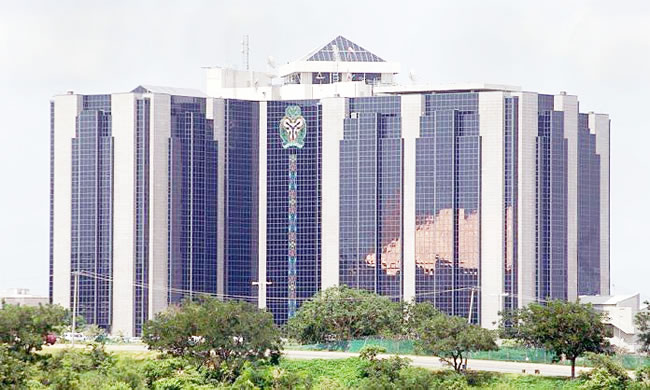
The ICIR reports that following the announcement by the Federal Government that the Federal Airport Authority of Nigeria (FAAN) headquarters and some departments of the Central Bank of Nigeria (CBN) would be moved to Lagos State, there were claims that the nation’s capital would also be relocated.
The presidency, however, reacted to the claims, saying there were no plans to move Nigeria’s capital from the FCT to Lagos.
THE Federal Competition and Consumer Protection Commission (FCCPC) has backed the Nigerian Electricity Regulatory Commission (NERC) for sanctioning 11 Electricity Distribution Companies (DisCos) for overbilling more than seven million of their customers in Nigeria.
The FCCPC also seeks stronger sanctions for erring DisCos to deter future violations.
The ICIRreported that NERC, as part of its regulatory role, sanctioned 11 DisCos for overbilling their customers.
Consequently, the NERC imposed a N10.5 billion fine on the DisCos.
A statement by Adamu Abdullahi, the Acting Executive Vice Chairman of FCCPC in Abuja on Monday, February 12, urged NERC to consider stronger measures to deter future violations.
Abdullahi said the stronger measures could include increased financial penalties, stricter enforcement mechanisms, and even the revocation of operating licenses for persistent offenders.
He said the punishments aligned with the commission’s mandate.
Abdullahi said the Federal Competition and Consumer Protection Act (FCCPA) 2018 empowered the commission to protect consumers from obnoxious practices or unscrupulous exploitation by companies, firms, trade associations, or individuals and to demand redress.
“We stand in solidarity with NERC in its commitment to safeguard unmetered customers from arbitrary billing by DisCos.
“The capping regulation was a significant step towards ensuring fairer treatment for those without meters, and the FCCPC fully supports its enforcement,” he added.
The FCCPC assured commitment towards a better deal for electricity consumers in Nigeria.
Abdullahi noted that apart from its routine resolution of electricity consumer complaints, the commission would continue to organise electricity consumer platforms across the country.
“These platforms have provided invaluable opportunities for consumers to voice their complaints and receive instant responses and redress from DisCos and regulators, including the FCCPC,’’ he said.
Abdullahi said the commission believed that fundamental reforms were necessary to address the sector’s systemic challenges, including metering gaps, billing malpractices, and inadequate customer service.
He encouraged consumers shortchanged by estimated bills to lodge complaints with their respective DisCos and intensify such complaints to NERC or the FCCPC when they were not satisfactorily resolved.
“We are committed to investigating all legitimate complaints and securing redress for consumers.”
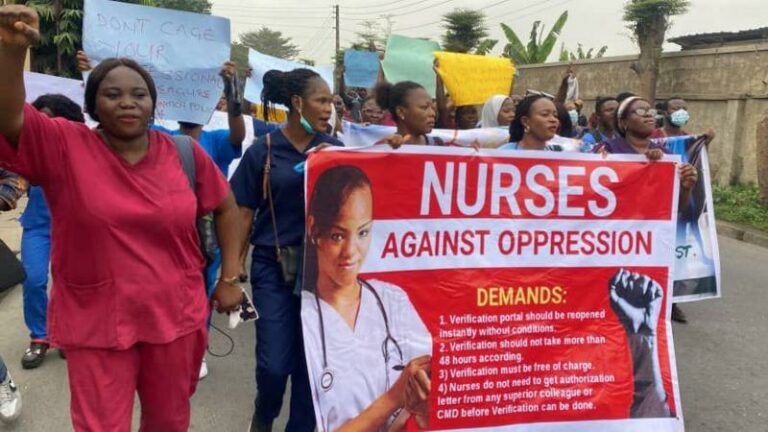
NURSES, under the umbrella of the National Association of Nigeria Nurses and Midwives (NANNM), on Monday, February 12, protested in Abuja and Lagos against the Midwifery Council’s new verification certification guidelines.
The Abuja protest, which took place at the headquarters of NMCN’s office, was against the new verification guidelines released by the Nigeria and Midwifery Council of Nigeria.
In a video shared on social media, the nurses and midwives were seen chanting and carrying placards, with some placard inscriptions frowning against the new development.
Several of the nurses, mainly women, voiced discontent regarding what they perceived as an effort to impede their freedom in pursuing career opportunities.
They also urged the council to prioritise nurses’ welfare, salary scale, staffing shortages, and other rights.
Some of the inscriptions on the placard read, “No to new verification law”, “Nurses are not slaves”, “Justice for nurses”, and “Eradicate quackery,” among others.
In another flex displayed by the aggrieved caregivers, the association demanded the following:
The verification portal should be reopened instantly without conditions.
Verification should not take more than 48 hours.
Verification must be free of charge.
Nurses do not need to get an authorization letter from any superior colleague or CMD before verification can be done.
Similarly, in Lagos, the nurses and midwives, dressed in different scrubs, chanted protest songs against the verification guidelines, taking to the streets of the nation’s commercial capital to express their displeasure.
The reaction was at the heel of the NMCN circular revising the guidelines for verification of certificates for nurses and midwives on February 7.
The circular, signed by the Registrar of the Council, Faruk Abubakar, read in part, “A non-refundable fee per application shall be paid for verification to foreign boards of nursing as specified on the portal. This shall cover the cost of courier services to the applicant’s institution(s) of training, place of work, and foreign board.
“Eligible applicants must have a minimum of two years post qualification experience from the date of issuance of the permanent practising licence. Any application with a provisional licence shall be rejected outright.
“The council shall request a letter of good standing from the chief executive officer of the applicant’s place(s) of work and the last nursing training institution attended and responses on these shall be addressed directly to the Registrar/CEO, NMCN. Please note that the council shall not accept such letter(s) through the applicant.”
The council also specified that applicants must possess active practising licenses valid for at least six months prior to the expiration date, and the verification application process would require a minimum of six months for processing.
It added that the implementation of the guidelines would take effect from March 1, 2024.
Meanwhile, this was as some Nigerians have also taken to social media to protest against the guidelines, noting that the development was oppressive and slavery.
A social media user, with the handle Nurse Bassey, wrote: “We endured so much during training, no holidays, a crashed five years programme that leaves you with no room to do any other thing. And on top of all these, we still have to endure humiliation and condescension while working. Nurses deserve better!”
Another user, @DeraVictory, also wrote: “The memo/circular from the Nursing and Midwifery Council of Nigeria is so saddening. It paints a picture of an organisation that does not care about the welfare of Nigerian Nurses. Why do you have to process verification of license for a minimum of six months?”
THE Central Bank of Nigeria (CBN) says it will start to enforce sanctions on banks flouting its rules on the loan-to-deposit ratio (LDR), which it instituted over four years ago.
In the circular dated September 30, 2019, to all banks, the CBN vowed to enforce a 50 per cent levy on banks not meeting its requirement on LDR policy.
The policy came after the apex bank raised the LDR of banks from 60 per cent to 65 per cent, a target meant to encourage small and medium-sized enterprises (SMEs), retail, mortgage and consumer lending.
It was also intended to improve lending to customers to stimulate the real sector of the economy, LDR policy implies that for every N100 received as a deposit, the banks are to lend N65 to customers.
“Failure to meet the above minimum LDR by the specified date shall result in a levy of additional cash reserve requirement equal to 50 per cent of the lending shortfall implied by the target LDR,” CBN stated in the September 2019 circular.
But findings by the The ICIR in a report on July 30, 2023, showed that in the last four years, most banks had yet to meet the CBN 65 per cent minimum LDR requirement for customers.
The report came after the apex bank reiterated its determination to enforce the 65 per cent LDR policy effective July 31, 2023, on banks flouting the directive but failed to execute its threat.
The CBN warned that banks with LDR below the minimum requirement as of the date and month after that would be liable to a CRR surcharge of up to 50 per cent of the lending shortfall.
Banks were before now maintaining a 32.5 per cent CRR with CBN, which represents a specified minimum fraction of the total deposits of customers.
The LDR is used to assess a bank’s liquidity by comparing total loans to deposits for the same period, which impacts both liquidity and solvency in the short, medium and long term.
In a recent circular to banks dated February 2, the CBN not only said it would discontinue the daily withdrawal of CRR from banks but also that it was determined to enforce the 50 per cent levy on the lending shortfall on LDR.
“CRR levy of 50 per cent of the lending shortfall will be enforced for banks that do not meet the minimum loan-to-deposit ratio (LDR).
“The CBN will provide your bank with details of the applied charges and their underlying computation rationale,” the apex bank stated.
Stressing stopping the daily CRR debits, CBN stated that it would adopt an updated CRR mechanism to facilitate banks’ capacity for planning, monitoring, and aligning their record with the apex bank.
The determination of the segment of deposits subject to sterilisation with the CBN as CRR will follow the processes outlined, it said, adding that “the extant ratios (commercial banks 32.5 per cent and merchant banks 10 per cent) will be applied to increases in the banks’ weekly average adjusted deposits.”
ABOUT four people have been reportedly killed in a fresh attack by suspected gunmen in two villages of the Miango district of Bassa Local Government Area (LGA) of Plateau State.
This was disclosed by the district’s traditional council and development association on behalf of the Rigwe nation’s leadership.
The organisation described the recent spike in attacks and killings in the state as ‘barbaric’ and ‘callous.
According to the association’s national publicity secretary, Davidson Malison, the assailants attacked the Nkienzha community in the Miango district of Rigwe chiefdom early on Monday, February 11.
He said the attack caused three fatalities and one serious injury from machete cuts, which was being treated at a hospital.
He also said attackers ambushed a car on Friday, February 9, resulting in the burning of the vehicle and injuries to one of the occupants.
He added another attack on Teegbe village within the district on Saturday night claimed a life.
The Rigwe nation’s leadership described the resurgence of attacks and killings in the state as brutal and heartless.
The president of the Irigwe Development Association, Robert Ashi, and the supreme monarch of the Rigwe Chiefdom, Ronku Aka, a reverend, pleaded with security agencies to ensure those responsible for the attack were apprehended and made to face the law.
The ICIR attempted to confirm the attacks from the state Police public relations officer, Alfred Alabo. He neither picked up the calls put across to his line nor responded to a message sent to his line.
The latest incidents add to a series of attacks on communities in recent weeks.
Over 100 people were killed during attacks on 2023 Christmas Eve in the Barkin Ladi and Bokkos LGAs in the state.
Homes and farms were set on fire during the attack.
The state governor, Caleb Mutfwang, imposed a 24-hour curfew on the Mangu LGA in response to a similar attack.
The ICIR reported on January 24, 2023, that despite the curfew, over 15 people were killed in the LGA by attackers.
The ICIR gathered that the victims were killed and burnt in their village in what seems like a reprisal attack to the killings of some Fulanis in some Muslim-dominated communities in the LGA.
According to a local source who spoke with The ICIR, before the curfew was declared on January 22, a community believed to be harbouring Fulanis was attacked by Christians retaliating against alleged earlier attacks by the Fulanis.
“The killings are more of a reprisal attack because yesterday morning, there was an attack on a community that harboured Fulanis who are killing Christians in Mangu LGA, saying that if they did not allow their people to live in the village, why should they (Fulani) come and live in the community?.
“It was more of a coordinated attack because they went to Sarbot, Mairana, but were unable to attack Mairana, and they went to Kinat,” the source said.
The source accused the military of bias in the crisis and said the violence had an ethno-religious undertone.
THE Auditor-General of the Federation’s Report 2020 has accused the Nigeria Police Force (NPF) under Mohammed Adamu as Inspector-General of spending N442.2 million on security equipment that was not supplied.
Former President Muhammadu Buhari appointed Adamu as Police IG on January 15, 2019, replacing Ibrahim Kpotun Idris.
Adamu was IG until 2021.
According to the report, which covers 2020 but was released in December 2023 and made available to the public in 2024, the sum of N442,216,819.00 (Four hundred and forty-two million, two hundred and sixteen thousand, eight hundred and nineteen naira) was paid to four contractors in 2020.
The report said the action of the NPF overstepped Paragraph 708 of the Financial Regulations (FR) 2009, which stated, “On no account should payment be made for services not yet performed or for goods not yet supplied.”
The report stated that the payments were in respect of contracts awarded in 2018 for the supply of aircraft surveillance system (drone), configuration of secured ground-to-air base, Vehicular Trans Receiver Equipment system for the Nigeria Police, supply of 15 Motorola Digital Communication Terminals and upgrade of a computerised E-Staff list.
It added that the completion period of four weeks for the setting up and upgrade of the computerised staff list phase 1 and the supply of aircraft surveillance system (drone) and components were yet to be delivered in August 2021 despite full payment, “And despite the non-completion of the project, a completion certificate reference no: CB:1080/DICT/IT/FHQ/ABJ/V.4/58, was issued on the 20th December 2018.”
It noted that the anomalies could be attributed to weaknesses in the internal control system at the NPF headquarters in Abuja.
The report recommends that the Inspector-General of Police should do the following:
1. Account to the Public Accounts Committees of the National Assembly, the sum of N442,216,819.00 (Four hundred and forty-two million, two hundred and sixteen thousand, eight hundred and nineteen naira) being payment for security equipment not supplied.
2. Recover and remit to the Treasury the sum of N442,216,819.00.
3. Forward evidence of remittance to the Public Accounts Committees of the National Assembly and
Otherwise, sanctions relating to payment for jobs not executed and assets paid for but not collected as prescribed in paragraphs 3104(iii) and 3109 of the Financial Regulations 2009, respectively, should apply.
N1.1 billion paid for ICT equipment without approval
The report also accused the NPF of payment for ICT equipment without approval from the National Information Technology Development Agency (NITDA) to the tune of N1.1 billion.
According to the report, this act violates Paragraph 4 of the Establishment Circular Ref. No. 59736/S.2/C.II/125, dated August 31, 2018, which states that “For the avoidance of doubt, MDAs and other government establishments are to relate with and obtain prior approval from National Information Technology Development Agency (NITDA) for the implementation of Information Technology (IT) projects as well as the procurement of locally assembled IT components.”
Unsubstantiated payment of N14.5 million for Human Resources Software
The Auditor-General’s report stated that the payment of N14.5 million for Human Resources software violates Paragraph 708 of the Financial Regulations (FR) 2009, which said that “On no account should payment be made for services not yet performed or goods not yet supplied.”
“Furthermore, paragraph 415 of the FR 2009 added, “The federal government requires all officers responsible for expenditure to exercise due economy. Money must not be spent merely because it has been voted.”
The ICIR reports that the report also indicted Tanko Muhammad-led Supreme Court of the unauthorised sale of landed properties.
The ICIR published several reports from the damning documents released by the Auditor-General over the years, emphasising the need to ensure transparency and accountability in government.
UPDATE: The report was updated to reflect 442 million and not 442 billion.
Selected Implementation of the KAROTA daily Keke ticket tax in Kano
When KAROTA and the then Ganduje government started the collection of daily ticket taxes from Keke riders, it was announced to cover the entire state, including metropolitan areas, towns, and villages. It was discovered that some major townships within Kano that have tricycle activities never paid the daily Keke tax of N120. Those towns include Dambatta and Gwarzo.
The Keke community in Dambatta never paid the Kano State Tricycle daily tax, which lasted for about three years. According to the Secretary of the Dambatta Tricycle Association called WASIAN, Mammam Abdu Danbatta, the Keke operatives in Dambatta town only pay N200 for newly registered Keke riders in the village and N50 association dues weekly.
“We our Keke riders only pay an association due of N50 weekly, this money is used to support each other in terms of any eventuality like accident matters that require the associations’ involvement,” he said.
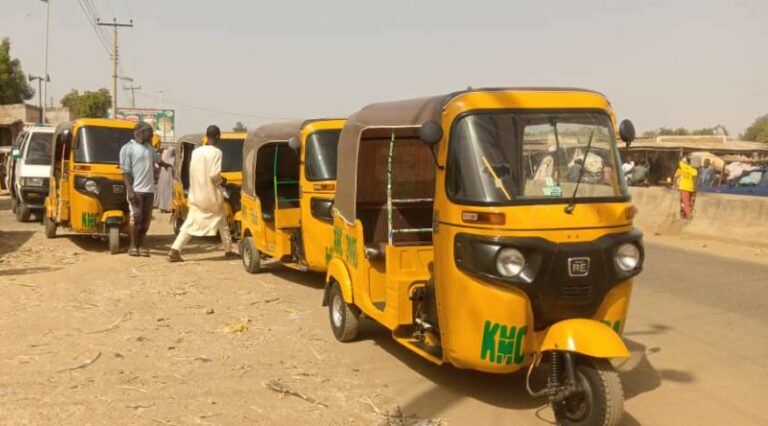
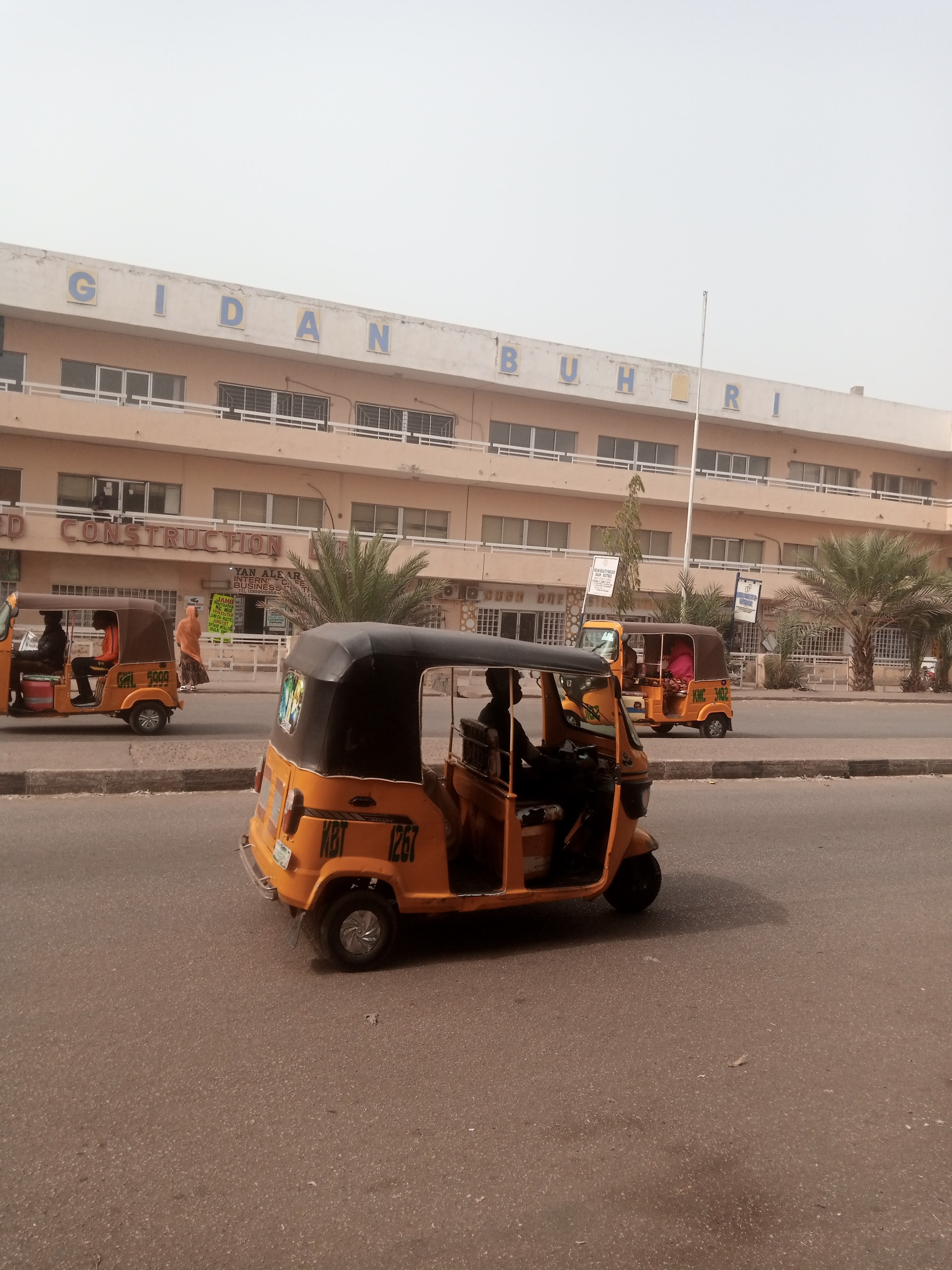
A keke on the road
“We collect N50 weekly per Keke because we are a small town, and we do not have many Keke riders [passengers] in the village,” he said.
According to Dambatta, when the Kano State government started collecting the N120 ticket tax in the Kano metropolis, the Keke operatives in Dambatta were very few, and it did not make sense to enforce the tax policy.
“We heard about the collection of N120 from Tricycles, but during the time that collection started, the Keke’s in Dambatta were about 10 in number,” he said.
It was gathered that the Keke Riders Association in Dambatta pays N1,000 tax yearly to the local government secretariat for being in operation as an association.
“We only pay N1000 to the council yearly for renewal of our association registration,” he explained.
The story was not different at Gwarzo Local Government area. The Keke riders in Gwarzo attested to never paying the N120 KAROTA Kano state tricycle ticket tax.
However, the head of the Keke riders Group at Gwarzo, Hassan Abdullahi, said that the only time the personnel of the Kano State Road Traffic Agency (KAROTA) enforced any kind of payment on them was when they came into the town about a year ago to enforce a state government and KAROTA order of re-registration all tricycles in the state.
“When the KAROTA men came that time, they caught anyone who did not re-register his Keke; they enforced them to do so.”
“The money we paid at that time was N19,000 each per Keke,” he said.
On Monday, January 10, 2022, the Kano state government and KAROTA demanded for a new yearly registration fee that will permit the tricyclists to continue operations in Kano state.
New tricyclists registrants were charged N18,000, while renewal fees for already registered tricyclists was N8,000 per annum. The KAROTA agency had previously put the registration fee at 100,000 Naira before it was reduced to N20,000, then it was left at N18,000.
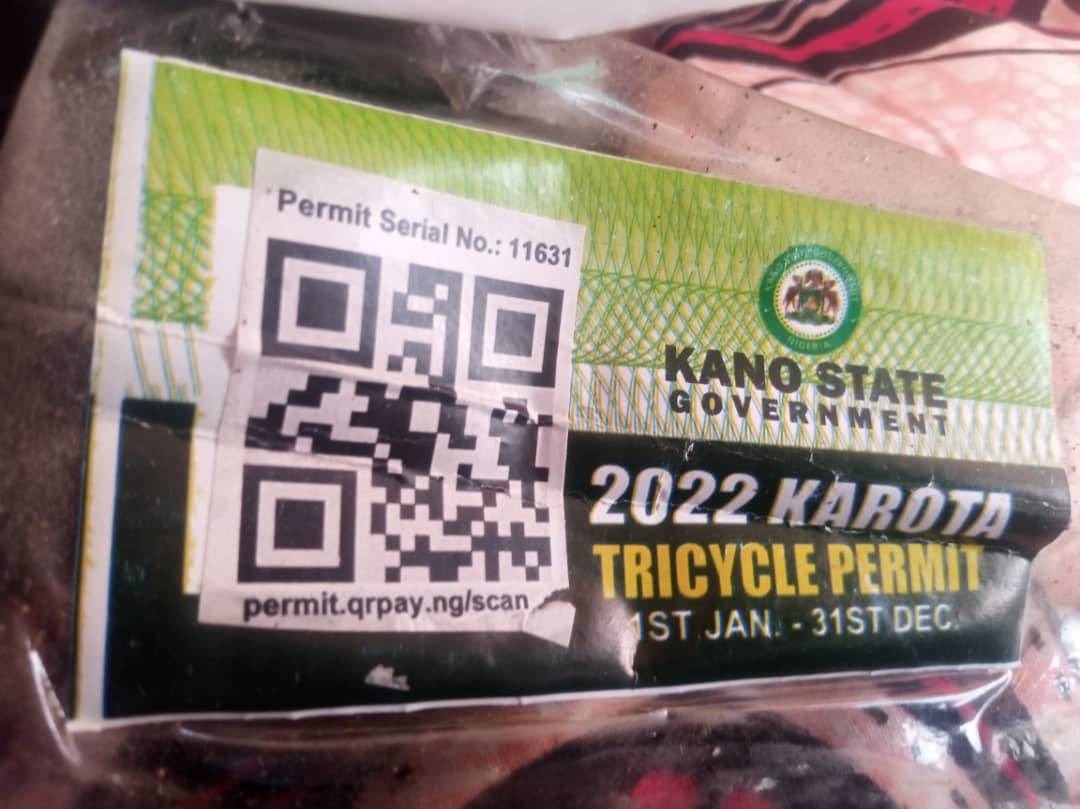
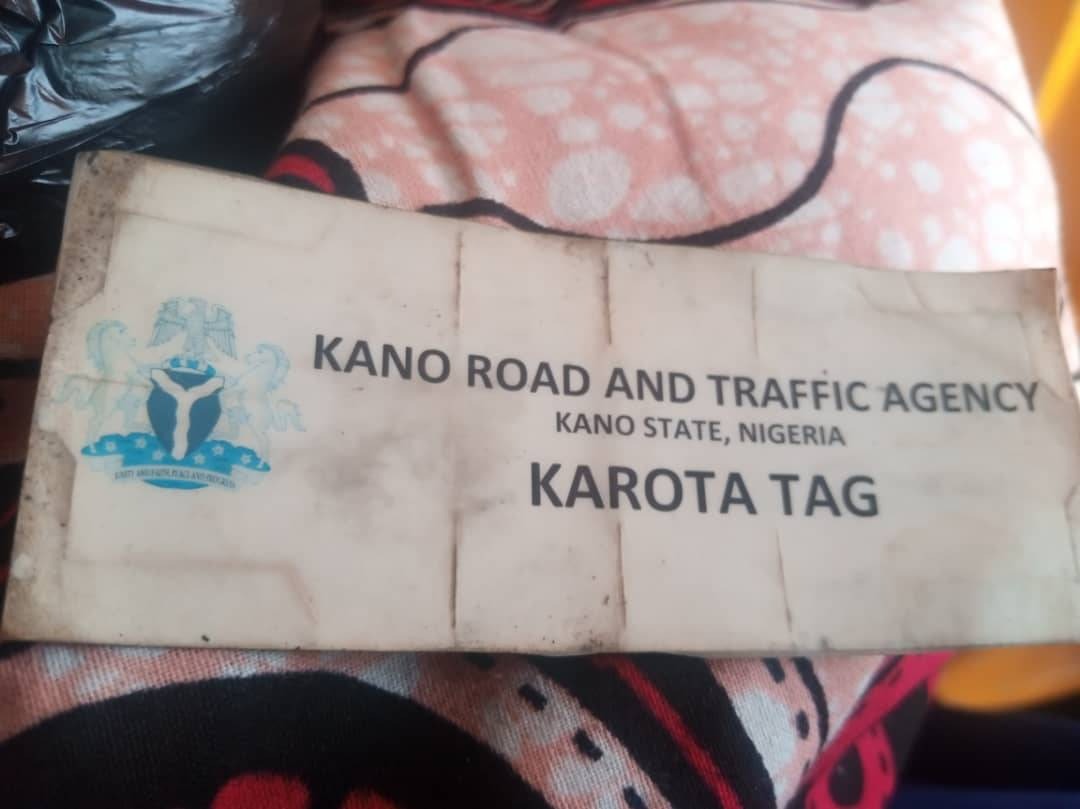
Revamped KAROTA tracker with permit registration evidence
The new registrants would have a tracking device as part of their payment. This paper-like sticker, known as the tracker, was sighted pasted on the windshield of one of the Keke riders at Gwarzo village.
Kano Focus followed up to find out the reason some areas of Kano state were exempted from the compulsory daily Keke tax.
The KAROTA PRO Nabulisi Na’isa said the were understaffed and could not cover a wide range of areas, hence, the management limited the taxing exercise to inside major metropolitan areas in the state.
However, when the reporter enquired deeper into reasons the agency had not deployed its staff to LGAs to enforce the collection and payment of the tax as it did during the enforcement of the re-registration of the operational licence, he declined to provide any answer.
Interestingly, the Kano State government does not have a record of how much tax it collects from Keke riders in the state daily. Our reporter asked both KAROTA and KIRS for the data, but neither of them could provide it. KIRS said they did not have it and that all monies coming from KAROTA were cumulatively sent in, without a breakdown of which money was for Keke’s daily tax and which were for other road offence levies.
On the part of KAROTA, its officials declined any attempt to disclose figures. The KAROTA spokesperson kept saying all the funds were sent to KIRS.
However, it is easy to determine that the state government collects up to N6 million as Keke tax daily going by the number of riders in the state, which KAROTA gave as 60,000. Some Keke Riders Association leaders dispute this figure, saying it is certainly higher. But staying with the government figure, at N100 per day Keke tax collected, the government would make N180 million from this tax alone in a month and over N2 billion in a year.
Yet, this huge revenue source is not properly regulated and is largely in the hands of touts and other non-state actors.
Manual collection of tax does not aid government accountability
In a reaction to the issues of selective implementation of government taxes and manual collection of taxes, the Programmes Officer of Dispute Resolution and Development Initiative, the secretariat of the tax justice and governance platform for Kano State, Sadeeq Muhammad Mustapha, said there are several modes of payment structures that are made available by the Kano State KIRS as well as the local government revenue administration.
“The KIRS has a website that allows for payment of taxes; the site offers a gateway that allows for payment or the person who intends to make the payment may pay directly by going to the bank and generating an invoice for the payment process,” he said.
However, he added that there are some taxes for the informal sector that do not offer access to pay directly through the website or go directly to offices of KIRS to process payment.
“In such cases, there are certain provisions made by the KIRS to access those taxes,” he said.
Mustapha added that KIRS currently categorises daily wage earners into the informal sector category.
“With such earners, the personnel of the KIRS go directly to the markets to collect these taxes,” he stated.
He recommended that to simplify the process for everyone, the purchase of Keke tax tickets can be done based on daily, monthly, quarterly or even bi-annual basis, adding that “manual collection of taxes does not aid in accountability because it gives an opportunity for corruption, and it makes tax collection processes porous.”
“Manual collection of taxes does not give a measuring system that will help ascertain the amount being collected or remitted to the government as exact.”
“For example, when a revenue officer collects an approximate amount of N50,000, there is no exact way to ascertain if that N50,000 collected manually by that officer is what is remitted to the government.”
“That can easily cause corruption if a person is not upright that individual might remit much less than they actually collected, so manual collection of taxes and levy by the government doesn’t not aid accountability in the state at all,” he said.
He, however, said that to make tax collection and compliance easier, tax methods should be simplified for both the formal and informal sectors, which will increase voluntary tax compliance.
Mustapha also added that the recently adopted consolidation and codification law should be implemented effectively, and KIRS should be the sole administrator of taxes collected both at local government and state levels.
Keke riders speak
According to *Kabir, (38) , who hails from Gezawa LGA but operates his Keke business inside Kano metropolis, many Keke operators who live outside the city are harassed, extorted and delayed in carrying out their daily activities.
Kabir said for any Keke rivers coming from Bichi, Tokarawa or Gezawa where the tickets were not sold and was unable to meet any daily Keke tax vendors on his way before having an encounter KAROTA enforcers would be stopped and harassed.
“They would stop us and ask why we didn’t have a ticket; we would say we just entered the metropolis and haven’t bought the tickets yet. They will now tell us to either give them money as a bribe or they will take us to the KAROTA headquarters,”.
“Most of the time, to avoid going to the KAROTA head office where we might end up paying up to N10,000 as a fine, we will give the men on the road N500 or N,1000 and they’ll let us go,” he said.
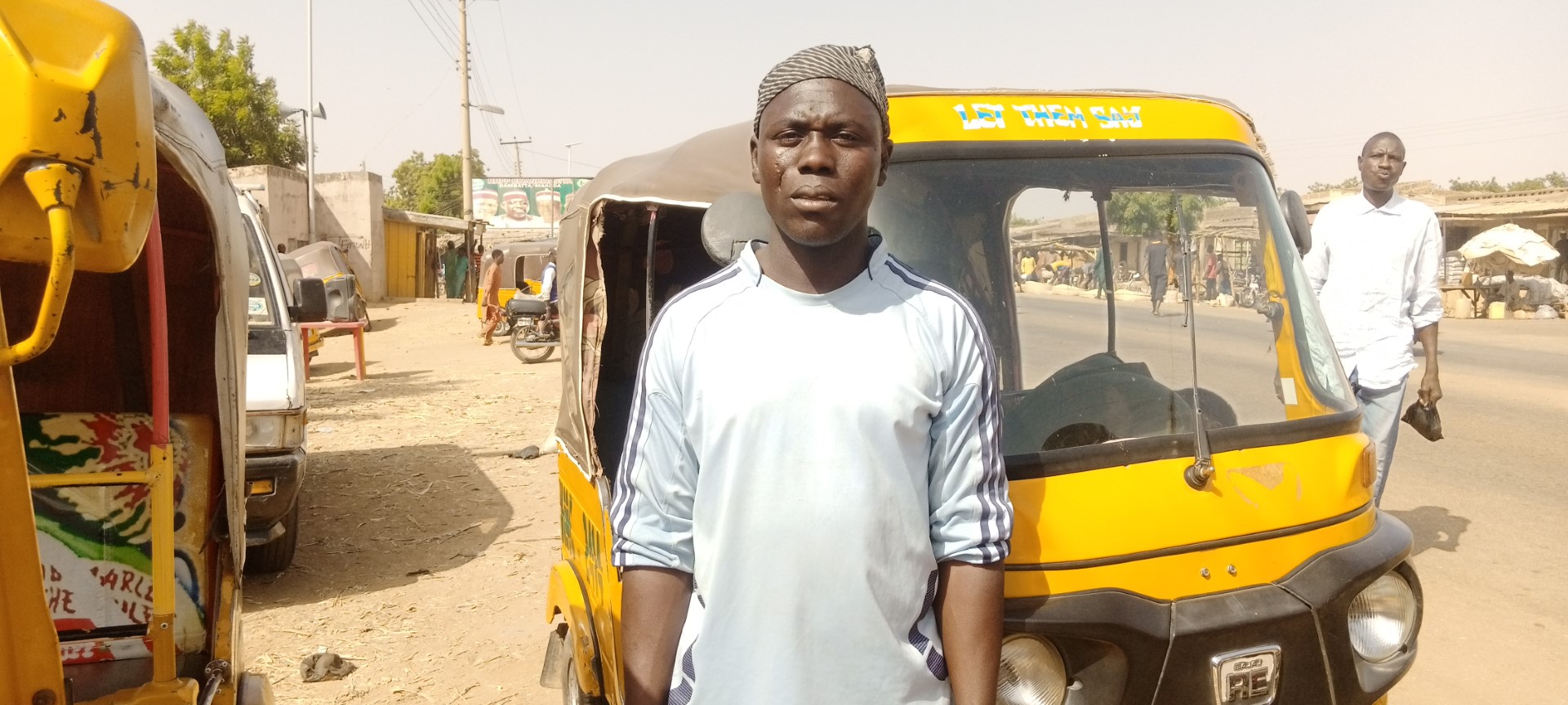
A keke rider
He lamented when a Keke driver who lives farther away comes into the metropolis around 2.00pm, he would find it a little difficult to get a ticket vendor because, most likely, most of them would have finished selling their bundle for that day due to high demand.
Another Keke driver, Muazu Abubakar, a resident of Farawa area of Kano City, said a lot of Keke men were not as bothered with the daily N100 collection as the sale of a fake tracking device angered them.
According to Abubakar, the strike action in 2021 by the Keke riders was not really about the enforcement of the daily Keke tax but was an outburst of anger against the issuance in 2020 of paper stickers as tracking devices.
“We paid N19,500 each to get that tracking device; they told us that they will give us a tracking device that will be attached to our Keke. The supposed tracking device was meant to be able to secure our tricycles in case of theft so that the KAROTA agency will be able to track down the location of the Keke and retrieve it,” Abubakar recalled.
Alas!!! When it got to the time for the riders to get the tracking devices as promised, he said, “we were given paper stickers instead, which were pasted on the windshield of our tricycles.”
He stated that the sticker has no electronic device attached to it for it to be considered a tracking device that could locate the whereabouts of a stolen tricycle.
“That is to say, they tricked us, and that action greatly angered us,” he said.
Furthermore, Abubakar also said that aside from collecting 19,500 form Keke men as money for a tracking device in 2020, in 2021, they were compelled to pay a sum of N5,500 as Keke plate number renewal fee.
“The worst part was that we were not given enough time to run around to pay the money, we were given only a period of two days of grace to make the payment of the N5,500 for the Keke number renewal.”
“And anyone who did not pay within the two days they will have to pay N18,500.”
“It is unfair, how would they triple the fees, someone may not even have the N5,000, talk more of N18,500” he said.
A calculation by the reporter of the N19,500 paid as tracker fees by each of the 60,000 registered Keke in the state stood at a figure of 1,170,000,000 (One billion one hundred and seventy million Naira).
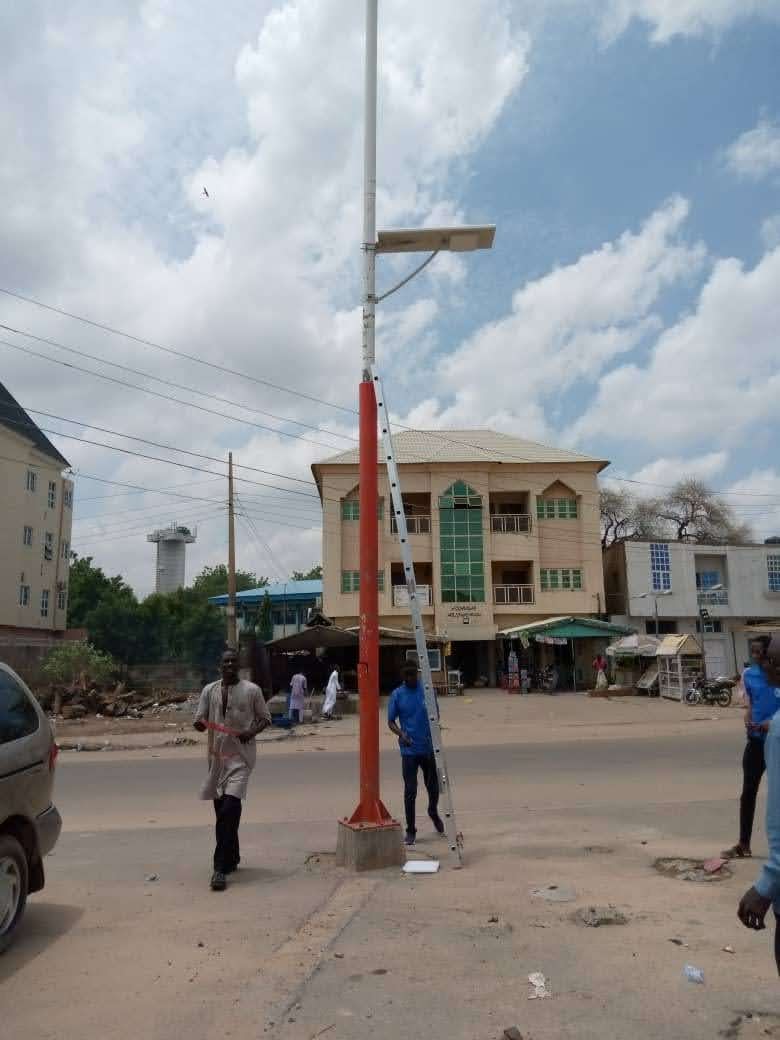
KAROTA’S alleged Tracking Machine — is a solar street lamp
It has been almost four years since the alleged issuance of fake tracker devices to Keke riders by then Baffa Babba-led KAROTA.
Aside the infamous court cases between Keke riders and Dan-Agundi, there has not been any specific inquiry into the alleged fake tracking device issued to Keke riders in Kano.
street lamp at Dan Agundi
In interviews with the Head of Information and Communication Technology (ICT), at the Kano State Road Traffic Agency (KAROTA), Abubakar Aminu Mamade, and Na’isa, the reporter was informed that the paper-like sticker on the windshield of Keke riders was really a tracking device.
Mamade said the agency was able to track the locations of the Keke riders through the barcode on the paper sticker through a tracking sensor machine installed across the state.
“We installed the tracking machine in 50 areas within the state,” he said.
According to Mamade the locations of the machine were not previously made public because the agency did not want to tip off the public, who may sabotage the agency’s effort to apprehend those who steal tricycles in the state.
Mamade listed the following locations as the places where the tracking machines were installed: Government house by state road, Hadeje road roundabout, Dakata Bus stop, Hadeje Road by Ahmadu Bello road roundabout, Kano Club roundabout, Aminu Dantata bridge by Yan Kura junction, Aminu Dantata bridge by Igbo road, Kafor Nasarawa bridge, Kwanar Tudun Wada, Brigade, Zaria road by Ring, Madobi road bridge, Kofar Fanfo by BUK road, Kabuga bridge, Sarkin Yaki road by court sabon gari, Tijjani hashim bridge, Kadan Kofar ruwa, kwanar Ungoggo, Mill Tara roundabout, Kwanar Jaba junction, Kankare market Gwarzo road, Badawa bus stop, Taludu roundabout, Gadan kaya, Kankara junction opposite gwaran dutse, Gwammaja by Munbaiya house junction, NNPC meger station maiduguri road, Baban Gwari roundabout Katsina road, Hajjo camp roundabout, Katsina road by hajj camp junction, Katsina road by France road, Triphon roundabout, Kofar mazugal, Airport road by Kwanar Jaba, Hamadiya junction, Kings guardian junction, club road by independence road roundabout, Airport road by murtala Muhammad way, Bank road roundabout, Grand central hotel roundabout, Lorge road by Alu avenue, Sabobaki zuhu road by maiduguri road, Kofar Dan Agundi, Zoo Road by Gidan Buhari, Ibrahim Taiwo road by IBB way junction, kwari junction by IBB way, Ibrahim Taiwo road by Bello road roundabout, Igbo road by France road sabon gari, Airport road by new road junction sabon gari, Sabonbaki zuhu by lamido crescent, Court road by teaching hospital road, Ring road by Gwarzo road.
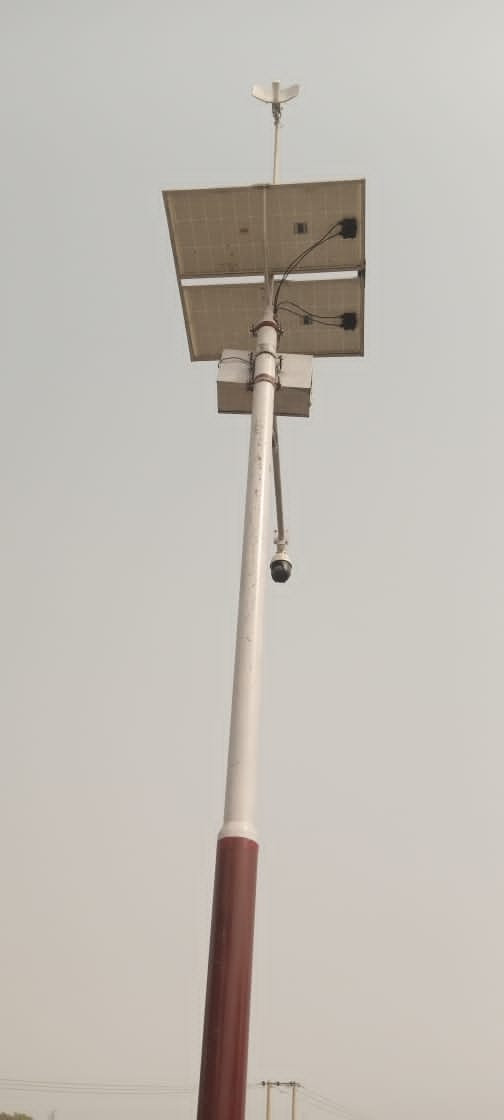
However, Kano Focus gathered through a quick Google search that the alleged tracking machines said to be installed across the 50 locations were in fact, solar street light lamps and not tracking devices.
The Google search was conducted with pictures given to the reporter by the head of ICT in KAROTA and purported to be snapshots from the field while the installation of tracker machines was carried out.
When confronted with our findings, Mamade said the tracking machines could be mistaken for solar street light lamp.
The street lamp at Gidan Buhari
But when further enquiry was made with Google search image on the same images obtained from Mamade, it was said to be a stand-alone module streetlamp. Further searches were made to ascertain if the device could double as a secret tracking device, as the KAROTA management alleged. The Google search remained the same, still indicating that the images were solar street light lamps and not tracker machines.
The reporter then visited a few of the alleged locations of the tracking machine was said to be mounted at State Road, Kofar Dan Agundi, Zoo Road by Gidan Buhari and Gadan kaya. The solar streetlamp at State Road stands close to the Kano state Government House. However, it is the same lamp obtained from the picture gotten from the head of ICT at KAROTA which was searched and identified as simply a solar street lamp.
At Kofar Dan Agundi, there was not street light mounted directly by the ‘Kofa’ ancient gate. But along the major road crossing from Gangun Albassa to Titin Dan Agundi the same solar street light was mounted beneath a street lamp pole. While at Gadan Kaya, the reporter did not find any street lamp resembling the one obtained from the Head of ICT at the KAROTA.
However, at Zoo Road by Gidan Buhari the same solar street lamp purported to be a tracking machine by the KAROTA was sighted on the middle of the main road by Gidan Buhari. It was also solar street light.
In existence, though are smart street lights which are GPS-based. These streetlights are regarded as smart streetlights; with their built-in technology, they can locate the streetlights in case they get stolen. This is due to the sensor system they possess.
Where does KAROTA daily N6 million generated keke tax go?
According to the released 2022 figures and reconfirmed by Na’isa, there are 60,000 registered tricycles in the metropolitan area of Kano.
A quick calculation of the number of 60,000 registered tricycles multiplied by the daily collection of N100 equals N6 million daily. In a month, the figure stands at N180 million and N2.6 billion annually. Thus, the amount generated by Kano state from Keke tax between 2021 and 2023 is about N7.8 billion. But officials of the government could not really say exactly what all the money was used for.
First issued KAROTA tracker
The KAROTA agency had always claimed that the funds generated from the daily Keke taxing were used for road maintenance, among other road-related issues in Kano state. However, not one concrte mention of the funds obtained has been linked to any road maintenance in the state.
In view of this, Kano Focus got in touch with the Kano State Road Maintenance Agency (KARMA) through the media aide to the Managing Director Kano State Road Maintenance Agency (KARMA), Jabir Mukhtar Salisu.
After enquiring from the MD of KARMA, Hassan Danbaffa, about the claims made by the KAROTA, Salisu said that the then management of the transport agency gave KARMA some funds to repair damaged roads in the state.
However, the funds were not said to have come from revenue gotten from the daily Keke tax collection, rather the agreement entered was said to be on all funds gotten from KAROTA’s monetary penalty on-road use offenders in the state.
“The then KAROTA management had written to the Former Governor, seeking to start the collection of monetary penalties on vehicles found wanting for road and traffic-related offences in the state.”
“The government approved this request, and also directed KAROTA to give the funds generated from such operations to KARMA to fill up potholes on roads in the state.”
Salisu said the project was carried out in three (3) batches. The first batch of the refilling of potholes was in 2021.
According to the Maintenance of Selected Rotary Intersection, U-Turn and Cross Junction within Metropolis document obtained from the Kano State Road Maintenance Agency (KARMA), the reporter was able to obtain that the roads which had refilling and patching of potholes were Katsina road, Sani Marshall/Independence way, Sani Abacha way/Independence way by Eldorado cross junction, Muhammadu Buhari way by Kansakali (Yan rake) and a few intersections and cross junctions along Aminu Kano way
A sum of N18,782,892.72 was given for the first batch of the repairs.
However, the reporter was unable to obtain such collaborative documents for the remaining two batches of alleged pothole repairs as the agency did not want to release any of the documents to the public.
The reporter obtained the first document only through picture shots taken at the agency on sighting the document.
In the same vein, in the interview with the Director, Government Business at the KIRS, Sammani Ibrahim, he confirmed that shortly after the Service discontinued direct involvement in the collection of the daily Keke tax, the then KAROTA under the management of Baffa Babba Dan Agundi and the state government approved for KAROTA to handover the revenue generated from the daily Keke taxing to the Kano state Road Maintenance Agency (KARMA)
“I can recall then that there was an approval by his Excellency Dr. Abdullahi Umar Ganduje that whatever amount generated from the daily taxing of Keke riders to be given directly to KARMA for road repairs of roads,” he said.
However, KARMA never confirmed that the money KAROTA gave them for filling and patching potholes came from the daily Keke tax collection, they rather made emphasis that the funds were from all funds gotten through monetary penalties on road and traffic offences.
The Director Government Business Ibrahim also confirmed to Kano Focus that the KAROTA pay all agency generated revenue cumulatively into the Kano State Single Treasury Account
“KAROTA has numerous revenue items that generate funds from vehicle riders in the state, if a vehicle breaks traffic law, they collect a fine, if a vehicle rides with lenses or commit any road offence they collect a fine.”
“They cumulate all these various funds as one and deposit it into the bank, they do not specify that a certain fund is for daily Keke tax collection or traffic offence fine” he said.
Mr. Ibrahim said the KAROTA sends the funds they generate to the bank, and they call and also send a written correspondence attached with the teller stating the amount of money they deposit into the Kano State Single Treasury Account
Mr. Ibrahim added that only the KAROTA could provide specifics on the amount they generate from the daily Keke ticket tax process.
However, the KAROTA were unable to provide any information regarding the money generated from the daily Keke ticket tax collect as the KAROTA PRO Nabulisi kept referring the reporter to the Kano State Internal Revenue Service.
Reintroduction of daily Keke taxing by Abba Kabir Yusuf Government a Hoax
In September 2023, Na’isa released a press release that the present government would soon begin the collection of daily taxes from Keke riders, as well as enforcement of re-registration payment on the tricyclists.
But Kano Focus sources assure that the present government has no plans to carry out the reintroduction of the daily Keke tax or any other form of Keke levy. According to an inside source at the KAROTA, the PRO was being overzealous in making the announcement.
“The declaration was indeed made, but the PRO wasn’t given approval to make the statement public when he did,” the source said. I can tell you that the press release by Nabulisi nearly caused his job,” the insider said.
Kano Focus reached out to Na’isa on his statement, and he said the only thing he could say “is that there is no plan yet on reintroducing the daily taxing.”
Kano Focus dug deeper to enquire into why the government hasn’t said anything regarding the reintroduction of the daily tax since a press release was made public on the matter, but he declined to answer any further questions on the matter.