Home Blog Page 777

What to know about BBNAIJA All-Stars winner, Ilebaye

0

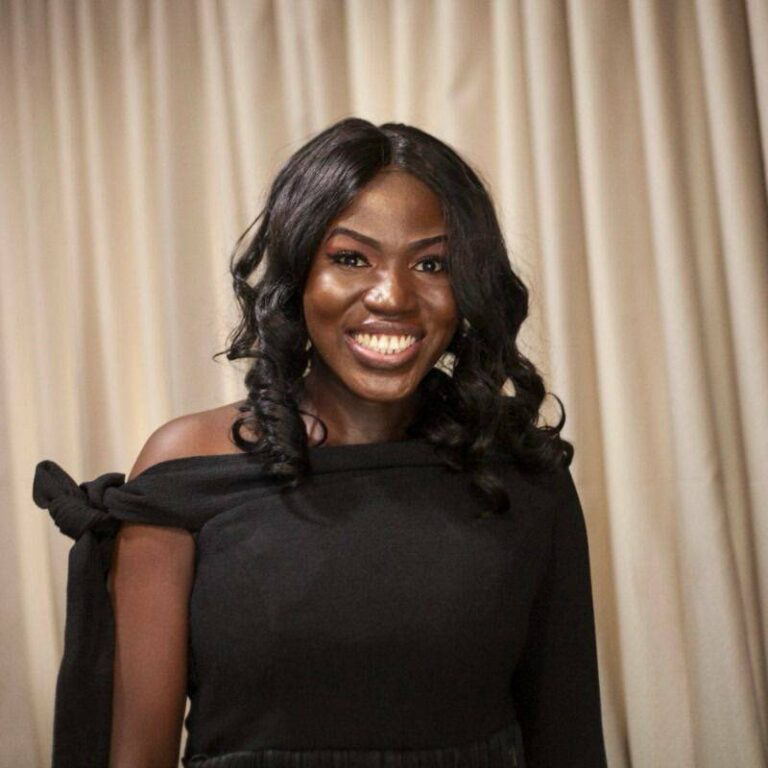
REALITY television show Big Brother Naija (BBNAIJA) has ended with Ilebaye Precious Odiniya emerging as the winner.

The show started on July 23 and ended on Sunday, October 1, lasting ten weeks.

With 20 housemates gunning for the N120 million grand prize, Ilebaye Precious Odiniya, who calls herself GenZ Baddie, claimed the prize.

Season 4 winner Mercy Eke was the runner-up, while Cynthia Nwadiora made it to the top three finalists.

Other housemates who made it to the finalists were Pere Egbi, Ikechukwu Sunday Okonkwo and Adekunle Tobiloba Olupade.

In this report, The ICIR highlights basic things to know about Ilebaye:

  • Ilebaye Precious Odiniya hails the Igala tribe of the Olamaboro local government area of Kogi state.
  • She was featured as a child actor in the popular TV series, ‘Papa Ajasco’, and ‘Nnenna and Friends’.
  • She is the 3rd female to win the show after Mercy and Phyna.
  • She has a Ghanaian accent from her secondary school teacher, who was from Ghana.
  • Among the top six finalists, she was the only housemate who was not a finalist in her previous season.
  • She won

What do people think about when they go to sleep?

0
By Melinda Jackson, Monash University and Hailey Meaklim, The University of Melbourne

YOU’RE lying in bed, trying to fall asleep but the racing thoughts won’t stop. Instead, your brain is busy making detailed plans for the next day, replaying embarrassing moments (“why did I say that?”), or producing seemingly random thoughts (“where is my birth certificate?”).

Many social media users have shared videos on how to fall asleep faster by conjuring up “fake scenarios”, such as a romance storyline where you’re the main character.

But what does the research say? Does what we think about before bed influence how we sleep?

How you think in bed affects how you sleep

It turns out people who sleep well and those who sleep poorly have different kinds of thoughts before bed.

Good sleepers report experiencing mostly visual sensory images as they drift to sleep – seeing people and objects, and having dream-like experiences.

They may have less ordered thoughts and more hallucinatory experiences, such as imagining you’re participating in events in the real world.

For people with insomnia, pre-sleep thoughts tend to be less visual and more focused on planning and problem-solving. These thoughts are also generally more unpleasant and less random than those of good sleepers.

People with insomnia are also more likely to stress about sleep as they’re trying to sleep, leading to a vicious cycle; putting effort into sleep actually wakes you up more.

People with insomnia often report worrying, planning, or thinking about important things at bedtime, or focusing on problems or noises in the environment and having a general preoccupation with not sleeping.

Unfortunately, all this pre-sleep mental activity can prevent you drifting off.

One study found even people who are normally good sleepers can have sleep problems if they’re stressed about something at bedtime (such as the prospect of having to give a speech when they wake up). Even moderate levels of stress at bedtime could affect sleep that night.

Another study of 400 young adults looked at how binge viewing might affect sleep. The researchers found higher levels of binge viewing were associated with poorer sleep quality, more fatigue, and increased insomnia symptoms. “Cognitive arousal”, or mental activation, caused by an interesting narrative and identifying with characters, could play a role.

The good news is there are techniques you can use to change the style and content of your pre-sleep thoughts. They could help reduce nighttime cognitive arousal or to replace unwanted thoughts with more pleasant ones. These techniques are called “cognitive refocusing”.

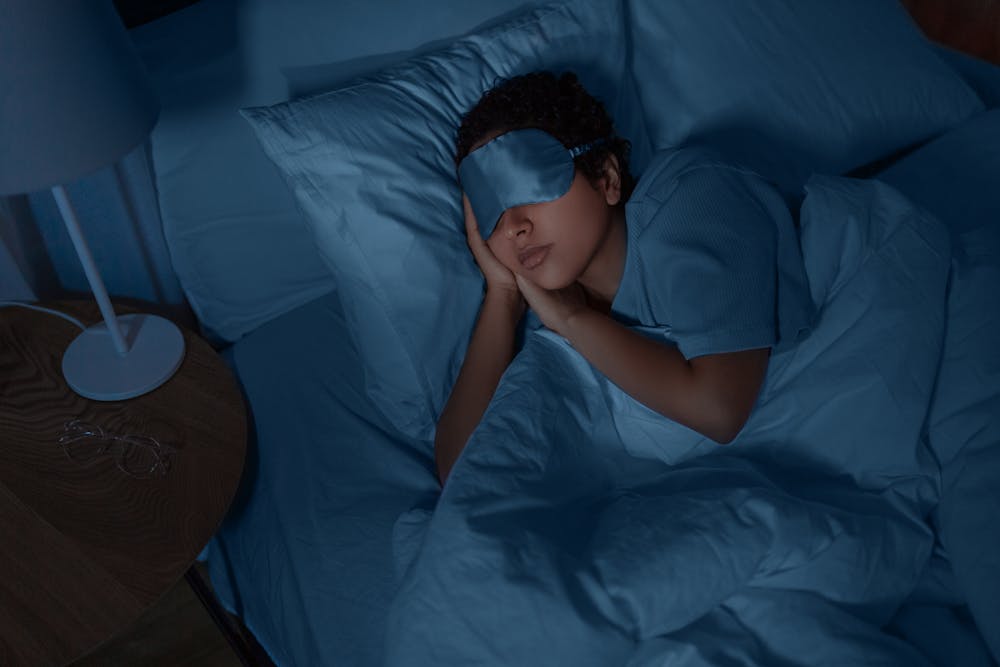
A woman lies in bed trying to sleep.
For people with insomnia, pre-sleep thoughts tend to be less visual and more focused on planning. Shutterstock

What is cognitive refocusing?

Cognitive refocusing, developed by US psychology researcher Les Gellis, involves distracting yourself with pleasant thoughts before bed. It’s like the “fake scenarios” social media users post about – but the trick is to think of a scenario that’s not too interesting.

Decide before you go to bed what you’ll focus on as you lie there waiting for sleep to come.

Pick an engaging cognitive task with enough scope and breadth to maintain your interest and attention – without causing emotional or physical arousal. So, nothing too scary, thrilling or stressful.

For example, if you like interior decorating, you might imagine redesigning a room in your house.

If you’re a football fan, you might mentally replay a passage of play or imagine a game plan.

A music fan might mentally recite lyrics from their favourite album. A knitter might imagine knitting a blanket.

Whatever you choose, make sure it’s suited to you and your interests. The task needs to feel pleasant, without being overstimulating.

Cognitive refocusing is not a silver bullet, but it can help.

One study of people with insomnia found those who tried cognitive refocusing had significant improvements in insomnia symptoms compared to a control group.

How ancient wisdom can help us sleep

Another age-old technique is mindfulness meditation.

Meditation practice can increase our self-awareness and make us more aware of our thoughts. This can be useful for helping with rumination; often when we try to block or stop thoughts, it can make matters worse.

Mindfulness training can help us recognise when we’re getting into a rumination spiral and allow us to sit back, almost like a passive observer.

Try just watching the thoughts, without judgement. You might even like to say “hello” to your thoughts and just let them come and go. Allow them to be there and see them for what they are: just thoughts, nothing more.

Research from our group has shown mindfulness-based therapies can help people with insomnia. It may also help people with psychiatric conditions such as bipolar disorder, obsessive-compulsive disorder and schizophrenia get more sleep.

A woman lies in bed with an eye mask on.
Try just watching your thoughts, without judgement, as you lie in bed. Shutterstock

What can help ease your pre-sleep thoughts?

Good sleep starts the moment you wake up. To give yourself your best shot at a good night’s sleep, start by getting up at the same time each day and getting some morning light exposure (regardless of how much sleep you had the night before).

Have a consistent bedtime, reduce technology use in the evening, and do regular exercise during the day.

If your mind is busy at bedtime, try cognitive refocusing. Pick a “fake scenario” that will hold your attention but not be too scary or exciting. Rehearse this scenario in your mind at bedtime and enjoy the experience.

You might also like to try:

  • keeping a consistent bedtime routine, so your brain can wind down

  • writing down worries earlier in the day (so you don’t think about them at bedtime)

  • adopting a more self-compassionate mindset (don’t beat yourself up at bedtime over your imagined shortcomings!).The Conversation

Melinda Jackson, Associate Professor at Turner Institute for Brain and Mental Health, School of Psychological Sciences, Monash University and Hailey Meaklim, Sleep Psychologist and Researcher, The University of Melbourne

This article is republished from The Conversation under a Creative Commons license. Read the original article.

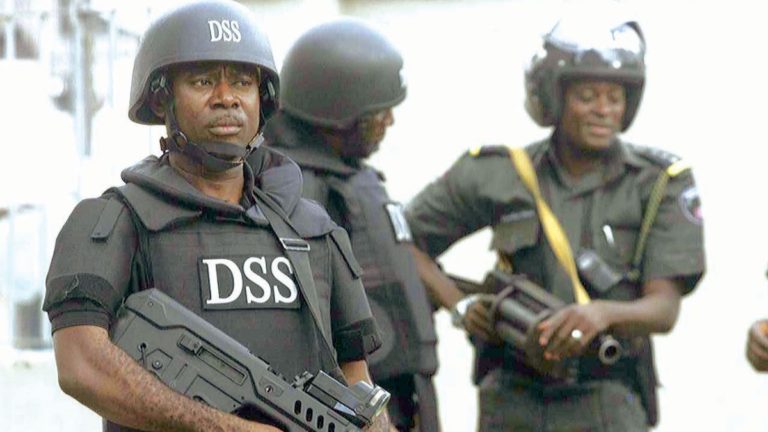
How far can SSS’ new Directorate take Service closer to Nigerians?

THE State Security Service (SSS), popularly known as DSS, established a new department on Wednesday, September 27 – the Directorate of Public Relations and Strategic Communications (DPRSC).

In a statement released in Abuja, the SSS said creating the new Directorate was part of its efforts to continue engaging with Nigerians.

The initiative has been greeted with mixed reactions, with many wondering if it’s just a gimmick or a genuine attempt to bridge the enormous communication gap between the Service and the citizens.


Read Also:


The announcement

According to the Service, the Directorate was to enhance further democratic governance, openness, and accountability in providing services.

The SSS said creating the Directorate was part of its attempts to showcase its work.

It appointed its spokesperson, Peter Afunanya, a doctorate holder, as the first director of the DPRSC.

SSS’s rampant lack of response to request

Over time, the SSS has been known to operate in secrecy and has failed severally to respond to enquiries on essential issues or communicate with the public.

Many observers have faulted Afunanya’s attitude towards the media and the general public, as there are complaints that he hardly responds to requests made by journalists.

After much criticism, in February 2023, the Service opened social media accounts, including X and Facebook @OfficialDSSNG, to enable it to move closer to the people.

DG of the SSS Yusuf Bichi

Bridging communication gap

However, some security experts in a chat with The ICIR expressed doubt if the creation of the new unit of the SSS would help bridge the gap between the Service, the media and other Nigerians.

A security analyst, Salihu Dantata Mahmud, who is the director of publicity at Arewa Youths for Peace and Security, said he didn’t think the creation of a Directorate of Communications by the SSS would make any difference since, according to him, the same person is still in charge. 

“The secretive nature of the DSS as one of the civil intelligence agencies often makes it difficult to share certain information with the media and general public. 

“I am not so confident that it is going to change anything,” Mahmud stated.

Another security expert, Oladele Fajana, told The ICIR that creating a new directorate by the secret Police is an attempt to redeem its image.

He stated that the Service created the unit to interact freely with the people.

“I think they’re trying to redeem their image to be functional, increase the time of quick response to press requests in terms of arrest, detention and release.”

He said Service was also trying to build its reputation and bridge the gap between it, the public, and the media.

“That’s one of the reasons they’re trying to create that opportunity, but we should wait and see how it will impact their image and job.”

According to him, it is essential to have a free society without crimes and criminality. 

Meanwhile, another security expert, Senator Iroegbu, noted that establishing the DPRSC within the SSS marked a significant stride toward enhancing transparency and communication with the media and the citizens. 

Iroegbu went further to outline strategies through which the new Directorate could effectively bridge the existing communication gap:

  • Appointment of a designated and substantive spokesperson

According to him, the Service must appoint a credible and readily accessible spokesperson capable of efficiently liaising with the media and the public. 

“This individual should exhibit responsiveness to calls, text messages, and inquiries from journalists and citizens.” 

Iroegbu said this appointment would present an opportunity to leverage alternative communication avenues beyond traditional media. 

“By doing so, the office can effectively safeguard and promote the interests of the SSS through diversified public relations and communication approaches.”

He urged the new Directorate to champion transparency by proactively implementing measures such as regular press briefings, issuing public statements, and releasing pertinent information to the media. 

He listed other things that could assist the new Directorate as follows.

  • Strengthen engagement with media houses;
  • Create user-friendly platforms;
  • Investment in training and sensitisation;
  • Enhancement of responsiveness;
  • Implementation of feedback mechanisms;
  • Ensuring FOI Act compliance.

He added that the new Directorate must uphold transparency, integrity, and a steadfast commitment to fostering open and constructive dialogue. This approach, he stated, is indispensable in building trust and accountability between the DSS, the media, and the Nigerian citizenry.

In August, The ICIR did a report in which lawyers clarified that the correct name of the secret service backed by law is the State Security Service (SSS) and not the Department of State Services (DSS) as it is popularly known.

Tinubu approves extra N10,000 for workers

FOR a period of six months, President Bola Tinubu has approved an extra N10,000 for employees making it N35,000.

This comes after a meeting between representatives of the Federal Government and labour leaders on Sunday to prevent the impending nationwide strike.

The N25,000 that the president had promised low-cadre workers for six months would be made available to all employees was decided during the meeting presided over by Femi Gbajabiamila, the president’s chief of staff.

THE ICIR had reported that the president had approved N25,000 increment in minimum wages for low-cadre staff for a period of six months during the Independence Day broadcast.

Nevertheless, the Labour leaders reportedly turned down the offer and sought more.

The presidency sent a statement shortly after reports on the development were made declaring the additional N10,000 raise.

Part of the statement read:

“The Federal Government, on Sunday, October 1, 2023, met with the leadership of the Nigeria Labour Congress (NLC) and Trade Union Congress (TUC) on measures to address the dispute arising from the removal of subsidy on Premium Motor Spirit (PMS).

The parties noted the following:

i) The Federal Government has announced N35,000 only as provisional wage award for all treasury-paid federal government workers for six months following further consultation with President Bola Tinubu.

ii) The Federal Government is committed to fast-tracking the provision of Compressed Natural Gas (CNG) buses to ease public transportation difficulties associated with the removal of PMS subsidy.

iii) The Federal Government commits to the provision of funds for micro and small-scale enterprises.”

The Federal Government asked the labor unions not to go on strike as the points in disagreement could only be settled while employees were at work and a subcommittee would be formed to hammer out the specifics of implementation to mitigate the effect of the loss of gasoline subsidies.

The NLC President, Joe Ajaero, the TUC Deputy President, Tommy Etim Okon, the NLC General Secretary, Emma Ugboaja, and the TUC General Secretary, Nuhu Toro were among the leaders of the labor delegation.

NLC urges Nigerians to join planned strike

0

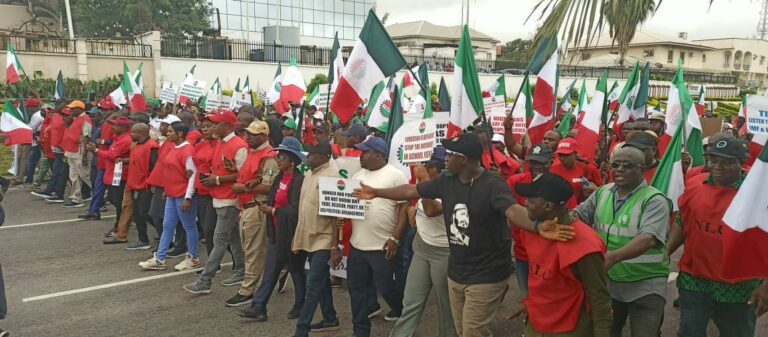
THE Nigeria Labour Congress (NLC) has urged Nigerians to join its proposed strike action against hardships trailing some reforms by the President Bola Tinubu-led administration.

The NLC President Joe Ajaero said in an Independence Day message on Sunday, October 1, that the strike would be a march to freedom for citizens.

“It is time for Nigeria to rise and shine once more as a beacon of hope and prosperity for all its citizens. Remember, when we stand as one refusing to be divided, we will triumph! We call on all Nigerians to join us on the 3rd day of October around Nigeria to begin our march to freedom through the indefinite nationwide strike.

“To this end, the Nigeria Labour Congress beckons on all of us to join hands from all parts of the nation: the North, the East, the West and the South to build the needed coalition to make our nation truly an independent nation. This nation can work for all of us! This nation can be made beautiful, but good things do not just happen; they are worked out,” Ajaero noted.

He condemned the mismanagement of the nation’s resources by corrupt leaders, adding that the leadership crisis in Nigeria had hindered growth and development. Ajaero also decried the dollarisation of the country’s economy by its leaders.

“We need to find out whether truly a genuine foreign exchange market exists in its true sense in Nigeria. Why would the value of the nation’s currency continue a free fall when the value of accruals from crude is rising? What magic has made it difficult for the value of the Naira to remain stable against the dollar, especially when the dollar is being pummeled all over the world?” he asked.

Ajaero chronicled Nigerian problems, including corruption by its leaders, the collapse of the nation’s industries, the sale of national assets by leaders to their cronies while those assets turned out to have become moribund, acute poverty, poor infrastructures, decaying health and educational institutions, moral decadence and deteriorating insecurity.

The NLC and Trade Union Congress (TUC) declared an indefinite strike to commence on Tuesday, October 3.

The unions directed their affiliate bodies to comply with the directive after a two-day nationwide warning strike held between September 5 and 6.

The strike had several organisations acting in compliance, including electricity distribution companies, which left many residents in darkness throughout the period.

Before the warning strike, Organised Labour, including NLC, TUC and affiliated bodies, staged a nationwide protest against hardships facing citizens following the petrol subsidy removal and the exchange rate unification.

The protest held on August 2 was suspended on the same day following a meeting with Nigerian President Bola Tinubu, during which the protesters were assured that their demands would be met.

However, in a national broadcast commemorating the nation’s Independence Day on Sunday, October 1, Tinubu announced a N25 increase for ‘average workers.’

The ICIR reports that the labour leaders are currently meeting with the Tinubu government’s delegation, headed by his Chief of Staff, Femi Gbajabiamila, at the State House in a last-minute effort to avert the strike.

Ilebaye takes home N120 million cash prize

0

ILEBAYE Precious Odiniya known as the GenZ baddie has emerged winner of the the Brother Naija season 8 All Stars edition taking home the grand prize of N120 million.

This was announced during the grand finale of the show on Sunday, October 1 by the host, Ebuka Obi-Uchendu.

Ilebaye from Kogi state was previously a housemate of the Level up (season 7) edition of the show of where she was the third housemate to be evicted. 

The first runner-up in the competition was Mercy Eke, a former housemate from the Pepper Dem (Season 4) edition of the show. 

Ikechukwu Sunday Okonkwo popularly known as Cross was the first finalist to be evicted from the show. He was the last Head of House (HOH) of the show making him the only housemate to win the position twice on the show. 

Pere and Adekunle were the 2nd and 3rd housemates respectively to be evicted from the show leaving three women as the top 3 finalists. 

Cynthia Nwadiora known as CeeC made it to the top 3, however got evicted leaving Ilebaye and Mercy as the top 2 finalists.

Alongside the N120 million grand cash prize, the winner also gets other prizes from the sponsors of the show. 

The grand finale was spiced up by performances from Nigerian artistes, Skales and Bnxn.

The show which started on July 23 lasted for 10 weeks.

BUA slashes cement price by 36 per cent 

0

BUA Cement PLC, on Sunday, October 1, slashed the ex-factory price of cement in Nigeria by 36 per cent. 

A statement by the company gave the price reduction from N5,500 to N3,500.

BUA Group’s chairman, Abdul-Samad Rabiu, pledged to reduce the price on Friday, September 15, at a meeting with President Bola Tinubu.

Rabiu outlined his firm’s strategy to support the government’s efforts to lower cement prices.

He also stated that the BUA Group would inaugurate two new cement plants by the end of the year or early 2024 to flood the nation’s markets with the product.

These additions, he noted, would increase his company’s total production capacity to 17 million metric tons yearly.

Meanwhile, while announcing this latest development, BUA, one of the leading cement companies in Nigeria, said the reduction was anticipated to have a far-reaching impact on the construction industry and the broader economy.

“We refer to our previous pronouncements regarding our intent to reduce cement prices upon the completion of our new lines at the end of the year in order to spur development in the building materials and infrastructure sectors.

“As per the commitment made to reduce prices and following a periodic review of our operations for efficiency, the management of BUA Cement Plc wishes to announce and inform our esteemed customers, stakeholders, and the public that effective October 2, 2023, we have decided to bring the price reduction forward.”

The firm also vowed to review the latest price further upon completing the ongoing construction of its new plants.

“As a result, BUA Cement would now be sold at an ex-factory price of 3,500 Naira per bag so that Nigerians can begin to enjoy the benefits of the price reduction before the completion of our plants.

“Upon completion of the ongoing construction of our new plants, which would increase our production volumes to 17 million metric tons per annum, BUA Cement PLC intends to review these prices further in line with our earlier pronouncements by the first quarter of 2024. All pending, undelivered orders which had been paid for at the old prices will be reviewed downwards to N3500/bag in line with the new pricing from October 2, 2023,” the statement added.

However, BUA urged its licensed dealers to ensure end-users benefit from this reduction in ex-factory prices, as we will monitor field sales to ensure compliance.

US Court orders Chicago varsity to give Atiku access to Tinubu’s records

0

THE Chicago State University (CSU) has until Tuesday, October 3, to give former Vice President Atiku Abubakar access to President Bola Tinubu’s academic records, the US Court for the Northern District of Illinois in Chicago has ruled.

Tinubu’s argument was overruled by the presiding judge, Nancy Maldonado, who gave CSU two days to grant Atiku access to the records. This was contained in a copy of the judgement obtained by THE ICIR.

She emphasised that the PDP candidate Atiku had a legal right to examine the data while upholding the September 20 decision of US Magistrate Judge Jeffery Gilbert, who ordered the CSU to reveal Tinubu’s academic records as requested by Gilbert.

“For the reasons stated in the Court’s accompanying Memorandum Opinion and Order, the Court overrules President Tinubu’s objections (44] and adopts Judge Gilbert’s recommended decision [40] in full.”

“The Court therefore grants Mr. Abubakar’s application under 28 U.S.C. § 1782. [1],”. Justice Maldonado of the Northern District of Illinois ruled.

The judge has ordered CSU to finish all paperwork related to the release by Tuesday at 5 p.m.

“Respondent CSU is directed to produce all pertinent and non-privileged documents in response to Requests for Production Nos. 1 through 4 in Mr. Abubakar’s subpoena by 12:00 p.m. (noon) CDT on Monday, October 2, 2023 (as narrowed by Judge Gilbert and adopted by the District Court in its opinion).”

“The Rule 30(b)(6) deposition of CSU’s corporate designee must be completed by 5:00 p.m. CDT on Tuesday, October 3, 2023,” a part of the judgment read.

Abubakar, the Peoples Democratic Party’s (PDP) presidential candidate in the February 25 poll, asked the US District Court in Northern Illinois to order the release of Tinubu’s academic records on the grounds that doing so would support his lawsuit contesting the President’s victory in the February 25 presidential election.

The PDP candidate had requested the documents for use in Nigerian courts to support his claim that Tinubu falsified a certificate he purportedly obtained from CSU in 1979 and submitted to Nigeria’s electoral body, the Independent National Electoral Commission (INEC), for the 2023 presidential election.

Abuja ‘one chance’ victim: What does the law say about police report?

0

THE Federal Competition and Consumer Protection Commission (FCCPC) and the Federal Capital Territory Administration (FCTA) have commenced investigations into the death of Greatness Olorunfemi, attacked by a ‘one chance’ gang in Abuja.

Executive Vice-Chairman of the FCCPC Babatunde Irukera disclosed this in a statement on Saturday, September 30.

“The Commission commiserates with Ms Greatness Olorunfemi’s family, friends and associates who are affected by this tragic loss. The Commission has opened an investigation accordingly,” the statement read.

Irukera noted that the Office of the Mandate Secretary for Health Services and Environment for the FCT also announced a Coroner’s inquiry into Olorunfemi’s death.

“Of particular concern is if Ms Greatness Olorunfemi died on account of failures implicated in the Commission’s Patients’ Bill of Rights (PBOR) or other enforceable legal instruments regarding attention and care to patients generally, and more specifically, in emergency situations where victims of criminal conduct require medical attention,” the statement read.

A separate statement issued on Saturday by the Office of the Mandate Secretary for Health Services and Environment occupied by Dolapo Fasawe disclosed that the inquest would follow an autopsy, both of which have become necessary due to the circumstances surrounding Olorunfemi’s death.

Olorunfemi’s death, Maitama hospital accused of negligence

A video went viral on Wednesday, September 27, showing a lady, later identified as Greatness Olorunfemi, by the roadside along the Maitama-Kubwa expressway after being pushed out of a vehicle by a suspected criminal gang disguised as commercial drivers.

“This lady was just pushed down from a vehicle between Maitama-Kubwa express, the road going towards Wuse, Berger. She was pushed by all this one chance. Please, let’s be careful, she was pushed down from a one-chance vehicle,” an unidentified eyewitness narrated in the video.

According to an audio tape from the eye witness that also went viral, passersby had taken Olorunfemi to the Maitama District Hospital in Abuja for treatment but were denied treatment by the hospital staff.

“All of us, about 15 vehicles, we all drove down there, and then she was still alive. The Maitama General Hospital refused to receive her and said they wanted a police report before they could attend to her,” the eyewitness narrated.

He stated that the hospital staff were informed of an extant law that criminalises the demand of a police report before treatment is provided for patients with gunshot or stab wounds. However, despite efforts to reason with the staff, Olorunfemi was denied treatment until she bled to death.

A social media user on X, with username @Nwaadaz, who claimed to be friends with the deceased, also posted a video of the victim with a caption accusing hospital staff of neglect.

“Maitama General Hospital refused to attend to my friend who was stabbed by a one-chance driver in Abuja. They allowed her to bleed to death and locked the emergency ward against her because she didn’t have a police report!! Nigeria has failed Greatness!!” she tweeted.

However, there are reports that the patient was brought in dead, which has resulted in the need for investigations.

What does the law say?

Many Nigerians have died due to the refusal of health facilities to provide treatment to patients with gunshot or stab wounds without a police report.

This is usually based on a misconception of the Robbery and Firearms (Special Provisions) Act of 1990, which mandates any person or health facility that treats a patient suspected of having bullet wounds to report immediately to the police.

According to Section 4(2) of the Act, “it shall be the duty of any person, hospital or clinic that admits, treats or administers any drug to any person suspected of having bullet wounds to immediately report the matter to the police.”

While the section seems to demand a report from health care providers even if treatment is given, many patients have been required to provide clearance from the police even before treatment.

In December 2014, Nigeria passed the National Health Bill into law, which described denying patients medical attention as an offence.

Section 20 (1) and (2) of the National Health Act states that “a health care provider, health worker or health establishment shall not refuse a person emergency medical treatment for any reason. A person who contravenes this section commits an offence and is liable on conviction to a fine of N100,000.00 or imprisonment for a period not exceeding six months or to both.”

This, however, did not stop the acts of requesting police reports, as in 2021, Oluremi Tinubu, who was a senator then, reacting to the practice said, “In a country where emergency response is almost non-existent, and getting victims to the hospital is already burdensome, it is sad that where the victims make it to a hospital alive, they are still denied treatment and left to die.”

Interestingly, the Lagos state police spokesman Benjamin Hundeyin had earlier stated that men of the police force were repeatedly turned away by several public health institutions when they wanted to access emergency care for an accident victim.

Hundeyin, in a post on X, said, “Officers on early morning patrol found a man critically injured as he had just been involved in a lone motorcycle accident. The police officers quickly took him to the nearest hospital. The hospital rejected him. They rushed to another hospital, again rejected”.

He noted that five hospitals rejected the patient.

Although allegations of negligence by the Maitama District Hospital are still under investigation, many Nigerians are outraged by Olurunfemi’s death.

The ICIR reports that the one-chance menace has increasingly worsened insecurity in Nigeria, especially in major cities where they operate as large syndicates.

One chance menace worsens insecurity in Nigeria

One chance is a criminal group disguised as commercial drivers and commuters. They usually move around cabs in groups of two, three or four, armed with weapons such as guns, knives, hammers and other harmful objects.

They dispossess passengers of their belongings, including laptops, money, phones and other valuables. Many of them conduct their illicit business, using Point of Sale machines to empty victims’ bank accounts, using force.

These criminals often leave the front seat of their vehicles or one or two seats at the back for unsuspecting victims.

The group’s mode of operation comes in different forms. They could drive victims into the bush or to a section of highways with few vehicles and carry out their heinous acts.

The ICIR reported how the FCTA vowed to crack down on the group, but the city continues to witness the criminals’ attacks on residents.

Many Nigerians believe that a poor transportation system, aggravated by high transport costs occasioned by fuel subsidy removal by the Federal Government, aids the group’s operations.

‘Why Nigeria lost 2025 AFCON hosting bid’

0

NIGERIA’S sports industry stakeholders have provided insights into why the country lost its bid to hold the 2025 Africa Cup of Nations (AFCON).

Two North African countries, Algeria and Morocco, including Zambia, vied to host the tournament against a joint bid from Nigeria and Benin.

But Morocco eventually won the bid.

The North African side will host Africa’s flagship event for the second time, 35 years after the country hosted the competition in 1988.

Meanwhile, the rights for the 2027 edition were handed to a co-bid from Kenya, Tanzania and Uganda.

The joint East African bid returns the tournament to the region for the first time since 1976.

They beat Botswana, Egypt and Senegal in a vote of the CAF executive committee.

Stakeholders’ reactions to Nigeria’s failed bid

A sports administrator, Peter Iweze, recalled how he and ex-international Segun Odegbami sought a joint bid for the country with South Africa ahead of the 2010 World Cup, saying they started the bid early.

He described Nigeria’s bid for the 2025 AFCON as impromptu, adding that early preparation would have conferred some advantages on the nation over its peers.

“We are not ready to do anything like that. Is that our priority? You don’t bid for events like that; you start early. When we bid for the World Cup for the West African joint bid, Odegbami and I went to the whole of West Africa. We took time for the World Cup in 2010; we started in 2002,” he said.

According to him, Nigeria is suffering from an economic downturn, and its failure to secure the hosting rights would help salvage its economy.

“So it is good savings for us. Right now, Nigerians are suffering. They don’t want unnecessary expenditure of funds. I am not surprised that we lost,” he said.

Also, a veteran sports journalist, Maxwell Kumoye, explained that hosting AFCON tournaments demands quality sporting infrastructures like good stadiums, airports and hotels.

He argued that the country could not boast of these.

“At the moment, look at the state of our facilities. What facilities were they putting forward to host AFCON besides UYO, Abuja, Stephen Keshi and Samuel Ogbemudia Stadiums?

“The stadiums in Lagos are nothing to write home about. They are not ready for major international events like AFCON. Yes, we may have hotels and airports, but our sporting facilities are below the mark,” he said.

He faulted the country’s bid, saying it was dead on arrival.

“We were thoroughly disgraced in the sense that we hurriedly put up that bid and indicated that it was dead on arrival from the start to the end.

“What did we do right? Certainly, we did not do anything right. Perhaps the board felt, ‘let’s put this together to tell the world we are doing something.’ For me, that bid had no substance. What was in that bid was that we were seeking the help of the Benin Republic to bid for our AFCON.

“Those doing this were not doing it for the country’s sake. They were doing it for their own to be relevant in the international scene that Nigeria is putting up a bid,” he added.