Home Blog Page 786

Bandits attack hostels in Zamfara, kidnap varsity students

0

BANDITS have abducted several students of the Federal University of Gusau, Zamfara State.

The bandits invaded the private hostels of the students in the Sabon-Gida community of the Bungudu Local Government Area of the state in the early hours of Friday, September 22. Sabon-Gida is a few meters away from the university.

Sources in the school disclosed to The ICIR that the bandits went away with no fewer than 25 students (largely female students).

One of the sources, a student at the university, Mubarak (surname withheld), said, “I heard that they kidnapped 25 girls, and some are in 300 levels and 200 levels studying Biology Education. I don’t know the department of others yet.”

“Students used to live in two places off campus – Sabon-Gida and Damba – before. But they said Damba wasn’t secure, and people asked us to go to Sabon-Gida, which we did. Now, they have entered Sabon-Gida and abducted 25 girls. The last time they kidnapped people in Damba, it was four. Before, the highest they would take away was two or three, and the last was five. Now it’s 25,” he exclaimed.

He, however, stated that the Nigerian Army rescued six out of the 25 girls after a face-off with the bandits.

Mubarak said the bandits had warned that they would attack some of the hostels and kidnap 100 students in the past. “They vowed that they would abduct 100, kill 30, and the government would pay ransoms for 70.

“Now they have started their mission and went with 24, they are still coming back to abduct the remaining 76 if care is not taken,” he added.

Speaking on how the incident has sparked fear among students, Mubarak mentioned that his parents were against him going to campus due to the incident.

He noted that most students in the axis had deserted the place to find safety elsewhere.

While recounting the incident, sources in Sabon-Gida told Channels TV that the gunmen invaded the community around 3 a.m. and started shooting sporadically.

“They were seriously engaged with the army troops, but the way these bandits operate, they will divide themselves into two, one group will move with the kidnapped victims while the other will stay behind to protect the first group.

“The first group had left with the students while the second group engaged the army in a gun duel,” a source revealed.

Efforts by The ICIR to get the school management and Zamfara Police command to speak on the incident proved abortive as calls and SMS were not answered or replied to.

Although the number of students abducted by the bandits was believed to be higher, it wasn’t the first time terrorists would kidnap students from the Gusau university. 

On Friday, June 16, bandits kidnapped five students from the institution. This incident led to student protests, resulting in a road blockade and leaving many motorists stranded for several hours.

One of the students, Musa Shehu, who spoke to Punch, stated that many students had been kidnapped in the past, but not much was done to rescue them.

 “A lot of students have been kidnapped from this institution, but no positive action is taken to rescue them.

“There are some students currently in bandits camp, and the authorities are not making any move to rescue them.”

Stakeholders task Tinubu on sustainable economic growth, social inclusion

0

Stakeholders have urged President Bola Tinubu to implement pro-poor policies to help address major socio-economic challenges facing Nigeria.

The Director and Chairman of the Centre for Public Policy and Research, Sam Amadi, charged the President to depart from the trajectory of the economic policies of his predecessor and launch new policies that will reduce poverty.

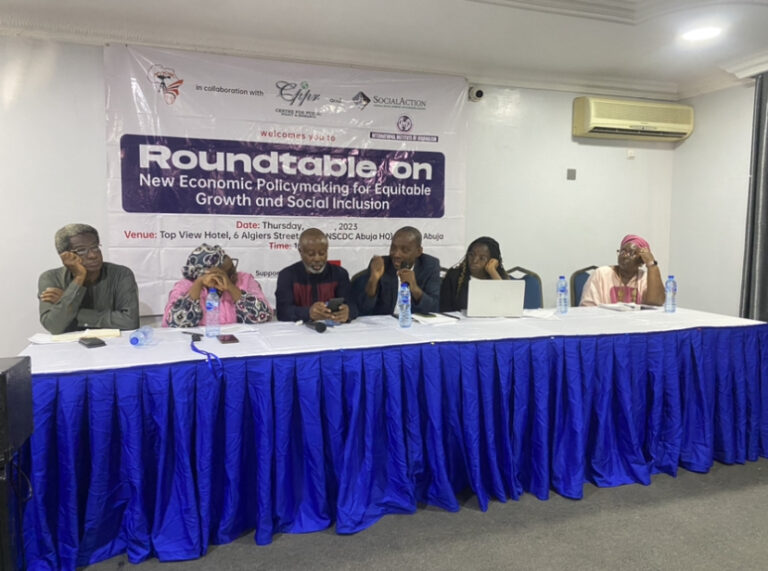
Amadi and other stakeholders spoke during a roundtable discussion organised by the African Centre for Media and Information Literacy (AFRICMIL) on Thursday, September 21, in Abuja.

The event had the theme, “Roundtable on new policy-making for equitable growth and social inclusion.”

While speaking on policy formulation, Amadi, the keynote speaker at the event, said the government must expand conversation and involve different classes of people. 

“It has to recognise that economic principles and theories are mere notions that have to be adapted to the reality of every stage of development. It must expand the conversation that economics is ideological, value choices and control discourse. So we can’t have people who are members of the transnational capital plans, including financial consultants, come and make policies that will translate for workers.

“They have to go back to discover that African countries, including Nigeria, made progress when we adopted a form of developmental economics, which is an economy that allows the state to intelligently intervene in the market.”

Speaking further on the issue with journalists, Amadi noted that the country lacked economic growth that improves the welfare of the poor.

“In the past, this country has not had the kind of economic growth it needs, and it has not been economic growth that improves the well-being of other Nigerians. The poverty rate is very high; about 90 million people are really poor, and over 130 million people are multidimensionally poor.”

In November 2022, The ICIR reported that Nigeria had 133 million people living in multidimensional poverty, with 86 million from the North. 

According to the report, over half of the population of Nigeria are multi-dimensionally poor and cook with dung, wood or charcoal rather than with clean energy. High deprivations are also apparent nationally in sanitation, healthcare, food insecurity, and housing.

Amadi advised that the Federal Government should not adopt all the academic economic policies and liberal policies without adapting them to the Nigerian context, adding that real growth occurring in Europe, Asia and some African countries was after their leaders localised these theories.

He added that the government “should focus economic development policy around the wellbeing of Nigerian citizens.  Development is transformation. You cannot think about development as only you know skyscrapers and a few businesses -helicopters and private jets. The real measure of development is like China that transformed in less than 30 years. It took close to a billion people out of poverty and became one of the largest economies in the world through good leadership. 


FG should ensure economic models in communities 

Also speaking, the Director of the International Institute of Journalism, Emmanuel Usman Shehu, urged the Nigerian government to ensure economic development models in communities to improve access for the average and poor Nigerians.

The models should be ones that include health, and transportation across board. Sustainable transportation is not the kind of fallacy that we practice here. Number three is talent and creativity across board. Identify peoples’ talents and their strengths. Support them to develop those talents because they create things through those talents.

“Housing is also one of the most important models. Give people housing loan funds. It’s not just for civil servants, but anybody who can repay should be able to have some loan.”

Shehu, one of the panellists, argued that the palliative being distributed by the Federal Government was a fallacy and solved no problem.

“Palliative is part of the fallacies that we are operating on. I’ve always said that because we have a colonized mind mentality, which leads us to dependency syndrome. 

“If we want to develop, we must do things in our own way that suits us. Look at our own peculiarities. So, you take palliative because America is doing palliative. You don’t even know why. It came from the word palliative itself, a medical term used for people who are terminally ill. They are about to die.”


Reversing the negative growth 

In the past 30 years, Nigeria’s economic policy has been consistently driven by neo-liberalism, advocating for a free market and unhindered competition, according to a social activist, Mustapha Hauwa.

She explained that the thrust of Nigeria’s economic policy hadn’t significantly departed from the trend observed since independence. 

Hauwa further highlighted that while the economic policy purportedly aims for growth, wealth creation, and poverty reduction, it had inadvertently resulted in wealth expansion for a small percentage, maintaining the status quo for a slightly larger fraction, and leaving the majority sinking deeper into poverty.

“Our economic policy emphasizes growth through wealth creation and poverty reduction, but what it ends up doing is wealth expansion for less than seven per cent, another 12 per cent managing to maintain their status, while the rest sink deeper into poverty and deepening of poverty.”

Proffering possible solutions, the activist said the government must coordinate macro-economic policy tools with sociocultural realities and ensure that it matches them with an evolving ecological transformation. 

“This means that our economic policy needs to shift from addressing simple economic issues to one whose outcome connects with our development goals.


READ ALSO:


“OXFAM report on inequality and poverty shows us that if the vehicle of politicians and government VIPs are reduced to two or three, we can save about N1 billion, which can build an average of 50 schools at an average cost of N20 million, even if we consider inflation and turn it to building 20 schools at an average of N50 million…”

Earlier in the event, the AFRICMIL Coordinator, Chido Onumah, stressed that the organisation partnered with the Centre for Public Policy & Research, Social Action, and the International Institute for Journalism with support from the Rosa Luxemburg Foundation to convene the meeting for stakeholders to deliberate on policy-making for equitable growth and social inclusion.

According to him, Nigeria’s challenge is enhancing the legitimacy and effectiveness of public policy and the administrative state through mainstreaming young people and the socially excluded into the policymaking framework and ensuring that their voices are factored in policymaking.

 

Tribunal affirms Mutfwang as Plateau governor

0

PLATEAU State Governorship Election Petition Tribunal has affirmed the election of Caleb Mutfwang of the Peoples Democratic Party (PDP) as the state governor.

In its judgement, the court struck out the petition filed by Nentawe Goshwe Yiltwada of the All Progressives Congress (APC).

Yiltwada has filed a complaint with the tribunal contesting Mutfwang’s election. He argued that Mutfwang was ineligible to run for office because the PDP had no structure at the time of the election and could not legally nominate and sponsor him.

Besides, the petitioner requested that the court count the ballots from the 14 polling units that INEC disqualified.

However, in its judgement on Friday, September 22, the Tribunal dismissed the petition as lacking merit.

Delivering the judgement, the tribunal led by Justice. R. Irele-Ifineh maintained that the petitioners lacked the authority to contest the party structure because the concerns highlighted by the petitioner were pre-election considerations.

The tribunal further ruled that PDP did a second congress on September 25, 2021, in accordance with the ruling of Justice S.P. Gang of the Jos High Court.

The tribunal also held that the APC failed to establish its allegations of electoral abnormalities.

The Independent National Electoral Commission (INEC) declared Mutfwang the poll winner after polling 525,299 votes to beat APC candidate Yiltwatda, who polled 481,370 votes.

Meanwhile, on Thursday, September 21, the Plateau State National and State Houses of Assembly Elections Petitions sacked three lawmakers of the PDP in the state.

In Langtang North Central, the election tribunal sacked Remvyat Nanbol of the PDP and declared Nanbol Listick of the Labour Party (LP) elected lawmaker.

The tribunal also nullified the election of Ibrahim Abalak Adukuchill in the Rukuba/Irigwe constituency and ruled that Bako Ankala of the APC won the election.

In the Pengana constituency, the tribunal also nullified the election of Happiness Akawu on the grounds of improper nomination by her party.

It declared a former Speaker, Yakubu Sanda of the APC, the winner.

In its judgement read by Muhammad Tukur, the panel ruled that the PDP did not legally sponsor the sacked lawmakers because it refused to obey court orders to conduct ward congresses that would enable it to have a valid structure.

Critical economic decisions put on hold as CBN postpones MPC meeting

1

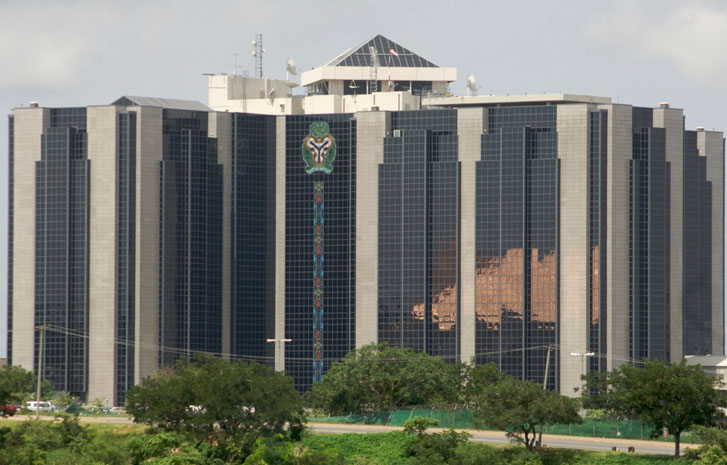
THE Central Bank of Nigeria (CBN) has indefinitely postponed the Monetary Policy Committee (MPC) meeting for September, putting on hold its bi-monthly statutory function used to consider, recommend and take critical economic decisions.


The apex bank announced this in a statement released on Thursday, September 21 and signed by its director of corporate Communications, Abdulmumin Isa.

In the statement, ‘CBN Defers September 2023 MPC,’ the apex bank gave no reason for the postponement. Still, it may not be unconnected with the “thorough housecleaning” happening at the CBN.

“The Monetary Policy Committee (MPC) of the Central Bank of Nigeria (CBN) has deferred its 293 meeting scheduled for Monday and Tuesday, September 25 and 26, 2023, respectively.

“A new date will be communicated in due course. We regret any inconvenience this change may cause our stakeholders and the general public,” the statement read in full.

The apex bank uses the MPC meeting to address major economic issues by considering global and domestic developments.

The MPC is the highest policy-making committee of the CBN and has the mandate to review economic and financial conditions in the economy.

It determines appropriate policy stance in the short to medium term, regularly checks the CBN monetary policy framework and adopts changes when necessary.

It also communicates monetary and financial policy decisions effectively to the public and ensures the credibility of the monetary policy transmission mechanism model.

The MPC meets bi-monthly, except otherwise, in the event of an emergency.

The MPC, scheduled for next week, Monday and Tuesday, September 25 and  26, would have allowed the apex bank to rein in inflation by raising, loosening or holding the monetary policy rate.

At its meeting in July, the CBN raised the benchmark rate (MPR) by 25 basis points to 18.75 per cent and adjusted the asymmetric corridor around the MPR to +100-300.

It retained the cash reserve ratio, which determines how banks price their loans to customers, at 32.5 per cent at the two-day MPC meeting chaired by the acting governor, Folashodun Shonubi.

President Bola Tinubu has, on September 16, appointed a new CBN governor and deputy governors, all awaiting the Senate’s confirmation.

Tinubu named Yemi Cardoso the new CBN governor and Sani Ahmad Dattijo, Emem Nnana Usoro, Philip Ikeazor, and Bala Bello deputy governors, respectively.

the cash reserve ratio, which determines how banks price their loans to customers, at 32.5 per cent at the two-day MPC meeting chaired by the acting governor, Folashodun Shonubi.

President Bola Tinubu has, on September 16, appointed a new CBN governor and deputy governors, all awaiting the Senate’s confirmation.

Tinubu named Yemi Cardoso the new CBN governor and Sani Ahmad Dattijo, Emem Nnana Usoro, Philip Ikeazor, and Bala Bello deputy governors, respectively.

Police confirm death of missing undergraduate in Abuja, goes after killers

0

THE Federal Capital Territory (FCT) Police Command, on Thursday, September 21, confirmed the death of an undergraduate of the National Open University of Nigeria, Blessing Karami.

Karami was declared missing on September 11, when she didn’t return to her house in Lugbe after closing from work at the Visest Supplement company in Area 3 junction.

The Police subsequently initiated a search after her disappearance was communicated to the Durumi Police station in FCT by her elder brother, Genesis Moses Karami, and her boss.

The elder brother had explained to The Whistler that the lady “studied Early Childhood Development at College of Education, Gidan Waya in Kaduna before going to NOUN as a direct entry student where she was studying the same course. She was in the 200 level.”

“I stay in Kaduna, but she stays in Lugbe. She stays alone. My sister left for work on Monday morning. They (her colleagues) saw her at work. She did all of her work and closed by 5 p.m., which was the last time. That was all,” he said.

Meanwhile, confirming her death on Thursday, September 21, the Public Relations Officer, Josephine Adeh, said the police had an unwavering commitment to uncover the cause of Karami’s death.

According to her, the lady’s body was discovered in a wooded area in Karimo. This is a different direction and transport route from where she stays.

“We wish to inform the Public that our primary focus at this time, under the directive of the Commissioner of Police, FCT, Haruna Garba, is to conduct a thorough and impartial investigation into the circumstances surrounding Blessing Karami Moses’ untimely death. Our commitment to this case is unwavering, and we are determined to uncover the immediate and remote causes of this tragic incident.”

She noted that the police were working with the Abuja Environmental Protection Board (AEPB) to facilitate the retrieval of the decomposed remains, adding that they would continue to provide updates to the public as the investigation progresses. 

Following her death, the Divisional Police Headquarters, Durumi, Abuja, arrested one Aminu, said to be the deceased’s boyfriend.

While recounting the incident, the deceased’s brother, Karami, informed the police that he received a call about discovering his sister’s body on Tuesday, September 19. However, it later became evident that the information was incorrect

“The caller said he saw a female body in Idu, so we asked him to describe what she was wearing, and he told us exactly what we were told my sister wore to the office the day she went missing,” Mr Karami told the police at the Durumi Divisional Police Headquarters on Wednesday.

Karami also told journalists that when he couldn’t reach the Durumi DPO, he proceeded to the police station at Karmo. Accompanied by a group of policemen, the caller kept toying with them as he kept changing location until they got tired and left.

He added: “We (later) saw her decomposed body in the bush here at Karmo; it’s not something we can move. We have to arrange with the environmental people to come and help us pack. We cannot travel with it. We have to bury it here. It seems she died for days due to the nature of the decomposition.”

The ICIR had reported how commuters in Nigeria’s major cities – Lagos and Abuja – are violently attacked and robbed.

Police exhume Mohbad’s body

0

THE Lagos State Police Command has confirmed the exhumation of the body of the late singer, Ilerioluwa Aloba, popularly known as Mohbad.

The Spokesperson of the Command, Benjamin Hundeyin, disclosed the development via his X handle on Thursday, September 21.

A Nigerian actress, Iyabo Ojo, has also disclosed that the nurse who reportedly injected the late singer before his demise on Tuesday, September 12, has been arrested.

The Police said the investigation followed growing public concerns and the preliminary police review of the circumstances surrounding Mohbad’s death.

 The Command said the team, which comprises seasoned homicide detectives, had been tasked to aggregate all allegations, suspicions and insinuations from various sources on the singer’s death and undertake a professional, diligent and timely investigation to establish facts and ensure that justice is served.

The Force promised to deploy all requisite protocols (which may include exhumation) and technical and scientific tools vital to the detailed investigation of homicide allegations related to Mohbad’s death.

The ICIR also reported that a lawyer, Festus Ogun, wrote to the Chief Coroner of Lagos State, Mojisola Dada and the newly sworn-in Attorney General of the state, Lawal Pedro, demanding a coroner’s inquest into the death of the singer

In a statement sent to The ICIR on Monday, September 18, Ogun, who described himself as a fan of the late singer, said there were significant reports that Mohbad’s death was not due to natural cause.

Mohbad passed away on September 12, 2023, and was buried a day after.

CMPA hosts round-table to standardise anti-corruption reporting in Nigeria

0

THE Centre for Media, Policy and Accountability (CMPA) has restated its commitment to ensuring transparency and accountability in Nigeria by hosting a round-table to standardise anti-corruption reporting in Nigeria.

The organisation stated this on Wednesday, September 20, in Abuja while rounding off its two-day programme to engage and sensitize more stakeholders on its Nigeria Anti-Corruption Performance Public Reporting (NAPPR) Project.

CMPA brought together past and present heads of anti-corruption agencies (ACAs), mid-level executives representing the various ACAs, investigative journalists, civil society organizations (CSOs) and media organizations to collaboratively shape the creation of a standardised template for anti-corruption reporting in Nigeria.


Read Also:

The MacArthur Foundation funds the NAPPR project to establish a unified reporting template for anti-corruption initiatives, fostering transparency and public engagement.

Discussions at the event centred on designing a harmonised framework for reporting anti-corruption activities to enhance transparency, consistency, and public awareness.

Executive Director of CMPA and project manager Suleiman Suleiman emphasised the importance of data collection in tackling anti-corruption.

“Our goal was to bridge the gap between anti-corruption agencies’ efforts and public perception by uniting CSOs and media organisations in shaping anti-corruption reporting,” Suleiman stated.

The Director of Research, Abdulmutalib Abubakar, reaffirmed the organisation’s vision and commitment to ensuring transparency and accountability in Nigeria.

Participants, including CSOs, media representatives, leadership experts, and stakeholders, engaged in fruitful discussions and shared best practices for creating a unified reporting mechanism.

CMPA urged participants to utilise their platforms to disseminate insights and contribute to strengthened anti-corruption efforts in Nigeria.

The CMPA is an independent, not-for-profit organisation focused on anti-corruption, research, public policy analysis, transparency, and accountability.

Women groups protest assault on Ondo Commissioner by APC Chairman

0

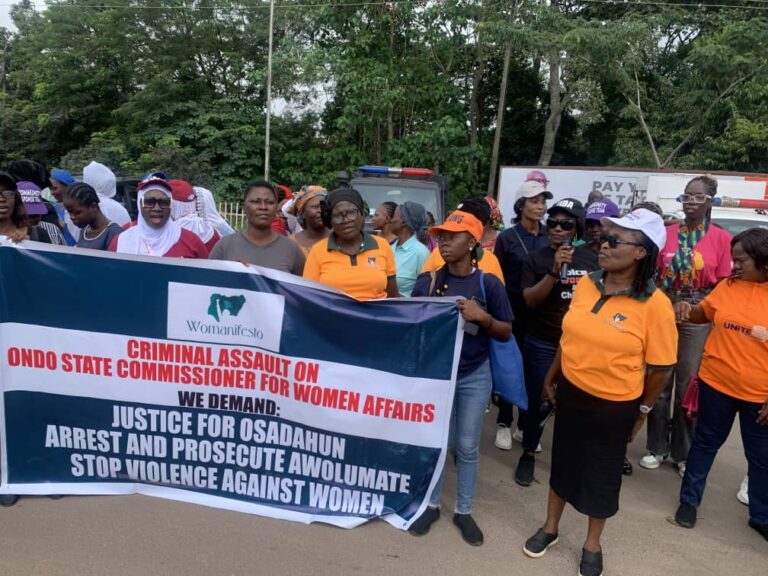
A coalition of over 1,000 Women Rights Organisation, Womanifesto, on Wednesday (Sept 20), held a protest against the assault on Ondo State Commissioner of Women Affairs Olubunmi Osadahun by the All Progressives Congress (APC) Ward Chairman of Akoko North-West LG Olumide Awolumate.

The Ondo State Chapter of Womanifesto took to the streets with banners demanding the prosecution of the APC Chairman and justice for the commissioner.

Awolumate attacked the commissioner on Saturday, September 16, while leading the distribution of palliatives provided by the Federal Government to alleviate hardships arising from the removal of fuel subsidy.

He was captured in a viral video hitting the commissioner on her head with a chair, which caused her some bleeding and swelling.

Osadahun was taken to the hospital for medical attention following the incident, while young men identified as her loyalists retaliated by launching an attack on Awolumate.

APC, others condemn attack, Awolumate suspended indefinitely

Following the attack, the Ondo State Chapter of the APC announced the Ward Chairman’s indefinite suspension on Tuesday, September 19.

His suspension was contained in a statement issued by the State Publicity Secretary of the party, Alex Kalejaye, who described his actions as deplorable and lamentable.

“In furtherance of the above, the leadership of the party in Akoko North West deems it fit to officially inform the state secretariat that Awolumate Olumide is hereby suspended indefinitely from the party in Akoko North West of our great party,” the statement read in part.

Meanwhile, Womanifesto condemned the assault in a statement on Monday, September 18 and called for the Chairman’s prosecution.

“This situation is a microcosm and replica of the varying degrees of violence against women across Nigeria. The deepest disregard for women in Nigeria was displayed in public without any form of reservation or remorse. If a commissioner can be so assaulted, we can only imagine the gruesome forms of violence meted out to women around Mr Awolumate,” the statement partly read.

The Ondo State Police Command also condemned the attack in a statement and commenced an investigation into the attack.

“Preliminary investigation reveals that the commissioner who was in the Akoko area to see to the distribution of said palliatives was attacked by the assailant named Awolumate Olumide while having a meeting with some of their party members in the area.

“The CP (Commissioner of Police) has ordered that a thorough investigation be carried out and the case transferred to the SCID (State Criminal Investigation Department), Akure, for further probe into what led to the assault,” the Police Public Relations Officer (PPRO) Funmilayo Odunlami noted in a statement.

Deputy Minority Leader of the Ondo State House of Assembly, Oluwatosin Ajirotutu, also described the attack as barbaric and inexcusable.

Security operatives arrest Ogun Assembly member, five others over cult clash

0

SECURITY operatives in Ogun State have arrested a member of the state House Of Assembly, Damilare Bello Mohammed, and five others over the recent cult clash in Sagamu area of the state.

Clashes erupted at the weekend between rival cult groups in Sagamu, leading to the death of some residents.

Bello, representing Sagamu State Constituency (1), allegedly provided refuge for some fleeing cultists.

According to Lekan Adeniran, the Chief Press Secretary (CPS) to the state governor, Dapo Abiodun, the State Security Service (SSS) arrested the suspects on Wednesday, September 20, at the official residence of the lawmaker.

Adeniran, in the statement, revealed that various deadly items, including guns, were found on the suspects and that they were being interrogated in SSS custody.

He stated that those arrested include Damilare Bello Mohammed, aka DRE, Adewale Otesanya, Bamidele Saheed, Ismaila Onitire, Debo Animashaun and Tobi Owoade.

In February 2023, Bello was arrested by the SSS for allegedly planning the violent demonstration that broke out in Sagamu when angry youths vandalised about ten banks and other public facilities in protest against the Central Bank of Nigeria’s (CBN) currency redesign policy.

Attempts to speak with the SSS spokesperson, Peter Afunanya, over the incident were unsuccessful, as he did not respond to messages sent to his phone.

Proffering a solution to the regular cult crisis in Sagamu, the spokesperson of the Nigerian Police, Muyiwa Adejobi, in his reaction to the cult incident on his X handle, said the situation in the town was beyond the deployment of an anti-cultism squad alone, saying all stakeholders must collaborate to tame the menace.

He recommended a multi-track diplomacy approach to tackling the crisis.

Adejobi urged the Ogun State Commissioner of Police to look inward and take action on the report by some residents that the cultists were well known to security agents.

He added that most of those causing trouble in the area were not from Sagamu.

Nigeria recorded fewer road crashes, fatalities in first half of 2023 – FRSC

0

THE Federal Road Safety Corps (FRSC) has recorded a decrease in road traffic crashes (RTCs), related fatalities and injuries during the first half (H1) of 2023.

Corps Public Education Officer (CPEO) Bisi Kazeem disclosed this in a statement on Wednesday, Sept. 20, noting that there had been a 15.5 per cent decrease in fatalities compared to the same period in 2022.

“On the number of people killed, the corps also recorded a significant reduction within the operational period. According to the crash data report, in the first six months of 2023, the corps recorded a total of 2,850 fatalities as against 3,375 in the same period in 2022, representing a 15.5% reduction,” Kazeem noted.

There were 5,700 RTCs in the first half of 2023, a 14 per cent decrease compared to 6,627 cases in H1 2022.

FRSC also recorded a 14 per cent decline in the figure of people rescued with injuries, as 16,716 were rescued in 2023 and 19,440 in 2022.

“The corps marshal attributed this modest achievement to a number of strategies and innovations in enforcement activities, improved presence and visibility, public enlightenment and partner engagement.

“While charging drivers to desist from bad driving behaviours, corps marshal Dauda Ali Biu re-emphasised the commitment of the corps towards achieving its corporate mandate of sanitising the highways and entrenching safety on the nation’s over 200,000 kilometres road network,” Kazeem noted.

Globally, Africa is infamous for having the world’s highest road accident death rates.

According to a 2014 report by the Global Road Safety Facility (GRSF), a global multi-donor fund hosted by the World Bank, Nigeria tops the countries with the most fatalities from traffic crashes.

Before the decline in H1, RTC cases in Nigeria had been on the rise, with the Federal Capital Territory (FCT) recording the highest figures nationwide.

There were 13,027 RTC cases in 2021, which rose to 13,656 in 2022.