BARELY three months after a United Nigeria Airlinesaircraft skidded off the Murtala Mohammed International Airport (MMIA) runway, another flight belonging to the organisation skidded off the runway again on Friday, September 8, while landing.
In a statement seen by The ICIR on Saturday, September 9, United Nigeria Airlines confirmed that its flight U5 0513, with registration 5N-BWY, upon landing, encountered aquaplaning due to a downpour.
The aircraft had onboard 51 passengers and four crew members, according to the Nigerian Safety Investigation Bureau (NSIB).
In aviation parlance, aquaplaning occurs when an aircraft lands on a wet runway at high speed, causing the tires to lose runway contact and the plane no longer responsive to steering.
In May this year, a United Nigeria Airlines aircraft, 5N-BWW, with 50 passengers on board, flying in from the airport in Abakaliki, Ebonyi state, also skidded off runway 18L at the Murtala MMA2 in Lagos.
The aircraft landed safely but was forced to terminate its movement to the apron off the runway.
Explaining the recent incident, United Nigeria Airlines’ head of corporate communications, Achilleus-Chud Uchegbu, said, “The aircraft which was coming in from the Sam Mbakwe International Cargo Airport Owerri operated and landed normally but skidded off the runway upon landing.”
He said no passenger was hurt in the incident, and all passengers were safely evacuated with their luggage.
“Relevant authorities have been informed about the incident,” the spokesperson added.
The NSIB spokesman, Tunji Oketunbi, while confirming the incident that 51 passengers and four crew members were onboard the aircraft, sought information from the general public to assist in conducting a comprehensive investigation.
He said, “NSIB has been notified and commenced investigation into a serious incident involving an Embraer ERJ145 with Nationality and Registration Marks 5N-BWY belonging to United Nigeria Airlines, which occurred around 06:33pm (Local Time) on 8th September 2023.
“The aircraft, with 51 passengers and four crew members onboard, was en route Lagos from Owerri. The aircraft on landing on Runway 18R of Murtala Muhammed International Airport, Ikeja, Lagos, skidded off the runway.”
He also confirmed that there was no injury or fatality.
The management of the Cross River State College of Nursing and Midwifery Sciences, Itigidi, in Abi Local Government Area, LGA, Cross River State, met the proverbial “judgment day” on Thursday, June 1, 2023.
The Registrar, Aji Eko, who was on his way to catch up with an appointment at the nearby General Hospital, expressed surprise when approached by the reporter.
The reporter had come to ask the Registrar questions about some contracts. This included the contracts to renovate the building used for his office awarded to Quintito Integrated Services Nig. Ltd for N20 million; completion of block work/fixing of doors and windows in a 3-story hostel block awarded to JND Consultant Ltd for N60 million; landscaping of the college premises, including the construction of the perimeter fencing awarded to Renaissance Datarium for N18 million; and another N18 million paid to Entek B for the construction of additional three classrooms to meet NBTE’s specification.
The Registrar could not hold his anger upon learning from the reporter that the Ministry of Health had played a fast one on the College. True, the projects are ongoing, but they are being funded from the college’s Internally Generated Revenue (IGR) because the government claimed it was financially constrained and asked them to use IGR for the projects. But, the Registrar and his team had not been told that contracts had been awarded and contractors paid. Meaning that work ought to have started.
Eko rang the Provost of the College, Ruth Eta-Ebong on the phone to share with her what he had just learnt. After expressing her frustration with the funding challenges bedevilling her office, the Provost instructed the Registrar, in the company of her deputy, to accompany the reporter to all the project sites to see the level of work done.
But, rather than do this, the Registrar set up an emergency panel that interrogated the reporter for over an hour about the source and authenticity of his information. At the meeting were the Registrar, Deputy Provost, Administration, Bursar, and Auditor, while the Provost coordinated them over the phone.
After surviving the interrogation, the officials declined to guide the reporter to the project sites and helplessly confirmed that this was for fear of losing their jobs.
The four contracts listed above and 32 others worth over N1 billion inspired this six-week investigation, which uncovered a far-reaching breach of the Cross River State Procurement Law, 2020.
From scrutinising documents from the Due Process and Price Intelligence Bureau (DPPIB), CrossRiverWatch established that 79 contracts were awarded from the $20.4 million grant the state government got from the World Bank through its States Fiscal Transparency, Accountability and Sustainability (SFTAS) programme. The 79 contracts were awarded from October 2020 to December 2021.
Of the 79 contracts, 36 were awarded by the immediate past government of Ben Ayade in violation of several provisions of the State Procurement Law, 2020 and the Project Development Objective (PDO) of the SFTAS programme, which is to strengthen fiscal transparency, accountability, and sustainability in participating Nigerian states. All 79 contracts were awarded at the exact amount the contractors proposed.
What is SFTAS?
To support the government in its objective to encourage a common set of fiscal behaviour aimed at fiscal transparency, accountability, and sustainability among states in Nigeria, the World Bank developed a four-year (2018 – 2022) Programme for Results (PforR) facility worth $750 million called States Fiscal Transparency, Accountability and Sustainability (SFTAS) Performance for Results (PforR).
The programme combines selected actions from the Fiscal Sustainability Plan (FSP) and the Open Government Partnership (OGP) agenda to form its disbursement-linked results, which States are to meet before they can access funds.
The $750 million financing of the programme was spread to cover $700 million in annual performance grants and $50 million in technical assistance support to states.
The State Procurement Law of 2020 and PDO of SFTAS were violated just to award 35 contracts to friends and cronies at the expense of the people. Part 3 – fundamental principles of procurement, section 1(b), 6(a) sub 1, and 6(b) are the provisions violated.
No prior budgetary appropriation
Part 3, section 1 (b) of the state procurement law stipulates that subject to any exemption allowed by the Law, public procurements shall be conducted “based only on prior procurement plans, supported by prior budgetary appropriation…”
Four contracts were not found in the 2020 and 2021 budgets of the state as required. Two of these are from the Ministry of Health, while the others are from the Internal Revenue Service (IRS).
The contracts by the Ministry of Health are renovation of the building used for the Registry/Registrar’s Office, College of Nursing Itigidi, valued at N20 million, awarded to Quintito Integrated Service Nig. Ltd and the renovation of General Hospital, Itigidi (female ward, children’s ward, and theatre) awarded to Gobenchi Supply and Investment Company Ltd for N48 million.
The IRS contracts are procurement of Integrated Data Extraction and Analysis (IDEAL) software, given to Gobenchi Supply and Investment Company Ltd for N21 million, and printing of 7,000 units of vehicle registration booklets and 3,000 units of motorcycle registration booklets for N9.5 million awarded to Odessys Services.
Incompetent firms
The investigation further revealed that three contracts were awarded in violation of Part 3, section 6(a) of the procurement law, which stipulates that “all bidders in addition to requirements contained in any solicitation documents shall possess the necessary “Professional and technical qualification to provide the goods, services, or works.”
The companies that lack the professional capacity for the services paid for are Konkri Kong Nigeria, Conceal Nigeria Ltd, and Ishor Global Concept (Nig) Ltd.
Konkri Kong Nigeria, which is registered as generator merchants and traders was employed and paid N15 million to purchase 200 non-contact stand-by infra-red thermometers for the Governor’s Office.
Conceal Nigeria, which is registered as an estate agent and maintenance company, was contracted to print pantographs and HMIS data tools for N65 million.
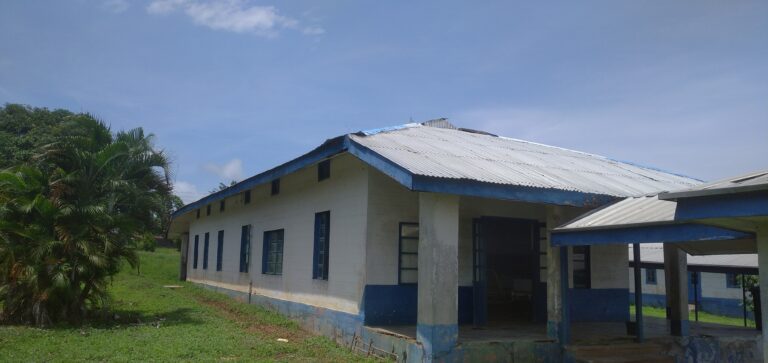
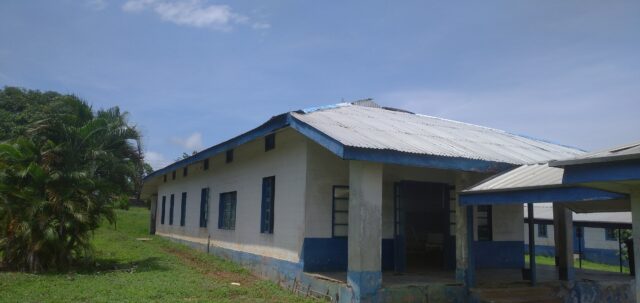
General Hospital Itigidi female ward, children’s ward, and theatre
Ishor Global Concept (Nig) Ltd was incorporated for cleaning/waste disposal services and was paid N40 million to build and equip Primary Health Care Centre Egbe Mbube, Ogoja LGA.
Unlicensed companies
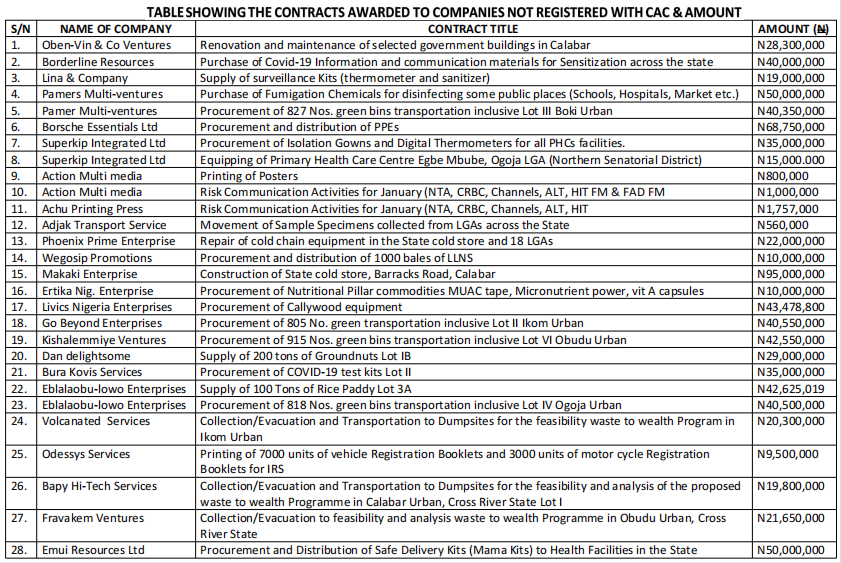
Another critical finding by this reporter is that despite being mandatory as contained in Part 3, section 6(b) of the law that all bidders “shall possess the legal capacity to enter into the procurement contract,” 24 companies that are not incorporated by the Corporate Affairs Commission (CAC) got 28 contracts.
Three out of the 24 companies got two each out of the 28 contracts. As for the procuring entities, the Ministry of Health topped the list with 16, the Ministry of Environment with seven, the Ministry of Agriculture and Natural Resources with two, the Governor’s Office with one, the Ministry of Land with one, and Internal Revenue Service with one.
Legitimate companies kicked aside
For the 28 contracts awarded to the 24 companies not registered with CAC as demanded by law, some legitimate and qualified companies were kicked aside during the bidding process to favour the illegal ones.
There are nine awards where all the companies that bidded were unregistered. These are Phoenix Prime Enterprise, Go Beyond Enterprises, Bura Kovis Services, Eblalaobu-lowo Enterprises, Bapy Hi-Tech Services, Fravakem Ventures, Action Multi-Media, Wegosip Promotions, and Emui Resources Ltd.
There are five cases where the only legal company that bidded was kicked aside. The companies kicked aside are Dadaman Global Invest. Nig Ltd in the contract to print 7000 units of vehicle registration booklets and 3000 units of motorcycle registration booklets for IRS – N9,500,000; Breatinor Ventures, collection/evacuation, and transportation to dumpsites for the feasibility waste to wealth program in Ikom Urban – N20,300,000; Fergobest Nig. Ltd, procurement of nutritional pillar commodities MUAC tape, micronutrient power, vit A capsules – N10,000,000; Dual Basol Nig. Ltd, construction of state cold store, Barracks Road, Calabar – N95,000,000; and Preyek Ventures, procurement of 818 Nos. green bins transportation inclusive Lot IV Ogoja Urban – N40,500,000.
In the case of another 14, there was more than one registered company that bidded, but none got the contract.
Surprisingly, in one instance, the contract to purchase IDEAL software was awarded at the sum of N21,000,000 to Gobenchi Supply and Investment Company Ltd, which did not bid but miraculously got the contract.
The companies that bidded to purchase IDEAL software and were kicked aside are Pierre Consulting, Direct Link Procurement, and Supply Ltd, and Glory Land Mega Works Ltd.
Awarded Contracts Less Than 8 Months After Incorporation
This investigation also uncovered a case of four companies that got contracts not more than 8 months after they got incorporated. They were awarded in vioaltion of the State procurement law which envisages that all contract seeking entities would have been filing returns and paying tax, among other obligations, for three years prior by providing a tax clearance certificate.
Tax clearance for three years is sacrosant as it is mandatory according to the check-list of documents required for Due Process review and certification.
Shaema Global Services was awarded the contract to collect/evacuate and transport waste for feasibility and analysis under the waste-to-wealth program in Boki Urban, Lot VI for N21,350,000. The contract was given to the company 8 months after its incorporation.
Patson Environment Services was also engaged to collect/evacuate and transport waste for feasibility and analysis under the waste-to-wealth program in Yala Urban, Lot Vii for N21,550,000. It got the contract two and a half months days after incorporation.
For the procurement of nine direct solar refrigerators and one ice park freezer for N30,000,000, Erhnof Limited was contracted 18 days after it registered with CAC.
Bedas Enterprise was paid N20,000,000 for the procurement of delivery kits for safe motherhood (Lot I) 35 days after it got registered.
Awarded to politicians
This six-week investigation also uncovered seven contracts awarded to four companies affiliated with politicians or Politically Exposed Persons, PEPs. Two are commissioners, one was an aide and relative to Governor Ben Ayade, and the other a 2019 House of Assembly candidate cum popular radio presenter turned legislative aide.
Glory Land Mega Works got three contracts, Gobenchi Supply and Investment Company Ltd got two, Quintito Integrated Service Nig. Ltd and Wegosip Promotions got one each.
Glory Land Mega Works was contracted to purchase gunshot-infra-red thermometers for N45,000,000; procurement of 70 life jackets for N10,000,000; and another 70 life Jackets for 10,000,000. Its has Okon Nyong Owuna, Mabel Okon Owuna, Obassi-Akare Okon Nyong, Onor-Obasi Okon Owuna, and Ekup-Nse Okon Nyong listed as Directors.
Mr. Okon Nyong Owuna was Commissioner for Agriculture and Natural Resources during the period of the contract award in Cross River State. He later resigned to contest for the Southern Senatorial District ticket.
Gobenchi Supply and Investment Company Ltd, which was contracted to renovate General Hospital, Itigidi (female ward, children ward, and theatre) for N48,000,000 and procurement of Integrated Data Extraction and Analysis (idea) software for N21,000,000 has two Directors, George O’ben-Etchi and O’ben-Etchi G. Both directors are believed to be Hon. George O’ben-Etchi, former House of Assembly member and immediate past Commissioner for Social Housing, but during the contract award period, he was Commissioner for Solid Minerals.
Quintito Integrated Service Nig. Ltd was contracted to renovate a building for use as Registry/Registrar’s Office, College of Nursing Itigidi for N20,000,000. The company is registered and has and has four Directors. They are Enamhe Ushie, Blessing Anthony Ulayi, Prince Victor Necus-Agba, and Anthony Andor Ulayi. The company is linked to Anthony Andor Ulayi who is related to Gov. Ayade through his half-brother, Placidus Ogar. Apart from the bloodline, Mr. Ulayi was Ayade’s Special Assistant on Local Government Service Commission.
Wegosip Promotions is an unregistered company but was contracted to procure and distribute 1000 bales of LLNS for N10,000,000. The company is owned by Mr. Awade Friday, owner of the popular vernacular English radio program on Hit 95.9FM Calabar – Otwetwe.
Mr. Awade AKA Last Prophet contested and lost in the February 2019 general elections, where he ran under the Social Democratic Party (SDP) for the Obanliku State Constituency in the House of Assembly category. He is currently a media aide to the member representing Obudu/Bekwarra/Obalinku in the House of Representatives, Hon. Peter Akpanke.
Sad Tales
It was further established that nine contractors did not go to their sites despite being mobilized, while one abandoned the project halfway.
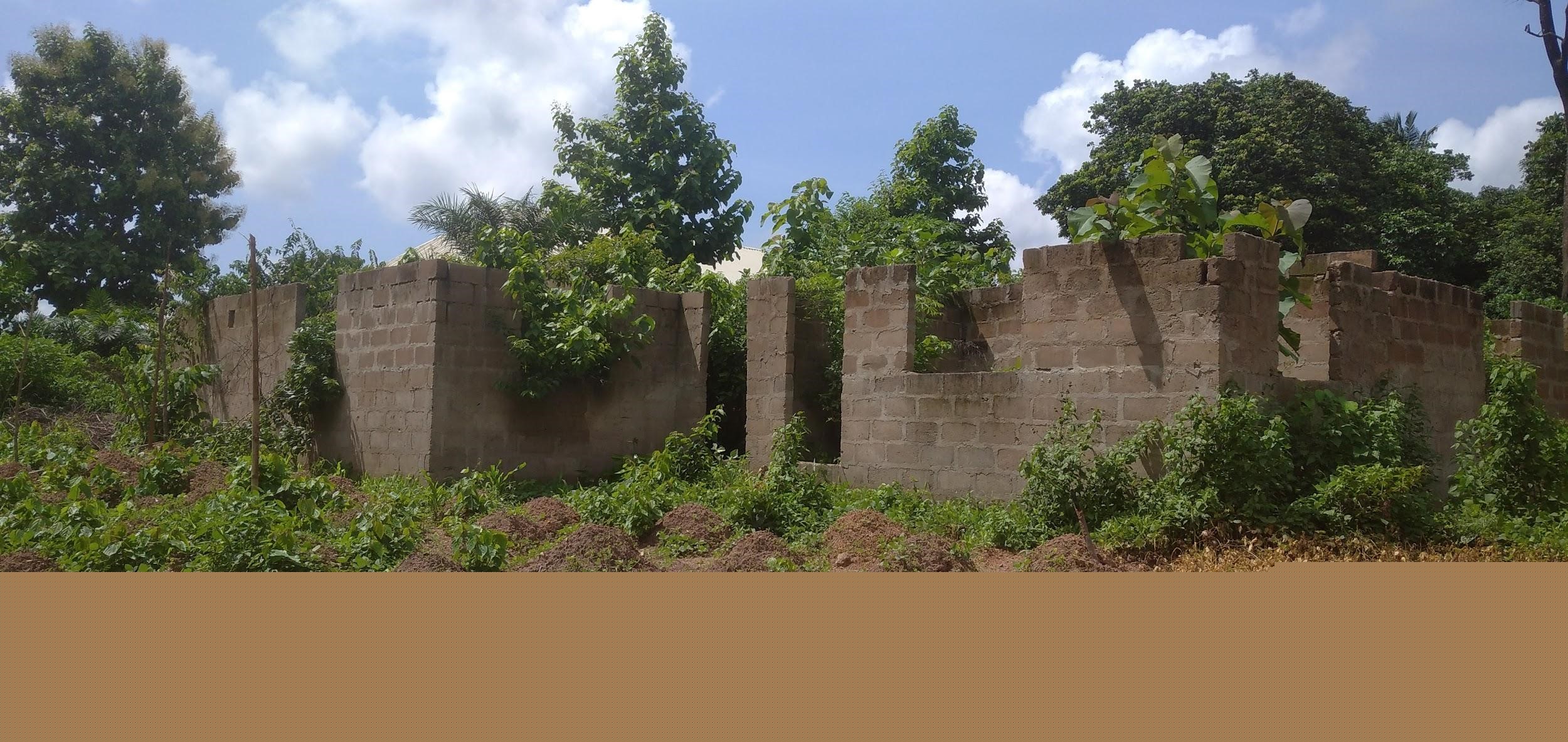
At the Cross River State College of Nursing and Midwifery Sciences, Itigidi, four contracts were awarded but the contractors never stepped foot on the institution.
Quintito Integrated Service Nig. Ltd, a company linked to Governor Ayade’s relative, got N20,000,000 to renovate a building used as Registry/Registrar’s Office but never visited the site.
Likewise, JND Consultant Ltd was paid N60,000,000 for the completion of block work/fixing of doors and windows in a 3-story hostel block, but it never went through with it.
Renaissance Datarium got N18,000,000 to landscape the college premises, including the construction of the perimeter fence, but it never did.
Also, Entek B was paid N18,000,000 for the construction of additional 3 classrooms to meet NBTE’s specifications like others, but it never went to the site.
Sharing the fence with the College in Itigidi is the General Hospital, where Gobenchi Supply and Investment Company Ltd, a company linked to Hon. George O’ben Etchi, former House of Assembly member and immediate past Commissioner for Social Housing, got N48,000,000 to renovate the hospital’s female ward, children ward, and theater but never did. He was Commissioner for Solid Minerals when the contract was awarded.
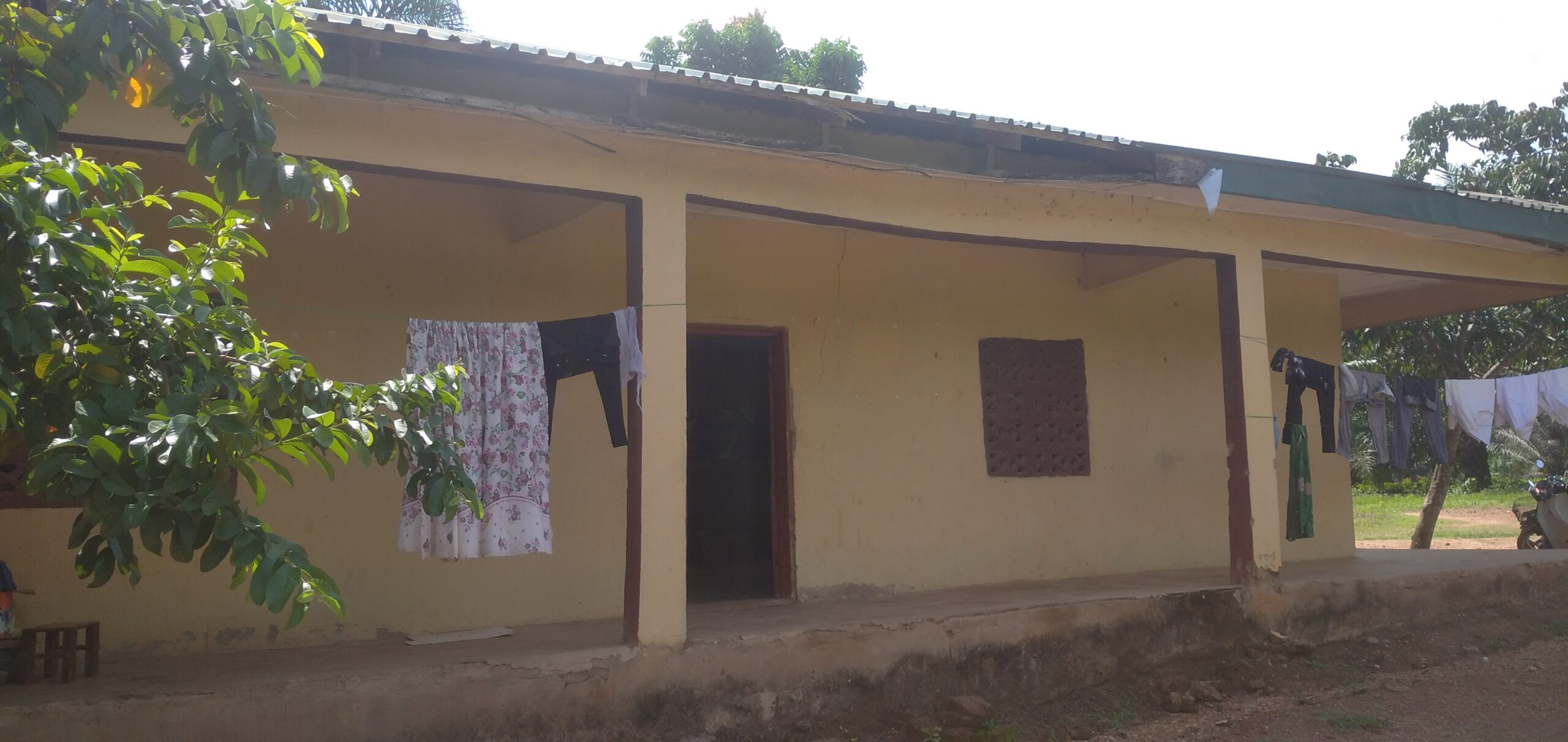
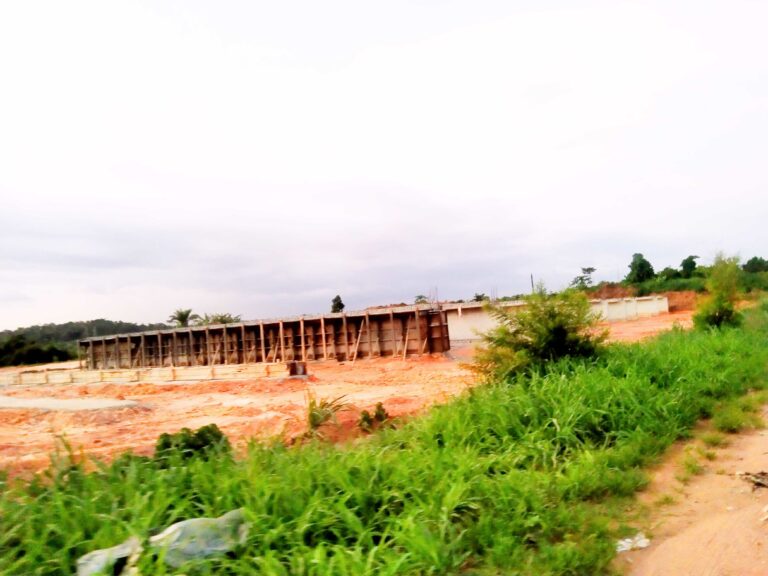
Ishor Global Concept (Nig) Ltd, a company registered as a cleaning/waste disposal service provider was paid N40,000,000 to build and equip a new facility for them. The Primary Health Care Centre Egbe Mbube, Ogoja LGA operated from a community town hall, and this was what the contract was supposed to address. It abandoned the project halfway.
Peter Enhievi Nigeria Enterprise was also contracted to equip the Primary Health Care Centre, Egbe Mbube, for N28,000,000, but no sign of the contractor or the equipment has been seen to date.
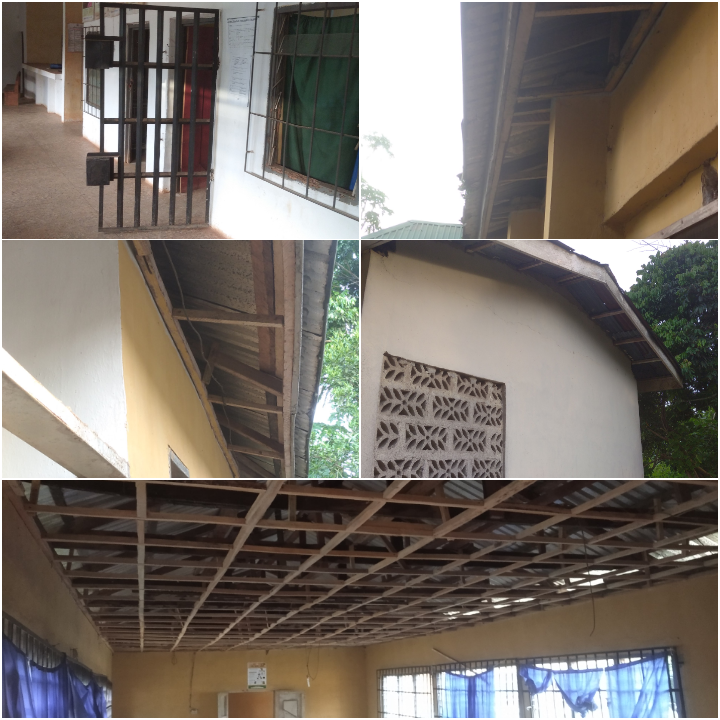
Current state of PHC Egbe Mbube.
Remains of what Ishor Global Concept (Nig) Ltd left behind.
De-sanitizers Nig. Ltd. was contracted to renovate Primary Health Care Centres in Adadama, Abi LGA; Benedehe Ekem, Etung LGA; and Katchuan Irruan, Boki LGA for N45,000,000.
The contractor only renovated the PHC in Adadama, Abi, and abandoned that of Katchuan Irruan in Boki and Bendehe Ekem in Etung LGAs.
PHC Katchuan Irruan in Boki.
PHC Bendehe Ekem in Etung.
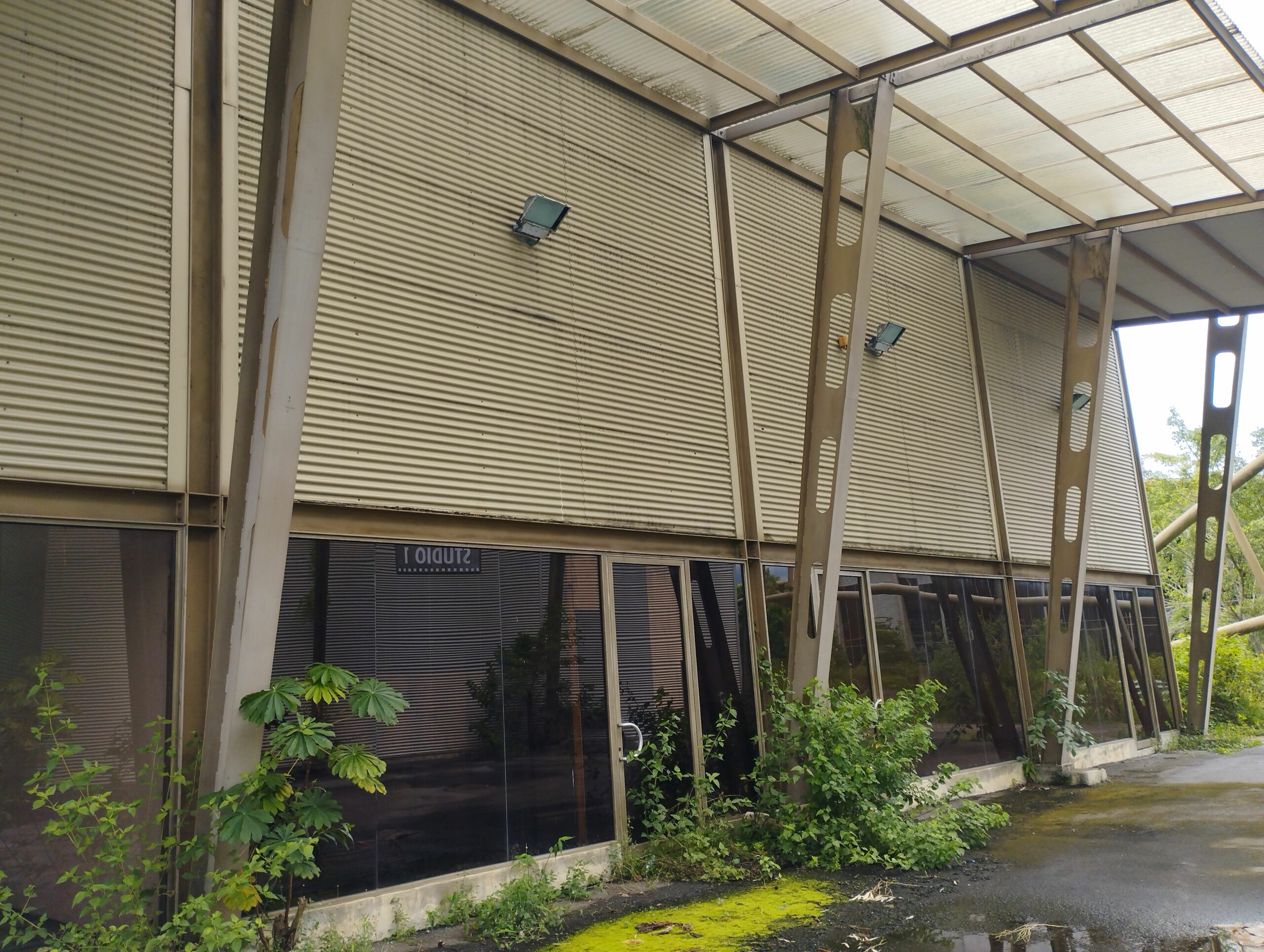
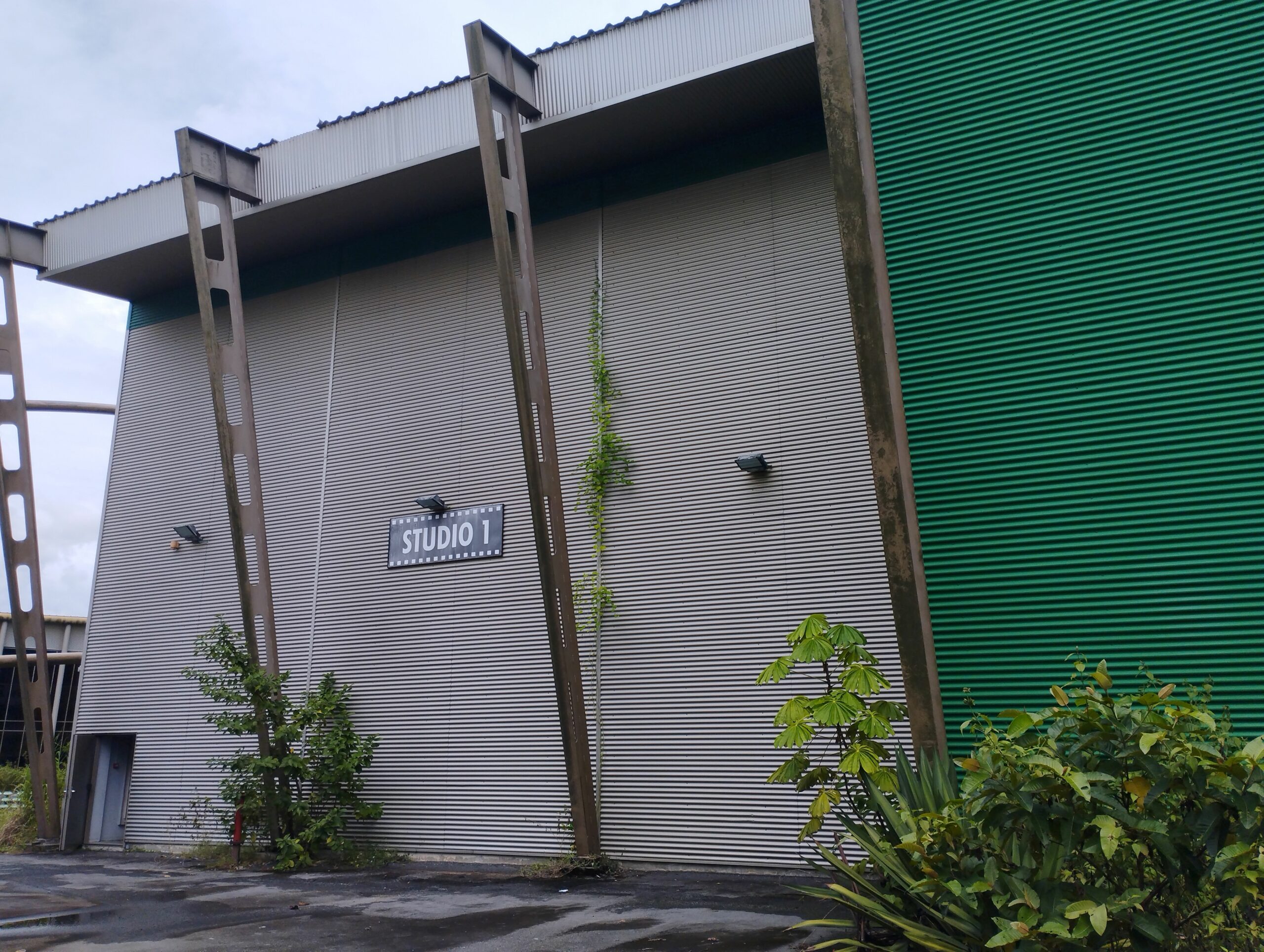
Livics Nigeria Enterprises, an unregistered company was paid N43,478,800 for the procurement of Callywood equipment. Callywood Studio, which operates from Tinapa, has been abandoned for years. A visit shows that it is still not functional, under lock and key and not bearing looks of N43,478,800.
What is left of Callywood studio in Tinapa.
What is left of Callywood studio in Tinapa.
Contractors explain
When asked why the N48,000,000 contract to renovate the theatre, female, and children ward was not executed, George O’Ben Etchi, owner of Gobenchi Supply and Investment Company Ltd was startled.
He told CrossRiverWatch over the phone that the contract was not given to him directly and that he only helped a young friend.
“Someone approached us to use our company to do a job. I was in the United States of America then, and I did not know the details of the job, but I said he can go ahead and make use of the company. When the payments were done, we made sure the money was released to him.
“Usually, when they get jobs at Lafarge and they don’t have the requirements, I say go ahead and use our company, but once money is paid we give it to them. Some people charge 10 per cemt but I don’t, I use that to help young people who have jobs, Just to enable them. Give me some time to make my findings, and I will get back to you.”
After two hours, an agitated O’Ben was sitting face-to-face with this reporter in Chef Zanga’s kitchen. Great Ogban and a lady accompanied him.
READ ALSO:
“So that’s the person that came to me (referring to Ogban) and said he had a friend whose madam (boss) wanted to give him a job. I said ok.”
Perplexed, Ogban revealed that the friend he assisted is Duke Igebu, who was Personal Assistant to the immediate past Commissioner of Health in Cross River State, Betta Edu, She is also the immediate past APC Women National Leader, now Minister of Humanitarian Affairs and Poverty Alleviation.
Edu enlisted his service right from her days as DG of the Primary Health Care Development Agency.
Thinking his problems were over, O’Ben was surprised when told that his company got another contract it did not bid for – a contract to purchase IDEAL software (N21,000,000) for the IRS.
Palpably angry, O’Ben said, “This is outright fraud. I may sue the IRS. I did not bid, and you did not pay the money to my company.”
Quintito Integrated Service Nig. Ltd was contracted to renovate a building for use as Registry/Registrar’s Office, College of Nursing Itigidi, for N20 million. The company, though registered, is linked to Anthony Andor Ulayi, a relative and aide of the then-governor, Ayade.
When contacted, Anthony Andor Ulayi, a director in Quintito Integrated Service Nig. Ltd, claimed not to know anything about the contract.
He confessed “It was a friend who approached me to use my company. I am not aware of this particular contract. Let me call him.”
Pressed further, he refused to give the name of the friend and the MDA he or she works with.
Awade Friday, the owner of Wegosip Promotions, which was found not to be registered with CAC, insisted that it is registered but could not provide the registration number.
Friday, the owner of the popular vernacular English radio programme on Hit 95.9FM Calabar, Otwetwe, said he delivered as contracted and presented his defense, though he deleted them after sharing them with this reporter.
Stakeholders call for law enforcement
Civic actors have condemned the brazen abuse of the procurement process in Cross River State and called for transparency and accountability.
Efanga Etim, Cross River State/South-South Zonal Lead for the #FollowTheMoney campaign, commended the investigation and called for law enforcement.
In a WhatsApp chat with this reporter, he stated, “It’s just disheartening to hear this. I want to first thank you for taking the time to uncover all this massive information.
“This is an issue that is bringing Nigeria to its knees on a daily basis.”
On the need to battle illegality, he posited, “Corruption is killing us as a nation, and we won’t stop until we fight it and ensure it is reduced to nothing in this country.
“The agencies are really not doing enough to combat corruption, I must say.
“The agencies should start enforcing laws to combat corruption in Nigeria. Once they do this, corruption will reduce.”
On his part, the Cross River State Lead of Policy Alert, Lawrence Peter, urged respective authorities to spring into action.
Pinpointing a gap between policy implementation and accountability, he said, “There is a gap between policy implementation and transparency. Most of the problems we have today about budgeting and project executions are major because of some political errors.
“It is time the government looks into issues of transparency, accountability, and service delivery, particularly in the public sector.
“We need a clear record on transparency and accountability.”
No response from the government
Two separate visits were made to the Ministries of Health, Agriculture, Environment, and Land as well as the Internal Revenue Service and Due Process and Price Intelligence Bureau after their information officers could not provide answers to this reporter’s questions.
A Freedom of Information (FOI) request seeking answers to why the state procurement law was not strictly followed in the award of the 36 contracts was sent to the heads of IRS, DPPIB, Ministries of Health, Agriculture, Environment, and Land. None of them responded within the seven-day stipulated time frame and at the time of filing this report.
When called to react to our findings, the Permanent Secretary of the Ministry of Health, Pauline Obute, told this reporter on the phone that she would facilitate a meeting with the contractors to answer questions relating to the awards they got.
“We will call for a meeting with the contractors. We will not speak on their behalf. I became Permanent Secretary in December last year. You will need to get ethical approval to get all the information.”
The Director of Planning, Research, and Statistics, Ministry of Agriculture, Cliff Ayang Oyira, while speaking on the phone, said the six contracts awarded from his Ministry never emanated from there as he would have been aware of them.
He said, “I will be sincere to you, I am not aware of such contracts. My office is the ideal office to deal with such things, but I’m not aware, sadly.”
The Procurement Officer for the Ministry of Environment, Samuel Ikpi, was called. He promised to respond later but did not. His number never connected afterwards.
The Ministry of Land, Internal Revenue Service, Due Process, and Price Intelligence Bureau are yet to respond to inquiries.
This investigation is supported by the John D. and Catherine T. MacArthur Foundation and the International Centre for Investigative Reporting, The ICIR
THE Editor of the Foundation for Investigative Journalism (FIJ) Damilola Ayeni has regained freedom from Benenise Police after spending nine days in detention while on his second part of his Nigerian-Benin Environmental Journalism report.
On Friday, September 8, Ayeni was released from captivity, a result of combined actions including persistent media pressure, the unceasing efforts of the Nigerian Embassy in Benin, and legal representation and advocacy efforts coordinated by the Foundation for Investigative Journalism (FIJ) and the Committee to Protect Journalists (CPJ).
The ICIR reports that Beninese police arrested and detained the Editor of the Foundation for Investigative Journalism (FIJ) Damilola Ayeni, at the Commisseria Central, Parakou Police Station, in Parakou, Republic of Benin on September 6, 2023.
The report stated that FIJ received a distress text from Ayeni on Thursday, August 31, which was swiftly deleted a few moments after it was delivered through one of its communication channels. The message read, “I have been apprehended.”
Ayeni subsequently told his colleagues on a phone call that he was briefly held because the authorities stated that there were security concerns in the area.
Following his arrest and detainment, the FIJ’s Editor was moved to Cotonou, ahead of his arraignment to a court in Porto Novo.
According to a statement by the Coalition of Whistleblowers Protection and Press Freedom (CWPPF) on Friday, September 9, 2023, Ayeni will be arraigned in court for “terrorism.’
Announcing his release in a report, FIJ mentioned that, Ayeni, as of the time filing the report, was being handed over to Nigerian authorities. Although, the report stated that he will remain in Benin Republic for a little longer.
Also, confirming his arrest the FIJ founder and editor-in-chief, via his X (now Twitter) handle, posted: “Damilola Ayeni @AF_Damilola, editor of @fijnigeria, has regained freedom after combined efforts of sustained media pressure, relentless work by the Nigerian Embassy in Benin, and legal representation and advocacy efforts facilitated by FIJ and @CPJAfrica.”
While he was in detention, The ICIRreported that several Nigerians and journalists expressed their dissatisfaction with the situation and demanded his immediate release.
ONLINE scams can originate from various parts of the world, and it’s challenging to pinpoint a specific geographical location as the sole source of most scams.
Scammers can operate from any country and target victims globally due to the nature of the internet and its borderless nature. However, certain regions have been known to have a higher concentration of online scam activities. These regions include:
West Africa, particularly Nigeria: Nigeria has gained notoriety for being associated with various types of online scams, most notable romance scams.
Eastern Europe, including Russia and Ukraine: This region has been associated with cybercriminal activities, including the development and distribution of malware, hacking, and financial frauds such as phishing and identity theft. Romania and Bulgaria have also been linked to various forms of online scams, including phishing, card skimming, and online auction fraud.
Southeast Asia: Countries in Southeast Asia, such as the Philippines, Indonesia, and Malaysia, have seen an increase in online scams. Some of the common scams originating from this region include online romance scams, job scams, and lottery scams.
It’s important to note that these regions should not be seen as the exclusive sources of online scams.
Scammers can operate from anywhere in the world, and their tactics and techniques continue to evolve. It’s crucial for individuals to remain vigilant and practice online security measures regardless of the origin of the scams.
Why are America and other developed nations targeted the most?
Economic Factors: Countries with strong economies and high levels of financial activity may attract scammers who seek to exploit potential victims for monetary gain. Scammers often target regions where people have disposable income and financial resources.
Technological Advancements: Countries with advanced technological infrastructure and widespread internet access give scammers more opportunities to exploit and penetrate sophisticated online systems.
Global Connectivity: Countries that have significant international connections, including trade and travel, are more susceptible to online scams. Scammers will have more opportunities to target individuals from different countries. The countries you mentioned are major players in global trade and have extensive connections with other nations, making them potential targets for scams.
Popularity and Awareness: It’s also worth noting that the inclusion of specific countries on these lists could be influenced by the level of awareness and reporting of scams in those regions. Countries with higher levels of awareness and reporting mechanisms may have more documented cases of scams, leading to a perception that scams frequently originate from those locations.
The technology behind scams
Online scammers employ various technologies to commit their fraudulent activities. Here are some common technologies used in online scams:
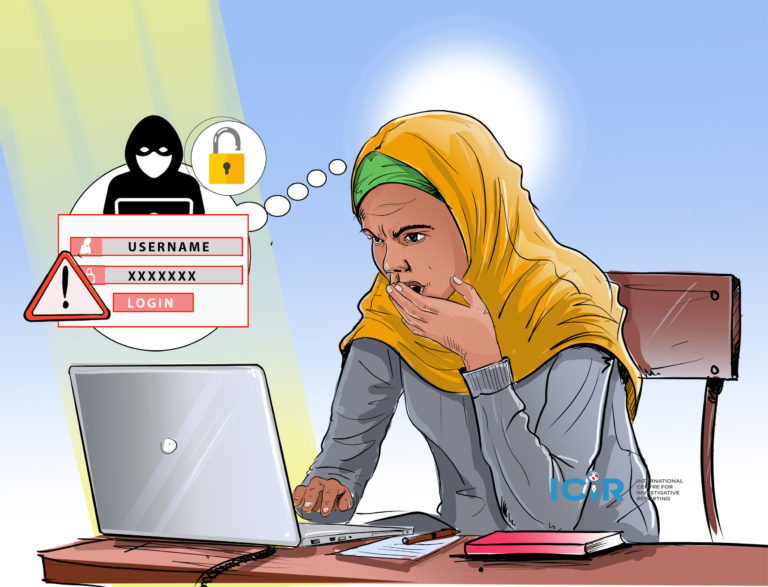
Phishing Tools and Kits: Phishing is a prevalent scamming technique where scammers impersonate legitimate organizations to deceive individuals into revealing sensitive information. Scammers use phishing toolkits and software to create convincing fake websites, emails, or messages that mimic reputable companies or services. These tools enable scammers to collect login credentials, financial details, or personal information from unsuspecting victims.
Botnets: Botnets are networks of compromised computers infected with malware and controlled by scammers. They can be used to carry out a range of malicious activities, including distributed denial-of-service (DDoS) attacks, spamming, or spreading malware. Botnets allow scammers to automate their operations, generate massive volumes of scam messages, or control multiple accounts to execute coordinated scams.
Voice Over Internet Protocol (VoIP): VoIP technology enables scammers to make phone calls over the internet instead of traditional telephone networks. They can use VoIP services to manipulate caller ID information, making it appear as if the call is coming from a different number or a legitimate organization. Scammers can utilize VoIP to conduct vishing (voice phishing) attacks, pretending to be representatives of banks, government agencies, or tech support to trick victims into revealing sensitive information.
Malware and Ransomware: Scammers deploy various forms of malware, such as viruses, worms, or Trojans, to infect victims’ devices. Malware can be distributed through malicious email attachments, infected websites, or software downloads. Once the malware infects a device, scammers can gain unauthorized access, steal personal information, or deploy ransomware that encrypts victims’ data and demands a ransom for its release.
Social Engineering Techniques: While not specific to technology, social engineering plays a significant role in online scams. Scammers use psychological manipulation and deception to exploit human vulnerabilities and persuade individuals to disclose sensitive information, make fraudulent transactions, or download malicious software. Social engineering techniques can include impersonation, creating a sense of urgency, building trust, or leveraging emotional appeals.
5 most common crypto scams
The unprecedented rise in investment scams in 2022 was largely due to crypto-investment scams, which stole a record $2.57 billion last year. Here are three current
Fake ICOs (Initial Coin Offerings): Scammers create fraudulent ICOs to capitalise on the hype around new cryptocurrencies. To avoid fake ICOs, conduct thorough research on the project team, the technology, and the use case. Look for legitimate projects with transparent whitepapers and active communities.
Fake Exchanges and Wallets: Scammers set up fake exchanges or wallet services to steal users’ funds. To avoid fake platforms, only use reputable and well-known exchanges and wallets. Verify the website’s URL and look for security measures like 2FA and cold storage for funds.
Pump and Dump Schemes: Scammers artificially inflate the price of a low-cap cryptocurrency by spreading false information, then sell their holdings at the peak, causing a price crash. To avoid pump and dump schemes, be cautious of sudden price spikes based on unsubstantiated claims, and research before investing in lesser-known tokens.
Investment Clubs or Telegram Groups: Scammers create fake investment clubs or Telegram groups, enticing users to join and invest. To avoid such scams, be wary of joining groups that promise exclusive investment opportunities or demand upfront payments. Do your own research and make informed investment decisions.
Malware and Fake Apps: Scammers distribute malware or create fake cryptocurrency-related apps to steal private keys and sensitive information. To avoid these scams, only download apps from official app stores, use reputable antivirus software, and avoid clicking on suspicious links.
5 most common AI deep fake video scams
The use of AI deepfake videos and voice cloning in online scams is a growing concern. Scammers are leveraging these technologies to manipulate and deceive individuals for fraudulent purposes.
Impersonation Scams: Scammers can use AI deepfake technology to create videos or audio recordings that mimic the voices and appearances of trusted individuals, such as family members, friends, or authority figures. They may impersonate someone close to the victim and request financial assistance or sensitive information, leading to financial loss or identity theft.
CEO Fraud and Business Scams: AI deepfake videos or voice cloning can be used to impersonate high-ranking executives within organizations. Scammers can manipulate videos or audio recordings to mimic the CEO’s voice and appearance, then use these to deceive employees into making unauthorized financial transactions or sharing confidential company information.
Romance Scams: In romance scams, scammers create fake personas and develop relationships with unsuspecting individuals online. AI deepfake videos or voice cloning can be employed to simulate video calls or voice conversations, making the scam appear more authentic and convincing. The scammers can further manipulate the multimedia content to deceive victims emotionally and financially.
Face Swapping: Deepfake technology can be used to swap the faces of individuals in videos, making it appear as if someone else is speaking or acting. For example, there have been deepfake videos that replace the faces of celebrities with other famous individuals, creating the illusion that they are performing in a movie or TV show.
Revenge Porn: Deepfake videos have been a cause for concern in the context of revenge porn, where someone’s face is superimposed onto explicit content without their consent. This has serious implications for privacy, consent, and the potential harm it can cause to individuals involved.
How to avoid AI deep fake and AI voice cloning scams
Be cautious of unsolicited requests: If you receive a phone call or message from someone requesting personal information or financial transactions, be skeptical, especially if it seems out of the ordinary. Verify the identity of the person through other means before sharing sensitive information.
Secure your personal information: Be mindful of the information you share online, especially on social media platforms. Limit the amount of personal information publicly available, as scammers can use it to create more convincing scams.
Enable two-factor authentication (2FA): Enable 2FA for your online accounts whenever possible. This adds an extra layer of security by requiring a secondary verification method, such as a unique code sent to your phone, in addition to your password.
Stay informed about AI scams: Stay updated on the latest AI scam techniques and trends. Awareness can help you identify potential scams and avoid falling victim to them. Follow reliable news sources and organizations that specialize in cybersecurity for the latest information.
Verify the source of information: If you come across a video or audio clip that seems suspicious or too good to be true, take the time to verify its authenticity. Cross-reference the information with trusted sources or contact the individual or organization directly to confirm its legitimacy.
Be critical of media content: Develop a critical eye when consuming media content, especially online. Look for signs of manipulation, such as unnatural facial movements, mismatched audio and video, or inconsistencies in the content. Use reputable fact-checking sources to verify the accuracy of information.
Report suspicious activity: If you encounter a suspected voice cloning or deep fake scam, report it to the relevant authorities, such as law enforcement agencies, online platforms, or cybersecurity organizations. By reporting scams, you can help prevent others from becoming victims.
This is part of Social Catfish annual study on the State of Internet Scams 2023. Read the complete report here.
PZ Cussons (Holdings) Limited has proposed a N21 per share offer to the minority shareholders of PZ Cussons Nigeria Plc to be implemented under a scheme of arrangement.
Informed analysts say it is a strategic move by the company to prepare for a “smooth exit” from the Nigerian market amidst ongoing reforms of the government.
PZ Cussons Nigeria currently has 3,970,477,045 units of shares listed on the Nigerian Exchange Limited (NGX), The ICIR can report.
In a notification on Monday, September 4, to the investing public and signed by its acting company secretary, Olubukola Olonade-Agaga, PZ Cussons Nigeria said the core shareholder, PZ Cussons Group, had informed its board of directors of its intention to acquire the shares held by all the other shareholders of PZ Cussons Nigeria. However, media reports say the minority shareholders have rejected the offer.
The Nigeria subsidiary further disclosed that the proposed transaction would be subject to prevailing market conditions.
According to PZ Cussons Nigeria, the transaction became necessary to enable the company to simplify and strengthen operations in Nigeria.
“It is intended that the Proposed Transaction will be implemented under a Scheme of Arrangement in line with section 715 of the Companies and Allied Matters Act, No.3 of 2020 (as amended) and other applicable rules and regulations.
“This will require the company to convene a court-ordered meeting of its shareholders by the directive of the Federal High Court,” it added.
The proposed N21 per share could have been arrived at based on earnings to book valuation of the company, an investment and portfolio analyst, Abel Ezekiel, told The ICIR.
He noted that the company, for a while, has experienced a downward movement of its market price but started moving upward from last year on the improved financial report or earnings since last seen in the previous years.
“So arriving at N21 could depend on current performance and valuation of their asset vis-à-vis liability, dividends, etc., and the company cannot do better than what it has offered their investors,” Ezekiel said.
Checks by The ICIR showed that the share price of PZ Cussons Nigeria closed at N19.15 on Tuesday, September 5.
A smooth exit from the Nigerian market
The ICIR recently reported why two consumer goods and manufacturing companies exited the Nigerian market.
On August 4, GlaxoSmithKline (GSK), a British multinational pharmaceutical Group, notified of its exit after 51 years of operation.
On April 6, Unilever Nigeria Plc also announced to close its operations in Nigeria after about 100 years.
A manufacturing and distribution company in the business of personal care, home care and electrical products, PZ Cussons Nigeria, which has been in Nigeria since 1899, is seemingly taking the exit door.
“One can only guess that it may be connected to recent changes in the FX policy, which has sent many import-dependent multinationals into panic,” another analyst, David Adonri, shared his view with The ICIR.
He believes the “delisting” may be a strategic move by the company to prepare for a smooth exit from Nigeria if the ongoing reforms go against their interest.
The ICIR had in a report on August 1 showed that many companies, especially manufacturing companies, are faced with dollar-denominated obligations arising from the exchange rate unification.
“Multinational companies are in host countries to make a profit and to use them as a market for their parent companies. Any threat to these objectives is intolerable to the parent companies and can result in harsh decisions,” Adonri said.
Reasons companies delist from the exchange
Several reasons abound why companies delist from the exchange, Ezekiel stressed.
It includes stringent post-listing requirements like the quarterly release of financial reports and the attendant high cost of hosting annual general meetings (AGM) and extraordinary general meetings (EGM).
“Other reasons include difficulty in repatriation of dividends by most of these multinationals, massive devaluation of the domestic currency which impacts negatively on these organisations, challenges in sourcing their input materials which are not readily available locally, difficulty is sourcing forex, high cost of OPEX which erodes margins.
“High cost of listing always slam on these companies by the regulatory bodies, undue fines, exposure of your financial report to competitors, high taxes they are numerous so most avoid all these problems and the best way is to go out of our exchange and remained at a level where no one gives them undue hassles,” he said
Adonri added that it was vital to note that most of these multinationals did not list voluntarily.
He said, “They were compelled during the indigenisation exercises of the 1970s to do so. Perhaps they feel that this is the right time, after several years of liberalised foreign investment policy, to reclaim full ownership of their enterprises.
“It might be unnecessary to bemoan these exits from the Capital Market because as old companies exit for one reason or another, new quality companies also come in to enjoy the benefits of listing. The secondary market is booming right now, but the only challenge is how to form capital through the market for enterprises in the strategic sectors of the economy and get them listed afterwards.”
DESPITE the clog in the wheel of the naira-yuan swap deal, China continues to dominate Nigeria’s import trade transactions, checks by The ICIR have shown.
The East Asia country is one of the trading partners with Nigeria on import transactions.
Other countries include the United States (U.S.), Belgium, India, Netherlands, United Kingdom, Brazil and Russia.
Majorly, Nigeria imports motor spirit (petrol), used vehicles, gas oil, durum wheat and jet fuel.
A cursory look at five-year reports of the National Bureau of Statistics (NBS) on ‘Foreign Trade in Goods Statistics’ showed that China dominated Nigeria’s import trade while the U.S. followed.
However, many stakeholders are concerned about promoting Nigeria-China currency for transactions.
The Central Bank of Nigeria (CBN) and the People’s Bank of China (PBoC) had in May 2018 signed a currency swap deal.
The deal was designed to provide the Chinese and Nigerian currencies directly to industrialists and other businesses from both countries.
It is expected to improve the speed, convenience, and volume of transactions between the two countries.
But recently, a Senior Advocate of Nigeria (SAN), Femi Falana, pointed an accusing finger at the apex bank.
He said the CBN was frustrating the deal and promoting the dollarisation of the Nigerian economy.
He wrote to the apex bank in June, invoking the Freedom of Information (FOI) and requesting CBN to disclose the details of the currency swap agreement.
He accused the apex bank of promoting “the unwarranted dollarisation of the Nigerian economy.”
Falana argued that despite the currency swap agreement, the federal and state governments and business community have been prevented from transacting business in naira and yuan.
He stressed that the International Monetary Fund (IMF) and the World Bank, which superintend the CBN, colluded with the apex bank to frustrate the currency swap.
“The purpose of the economic sabotage is to promote the dominance of the United States Dollar in Nigeria. Hence, the federal government, state governments, and the business community have been prevented from transacting business in Naira and Yuan. Thus, by compelling Nigerians to pay dollars for goods imported from China, the Central Bank has continued to promote the unwarranted dollarisation of the Nigerian economy,” TheCable quoted Falana to have said.
The human rights lawyer, therefore, asked Nigerians to use naira as payment for goods imported from China.
In response to Falana’s request, the apex bank said the swap deal, which commenced in July 2018, was renewable every three years.
It said the agreement was renewed after it expired in April 2021.
The apex bank claimed that 15 billion Chinese yuan renminbi (CNY) was usable within the year.
According to CBN, since the renewal of the deal, nine billion yuan have been drawn and six billion yuan utilised, while the sum of three billion yuan is outstanding.
Of the six billion yuan utilised, 5.10 billion yuan had been repaid, while 2.10 billion yuan had not been used.
Be that as it may, experts are worried that the dollar has adversely impacted Nigeria’s economy for the past decades.
The effect is depreciation in the naira value, spike in inflation, reduction in investment, increase in debt burden, and decline in foreign reserves.
The IMF reportedly said that a 10 per cent appreciation in the dollar decreased economic output in emerging market economies, including Nigeria, by 1.9 per cent.
Findings by The ICIR on naira-dollar value over the years showed that the naira had depreciated against the dollar by over 141 per cent since 2018, worsening in value to N785.532 per $1 as of September 6, 2023.
At the same time, one yuan averaged N54.68 in 2018 and is currently equivalent to N106.097.
Nigeria’s total trade rise in Q2 2023
In its latest report, the NBS disclosed that Nigeria’s total trade stood at N12.741 trillion as total exports stood at N7.015 trillion and total imports at N5.726 trillion in the second quarter (Q2) of 2023.
Total exports increased by 8.15 per cent compared to the N6.487 trillion recorded in the first quarter (Q1) but declined by 5.20 per cent compared to the N7.400 trillion in the corresponding quarter in 2022.
Likewise, in the period under review, total imports increased by 2.99 per cent compared to N5.559 trillion in Q1 but declined by 10.37 per cent compared to the N6,388 trillion recorded in the corresponding quarter of 2022.
The report showed that while the Netherlands topped the list of Nigeria’s export destinations in Q2, China topped the list of partner countries’ origin of imports to Nigeria.
The Ibadan Circular Road project has been mired in controversy, with allegations of irregularities in the procurement process and the contractors’ qualifications. This investigation reveals the hidden truths behind the project, including secret connections between the parties involved and intricate layers of deception masquerading as truth. Enoch Oyedibu reports.
AS the sun dipped below the horizon, it cast a warm, golden glow across the sprawling expanse of the 32-kilometre East Wing of Ibadan Circular Road, nestled in the heart of Oyo State, Southwest Nigeria. The once bustling construction site, typically abuzz with activity, now lay enshrouded in an unsettling calmness as the hues of twilight enveloped it.
Renamed after former Governor Rashidi Adewolu Ladoja, who commenced the project, it is a key project that aims to not only ease traffic congestion but also boost urban development in the city of about 3.75 million people by 2022 estimates.
The actual construction took off during the tenure of late Governor Abiola Ajimobi with ENL Consortium Limited awarded a N67bn contract for the construction of a 32km section of the road, with high hopes for completion by 2019.
Since then, the trajectory of this crucial project has been fraught with controversies, delays, and conflicting contract pricing.
Governor Seyi Makinde.
A road of dreams and challenges
Although the contract awarded to ENL Consortium Ltd was almost cancelled at first due to the slow pace of work, Governor Seyi Makinde, who came into office in 2019, later extended the deadline to 2020 under the condition that the 32km stretch of the road must be completed.
Meanwhile, ENL continued to face consistent criticisms from the state government due to slow progress and disagreements about contract pricing. Makinde claimed that the consortium had initially quoted N14bn for the contract, but Ajimobi’s government eventually approved it for N67bn. Makinde also said that sum of N11bn was earmarked for bush clearing.
In his response, ENL Consortium Chairperson and former Deputy Governor in Osun state, Adesuyi Haastrup, refuted the accusations, emphasizing that N11bn was meant to cover “a combination of 10 items for bush clearing and all earthworks of the entire 32km”.
On June 4, 2021, the Oyo State government revealed that ENL Consortium had only completed a mere 5.5 per cent of the entire project, a disappointing outcome given the extended timeframe. The consortium attributed this sluggish progress to the governor’s failure to fulfil his promise of providing a “Letter of Assurance of Continuity” to support their work.
“He promised he would write us a Letter of Assurance of Continuity for the work. He later did not honour his words,” Haastruplamented, expressing his dismay at the broken commitment.
While ENL Consortium anxiously awaited the promised letter, the state government had already taken steps to consult with a new consortium, signalling the commencement of a new chapter in this evolving narrative.
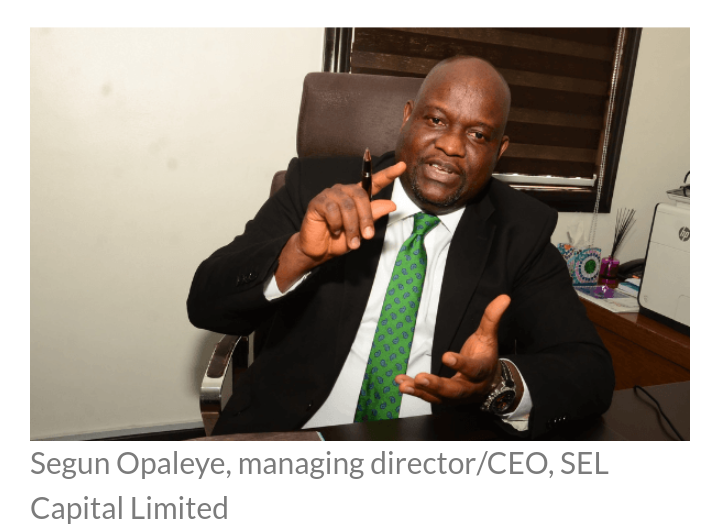
FL: Olusegun Opaleye of SEL, Michael Msughter Dugeri and Anthony Adedapo Makinde of Vydra Investments; the current Chief of Staff to the Oyo State Governor, Hon. Segun Ogunwuyi who was also the former Director General of OYSIPA—an agency of the State that procured Ibadan Circular road project when he was DG.
The controversial journey of the briefcase consortium
In a whirlwind of events, on July 5, 2021, the newly formed Bureau of Investment Promotion and Public Private Partnership (now Oyo State Investment and Public Private Partnership Agency—OYSIPA) re-awarded the entire stretch of the 110km Ibadan Circular Road to another company, SEL-VYDRA consortium for a staggering N138.2bn.
This was about 14 months before the project was eventually flagged off in September 2022, with assurance from the state government that 75km of the road project would be completed before the end of his tenure (first term) in June 2023. The government asserted that it had saved the state approximately N77bn compared to the previous contract granted to ENL, factoring in inflationary trends. However, questions began to emerge about the consortium’s credentials and the transparency of the award process.
The road project was established as a Public Private Partnership (PPP) under a Build Operate and Transfer model, between the state government and contractorSEL-Vydra, contributing a ratio of 20 to 80 percent respectively.
The first 32km phase of the 110km road project embodies a four-lane, dual-carriage motorway that links the Lagos-Ibadan expressway to the Ibadan-Ife highway, incorporating diverse features such as bridges, interchanges, streetlights, security posts, and other essential road infrastructures.
Amidst these aspirations, concerns emerge surrounding the precise financial commitment of the state government. SEL-Vydra’s involvement is anticipated to contribute N110.5bn, establishing an 80 percent ownership stake in the venture. Counterpart funding from the state government, however, is met with a degree of discrepancy.
Twenty per cent of the contract amount, N138.2 billion, logically equates to N27.64 billion, yet budgetary details and statements from Oyo’s commissioner for Works, Dahud Sangodoyin, reveal varying figures. The approved 2021 supplementary budget earmarks N25bn for counterpart funding. However, Prof. Sangodoyin later cited N35.97bn for the same item.
Professor Sangodoyin
Sangodoyin, said while addressing pressmen on March 4, 2023, that the counterpart funding the state is contributing is N35.97bn, and is channelled towards the execution of interchanges and bridges construction on the 32km Southeast segment of the 110km road.
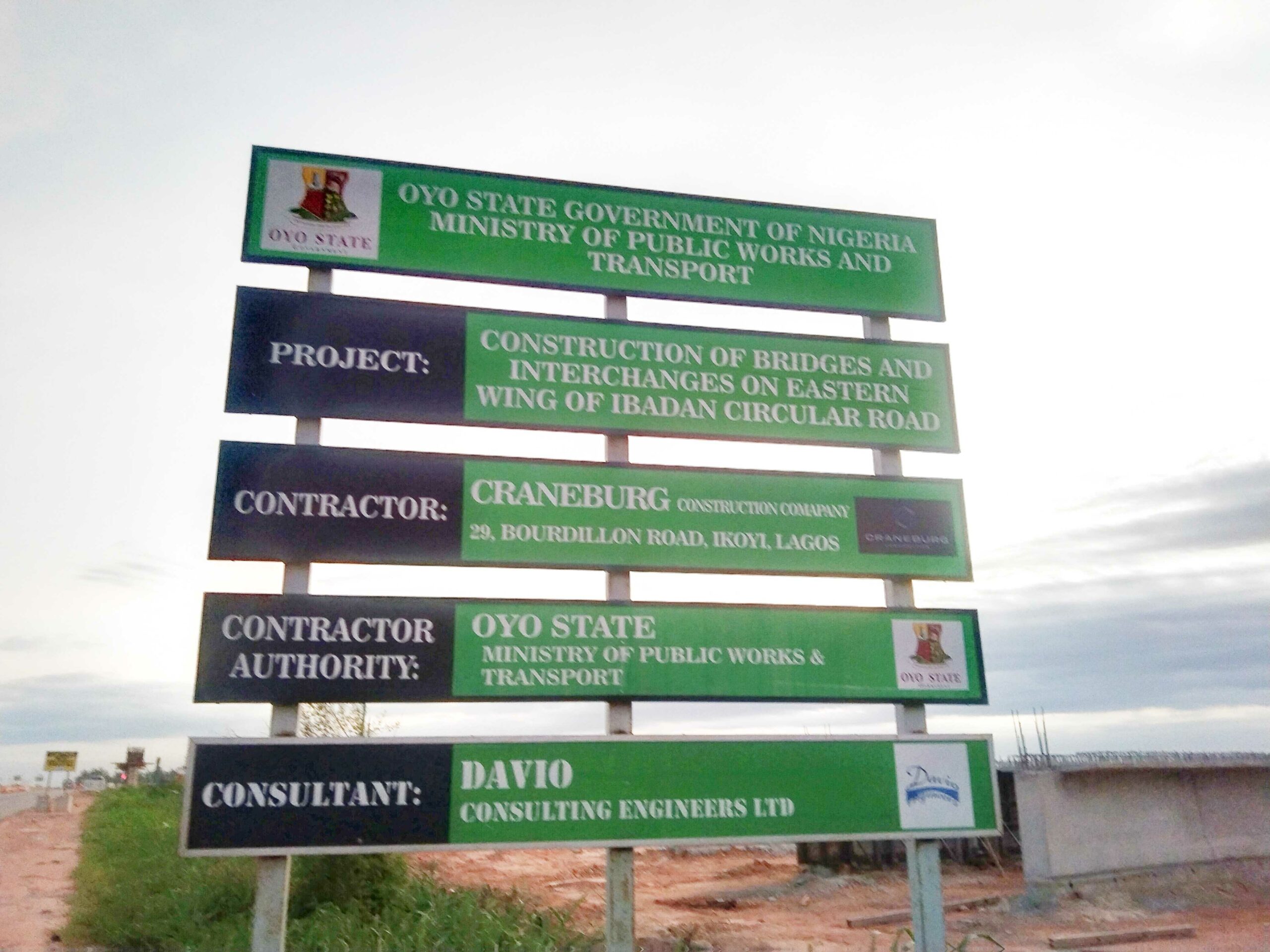
However, this was a separate contract awarded to Craneburg Construction Company on March 17, 2022, according to the Oyo State Procurement portal. The commissioner added that the bridges and interchanges would be finalised by June 2023.
A search shows that Craneburg was officially registered with the Corporate Affairs Commission, CAC, on April 15, 2013. Online business registry, NG-Check.com showed Gilbert Sassine and Larissa Okpala as directors.
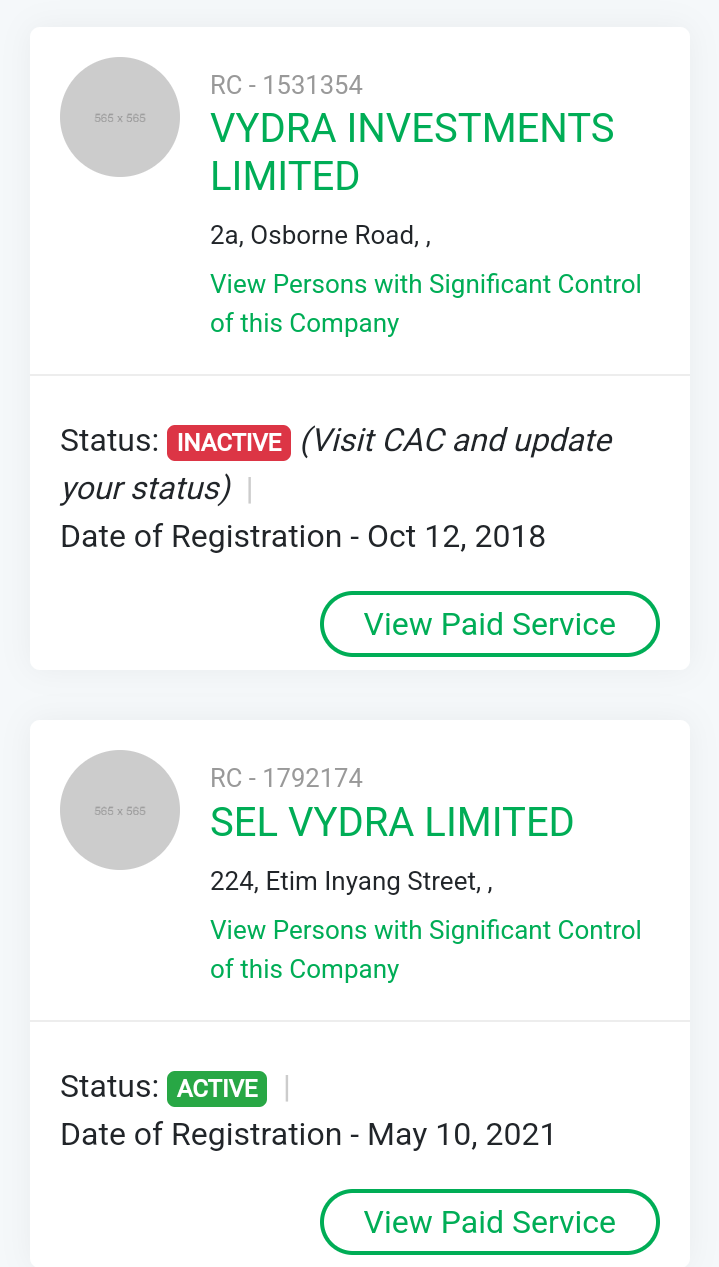
In the same fashion, investigations reveal that SEL-VYDRA was registered merely two months before it was granted the contract—specifically on May 10, 2021.
Alarmingly, neither of the two constituent companies within the consortium, namely Still Earth Capital Finance Limited and Vydra, possessed any prior road construction experience in managing a project of this magnitude and complexity.
Search entry of SEL-Vydra on Corporate Affairs Commission (CAC) portal.
This contravenes Part IV, Section 8 of the Oyo State Procurement Law (2010), which outlines several grounds for disqualifying a contractor’s bid or tender from a procurement process. Notably, subsection (b) of the aforementioned section stipulates that “a supplier, contractor, or consultant who, in the three years preceding the initiation of the relevant procurement proceedings, demonstrated inadequate performance or lack of due diligence in fulfilling any previous public procurement obligation” shall be ineligible to participate in the said procurement proceedings.
These rules were established as clear guidelines to dismiss any bids that did not comply. Despite the infractions, SEL-VYDRA was awarded a substantial N138bn project under the Build Operate and Transfer (BOT) model.
In the face of public scrutiny and questioning, the Oyo State government attempted to address concerns by providing explanations, asserting that it had not committed any wrongdoing. The government claimed that the usage of a Special Purpose Vehicle (SPV) to execute such projects was permitted under relevant laws of the state.
Notably, the Oyo State Public-Private Partnership (2013) Law serves as a practical guide for public-private partnership projects, within which a clause outlining the utilization of SPVs is included. Similarly, the Oyo State Investment, Public-Private Partnership (OYISPA) Law includes a provision concerning SPVs, which were later designated as private sector partners or concessionaires.
However, it is important to emphasize that no segment of the Oyo State Procurement Law (2010) contains explicit provision regarding the use of SPVs. While it is comprehensible that the Oyo State Public-Private Partnership Law (2013) permits the use of Special Purpose Vehicles (SPVs) for project execution, it is worth noting that the OYSIPA Law (2019), does not compromise on the principles of competence and transparency in the composition of these SPVs.
Section 30, subsection 9 of the law stipulates that “the agency (OYSIPA) shall ensure that the concessionaires or private sector partners for public private partnership projects shall be selected through a transparent, efficient and competitive procedure, adapted to the peculiarities of the different projects selected for the public private partnership arrangement.”
The Oyo State Procurement Law (2010) outlines a comprehensive set of prerequisites for contractors vying for bids or contract awards. These encompass a range of documents such as CAC Registration, Payment Receipts, Company’s Income Tax Clearance, Personal Income Tax Clearance, VAT Registration Certificate, Company Profile with Resumes, Government-issued IDs of Key Personnel, Memorandum & Articles of Association, Evidence of Past Projects, Bank Reference Letters, and a Company’s 3-Year Financial Summary.
These prerequisites are fundamental for contractors participating in the bidding process and being eligible for contract awards. However, in the case of SEL-Vydra, their registration occurred just two months before the contract was awarded in 2021, leaving insufficient time to amass the required documents, particularly the 3-year financial summary.
In contrast to well-established construction firms with substantial experience, SEL-Vydra’s limitations become evident, prompting significant questions about the decision to award the contract to a relatively new player in the construction sector.
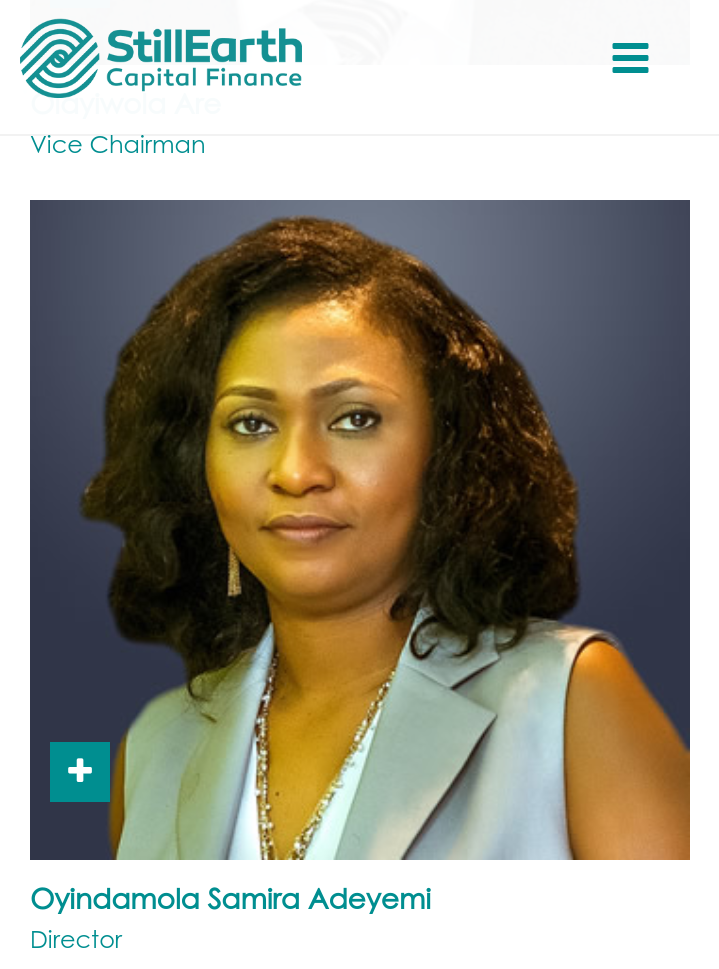
Oyindamola Samina Adeyemi
WHAT IS SEL?
Still Earth Capital Finance Limited, also known as SEL Capital is a “financial services” rendering company, with Mr. Olusegun Opaleye as its director. However, a representative from the company said that Opaleye left the company in 2022.
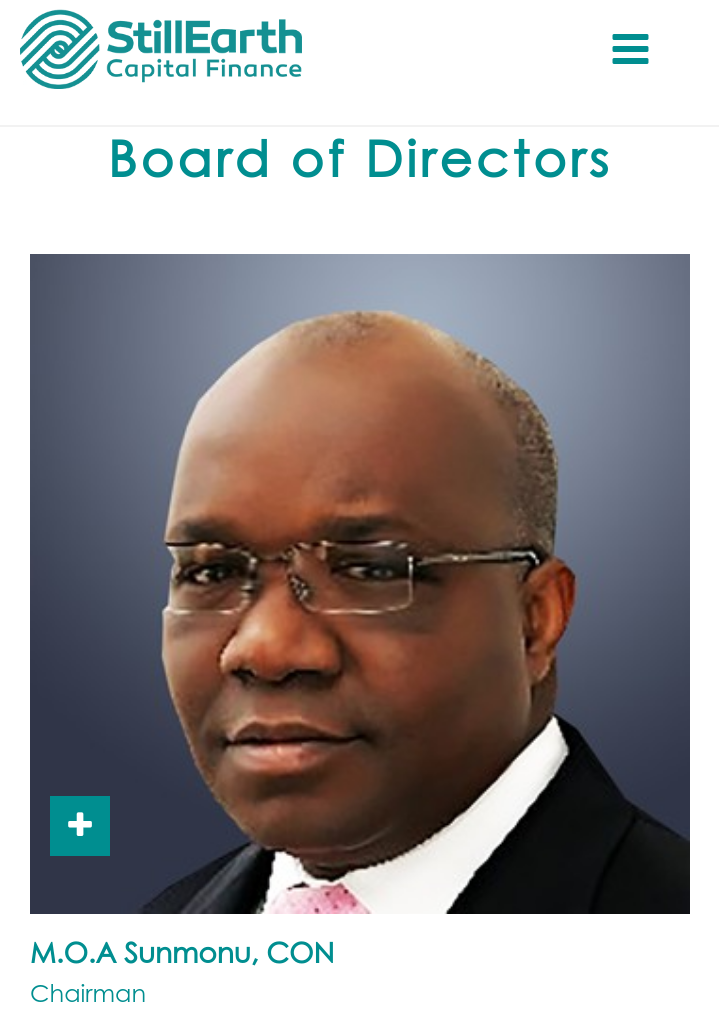
Findings showed that SEL is chaired by Mutiu Sunmonu CON, while the director is Oyindamola Samira Adeyemi. Both individuals seem to have ‘political’ connections to the current governor of the state, Seyi Makinde.
Sunmonu and Seyi Makinde are both former employees of Shell Petroleum Development Company of Nigeria (SPDC) while Adeyemi has affiliations with the People’s Democratic Party (PDP), the ruling party in the State. Segun Odegbami, a footballer turned politician and former captain of the national soccer team, Super Eagles, is also one of the shareholders of the company.
A few more eyebrow-raising revelations come to light. Sunmonu, who holds a significant role in the SEL-VYDRA consortium is also the chairman of Julius Berger. This raises questions, as Julius Berger, being a renowned construction company, has the capability to bid for the contract independently, without the need for the establishment of a new consortium. This suggests the possibility of personal interests at play.
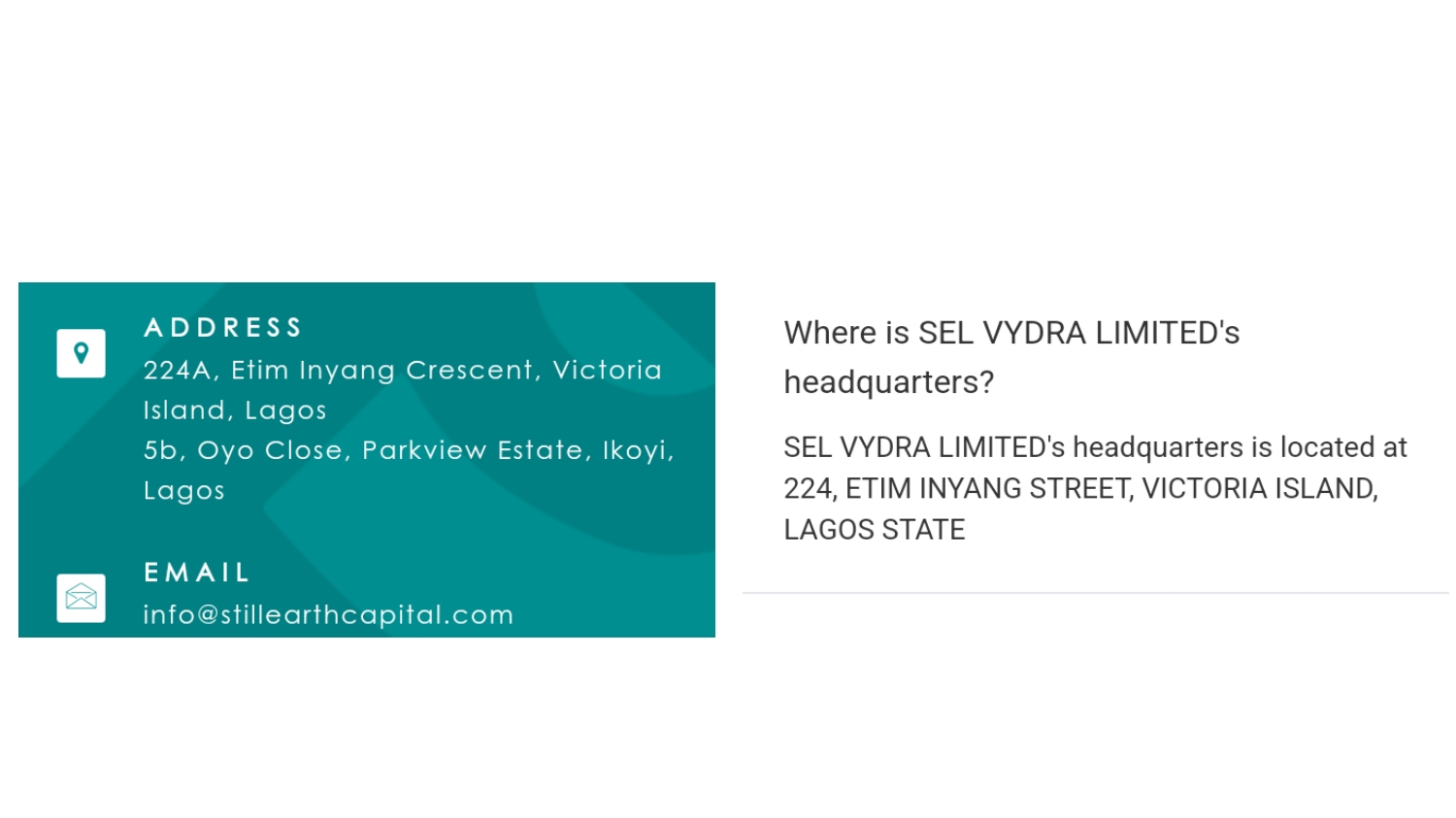
FL: Working Address of Still Earth Capital Finance Limited (SEL) and the working address of SEL-Vydra limited on Ngcheck, bearing resemblance. Subsequent companies registered in the name of Still Earth share either of the two addresses on the SEL Capital website.
A lady named Esther, who declined to provide her last name but identified herself as the legal advisor of the company, SEL Capital, stated that the company is a subsidiary of Still Earth Holdings.
Among the array of companies associated with Still Earth, Still Earth Construction and Realty stands as the solitary subsidiary exclusively focused on construction.
The rationale behind the decision to bid for the contract using SEL Capital instead of Still Earth Construction and Realty remains unclear.
WHAT IS VYDRA?
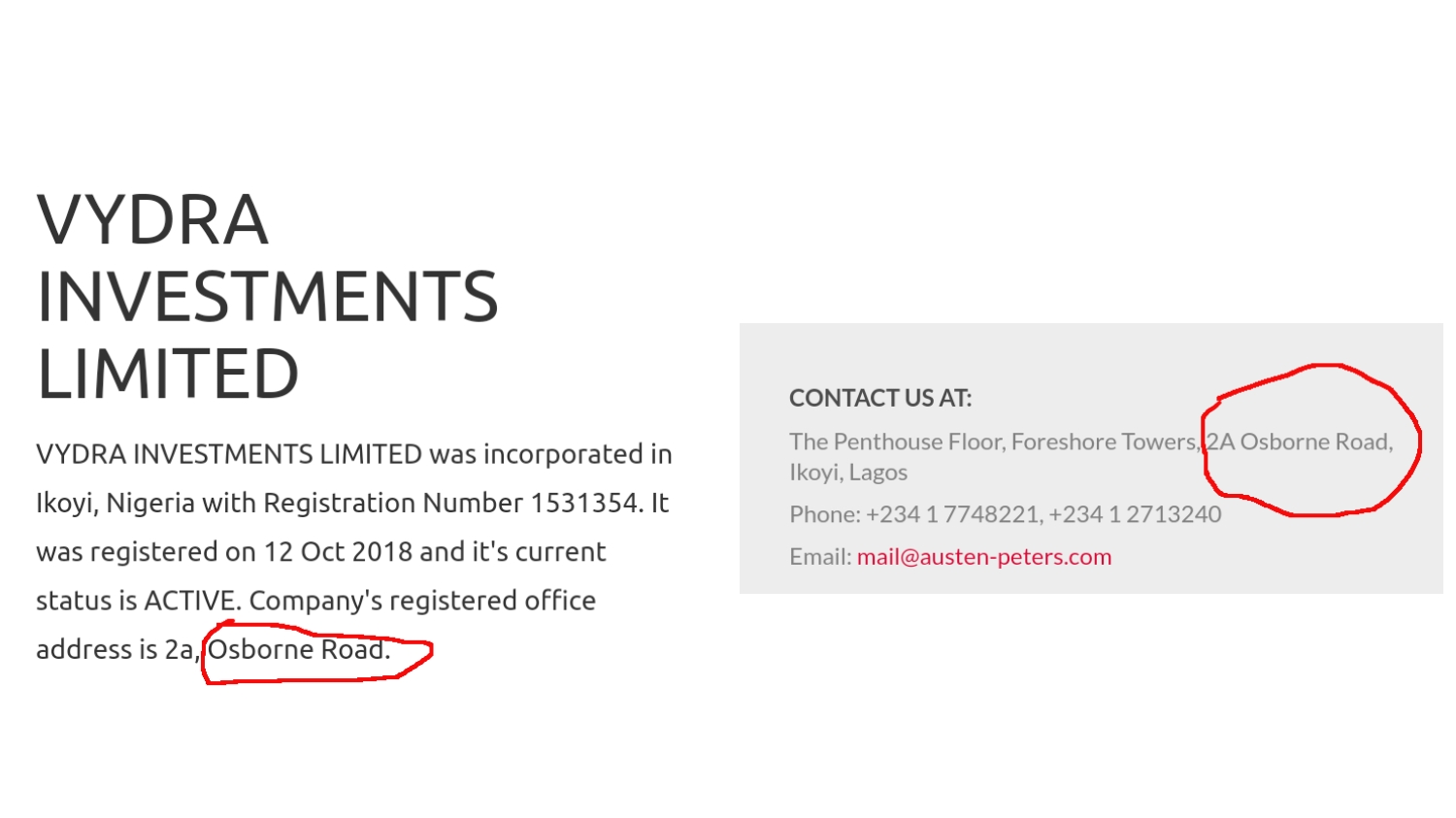
“They don’t exist,” said Jerome Kalu, a Lagos-based fixer who paid a visit to Vydra’s address at the 2A, Osborne, Ikoyi Lagos. “At Foreshore Towers, 2A Osborne Road, Ikoyi, Lagos, there’s nowhere or nothing like Vydra Investment, but just Austen-Peters and other…”
According to the online corporate registry ng-check.ng, VYDRA Investment was registered on October 12, 2018, with Michael Msughter Dugeri and Anthony Adedapo Makinde as its directors. Intriguingly, both individuals hold positions as Senior Associates at Austen-Peters & Co law firm, sharing the same address as Vydra.
FL: Vydra Investments address on Ngcheck and Austen-Peters & Co working address striking a convincing resemblance.
The connections surrounding Vydra, and its related entities raise concerns about potential beneficial ownership and the intricacies of their relationships.
One notable link is Anthony Adedapo MAKINDE, a director associated with the company. What draws attention is that the company (VYDRA) shares the same address as Austen-Peters & Co, whose principal partner is Timi Austen-Peters, a lawyer and chairman of Dorman Long Engineering Limited.
Adding a riveting twist, Dorman Long Engineering Limited boasts an extensive roster of 29 directors and shareholders, among whom is Mr. Godwin Obaseki, the Governor of Edo State and a prominent member of the People’s Democratic Party, the same political party as Governor Seyi Makinde.
Furthermore, Governor Makinde, an alumnus of UNILAG, graduated in 1991 alongside a fellow student bearing the name MAKINDE A. A. While confirmation of whether the “A. A.” signifies “Anthony Adedapo” remains elusive, it does raise the suspicion that one of the directors of Vydra may have a direct or indirect connection to the governor.
However, the Oyo State Procurement Law (2010) explicitly frowns upon any form of direct or indirect government personnel involvement in the procurement process.
Section 24 of the law states that, “Persons who have been engaged in preparing for a procurement or part of the proceedings thereof may neither bid for the procurement in question or any part thereof either as main contractor or sub-contractor nor may they cooperate in any manner with bidders in the course of preparing their tenders.”
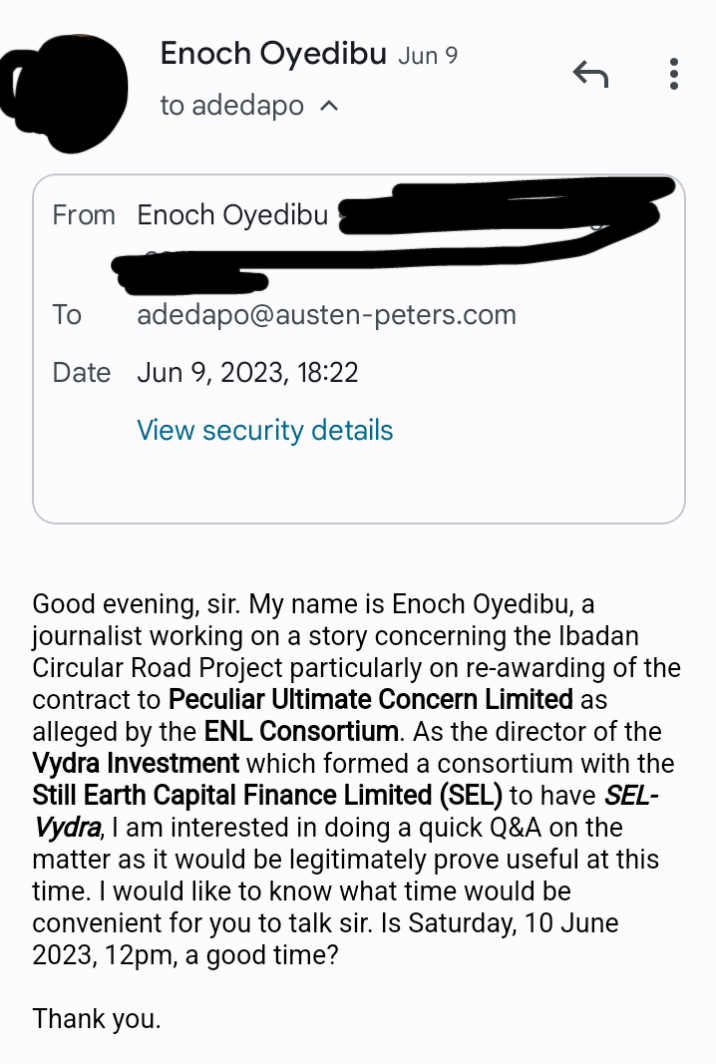
Attempts to schedule an in-person meeting with Anthony Adedapo Makinde at Austen-Peters’ office were unsuccessful. An email sent to Adedapo Makinde via Adedapo@austen-peters.com got no response leaving a trove of unanswered questions about the connections and vested interested surrounding SEL-Vydra. We might have to send someone from our Lagos office to speak with him.
The email sent to Anthony Adedapo Makinde since June 9 with no response, hitherto.
A Tale of confusion and intrigues
In response to the contract cancellation, the ENL Consortium filed a lawsuit against the state government and other contractors involved in the project. Their claim is straightforward: that the contract was re-awarded to SEL-Vydra in bad faith.
ENL Consortium further contends that the state government subsequently reassigned a segment of the contract – originally designated for SEL-Vydra – to other entities. Notable among these recipients are Craneburg Construction Company and Peculiar Ultimate Concern Limited.
Efforts to get comments from ENL Consortium through its lead counsel, Olaniwun Ajayi, LP, regarding the Ibadan Circular Road case proved abortive. Speaking with Mr. Joshua Ayanda, a lawyer at the firm also proved challenging, as he was uncooperative and evasive about his involvement in the case.
Contradicting the information provided by the client care agent of the law firm who initially facilitated the phone call to Ayanda, he denied any connection to the case, stating, “I cannot speak on the case. I am not the counsel on the case.”
When repeated calls were made by this reporter, his line was blocked. Subsequently, another client care agent, speaking over the phone, assured the reporter of facilitating a conversation with Opasanya Oluseye, SAN, the main counsel, but failed to do so as of the time of filing this report.
Amongst other issues, ENL Consortium accused SEL-Vydra Consortium of improperly re-awarding the Ibadan Circular Road contract to Peculiar Ultimate Concern Limited, a company headed by Mr. Abel Olanrewaju Adeleke.
Efforts to contact Peculiar Ultimate Concern Limited on three occasions yielded no success. Calls directed to the established company contact were abruptly terminated as soon as Mr. Michael, the individual who answered the call, knew who was on the line.
As of the time of visit to the project site, on May 28 and 29 of this year, 2023, construction on the road has not reached the promised 75km target set for June 2023. Notably, on-site observations indicated a conspicuous absence of SEL-Vydra, while the active involvement of Craneburg Construction Company in the project was evident.
Efforts to obtain information from the Oyo State Ministry of Works and OYSIPA regarding bid details, approved contract sums, durations, completion dates for contracts awarded to SEL-Vydra and Craneburg Construction Company, as well as releases made to contractors, proved abortive. Despite submitting Freedom of Information Act (FOIA) applications, both initial and reminder letters, on June 27 and July 12 respectively, got no response or acknowledgment.
Ilevbaoje Uadamen is a procurement fraud expert, and founder of Monitng, a civic technology platform that provides citizens with information to track the progress of public projects, access public data, and engage in civic advocacy. He said the idea behind awarding Ibadan Circular Road project to SEL-Vydra is questionable and a replica of what was done on the Lekki Toll Gate in Lagos.
“The way this thing works is that some governors want to remain financially relevant even after leaving office so they come up with these Public Private Partnership projects, forming consortium to build roads on Build, Operate and Transfer (BOT) model that will be tolled.”
A BOT contract model finances significant projects, especially infrastructure, in public-private partnerships. It involves a concession from a public entity to a private firm to construct and manage the project. After a fixed period, control returns to the public entity.
“The private entity will build the project by itself, own it for a period of 30 to 35 years, then transfer it to the public entity, which is the government. But most of these construction companies involved as consortium or private entities are directly or indirectly related to the government officials.
“So, at the end you’ll find out that a road built with public funds is used to enrich some private bodies. They want to leave the government and remain relevant. In the next 30 years when the road is tolled, they will be in their comfort zone and be cashing out. If such roads are being awarded to Julius Berger and the likes, do you think something like this will occur?” he said.
“The counterpart funding is just a way to launder the public funds. They make use of funds suitable enough to build the road as counterpart funding and lie that other entities own the biggest shares.”
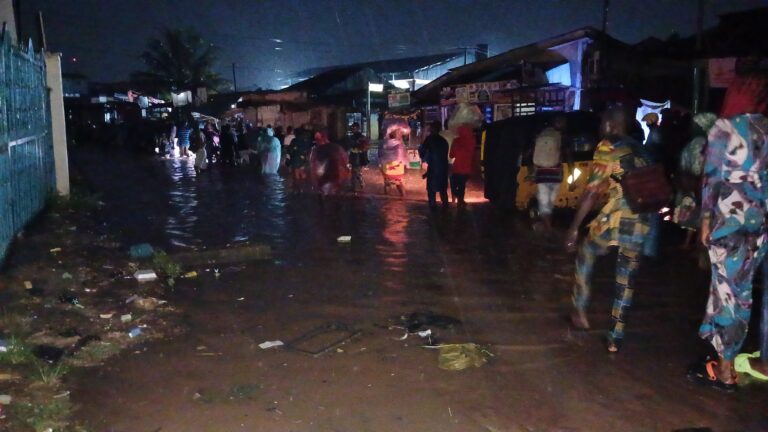
COMMUTERS and passers-by were stranded on Friday night after a heavy downpour led to flooding at the Akinola/Aboru drainage channel in Samson Street in Oke-Odo Local Council Development Area (LCDA) in Lagos state.
The flood made the street – which links the drainage channel – impassable for both human and vehicular movement, thereby leaving those returning from their respective places to their homes stranded for hours.
The ICIR observed that some people dared the flood while some had to re-route through Mosan Road in Abesan to get to their homes.
Recall that the Lagos state government announced the construction of the 9km Akinola/Aboru Drainage Channel in 2020.
According to the then state’s commissioner for the Environment and Water Resources, Tunji Bello, the construction would contribute to sustainable development and a quality living environment for all, and curb flooding had almost become intractable.
From the signpost erected beside the construction of the drainage, the state government awarded the contract to Trucete Solutions Limited, located at D55 Millenium Estate, Oniru, Victoria Island, Lagos state.
Also, it reads that the duration of the project was for 24 months.
Commuters who spoke to The ICIR called on the state government to come to their rescue.
Mohammedu Emmanuel, who resides on Raji Rasak Street in Aboru, said, “I have been leaving for about two years plus. My experience with flooding along this street is inconveniencing the residents of the community because when there is a heavy downpour in Lagos state, we experience a lot of floods, which affect the houses close to the canal here.
“Work has been going on, but I think it is very close. I believe if the government can actually work on it, it will be a good thing for the community”.
Motorists hike transport fare
Stephen John, a tricycle driver who resides on Victor Fagbemi Street in Aboru, said whenever there is a heavy downpour, the prices for transport fare increase.
“We increase the transport fare from N300-N500 for those who are going from Aboru to Agbeleke. I want the state government to help complete this drainage,” he said.
THE Ondo State Governor Rotimi Akeredolu is on his way to Nigeria from Germany after over 90 days spent on medical leave.
The governor’s wife Betty Anyanwu-Akeredolu disclosed this via her social media handle, X, on Thursday, September 7, when she posted a picture of him in an aircraft with the caption “Homebound.”
Akeredolu became noticeably ill some months after his mother’s death in September 2022.
There were speculations that the governor was battling a life-threatening ailment, and in January 2023, Akeredolu admitted to being ill.
He stated that he was in recuperation and the illness was not hindering him from carrying out his duties as governor.
“Since the Governor is not a superhuman and the immunity his office enjoys does not extend to physical wellness or otherwise, the health issue is therefore not an unusual one. However, contrary to speculations and insinuations making the round, the Governor, though frail, is discharging his official functions,” a statement by his Chief Press Secretary, Richard Olabode, read.
Despite assurances that he was getting better, Akeredolu applied for a three-week medical leave in June, and Deputy Governor Lucky Aiyedatiwa took over governance in his stead.
He, however, failed to return upon exhaustion of the 21 days, and a letter he addressed to people of the state disclosed that only his doctors could determine when he would be discharged.
Stakeholders in the state, including the Social Democratic Party (SDP) and the Peoples Democratic Party (PDP), expressed concerns over the governor’s health and called for his resignation.
A statement by the Publicity Secretary of the PDP in the state, Mr Kennedy Peretei, said the state should not be grounded because of the governor’s health conditions.
Akeredolu returns to the state to confront the huge task of governance and aspirations for the 2024 governorship poll in the state from his party members and those in the opposition parties.
The ICIR reports that the governor was sworn in for a second term of four years on February 24, 2021.
He is the 18th person to lead Ondo State since its creation in 1976 and the sixth elected governor of the state.
He has been the most vocal governor in Nigeria’s southern region against atrocities committed by non-state actors, including herders, kidnappers, insurgents and bandits, who killed many people during former president Muhammadu Buhari’s tenure.