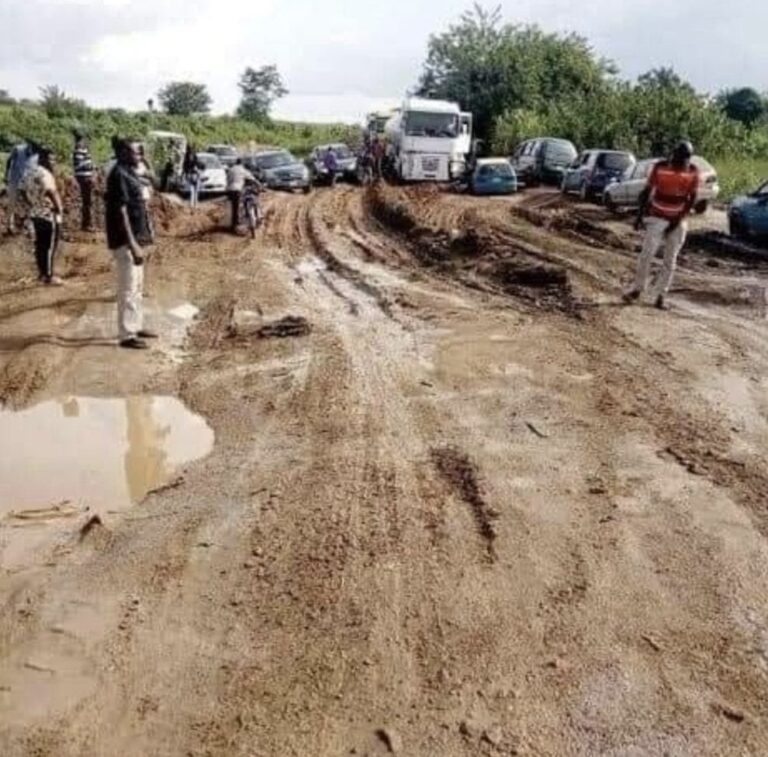
PRESIDENT Bola Tinubu-led Nigerian Government has said it would redesign the ongoing construction of the Akure – Ikere – Ado-Ekiti Expressway with concrete rather than asphalt.
The Minister of Works, David Umahi, disclosed this during a visit to the acting Governor of Ondo state on Friday, September 1.
Umahi, who was in the South-West to inspect federal roads on which works were ongoing, said Nigerians should expect more concrete pavements on the nation’s roads due to their extended durability compared to bitumen-based roads.
According to him, roads constructed with bitumen do not last beyond 15 years, while those built with concrete technology have a minimum of 50 years lifespan.
“Any road construction contract, awarded by the Federal Government, with less than 20 per cent progress would be redesigned to concrete pavement roads,” Umahi declared.
On March 30, 2023, towards the end of former President Muhammadu Buhari, The ICIRreported that the FG approved N95.8 billion for the dualization of the Akure/Ita Ogbolu-Iju/Ado Ekiti road, linking Ekiti and Ondo states.
The former Minister of State for Works, Umar El-Yakub, revealed that the first section of the road project on the Ondo side was awarded to two construction companies at the cost of N46.6 billion, adding that the remaining N49.2 billion would be used for the second section of the project from the Ekiti State border.
The ICIR gathered that the road had been a subject of discussions between the Federal Government and the two state governments in the past years, as it has wide economic importance.
Umahi argued that the exclusive dependence on bitumen imports had been straining the national currency, and the adoption of concrete pavement roads would contribute significantly to utilizing local resources.
He said: ”You see jobs that are still ongoing, and that is why we are going round and then redesigning a portion of roads that are maybe 10 to 20 per cent completion, and we are sure that this is the way to go and it has a guarantee of 50 years.
“Not only that, you find out that we are having so much pressure on the naira; the importation of bitumen is a lot of pressure on the naira. So, cement is a local content, and almost everything we need is not produced in Nigeria.”
He also stated that all Federal Government road projects awarded three years ago were due for review, adding that some had been reviewed through VOP (Variation of Price).
The Minister also pointed out that road construction is a constantly changing sector, with material prices continuously rising and fluctuating.
He decried a growing reduction in the quality of bitumen compared to what was obtained in the past.
“Let me put it on record that bitumen imported in the 1950s and 1960s is of higher quality than what we have today, so we have a lot of problems on our hands, and that is why we are courageous to introduce the concrete road department,” he stated.
In his remarks, the acting Governor, Lucky Aiyedatiwa, emphasized that many federal roads in the state had either deteriorated or received inadequate maintenance, with many experiencing severe degradation.
Aiyedatiwa called for the dualisation of the Ore-Ondo-Akure road and highlighted the need to rehabilitate the Ore-Okitipupa road among other federal roads in the state.
“It is noteworthy to mention that the intervention of my boss (Governor Rotimi Akeredolu) is principally what has made these roads remain in their present motorable state,” he noted.
SEVEN persons, including five worshippers, have been reportedly killed by suspected bandits in Saya-Saya village of Ikara local government area of Kaduna State.
The five worshippers were gunned down in the village mosque, while the remaining two other victims were killed at different locations.
Locals explained that the incident occurred around 8 p.m. while villagers conducted their sunset prayers (Isha’i) at a nearby mosque on Friday, September 1.
A resident, Dan Asabe, said two other villagers who sustained gunshot wounds were rushed to the hospital for treatment.
Confirming the incident, the village Head, Abdulrahman Yusuf, said the head of the vigilante in the community was among the victims killed inside the mosque.
“We suspected they traced him (vigilante boss) to the mosque to attack him. We were inside the mosque praying when they arrived and started shooting. Five persons were killed at the mosque, while a driver who brought food items to the village was also killed. The other person was killed at a nearby village,” he said.
According to him, security forces, including soldiers and police from Ikara town and the Palgore area, reached the location at approximately 12:30 a.m. However, the bandits had already departed from the village by that time.
He also mentioned that one of the individuals injured by gunfire was transported to Aminu Kano Hospital for medical care.
Also, while confirming the incident, the acting Public Relations Officer of the State Police Command, Mansir Alhassan, said security personnel had been mobilised to nearby bushes to fish out the perpetrators.
He also stated that the police and other security agencies were not informed of the attack until after the attackers left the area.
Kaduna state has, over the years, witnessed a recurring wave of insecurity that has resulted in the loss of thousands of lives, including some security personnel, the displacement of many people, and extensive damage to hundreds of hectares of land.
In addition to the recurring bandit attacks, the state has grappled with other security issues, including religious tensions and ethnic conflicts.
In 2021, The ICIRreported how deaths from insecurity causes were higher in Kaduna State than all people who died from the insurgency in Borno, Adamawa and Yobe States.
In 2022, The ICIRreported how parents withdrew their children and wards from school in the state because of insecurity.
According to records released by the state government in April 2023, approximately 1,266 individuals fell victim to bandit attacks in Kaduna State over the past 15 months.
The report stressed that 746 persons were kidnapped in the state, and another 214 persons were killed in similar incidents between January and March.
“Between January and December 2022, 641 deaths were recorded in Kaduna Central Senatorial Zone, while 349 deaths were recorded in Southern Kaduna Senatorial Zone, and 62 deaths in the Northern Senatorial Zone, bringing the total to 1,052 deaths as a result of banditry and other attacks.
“214 persons were killed between January and March 2023 in attacks by bandits/terrorists, communal clashes, violent attacks, and reprisals,” Kaduna State Commissioner for Internal Security and Home Affairs Samuel Aruwa said.
The ICIR reports that insecurity affects many states in Nigeria. On August 14, The ICIR also reported that within the first 45 days of President Bola Ahmed Tinubu’s inauguration – May 29 to July 13 – more than 600 individuals had lost their lives due to violence perpetrated by non-state actors nationwide.
According to data, the killings happened primarily from activities of bandits, Boko Haram insurgents, ethnic militias, armed robbers and other non-state actors.
Data from SBM Intelligence, an analysis platform, revealed that about 629 Nigerians were killed in the last 45 days under President Tinubu.
Other data from the Council on Foreign Relations’ Nigeria Security Tracker (NST) and media reports checked by The ICIR showed that non-state actors killed 587 people within the same period.
THE Group Managing Director, Nigerian National Petroleum Company Limited, (NNPCL), Mele Kyari, has said the drop in Nigeria’s Premium Motor Spirit (PMS) consumption by 30 per cent was a result of removal of petrol subsidy by the current administration.
Kyari, who gave the information, at a joint press conference with the Minister of Finance and Coordinating Minister of the Economy, Wale Edun, in Abuja on Friday, September 1, said fuel subsidy removal had unmasked Nigeria’s real consumption figures.
He explained that the drop in fuel demand from 66.7 million litres daily before to about 46 million currently also meant a 30 per cent reduction in NNPCL’s demand for foreign exchange to import fuel.
“Oil production ramped up to 1.6 million barrels by Wednesday, August 30, from a very poor position of less than 1 million a few months ago,” he said.
PMS subsidy had kept prices cheap for decades in Africa’s biggest economy but it became increasingly expensive for the country – the government spent $10 billion last year – leading to wider deficits and driving up government debt.
Since the subsidy was ended, a black market in neighbouring Cameroon, Benin and Togo that relied on petrol smuggled from Nigeria has collapsed.
Despite having spent $2.41 billion on the subsidy in the first five months, Nigeria could save up to $5.10 billion this year from scrapping the petrol subsidy and from FX reforms, the World Bank said on June 27.
THE State Security Services (SSS), also called DSS by many, has arrested a deputy governor of the Central Bank of Nigeria (CBN), Kingsley Obiora.
Obiora is in charge of economic policy at the CBN.
According to reports, his arrest is connected to the ongoing trial of the suspended CBN governor, Godwin Emefiele, accused of financial mismanagement.
According to reports, Obiora, who resumed as a Deputy Governor in the Central Bank of Nigeria on March 2, 2020, is being sought as a critical witness against Emefiele.
Several attempts to confirm the arrest of Obiora from the Spokesperson of the SSS, Peter Afunanya, were unsuccessful as he did not pick up his call or respond to WhatsApp and SMS messages sent to his mobile line.
The ICIR reports that the SSS confirmed the arrest of Emefiele on June 10 after President Bola Tinubu suspended him on Friday, June 9, as the CBN governor.
Emefiele’s arrest was confirmed by the public relations officer of the SSS, Peter Afunaya, in a tweet posted on its official Twitter handle on Saturday, June 10.
The ICIRreported how President Tinubu suspended Emefiele shortly after assuming office and directed him to hand over the affairs of his office to the deputy governor operations directorate, Folashodun Shonubi.
The secret police did not initially give reasons why Emeiele was arrested.
However, the SSS finallyarraigned him for alleged illegal gun possession before the Federal High Court in Lagos on July 25.
He was arraigned on two counts of illegal possession of firearms and ammunition.
Justice Nicholas Oweibo, however, released him on a N20 million bail bond, with one surety in the like sum.
The Federal Government, on Tuesday, August 15, filed fresh charges against the suspended apex bank chief in Abuja after rearresting him at the premises of the Federal High Court in Lagos.
He faces fresh charges filed at the Federal Capital Territory (FCT) High Court in Abuja.
NOLLYWOOD actor Bolanle Ninalowo has separated from his wife, Bunmi, after 18 years of marriage.
He shared the news on his Instagram page on Friday, September 1.
He wrote that he and his wife had decided to go their separate ways after issues between them became irreconcilable.
Ninalowo revealed he had endured to avoid the break-up, especially for the well-being of his children.
He said he recognized the separation as a crucial step “towards a more peaceful and affectionate future.”
According to him, he was heartbroken but not shattered. He expressed sadness in sharing the news to the world that once “adored his beautiful family.”
He wrote, ”Finally, I accept the reality of the end to a road! A sad reality that gives room and hope for a brighter and more fulfilling future! A reality that is sad for my loving and adorable children but necessary for a peaceful and loveable future.
“A sad reality I prayed, nurtured and worked tirelessly hard never to experience for the sake of all. A sad reality I now have to accept as I realize that my kids are much grown with a better sense of understanding and knowledge of my pain and struggles regarding them!
“A sad reality that screams that I won’t live or be around forever and must take care of my health and mental state for the goodness of all. May God help me and reward me with all I truly deserve or punish me for all I have done wrong if that be the case. In the end, we will all live with the consequences of our actions.”
He urged the public to honour their privacy and pray for them as they navigate the healing phase.
The ICIR reports that the actor and his wife celebrated their 18th wedding anniversary in November 2022.
Ninalowo is not the only actor to experience a relationship break this year. Actor Yul Edochie also parted ways with his wife, May.
In a statement released by a law group, DPA Family Law Clinic, in August, it was revealed that May Edochie filed a divorce petition against her husband, Yul, including his mistress, Judy Austin.
According to the statement, May took legal action against them, suing for adultery and seeking N100 million in damages. She also requested a restraining order to prevent Yul from accessing their matrimonial home.
THE Federal Government is set to establish mobile courts to attend to issues relating to sexual harassment and Female Genital Mutilation (FGM).
The decision will help to tackle violence against women and enhance their participation in governance, the Minister of Women Affairs, Uju Kennedy Ohanenye, announced at a media roundtable in Abuja on Thursday, August 31.
The Federal Ministry of Women Affairs, Global Affairs Canada, and ActionAid Nigeria collaborated with Change Managers International Network, the 100 Women Lobby Group leaders, to organise the event.
Ohanenye said implementing a mobile court to try people mutilating female genital and abusing girls, including university lecturers sexually harassing female students was significant in promoting the rights of the female gender in Nigeria.
“I had a conversation with Mr President two nights ago, who granted me permission to address this matter. I also had a meeting with the Attorney General of the Federation (AGF) yesterday (Wednesday). However, during our discussion, we faced several obstacles, such as determining the extent of involvement of the state governors,” the minister stated.
According to her, the AGF said they would establish the mobile court when the Chief Justice of Nigeria (CJN) Kayode Ariwoola returns from vacation.
“We need a mobile court to facilitate our efforts in sensitising the public about gender-based violence, particularly Female Genital Mutilation as an offence that should not be condoned,” she added.
She told the gathering she would attend the United Nations (UN) General Assembly to discuss the matter.
Ohanenye stated that paid informants would be used, and mobile courts would be used to bring cases against those responsible for FGM and other types of gender-based violence.
The minister argued for a 50/50 gender representation in power, saying that such a fair distribution might result in positive societal reforms.
Also speaking at the event, former Minister of Women Affairs and Social Development Josephine Anenih emphasised the need for women to strategise and overcome societal barriers to their progress in governance.
According to a United Nations Women survey in November 2021, Forty-eight per cent of Nigerian women have been victims of violence since the COVID-19 outbreak.
According to the paper “Measuring the Shadow Pandemic: Violence Against Women During COVID-19,” 45 per cent of women in the research’s participating nations have experienced at least one kind of violence directly or indirectly.
The study covered 13 nations, including Albania, Bangladesh, Cameroon, Colombia, Côte d’Ivoire, Jordan, Kenya, Kyrgyzstan, Morocco, Nigeria, Paraguay, Thailand, and Ukraine.
Women in Kenya (80 per cent), Morocco (69 per cent), Jordan (49 per cent), and Nigeria (48 per cent) had the highest rates of exposure to violence. Less than 25 per cent of people in Paraguay reported having such encounters.
In a different report, Fatima Waziri-Azi, the director general of the National Agency for the Prohibition of Trafficking in Persons, NAPTIP, stated that more than 30 per cent of girls and women in Nigeria between the ages of 15 and 49 experienced sexual abuse.
Waziri-Azi disclosed in October 2021 at the commissioning of the Benue State Zonal Command office of the United Nations Population Fund (UNFPA) in Makurdi for survivors of Gender Based Violence (GBV.)
The Director General thanked UNFPA for its intervention and noted that, according to available statistics, “43 per cent of women marry before the age of 18; 30 per cent of girls and women between the ages of 15 and 49 are reported to experience sexual abuse,” she said at the event, where the Benue Zonal Commander Gloria Bai represented her.
ONYEKA, a Nigerian, is married to an American woman. *Olayemi, another Nigerian, is married to a Ghanaian man. This looks like two Nigerians married to two foreigners, right?
Wrong!
In the eyes of the 1999 Constitution of the Federal Republic of Nigeria (2023 amendment), Olayemi cannot give her husband citizenship, but *Onyeka can. The reason for this discrimination is simple: Olayemi is female.
There are three ways of becoming a Nigerian citizen — citizenship by birth, citizenship by registration and citizenship by naturalisation, according to Sections 25, 26 and 27 of the constitution.
For the citizenship-by-registration route, either you have a grandparent who is a Nigerian citizen, or you are married to a Nigerian, popularly referred to as ‘citizenship by marriage’.
For the latter, the constitution in section 26 subsection 2a expressly discriminated against women by recognising only marriage to Nigerian men – “any woman who is or has been married to a citizen of Nigeria” – as the way to obtain citizenship by marriage.
Olayemi tells The ICIR the divide is “unfair”. “I don’t think it’s fair,” she said. “What’s the essence of the man being able to give and the woman cannot?”
But there is an anticlimax. Olayemi’s husband lived in Nigeria long before the couple met and married, and he is not interested in Nigerian citizenship.
But she doesn’t care much for the discrepancy.
“I feel the woman too should be given equal opportunity,” she said. “If you are married to a non-citizen, by virtue of that, your husband should be able to apply for citizenship.”
Nura Abubakar, who works in academia, describes the gendered discrimination as misogynistic. “That was really misogynistic. I never knew that.”
Onyeka was not aware of the Constitutional provision that discriminates against women until the interview. He was surprised and shocked.
“Is this true?” he asked. “Wow, this is freaking awful.”
The twist …
Interestingly, this discrimination contradicts Section 42 of the Nigerian Constitution. The section gives Nigerian citizens a right to freedom from discrimination by outlawing discrimination on the basis of sex.
The section reads: “A citizen of Nigeria of a particular community, ethnic group, place of origin, sex, religion or political opinion shall not, by reason only that he is such a person:-
“(a) be subjected either expressly by, or in the practical application of, any law in force in Nigeria or any executive or administrative action of the government, to disabilities or restrictions to which citizens of Nigeria of other communities, ethnic groups, places of origin, sex, religious or political opinions are not made subject; or”
Furthermore, the B part of the section also states that one should not be accorded privilege on the basis of sex, like obtainable, in citizenship by marriage.
“(b) be accorded either expressly by, or in the practical application of, any law in force in Nigeria or any such executive or administrative action, any privilege or advantage that is not accorded to citizens of Nigeria of other communities, ethnic groups, places of origin, sex, religious or political opinions”.
The principal partner of Spectrum Legal Services, Saidu Mohammed Lawal, agrees that subject to the provision of dual citizenship, citizenship by marriage is discriminatory against Nigerian women.
He, however, notes that should such a woman seek legal remedy, the defence can argue that the section is discriminatory against non-Nigerian men “as it’s discriminatory against the man married to a Nigerian woman at the same it’s discriminatory against the Nigerian woman when she wants to make her husband a citizen”.
But Lawal pointed out that Section 42, which gives the right to freedom against discrimination, only applies to Nigerian citizens. Therefore, the man (non-Nigerian) cannot complain; however, the wife, on the other hand, can.
Lawal said, “A very clear and reasonable interpretation is that it’s discriminatory because it does indirectly confer a right on Nigerian men—and since it does so, Nigerian women married to non-Nigerian men should also enjoy it.”
What can women do?
“The Supreme Court has ruled severally on the issue of citizenship and on the issue of discrimination,” said Onyekachi Umah, managing partner of Bezaleel Chambers.
“There shouldn’t be any difference when I marry or when a woman marries, so ordinarily, it means that whether a man marries or a woman marries, that apparatus of government should accord the same duties, rights and privileges to all. So, it is a problem of the Ministry of Interior.”
He suggested that people suffering from such discrimination—females married to foreigners—are the ones to approach the court for a pronouncement.
“The moment the court makes a pronouncement, that takes over because our laws are made first by the legislature and also the pronouncements of courts,” he said.
Umah explained that the government could only be accountable if citizens demand accountability.
“When we demand from the ministry of interior by going to court, the court will make an order. And the order of the court is binding on all parties,” he said.
“Then we can start talking of Constitutional amendments.”
Attempt at constitutional amendment
Last year, women’s groups and civil rights organisations attempted to get the law amended. It was one of the five gender bills submitted for a constitutional amendment. However, the bill, known as ‘Bill 36’, did not scale through the lower house of the legislature.
“The House of Representatives rescinds decisions on three women-related bills for re-consideration. They are the bills on citizenship, indigeneship and 35% affirmative action for women. The bills failed to secure the mandatory two-thirds votes to pass during voting on the proposed amendments to the constitution,” the lower chamber stated via the official Twitter handle.
The lawmakers had initially rejected the five gender bills but opted for re-consideration following protests across several locations in Nigeria.
At a press briefing in Abuja, civil rights activist Abiola Akinyode-Afolabi said women would continue to pressure the legislators over the rejected bills.
“We also urge all Nigerians, especially women, not to give up hope as we shall continue to apply pressure to persuade the NASS to act responsibly,” she said.
“Citizenship by registration in Nigeria, as it stands, is very biased towards the female gender,” writes Babatunde Christian Denton of the City Law Associates in reaction to Bill 36 rejection.
He added: “The issue of culture and religion has also made it difficult for those who create laws in the country to allow male spouses of Nigerian women to obtain citizenship through their wives. Nevertheless, continuous pressure on the legislators should yield positive results and a change in policy.”
Nigeria immigration: long history of institutional discrimination against women
However, this policy changed only after Priye Iyalla-Amadi, wife of the celebrated author Elechi Amadi, challenged the NIS. Her legal team, leaning on Section 42 of the Constitution, argued that the policy was contrary to the fundamental human rights of married women since no person is to be discriminated against because of their sex.
The discrimination is not on marriage as men were not required to present written consent from their wives.
She argued that she was mature enough to apply for a passport without anyone’s consent since that condition was meant for minors.
The judge, G. K. Olotu, ruled that the NIS position violated Constitutional provisions in Section 42. It also violated Section 18 (3) of the African Charter on Human and Peoples’ Rights, of which Nigeria is a signatory.
Shortly after Iyalla-Amadi’s victory, in 2010, a Nigerian woman at the Nigeria South African consulate was told she could not apply for her children to get passports without their father’s consent.
More recently, in 2023, several women signed a petition against such discrimination as they were asked to produce written consent from the fathers of their children – this is despite the NIS policy, which states that consent from either parent would suffice – alluding to an entrenched institutional discrimination against women.
In all of this, what is the Ministry of Women’s Affairs doing? A message sent to the spokesperson Olujimi Oyetomi is yet to receive any response. It was followed by calls, after which Oyetomi asked that the question should be written and sent to the ministry. There is no email address on the ministry’s website; therefore, the question was sent via the contact form on the website.
Umah, the principal partner at Bezaleel Chambers, writing about the situation, noted: “At this point, the Constitution of Nigeria, being the hunter of the violators and perpetrators of discrimination in Nigeria, should be hunted via Constitutional amendment over its discrimination in citizenship by registration.”
Gender discrimination being treated less favourably because of an individual’s gender is stacked against women who are constantly jumping one hurdle after the other in Nigeria.
Onyeka, the Nigerian married to an American after learning that married women were once required to produce a letter of consent from their husband to obtain an international passport, remarked, “I never knew women dealt with and are still dealing with such unforgivable suffering and humiliation.”
Note: Names with asterisks means a single name of source was used.
*This report was supported by the Wole Soyinka Center for Investigative Journalism (WSCIJ) under its Report Women! Female Reporters Leadership Programme (FRLP), champion building edition.
THE Lagos state government has recorded 5,624 cases of sexual abuse between August 2022 and July 2023.
The state’s Permanent Secretary and Solicitor-General, Titilayo Shitta-Bey, represented by the Executive Secretary of the Lagos State Domestic and Sexual Violence Agency Titilola Vivour-Adeniyi, disclosed this during a press briefing on Thursday, August 31.
“From August 1, 2022, to July 31, 2023, the Agency handled 5,624 cases in two categories, adults and children.
“The agency now receives an average of 250 clients every month. For adults – 91 per cent of survivors were female, and nine per cent were male; while for children – 45 per cent of survivors were boys, 55 per cent were girls,” she said.
Vivour-Adeniyi also disclosed that there were at least seven persons with disabilities who encountered gender-based violence during the period under review.
Of the figure, 2,588 were children, which is over 45 per cent of the recorded cases. The Executive Security said some of the affected children had begun counselling programmes to aid them in overcoming their experiences.
“The youngest child that experienced sexual violence was an 18-month-old baby, while the oldest client that experienced domestic violence was a 79-year-old woman,” she said.
Sexual violence is a global problem. Nigeria declared a state of emergency on the issue in 2020 due to the increasing number of cases nationwide.
Many victims also never get justice for several reasons, including long trial periods, which are also responsible for low conviction rates in Nigeria.
On several occasions, the government promised to establish specialised courts to ensure speedy trials of rape cases, but very little has been done beyond promises.
Child sexual abuse is also quite prevalent in the country. Although Nigeria has signed several legal instruments to protect children against the menace, the lack of implementation makes a mockery of some enacted laws and treaties.
According to the United Nations Children’s Fund, one in four girls and one out of ten boys in Nigeria have experienced sexual violence.
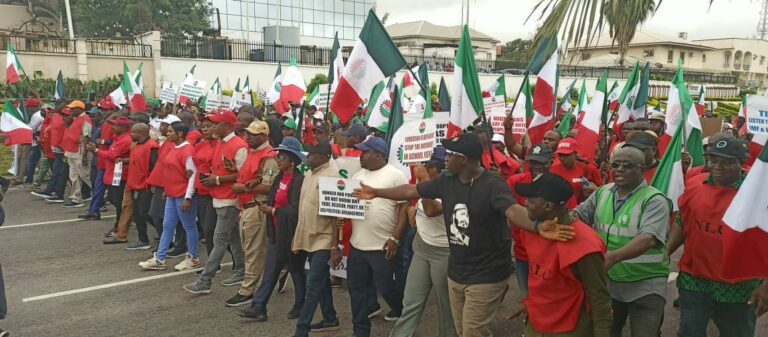
THE Nigeria Labour Congress (NLC) has declared a two-day warning strike over the Federal Government’s failure to alleviate the hardships caused by the removal of petrol subsidy in the country.
The NLC President, Joe Ajaero, disclosed this on Friday, September 1, during a press briefing, stating that the strike would commence on Tuesday, September 5, and precede an indefinite action to begin later in the month.
“We have resolved to embark on a total and indefinite shutdown of the nation within 14 working days or 21 days from today Until steps are taken by the government to address the excruciating mass suffering and impoverishment being experienced around the country.
“We will commence a 2-day nationwide warning strike on Tuesday & Wednesday the 5th & 6th of September, 2023, to demonstrate our readiness for the indefinite strike later in the month and to also demand that the State vacates the illegally occupied National Headquarters of the National Union of Road Transport Workers,” Ajaero said.
He added that there would be a protest in Imo state against the abuse and violations of workers’ rights in the state.
“We are set to begin the shutdown of the operations of Airpeace Airline and other companies in the Aviation sector that are involved in serial violation of the rights of workers in the sector to freedom of Association and to collectively bargain and Organise,” he added.
This comes a month after the NLC, Trade Union Congress (TUC) and other members of Organised Labour staged a nationwide protest against the subsidy removal.
Organised Labour staged the protest on August 2, pulling down one of the gates of the National Assembly complex in Abuja in defiance of security operatives who denied them entry into the premises.
The protesters said negotiations between the Federal Government and Organised Labour yielded no positive results.
They also noted that Nigerian President Bola Tinubu had not shown interest in reviving the nation’s economy, as the problems of non-functional refineries, which they said could resolve the country’s fuel crisis, were yet to be addressed by him.
The protest was suspended the same day after a meeting with President Bola Tinubu at the Presidential Villa.
Ajaero told journalists that the meeting with Tinubu had been fruitful, and conversations were held around the work of the Presidential Committee on Subsidy Removal.
He also disclosed that the president committed to revitalising the Port Harcourt refinery, improving the minimum wage for workers, and other measures to address the hardship caused by the removal of the petrol subsidy.
“He (Tinubu) committed to an immediate restructuring of the framework for engagement in line with the input of the labour leaders. He confirmed that the Port Harcourt refinery would commence production by December. He pledged a wage increase for Nigerian workers.
Although the president approved N5bn per state to be distributed among citizens as palliatives against the subsidy removal, NLC faulted the package, saying it could only amount to N1,500 when shared to about 133 million Nigerians, who are multi-dimensionally poor.
EXPERTS have advised the Federal Government to work with Nigeria’s Multidimensional Poverty rate released last year by the National Bureau of Statistics instead of the recently published Nigeria Labour Force Statistics Report.
According to NBS, 133 million Nigerians were multi-dimensionally poor as of 2022. However, the recent Labour Force Report for the first quarter of 2023 disclosed that 76.1 per cent of Nigerians were engaged in some job for at least one hour a week for a pay or profit, which qualified them as being employed.
This puts the unemployment rate at 4.1 per cent, a drop from 33.3 per cent as of the fourth quarter 2020.
The experts who spoke on The ICIRTwitter Space on Friday, August 31, said that the Labour Force Report was unrealistic compared to how Nigerians adjusted to economic policies enacted by former President Muhammadu Buhari and President Bola Ahmed Tinubu.
Some of these policies include the naira re-design policy, removal of fuel subsidy and devaluation in Nigeria’s exchange market. These policies had increased the inflation rate to 24.08 per cent, the highest in over a decade, increased the pump price by over 200 per cent and the exchange rate to more than N900/1 USD.
In the new Labour Force Report, NBS said that it revised and adjusted the methodology used for the survey as against what was obtained in the previous reports. For instance, in the old methodology, the working population was 15 to 64 years. Now, the working population is 15 years and above. Also, the new methodology interprets unemployment as people who are not doing anything, while the old methodology interprets unemployment as people who worked below 20 hours.
Similarly, underemployed persons worked between 20 and 39 hours in the old methodology, while underemployed persons worked less than 40 hours in the new methodology.
These adjustments have sprouted several controversies as to how accurate the figures are. The ICIRreported how these would affect the Nigerian economy and policy implementation by government parastatals.
A principal partner at Afrique Capital and Equity Funds Limited, Kazeem Bello, said that while there were several parameters provided by the International Labour Organization (ILO) for calculating the labour strength of a country, the country was at liberty to pick whichever parameters best work with the economic policies, impact of the policies and benefits.
Bello said that the adjustments by the bureau agreed with Nigeria’s economic system, which operates a minimum wage of N30,000 monthly. By implication, if a person is paid N1,000 daily for a one-hour job, he is considered employed.
He said, “I do not expect the government to accept that kind of unemployment figures. If they do, we will be increasing the poverty rate in the country unknowingly. What the government can do is focus on the multidimensional poverty ratio. Some people doing the 20-hour jobs in Nigeria live below the global household income threshold.”
Bello noted that if someone worked and did not live above the Standard Poverty Index (SIP), they would be considered poor globally.
Also, the Head of Financial Institutions rating at Agusto&Co, Ayokunle Olubunmi, added that the average amount made from working an hour could not form a basic living wage for any Nigerian.
Olubunmi said, “The new methodology begs a lot of questions. Data is meant to reflect reality and influence economic decisions, but this data cannot be used for anything. You cannot say GDP growth is declining and unemployment is also reducing. It is not logical.”
He noted that the most reliable form of data comes from the NBS, and the bureau must ensure it provides data that reflects the situation of the economy.
The experts urged that the government focus its strength on poverty reduction rather than unemployment, especially with the new methodology.
The ICIR reported how Tinubu promised to create one million jobs through the digital economy for the teeming youths in Nigeria during his inauguration on May 29.