The 2023/2024 UEFA Champions League campaign will commence on Tuesday, September 19.
This was disclosed during a ceremony for the draw for the group stages of the competition in Monaco on Thursday, August 31.
The draw saw 32 European clubs that qualified for the competition divided into eight groups. They will slug it out with one another to covet the season’s title.
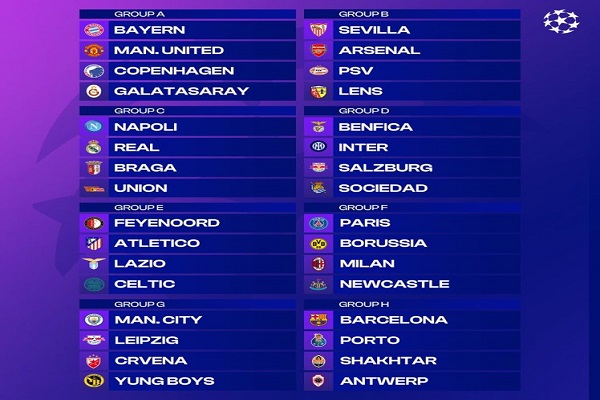
One of the high-profile matches will witness Maguire’s Manchester United battle against Bayern Munich’s Harry Kane.
Also, Saudi-owned Newcastle, featuring in Europe’s elite club competition for the first time in 20 years, will face AC Milan, Borussia Dortmund and Qatar-backed PSG in a tough Group F.
In Group A, Bayern and United were joined by FC Copenhagen and Galatasaray.
Below is the draw for the group stage of this season’s UEFA Champions League.
THE National Press Foundation (NPF) is inviting applications for its online fellowship on covering rare diseases.
The programme runs from November 13 to 17, 2023.
The programme will include online briefings and question-and-answer sessions with leading international experts on rare illnesses, diagnostics, focused testing, and medication development, as well as with representatives of patient advocacy organizations and journalists who have been writing about the subject.
Additionally, fellows will receive up to US$3,000 to assist in reporting initiatives on rare diseases worldwide. Projects must be published by February 29, 2024.
Journalists globally can apply for this fellowship, which offers reporting grants.
The deadline for submission of applications is September 12, 2023.
OVER 23,000 persons have disappeared in Nigeria under various circumstances, including insurgency and kidnapping, in less than a decade, the Federal Government has said.
The figure represents half of those missing in Africa within the same period, said the Minister of Humanitarian Affairs and Poverty Alleviation, Betta Edu.
Edu disclosed this while speaking at an event to mark the International Day of the Disappeared at the National Human Rights Commission on August 30.
Represented by the Director of Humanitarian Affairs, Ali Grema, the minister noted that a more efficient mechanism was needed to improve the reporting and forensically trace cases of missing persons in the country.
“In Nigeria, it’s reported that in less than a decade, more than 25,000 persons are registered as missing by the ICRC (International Committee of the Red Cross) and the Nigerian Red Cross Society (NRCS) as a result of the insurgency in the North East. This represents half the number of missing persons in the whole of Africa.
“Today, over 23,000 persons are still missing. However, this is likely just the tip of the iceberg, as a more efficient mechanism is needed to improve the reporting and forensically trace cases of missing persons. To date, the exact number of people going missing in the country is not yet determined,” Edu said.
She promised to ensure the domestication of international treaties and instruments using a whole society and government approach and argued that the strategy would strengthen the country’s mechanism to address issues of missing persons effectively and efficiently.
This is not the first time the ministry’s official complained about the lack of an efficient system to capture the actual number of missing persons in Nigeria. The former minister, Sadiya Farouk, in January 2023, said the country lacked an official register of missing persons.
Represented by the Permanent Secretary of the ministry, Nasir Gwarzo, Farouk said, “Currently, Nigeria has no national structure or Standard Operating Procedure (SOP) to address humanitarian consequences of disappearances”.
“To date, there is no reliable national data on the number of missing persons in Nigeria because there is no official register.
“It is very understandable why Nigeria as a country and this ministry is very concerned about this often-neglected and tragic humanitarian and social issue,” she added.
Also, a report by the ICRC in 2022 said Nigeria accounted for the most missing persons ever registered by the organisation.
The report showed that 25,000 out of 64,000 missing persons are from Nigeria.
The head of the ICRC Nigeria delegation, Yann Bonzon, said, “These are numbers of cases that have been registered with the ICRC and Nigerian Red Cross Society. We know that this number is likely just the tip of the iceberg”.
Bonzon added, “The ICRC know that no fewer than 13,000 families in Nigeria are seeking missing loved ones”.
THE Executive Director, International Centre for Investigative Reporting (ICIR), Dayo Aiyetan, and Head of Investigations, Olugbenga Adanikin, have been selected among the speakers at the Global Investigative Journalism Conference (GIJC) holding in Swedenbetween September 19 and 22, 2023.
Aiyetan will deliver a session during the “Lightning round: Great stories you’ve never heard of.” It showcases investigative projects that may have escaped people’s notice and a chance to listen to extraordinary global works of journalists.
This year’s session features prominent journalists from China, France, Nigeria, Norway, Peru, and Ukraine, among others.
Adanikin will speak on “Digging into Government Contracting: Finding Patterns, Tracking Corruption, and Telling Stories.”
The session will provide practical tips and tricks to investigate the entire public procurement process, from planning to tendering and delivery, and show how to get data on the three core elements of a public procurement process: buyers, companies, and projects.
The Global Investigative Journalism Conference (GIJC) is the world’s largest international gathering of investigative journalists. The conference features training on the latest tools and techniques, cutting-edge workshops, and extensive networking and brainstorming sessions.
The Global Conference holds every two years. Since the first gathering in Copenhagen in 2001, the GIJC has brought together over 10,000 journalists from 140 countries.
It is designed by journalists for journalists and is famous for focusing on practical and advanced reporting techniques.
PRESIDENT Bola Tinubu will prioritise health for all Nigerians, make it a fundamental right for citizens, and use it to promote the nation’s security, his Special Adviser on Health, Salma Ibrahim Anas, said on Thursday.
Anas stated these at a webinar to discuss Nigeria’s new administration’s health agenda, the trajectory toward achieving the government’s health manifesto, and its implications for a strengthened health system, organized by Nigeria Health Watch in conjunction with The Conversation Africa.
This webinar was themed “Nigeria’s new administration: Setti ng the health agenda.”
The ICIR reports that Tinubu’s promise shows his government’s readiness to comply with the World Health Organisation’s (WHO)constitution, which makes the enjoyment of the highest attainable standard of health one of the fundamental rights of every human being without distinction of race, religion, political belief, economic or social condition.
Anas explained that before the 2023 elections, stakeholders, including herself, made deliberate efforts to ensure the inclusion of health in the country’s political agenda, culminating, among others, in Tinubu’s renaming the Health Minister’s office as the Coordinating Minister of Health and creation of Anas office – the Special Adviser on Health (to the President) – the first in Nigeria.
She argued that Tinubu Renewed Hope Agenda aimed to achieve health for all through an efficient and effective universal health care coverage system, using the continuum model as contained in the Sustainable Development Goals (SDGs).
Anas regretted the state of the country’s health and promised a rapid turnaround under Tinubu.
“We are making a slow progress over a long period of time. In some areas, we are not even making progress. We are almost stagnated, with no progress as the trends remain the same despite all efforts.
“We have witnessed significant efforts in the past ten years, either by government at the national level or the sub-national level, and huge investments by our development partners, donors and all relevant stakeholders. But unfortunately, they have not given us the desirable results. So, what is wrong? How do we address this? These are the questions that we ask ourselves.”
She blamed the “weak health system” on the outbreak of diseases, including diphtheria, from which the nation suffered major blows in the past weeks.
On July 31, The ICIR reported how diphtheria killed 83 people in seven states and the Federal Capital Territory (FCT).
“This administration ably led by President Bola Tinubu strongly believes that Nigeria deserves quality health,” Anas stated, adding, “The overall goal is to move Nigeria closer to the universal health coverage aspiration with a key focus to reduce the huge gaps between those in need and the use of services. “As we all know, experiences have shown that quality of services is very poor, especially at the primary healthcare level and the unregulated private sector, where the majority of Nigerians access services.”
The Renewed Health Agenda offers several laudable changes to the health system, including an increase in public health financing, prioritising the poor and vulnerable.
She said the agenda focused on new funding for the expansion of PHC, adding that the funding would be used for the purpose for which it is made available.
Other focus areas are health governance and institutional reforms, increased budgetary allocation for health for high impacts, increase in national insurance coverage to cover a significant per cent of the population, presenting the National Health Insurance Health Authority (NHIA) for better performance, and improving on existing private-public partnerships.
Others are:
Delivery of integrated, comprehensive health care services.
Boosting preventive health care services.
Linking the primary, secondary and tertiary levels of care.
Guaranteeing human resources for health.
Reducing brain drain.
Ending rivalries among workers.
Promoting local manufacture of essential health commodities.
Meanwhile, panellists at the webinar lent their voices to the need for the Tinubu government to raise the bar in health governance, funding and services.
Ibrahim Oloriegbe, Chairman of the Senate Committee on Health in the 9th Assembly, urged the Federal Government to increase its contribution to the National Health Act from one per cent of the consolidated fund from one per cent to two per cent.
“The National Health Act can help the new administration to efficiently raise health allocation in the 2024 budget. This must happen before the budget presentation in December to ensure the inclusion of the two per cent consolidated fund for the 2024 allocation,” he said.
Morenike Folayan, a professor of Paediatric Dentistry at the Obafemi Awolowo University, Ile-Ife, Osun State, noted that the nation had an impressive library of policies but struggled with effective policy implementation.
“What we anticipate from this administration is the transformation of existing policies into tangible actions. Unless a strategic approach is adopted for implementing health policies and promoting community ownership of health outcomes, progress in health system indicators like antenatal care access in Nigeria will remain elusive.”
Mairo Mandara, an Obstetrician/Gynaecologist, and a former Country Representative of the Bill Gates Foundation in Nigeria, urged the nation to prioritize the functionality of its PHCs.
She emphasized the need to invest in the right healthcare level and focus on training nurses, midwives, and health assistants for effective deployment.
“This approach should prioritize practical skills and stop the excessive craze for academic certification.”
Similarly, Obinna Onwujekwe, a professor of Health Economics and Policy Pharmaco-economics/pharmaco-epidemiology, said that the weak health system and tiers of government’s indifference to health are some of the challenges facing Nigeria’s health system.
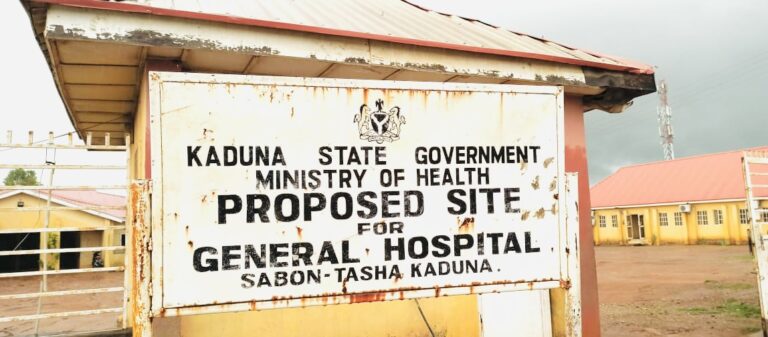
SINCE August 2022, the General Hospital in Sabon-Tasha, Chikun Local Government Area (LGA) of Kaduna State has been operating without electricity. In this report, The ICIR’s Nurudeen Akewushola chronicles how the hospital was thrown off the national grid, thereby crippling healthcare services in the facility.
————
It was around 7 p.m. on a Friday. The premises of the General Hospital, Sabon-Tasha, appeared quiet, unlike the busy atmosphere of a typical general hospital. The disposition of both patients and their caregivers mirrored their dissatisfaction, as some had to abandon the wards to sit at the entrance to escape the suffocating heat. In an attempt to find relief, a number of caregivers and patients resorted to the use of placards to wave off the heat.
It all began in August 2022 when the transformer supplying the hospital developed a fault. Though the transformer was later fixed, a year later, the facility, located in the heart of Kaduna Metropolis, remains unconnected to the national grid, thus crippling efficient health care service in the hospital.
Since then, the hospital has relied on a generator as its power source. But this comes at a cost. The patients have no alternative but to bear the cost. The generator is fuelled by the fees charged clients for medical and laboratory services.
Nurses rely on phone torches for ward round check
Faith Isaac looks tired and frustrated. Her child was admitted to the hospital due to malaria and that has kept her within the hospital walls for three days and throughout this time, she could not have access to electricity.
“It’s frustrating because there’s not been light for the past three days that we have been here and the mosquitoes are everywhere,” Faith lamented. “When the nurse wants to go around to check the children at night, she will have to use her phone. Sometimes I have to borrow her my power bank to charge her phone.”
She recalled an incident where she was nearly stung by a scorpion in the darkness but was saved by her torchlight.
“Thank God I was using my torchlight, the scorpion would have stung me. The experience has been very bad,” Faith recalled.
During a visit, The ICIR confirmed the absence of potable water either for drinking or domestic use. Though strange, findings showed that health workers, especially nurses, often go outside the hospital to get water at a cost. Relatives of the patients also do the same in some cases, due to the same challenge.
Though the hospital has a borehole, the absence of electricity makes it impossible for the hospital to pump water for its basic needs.
Kezia Amos, a caregiver from Angwan Gimbiya community lamented the persistent darkness at the hospital in the evening. She said there was no power during his four-day stay, forcing health workers to rely on lamps and phones for tasks due to the absence of power supply.
Kezia Amos
Garba Makama, a resident of Anwan Baro community, recalled a fateful day he brought his daughter to the hospital in the night, only to find out that the doctors were absent from their seats. The nurse he met was preparing to leave and they had to sit down in the dimly lit reception area.
Suddenly, another patient emerged who was in need of emergency attention. The health workers wanted to attend to him but were all holding feeble torchlights amid darkness. This made it hard for them to locate the patient’s vein and inject him accordingly.
“Because they were using torchlight, they were looking for his vein and when they saw it, they wanted to put the syringe in it but they couldn’t get it right and that’s how they ‘punched’ the patient like more than 10 times and the patient later collapsed and fainted,” Garba recalled.
*Usman, a civil servant, has been admitted for five days and since then, he has witnessed the departure of three persons which according to him is due to lack of quality healthcare delivery in the hospital.
He believes the hospital is lagging behind its counterparts. He said the problem extends to the surgical unit but once it is time for surgery, the hospital’s management would swiftly power the generator.
“I have been here for the past five days and it has been a horrible experience,” *Usman lamented.
“On this light issue, I think this hospital has been neglected. I have never experienced light since I came here. The only place that I experienced light was in the theatre. They powered the generator to operate on people. But at the wards, everybody has to use their phones or rechargeable lanterns.”
Mirabel Esau, a resident of Sabon Tasha, decried the lack of electricity and water at the hospital, highlighting how these challenges impact patients’ comfort. According to her, washing the patients’ clothes and other necessary cleaning tasks have become a difficult assignment due to lack of water.
Mirabel Ezau
“I am here to care for a patient, but the major challenge we face is the absence of both light and water within the hospital premises. This has made it impossible for us to remain within the ward due to the heat. We had to sit outside to get fresh air,” said Mirabel.
Struggles of health workers
The hospital’s health workers interviewed by The ICIR shared their experiences of using cellphone touch lights and rechargeable lamps to provide healthcare for patients due to the absence of electricity.
They also expressed their concern over the frustration of patients in the pediatric ward where they constantly battle heat and mosquito bites.
“The work is frustrating,” said a nurse in the hospital who was met using his broken phone to write medical prescriptions on paper.
The dark hospital’s view in the night
Etched on her face was a feeling of discomfort and concern over the lingering problem.
“To get the right prescription written on the administered drugs for patients is also a challenge. This is because at times, the drugs are tiny, and one will have to strain her eyes to write the drugs,” she added.
She lamented how the lack of basic amenities especially electricity hamper their productivity and healthcare delivery in the hospital.
According to her, the health workers have to go outside the hospital to power their gadgets and get water for their various needs.
“Both the patients and the medical workers are not comfortable but we have to make these sacrifices because of our patients.”
A medical doctor in the hospital’s maternity, who also cannot be named, expressed frustration over the inaction of the state government and how the absence of light has made his job very challenging.
According to him, doctors and nurses need to wear torchlights on their foreheads in order to take care of pregnant women in the maternity.
“People are really fed up with government hospitals because of lack of facilities and this place is in the metropolis of the state that the government needs to look into. It’s not primary healthcare, it’s a secondary facility the government needs to put into consideration the lives of the people which is very important that those are the things that people should benefit from for free for the benefit of the society,”the doctor lamented.
The bigger picture
The Nigerian healthcare system has long grappled with significant challenges that have impeded its ability to provide quality and accessible medical services to its citizens. One of the foremost contributors to these struggles is government negligence, which has led to a plethora of issues affecting patient care, healthcare infrastructure, and overall public health.
The chronic underfunding of healthcare and insufficient financial support cripples hospitals’ ability to afford basic amenities and provide a conducive environment for both its workers and users.
The hospital appearing deserted in the evening.
As a result, patients often receive substandard care, leading to delayed diagnosis, inadequate treatment, and sometimes even preventable deaths. The challenge also exposes health workers to risk. This manifested in the tragic death of a medical doctor at Odan General Hospital, Lagos Island, who was crushed to death in a lift on July 26, 2023.
The lack of a conducive environment in public hospitals such as General Hospital Sabon-Tasha has been attributed to the high rate of “brain drain,” where qualified healthcare professionals seek employment opportunities abroad and incessant industrial action by resident doctors which have further depleted the nation’s healthcare.
This commitment encompasses various targets, such as reducing the global maternal mortality rate to below 70 per 100,000 live births by 2030 and putting an end to avoidable deaths among newborns and children under 5 years old. Every nation is striving to decrease neonatal mortality to at least as low as 12 per 1,000 live births and under-5 mortality to at least as low as 25 per 1,000 live births by the year 2030.
Additionally, the goal includes eradicating the epidemics of diseases like AIDS, tuberculosis, malaria, and neglected tropical diseases, while also combating illnesses such as hepatitis, water-borne diseases, and other communicable diseases by the same deadline.
However, the realization of this crucial and admirable objective has become a distant prospect in Nigerian government health facilities.
Nigeria accounts for the second-highest number of maternal and child deaths globally according to World Health Organisation. Nigeria’s former health minister, Osagie Ehanire, attributed the high maternal, infant and under-five mortality in the country to a lack of access to quality healthcare services which experts have said is partly due to poor investment in healthcare infrastructures such as General Hospital, Sabon-Tasha which has been in darkness for close to a year.
According to the 2021 Multiple Indicator Cluster Survey by the National Bureau of Statistics, the under-five mortality rate in Kaduna State increased from 82 per 1,000 births in 2017 to 127 per 1,000 births in 2021 while the child mortality rate increased from 18 per 1,000 births to 58 per 1,000 showing the alarming situation of the state’s healthcare.
Management bemoans low patronage, drop in IGR
A top official in the hospital who spoke under the condition of anonymity explained that the problem of power outage in the hospital lies in the hands of the state government which fails to pay the electricity bills of the hospital to Kaduna Electric Distribution Company.
According to him, the problem has led to the disconnection of the hospital from the national grid and made it rely solely on generator for more than eleven months.
He noted that the challenge is taking a toll on the internally generated revenue of the health facility as they now spend more on fuel especially now the price of PMS has risen.
“The power is not there and so we generate little, not as much as we should because of that and now, we even spend more on power. The Internally Generated Revenue has dropped because of that and even patients’ influx is down,” he lamented.
He urged the state government to offset the electricity bills of the hospital or give an order to the distribution company to restore electricity in the hospital pending when they are going to settle them ultimately.
Power companies trade blames
When contacted, the Head of Corporate Communication, Kaduna Electric Distribution Company, AbdulAzeez Abdullahi, explained that power has not been restored to the hospital due to the failure of Kaduna Power Supply Company(KAPSCO) to pay the electricity bills of the hospital.
The Kaduna Power Supply Company is the official body charged with increasing Kaduna’s electricity access. It is responsible for powering off-grid communities, executing independent power projects, maintaining streetlights, and providing power to public buildings such as government health facilities.
Abdullahi said, “The issue now is with KAPSCO. They are the ones who will explain to you how much they owe and why are they not paying their debt. The hospital is not even among the list of government agencies that KAPSCO is paying us for every month.”
He, however, clarified that KAPSCO has fixed the transformer of the hospital and they are also responsible for connecting the hospital back to the grid.
The ICIR contacted the Kaduna Power Supply to verify what led to the hospital’s disconnection from the national grid but the company only responded with one sentence that reads :
“We wish to inform you that KAPSCO does not disconnect national grid electricity customers, only the distribution companies do so. You should please direct your letter inquiries to them.”
Further clarifications sought after the response were not answered by the company as of the time of filing this report.
NMA calls for enabling environment for health workers
Speaking with The ICIR, the President of Nigeria Medical Association, NMA, Kaduna State Chapter, Madaki Sheyin, noted that the absence of electricity in the hospital would greatly impact the welfare of doctors and the quality of healthcare delivery in the hospital.
“Without a conducive environment, doctors cannot function optimally no matter how good they are. For instance, in a situation like this where there is no light, the doctors won’t be able to operate properly, especially at night. It will impact how they handle emergencies among others.
Sheyin Madaki, NMA President, Kaduna Chapter
“Productivity will definitely be reduced, there’s no two ways about that. That’s why we have always encouraged and agitated for the government to ensure that these things are put in place,” he said.
Madaki noted that the poor working conditions and lack of an enabling working environment would also prevent the state from attracting doctors.
He pointed out that the previous administration invested heavily in primary healthcare facilities but a lesser attention is given to secondary healthcare facilities such as General Hospital, Sabo despite the fact that it’s within the metropolis.
He charged the state government to address the challenge in order to ensure optimum productivity and curb the exit of doctors from Nigeria to countries with a better working environment.
“We are dealing with ‘Brain drain’ issue which is one of the issues that we have always been hammering on. The Government needs to address those push factors. We cannot really do much about the pull factors that are actually making the doctors leave the country or state.
“The government should ensure that these lingering issues are addressed quickly and with all political will. I think if we do that, a lot of doctors I know are willing to stay back and work for their state and country at large,” he concluded.
State govt. faults El-Rufai’s administration
Meanwhile, the Kaduna State governor, Uba Sani, in several of his campaign promises pledged to improve public healthcare in the state and make it more accessible to the people.
Kaduna state governor, Uba Sani
A few weeks after he assumed office, he signed into law the Public Health Bill. The law is aimed at improving the public safety of the people of Kaduna State from health threats, preventing diseases and striving for a healthy population.
The purpose of the law is to improve the public safety of the people of Kaduna State from health threats, prevent diseases and strive for a healthy population.
The ICIR contacted the Governor’s Chief Press Secretary, Muhammad Shehu Molash, to ask about the government’s efforts to address the challenge and he forwarded the enquiries to the Permanent Secretary of the Ministry of Health, Adamu Mansur.
According to Mansur, the problem is due to the failure of the Committee on Billing of Government institutions of the last administration to capture the hospital for electricity bill payment.
“We have been engaging KAPSCO on the matter. There was an error by the last administration for not capturing the hospital bill centrally by the Committee on Billing of Government institutions,” he said.
He promised to follow up with Kaduna Power Supply Company to ensure that the issue was resolved and electricity is restored in the hospital.
THE Minister of State for Petroleum (Oil), and his counterpart, Ekperikpe Ekpo,(Gas), have urged the ministry’s staff to support President Bola Tinubu in realising his vision in Nigeria’s oil and gas industry.
The duo, at a town hall meeting in Abuja, emphasised the need to reshape the narrative within the oil and gas sector.
Lokpobiri, in statement on August 30,2023 signed by Oluwakemi Ogunmakinwa, Deputy Director/Head, Press and Public Relations Unit, stressed the ministry’s vital role in Nigeria’s economic survival and the need for effective performance to address the nation’s challenges.
He explained that having two ministers in the ministry was a strategic decision to propel change and expand investments in the Oil and Gas sector.
He described the Petroleum Industry Act (PIA 2021) as a facilitating factor, and assured the staff that collaboration between him and his counterpart would lead to the realisation of the president’s directive.
He stated that during their recent visit to the Port Harcourt Refinery, the contractors working on the refinery’s rehabilitation indicated that the initial phase would be completed by December 2023.
Lokpobiri also expressed willingness to engage stakeholders in the creeks to combat oil theft and pipeline vandalism.
Ekpo also underscored the ministry’s significance in Nigeria’s economic growth and urged the staff to contribute their expertise to fulfil their mandates.
“We are here to work alongside you, understand you, and encourage you to bring your skills to bear,” he expressed.
He further outlined their shared objective of expanding domestic gas penetration, including Compressed Natural Gas (CNG) and Liquefied Petroleum Gas (LPG), for the betterment of the nation.
Gabriel Aduda, the Permanent Secretary of the ministry, expressed confidence in the staff’s capability to achieve the president’s objectives.
He listed initiatives such as providing staff buses to ease transportation and transitioning same to CNG to align with environmental concerns.
Aduda advocated leveraging the ministers’ experience to advance the industry and announced plans for frequent meetings to enhance communication and collaboration within the ministry.
The engaging town hall meeting was attended by directors and staff from the Ministry of Petroleum Resources, showcasing the ministry’s dedication to transparency, collaboration and administration’s agenda.
NIGERIA’S currency problems have failed to ebb, with the naira on sustained depreciation against the dollar, despite the $3bn Afrexim Bank deal with the Nigerian National Petroleum Company (NNPCL).
On Wednesday August 16, 2023, NNPCL and Afrexim Bank jointly signed a commitment letter for an emergency $3billion crude oil payment loan expected to ease Nigeria’s foreign exchange volatility.
The ICIR reported earlier that the signing raised unanswered questions about the deal, urging the National Assembly to probe further the details, while ensuring Nigeria does not raise grow its depth further.
The Naira currently exchanges at N920 against the American dollar at the parallel market, while it it exchanges for N738.18 at the I & E window.
This depreciation continues against the dollar, despite assurances from the CBN’s Acting Governor, Folasodun Sonubi, after a meeting with President Bola Tinubu on the issue on August 14,2023, that things would improve.
“Mr.President is very concerned about some of the goings in the foreign exchange market,”he said after the meeting.
The meeting with the President has failed to provide the much needed respite for currency problems, with knowledgeable economists stressing the importance of Nigeria exporting more to strengthen the naira.
“We need to export more and earn more foreign exchange.We are hugely an import dependent country and the pressure keeps up on the naira. In fact, market speculators prefer dollar as a store of value for their currency now than the naira,”an economist and a financial consultant, Kalu Aja, said in an organised Tweeter Space event.
A financial consultant and Economist, Kalu aja
The Chief Executive Officer at Cowry Asset Management Limited, Johnson Chukwu, said Nigeria would have to start exporting processed products to improve the value of the naira and revitalise the country’s refineries to check foreign currencies being expended on importing petroleum products and the attendant inflationary push.
Chukwu also said, “Many global currencies have suffered depreciation against the dollar, but it is worse for Nigeria, which is importing petroleum products even as an oil-producing nation.
Johnson Chukwu, CEO of Cowry Asset Management Limited
“What we should do in the medium-to-long term is that we must be a producing economy. We must be a manufacturing hub. If you don’t have quality things to export, then your policy will come under pressure under any crisis. We are basically still exporting crude and importing refined petroleum products.”
The Managing Director/Chief Executive Officer of Financial Institutions Training Centre (FITC), Chizor Malize, corroborated this , saying Nigeria now needs to move from consumerism to production to prevent any form of currency crisis.
To state the least, naira is in free fall once again after a $3 billion loan secured by state-oil company NNPCL that was supposed to inject much-needed dollar liquidity into the foreign exchange market appears to be stalling.
Sources familiar with the $3 billion loan deal say it is now on ice after investors who were supposed to make up the balance of the syndicated loan have now gotten cold feet, leaving only the Afrexim Bank, which can not single-handedly provide all the cash.
The reason for the sudden change of heart has been linked to the country’s worsening finances and apparent desperation to defend the naira.
“Afrexim bank has too much exposure to Nigeria and has reached its single obligor limit & can’t do it alone,” a source familiar with the deal who pleaded anonymity said.
“NNPC is too big a risk so Afrexim bank can’t close the deal without some other investors,” said another source familiar with the deal but not allowed to speak publicly.
It has been two weeks since the deal was first announced and the market has run out of waiting time.
There has been zero accretion to the country’s external reserves since then and, most importantly, the CBN’s dollar supply remains thin.
While the loan deal drags, the naira is taking a beating with the situation threatening to get worse as Nigeria muddles through without a substantive CBN governor to calm the storm.
This fellowship offers experienced journalists the chance to engage with an international academic community and delve into key questions and current issues in international law, European Union law, and public law.
The MPIL, invites individuals from around the globe Who are both freelance and staff journalists from all media (print, online, television, radio) who report and write on legal and constitutional topics or topics from politics.
The fellowship spans three months between March and November 2024, allowing journalists to work on self-chosen projects without the pressures of daily deadlines.
Participants will have the opportunity to collaborate with researchers, utilize the institute’s extensive library, and join various discussions.
The fellowship caters to freelance and staff journalists from diverse media platforms and provides a monthly research grant of up to €3,500 based on qualifications and experience.
The deadline for submission of applications is October 6, 2023. Aspiring fellows can apply here
AS an internal restructuring to be executed through a merger scheme, Dangote Sugar Refinery Plc said it had reached an agreement with NASCON Allied Industries Plc and Dangote Rice Limited.
The company disclosed this in a statement on Wednesday, August 30, signed by its secretary/legal adviser, Temitope Hassan.
It stated, “The Merging Entities have agreed [on] the terms and conditions of the Merger of the Company with NASCON Allied Industries Plc and Dangote Rice Limited, which is an internal restructuring to be executed through a Scheme of Merger, under Section 711 of the Companies & Allied Matters Act, 2020 (as amended) and other applicable rules and regulations.”
The ICIR reports that Section 711 of CAMA 2020 provides for the power of the Court to order separate meetings of companies on the application in summary of any of the companies to be affected, where under a scheme proposed for a compromise, arrangement or reconstruction between two or more companies or the merger of any two or more companies, the whole or any part of the undertaking or the property of any company concerned in the scheme is to be transferred to another company.
According to Dangote Sugar, it will offer scheme consideration, which means cash consideration and share consideration, to shareholders of NASCON and Dangote Rice.
The consideration offered is 11 ordinary shares of 50 Kobo each in Dangote Sugar, credited as fully paid-up shares, for every 12 NASCON shares of 50 Kobo each, which totals 2,428,651,847 new ordinary shares of the company (Dangote Sugar).
It also offered 14 ordinary shares of 50 Kobo each in Dangote Sugar, credited as fully paid-up shares, for every one ordinary share of N1.00 Kobo each in Dangote Rice share, which totals 2,775,792,508 new ordinary shares of Dangote Sugar.
The terms and conditions of the merger, as agreed by the parties, will be presented to the Securities and Exchange Commission (SEC) and, subsequently, the company’s shareholders at a Court-Ordered Meeting.
“The Company will now proceed to apply to the SEC for the approval of the Scheme, and subject to the approval of the SEC, will apply to the Federal High Court for an Order to convene a meeting of its Shareholders to consider the Scheme,” it said.
The company advised shareholders to exercise caution when dealing with its shares until it made a further announcement.
In a recent report on August 27 by The ICIR, shareholders had expressed concern why the SEC is not bordered with withholding investors’ money paid by Olam International Limited to acquire Dangote Flour Mills Plc.
Olam International had on November 1, 2019 completed 100 per cent acquisition of Dangote Flour and offered N120 billion compensation to investors but SEC had held on to the money.
Meanwhile, on Wednesday, August 30, the share price of Dangote Sugar rose by 1.48 per cent to close at N58.30 and NASCON by 3.60 per cent to N56.05, respectively.
Further checks showed that Dangote Sugar’s market capitalisation stood at N708.16 billion with shares outstanding of 12,146,878,241 units, while NASCON’s at N148.501 billion and 2,649,438,378 units.
Dangote Sugar is in the business of refining raw sugar into edible sugar and selling refined sugar. NASCON processes raw salt into edible salt and imports tomato paste.