Home Blog Page 822

Insecurity: Over 600 people killed within 45 days under Tinubu

KILLINGS by non-state actors have continued unabated in many places in Nigeria several weeks into President Bola Tinubu’s administration. 

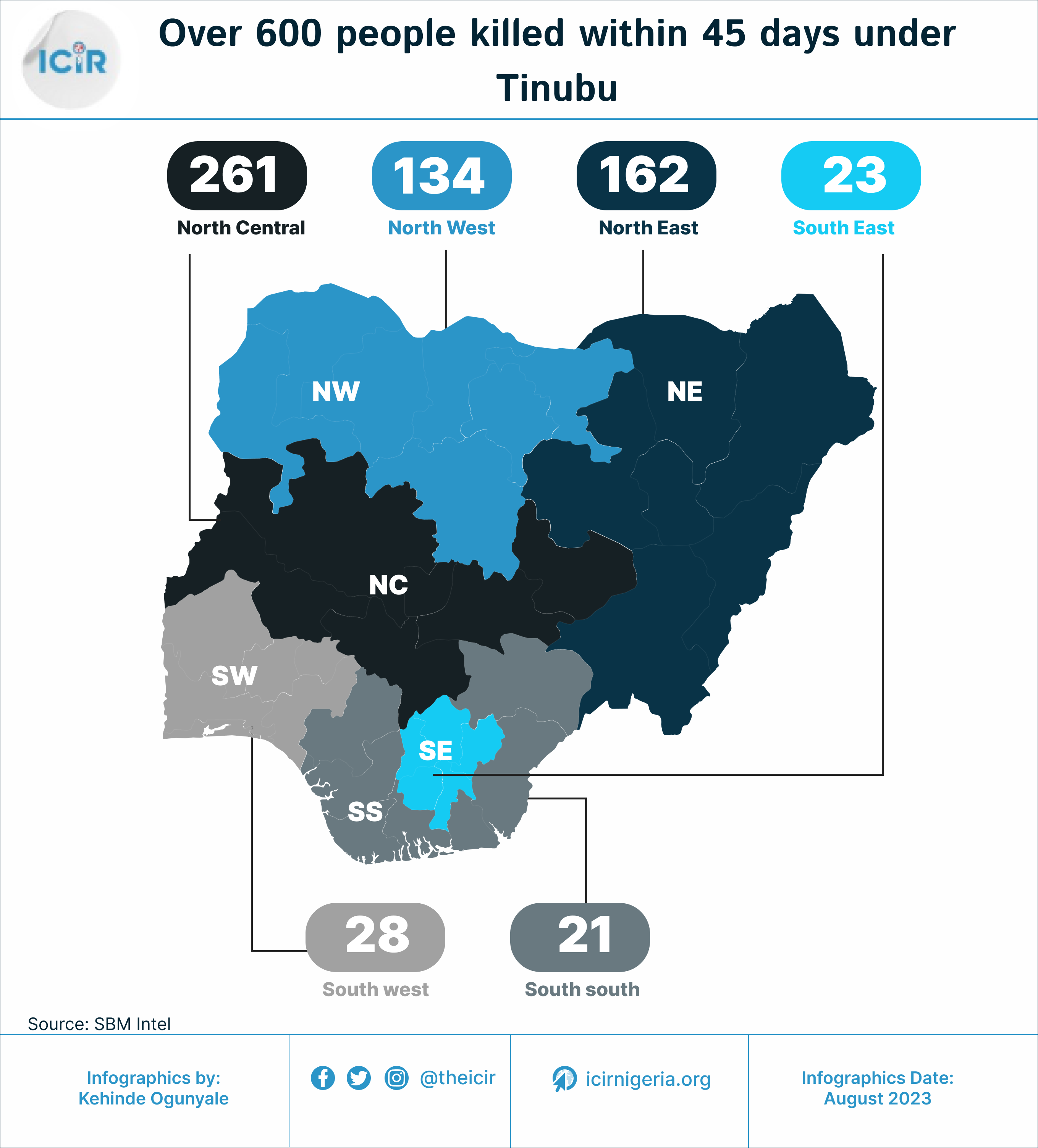
In 45 days between May 29 and July 13, 2023, over 600 people had been killed by non-state actors across the country.

According to data, the killings happened primarily from activities of bandits, Boko Haram insurgents, ethnic militias, armed robbers and other non-state actors.

Data from SBM Intelligence, an analysis platform, revealed that about 629 Nigerians were killed in the last 45 days under President Tinubu.

Other data from the Council on Foreign Relations’ Nigeria Security Tracker (NST) and media reports checked by The ICIR showed that non-state actors killed 587 people within the same period.
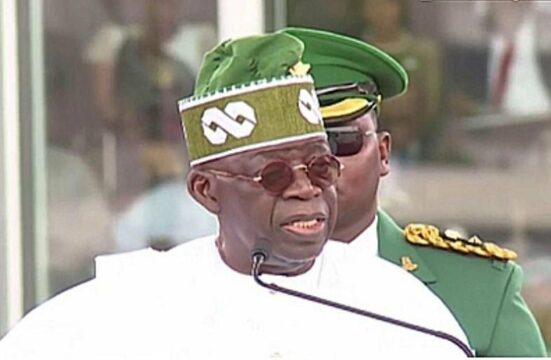
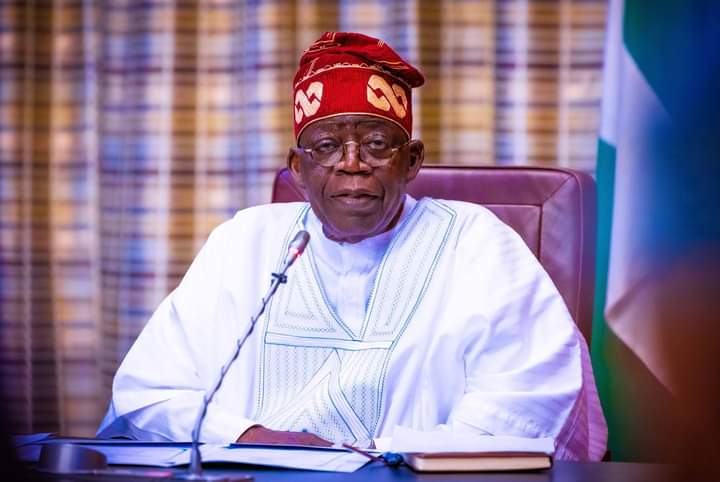
President Bola Tinubu during his inauguration.

In May, The ICIR published reports highlighting the key insecurity issues confronting the Muhammadu Buhari administration and another listing things Tinubu must do to address insecurity.

highlights of promises made by Tinubu on security

In his victory speech after securing the All Progressives Congress (APC) presidential ticket in June 2022, Tinubu promised a secure, prosperous, united Nigeria if he won the 2023 general elections.

Tinubu said he was ready to unite the nation, provide security, revamp the economy and create wealth.

He also promised to eliminate criminals, including terrorists. 

“They have been worrying us, but we will eliminate them. We are Nigerians. We are sure that no animal in the darkness of the night, no intruders, no destroyers, can bring Nigeria backwards. Forward we are moving,” he said.

Tinubu, while delivering his inaugural speech as President amid cheers from his supporters on Monday, May 29, at Eagle Square in Abuja, outlined the key initiatives to be anticipated from his administration and pledged to prioritise security and effectively tackle the menace of insecurity.

“Security shall be the top priority of our administration because neither prosperity nor justice can prevail amidst insecurity and violence.

“To effectively tackle this menace, we shall reform our security doctrine and its architecture.

“We shall invest more in our security personnel, and this means more than an increase in number. We shall provide better training, equipment, pay and firepower,” Tinubu stated.
Over 600 people killed within 45 days under Tinubu

What data say

Despite the promise made by the President to hit the ground running, data from various sources showed that the insecurity issues is yet to improve under Tinubu’s administration.

Disaggregating the data

A further look at the data from the SBM Intelligence revealed that in May, 38 people were killed by non-state actors between May 29 and May 31, 541 in June, and 50 as of July 13.

Killings by non-state actors per region

North Central: 261

North East: 162

North West: 134

South East: 23

South West: 28

South-South: 21

A breakdown of the data per state shows that Plateau has the highest number of casualties with 111, followed by Borno, 96; Niger, 76; Benue, 69; Zamfara, 67; Taraba, 60; and Sokoto, 51.

Others are Lagos, 13; Kaduna, 11; Rivers and Anambra, 9, Ogun, 8; Ebonyi, 7; and Imo and Delta, 6.

Other states had less than five casualties, while states like Osun, Kano and Jigawa recorded zero losses within this period.

In total, 629 casualties were documented from actions of non-state actors from May 29 to July 13.

NST/Media reports

Data from NST/Media reports showed that 39 persons were killed from May 29 to May 31, 444 in June, and 104 as of July 13, totalling 587 deaths recorded. 

Plateau had the highest number of casualties with 145 deaths, Benue 68; Zamfara, 57; Sokoto, 55; Imo, 53; Niger and Borno, 51; and Taraba, 50.

Governor of Plateau State Caleb Mutfwang

Additional data

A recent report by a civil society organisation, Global Rights Nigeria, revealed that at least 555 people had been killed and 267 others abducted six weeks after President Tinubu took office. 

The Country Manager of Global Rights Nigeria, Edosa Oviawe, while presenting a paper on realities of mass atrocities at a two-day ‘Conflict Sensitive Reporting Training for Journalists’ programme in Abuja, said the findings were based on reports from the media, civil society groups and security agencies.

Also, in a report published on June 14, Amnesty International (AI) said more than 120 people were killed a few days after Tinubu assumed power.

“It is horrific. Gunmen attacks have claimed at least 123 lives mere weeks after President Bola Tinubu assumed office on May 29. Rural communities, always bracing for the next bout of violence, faced deadly attacks by rampaging killers. Protecting lives should be the utmost priority of the new government. The Nigerian authorities must urgently take steps to stop the bloodletting.

“The brazen failure of the authorities to protect the people of Nigeria is gradually becoming the norm in the country. The government said it will enact security measures in response to these attacks, but these promises have not translated into meaningful action that protects the lives of vulnerable communities,” Amnesty International’s Acting Nigeria Director, Isa Sanusi, said concerning the report. 

Some major incidents under Tinubu as President

May

Four persons were reportedly killed on Monday, May 29, with two of them beheaded by gunmen who invaded the Rundele community in Emohua Local Council of Rivers State.

Bandits on May 30 killed 25 people in three separate attacks in the Kanoma district of Maru Local Government Area of Zamfara State.

Gunmen suspected to be cultists invaded two communities in the Ahoada East and Ahoada West local government areas of Rivers State on Wednesday, May 31, killing six persons.

 June

The Makurdi branch of Shitile Development Association (SDA), Benue Statein a letter of intervention written to the state government and signed by its President, Door Samuel, and secretary general, Zuai Ephraim, said at least 40 people were killed in separate attacks carried out simultaneously on June 4 in several communities of the Katsina-Ala local government area of the state.

Samuel stated that after the dust settled on the June 4 shooting by gunmen at Imande Mbakange village market in Mbacher council ward, a total of 28 people had been killed.

The group added that on the same day, in Michihe council ward, six other people were slaughtered, while another six on the same night were killed at Achamegh village, Mbagene Kpav, bringing the total number of those killed to 40 in just one night.

Bandits killed no fewer than 50 people in Gwadabawa and Tangaza local government areas of Sokoto state in June for refusing to pay illegal levies imposed on them.

In another incident, attacks by bandits on the villages of Janbako and Sakida in Maradun local government area, Zamfara State, resulted in the death of 31 persons and injuries to many others.

At least 13 persons were also killed in Barkin Ladi local government area of Plateau State on June 10 in a retaliatory attack between herders and farming communities. 

The incident happened after five herders were killed in Rawu village earlier.

According to reports, bandits in Niger State’s Rafi local government area slaughtered 25 farmers and kidnapped several women and girls from different areas.

According to reports, the incident happened in five communities. 

July

On Sunday, July 2, Taraba State Governor Agbu Kefas imposed a 24-hour curfew on Karim town and its surroundings in Karim Lamido local government area.

The curfew followed a communal clash between the Wurkuns and the Karimjos in the LGA, where at least 50 people died.

A total of 24 people were killed on Saturday, July 8, when armed men entered the Zaki Akpuuna 1 and Diom towns in the Mbaterem district of the Ukum local government area of Benue State.

The way forward…

Commenting on the data on incessant killings in the country, a security analyst with SBM Intelligence, Emeka Okoro, said the killings in Nigeria have continued despite a new administration due to various complex factors.

Okoro said the killing in Nigeria is multifaceted and influenced by factors such as:

1. Ethnic and religious tensions.

2. Insurgencies and terrorism.

3. Inadequate security infrastructure. 

5. Socio-economic factors.

6. Political tensions, frictions from political competition, and power struggles can sometimes spill over into violence. Pre- and post-election periods have historically been accompanied by an upsurge in politically motivated violence in Nigeria.

“Addressing these complex issues requires a multifaceted approach, including improved security infrastructure, effective governance, social cohesion, economic development, and peace-building efforts. 

“However, comprehensive and sustainable solutions will require political will and concerted efforts both within Nigeria and from the international community,” the security analyst stated.
How Sporting Lagos generates at least N3.5m per league match in Lagos

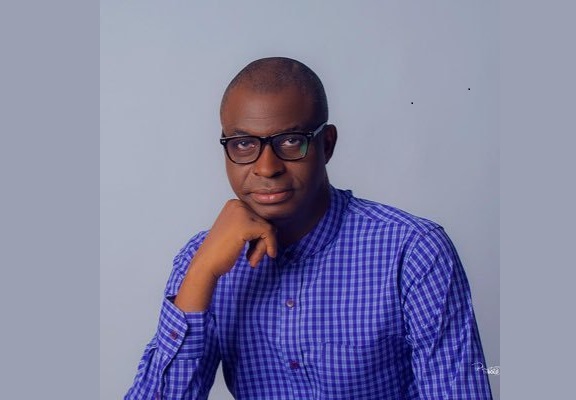
FOOTBALL administration in Nigeria has suffered setbacks owing to the hands saddled with the responsibilities. In an interview with  The ICIR, Godwin Enakhena, the Chairman of a newly promoted club, Sporting Lagos, from the country’s second division league, knowns as Nigeria National League(NNL) to the top-flight league- Nigeria Professional Football League (NPFL)  spoke on how his club has been making economic fortunes from the league.


The ICIR: What exactly can be done to the football administration in Nigeria to produce quality results?

Enakhena: I always say that the first to do if you want a result is to fix Nigeria. If you do not fix Nigeria, we are just wasting time. In my little way, I make a difference and we can all see it with Sporting Lagos.

The ICIR: Lagos has experienced many clubs who have brought premier league matches from the days of Julius Berger, but they don’t last long, is Sporting Lagos staying for long?

Enakhena: The previous clubs in Lagos were not set for business. MFM FC was not set up for business. Julius Berger was just corporate social responsibility (CSR); things like that do not last, but this (Sporting Lagos) is a business model from the get-go. We are building our stadium inside Landmark in Victoria Island, it is 85 per cent complete, so it means, we will not have to beg anybody for a stadium.

So sustainability was even before the club was formed. The owners knew what they wanted and these guys are tech people in their 30s. They are start-ups kings.

Government clubs don’t have accountability, they just spend.

The ICIR: Congratulations, Sporting Lagos FC just got promotion in the NPFL, are there plans to get new players ahead of the new season?

Enakhena: In football, you can never have enough. Manchester City and United are buying players every day. There is no exemption here.

Just like I said, it is the job of the coach to know where he got challenges and to do what he has to do to ensure that he has a formidable team.

The job of the coach to know where he got challenges and to do what he has to do to ensure that he has a formidable team.

The Nigeria Professional Football League, NPFL is not the same as the Nigeria National League, NNL. They are two different ball games, even though I believe that the NNL is tougher.

Definitely, from my understanding of the game, we find that there are some loopholes that we need to fill and I know the coaches are working on that.

Yes, we are going to recruit more players to fortify us for next season.

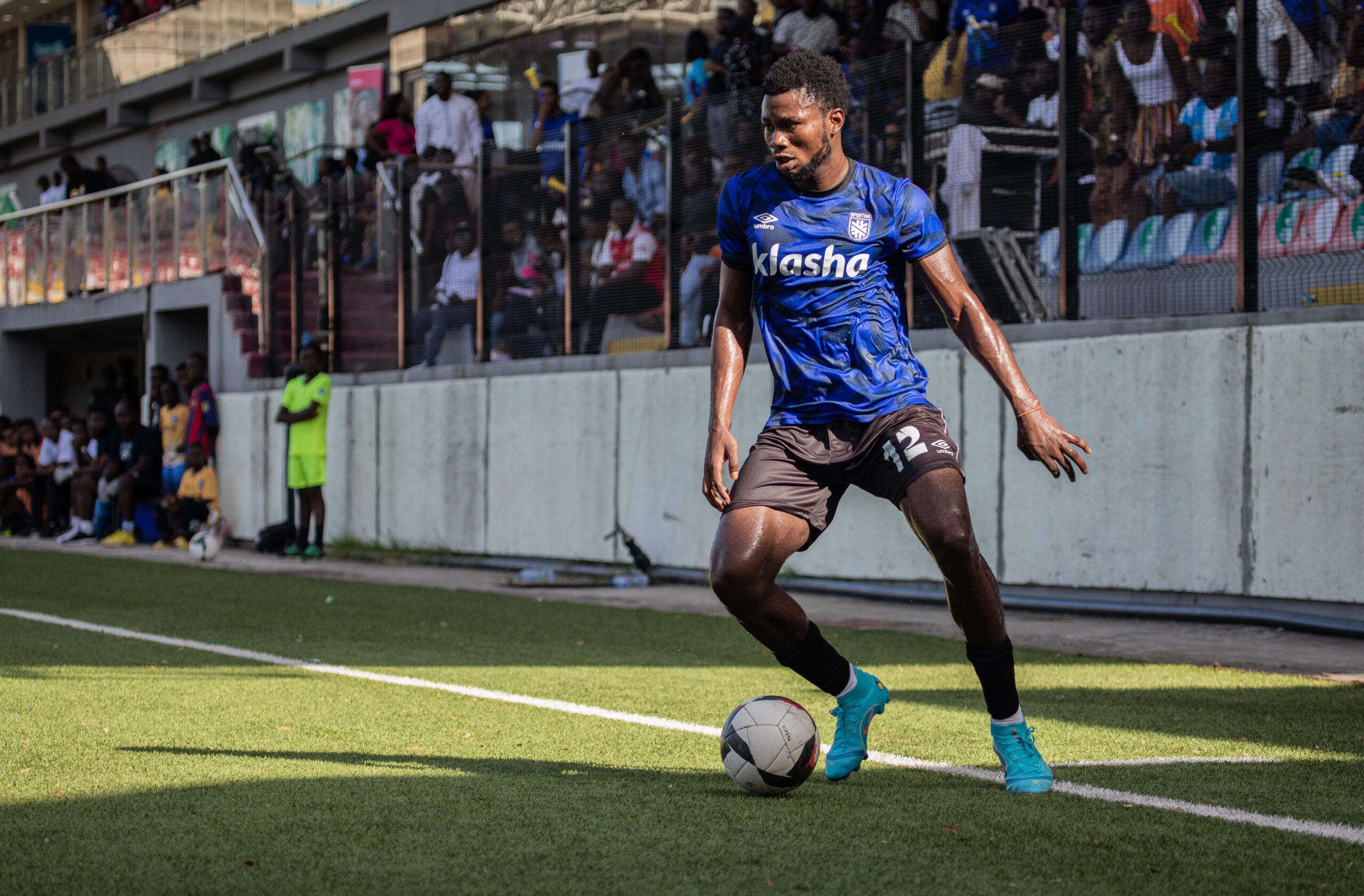
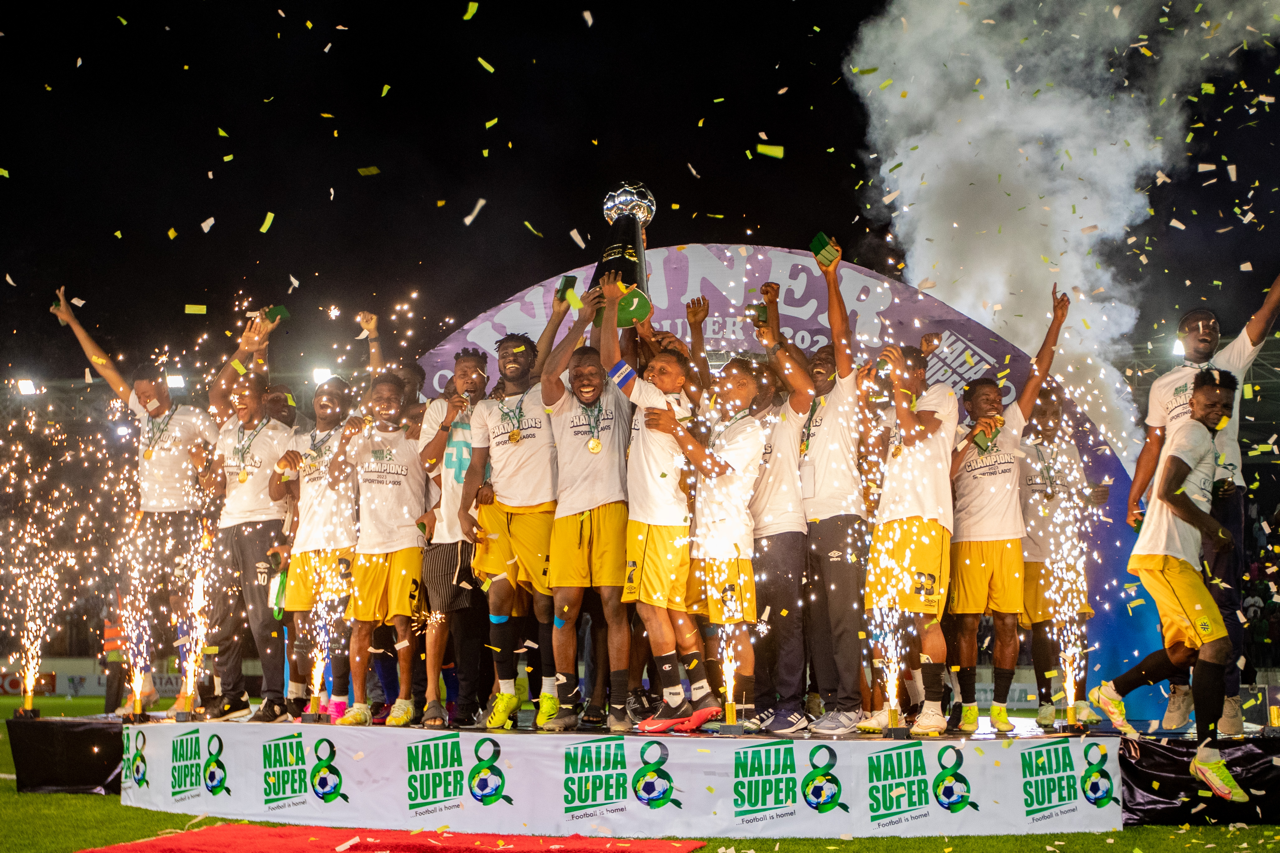
Sporting Lagos celebrates as champions of the Naija Super 8. Photo via Sporting Lagos

The ICIR: What has been the magic of your success as a football administrator?

Enakhena: Like I have told people there is no magic, it is putting God first, and number two, the experience will always come to bear. My attitude toward doing things is never to say fail.

Commitment and dedication you can never buy with money. I always believe that whatever I set my mind to,  whatever I do and put in every of my dime, knowing that God makes everything perfect. So my secrets are hard work, dedication, commitment, focus and asking God to take control.

The ICIR: How do you discover talent?

Enakhena: Discovering talents is not the job of a club chairman. The job of a club chairman is purely administration.

Well, the first to do as a club chairman is to get a good coach and get maybe a good backroom staff. When you put these together, it is now the job of the coaches majorly to get quality players. So, the coach gets the credit because if you get a bad coach, you are going to get a bad team.

The ICIR: Sporting Lagos home matches attract fans to the stadium. What is the brain behind it?

Enakhena: You know football is about entertainment but, sadly, in Nigeria’s football league, most of the clubs are run by governors for CSR, and sometimes publicity.

So, government, we all know is not in the business of making a profit. It is in the business to render services. We have some young people who have come together to say they want to do business with football and to engage in the business of football, so you must think of what can bring the fans to the stadium, what can make them choose you ahead of every other thing.

So, each time fans come to watch Sporting Lagos, they do not know who is going to be the musician or performer, and there is also the kick about. Different things that will put money into your pocket.

Imagine a fan coming to the stadium to watch football, and he or she goes home with N100,000; that is a big deal. So, you come to the stadium, and you are going back with a vuvuzela and flag for free.

Also, when Sporting Lagos plays, there are no areas for thugs because security is top-notch. Football is big business, and it is about competition. You must give something to the fans. Nigerians want to watch football. You have to give them a reason to come to the stadium; a value for money and their time.

The ICIR: In 2016, Mountain of Fire Ministries (MFM FC) brought the Premier League to Lagos; fast forward to 2023, Sporting Lagos is doing the same, and you were involved in the two clubs; what does that mean to your career?

Enakhena: I do not know what is my career. I am a journalist first and foremost, and that is what I will do until I die. Sports administration is a side hustle for me. What gives me money is journalism, not administration.

Before MFM, I organised a lot of grassroots competitions. MFM just gave me the platform to move a lot higher, and one thing I can not throw away is the experience I gathered from that top-level managing MFM football club.

So that stood me in good stead when I got the Sporting Lagos job. There are two different propositions. MFM was just youth repositioning, non-profit, while Sporting Lagos is strictly business.

There are two different propositions. MFM was just youth repositioning, non-profit, while Sporting Lagos is strictly business.

So that is the difference between MFM and Sporting Lagos but the truth is both of them are getting the youth engaged in profitable ventures, giving them opportunities to play football.

I always try to do things differently, my mum taught me something, she used to say, “The moment you can do what everybody can do with ease, that means you are nobody.” So I try to do what people can do, but I will do mine in one day, and they will do theirs in one week.

You know that it takes a lot of effort, commitment, and asking questions which is one of my strong points. I love to ask those who have been there before me. I used to call Rasheed Balogun, the late General Manager of Shooting Stars Sports Club(3SC) in Ibadan and Dominic Iorfa. So I marry everything I got and take the ones that I like.

So that is one of the things that I have been able to do.

Chisom Orji playing for Sporting Lagos. Photo Sporting Lagos.

The ICIR: You talked about the football business. Can you share how the business acumen of sporting Lagos?

Enakhena: Sporting Lagos is a baby of 16 months. You have to crawl before you start running. The good thing about it is that Shola Akinlade (owner of Sporting Lagos) has bought a club in Denmark, which means every year, as a matter of policy – has happened this year – a minimum of 2-3 best players in Sporting Lagos will be going to Denmark.

As a matter of policy – has happened this year – a minimum of 2-3 best players in Sporting Lagos will be going to Denmark.

This is the beginning of a bigger window to a bigger European market, so this is the number one side of the business.

Number 2, during match day, I never thought it would happen in my lifetime in the NNL, not even if in the premier league, some person would come and pay N500,000 to come and see our games.

I never thought that some person would pay N500,000. We have seven booths at the Onikan stadium. Inside the booth, there is a TV, AC, choice of wine and food. If you put N500,000 by 7 booths, that is N3.5M from the booths, that is minus sponsorship, gate tickets and souvenirs. It is one step at a time, and we will surely get there.

You can only sustain it (football club) by doing business. You find out that government club if they play, you will not find anybody at the stadium; they don’t care, but Sporting Lagos, without people at the stadium, then what are we doing?

The ICIR: Are the Nigeria Football Federation and League Management Company, LMC tapping your brain when it comes to football administration?

Enakhena: Let me say to you that the NFF and NPFL know what to do. They don’t need me. I am sure they know more than me, but the system has a way of handcuffing one when one is there; that is what they are battling with.

I always tell people that the problem with Nigeria does not mean that we do not know people who can fix things when you get in there; there is this thing that will teach you a lesson that this is not your property, that you are running it on behalf of the populace but this how you must do it.

So, you find the administrators struggling. Look, if a football administrator goes in front of a governor that appointed him or her on a Monday and you request for 72 months to give a result, the governor will sack the person.

So those who are appointed by the governors promise to give results quickly. So you find that the ‘win at all cost’ is caused by the governor. There is too much pressure placed on administrators to win.

At Sporting Lagos, we don’t have that. It was a youth repositioning agenda. I am boastful and said when I got the Sporting Lagos job that I would spend two years in the NNL, so it is about the person and the enabling environment to work.

The ICIR: Considering the environment you talked about, will you accept the tough NFF job?

Enakhena: The tough NFF job is not giving to anybody on a platter. I do not have billions of naira to spend. You cannot become NFF president without money. I won an election as the General Secretary of the Clubs Owners Association in Abuja. I didn’t spend one naira. So anything that will make me beg people, I won’t do it. If I think I have what it takes why should I beg anybody?

BBNaija All Stars: Uriel evicted from show

0

URIEL Ngozi Oputa, a housemate from Big Brother Naija All Stars, has been evicted from the reality show on Sunday, August 13th.

She becomes the second housemate to be evicted, following Princess, who got evicted from the show last Sunday.

For the eviction night, the jury included Laycon, the 2020 winner of the show (Lockdown- Season 5), Teddy A, a housemate from the See Gobe edition (Season 2), and Diana Isoken from the Level Up edition (Season 7).

According to the host, Ebuka Obi-Uchendu, the contestants in the bottom two were Uriel Oputa and Seyi Awolowo, with Seyi facing this situation for the second consecutive time. Nevertheless, the jury decided to save Seyi, allowing him to remain on the show leading to Uriel’s elimination.

Uriel Oputa, who was part of the second season of the reality TV show “See Gobe,” is no longer in the running for the N120 million star prize, leaving 18 housemates still vying for the coveted prize.

2022 flooding: over 660,000 households to benefit from NEMA’s livelihood supports

0

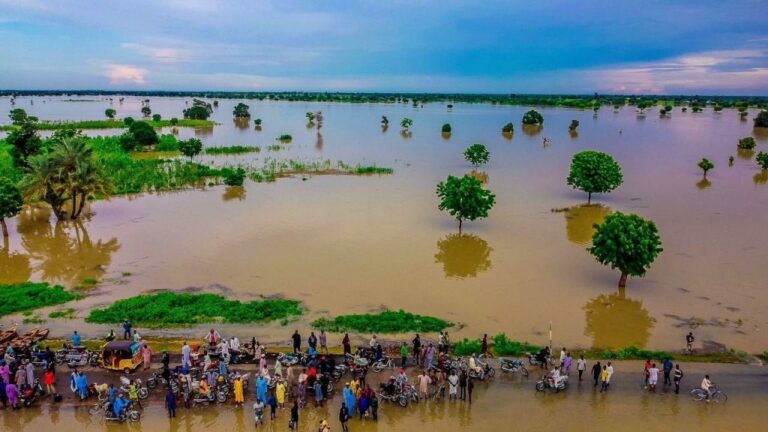
THE National Emergency Management Agency (NEMA) targets 660,884 households affected by floodings across the 36 states and Federal Capital Territory (FCT) for its livelihood support.

The agency disclosed this in a statement on Sunday, August 13.

It said the distribution was flagged off in Kano on Saturday, August 12, by the State Governor, represented by the Deputy Governor, Aminu Gwarzo.

The support targets persons classified as most vulnerable under the Special National Economic Livelihood Emergency Intervention (SNELEI) in Kano state.

“A total of 660,884 households were verified and targeted to benefit from this special intervention across the 36 states and Federal Capital Territory (FCT),” NEMA’s director general, Mustapha Ahmed, said.

According to him, the intervention is expected to stimulate value chain activities at the grassroots and, at the same time, the livelihood support items meant to help artisans to improve their businesses and grow the economy.

Ahmed had in January  said that over two million Nigerians were displaced by flood in 2022 during a one-week Strategic Executive Seminar for the agency’s staff and stakeholders.

He revealed that 662 persons lost their lives, 3,174 suffered injuries, and 2,430,445 individuals were displaced by the 2022 flood disaster in the country.

The ICIR, in various reports, had chronicled many cases of flood disasters in 2022, including the occurrences that happened in Bayelsa, flooding, Jigawa flooding, Kogi flooding.

In the statement on Sunday, the NEMA boss urged the beneficiaries to use the items properly to improve their socio-economic conditions.

“Beneficiaries are therefore advised to avoid selling the items and destroy the good intention of the Federal Government,” Ahmed added.

N110bn: SERAP sues Akpabio, Abbas over planned palliatives, bulletproof cars for lawmakers

0

THE Socio-Economic Rights Accountability Project (SERAP) has sued the leadership of the National Assembly over plans by the lawmakers to utilise N110bn as palliative and to purchase bulletproof and Sports Utility Vehicles (SUVs).

This was disclosed by the organisation via its official Twitter handle on Sunday, August 13.

“We’ve sued the Senate President, Godswill Akpabio and Speaker of House of Reps, Tajudeen Abbas over the unlawful plan to spend N110 billion to buy exotic and bulletproof cars for lawmakers and to provide ‘palliatives’ for new members,” SEARP posted.

In the suit, which was filed on Friday, August 11, SERAP demanded that Akpabio and Abbas be compelled to reduce the N40 billion budgeted for purchasing vehicles and repeal the Supplementary Appropriation Act 2022.

“SERAP is seeking ‘an order restraining Mr Akpabio and Mr Abbas from demanding or receiving the N40 billion to buy 465 SUVs and bulletproof cars for members and principal officials until an assessment of the socio-economic impact of the spending on the 137 million poor Nigerians is carried out in the public interest’ ” the organisation noted in a statement.

While Nigerians struggle with the rising cost of living occasioned by the removal of fuel subsidy and unification of the naira, members of the National Assembly approved N70bn to support the working conditions and an extra N40bn for the acquisition of vehicles.

The N110 billion shared among the 469 members of the National Assembly amounts to N234.5 million per legislator.

A report by The ICIR showed that the earmarked sum could improve the state of various sectors in the country, including health and education.

The report showed that N110bn could construct at least 3600 Primary Healthcare Centres (PHC) in different communities in Nigeria, going by the national budget of N30m per PHC contained in the national budget.

It can also be used to build 1,360 blocks of 11 standard classrooms across a country where overcrowded classroom continues to affect the quality of education provided, The ICIR reported.

NDLEA nabs drug baroness, 4 kingpins, recovers multi-billion naira worth of drugs

0

THE National Drug Law Enforcement Agency (NDLEA) has arrested a drug baroness, alongside three major illicit drug syndicates with a multi-billion-naira worth of Cocaine, Opioids, and Loud.

The Agency said the arrest resulted from intelligence-led operations across parts of Lagos state.

The drug enforcement agency, made this known in a statement issued on Sunday, August 13 2023, and signed by its  Director of Media and Advocacy NDLEA, Femi Babafemi.

According to the statement, a female head of one of the syndicates, Faith Ebele Nwankwo, was arrested on Wednesday, August 9, at her residence, House 6, C Close, 3rd Avenue, Festac area of Lagos, shortly after she returned from a warehouse at Plot 3432 Sola Akinsola Street, Divine Estate, Amuwo Odofin where she loaded eight cartons of tramadol 225mg into an unmarked white Honda Pilot SUV.

“A search of her residence and the warehouse led to the recovery of Two Million Seven Hundred and Fifty Thousand (2,750,000) pills of tramaking, a brand of tramadol 225mg and 250mg packed in 39 cartons weighing 1,916 kilograms. The drugs and the SUV were recovered while the suspect was taken into custody,” NDLEA said.

In another operation, the NDLEA stated that it targeted a group of transnational syndicates involved in the importation, exportation, distribution, and dealing of Cocaine and Canadian Loud.

“Operatives of the same Special Unit of the Agency on Friday, August 4, tracked the drug syndicate to Atlantic Nominee Estate in Lekki- Ajah area of Lagos where a blue Toyota Highlander SUV was loaded with 8.49kg of cocaine and 10.3kg Canadian Loud for distribution by the duo of Urama Chinemelum Precious, 32, and Adelakun Ilelabayo Oluade, 55,” the Agency stated.

The statement added that a follow-up operation at the residence of Chinemelum at House 7, Road 7, Lagra estate, Eti-Osa, Lagos led to the recovery of additional 18 blocks of Loud weighing 18.5kg.

According to the anti-narcotics Agency, on the following day, Saturday, August 5, operatives of the Special Unit went after another syndicate involved in the importation, distribution, and diversion of ephedrine hydrochloride, a precursor chemical used for the production of methamphetamine.

This followed intelligence that members of the cartel were planning to divert 25 kilograms of the substance.

Two members of the syndicate: Udeh Vincent Ogbonna, 53, and Okonkwo Ifeanyi Uzozie, 50, were arrested at a commercial bus terminal in Jibowu, Yaba, Lagos where they were attempting to send the concealed substance to the South East.

The Agency added that a body search on the two suspects led to the recovery of Three Thousand ($3,000) US Dollars found on Udeh Vincent Ogbonna.

Military coups in Africa: here’s what determines a return to civilian rule

0

By Sebastian Elischer, University of Florida

Slightly more than two years after Niger’s first peaceful handover of power from one civilian president to another, the military seized power in July 2023. The coup – the fourth in Nigerien history – follows on the heels of recent military interventions in Africa. Mali (August 2020 and May 2021), Chad (April 2021), Guinea (September 2021), Sudan (October 2021) and Burkina Faso (January and September 2022).

Since the end of the Cold War in 1991, the number of military coups has declined sharply. However, francophone west Africa now accounts for approximately two-thirds of all military coups that have occurred since then.

As a political scientist analysing African politics, I have studied military coups and their outcomes for the last decade and a half. In a recent article, Justin Hoyle, a doctoral candidate in political science at the University of Florida, and I demonstrate that since 1989, military coups across the world have resulted in two outcomes.

First is the withdrawal of the junta from executive power. This means the junta doesn’t participate or interfere in post-coup elections. While it is necessary for the transition to democracy, it isn’t sufficient in itself. This scenario played out in the Nigerien coup of 2010 and the Thailand coup of 2006.

Second is electoral rigging by the junta in favour of its own candidate. This scenario establishes a regime in which coup leaders entrench themselves in executive power.

Examining how military coups unfold is crucial to understanding a country’s path back to democracy. It also provides insights into the effect of coups on the quality of democracy.

The research

We studied five countries and 12 post-coup transitions: Egypt (coups in 2011 and 2013), Mauritania (coups in 2005 and 2008), Niger (1996, 1999 and 2010), Fiji (2000 and 2006) and Thailand (1991, 2006 and 2014).

Overall, we examined slightly more than a third of all military coups between 1989 and 2017.

Out of a total of 32 post-coup environments, we found that in half of all cases, juntas withdrew from executive power in the coup’s aftermath.

However, even with the military’s withdrawal from power, the transition period to civilian rule was highly volatile. Particularly in sub-Saharan Africa, counter-coup attempts by a rival faction within the armed forces intending to remain in power occurred rather frequently. This was the case most recently in Burkina Faso in 2015.

Although many coups result in the withdrawal of juntas from executive power, many of the cases from our study were near-misses – the country could’ve ended up under military authoritarian rule.

We examined four key variables and their influence on coup outcomes. These are:

  • the internal coherence of the armed forces
  • the ability of civil society organisations and political parties to mobilise against the junta
  • the deployment of donor leverage
  • trade dependency on regional and western partners.

Of these, we argue that the two that matter the most are: the internal cohesion of the military and the vibrancy of civil society groups.

The findings

In our analysis, we found that the single most important variable that accounts for different coup outcomes is the internal coherence of the military.

When there’s internal coherence, militaries generally feel inclined to withdraw from executive power. This is because holding on to power challenges their internal cohesion.

Internal cohesion is based on the factors that triggered the coup. If a coup occurs in response to threats to the country’s territorial integrity, to the preservation of public order, or to the military’s material or reputational benefits, the junta will have the backing of the military at large. This is because the benefits of seeking power outweigh the risks of not being in power.

If a coup occurs for reasons outside these, the junta either won’t seek power or will face resistance from within the military and withdraw. We found this confirmed in all the coups that we analysed.

Another relevant yet less significant variable is the positioning of civil society toward the junta.

Where civil society groups manage to rally the population to demand a return to democratic civilian rule, juntas depart from power. The most prominent example of this was in Egypt after the 2011 coup.

Interestingly, we didn’t find that aid dependency or membership in an international organisation with anti-coup rules exerted any discernible influence on juntas. This means that domestic variables – and in particular the drivers of the coup – influence political aftermaths.

What it all means

For the current transitions in parts of Africa, these findings are troubling.

In Sudan, Mali, Burkina Faso and Chad, militaries overthrew their governments because of threats to their countries’ territorial integrity or to the military’s material benefits. The juntas in these countries can rely on the backing of the military at large. This decreases the likelihood of a return to civilian rule.

The implications of our findings for Niger and Guinea are less straightforward, however. Here, coups were staged by a sub-section of the military, even though such a move wasn’t in line with the interests of the armed forces at large. Our research findings suggest a more volatile dynamic for these two post-coup states.

At this stage, no one can predict how the motives of Niger’s presidential guard will shape future action. Much will depend on coup leader Abdourahmane Tchiani’s ability to convince the military that a coup was the right thing to do politically.

Generally, military coups bode ill for democratic processes. In instances where juntas withdraw from power, democracies don’t emerge. When juntas rig post-coup elections, they become entrenched in power in the medium to long-term. This has devastating consequences for the political and civil rights of their populations.The Conversation

Sebastian Elischer, Associate Professor of Political Science, University of Florida

This article is republished from The Conversation under a Creative Commons license. Read the original article.

Nigeria’s crude oil output reduces by 40,000bpd

0

NIGERIA’S crude oil production fell by 40,000 barrels per day (bpd) in July relative to the previous month, reflecting a generally sluggish business activity in Africa’s largest economy.

The Organisation of the Petroleum Exporting Countries (OPEC) stated this in its Monthly Oil Market Report (MOMR) released on Friday, August 10.

The report showed that Nigeria’s crude oil output slid to 1.295 million bpd in July from 1.255 mbpd in June.

It stated that the total crude oil output produced by OPEC’s 13 member countries dropped by 836,000 bpd to an average of 27.31 mbpd in July, due mainly to a decline in production in Nigeria, Saudi Arabia, and Libya.

The OPEC members had in June this year agreed to cut production volumes to ensure global oil market stability.

For a long while, Nigeria hardly fulfilled the 1.8 mbps OPEC quota as it battles operational and security issues. In February, it only reached 1.38 mbpd, The ICIR reported, representing the highest production output since the beginning of the year.

From August to November this year, the country expects production output of 1.826 mbpd, 1.830 mbpd, 1.826 mbpd and 1.747 mbpd, respectively, while from January to December 2024, it is expected to reduce its production quota to 1.380 mbpd

The OPEC report noted that Nigeria’s economy, which grew by 3.3 per cent in 2022, is forecast to decelerate in 2023.

Growth in the first quarter stood at 2.4 per cent, following growth of 3.6 per cent in the fourth quarter of 2022, an indicator of this year’s anticipated slowdown.

High inflation continues to burden the economy.

Inflation data for June showed an ongoing acceleration, with an annual rate of 22.8 per cent, following 22.4 per cent in May and 22.2 per cent in April and 22 per cent in March.

Food inflation has been a critical factor in this rise, reaching 25.1 per cent in June after 24.8 per cent in May.

In the meantime, President Bola Tinubu has declared a state of emergency in response to the pressing issue of food insecurity.

“A combination of factors, including conflict, the impact of climate change, population pressures, and the below-average output of the agricultural sector, has exacerbated the scarcity of food resources over recent years,” OPEC highlighted.

On the fiscal side, the Federal government has unveiled a financial package amounting to N500 billion, while on the monetary side, the Central Bank of Nigeria lifted the key policy rate by 25 basis points to 18.75 per cent in July to lower inflation pressure.

As a consequence of the ongoing challenges, business activity retracted to stand at 51.7 in July after it reached a level of 53.2 in June, according to Stanbic IBTC Purchasing Managers’ Index (PMI) released in August.

It showed that business activity shrunk in July on rising input costs, although still above the contractionary threshold.

A PMI reading above 50 indicates that business activity is expanding, while below 50 indicates contracting.

It measures the performance of the private sector from agriculture, manufacturing, services, construction and retail.

Fuel subsidy removal and exchange rate unification are pressuring business activity, raising input costs, and weakening the naira.

The combination of rising petrol prices and increased electricity costs would exacerbate the difficulties businesses face and limit the manufacturing sector’s profitability, according to the director general of the Manufacturers Association of Nigeria (MAN), Segun Ajayi-Kadir.

Niger’s military Junta: Adeboye tells Nigeria to avoid fresh wars

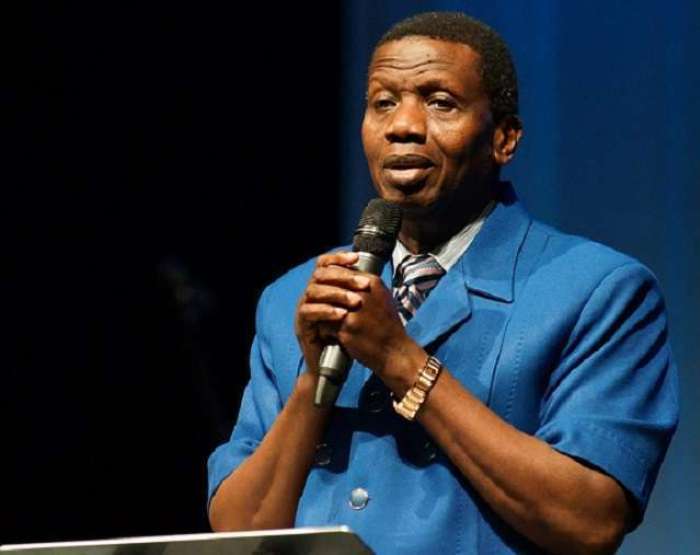
AS concerns grow over the military coup d’etat that took place in Niger Republic, the General Overseer of the Redeemed Christian Church of God (RCCG), Enoch Adeboye, has told Nigerian leadership to avoid possible fresh wars brewing in the West African country.

Already, there are safety concerns for communities along the over 1,500-kilometre-long Nigerian border, which shares proximity with the Niger Republic and covers seven states of Kebbi, Sokoto, Katsina, Jigawa, Zamfara, Yobe and Borno.

But the revered cleric, who reacted to the Economic Community of West African State (ECOWAS) order to reactivate military force against Niger Republic, said,” Nigeria is already fighting some serious wars and that the country does not need more wars.”

He spoke today at the church’s 2023 Convention with the theme, ‘Beyond Expectations’.

He said, “We are still fighting wars against hunger. We are fighting some serious wars and sure, we don’t want more wars. We want to win the ones we are fighting, and we don’t want fresh ones, whether within or without our borders,”

The cleric, who shared his personal experience on the Nigerian-Civil War between the Nigerian and Biafran sides from July 1967 to January 1970, said peace is always preferable to war.

“Nigeria still needs a lot of prayers. I’m a small boy, but I was at the battlefront during the civil war, not as a soldier, but I lived near the battlefront, and what I saw, if anybody asks me to choose between war and peace, I will choose peace.”

Adeboye said Nigeria is already fighting several wars against kidnappers, terrorists, amongst others, while he stressed that “the country does not need more wars but to win the ones it is battling currently,”

“We are already fighting many wars in Nigeria; we are fighting wars against kidnappers. We are fighting wars against terrorists. There are still places in Nigeria today that when people go to bed, they are not sure they would not be killed before tomorrow morning,” Adeboye said.

He said,” We still fighting wars against some people who feel that if you are a farmer and you plant, then what you have planted is food for their cows, and if their cows come to eat your harvest and you complain, they kill you.”

Adeboye’s comment followed the controversy over the proposed deployment of soldiers to the Niger Republic by the Economic Community of West African States (ECOWAS) under the chairmanship of Nigeria’s President Bola Tinubu.

Recall on July 26, 2023, the military in neighbouring Niger Republic snatched power from the constitutionally elected government of President Mohamed Bazoum.

ECOWAS subsequently gave the troops who seized power until last Sunday to reinstate 63-year-old Bazoum or face the potential use of force through the deployment of troops of the ECOWAS Monitoring Group (ECOMOG), a multilateral armed force drawn from the 15-member states, to compel a return to democracy.

Nigeria has also cut off electricity supply to Nigeria amid a flurry of economic sanctions, including border closure, but the coup leaders remained defiant, and the deadline passed without action.

Tinubu urges young police officers to shun corruption

0

PRESIDENT Bola Tinubu has admonished young police officers to shun all forms of corruption and adhere to the ethics of modern policing in discharging their duties.

The President gave the charge at the graduation ceremony of 169 graduands of the Nigerian Police Academy, Wudil, in Kano State on Saturday, August 12.

Tinubu, represented by Vice President Kassim Shettima, urged the fresh officers to be professional in their duties to impact the country’s security architecture positively.

He also urged the officers to stay vigilant to the ideals of the Nigerian Police geared towards ensuring effective service delivery.

“You should have it in mind that Nigerians have high expectations of you; you must brace up to face the challenges ahead,” he said.

Tinubu also told the officers to put the nation at heart and handle their constitutional responsibility with utmost dedication and commitment.

The President also assured the young officers that the federal government would continue to support the Nigerian Police Academy, noting that it remains “one of the best training grounds for police officers in the sub-Saharan region.”

There are concerns that policing, which plays a vital role in maintaining law and order in any society, has lost the public trust and confidence in Nigeria.

Accordingly, public trust in the police seems low, as shown in various studies, The ICIR reported.

In a recent incident on Friday, August 10, the Osun State Police Command confirmed the arrest of some of its personnel for extorting commuters along the Ile-Ogbo-Iwo road in the state.

Also, a report on April 13, 2022, by The ICIR indicated how the United States (US) accused the Nigerian police, among other security agencies, of corruption and other unethical practices.

In a related development, the acting Inspector General of Police (IGP), Kayode Egbetokun, warned officers against corrupt tendencies damaging the image of the profession in the eyes of the public.

Egbetokun reportedly said this while he addressed officers and men of the Kano State Police Command on Friday, August 11.

Extolling the Nigerian police to be one of the finest in the world, the acting IGP, however, said police officers needed to be seen as above bribery and corruption.