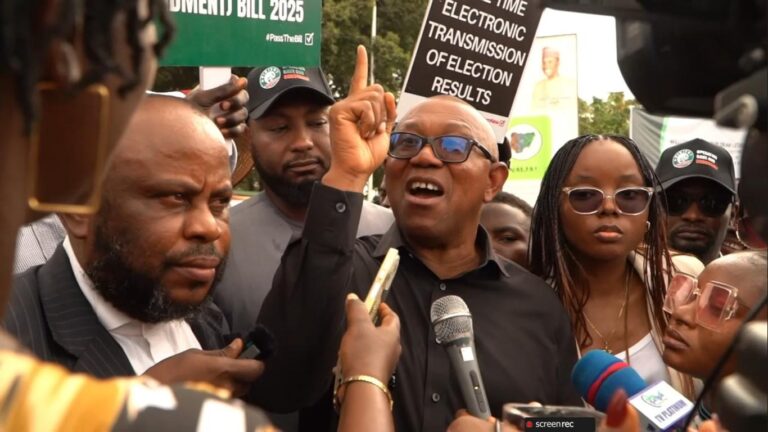
THE 2023 presidential candidate of the Labour Party, Peter Obi, has joined the coalition of civil society organisations to demand the inclusion of a compulsory provision for real-time electronic transmission of election results in the Electoral Act (Amendment) Bill, warning that Nigeria’s democracy would not survive without credible polls.
Obi made the demand during a peaceful protest organised by a civil society group, “Enough is Enough”, at the National Assembly on Monday in Abuja.
“Election must take its process from the beginning of qualification to the campaigns, to the debates. Everything must be done in a manner that we will show we are exemplary as giants of Africa. This giant must now rise and be giant. We cannot continue to be giants in doing the wrong thing. We want to be giants in doing the right thing now. We must dismantle our criminality and show that we are not a nation that should lie to Africa,” Obi said.
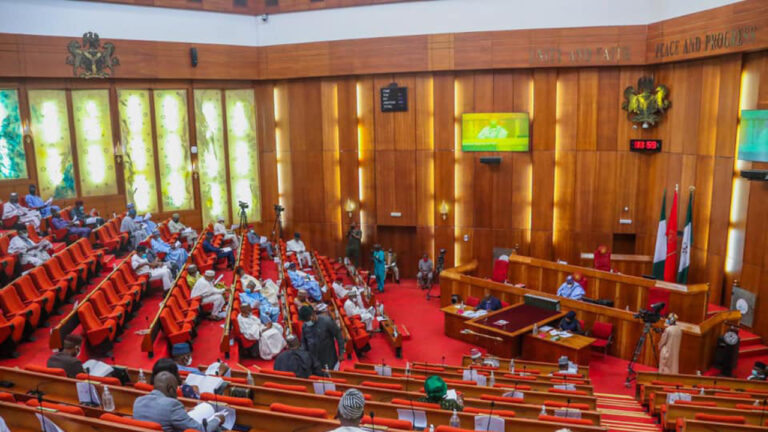
The ICIR reported that the Senate on Wednesday, February 4, approved the Electoral Act (Amendment) Bill which introduced several changes but failed to include real time transmission of results from polling units to INEC’s Result Viewing Portal (IREV), as advocated by most Nigerians.
Some senators in the minority caucus told journalists on Thursday that the approved Electoral Bill did not accommodate real time electronic transmission of election results.
However, the Senate President, Godswill Akpabio, speaking at a book launch on Saturday, acknowledged that the Senate removed the provision for mandatory real-time electronic transmission of results during the clause-by-clause consideration of the amendment.
He said the decision was informed by concerns that enforcing real-time transmission could lead to legal disputes in the event of network failures during polls.
However, during Monday protest, the representative of Lawyers in Defence of Democracy, Okere Kingdom, said in the Electoral Act, there must be provision for transmitting election results from the polling booths to online, in real time, for Nigerians to view on IReV. He insisted that anything short of mandatory electronic transmission would leave room for votes manipulation.
He accused the former INEC chairman, Mahmood Yakubu, of what he called “wrongful exercise of discretion” during previous elections, alleging that objections raised by stakeholders were ignored, leading to disputed outcomes.
“The description that Yakubu Mahmoud exercised when he leveraged on the current Electoral Act, how did he exercise it? Objection was raised at the International Conference Centre. He ignored his own regulation. The regulation said if an objection is raised, you will suspend everything and resolve it.
“When objection was raised, he ignored it and continued and delivered a wrong result, a fraudulent result. So, we are saying no wrongful exercise of description. The Senate must know that Nigerians are saying no and will resist wrongful exercise of description,” he added.
Similarly, an activist, Aisha Yusufu, said that Nigerians were no longer interested in “press conferences, media rounds or Twitter spaces” by senators, but concrete legislative action, noting that the National Assembly had the constitutional authority to ensure that electronic transmission of results is clearly provided for in the law.
“The Senate President is saying that there are places where there are no networks. If they don’t have, which is a shame by the way, Nigeria would provide that network. If either can register everywhere, they can also provide those networks,” she said.
The activist countered Akpabio’s position, noting that telecommunications companies provided network coverage across the country and that the same infrastructure used by INEC for voter registration could support result transmission.
Also speaking at the protest ground, Isaac Fayose, younger brother of former Ekiti State Governor Ayo Fayose, dismissed claims that poor network coverage would make electronic transmission of results impossible, describing such arguments as excuses meant to justify electoral fraud.
He questioned how Nigeria could justify spending hundreds of billions, and in some cases trillions of naira, on elections and technology, only to abandon a system designed to guarantee transparency.
“How do we explain something that we spend close to a billion, a trillion, and you just want to throw it away like that? It’s like carrying our money, throwing it like that. No, it’s not possible,” he said.
The ICIR reported that threatened by criticisms that trailed the Senate’s position, Akpabio directed his colleagues to reconvene for an emergency plenary session on Tuesday, February 10.
The Upper Chamber had adjourned for a two-week recess after approving the bill, to enable senators to engage heads of ministries, departments and agencies (MDAs) on the defence of their 2026 budget proposals.
Under Clause 60 of the bill, the Senate retained the provision in the Electoral Act which permits the transmission of results to collation centres.
On voter identification, Clause 47 was amended as lawmakers rejected a proposal to allow alternative forms of identification other than the Permanent Voter Card (PVC). While “smart card readers” were replaced with the Bimodal Voter Accreditation System (BVAS) for accreditation and voting, the Senate retained the PVC as the sole mandatory means of voter identification at polling units.
Earlier, the bill had proposed that because BVAS would not read the microchip embedded in PVCs, the card should no longer be compulsory, allowing voters to use the National Identification Number (NIN), international passport or birth certificate. However, the Senate disagreed and upheld the PVC as the primary mode of identification.
On Clause 22, which deals with PVC-related offences, lawmakers rejected a proposed 10-year jail term for buying and selling PVCs. They instead retained a two-year imprisonment term and increased the fine from N2 million to N5 million.
Regarding proof of non-compliance, the Senate deleted Clause 142, which would have allowed political parties to establish non-compliance solely through original or certified documentary evidence without oral testimony. Lawmakers argued during clause-by-clause consideration that the provision would amount to a “waste of time in court.”
On ballot paper inspection, Clause 44 was retained, maintaining the existing procedure that gives political parties two days to submit written approval or disapproval of their representations on sample ballot papers. INEC is also required to invite parties to inspect sample electoral materials at least 20 days before an election.
Under Clause 29, the deadline for political parties to submit candidate lists was reduced from 120 days to 90 days before an election.
To curb vote buying, lawmakers also amended Clause 22 to impose stiffer penalties, increasing the fine for offenders from N500,000 to N5 million.
On post-election disputes, the Senate amended Clause 136 by removing the power of election tribunals to declare winners outright in certain situations. The amendment provides that where a candidate is found not to have been validly elected for failing to score the majority of lawful votes, a rerun election shall be conducted, and the disqualified candidate and sponsoring party will be barred from participating.
This provision differs from the 2022 Electoral Act, which allows a tribunal to declare the candidate with the second-highest number of valid votes the winner where the candidate with the highest votes is found to be unqualified.