Home Blog Page 869

Flooding: What is Niger state doing to mitigate future disaster?

One year after flooding affected communities in Niger state, The ICIR’s Mustapha USMAN visited several local governments to examine the level of government preparedness to deal with potential flooding and mitigate reoccurrence.

See also: Flooding: What is Jigawa state doing to mitigate future disaster?


Kushogi

In Kusogi, a community in Mokwa LGA, Niger state, the memory of the devastating floods that forced residents to abandon their homes still haunts them as many lives were lost, farmlands were damaged, and properties ruined.  Despite this unfortunate mishap, the government’s response has been lacking, with no flood prevention measures or control projects initiated in the village.

As of October 2022, residents of this community, along with their neighbours in surrounding towns, were forced to abandon their homes due to the onslaught of heavy flooding. 

Before seeking refuge in an official Internally displaced persons (IDP) camp and makeshift huts, inhabitants of Kusogi squatted in a few houses in large numbers. However, as the flooding became more severe, overburdening even the houses, they gave up and had to flee. 


READ ALSO:


Situated in a riverine area, the community had experienced periodic flooding, but this was one of the worst. While it appears that there may be a similar occurrence this year due to the forecast by the Nigeria Meteorological Agency (NiMET), survivors in this community have returned to their homes; this time, they vowed not to relocate even if there is a repeat of last year. 

Some of the reasons cited are hunger, government neglect and lack of basic amenities in their camps.

The ICIR investigation shows that should the forecast become a reality, the community is at risk of losing lives and property as no flood preventive measures and control have been launched in the village – either by the government or the residents.

Yahaya Mohammed
Forty-year-old Yahaya Mohammed who lives in Kusogi was one of the victims of 2022 flooding incident as he lost his property to the devastating force of the flood. Photo: The ICIR/May 2023.

Forty-year-old Yahaya Mohammed, an inhabitant of Kusogi, explained that flood cut off roads to adjoining villages, and they resorted to using canoes for evacuation. The canoes could hardly take up to 20 residents each.

He said,  “It has been eight years now that the government intervened in our plight”, adding that the Hydro Power Producing Area Development Commission (HYPPADEC) visited his village and promised to help the residents in the area with relief materials and fertilisers but failed to deliver.

Kusogi was among the major areas affected by flood in 2022 as scores of houses, thousands of hectares of farmlands, infrastructures and roads were flooded. Beyond the infrastructural damages, many people were reported dead, while thousands were displaced.

The flooding across the country affected 35 of the 36 states and FCT, which Niger state is among. In Niger state, about 35,629 persons were displaced, over 37,000 hectares of land were washed away, and 12 died. 

Ketso

Ketso one of the most affected but no visible proactive measures 

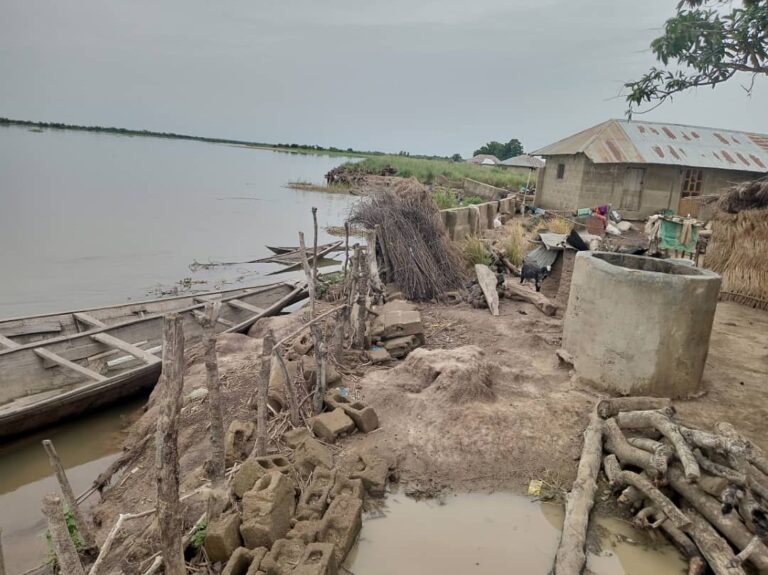
Ketso villageKetso village. Ketso is located in the shore of River Niger, thus prone to flooding every year. Photo: The ICIR/May 2023.
Ketso village. Ketso is located in the shore of River Niger, thus prone to flooding every year. Photo: The ICIR/May 2023.

The absence of effective flood control measures, infrastructure improvements, and proactive disaster management has left residents of Ketso, a village in Mokwa, exposed and vulnerable to future climate disasters.

According to reports and residents who spoke to The ICIR, this village was one of the most affected areas by flooding last year. The entire area was submerged by water, leading to the loss of lives and property.

Another house on the shore of thAnother house on the shore of the River Niger in Ketso village. Photo: The ICIR/May 2023e River Niger
Another house on the shore of the River Niger in Ketso village. Photo: The ICIR/May 2023

The village is close to multiple waterways, making it susceptible to future floods. Aside from that, the village hasn’t recovered from last year’s loss as schools, houses, and primary health care in that area remained closed, thus causing distress to the residents. 

The ICIR investigation revealed that there’s no single project launched in the villages either by the government or the community despite the severity of last year’s flood and the urgent need for resettlement.

The Back view of some of the houses previously affected by flood in 2022. Photo: The ICIR/May 2023

When The ICIR visited Ketso, the lands allocated to the village for relocation purposes, as directed by the villagers, remained undeveloped, lacking both housing and necessary facilities. The villagers blamed the lack of development on the paucity of funds from the government.

Although HYPPADEC public relation officer Nura Tanko blamed the situation on the area’s inaccessibility, he stated that the initial contractor who was awarded the project left the site and abandoned the project.

However, he noted that the HYPPADEC didn’t plan to execute drainage projects in these communities as they planned to get them housing in upper land.

While speaking with The ICIR in May, he said, “We have already awarded this project about three months ago with the intention that before the rain starts, the project will be completed, but the contractors found it very difficult to assess the areas because of the nature of the place. He abandoned the site, but we mobilised another contractor, who has now resumed work in Muregi and Ketso.”

He also noted that villagers mistook another place for the project’s construction site as the housing scheme was already launched in a place known as the new Ketso and Muregi.

Idris Mohammed, a 37-year-old farmer in Ketso, while explaining the plights and hurdles they went through during the flooding incident, said “When it submerged houses, we deserted village to upland. But when we returned home, our buildings were completely destroyed.”

Speaking further, Idris explained that many farmers took loans to renovate their houses and start afresh.

While appealing to the government, he said, “If the government can not prevent flooding in this community, the hectare upland can be built for us. That is the help that we are seeking from them. It will be the biggest intervention from the government.”

A 25-year-old farmer and the Secretary to the village head, said they have experienced annual flooding for a decade, “When it floods, more than 30 people live in a single room.” 

According to him, in a few months to come, no adjoining villages can cross to this village. The ICIR can also confirm that the only bridge that joins the community to other villages and the outside world has been destroyed by flood. One would need to journey on a canoe to get basic amenities.

“Before the election, I took the village head to Muregi where HYYPADEC flagged up”, Usman noted, adding that HYYPADEC promised to build 50 rooms, but they are yet to hear from them.

Unlike residents of Kusogi, who have remained steadfast about not relocating should flooding happen, Ketso inhabitants claimed that by September, they would temporarily seek refuge elsewhere.

Zhiwu and Muregi

Two other villages affected by the flood that The ICIR assessed and observed that there are no flood and erosion control projects are Zhiwu and Muregi.

Like Kusogi and Ketso, these two villages were severely affected by the flood, leading to the loss of lives, farm products and houses. Residents of these communities who were also displaced have now returned to their homes amidst rising fear of future occurrences.

Mariga

Locals deploy self-help to mitigate flooding in Mariga

A drainage system completed by residents of Mariga
The view of  the abandoned drainage project in Mariga. A project now being completed and repaired by residents of the community. Photo: The ICIR/May 2023.

After suffering extensive damage from last year’s floods, including the horrifying sight of a dead body floating in waterlogged graveyards, residents in Mariga resorted to self-help to repair the abandoned drainage system that has left residents vulnerable to the devastating impact of flooding.

One major concern is the poor state of the road linking Mariga Market to Gulbin Gada, which experienced severe flooding on Monday, May 22, a day before this reporter visited the location. Due to a blockage along its path, water inundated houses and caused widespread damage.

The ICIR gathered that the drainage construction project in the area, initiated by the government, has been left unfinished, leaving the waterways obstructed. The lack of proper drainage systems has further compounded the flooding problem. 

Frustrated by the government’s negligence, the community took it upon themselves to repair and complete the culvert.

Culvert repaired by Mariga residents
The yet to be completed drainage project in Mariga. A project now being completed and repaired by residents of the community. Photo: The ICIR/May 2023.

The flooding affected 1500 graves last year.  Reports stated that over 1000  decomposed bodies were reburied after the incident, noting that mining activity in the region also contributed to the unfortunate event. 

Shafi’u Nata, a 23-year-old residing in Mariga, expressed his concerns about the dire situation. “To tell you the truth, last year’s flood has inflicted damages to our graveyard up to the extent that you can see a dead body floating on water. People have to join forces to relocate graves to safer places because of the water that is flowing.” 

“We are anticipating heavy rainfall and the likelihood of flooding this year,” Nata warned. “Even yesterday’s rain experienced blockages in its passage, leading to the forceful breakage of some portions of the road. If not repaired, we fear this project [abandoned construction] may be damaged from the ground.” 

“As you see, the water that is coming out from the community has no passageway,” Nata pointed out. “Here, we organised a self-help project to repair a damaged culvert by the caterpillar when they were carrying out the work. We have now repaired it ourselves.

Dayyabu Kabiru Maga, 30 years, another resident of Mariga said, “As a community whose majority of its members are poor, we can’t do anything because it has passed our capacity. Look at the size of the graveyard, a poor man can not do anything to repair it, and we have severally appealed for help, but nothing came. Even the Emir had come, we had one of our townsmen as Commissioner, he came and visited the place, we had state assembly members, they all came in fact their dead parents and relatives are buried here, but they did nothing”.

“We are afraid now if another rain comes and floods occur; we don’t have anywhere to go. All that we can do is to turn to God. Look at this deep hole here (Pointing directly to the abandoned culver) that they started work and abandoned it. We wish they did not even start it because it has no significance. They have blocked waterways. Even the rain that fell the day before yesterday has filled up the place because they have destroyed the mini bridge here.”

Shiroro

Inadequate response in Shiroro LGA

Gwada IDP, where displaced persons by flood camped last year
Gwada IDP, where displaced persons by flood camped last year. Photo: The ICIR/June 2023

The flooding incident in Shiroro LGA was not different from other LGA, as about five communities bordering Zungeru hydroelectric power station were affected during the last year’s rainy season. The communities – Gurumana, Palei, Nmachi, Npani, Zangoro, Masuku, and Magani – according to a report, were affected due to the ongoing construction of the power station.

The then Niger state governor also confirmed the incident, noting that the FG made provisions for the affected communities to move to higher grounds. However, villagers claimed neglect in the camp and are returning to their flood-prone communities. 

The ICIR gathered that the Federal Government commenced the Zungeru Hydro Electric Power Project in 2013 — an infrastructure that has now caused the displacement of hundreds of residents who were living on the shore of the dam.

Zungeru hydroelectric power plant. Pc: Niger state govt.

The project, which commenced during former President Goodluck Jonathan’s administration at a contract rate of N162.9 billion, was awarded to Messrs SYNOHYDRO Corporation/China Nation Electrical Engineering Corporation Consortium for N162.9 billion.

During the previous year’s rainy season, many villagers from the affected areas were forced to evacuate their homes and seek shelter at the Central Primary School Gwada, which served as a camp for displaced persons.

The camp, which housed people displaced by banditry, was now faced with people displaced by flooding. The then governor of the state, Sani Bello, had said: “We have almost 4,000 IDPs displaced by banditry and the construction of Zungeru dam; some communities have been flooded and are underwater and have left, while they have not been paid compensation.”

“The situation is serious; we are concerned that epidemics can spread. We are making efforts with security agencies as they have been up to the task and have dealt decisively with the bandits,” he said. 

During the peak of the flooding in September-October, some villagers resorted to building makeshift shelters, as the Gwada camp was unable to accommodate more people. 

Situation of the Gwada camp when The ICIR visited.

However, when The ICIR visited the camp on May 22, 2023, the camp appeared sparsely populated. The camp chairman Lado Pada explained that those displaced by the flood had left. “Now they left because they are looking for where they can get food and water to drink. But we that left Kore are in the IDPs camp, and we are appealing for assistance from wealthy individuals and the government.”

Rafin Gora

In Kotagora, projects are half done

One of the projects constructed to mitigate the effect of flooding

To assess the government’s proactiveness in preventing flooding, The ICIR visited Rafin Gora, a community affected by flood in Kontagora. 

Findings revealed that to mitigate the effect of flooding, Niger state government initiated a project in the area late last year, which lasted to early this year. There were constructions of a substantial drainage system, waterways and culverts in one of the places that leads to the village.

Culvert built to mitigate flooding

The ICIR was unable to ascertain the contractor’s identity, as there were no signboards or project offices.

There are two major routes through which water enters the community, and the government has taken measures to address one of these routes.

However, the other waterway remains a significant concern for the residents, as previous flood incidents have already widened it.

Other waterway yet to be addressed by the state government

The ICIR gathered that Niger State Executive Council in 2020 approved the continuation of the construction of drainage channels in the Minna metropolis and the extension of a similar project in Kontagora to avoid flooding.

The then commissioner for Works and Infrastructural Development, Ibrahim Mohammed Panti, explained that the Minna metropolis drainage construction work was paused due to some challenges beyond the control of the contractor which was awarded last year at the cost of over N1.4billion, adding that a similar project in Kontagora has been extended with the additional cost of N635.3million.

Speaking on the intervention received from the government, a 40-year-old Rafin Gora resident Bilyaminu Ango explained that although both the state and local government have attended to some of their needs, he still wished they could do more.

He said, “Government did their best, especially our state government and local government and also the elected governor sent his people to check the place last month. But I still appeal to the government to help us and execute another project in our community, especially the remaining waterway. Because they only contracted one area, and we want them to help us with more culverts in the village.”

Another drainage system in Rafin Gora

Beyond losing houses, property and farm products, Yunusa Kabiru, 49 years old, lost two children and one sibling to the flood last year when the flood hit the community.

When asked if he is planning to relocate this year, he said, “We are going to relocate because even now we are preparing to relocate. Yes, we have intervention from the government; even the governor visited us more than two times and helped us. They helped us with a culvert and a drainage system at the back of our village.”

Flood prevention in Niger state and FG’s Budget

As the flood caused many untold effects last year, the Federal Government under the administration of Muhammadu Buhari took a step towards preventing the flood by budgeting a sum of N43.7 billion out of the approved N49.7 billion for the capital expenditure of the federal ministry of environment. 

The FG reported that the amount is a 141.6 per cent increase on the sum of N18.1 billion budgeted for erosion and flood control in 2022. In the budget, the ministry is allocated N86.4 billion for personnel, overhead and capital development fund for the entire 2023.

Also, the National Assembly directed a committee to introduce N200 billion in the budget for ecological funding under the Presidency to prepare and plan further ahead for recurrent floods. This development is to prevent flooding nationwide and prepare a lasting solution to the climate problem. 

Similarly, the Niger state earmarked 2.4 billion towards erosion and flood control in their 2023 budget. The projects as nominated by Niger government are the provision of 2no Hilux Vans and 30no motorcycles for Forest Protection Enforcement (statewide) at a contract amount of (N90,000,000.00) distillation of mega drainages and Water-ways in Minna, Suleja, Bida, Kontagora and New Bussa at a contract amount of N20,000,000.00 in Borgu and Agro-climatic resilience activities for semi ARID landscape project (statewide) at N2,327,480,000.00.

Meanwhile, efforts to check other flood-related projects using the Niger state Open Contracting Portal proved abortive as the state failed to upload all the 2023 projects under the Ministry of Environment and Forestry.

The ICIR further checked whether the state government procured flood-related projects in 2021 and 2020 under the same ministry but got no result. Checks by the Ministry of Water Resources and Development and Ministry of Local Government, Community and Development Chieftaincy Affairs to see if the government takes an approach from the Local Government position also showed no result.

Ecological fund from FG and alleged corruption

Dataphyte report shows that 36 states received a total of N64.417 billion as ecological funds between 2021 and 2022. The report noted that the Niger state government got N1,395,465,315 as the ecological fund to mitigate the effects of climate change within that period.

The Ecological Fund is an intervention fund by the Federal Government of Nigeria to address the multifarious ecological challenges in various communities across the Country.

Data for the National Bureau of Statistics shows that Niger state’s ecological fund in December 2022 was N71.8 million. The amount was part of the N1.44trn disbursed by the Federation Account Allocation Committee (FAAC) to the three tiers of government in January 2023 from the total revenue generated in December 2022.

However, several reports indicated corruption and mismanagement of money in using the fund. Earlier in 2023, the former president challenged the state governors to account for all the allocated ecological funds in the past years.

Affected residents need to exercise patience – HYPPADEC

The HYPPADEC spokesperson Nura Tanko, while responding to some of the findings by The ICIR, said the commission is doing its best and needs to prioritise the most hit communities. 

“As you know, this problem has accumulated for over five decades, and these communities are dealing with socioeconomic and ecological challenges. Addressing it to the satisfaction of the people going by their expectations is not a day or two days job. We are just two years old,” he said.

“Resources also matter in addressing this issue. I can tell you we have actually done our best, and where people are not satisfied with what we are doing, all they need to do is to exercise patience. We can’t rise up in one day and address all the issues.”

“We are sure that we experienced last year no matter the amount of torrent flood, we aren’t going to experience it again. We have re-channelled the water, and we constructed dykes to prevent it from cutting off the road.”

When asked about Ketso and Muregi, he said, “For Ketso and Muregi communities, our plan is not to provide ecological intervention within the existing community, our plan is to relocate these people to where the state government has provided for their relocation and as I speak with you, construction of houses for their relocation has started in a place identified by the state government where the government constructed a clinic and palace for the district heads.”

“For Mariga, as we address these things in batches, it will get to them. We can’t address all this problem overnight because of resources and the number of communities we operate in the six states.”

Speaking on the Hydro Electric Dam project in Shiroro LGA, Tanko said communities in that area have enjoyed the commission’s intervention, which is in contrast to what The ICIR  reporter gathered on the field. 

“For the Hydroelectric dam, the communities I can tell you about have been enjoying our intervention because we consider them as HYPPADEC communities. Controlling ecological problems is the most expensive project. Flooding is a problem, and it comes with another problem. Whenever there’s flooding, people usually suffer access to potable water and construct boreholes for them.  We are also planning to move them.” 

When asked about the idea of dredging River Niger, he explained that the idea is not an easy task, and the Federal government cannot take the challenge currently. 

The managing director of HYPPADEC, Abubakar Yelwa, had earlier noted that to dredge River Niger, River Benue, and River Kaduna, the Federal Government will have to spend over $20 billion.

The HYPPADEC boss, unfortunately, stated that the process will be difficult for the federal government to handle without intervention from international donor agencies.”

Need for urgent policy coherence in Nigeria

The team lead of GIFSEP, who is also the Africa Regional Coordinator Citizens Climate International, David Mike Terungwa, said there is no policy coherence on flood management in Nigeria. 

“There is no one single policy on flood management in Nigeria. Different agencies of Government work on flood and flood-related issues. The Nigeria Hydrological Services Agency is saddled with the responsibility of providing the flood outlook of the country.  The federal and State Governments have the National Emergency Management Agency and the State Emergency Management Agency, respectively. These agencies have more to do with disaster response than prevention. There is, therefore, an urgent need for a policy coherence in respect to flood management and control policy. Programmes and plans integration exist usually between the three tiers of government federal-to-states and states-to-local governments.”.

He also stressed that lack of land use planning and enforcement of sustainable land use and urban planning laws affect flood control.

He said, “There is also the lack of early warning systems and downscaling of flood risk and seasonal rainfall predictions. The annual predictions made by NIMET are not downscaled enough to the vulnerable communities. There is also the lack of proper awareness and public sanitisation on climate change and its associated risk such as floods.” 

He added that  “effective Cooperation and collaboration among relevant Government agencies is key to solving this problem. There is an urgent need to form an intergovernmental agency both at the federal and the state levels that will work beyond the provision of relief materials alone but focus on prevention. This is a combination of awareness, relocation of people from flood plains etc.  It is very important to involve stakeholders from the community; the state and local governments have a huge role to play.”
Resurgence of malaria in US after 2 decades sparks concerns

UNITED States (US) health officials have issued a warning following the identification of five cases of malaria in Florida and Texas among individuals who had not recently travelled overseas.

This has raised concerns about the possibility of local transmission of the life-threatening disease within the country.

Authorities in Florida have confirmed four locally transmitted malaria cases in Sarasota County since May, with an additional case identified in Cameron County, Texas.

These cases mark the first instances of local transmission within the United States since 2003.

The Centers for Disease Control and Prevention (CDC) has assured the public that all patients have received treatment and are currently recovering.

The CDC emphasised that there was currently no evidence to suggest a connection between the cases in Florida and Texas.

Nevertheless, investigations have revealed that at least two individuals, one in Florida and another in Texas, had spent prolonged periods outdoors, raising questions about potential exposure to infected mosquitoes.

The CDC also cited an increased risk of “imported malaria cases” as the summer travel season unfolds.

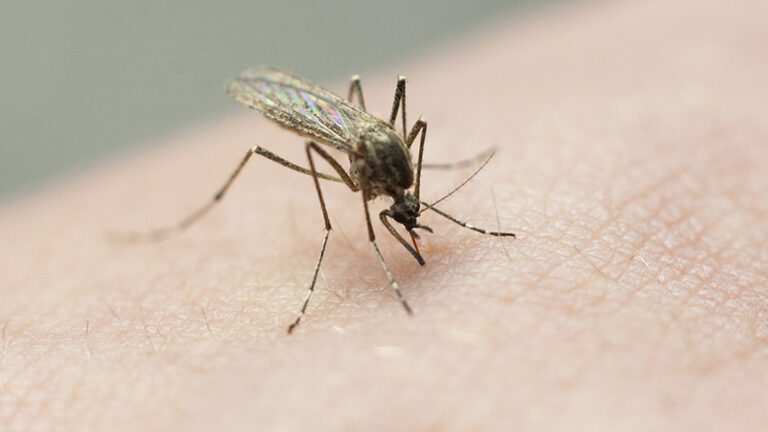
Malaria, a curable yet dangerous illness, is primarily transmitted to humans through mosquito bites from infected mosquitoes carrying the malaria parasite.

However, it can also be transmitted through infected blood during transfusions, organ transplants, or from a pregnant mother to her fetus.

According to the CDC, all five cases involve the P. vivax malaria strain and although this strain is less likely to cause severe or fatal infections compared to other strains, it can lead to relapsing malaria episodes as the parasites hide in the liver and reemerge months or even years later.

An associate professor of pathology and international health at Case Western Reserve University Brian Grimberg, stressed that it was not a time for panic but rather for heightened awareness, as malaria is often not a concern for Americans unless they travel abroad.

While malaria is most prevalent in warm countries, particularly those with tropical climates, the disease was once a significant public health issue in the United States before it was officially eradicated in 1970 after being declared eliminated in 1951.

Globally, malaria continues to be a serious disease, with over 240 million infections occurring each year, predominantly in African countries.

The recent cases serve as a stark reminder of the importance of finding a cure or vaccine for malaria which will not only have significant implications for global health, but would also bolster disease control measures within the US.

In an effort to mitigate the risk of malaria and other mosquito-borne diseases, the CDC has urged the public to apply insect repellents, use screens on windows and doors, and regularly drain items that hold water.

Travellers heading overseas are also advised to pack bug spray and consider staying in accommodations with air conditioning, window and door screens, or using mosquito nets for protection.

Furthermore, the CDC has recommended that hospitals maintain access to malaria tests and stock up on treatments, while public health officials should develop rapid identification, prevention, and control plans to effectively respond to any potential outbreaks.

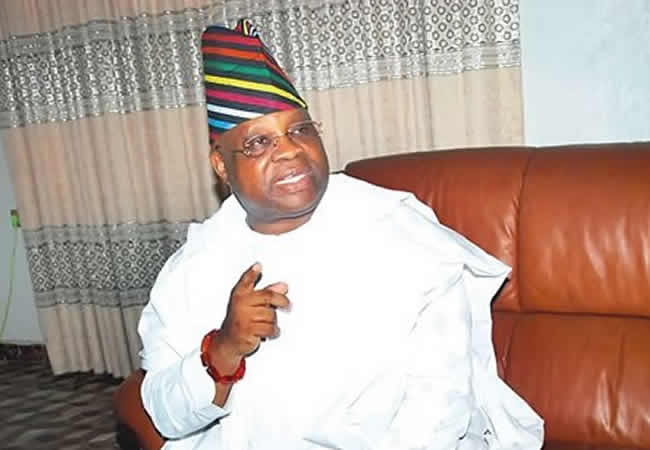
Osun: Adeleke, ex-Senate spokesman clash at Eid praying ground

OSUN State governor, Ademola Adeleke, has blamed a former spokesperson of the Nigerian Senate, Ajibola Bashiru, of masterminding an alleged plot to assassinate him on Wednesday, June 28.

The alleged assassination attempt occurred at the Muslim praying ground in Osogbo, the state capital, where the governor had gone to commemorate this year’s Eid celebration with muslims.

The governor, in a statement by his spokesperson, Olawale Rasheed, also blamed leaders of the All Progressives Congress (APC) in the state for the alleged assassination attempt.

The statement shared with The ICIR said Bashiru occupied the space reserved for the governor at the prayer ground and refused to vacate it after he was persuaded to do so.

Peoples Democratic Party (PDP) members at the praying ground, who demanded respect for the governor, were assaulted.

“The government particularly notes with shock and surprise the role played by former Senator Ajibola Bashiru who took over the space reserved for the Governor at the prayer ground. All efforts to get the former Senator to vacate the space proved abortive,” the statement said.

“PDP members who agitated for respect for the office of the governor were beaten up. It was a scene of chaos by the time the governor arrived for the prayer.

“The government was even more shocked that thugs armed to the teeth were spotted all over the praying ground with security information that they were imported to eliminate the governor and key government functionaries.”

The statement added that the governor was surrounded by armed thugs upon his arrival at the venue, prompting security personnel to escort him into his vehicle for safety.

According to the statement, Adeleke made a second attempt to enter the praying field, but he was encircled by armed thugs, forcing him to finally leave the praying ground.

Following the incident, reports emerged that the governor escaped an assassination attempt.

Reacting to the development in the statement, Adeleke called for calm and expressed gratitude to God for protecting him and his team.

He directed security agencies to arrest those responsible, regardless of their positions, and ensure that they face the full consequences of the law.

“My good people of Osun, I appeal for calm and urge us to continue to celebrate the Sallah festival in peace. I am safe by the special grace of God

“I have directed security agencies to arrest those behind the incident and get them to face the wrath of the law. The Commissioner of Police has been directed to arrest those involved no matter how highly placed.”

Spokesperson of the Osun State Police Command, Yemisi Opalola hung up when she was contacted by The ICIR for inquiries. She also did not respond to messages sent to her through SMS and WhatsApp. The messages were delivered.

Also, the former Senate spokesperson Bashiru could not be reached for commencements as his phone number indicated that it was unreasonable.

Lawyer faults Tinubu’s large convoy, says no gov should move with more than 5 cars

A LAGOS-BASED human rights lawyer, Inibehe Effiong, has suggested that no governor in Nigeria should have more than five vehicles in his convoy.

He gave the recommendation following the large convoy that welcomed and accompanied President Bola Tinubu out of the Murtala Mohammed International Airport, in Lagos, on Tuesday, June 27.

The President arrived at the airport from London, where he went on a private visit after attending the signing of a New Global Financial Pact with other global leaders in Paris, France, between June 22 and 23.

Tinubu returned to Nigeria (Lagos State) to celebrate today’s Eid-el-Kabir (Sallah) with his family, friends and political allies.

Among the dignitaries who received the President at the airport were the Lagos State Governor Babajide Sanwo-Olu, his deputy, Obafemi Hamzat, and All Progressives Congress (APC) Governance Advisory Council members.

Reacting to the long convoy that snaked through the streets of heavily-populated Lagos with attendant gridlocks, Effiong wrote on his Twitter and verified Facebook Page on Wednesday, June 28: “Mr Bola Tinubu’s convoy in Lagos is another reminder that the political class is not ready to make the sacrifices which they expect from citizens. A nation that has a devastating debt burden shouldn’t be run this way. Those defending the monstrous convoy don’t wish Nigeria well.

“The fact that other officials were in the convoy does not justify such monstrosity. The fact that two governors and the NSA (National Security Adviser) were reportedly part of the convoy does not justify the number of vehicles in the video. It is absurd. Tinubu could have insisted on reducing the vehicles.”

He accused the President of removing fuel subsidy to save cost but was “wasting limited resources on frivolity. No governor should have more than five vehicles in a convoy,” Effiong said.

He noted that the country could keep making ‘silly’ excuses for its wastefulness, stressing that its people would bear the consequences through continuous suffering. 

The ICIR reported how the President suspended fuel subsidy on May 29 after taking the oath of office.

The end of the subsidy regime was accompanied by a surge in the pump price of premium motor spirit (PMS), otherwise known as petrol.

The price increase, which went as much as over 200 per cent in some states, attracted a commensurate rise in prices of some basic goods and services.

2024 Olympics: How 30-year-old law on alcohol sale will affect fans

0

AS the date draws closer for the commencement of the 2024 Olympics in Paris, France, there are indications that a law established in 1991 may take a toll on alcohol consumers.

The 1991 Evin Law prohibits the sale, distribution and introduction of alcoholic beverages in sports and physical activity establishments.

The law means that alcohol will not be sold in any of the venues at next year’s Olympic and Paralympic games in Paris.

According to Insidethegames, although organisers of this year’s Rugby World Cup in France negotiated an exemption, the International Olympic Committee (IOC) is not seeking to have the law lifted for the Olympic games.

However, beer, wine and spirits will be allowed to be served in VIP and corporate hospitality areas at stadiums.

Fans call for lift of ban on alcohol sale in French stadiums 

Many fans in France have called on the authorities to allow alcohol to be sold at regular areas in stadiums across the country. They complained about the hypocrisy in allowing alcohol sale only in VIP areas.

In 2019, France’s then Health Minister Agnès Buzyn suggested that alcohol should also be banned from VIP areas, but the suggestion was quickly rejected following intense opposition from the drinks industry.

There are, however, several loopholes in the law which mean wine, beer and cider are regularly sold at events for certain sports, such as rugby.

The law also allows local mayors to grant a limited number of exceptions to the law each year.

Japanese beer company negotiate to sell alcohol during Rugby World Cup

Japanese beer company Asahi has signed up as sponsor of the Rugby World Cup, due to take place between September 8 and October 28, in France and beer will be sold openly during the 48 matches to be played in the competition, as is done in normal domestic or international rugby games in France.

However, so far, there are indications that organisers of the Paris 2024 Olympics will not be taking advantage of any of the loopholes to allow alcohol sale during the games.

Alcohol was also banned from stadiums at the last Olympic Games in Tokyo, but in the end spectators were not allowed to attend venues due to the COVID-19 pandemic.

Beer and wine were available at the 2012 and 2016 Olympics in London and Rio de Janeiro, respectively.

Last November, on the eve of the 2022 FIFA World Cup in Qatar, organisers announced that beer would not be available for sale in stadiums.

Previously, ticket-holders – according to FIFA’s fan guide – were told they would be able to buy Budweiser at the Brand Activation Areas within the stadium perimeter three hours prior to kick-off and one hour after the final whistle.

Inside the actual stadiums, fans were only able to buy Budweiser Zero – which is non-alcoholic – and Coca-Cola.

51 Nigerian universities make new African ranking

FIFTY-ONE Nigerian universities have been ranked among the best in Africa in the Times Higher Education Sub-Saharan Africa University Rankings.

The rankings, which followed a survey conducted by Times Higher Education, was published on Monday, June 26.

Covenant University, Ota, Ogun State, was ranked as Number 7 out of a total of 121 Sub-Saharan Africa universities, and the first in Nigeria.

The other Nigerian universities that made the ranking are Federal University of Agriculture, Abeokuta (26th), Benson Idahosa University (30th), Nnamdi Azikiwe University (31st), Redeemer’s University (35th), University of Ibadan (36th), CRUTECH (37th), OAU, Ife (39th) Umaru Musa Yar’Adua University (43rd), Adeleke University (45th), and Ahmadu Bello University (46th).

Also on the list are University of Benin (47th), Landmark University (49th), Babcock University (50th), Ajayi Crowther University (51-60th), Bells University of Technology (51-60th), Federal University Kashere (51-60th), Federal University Lokoja (51-60th), Gombe State University (51-60th), Lagos State University (51-60th), University of Port Harcourt (51-60th), Baze University (51-60th), Delta State University (61-70th), Elizade University (61-70th), Niger Delta University (61-70th), Abia State University (71+), Alex Ekwueme Federal University, Ndufu-Alike (71+), Bamidele Olumilua University of Education, Ikere (71+), Bauch State University (71+), Bayero University (71+), Edo State University (71+), LAUTECH (71+), Lead City University (71+), NOUN (71+), Glorious Vision University (formerly Samuel Adegboyega University (71+), Veritas University (71+), and Yusuf Maitama Sule University, Kano (71+).

According to Time Higher Education, 88 universities had enough student survey responses, overall score and rank, while 33 have incomplete data and pillar scores, but were not ranked overall.

The organisation explained that the ranking was developed through extensive engagement with university leaders across the region, under a project initiated by a consortium of African and international higher education institutions.

It stated that a hybrid methodology was used to account for the diverse strengths of the universities by focusing on the  elements of teaching, impact and research.

According to the methodology, the ranking was based on five pillars – resources and finance (20 per cent); access and fairness (20 per cent); teaching skills (20 per cent); student engagement (20 per cent) and Africa impact (20 per cent).

Factors considered include disability access and support, skills-building that institutions provide, practical learning courses and experiential learning.

Others include student engagement schemes like work-readiness institutions provide to students, and intellectual growth as citizens.

The acceptability of researches produced by institutions and their adoption by other researchers in Africa were also considered as criteria for the evaluative ranking.

The delegation from Nigeria that attended the event where the ranking was released, in Accra, Ghana, was led by the Chairman of the Nigerian Universities Ranking Advisory Committee, Peter Okebukola, a professor.

Commenting on the performance of Nigerian universities in the ranking, Okebukola, a former executive secretary of the National Universities Commission (NUC), noted that Nigerian universities did well while stressing the need for improvement.

Okebukola assured that Nigerian universities would leap to the lead by the the next and subsequent editions of the Sub-Saharan Africa university rankings.

“We will continue to improve on the metrics through better quality teaching, especially with the incoming Core Curriculum and Minimum Academic Standards Research and provision of better services for our students,” he said.

Experts proffer solutions to insecurity in Nigeria

SECURITY experts who participated in a Twitter Space organised by The ICIR on Tuesday, June 27, have proffered solutions to the high level of insecurity in Nigeria.

They also charged President Bola Tinubu’s government to urgently tackle security challenges, including terrorism, banditry, communal and pastoral clashes, across the country.

The Twitter Space was themed ‘Insecurity: Setting Agenda for Tinubu’s Government’.

Government should address root causes of insecurity 

One of the experts, a Researcher at the Institute for Security Studies, Malik Samuel, advised the Tinubu administration to address the root causes of insecurity.

“The President should address root causes of insecurity. He should look at insecurity not just as a threat to national security but also as a threat to the people.

“He should focus on the safety and the welfare of the people. Instead of focusing on military force, address the issues driving the violence. Address the issue of governance and corruption.

“No group in Nigeria possess the capacity to take on the state. It is really about dealing with the drivers first.”

Corruption in the defence sector should be tackled

Malik also urged the government to deal with corruption in the defence sector.

“A good way to start is to deal with corruption in the defence sector,” he said, adding that there is a correlation between corruption and insecurity.

Learn from previous administrations

The security expert further advised the President to learn from how previous administrations handled insecurity and toe a different part. “He is on the right path with his recent appointments, but the strategies that will be adopted are more important. The President must also demonstrate good leadership,” he said.

Weaken terrorists

The security expert spoke of the need for government to weaken the terrorists operating in the country. 

According to him, the government should look at cutting the source of their income and supplies from outside the country.

“Terrorist groups like ISWAP should be driven out of their comfort zone. We all know where these guys are located. We know that they are on Lake Chad Island. What is stopping the government from uprooting them from these places? Take them out of their comfort zone, and ISWAP will struggle financially. While at this, the government should ensure that the livelihood of civilians is not affected to avoid pushing the people back to the extremists.”

Government should listen to the people

Also speaking at the Twitter Space, a Senior Security Analyst at SBM Intelligence, Confidence MacHarry, advised the government to listen to the people.

“These (security) issues are issues that can be avoided if the government listens to the people. As we see in the Gombe State case, the government often doesn’t listen and would instead do what is on its mind. Eventually, they escalate the conflict, which is blown out of proportion. The government needs to learn to listen to the people.”

President, governors should be impartial 

The security expert added: “Anyone controlling the security agencies is to be seen as impartial. That partiality and affinity towards one particular ethnic group seem to offset the balance of power. For example, in Akwa Ibom, the governor Emmanuel Udom, he was accused of trying to illegally alter the state boundary to favour his LGA over a rival LGA. This is one of the issues in response to increased conflict.

“The key reason there seems to be a massive decline in state capacity is the absence of institutional trust. Nigeria naturally is a low-trust environment, and the trust in government capacity is diminishing.”

Government should address injustice

MacHarry further advised that government at all levels should address injustice.

“Justice has to be seen to be done. And this is the problem Nigeria’s political elite do not grasp. You should not only be saying you’re going to bring justice to the victim’s family, you have to demonstrate; people have to see that you are doing justice. If a court order says this property belongs to this ethnic group, it should be effected in the country’s gazette. If the other group try to make trouble, the government must deploy state capacity to crush that problem.”

According to him, the ban on sit-at-home in the South-East won’t work if the government fails to address the root cause of the conflict, stressing that the government must put in the work to make sure there is no sit-at-home instead of making a declaration.

“The high rate of employment in the region has influenced the increase in violent non-state actors. The government should address unemployment and provide many other basic amenities absent in the region before announcing an end to sit-at-home.”

Tinubu should avoid starting a new war

He warned that Tinubu shouldn’t start a new war like the previous administration did.

To avoid escalating insecurity, MacHarry advised that the Army should not be deployed to quell crises that require the attention of the Police.

He also suggested that political issues should be addressed politically, rather than with military force.

“In the US, there is a lot of talk about scorecards, and a President is rated much more highly if he doesn’t start a new war in Africa or the Middle East.

“This government has to stop this bad streak of new Federal Governments starting new wars. What the Tinubu government should be doing is solving political issues politically. The police should address issues that need the police.

“It should only use the military in situations where it is absolutely certain that the police cannot carry out peacekeeping operations.”

Tinubu returns to Nigeria after overseas trips

PRESIDENT Bola Tinubu returned to Nigeria Tuesday evening after attending the New Global Financial Pact summit in Paris, France, and embarking on a short personal visit to the United Kingdom (UK).

Following his inauguration as Nigeria’s new leader on May 29, Tinubu embarked on his first official trip overseas on Thursday, June 22.

After the two-day summit, Tinubu proceeded to the UK on a personal visit, although the specifics of the trip were not disclosed.

Tinubu arrived the Murtala Muhammed International Airport in Lagos from London, UK, at at exactly 05:13 pm local time on Tuesday, June 27, and was received by supporters and high-ranking members of the All Progressives Congress (APC).

Those present at the airport to receive him included: the Lagos State Governor Babajide Sanwo-Olu; Chief of Staff to the President Femi Gbajabiamila; Acting Inspector-General of Police Olukayode Egbetokun; National Security Adviser Nuhu Ribadu; senators and Members or the House of Representatives from Lagos State.

Tinubu was also welcomed by members of the Nigerian Army and the Nigerian Navy as his convoy made its way from Ikeja to his private residence in Bourdillon, Ikoyi.

The President who did not participate in this year’s Hajj exercise holding in Saudi Arabia, is expected to join fellow Muslim faithful for the Eid prayers at the Obalende Eid Prayer Ground, located at Dodan Barracks on Wednesday, June 28.

The rituals of Hajj 2023 commenced on the evening of Sunday, June 25, and will continue until the evening of Friday, June 30.

During this period, millions of muslims from around the world gather in Mecca to perform sacred rites, symbolising unity, humility, and devotion.

Reports suggest that Tinubu’s trip to the UK might have been motivated by a more pressing health concern.

Nigerian leaders usually seek medical attention or consultation abroad.

Sierra Leone: Bio declared winner of presidential election

IN a tightly contested race, Sierra Leone’s incumbent President Julius Maada Bio has been declared the winner of the country’s presidential election, according to the election commission.

The process leading up to the announcement has been marked by disputes and tensions.

Chief Electoral Commissioner Mohamed Kenewui Konneh announced on Tuesday, June 27, that Bio secured 56.17 per cent of the vote in the Saturday, June 24, election, ensuring his re-election.

His main challenger, Samura Kamara of the All Peoples Congress (APC), came in second with 41.16 per cent of the vote.

“By the powers invested in me… I hereby certify that Bio Julius Maada… (is) duly elected president,” stated Konneh, confirming Bio’s victory.

The announcement follows days of conflicting claims from both parties, with Kamara asserting that he was on an “irreversible path to an overwhelming victory”.

He also alleged that security forces had fired live bullets during a celebration at his party’s headquarters on Sunday, a claim denied by the police.

The APC has expressed concerns about the transparency and inclusiveness of the electoral process, criticising the electoral commission for not providing detailed information about the origin of the ballots from polling stations or districts.

The party issued a statement on Monday, June 26, condemning what they referred to as “fake and cooked up results”, rejecting the outcome and reiterating their claim of victory.

European Union (EU) observers, in a press conference on Monday, highlighted a lack of transparency and communication by the electoral authority, which contributed to mistrust in the process.

They also reported instances of violence at several polling stations during voting and counting stages.

The June 24 election, the fifth since Sierra Leone’s civil war ended in 2002, took place against a backdrop of high unemployment, inflation, and escalating violence.

Bio, a former coup leader from the 1990s, emphasised education and women’s rights during his first term, but faced mounting frustration over the country’s economic challenges.

Last year’s violent protests, triggered by rising prices, reflected the enduring cost-of-living crisis that the APC sought to capitalise on in their bid for votes.

However, Sierra Leone’s economic downturn, with widespread underemployment and over half of the population living in poverty, has hindered prospects of recovery, as highlighted by the World Bank.

Bio’s administration has faced increasing criticism for the country’s debilitating economic conditions, an area where Kamara pledged to bring improvement.

The challenges ahead for Sierra Leone’s re-elected President include addressing the economic hardships and fulfilling the aspirations of a nation striving for progress.

Boat mishap: Operators, officials face sanctions over death of medical students

0

FOLLOWING the boat mishap that claimed the lives of three medical students in Calabar, Cross River State, operators and officials connected to the development face sanctions from the state government.

Thirteen medical students under the aegis of the Nigeria Medical Students Association (NiMSA) had on Saturday, June 24, boarded a boat at Marina Resort as part of their annual health week programmes. But the boat cruise turned tragic after the vessel capsized.

A total 10 out of 13 medical students were rescued immediately by the Naval officers, while the remaining three drowned. Their bodies were discovered two days after the incident.

The students, who were from various Universities across the country, were scheduled to visit the marina resort, slave trade museum and the Tinapa tourist resort as part of the boat cruise on Saturday.

The ICIR gathered that the first set of student tourists had a safe landing but raised concerns, and were assured of safety by the operators of the Marina Resort.

After the second group of 13 students tourists boarded the boat, the engine reportedly shut off some minutes into the journey, giving way for water to enter the boat at an uncontrollably rapid speed and amount. 

This situation led to the sinking of the boat and caused the death of the three students, consisting of two males and a female.

Announcing their demise on its Twitter account, NiMSA revealed that the two male students, Mustapha Tukur and Hamza Kabir, were from the Ahmadu Bello University (ABU) Zaria, while the female student, Aisha Celestine Ogwu, studied in University of Uyo.

The state Commissioner of Police, Gyogon Grimah, confirmed the development on Monday, June 26, noting that “The three corpses of the missing students have been recovered. The police have been working day and night to rescue the missing students.”

Incident was a result of negligence, incompetence -NiMSA

The Nigerian Medical Students’ Association (NiMSA) has blamed Saturday’s incident on the operators of the Marina Resort.

The association, in a statement by its President, Ejim Clement Egba, explained that the “ugly, avoidable and extremely traumatizing incident causing so much anguish to the medical students community nation wide was as a result of negligence, incompetence and the lackadaisical attitude of the crew members and the management of Marina resort.”

He also highlighted some other factors that contributed to the boat mishap.

“Factors that contributed to this occurrence include: leaky boat, poor condition and integrity of the vests, poorly maintained engines resulting in the engine going off during the trip, fuel finishing before they got back to shore, little or no supervision by management, poor regulation and monitoring.

“I and the leadership of NiMSA swiftly ensured that all those rescued were taken to the hospital for prompt and adequate medical attention. While on that, I also led a delegation to the Naval base base and search teams were again sent out with the aim of rescuing the three remaining students. We have reached out to the marine police as well as the indigenous divers.

“I had since converged an emergency briefing with all the delegates, explicitly explaining measures instituted and ongoing actions actions by security agencies to recover our colleagues. All the delegates involved had since been discharged in good condition but for one who is still being observed, though will be discharged soon as he is stable and ambulant.”

State government’s reaction

The Cross River State Governor, Bassey Otu, has ordered an investigation into the boat accident, vowing to punish any government official found culpable.

A statement on Saturday, June, 24, by spokesperson to the governor, Emmanuel Ogbeche, said Otu decried the safety standards at the resort adding he will sanction anyone found guilty of compromising safety.

”To imagine that the boat was overcrowded and some of those on it were without life jackets is of even greater concern and the more reason why the state government will be investigating the incident.

”All those found culpable of having compromised on safety standards will face the wrath of the law.

“As a government, we remain committed to protecting lives and providing an enabling environment for business, tourism.”

NIWA arrests operators

Meanwhile, the National Inland Waterways Authority (NIWA), on Monday, June 26, announced the arrest of the operators of the boat that crashed while conveying the students during the boat cruise for offences bordering on overcrowding and engine malfunctioning.

A statement released by the organisation said the jetty has been sealed as the boat was not duly registered with NIWA. It added that the jetty was also not approved by NIWA. 

Parts of the statement read: “NIWA has since arrested the operators and sealed the jetty as the boat is not duly registered with NIWA, and the jetty is also not approved by NIWA. The 11 rescued victims were taken to hospital and they are now okay and discharged.

“We commiserate with the families, friends, loved ones, and the Medical Students Association for the loss of the three students. We pray to God Almighty to grant them the fortitude to bear the irreparable loss and may the gentle souls of the departed rest in peace.

“We feel very sad to announce that NIWA’s search and rescue team recovered the three missing corpses of the medical students that were involved in the boat mishap on Saturday, June 24, 2023, in Calabar waterways.”