Home Blog Page 906

‘I was forced to sign rustication letter ‘- UniAbuja student expelled over planned ‘meeting’ against fee hike

CYPRIAN Igwe, an undergraduate student of the Sociology department at the University of Abuja has been rusticated from the institution for urging colleagues to dialogue on the school’s hike of its fees.

Igwe, who just finished his final-year examinations, had, in a WhatsApp message, invited his colleagues to a meeting to share ideas on how to convince the school to reduce the fees. 

The student, along with one Oladeru Samson Olamilelkan, the Students’ Union’s director of Sports, were “banned from all the university campuses pending the determination of the case” for allegedly calling for a protest. 

The ICIR had reported that returning students in the Arts and related faculties in the university would be paying N82,000, while their medical counterparts pay N225,000.


READ ALSO:
Why UniAbuja charges N225,000 for medical students, N82,000 for Arts — VC

Police identify hideout of kidnappers of Uniabuja lecturers

Police confirm abduction of Uniabuja staff

FG approves N400m for construction of UniAbuja fence, as bandits take over varsity land


Some students who spoke with The ICIR added that new students would be paying between N85,000 and over N100,000 in the Arts faculties, while medical students would pay above N225,000.

The increase in fees was not a welcome development for certain students, but they could not voice their concerns due to the cautionary message delivered by the vice-chancellor, Abdul-Rasheed Na’Allah.

Na’Allah had said that any student planning to disrupt the peace in the school because of the fee hike would face severe consequences of the action.

According to him, any student caught engaging in violent activities on campus would face the penalty, including expulsion.

“The repercussion is swift and merciless. If anyone is caught anywhere destroying anything or simply disturbing the peace of our campus, I promise you I will descend heavily on such a person by showing him or her a way out,” the vice-chancellor had said.

The ICIR sighted the post by Igwe intending to schedule a meeting with the purpose of discussing possible solutions to address the situation at hand.
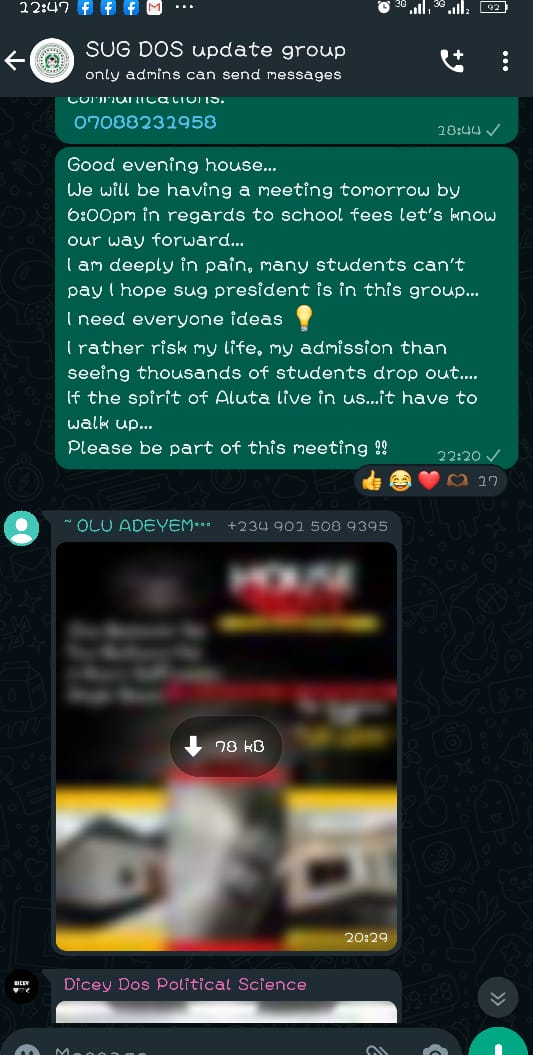
Post made by Cyprian Igwe

The management has, as a fallout from the post, expelled Igwe and issued a ban on his presence on all university campuses. 

This decision was conveyed to Igwe through a letter dated May 26.
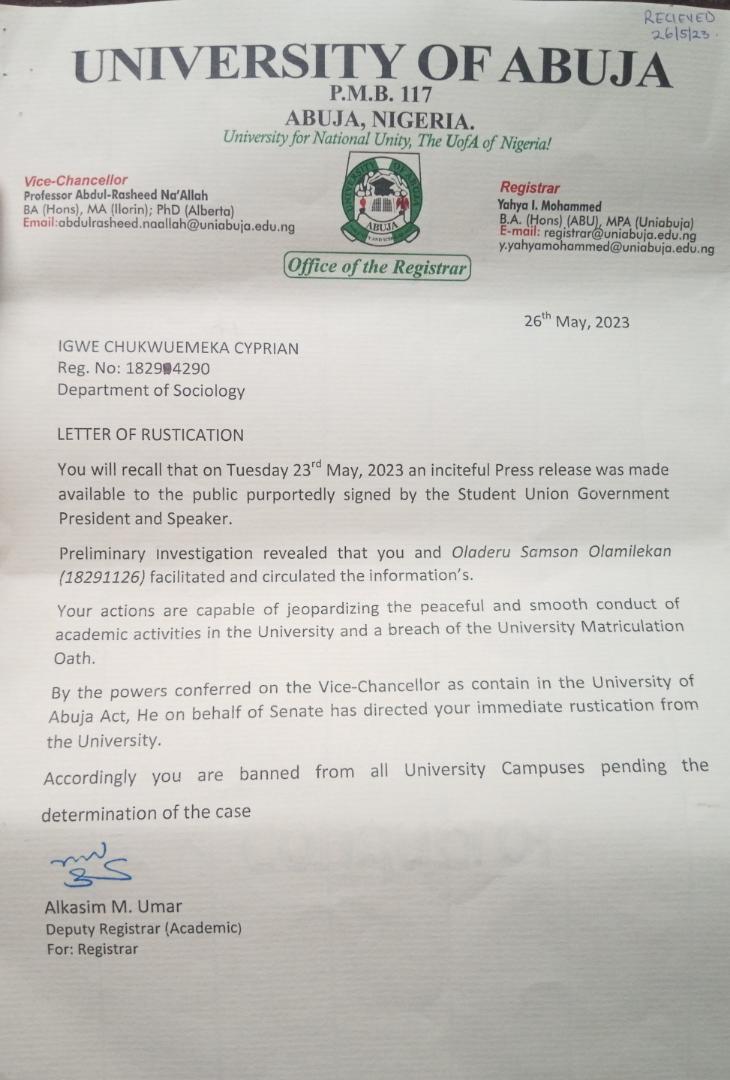
Rustication letter
Rustication letter

According to the letter, Igwe’s post was capable of jeopardising the peaceful and smooth conduct of academic activities 

The letter, which was signed by the Deputy Registrar (Academic), Alkasim M Umar read, “You will recall that on Tuesday, May 23, 2023, an inciting press release was made available to the public, purportedly signed by the Student Union Government’s President and Speaker.

“Preliminary investigations revealed that you and Oladeru Samson Olamilekan (18291126) facilitated and circulated the information.

“Your actions are capable of jeopardising the peaceful and smooth conduct of academic activities in the university and a breach of the University Matriculation Oath.

”By the powers conferred on the Vice-Chancellor as contained in the University of Abuja Act, he, on behalf of the Senate, has directed your immediate rustication from the university.

“Accordingly, you are banned from all university campuses pending the determination of the case.”

Igwe, announcing his rustication on Friday, May 26, on twitter, said Nigeria did not have the education that the poor deserved if they could not go to school. 

I was forced to sign the rustication letter – Igwe

The rusticated student, who is also the school’s director of Socials, told The ICIR that he was made to sign the letter without a fair hearing.

He said, “The thing started on Monday when I made a post on my group chat that I’m in pain and that I do not want to see thousands of students suffer.

“The school fees were increased; they doubled the cost of the school fees. For instance, some departments’ fees were increased by over 100 per cent, Like my own department it is from N47,300 to N89,000.”

“The next day, I called for the meeting; in the evening, I called our president. He didn’t make any comments or reasonable information to me, so the meeting didn’t hold. Later that evening, someone posted on my group chat and some other group chats, giving the school a warning to reverse the increment or else there’ll be a protest. The school security now called me and said I’m a suspect and that I have to write a statement and provide the person from before 5pm. I said I don’t know the person that wrote the post.

“They called me yesterday saying that I should come back and bring another statement and told me what to write there. When I finished, they seized my phone and brought a rustication letter saying that I should sign it, that if I didn’t sign it, they won’t give me my phone. They forced me. After I signed it, I stayed there for four hours, and they now gave me my phone.”

A source at the school’s Students’ Union, who preferred not to be mentioned for fear of backlash from the school management, described the expulsion of the two students as “unjust”, adding that the students were not indicted. 

The source told The ICIR, “This whole issue for me is very unjust in the sense that a write-up was purportedly circulated, and to the best of my knowledge, he has not been anyway indicted, like properly indicted for the so-called write up. I can just say the school saw these two young men that were rusticated as threats in the sense that they were vocal enough and were bold to take steps. What I mean by step is working towards the interest of the students in a very lawful and peaceful manner.”

He said that the director of information, Dr Habin Yaqoob, accused the students of calling for a protest that amounts to inciteful action against the school, which of course is not.

The source maintained that the rusticated students never called for any protest.

The content is capable of upsetting peace – Management 

The ICIR’s efforts to get the university’s director of Information, Habib Yakoob, proved abortive. However, Yakoob, speaking to The Punch on Saturday, May 27, alleged that the students committed fraud by impersonating the SUG executives.

He said, “Two students were suspected to have issued and circulated a write-up purportedly in the name of the SUG president and speaker (who has disowned the write-up promptly). This is impersonation/ forgery.

“The content of the said write-up was quite inciteful and capable of upsetting the peace and tranquil environment that the university has been known for. Preliminary investigations implicated the two, hence the decision to suspend them pending the full determination of the matter.

“Please note that they weren’t suspended because they complained about the increment of fees. Thank you.”

The spokesman said an investigation was continuing on the case.

No clear evidence to prove the rustication – SU

The Students’ Union president, Emito Emmanuel Ayandayo, said the students were wrongfully rusticated as there was no evidence to back up they made a write-up calling for a protest on May 29.

According to Ayandayo, the management was acting on a post purportedly signed by the Union president and secretary. 

He said, “First of all, I got to see the content of the letter yesterday evening. On the letter, it was referencing back to the purported press release that was sent out and signed by my office and the office of the speaker of the legislative stating that we were inciting violence, that we had a meeting with some members, alumni of our schools and stakeholders, that we want to protest on May 29 at Eagle Square, which was completely wrong.

“Below it was stated that I signed the communique alongside my speaker, which was completely wrong. And immediately I sent a counter release that we didn’t sign such a press release and that no meeting was ever held by myself and my speaker.”

He said that the university started an investigation and met with some faculties’ presidents to ask if a meeting was held in that regard, noting that he was exonerated.

He added, “There is no valid evidence that this is who did that press release. The contact number of the persons that sent the post to the group chats, of course, I picked up and sent to the DSS the following day. They are still tracking, but we haven’t gotten who sent out that information yet. Not until yesterday that I saw the letter, and this morning I called the management, the dean of Students Affairs to be precise, and he told me he has spoken to the vice-chancellor, and the vice-chancellor said the assistant registrar didn’t write the letter properly, that it was not meant to be rustication but suspension since there’s no proper evidence.” 

When asked if the university has sent a new communique reinstating the students, Ayandayo said no.

Nigeria Air: Kudos, knocks over aircraft arrival as controversies rage over age, ownership

THE Federal government has welcomed the Nigeria Air aircraft’s arrival, which landed at the Nnamdi Azikiwe International Airport, Abuja, on Friday, May 26, amid controversies over its specification, documentation, ownership, and technical agreement.

The ICIR reported the branded Nigeria Air aircraft was expected to arrive on Friday despite the controversy and court order surrounding the project.

The outgoing Minister of Aviation, Hadi Sirika, had insisted on bringing in the aircraft before the end of his tenure on May 29.

“We are here. To Almighty God be all the glory. It has been a very long, tedious, daunting and difficult path,” Sirika tweeted on his verified Twitter handle on Friday to welcome the aircraft’s arrival.

The minister told journalists that 30 aeroplanes were expected to form the fleet of Nigeria Air in the next five years and confirmed that only one plane had arrived as he conducted stakeholders around the aircraft.

He explained that the carrier would be private-sector driven, with the Federal government holding just a five per cent stake and private owners holding the remaining 95 per cent.

Reactions have, however, trailed the aircraft’s unveiling as comments on social media questioned its specification and documentation, among others.

The aircraft was flown into Abuja merely for show, notwithstanding anything the minister may say or do afterwards, the immediate past general secretary of the National Union of Air Transport Employees (NUATE), Olayinka Abioye, shared his concern with The ICIR.

Abioye said, “It is globally recognised that the aircraft belongs to Ethiopian Airlines, carries Ethiopian Airlines call sign and is flown by Ethiopian crew.

“No single Nigerian was on board, and further to this, it was an aircraft leased to Malawi years ago and retrieved when their relationship broke down. Available information was that the machine was flown from Addis Ababa, Ethiopia, to Israel for painting, and then flown to Nigeria to fulfil the 419 arrangements of the Honourable Minister.”

He described it as “an unfortunate development for a country as big as Nigeria to be involved in outright falsehood and fraudulent tendencies as massive as this,” asking, “How can we expect to be respected by other nations?”

The NUATE scribe explained it would take the Nigerian Civil Aviation Authority (NCAA) five steps to obtain an airline operation certificate (AOC) for Nigeria Air.

“What the Minister did was a gross violation of extant rules, which others have been punished for. So where do we go from here? I am saddened by this ugly show because, for all intents and purposes, we have just been swindled,” he lamented.

Shehu Sani who was once in the senate, tweeted that the controversy of whether the aircraft was leased from Ethiopian Airlines or purchased for Nigeria Air could be settled if the plane’s documents were made public.


“The minister has committed broad daylight fraud by displaying this rented and hurriedly repainted Boeing 737-800 as an aircraft belonging to a phantom Nigeria Air,” a Twitter user, a media activist, David Hundeyin asserted.


Hundeyin further tweeted.


Another Twitter user, Taye, was worried that the minister intended to commission an aircraft “clearly owned by Ethiopian Airlines” and still in active service. This raised questions about the ownership and technical agreement between Ethiopian Airlines and Nigeria Air.


The ICIR can report that the Boeing 737-800 has a registration number, ET-APL; mode, S Q4005C; and serial number 40965/4075. It is about 10 years eight months old, with its first flight being June 22, 2012, as an Ethiopian Airlines aircraft.

It became Malawi Airlines on February 16, 2014, before it was released to Ethiopian Airlines on August 12, 2015, and before landing in Nigeria on Friday, May 26.

Reno Omokri, a social media influencer and former political aide to ex-President GoodluckJonathan, said there was nothing wrong with leasing a plane, even a 10-year-old aircraft.

Omokri argued that a Boeing 737 has a lifespan of 35 years and that new airlines should start with such a plan until the business becomes profitable and stable.


“The Nigeria Air will be proud not only for Nigeria but for Africa and its people,” Bashir Ahmad tweeted.


Another Twitter user, Woye, hailed the Buhari administration for delivering the Nigeria Air aircraft, adding that history would be kind to him.


Meanwhile, the Airline Operators of Nigeria (AON) has sued the minister over the planned arrival of the aircraft.

The suit was filed to question what the AON alleged were shady deals, deliberate infractions of the Nigerian laws, and self-enrichment/corruption by the Aviation ministry over the Nigeria Air project.

Filed at the Federal High Court in Lagos, the court granted orders of interim and interlocutory injunctions restraining the Aviation ministry from taking any step concerning the Nigeria Air project.

In a letter dated May 24, 2023, the airline operators, also dated May 24, 2023, requested President Buhari to compel the minister to obey a court order restraining him (Sirika) from bringing in the aircraft.

Signed by its lawyers, the letter was copied to the Attorney-General of the Federation, Inspector-General of Police, Permanent Secretary, Federal Ministry of Justice, and Federal Ministry of Aviation.

Drawing the attention of the President to the court order, the operators stated, “In the suit, the Federal High Court sitting in Lagos presided by Hon. Justice A.L Allagoa, in the above suit, granted Orders of interim and interlocutory injunctions, in the terms contained in the Order, restraining taking of any step in relation to the Nigeria Air project. Copy each of the Orders are enclosed as Annexures 1, 2 & 3.”

The operators have now threatened to sue Sirika for contempt of court for planning to launch the carrier despite a court order stopping the project.

They maintained they would pursue the contempt action against the minister personally, whether or not he leaves office, for the promotion of the rule of law, protection of the court’s integrity and in line with international best practices.

Police confirm armed robbers escaped with N11m, not $11m in Ogun

0

THE Ogun state police command has confirmed that armed robbers on Friday, May 26, carted away N11 million and not $11 million, as widely speculated, in an armed robbery attack in Abeokuta, the state capital.

Many reports on Saturday said the robbers stole $11 million in the operation.


READ ALSO:

Female journalist accuses police of assault in Katsina

May 29: Police tighten security in FCT, block roads around Eagle Square

Assault: Seun Kuti released from police custody


The reports added that the robbers, wearing black T-shirts, jean trousers and facemasks, operated successfully at Oke-Sokori in the Abeokuta North local government area.

They attacked a Hausa trader in a Toyota Venza salon car and dispossessed him of some money.

The robbers, who brandished rifles in the three-minute robbery act, were said to have fled the scene with their loot piled in two ‘Ghana-Must-Go’ bags.

But in a chat with The ICIR on Saturday, May 27, the police public relations officer in the state, Abimbola Oyeyemi, confirmed the incident in a phone conversation but said the robbers took away N11 million and not $11 million as widely reported.

“Yes, we can confirm that it is true there was an armed robbery attack yesterday, but the money they carted away was not $11 million but N11 million.

“Where will somebody get $11 million? They attacked the man’s car and took away N11 million. He collected N5.5 million from the FCMB and another N5.5 million from Zenith. They traced him and collected the money.

“Unfortunately, the suspects escaped the scene before our operatives could arrive at the scene,” Oyeyemi said.

He added that the police authorities in Ogun State had commenced a search for the armed robbery gang.

“Upon receipt of information about the incident, the command had immediately sent a signal across the state to ensure that the suspects are tracked down,” he said.

He assured the people of the state of adequate security and urged them to remain calm and go about their regular businesses.

Tinubu will rescue remaining Chibok Girls, others – Buhari

IN what appears like an admission of failure by his administration to rescue the remaining ‘Chibok Girls’ from insurgents’ captivity, President Muhammadu Buhari has thrown the gauntlet at the incoming administration of the President-elect, Bola Tinubu, to rescue the schoolchildren and others that terrorists abducted under his government.

Feting Nigerian children on Saturday for the Children’s Day commemorated in the country on May 27, Buhari said that his own administration spent eight years attempting to rescue all the children abducted during the administrations of his predecessor, Goodluck Jonathan and others before him.


READ ALSO:
’37 Chibok girls’ parents have died since abduction’

We are committed to recovering Chibok girls still in captivity — FG

Parents of abducted Chibok girls demand daughters’ release

Army rescues two Chibok girls in Borno


In a message on his Twitter handle, the president said, “We must not lose hope, and our faith should be rekindled in the ability of government to safeguard the future of our lives and children.

“In eight years, we have focused on children, negotiating and fighting for the release of many that were taken captive, and painstakingly building intelligence on the whereabouts of others.

“Some have been released; more will come, by God’s grace, as the next administration continues on the same noble path.”

As at the time of filing this report, 93 of the 276 schoolgirls abducted by Boko Haram at the Government Girls Secondary School, Chibok, Borno State, in 2014 during the Jonathan era were still with their captors.

Thirty-seven of the girls’ parents had died.

The ICIR reported earlier today how the Buhari administration recorded 300 per cent more school children abductions than Jonathan’s.

Schoolchildren abducted under President Buhari, who won the 2015 presidential poll mainly because he promised to reverse the nation’s security misfortunes, included the 110 abducted in Government Girls’ Science and Technical College, Dapchi, Yobe State. 

Among the Dapchi schoolchildren is Leah Sharibu, a Christian her abductors held on to because she refused to renounce her faith.

As of February 2021, nearly 900 schoolchildren had been abducted under Buhari alone, less than six years into his government. More had been abducted, and a few remain with their captors.

When campaigning for the presidency in 2015, Buhari had said, “I have had the opportunity to serve my country in the military up to the highest level, as a major-general and as commander-in-chief of the armed forces. In the course of my service, I defended the territorial integrity of Nigeria, and if called upon to do so again, I shall rise to the occasion.

“As a father, I feel the pain of the victims of insurgency, kidnapping and violence. Under my watch, no force, external or internal, will occupy even an inch of Nigerian soil. I will give it all it takes to ensure that our girls kidnapped from Chibok are rescued and reintegrated with their families,” Buhari said.

The ICIR reports that the President did not keep his word.

Judging from Nigerians’ reactions to his administration’s handling of the nation’s security, most citizens believe the nation experienced unprecedented insecurity under his watch.

On Thursday, May 25, The ICIR reported a civil society organisation, Global Rights saying that between 2019 and 2022, Nigeria witnessed a surge in violence, resulting in the tragic loss of thousands of lives and the abduction of countless individuals.

“At least, 20,431 civilians and security personnel have been killed, and 12,944 people have been abducted during this period,” the organisation said.

Different parts of Nigeria, including Plateau and Benue states (in the North-Central),  Kaduna, Katsina, Zamfara and Sokoto states (in the North-West), and Imo, Enugu, Anambra and Ebonyi (in the South-East) have been killing fields, where thousands of Nigerians have died from insecurity-related causes under Buhari administration.

In Ogun, Oyo, Ondo, Osun, Ekiti and Lagos states, ritualists, fraudsters and other criminals have had field days.

Cultists have been on the rampage in the South-South, as the North-East begins to recover from the horrors of a decade of rampage by terrorists.

For the first time in the nation’s history, the South-West experienced waves of herdsmen and insurgents’ attacks, under Buhari.

In June 2022, attackers descended on worshippers at the St Francis’ Catholic Church in Owo, Ondo State, shot sporadically at worshippers and reportedly detonated a bomb, killing about 40 worshippers.

The ICIR reported how killings escalated a few days before the end of the president’s tenure in the North-Central. Large-scale killings by non-state actors have been recorded in Kaduna, Plateau, Nasarawa and Benue states in the past weeks.

report published by The ICIR  on May 21 detailed key security issues and killings under the President.


Buhari defends debt profile, says loans funded assets, investment

PRESIDENT Mohammed Buhari has urged Nigerians to consider the assets and investments gained in the last eight years when discussing the country’s huge debt profile.

As Buhari maintained, debts that his administration acquired funded many major assets and investments.

Buhari said this in a statement posted on Twitter on Saturday, May 27.

The ICIR had reported that every Nigerian would owe N384,864 by the time the president leaves office due to the country’s spiralling debt profile.

According to the Debt Management Office (DMO), the Buhari administration would, by its persistent borrowings, be leaving a humongous debt of N77 trillion for the incoming administration.

Data from the Budget Office of the Federation showed that the total budget deficit would hit N47.43 trillion under President Buhari.

According to the figures, deficit financing has risen by 370.54 per cent, moving from N2.41 trillion in 2016 to N11.34 trillion in 2023.

Buhari, who is set to hand over to the incoming administration on Monday, May 29, asked Nigerians to consider the assets and investments when looking at the current debts.

The President pointed out that his administration doubled Nigeria’s infrastructure stock to gross domestic product (GDP) from 20 per cent to more than 40 per cent.

He said, “As we look at Nigeria’s debt profile, I urge us to also look at the assets and investment profiles, some of which were paid for by debt and some by investment income.

“In eight years, I am proud to say that we have doubled Nigeria’s stock of infrastructure to GDP from about 20% to over 40%.

“This growth is no small undertaking given that it was recorded amid a plunge in global oil prices, a recession in the country, and a war in Europe.

“This happened when global oil prices plunged to almost zero when we encountered a recession that was not predicted, when we dealt with a pandemic that was unforeseen and when we are still grappling with the global effects of an ongoing war in Europe.”

He noted that the road out of poverty was much more arduous without investing in infrastructure.

“The wealth and prosperity of many nations, especially post-war Europe, was built largely on infrastructure and debt redeemed over decades. Some of the projects are commercially self-liquidating,” he added.


Will president Tinubu be another post turtle?

0

By Ayodele Akinkuotu

In the course of discussing politics in the United States with a gentleman from the city, an American rancher once quipped that many politicians were like post turtles.

Unfamiliar with the term, the fellow from the city sought an explanation. And the rancher obliged him. When farmers are busy ploughing their fields, they dutifully watch out for turtles. Because of its hard shell, a turtle can ruin the best of farming equipment, thus resulting in additional costs to a farmer.

Once one is sighted, the farmer gets down from his tractor, picks it up and puts it on the fence post of his farm until he is done with the day’s job. For the turtle, the post is like a prison, and it patiently awaits its freedom. So, for many politicians in Nigeria, public office is like the fence post of a farm; it is the people who put these politicians in office. But no sooner do they get there, they simply forget who put them there and why they have been so lifted above their fellow men. Thus for four years, they run around in circles, embark on extravagant and obscene lifestyles. And the society they have been elected to make better remain in perpetual penury.

As May 29, 2023, dawns, Nigerians are reminded that this is the longest stretch of civil rule since independence. Four presidents later, however, the Nation is seemingly rooted to a spot. Perhaps, because our leaders in the last two decades have been nothing more than post turtles.

For instance, in 1999, the power sector was one of the Nation’s daunting challenges. Several decades of negligence of the sector resulted in a situation where a large swathe of the country has continued to suffer severe outages. Therefore, at night, our homes are always in perpetual darkness. And for companies to stay in business, they have to invest humongous resources in generating plants to power their machines.

Twenty-four years later, the situation is worse. And that is in spite of all the overhauling supposedly embarked on in the sector.

Today, a country of 200 million people is said to generate about 5,000 to 10,000 megawatts. And as meagre, as that is for the Continent’s largest economy, the distribution companies are said not to have the capacity to evacuate more than 50 per cent of that.

We understand the story is not as simple as that; the transmission company, which is wholly owned by the government, is believed to be ill-equipped to transmit what is being generated.

Yet, South Africa, with a population of about 60 million people, generates about 60000 megawatts daily; and that country is planning to double that capacity. Thus making it a more attractive destination for investors.

As if that is not enough, as a member of Organisation of Petroleum Exporting Countries, OPEC, Nigeria is the sixth largest producing crude oil exporter. Yet, we import refined petroleum to power our economy. That’s against the backdrop of four refineries that are perpetually comatose.

Thus whenever the international oil market sneezes, the country catches cold. Whereas, high oïl prices should be a boom to our economy, it has become a curse.

In an attempt to cushion the pump price of imported fuel, the government has been subsidising its price for decades. In the last two decades, the subsidy regime has become a scandalous affair.

Today, government subsidy runs into trillions of naira, and sometimes it outstrips the revenue generated from oil exports. The Nation is waiting with bated breath to see how the Bola Tinubu administration handles the subsidy issue.

Although the incoming President belongs to the ruling party, experts expect him to handle the situation better than outgoing Muhammadu Buhari. This is in a situation where manifestos of political parties are mere deceptions to hoodwink the electorate.

Since 1999, every President we have had run his own show allowing the party’s manifesto to gather dust on the shelves in the secretariat. And in the ensuing confusion of what governance has become in Nigeria, nobody remembers what the party in power promised the people. Rather, the presidents substitute their own hurriedly assembled “agenda”, which is largely implemented in the breach.

It is doubtful if Buhari ever took a look at the APC manifesto. His campaign promise in 2015 focused on combating insecurity, corruption in government and reviving the economy.

Eight years later, his scorecard on security leaves much to be desired. In fact, his traducers would say he worsened it with his nepotism. Though at his swearing-in in 2015, he declared that “I belong to nobody and I belong to everybody”. With his poor handling of the Fulani herders and Farmers’ clashes, and his loading the top hierarchy of the security services with men from a particular ethnic group, we all now know to whom Buhari belongs.

After eight years in office, his legacy is a more fractured Nation than the one he took over at his assumption of power. And talking about his fight against corruption, it is doubtful whether he indeed achieved much.

Although the Economic and Financial Crimes Commission was very active in going after those who have dipped their hands into the till, the fact that the bosses of the Commission itself has at various times been accused of what they are fighting against speaks volume of the success of the war.

Outgoing Governor Bello Matawalle of Zamfara State has accused AbdulRashid Bawa, EFCC’s executive chairman, of demanding two million dollars from him. That allegation reminds us that Bawa’s predecessor in office, Ibrahim Magu, was relieved of his office because of corruption allegations.

So, if the EFCC gold, the number one anti-corruption fighter, is rusting what will ordinary iron do? And as regards the economy, nothing paints the despair it is in better than the free fall of the Naira against the dollar in the last few years.

So, against this backdrop, is the incoming President going to be another post-turtle? Although, during the campaigns, Tinubu did say he would continue from where Buhari stopped, deep in his heart, he knew Buhari has underperformed on all fronts.

Even the outgoing President wondered aloud why those who should be trumpeting his achievements from the rooftops were not doing so. To many Nigerians, Buhari tried his best, but it was not good enough for Nigeria. That was why, rather than trumpet Buhari’s “achievements”, Tinubu’s campaign team focused on his achievements in Lagos in his two-term tenure as governor.

Furthermore, since he left office in 2007, the template for the government he left as a legacy is what all the three administrations that came after him are still using. And no matter what Tinubu’s traducers may say, not a few believe Lagos, the City State, is the better for it.

Thus, the incoming President is not going to be a post-turtle, who will be totally bemused as to what he is doing in Aso Rock. God helping him, he has promised to hit the ground running.

In respect of the economy, he has promised a revival of the manufacturing sector. To quote him, “we seek a minimum of six per cent growth annually through reforms of our industrial policy, infrastructure enhancement, power sector innovations, and significant budgetary reforms.”  Those reforms will result in job creation, reduce brain drain, stop crude oil theft, and cut the country’s penchant for borrowing. Right now, the country’s debt burden is very alarming, the greater percentage of which was incurred in the last few years under President Buhari.

One crucial matter waiting for the new President to tackle with urgency is the fuel imports to power the economy. Since the last quarter of 2022, fuel queues have become a nasty recurring decimal all over the country. Thus, many Nigerians spend many hours at filling stations to fuel their vehicles or to buy fuel in jerry cans to power their homes and small businesses.

Those queues may be about to disappear. Why? On Monday, May 22, 2023,  Buhari commissioned the newly built Dangote Oil refinery in Lagos. It has a capacity to refine 650,000 barrels of crude oil daily. That should largely reduce if not totally put an end to fuel importation.

It will be a great relief for Nigerians and the dawn of a new era. This milestone comes 16 years after Aliko Dangote, leading a Consortium of investors, purchased the NNPC’s three refineries for 750 million dollars in the twilight of Obasanjo’s government. But no sooner than his successor, President Umaru Musa Yar’Adua assumed power did vociferous calls from labour and civil society organisations demand that the deal should be cancelled.

The then group managing director of the NNPC added his voice, promising late President Yar’Adua that he could revive the refineries and put them on winning ways. Yar’Adua returned the consortium’s money. Today, those refineries are said to be in a worse situation than they were 16 years ago. The incoming President should end the regime of the conduit of waste that those refineries have become.

Another issue demanding Tinubu’s immediate attention is the insecurity in the land. While the Buhari government claimed that insurgency and kidnapping had been largely degraded, but banditry and mindless killings are still rampant. In the wake of the general elections, there was another bloodbath in the North Central geopolitical zone. And a so-called Fulani group claimed responsibility.

Till date, not much is known about what the security services had done to arrest the culprits. Because they have been largely allowed to go on the rampage when it suits them, the blood-thirsty criminals continue unabated. Nigerians are, therefore, relying on Tinubu’s promise to rejig the security apparatus.

Beyond that, within the shortest time possible, he needs to set in motion a process to reconcile Nigerians who are aggrieved, and who if given the opportunity would want to opt out of the Federation. Certainly, the task ahead of him is daunting, but having prepared for many years for this Number One spot, Tinubu, warts and all, cannot afford to fail.

Allison-Madueke slams N100bn defamation suit on EFCC, Malami’s office

THE Minister of Petroleum Resources in former Nigeria’s president Goodluck Jonathan’s administration, Diezani Alison-Madueke, has sued the Economic and Financial Crimes Commission (EFCC) and the Office of the Attorney-General of the Federation N100 billion for libel and defamation.

Alison-Madueke was represented by a team of her lawyers headed by Mike Ozekhome, a senior advocate, in the suit marked CV/6272/2023, filed at the High Court of the Federal Capital Territory (FCT) on Friday, May 26.

The EFCC and Attorney-General’s Office are the first and second respondents in the suit.

The former minister, arguably the most vilified of Jonathan’s aides for corruption by the President Muhammadu Buhari government, is demanding a public apology to be published in three major national dailies, and an order by the court to stop the respondents from further defaming her.

She informed the court she had been away from Nigeria after leaving office in 2015 to manage, in the United Kingdom, “the most aggressive form of breast cancer”.

The ICIR reports that Buhari’s largely-unsuccessful fight against corruption has its roots in the arms procurement fund, which exposed much rot in Jonathan’s government, and its incapacity to contain the Boko Haram insurgency that spiralled and worsened the nation’s insecurity under Buhari.

Buhari leaves office on May 29 with the minister of Justice and Attorney-General of the Federation, Abubakar Malami, whose office is the second respondent in Alison-Madueke’s suit.

She said in the suit that the first and second respondents had on December 16, 2021 made a libellous and defamatory publication about her titled, ‘Diezani: EFCC uncovers additional $72.8 million in Fidelity Bank’, and “maliciously wrote, authored and/or caused to be written, authored, or published to the whole world at large of and concerning the claimant, through the 1st Defendant’s online official website through which they falsely and maliciously described the claimant as a common criminal who looted public funds belonging to the Federal Republic of Nigeria for her personal gain.”

She added, “In a publication made on August 8, 2017, by the 1st and 2nd defendants, titled ‘Unbelievable!!! EFCC traces N47.2 Billion, $487.5 Million to ex-Minister Diezani Alison-Madueke’, the 1st and 2nd defendants falsely and maliciously wrote, authored and or/caused to be written, authored, or published to the whole world at large through the 1st defendant’s online platform, a false and insidious story ….wherein they falsely and maliciously described the claimant thus: ‘It seems Mrs Diezani Alison-Madueke, until recently, Minister of Petroleum Resources, going by the sheer amount of her acquisition of gold and diamonds, may have been fighting a spirited war against millions of compatriots who are heavily and unevenly yoked by crass poverty.”

According to her, the publications and many others diminished her person and lowered her esteem before the right-thinking public, adding that many people who saw the publications called her and expressed disappointment with her alleged ‘dubious character.’

Among others, the claimant is seeking an order restraining the 1st and 2nd respondents, whether acting by themselves, servants, agents, operatives or by whomever and howsoever from distributing or further distributing, publishing or further publishing in any form or manner, the same or similar offensive, libellous materials or stories of or concerning her.

She is, therefore, demanding, “An order directing the defendants jointly and severally to pay to the claimant the sum of N100,000,000,000.00 (100 billion naira) only as damages for the false, injurious, malicious and libellous publications against the claimant in the 1st defendant’s publishing platform, and at the instance of both the 1st and the 2nd defendants.”

In May 2021, The ICIR reported how the EFCC claimed that the pieces of jewellery found in the claimant’s home were worth N14.4 billion.


READ ALSO:


In another report that year, the commission said it found $153 million and 80 houses related to her.

Earlier, a court had ordered the permanent forfeiture of N34 billion linked to her.

In a similar ruling in 2019, a court ordered the permanent forfeiture of her jewellery and an iPhone.

Buhari’s toothache and a nation in its death throes 

0

By Chido Onumah 

Muhammadu Buhari, a retired general, will leave office on May 29 after eight uneventful years. We hope it is the last time we hear from a man who rode to power eight years ago promising to end insecurity, strengthen the economy and fight corruption, none of which he achieved.

Thankfully, he has vowed not to intervene in our national life and expressed his willingness to disappear to the Niger Republic if we request accountability after almost a decade of ruinous leadership.   

It is a fitting testament to the leadership calamity of the past eight years that Buhari was in a London hospital two weeks to the end of his eight-year tenure, this time to treat toothache. He is ending his misrule much the same way he started it.

The only thing that seems to have improved since he became president on May 29, 2015, is his health and his family fortune.  

While Buhari has spent the last eight years taking care of himself and his health, he has left the country prostrate; more corrupt, more insecure, and more divided than he met it eight years ago. The only thing that seems to have improved since he became president on May 29, 2015, is his health and his family fortune.  

Thanks to Dataphyte, a media research and data analytics organisation, we know that since 2016, Buhari has budgeted a total of N7.7billion (about $16.7million), at the official exchange of N461 to a dollar, for the presidential clinic. A breakdown of this figure shows that N2.027 billion ($4.3milion) was for recurrent expenditure while N5.6 billion ($ 12.3 million) was for capital expenditure. In 2021,  Buhari approved the construction and equipping of a 14-bed space presidential clinic at a cost of N21 billion ($ 45.5 million).  

Last November, the retired general  was in London on a “routine medical check-up.” Nigerians have lost count of the number of days Buhari has spent in London on medical tourism since he came to power.

According to a professor, Farooq A. Kperogi, in a November 2022 essay titled, “Buhari Misunderstood King Charles—and Burns Nigeria on His Way Out,” Buhari’s frequent London trips “while pretending to be president of Nigeria,” may have provoked the question by England’s King Charles III if Buhari had a home in London.  

It is almost forty years since Buhari overthrew the democratically elected government of Shehu Shagari, truncating Nigeria’s Second Republic. One of the reasons Buhari and his coterie gave for their treasonable act was to tackle “the great economic predicament and uncertainty, which an inept and corrupt leadership has imposed on our beloved nation for the past four years.” 

A brigadier general, Sani Abacha (later, military dictator from 1993-1998), read the coup speech—purportedly on behalf of the Nigerian Armed Forces—that formally ended the government of the then president, Shehu Shagari (1979-1983). Abacha spoke of “the harsh, intolerable conditions under which we are now living.”  

“Our economy has been hopelessly mismanaged; we have become a debtor and beggar nation [sound familiar?]. There is inadequacy of food at reasonable prices for our people who are now fed up with endless announcements of importation of foodstuff; health services are in shambles as our hospitals are reduced to mere consulting clinics (emphasis mine) without drugs, water and equipment,” he told a beleaguered nation. 

Less than two years later, another general, Ibrahim Badamosi Babangida, would give the same reasons for overthrowing the regime of Buhari.  

The last twenty months have not witnessed any significant changes in the national economy. Contrary to expectations, we have so far been subjected to a steady deterioration in the general standard of living; and intolerable suffering by the ordinary Nigerians have risen higher, scarcity of commodities has increased, hospitals still remain mere consulting clinics (emphasis mine), while educational institutions are on the brink of decay. Unemployment has stretched to critical dimensions,” Babangida averred in his August 27, 1985, coup speech.  

Babangida ruled for eight years. In 2009, sixteen years after he “stepped aside,” he lost his wife, the delectable First Lady, Maryam Babangida, at the City Hope Hospital, California, USA, after years of battling ovarian cancer. Babangida was reported to be by her side when she died. As military president, Babangida spent time in France for surgery—one of many subsequent overseas surgeries—for treatment of radiculopathy (pinched nerve), a medical condition in which “one or more nerves are affected and do not work properly.” 

When you hear or read the reasons these soldiers of fortune gave for upturning the constitution and how they ended up violating our fundamental freedoms and savaging the country, you want to weep for Nigeria.  

Eight years ago, some Nigerians took a chance on Buhari. They were willing to replace a weak and rudderless president with one who vowed that he was a born-again-democrat, a man of integrity. He would end up dividing us into a country of 97 and 5 per cent. It is trite to say Nigerians have been terribly disappointed; it is a great understatement to say that the cheque of tackling corruption and insecurity and building prosperity promised eight years ago has been nothing but a dud cheque. 

Today, the country is broken almost beyond repair. Corruption is rife. We are a debtor nation, a deeply fractured one at that. The country is more divided today than at any other time, and I am not talking about political division. Not since the civil war have we witnessed the level of division, fear and loathing we are experiencing today. Indeed, we are facing an existential crisis.  

Make no mistake, the trouble with Nigeria did not start with Gen. Buhari (retd.) The trouble has been there from the outset.   

Part of the solution to the trouble with Nigeria is effective and selfless leadership.

Unfortunately, the leadership recruitment process in Nigeria is as polluted as the gutters of the major streets of the country. a professor, Chinua Achebe, in his 1983 book, The Trouble with Nigeria, noted that, “I know enough history to realise that civilisation does not fall down from the sky; it has always been the result of people’s toil and sweat, the fruit of their long search for order and justice under brave and enlightened leaders.”

Of course, Nigeria can redeem itself. But a nation can only have so many chances to redeem itself. Nigeria is certainly running out of chances. Time is running out on what some people like to call the Nigerian project. Everywhere you turn to, you are confronted with poverty, decay, corruption, injustice, lawlessness, impunity, nepotism, and insecurity, occasioned by a bankrupt elite—certified scoundrels in every sense of the word—for whom enlightened self-interest means absolutely nothing, who have occupied the political space and are holding the country by the jugular. The educational system has all but collapsed; health services are in shambles. If our hospitals were “consulting clinics” four decades ago when the current monstrosity truncated the Second Republic, today they are death chambers.  

Unfortunately, there is no let-up in this quest for redemption. Of course, the challenge today is how to pull the country from the brink, save its beleaguered citizens, and restore the dignity of Africa and the Black race. 

We must do it, by any means necessary! 

This essay is an excerpt from the introduction of an up-coming book: By Any Means Necessary: Rogue Elte, State Capture, and the Transformation of Nigeria.  

Onumah writes from Abuja and can be reached onumah@hotmail.com

Buhari’s administration records 300% more school children abductions than Jonathan’s

PRESIDENT Muhammadu Buhari boasted he would rescue all 276 schoolgirls that terrorists kidnapped in Chibok, Borno State, during former President Goodluck Jonathan’s administration, but he has failed in that talk as he is leaving office with 96 girls remaining with their captors.

Buhari, who leaves office on May 29, vowed while campaigning for the presidential position in 2015 that he would ensure the girls return safely to their parents soon.

He assured Nigerians he would make the country a safe nation if Nigerians elected him.


READ ALSO:


“I have had the opportunity to serve my country in the military up to the highest level, as a major-general and as commander-in-chief of the armed forces. In the course of my service, I defended the territorial integrity of Nigeria, and if called upon to do so again, I shall rise to the occasion.

“As a father, I feel the pain of the victims of insurgency, kidnapping and violence. Under my watch, no force, external or internal, will occupy even an inch of Nigerian soil. I will give it all it takes to ensure that our girls kidnapped from Chibok are rescued and reintegrated with their families,” Buhari said.

The ICIR reports that the President did not keep his word. Apart from failing to rescue the Chibok schoolgirls, insurgents and other criminals had whisked away approximately 900 children from their schools during his eight years in office.

This makes the population of kidnapped schoolchildren under the President triple the 276 Chibok schoolgirls whisked away under Jonathan, his predecessor.

The data for Jonathan’s government do not include nearly 100 students that terrorists murdered in two schools in Yobe state during his tenure.

The first was an attack on a Government Secondary School in the village of Mamudo, Yobe state, in 2013, in which saw at least, 42 people were killed, including students.

The second terror was at the state’s Federal Government College of Buni Yadi in 2014. The attackers burnt or slaughtered 59 schoolchildren, who were all boys.

Madagali, in Adamawa State, was one of the worst-hit towns during the Boko Haram insurgency

The number of kidnapped school children under President Buhari is in addition to thousands of citizens who died from insecurity-related incidents during his tenure.

They also add to hundreds of orphaned children and thousands of citizens that insurgency or other conflicts under his government displaced.

In February 2021, The ICIR reported how terrorists kidnapped 881 school children and students under Buhari’s watch in less than seven years.

A report shows over 10,000 people died from insecurity-related causes in 2021 alone in Nigeria.

The ICIR reported how 287 people were killed in five months through similar reasons in the South-East, one of the country’s six regions, in 2021. 

Similarly, this organisation reported how over 80,000 Nigerians fled to the Niger Republic in three months during the President’s term.

As Buhari leaves office, killings and abductions have surged after the 2023 elections, especially in the North-Central, where three of the six states making up the region have persistently faced attacks from non-state actors. The states are Plateau, Nasarawa and Benue.

Gunmen stormed the Gitata district of Karu Local Government Area of Nasarawa State on May 12 and mowed down about 40 farmers, including women and children.

Sources claimed the onslaught was an escalation of a similar attack on Tattara Mada and Angwan Barau communities in the Kokona local government area in the state in April, where 20 persons reportedly died and property worth millions were destroyed.

In Plateau state, a yet-to-be-arrested group pounced on the Bwoi District of Mangu local government area of Plateau sd,tate on May 16 and killed dozens of residents.

That tragedy adds to other villagers murdered the same day in Adaka village in Makurdi local government and in the Ijaha community of Apa local government area of Benue State, where a report said nine people died. 

Plateau and Benue states (in the North-Central), as well as Kaduna, Katsina, and Zamfara states in the North-West have been killing fields, where thousands of Nigerians have died from insecurity-related causes during the Buhari administration.

Parents besieged Government Science Secondary School, Kankara, Katsina State, after terrorists abducted over 300 school children in the school in December 2021.
Source: BBC

The killings have negatively affected education in the states. In January 2022, The ICIR reported how parents withdrew their children from schools in Kaduna and Niger states because of insecurity.

In Zamfara state, this organisation also reported in October 2022 how 30 schools remained shut after one year. The government had opened 45 of the 75 schools it shut after a year.

Challenges such as these are part of the reasons Nigeria has 20 million out-of-school children, the highest number globally.

Hundreds of the nation’s security and paramilitary forces fighting to dislodge terrorists and other criminals also died. The Punch newspaper reported in January that 2,140 soldiers, police officers, and others were killed during the President’s tenure.

Insecurity takes different forms under Buhari across the geo-political zones. Though he inherited the menace, many Nigerians believe the situation worsened during his tenure – against their expectation that he would contain it as a retired military general and a former Head of State.

Banditry and kidnapping reign in the North-West and North-Central, and there were still pockets of insurgency in the North-East as of 2022.

‘Unknown gunmen’ take charge of the South-East, killing people and grounding businesses, while ritual killings surged in the South-West with the attendant human toll.

But there has been relative peace in the South-South, where agitators for (petroleum) resource control had wreaked havoc in the past. The region has been largely peaceful because of the Federal government’s empowerment programmes for the repentant militants. Ex-militants also secured juicy contracts from the Buhari government to monitor oil infrastructures.

In 2022, The ICIR reported how terrorists attacked 18 correctional centres and released inmates, including other terrorists across Nigeria, under the President’s watch.

In July 2022, suspected insurgents attacked the Presidential Guards Brigade in the nation’s capital, a situation that forced the National Assembly to threaten to impeach him.

Kidnapped school children and staff of Government Science Secondary School, Kagara, Niger state, in 2021

Buhari records significant success in containing insurgency in North-East, but insecurity festers in other parts of Nigeria

Buhari inherited a nation blanketed by terrorist attacks, especially in three North-East states: Borno, Yobe and Adamawa.

In addition to the three states, the terrorists attacked Kano. They also struck the United Nations building in Abuja on August 27, 2011, and another barrage by the group consumed the Police Headquarters in the nation’s capital on July 16, 2012, killing many people, while many fires that erupted from the attack destroyed many assets. 

The last major insurgent attack in Nigeria occurred around the Lake Chad region in March, where more than 30 civilians reportedly died. 

But Buhari has arguably contained insurgency by the terrorist groups, Boko Haram and Islamic West Africa Province (ISWAP), even if other forms of heinous criminality that consume lives have festered across the country.

As Buhari hands over to the President-elect, Bola Tinubu, on May 29, parents of Chibok schoolgirls who are yet to have their children back from captivity will no doubt be more hopeless and sadder about how President Buhari has failed to make good his vow to rescue their children from their captors.

FG declares May 29 work-free day

0

THE Federal Government has declared Monday 29 a work-free day for all workers in the country.

A statement from the Minister of Interior, Rauf Aregbesola, on Friday, May 26, said the gesture was to commemorate the inauguration of the President-elect, Bola Tinubu.

The minister enjoined Nigerians to continue to support and promote democracy through adherence to the rule of law.

Parts of the statement read, “The Minister felicitates with all Nigerians on the momentous occasion, commending them for their faith in democracy as expressed in the nationwide election that produced the President and his Deputy being inaugurated and indeed in all elections across the nation.

“He said democracy anywhere is an unfinished business and the only way it can keep developing and serve its end of being the vehicle to good governance and the welfare of all the people is by adhering to its tenets of the rule of law, supporting democratic institutions, promotion of free and responsible press and advancement of the frontiers of freedom for all the people.

“Aregbesola urged Nigerians also to continue to promote ideals of peaceful coexistence and love for our neighbours, noting that we can only practice democracy and enjoy its dividends in a peaceful environment.”

The Minister, however, commended all Nigerians for their efforts at achieving an unbroken civilian rule and successful change of governments since 1999.

He urged Nigerians to support the in-coming administration, adding that the unbounded energy of the people is the nation’s greatest strength and will take the nation to its greatest height when it is positively deployed in its service.

Aregbesola further charged Nigerians to shun any form of violence and other untoward acts, assuring them that with all hands on deck, the future is very bright when the nation will attain greatness in all facets of human development.

The ICIR reported that Bola Ahmed Tinubu was announced the president elect by the Independent National Electoral Commission (INEC) on March 1.

Tinubu, candidate of the All Progressives Congress (APC), was announced the winner of the presidential election after polling the highest number votes.