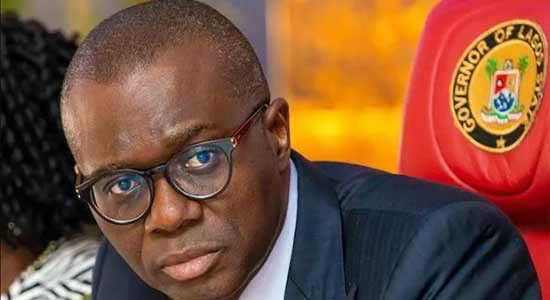
THE President-elect, Bola Tinubu, has been conferred with the National Honour of Grand Commander of the Federal Republic (GCFR) by the outgoing President Muhammadu Buhari.
Tinubu was conferred with the honour at the State House Banquet Hall in Abuja on Thursday, May 25.
Buhari also conferred national honour of Grand Commander of Order of the Niger (GCON) on Vice President-elect Kashim Shettima.
Tinubu was handed transition documents by Buhari in line with Executive Order 14, mandating the Transition Council to issue handover notes containing, amongst other things, proposed policy direction to the incoming administration.
The former Lagos governor is the 16th person to be conferred with the GCFR title since it was instituted by the National Honours Act No. 5 of 1964. The GCFR and the GCON are awarded to the President and Vice President, respectively.
The country’s highest national award has been conferred on Nnamdi Azikiwe, Obafemi Awolowo, Shehu Shagari, Olusegun Obasanjo, Abdulsalami Abubakar, Ibrahim Babangida, Ernest Shonekan, Sani Abacha, Moshood Abiola, Umaru Yar’Adua and Goodluck Jonathan.
Others who have been conferred with the title include British Monarch Queen Elizabeth II, South Africa’s Nelson Mandela and former Libyan Leader, Muammar Gaddafi.
Speaking at the event, Tinubu assured Buhari that he will not disappoint him.
He also affirmed that he understands the magnitude of the honour conferred upon him and the corresponding task ahead.
“I understand the magnitude of the honour conferred on me today and the task ahead. Nigerians deserve no less,” he said.
“You (Buhari) have charted the course and I shall not disappoint you.”
INEC had declared Tinubu as the winner of the February 25 presidential election.
According to INEC, Tinubu secured 8,794,726 votes, the Peoples Democratic Party (PDP) candidate, Atiku Abubakar had 6,984,520, while the Labour Party (PDP) presidential candidate, Peter Obi, polled 6,101,533.
His election is currently being challenged by the Labour Party (LP), the Peoples Democratic Party (PDP) and the Allied People Movement (APM).
He and his deputy will be sworn in on Monday, May 29.
The former Lagos state governor, in his manifesto, has outlined his commitment to prioritising various sectors crucial to the nation’s development.
With a focus on national security, economy, agriculture, power, oil and gas, transportation, and education, his vision aims to foster a new society built on shared prosperity, tolerance, compassion, and equal respect for all citizens.
One of the key areas of emphasis in his plan is the creation of employment opportunities for the youth, aiming to build a Nigeria where sufficient jobs with decent wages can lead to a better quality of life.
According to him, he envisions transforming Nigeria into a nation known for innovations, with a focus on manufacturing, creating, and inventing goods and services, thus shifting from being primarily consumers to creators.
To strengthen the economy and promote self-sufficiency, the former governor advocates increasing exports and reducing imports, which would have the dual effect of bolstering the national currency, the naira, and improving overall living standards.
THE Kano State Government has cleared House of Representatives Majority Leader, Alhassan Ado Doguwa, of charges relating to criminal conspiracy and culpable homicide.
The Attorney General and Commissioner of Justice, Musa Abdullahi Lawan, made this known while briefing journalists in Kano on Thursday, May 25.
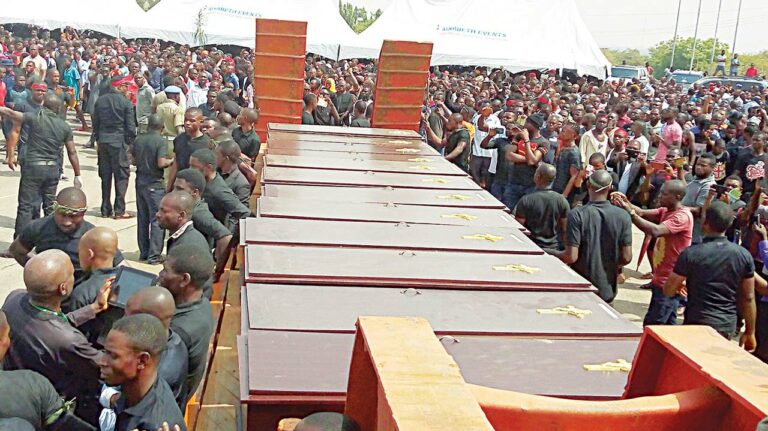
The charges were levelled against Doguwa after violent clashes that occurred during the collation of results of the 2023 Presidential and National Assembly elections in Tudun Wada/Doguwa Federal Constituency of Kano State.
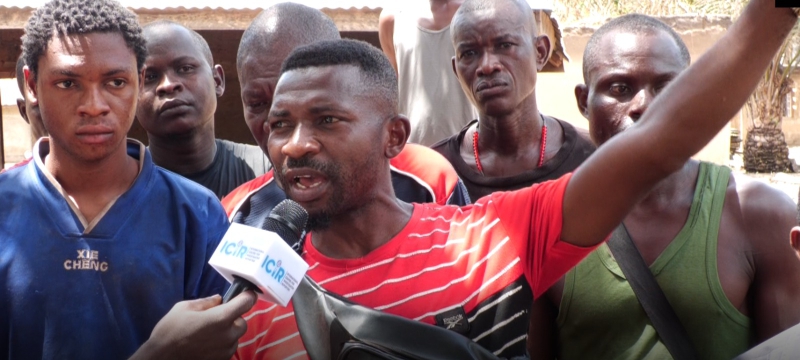
According to residents and survivors who spoke to The ICIR in a report, some members of the New Nigeria Peoples Party (NNPP) were attacked by Doguwa, of the All Progressives Congress (APC) and his supporters while the collation of results was going on, on February 26.
The incident which led to multiple fatalities and burns were said to have been perpetrated by Doguwa, the minister representing Doguwa/Tudun Wada Federal Constituency of Kano State.
Following the allegations, the Kano State Police Command arrested Doguwa. According to Kano state police spokesperson Haruna Kiyawa, the lawmaker was arrested in connection to a suspected case of criminal conspiracy, culpable homicide, causing grievous hurt, mischief by fire and inciting disturbance.
Doguwa was subsequently charged at the Federal High Court in Kano. He was subsequently granted bail of N500 million with two sureties.
On May 20, it was reported that the Inspector General of Police Usman Alkali, concluded the murder case investigation and transmitted the case file to the Kano State Government for prosecution.
It was expected that with the findings of the case concluded, the Kano State Government would formally file criminal charges against the lawmaker.
Meanwhile, the Commissioner of Justice and Attorney General of the state, Abdullahi-Lawan, while briefing newsmen in Kano, said that the ministry could not substantiate charges of criminal conspiracy, mischief by fire, and culpable homicide against Doguwa.
He said facts and observations were not enough to link Doguwa with the said offences.
“We cannot find sufficient evidence to link Doguwa with the said offences, considering that we are faced with so much inculpatory and exculpatory evidence for and against him,” Abdullahi-Lawan said.
According to Lawal, the statements of those that implicated Doguwa were full of contradictions. He added that there was no medical evidence to prove the cause of the death of the victims.
“The law is clear that the allegations that Doguwa killed people cannot be substantiated.
“We are variably guided by the findings of the investigations of the Police as contained in the case diary sent from the FCID devoid of sentiments, fear or favour,” he said.
The attorney general also noted that the pistol and 30 rounds of live ammunition recovered from the second and third suspects, who were aides to Doguwa, adding that investigations showed that the ammunition given to them by Ballistic states was found intact.
“Some of the witnesses said Doguwa carried a Dane gun while some said it was a pistol.
“No bullet shell was recovered at the scene, only one knife, cutlass and charm,” he said.
According to him, eight to 12 other suspects would be charged to court with mischief by fire under section 336 of the Penal Code as amended..
A CIVIL society organisation, Global Rights, will hold a virtual candlelight memorial on Friday, May 26, to remember thousands of Nigerians who died from conflicts and related crises during President Muhammadu Buhari’s eight years in office.
A statement mailed to The ICIR on Thursday, May 25, by the organisation, said the memorial would reflect on the “mass atrocities that have deeply affected Nigeria”.
Global Rights noted that from 2019 to 2022, Nigeria witnessed a surge in violence, “resulting in the tragic loss of thousands of lives and the abduction of countless individuals”.
“At least 20,431 civilians and security personnel have been killed, and 12,944 people have been abducted during this period. Urgent action is needed to address this insecurity.
“As we approach the end of a leadership cycle and anticipate a new era, it is crucial to evaluate the security situation, analyse the underlying causes of the administration’s shortcomings, and comprehend the profound impact of mass atrocities on individuals, families, and communities. This virtual memorial will pay tribute to the victims, shed light on their experiences, and explore strategies to prevent future tragedies,” the organisation added.
Several reports by The ICIR show how thousands of Nigerians fell victim to insurgency, banditry, kidnapping, ritual killing and other atrocities under Buhari’s administration.
A report published by The ICIR on May 21 detailed key security issues and killings under the President.
Another report in June 2021 showed how the insecurity crisis persisted despite billions the government sank into tackling it.
On May 20, this organisation reported that 37 of the Chibok girls’ parents, who the President vowed to rescue from their abductors, had died since the abduction, while 93 of the girls are still with their captors.
In March 2022, The ICIR reported a timeline of Buhari’s condolences on tragedies that stemmed from insecurity in the nation within a year.
Nigerians elected Buhari in 2015 after he repeatedly vowed to secure the nation if given the chance.
The ICIR reported that 287 people were killed within five months in the South-East for similar reasons in 2021. The South-East is one of the country’s six geo-political zones.
Insecurity takes different forms under the President across the zones. Though he inherited insecurity when he assumed office, many believe the situation worsened during his tenure.
Banditry and kidnapping reign in the North-West and North-Central, and there were still pockets of insurgency in the North-East as of 2022.
‘Unknown gunmen’ take charge in the South-East, killing people and grounding businesses, while ritual killings surged in the South-West. But the South-South, where agitators for (petroleum) resource control had wreaked havoc in the past, have been pacified with empowerment programmes and juicy contracts for monitoring oil infrastructures.
In 2022, The ICIRreported how terrorists attacked 18 correctional centres and released inmates, including other terrorists across Nigeria, under Buhari’s watch.
In July 2022, suspected terrorists attacked the Presidential Guards Brigade in the nation’s capital.
Similarly, this organisation reported that over 80,000 Nigerians fled to the Niger Republic in three months under Buhari’s watch.
Following deteriorating insecurity across the country, the National Assembly threatened to impeach the President in 2022.
In January, The Punch newspaper reported that 2,140 soldiers, police officers, and others were killed while securing the nation during Buhari’s tenure.
Buhari leaves office on May 29 and will hand over to the President-Elect, Bola Tinubu.
A FEMALE officer, Fauzziyah Isiak, has been arrested and detained by the police authorities after she made attempts to resign from the Nigeria Police Force (NPF).
She is currently facing orderly room trial for being absent from duty and flouting the social media policy of the NPF.
Isiak, who took to Twitter to recount her travails on Thursday, May 25, lamented that she was detained without any form of interrogation when she arrived at the office on Wednesday, May 24.
According to her, she was called into the office and detained, despite disclosing that she was menstruating at the time.
“I never saw this coming. I have never thought I’ll be put in detention without interrogation. All I did was try to resign,” she said.
She explained that she has been attempting to resign from the Police Force since 2022, but her resignation letters were not approved.
Isiak explained that she was hopeful that he resignation would finally be accepted when she was summoned by her immediate boss to meet with the Deputy Commissioner for an interview on May 24.
However, according to her, she was informed that she would be detained and subsequently dismissed.
Isiak, who said she is also an entrepreneur and beekeeper, added, “Later, I heard that I should have begged and cried, but my lack of reaction worsened the matter.”
Bemoaning her plight, she said she had not changed her clothes or sanitary pad since her detention about 24 hours ago.
She further claimed she is suffering from severe exhaustion and migraines in her detention cell, which she said is filled with mosquitoes.
Isiak also said her mother has been advised to come and plead with the police authorities on her behalf.
“I have not taken my clothes and shoes off since yesterday. I can’t even change my sanitary pad. My migraine is throbbing at full speed and my head is about to explode from exhaustion,” she said.
“My mother has called that she has been advised to come and plead that I will continue working. I have been working for 6 years and I think it is fair to let someone go and aid them to leave if they do not want to stay anymore.
“I have been very easygoing since I was born, this is my first time in this kind of situation. I have always worked in the administrative department, in fact, the religious department of the Nigeria Police. I believe in pursuing everything with passion, I always remove myself whenever I think I am no longer giving full attention to a job or career.
“I don’t know how long I’ll be here for but I really need to sleep. If the women at the Provost’s office had not given me some Paracetamol yesterday afternoon, I may not have survived until now. I don’t know how long I will be here for but I’ll appreciate a blanket with a sanitary pad.
“The cold is about to snuff my life out. As I sit here through the night and the mosquitos hum in my ears. I keep talking to them to ask them why someone who could have stamped my letter and put me through on what to do will have me held down and humiliated instead.”
She did not follow due process -– Police
Following Isiak’s claims, the Force Public Relations Officer, Olumuyiwa Adejobi explained that the female officer did not follow the due process in her bid to resign from the Nigeria Police Force.
Adejobi, spokesperson of the NPF, accused Isiak of misinforming the public and making light of the situation.
“She is just being funny and misled, I guess. I am sure many have got the facts from the Command,” he said in a statement posted on Twitter on Thursday, May 25.
Adejobi outlined the resignation process, explaining that it involves submitting a resignation letter through the appropriate channels and receiving approval before being allowed to leave.
He noted that if urgent departure is required, payment equivalent to three months’ salary must be made to the government.
The police spokesperson concluded by stating that since Isiak had not received approval, she was obligated to remain on duty.
“The process is clear. You write a resignation letter through your, DPO, to Area Commander, follow the ladder up to the IGP, and response comes via the same route. And if it’s so urgent that you must leave, you make payment equal to ur salary for 3 months, to be paid to the purse of the government, with proof of payment.
“That is express. But if you have not received any approval, you must be on duty. So, she has not been reporting on duty.”
Also, spokesperson of the Lagos State Police Command, Benjamin Hundeyin, in a statement posted on Twitter on Thursday, revealed that Isiak was absent from duty without leave or permission, prompting the subsequent actions taken by the police.
In the statement titled ‘Setting the records straight’, Hundeyin explained that Isiak’s absence without permission constituted desertion, a serious offence.
He further accused Isiak of maliciously tarnishing the image of the Force.
According to him, working in the Police Force differs from being employed in the private sector, where resignations are processed swiftly.
Hundeyin also disclosed that Isiak would face orderly room trial, for desertion, on Thursday.
Parts of the Lagos police spokesperson’s statement read: “It is one thing to turn in your resignation. It is another thing for the application to be processed, upon which you receive your discharge certificate.
“Till you get the discharge certificate, you remain a serving member of the Force, bound by all extant rules and regulations of service.
“Absence from duty for twenty-one days without leave or permission automatically results in your being declared a deserter. Every serving member knows this.
“Corporal Fauzziyah Isiak, who serves in the office of the Imam of the Command, without leave, permission or discharge from service, absconded from duty for over a month, in flagrant disregard for the conditions of service she willingly signed to. For this offence against discipline, she was detained yesterday for the commencement of her orderly room trial today.”
He noted that Isiak would be given the opportunity to explain herself at the trial, after which a decision will be made.
Hundeyin added that Isiak had committed a similar ‘offence’ in the past.
Explaining how the female police officer resigned, he said, “Last year, at the start of the honey season, she absconded from work without permission. When reached on phone to ascertain her whereabouts, she sent in her resignation – not tenable.
“Same thing this year. She sent in a resignation letter after first going AWOL. Due process must be followed.”
He said Isiak is currently on trial for being absent from duty for 53 days and flouting the Nigeria Police Force Social Media Policy.
This report covers the fatal crisis that escalated at an electric isolation point between youths of Obi and Otukpo Local government areas (LGA) in Benue state after the Jos Electricity Distribution (JED) Plc failed to restore power. The ICIR crew Sinafi OMANGA and Olayinka FATUNBI who visited the communities, report.
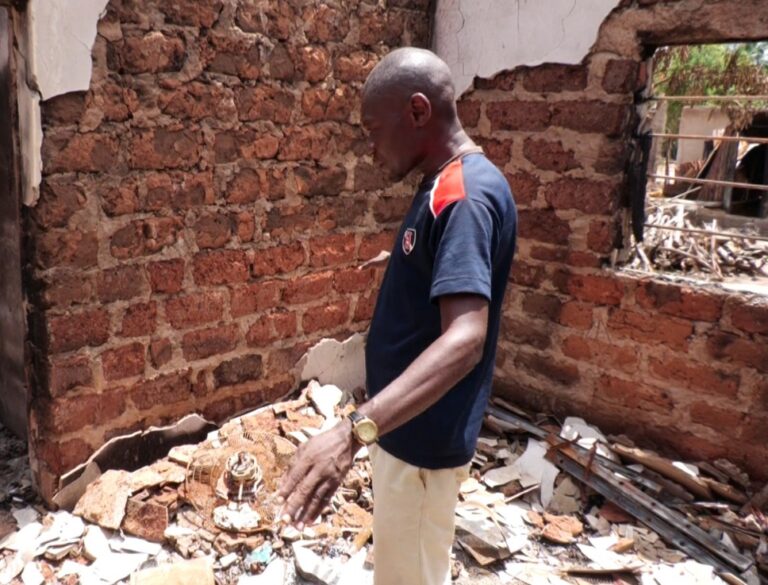
It felt like a ghost town. Three men sat under a mango tree in a local market square that used to be filled with residents of the Ijegwu community, Obi LGA, Benue state. During a visit on the afternoon of April 20, 2023, Several buildings lay in ruins – burnt to the ground.
Shortly, five men and two women emerged from behind some of the houses. One of them is Jacob Orokpo, the soft-spoken district head of the village. “What are you doing here?” he asked.
Realising that he was speaking to journalists, the village chief said he did not know where to begin the story.
“I was not around when the crisis broke out,” he told The ICIR. “I was advised not to come back because the community was on fire. When I came back a few days ago, I did not know my house again,” said the octogenarian, who was still visibly shaken.
Charred items such as furniture, sets of desktop computers, television screen, kitchen utensils, tubers of yam and ornaments that once filled the apartments of the village chief are a poignant reminder of the jarring incident.
Jacob Orokpo, District Head of Ijegwu has been rendered homeless.
Orokpo said he is now homeless and has nowhere to seek refuge.
Thirty Km away lies another neighbouring community with a similar level of devastation and desolation. Blessing Sunday, a 38-year-old resident of Otobi in Otukpo LGA, was picking ripe mango fruits on Friday morning of April 21, 2023.
“I lost everything that I have laboured for so many years. Even the clothes I’m wearing are not mine. Somebody gave them to me. I lost everything,” cried the mother of four.
Ever since she fled with her four children, Sunday said they have gone to different places in search of where to lay their heads. “Only God is helping us,” she added.
Blessing Sunday, resident of Otobi-Otukpo in her building that was burned down.
Ordinarily, residents of Ijegwu and Otobi should be going about normal activities in the farms or markets and children attending schools, but those days are gone since they fled a communal crisis that rendered them homeless.
As the attention of Nigeria’s over 200 million citizens and the international communities focused on the 2023 general elections, youths in the neighbouring communities of Otukpo and Obi LGAs in Benue State launched a communal war, causing death and destruction that is still being investigated, according to the police.
The genesis…
On Monday, March 13 what appeared like a peaceful protest saw youths of Ijegwu march to where the transmission isolation point that supplies electricity to the neighbouring communities is located.
There had been a protracted power outage in Obi, which has a population of 193,098 Igede-speaking people, while neighbouring Otukpo, with a population of 266,411 predominantly Idoma-speaking people, enjoyed relatively constant power supply, according to residents.
Speaking to The ICIR, Ogbu John-Lion, the national president of Ito Youth Forum, an umbrella body for youth groups in Obi LGA alleged that youths in Otukpo LGA “deliberately tampered with the transmission line in order to put Igede land in darkness.
But his allegation was based on suspicion fuelled by historical distrust between the two communities.
He said Jos Electricity Distribution (JED) Plc failed to reconnect the power despite the youth’s effort to draw the attention of the distribution company to the situation.
“The company did not explain or assure us of restoring electricity, and for more than two weeks, we were in total blackout.”
“How was it possible that our neighbours had light but we didn’t? So we went there peacefully to find out for ourselves what the problem was and to suggest how to fix it”, said John-Lion.
Ogbu John-Lion in company of some youths in Obi LGA
On reaching the isolation point, John-Lion said Idoma youths attacked and shot one of them, Jacob Iji, who climbed the electric pole to “rectify” the fault. However, John-Lion said he did not know the name of the person that shot and killed his kinsman.
“That day alone, five unarmed Igede youths were murdered in cold blood”, John-Lion added.
In contrast, the youth leader of Otobi-Otukpo, Agbo Okwanya said they were only resisting the attempt by Igede youths to tamper with the transmission line that could have endangered the lives of residents.
Okwanya also denied allegations that they disconnected lines that supply power to Igede land.
“We are not JED Plc, all the Igede youths needed to do was to draw the attention of the transmission company to the problem but instead they transferred their aggression to us.
“Do they have evidence that we were responsible for the power outage in their land? We were just protecting public infrastructure in our community against Igede youths who came here ready for war”, Okwanya said as he recalled the brawl that ensued at the electric isolation point, which later became a theatre of bloodshed.
Okwanya identified one of his kinsmen, Ogili Onu, as the first casualty from his community. “He was shot by the Igede youths on this road”, he said, pointing to the community access road.
Like John-Lion, Okwanya told The ICIR he did not know the name of the person that shot and killed his kinsman.
Agbo Okwanya in company of some youths in Otukpo LGA Photo credit: Fatumbi Olayinka
As the cacophony of war chants and gunshots filled the air, women and children took to their heels but both communities went back to mobilise militias for the war of attrition that residents said lasted about three weeks. The once bubbling neighbouring communities are now shadows of the past.
Power outage is a recurrent challenge in Nigeria, where an estimated population of200 million rely on only 4000MWs distributed electricity instead of at least 200,000MWs based on the energy demand of a country with a Nigerian population size.
Over 92 million Nigerians lack access to electricity, according to theEnergy Progress Report, by the International Energy Agency (IEA) in 2022.
Government abandoned us, victims cry…
Findings by The ICIR during a four-day visit to ascertain the level of the humanitarian disaster in both LGAs show that over three hundred houses were destroyed. The youth leaders said approximately three thousand persons, including children, were displaced.
Without IDP camps, most of the displaced persons have taken refuge with relatives in other towns and villages, according to residents, mostly men whom this reporter met in the deserted villages.
“This place is not safe for women and children until we can provide shelter and food. Without humanitarian assistance, this will not be possible in many years to come”, said Matthew Adekpe, a former leader of Ito Youth Forum.
David Ekwo, a member of the Otukpo Traditional Council, decried the “slow response” from relevant agencies to the humanitarian crisis that rocked the communities.
“Perhaps, the state government was distracted by the elections because the crisis began a week before the governorship and state assembly elections”, he observed.
Special Adviser to Benue State Governor on Security Matters, Paul Hemba, in an exclusive interview with The ICIR indirectly attributed inactions from the state government to the 2023 general election.
“The general elections came with its own issues,” he told The ICIR
He explained that efforts by the state government to intervene in the crisis were slow because mobile police had been deployed to monitor the elections across the country. The governor’s aide further argued on the bias of Obi residents against the military, which would have intervened in the matter.
“It was after the elections that we deployed mobile police along the boundaries because the Igede people opposed the intervention of the military for the mere perception that the military, whose base is in Otukpo, would join forces with Idoma people against them.”
Paul Hemba
On the humanitarian disaster, Hemba said the government was “seeking the attention of concerned organisations to see ways of alleviating the suffering of the people”.
But in his reaction, an Abuja-based security analyst, Ben Okezie described the efforts of the Benue state government and security agency as “not good enough”.
“it is unfortunate that the state government and security operatives gave more priority to elections over protecting the lives and property of citizens,” he said.
Okezie recommended state policing across the country to avoid state governments making excuses for failure to protect the lives and property of citizens.
Schools shut down as residents flee…
More disturbing to Ekwo, the Otukpo chief, is the future of many children who were forced out of schools by the crisis.
“Our major concern is the fact that thousands of children could not sit for the second term examinations of the 2022/23 academic session, which their mates in other schools across the federation took,” Ekwo disclosed, highlighting the concerns of the school pupils.
“Schools in the communities were sacked, but whatever we do, the plight of children should be paramount. This act is unfortunate and condemnable,” he said
David Ekwo, a member of Otukpo Traditional Council said they were still mourning.
Three schools in Otukpo and four in Obi LGAs have been closed down due to the displacement of residents. The schools in Otukpo are R.C.M Primary School Otobi, L.G.E.A Primary School and Ankan Nursery and Primary School, Ojantele.
L.G.E.A Ijegwu Ito, New Age International Academy Ijegwu Ito, L.G.E.A and Royal Pride Secondary School Opirikwu Ito are schools closed down in Obi LGA.
No fewer than 40 primary and secondary schools have beenshut down across Benue state due to insecurity, according to the state Commissioner for Education, Tarnongo Saawuan.
UNESCO in 2022places out-of-school children in Nigeria at 20 million, and insecurity is a contributor to this data. The situation contravenes the position of the United Nations Sustainable Development Goal (SDGs) 4, where access to basic education is considered vital to promote lifelong learning opportunities.
Police not aware of casualties, missing persons – Spokesperson…
Both John-Lion, the Igede youth leader and Okwanya, the youth leader of Otobi-Otukpo said their communities recorded seven casualties respectively, making fourteen deaths.
Okwanya added that eleven persons from his community were still missing. , But TheICIR could not independently verify this number.
Ekwo, the traditional chief in Otukpo who spoke earlier, confirmed that the missing persons were women and youths whom the “invaders (referring to the Igede youths) trapped and murdered in cold blood”.
Hemba, Ortom’s special adviser on security matters, confirmed that several lives were lost.
However, the retired military colonel said the state government had yet to arrive at the exact number of deaths and missing persons.
“We got conflicting figures from both communities. Some people died, but their bodies could not be found due to the nature of the crisis. Some were burned in their houses, and others were killed in the bushes while trying to escape.
“For these particular reasons, I cannot give a reliable figure now”, Hemba told The ICIR.
However, the Nigeria Police Force denied knowledge of any death or missing person.
The Benue state police spokesperson, Catherine Anene, said the cases were not officially reported to the police command.
“No party reported dead or missing persons to us. The police cannot give accounts of killings that were not reported. They did everything on their own. That crisis is a case of absolute lawlessness”, she said.
She added that an investigation was still underway to arrest and prosecute masterminds involved in the crisis.
Two months after the incident, the police are yet to arrest any suspect.
Is JED Plc responsible for the crisis?
The Jos Electricity Distribution (JED) Plc is one of the indigenous power distribution companies (DisCos) in Nigeria. It is a product of the Federal Government Power Sector Reform of 2015; as part of efforts to further domesticate and provide stable electricity to the people.
However, a resident of Obi LGA, Joseph Obaike, whose family’s property was destroyed, blamed the crisis on the company for not attending to complaints when he informed the office about the power outage.
Obaike said he had made a phone call to the technical staff of JED in Otukpo by the name Ogbu Ateh about the blackout, but he never acted.
“Not even a feedback after he promised to get back to me. I called again more than ten times, but he did not pick up the calls”, Obaike said.
Joseph Obaike inside the rubbles of his building Photo credit: Fatunbi Olayinka/The ICIR
It is the same perception held by all Obi residents The ICIR spoke to.
But the company exonerated itself despite its perceived role in the crisis for failing to restore power to the aggrieved customers.
JED’s head of corporate communications, Friday Adakole Elijah, in a press statement disclosed that “wind storms occasioned by heavy downpours in Otukpo” destroyed electrical installations that caused the power outage in neighbouring communities”.
Elijah added that the “company was not in receipt of any formal or informal complaint” about protracted power outage from its customers in Obi LGA.
According to the statement, the company’s technical crew was on the way for fault tracing in Otobi on the Monday when the crisis broke out but “were told to go back because youths from Obi Local Government have been mobilised to go and destroy the isolator situated in Otobi Ipakangwu.
“It was the attempts to destroy the isolator by the Igede youths and the resistance by the Otobi Ipakangwu youth that led to the crisis as the Igede youth insisted that the Isolator must be destroyed”.
“It is our candid belief that the remote causes of this crisis may be something different from the issue of isolators or lack of power supply,” Elijah added in a telephone interview.
JED Plc Business Unit, Otukpo Photo credit: Fatunbi Olayinka
Findings show JEDC Plc’s communication failure
A search on the website and social media platforms of JED show that the company usually gives updates to explain reasons for power outage or when rectifying a technical fault that would cause blackout. It also informs customers when power would be restored.
For instance, in July 2022, the company informed customers that “there will be a planned outage in Otukpo Region to enable technical crew carry out maintenance on 132Kv bus bar”.
In another announcement on February 11, 2023, JED Plc promptly apologised to customers in Bauchi, Gombe, Plateau and Benue for a power outage it said was caused by the “tripping of a 330KV power line”.
A public announcement by JED Plc
However, findings by The ICIR showed that the company neither communicated to the communities about the power outage supposedly caused by heavy rainfall nor informed the residents about its effort to rectify it, at least not until after the clash.
The vice chairman of Obi LGA, Ogor Ajine, said the crisis could have been avoided if JED Plc had given timely information to the residents.
Ogor Ajine faulted JED Plc for not issuing the statement till after the crisis escalated.
He said the information would have dispelled the suspicion that the power outage was caused by Otukpo residents whom the Obi people accused of “disconnecting them”.
“I can’t heap all the blame on JED Plc, but I believe if they had come out with information on time, it would have helped in calming the situation,” Ajine said during an interview with The ICIR in Otukpo, Benue state.
Proliferation of illegal arms worrisome
In the wake of the incident, the Benue state government expressed concerns over the proliferation of illegal weapons in the hands of some citizens in the state and across the country.
Hemba, the Special Adviser to Benue State Governor on Security Matters, told The ICIR, that illegal possession of arms is why youths in Obi and Otukpo LGAs resorted to violence with its attendant devastation.
He said, “The crisis came to us as a shock because the Idoma and the Igede people have coexisted peacefully and share many things in common.
“Electricity is not the only trigger. The availability of illegal arms in the hands of idle youth is another factor responsible for the crisis”.
Hemba added that the state government was considering an amnesty programme as a strategy to recover illegal arms in possession of the militias and other criminals in the state.
He explained that the amnesty programme will curtail communal crises and other criminal activities such as cultism, armed robbery and kidnapping.
Asked how feasible is the amnesty programme since Ortom’s tenure would officially end on 29 May, 2023, Hemba said, “government is a continuum” with “hope that the next government will look into our recommendations”.
Ortom’s amnesty programme
During his first amnesty programme in 2016, Ortom blamed his predecessor, Gabriel Suswam, for the proliferation of arms in the state.
The Governor stated that Suswam believed in violence and bought arms for youth to achieve his political ambition.
“The amnesty programme succeeded because more than 800 young people came out and surrendered. We have in our possession over 600 assorted weapons and ammunition that we collected from these young men”, said Ortom.
Similarly, the Presidential Committee on Small and Light Weapons, in the same year, disclosed that it recovered and destroyed over 1,500 assorted weapons during the Benue state amnesty programme.
Governor Samuel Ortom (L) and predecessor, Gabriel Suswam
In another batch of amnesty programmes in 2020, Ortom granted pardon to “42 repentant youths” for laying down illegal arms.
However, Ortom’s successor, the Governor-elect, Hyacinth Alia, in one of his campaigns, faulted the amnesty programmes executed by Ortom’s administration.
Alia noted that criminals who were given amnesty went back to crime due to the failure of the government to “properly rehabilitate and reintegrate” them into society.
The Catholic priest turned politician, who was the governorship candidate of the All Progressives Congress (APC) at the time, pledged to introduce a “comprehensive amnesty programme for repentant militia” if elected governor.
Alia later won the March 18 gubernatorial election asdeclaredby the Independent National Electoral Commission (INEC), but it is not clear yet how soon he would begin his amnesty programme.
To account for some of the losses due to the proliferation of small arms and repeated crises, the Executive Secretary of Benue State Emergency Management Agency (SEMA), Emmanuel Shior said the state has lost atotal of 5138 people to violent clashes since Governor Ortom assumed office in 2015.
The SEMA boss attributed most of the killings to farmers-herders conflict in his call on the federal government to boost security and attend to the infrastructural needs of thousands of displaced people in the state.
The electric isolation point where the crisis escalated is located on the boundary between Otukpo and Obi LGAs Photo credit: Sinafi Omanga/The ICIR
Resolving the crisis…
The Benue state government has set up a panel of traditional rulers, lawmakers and other stakeholders from the two LGAs to resolve the conflict through mediation and reconciliation. The panel had its first sitting on April 17, 2023.
One of the mandates of the panel recommending measures to forestall any future occurrence of such a crisis, according to Hemba, who said, “both communities have regretted their actions and tension is gradually going down”.
As of the time of filing this report, no suspect has been arrested or arraigned by security operatives for the wanton destruction of lives and property in Obi and Otukpo communities.
With no arrest so far, it is not clear yet if the panel set up by the Benue state government would recommend prosecuting the masterminds of the crisis.
For the several residents that have been rendered homeless, the struggle is no longer about electricity alone but about how to make ends meet on a daily basis.
“If we had got the power supply, this disaster would have been averted,” Obaike said, laying the blame at the doorstep of the power distribution company.
“For now, we will monitor Jos Electricity Distribution Plc to make it more responsive when there is power outage especially in volatile areas,” Hemba stated.
Cinema Verde, an environmental film and arts festival, is seeking entries.
The festival showcases films from around the world that bring awareness to environmental challenges and sustainable solutions.
The primary focus is to present artistic and creative environmental films as a means to seek change in human-made challenges and disasters such as pollution, water scarcity, biodiversity loss, global warming, and environmental contamination.
Awards will be given in a variety of categories including documentary, short, and full-length feature film. There are also high school and college student categories.
Entry fees vary according to categories and range from US$30 to US$65.
Filmmakers and students who have created films that spotlight environmental issues can enter their work to be featured at this festival.
The regular deadline is August 27, 2023. The late deadline is October 17, 2023. Interested applicants can apply here.
DANIDA Fellowship Centre and the Danish Embassy in Kenya are inviting journalists in Africa to apply for training on climate change reporting.
The prime goal of the training is to pave the way for climate news and feature stories that are relevant for Africans.
The organisers say the media plays an essential role in getting the message of climate change and the stories of adaptation and mitigation across to the public as well as to decision-makers.
When journalists tell well-informed and accurate climate stories, they help citizens and decision-makers understand the realities of climate change and the possible responses.
This learning programme themed, ‘Reporting from the African Frontline of the Global Climate Crisis’, is designed for professional journalists including photographers and videographers working in African print and broadcast media.
The participating journalists must have both experience and a keen interest in covering the global climate crisis and environmental issues.
The program begins in August with online sessions and continues until September with in-person sessions in Tanzania and Kenya.
Transfer from Tanzania to Nairobi will be provided. Journalists, photographers, and videographers in Africa can participate in this training.
The deadline for the submission of applications is June 16, 2023. Interested applicants can apply here.
THE Lagos State Government has moved to address the high level of child abuse in the state by launching a child-friendly booklet called ‘My Passport of Rights’.
The unveiling ceremony, organised by the state’s Domestic and Sexual Violence Agency (DSVA), took place on Wednesday, May 24.
The event, held at Lagos City Model College in Sabo, Yaba, attracted over 300 students from various schools in Education District IV.
The Executive Secretary of DSVA, Titilola Vivour-Adeniyi, explained that the purpose of the booklet was to raise awareness about the widespread occurrence of child abuse in the state while offering valuable information and resources for survivors.
Vivour-Adeniyi stressed the urgent need for intervention strategies that facilitate early detection, care and support for victims.
She highlighted the booklet’s role in encouraging children to speak up when confronted with any form of child abuse.
By familiarising themselves with the signs of abuse, she said children would be better equipped to report incidents promptly, ensuring that appropriate action can be taken.
”Over the years, we have recorded a steady increase in child abuse and related issues. So, this book is an intervention strategy for early detection, care and support,” she said.
”The passport encourages you to speak up in case you are faced with any form of child abuse. It will help you to detect the signs of child abuse, so that you are able to report and that action can be taken on time.”
Vivour-Adeniyi encouraged anyone concerned about the welfare of children and desiring to make a positive impact in their lives to acquire and study the booklet, noting that it aims to inspire actionable steps towards safeguarding children.
She further noted that the booklet is exclusively available through the agency and strictly prohibited from being sold.
She urged parents and guardians to obtain copies of the booklet and carefully consider the valuable information it provides.
The School Counsellor of Education District IV, Taiwo Salako, commended the initiative.
She said that the booklet has the potential to address the pressing issues of domestic and sexual violence perpetrated against children in the state.
The Principal of Lagos City Model College in Sabo, Abiodun Hassan, expressed his appreciation for the state government’s initiative.
He acknowledged that the booklet would safeguard and protect children, thereby helping to mitigate the occurrence of child abuse.
Despite its strict laws, there have been rising cases of domestic violence, especially against children in Lagos in recent times.
According to the State Attorney General and Commissioner for Justice, Moyosore Onigbanjo, Lagos recorded a minimum of 4,860 cases of domestic violence between September 1, 2021, and July 31, 2022.
These cases encompassed various forms of violence, including those directed against children.
Specifically, during that period, 113 children were subjected to physical abuse and assault, while 194 others suffered defilement.
Additionally, there were 15 incidents of defilement and molestation involving minors, 105 cases of child labor, abduction and neglect, and 145 instances of sexual harassment and molestation.
Onigbanjo highlighted that among the reported cases, 1,578 children experienced emotional abuse.
To support the affected children, 55 per cent of them underwent counseling programs aimed at equipping them with the necessary psychological tools to cope with their traumatic experiences and prevent long-lasting negative impacts on their well-being.
He noted that initiatives were designed to provide them with support and aid in their recovery process.
“We have also witnessed an increase in reporting of cases from other states; mostly from Ogun, Abia, Anambra and others respectively. In the past 11 months, a total of 394 cases occurred outside Lagos. Such cases are promptly referred to the relevant agencies in their respective States.
“The Office of the Public Defender as well as the Lagos Public Interest Law Partnership (LPILP) has provided free legal representation to 110 survivors of Domestic Violence, ranging from Judicial Separation, Divorce, Maintenance, Custody of children and Settlement.
“All the survivors of sexual assault received medical attention from Comprehensive Primary Health Care Centres, General Hospitals and Sexual Assault Referral Centres like Mirabel Centre, Women at Risk International Foundation (WARIF) as well as Idera Centre,” he had said.
He further revealed that the youngest child that experienced sexual violence in the year under review was eight months old.
WITH over 133 million people living in multidimensional poverty, the administration of President Muhammadu Buhari has failed through its National Social Investment Programme (NSIP) to allay poverty after expending over N2 trillion on the programme.
Buhari’s campaign was dominated by his Economic Recovery and Growth Plan (ERGP), which promised to restore, boost and resuscitate the Nigerian economy that had gone into recession.
On assumption of office, he established the National Social Investment Programme (NSIP) ostensibly to address the immediate and long-term socio-economic imbalance, alleviate poverty and act as a stimulant to further economic growth.
The NSIP includes a range of programmes like the Government Enterprise and Empowerment Programme (GEEP loans – MarketMoni, FarmerMoni and TraderMoni), N-Power, National Home-Grown School Feeding Programme (NHGSFP), and Conditional Cash Transfer (CCT).
The Federal government, through the Minister of State for Budget and National Planning, Clement Agba, revealed that it had invested a sum of N500 billion annually since 2016 in its NSIP.
He said the Federal Government was committed to grassroots development and had shown this by investing N500 billion annually from 2016 to 2019 in the NSIP.
The minister explained that the investment was done to create a more inclusive society that enhances the quality of life. The government has continued to implement the programme.
He noted, “The sum of N500 billion is appropriated annually for the scheme since 2016 to reflect the continued determination of the government to pursue an inclusive society and achieve growth. Policies such as the N-power scheme have seen 500,000 graduates and 26,000 others engaged.
“Under the national home-grown school feeding programme, as at March 2019, over 9.5 million school children across 30 states are being fed and over 1913 cooks empowered,” Agba said.
This means that the Federal government appropriated a sum of N500 billion for 2016, 2017, 2018 and 2019 budget calendar each.
Other documents obtained by The ICIRindicated that over N5.04 billion was appropriated for similar programmes between 2020 and 2023.
The minister of Humanitarian Affairs, Disaster Management and Social Development, Sadiya Umar-Farouk, stated in January that the ministry had impacted the lives of 15 million families through the NSIP.
Speaking at the 23rd edition of the President Muhammadu Buhari administration scorecard series in Abuja, Umar-Farouk said the programme had positively impacted the lives of millions of Nigerians since its inception in 2016.
”The NSIP has provided assistance and hope to millions of Nigerians. Let me once again list them as the national home-grown school feeding programme, the job creation unit, the national conditional cash transfer and the government enterprise and employment programme,” she said.
She explained that the national home-grown school feeding programme had already captured and fed over 9.9 million pupils across the 36 states of the federation, including the Federal Capital Territory.
Given this context, Nigerians anticipated that the programme would address the rising level of destitution and offer some social safety for those members of the society who are unable to easily eke out a living.
Despite these interventions and funding, 63 per cent of the population was estimated to be living in different categories of poverty, according to the National Bureau of Statistics Nigeria Multidimensional Poverty Index (2022).
The report stressed that 65 per cent of the poor (86 million people) live in the North, while 35 per cent (nearly 47 million) live in the South.
It said the survey sampled over 56,000 households across the 36 states of the federation and the Federal Capital Territory and was conducted between November 2021 and February 2022. It provided multi-dimensional poverty estimates at senatorial district level.
The National Multi-Dimensional Poverty (MPI) report is 0.257, indicating that poor people in Nigeria experienced just over one-quarter of all possible deprivations.
The report stressed that poverty levels across states varied significantly, with the incidence of multi-dimensional poverty ranging from a low of 27 per cent in Ondo to a high of 91 per cent in Sokoto.
According to the report, over half of the population of Nigeria are multi-dimensionally poor and cook with wood or charcoal rather than with cleaner energy.
In 2016, the World Poverty Clock put the number of people living in extreme poverty in Nigeria at 60.8 million or 33 per cent of the population, while the country’s total population stood at 185 million.
By 2023, the number of people living in extreme poverty had moved to 71.2 million, representing 32 per cent of the 220 million population.
The ICIR had reported that the poorest Nigerians had been deprived of the federal government conditional cash transfer.
The report revealed that some of the beneficiaries of the programme had jobs.
It also showed that the method of selection was questionable and lopsided as well and there were politicisation and irregularities in the scheme.
It also unravelled that the enumerators used false information to put the names of their relatives and friends in the social register to gain from the cash transfer.
NIGERIA’s gross domestic product (GDP) declined to 2.31 per cent in the first quarter of 2023, occasioned by the Central Bank of Nigeria’s naira redesign policy, the National Bureau of Statistics (NBS) has said.
The NBS revealed this in its ‘Nigerian Gross Domestic Product Report Q1 2023’ it released on Wednesday, May 24.
The policy brought untold hardship to households, organisations, and even the government as it created cash scarcity, and crippled many businesses, The ICIR can recount.
In its reports, the NBS stated that the GDP rate in the first quarter (Q1) fell, relative to 3.11 per cent recorded in Q1 2022 and 3.52 per cent in the fourth quarter (Q4) 2022.
“The reduction in growth is attributed to the adverse effects of the cash crunch experienced during the quarter,” the NBS said.
According to the statistics office, the performance of the GDP in Q1 2023 was driven mainly by the services sector, which recorded a growth of 4.35 per cent and contributed 57.29 per cent to the aggregate GDP rate.
The agriculture sector declined to negative territory by -0.90 per cent, lower than the growth of 3.16 per cent recorded in Q1 2022, while the industry sector improved to 0.31 per cent from a hostile zone of -6.81 per cent recorded in Q1 2022.
The agriculture and the industry sectors contributed less to the aggregate GDP in the quarter under review than in the first quarter of 2022.
Aggregate GDP stood at N51.24 million in nominal terms in the quarter under review, higher than N45.32 million recorded in Q1 2022, which implied that nominal grew by 13.07 per cent in one year.
Nigeria recorded an average daily oil production of 1.51 million barrels per day (mbd) in Q1, higher than the average daily production of 1.49 mbpd in the same quarter of 2022 and 1.34 mbpd in Q4 2022.
The natural growth of the oil sector was negative at –4.21 per cent in Q1 2023, an increase of 21.83 per cent points relative to -26.04 per cent recorded in Q1 2022.
The oil sector contributed 6.21 per cent to the total real GDP in Q1 2023, down from 6.63 per cent recorded in Q1 2022 but up from 4.34 per cent reported in Q4 2022.
The non-oil sector fell to 2.77 per cent, lower than 3.30 per cent in Q1 2022 and higher than 1.67 per cent in Q4 2022.
According to the NBS, the non-oil sector was driven mainly by information and communication, financial and insurance, trade, manufacturing, construction, and transportation, which accounted for positive growth.