Home Blog Page 911

Why NNPC resumed oil drilling in Borno

THE Federal Government has explained that the recent resumption of oil drilling in Borno and other basins is aimed at growing the country’s reserves which currently stands at 37 billion barrels.

The Nigerian National Petroleum Company Limited (NNPC) formally resumed drilling in the Chad Basin, Borno State, twenty-eight years after its withdrawal from the site.

The initial withdrawal was as a result of the discovery that the quantity of oil in the basin could not serve commercial purposes.

However, the discovery of crude oil and gas in commercial quantities in Kolmani River 2 prompted the resumption of drilling activities in the Chad Basin.

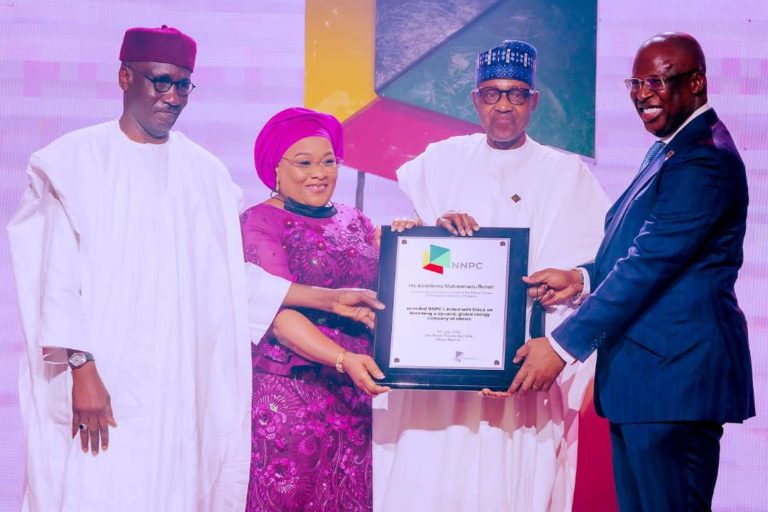
Speaking at the flag off of the Wadi-B drilling campaign on Tuesday, May 23 in Borno State, President Muhammadu Buhari said the oil drilling campaign would signal the commencement of physical activities for the exploration of crude oil and gas in the Chad Basin area.

Buhari pointed out that active drilling activities were suspended in 1995 to enable the re-evaluation of exploration activities in the entire frontier basins.

According to Buhari, “The NNPC has since then conducted extensive basinal analysis and evaluation of oil frontier indices, leading to the successful discovery of crude oil and gas in commercial quantities in Kolmani River 2 and providing insight into the on-going crude oil and gas drilling campaign in Nasarawa State as well as the current re-entry activities into the Chad Basin.”

Buhari expressed optimism that the positive outcome of the Chad Basin exploration campaign would increase the nation’s crude oil and gas reserves and as well enhance national energy security.

Similarly, the Chief Executive Officer of NNPC, Mele Kyari, said the remobilisation of drilling rig to the Chad Basin indicated that the situation had changed since it was abandoned 28 years ago.

He said, “We stopped drilling here in 1995 because the successes were weak and because the findings were not commercial.

“We understood very clearly that we needed to understand the basin very well, we needed to have a different approach to exploration activity in this basin. And that’s why the NNPC and our partner, the erstwhile Department of Petroleum Resources (DPR) and the current NUPRC, decided to embark on massive evaluation of all the frontier basins in the country.”

Kyari further noted that the evaluation of frontier basins had enabled NNPC to understand the geological basin of the Chad Basin.

“It also enabled us to mobilise to Nasarawa State. Now a drilling activity is going on. It also helped us to understand the geological basin of the Chad Basin which is why we are back here.

“Of course, our findings have been useful. The understanding of the rift system in Nigeria enabled us to have successful outcomes in the Kolmani Area.”

The NNPC chief also noted that the company and its partners are committed to deploying the necessary technology and best approach that would enable it to create value for Nigeria.

Kyari added that the exploratory exercise would enable Nigerians to have access to an alternative source of energy for cooking.

The ICIR reported that the NNPC said it would commence the drilling of the first oil well in Nasarawa State by March 2023.

Kyari said the drilling is in continuation of its oil exploration activities in the country’s inland basins.

He noted that the results of exploratory activities confirmed the presence of substantial hydrocarbon resources in the state.

The NNPC chief, calling for prompt action on the project, said, “This work must be done very fast because the whole world is walking away from fossil fuel due to energy transition.

“The earlier you go to the market, the better for you, otherwise, 10 years from now, no one will agree to put money in petroleum business except it comes from your cash flow.”


READ ALSO:


The ICIR reported that the first cargo from the $18.5 billion Dangote Refinery and Petrochemical Company, Ibeju-Lekki, Nigeria, which was commissioned on Monday, May 22, will be available in the market by the beginning of August 2023.

He said, “Our first product will be in the market before the end of July and beginning of August this year. Our investment of over $18.5 billion in this industry has been prompted by our desire to support and contribute our quota to the Federal government to sustain airports, the transform our economy and properly positioned.”

The 650,000 barrels per day (bpd) refinery, expected to save Nigeria from spending scarce foreign currency earnings on importing petroleum products and subsidy payments, was commissioned by outgoing President, Buhari.
Kwara gov emerges chairman Nigeria Governors Forum

0

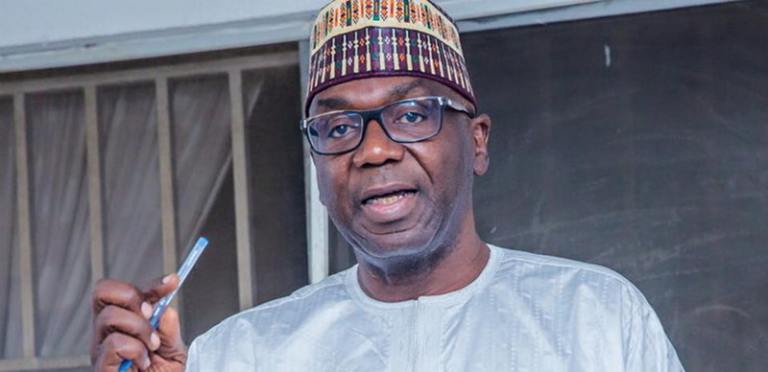
KWARA State governor Abdulrahman Abdulrazaq is the new Chairman of the Nigeria Governors Forum (NGF).

Abdulrasaq replaced Sokoto State governor Aminu Waziri Tambuwal, whose tenure as governor expires on May 29.

This was disclosed in a communique released after the seventh emergency meeting of the NGF, which took place on Tuesday, May 23, in Abuja.

The communique, signed by Tambuwal, stated that Abdulrazaq was elected by consensus.

Oyo State governor, Seyi Makinde, was chosen to serve as the Forum’s vice chairman

“The Governor of Kwara State, Abdulrahman Abdulrazaq, emerged as the new Chairman of the Nigeria Governors’ Forum through a consensus, and the Governor of Oyo State, Seyi Makinde, is now the vice chairman.

“Members expressed satisfaction with the success of the just concluded induction for new and returning governors that took place between 14th and 19th of May, 2023,” parts of the communiqué read.

In a related development, Abdulrasaq, on Wednesday, May 24, assured of his commitment to the NGF’s ideals and vision.

The Kwara governor spoke in a statement issued by his spokesperson, Rafiu Ajakaye, in Ilorin.

“I want to thank Allah, exalted is He, for the historic event in which my brother Governors bestowed upon me the Chairmanship of the Nigeria Governors’ Forum (NGF).

“I hereby pledge to uphold the ideals and vision of the NGF whilst recognising and appreciating the eminent track record of the institution as a most credible, authoritative, influential and effective inter-party platform for consensus building and peaceful resolution and advancement of pan-Nigeria goals, interests and aspirations.

“l will ensure regular consultation with all members in order to arrive at a consensus on all issues for the advancement and promotion of national interest, peace, progress, and stability of the nation,” Abdulrasaq said.

The ICIR reported that Tambuwal became the Chairman of the NGF in September 2022, replacing his Ekiti State counterpart, Kayode Fayemi.

Until then, Tambuwal was vice chairman of the Forum.

Fayemi became chairman of the NGF in May 2019 after taking over from former Zamfara State governor Abdulaziz Yari.

Fayemi was elected through consensus after he was nominated by Kaduna State governor Mallam Nasir El-rufai. The nomination was seconded by Delta State governor Ifeanyi Okowa.

The Nigeria Governors’ Forum is a non-partisan platform that was created to enhance collaboration among executive governors in the country.

The 36 state governors of the federation make up the NGF.

Vandals destroy 9 transmission towers, cause blackouts in Abeokuta, environs

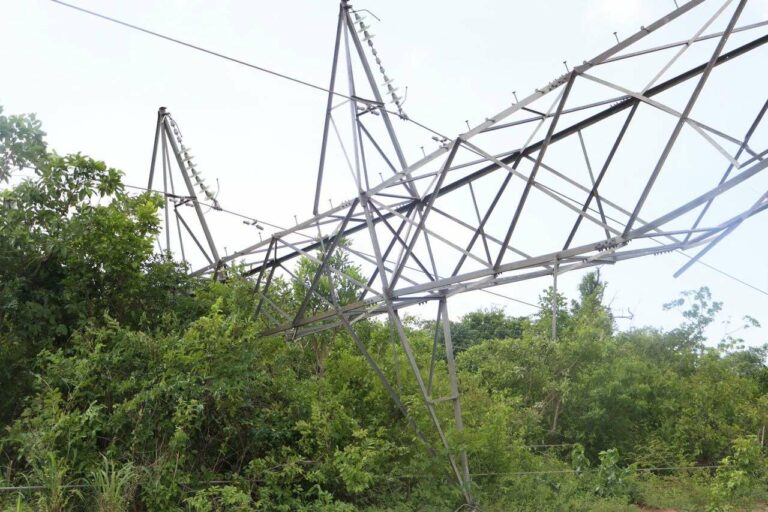
VANDALS have destroyed nine transmission towers of the Transmission Company of Nigeria (TCN) in Ogun state, throwing the affected areas into blackouts.

The vandalism is believed to be the worst transmission tower destruction since two years ago when Boko Haram terrorists blew up about five transmission towers near Maiduguri, the Borno state capital.


READ ALSO:
Oil theft: NSCDC arrests 192 vandals, recovers tankers in Delta

AEDC to enforce maximum punishment for vandals, confirms conviction of arrested staff

NNPC calls for special court to prosecute oil theft, laments loss of $1.5bn to vandals


The destroyed towers were situated between tower 56 and tower 65 along the Papalanto/Abeokuta 132KV transmission line, in the Obafemi Owode area of the state.

A statement by the TCN general manager, Public Affairs, Ndidi Mbah, on Tuesday, May 23, said the towers were “all massively vandalized, leading to their collapse.”

Quoting the general manager, Lagos Region, Mojeed Akintola, Mbah said the collapsed towers were discovered on Monday, May 22 after a tripping was recorded, and a team was dispatched to trace the fault.

“As a result, Abeokuta and environs are presently out of power supply even as efforts are ongoing to supply bulk electricity through an alternate line to enable Ibadan DisCo distribute electricity to its customers whose supply is affected by the incident,” Mbah stated.

A TCN Senior official inspecting vandalised facilities in Abeokuta

She condemned the activities of vandals, stating that their nefarious acts had negatively impacted on the company’s grid expansion efforts.

She expressed regrets that resources that would have been used to further improve the grid infrastructure in Ogun state would now be used to replace the vandalized towers.

The TCN has appealed to host communities to work with it to protect the country’s common national assets.

CBN revokes licence of 179 MfBs, expert weighs implications

THE Central Bank of Nigeria (CBN) has revoked the operating licences of 179 microfinance banks (MfBs), four primary mortgage banks (PMBs) and three finance companies, as disclosed by the regulatory body in two separate gazettes it released on Tuesday, May 23.

The impact of these revocations would affect the larger society, a lecturer at the Department of Finance, University of Lagos, Abu Noruwa, told The ICIR.


READ ALSO:
Naira deadline: Zulum orders emergency microfinance banks in Borno LGAs

Adamawa school suspends admissions after Muslims protest payment of fees in church microfinance bank

CBN again warns commercial banks to desist  from forex malpractices

CBN warns micro-finance banks to desist from wholesale banking, FX deals, or have licenses revoked


Before the revocation, the CBN would have found out that the operators were not complying with the rules and regulations, and the owners of the banks could have been diverting funds for personal use outside the purpose of the MfB operations, Noruwa asserted.

“Some creditors may lose certain parts of their funds [money]. And the debtors, when they are aware of the revocation, may default repaying the loans granted them,” Noruwa said.

The finance expert pointed out that the revocation could reduce the level of investment in small and midsize enterprises (SMEs) and the availability of access to funds, which could lead to a reduction in productivity for the larger society.

He explained, “If the CBN had not revoked those licences, it could affect the larger society and lead to lack of confidence in the establishment of MfBs.”

In the first gazette dated May 22, the apex bank revoked the operating licences of 47 microfinance banks.

In the second gazette dated May 23, the apex bank revoked the operating licences of 132 MfBs, four PMBs and three finance companies.

The regulatory authority said the 47 MfBs had either remained inactive, insolvent, failed to render returns, closed shop, or ceased to carry on the type of banking business for which they were licensed for more than six months.

It added that various steps taken to halt their persistent failure to carry on business had failed.

The CBN said the penalised financial institutions had ceased to practise the type of business for which their licences were issued for a continuous period of six months, among other reasons.

According to the CBN, the institutions’ activities contravened the Banks and Other Financial Institutions Act (BOFIA), 2020 and the Revised Regulatory and Supervisory Guidelines for Microfinance Banks in Nigeria.

The three affected finance houses are HHL Invest & Trust Limited, TFS Finance Limited, and Treasures & Trust Limited, while Resort Savings & Loans, Safetrust Mortgage Bank, Adamawa Savings & Loans and Kogi Savings & Loans are the four mortgage banks, besides the long list of the 179 MfBs.

See the list here

Nigeria’s city of Ilé-Ifẹ̀ has survived and thrived for 1,000 years: here’s how

0

By Akinwumi Ogundiran, University of North Carolina – Charlotte

BY the end of this century, the three most populous cities in the world are expected to be in Africa, with Lagos in Nigeria leading as home to 88.3 million people.

When thinking about what city life is like now and could be like in future, it’s helpful to know something about African urban history.

It’s a history that goes far back, long before the onset of European colonial rule in the late 19th century. And the Yorùbá-speaking area of west Africa was a key player in the continent’s ancient urban history.

Ancient Yorùbá towns and cities, such as Ilé-Ifẹ̀, Ọ̀wọ̀, Ìjẹ̀bú-Òde, and Ọ̀yọ́-Ilé, have attracted attention from different disciplines – especially sociology, anthropology and geography. But their deep history, including how, why, and when they developed, isn’t well known.

In a recent article I set out my findings on the early centuries of Ilé-Ifẹ̀, in south-west Nigeria.

Ilé-Ifẹ̀ occupies a central place in Yorùbá history and identity. It is claimed to be the harbinger of Yorùbá civilisation. More than a thousand years old, Ilé-Ifẹ̀ is one of the oldest and longest-occupied cities in Africa.

Ilé-Ifẹ̀ literally means “House of Abundance”. The name also refers to a place that is diverse and always expanding. In my paper, More than a thousand years old, Ilé-Ifẹ̀ is one of the oldest and longest-occupied cities in Africa.
.

My archaeological and historical findings show how Ilé-Ifẹ̀ became a commercial hub, a pilgrimage and intellectual centre, a magnet for migrants, and a legitimator of social order for a multi-lingual region about 1,000 years ago.

A man holding work tools
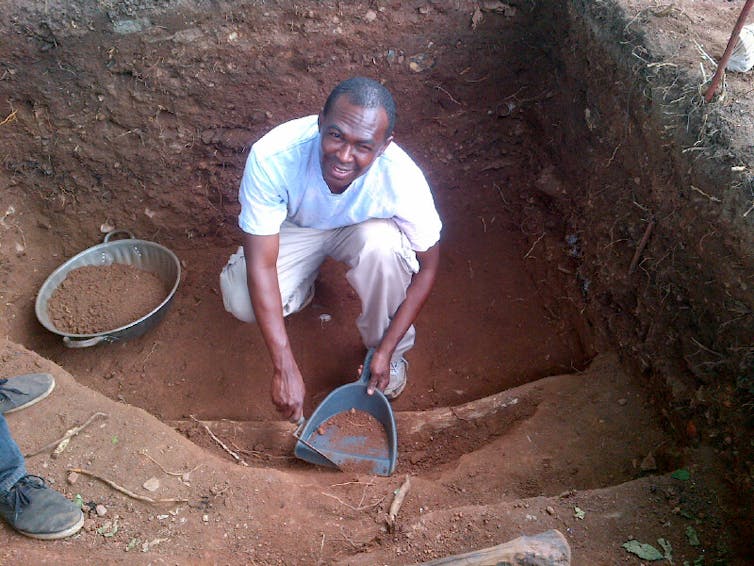
The author’s excavation in Oduduwa Grove in 2014. Akinwumi Ogundiran, Author provided

My research

I began my study of Ilé-Ifẹ̀ in the mid-1980s, learning historical, ethnographic and archaeological field methods in shrines, temples and sacred groves in the city and its suburbs.

I later researched oral traditions and ritual archives in the ancient city to understand indigenous urbanism (the way people relate to the built environment), social organisation and governance. My research extended to other parts of the Yorùbá-speaking region in Nigeria, combining archaeological methods with oral traditions, rituals and language history. I also benefited from published scholarship on Yorùbá history.

My comparative and interdisciplinary approaches highlighted three kinds of urban scale: complexity, multiplexity and referentiality.

Complexity is about social organisation and communities building from the ground up.

Multiplexity is how the diversity of skills and social differences are cultivated and harmonised to form an organic whole greater than the sum of its parts.

Referentiality is about the values the city generates for its residents and a vast area beyond its core.

Community building as urbanism

My key finding was that the raison d’être of urbanism in Ilé-Ifẹ̀ was community building.

Unlike some other African urban centres, such as the Swahili cities in East Africa, Ilé-Ifẹ̀ did not begin as a terminus of long-distance trade routes. Neither did it begin as a hub of craftworks.

Rather, it started as a political unit integrating smaller social units called ilé. The city came into being as a result of the self-organising strategies that several ilé embarked upon at the end of the first millennium AD.

They did this to manage resources and potential conflicts in the face of increasing population and ecological stress.

Ilé-Ifẹ̀ soon set the pace for urbanism in the region through overlapping innovations in sociopolitical ideology, technology and cosmogony (ideas about how the world began).

The intellectuals and political leaders of Ilé-Ifẹ̀ developed a coherent framework for Yoruba city-making by standardising the ideology of divine kingship and what an urban layout should look like. For example, spatial arrangement of the palace, markets, temples, city walls and gates, crafts centres, and road network. They developed a new cosmogony that unified and universalised the Òrìṣà pantheon -the deities in Yorùbá religion.

They also created a new economy that centred on primary glass production.

The glass industry in Ilé-Ifẹ̀ was devoted to bead-making. Glass beads were used to legitimise divine kingship across the region and to finance external trade that brought imports such as brass and possibly salt and silk from across the Sahara. Ilé-Ifẹ̀’s trading partners included cities on the River Niger and other parts of the western Sudan region, such as Timbuktu and Gao.

The city was also a centre of learning. Its intellectuals created schools, some of them devoted to healing and wellness, astronomy and critical inquiry through divination. They attracted students from far and near.

Commemoration and religious sites were set up across the city that attracted tourists. Many of these sites survive today as sacred groves.

Our findings show that the community-building origins of Ilé-Ifẹ̀ made ancestor veneration important to the well-being of households, families and the city. Mortuary art was an important sector of the city’s economy.

The city’s economic buoyancy made it a magnet for immigrant labourers and fortune-seekers. The significance of its bead production also attracted diplomats, traders and pilgrims from across the region.

All of these made it a cosmopolitan city. Consequently, it attained the moniker “city of daybreak”, a nod to its status as a place of novelty and innovations.

During the 13th and 14th centuries, the core city was about 4km in diameter. Beyond that, its satellite areas stretched for about 30km.

The city of Ilé-Ifẹ̀ has weathered many storms in its long history. Its growth was interrupted at different times by drought, famine, epidemic outbreaks, political intrigues, warfare and economic collapse. Its community-building foundation and enduring institutions likely explain its resilience. Now a city of about half a million people, it offers lessons to urban planners and city managers everywhere.The Conversation

Akinwumi Ogundiran, Chancellor’s Professor, and Professor of Africana Studies, Anthropology & History, University of North Carolina – Charlotte

This article is republished from The Conversation under a Creative Commons license. Read the original article.

Ways Dangote refinery will benefit Nigeria

NIGERIA will be making huge foreign exchange savings and meeting demand for local petrol consumption following the commissioning of the much-awaited Dangote refinery by President Muhammadu Buhari on May 22.

The single largest refinery in Africa is expected to commence cargo lifting by the end of July or early August.

Foreign exchange

Industry sources say Nigeria would be saving $26 billion annually from petrochemical plants and fertiliser importation.

“Nigeria will stop importing diesel, petroleum products, fertiliser and petrochemicals. That is saving over $26 billion in foreign exchange.”

“The self-sufficiency in refined petroleum will also be achieved,” the Central Bank of Nigeria (CBN) governor, Godwin Emefiele, said at the commissioning of the $18.5 billion refinery.

He also confirmed the refinery would generate 5,000 permanent jobs and 12,000 megawatts of electricity.

Jobs and taxes

To a former president of the Nigeria Society of Petroleum Engineers, Joe Nwakwue, Nigeria would reap enormous benefits from the Dangote refinery with direct jobs and taxes being paid to both the federal and sub-national governments.

“When we export crude to Europe and import fuel, we export jobs and put pressure on our scarce foreign exchange. The refinery will save us from that and create thousands of direct and indirect jobs,” Nwakwue said.

The refinery, he added, would also make fuel available at affordable price and save us from long queues of fuel scarcity.

Subsidy

He said, “The over $12 billion spent annually on importation would be saved and have a salutory effect on our exchange rate.”

Nigeria spends an average of N4.3 trillion annually on subsidy.

“There would be flexibility in Nigeria’s foreign exchange market once the cargo lifting commences. Gas is also a low-hanging fruit for the in-coming government if they can really pay closer attention to it,” a development economist, Kelvin Emmanuel, told The ICIR.

Oil importation 

The Dangote refinery has strategically positioned Nigeria’s oil and gas market for the global business opportunities.

Most oil majors at the commissioning were said to be match-making their businesses and looking towards bringing in their cargoes here.

For some economic watchers, this is a major signature to Nigeria’s industrialisation.

The huge pull of capital into the economy from this project would have significant multiplier effects, Emmanuel noted.

The Dangote refinery has the capacity to produce 650,000 barrels of crude a day, and meet Nigeria’s local consumption needs.

It is powered by a 435-megawatt power plant.

At full capacity, it can meet 100 per cent of the home requirements of all refined products, as well as meet export targets. The refinery was designed to process 100 per cent Nigerian crude, with the flexibility to process other varieties of crude, including many African countries’ crude, some middle eastern crudes, and the United States’ light-tight oil.

Ex-FAAN MD Yadudu refutes claim that he was sacked by aviation minister

IMMEDIATE past managing director of the Federal Airports Authority of Nigeria (FAAN), Rabiu Yadudu, has dismissed reports about his sack from office.

The media had on Sunday, May 21, reported that the minister of Aviation, Hadi Sirika, had sacked Yadudu as head FAAN and immediately replaced him with Kabir Mohammed, formerly the regional general manager, North-Central, of FAAN.

But Yadudu, in a report on Monday, May 22, wondered how his exit from the aviation parastatal could have been a sack when his tenure only expired after serving four years, as his appointment letter read May 19, 2019.

In a chat with The ICIR, the immediate past general secretary of the National Union of Air Transport Employees (NUATE), Olayinka Abioye, said Yadudu actually served out his tenure, which the minister did not renew.

“The facts available to me are that the government hires and fires at its pleases. However, Captain Yadudu, outgoing Managing Director/CEO of FAAN, was not sacked even though our use of the English Language in this part of the world is different.

“His four-year tenure on the seat lapsed, and rather than the tenure renewed, it is within the powers and authority of the hirer, the Minister of Aviation in this instance, to refuse to renew, and it is, therefore, within his powers to appoint another fellow.”

Abioye, however, hailed the appointment of the new FAAN executive.

He said, “The good thing is that the gentleman, Mohammed, that has just been appointed is a round peg in a round hole who will do justice to the office of the CEO for the greater good of the Nigerian people and the benefits of the global community.”

A check by The ICIR showed that President Muhammad Buhari had, on May 20, 2019, approved the appointment of Yadudu as managing director of FAAN.

An aviation observer, Simon Tumba, had, however, faulted that appointment.

He told The ICIR, The minister ought to have waited for the next government to appoint the new managing director since he is unlikely to work with the new appointee.

“I think what the minister did was wrong. Unfortunately for the minister, many are reading pecuniary interests behind the appointment.”

Less than 24 hours after Yadudu’s re-placement, the Minister of Aviation had reportedly also sacked Mathew Pwajok, the acting director-general of the National Airspace Management Agency (NAMA), and replaced him with  Tayib Odunowo, the director of aerodrome and airspace standards in the National Civil Aviation Authority (NCAA).

Meanwhile, on Wednesday, May 3, the House of Representatives queried Yadudu over the volume of dilapidated infrastructure in the nation’s airports.

The House Committee on Aviation had demanded the reason behind the demolition of houses reportedly built on Lagos airport land.

Eight years after, Buhari fails to end pollution in Niger-Delta despite campaign promises

In a few days, President Muhammad Buhari’s eight years tenure will be over. But the president is yet to end pollution and depollute areas affected by frequent oil spills in the Niger Delta as he promised during his presidential campaign in 2015.

THE families in Goi, a small community within the Gokana Local Government Area (LGA), Rivers state, breathe, eat and live in a contaminated space. Their village is a wet, murky land swamped with black mist that pollutes everything they own.

According to an investigation by The ICIR, the creeks and farmlands are filled with crude oil spills and a vile smell that makes breathing difficult.


READ ALSO:

For decades, crude oil from the Niger Delta accounted for 70 per cent of Nigeria’s foreign revenue. But repeated oil spills continue to endanger the lives of the 30 million residents of the region, which spans nine states and has a coastline of approximately 450 kilometres.

The most internationally known incident is the 2011 Bonga oil spill from a Shell oilfield, in which 40,000 barrels of oil spilt into the Atlantic Ocean and affected 168,000 people in 350 communities in Nigeria’s states of Bayelsa and Delta.

According to Amnesty International, 60 years of oil exploration has turned the region into one of the most polluted places on earth.

Caroline Gbogbara, a resident of Goi, said the pollution continued to affect the quality of farm outputs and the health of community members.

“We don’t have anything to eat. Farmers farm on lands filled with crude and have no choice but to feed on the contaminated produce. Families are forced to eat from poisoned crops,” she said.

This is despite the pledge by President Mohammed Buhari during his campaign in 2015 to end pollution and clean up already polluted areas in the Niger Delta region.

His manifesto included a robust plan to clean and resolve environmental degradation in the region in line with the recommended standard of the United Nations.

“The devastation caused by oil spillage has destroyed many lives and livelihoods and is one of the reasons why many people in that region lost faith in government and resorted to the many criminal activities we see today.

“My government will implement UNEP’s recommendations and give the indigenes of the region hope that there are better days ahead,” he said.

Eight years after, Niger Delta states are still significantly polluted. Air, land and water remain contaminated, with studies reporting devastating effects on residents’ health and livelihoods. 

Vast areas of the waterways and mangrove swamps are being destroyed.

Farmlands are cloaked in oil and contaminating crops which are exposing people to high levels of heavy metals like chromium, lead and mercury.

Buhari’s clean-up exercise

In 2016, Buhari launched a $1 billion clean-up exercise coordinated by the Hydrocarbon Pollution Remediation Project (HYPREP). The goal was to rehabilitate the areas destroyed by crude oil spills and gas flaring. But very little has been done. 

In Ogoniland, Rivers State, where the first phase of the project began, the emergency measures proposed by the United Nations Environmental Programme (UNEP) in 2011 were not correctly implemented and the project has been ineffective.

The rising oil spills outpace clean-up efforts. Almost 6,000 oil spills have been recorded in the region since 2006. Thirty-two per cent of this occurred after 2016.

According to the United Nations, Ogoniland is even dirtier than before the clean-up commenced.

The UN described the HYPREP clean-up exercise as enmeshed in mismanagement, incompetence, waste, and lack of transparency.

So far, the first phase of the clean-up, which began in 2018, is yet to be completed, and the 16 companies awarded contracts for the first phase of the exercise have no experience in the remediation of oil spills.

While most oil spill cases can be attributed to sabotage, theft, and vandalism, it is also significantly caused by other technical faults of oil production and exploration companies, according to the National Oil Spill Detection and Response Agency (NOSDRA).

Analysts say the failure of government authorities to restore the polluted areas could lead to health complications for the locals.

An environmental scientist and lecturer at the Niger Delta University, Charles Oyibo, described the entire clean-up process as fraught with gaps. 

“The impact keeps piling up until they become magnified, and over time, they will begin to manifest to health complications like cancer,” he said.

NOSDRA data on oil spillage showed that about 1,311 spill incidents involving 62,072 barrels were recorded between 2018 and 2020. About 408 spills were documented between 2020 and 2021 under Buhari’s administration.

Rivers, Delta, Bayelsa, Akwa Ibom and Abia states have had the highest incidents of oil spillage.

About 1.89 million barrels out of 2.4 million barrels of petroleum were spilt into the Niger Delta region between 1976 and 1996 in 4,835 incidents, according to the Ministry of Petroleum Resources.

A UNDP report also stated that Nigeria recorded about 6,817 spills between 1976 and 2001.

As Buhari’s tenure winds down, the people of the Niger-Delta are left with an unhealthy environment despite having their hopes raised by the president.

Assault: Seun Kuti released from police custody

AFROBEAT musician Seun Kuti has been released after spending eight days in police custody.

The presidential candidate of the African Action Congress (AAC), Omoyele Sowore, announced his release in a tweet on Tuesday, May 23.

Sowore declared, “Just to announce that @RealSeunKuti has been released from @PoliceNG detention in Lagos. Hasta la victoria siempre!”

He accompanied his message with a video capturing the euphoric moment when the musician reunited with his loved ones.

Kuti’s release came after his trial was adjourned as the Chief Magistrate’s Court where his case is being heard did not sit on Tuesday.

At the resumed hearing in the case on Tuesday, Adeola Olatubosun, who had been presiding over the matter, was absent, and no explanation was provided for her absence.

Kuti was brought to the court as scheduled, but upon learning of the magistrate’s absence, a team of policemen swiftly moved him to a nearby police station at Panti.

There were reports that the case had been adjourned until Wednesday, May 24. But no official statement was issued to that effect.

Outside the court premises, a group identifying themselves as members of the ‘Free Seun Kuti campaign’ took to the streets in protest.

They demanded the immediate release of the artist, whose case has garnered significant attention across the country.

Trouble started for the son of Afrobeat legend, Fela Anikulapo Kuti, after he was seen in a viral video slapping a policeman in Lagos State.

The Inspector General of Police, IGP Alkali Baba Usman, according to a statement from police spokesman, CSP Muyiwa Adejobi, thereafter ordered his arrest.

Kuti, on May 15, turned himself in at the Lagos State Police Command Headquarters, Ikeja, accompanied by his lawyers and family members.

The 40-year-old musician was subsequently arrested and moved to the State Criminal Investigation Department (CID) in Panti.

On May 16, he was arraigned before Adeola Olatunbosun of a Magistrate’s Court in the Yaba area of Lagos State.

The Afrobeat singer was, however, granted bail but according to his lawyer, the judge ordered that he is to be released in 48 hours after meeting his bail conditions.

The judge also ordered that Kuti’s file be duplicated and sent to the director of public prosecution (DPP) and subsequently adjourned to May 23, 2023.

But on May 18, his lawyers said the magistrate has extended the remand order for additional four days to enable the police continue with its investigations.

In a statement on Saturday, May 20, the musician’s lawyers accused the Lagos State Police Command of failing to comply with a court order by withholding his case file.

Kuti’s lawyers also accused the police of intentionally sensationalising the case.

Tingo Mobile gets low risk grade amid harsh operating environment

0

NIGERIAN credit rating agency, DataPro Limited, has assigned a long-term rating of ‘A’ with a positive outlook for 2023/2024 to Tingo Mobile Plc, despite the unfriendly business environment in the country.

Businesses operated under rising interest rates, surging inflationary pressure, and foreign exchange volatility, among other headwinds in 2022.

The economic challenges impact input costs, operating expenses, and the general profitability of businesses.

For instance, inflation, representing the overall price level for goods and services in the economy, rose from 15.60 per cent in January 2022 to 21.34 per cent in December.

According to DataPro, the rating was based on the company’s financial performance, profitability, capital structure, asset quality, liquidity, corporate governance, risk factors and management, among other criteria.

An ‘A’ positive rating indicates that Tingo has a low-risk grade with very good financial strength, operating performance and profile, according to the standards established by DataPro.

According to the rating agency, Tingo, an agri-fintech company, demonstrated sustained growth in earnings with a compound annual growth rate of 30 per cent.

In 2022, the company’s revenue rose by 35 per cent to N463 billion, and equity also provided 47 per cent funding for the company’s assets as against 22 per cent funding recorded in the previous year.

DataPro said, “The Positive Rating assigned reflects DataPro’s opinion of Tingo’s good revenue and funding profile, as well as its experienced management team.”

It explained that at lower risk, Tingo demonstrated excellent financial strength, operating performance and business profile.

“This company, in our opinion, has a very strong ability to meet its ongoing obligations. The short-term rating of “A1” indicates good credit quality and satisfactory capacity for timely payment of financial commitments,” it maintained.

DataPro noted that the rating carries a maximum shelf life of 12 calendar months, in line with international best practices.

“The Rating is therefore not an offer to trade in securities nor a substitute for the user’s judgement. It is meant for reference purposes,” it added.