Home Blog

Dozens dead in Accra, Abidjan, Lagos floods

FLOODS triggered by days of torrential rainfall have killed dozens of people and displaced hundreds across three major West African cities – Lagos, Accra and Abidjan – raising fresh concerns over climate change, poor urban planning and inadequate drainage infrastructure.

In Ghana, authorities confirmed that at least 13 people have died after intense rainfall submerged large sections of the capital, Accra, with emergency officials warning the death toll could rise as rescue operations continue and several people remain missing.

The Ghana National Fire Service (GNFS) said it had rescued more than 470 residents trapped by floodwaters, while emergency teams drawn from the military, police, fire service and the National Disaster Management Organisation remained on the ground searching flooded communities.

The government urged residents to remain indoors where safe or move immediately to higher ground, warning that another storm system approaching from the east could trigger additional flooding.

President John Mahama disclosed that preliminary data showed approximately 140 millimetres of rainfall fell on Accra within a short period more than double the city’s highest single-day rainfall recorded in 2025.

“That increase points to climate change,” Mahama wrote on X, while also blaming clogged drainage channels and illegal construction on waterways for worsening the disaster.

Following an aerial assessment of the city, the president ordered the demolition of structures obstructing natural waterways.

The floods also forced the temporary shutdown of electricity in parts of Accra after floodwaters damaged key power substations, while a major fire broke out at a rubber factory amid the flooding.

Residents described scenes of widespread devastation, as authorities braced for further rainfall forcing markets, businesses and roads to remain closed.

Ivory Coast records about 20 deaths

Neighbouring Ivory Coast also suffered deadly flooding after heavy rains that began over the weekend.

Although authorities had yet to release an official casualty figure, a source close to firefighters and the country’s Interior Ministry told Journalist that about 20 people had died in the commercial capital, Abidjan, following floods and landslides.

The disaster has compounded concerns over increasingly frequent extreme weather events affecting coastal West Africa.

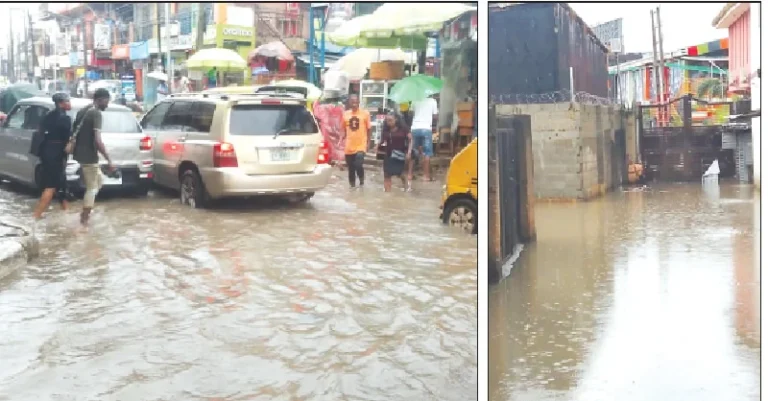
In Lagos, hours of heavy rainfall on Tuesday submerged roads, homes and businesses across several parts of the state, disrupting transportation, knocking out electricity in several communities and forcing some residents to abandon their homes.

Communities affected included FESTAC, Gbagada, Ikeja, Ajah, Evans, Olushi, Anikantamo, Adeniji Adele, Victoria Island, Lekki, Mushin and Mafoluku, where videos circulating online showed residents wading through knee-deep floodwaters while stranded motorists struggled to navigate submerged roads.

Residents blamed the recurring floods on blocked drainage systems, poor road construction and unchecked urban development.

“The way the road was constructed contributes to the flooding,” Ikeja resident Abidemi Raji said, alleging that construction activities had obstructed an important drainage channel connecting neighbouring streets.

In FESTAC, resident Okeke Mmesoma described the flooding as an annual ordeal.

“Anytime it rains heavily, this place gets flooded. My shoes were soaked this morning on my way to work,” she said.

The flooding also disrupted electricity supply after floodwaters damaged critical equipment at the Oworo 132/33kV Transmission Station.

Power distribution company Ikeja Electric confirmed that two transformers and multiple 33kV feeders were affected, resulting in outages across communities including Ladilak, Bariga, Oworo, Pedro, Agboyi, Araba and Gbagada.

In neighbouring Ogun State, residents of Gloryland Estate in Ibafo appealed for urgent government intervention after floodwaters damaged homes and forced some families to relocate temporarily.

The ICIR reports that flooding is a recurring yearly tragedy in Nigeria.

Between January and August 2025, the National Emergency Management Agency (NEMA) said at least 165 people had died and 82 were missing due to flooding.

In a data dashboard released on August 1, the agency said 119,791 people were affected, with 138 injured and 43,936 displaced across 43 Local Government Areas in 19 states.

Former minister Uche Nnaji arrested

0
FORMER Minister of Science, Technology and Innovation, Uche Nnaji, has been arrested.
He was arrested at the Nnamdi Azikiwe International Airport in Abuja, shortly after his arrival on a chartered flight from Enugu State.
Nnaji was a cabinet member in President Bola Tinubu’s government until he resigned on October 7, 2025, following a certificate forgery scandal.
He is expected to be handed over to the Independent Corrupt Practices and Other Related Offences Commission (ICPC) for prosecution, following a recent Federal High Court order in Abuja directing the ICPC to arrest him for certificate forgery.
The court gave the ruling following an ex parte motion by the ICPC in suit number FHC/ABJ/CS/1160/2026.
The ICIR reports that the embattled former minister is the governorship candidate of the Peoples’ Democratic Party (PDP) in Enugu State for the 2027 poll.

On October 4, The ICIR reported how a two-year-long investigation by Premium Times found that both Nnaji’s university certificate and his National Youth Service Corps (NYSC) discharge certificate were forged.

According to the report, the University of Nigeria, Nsukka (UNN) disowned the Bachelor of Science certificate Nnaji claimed to have obtained from the institution, stating that there were no records showing he graduated in July 1985 as alleged.

The report quoted a response to a freedom of information request sent by the newspaper, which stated that while Nnaji was admitted in 1981, there was no record that he completed his studies or graduated in July 1985, as his certificate claimed.

In a letter dated October 2, 2025, and signed by the Vice-Chancellor, Simon Ortuanya, a professor, UNN disowned the certificate paraded by the minister.

Further checks by the newspaper showed that although Nnaji was admitted to study Biological Sciences, he failed several courses before he was advised to withdraw.

The case has since been at the Federal High Court, Abuja, where Nnaji is challenging the accusation.


.

2027: ADC, NDC upbeat as presidential candidates’ particulars hit INEC portal

0

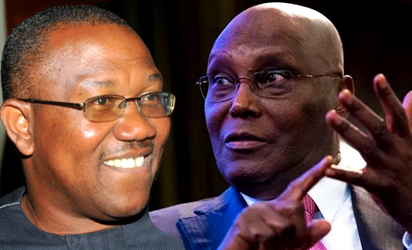
THE African Democratic Congress (ADC) and the Nigeria Democratic Congress (NDC) have uploaded the particulars of their presidential candidates to the Independent National Electoral Commission (INEC) nomination portal as preparations for the 2027 general election gather momentum.

The ADC confirmed that it had successfully uploaded the names and particulars of its presidential candidate, former Vice President Atiku Abubakar, and his running mate, former Minister of Transportation Rotimi Amaechi.

Announcing the development on his X account on Tuesday night, the party’s National Publicity Secretary, Bolaji Abdullahi, described the upload as another milestone in the party’s preparations for the election.

“We are pleased to announce that we have successfully uploaded the names and particulars of the African Democratic Congress (ADC) Presidential Candidate, Atiku Abubakar (GCON), and our Vice Presidential Candidate, Rotimi Amaechi (CON), to the nomination portal of the @INECNigeria,” Abdullahi said.

Similarly, the Nigeria Democratic Congress (NDC) announced that it had uploaded the particulars of its presidential candidate, Peter Obi, to the INEC portal.

The party’s National Leader, Seriake Dickson, disclosed this in a post on his X account, adding that the name of the vice-presidential candidate, Rabiu Kwankwaso, would be uploaded after the completion of the required documentation.

He also said the submission of candidates for other elective offices was ongoing.

Dickson said the party had complied with the INEC timetable and assured members that there was sufficient time to submit the names of candidates for the National Assembly, governorship and state Houses of Assembly before the respective deadlines.

He also revealed that the NDC had filed an appeal against a court ruling affecting the party, alongside an application for a stay of execution, which had been served on the INEC chairman.

According to him, the party remains a duly registered political party and had concluded its nationwide primaries under INEC’s supervision.

The ICIR reports that the latest developments come amid legal uncertainty surrounding both parties.

On June 27, a Federal High Court in Lokoja set aside its earlier judgment that had directed INEC to register the NDC as a political party.

The presiding judge, Isah Dashen, ruled that the earlier decision was constitutionally defective because it was delivered without hearing all parties with an interest in the matter.

The court upheld an application by the Peace Movement Party (PMP), which argued that its interests were affected by the registration of the NDC, particularly over the party’s logo. The judge ordered that the status quo before the December 2025 judgment be restored and directed that the substantive suit begin afresh, with INEC, the PMP and the NDC joined as parties.

Despite the ruling, the NDC National Leader has maintained that the party remains duly registered, noting that it has appealed the judgment and filed an application for a stay of execution.

He also disclosed that the appeal and stay application had been served on the INEC chairman and insisted that the commission should act in accordance with the law while the appeal is pending.

Similarly, the ADC is also facing legal hurdles. On June 15, a Federal High Court in Abuja ordered INEC to deregister the ADC, alongside the Action Peoples Party (APP), Action Alliance (AA), Accord Party (AP) and Zenith Labour Party (ZLP), citing their poor electoral performance in previous polls.

The judge, Peter Lifu, held that the parties failed to meet the constitutional requirements for retaining their registration and directed INEC to remove them from its register, effectively barring them from participating in future elections, including the 2027 general election.

The judgment followed a suit by the Incorporated Trustees of the National Forum of Former Legislators, which argued that the affected parties no longer satisfied the constitutional thresholds required to remain registered.

APC drops Suswam, 5 other senatorial candidates on final list to INEC

THE All Progressives Congress (APC) National Working Committee (NWC) has dropped former Benue Governor, Gabriel Suswam, and five other senatorial candidates from the party’s final lists of candidates forwarded to the Independent National Electoral Commission (INEC).

The News Agency of Nigeria (NAN) reports that a former Ondo State House of Representatives member, Gbenga Elegbeleye, was also dropped from the list among others.
Also contained in the final lists of dropped and replaced candidates forwarded to INEC are 19 House of Representatives candidates that emerged victorious in the party’s primary elections held in May 2026.
According to the document forwarded to INEC, the states affected were Abia, Kogi, Taraba, Benue, Ebonyi, Ondo, Kaduna, Niger and Kwara.
In the letter sent to INEC and signed by the APC National Chairman, Nentawe Yilwatda, a professor, and its National Secretary, Ajibola Basiru, the party attributed the changes to the report of its Primary Election Appeal Committee.
The letter was titled: “Forwarding of approved list of senatorial and House of Representatives candidates”.
it read in part, “We write to formally forward the attached list of the party’s candidates for the affected senatorial and House of Representatives constituencies arising from the report of the Primary Election Appeal Committee.
“Following the determination of appeals from the recently concluded primary elections, the reports of the Appeal Committee were reviewed and subsequently considered and approved by the party’s NWC as its final position on the affected constituencies.”
The party said it transmitted the list of the approved candidates for seven senatorial districts and 19 House of Representatives constituencies to INEC in compliance with the amended Electoral Act 2022 and INEC’s regulations and guidelines,
Senate President, Godswill Akpabio, his deputy, Jibrin Barau, Senate Leader, Opeyemi Bamidele, Senate Chief Whip, Mohammed Monguno and the senator representing Edo North, Adams Oshiomhole, received their Candidate Affidavit Forms (EC9).
Four state governors are among the candidates whose names were uploaded by the APC to the INEC portal,
The four governors are AbdulRahman AbdulRazaq of Kwara, Hope Uzodimma of Imo, Ahmadu Fintiri of Adamawa and Inuwa Yahaya of Gombe who had all been cleared by the party to contest Senate seats.
Also cleared are former Kaduna State Governor Mukhtar Yero, former senator Shehu Sani and serving senator Sunday Katung to contest Senate seats in Kaduna State.
Former Kogi State governor, Yahaya Bello, secured the party’s ticket for the Kogi Central Senatorial District. He is among the 109 senatorial candidates running on the APC platform.
The uploading of candidates’ particulars, a continuous process, followed the ratification of the results of the April shadow polls and a review of the list in line with the outcome of the Primary Appeal Reports and INEC’S guidelines.
NAN reports that for the House of Representatives, Speaker Abbas Tajudeen, Deputy Speaker Benjamin Kalu, Mudashiru Obasa and James Faleke are among candidates to fly APC’s flag.
Political parties are expected to upload names and particulars of their presidential and National Assembly candidates on INEC’S nomination portal between 9 a.m. from June 27 to 6 p.m. July 10, when the portal would be closed.
The documents to be uploaded include Form EC9, containing candidates’ personal particulars, and Forms EC9A, EC9B, EC9C, EC9D and EC9E, containing the names and lists of nominated candidates.
According to the APC National Publicity Secretary, Felix Morka, the party received over 700 petitions from aggrieved members on the ongoing process.
(NAN)

US Supreme Court strikes down Trump’s birthright citizenship order

THE United States Supreme Court has struck down President Donald Trump’s executive order seeking to end birthright citizenship for children born to undocumented immigrants and temporary residents.

In a 6-3 decision delivered on Tuesday, the court ruled that the US Constitution guarantees citizenship to anyone born on American soil, regardless of their parents’ immigration status.

The ruling is a major setback for Trump’s efforts to narrow the scope of the Citizenship Clause of the Fourteenth Amendment.

Writing for the majority, Chief Justice John Roberts said birthright citizenship remained a fundamental constitutional guarantee.

“Citizenship, then and now, was the right to have rights — to freely participate in our political community. The Framers of the Fourteenth Amendment extended that promise to ‘every free-born person in this land’,” Roberts wrote.

“We keep that promise today.”

The Fourteenth Amendment provides that all persons “born or naturalised” in the United States are citizens of the country.

Trump, however, has repeatedly argued that the provision encourages “birth tourism,” with foreign nationals travelling to the US to give birth so their children automatically acquire American citizenship.

Hours after returning to office in January, Trump signed an executive order seeking to end the practice. The order was immediately challenged in court and blocked by lower court injunctions.

Despite the legal challenges, the administration continued to discourage birth tourism. In July, the US Embassy in Nigeria warned that visa applications could be denied if consular officers believed the primary purpose of travel was to secure US citizenship for a child through birth.

Tuesday’s ruling effectively nullifies Trump’s executive order, reaffirming that any attempt to alter birthright citizenship would require a constitutional amendment rather than executive action.

Protesters reject Jabi Lake privatisation, demand transparency, consultation

0

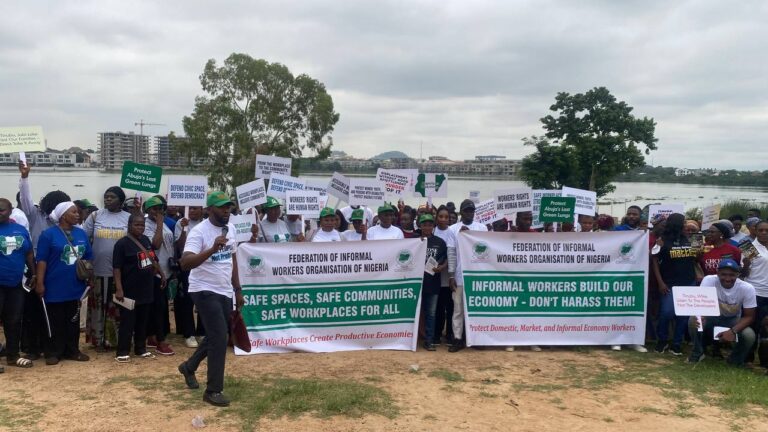
INFORMAL workers, residents and civil society prganisations on Tuesday, June 30, staged a peaceful protest at the Jabi Lake Recreational Park in Abuja, demanding that the Federal Capital Territory (FCT) Administration halt the proposed redevelopment and privatisation of the park until the full details of the project are made public and affected communities are consulted.

The protesters, led by the Federation of Informal Workers Organisation of Nigeria (FIWON) and Accountability Lab, among others, marched through the park carrying placards with inscriptions such as “Displacement Without Good Resettlement Is Murder. Stop It,” “Protect Abuja’s Last Green Lungs,” “Tinubu, Governance by Fiat Is Not Democracy,” “Tinubu, Small Businesses Matter. Stop Demolition,” and “Jabi Lake Fed Our Families—Don’t Take It Away.”

They called on President Bola Tinubu and the FCT Minister, Nyesom Wike, to protect women, youths, children and informal workers from displacement, insisting that any redevelopment of the park should be preceded by transparency, meaningful public consultation and adequate protection for those whose livelihoods depend on the facility.

Background

The protest came months after the FCTA signed development agreements with Suburban Broadband Limited and Akida Hills Limited to transform the Jabi Lake waterfront into what officials describe as a world-class recreational and tourism hub.

The agreements, signed in February 2026 at the office of the FCT Minister, reportedly form part of the administration’s urban renewal agenda aimed at redeveloping the lake into a major destination for recreation and tourism.

According to the FCTA, the project will include waterfront commercial developments, tourism and leisure facilities, modern recreational infrastructure, environmental clean-up, urban renewal around the lake, and the removal of illegal settlements and abandoned structures.

The administration argued that the redevelopment would beautify Abuja, attract investment, boost tourism and create employment opportunities.

During the signing ceremony, Wike said the initiative would reposition the nation’s capital while addressing land speculation, warning that allocated lands left undeveloped would be revoked.

The redevelopment, however, attracted widespread criticism from residents, traders, religious leaders and advocacy groups, who fear the concession could limit public access to one of Abuja’s few remaining public recreational spaces and threaten the livelihoods of hundreds of informal workers operating around the lake.

Earlier in June, Daily Trust reported that preparatory work had commenced at the site, with sections of the park barricaded, perimeter fencing installed, and construction equipment moved into the area despite public opposition.

Commissioned in 2007, Jabi Lake Recreational Park spans about 1,300 hectares in Abuja’s Jabi District and has become one of the city’s most popular public leisure destinations. Besides providing free recreational access to residents, the park supports dozens of small businesses, including food vendors, artisans, boat operators and other informal workers who depend on daily patronage for their survival.

Rights group demands transparency

Addressing journalists during Tuesday’s protest, Accountability Lab Nigeria Country Director, Friday Odey, said the groups were not opposed to development but insisted that the process must be transparent, inclusive and accountable.

According to him, although the FCTA entered into an agreement with two private companies in February, the details of the Memorandum of Understanding (MoU) were not made public.

“We are not against development,” Odeh said, adding, “What we are saying is that the MoU has not been published. Under the Open Government principles, citizens have the right to know what agreements have been entered into concerning public assets.”

He said Nigerians also deserve to know whether the government conducted any assessment of the social and economic consequences of the project before allocating the park to private companies.

Odeh further argued that informal workers whose livelihoods depend on activities around the park were neither informed nor consulted before the decision was taken.

“These workers have not been communicated with or consulted. Civic space matters, people’s voices matter, and those who will be directly affected deserve to be heard,” he said.

He also urged the FCTA to publicly disclose any relocation or resettlement plans for people who may be displaced by the redevelopment.

The Chairperson of FIWON, Blessing Yusuf, also condemned what she described as the privatisation of one of Abuja’s last major public recreational spaces.

She argued that Jabi Lake serves not only as a business hub for informal workers but also as a public space where residents exercise, socialise and interact freely.

Residents who use the park for recreation also expressed concern that unrestricted private control of the facility could reduce public access.

“This is where people come to exercise, socialise and do business. Many people earn their living here while residents also come to relax and relieve stress. The government should allow the public to continue using this place while ensuring there is proper planning and engagement before any redevelopment takes place,” Akpotu Mobo, a resident said.

South African cities shut down as anti-migrant protests trigger fear

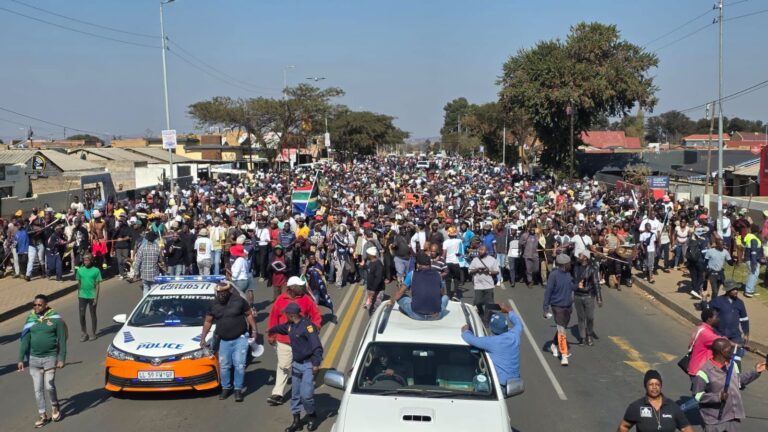
ECONOMIC activities have been brought to a near standstill as thousands of workers in South Africa remain indoors across parts of the country on Tuesday following a nationwide anti-migrant protest, deepening fears of renewed xenophobic violence.

According to Reuters, in major cities including Johannesburg and Durban, groups of protesters carrying wooden sticks gathered in the streets, chanting anti-immigrant slogans and accusing undocumented foreigners of worsening unemployment and crime.

The demonstrations followed an ultimatum issued by protest organisers demanding that undocumented migrants leave the country by Tuesday, prompting thousands of foreign nationals to flee their homes or avoid public spaces amid growing security concerns.

Authorities have mounted one of the country’s largest recent security operations in anticipation of possible violence.

Thousands of police officers have been deployed nationwide, while the military remains on standby under an emergency security allocation worth 600 million rand, approximately $36.6 million.

Deputy National Commissioner for Policing Tebello Mosikili said authorities had already opened 103 criminal cases against anti-foreigner vigilante groups since March.

The protests have heightened fears among migrant communities after weeks of attacks linked to anti-immigrant sentiment.

Since demonstrations began in April, at least five people have been killed, while thousands of migrants have reportedly been displaced, with homes, shops and businesses vandalised and looted.

Community leaders said many victims possess valid immigration documents but have nevertheless become targets.

Congolese community leader, Mabako Majole, revealed that nearly 100 displaced people were sleeping outside a government office in Durban, noting that many of them had been illegally evicted by landlords fearful that their buildings would be attacked.

Witnesses in both Durban and Johannesburg reported landlords forcing foreign tenants from their properties as tensions escalated.

Meanwhile, the protest campaign, March and March, insists it is advocating government action against undocumented migration rather than violence against foreign nationals.

Its leader, Jacinta Ngobese, acknowledged widespread anger but denied responsibility for attacks carried out by individuals.

Despite those assurances, rights groups have warned that previous waves of anti-migrant protests in South Africa have frequently escalated into deadly attacks, regardless of migrants’ legal status.

President Cyril Ramaphosa condemned threats against migrants while acknowledging growing public frustration over illegal immigration.

In a statement on Monday, Ramaphosa said concerns about undocumented migration deserved attention but warned that violence and intimidation could not be justified.

South Africa continues to grapple with deep economic challenges more than three decades after the end of apartheid, as the country faces one of the world’s highest unemployment rates, with roughly one in three people out of work, while slow economic growth has fuelled public frustration over access to jobs, housing and public services.

Although migrants are frequently blamed for unemployment, rising crime and pressure on social infrastructure, researchers have repeatedly found limited evidence supporting those claims.

According to Statistics South Africa (StatsSA), immigrants account for about three million people, representing roughly four per cent of the country’s population, relatively low compared with many countries globally.

The renewed anti-migrant unrest threatens South Africa’s international standing as a defender of human rights and risks straining diplomatic relations with neighbouring African countries whose citizens make up a large share of migrant communities.


Ford rehires 300 veteran engineers after AI quality check fails

THE Ford Motor Company has rehired more than 300 veteran quality inspectors and engineers to reverse manufacturing shortfalls after finding that its automated artificial intelligence systems could not replicate human experience.

The decision represents a change for the automaker, which had previously integrated automation across its manufacturing operations in an attempt to reduce production costs and maximise factory efficiency.

During an investor briefing during Ford’s quarter earnings call in October 2025, Ford’s Chief Operating Officer, Kumar Galhotra, stated that the firm was “deploying AI across the entire industrial system.” The strategy involved installing 900 automated cameras across various plants to detect assembly flaws at the source and minimise supply chain disruptions.

However, the technology failed to live up to internal expectations. Charles Poon, Ford’s Vice President of Vehicle Hardware Engineering, stated that the company overestimated the tech’s standalone capabilities.

“Mistakenly, we thought that by just introducing artificial intelligence and ingesting the design requirements that we had, that would produce a high-quality product,” Poon admitted.

He noted that the automated tools lacked the practical training and nuance of experienced staff, adding that “artificial intelligence is a fantastic tool, but it’s only as good as the information you use to train it.”

According to reports, many of Ford’s most knowledgeable engineers had left the company before their technical insights could be incorporated into the machine learning models.

The returning specialists are now tasked with identifying potential quality issues before vehicles enter production, mentoring younger factory employees, and calibrating the automated systems.

This pivot to human oversight coincides with Ford securing the number one spot among mainstream US automakers in the J.D. Power Initial Quality Study, a ranking the company has not held since 2010.

In an official statement addressing the quality milestone, the company noted that achieving best-in-class quality required a significant talent refresh. This initiative involved restructuring senior leadership across its engineering, manufacturing, and supply chain divisions, alongside hiring the 300 veteran engineers who hold decades of hands-on design experience.

Court grants Sowore N200m bail, demands traditional ruler with Abuja land as surety

0

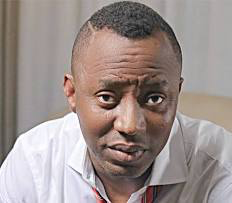
THE Federal High Court in Abuja on Tuesday admitted the presidential candidate of African Action Congress (AAC), Omoyele Sowore, to a N200 million bail with two sureties.

One of the court’s justices, Mohammed Umar, in a ruling on Sowore’s application for stay of execution of the order for his bail revocation, directed that one of the sureties must be a traditional ruler from Sowore’s community.

Umar held that the surety must have a landed property in Abuja.

The judge, who held that the sureties must also be verified by the prosecution, the State Security Service (SSS), ordered Sowore to also deposit his international passport with deputy chief registrar of the court.

The judge then handed over the defendant to his lawyers and adjourned the matter until July 6 for Sowore to open his defence.

Umar earlier vacated the defendant’s bail revocation order and the earlier order remanding him in Kuje Correctional Centre.

The News Agency of Nigeria (NAN) reports that Umar had, on June 22, ordered the remand of Sowore, also the publisher of Sahara Reporters, in Kuje Correctional Centre.

The judge, in a short ruling, ordered Sowore to be kept in the correctional centre pending the hearing and determination of his motion for stay of the order for revocation of his bail and bench warrant filed by his lawyer, Adeyinka Olumide-Fusika, a senior advocate.

The judge equally dismissed Sowore’s earlier application seeking the judge’s recusal from the case on the ground of alleged bias.

He adjourned the matter till June 24 for hearing of the application for stay of execution.

After Sowore’s application was moved and argued on June 24, Umar fixed today for a ruling.

He ordered the defendant to remain in custody pending the ruling.

The judge had, on June 16, revoked a bail granted to Sowore following his failure to appear in court for his trial.

Umar, in a ruling on an oral application made by the lawyer to the prosecutor, the SSS, Akinlolu Kehinde, a senior advocate, also issued a bench warrant for his arrest.

The SSS is prosecuting Sowore for allegedly making false claims against President Bola Tinubu by referring to him as “a criminal” in a post he made on his X and Facebook accounts. (NAN)

Police officer, 2 others arrested for allegedly raping 13-year-old girl in Niger

THE Niger Commissioner for Women Affairs, Hajiya Hadiza Kuta, has confirmed the arrest of a police officer serving with the Niger Police Command for allegedly raping a 13-year-old girl.

Hajiya Kuta disclosed this in an interview with the News Agency of Nigeria (NAN) in her office in Minna on Monday.

She said two other suspects were also arrested for allegedly raping the girl.

According to her, the victim was repeatedly raped by the three suspects before the matter was reported to the ministry.

The commissioner explained that the victim’s parents reported the case to the ministry for intervention, which led to the suspects’ arrest.

“The parents told the ministry that their efforts to seek justice were consistently obstructed, which prompted them to seek the ministry’s assistance,” she said.

Kuta expressed concern over the rising cases of rape involving minors and teenagers.

She lamented that attempts were being made to divert attention from the rape allegations by accusing the victim of stealing livestock.

According to the commissioner, the suspects took advantage of the girl after buying chickens from her.

She stressed the dangers of street hawking, especially for girls.

The commissioner also lamented that the individuals accused of rape were often granted bail shortly after arraignment.

She said such practices deny victims and their families justice and embolden perpetrators to continue the act.

“It is distressing to observe that cases of this nature frequently cause significant psychological trauma, undermining the educational aspirations of young girls.

“The future of these children can be irreparably damaged by the actions of the perpetrators,” she stated.

She assured the victim’s family that the ministry would pursue justice on their behalf.

“As part of its intervention, the ministry has relocated the victim from her community to ensure her safety and has placed her under protective custody,” she revealed.

Kuta said the girl would receive comprehensive medical care, psychological evaluation, counselling, and other support services to assess the physical and emotional impact of the abuse and aid her recovery.

She stressed the need for a thorough investigation, noting that the charges filed against the suspects would determine the strength of the prosecution’s case in court.

“The ministry hopes justice will prevail and reaffirmed its commitment to protecting the rights and welfare of the victims,” she noted.

According to findings by the Thomson Reuters Foundation’s 2018 global poll, Nigeria ranked among the most dangerous places in the world for women, largely due to the prevalence of sexual violence, cultural stigma, and weak enforcement of protective laws.

Recent data from the National Bureau of Statistics also suggests that sexual offences remain widespread, though significantly under-reported, with many survivors never formally reporting cases to authorities.

In many communities, incidents are further compounded by silence, fear of stigma, and limited access to justice, leaving survivors to navigate trauma without institutional support.

The ICIR reports that in Nigeria, six out of every 10 children suffer from one or more forms of physical, sexual or emotional violence before clocking 18. More than 70 per cent of children experience this violence repeatedly, according to the United Nations Children’s Fund (UNICEF).