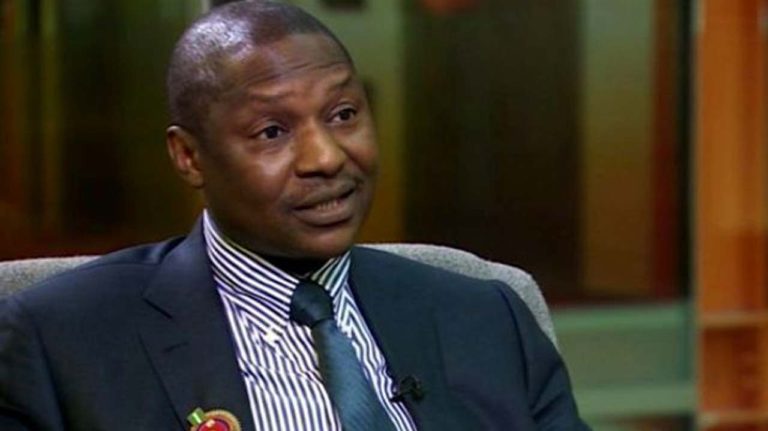
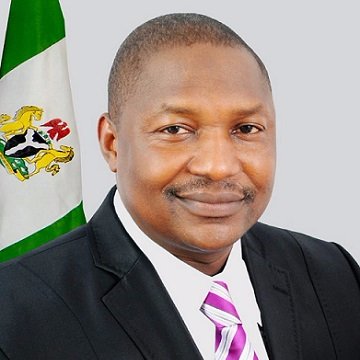
THE hearing on the bail application by former Attorney General of the Federation and Minister of Justice, Abubakar Malami, commenced at a Federal High Court in Abuja on Friday, January 2.
Malami, a Senior Advocate of Nigeria, is currently being remanded at the Kuje Correctional Centre alongside his son, Abdulaziz, and one of his wives, Bashir Asabe, over allegations of money laundering.
The three defendants are facing a 16-count charge brought against them by the Economic and Financial Crimes Commission (EFCC), bordering on the alleged laundering of ₦8.7 billion.
They pleaded not guilty to the charges during their arraignment on December 29, 2025.
Following the plea, the trial judge, Justice Emeka Nwite, ordered that the defendants be remanded at the Kuje Correctional Centre pending the hearing of their bail application, which was scheduled for January 2, 2026.
The ICIRreported that The EFCC had in the charge sheet marked FHC/ABJ/CR/700/2025, submitted to the court, alleged that the defendants used corporate entities, bank accounts, and real estate transactions to disguise the source of illicit funds.
The prosecution alleged that between July 2022 and June 2025, Malami and his son procured Metropolitan Auto Tech Limited to conceal the unlawful origin of over N1.01 billion, while an additional N600 million allegedly passed through a Sterling Bank account linked to the same company.
In another count, the EFCC accused Malami, his son, and Asabe, an employee of Rahamaniyya Properties Limited, of disguising the origin of N500 million allegedly used to purchase a luxury duplex located on Amazon Street, Maitama District, Abuja.
The commission further alleged that the defendants conspired to launder N1.04 billion through the Union Bank account of Meethaq Hotels Limited, with transactions spanning from November 2022 to September 2024.
Another count accused Malami and his son of taking indirect control of N1.36 billion paid through the same company’s bank account, funds the EFCC said were proceeds of unlawful activity.
The EFCC also alleged that Malami, while serving as Attorney-General of the Federation, concealed N700 million allegedly used to acquire a property at No. 3 Onitsha Crescent, Area 11, Garki, Abuja, as well as ₦850 million used to purchase another property in the Jabi District of Abuja.
According to the prosecution, the alleged offences contravene provisions of the Money Laundering (Prohibition) Act, 2011 (as amended) and the Money Laundering (Prevention and Prohibition) Act, 2022.
The anti-graft agency told the court that it had traced 41 properties valued at approximately N212 billion to Malami and his associates, and that these assets form part of the subject of the ongoing prosecution.
NINE people were killed on Wednesday night in a fresh attack during a crossover night celebration in Chigwi village, Vwang District of Jos South Local Government Area, Plateau State.
The secretary to the district head of Vwang, Iliya Chung, confirmed the incident to The ICIR in a telephone interview Thursday morning, January 1, saying the victims included men, women and children.
“What happened is that yesterday around 10 p.m. to 11 p.m., we got a call that there’s an attack at one of our villages called Boom in Chigwi village in Vwang district, and we were hearing gunshots and around 12 a.m. They started bringing some of the victims that were affected. So, around that yesterday, we received six bodies,” said Chung.
He explained that nine dead bodies were confirmed on Thursday morning, noting that an entire family was wiped during the attack. He could not confirm how many were injured. He said the affected community was still documenting the number of people injured.
“This morning, we confirmed that it’s nine people. There were eight corpses and another one who gave up at the hospital this morning. Currently, there is tension in the area. There is one family that was wiped, it’s only one child that survived in that family. We don’t know the number of people that were injured up till now because we are still gathering some of the names of the people. Police are there right now,” he said.
The ICIRthat the latest incident echoes the deadly Christmas Eve attack on communities in Bokkos Local Government Area in 2023, during which at least 160 people were killed.
Explaining the latest attack, Chung noted that the district head had warned its people because he had received a threat of the attack, but the threat showed that its target would be Farin Lamba community. Following the attack, he said the district has suspended its annual grand new year celebration.
“Even though we warned our people that we should not do crossover celebrations. We were hearing that there will be an attack, but not that area. They were saying that they would attack Farin Lamba, but they went to another village. We’re supposed to have our celebration today, New Year celebration in Vwang that the governor wanted to come for. Because of this thing now, there’s nothing we can do. We are suspending everything because of what has happened,” he said.
Chung said that a similar attack occurred two weeks ago at K-Vom division where a police officer was killed, and his gun was taken.
“About two weeks ago, there was an attack in K-Vom Division, in which they killed a policeman. He was on his duty post around 11 p.m. to 12 a.m., they came and killed him, and they left with his gun,” he added.
The Police Public Relations Office, Plateau State Police Command, Alfred Alabo, told The ICIR that he could not confirm the latest attack.
“I am working on some of this information,” Alabo said, noting that the officers in Vwang would inform him when they are done compiling their report on the incident. He also promised to get back to the reporter when he obtained report on the incident.
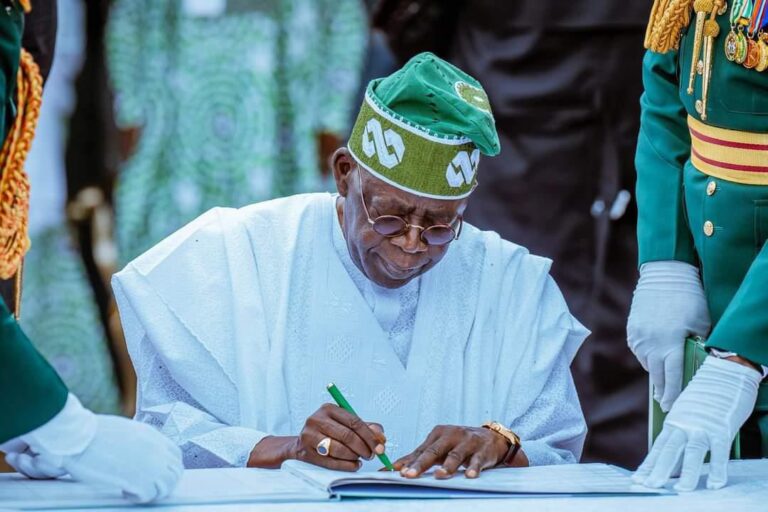
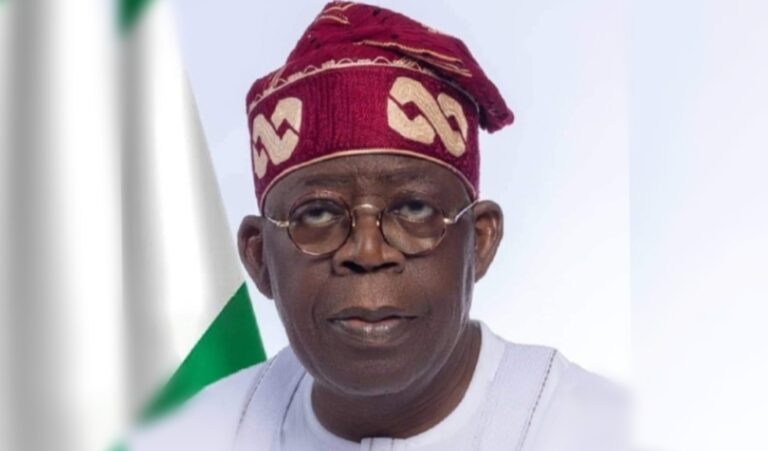
PRESIDENT Bola Ahmed Tinubu has assured that the economic policies and reforms of his government would positively impact more households in 2026, noting that the government would build on the gains of such reforms within the year.
The President cited easing inflation, stronger foreign reserves and renewed investor confidence as evidence that his administration’s reforms were beginning to yield results, adding that Nigeria is entering a more robust phase of economic growth in the new year.
In his New Year goodwill message to Nigerians on Thursday, January 1, Tinubu said 2025 closed on a strong note despite global economic headwinds, adding that the government would focus on consolidating gains and ensuring that the benefits of reform reach households across the country in the new year.
According to the president, Nigeria recorded consistent quarterly GDP growth in 2025, with annualised growth expected to exceed four per cent. He said inflation declined steadily to below 15 per cent, meeting the government’s target, while trade surpluses and greater exchange rate stability were maintained.
Tinubu also pointed to strong performance in the capital market, noting that the Nigerian Stock Exchange posted a gain of 48.12 per cent in 2025, extending a bullish run that began in the second half of 2023.
On external buffers, the president said Nigeria’s foreign reserves stood at $45.4 billion as of 29 December 2025, describing this as a “substantial buffer” against external shocks to the naira.
He added that foreign direct investment rose sharply in the third quarter of 2025 to $720 million, from $90 million in the previous quarter, reflecting renewed investor confidence and positive assessments from international credit rating agencies.
Despite allegations of alterations, which made many Nigerians ask the president to halt the implementation of recently enacted tax laws, Tinubu said his administration would intensify tax reforms in 2026, with a focus on harmonising taxes across all tiers of government to reduce multiple taxation and ease the burden on citizens and businesses. He said moderating inflation and interest rates would create more fiscal space for infrastructure and human capital investment.
The president’s assurances are coming at a time when households are still struggling to buy basic food and commodities with weak purchasing power as a result of the government’s policies of floating the exchange rate and fuel subsidy removal.
The president also addressed security, acknowledging continued threats from terrorist and criminal groups. He confirmed that, in collaboration with international partners, including the United States, Nigerian forces carried out strikes against terrorist targets in parts of the North-West on 24 December, with sustained operations ongoing in the North-West and North-East.
In 2026, he said, security and intelligence agencies would deepen cooperation with regional and global partners, while the government would continue to explore decentralised policing and regulated forest guards as part of efforts to tackle banditry and terrorism.
On social development, Tinubu stated that the government would accelerate the Renewed Hope Ward Development Programme, aiming to empower at least 10 million Nigerians by supporting at least 1,000 people in each of the country’s 8,809 wards. He said agriculture, trade, food processing and mining would be prioritised to stimulate local economies, alongside continued investment in infrastructure, including roads, power, ports, railways, healthcare and education.
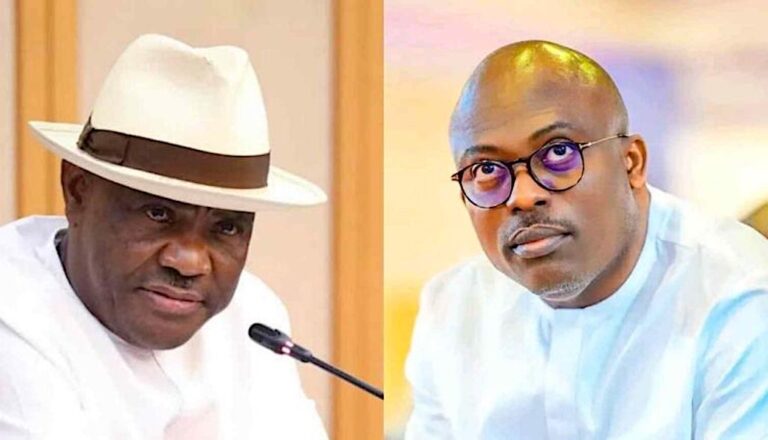
THE Minister of the Federal Capital Territory, Nyesom Wike, has said that Rivers State Governor, Siminalayi Fubara, failed to comply with the agreement reached through the mediation of President Bola Tinubu to address the state’s deepening political crisis.
Wike made the allegation on Wednesday during his visit to Tai Local Government Area of Rivers State, where he told supporters that the agreement reached at the Presidential Villa would soon be made public.
The agreement emerged from a closed-door meeting convened by Tinubu at the State House in Abuja in June 2025 with the two leaders.
The crisis, rooted in a battle for control of the state’s political structure within the ruling Peoples Democratic Party (PDP), had triggered division in the state House of Assembly and heightened political tension in the oil-rich state.
At the height of the crisis, lawmakers loyal to Wike, who constituted the majority of the Rivers State House of Assembly, threatened to impeach Fubara, accusing him of failing to implement a Supreme Court ruling related to the dispute.
The standoff prompted Tinubu, on March 18, to declare a state of emergency in the state.
The president, acting under Section 305 of the 1999 Constitution, suspended Fubara, his deputy, and all members of the State House of Assembly for six months.
He appointed Ibok Ekwe Ibas, a retired rear admiral, as the state administrator. The decision sparked widespread criticism from civil society groups and legal experts, who questioned its constitutionality.
Following months of political deadlock, Wike announced, in June 2025, that the crisis had been resolved after another closed-door meeting with Tinubu at the Presidential Villa.
At the time, he described the agreement as final and urged supporters on both sides to embrace peace.
“Yes, just like humans, you have a disagreement, and then you also have time to settle your disagreement.
“And that has been finally concluded today, and we have come to report to Mr. President that is what we have agreed. So for me, everything is over,” Wike had stated.
Fubara also welcomed the truce, describing it as a turning point for the state and pledging to preserve the unity achieved during the meeting.
“For me, it’s a day we have to thank Almighty God. For me, it’s very important that this day has come to be.
“What we need for the progress of Rivers State is peace, and by the special grace of God, this night, with the help of Mr. President and the agreement of the leaders of the state, our leader, peace has returned to Rivers State,” he said.
However, Wike on Wednesday hinted that the governor had failed to honour aspects of what was agreed before the president.
“After agreeing on something, you renege. And you think you are a smart politician? You are clever by half.
“Very soon, we will let Rivers people know what we agreed before Mr President. This agreement was not done anywhere; before Mr President. If you can renege on what we agreed before Mr President, then who are we?” he asked.
The minister also issued a renewed political warning, insisting that his supporters were prepared to challenge Fubara’s leadership.
“We are battle-ready. We were the original ‘mandate’ people. Don’t deal with people who cannot keep to agreements. And they tell you it’s politics, that politics will not work here again.
“If they like, let them keep all the money, whether they have N600 billion or not. We have defeated people with money before. We will still defeat people with money. What matters is the people, it’s not money,” he said.
President Bola Tinubu’s approval of the cancellation of a substantial portion of the debts owed by the Nigerian National Petroleum Company Limited (NNPCL)to the Federation Account has raised a lot of unanswered questions.
The approval led to the wiping off of approximately $1.42 billion and N5.57 trillion after a reconciliation of records.
The decision has been questioned by public sector analysts and pressure groups.
Part of the questions raised is the President’s powers for such cancellation, since NNPCL money belongs to the three tiers of government, not just the Federal Government.
A document prepared by the Nigerian Upstream Petroleum Regulatory Commission (NUPRC) and presented at the November meeting of the Federation Account Allocation Committee confirmed the development.
In a section of the document titled, “Recovery from NNPC Ltd Outstanding Obligations,” the commission said the debts earlier reported at the October 2025 FAAC meeting stood at “$1,480,610,652.58 and N6,332,884,316,237.13 for PSC, DSDP, RA & MCA Liftings and JV & PSC Royalty Receivables respectively.”
It disclosed that the Presidency approved that most of those balances be removed from the federation’s books.
The document stated, “However, the commission recently received a Presidential Approval to nil off the outstanding obligations of NNPC Ltd as at 31st December 2024, as submitted by the Stakeholder Alignment Committee on the Reconciliation of Indebtedness between NNPC Ltd and the Federation.”
Reacting to the development, the Lead Director of the Centre for Social Justice, Eze Onyekpere, questioned Tinubu’s constitutional powers for such an action, as the money belongs to the federation, not just the Federal Government.
He said: “The president has no such statutory or constitutional right or duty to write off any debt of a government corporation. If he purported to do so, it is an unconstitutional exercise of power. In fact, the president is obliged to recover all sums due to the treasury through GOEs.
“This money belongs to the three tiers of government that share from the federation account. Unless the three tiers agree, the presidential waiver is an exercise in futility,” he added.
Expressing similar concerns, a public policy analyst and a development economist, Celestine Okeke, noted that the governors might not raise questions regarding the debt write-off since most of them are moving to the president’s party.
“With this development, do you think any governor would have the audacity to take him to court now that everyone of them is even carpet-crossing to the APC?,” he reasoned.
The Executive Director of African Centre for Leadership, Strategy and Development, Monday Osasah, told The ICIR that “The president may have acted based on the information available to him, which most of us are not privy to.”
He, however, called for transparency in the process, stressing the importance of Nigerians being carried along in such critical decisions, since it’s money owed by the federation.
An analysis of the cancelled debts shows that the presidential directive wiped out about 96 per cent of the dollar-denominated debt and about 88 per cent of the naira-denominated obligations previously reported as outstanding.
The document indicates that the approval followed the recommendations of the Stakeholder Alignment Committee on the Reconciliation of Indebtedness between NNPC Ltd and the Federation, which reviewed the company’s royalty and lifted related liabilities up to December 31, 2024.
Despite the cancellation of the legacy balances, fresh debts built up in 2025 remain.
In a separate section titled “NNPC Ltd Outstanding Obligations,” the regulator disclosed that statutory obligations arising between January and October 2025 still stood at “$56,808,752.32 and N1,021,550,672,578.87 for PSC & MCA Liftings and JV Royalty Receivables respectively.”
The commission added that part of the dollar component was recovered in the month under review, stating: “However, the commission received $55,003,997.00 in the month under review from the outstanding, leaving a balance of $1,804,755.32 and N1,021,550,672,578.87. The amount of $55,003,997.00 received is part of the total collection reported above for sharing by the Federation this month.”
The NUPRC confirmed that it had already implemented the directive in the Federation Account, noting that “the Commission has passed the appropriate accounting entries as approved.”
The approval effectively resolves long-running disputes over NNPC’s legacy indebtedness to the Federation, while current liabilities from ongoing operations continue to be tracked for future recovery.
The debt cancellation comes at a time when the commission is struggling to meet its revenue projections for the year.
The Senate had on December 15, demanded answers and expressed doubts over 2026 budget projections after the Federal Government admitted that it realised just N10 trillion out of the N40 trillion revenue targeted for the 2025 fiscal year.
This development led to the Senate asking questions about persistent borrowing, overlapping budgets and weak capital project execution.
Data from the NUPRC document showed that against a 2025 approved monthly revenue target of N1.204 trillion, the commission recorded N660.04 billion as actual collection for November 2025, leaving a shortfall of N544.76 billion for the month.
Royalty payments on oil and gas, which account for the bulk of upstream revenues, fell sharply below target. The approved monthly royalty projection was N1.144 trillion, compared to N605.26 billion actually collected in November, indicating a deficit of N538.92 billion.
Cumulatively, as of November 30, 2025, the NUPRC’s total approved revenue stood at N13.25 trillion, while actual cumulative collections were N7.60 trillion, representing a revenue gap of N5.65 trillion. For royalties alone, cumulative approved collections stood at N12.59 trillion against N6.96 trillion actually received, leaving a shortfall of N5.63 trillion.
The document further showed a drop in revenue collections compared to the previous month. While N873.10 billion was collected in October 2025, the figure declined to N660.04 billion in November.
PRESIDENT Bola Tinubu’s insistence on the implementation of the new tax laws on January 1, 2026, has been generating criticisms from opposition parties, several pressure groups, and other Nigerians amid concerns of unresolved controversies trailing the laws.
In a statement he personally signed on Tuesday, December 30, Tinubu insisted that the laws were not designed to raise taxes, but rather to support a structural reset, drive harmonisation, and protect dignity while strengthening the social contract.
“The new tax laws, including those that took effect on June 26, 2025, and the remaining acts scheduled to commence on January 1, 2026, will continue as planned,” the president said.
“These reforms are a once-in-a-generation opportunity to build a fair, competitive, and robust fiscal foundation for our country.”
He called for support from all Nigerians as the laws would take effect in a few days.
He further said that his administration was aware of the public discourse surrounding alleged changes to some provisions of the recently enacted tax laws.
“No substantial issue has been established that warrants a disruption of the reform process. Absolute trust is built over time through making the right decisions, not through premature, reactive measures,” he stated.
Notably, controversies have continued to trail the new tax laws after a member of the House of Representatives, Abdussamad Dasuki, raised concerns about what he described as discrepancies between what was passed by the National Assembly and the versions subsequently gazetted and made available to the public.
Dasuki argued that his legislative rights had been breached because the content of the gazetted tax laws did not reflect what lawmakers debated and approved on the floor of the House.
His comment led to calls for the suspension of the laws.
Opposition leaders like Peter Obi, Atiku Abubakar, and pressure groups like the Nigeria Bar Association (NBA) have criticised the alleged alteration, asking the Federal Government to halt the implementation of the laws.
A tax expert and Public Sector Analyst, Emeka Okoroeze, believes that the issue that stirred the controversy in the tax law has not been sufficiently addressed by the National Assembly and the Federal Government.
“I believe the right thing should have been to suspend implementation, investigate the unlawful insertion and prosecute the perpetrators. Then reconcile the different versions to get a clean copy that will be regazetted. This way, the legitimacy and integrity of the Act will be restored as well as the people’s confidence,” Okoroeze stated.
In a similar submission, the Lead Director for the Centre for Social Justice, Eze Onyekpere, told The ICIR that the tax law was becoming a fiscal governance architecture based on forgery.
‘Evidently, we have a supine and rubber-stamp legislature that cannot stand up to assert its constitutional mandate of law-making in the face of a rampaging executive.
“Prima facie, the enactment passed by the legislature is different from what is in the public domain as law. The simplest way of showing that there was an alteration or that the documents are the same is to upload the NASS harmonised copy to the website of NASS. No committee or panel is needed. Literate Nigerians can compare and contrast the two documents,” he added.
He further stressed that no citizen was under an obligation to obey a purported law that was not the product of due process. “Nigerians have a right to resist forgery,” he said.
Tinubu signed the four tax reform bills into law in June, marking what the government described as the most significant overhaul of the country’s tax system in decades.
The laws include the Nigeria Tax Act, the Nigeria Tax Administration Act, the Nigeria Revenue Service (Establishment) Act, and the Joint Revenue Board (Establishment) Act, all operating under a single authority, the Nigeria Revenue Service.
The tax reform bills faced initial stiff opposition from lawmakers and key figures before their passage.
THE Dangote Petroleum Refinery has announced a 10-day credit facility, backed by a bank guarantee, for petrol station owners and dealers, alongside free direct delivery and other incentives, as part of a new supply arrangement.
In a statement posted on its official social media handle on Tuesday, December 30, the company invited petrol station operators across the country to register for the offer.
According to the statement, participating dealers will enjoy “a 10-day credit facility backed by a bank guarantee,” with a minimum order requirement of 5,000 litres.
“Our free direct delivery service will commence soon,” the group said, adding that the offer is open to “all petrol station owners and dealers.”
The Dangote Group called on operators to register their stations to access the supply arrangement.
“Register your petrol stations today to benefit from our competitive gantry price,” the notice read.
The company also disclosed that petrol supplied under the arrangement would be sold at a gantry price (the refinery depot price) of ₦699 per litre.
The company had earlier in June announced plans to begin a nationwide targeted distribution of petrol and diesel to marketers, petrol dealers, manufacturers, telecoms firms, aviation, and other large users across the country.
It further revealed that the logistics and credit facility support was to ensure hitch-free supply of petroleum movement across the country to consumers.
The initiative came with free logistics to boost the distribution network with the recent procurement of new compressed natural gas (CNG)-powered tankers to ensure smooth take-off of the scheme.
With the price slash and credit facility support to petrol stations across the country, Dangote Refinery is expected to sustain market dominance in the sector, which already does not favour other marketers’ associations that feel challenged and have noted concerns of market disruption by the refinery’s continued price slash.
A FEDERAL High Court sitting in Abuja has ordered the remand of former Attorney-General of the Federation and Minister of Justice, Abubakar Malami (SAN), at the Kuje Correctional Centre, following his arraignment on charges bordering on large-scale money laundering.
Emeka Nwite, the justice who presided over the proceedings on Tuesday, December 30, also ordered that Malami’s son, Abubakar Abdulaziz Malami, and an associate, Bashir Asabe, be remanded in custody pending the hearing and determination of their respective bail applications.
Malami and the two co-defendants were standing trial on a 16-count charge filed by the EFCC, accusing them of conspiracy, concealment, retention, and laundering of proceeds of unlawful activities amounting to several billions of naira.
After reading the charges to them, the three defendants pleaded not guilty.
The remand order, however, followed submissions by the defence team led by Joseph Daudu, a senior advocate, and the prosecution counsel, Ekele Iheneacho, also a senior advocate, who represents the Economic and Financial Crimes Commission (EFCC).
Nwite adjourned the matter to a later date for the hearing of bail applications.
Charges
The EFCC had in the charge sheet marked FHC/ABJ/CR/700/2025, submitted to the court, alleged that the defendants used corporate entities, bank accounts, and real estate transactions to disguise the source of illicit funds.
The prosecution alleged that between July 2022 and June 2025, Malami and his son procured Metropolitan Auto Tech Limited to conceal the unlawful origin of over N1.01 billion, while an additional N600 million allegedly passed through a Sterling Bank account linked to the same company.
In another count, the EFCC accused Malami, his son, and Asabe, an employee of Rahamaniyya Properties Limited, of disguising the origin of N500 million allegedly used to purchase a luxury duplex located on Amazon Street, Maitama District, Abuja.
The commission further alleged that the defendants conspired to launder N1.04 billion through the Union Bank account of Meethaq Hotels Limited, with transactions spanning from November 2022 to September 2024.
Another count accused Malami and his son of taking indirect control of N1.36 billion paid through the same company’s bank account, funds the EFCC said were proceeds of unlawful activity.
The EFCC also alleged that Malami, while serving as Attorney-General of the Federation, concealed N700 million allegedly used to acquire a property at No. 3 Onitsha Crescent, Area 11, Garki, Abuja, as well as ₦850 million used to purchase another property in the Jabi District of Abuja.
According to the prosecution, the alleged offences contravene provisions of the Money Laundering (Prohibition) Act, 2011 (as amended) and the Money Laundering (Prevention and Prohibition) Act, 2022.
The anti-graft agency told the court that it had traced 41 properties valued at approximately N212 billion to Malami and his associates, and that these assets form part of the subject of the ongoing prosecution.
“That you ABUBAKAR MALAMI SAN, and ABUBAKAR ABDULAZIZ MALAMI between November 2022 and October, 2025 indirectly took control of the aggregate sum of N1, 362, 887, 872.96 (One Billion, Three Hundred and Sixty Two Million, Eight Hundred and Eighty Seven Thousand, Eight Hundred and Seventy Two Naira, Ninety Six Kobo paid through the savings account of Meethaq Hotels Ltd in Union Bank Plc when you reasonably ought to have known that the said funds formed proceeds of unlawful activity and you thereby committed an offence contrary to section 18(2) (d) and punishable under section 18(3) of the Money Laundering (Prevention and Prohibition) Act, 2022.
“That you ABUBAKAR MALAMI SAN whilst being the Attorney General of the Federation and HAJIA BASHIR ASABE an employee of Rahamaniyya Properties Ltd sometimes between November and December, 2018 in Abuja within the jurisdiction of this Honourable Court indirectly concealed the unlawful origin of the aggregate sum of N700, 000, 000.00 (Seven Hundred Million Naira) paid for the purchase of the property described as No. 3 Onitsha Crescent Area 11, Garki Abuja (Hamonia Hotels Ltd) in favour of ABUBAKAR MALAMI SAN when you reasonably ought to have known that the said sum of N700, 000,000.00 formed proceeds of unlawful activity and you thereby committed an offence contrary to section 15(2) (d) and punishable under section 15(3) of the Money Laundering (Prohibition) Act, 2011 as amended,” part of the charges read.
A coalition of civil society organisations (CSOs) and non-governmental groups in Nigeria has expressed concern over what it described as the silence, absence and abdication of responsibility by Nigeria’s political and military leadership, particularly President Bola Ahmed Tinubu, following a recent United States military strike on Nigerian territory.
The concerns were raised after the strike carried out on Thursday, December 25. In a statement titled: “Where is Nigeria’s President” and signed by nearly 90 organisations and individuals, the groups said the incident raised serious questions about Nigeria’s sovereignty, constitutional order, civilian safety and the integrity of the country’s social contract.
According to the signatories, the situation reflects a twin crisis of leadership and security, with allegation that President Tinubu has effectively abandoned his constitutional responsibility as Commander-in-Chief of the Armed Forces. They argued that involving a foreign government in what they described as an internal security matter amounted to a surrender of sovereign authority and weakened Nigeria’s constitutional framework.
“By inviting a foreign government to manage what is fundamentally an internal security challenge, the president ceded sovereign authority in a manner that undermines Nigeria’s constitutional order. Even more disturbing is that during and after the operation, the president, the service chiefs, and the leadership of the National Assembly were either on vacation or completely silent, leaving the Minister of Foreign Affairs, Ambassador Yusuf Tuggar, to publicly rationalise decisions that strike at the core of national sovereignty and democratic accountability.
“This silence reflects a profound breakdown of institutional accountability mechanisms. Section 14(2)(b) of the 1999 Constitution (as amended) is unequivocal: ‘the security and welfare of the people shall be the primary purpose of government.’ This provision represents a central pillar of Nigeria’s social contract. Any security action, especially one involving foreign military forces, must be grounded in transparency, civilian protection, and democratic oversight. None of these standards were met,” the statement read in part.
While acknowledging the importance of international cooperation in counterterrorism, the groups said the US operation on Nigerian soil underscored the need for a critical review of Nigeria’s National Counter Terrorism Strategy, its policy framework and national action plan for preventing and countering violent extremism. They said such a review was necessary to determine whether the operation aligned with these frameworks or exposed significant gaps.
The organisations also expressed concern over what they described as a severe lack of information regarding the collaboration between the Nigerian and US governments, including its scope, legal basis and rules of engagement.
“We are particularly troubled by the severe deficit of information regarding the nature, scope, legal basis, and rules of engagement governing the collaboration between the Nigerian and US governments. Since the incident, Nigerians have not been informed of the basis for authorising the strikes, under what legal framework they were conducted, what safeguards were in place to protect civilians, or what accountability mechanisms exist for harm caused. This opacity fuels mistrust and undermines public confidence in government at a time when trust is already dangerously low,” the statement added.
They further noted that as of the time the statement was issued, there was no confirmation that any legitimate militant targets had been hit. Instead, they cited reports that debris from expended munitions landed on farmlands in Jabo, Tambuwal Local Government Area of Sokoto State, and near a hotel in Offa, Kwara State, as evidence of risks posed to civilians and property.
Although the Nigerian Air Force inaugurated a Civilian Harm Mitigation and Response (CHMR) Board in July 2025, the groups said no clear or publicly articulated civilian harm mitigation procedures were presented for the operation.
They argued that modern military operations, particularly air strikes, required transparent standards for target verification, proportionality assessments and post-strike evaluations, as well as clear mechanisms for civilian complaints, investigations, compensation and redress. The absence of such safeguards, they said, constituted a serious failure of governance.
The groups warned that poor handling of the situation could inflame religious and communal tensions in an already fragile national environment, stressing that Nigeria’s security challenges should not be addressed in ways that deepen division or stigmatise communities, but through an inclusive, rights-based approach that promotes peace, social cohesion and long-term stability.
They also said civilians harmed by the strike must be accounted for through transparent investigations, public disclosure, support for affected communities and compensation, warning that failure to do so would further erode public trust.
The signatories criticised the president and security leadership for permitting a foreign military operation without public justification or legal clarity, arguing that the continued silence of key institutions undermined sovereignty, accountability and constitutional governance.
FOR two consecutive days, bombs believed to have been released by the Nigerian Air Force (NAF) during a ‘precision’ airstrike rained on civilians, mostly commercial drivers, fishermen and farmers around Mararaba between Kukawa and Monguno Local Government Areas of Borno State.
By Hamzat Ibrahim ABAGA
The first airstrike which on December 13 targeted over 100 vehicles parked by drivers who had gone to convey their customers (fishermen) and their goods. They returned to the area the following day—this time in the morning and rained bombs on the civilians who had returned to convey the fishermen and their goods to Monguno town.
Although reports say NAF’s spokesperson claimed the precision strikes were targeted at terrorists and their vehicles, multiple sources told The ICIR that several residents were among the victims even as about 50 vehicles belonging to locals were also destroyed.
Another report said an airstrike carried out by the Nigeria Air Force (NAF) targeting members of ISWAP in Borno State had reportedly killed an unspecified number of civilians.
However, no official statement disputing alleged civilian casualties has been made by NAF even as inquiries to its spokesperson by The ICIR on the strikes have not been responded to.
However, a visit by The ICIR to the neighbouring communities found that six persons were killed, three severely injured while 50 cars were destroyed.
Due to the difficult nature of the terrain, coupled with security reason, The ICIR could not get to the exact location of the attack. However, surviving victims at neighbouring communities, including Monguno, narrated their ordeals.
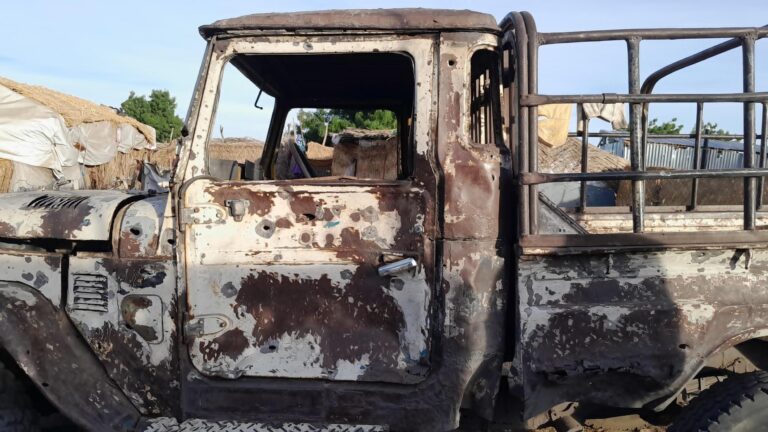
The remains of a car damaged by NAF airstrike. Photo credit: Hamzat Ibrahim Abaga
‘Civilians were struck twice at Mararaba motor park’
On Saturday, December 13, 2025, at about 1pm, a NAF aircraft struck more than 50 commercial vehicles parked at Tashan Mararaba motor park. Sources said the vehicles were waiting to convey fishermen back to markets in Monguno town, where they sell fish.
Baba Malaji, 55, and Baba Goni, 40, who sustained head and leg injuries, described the incident as a devastating attack. Both men said they had operated along the route for over four years, transporting fishermen and traders, and had never experienced a similar incident.
The remains of a car damaged by NAF airstrike. Photo credit: Hamzat Ibrahim Abaga
According to them, after learning that their vehicles had been hit, drivers rushed to the scene to assess the damage. They decided to remain there overnight while waiting for the fishermen to return.
They said that at about 3:am on Sunday, December 14, the aircraft returned and carried out a second strike. The renewed attack left three people seriously injured and resulted in six deaths with 50 vehicles destroyed.
Among those who died were people caught in the vicinity, including a farmer working nearby. Some victims died at the scene, while others later died at the Monguno General Hospital. The injured survivors were treated and discharged after several days.
Identities of the deceased victims
The following are names and ages of those who lost their lives in the airstrike:
Modu Kuru, 42;
Bakar Danbe, 50;
Abba Kaka, 30;
Babulama Datinkone, 65;
Ali, 25;
and a 45-year-old man identified as Keliye.
National ID card photograph of one of the deceased victims
More survivors narrate ordeals
Casualties from Nigerian Air Force strike in Mararaba (Borno State)
For 55-year-old Baba Malaji, a commercial driver with a wife, 10 children, and who drove his neighbour’s car, the NAF airstrike is an unforgettable experience. He described it as a deliberate attempt to harm them.
Speaking to The ICIR, Malaji said he was at home when he learned that his car had been destroyed by the airstrike. He bade farewell to his wife and children before rushing to assess the damage, hoping to return home safely the next day. To his chagrin, another strike hit him and his colleagues while they slept under a tree.
Names and ages of deceased and surviving victims. Source: Relatives of deceased and surviving victims
“I and other drivers whose cars were affected went to check the damage when NAF struck us again. We usually sleep over at the park to reconvey the market men the following morning. Indeed, that night is one some of us, especially those who lost loved ones, will never forget,” Malaji said.
‘We were falsely labelled as bandits’
Goni, 40, who sustained head injuries and a fractured leg, told The ICIR that claims labelling them as bandits are false. He explained that Tashan Mararaba is a bustling business junction frequented by traders, marketers, and commercial drivers, serving as the main transit point for travellers heading to Monguno, Manunbari, Dafan Masara, and Kokawa.
“The insinuation that bandits take shelter there is a fat lie. Many people, including the NAF, knew about the location and its activities. They are just trying to justify their actions,” Goni said.
Another survivor, identified as Ali Baba Lawal, a security officer at Monguno General Hospital, confirmed to The ICIR that four victims were brought to the hospital on the morning of Sunday, December 14. They were treated and later discharged.
“When they were brought in, there was no doctor on duty, so I quickly called one to attend to them. One later died, while two whose injuries were not critical were treated and discharged after three days,” Lawal said.
Over 50 cars destroyed in airstrike
Survivors and relatives of the deceased reported that around 50 vehicles were destroyed during the airstrike—some reduced to ashes, others beyond recognition, while a few sustained moderate damages.
A car damaged by NAF airstrike. Photo credit: Hamzat Ibrahim Abaga
The volatile nature of the area prevented The ICIR from visiting the site for verification, making it difficult to quantify the full extent of the destruction. However, survivors and family members confirmed the scale of the damage.
“I counted 10 cars severely destroyed. Some of us have gone back to collect what remains of our vehicles, while others cannot be recovered due to the extent of the damage,” said Goni.
Malaji, 55, who relied on his neighbour’s car to earn a living, said he has been involved in commercial driving in the area for over 30 years but had never faced such a situation.
“The car is not mine; it belongs to my neighbour, and I drove it to pay him weekly. We’ve been doing this for over four years. Now that the car is gone, I must find another way to support my wife and our 10 children,” he said.
“As it stands, I don’t know how the owner and I will resolve this. If he asks me to pay him, I currently have no means, but I am determined that my family and I will survive this trying time,” Malaji added.
How previous airstrikes targeted civilians
A Reuters review of data from the Armed Conflict Location and Event Data Project (ACLED), a US-based crisis monitoring group, shows that the NAF has repeatedly targeted civilians by ‘mistake.’
Since2014, over 2,600 people—mostly civilians—have been killed in 248 airstrike incidents outside the terror-affected Northeastern states of Borno, Adamawa, and Yobe, referred to by experts as BAY states.
Another vehicle damaged by NAF airstrike. Photo credit: Hamzat Ibrahim Abaga/ICIR
The analysis highlights a history of deadly errors, including a 2014 bombing in a Borno village that killed more than 30 people. In 2017, NAF airstrikes in Rann, Kala-Balge LGA, Borno State, killed around 50 refugees and injured 200 others.
Reuters also notes that in April 2022, six girls were killed in Kurebe, a terror-affected village in Shiroro LGA, Niger State. Four months later, the Air Force returned to the same location, killing eight more people in another accidental strike.
NAF yet to respond to our injury on airstrike — Borno State gov’t
When The ICIR contacted Borno State’s Commissioner for Information, Usman Tar, a professor, he said the state government had previously reached out to the Nigerian Air Force (NAF) for details of the incident but had not received any response.
“I have been informed about the purported airstrike, and I have reached out to NAF but didn’t receive a response,” Tar said.
He added that he needed more information from the Air Force to comment on the incident and need to contact affected locals or their relatives for verification.
“I need to get the details of the airstrike, the exact location of the incident, and I will do my independent verification from the locals. Until then, I can’t say anything about the incident,” Tar said.
Families of deceased victims call for justice
Malam Haji, father of the late Kaka, told The ICIR that his son left home intending to return after checking on the airstrike that destroyed his car. “On getting to the scene of the incident, NAF struck again and that was the end,” he said.
Malaji, a surviving victim of the NAF airstrike.Photo credit; Hamzat Ibrahim Abaga/ICIR
Haji appealed to Nigerian authorities for justice, adding that the death of his 30-year-old son is the will of God and prayed that his soul may rest in peace. “Authorities should assist us in holding those responsible accountable, and for justice,” he urged.
Malam Goni recounted the loss of his elder brother, who left home reassuring the family he would return, never imagining it would be his final departure.
Goni, another surviving victims of the NAF airstrike. Photo credit; Hamzat Ibrahim Abaga/ICIR
Baba, Goni’s late brother, left behind a wife and eight children, all now under Goni’s care. “The past two weeks since his demise haven’t been easy for the family. We are predominantly farmers and depend on our farm produce for survival, but insecurity has prevented us from accessing our farms,” Goni said.
Nigerian Air Force remains mum
Several weeks after the airstrikes, NAF has yet to respond to inquiries about its operations. NAF’s spokesperson, Ehimen Ejodame, told The ICIR on Tuesday to send a text message as he was in a meeting.
However, messages sent to him went unanswered by press time, and multiple follow-up calls were also unsewered.
The ICIR reports that strikes occurred barely 24 hours after NAF had assured civilians of their safety during operations.
On 13 December, the Air Force in a statement stated its commitment to responsible and precise air operations while hosting a delegation of United States experts on Civilian Harm Mitigation and Response (CHMR).
The Chief of the Air Staff, Air Marshal Sunday Kelvin Aneke, said the engagement “forms a critical component of the NAF’s operational ethics and professional evolution,” highlighting measures aimed at minimising civilian harm. He added that cooperation with the United States “has progressed from concept to measurable institutional gains,” reflecting steps designed to protect civilians.
Aneke also cited measures already in place, including “the NAF’s CHMR Action Plan, a dedicated Department at the Air Warfare Centre, standardized CHMR training, strengthened assessment and investigation team capabilities, and enhanced strategic communication with NAF Public Relations.”
This is part of the ICIR Terror Series, read it HERE.