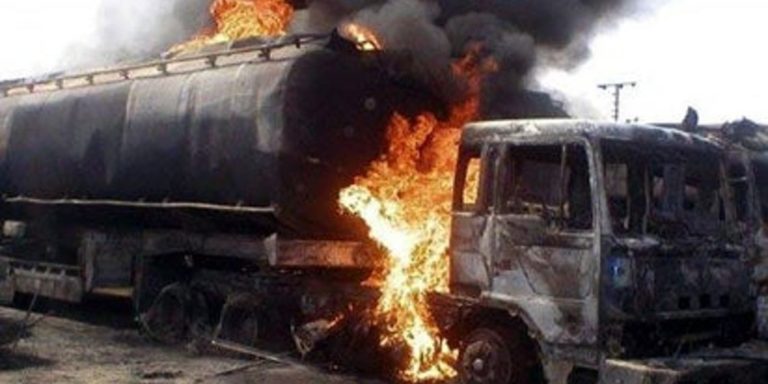
NOT less than 11 persons were burnt to death in an auto crash involving a commercial passenger bus and a truck in in Ondo State on Sunday, January 28.
The incident, according to the Federal Road Safety Corps (FRSC), happened on Soka Bridge along the Benin-Ore Expressway in Odigbo Local Government Area of the state.
FRSC Commander, Ore Unit, Sikiru Alonge, blamed the accident on “one-way driving”.
He said the truck had a head-on collision with a passenger bus.
“The trailer passed through one way and, in the process, collided with the Marcopolo bus which was coming from Benin Road,” Alonge said.
“The bus caught fire in the process.”
He said the incident caused traffic congestion along the route.
“The fire has been extinguished, while the traffic is being controlled on the Benin/Lagos lane,” he added.
The FRSC commander noted that efforts were on top gear with other security agencies to remove crashed vehicles from the road.
Alonge urged motorists to always obey all traffic rules to avert further tragedy.
THE Federal Capital Territory (FCT) Police Command foiled an armed robbery attack in the Kabusa area of Abuja on Saturday, January 28.
Spokesperson of the Command, Josephine Adeh, in a statement released on Sunday, January 29, said the police responded to a distress call when members of an armed robbery gang were operating in the area.
The statement said the operatives of the Kabusa Police Division responded to the incident at ECWA 2 community of Kabusa Village.
“On receipt of the report, the police operatives swiftly mobilized to the scene in collaboration with the locals. The hoodlums, on sighting the police team, opened fire at them, and a gun duel ensued,” the statement said.
The statement added that the superior gunfire of the police led to one of the armed robbers being killed while others fled with bullet wounds.
Two residents injured by the hoodlums were taken to the hospital, where they were treated and discharged. The armed robber was confirmed dead by the medical doctor on duty.
The statement further noted that efforts are being made to arrest the fleeing gang members.
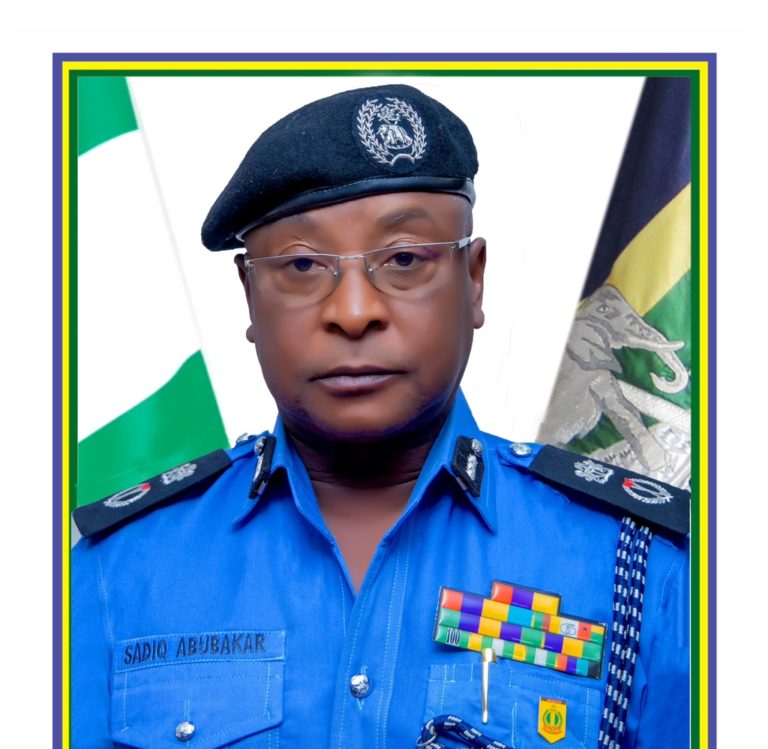
Meanwhile, the Commissioner of Police in FCT, Sadiq Abubakar, has applauded residents for their prompt notification and support to the police.
He assured that, while efforts are intensified to prevent any threat to public safety, incidents of crimes as such would be appropriately confronted and promptly nipped in the bud.
The Commissioner urged the public to maintain vigilance and report suspicious activities to the police.
OPERATIVES of the National Drug Law Enforcement Agency (NDLEA) have dismantled a trans-border drug cartel and arrested five leaders of the syndicate.
NDLEA, in a statement signed by Femi Babafemi on Sunday, January 29, said the members of the syndicate, which operate in different parts of the world, were arrested in a special operation that lasted for weeks.
He added that different quantities of drugs and air compressors used to conceal and distribute them globally were recovered during the operation.
“The special operation came on the heels of a warning by the Chairman/Chief Executive of the Agency, Brig. Gen. Mohamed Buba Marwa (Retd) said that drug barons and cartels would have it rough in 2023 if they fail to back out of the criminal business.
“Leaders of the cartel, which spreads across Dubai, UAE; Cotonou, Benin Republic; Togo; Oman, Thailand and Europe, as well as Lagos, Imo and Onitsha in Anambra state, had while on Christmas and New Year holidays in their villages were still coordinating efforts to send their illicit consignments to Dubai and other parts of the world.
“Their lid was blown open on Thursday, 29th December 2022, when their freight agent, Onyeisue Collins Chukwudi, was arrested by NDLEA officers at the SAHCO export shed of the Murtala Muhammed International Airport, MMIA, Ikeja Lagos, for attempting to export three big automobile air compressors to Dubai,” Babafemi said in the statement.
Arrested Freight agent, Onyeisue Collins Chukwudi
The statement added that a quick follow-up operation led to the recovery of additional five compressors at Chukwud’s home at 24 Legacy road, Ayobo area of Lagos.
According to the Agency, 27.50kgs of skunk were taken out of the air compressors after welding equipment was used to cut them open.
Further investigations by the NDLEA revealed that the freight agent was working for a bigger organized criminal group.
“As a result, extensive operational tools were deployed to track the first kingpin, Onuoha Peter Obioma, who lives in the Benin Republic and Togo but comes occasionally to do business in Lagos.
“The efforts paid off on Saturday, 7th January 2023, when Obioma walked into the waiting arms of NDLEA operatives with a bag containing additional air compressors used to conceal 15.7kgs skunk and a crystalline substance that later tested positive to methamphetamine after the Agency’s sniffer dogs identified compressors with drug concealment.”
According to the NDLEA, Obioma’s statement led to the unravelling of two other leaders of the cartel: Dubai-based Ugo Kelechi Alex (aka KC) and Iwueke Ugochukwu (aka Odugwu), an Onitsha, Anambra based businessman.
The anti-narcotic Agency said in a well-coordinated operation carried out on Tuesday 10th, January at the ancestral homes of the Kingpins in Imo State, the arrowhead of the cartel identified as Ezenwekwe Obinna Nicodemus, an automobile parts dealer at Alaba International market, Lagos was put under surveillance.
“A Lexus SUV and a Toyota jeep were recovered from Kelechi and Iwueke.
“After so many dramatic bids to evade arrest, NDLEA operatives eventually pinned Obinna down at a bar in Mazamaza, Mile 2 area of Lagos on Saturday 14th January.
The Agency added that a search of his home led to the recovery of 607 grams of ephedrine, a handful of Cannabis weighing 20 grams, and other paraphernalia, including 271 grams of dimethyl sulfone used as a cutting agent for ephedrine.
Also recovered were a chemical precursor, an active ingredient for the production of methamphetamine, a weighing scale and an International passport.
Meanwhile, the NDLEA said no fewer than 2,601.5 kilograms of Cannabis and 102,500 pills of pharmaceutical opioids were seized during interdiction operations across Plateau, Edo, Delta, Taraba, Kogi, Kano, Lagos, and Adamawa states in the past week.
SANI Bello, the aide-de-camp (ADC) to Nigeria’s first military leader, Johnson Aguiyi-Ironsi, has narrated how his boss was killed alongside Adekunle Fajuyi, the then governor of Nigeria’s defunct Western Region.
Bello, who was a second lieutenant in the Nigeria Army when the coup took place, revealed how he was suddenly appointed as ADC to Ironsi in an interview with Daily Trust newspapers.
As an officer stationed in Enugu with less than a year in the battalion, Bello said he was surprised by his nomination to serve as ADC as he was not qualified for the position.
When Bello arrived, he was told that the interview for the ADC position had already taken place and was about to return to Enugu when the Chief of Staff, Brigadier-General Ogundipe, called him back and he was then taken to meet with Ironsi.
“I was not in any way qualified to be an ADC to the supreme commander. I was a second lieutenant and they needed a captain, and the one there was a captain. Also, I was in the battalion for less than one year, by all identifications I was not qualified,” he said.
“When I got to Lagos I went to the Supreme Headquarters, which is the old State House on Marina. I met one Captain Sylvester and saluted him smartly because he was in his final term at Sandhurst when I was going in. And fortunately for me, we were in the same college.
“He was surprised to see me. He asked why I was there and I told him I was asked to attend an interview for ADC selection. He said I was late as the interview had been conducted and everybody had gone.
“I saluted smartly and said I was going back to Enugu. I don’t know what he thought but he said I should let him talk to the chief of staff. He called the chief of staff on his open intercom and said that one Second Lieutenant Sani Bello from first battalion came for ADC selection.
“Ogundipe was a brigadier-general and Sylvester was a captain, while I was a second lieutenant; look at the gap. He said they did not have time for a second lieutenant in that place. I said there was no problem, so I would go back.
“I was about to go back, suddenly, Ogundipe called Sylvester and said I should wait. He said he was tired of the first battalion commanding officer because he was not doing the right thing. He said they would give me a docket to take to my commanding officer.”
After a few minutes, Ironsi called Bello into his office and informed him that he would be taking over as ADC from Captain Sylvester.
As Ironsi travelled through the country to restore peace in the aftermath of the 1966 coup, Bello said he was received well in all the places he visited. He noted that one slight incident occurred in Zaria, where there was an accidental discharge by a soldier, but it was not an issue and not meant for Ironsi and his team.
Ironsi’s next stop was in Ibadan, where he met with Fajuyi. The two men were hosted to a cocktail reception, and everything went well.
However, late that night, Ironsi received word that there were riots taking place in Ikeja cantonment and an uprising in Abeokuta, with several casualties.
Ironsi ordered his officers to put on their uniforms, and he prepared to address the Council of Emirs, Obas, and Obis, who were assembled in Ibadan. But before he could deliver his address, Ironsi and Fajuyi were arrested by a group of coupists led by General T.Y. Danjuma.
The coupists then took Ironsi and Fajuyi to an unknown location, where they were later executed.
“Sure. After he took over, many events followed. There was something called the May riot, which killed a lot of people in the North, especially the Igbo.
“However, peace was later restored. After the riot, things settled down and Ironsi decided to embark on meeting the people; so we came to the North and visited Kaduna, Zaria and Kano.
“The reason we went to Ibadan was for Ironsi to address the Council of Emirs, Obas and Obis, who assembled there. The address was to take place on July 29, 1966.
“We were hosted to a cocktail by 7:30pm to 8:00pm. We were sent an invitation for that, but on the late minute the general said we should make it between 6pm to 7pm. We had the cocktail, everything went well and we all retired for the night.
“After we retired, about 12am we started hearing that something was happening. The commissioner of police in Lagos called me to say there was riot in Ikeja cantonment, so I called oga.
“They went to the house and brought out Fajuyi and Ironsi. When they brought them out, they opened the guardroom and asked us to enter the Land Rover. We entered the Land Rover and five of us were driven to God-knows-where. Later on we were told that it was along Owo road.
“As we were jumping into the Land Rover, we heard a machine gun fire. Dada rushed back. The sergeant-major said “he was trying to run away and we shot him”.
“They killed Fajuyi while we were there. I did not see the body but we heard the shot and they told Dada that they killed him. That was the last I heard of Ironsi.”
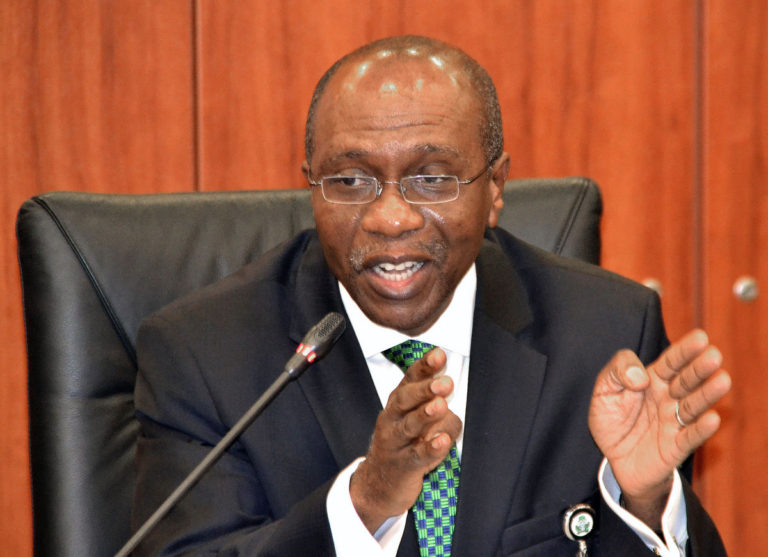
The CBN has been under immense pressure from Nigerians calling for the extension of the January 31 deadline due to their inability to swap their old N200, N500 and N1000 notes for the new ones.
Emefiele said on Sunday that as a result of measures put in place to ease the scarcity, President Muhammadu Buhari approved the deadline extension.
“Based on the foregoing, we have sought and obtained Mr President’s approval for the following: a 10-day extension of the deadline from January 31, 2023, to February 10, 2023, to allow for the collection of more old noteslegitimately held by Nigerians and achieve more success in cash swap in our rural communities after which all old notes outside the CBN loses their Legal Tender Status.
“Our CBN staff currently on mass mobilization and monitoring, together with officials of the EFCC and ICPC, will work together to achieve these objectives.
“A 7-day grace period, beginning on February 10 to February 17, 2023, in compliance with Sections 20(3) and 22 of the CBN Act, allowing Nigerians to deposit their old notes at the CBN after the February deadline when the old currency would have lost its Legal Tender status,” Emefiele said in a statement.
The CBN had, in October 2022, introduced redesigned N200, N500 and N1000 notes and gave a deadline of 31 January for the use of the old notes.
THE World Health Organization (WHO) has called on Federal Government to prioritise health funding in the fight against outbreaks of diseases in the country.
WHO urged the government to pick lessons from the outbreaks of COVID-19 pandemic and diseases such as Lassa fever and Cholera which it said exposed gaps in the country’s preparedness for epidemics.
The WHO Country Representative in Nigeria, Walter Kazadi Mulombo stated this during the 3rd edition of Nigeria Health Watch Prevent Epidemics Journalism Awards in Abuja on Friday, January 27.
“If unchecked it, gaps in preparedness can result in terrible danger. Nigeria needs a pivot to prevention in the fight against diseases by addressing the root causes.
“While there is no single pathway to epidemic prevention, all countries must find their way in the context of their own social, political and economic circumstances,” Mulombo said.
Represented by the Medical Officer (Emergency Programming and Response, Victor Tugumizemu, the WHO representative said Nigeria bears the highest burden of tuberculosis and paediatric HIV.
WHO Country Representative, Walter Kazadi Mulombo
Similarly, he said the country accounts for 50 per cent of tropical diseases in Africa and contributes 27 per cent of global cases of malaria and 24 per cent of deaths.
According to Mulombo; “Non-Communicable Diseases account for 29 per cent of all deaths in Nigeria with premature mortality from the four main NCDs (hypertension, diabetes, cancers and malnutrition) accounting for 22 per cents of all deaths”.
He added that the number of people in need of humanitarian relief in the world has increased by almost a quarter compared to 2022, to a record of 339 million.
“The foundation everywhere must be a political commitment to building a strong health system, based on primary care, with emphasis on disease prevention and health promotion,” he added.
Also speaking, the Managing Director, Nigeria Health Watch, Vivianne Ihekweazu called on Nigerians to “hold politicians accountable in order to improve public health in the spirit of electioneering campaigns and voting for new leaders”.
Ihekweazu said health security should not be seen as the responsibility of the Federal Government alone, but also state and local governments.
Managing Director, Nigeria Health Watch, Vivianne Ihekweazu
Meanwhile, the Director-General of Nigeria Centre for Disease Control, Ifedayo Adetifa commended the role of the media in tackling epidemics.
THE Adamawa State Police Command has arrested five Cameroonians suspected to be involved in the attempt to kidnap one Emmanuel Ebel, a resident of Jambutu, in Yola-North Local Government Area.
The Command’s spokesperson SP Suleiman Nguroje made this known in a statement on Saturday, January 29.
According to him, the crime was foiled following reliable information received from a good samaritan that led to the arrest of the suspects.
“The Command’s operatives attached to State Intelligence Bureau in sustained effort foiled an organised crime to kidnap one Emmanuel Ebel a resident of Jambutu, Yola North Local Government Area.
“The Command upon receiving the information designed a security ring around the target and luckily engaged the suspected kidnappers,” the statement said.
The suspects, according to the statement, are; Chubrandom Safinga, 30; Ibrahim Tala, 32; Ngosso Ndjombe, 28; Mmai Rostand, 32; and Nossu Ngambewo Ricky 27.
“The illegal immigrants from the neighboring Cameroon Republic were arrested 20 minutes before implementing their organised crime.
“The Commissioner of Police, CP Sikiru Akande, while commending OC SIB and his men for gallantry performance and professional conduct displayed leading to their arrest, also directs them to sustain the tempo as a strategy for crime prevention.”
The statement said the police commissioner urged residents to always inform the police of the whereabouts of criminals and their accomplices.
The Command further assured the government and people of Adamawa State of its continuous efforts in protecting lives and property of the citizens.
Other contractors banned by the Bank are Bamidele Obiniyi, Frank John Friday Nnaji, Isaiah Salihu Kantigi, Abuharaira Labaran, and Amin Moussalli.
Sanctioning contractors that breach the procurement guidelines of the World Bank is a usual occurrence the global bank does to promote transparency in contract awards and prevent procurement fraud among corporate entities it transacts business with.
The financial institution sanctions individuals or entities that go against its procurement policies by debarring them, sometimes, they are ‘cross debarred’.
The blacklisted Nigerian firms. Source: World Bank. January 23, 2023.
An organisation or contractor is considered ‘crossly debarred‘ in this context when a member of the group of Development Financial Institutions (DFI) finds a contractor guilty of procurement fraud or related offences, and other members of the DFI decide to effect the same sanction on the firm.
It is called mutual enforcement. And this exists among the African Development Bank (AfDB), European Bank for Reconstruction and Development, the Inter-American Development Bank Group, and the World Bank Group.
Gitto’s case was of ‘cross debarment’ from the AfDB, and the sanction took effect on December 28, 2022.
The AfDB accused Gitto Costruzioni of ‘fraudulent and obstructive practices’ during the bid tendering for the contract award of the Bank’s Transport Sector Support Programme (Phase II).
The World Bank, due to the agreement among the DFIs, decided to enforce the same sanction on the firm.
It is worth noting that Gitto Costruzioni has executed notable projects in Nigeria, which included the National Ecumenical Centre, Abuja; Akwa Ibom International Airport, Akwa Ibom state, and the Central Bank of Nigeria, Yenagoa in Bayelsa state.
The apex bank has delisted it for the next four years for procurement-related offences.
The decision took effect following an investigation conducted by the Bank’s Integrity and Anti-corruption Office. The unit is responsible for preventing, deterring and investigating allegations of corruption, fraud and other sanctionable practices in the AfDB’s financed projects.
The firm’s ineligibility period is expected to end on September 9, 2026. Gitto is located at Plot 737, Mabushi District, in Abuja.
The contracts for which it was sanctioned included the rehabilitation of the Yaounde-Bafoussam-Babadjou road, the improvement of the Great Zambi-Kribi Road, and the improvement of the Maroua-Bogo-Pouss road.
The World Bank stated, “The rehabilitation of the Yaounde-Bafoussam-Babadjou Road, Improvement of the Great Zambi-Kribi Road is aimed to respond to the urgent need for further economic development in the poorest regions of Cameroon and the Far North and East regions.”
Contractors barred for nine years
By the sanction, the affected firms and individuals have been prohibited from participating in World Bank-financed contracts until October 3, 2031.
For instance, Nnaji, one of the affected contractors, was blacklisted on October 2, 2022, and is ineligible to participate in World-Bank-financed projects until October 3, 2031.
He was blacklisted with Chez Aviv Nigeria Limited the same day, and the sanction extends to the same period – October 3, 2031. This implies both were banned for nine years and guilty of fraudulent and corrupt practices.
“The period of ineligibility for Chez Aviv Nigeria Limited (“Chez Aviv”) extends to any legal entity that it directly or indirectly controls. The minimum period of ineligibility is the nine-year period indicated,” a note released by the Bank on debarred firms and individuals stated.
The note continued, “Provided, however, that after this minimum period of ineligibility of nine years, Chez Aviv may be released from ineligibility only if it has demonstrated to the World Bank Group’s Integrity Compliance Officer that it has complied with the following conditions:
“(a) Chez Aviv has taken appropriate remedial measures to address the sanctionable practices for which Chez Aviv has been sanctioned; and (b) Chez Aviv has adopted and implemented, in a manner satisfactory to the Bank, integrity compliance measures as may be imposed by the Bank Group’s Integrity Compliance Officer pursuant to subparagraph 9.03(b) of Section III.A of the Sanctions Procedures (e.g., an integrity compliance program or elements thereof) to address the sanctionable practices.”
The Lagos-based firm, with registration number 401253, was registered on February 20, 2001. The directors are Igwe Anthony, Friday Nnaji and Steve Nnaji.
Procurement fraud – a usual occurrence among local firms
The alleged non-existent office building of Lutoyilex Construct Limited at Suite 295, Soar Plaza, Gwarimpa, Abuja. Photo Credit: Olugbenga Adanikin, The ICIR. Thursday, January 19, 2023.
Reports have shown that breaching procurement guidelines has been a major corrupt practice perpetrated during public procurements. It is not peculiar to the private sector but also to government spending.
It is a usual occurrence during every budgetary provision and contract award in the country.
According to the Chartered Institute of Purchasing and Supply Management of Nigeria, about 30 per cent of the nation’s resources are lost due to the manipulation of its procurement process.
The ICIR also documents a series of suspicious contracts, some of which flouted the country’s Public Procurement Act (PPA) 2007.
Regardless, the Bureau of Public Procurement (BPP) had to set up the federal contractors’ database as part of measures to reduce the fraudulent trend in government spending.
It would also enable interested public members to easily establish a firm’s eligibility to secure contract awards from government ministries, departments and agencies (MDAs).
It showcases the level of compliance with the Pension Commission (PenCom) obligation, the Nigeria Social Insurance Trust Fund (NSITF), the Industrial Trust Fund (ITF), tax payment at the Federal Inland Revenue Service (FIRS), and the Corporate Affairs Commission (CAC).
As a result, any firm that fails to comply with the above requirements is mostly considered ineligible to be awarded contracts; otherwise, such would have breached the procurement law.
Meanwhile, both Softech IT Solutions & Services Limited and Kantigi were sanctioned for four and five years. The sanctions for both entities took effect on March 29, 2022.
Sanctioned for improper payment to project officials
Also, AIM Consultants Limited and Moussalli were banned same day – February 22, 2022. They had just a two-year ban. The sanction will expire on December 21, 2024.
Meanwhile, Moussalli works as the managing director of Aims Consultants which is located in Lagos.
Based on a release with reference number 2022/46/INT made public, AIMs Consultants ‘made improper payments‘ of about N12.95 million to project officials under the directive of Moussalli.
“AIM Consultants made improper payments totalling Nigerian naira 12,954,400 (approx. US$45,500) to project officials. The payments were through AIM Consultants’ Resident Engineers in both states.
“Soon after receiving payments from the project, AIM Consultants transferred money to the personal accounts of the two Resident Engineers for onward transmission to various project officials. Engineer Moussalli authorized all the payments. This constitutes a corrupt practice under the World Bank’s Consultant Guidelines.”
Contractors on cross-debarment
There are four other contractors in the category of cross-debarment. They are Lutoyilex Construct Limited, Obiniyi, Abuharaira and ALG Concept Limited. The ineligibility period of the four affected entities was tagged “Ongoing” without a specific period to when the sanction would end.
Lutoyilex and Obiniyi are located Suite 295, Soar Plaza, Gwarimpa, Abuja, and were suspended on May 17, 2022, while ALG Concept Limited and Abuharaira were both suspended on the same day – March 7, 2022.
Untraceable Softech IT Solutions and Services Limited, at the claimed address at Banex Plaza. Photo Credit: Olugbenga Adanikin, The ICIR. Thursday, January 19, 2023.
Faces behind blacklisted firms
The ICIR attempted to identify the owners of the suspended companies and the contractors. This was done through field visits and deploying the Open Source Intelligence Tools (OSINT). It showed Gitto, a company largely owned by the Italians, has six Directors.
They include Civil Engineering Company of Srl, Ebuara Agnes (Mrs), Nicola Busacca, Gitto Domenico, Salvatore Gitto, and Akpana and Co. Nigeria Limited.
The Civil Engineering Company holds a 95 per cent stake in the ownership of Gitto Costruzioni Generali Nigeria Limited. And the key principal of the Italian firm is Gianfranco Zinfollino.
Akpana and Co. Ltd., another shareholder, is also owned by eight directors.
One of them – Agnes Ebuara – had earlier appeared among owners of Gitto. She was listed as Ebuara Agnes (Mrs). This implies she owns shares in both companies.
Other directors are Agabi Achu, Agabi Kanu, Agabi Echaka. These names are also reflected as Achu Agabi, Kanu Agabi, and Echeka Agabi.
Chez Aviv Nigeria Limited is owned by three directors – Igwe Anthony, Friday Nnaji and Steve Nnaji.
Lutoyilex, an Abuja-based firm, is owned by Queen Bethel Obiniyi, Kelvin Olasunkanmi Obiniyi, Zion Feyikunmi Obiniyi, Oluwatoyin Alexzirah Obiniyi and Bamidele Johnson Abayomi Obiniyi. With registration number 1046648, its core area of strength is general merchandise and trading.
ALG Global Concept Nigeria Limited, a local construction firm, is owned by Abuharaira Gero Labaran. It was registered on April 20, 2016, with registration number 1330049. Abahuraira Gero Labaran and Fulaira Adam are shareholders of the firm. Fulaira Adam is also a Director, while Mohammed Sherif is the company’s secretary.
The Managing Director, AIMS Consultants, Amin-Mousalli. Photo Credit: PoliticalEconomistE
Aims Consultants Limited was established on November 20, 1979, with registration number 30821. It was rated as an active company by the CAC. This implies it complied with the Commission’s guidelines for submitting relevant documents, such as its annual report.
It has 11 directors. They include Saada Elias Moussalli, Lanre Fisher, Yahaya Umar, Amine I. Moussalli, Tatiana Moussalli-Nouri and Evita Moussalli Arc.
Others are Peter Fisher, Oyebanji Dominic, Adebayo Idowu Adebola, Umeadi Lawrence, Architect Paul Uzor and Idowu Adebayo.
Still, no feedback was provided as of the time of filing this report when this reporter reached out via the firm’s website.
On Thursday, January 19, The ICIR visited Gitto to seek a reaction to the ban by the World Bank. But the security officials disclosed that the corporate communication manager had left the company and the special assistant who could have responded was on leave. The visit was rescheduled to Monday, January 23.
When The ICIR made a further effort on Monday, the reporter was asked to visit on Wednesday, January 25.
Following a visit to the office on Wednesday, the security officials advised the reporter to submit an official request letter.
On-spot visit to the corporate offices of Lutoyilex and Softech IT Solutions and Services Limited was unsuccessful. The offices could not be located at the claimed address, and the security officials were unaware of the firm or the chief executives.
Bamidele Obiniyi of Lutoyilex was eventually contacted via a third party. He initially watered down the World Bank listing, saying it was not a current issue. He claimed his lawyer had intervened in the matter. But in another twist, he exonerated himself, saying one of his boys used the firm to seek a contract at the bank.
“We have responded already, and it has expired,” Obiniyi said. The ICIR requested a copy of the response, but he responded, ‘No.’ “It was not a blacklist but a suspension,” he added.
Non-existent office of Chez Aviv Nigeria Limited in Lagos. Photo Credit: Temitayo Odunlami, The ICIR
“One of the staff used the company, not me. And after an investigation, they suspended the company because it is registered in my name. But, they have lifted it…”
At the corporate headquarters of Aims Consultants Limited, owners of Wazobia FM, Cool FM, and Nigeria Info, The ICIR attempted to speak with the Corporate Affairs Manager, but the Client Service Officer at the reception said he was in a meeting and he would not be available for the day.
The ICIR waited for about an hour. Then, the official advised the reporter to write a note to the corporate affairs manager stating the purpose of the visit, and he would return with a call to The ICIR. That was done.
However, as of the time of filing this report, he was yet to return a phone call to The ICIR. Efforts to get his name was unsuccessful.
Other corporate entities could not be contacted at the time of the report due to an inactive website.
THE decision of an Ikeja Special Offences Court presided over by Justice Mojisola Dada to sentence a 32-year-old vulcaniser, Chidozie Onyinchiz, to death by hanging on Tuesday, January 17 for robbing a nurse of N57,000 has generated reactions from Nigerians.
Justice Dada held that the prosecution had proved the three-count charge of conspiracy, armed robbery and membership of an unlawful society against Onyinchiz.
Dada said the convict’s attempt to wriggle out of the charges was futile.
“The defendant had stated that the complainant pointed at him as one of the boys armed with a pair of scissors and forcefully snatched her bag containing N57,000 at Akesan Bus Stop.
“In his confessional statement, Onyinchiz stated that he met Ediri Endurance in a public bus, and Endurance took him to his father’s house after the bus developed a fault.
“He also stated that they ended up sleeping in an uncompleted building because Endurance’s father did not open the door for them to spend the night in his house.
“The statement corroborated the submission of the victim that she was accosted at about 4.30 a.m. by two boys holding an iron rod and a pair of scissors on the day of the incident.
“She said the two boys were the ones who robbed her.
“The totality of the evidence before the Court is compelling, and I find the defendant guilty of the charges preferred against him.
“He is hereby sentenced to death by hanging and may God have mercy on his soul,” Justice Dada said.
The state prosecutor, Afolake Onayinka, had earlier told the Court that the convict committed the offences with an accomplice still at large.
Onayinka submitted that the offences contravened the Criminal Law of Lagos State, 2015.
The judgement has, however, generated many comments among Nigerians, with many wondering why some politicians allegedly steal billions and yet are given lighter punishments while some supposedly “small” offences get the death sentence.
Twitter users react
A Twitter user @DanielRegha tweeted, “A man (Chidozie Onyinchiz) was reportedly sentenced to death by Justice Dada for robbing a nurse of N57k; The man deserves to be punished, but the death sentence is extreme. Many found guilty of worse were sent to prison, so why is he being killed? Section 390 states otherwise.”
Another Twitter user, @MrJamal001, said, “If he used any form of weapon (Knife, broken bottle, gun etc.), it amounts to armed robbery and the term under the Law is a mandatory death sentence. It’s immaterial the value of what was stolen. The Court’s hands are tied in circumstances like this one.”
@owendino01, in his own comment on the matter, said, “This judgment, in my opinion, is politically motivated; a Yoruba Judge sentenced an Igbo Nigerian to death for theft speaks volumes. I believe he can appeal the judgment; hence he will probably do time in jail! There’s always double standard in our judicial system!”
Also reacting, @chaeyyilaw said: “Armed Robbery is Death Sentence; as long as the convict is armed (gun, table knife, scissors) while committing the crime, he will be charged for Armed Robbery. The Law doesn’t care about your emotions; the Law is the Law.”
In his reaction another Twitter user, @realDan32, said, “Our justice system in this country is biased, a vulcaniser can be sentenced for 57,000 but Uzo Kala was discharged and set free after looting billions. God dey oooo.”
Legal opinion
Giving a legal opinion on the matter in a chat with The ICIR, a lawyer Abiola Kolawole, said that once it has to do with armed robbery, the penalty is the death sentence.
“This can’t be the fact of the case. It is either the method of getting the item was armed robbery or someone was killed in the process of the stealing.
“The fact of the case is always important; context is important. If you look at what I pointed out earlier, I said robbery is different from stealing.
“Yes, the offence of armed robbery is death. Now, that’s the difference with stealing. Now Let me play the devil’s advocate here.
“Do yahoo boys who defraud people of millions get sentenced to death? No, taking advantage of a society is different from armed robbery.”
Kolawole stressed that the law is strict with armed robbery because weapons are involved.
Also commenting on the verdict, an Abuja-based legal practitioner, God’sglory O. Ifezue pointed out that while it would appear harsh to the average Nigerian, it is what the law provides for.
She pointed to the Robbery and Firearms (Special Provisions) Act which provides in Section 1(2) that the penalty for armed robbery is death, whereas the penalty for robbery simpliciter is a term of imprisonment not less than 21 years (section 1(1) of the same Act).
“And you’re probably wondering, what is the difference between the two? Well, the two offences are not considered the same under the law. It is considered robbery simpliciter when a person robs another without any weapon.
“However, should any arms or offensive or harmful weapon enter the equation, it automatically changes the offence to armed robbery.
“To make it clear, any robbery with any of the firearms or offensive weapons mentioned next is armed robbery under the law and attracts the death penalty – “any canon, gun, rifle, carbine, machine-gun, cap-gun, flint-lock gun, revolver, pistol, explosive or ammunition or other firearms, whether whole or in detached pieces,” Ifezue stated.
She added that the reason for this law was because of the high rise in cases of robbery involving arms and offensive weapons, especially after the civil war. Thus, the law was passed to nip that mischief in the bud and deter would-be offenders.
However, some Nigerians are wondering why petty criminals such as the vulcanizer who was sentenced to death for stealing N57,000 do not benefit from plea bargain, like prominent people, including former governors who were convicted for stealing billions.
What is a Plea Bargain?
This is an agreement between the prosecutor and a defendant who pleads guilty to a lesser charge or to one of the multiple charges in exchange for a more lenient sentence or a dismissal of the other charges. In other words, it is an agreement in a criminal trial in which a prosecutor and a defendant arrange to settle the case against the defendant on terms accepted by the prosecutor, which terms are premised in the interest of justice public, interest, and public policy.
Politicians that benefitted from Plea Bargain
In 2008, the Economic and Financial Crimes Commission (EFCC) entered into a “plea bargain” agreement with the former governor of Edo State, Lucky Igbinedion.
Igbinedion was charged with stealing up to N4.4 billion, but in the ruling given by a judge at the Federal High Court in Enugu, he was fined only a paltry N3.5 million, with no option of jail time for the crime.
Tafa Balogun, a former Inspector-General of Police, also benefited from plea bargain.
CSO/Human Right intervention
According to a Human Rights/Youth Activist, Rinu Oduala, the death sentence imposed on the man who stole N57,000 should prompt Nigerians to look into the selectiveness of the country’s justice system.
“Recently, Governor Dariye and Senator Nyame were pardoned after a landmark ruling sentenced them to prison for stealing billions.
“This is a reflection of our society, in which the powerful are let off the hook while the poor are lynched.
“Our politicians’ theft has never resulted in the death penalty. If we are sentencing petty thieves to death, the obvious question is what about our politicians?” she asked.
In his submission on the issue, the Director General of the Centre For Credible Leadership And Citizens Awareness, Gabriel Nwanbu, said issues like this are unbecoming of the judiciary system we have in Nigeria.
“The kind of money they steal is enough to build an entire country, but they are kind of plaguing the treasury of the Federal Republic of Nigeria, and sadly there is this clause we have in our criminal justice system that they call plea bargain.
“The plea bargain gives them room to keep perpetrating criminalities. It gives them the courage to keep stealing; it makes them to be somewhat kind of immune.
“Moreover, the kind of money people in government steal is so much that it is becoming worrisome because the country is now going handicapped to finance the budget of the country,” Nwambu said.
He said a mechanic or vulcaniser who stole N57,000 should have the same punishment as somebody who stole over a hundred billion naira.
“The idea is that there should be consequences for a crime, there should be consequences for offences. If we are looking for an egalitarian society, it should be a society where everybody should be equal before the law. We should be able to ensure that there is a rule of Law in Nigeria.”
What the Law says
The following can attract the death penalty in Nigeria: armed robbery, murder, rape, terrorism-related offences, treason and kidnapping.
Under Section 297(2) of the Criminal Law Ch. C17 Vol. 3 Laws of Lagos State, 2015, any person found guilty of armed robbery is convicted and sentenced to death.
The same Law provides death as punishment to any person convicted of murder (Section 223 of the Law).
However, by Section 308 of the Administration of Criminal Justice Law Ch. A3 Laws of Lagos State, 2015, the Governor, upon advice from the Advisory Council of Prerogative of Mercy, may commute death sentence to life imprisonment, any specific period or decide to pardon or grant a reprieve.
Section 402. of the Criminal Code Act states that: “(1) Any person who commits the offence of robbery shall, upon conviction, be sentenced to imprisonment for not less than 21 years.(2) If ‐ (a) any offender mentioned in subsection (1) of this section is armed with any firearms or any offensive weapon or any obnoxious or chemical materials or is in company with any person so armed; or (b) at or immediately before or immediately after the time of the robbery, the said offender wounds any person, the offender shall, upon conviction, be sentenced to death.”
THE Benue State government and the state chapter of the All Progressives Congress (APC) are trading blames over the killing of residents by herdsmen.
Earlier, The Voice Newspaper, owned by the state government had reported how gunmen attacked Abagana, killing an entire family of six and two other Internally Displaced Persons (IDP).
Abagena is a community located close to the IDP Camp in Makurdi, the state capital.
Reacting on January 24, the state chairman of the APC, Austin Agada, described attacks by the armed herdsmen as “a prevailing atmosphere of politically induced insecurity that calls for the urgent attention of all Benue patriots”.
Agada accused Governor Samuel Ortom of using the Community Volunteer Guards to rustle cattle in Gwer-West, Makurdi and Guma, the areas most affected by herdsmen attacks in the state.
He noted that cattle rustling has come “with attendant consequences of spontaneous Fulani militia killing of one person in Mbapa Ward of Gwer-West LGA, eight persons in Makurdi on the January 19, 2023 and eight persons in Guma LGA on the January 20, 2023, all within the Ihyarev dominated communities”.
Chairman. APC Benue chapter Austin Agada
Agada also said “available information indicates that on Wednesday 18 January, 2023, over 600 herds of cattle were rustled in Sengev Ward of Gwer-West LGA and kept at the Local Government Guest House at Naka, the objective was to trigger reprisal attacks against Gwer-West people by the herders. We roundly condemn this development and urge Governor Ortom to desist from spilling more blood”.
However, while restating his administration’s commitment to end open grazing in the state, Ortom on January 25 accused the APC in the state of colluding with herdsmen to terrorise Benue communities.
“The Open Grazing Prohibition and Ranches Establishment Law and the Livestock Guards which the APC and their herder allies desperately want to see scrapped have come to stay. Anyone who wants to rear cattle in Benue State must do so within the confines of ranches and be prepared to face the long arm of the law in the event of any breaches”, he said in a statement by the Special Adviser to the Governor on Media and Publicity, Terver Akase.
The statement added: “The APC in Benue State has left no one in doubt that they are working closely with those who invade communities of the state and attack innocent people. This is not the first time that leaders of the party have come out to take sides with killer herders.
“The APC in Benue State has often accused Benue people of attacking and killing themselves. Not too long ago, the sacked governorship candidate (Hyacinth Alia) of the party re-echoed the accusation which the party’s leader (Sen.George Akume) first made four years ago absolving herdsmen of any responsibility in the series of attacks on Benue people.”
Meanwhile, according to Armed Conflict Location and Event Data Project (ACLED) report, Benue topped the states in Nigeria with most violent herder-farmer attacks.
The report which covered 2005 to 2021, put the number of killings in Benue at 2, 539 from 303 attacks.