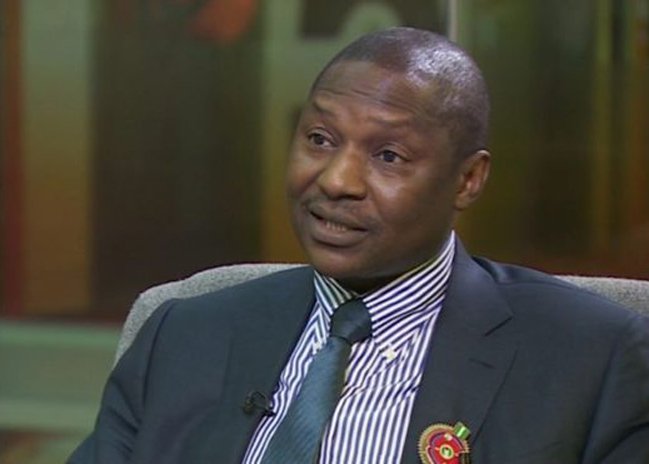
THE Economic and Financial Crimes Commission (EFCC) has reportedly seized the international passport of former Minister of Justice and Attorney-General of the Federation (AGF), Abubakar Malami, following his ongoing investigation.
Malami, a senior advocate, who was released around 1am on Saturday, November 28, after hours of interrogation, has now been placed under a one-month restriction that compels him to report at the EFCC headquarters in Abuja every day, according to The Nation Newspaper.
The travel ban, according to the fact sheet reported by the newspaper, was necessary to prevent any interruption in the ongoing probe.
It also noted that Malami had significant questions to answer over how alleged $490 million loot of the late Head of State Sani Abacha was managed under his watch.
The report further stressed that the decision to seize Malami’s passport was informed by the volume of documents he is expected to review and myriads of questions waiting ahead for him to answer.
The report noted that he could not travel out of Nigeria except with EFCC approval or a court order.
The ICIR’s efforts to reach the commission through its spokesperson, Dele Oyewale, proved abortive, as calls directed to his line went unanswered, and SMS and WhatsApp messages sent to him were not replied when filing this report.
The ICIRreported that Malami claimed the allegations against him were fabricated.
In a reaction posted on his X handle, the former minister said his interaction with EFCC investigators went ‘successfully’.
He said nothing about seizure of his passport.
““In line with my undertaking to keep Nigerians updated on my invitation by EFCC, I give glory to Allah for his divine intervention,” he said.
“The engagement was successful and I am eventually released while on an appointment for further engagement as the truth relating to the fabricated allegations against me continue to unfold,” he added.
Malami had earlier announced the EFCC invitation on his Facebook page, describing himself as a law-abiding citizen ready to honour the summon.
The ICIR reports that Malami served as the AGF from 2015 to 2023 under the late President Muhammadu Buhari.
During the period, he became one of the most influential figures in the cabinet and a central actor in several major legal and political decisions.
He was also widely regarded as one of Buhari’s most loyal allies, often defending controversial government policies and legal actions.
Malami was also central to the administration’s alleged selective anti-corruption drive, with critics accusing him of selective prosecution and political interference.
His tenure courted controversies, including allegations of financial irregularities, handling of recovered looted funds and legal interpretations that shaped the Buhari administration’s posture on human rights and press freedom.
In 2020, he was accused of interfering in the prosecution of some high cases such as the Malabu Oil case, former Senate President, Dr. Bukola Saraki and former Gombe State Governor, Danjuma Goje.
Also in August 2020, a coalition against corruption called on Buhari to probe Malami for allegations ranging from financial sleaze involving him and his family to influence peddling.
Recall that shortly after leaving office in August 2023, the Independent Corrupt Practices and other related offences Commission probed him over allegations of corruption and abuse of office.
Recently, the former AGF declared his intention to contest the 2027 governorship election in Kebbi State.
Malami, who spoke with DCL Hausa on November 17, said he had the backing of the people of the state.
“I have agreed to contest, and there is no retreat. God willing, we are going to win because we have people who believe in us, and we will not let them down,” he added.
He also criticised the ruling All Progressives Congress (APC), saying it had caused hardship, particularly in northern Nigeria.
THE Peoples Democratic Party (PDP) has criticised President Bola Tinubu’s newly released list of ambassadorial nominees, describing it as scandalous, disappointing, and a reflection of the administration’s values.
In a statement on Saturday, November 29, the PDP condemned the list, alleging that several nominees were individuals with “integrity deficits,” tainted public records, and histories of anti-democratic behaviour.
The party said the list confirmed fears that the Tinubu administration was more inclined to reward political loyalists than appoint credible representatives capable of enhancing Nigeria’s global standing.
According to the statement, signed by the PDP National Publicity Secretary, Ini Ememobong, the ambassadorial selections offer a troubling picture of the president’s judgment and priorities. The party said it was no surprise that Nigerians reacted with outrage when the names were made public.
“Specifically, we convey the disappointment of many right-thinking Nigerians on the nomination of Prof. Mahmood Yakubu, the immediate-past Chairman of the Independent National Electoral Commission (INEC), whose administration of our electoral umpire was characterised by countless double-speaks, flip-flops, and undelivered promises, which ultimately resulted in the birth of this administration, which is struggling in all areas of governance.
“To offer him an ambassadorial appointment at a time like this is an excellent exemplar of a skewed reward system, which we suspect is designed as an incentive to the new INEC Chairman, to also deliver flawed elections in 2027, in expectation of future rewards. This is absolutely scandalous and completely unacceptable,” the party said.
Tinubu on Saturday, November 29, forwarded 15 career and 17 non-career nominees to the Senate, including immediate past INEC chairman Mahmood Yakubu; former Aviation Minister, Femi Fani-Kayode; and former presidential aide, Reno Omokri.
The list also featured former governors, former first ladies, ex-lawmakers, and several political loyalists.
Although the Presidency failed to explain or give reasons for enlisting them, many Nigerians on social media, especially X, said the nominations portrayed a government more concerned with rewarding political allies than rebuilding its diplomatic strength.
‘A country rewarding criminality’ — Inebehe Effiong
Human rights lawyer, Inebehe Effiong, described the nominee list as a ‘travesty’. He said it reinforced the perception that Nigeria habitually rewards misdeeds.
According to him, many of those who “contributed to Nigeria’s destruction” were being being positioned as the country’s voice abroad.
He expressed particular outrage at the nomination of former INEC chairman Yakubu, whom he accused of supervising a “highly disputed and rigged” 2023 election.
“Most of the names on President Tinubu’s list are career politicians who have failed to deliver in their previous roles, sycophants, and morally challenged individuals.
“I find it particularly upsetting, that the same discredited Prof. Mahmoud Yakubu, who supervised a highly disputed and rigged election in 2023, has now been rewarded with an ambassadorial position. No country on earth has prospered through a shambolic, corrupt and discredited leadership recruitment process,” he wrote.
Also, another X user, @Arakunrin_MFR, faulted the inclusion of former governors Ifeanyi Ugwuanyi and Okezie Ikpeazu, as well as Reno Omokri, describing them as individuals with “nothing to offer in diplomatic relations.”
He argued that their nominations were clearly political compensation rather than merit-based selections.
‘A few outstanding names, many ridiculous ones’ – Ridwan Oke
Reacting to the list, a human rights lawyer, Ridwan Oke, also criticised the list, saying he could barely identify “15 decisive names” capable of strengthening Nigeria’s international relations.
He described the president’s earlier list of three ambassadors as excellent but dismissed the new nominees as a mix of federal character considerations and blatant political rewards.
For writer Kelechi DonPido, the list symbolises a deeper national decay.
He said the nomination was “an indictment etched in ink and patronage,” accusing the administration of turning diplomatic postings into “baubles in a marketplace of shamelessness.”
He added that the appointments reflected a government “so entangled in corruption and callousness” that it could no longer distinguish between competence and favour-trading.
‘Tinubu more focused on 2027 than reform’
Another X user, La Danat, accused the All Progressives Congress (APC)-led government of reducing Nigeria to a “disgraced country,” arguing that the ambassadorial nominations prioritised political survival over national reform.
He said the president appeared more interested in appeasing politically influential figures ahead of the next election than in appointing individuals with clean records or diplomatic capacity.
The ICIR reports that if confirmed by the Senate, the ambassadors will be deployed to key nations such as China, India, South Korea, Canada, Mexico, the UAE, South Africa, and Kenya, as well as multilateral missions like the UN, AU, and UNESCO.
Tinubu recalled all ambassadors appointed by former President Muhammadu Buhari in September 2023 but did not immediately replace them. This latest list is the most extensive ambassadorial submission since then.
THE Nigerian Association of Resident Doctors (NARD) has suspended its total and indefinite strike following fresh agreements reached with the Federal Government after several rounds of conciliatory meetings.
In a statement issued Saturday night, November 29, the NARD President, Mohammad Suleiman, said the National Executive Council (NEC) resolved to halt the industrial action for four weeks after both parties signed a Memorandum of Understanding (MoU) detailing the status of the association’s 19-point demands.
The suspension, he stressed, is “an uncommon gesture” to show good faith while monitoring the government’s commitment to fulfilling its obligations.
According to him, although progress has been made, several issues remain at the implementation stage.
These include unresolved promotion and salary arrears, which he said the government had committed to clear within four weeks.
The association also noted that the directive on specialist allowance had been issued.
The long-standing case of the “Lokoja 5” is also expected to be resolved within two weeks following a recommendation for the doctors’ reabsorption into the Federal Teaching Hospital, Lokoja.
Suleiman explained that the MoU captured fresh commitments from government on failed payments of the 25/35 per cent allowance and the accoutrement allowance, as well as clear directives resolving the skipping and entry-level controversies.
He noted that matters concerning house officers was also settled, while hospital managements were instructed to stop all “obnoxious clauses” in locum arrangements and to enforce proper rest periods during call duties.
He added that committees set up to review locum policies and work-hour regulations was given two months to produce workable frameworks.
Besides, he said the NEC endorsed the suspension of the strike to give the government time to implement these commitments.
He acknowledged that mistakes were made in the course of the struggle and took responsibility for them, but assured members that NARD would use the four-week window to intensify advocacy and ensure full compliance with the agreement.
“The countdown for the four weeks shall start on Monday (December 1). It shall be a daily reminder to Nigerians and the Federal Government to adequately use this ‘four weeks window’ justly and fully,” he added.
Recall that the association downed tools on Friday, October 31, following the expiration of a 30-day ultimatum issued to the Federal Government over unresolved demands.
THE ICIR’S senior investigative reporter, Nurudeen Akewushola, has been shortlisted for the 2025 Fetisov Journalism Awards in the category of Outstanding Contribution to Peace, following his ground-breaking investigation into a Nigerian Air Force airstrike that killed civilians in Katsina State.
Akewushola’s reporting revealed that on November 20, 2024, an airstrike in Shawu village, Ruwan Godiya district, Faskari Local Government killed at least five unarmed civilians, including women and children, and injured 19 others.
Despite claims by the Katsina State Government and the Nigerian Air Force (NAF) that the operation targeted terrorists, Akewushola’s investigation showed the area had been evacuated by the armed groups before the attack, leaving innocent villagers as the primary victims.
Through field reporting, interviews, Akewushola documented consequences for families like that of Isah and his heavily pregnant wife, Hafsat, who lost their unborn child and faced crippling medical expenses. Other victims included eight-year-old Maryam Mukhtar and her mother, Abasyya, whose deaths left relatives grappling with profound loss.
The investigation also highlighted the government’s attempts to mislead the public, with the report exposing a systematic cover-up.
In his category, nine other journalists were shortlisted.
This year, 33 submissions from 19 countries were shortlisted, including entries from the UK, Lebanon, Bosnia and Herzegovina, Cameroon, and Nigeria. The winners will be announced at a gala in Cyprus on April 22, 2026.
“This year’s bumper harvest of outstanding stories is more evidence that, in spite of the many crises facing news media, quality journalism around the world is alive and well.
“The shortlist includes entries from France, the Netherlands, Qatar, Indonesia, UK, USA, India, Finland, Mexico, Italy, Canada, Germany, Israel, Jordan, Lebanon, China, Nigeria, Cameroon, and Bosnia and Herzegovina, all of them competing for a share of the 520,000 CHF (USD 644,000) prize fund,” the statement read.
The Fetisov Awards aim to reward journalists whose work challenges injustice, fosters transparency, and contributes to global peace, highlighting the indispensable role of investigative reporting in shaping societies.
The jury is expected to review the shortlist to determine the finalists, with winners set to be announced at a gala ceremony in Cyprus on April 22, 2026.
PRESIDENT Bola Tinubu has nominated immediate past Chairman of the Independent National Electoral Commission, Mahmud Yakubu; former Aviation Minister, Femi Fani-Kayode; former presidential aide, Reno Omokri; and 28 others as Nigeria’s ambassadors.
A statement by the president’s media aide, Bayo Onanuga, on Saturday , November 29, noted that the president forwarded a total of 32 names to the Senate for confirmation.
In two separate letters addressed to the Senate President Godswill Akpabio, the president requested expeditious confirmation of 15 career ambassadors and 17 non-career ambassadors.
According to the list, four women are among the career nominees, while six women feature on the non-career list.
Among the non-career nominees are former Ekiti First Lady, Erelu Angela Adebayo; former Enugu Governor, Ifeanyi Ugwuanyi; former Katsina House of Assembly Speaker, Tasiu Musa Maigari; and Ogbonnaya Kalu, a lawyer from Abia State.
Others are former Universal Basic Education Commission (UBEC) Deputy Executive Secretary, Yakubu Gambo; former Plateau State senator, Nora Ladi Daduut; a professor; former Lagos Deputy Governor, Otunba Femi Pedro; former Aviation Minister, Femi Fani-Kayode; and Nkechi Linda Ufochukwu, a lawyer from Anambra State.
Also nominated are former Oyo First Lady, Fatima Florence Ajimobi; former Lagos Commissioner, Lola Akande; former Adamawa State senator, Grace Bent; former Abia Governor, Victor Okezie Ikpeazu; the senator representing Ondo South in the current National Assembly, Jimoh Ibrahim; and former Ambassador to the Holy See, Paul Oga Adikwu, from Benue State.
“Among the nominees for career ambassador and high commissioner-designates are: Enebechi Monica Okwuchukwu (Abia), Yakubu Nyaku Danladi (Taraba), Miamuna Ibrahim Besto (Adamawa), Musa Musa Abubakar (Kebbi), Syndoph Paebi Endoni (Bayelsa), Chima Geoffrey Lioma David (Ebonyi) and Mopelola Adeola-Ibrahim (Ogun).
“The other nominees are Abimbola Samuel Reuben (Ondo), Yvonne Ehinosen Odumah(Edo), Hamza Mohammed Salau (Niger), Ambassador Shehu Barde (Katsina), Ambassador Ahmed Mohammed Monguno (Borno), Ambassador Muhammad Saidu Dahiru (Kaduna), Ambassador Olatunji Ahmed Sulu Gambari (Kawara) and Ambassador Wahab Adekola Akande (Osun),” the statement added.
Upon confirmation by the Senate, the new ambassadors are expected to be posted to countries where Nigeria maintains strategic partnerships, including China, India, South Korea, Canada, Mexico, the UAE, Qatar, South Africa, and Kenya, as well as to multilateral missions such as the United Nations, UNESCO, and the African Union.
Recall that the president had on November 26 sent a list of ambassadors containing three names to the Senate.
The Senate President, Godswill Akpabio, announced this in a letter from the president at the Senate plenary on Wednesday, November 26.
Since Tinubu recalled all ambassadors appointed by his predecessor, the late President Muhammadu Buhari, on September 2, 2023, he has yet to replace them.
PRESIDENT Bola Tinubu has welcomed Nigeria’s election into the Council of International Maritime Organisation (IMO), describing it as a reaffirmation of the country’s rising influence in global maritime affairs.
A statement by his Special Adviser on Information and Strategy, Bayo Onanuga, noted that Nigeria, secured a seat in Category C of the IMO Council for the 2026–2027 biennium during the organisation’s General Assembly in London on Friday, November 28.
It noted that the victory marked the country’s return to the council after a 14-year break.
Category C is the executive organ of the IMO that takes decisions in the absence of the Assembly and coordinates all activities of the organs of the organisation
According to the statement, Tinubu said the development reflected renewed international confidence in Nigeria’s commitment to safe, secure and environmentally responsible maritime operations.
The ICIR reports that Nigeria has not held a seat on the IMO Council since 2011, having failed in several consecutive attempts to regain membership.
The country’s long absence was widely attributed to its “late, shoddy preparation and inexperience.” It was also attributed to the country’s failure to develop its indigenous shipping and implement the report of the IMO Member State Audit Scheme (IMSAS).
Reacting further to the latest development, Tinubu stated that the re-election was “a strong affirmation of the country’s growing maritime influence and its constructive role in global shipping governance.”
The president commended the Minister of Marine and Blue Economy, l Adegboyega Oyetola, the ministry’s staff, the Nigerian Maritime Administration and Safety Agency (NIMASA), and Nigeria’s diplomatic team for their “dedication, strategic engagement and professionalism” throughout the campaign for the seat.
Tinubu noted that Nigeria’s fresh mandate at the IMO aligned with his administration’s commitment to fully harnessing the country’s blue economy, strengthening maritime infrastructure, enhancing anti-piracy measures and positioning Nigeria as a leading regional shipping hub.
“President Tinubu noted that the new IMO Council mandate aligns with his administration’s drive to unlock the full potential of Nigeria’s blue economy, expand maritime infrastructure, strengthen anti-piracy initiatives, and improve the nation’s standing as a regional shipping hub.
“He assured the global maritime community of Nigeria’s readiness to partner with it to ensure safer seas, cleaner oceans, more efficient maritime transport systems, and to champion cooperation, innovation, and fairness in global maritime regulation,” the statement stressed.
Tinubu added that Nigeria would “champion cooperation, innovation and fairness in global maritime regulation,” pledging that the country would justify the trust placed in it through active leadership and meaningful contribution to international maritime goals.
FORMER Minister of Justice and Attorney-General of the Federation, Abubakar Malami, said he had been released by the Economic and Financial Crimes Commission (EFCC) after what he described as a ‘successful’ engagement with investigators.
Malami, who was invited by the anti-graft agency to clarify certain issues, confirmed his release in a statement Friday night, saying he remained committed to keeping Nigerians informed about the development.
“In line with my undertaking to keep Nigerians updated on my invitation by EFCC, I give glory to Allah for his divine intervention,” he said.
“The engagement was successful and I am eventually released while on an appointment for further engagement as the truth relating to the fabricated allegations against me continue to unfold,” he added.
Malami had earlier announced the EFCC invitation on his Facebook page, describing himself as a law-abiding citizen ready to honour the summon.
The ICIR reports that Malami served as the AGF from 2015 to 2023 under the late President Muhammadu Buhari.
During the period, he became one of the most influential figures in the cabinet and a central actor in several major legal and political decisions.
He was also widely regarded as one of Buhari’s most loyal allies, often defending controversial government policies and legal actions.
Malami was also central to the administration’s alleged selective anti-corruption drive, with critics accusing him of selective prosecution and political interference.
His tenure courted controversies, including allegations of financial irregularities, handling of recovered looted funds and legal interpretations that shaped the Buhari administration’s posture on human rights and press freedom.
In 2020, he was accused of interfering in the prosecution of some high cases such as the Malabu Oil case, former Senate President Bukola Saraki and former Gombe State Governor, Danjuma Goje.
Also in August 2020, a coalition against corruption called on Buhari to probe Malami for allegations ranging from financial sleaze involving him and his family to influence peddling.
Recall that shortly after leaving office in August 2023, the Independent Corrupt Practices and other related offences Commission probed him over allegations of corruption and abuse of office.
Recently, the former AGF declared his intention to contest the 2027 governorship election in Kebbi State.
Malami, who spoke with DCL Hausa on November 17, said he had the backing of the people of the state.
“I have agreed to contest, and there is no retreat. God willing, we are going to win because we have people who believe in us, and we will not let them down,” he stated.
Following his safe return to Nigeria, former President Goodluck Jonathan addressed journalists on the coup in Guinea Bissau. He expressed shock at how the ousted President Umaro Sissoco Embalo told international media that he was arrested and detained by the country’s military in what eventually ended up as another coup for the embattled West African nation.
Journalists: You were in Guinea Bissau monitoring these elections…
Jonathan: Since I left office, I’ve always been scared talking to the media. But in this particular case, I decided to speak to the media. First and foremost, to thank Nigerians for the show of empathy and encouragement. While we were in the Bissau, the information we got was that the whole country (Nigeria) was agitated—young and old, irrespective of religious or political divides. I sincerely appreciate Nigerians, and I want them to hear directly from my mouth.
Secondly, I want to thank my President, President Tinubu, and the Ivorian President, President Ouattara. Both presidents were to send aircraft to lift us, but somehow, Côte d’Ivoire were closer to Guinea-Bissau, and because of relationships between Francophone countries, they were able to facilitate their system to get landing permits before Nigeria could do that. The Ivorian aircraft was already on the way to pick us up.
So, when we learned about the Nigerian aircraft, we asked them not to bother. That is why you saw the picture of Ivorian aircraft. We are thankful to President Ouattara and President Tinubu, and we are grateful to the Nigerian people.
“It was not a coup — maybe a ceremonial coup.”
Jonathan: What happened in Guinea Bissau I wouldn’t call it a coup. It was not a coup. Maybe some people would describe it differently. I would just say, for want of a better word, that maybe it was a ceremonial coup—because of two things.
It was the president, President Embaló, who announced the coup before a military man later came up to address the world that they were in charge. Meanwhile, Embaló had already announced it, which is strange. Not only announcing the coup, but he was also using his phone while the coup took place, addressing media organisations across the world that he had been arrested. I am a Nigerian, close to 70 years, and I know how they keep heads of state when a coup takes place.
Recently, I was a mediator in Mali, and within that period, there was a military coup. Military don’t take over government and the sitting president that they overthrew would be allowed to address press conferences and announce that he had been arrested. What does this happen? Who is fooling who?
Basically, what happened in Guinea-Bissau is quite disturbing to me, who believes in democracy. In fact, I feel more pained than the day I called Buhari to congratulate him when I lost the election as a sitting president.
Because I’ve been quite particular about Guinea-Bissau. As the sitting president then, Guinea-Bissau was in crisis. It started around 2012. By 2011, we had to go physically. We worked with them. We made sure that by 2014 (or 2013) elections were conducted.
In fact, it was so bad the day that I learned that a military man went to the office of the prime minister and slapped the prime minister in the office. It was that bad. And what is happening is that we are going back to those dark days of Guinea-Bissau, where the military can do whatever they think they can do. It’s certainly not acceptable…
“Elections were peaceful. The results must be announced.”
Jonathan: Elections were peaceful. Counting of results at the polling units was peaceful. The conduct of electoral officials, security agents, and voters—it was a good election. One expected the results to be announced.
While they were collating results, the nine regions’ results were ready, and they were being tallied in the capital. When they were almost done, we were all waiting for the result to be announced. Then Embaló announced that there was a coup and said they had taken over and arrested him. But from all indications, nobody arrested him.
My conviction is that and my charge to ECOWAS and the AU is that they must announce that result. They have the results because their officials were at all the regions. They cannot change the results. They should tally them and announce. They cannot force the military out, but they must let the world know who won that election. Let the world know who won the election. They owe the world that responsibility.
Similar things happened in Côte d’Ivoire when I was chair of the Authority of Heads of State and Government of ECOWAS. When in 2010 we had election in Cote d’Ivoire, Gbagbo was the sitting president. In the first round, Gbagbo got 40 something per cent of the votes (38 per cent) and Ouattara got 30 something per cent (32 per cent). And in their law, you must get 50 per cent plus one to win, so they went for a second round.
All the candidates that lost supported Ouattara, and he won. Gbagbo said he was not going. But all the observers and the international community said Ouattara won. I stood my ground as chair, and he was sworn in.
So, the leadership of ECOWAS should be courageous. The leadership of AU and ECOWAS should be courageous. They must announce who won that election. I’m not saying they should mobilise soldiers. No—we do not need to shed blood. But we must know the truth. They have the results.
ECOWAS suspension of Guinea-Bissau
Journalists: There was an update that ECOWAS leaders have suspended Guinea-Bissau from decision-making bodies. What comments do you have about that?
Jonathan: That’s traditional. ECOWAS started when a number of West African countries had military leaders. But later on, when leaders saw that nation’s economies needed to be better, ECOWAS is an economic community, the emphasis is on the economy. But for you to develop your economy, you should be politically stable. So, protocols were changed. And we agreed that in ECOWAS, we must not go back to military rule. We must not go back to military dictatorship.
We must embrace democracy. And since the change of protocols, if in any country, military takes over, that country is suspended. It’s normally internationalised.
Jonathan’s position on countries leaving ECOWAS
Journalists: As we speak, several countries are no longer participating fully in ECOWAS. Should the region be worried?
Jonathan: Don’t worry yourself. Even if five countries remain in ECOWAS, so be it. But ECOWAS must not bother.
Even if five countries are committed to remain in ECOWAS and develop ECOWAS, the only thing is that they must modify the protocols or use some other protocols to make sure that ECOWAS do things that will endear them to the citizens. Things that young people will benefit from; things that will benefit business class. Things that will benefit students.
Let ECOWAS be attractive to citizens of the community. Not just talking about political issues. When ECOWAS continues to do those things, these countries will come back to join ECOWAS. The military, it will not be forever. You carry gun today, took over government, with time, society will be tired of you and they will ask you to go.
On President Embaló
Journalists: You sounded pained. For someone who chaired ECOWAS talking about president, how do some of you who also chaired the body feel?
Jonathan: That is the most painful thing. President Embaló was just yesterday the chair of the Authority of Heads of State and Government of ECOWAS. One would expect him as the president of Guinea Bissau to do his best. He is an ex-military man. So, he has a military constituency. He was a very senior military man before retiring. He has his own friends, boys and so on. He should be the person that can prevent any coup.
In Guinea-Bissau, I don’t expect a coup that would remove him from office… I don’t expect him to be, as the president of Guinea-Bissau, a retired senior military man, and a coup would be organised against him.
Advice to the political class and military in Guinea-Bissau
Journalists: What would you advise President Embaló and the political class?
Jonathan: Well, I know what the political class will do. I don’t even need to advise. Because the political class will want those results to be announced. The political class will want the results of the election to be announced. Nobody should take the business of the country for a ride.
For the military, I plead with them not to take Guinea-Bissau back to the dark days of 2011 to 2014.
Call for Fernando Dias’ release
Journalists: The main opposition leader, Fernando Dias, is still in custody. What is your message?
Jonathan: They have to release the man. He has not committed any offence. They just have to release him. The international community must talk to the military to release him. He has not even declared himself president to say, oh, we are taking over the government, and you have declared yourself to this tribunal. The man has not committed any offence. There is no reason to restrict the man at all.
The interview was culled from video interview published by Symfoni
THE first thing visitors now notice at Gog and Magog is not the height of the twin rocks, nor the panoramic sweep of Jos, the Plateau State capital. Beneath these lie the scars of years of quarrying activities that have affected the community’s heritage. The ICIR visited the community and digs into the impact of quarrying activities on these ‘sacred rocks’
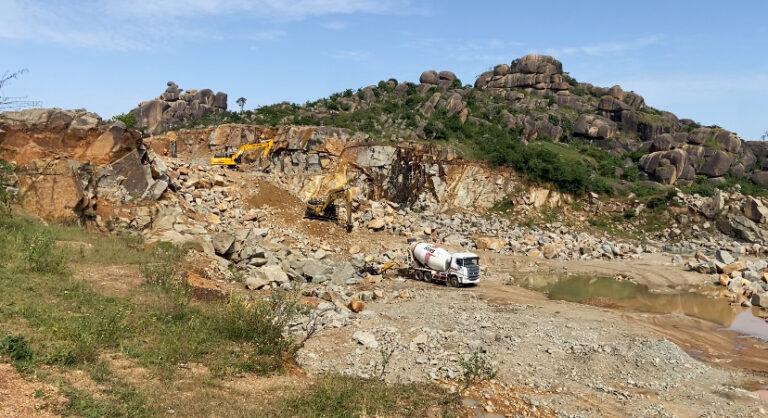
White dust hangs permanently in the air, the ground trembles from distant blasting, and the paths that once guided hikers and worshippers toward the summit are being eaten away gradually by quarrying activities, driven by the growing demand for granite for construction.
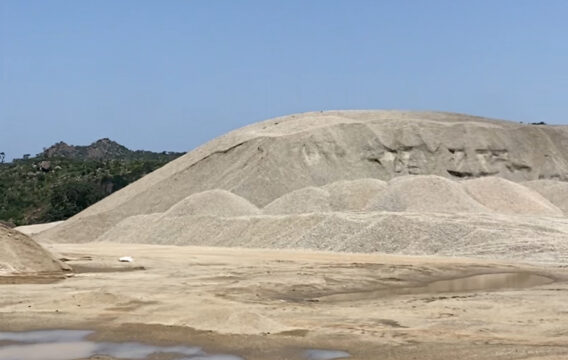
Granite from the quarrying site
Gradually, the landscape that the Afizere people have revered for generations is being fractured. Residents say the destruction has accelerated in recent years as quarry operators push deeper into the terrain, extracting the stone that feeds the expanding local building industry.
‘For the community living around the 5,500-foot formation called Kukwasa Gbum, this is not merely environmental degradation; it is an erasure of memory, livelihood, and identity.
The quarrying activities are not strange or surprising to the locals. They had heard the blasts long before anyone raised an alarm.
But in July 2025, the issue came to public attention when a Plateau-based tourism advocate, Ephraim “Freezle” Bulus, posted on social media about an active quarry near the formations.
I recently came across something quite disturbing that I believe needs urgent attention.
There appears to be an active quarry operation happening near the iconic Gog Magog rock in the Shere Hills area.
His observation prompted an immediate response from residents; many of whom pointed to the company they believed to be responsible for the slow encroachment: Moulds Nigeria Limited.
Locals who spoke to The ICIR said the impact visible today is the cumulative result of years of steady extraction—each blast shaving away parts of a landscape tied to history, spirituality, and survival.
The public outcry forced the Plateau State government to visit the area and offer assurances, officials insisted that the site was safe and “not under threat”, arguing that Moulds was operating legally and at a “reasonable distance” from the twin rocks.
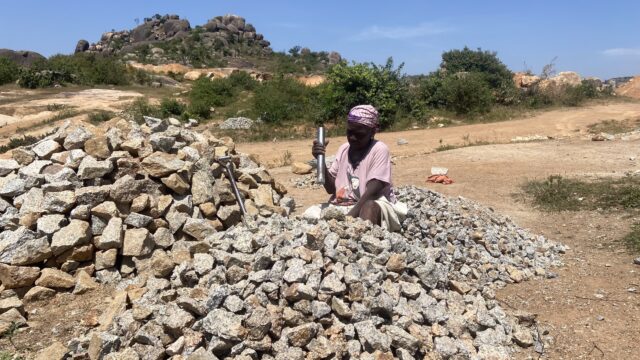
However, residents disagreed. When The ICIR visited on October 24, 2025, the evidence was unavoidable: fresh blast marks, rising plumes of white dust, and piles of fractured stone, some of which were later broken manually by women who rely on the quarry’s leftovers for a living.
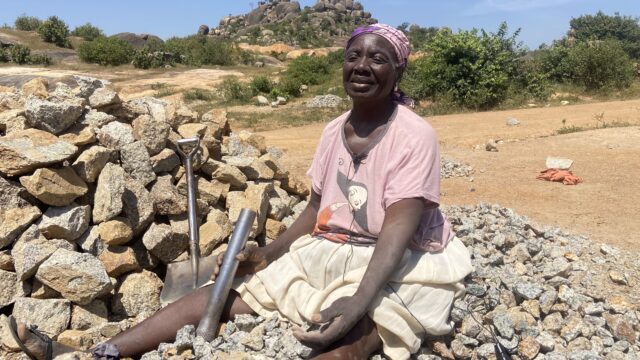
Ladi Ager Itse, a local stonemason.
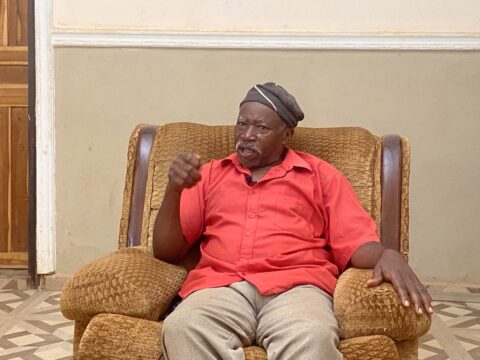
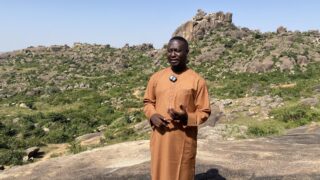
For the Afizere, the indigenous group in the area, what is at stake is not just the rock but everything embedded in it. Sitting on a brown couch in his home in Gwafam, Ayuba Yohanna Azi, the Chiroma of Jos Ezire Chiefdom, and protocol officer to His Royal Highness, Adagwom Emmanuel Legic, explained how deeply Gog and Magog sit within Afizere identity.
Ayuba Yohanna Azi—the Chiroma, Jos Ezire Chiefdom, and protocol officer to His Royal Highness, Adagwom Emmanuel Legic
From oral history, Ayuba said, their ancestors migrated from Yemen, moved through the Kanem-Bornu region after the fall of Ngazargamu in 1808. They gradually settled in Shere, a community in Plateau State, after journeys through Chaweh, Piti, Pengana, and Toroh. Every phase of movement was shaped by farming, survival, and spiritual custodianship, he said.
“Kukwasa Gbum (Gog Magog),” he said, “was where our people chased away the baboons before going to the farms. There are spirits there, and those spirits matter to us.”
Today, the baboons are gone. The quarry blasts drove them away, he said.
This sense of loss is sharpened by the community’s long history of displacement. When Europeans followed tin deposits to the Plateau in 1902, farmlands stretching from the Jos City Centre to nearby Gada Biyu were gradually taken over by mining interests, pushing Afizere families deeper into the hills.
Many see the quarrying around Gog and Magog as a continuation of that pattern—another moment where economic activity displaces cultural memory.
Yet the significance of Gog and Magog extends far beyond Afizere history. In the 1950s, the Citizenship and Leadership Training Centre, a parastatal in the Federal Ministry of Youth and Sports, popularly linked with Man O’ War, used the hills as a training ground.
Generations of Nigerians tested their endurance, navigation, and teamwork on this same terrain. By the early 2000s, cultural groups featured the rocks in dance and performance art. In 2007, Gulder Ultimate Search broadcast the formations into homes across the country, cementing their status as a national landmark. Images of the rocks appeared in artefacts, underscoring their symbolic value.
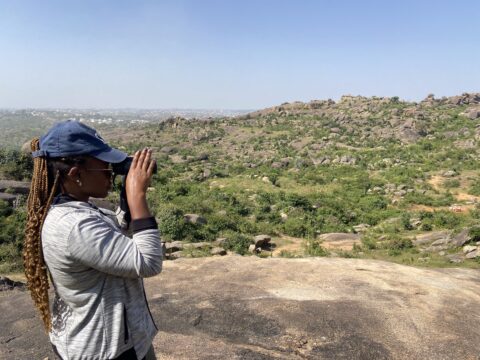
But the hills are now under multiple pressures—ecological, recreational, and cultural. Hikers now speak of grit in the air and trails that end abruptly at excavation sites. Birdwatchers report the disappearance of species that depend on rocky habitats, adding that quarrying threatens birds such as the Gosling’s bunting, Rock-loving cisticola, and the regionally endemic Rock Firefinch—found only in Nigeria and northern Cameroon.
Nanchin Winnifred, a conservation biologist and ornithologist at the University of Jos.
Migratory species like the Whitethroat, which winters in the nearby Shere Hills, may also lose their habitat.
Winnifred, conservation biologist on the field
“The Gog and Magog rock formations are very crucial for birds,” Nanchin Winnifred, a conservation biologist and ornithologist at the University of Jos, told The ICIR. “In Ornithology, we have birds that are generalists and some that are specialists. Some birds prefer rocky habitats, and you wouldn’t find them in any other place.
“For example, the Gosling’s bunting and Rock-loving cisticola. They will be displaced if there are no rocks. When a natural habitat like this is lost through anthropogenic activities, it changes the status of the birds from least concerned to threatened or completely extinct in the world.
“Preserving the site is important to birds like this and others, because birds are indicators of a healthy environment; preserving this environment is equally preserving the birds and helping ourselves in the long run,” she explained.
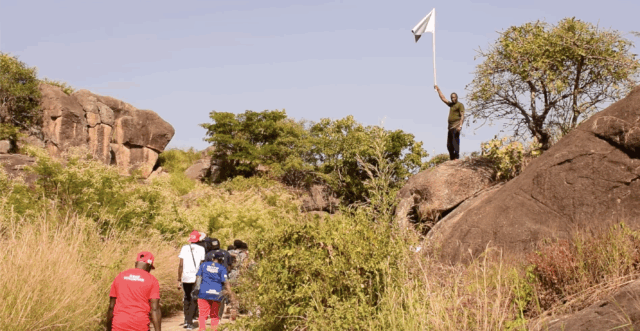
The impact extends beyond wildlife—hiking and outdoor recreation are being affected, too. According to a report by Harvard Medical School, “hiking is a good way to improve your cardiovascular fitness.” To understand the local impact, the ICIR reporter joined the Wayfarers of Jos, a hiking group, on one of their excursions on the rocks. Participants spoke of how quarrying and mining have altered their experience of Plateau State’s hills.
John Okupji, a medical doctor at the Jos University Teaching Hospital, who took part in the hike, said: “Hiking is heart-friendly, it helps you to lose weight, it helps you to burn a lot of calories, it helps the lungs. It’s recommended for everyone, especially after the age of 35.”
Hikers who regularly trek in Plateau State expressed concern over mining and quarrying activities. Their main issue is the distortion of the natural beauty of the state and the need for strict regulation. Erimiya Sunny Wayel, a hiker, explained: “If control is put in place to regulate quarrying, hiking activities will not be impeded much. When there is no control, some mountains and hills, if brought low, affect activities like hiking.”
Wayfarers of Jos, on a hiking expedition
Stone crushing
The damage is ecological or recreational. For the women who crush stones by hand for survival—like 65-year-old Ladi Ager Itse—the quarry is both a source of income and a source of harm.
Ladi Ager Itse, a local stonemason trying to make ends meet
She has worked as an artisanal stonemason for 13 years to support her six children, breaking rocks without protective gear and earning just ₦45,000 per truckload. Her hands bear the scars of this labour; her lungs bear the dust.
Geoscientists warn of deeper risks. Tersoo Aga, whose postgraduate research focused on Gog and Magog, described the formations as part of the Jos–Bukuru younger granite complex, one of the largest in West Africa. He explained that the rocks contain radioactive elements that are exposed and dispersed when blasted.
Tersoo Aga, speaking about the rocks.
“If quarrying continues,” he said, “the health risks from radioactive exposure, air pollution, and water contamination will become severe.”
These, according to him, are the same concerns UNESCO evaluates when considering a site for heritage status—a recognition Gog and Magog could qualify for if preserved.
Moulds defends its operation
But preservation seems distant. Moulds Nigeria Limited insists its operations follow the law and that it will rehabilitate the site once extraction ends, even promising to convert part of the quarry into a recreational centre.
“The company’s activities are legal, and as you can see, Gog and Magog are far off, there’s a government reserve that protects it, and nobody has encroached on it and nobody will encroach on it,” said Kayode Oyafemi, a senior official at Moulds Nigeria.
Residents sceptical
However, residents remain sceptical, pointing to the countless abandoned mining pits across Plateau State—now stagnant ponds contaminated by past extraction.
Under Nigerian law, quarrying requires licences and Environmental Impact Assessments, including measures to protect cultural sites and agreements on community benefits. Enforcement, however, has historically been weak, and communities often see little of the promised corporate social responsibility.
For now, the dust rises, the blasts continue, and one of Nigeria’s most significant geological, spiritual, and historical landscapes continues to shrink under the pressure of human activity.
“If developed and managed with proper standards, the Hills could host various mountaineering activities, professional hiking trails, eco-tourism projects, and heritage conservation efforts. But that future is at risk if quarrying continues unchecked,” Bulus noted.
File photo of Joshua Ubandoma Laven.
Joshua Laven, the Plateau State Commissioner of Works, told journalists that the heritage site will remain intact and under no threat from the quarry activities.
“The community has sold everything to Moulds but were now pleading that he should still step further so that he should allow more allowance of almost a kilometre from the Gog and Magog,” he said.
THE Independent Corrupt Practices and Other Related Offences Commission (ICPC) has described the conviction of the suspended Dean of Faculty of Law at the University of Calabar (UNICAL), Cyril Ndifon, as a watershed moment in Nigeria’s fight against corruption, sexual abuse and abuse of office.
Speaking at a press conference in Abuja on Friday, the commission’s spokesperson and Head of Media and Public Communications, John Okor Odey, said the judgment delivered by the Federal High Court, Abuja, sent a clear message that “the rule of law will penetrate the deepest recesses of power and privilege.”
He added, “This verdict marks a watershed moment in the history of this commission and our nation’s fight for justice…It is a declaration that the rule of law will penetrate the deepest recesses of power and privilege.”
He also spoke about what he described as a disturbing pattern of harassment and manipulation during trial.
He said the court accepted the victim’s testimony that Ndifon groomed her under the guise of mentorship and eventually coerced her into sending nude images and performing repeated acts of oral sex on her.
“The testimony of the victim, Miss TKJ, painted a harrowing picture. As dean, professor Ndifon exploited her desperation for admission, a goal she had pursued for four years. His abuse followed a sickening pattern. He first presented himself as a ‘father’ figure, assuring her she was safe under his care to lower her defences.
“This guise quickly gave way to escalating physical contact, from a “side hug” to holding her waist, all the while dangling the promise of admission. He engineered situations to be alone with her, such as sending her friend on an errand and locking his office door.
“He escalated from persistent digital demands for pornographic images, which the judge noted continued even while the victim was at the hospital with her sick mother to violent physical sexual assault. In his office, he attempted to remove her trousers and forced her to perform oral sex.
“The depravity did not end there. In a separate incident in his car, he again forced the victim to perform oral sex, injuring her neck in the process. His response was not remorse, but a transaction. He sent her N3,000, a paltry sum he believed could monetise her pain and purchase her silence,” he added.
The ICPC said the case was triggered by widespread campus protests and a petition submitted to the commission on September 15, 2023, noting how Ndifon declined to honour its invitation, compelling investigators to obtain an arrest warrant and seek assistance from the Department of State Services (DSS) to arrest him on October 4, 2023.
“To protect the survivor, the court ordered that her real identity be concealed permanently and replaced with the pseudonym “Miss TKJ,” he said.
Odey emphasised that all investigative actions complied with the law, including respecting the defendants’ rights to counsel. He argued that the court’s acceptance of the digital evidence reaffirmed the strength of the ICPC investigative process.
He added that forensic analysis of the defendants’ mobile phones, obtained with signed consent, uncovered extensive WhatsApp conversations that corroborated the victim’s account.
“The judge described him as a “sexual predator” who was “never remorseful but tried to blame some other irrelevant reason for his arraignment.” He was found to have instilled fear in the student body and was condemned as a “disgrace to the community of learned persons.”
Odey outlined the court’s decision, explaining that the former dean was convicted on count 1 for violating Section 24 of the Cybercrime Act, 2015, after the court found him guilty of coercing a student, identified as Miss TKJ, to send pornographic and obscene images of herself.
He was also convicted on count 2 for contravening Section 19 of the Corrupt Practices and Other Related Offences Act, 2000, for corruptly using his office to solicit nude visuals from the student in exchange for the false promise of securing her admission.
However, the court discharged and acquitted the second defendant, Barrister Sunny Anyanwu, of charges relating to threatening a witness and conspiracy to pervert justice. The court held that while a call was indeed made to a witness, the alleged intention was not sufficiently corroborated to meet the standard of proof beyond reasonable doubt.
“For the public to fully grasp the importance of this outcome, it is essential to present a clear and factual summary of the court’s decision. This verdict forms the foundation of our message today: that the rule of law will prevail and that evidence-based prosecution can and will succeed.
The commission said the judge noted that safeguarding victims from stigma was essential to encouraging others to come forward.
“The courage of the victim, Miss TKJ, was central to securing this conviction. Her detailed, credible, and consistent testimony stood firm throughout the trial, and the court rightly praised her immense bravery.
“We must commend the profound courage of Miss TKJ. In the words of the presiding judge, she can be a “shining examples for all those who are being sexually harassed to come out to report their oppressors. Her bravery has forged a path for others to seek justice,” Odey said.
The ICIRreported that The Federal High Court in Abuja, presided by Justice James Omotosho, on Monday handed Ndifon a five-year prison sentence with no option of a fine.
Recall in August 2023 that Female students of UNICAL’s Faculty of Law staged a protest within the school premises carrying placards that read, “Law students are not Bonanza, Prof. Ndifon should stop grabbing us. The Faculty of Law is not a brothel,” “Ndifon must go for our sanity,” among other inscriptions.
Videos of the protest went viral on social media, generating several reactions, including those from many ex-students sharing similar experiences.
Ndifon reacted to the allegations, describing them as lies and the handiwork of his enemies following his emergence as Dean of Faculty.
Meanwhile, Ndifon had been suspended for similar reasons in 2015 after a final-year student accused him of raping her in his office.
The institution suspended Ndifon some days later, over allegations of sexual assault against him by some female students and set up a seven-member panel to investigate allegations of sexual harassment levelled against him.
The panel, headed by Dorothy Oluwagbemi-Jacob, a professor of philosophy, was expected to carry out thorough investigations into at least six issues ranging from sexual harassment to results manipulation by the suspended dean and make appropriate recommendations to the management.
In October 2023, Ndifon was arrested by the State Security Service (SSS) at the request of the ICPC after he failed to honour invitations following allegations of sexual assault levelled against him. The agency was on the case till the accused was jailed.



![[INTERVIEW] AU, ECOWAS must announce Guinea-Bissau’s presidential election results – Jonathan](https://www.icirnigeria.org/wp-content/uploads/2022/05/ImageFile-17-1024x639-1-768x479.jpg "[INTERVIEW] AU, ECOWAS must announce Guinea-Bissau’s presidential election results – Jonathan")