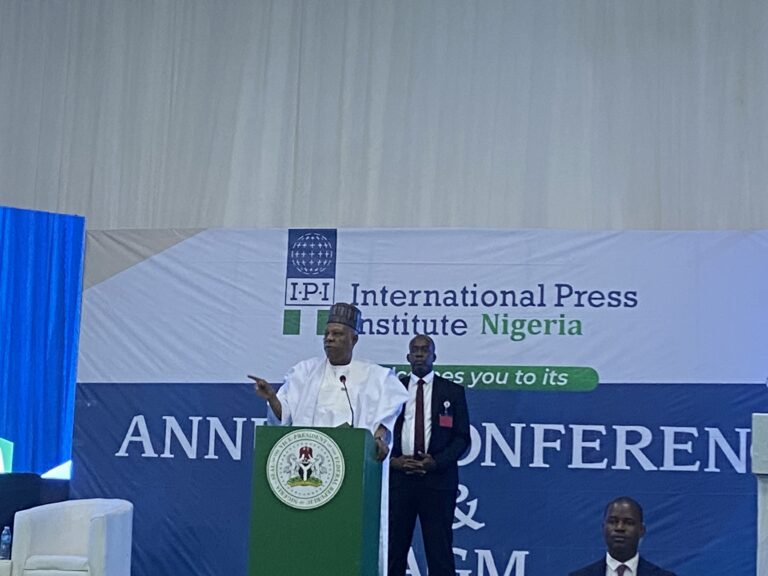
VICE President Kashim Shettima on Tuesday, December 2, said Nigeria’s democracy depended on a media ecosystem anchored on ethics, integrity and fact-based reporting.
Addressing senior editors, publishers and journalists, at the 2025 Annual International Press Institute (IPI) conference in Abuja, Shettima said every nation is ultimately defined by the character of its media.
He lauded the Nigerian press for its resilience over the years, noting its capacity to “rise in defence of the public’s right to know” even in difficult times.
“There is no doubt that Nigeria has one of the most vibrant media communities anywhere in the world, a fact proven across generations. We have lived through days that showcased your brilliance and patriotism, just as we have lived through days that revealed your imperfections.
“Yet one thing you have never failed to do is rise in defence of the public’s right to know. You have confronted those who sought to suffocate this oxygen of our democracy, and in moments of national confusion, you stepped forward to correct misinformation. This is a responsibility we cannot afford to take for granted, however complex our relationship may sometimes be.”
He explained that the media had the power “to summon the collective courage of the people” and equally the ability “to dismantle dreams or dismantle illusions.”
According to him, journalism fulfils its duty only when “truth, not convenience, becomes the supreme editorial policy.”
Shettima further lauded what he called the ‘sincerity’ of the Nigerian media in exposing foreign interference and disinformation, stressing that the majority of journalists refused to compromise their platforms.
“One of the proudest moments for journalism in contemporary Nigeria has been the sincerity with which the overwhelming majority of you continue to confront the rising tide of Foreign Information Manipulation and Interference.
“You have stood firmly against disinformation and refused to surrender your pens to falsehoods or foreign puppeteers.”
He criticised a ‘minority’ whom he said manipulated unverified data, warning that no one could practise responsible journalism without ethical commitment.
“The pen is only mightier than the sword when it is deployed in the pursuit of justice and objectivity,” he said, adding that without ethics, media work becomes “a dictatorship of text and airwaves.”
Urges media to save democracy
The vice president also described the protection of democracy as the media’s most sacred duty.
This, he argued, includes saving democracy from the political class and “saving the political class from themselves.”
“Democracy is safe only when power is under constant observation,” he argued, insisting that such monitoring must be rooted in integrity.
Shettima said the mainstream media was not the real danger to Nigerian democracy, warning that digital platforms had empowered online mischief-makers.
He described social media actors as a mix of “serious commentators” and ‘mischief-makers’, lamenting that their influence fueled disinformation and deepened national divisions.
‘Impossible to suppress Nigerian media’
Speaking further, Shettima said previous attempts by leaders to intimidate the press failed because the Nigerian media space was too diverse and resilient.
“It is impossible, utterly impossible, to have a successful dictator in Nigeria,” he said, adding that “Never in our history has any person or government succeeded in suppressing the media community.”
Shettima urged journalists to maintain accuracy and fairness while holding the government accountable.
THE United States House Appropriations Committee will lead a joint congressional briefing addressing allegations of Christian genocide in Nigeria today, Tuesday, December 2.
A notice shared on X by US Congressman Riley Moore, shows that the House Appropriations Committee Vice Chair and National Security Subcommittee Chairman Mario Díaz-Balart will convene the briefing, alongside other Appropriators and members of the Foreign Affairs and Financial Services Committees.
The notice notes that representatives from the US Commission on International Religious Freedom and other experts will be part of the meeting.
“President Trump asked me and @HouseAppropsGOP to investigate the persecution of Christians in Nigeria,” he wrote.
Moore said that the briefing aimed “to spotlight the escalating violence and targeted persecution of Christians in Nigeria.”
He added that the roundtable would collect testimony for a comprehensive report directed by President Trump on the alleged massacre of Nigerian Christians and the steps Congress could take to support the White House’s efforts to protect vulnerable faith communities worldwide.
“As part of this investigation, the committee is hosting a roundtable to continue building on the work we’ve done so far. We will never turn a blind eye to our brothers and sisters in Christ who suffer for their faith,” he stated.
The briefing comes as part of US efforts to deepen security cooperation with Nigeria amid allegations of a Christian genocide in the country.
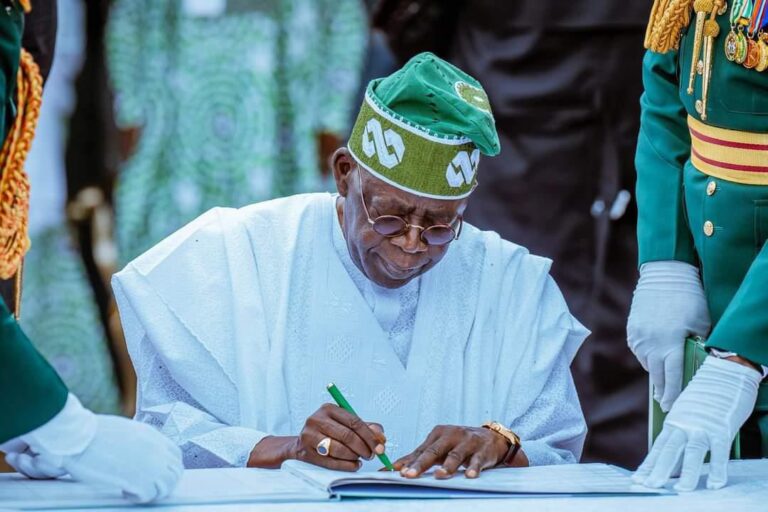
The ICIR reported that President Bola Tinubu recently cleared Nigeria’s delegation for the new US–Nigeria Joint Working Group, launched to make commitments from high-level talks in Washington, led by the National Security Adviser, Nuhu Ribadu.
The group, made up of top ministers and security officials, seeks to strengthen counterterrorism operations, improve intelligence sharing, bolster border security, and enhance coordination on humanitarian and civilian protection issues.
The initiative comes amid growing concerns over terrorism, banditry, and targeted attacks on Christians in Nigeria, drawing heightened US scrutiny and renewed warnings on safeguarding vulnerable communities.
Trump added Nigeria to countries on watchlist for Christian genocide on October 31.
He referenced alleged grave violations of religious freedom, including the persecution of Christians.
He alleged that Christianity faced an existential threat in Nigeria, with thousands of Christians reportedly killed by radical Islamist groups.
He also warned that the US could take action including the possibility of military intervention if Nigeria failed to address the issue.
Nigeria was first designated a CPC by President Donald Trump in 2020, but his successor, President Joe Biden, removed the country from the list after assuming office.
OSUN State Governor Ademola Adeleke has announced his resignation from the Peoples’ Democratic Party (PDP)
The governor becomes the latest top member of the leading opposition party to be toppled by tsunami that has swept several stalwarts and leaders out of a party that once prided itself as “Africa largest” political group.
Adeleke confirmed his exit in a statement letter dated November 4, addressed to his ward chairman, in Sagba Abogunde, Ward 2, Ede North Local Government Area.
The letter, which was shared on his X handle on Monday, December 1, attributed his decision to the deepening leadership crisis within the PDP at the national level.
“Due to the current crisis within the leadership of the People’s Democratic Party(@OfficialPDPNig) at the national level, on the 4th of November 2025, I officially conveyed my resignation letter as a member to the leadership of the party in Sagba Abogunde, Ward 2, Ede North local government,” Adeleke said.
He thanked the party and its members for the platform on which he rose to political prominence, first as a senator and now as governor.
“I thanked the party and its numerous members and supporters for the opportunities given to me to use the platform for my elections as first a senator of the Federal Republic of Nigeria and now as Governor of Osun State,” he stated.
His resignation added to the list of PDP governors who have abandoned the party in recent months.
On October 14, Enugu State Governor Peter Mbah declared his move to the APC in a statewide broadcast, saying the decision was necessary “to connect Enugu and the South-East region to the central government in Abuja.”
“Today, after a long reflection, we have decided to join the All Progressives Congress,” Mbah stated,” Mbah said.
He also stressed that his defection was in the best interest of the region, adding that so many things were still unfolding.
Mbah defected alongside members of his State Executive Council, House of Assembly members, all 260 ward councillors, and local government chairmen, an exodus that significantly weakened the PDP’s structure in the state.
APC leaders hailed the move as evidence of the party’s expanding influence in the South-East ahead of the 2027 elections.
Earlier in the year, Delta State Governor Sheriff Oborevwori and Akwa Ibom State Governor Umo Eno also defected to the APC with their cabinets. In Delta, the defection included former governor Ifeanyi Okowa, the PDP’s 2023 vice-presidential candidate.
Despite widespread public complaints that the APC-led federal government has worsened economic hardship and insecurity, the ruling party has steadily gained new members, especially among political office holders repositioning for the next election cycle.
NIGERIA’S Minister of Defence, Mohammed Badaru Abubakar, has resigned from President Bola Tinubu’s cabinet with immediate effect, citing health concerns.
His resignation was conveyed in a letter dated December 1 and accepted by the president, according to a State House statement by presidential aide Bayo Onanuga on Monday, December 1.
Tinubu thanked the former Jigawa State governor for his service and is expected to notify the Senate of a successor later this week.
“President Tinubu will likely inform the Senate of Badaru’s successor later this week,” the statement read.
Badaru’s departure was on the heels of the recently declared national security emergency and the insecurity that has continued to ravage the country.
“His resignation comes amid President Tinubu’s declaration of a national security emergency, with plans to elaborate on its scope in due course,” the statement added.
His resignation also followed another exit of a cabinet member that drew public attention.
On October 4, The ICIRreported how a two-year-long investigation by Premium Times found that both Nnaji’s university certificate and his National Youth Service Corps (NYSC) discharge certificate were forged.
According to the report, the University of Nigeria, Nsukka (UNN) disowned the Bachelor of Science certificate Nnaji claimed to have obtained from the institution, stating that there were no records showing he graduated in July 1985 as alleged.
The report quoted a response to a freedom of information request sent by the newspaper, which stated that while Nnaji was admitted in 1981, there was no record that he completed his studies or graduated in July 1985, as his certificate claims.
In a letter dated October 2, 2025, and signed by the Vice-Chancellor, Simon Ortuanya, a professor, UNN disowned the certificate paraded by the minister.
Further checks by the newspaper showed that although Nnaji was admitted to study biological sciences, he failed several courses before he was advised to withdraw.
THE World Health Organization (WHO) has warned that sharp cuts to international donor funding are disrupting HIV services globally and could jeopardise decades of progress, even as new prevention tools offer a rare opportunity to reduce infections.
The call came in a statement on December 1, to mark World AIDS Day 2025, with the WHO highlighting the transformative potential of Lenacapavir (LEN) – a twice-yearly injectable that the organisation approved in 2025 as an additional pre-exposure prophylaxis (PrEP) option.
LEN is designed for people who struggle with daily oral medication or face stigma while accessing HIV services.
The WHO described 2025 as a year of “remarkable momentum” due to the introduction of the long-acting injection, even as “sharp and sudden reductions in international funding” forced countries to scale back or shut down community-led HIV programmes, including PrEP services and harm-reduction initiatives for people who inject drugs.
“We face significant challenges, with cuts to international funding, and prevention stalling,” said Dr Tedros Adhanom Ghebreyesus, WHO Director-General.
“At the same time, we have significant opportunities, with exciting new tools with the potential to change the trajectory of the HIV epidemic. Expanding access to those tools for people at risk of HIV everywhere must be priority number one for all governments and partners,” he added.
Themed “Overcoming disruption, transforming the AIDS response,” the global health body warned that the global HIV response stood at a critical crossroads.
Nigeria has one of the largest HIV epidemics in Africa, with over 1.9 million people living with the condition. While the country has made gains with treatment access, prevention efforts, particularly PrEP uptake, remain slow, partly due to stigma, structural barriers, and dependence on external funding.
Stalled progress and growing vulnerabilities
Global data from 2024 show that HIV prevention stagnated, with 1.3 million new infections recorded for the third consecutive year. Key populations, including sex workers, men who have sex with men, transgender women, and people who inject drugs, accounted for 49 per cent of new infections.
These groups continue to face disproportionately high risks driven by stigma, discrimination, and legal barriers to accessing care. An estimated 40.8 million people were living with HIV globally in 2024, and 630,000 people died from HIV-related causes.
According to the AIDS Vaccine Advocacy Coalition, 2.5 million people who were using PrEP in 2024 lost access to their medications in 2025 due entirely to donor funding reductions.
Recall that at his inauguration on Monday, January 20, President Donald Trump signed an executive order reversing the US 2021 reunion with the WHO by his predecessor – Joe Biden.
Trump criticised the financial contributions required from the US, claiming they were disproportionately high compared to other nations.
He also highlighted that China, with three times the population of the US, contributed much less to the organisation’s budget.
The order directed federal agencies to immediately halt funding to the WHO, recall US personnel working with the organisation, and identify alternative partners to take on activities previously overseen by the WHO.
New tools, old barriers
However, despite the disruptions, WHO said new innovations offered a chance to reinvigorate global prevention strategies.
“We are entering a new era of powerful innovations in HIV prevention and treatment,” said Tereza Kasaeva, WHO’s Director for HIV, TB, Hepatitis and STIs. “By pairing these advances with decisive action, supporting communities, and removing structural barriers, we can ensure that key and vulnerable populations have full access to life-saving services.”
THE Special Adviser to President Bola Tinubu on Policy Communication, Daniel Bwala, has said that the Federal Government would soon name individuals and networks behind terrorism financing in Nigeria.
In an interview on a Television Continental programme on Sunday, November 30, Bwala said the Tinubu administration had begun taking “far-reaching decisions” on national security.
“The government is making decisive interventions. In the coming days, Nigerians will know who the terrorists are and those funding them are,” Bwala said.
He noted that terrorism had evolved into a global menace that transcends national borders, making international collaboration essential in tackling its spread.
Bwala explained that world powers increasingly recognised the need to support countries like Nigeria, where extremist groups sought to expand their operations.
“Since the events of 9/11, terrorism has been treated as a global security issue. Any nation where terrorists operate becomes a concern to the rest of the world. This is why international partners must continue to cooperate with Nigeria in our efforts to dismantle terrorist networks,” he said.
Meanwhile, Bwala urged Nigerians to play active roles in monitoring compliance with Tinubu’s directive to the police authorities to withdraw their officers serving as escorts to Very Important Persons (VIPs)
The ICIR reported Tinubu directed the withdrawal of all police officers providing security for VIPs in Nigeria on November 23.
The president said that authorities were to deploy such officers to concentrate on their core policing duties, noting that anyone seeking police protection to request well-armed personnel from the Nigeria Security and Civil Defence Corps (NSCDC).
Bwala, in his remarks, highlighted the administration’s commitment to enforcing the order and urged citizens to document any violations.
“If you identify a celebrity, a private sector person, or any individual who has police against the executive order of the president, as much as you can, capture evidence, whether a photograph or video. The order of the president to withdraw police from VIPs is not all-encompassing. There are critical people in government who will still have one form of security or another,” he explained.
He added that other security agencies, such as the State Security Service (SSS) and Civil Defence, would provide protection where necessary.
“It could be SSS, Civil Defence, and not the police who will be there to help you. But police have no business being with you,” he said.
The ICIR reported that sequel to Tinubu’s directive, the Inspector-General of Police, Kayode Egbetokun, announced the withdrawal of all police escorts from VIPs on November 25.
THE Federal Capital Territory Administration (FCTA) has released the names of 1,095 individuals and organisations whose properties’ titles were recently revoked over their failure to settle statutory land charges.
In a notice signed by FCTA management, the agency stated that enforcement actions would begin after the 14-day final grace period ended on November 25.
Most of the affected properties listed in the properties are mostly in highbrow neighborhoods such as Asokoro, Maitama, Garki, and Wuse area of the nation’s capital.
According to the administration, of the revoked titles, 835 properties defaulted on ground rent payments while 260 failed to pay violation and land use conversion fees.
Among those affected are former governor of Kano, Abdullahi Ganduje; former governor of Cross River, Donald Duke; wife of former President Goodluck Jonathan, Patience Jonathan; former Senate President, David Mark; and former deputy governor of Osun State, Iyiola Omisore.
The FCTA had urged the properties owners to settle outstanding charges to avoid enforcement of its threat to revoke their titles.
In May 2025, the administration announced the takeover of 4,794 properties in the heart of the city. The properties include the Peoples’ Democratic Party (PDP) National Secretariat, the Central Bank of Nigeria (CBN), and the Independent National Electoral Commission (INEC). The FCTA cited decades of unpaid ground rent, some stretching 10 to 43 years.
“Ownership of the revoked 4,794 properties in the Central Area, Garki I and II, Wuse I and II, Asokoro, Maitama and Guzape districts, had already reverted to the FCTA, and as from Monday, next week, the government will begin to exercise its rights of ownership on the affected landed properties.
“As usual, this will be done without consideration as to ownership of the affected landed properties. It will be purely in line with extant laws and regulations guiding the process,” said FCT Minister’s Senior Special Assistant on Public Communications and New Media, Lere Olayinka.
He was joined by the Director, Land Administration, Chijioke Nwankwoeze and the Director, Department of Development Control, Mukhtar Galadima at a media briefing on the planned revocation of the properties.
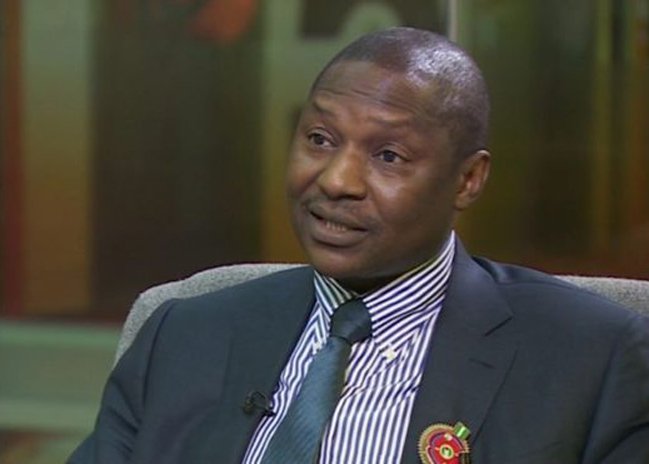
FORMER Attorney-General of the Federation and Minister of Justice, Abubakar Malami, has dismissed claims by the Economic and Financial Crimes Commission (EFCC) that he duplicated the recovery of the $310m Abacha loot.
He described the allegations as “baseless, illogical and lacking in substance.”
Malami’s position followed reports that the EFCC seized his international passport and placed him under a one-month restriction that compels him to report at the commission’s headquarters daily.
The former minister was interrogated for hours on November 28 over the handling of about $490m linked to the late Head of State, Sani Abacha, a general.
Malami, a senior advocate, in a statement Sunday night, through his media aide, Mohammed Bello Doka, said he was invited by the EFCC on November 28, over suspicions of abuse of office and money laundering linked to the repatriation of the funds.
“The EFCC informed me that its inquiry relates to an alleged duplication in the recovery of the $310 million Abacha loot, which by accrual of interest rose to about $322.5million as of the time I eventually succeeded in recovering the funds for the Federal Government and, flowing from that assumption, two allegations were majorly raised, namely: abuse of office, and money laundering,” he wrote.
He said the anti-graft agency alleged that the recovery process had been concluded by a Swiss lawyer, Enrico Monfrini, before he took office in 2015.
He argued that the allegation “collapses when subjected to facts and elementary logic.” According to him, no funds had been lodged into the Federation Account as of 2016 when the Buhari administration revived negotiations for the repatriation of the money, which had accrued to about $322.5 million with interest.
“It is trite to state from the onset that recovery of illicit funds can legally be said to have been completed upon the actual lodgement of recovered funds into the Federation Account.
“As of 2016, when the Buhari administration initiated the process relating to the said $310 million (later $322.5 million with interest), there was no lodgement of any such funds into the Federation Account. There was, therefore, no completed recovery in existence, and nothing whatsoever to duplicate.
“More instructive and revealing is the undisputed fact that in December 2016, several lawyers applied to be engaged for the recovery of these same funds — Mr. Monfrini himself included. It is entirely illogical for a lawyer to apply in December 2016 to be engaged to recover funds he purportedly recovered two years earlier. That singular fact exposes the internal contradiction and absurdity of the EFCC’s narrative,” Malami said.
According to him, Monfrini demanded a $5 million upfront payment and 40 per cent success fee, which was later reduced to 20 per cent.
He added that the Buhari administration rejected the proposal because it violated its policy of zero upfront deposits and capped success fees at five per cent, noting that the government instead engaged a Nigerian law firm on an all-inclusive five per cent fee.
“At an average exchange rate of ₦1,600 to the dollar, a 15 percent saving on $320 million amounts to approximately ₦76.8 billion, while a 35 per cent saving translates to about ₦179.2 billion. These are concrete, measurable benefits to the Nigerian state.
“Accordingly, any claim or investigation suggesting abuse of office or money laundering in relation to the $322.5million is not rooted in any reasonable ground for suspicion. It is neither supported by facts nor by logic,” the statement added.
Malami further explained that the $322.5 million repatriated from Switzerland between 2017 and 2018 was deployed through the National Social Investment Programme under World Bank and civil society monitoring.
He said another tranche of about $321 million recovered from Jersey in 2020 was committed to major infrastructure projects such as the Lagos–Ibadan Expressway, Abuja–Kano Road and the Second Niger Bridge.
PEDESTRIANS and motorcyclists intending to cross the collapsed Kibangari Bridge on River Kabene, Kauru Local Government Area (LGA) of Kaduna State must be assisted by youths whose services attract a fee. The ICIR visits the collapsed bridge and reports a looming humanitarian crisis in the community.
The steel bridge, built by the late President Shehu Shagari led government in 1979, connects the Kauru LGA to various parts of the state. Users can commute from the area through Mariri town in Lere LGA to Kachia and Kaduna, the state capital. The Mariri road also takes users to Kafanchan and Keffi in Nasarawa State. From Kauru, motorists and others can easily travel to Kano State and other parts of the North.
Kibangari Bridge is arguably the most important infrastructure in the Kumana district of Kauru LGA because apart from schools in dilapidated state, there is no functional public infrastructure in the area, including electricity, good road, potable water and hospital.
The district has never seen grid electricity, and its teeming population is currently among the 85 million Nigerians lacking access to power supply. The district’s deplorable roads are among the 87 per cent of Nigerian rural roads in poor condition. Similarly, the Kumana district has significant share in the over 100 million Nigerians lacking access to safe water.
The Kibangari bridge helps the movement of people and agricultural produce. Virtually all residents of the area are farmers.
“Nothing can be more painful than the fact that the bridge we consider as the only functional infrastructure from our government in this district has collapsed,” said Istafanus Yanaba, a resident of Rishuwa, one of the communities in the district.
The fallen section of the Kibangari Bridge on River Kabene, Kauru Local Government Area (LGA) PC: Marcus Fatunmole
A section of the bridge caved in in 2019 and has since been lying dangerously over the Kabene River. It not only disrupts movements and commerce in the area, but it has also been a death trap, causing many residents to drown.
At least 10 people drown in the river yearly while using the bridge, according to leaders in the area.
“It is the main bridge that links us with Lere LGA. We go through this bridge to carry out our trading activities. Similarly, to access healthcare, we must go to Saminaka, the headquarters of Lere LGA, which means we have to go through this bridge. Ever since the bridge collapsed, we have been facing a lot of difficulties, not to mention the countless lives lost as a result of the collapse of that bridge.
“We have been begging the government to help us repair it; our pleas have been to no avail,” said the head of the Kumana traditional council, Dauda Abdullahi.
The District Head of the Kumana Kingdom, Samaila Yanaba, also expressed sadness with the state of the facility. He said his district, with over 20 communities, lost much of its farm produce yearly due to lack of means to take the yields out of the district.
“This is the only bridge vehicles used to convey our goods because we are all farmers here. We use two markets: Mariri Market in Saminaka LGA and Pambegua Market, which is about 50 kilometres from our LGA.
“If we are to go to Kauru, the road is very bad, as it is in this community, until you get to the LGA headquarters. Our people are really suffering. Since one end of the bridge fell in 2019, no vehicle has driven across it. That will tell you the damage this causes our agrarian communities,” Yanaba added.
A section of the Kibangari Bridge on River Kabene, Kauru Local Government Area (LGA) of Kaduna State. PC: Marcus Fatunmole
He also decried the maternal and child deaths in the area, which he blamed largely on difficulty in crossing the bridge during emergencies.
He listed some of the communities in the district as Kurama, Binawa, Surubu, Dingi, Kono, Kinugu, Rishuwa, Kuzamani, Bikai, Kiwollo, Kaibi, Kitimi, Ruruma, Rummaiya, Hausawa, Fulani, Amawa, Siyawa, Fijima, and Chawai.
The ICIR observed that another bridge under construction at the Kaibi community, along Kauru township road, is about to collapse, after gulping millions of naira. Dozens of towers, girders, beams, piers and other components of the bridge litter the surroundings. Residents said they had been there for over a decade.
Further findings showed that the Mariri-Kauru Road was among the projects whose contracts were awarded in Southern Kaduna by Governor Patrick Yakowa before his passing in 2012.
Subsequent administrations took different decisions on the contracts, including revoking, splitting, and re-awarding them to other contractors. For instance, the Governor Uba Sani administration said it concluded the Kaduna Kachia Road, which now makes travelling easier from that part of the state to the state capital.
The ICIR noted that the work ended at Kachia, while the road from Kachia to Samaru Kataf enroute Mariri and Kauru remains in terrible shape.
A section of the Geshere-Kaibi road washed off by erosion
The contractor handling the Mariri-Kwassam road, Sadiq Abubakar, told the reporter that his company suggested to the former Governor El-Rufai’s administration that it would repair the Kibangari Bridge with N36 million when it was becoming clear that the bridge could give way. He said the request was not approved.
Abubakar, the managing director and chief executive officer of FarmTrack Ltd, said the Mariri-Kwassam road contract he got did not include the reconstruction of the Kibangari and Kaibi bridges.
The contract, awarded to him in 2016 was revoked in 2021 by the El-Rufai’s government. The contractor explained that he got five contracts from the state government on retainership basis and was paid N100 million monthly to work on the projects.
He said the money he got was only able to complete one of the projects. The El-Rufai’s government, which gave him the contracts, revoked the remaining four, including the Mariri-Geshere road.
He is currently in talks with the Uba Sani administration to enable him to continue with the projects.
He said the Geshere-Kwassam road required three billion naira when he got its contract but would require about five billion Naira to fix now.
Another section of the Geshere-Mariri road. PC: Marcus Fatunmole
How Kabene Bridge collapsed – Community leaders
The District Head of the Kumana Kingdom, Yanaba, said his people noticed that water was washing off the foot of the bridge in 2018. They contacted the Kauru LGA to help them fortify the abutment and save the bridge from crashing into the water.
Yabana said, “We did community work. The bridge was not here but down there. Through community effort, we built the entrance there. People packed stones and sand. We bought cement and put them there. Yet, the water overpowered the work that we did.
“When this governor came in, we pleaded with him to help us with the road. This is a very big road. From here, you can go to Kaduna, Kano, Abuja, and other places. We can only use motorcycles to convey our goods to the market. If you have 100 bags of grain from here, how can you transport them? We are really suffering. I can count more than 20 villages where people are mainly farmers from here to Kauru, which is more than 90 kilometres.”
He called on the state governor to help the communities by building the bridge.
A youth assisting a motorcylist on the Kibangari Bridge on River Kabene, Kauru Local Government Area (LGA) of Kaduna State
How we lost our husbands in River Kabene – Widows
Julie Yahaya, 37, said her husband died in 2020 in the river while riding on his motorcycle across the bridge. There was no way to take him out of the village for medical treatment when he was rescued. He later died. The deceased had four children, whom his wife now struggles to fend for. The oldest child is 19, and the youngest is five.
Faith, 16, is the eldest daughter and the second-oldest child. She couldn’t finish secondary school, and her other siblings were withdrawn from school after their father died.
Another widow, Ladi Maitala, 45, lost her husband in 2020 while conveying produce from his farm to Mariri on motorcycle. She has seven children – a boy and six girls. The oldest is 22, and the youngest is 10.
The highest educational qualification attained by the children is junior secondary school. They couldn’t proceed after their father died. Mary, now a mother of two, was in boarding school when her father drowned. She was withdrawn from school and married off.
Similarly, Annah Danasebe, 35, lost her husband in the river in 2023. She has since been left to fend for her three children. The oldest is 13, and the youngest is four. Two of the children are in public primary school, but the mother said life had been tough for the family since her husband died.
Mary, a mother of two, was withdrawn from boarding school and married off after her father died. PC: Marcus Fatunmole
Kumana’s pride in agriculture
The district, in Southern Kaduna, which witnessed unprecedented insecurity under El-Rufai’s government, is now relishing a fresh breeze of peace. A testament to this is how almost every piece of land in the area was cultivated in 2025.
Rice, guinea corn, pepper, yams, tomato, groundnuts, beans, soybeans, millet, and maize are among the several crops grown in the district. Many residents confirm they would not consume 20 per cent of what they produce yearly since they overcame insecurity.
The land, nestled in a ring of rocks, is very fertile for agricultural purposes, as seen in the allure of crops and their bountiful yields across the communities in October when The ICIR visited the district.
However, many residents decried high level of waste and loss they incur over their inability to get buyers or take their produce out of the area because of the fallen bridge.
A rice field along the Kaibi road in Kubana District. PC: Marcus Fatunmole
Crossing the Kibangari Bridge
It takes the help of youth in the area for anyone with a load to cross the bridge. Children, women, and motorcyclists also require their support. The youth charge their clients between N100 and N500, depending on the size of the goods and the water level.
The ICIR gathered that people who drowned in the river while crossing the bridge were mostly men who were looking for means of fending for their families. Victims also include women and children.
One of the youth who help people on the bridge, Yohanna Adams, said it would take luck and God to save people on the bridge at the peak of rainy season. “Water always covers the bridge from July to September. If you come here within this period, you will be afraid to allow us to carry you through the river if you can’t swim. Unfortunately for us in this area, we are not good swimmers, and we don’t have canoes to cross the bridge,” he stated.
Adams added that he could not recollect the number of people who had died in the river.
The District Head of Kumana District, Samaila Yanaba, flanked by people in the district. PC: Marcus Fatunmole
More residents speak on challenges posed by fallen bridge
Bako Musa works at the LGA Secretariat in Kauru. He rides his motorcycle from Geshere to Kauru, at least three times weekly. He lamented how poor the road is, and how he rides for over 60 kilometres to get to work and return home.
Phebe Yanaba decried how absence of basic amenities in the area affected education, health, and agricultural activities.
“Imagine how thousands of people in this area have been living without electricity, safe water, hospital and the likes for years. It will surprise you that it’s the same river that our people fetch and drink. Residents struggle for water with animals, during the dry season,” she said.
The abandoned bridge in Kaibi community. PC: Marcus Fatunmole
Kaduna government promises action
The state government has promised to fix the bridge and the road. It said it was concerned with the pains the people of the area go through.
The Commissioner for Public Works and Infrastructure, Ibrahim Hamza, told The ICIR that infrastructure deficit was a major challenge across Nigeria, and not limited to his state. He promised to fix the Mariri-Kauru road, including its bridges.
He challenged the reporter to call him by the middle of 2026 or visit the area to see the level of work that would have been done.
“In Kaduna State, you can confirm that we have constructed over 785-kilometre roads in and around Kaduna within the urban area and the rural areas. We are also working on a lot of bridges, which are going to link a lot of local governments, that is, from one local government to the other.
“As it is for that particular road that you mentioned, Kaduna State is really doing something about it. We’ve already awarded a contract from Kaura down to Pambeguwa. Between Kauru and Laduga, which is the village that has that bridge that you’re talking about, we’ve also awarded a contract for the construction of that bridge. Once that bridge is constructed, it will reduce the hours coming down from the southern part of Kaduna to the northern part of the state.
Some of the abandoned components of the Kaibi bridge. PC: Marcus Fatunmole
“It’s a very vital or important road to us, and I want to assure you that if we talk at the same time in the middle of next year, it will be a better story than what I’m telling you today. Be assured that the Kaduna State government is doing something about it,” he said.
LAST week, following a TV programme in which he featured as a guest, Yusuf Datti Baba-Ahmed the running mate to Peter Obi in the last presidential elections in 2023 under the Labour Party was ’invited’ by the Department of State Security (DSS) for a ‘chat’ over comments he made while on the programme.
From our knowledge and experience in when the DSS invites one for such chats it is almost always a thing to be alarmed because under one pretext or another such a person is subjected to unlawful detention and the inconveniences that come with it.
Although this was not the case with Datti Baba-Ahmed who was released without further ado after a civilised chat as he later told newsmen, the episode however cannot go without reflection.
The question that arises is, did the DSS obtain a valid order from a competent court of law to invite Baba-Ahmed?
If it did not, then it establishes that it was acting outside of its brief to so do. Further to that it can then be established that the DSS acted in violation of the basic constitutionally guaranteed freedoms of Datti Baba-Ahmed.
First, he was denied his freedom of movement as the time he spent honouring the DSS invitation constitutes a restriction and inconvenience to his person as he never bargained or planned in his schedule for that day to spend some time at the DSS offices especially given the fact that the invitation was not ordered by a court of law as it should.
Secondly, the DSS infringed on his freedom of speech. Was it established by a court of law that what Datti Baba-Ahmed purportedly said during the programme warranted his being invited to explain to the DSS? Does the DSS have a carte blanche to determine what constitutes a speech that affects the security of the state and to act in a manner that questions the basic, inalienable rights of a citizen to express his views on a matter of overriding public interest?
On the instant matter of the invitation to Datti Baba-Ahmed, it must be reiterated that if indeed, there was no valid court order for such an action, then the DSS illegally and must be sanctioned by supervising authorities.
In context, the DSS is basically an agency established by law as part of the security architecture of state with the principal responsibility of thwarting and protecting the state from infiltration and acts of destabilisation by agents of foreign interests.
Due to the sensitive nature of these duties, the DSS is set up by law to carry out its functions unobtrusively without intruding into the lives of citizens and very importantly, without bringing undue attention to itself and the work it is expected to do. Its counterparts like the Federal Bureau of Investigation (FBI) and MI5 in the United States of America and Britain respectively have never publicly invited a citizen to their premises. If they have to, it is always done quietly or preferably pay a visit.
But come to think of it, was there anything said by Datti Baba-Ahmed in the interview to warrant the invitation?
In the interview Baba-Ahmed mentioned three factors that enabled President Bola Ahmed Tinubu’s ascension to power; the judiciary and their lack of judicial diligence, his political opponents who could not come to a consensus on a broad political front during the 2023 elections and the military and security establishment who could not do the necessary background security checks on President Tinubu prior to the last elections.
Everyone knows that this has been a matter of public discourse for quite sometime now. So why should Baba-Ahmed’s reference to the matter now cause the DSS to be so panicky as to act outside its brief and to break its statutory rules of engagement?
The DSS is an important component of the ‘’Deep State’’ and its responsibility is principally to the protection of the state of Nigeria in enlightened interest guided by law. Baba-Ahmed’s statements are no more incendiary and inciting as statements and actions credited to other public figures in the present and previous political dispensations. During the Goodluck Jonathan administration, President Tinubu as opposition leader was recorded to have called President Jonathan as a ‘drunken fisherman’ among other inciting rhetoric.
Tinubu was never hauled to the DSS then as Baba-Ahmed now. If the DSS needed any proof of the compromised nature of the Judiciary as Baba-Ahmed has mentioned, one needs to look no further than recent episode where judges were seen and heard chanting “On Tinubu’s mandate we stand.”
Does the DSS not consider that a danger to the state where Judges and the Judiciary which is an independent arm of government surrendering its constitutional mandate to the executive arm of government? Or was the DSS not aware of the recent incident involving a serving minister in this government involved in a shameful altercation with a representative of the security institution of government which could have resulted in the sort of actions that could destabilise the government and the country as a whole. Did the DSS act on these incidents?
Let it not be that the DSS’s action on Baba-Ahmed be the beginning of a move towards intimidating opposition political figures and dissenting voices as the political season gathers momentum. Let the DSS not consider itself as beholden only to protecting the interests of President Tinubu at the expense of the Nigerian state for which it was established by law. Otherwise, the DSS must be prepared to detain as many Nigerians as possible who will not be denied their constitutional rights to freedom of movement, speech and association.
DSS should let Datti Baba-Ahmed and all those who want to exercise their constitutionally guaranteed rights be in the overriding interest of the democracy which all Nigerians in one way or the other fought for.
Gadu, an Abuja based public affairs analyst can be reached on Ilgad2009@gmail.com