PRESIDENT Bola Tinubu has prepared Nigerians for a new tax regime scheduled to commence in January 2026, with the approval of the establishment of the National Tax Policy Implementation Committee (NTPIC).
The committee is tasked with overseeing the coordinated rollout of the Federal Government new tax reforms.
This was disclosed in a statement signed by the president’s aide, Bayo Onanuga, on Friday, November 28.
The committee will be chaired by Joseph Tegbe, a fellow of both the Institute of Chartered Accountants of Nigeria and the Chartered Institute of Taxation of Nigeria, with over 35 years of experience across public and private sectors, including his tenure as Senior Partner and Head of Advisory Services at KPMG Africa.
The Special Adviser to the President on Finance and Economy, Sanyade Okoli, will serve as secretary, while members include Ismaeel Ahmed, Rukaiya El Rufai, and other experts.
Minister of Finance and Coordinating Minister of the Economy, Wale Edun, will supervise the committee, which is also tasked with consulting widely across public and private sectors to ensure broad-based input into the implementation process.
Tinubu said the new tax laws were central to the nation’s economic transformation and public finance management.
“These new tax acts reflect our administration’s commitment to building a fair, transparent, and technology-driven tax system that supports economic growth while protecting the interests of citizens and businesses.
“The National Tax Policy Implementation Committee will ensure coherent, effective, and well-aligned implementation across all levels of government,” the president said in the statement.
The NTPIC will also ensure inter-agency coordination, harmonise existing frameworks with new statutes, and run public awareness campaigns to promote compliance.
According to the committee chairman, the team is ready to work closely with stakeholders to build public trust in the tax system.
“We understand the strategic importance of these tax acts. Our committee will work closely with all stakeholders to support the Minister of Finance and Coordinating Minister of the Economy in ensuring seamless implementation and building public trust in the tax system,” he stated.
Edun was quoted in the statement as saying he would provide the authority and direction needed to reset the tax system and fiscal policy framework, aiming to boost revenue mobilisation, reduce leakages, and reinforce accountability for sustainable national development.
“With the establishment of this committee, the president has not only set the direction but also provided the authority and support required to reset not just the tax system but the entire fiscal policy framework of the government, to deliver significant economic growth for the benefit of all Nigerians,” Edun added.
Over the past year, the Tinubu administration pushed through a series of new tax laws aimed at overhauling Nigeria’s tax system.
An earlier report by The ICIR disclosed that the government vowed to expand the tax base by tracking tax evaders’ bank accounts, National Identity Numbers (NIN), and phone numbers, under the newly enacted tax laws.
The Chairman of the Presidential Committee on Fiscal Policy and Tax Reforms, Taiwo Oyedele, who disclosed this on Thursday, June 26, a few hours after Tinubu signed the tax law, said the government had already projected a revenue of N50 trillion from the tax law, amid dwindling oil revenue resources.
THE Anambra State Electricity Regulatory Commission (ASERC) has issued an interim licence to First Power Electricity Company Limited as an electricity distributor in the state.
This comes on the heels of the Electricity Act, signed into law in 2023 to enable states to take charge of independent power distribution in their respective states – a move intended to lessen the burden on the national grid power.
The Chairman and Chief Executive Officer of ASERC, Frank Okafor, said on Thursday, November 27, that the move was part of efforts to ensure a steady power supply in the state.
Okafor said the government of Chukwuma Soludo was poised to making the state a preferred destination, a goal, he said, would not be achieved if power remained a luxury.
He added that with the issuance of a temporary one-year license to First Power, the commission looks forward to seeing improved electricity distribution in the state.
He further explained that ASERC was evaluating investment proposals from power generation companies expressing willingness to invest in the state.
“Today, history is made in our dear Anambra State. A journey to adequately regulate the energy sector, particularly the electricity business in Anambra State, has commenced. The whistle was blown by the Executive Governor himself, Prof. Charles Chukwuma Soludo CFR, who on October 9, 2025, inaugurated five distinguished professionals as commissioners to midwife the Anambra State Electricity Regulatory Commission (ASERC).
“We thank the Anambra State House of Assembly for bringing the Anambra State Electricity Law (ANEL) into effect. After the inauguration of ASERC commissioners, the Nigerian Electricity Regulatory Commission (NERC) issued an Order of Transfer of Regulatory Oversight of the electricity market in Anambra State from NERC to ASERC.
He said the commission, after due consideration, passed a resolution to issue interim licenses to companies licensed by NERC and operating in the state to legalise their operations in line with the provisions of the law.
The Group Managing Director of Enugu Electricity Distribution Company, the parent body of First Power Electricity Distribution Company, represented by Ernest Mupwaya during the certificate presentation, assured that the company would surpass the expectations of the state government in terms of performance.
The certificate issuance ceremony was attended by officials of the Anambra State government, including the Commissioners for Information, Law Mefor, and Power and Water Resources, Julius Chukwuemeka.
The ICIRreported that the state governments could attract more investments into Nigeria’s power sector and improve access to electricity in their respective states with the 2023 Electricity Act.
INDIAN security agencies have arrested 50 Nigerian nationals after busting a large transnational drug and hawala network operating across several major cities in the country.
The Delhi Crime Branch, which coordinated the operation, said that months of intelligence work led to the arrests, according to a report on Thursday, November 27, by NDTV.
The crackdown was carried out with heavy support from the Telangana Police’s Elite Action Group for Drug Law Enforcement.
The report noted that a 120-man team from Telangana travelled to Delhi in two dedicated train coaches and spent weeks conducting surveillance and raids on locations linked to the cartel.
Investigators said the syndicate operated from Delhi and expanded its drug supply routes to Hyderabad, Bengaluru, Goa and Kerala, dealing mainly in methamphetamine and cocaine.
The network allegedly used encrypted communication and “dead-drop” delivery methods designed to avoid face-to-face contacts and police detection.
Security officials also uncovered links between the cartel and sex work rings, which were allegedly used to disguise drug distribution activities across several Indian cities.
Police said the syndicate had a customer base of at least 2,000 people who received drugs through courier services and covert drop-off points.
A parallel financial investigation showed that proceeds from the drug trade were channelled through local hawala operators who converted the funds into goods, including clothing and human hair, and shipped them to Lagos State as part of a laundering process.
Authorities estimated that the suspected kingpin laundered more than Rs 15 crore (over ₦3bn) through the network. His identity, officials said, has now been confirmed.
The arrest of the 50 Nigerians is being described as one of India’s biggest coordinated crackdowns on a foreign-led crime network.
Officials reportedly said they were strengthening verification processes for foreign nationals and tightening visa controls to prevent individuals previously deported for similar offences from re-entering the country.
ON November 21, terrorists stormed St. Mary’s Private Catholic Primary and Secondary School at Papiri in Niger State, abducting 253 students and 12 staff members in one of the state’s largest school kidnappings in recent years. The ICIR speaks with parents, teachers and community members as they recount the horrific night.
Anthony Musa did not live long enough to see whether his children would regain freedom before he slumped and took his last breath.
For days, the father of three, each of them among the pupils kidnapped from St. Mary’s Catholic Primary and Secondary School in Papiri, had been shuttling between phone calls, community meetings and sleepless nights, clinging to the hope that some news, any news, would break the silence around the abduction. But the weight of uncertainty proved heavier than his already fragile body could bear.
On Monday morning, he died at the New Bussa General Hospital.
Anthony, one of the parents who died in the course of looking for his abducted children
Residents said the anxiety of the past days had worsened his hypertension, pushing him into repeated bouts of distress as families in the community waited desperately for word from the armed men who took the children.
In the days before he died, Anthony moved restlessly from one place to another, asking if anyone had heard anything. Sometimes he sat quietly under a tree near his home, staring into the distance. Other times, he tried to reassure his family, even as his own fear tightened around him.
Now his three children remained in captivity, while he has lost his life without ever knowing their fate.
Anthony was among the parents whose lives were shattered when terrorists attacked St. Mary’s Primary and Secondary School and abducted children. It was expected to be a quiet night, and most people were asleep. But inside the school’s dormitories, children were soon startled awake by the sound of footsteps, hurried voices and cries for help — the beginning of a raid that would plunge an entire community into fear and uncertainty.
By dawn, dozens of pupils and several staff members had been taken. The ICIR gathered that 265 people were abducted, among them 253 students and 12 staff members. Residents said the 50 students who were initially reported as having escaped were not actually kidnapped; they went missing during the chaos and were later found by their parents.
The unforgettable night
Martha Mathias, one of the teachers at St. Mary Catholic Primary and Secondary School who witnessed the attack recalls with vivid clarity. Around 1 a.m., the school compound was shattered by the sound of children screaming for help.
Martha Mathias
The bandits moved through the students’ hostel first, gathering the children and forcing them into lines, questioning them about their parents and teachers. Panic spread quickly, and teachers and staff were soon caught in the chaos. Martha’s husband was pulled from his room and tied up, along with other colleagues, as the assailants secured the school.
Inside her quarters, Mathias tried to shield her four children from the intruders. One of her daughters woke up during the raid and cried out in fear, prompting the bandits to threaten her with guns before allowing Mathias to stay with her children.
The ordeal was terrifying and chaotic, with the attackers scattering belongings, taking cash, and moving students and staff into waiting vehicles.
According to her, the bandits arrived in multiple cars and on motorcycles, their numbers large enough to overwhelm the school’s defence. Children as young as five and as old as nineteen were taken, leaving families shocked and frustrated.
Mercy Yohanna, one of the abducted teachers. Source: Relatives
In the hours and days that followed, parents struggled for information. Many had not heard from their children or the government, and rumours of rescued students added to the uncertainty. Some children managed to escape to neighbouring houses, but the whereabouts of the rest remained unknown.
Insecurity and education
Agwara, a remote local government area in north-western Niger State, lies close to the border with the Benin Republic. The area is made up of small, scattered farming and fishing communities connected by long stretches of bush paths and unpaved roads. Within the local government lies Papiri, a quiet community that barely appears in the news.
The community was thrust into the national spotlight due to the abduction incident. It is unclear where the students were taken, but residents said they were likely moved into the vast forests surrounding Kainji National Park. The community is also surrounded by several other natural forests connected by long stretches of bush paths and unpaved roads.
The attack in Papiri came just days after a similar raid in Kebbi State, where gunmen kidnapped 25 students and killed at least one staff member.
The abduction is part of a disturbing pattern of mass kidnappings that have bedevilled the region for over a decade. The first of such incidents to gain global attention occurred in 2014, when Boko Haram militants abducted 276 schoolgirls from Government Secondary School in Chibok, Borno State. Hundreds of other students have since been seized, sometimes escaping, sometimes released after ransoms, and in some tragic cases, never returned home.
Mass school kidnappings in Nigeria
Niger State itself had experienced a previous school abduction in 2021, when gunmen attacked a science college in Kagara, taking dozens of students and staff. Most were released after more than a week.
The wave of school kidnappings has evolved over the years. In February 2018, a Boko Haram faction targeted a science college in Danchi, Yobe State, abducting 110 schoolgirls. While most were later released, the attack left five students dead, setting a tragic precedent for future raids.
Two years later, in December 2020, the violence spread to the Northwest when gunmen on motorcycles stormed Government Secondary School in Kankara, Katsina State, taking more than 300 boys. Unlike the Danchi abduction, these students were released after six days, following negotiations between the authorities and the kidnappers, though the trauma for families lingered.
St. Mary’s Statue burnt by terrorists in St Mary Primary and Secondary School.
The following year, the violence struck again when over 300 schoolgirls were taken from the Government Girls Secondary School in Jangebe, Zamfara State. These girls were eventually freed after weeks in captivity, reportedly following ransom payments.
Classrooms shattered by terrorists. Credit: CAN
As insecurity persisted, Kaduna State became another flashpoint. In March 2021, 39 students were abducted from the Federal College of Forestry Mechanisation in Afaka, and a month later, armed men attacked Greenfield University, Kaduna, taking at least 20 students. In that case, five were killed when ransom negotiations failed. Several months later, gunmen seized over 100 students from Bethel Baptist High School in Chikun.
More recently, in March 2024, Kuriga in Kaduna State experienced a mass abduction of 287 students. This was followed two days later by a smaller raid on a boarding school in Gidan Bakuso, Sokoto State, where 15 children were taken.
The Nigerian government had launched its Safe School Initiative (SSI) to protect schools, particularly those in high-risk areas like Papiri, from terror attacks. Despite the initiative, which cost billions of naira, the country is still experiencing persistent mass abductions of children at schools.
Agonies of victims’ mothers
Three days after the incident, Karima Segun still languishes in dazed disbelief when she spoke with The ICIR. It was as though she were trying to piece together a nightmare that refuses to end. The strain shows on her face; her voice laced with exhaustion, and her eyes filled with grief.
Her eight-year-old daughter, Clementine, was among the pupils dragged away before dawn that Friday. The little girl had been in primary two, eager and endlessly talking about her dreams of becoming a nurse one day. Now, those dreams are suspended in uncertainty, swallowed by the silence that has followed her abduction.
The night before the attack, Karima received a call at around 2 a.m. It was a call laced with panic from people in Papiri who had seen strange movements near the school. She had no direct contacts there, only unsettling whispers carried across the night. She spent those dark hours praying, hoping the threat would pass with daylight.
But morning brought the worst news imaginable.
Karima Segun
“When I heard they invaded the school and took the students, I cried. I left immediately for Papiri.”
By the time she arrived, the abducted children were already gone, marched out of the village before anyone could intervene. Karima lingered around the school grounds, scanning every corner as though her daughter might suddenly appear among those who had managed to escape. No familiar face emerged.
Since then, nothing.
“Whoever sees me can tell I am worried,” she said quietly, her voice thin from days of sleeplessness. “We have not heard anything.”
What pains her most is the memory of Clementine’s promise, spoken with the earnest certainty only a child can carry. The girl often said she wanted to follow in her aunt’s footsteps and become a nurse.
For Ruth Emos, the experience is even more devastating. The 29-year-old mother of five had three children among the abducted: Happiness, Emmanuela, and Gabriel to the incident.
“They called me around 1 a.m. It was my sister who informed me. I was very sad hearing the information.”
Ruth said no one expected the attack. Some villagers reportedly saw suspicious movement the previous evening but assumed the men were simply passing through.
“We never thought they would enter the village,” she said, adding: “We haven’t heard anything from them. We are hoping the kidnappers will call soon. We want the government to help us so our children will be released.”
The Parent-Teacher Association chairman, Emmanuel Bala, was among those who rushed to the school immediately after hearing about the incident.
“When I arrived, the incident had already taken place,” he said. “We were searching for our children everywhere.”
According to him, confusion made it difficult to compile accurate numbers immediately.
“At that very moment, we could not know the exact number of students missing,” he said. “Some escaped into nearby houses. Some hid in the bush. The list was not compiled yet.”
Security operatives arrived later in the morning to inspect the scene.
“They asked questions, but nobody could answer because we didn’t have the complete records yet,” he said.
Regarding reports that the government had rescued 50 students the next day, Bala said the information was likely misunderstood.
“Some children who escaped earlier returned in the morning,” he clarified. “I think those are the ones people counted and said were rescued. No child has been returned by the government as far as we know.”
State government shuts down schools
Following the attack and widespread fear and panic in the state, the Niger State Governor, Umaru Bago, ordered the closure of schools across the state.
He also assured Niger citizens of the state government’s unwavering commitment to securing the safe return of the abductees.
Addressing journalists on Saturday after an emergency meeting with service chiefs and key stakeholders at the Government House, Minna, the Governor described the incident as “unfortunate and deeply saddening,” noting that the state woke up to news that should never have happened.
“We woke up yesterday to a very sad and unfortunate incident involving the kidnapping of children from a missionary school in Agwara LGA,” Bago said, adding: “While this situation could have been avoided, this is not the time to apportion blame. Our immediate mission is to ensure the safe rescue of these children, and everyone abducted.”
The governor called on all security agencies, civil society organisations, labour unions, religious leaders, and community stakeholders to rally together and intensify efforts toward the rescue operation.
Presidency declares state of emergency on insecurity, pushes for state police
Following the waves of attacks in recent weeks, President Bola Tinubu on Wednesday, November 26, declared a nationwide state of emergency on insecurity, ordering massive recruitment into the military and police as attacks and abductions by terrorists escalate across the country.
A statement released by the Presidency noted that the president authorised the police to recruit 20,000 additional officers.
It noted that the development would raise the new intake to 50,000, while also directing the Army and State Security Service (SSS) to immediately enlist more personnel.
The SSS was also ordered to deploy all trained forest guards and hire more hands to flush out armed groups hiding in Nigeria’s forests.
Tinubu approved the use of NYSC camps as temporary police training centres and directed that officers withdrawn from VIP protection be given crash training before deployment to crisis zones.
In the same development, the president announced federal backing for states that have set up their security outfits.
He also called on the National Assembly to begin work on laws that would allow states willing to establish state police to do so.
Fates left hanging
“We send our children to school so they can become better people in the future. We were never told the school environment was unsafe. Nobody warned us anything like this could happen,” lamented Luka Ilya, one of the parents whose child was kidnapped.
His 14-year-old son, Prosper, a primary six student, had been taken. His nephew, Ebenezer, just 10 years old, was also among the children kidnapped from the boarding school.
Luka Ilya
“We received a call at night that our children had been kidnapped,” Luka said, adding, “We tried calling and calling, but no one at the school was reachable.”
At dawn, around 6 a.m., he rushed to the school with other parents, desperate for answers.
“When we got there, the whole place was quiet. No teachers, no staff. The only ones we saw were some children who escaped. They hid in the nearby bush during the attack and came out when they saw their parents arriving.”
For Luka, the pain cuts deeper because he believed the boarding school would give his son a chance at a better life, steady learning, discipline, and a path out of hardship.
“We are very sad. Our mind is not at rest,” Luka said. “Someone (Anthony) even died because of this. His child is among the kidnapped.”
Following the attack, the school, like several others threatened across the country, is now shut down. At the same time, security forces have launched a manhunt as the families hope for the safe release of their abducted children.
As daylight fades each evening, Luka and the rest of the families in Papiri gather in the school every day, hoping for news as the lives of their children hang by a fraying thread held by merciless terrorists.
AT least seven people have been reportedly kidnapped in Gidan-Bijimi, a settlement in Kawu Ward of Bwari Area Council of the Federal Capital Territory (FCT)
ThisDay quoted sources as saying six girls and a 16-year-old boy were taken in a well-coordinated attack that occurred around 10 p.m. on Wednesday.
It was learned that the victims had travelled to the community, which borders the neighbouring Marke village in Kaduna State, for a relative’s burial ceremony when the armed men struck.
Eyewitnesses said the kidnappers, armed with AK-47 rifles, stormed two houses in the community and fled with the victims amid sporadic gunfire that prevented residents from confronting them.
The latest abduction occurred just three days after FCT Minister Nyesom Wike launched Operation Sweep, directing security agencies to intensify surveillance, curb crime, and enhance safety across the nation’s capital.
It also came a day after the FCT Police Commissioner Miller Dantawaye assured residents that the police were fully prepared to secure border communities and protect major areas within the nation’s capital.
The ICIR contacted the Police Public Relations Officer, Josephine Adeh, for confirmation, but calls and a WhatsApp message to her went unanswered.
This latest abduction adds to the list of abduction that has rocked the country in the past weeks.
The ICIRreported that Before dawn on November 17, 2025, armed men breached the fence of Government Girls Comprehensive Secondary School in Maga, Kebbi State, killed the vice principal, and abducted 25 schoolgirls – a chilling echo of the Chibok, Dapchi, and other mass kidnappings of young girls in Nigeria.
A teacher was killed while trying to protect schoolchildren during the attack and a security guard later died in hospital from gunshot wounds.
An official of Danko Wasagu council, Hussaini Aliyu, said on November 19 that two girls among the 25 students managed to escape.
He explained that the girls ran away across farmland as their armed captors were leading them into the bushes.
Gunmen also stormed St. Mary’s Papiri Private Catholic Secondary School in the Papiri community of Agwara Local Government Area, Niger State, and abducted scores of students and teachers, in the early hours of Friday November 21, making it the second mass abduction within a week.
Local sources said the gunmen arrived at the school between 3 and 4 a.m. in large numbers, riding on over 60 motorcycles and accompanied by a van, and shot the school’s gatekeeper, leaving him with serious injuries.
Earlier, a Daily Trust’s report showed that seven people were reportedly kidnapped in the Bwari, Gwagwalada, and Abaji Area Councils between October 2 and 21.
Armed men suspected to be kidnappers stormed Kungabokun, a remote settlement near Byazhin-Across on the outskirts of Kubwa in the Bwari Area Council on October 2.
The assailants allegedly shot and killed a veterinary doctor, identified as Ifeanyi Ogbo, after breaking into his residence. They also reportedly abducted his three children during the attack.
On October 16, kidnappers seized a primary school teacher, Ishaya Ismaila, while he was harvesting maize on his farm in Tungan Maje, a community in the Gwagwalada Area Council of the FCT.
He was later released after reportedly paying N1 million ransom.
On October 21, a Principal of Junior Secondary School (JSS) Naharati in the Abaji Area Council, Zakari Abdulkadir Yelwa, his wife, Rakiya Zakari Yelwa, and their daughter, Hafsat Dauda, were abducted by gunmen.
IMMEDIATE past Minister of Justice and Attorney-General of the Federation (AGF), Abubakar Malami, has confirmed that he was summoned by the Economic and Financial Crimes Commission (EFCC) to “clarify on some issues.”
Malami, a senior advocate, ardent supporter of the late President Muhammadu Buhari, and a contender for the Kebbi State governorship seat in the 2027 election, stated this on his Facebook page on Friday, November 28, and expressed his willing to honour the invitation.
His post read, “I am informing my family and friends that EFCC has invited me to clarify on some issues, and as a citizen of law and order and patriot, I am willing to honor this invitation without any hesitation.
“I believe in the importance of honesty, integrity and honesty in leadership — these are principles I’ve long supported and uphold, over the years I’ve spent in public service.
“On this note, I am informing Nigerians of any development that will follow, so that everyone will be aware of what is going to go back to because of his current life and history.”
The ICIR reports that Malami served as the AGF from 2015 to 2023 under Buhari.
During the period, he became one of the most influential figures in the cabinet and a central actor in several major legal and political decisions.
He was also widely regarded as one of Buhari’s most loyal allies, often defending controversial government policies and legal actions.
Malami was also central to the administration’s alleged selective anti-corruption drive, with critics accusing him of selective prosecution and political interference.
His tenure courted controversies, including allegations of financial irregularities, handling of recovered looted funds and legal interpretations that shaped the Buhari administration’s posture on human rights and press freedom.
In 2020, he was accused of interfering in the prosecution of some high cases such as the Malabu Oil case, former Senate President, Dr. Bukola Saraki and former Gombe State Governor, Danjuma Goje.
Also in August 2020, a coalition against corruption called on former president Buhari to probe Malami for allegations ranging from financial sleaze involving him and his family to influence peddling.
Recall that shortly after leaving office in August 2023, the Independent Corrupt Practices and other related offences Commission probed him over allegations of corruption and abuse of office.
Recently, the former AGF declared his intention to contest the 2027 governorship election in Kebbi State.
Malami, who spoke with DCL Hausa on November 17, said he had the backing of the people of the state.
“I have agreed to contest, and there is no retreat. God willing, we are going to win because we have people who believe in us, and we will not let them down,” he added.
He also criticised the ruling All Progressives Congress (APC), saying it had caused hardship, particularly in northern Nigeria.
ALFRED Ajayi’s report, supported by International Centre for Investigative Reporting (ICIR), has won the Best Solutions Journalism Reporting category at the 2025 Centre for Journalism Innovation and Development (CJID) Excellence in Journalism Awards.
The report done under the Strengthening Public Accountability for Results and Knowledge (SPARK 2) project, spotlighted the positive impacts of the free Antenatal (ANC) and delivery programme of the Anambra State Government.
Ajayi’s winning entry titled “Anambra Free Maternal Care Policy Sparks Hope Despite Challenges”, was adjudged the best among the five finalists in that category.
The solutions-based report harvested testimonies from beneficiaries mostly pregnant women and health workers on how the initiative was increasing patronage of primary healthcare facilities. It also x-rayed outstanding challenges hampering optimal impact of the programme.
Ajayi’s work was recognised for its depth, clarity and strong focus on practical, evidence-based responses to societal challenges – a key hallmark of solutions journalism.
Speaking on the recognition, Ajayi expressed gratitude to God and the Federal Radio Corporation of Nigeria (FRCN) for providing the platform to excel professionally.
“First of all, I dedicate this to God who gives inspiration that makes the difference. I am also grateful to my employer, Radio Nigeria, who gave the platform that has brought the best out of me.
“This award is particularly cherished because it is a sweet reward for my consistent efforts since 2023 when I knew about Solutions Journalism. Indeed, hard work pays, no matter the incentive or enticement to the contrary.”
The CJID Excellence in Journalism Awards is regarded as one of West Africa’s most prestigious platforms for rewarding exceptional contributions to media development and practice.
The ICIRreported how another report it funded was named first runner-up at the 34th Diamond Awards for Media Excellence (DAME)
WOMEN farmers in Niger State struggle with crashed crop prices despite bumper harvests, rising input costs, diverted subsidies. The ICIR visited some local governments across the state to document how the drop in food prices has affected farmers, especially smallholder women farmers.
By Justina Ashishana
Across Niger State, harvest season and storage of food produce usually bring joy. But this year, it is a different story. Women who once celebrated full barns now count their losses as they lament that bumper harvests no longer translate into profit, with the prices of crops like maize, rice and beans, which were once seen as gold, having crashed. These food products that once fetched thousands per measure now sell for a fraction of their former price.
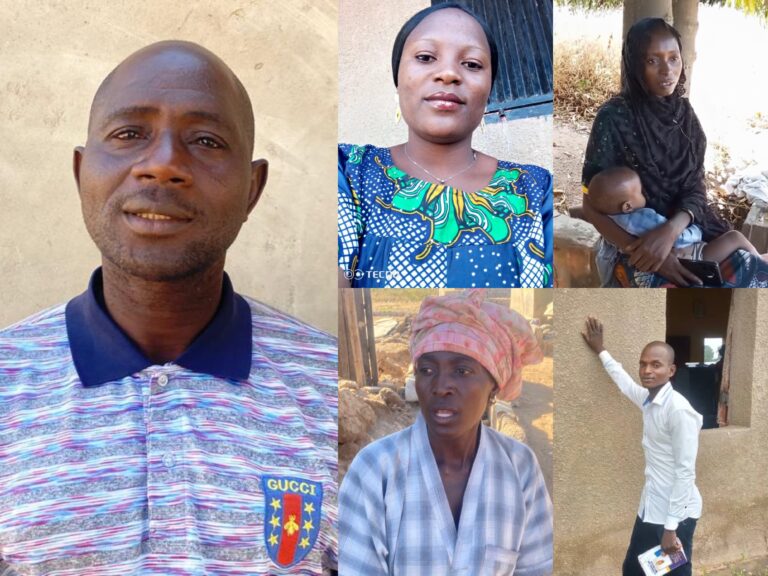
Women farmers in Paikoro
Women farmers like Jummai Makama and Aishatu Bawa in Paikoro, Priscilla Sado and Agnes Aynadanyi in Gurara and Halima Mohammed in Agaie stored grains from their last harvest, hoping for better prices. However, they were disappointed when it came time to sell their grains.
Prices of maize dropped from N1,000 per measure to as low as N250-N400; beans fell from N150,000 per bag to N70,000, with a measure selling between N1,500 to N1,700 as against N2,800 to N3,000 that it was sold early in the year and the year before. This development makes farmers who waited to sell their farm produce get stuck with unsold produce, while those who sold early barely broke even.
“As at this time last year, a bag of beans sold between N130,000 to N180,000 depending on the type that you have. But this year, the highest we can sell our beans is N80,000, which is not encouraging, not after buying fertiliser and chemicals very costly and not getting anything for your effort in the farm.
“Buying fertiliser at a higher cost, and after harvesting, you look at the price you sold it and you will know that you did not gain. Most of our produce is still on ground and we are looking for buyers at the rate we want to sell it that would be okay for us,” Aishatu Mohammed, a multiple crop farmer in Paikoro said.
With a tone of resignation, she said that though she was planting new crops, she does it reluctantly because she still has a lot of her harvest unsold with no hope of the price rising again.
“I am praying that the prices will go up a little, at least to enable me to get the amount of fertiliser and chemicals I spent during the planting season. I sincerely pray that next year, the price will increase more than this year.”
Talma Baba
After spending 25 years in farming, Talma Baba, a rice farmer in Gurara Local Government Area, is taking the price fluctuations and uncertainty in good faith. She believes that it is the will of God for food prices to either go up or down, and since she does not lose too much, she will keep farming with the hope that her family will not be hungry.
“Everything I do about my farming depends on God, and if He says the price will go up, it is His will. If the price reduces, I will still farm and sell. I will not get discouraged,” she said.
Talma said she did not lose much in terms of selling her last year harvest as she was part of those who sold theirs at the beginning of the year when the prices were still high.
“At the beginning of this year, the food prices were still high and that was when I sold some of my produce, so I did not lose that much. It was after the middle of the year that the prices began going down, so I can say I did not lose too much.”
NBS data analysis
The data from the National Bureau of Statistics (NBS) confirms what farmers are experiencing. While food prices were still higher early this year, the monthly increases slowed down until September 2025, which saw the first actual month-to-month drop in food prices in over a decade. According to data from the NBS, Nigeria’s food prices showed a general slowdown in increases compared to 2024.
Food inflation measures how much food costs have risen, compared to the same time the previous year. According to NBS, year-on-year food inflation rates dropped over the months in 2025, though actual month-to-month price reductions happened from September
Based on NBS Consumer Price Index (CPI), the year started with January showing 26.08 percentage change in food prices compared to the same month in the previous year while in September 2025, the food inflation rate showed 16.87 per cent as against 37.77 per cent in September 2024.
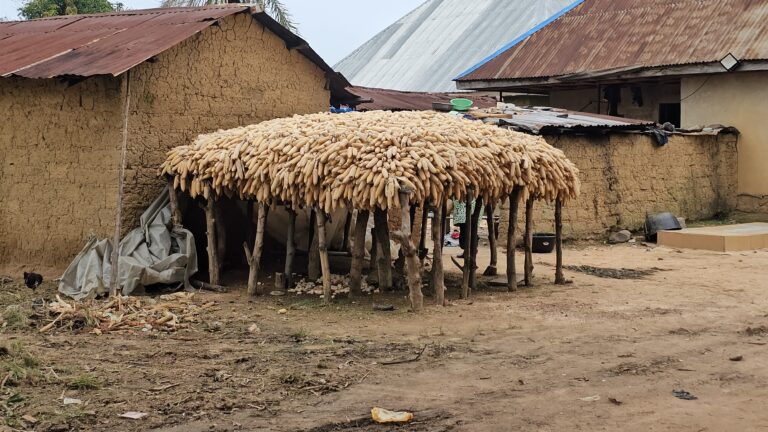
This is how Talma Baba stores her grains
October and November data have not been released by NBS as at the time of writing this report
The cost of farm input like fertiliser, herbicides, chemicals and seedlings continues to increase annually, with no hope of farmers, especially women in the rural areas, getting access to government-subsidised input. Several of the farmers say that they have to rely on fowl or cow dung and refuse as fertiliser since they cannot afford buying fertiliser. This in turn does not give the yield they expect. Farmers say fertiliser that once sold between N18,000 and N30,000 is now ₦60,000, and that is if it is even available.
Since she went into rice farming ten years ago, Habiba Abdullahi, lamented that her greatest challenge has been accessing fertiliser, herbicide and pesticide. She said this has reduced her produce yield annually.
“Since I started farming, I have not had access to government-subsidised fertiliser,” she said, adding that last year when the Smallholder Women Farmers (SWOFON) were promised 300 bags of fertiliser by the government, they were only able to access 60 bags, which she said were not enough to go round members across the state.
“When I started farming, my land was still fertile, so I was able to harvest 120 bags of rice. But as the years went by, the harvest reduced drastically, and last year, I was able to harvest just 30 bags of rice.
“This year, I don’t know how many bags I will harvest. I now use fowl droppings as fertiliser in my farm. Then for the chemical, I buy a little amount and mix with the fowl poo, which I use in the farm.
Though Habiba sold her produce early in the year before food prices went down, she worries over the price of rice which is currently being planted and would soon be harvested.
She said: “I have fears over the price of rice for next year. I only pray that the prices improve before we harvest this year’s rice and sell them.”
‘Politicians hijack fertiliser’
Some of the women farmers accuse politicians of hijacking subsidized fertilisers meant for them as several of them noticed that the fertilisers sold by these politicians are usually cheaper than those sold in the market.
According to them, the politicians hijack the inputs and because they are not real farmers who end up selling it less than the real market rates to the real farmers.
“We do not get our fertiliser from the government. We get it from those who sell it in the market. All the fertiliser shared by the government belong to politicians. The common man buys from the black market where a bag costs N50,000 to N60,000. Before, we were getting it at N25,000 at government price. The politicians sell to them, and they sell to us.
“Last year, the governor directed that women farmers should be given 600 bags of fertiliser, out of which 300 were supposed to be for Smallholder Women Farmers of Nigeria (SWOFON). But because of the politicians involved, we only got 68 bags, which was not enough to go round.
“This year, we did not even see one bag. This is sad because four, five years ago, they gave these fertilisers to us for free, but now, nothing. How can the government go for a year without giving subsidised fertilizer to farmers?”
Agnes Aynadanyi
Agnes Aynadanyi in Gurara LGA lamented that after using fertiliser for planting, she did not get the money back to even pay for the input
“We brought medicines and fertiliser to use while planting, and most of us did not even get the money for the inputs.
“This year, one measure of corn was sold for N300. Last year, we sold it at N1000 to N2000. I had to sell mine like that because I needed money. No gain at all.
“Sometimes, I buy chemicals for N65,000 and fertiliser for N97,000. I buy 10 bags because if you did not apply enough, it will not yield much. I did not get the money back.
“With this new planting season, I just managed to start farming.”
Pricilla Sado
Pricilla Sado, who farms groundnut, melon, rice, beans and cassava in Agaie, lamented the high cost of renting farm implements every year. “This year, I hired a tractor to work for me in my farm. I paid N70,000 because my cousin knows the owner.
“But last year, the person who did it for me collected N110,000 for just clearing and tilling the ground. We do not have access to government owned tractors. We hear that they bring them, but politicians hijack. It is the same thing with fertiliser.”
Jummai also lamented how the tractors were being hoarded by the Niger State Agricultural and Mechanisation Development Agency (NAMDA), which claims that it does not have any, despite the ones seen in its offices in Minna.
“If you have a big farm, you will have to go and rent it from private individuals. We haven’t seen any from the government here. In the whole local government, we don’t have a tractor. The government keeps saying it shared tractors, but it is all politics.
Fatima Matyaki in Katcha LGA, has entered into an agreement with the people who sell fertiliser where she buys on credit and pays back after she harvests her crops. Because of the need to pay off the debt, she had to sell her produce quickly. So, she did not save a lot of grains like her fellow farmers.
She lamented that from her last harvest, she was barely able to meet up with the payment of the fertiliser and have some gain, because she sold the produce at very low price than she budgeted to sell it.
“But I just had to sell it, because if I had waited longer, the fertiliser seller would be on my neck. So, I could only afford to store little that would be enough for my family to feed on. So I am even discouraged to farm this year”, she said.
Storage: Between spoilage and poison
Several of the farmers do not sell the crops they harvest immediately. They store them using different preservation methods. None of the women farmers interviewed used modern methods for storing their crops.
Majority of the women rely on traditional storage methods using insecticides or rat poison, locally referred to as “bomb”, which they tie in rags to repel pests. One of the crops they use the “bomb” to preserve is beans, risking food poisoning if not properly handled before it is sold.
Explaining the reason for storing their produce for a while before selling, majority of the women said they do so to make more profit as this tends to increase the price of the products, which had benefitted them in the past.
“We store our harvests the local way. Like beans, we got some storage bags sold by the Niger State Agricultural and Mechanisation Development Agency (NAMDA). When you put your beans in that bag, it can stay for 8 to10 months.
“The reason for using the bomb is that the smell drives away any pest, especially rats, weevils and termites. So, on my part, when I want to sell my produce, I take the produce and spread it on the floor for a day or two so that the sun can heat it and remove any smell or residue from the chemical we use.
But she admitted that this could be dangerous to health.
“In some cases, you will hear sometimes that beans kill people. That is because some people just take it to the market without removing the bomb, and this type of beans, when you cook it, you will perceive the smell. That is why it poisons people.”
“For yams, we have the barns which can serve for three to six months,” Jummai said.
Safiya Musa, who farms rice in Paikoro, said she has been using the rat poison known as “bomb” for storing her grains since she started farming about six years ago.
“I don’t have any problem or loss or damage. I use rat poison. I store maize for one year; nothing goes wrong with it.
“Apart from maize and rice, other grains cannot stay very long as termites can enter to eat them up, especially if the ‘bomb’ you use has expired and you did not check it.”
Comfort Joseph, a rice, beans, potatoes and corn farmer in Dikko community in Gurara LGA, uses a different and safer method in storing her beans. She by pours ash on it as she fills it into the storage bag. For maize, she uses neem leave which she places inside the sack.
“For other crops, I use the insecticide bomb to store them. It does not affect the crops; it is safe to use. All you have to do is use rag to tie it before dropping it into the crop.”
Nutritionist speaks
A Niger State based Nutritionist, Hajiya Asmau Mohammed, explained that the use of chemicals in grain preservation is a common practice worldwide, particularly in areas with high humidity or long storage periods.
She noted that while chemicals effectively prevent insect damage, reduce post-harvest losses and maintain grain quality, they also pose significant health and environmental risks.
“The contamination of grains with pesticide residues and the development of insect resistance are major concerns. For instance, studies carried out have shown that exposure to pesticides like phosphine can lead to neurological damage and respiratory issues in humans.”
She noted that non-chemical methods, such as drying, storing in airtight containers, and using natural preservatives, offer eco-friendly and cost-effective alternatives as these methods not only preserve grain quality but also promote sustainable food systems and community resilience.
“However, the non chemical method may require more labour and careful monitoring, and their effectiveness can be limited by factors like storage conditions and pest pressure.
“As a nutritionist, I believe that a balanced approach that combines the benefits of both chemical and non-chemical methods could be the way forward.”
A health consultant, Mathew Oladele, noted that the common rodenticides in Nigeria commonly called rat bomb or giant killers or smoke bomb are not safe for grain or any type of food preservation, especially grains, adding that these chemicals cause food contamination and poisoning risks.
“The rodenticides contains some chemical properties that are harmful to humans and animals. These materials are made purposely to control rodents and not to preserve foods items especially grains. These chemicals cause food contamination and poisoning risks.
“The farmers need to be advised to stop using these harmful methods to preserve grains. Rat bomb has a tendency to cause multiple organs failures in human beings just as it does to the rats. It can cause food poisoning, severe illness, internal bleeding, brain swelling or even result in death.”
Enforced uniform prices, higher losses
In markets across the state, farmers face difficulties in selling their grains in the local markets at the rate they desire because of the market leaders who work at ensuring that every trader in the market sells at uniform prices, irrespective of each one’s peculiar realities, which in turn worsens farmer’s losses.
Ndatu Ibrahim, a market leader in Paikoro, said the price of food is set when the market leaders calculate the amount the grains were bought and the transportation used in conveying to the market with a little amount added to it as gain for the traders.
Ndatu, who acknowledged the low prices of food, said unlike previous years when middlemen followed the farmers to their farms in the hope of getting it cheaper, this year was different because farmers were looking for ways to sell their produce at slightly higher rate in order to get returns on their investment. She added that several of the middlemen also felt the brunt of the food price reduction as those who stored their goods now sell at a loss.
The head of market women Head in Agaie LGA, Zainab Mohammed, noted that they try to ensure that there are uniformed prices and anyone who flaunts the order faces disciplinary action which may lead to the person not selling in the market that day.
“Every day, when I come into the market, I and other officials go round and ask how much they are selling their produce. Once a trader gives a different price, that trader is queried, and if the reason is not vital, we ask them to sell at the same rate with others. That is how we work to ensure all prices are the same.
“We always have challenges especially with the farmers who sell their goods directly in the market. When we ask them to sell at lesser price, they complain that some of them go on dry season farming where they use fuel, which is very expensive. The price of the fertiliser is high and selling at lower price is killing them. But our hands are tied because the price has to be uniform.”
Price Control Board dormant?
Niger State Governor, Umaru Mohammed Bago, in October last year inaugurated the Niger State Price Control and Monitoring Board. The board is an eight-member committee led by Alhaji Hussaini Ahmed, who is a former Permanent Secretary, as Chairman – with other members drawn from various ministries, departments and agencies.
The primary goal of the board is to ensure fair pricing and protect consumers and farmers from exploitation. Its specific functions include; control and stabilise the prices of essential commodities across the state; eradicate or minimise the hoarding of essential goods by traders; keep market prices under continuous surveillance and interpret price movements and handle issues that arise from enforcement and implement penalties for those who violate pricing guidelines.
As at November 2025, the board was yet to undertake any activity nor has it carried out any specific enforcement actions, such as crackdowns on hoarders or the seizure of goods. The board has also not released an official, regulated price list for specific essential commodities.
The reporter tried to get the Chairman but could not get his contact, while some members who were reached said since the announcement of their names as board members the board has never really functioned.
This is essentially, they said, because the government has not released money to fund its activities. It was gathered that since its inaugural meeting, the board has not met since it was inaugurated in October 2024.
A retired statistician general in Niger State, who is also a farmer, Alhaji Usman Liman, noted that the drop in food prices is a good thing, but added that it would discourage farmers, especially as the prices of inputs, fertilizer, chemicals and seedlings have not reduced.
“A farmer will buy his fertiliser N40,000 or more per bag and at the end, he will sell his maize for N20,000 per bag. This means he has to sell about two or three bags to get a bag of fertiliser. So, it is not good for the farmers.
“The long-run implication is that the next one year or less than one year, these prices will move. Particularly if it reaches next year, if farmers are discouraged, they won’t farm again..
“What the government should have done is to encourage the farmer by not opening the door for import, because you are encouraging people from other countries, particularly large-scale farmers from other countries bringing in their goods.”
Why intended support fails to reach women farmers —NAMDA
The Managing Director of NAMDA, Muhammad Alibaba, explained that while the state has policies to support women, a combination of input diversion, distribution model that relies on a few formal (and not widespread) groups, and a critical lack of extension staff makes several women farmers to be “sidelined” and fail to access the intended inputs.
He explained that the government’s specific allocation for women is channelled through a few prominent, organised women farmer groups, stressing that those who are not registered members of these specific organisations were often left out, admitting that these organised women farmers groups are not widespread but the agency cannot be everywhere.
“As we speak, the government has approved the purchase of some quantity of inputs that will be distributed to farmers for the dry season (farming), since rainy season is over already. So that is likely to be sold as a subsidy to farmers.
“We are conscious of the gender balance and gender mainstreaming. So, most often when it comes to inputs distribution by government, there are a few notable organisations that cater for women farmers. They are usually given priority attention in addition to ordinary farmers. These women organizations usually get specific allocation for their members.”
On diversion, Muhammad acknowledged that they receive the same complaints once in a while explaining that most often, the inputs are usually limited and with little or no logistics to convey them to the expected locations, it may be diverted by some elements.
“Efforts, like I said, are being deliberately made to ensure that women are not sidelined. So, those women that are complaining, maybe we need to encourage them to join this kind of women organizations who we give priority to so that if these inputs are available, they will be able to benefit from them.”
The MD lamented that the extension officers available at the local government levels to help farmers are not enough to cater for this large number of farmers across the state adding that there are some other initiatives at the community level that have taken it upon themselves to enlighten and train farmers.
As women farmers are already in the planting season, hope remains their only capital. They pray for better prices and real government support, so that full barns can finally mean full pockets.
This report was made possible with support from the International Centre for Investigative Reporting, (ICIR).
THE Wole Soyinka Centre for Investigative Journalism (WSCIJ) has shortlisted 14 journalists for the 20th edition of its awards – the Wole Soyinka Award for Investigative Reporting (WSAIR).
A statement by the centre stated that this year’s edition is considered historic as it reflects 20 years of exposing corruption, defending democracy, and holding power to account.
The statement noted that the finalists were chosen from a total of 184 entries submitted across the country, following careful deliberation by the 2025 WSAIR judges’ board chaired by Abigail Ogwezzy-Ndisika, a Professor and Director of the Institute of Continuing Education, University of Lagos.
The shortlisted journalists include Kingsley Jeremiah, Ann Godwin, Tina Todo, Julius Osahon, and Monday Osayende of The Guardian; Muslim Yusuf of Trust TV; Victor Asowata of The Will; Ugonma Mathias of African Angle; Kunle Adebajo of HumAngle
Others are Afeez Hanafi of Daily Trust; Elliot Ovadje of The Punch; Isah Ismaila of HumAngle Media; Emenike Chukwuemeka of New Telegraph; and freelance reporter Theophilus Adedokun with National Record.
Their stories, the centre noted, demonstrate the courage, depth, and public-interest focus that have defined WSAIR’s legacy since its inception in 2005.
The winners will be announced at the WSAIR presentation ceremony and WSCIJ@20 anniversary celebration on Tuesday, December 9, 2025, at the AGIP Recital Hall, MUSON Centre, Lagos, alongside the conclusion of the two-day Amplify In-depth Media Conference and Awards.
The conference, which runs virtually on December 8 and 9, will feature 11 speakers, including Professor Rosental Alves of the University of Texas at Austin and Khadija Patel, Director of the International Fund for Public Interest Media, under the theme “Investigative Reporting and the Future of Truth.”
“Since 2005, WSAIR has recognised and celebrated journalists across print, radio, television, photography, online media, and editorial cartoons whose reporting exposes injustice, holds power to account, and advances the public interest.
“The award has been hosted on the International Anti-Corruption Day and the eve of Human Rights Day since 2009 to highlight the significance of these days and their connection to investigative reporting and democracy. This 20th anniversary edition carries added meaning, not only crowning the 2025 winners, but honouring two decades of reporters who have set the standard for integrity, courage, and impact in Nigerian journalism,” the centre added.
FORMER ICIR staffer Ijeoma Opara has been named first runner-up at the 34th Diamond Awards for Media Excellence (DAME) for her reporting on illegal mining in Nasarawa State.
The report, “Chinese Illegal Miners Deprive Government of Revenue, Exploit Child Labour in Nasarawa,” was nominated in the Solid Minerals Development Reporting category.
The investigation revealed that despite the 2022 Nigerian government ban on the exportation of raw minerals, the country was losing millions to illegal miners, who often supplied Chinese-owned companies.
It also exposed widespread exploitation of child labour and the siphoning of millions of naira in potential government revenue to Chinese-owned firms.
It further highlighted cases such as 10-year-old Celestina Geremiyah, who manually hauled sand from mining pits, and other children forced into labour.
On November 9, 2025, Opara was formally notified of her nomination by the DAME secretariat, which stated that her work met DAME’s “highest standards” and recognised her as one of three finalists in the Solid Minerals Development Reporting category.
The awards ceremony took place on Tuesday, November 25, 2025, at the Lagos Sheraton Hotel, Ikeja.
During the ceremony, Folashade Ogunrinde won the category with her report ‘illegal operations of mining firm responsible for Ibadan fatal explosion,’ while Opara came second.
Yakubu Mohammed won the second runner-up with his report titled ‘The Digital Black Market: Nigeria’s illicit lithium trade uncovered.’
The ICIR reports that DAME Awards aim to recognise journalists whose work combines investigative rigour with solution-oriented reporting.
Other categories awarded at the ceremony included Judicial Reporting, Sports Reporting, Education Reporting, and Investigative Reporting.








 Women farmers in Paikoro
 Talma Baba
 This is how Talma Baba stores her grains
 Agnes Aynadanyi

