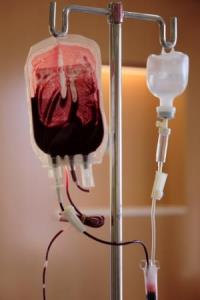
Blood plays a critical role in childbirth, surgery, trauma care and the treatment of chronic illnesses. But experts say Nigeria’s blood supply system remains underfunded, poorly coordinated and heavily dependent on family replacement donors. As the world marks the 2026 World Blood Donor Day, stakeholders call for urgent reforms to address shortages and improve access.
After delivering her baby through a caesarean section at an Abuja-based hospital in 2025, Blessing (second name withheld) was discharged in stable condition. Two weeks later, she developed severe anaemia, with her packed cell volume dropping to 12.
Although Blessing had initially secured a donor and a pint of blood in case complications arose during childbirth, she was told upon returning to the hospital that she would need to either buy blood or find another donor.
When she asked what had happened to the blood she had earlier secured, the hospital informed her that it had been used on another patient. As her condition worsened, an attending doctor eventually donated his blood, an act she said saved her life before the hospital later sourced another unit.
“Doctor Davidson rolled up his sleeves and donated blood for me… If he hadn’t, maybe I wouldn’t be here today,” she recalled.
Blessing’s experience reflects a wider pattern across Nigeria’s health system, where access to blood often depends on family efforts, informal networks, or last-minute interventions rather than a reliable national supply.
Across hospitals, patients such as pregnant women, accident victims and people living with sickle cell disease are frequently asked to provide replacement donors before treatment, even in emergencies. In some cases, families search outside hospital gates or rely on informal arrangements to secure blood.
While Blessing was fortunate to get an emergency donation from the attending doctor, many others have not been so lucky.
Low voluntary donation and heavy reliance on emergencies
Reports show that Nigeria still falls far below the recommended level of voluntary blood donation needed to meet national demand.
The World Health Organisation said an adequate and reliable supply of safe blood depends on a stable base of regular, voluntary, unpaid donors, who are considered the safest source of blood. Health experts estimate that countries generally need regular donations from about 1–2 per cent of their population to meet demand. For Nigeria, this would translate to roughly two million regular donors, yet the country continues to grapple with blood shortages and unequal access to safe blood
Despite the life-saving importance of transfusion in surgeries, childbirth, trauma care and cancer treatment, blood availability in many Nigerian hospitals remains inconsistent. According to the National Blood Service Agency (NBSA), Nigeria currently meets only about 25 to 30 per cent of its estimated annual blood requirement, which is put at between 1.8 and 2 million units.
The Director-General of the NBSA, Saleh Yuguda, said in 2025 that the country records an annual collection of roughly 500,000 units of blood, most of which comes from family replacement donors and paid donors. He noted that this figure remains significantly below national demand.
He further explained that only about 17 to 20 percent of blood collected in Nigeria comes from voluntary, non-remunerated donors—the group the World Health Organisation identifies as the safest and most reliable source of blood.
“No will, no system,” expert warns of structural failure
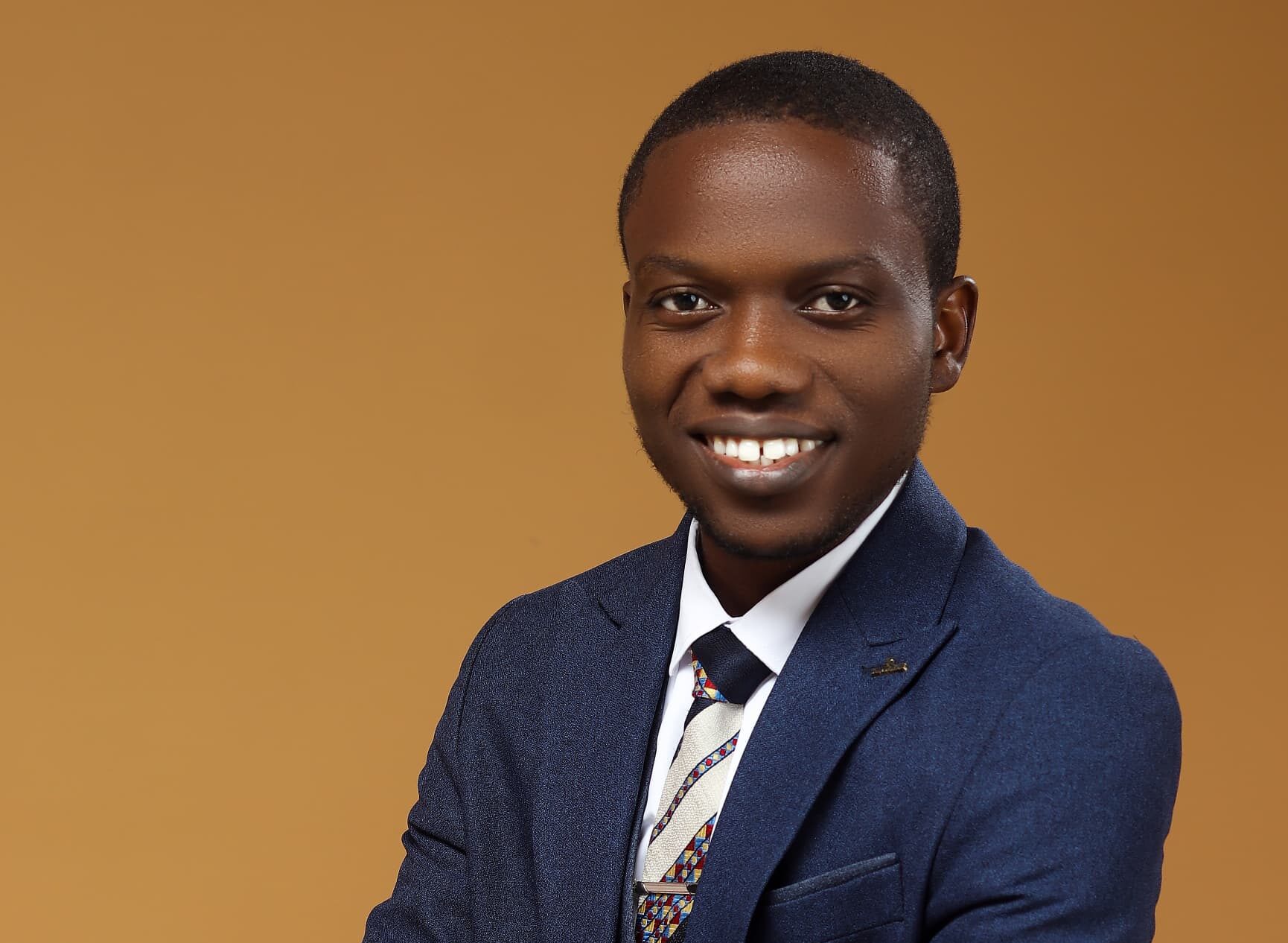
Speaking on the 2026 World Blood Donor Day, a Nigerian medical laboratory scientist and blood donation advocate, Oluwamuyiwa Ogunkoya, described the country’s voluntary blood donation system as “abysmal,” warning that patients continue to suffer due to systemic gaps rather than lack of need.
Nigerian medical laboratory scientist and blood donation advocate Oluwamuyiwa Ogunkoya
“There is no will, no structure, no system and no culture for voluntary blood donation in Nigeria,” he said.
Observed every June 14, World Blood Donor Day honours voluntary, unpaid blood donors and highlights the importance of safe blood in saving lives. This year’s theme, “One Drop of Humanity. Give Blood. Save Lives,” emphasises solidarity and shared responsibility in ensuring access to safe blood.
Speaking further, Ogunkoya explained that although Nigeria has legal frameworks such as the National Health Act (2014) and the Blood Transfusion Act, enforcement is weak, and funding remains far below what is required.
He noted that while reforms would require about $15 million, the national blood agency has reportedly received only a fraction of that.
Ogunkoya, who is also the Co-founder of Bloodlines Foundation, highlighted the lack of donor centres, mobile collection units and proper recruitment systems, saying many Nigerians travel long distances to donate or access blood.
He added that most donations occur only during emergencies done by relatives, with no system for repeat or voluntary participation.
“There is also no recruitment system, no retention strategy. People donate once, usually for family emergencies, and that is the end of it,” he said.
Informal networks and urgent call for reform
Oluwamuyiwa Ogunkoya further raised concerns about informal and commercial blood arrangements that persist in parts of the country despite laws prohibiting the sale of blood.
He said desperate families are sometimes forced into replacement donor arrangements or linked to paid donors through informal intermediaries around hospitals.
While noting improvements in some states, such as Lagos, he said enforcement remains inconsistent nationwide, adding that misconceptions are not the main barrier to donation, but rather weak systems and a lack of political commitment.
The medical laboratory scientist called for stronger political will, increased funding, and a shift towards building a culture of voluntary donation through schools, youth service programmes, workplaces and community mobilisation.
On his part, Ayobami Bakare, Program Manager for Haima Health Initiative Nigeria, an initiative that facilitates access to safe blood and blood products in different blood banks, said Nigeria’s blood shortage is not only a supply problem but a failure of coordination and information management.
Bakare said there are instances when blood is available within a city. Still, because a hospital operates in isolation, it becomes difficult to know where units are located or how they can be redistributed during emergencies.
“Blood shortage in Nigeria is dependent on a lot of factors because there are instances where the blood is available, and Hospital A has particular blood units in particular blood groups, and Hospital B, which is down the road, doesn’t know,” he said.
Building a national blood database and strengthening coordination
Bakare said one of the most effective ways to address blood shortages in Nigeria is the creation of a centralised national blood database to connect public and private hospitals across the country.
He said such a system would allow health authorities and hospitals to know where blood is available and what blood groups are in stock. He said that where shortages exist, the enabling facilities could share resources during emergencies.
Bakare explained that many shortages are not necessarily caused by a complete absence of blood but by poor coordination and a lack of information on existing supplies.
“If we have a whole system where we know how much blood is available in Abuja today and where they are located, if Hospital B needs B positive, they can swap with Hospital A,” he said.
He proposed that every unit of blood collected and used in Nigeria should be logged into a central database, creating a real-time picture of national blood availability. But beyond technology, Bakare stressed that success would depend on sustained government investment and political commitment.
“It’s not about practical steps; mainly, it’s more of political will. Like, are they willing to do the work?” he queried, adding that blood availability should be treated as a national healthcare priority, requiring adequate funding for specialised equipment, storage facilities, reagents, donor recruitment and monitoring systems.
According to him, a coordinated national blood system would not only improve access to safe blood but also reduce the dependence on emergency family donations and informal donor networks that many patients currently rely on.
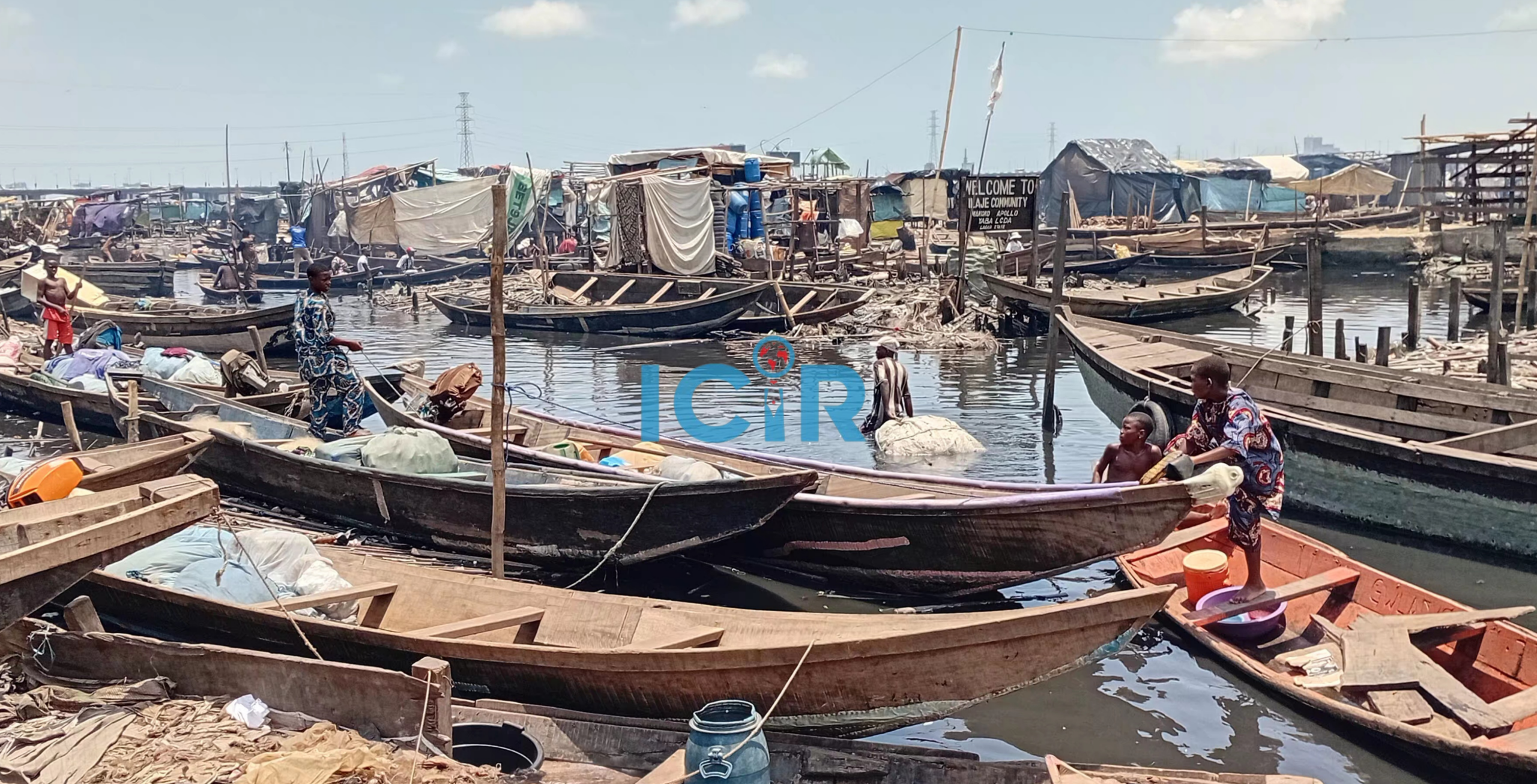
For decades, the narrow wooden walkways of Makoko have carried the hopes, struggles, and livelihoods of thousands of residents living along Lagos waterfront. But after recent demolitions in Makoko, Oko-Agbon, and Sogunro communities, many now face a difficult choice. They must either abandon the fishing settlements where their families have lived and worked for generations or resist relocation to a proposed housing estate in Agbowa, Epe.
‘We’re not leaving our ancestral home’
Like many of the affected individuals, Wabi Jarado insists that he and his family aren’t relocating. “When they evicted us, we had nowhere to stay,” he lamented, “We lost our house, and many of our belongings. The place they’re planning to relocate us to is not acceptable to us,” he insists. “Makoko is where we belong. This is where we will stay, from beginning to end. We can’t abandon Makoko.”
Jarado maintains his defiance. “We do not want to go far from here. This community, Makoko, is where we want to remain. We are fishermen; we earn our living by catching fish. We are not thieves, and we do not steal. We can’t leave this community… We need everyone’s support so that we can continue to live among you. If we are forced out, it means we may have to return to Benin, which we do not want,” he said.
In a press statement on April 15, 2025, jointly signed by designated members of the Makoko community, including traditional leaders, youth representatives, and religious figures, the waterfront community rejected plans by the Lagos state government to relocate them from their ancestral homes, insisting instead on being included in the United Nations-backed urban development project.
They stated: “Despite our demands being clearly set out – a stop to the demolition, immediate humanitarian assistance and emergency shelter for the displaced, and the rebuilding of illegally demolished homes – none of these things has transpired. Not even the most modest form of palliatives.”
Proposed relocation to Agbowa
Amid growing tension over the forced eviction of waterfront communities, the Lagos State House of Assembly has recommended relocating affected residents to a proposed low-cost housing estate in Agbowa, Epe. The recommendation followed the adoption of a report by the House Committee on Rules and Business during plenary on Tuesday, March 10, after lawmakers received a petition titled, ‘Urgent Appeal Regarding Ongoing Mass Forced Eviction and Illegal Demolition Threatening Tens of Thousands in Makoko, Oko-Agbon and Sogunro Communities.’
However, for many residents, relocation is not simply about moving homes; it means abandoning their livelihoods, the fishing economy, and their way of life tied to the Lagos Lagoon. As demolitions spread across the waterfront communities, residents insist they would rather remain in Makoko than relocate inland to Agbowa, which they fear would cut them off from the water that sustains them.
Demolition day: How thousands were displaced
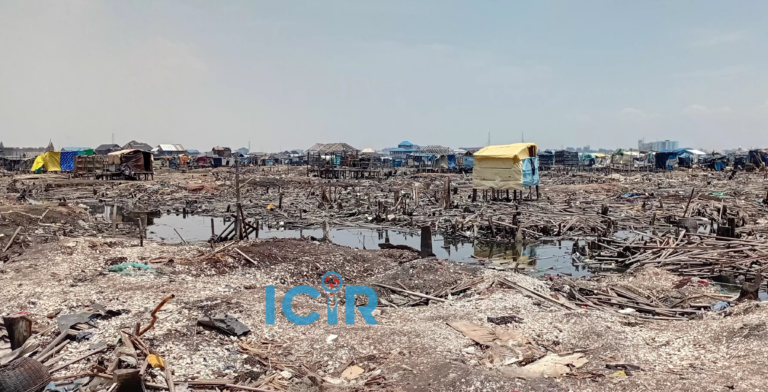
It was just after midday on Tuesday, December 23, 2025, when the quiet rhythm of life in Makoko was broken. Around 12:30 p.m., amphibious excavators pushed through the narrow waterways as they advanced into the community. Armed police officers escorted them, moving in formation as the machines bore down on rows of wooden homes balanced on stilts above the water. One after another, the structures gave way, shacks that had stood for years crushed beneath metal and force.
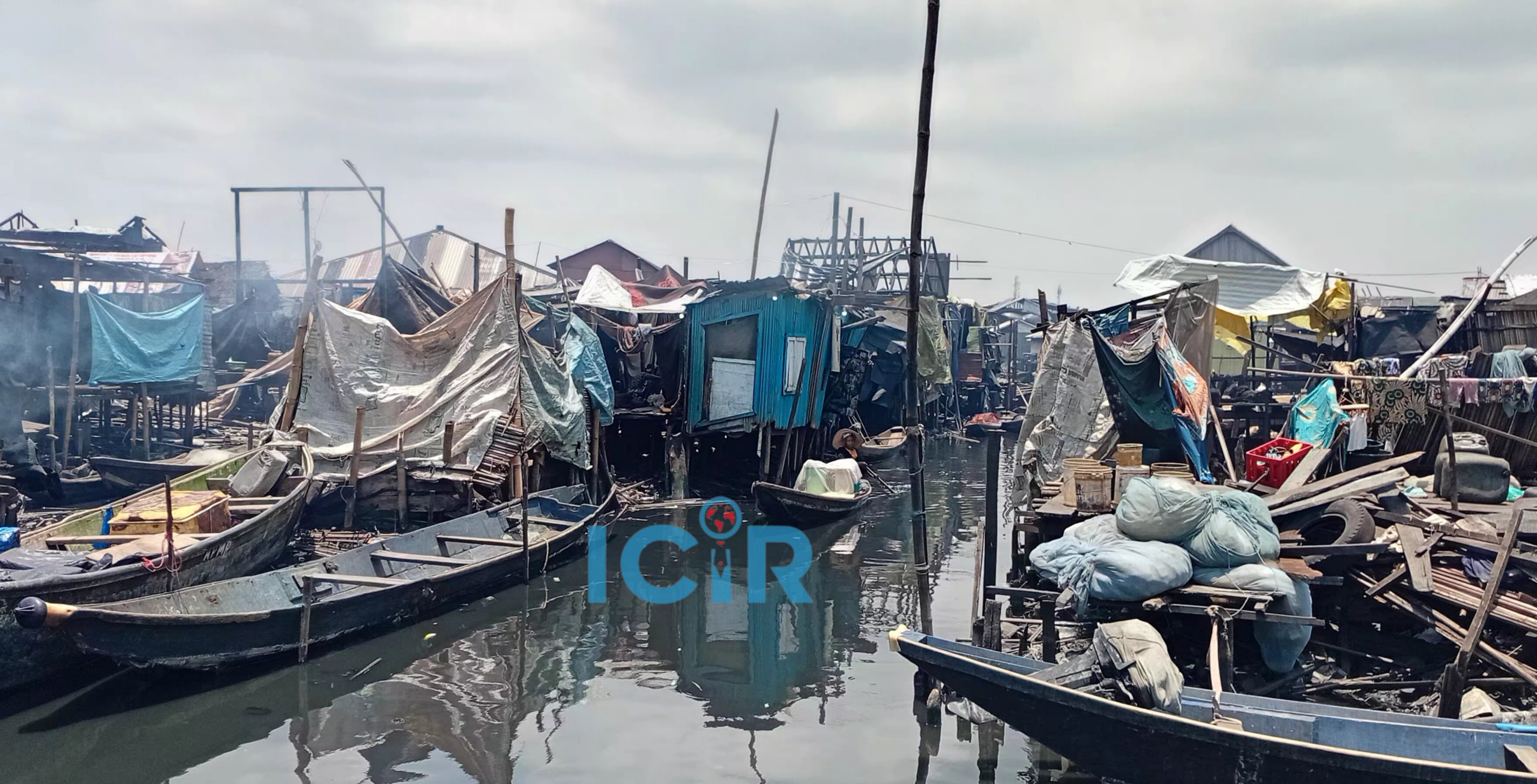
Life in Makoko – Photo by Ehime Alex
The community says the operation affected an estimated 30,000 people before it stopped after protests. Residents later learned it aimed to enforce a 30-metre safety setback from a high-tension power line across Makoko, Oko Agbon, Sogunro, and the Third Mainland Bridge. But the clearance area, they say, was extended to cover more than ten times that length.
What began as a targeted enforcement of safety setbacks has escalated into a humanitarian crisis, putting one of Lagos’s most vital informal economic systems at risk. The community’s aquatic economy, driven by fishing, boat-making, and informal trade, is now caught between state-led urban renewal and residents’ struggle to preserve their ancestral livelihood.
A fishing community fighting to stay afloat
Long before the demolition, Isaac Dosugan’s days followed a familiar rhythm: going out to fish, returning to sustain his household, and continuing a way of life passed down through generations. At over 75 years old, his life has been shaped by the water. “I’ve been a fisherman from the beginning until today,” he says. “Makoko is my town, my community.”
Beyond fishing, Dosugan is one of the elders of Makoko, but that sense of stability was shattered. “I had a house on the water, and it was destroyed,” he recounts. “All my fishing nets were destroyed… my house and all my property.”
What happened to Dosugan was repeated across the settlement. “About 852 houses were destroyed,” according to him, adding that canoes, essential tools of trade, were not spared. “Every house has a boat. Many people couldn’t remove their boats, which were broken and destroyed,” noting that the human cost, however, weighs more heavily. “We lost about 12 people,” he says quietly. “One was a five-day-old baby who died immediately from tear gas.”
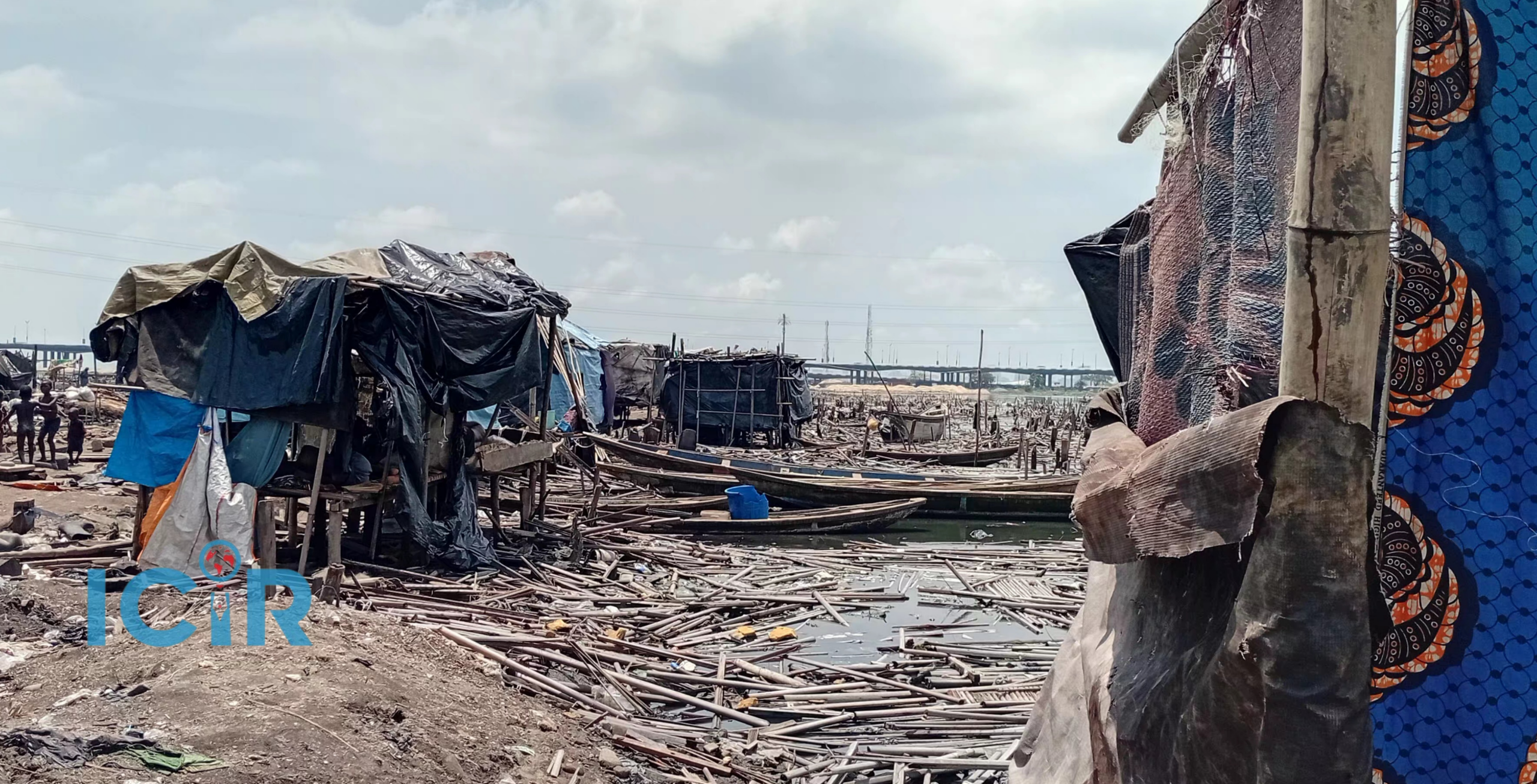
Makeshifts built after the demolition – Photo by Ehime Alex.png
Lamenting, Christiana Bababatan says, “I lost everything again in the Makoko demolition,” then her voice breaks into the deepest loss of all: “I even lost my child. Now, I’m left with nothing.” She recalled that everything she had lost had been gathered after suffering an earlier loss from the demolition of Otodo Gbame, a predominantly Egun fishing community on the shores of the Lagos Lagoon in Lekki, which was demolished between November 2016 and April 2017, leading to the displacement of over a thousand residents.
For Bababatan, the story isn’t just about displacement. “How can you remove fish from water?” she asks rhetorically. “We are like fish; we can’t leave the water. That’s where we feed our families, where we eat, and where we live.” Like many others, her position is firm: “We are not going to Agbowa. We want our land back. We are still on our land. We want it back.”
Why residents say Agbowa isn’t an option
For Ade Oluwatobi, Vice Chairman of the Fishermen Association of Makoko, popularly known as Baale Jeje, Makoko is a way of life shaped by water, work, and tradition. “Makoko people lived on the water because we were fishermen. We couldn’t stay on land,” he says, explaining that residents settled on the water to stay close to fishing routes and tides.
“This water connection has continued to define our daily life and livelihoods,” he says, adding that, “we have more than 4,000 houses, and almost everyone is a fisherman. We work as a team. After fishing, everyone sells their catch and provides for their family.”
Over time, this collective effort has grown into a major supply chain, as Baale Jeje notes that “Makoko supplies about 90 per cent of fish to the state and even beyond Nigeria. If you want fresh fish, Makoko is the best place.”
For him, any attempt to relocate residents inland threatens not just shelter, but an entire economic and cultural system. “Relocation would destroy our way of life,” he says, stressing that their fishing knowledge “is tied to this environment.”
Homeless after widespread displacement
Honfo Ela, 40, says the demolition has left many families homeless. “Since they demolished our community, people have been suffering. We have no place to sleep; we are homeless.” With eight children to care for, the strain has become overwhelming.
“We are worried and sad, we are living a restless life, like dead people. They evicted us without informing us, and now we don’t know where we are being relocated to. When the government talked about resettlement, we were not okay with those places. They should allow us to stay in Makoko,” she said.
Insisting that Makoko is their inheritance, Ela laments, “The Makoko community belongs to our elders. They can’t take Makoko away from us; that’s impossible. Our children do not have food to eat. This is not proper. Someone gave my children money, and that’s what we are using to feed ourselves.”
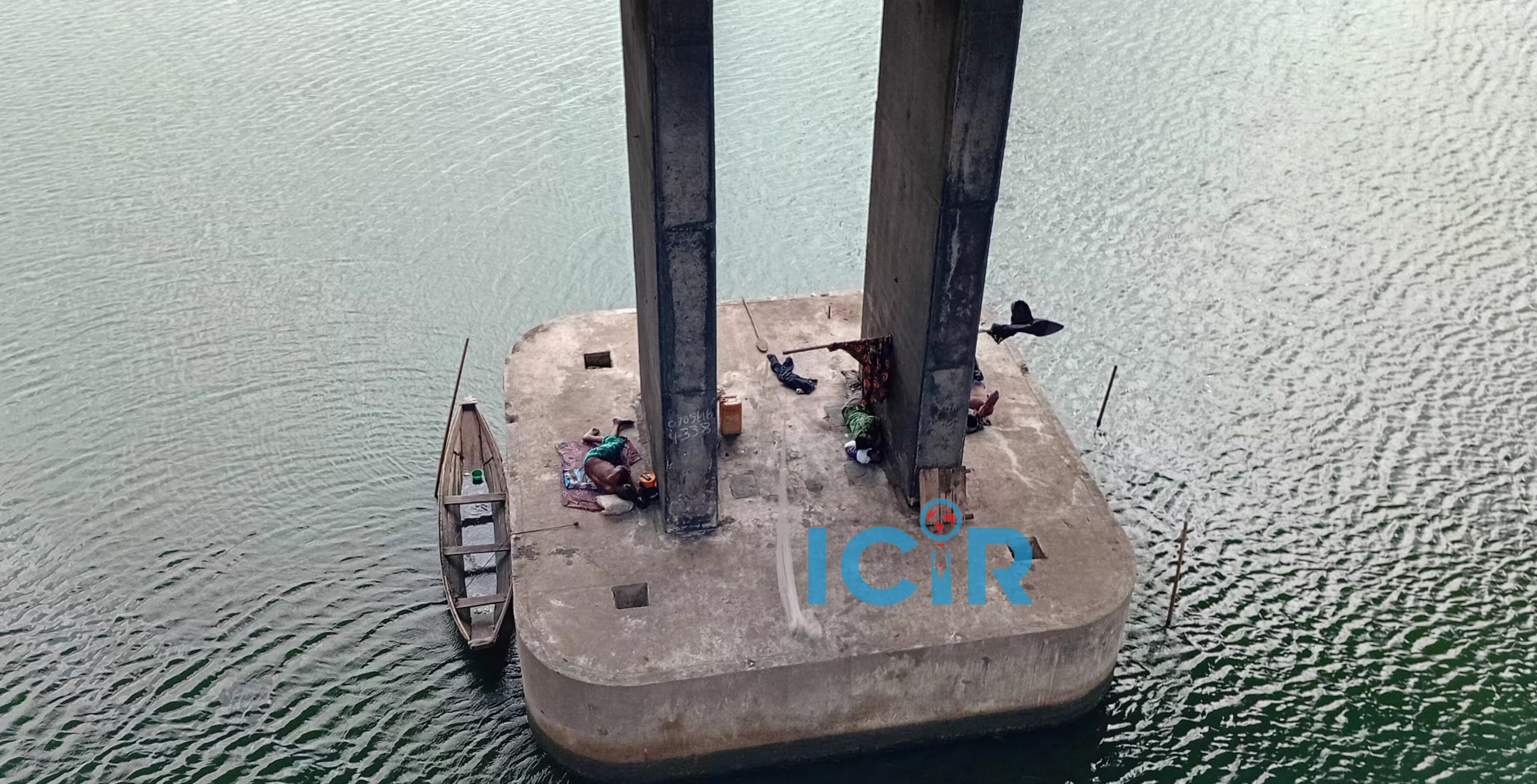
They now sleep in canoes and on the Third Mainland Bridge – Photo by Ehime Alex.png
At 30, Basira Jarado finds herself forced into the open with her children after the demolition. “We have no other place to stay. We are outside with our children, filled with worry. We are exposed to the sun, and when it rains, we are also affected.”
Abetigo Adogba, 60, says his life as a fisherman was disrupted when the demolition began. “They demolished our homes while we were there with our children,” he said. “They did not inform us beforehand. They took away our houses, and now we have nowhere to stay. We are suffering. The rain beats us, and the sun scorches us,” Resisting the relocation move, he says: “They said they would take us to Agbowa, but we won’t accept that place. If we go there, what work will we do? We are fishermen, and this is where we do our work.”
Fear of eviction deepens across the waterfront
For Solomon Shepherd Wesu, Makoko has been home since birth. “I was born and raised in Makoko. The land we are living on wasn’t bought from anyone… it was given freely to us by the Baales,” he said. He said the residents had used their own resources to develop the area. “We created this land through our labour. We bought sand with our own money.”
For Wesu, demolitions of houses under the power lines may be lawful, but he fears the wider eviction plan. “They want to take away Makoko, where our fathers lived. I’ve grown old here. My children were born and raised here.” What troubles him most is the motive he perceives behind the eviction. “It feels like they want to demolish our homes for the benefit of rich people, so that we will end up serving them,” he fears.
The threat of displacement has also left Gosu Ezinsu demoralised. “We have nowhere else to go. We are the owners of Makoko, and all our belongings are here.” For him, relocation isn’t an option. “They said we are being moved to Agbowa, but we can’t stay there. We want to remain in Makoko. We are fishermen.”
Livelihoods destroyed
Often described as a waterfront slum, Makoko is also a thriving economic system that sustains families and connects directly to the wider Lagos economy. Set along the Lagos Lagoon, Makoko runs on what has been described as an “aquatic economy.” Fishing, logging, and boat-making form the backbone of daily life, turning the water into both a workplace and a marketplace.
But the economy does not end on the water. Furniture makers, shoemakers, welders, caterers, and food sellers operate within the settlement, serving both residents and nearby communities. Makoko also supplies labour and services to the broader Lagos metropolitan area, linking the informal settlement to the formal city economy.
Before the demolition, economic life in Makoko had been relatively stable, with income levels varying sharply, depending on occupation. But since the demolition, many livelihoods have collapsed.
Razaq Adosu, a tailor, now tends to what remains of his livelihood under the open sun. “They scattered all the shops here in Makoko. Look at my shop, I’m under the sun with my apprentice,” he says. “I don’t have any other place to work. Whenever I try to find another spot, they say there is no space,” he says. “I’m under the sun with no food to eat.”
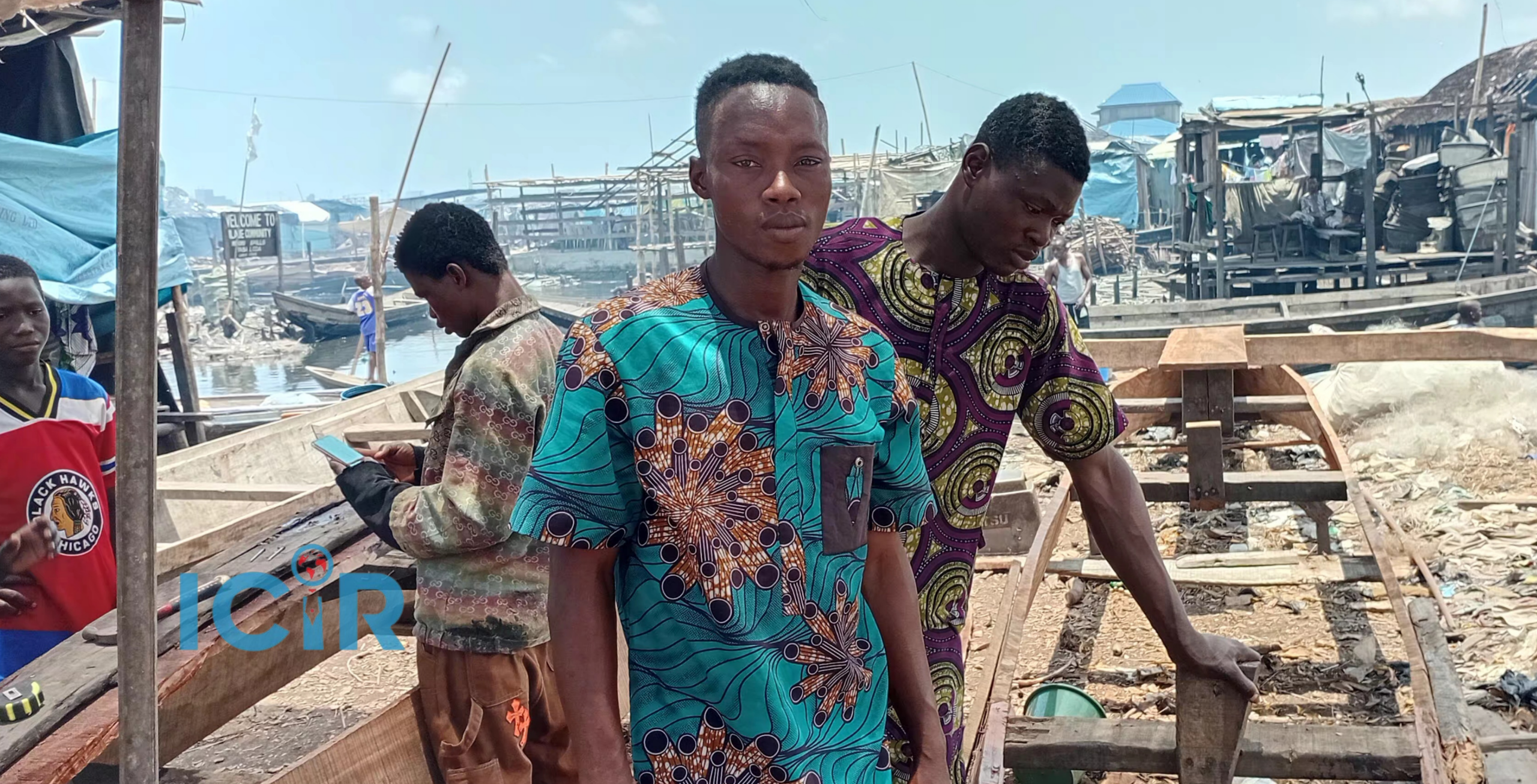
For Agemo Atiatan, Makoko is the centre of his craft. “This is where we carry out our business,” he says. “Since they came and destroyed parts of Makoko, business hasn’t been moving well.” A boat maker, Atiatan says, the losses have cut deep into his livelihood. “When they demolished this place, both our homes and materials were scattered. The woods we used for building boats were missing, and even the new boats we had parked by the waterfront could not be found. We lost many boats.”
Agemo Atiatan, one of the boat builders – Photo by Ehime Alex
“Some cost ₦200,000 for smaller sizes, others ₦500,000, ₦1,000,000, and even up to ₦5,000,000… This is our livelihood, but the demolition has continued to affect us deeply,” he laments. Atiatan had tried moving to Agbowa and other places, but could not survive there. “Now, we sleep outside because we have no homes. We sometimes sleep inside the boats.”
Schools, clinics and community structures left in ruins
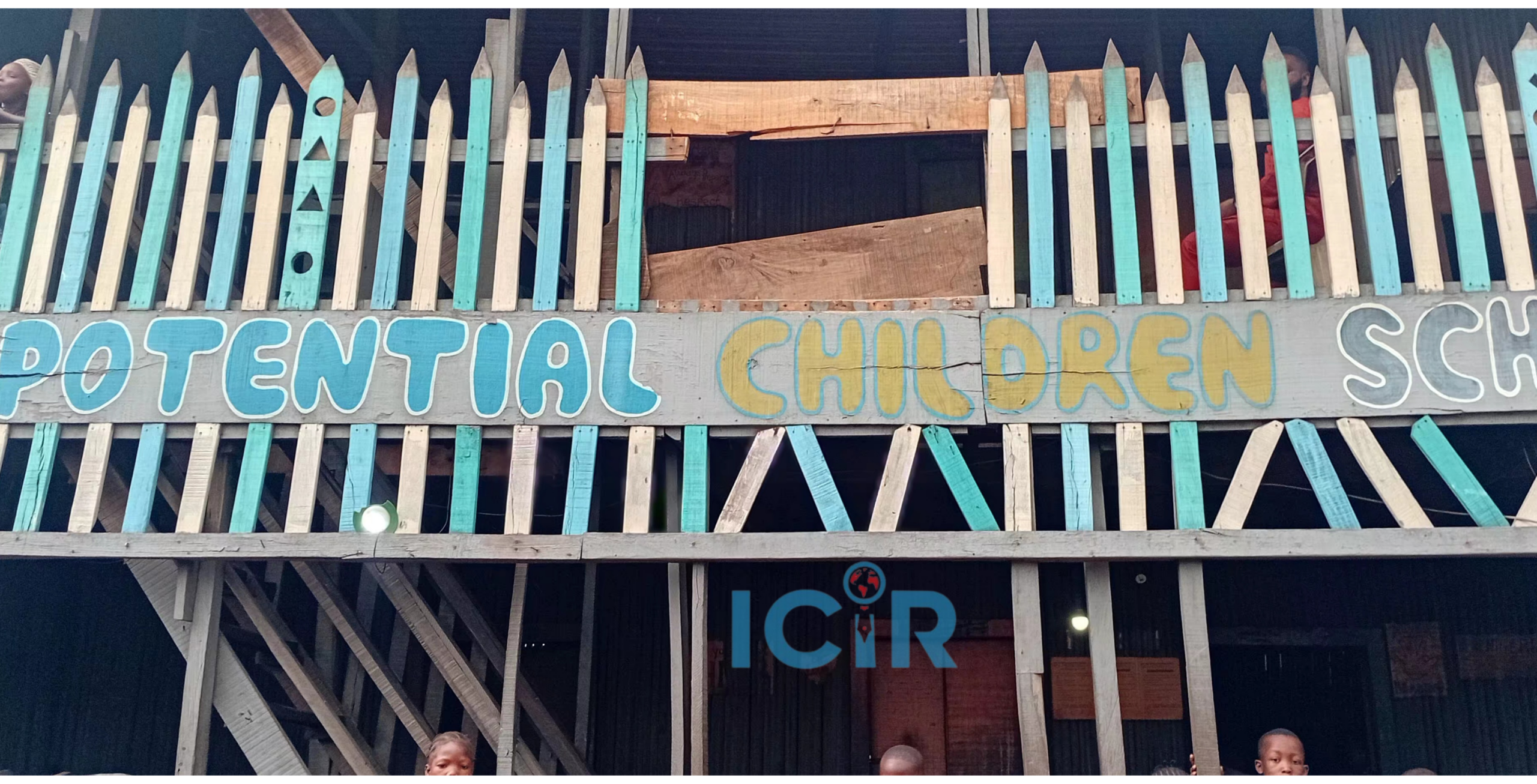
Many parents said their children stopped going to school after the demolition because they no longer have the money to send them back. Ayinde Rodrick Oluwatosin, founder of Potential Children School, says the demolition swept through schools, clinics, churches, and shops built by residents.
Potential Children School building affected by the demolition – Photo by Ehime Alex
“Lagos State Government officials pulled down houses, schools, clinics, churches, and shops without proper notice,” stressing that “there was no warning, no time given to pack or evacuate.” The result, he says, has been a sharp decline in access to education and healthcare, with his school’s population dropping from over 360 pupils to about 120.
Residents also attempted to quantify their losses through a self-organised enumeration process, as Oluwatosin says they counted about 562 houses in Makoko alone before the exercise was halted. “Other nearby communities like Oko-Agbon and Sogunro also recorded hundreds of demolished houses,” estimating that “nearly 2,000 houses across three communities were affected.”
Questions trail UN-backed Makoko dev’t plan
Amid the crisis, Oluwatosin pointed to earlier engagement with international development partners as evidence that Makoko was already on a path toward improvement, not displacement. He recalled facilitating visits by the UN Deputy Secretary-General, Amina Mohammed, in 2020 and 2021.
“We later heard that about $8 million was allocated through the United Nations for the development of Makoko, with an additional $2 million from the state government,” he says, emphasising that the combined $10 million “was meant to improve the community—not displace its residents.”
While the government has since floated a Makoko Water City project, findings by this reporter show that the residents remain wary of any plan that prioritises relocation over development.
Rights groups raise concerns over forced relocation
Megan Chapman, co-executive director of Justice and Empowerment Initiatives (JEI), describes the demolition in Makoko as “very heartbreaking,” noting that many residents have been left homeless and scattered. “People are really suffering, and they will continue to suffer because what they have lost, no one is helping them rebuild,” she says.
She argues that repeated evictions across Lagos are damaging the wider economy. “To go from that to living under the bridge… the losses are not just for the family but for society,” she says. Citing recent cases such as Ilaje-Otumara and Precious Seed communities, Chapman says thousands have been displaced despite prior engagement with the government.
She contrasts this with recommendations for in-situ upgrading, where communities are improved rather than destroyed. “The communities are ready to work with the government,” she says, “but instead, people are being evicted in violation of the law.”
On the proposed relocation of Makoko residents, Chapman believes the plan is unrealistic. “How can you take over 80,000 people and move them to a place that’s a fraction of their current land, with nothing built?” she asks.
Livelihood in Makoko – Photo by Ehime Alex
Lagos gov’t defends demolition, stays silent on key questions
Reacting to criticism over the demolition and proposed eviction, the Lagos State government defended that the demolitions were a safety and environmental measure.
The Special Adviser to the Governor on eGIS and Urban Development, Olajide Babatunde, in an official statement, said the exercise aligns with similar enforcement across the state. “Clearing high-tension corridors is a safety requirement across Lagos State,” he said, linking the exercise to a long-term Makoko waterfront redevelopment plan, with about $2 million committed since 2021.
However, the Lagos State Commissioner for Information and Strategy, Gbenga Omotoso, did not respond to inquiries seeking clarification on compensation plans, funding commitments, and how the demolitions align with the project’s stated objectives. Follow-up phone calls also went unanswered.
Similarly, efforts to obtain clarification from the UN were unsuccessful. After contacting Stéphane Dujarric, spokesperson for the UN Secretary-General, via email, he referred the inquiries to the Lagos office. The reporter subsequently contacted Adeola Margaret Adedeji, Public Information Assistant at the UN Information Centre in Nigeria, seeking details on the UN’s role in the Makoko Water City project, including its status, safeguards against displacement, and community engagement efforts. Despite repeated follow-ups through email, WhatsApp messages, and phone calls, no response was received.
Experts warn of economic fallout if relocation fails
Clearing Makoko without a structured plan is not urban renewal, but the disruption of a functioning economic system, says Felix Ijeh, an economist, researcher, and policy analyst. Currently lecturing at the Department of Economics, Faculty of Management and Social Sciences, Adeyemi Federal University of Education, Ondo, Ijeh explains that the immediate impact is a collapse in daily income from fishing, trade, and related services that could result in millions of naira in lost turnover and a contraction of Lagos’ informal economy.
“You are creating sudden unemployment with no safety nets,” Ijeh explains, warning that this deepens urban poverty and strains the labour market. He also points to the destruction of informal capital, boats, tools, and trade networks, describing it as “equivalent to wiping out SMEs overnight.”
Ijeh maintains that the government must move away from a “clear first, think later” approach and ensure any relocation preserves livelihoods. Otherwise, he warns, such demolitions will continue to create more economic problems than they solve.
A COALITION of civil society organisations has warned that Nigerians’ personal information remains vulnerable to abuse despite existing data protection laws.
In a statement titled “Protected From the State, Not By It: Nigeria’s Data Protection Crisis Is a Crisis of Implementation,” the group said Nigeria developed one of Africa’s largest digital identity databases but failed to adequately protect the information it collects.
The coalition, comprising Media Rights Agenda (MRA), Paradigm Initiative (PIN), Digital Rights Lawyers Initiative (DRLI), Accountability Lab Nigeria, PROMAD Foundation, DigiCivic Initiative and others.noted that the National Identity Management Commission (NIMC) had enrolled more than 121 million Nigerians as of June 2025, while the country also operates under the Nigeria Data Protection Act (NDPA) 2023 and a dedicated Nigeria Data Protection Commission (NDPC).
However, the organisations argued that these safeguards failed to translate into meaningful protection for citizens.
According to the group, recent incidents involving alleged unauthorised access to sensitive government databases have exposed weaknesses in oversight and accountability mechanisms.
They cited reports surrounding the disclosure of voter registration information from the Independent National Electoral Commission (INEC) database and investigations that uncovered the online sale of sensitive identity records, including National Identification Numbers (NINs), for as little as ₦100.
“When the regulator’s own data is not safe, no citizen’s data is. A government that cannot protect its citizens’ data should, at minimum, be cautious about how aggressively it collects and deploys it. Nigeria has done the opposite. Under the NDPA, data controllers are required to undergo compliance audits filed with the NDPC, an obligation enforced against private entities even as public institutions, the largest holders of citizens’ data, face no comparable scrutiny,” the coalition stated.
The organisations also expressed concern about the expansion of state surveillance programmes, arguing that Nigeria lacked a comprehensive legal framework governing public surveillance systems.
They said existing laws did not clearly define the limits of surveillance, provide independent oversight, or require human rights impact assessments before such systems are deployed.
The coalition further criticised the continued use of provisions of the Cybercrimes Act against journalists, bloggers and social media users, despite a 2022 judgment by the ECOWAS Court of Justice declaring aspects of Section 24 of the law arbitrary and repressive.
According to the group, Nigeria’s data governance system currently places citizens in a vulnerable position where personal information is aggressively collected but inadequately protected.
“This is the asymmetry at the heart of the crisis: citizens are under-protected from data abuse and over-exposed to state monitoring and punishment,” the CSOs said.
They called on the Federal Government to strengthen enforcement of the Nigeria Data Protection Act, ensure public institutions are subjected to the same compliance requirements as private organisations, and publish the findings of investigations into alleged breaches involving government databases.
The coalition also urged authorities to establish an independent oversight framework for surveillance systems, amend Section 24 of the Cybercrimes Act, in line with the ECOWAS Court ruling, and strengthen accountability mechanisms across public institutions handling citizens’ data.
It warned that public trust in digital governance would continue to erode unless citizens are assured that their personal data is protected from misuse, unauthorised access and unlawful surveillance.
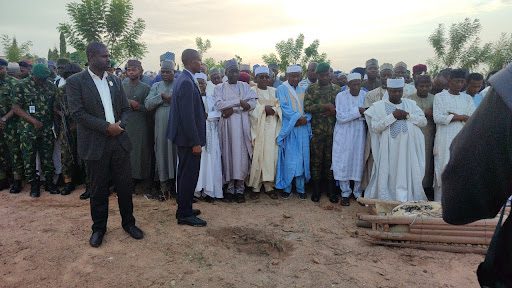
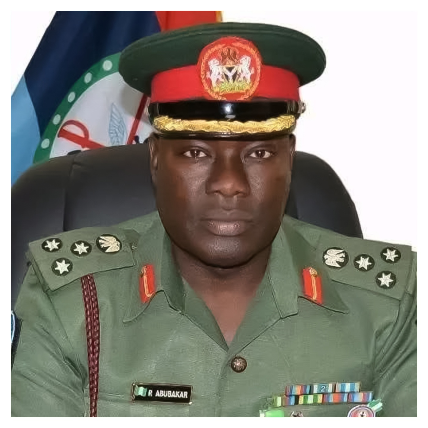
FORMER spokesperson of the Nigerian Army, Rabe Abubakar, a retired major general, has been laid to rest in Katsina State after dying in bandits’ custody.
The burial, conducted in accordance with Islamic rites, on Saturday evening, was attended by family members, senior military officers, government officials and residents.
While the fate of his wife, abducted with him by terrorists, remains unclear, the Presidency, in a statement on Saturday, said she had yet to be freed..
President Bola Tinubu condoled with the deceased’s family, the Katsina State Government, and the Armed Forces of Nigeria.
Tinubu said the government would not bow to demands by terrorists for the release of their members in exchange for hostages.
He described Abubakar’s death as a defining moment in Nigeria’s battle against terrorism and insurgency, stressing that terrorists should continue to be treated as enemies of the state.
The retired general was abducted alongside his wife by armed bandits while travelling to his hometown in Katsina State.
The ICIR reports that the Katsina State Government confirmed the death of the retired general, saying he died from complications arising from diabetes and hypertension while being held by his abductors.
In a statement issued earlier on Saturday, the state Commissioner for Internal Security and Home Affairs, Nasiru Mu’azu, said Abubakar died despite sustained efforts by the state government and security agencies to secure his release.
The commissioner conveyed the condolences of Governor Dikko Radda to the deceased’s family, describing the incident as a dark moment in the state’s battle against insecurity.
Reacting to the development, the Defence Headquarters (DHQ) expressed sorrow over the death and reaffirmed the military’s commitment to eradicating terrorism and banditry across the country.
In a statement signed by the Director of Defence Information, Samaila Uba, a major general, the Armed Forces described Abubakar as an officer who served the nation with distinction and made significant contributions to counter-insurgency operations, professional military development and national unity.
The military disclosed that it deliberately refrained from making public comments on his abduction to avoid jeopardising ongoing rescue efforts by security agencies.
“The Defence Headquarters withheld public comment on his abduction in deference to ongoing rescue efforts by the Armed Forces of Nigeria and sister security agencies. Every operational resource was deployed in the hope of securing his safe return,” the statement said.
The DHQ added that the tragedy had strengthened the resolve of the military to intensify operations against terrorist and criminal networks, assuring Nigerians that security forces would not relent until those responsible were brought to justice.
STAKEHOLDERS in Nigeria’s health sector have called for a scale-up of Multiple Micronutrient Supplementation (MMS) to reach all pregnant women in the country.
They made the call on Thursday in Abuja during the launch of research findings on Multiple Micronutrient Supplementation (MMS) landscaping and segmentation in the nation.
According to the findings, MMS can provide adequate nutrition for the 7.8 million pregnancies recorded annually in Nigeria and help reduce the high burden of maternal anaemia.
It showed that while MMS offers broader nutrient support than iron and folic acid supplementation and is strongly accepted by women when available, affordable and properly explained, long-term scale-up would require stronger public financing, protection for low-income women, and a more reliable supply system.
The study, commissioned by Sight and Life, with support from the Children’s Investment Fund Foundation (CIFF), and conducted by development Research and Projects Center (dRPC), revealed that the nationwide rollout of MMS is severely hindered by fragmented funding, high costs for mothers, and a massive supply deficit.
Presenting the data, the Lead Researcher, Stanley Ukpai, a doctor, warned that policy intentions must be backed by structural solutions to achieve meaningful impact.
“The research findings show that policy ambition alone will not deliver impact unless financing, access and supply constraints are addressed together,” Ukpai stated.
He added that long-term success relies on institutionalising public funding, lowering costs for low-income families, and building a reliable supply network.
Participants during the presentation of the report in Abuja
The research highlighted that existing health financing systems are inadequate to support equitable access, leaving maternal nutrition services heavily dependent on inconsistent donor funding and out of pocket spending by patients.
Commenting on the significance of the data, Executive Director of Nutrition at CIFF, Anna Hakobyan, noted that the data offered a clear roadmap for future intervention strategies.
Hakobyan explained that the findings provided valuable evidence and practical insights to support Nigeria’s efforts to integrate micronutrient supplementation as part of wider sustainable maternal and child nutrition strategies.
In her remarks, the country programme manager for Sight and Life, Zainab Abubakar, noted that the survey was designed to provide actionable data for the government. She noted that limited funding, weak insurance inclusion, and heavy dependence on out-of-pocket spending continued to create barriers to equitable access to maternal nutrition services in Nigeria.
The Special Adviser to the President on Health, Salma Anas, a doctor, concluded that maternal nutrition remained central to the country’s development agenda, stressing that the focus must shift toward effective and equitable implementation across Nigeria.
Similarly, the Director of Nutrition at the Ministry of Health, Adegbite Olufunmilola, saidsteps were already being taken to institutionalise MMS into national antenatal care guidelines. She suggested utilising public budgets, health insurance schemes, and local manufacturing to secure supply sustainability. However, she emphasised that its success would depend on moving from policy to action.
“The Federal Government has demonstrated high-level commitment to improving nutrition outcomes but stronger implementation at national and subnational levels remains essential,” Olufunmilola added.
Highlights of the launch included panel discussions on the financing and policy landscape, demand equity and consumer behaviour, supply landscape and market structure, with participants identifying practical actions for federal and subnational governments to accelerate the adoption and scale-up of MMS for pregnant women in the country.
THE Katsina State Government has announced the death of Rabe Abubakar, a retired major general and former Nigerian Army spokesperson, while in bandits’ captivity.
The government described the development as a tragic loss to the state and the nation.
The announcement was contained in a statement issued on Saturday by the Commissioner for Internal Security and Home Affairs, Dr Nasiru Mu’azu.
According to the statement, the retired military officer died from complications arising from diabetes and hypertension while being held captive by his abductors.
Mu’azu said the unfortunate development occurred despite sustained efforts by the Katsina State Government and various security agencies to secure the safe release of the former senior military officer.
“It is with profound sadness that we confirm the death of retired Maj,-Gen. Rabe Abubakar while in bandits’ captivity.
“Despite the relentless and concerted efforts of the state government and security agencies to secure his safe release, the situation ended in this tragedy,” he said.
The commissioner described the late general’s abduction and subsequent death as a monumental loss, not only to his immediate family and Katsina, but also to the entire country.
He conveyed the condolences of Gov. Dikko Radda to the bereaved family and Nigerians at large, noting that the governor viewed the incident as a dark moment in the state’s fight against insecurity.
According to him, Radda said the tragedy underscores the urgent need for a united and intensified effort against criminal elements threatening the peace and security of communities.
“The governor extends his deepest condolences to the family of the late general and the nation.
“He described the incident as a dark moment and a reminder of the need for collective action in tackling the menace of banditry and other security challenges,” Mu’azu stated.
The commissioner reiterated the state government’s commitment to working closely with the Federal Government and security agencies to ensure that those responsible for the crime are brought to justice.
He also assured residents that the government’s resolve to combat banditry and guarantee the safety of lives and property across the state remained unwavering.
Mu’azu prayed for the peaceful repose of the deceased and urged citizens to continue supporting security agencies in their efforts to restore lasting peace in the state.
The ICIRreports that Abubakar’s death adds to the list of cases involving senior retired military officers who have either been abducted or killed by terrorists, bandits and other armed criminals across the country.
Others include Alex Badeh, Idris Alkali, Muhammed Maisaka, Richard Duru, Rabe Abubakar among others.
KADUNA State Governor Uba Sani has granted clemency to 97 inmates as part of activities marking the 2026 Democracy Day celebration.
The governor announced the decision during a ceremony at the Kaduna State Correctional Centre on Friday, describing the move as a demonstration of justice, compassion and the belief in second chances.
The clemency followed recommendations by the Kaduna State Advisory Council on Prerogative of Mercy and was exercised under the governor’s constitutional powers.
According to Sani, the beneficiaries received outright release, sentence commutation and payment of fines, depending on their cases.
“While justice must be upheld, we must never lose sight of the transformative power of redemption and the profound impact of second chances,” he said.
The governor urged the freed inmates to embrace lawful conduct, show genuine repentance and become productive members of society.
” To those being released this moment signifies not only the gift of freedom but also a profound responsibility. It is an invitation to embrace genuine repentance, engage in lawful conduct, and contribute meaningfully to society as responsible citizens. I urge you to seize this opportunity to become agents of positive change within your families and communities”.
Sani also called on traditional rulers, religious leaders and community stakeholders to support the reintegration of the former inmates and give them opportunities to rebuild their lives.
He said reintegration remains critical to reducing repeat offences, strengthening communities and improving public safety.
The governor commended the judiciary, the Nigerian Correctional Service, the Legal Aid Council, security agencies, civil society organisations, traditional institutions and members of the Advisory Council on Prerogative of Mercy for their roles in the exercise.
He reaffirmed his administration’s commitment to a justice system that balances accountability with mercy and offers rehabilitated offenders a pathway back into society.
The ICIR also reported on Friday that the Borno State Government reintegrated 3,740 repentant Boko Haram members into society.
Cameroon’s regulators say no private institution may train students at the doctoral level. The man Adamu names as his thesis supervisor appears in the university’s own records as a student.
Yakubu Adamu, the Bauchi State Governorship candidate of the Allied Peoples Movement (APM), who served as a commissioner in the Bauchi State government, presents himself as a holder of a Doctor of Philosophy. He uses the title “Dr” and says he earned the degree in 2020 from the International University of Bamenda, a private institution in Cameroon. Adamu always introduces himself as ‘Dr. Yakubu Adamu, PhD’—a redundant doubling.
The International University of Bamenda, the Cameroonian institution Adamu says awarded his degree, has never been authorised by Cameroon to train students at the doctoral level. It was not authorised in 2020 when his thesis is dated, as shown in the government’s own approval records and in an April 2026 communiqué from Cameroon’s Ministry of Higher Education.
The university’s Secretary, Mary Fusi, said the institution has no satellite campuses in Nigeria and that any college awarding degrees in its name does so without approval. She said the institution does “not have anything to do with Nigeria,” and that “whoever is doing so is doing so at his or her own risk.”
Mary Fusi, who WikkiTimes understands is the daughter of the late Patrick Chefu Fusi, the founder of the university, said in a telephone interview that the institution had issued a formal disclaimer years ago. She said copies were sent to “the Youth Council in Nigeria, to the Nigerian Consulate, to the Ministry of Education in Nigeria, to the Ministry of Higher Education here in our country,” adding that IUB wanted no satellite campus in Nigeria.
She said students who came to her claiming admission through a Nigerian centre were told plainly that they were being scammed. She described a prospective student who said his friends were already studying at an IUB centre in Nigeria. She told him they were being deceived. “He never followed up,” she said. “Some of them are comfortable to be duped.”
But the records contradicting her are published by the university itself. IUB’s own website carries an alumni roster that is overwhelmingly Nigerian, listing serving and former officials of Bauchi State institutions by name, position and registration number. The thesis Yakubu Adamu submitted in 2020 records her late father, Patrick Chefu Fusi — the university’s founder and the promoter named on its government approval documents — as its external examiner. And the man Adamu names as his supervisor appears on the same roster, not as a supervisor but as a doctoral student.
WikkiTimes’ checks on the MINESUP registry, the official Cameroonian government database of accredited private institutions, found two approval orders for the university: a creation order No. 11/00507/MINESUP/SG/DDES dated 5 October 2011, and an opening authorisation No. 12/0363/MINESUP dated 17 August 2012. None of the approvals allows for Masters and PhDs. The institution’s authorisation never covered doctoral training in 2011, 2012, and June 2020, when Adamu’s thesis was submitted. No version of the university’s licence has ever permitted the degree he holds. The approval document lists Patrick Chefu Fusi as the institution’s promoter and includes the same telephone number that WikkiTimes used to contact Mary Fusi.
Furthermore, on June 1st, Cameroon’s regulator for private higher education told WikkiTimes that no private institution in the country is permitted to award doctoral degrees.
Gabriel Djankou Nkuissi, National Executive Secretary of the National Association of Private Higher Education Institutions of Cameroon (ANIPES), told WikkiTimes in writing:
“Even before any verification, which would only confirm the principle, no private higher-education institution is to date authorised to train at the PhD level. The IUB is a recognised private higher institution, authorised to operate in Cameroon. But it cannot train at the doctoral level, nor host doctoral training.”
Before then, in a press release dated 13 April 2026, signed by the Minister of State for Higher Education, Professor Jacques Fame Ndongo, the Ministry of Higher Education, known by its French abbreviation MINESUP, equally said no private higher-education institution in Cameroon is authorised to deliver training at the doctorate level. The Ministry said no “offshore” doctoral programme is authorised anywhere on Cameroonian territory, and that certificates resulting from such programmes cannot be recognised in Cameroon. The International University of Bamenda is a private institution. Under the ministry’s rule, a private doctorate awarded in Cameroon is not recognised.
A registered institution, closed by Cameroon’s regulator
National Commission for Private Higher Education, known by its abbreviation CNESP, has sanctioned the International University of Bamenda. On 28 August 2024, the Commission closed its 30th session by sanctioning nine private institutions, in a communiqué signed by Fame Ndongo. The International University of Bamenda was one of them.
Cameroon Tribune, the state-owned daily, reported on 3 September 2024 that the university was sanctioned for the “issuance of false diplomas and the refusal to compensate a learner,” and was closed for three years. The Guardian Post, an English-language Cameroonian newspaper, reported the same action on 5 September 2024, citing similar reasons. The closure took effect in 2024.
Yakubu Adamu’s thesis’s abstract matched a project sold online
Yakubu Adamu has not published his complete thesis anywhere. Rather, he published an abstract and redacted the rest of the thesis, saying, “The contents of the thesis are for internal users only.”
The dissertation’s abstract submitted under Adamu’s name matches a study found on a commercial platform that sells theses and dissertations to students online. The thesis, titled: “The Impact of Risk Management on Organisational Efficiency: A Case Study of Plateau State Inland Revenue Service, Jos, Nigeria,” was submitted to the International University of Bamenda in June 2020. WikkiTimes used two separate plagiarism checks—Turnitin and Copyleaks to examine Adamu’s thesis abstract. On one check, the abstract returned similarity scores of up to 91, 86, and 91 percent in three instances. On another check, it returned a similarity score of 64 percent.
WikkiTimes notes that similarity scores alone do not constitute a finding of plagiarism. Turnitin, the world’s leading academic integrity platform, states explicitly that “the relationship between a similarity score and plagiarism is often misunderstood,” adding that “many assume that a high similarity score automatically signifies plagiarism, but that is not always the case,” and that “determining whether plagiarism has occurred requires more than looking at the score.” The scores documented by WikkiTimes — ranging from 64 to 91 per cent across multiple checks of the dissertation’s abstract — are presented as indicators warranting further scrutiny, not as a conclusive determination of misconduct.
WikkiTimes formally requested access to Adamu’s full, unredacted thesis to allow for a complete and fair assessment of the work beyond its abstract. Adamu did not respond.
A substantial part of his abstract matches a pre-written research project on the same subject — risk management and organisational efficiency — applied to a different organisation, Dunlop Nigeria Plc, which was sold to students on the commercial website projectclue.com.
Adamu’s thesis records that Dr Alhaji Kawugana supervised it, that a committee including Nbifor Cletus certified it, and that Professor Patrick Chefu Fusi, the institution’s founder, examined it externally. WikkiTimes traced Kawugana to the Federal Polytechnic, Bauchi. Unlike other supervisors, Kawugana’s name does not appear on IUB’s website as a supervisor or examiner.
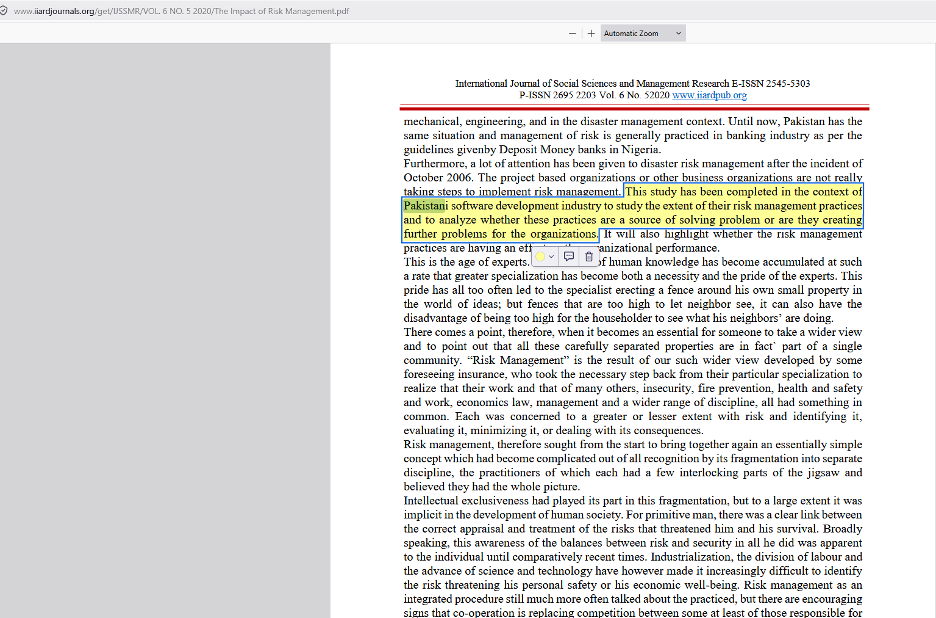
When the same PhD thesis, purportedly written by Yakubu Adamu, appeared in the International Journal of Social Sciences and Management Research in 2020, the authorship order had changed. Kawugana was listed as the lead author, and Adamu and Abdallah as co-authors. In standard academic practice, a student publishing his own thesis is credited as first author, with the supervisor named second. The journal version also reproduces a passage stating that the study “has been completed in the context of [the] Pakistani software development industry” — a description inconsistent with a Nigerian case study, further raising suspicion of plagiarism.
Highlighted in yellow: A description that raised suspicion of plagiarism.
Yakubu Adamu has more than 20 papers in a single year
In 2025, while Adamu held public office as a commissioner for Finance in Bauchi State, WikkiTimes counted more than twenty research articles he purportedly co-authored with Alhaji Kawugana. Several were presented as conference papers attributed to institutions WikkiTimes could not confirm exist. A significant number of the articles appeared in journals published by the International Institute of Academic Research and Development (IIARD), a platform that charges authors $20 per article for online publication — a fee that must be paid before a paper goes live. IIARD’s own homepage states that papers will be “published within 48 hours after the payment confirmation.”
IIARD’s indexing disclosure page lists only Google Scholar and ResearchGate — the latter populated by authors themselves — as its current databases, while acknowledging it is “actively pursuing inclusion in additional indexing services.”
The process sits outside normal academic practice. In management and business research, the path from submission to publication takes, on average, just under 18 months. Most active academics publish a low single-digit number of peer-reviewed papers per year. In one study of research productivity, faculty averaged about 2.1 publications per year, and the most productive member managed 10.3 per year. Twenty papers in 12 months is an average of one new paper every two and a half weeks, sustained over a year during which the listed author was running a government ministry. High-volume output published in low-scrutiny journals is a recognised feature of predatory journals, which produce large quantities of poor-quality research.
Unlike other graduates, Yakubu Adamu’s record on IUB website is missing
The institution’s own records do not list Adamu among its graduates. WikkiTimes examined its published student lists, its LinkedIn alumni listing, which records 1,115 alumni, most of them registered as based in Nigeria, and its published alumni roster. Adamu’s name does not appear on any of them.
Despite the presence of many Alumni from Bauchi State on IUB’s website, Adamu’s name is conspicuously absent. An alumni list may be incomplete, and the absence of a name is not by itself conclusive.
IUB has an overwhelmingly Nigerian roster; Many are from Bauchi
The institution’s alumni roster is overwhelmingly Nigerian. For a university located in Bamenda, Cameroon, that houses almost entirely Nigerian alumni raises suspicion. A large share of the listed figures is drawn from Bauchi’s public sector.
The IUB website listed several high-profile names in Bauchi, including Ali Gali, who it says was a rector at the Abubakar Tatari Ali Polytechnic. Other names listed include Ibrahim Buba, registrar; Friday Achimugu, bursar; and the head of accounting, M.D. Aliyu, and a lecturer, Ibrahim Adamu Saleh, all from the same Abubakar Tatari Ali Polytechnic. The roster also lists Adejoh Apeh Mathew, recorded as an examination officer at the Federal Polytechnic, Bauchi; Egwuemi Dennis Knights and Tijani Abubakar, recorded as staff of the Abubakar Tafawa Balewa University, Bauchi; Stephen Abubakar, recorded as a general manager of the Bauchi State Development Board; Mohamed Aminu and Lanze Sumaila, recorded in connection with the UNDP office in Bauchi; and Abdullahi Abba and Nasiru Yaro, recorded as the managing director and an accountant of a Bauchi microfinance bank. The appearance of these individuals on the roster is not, by itself, evidence of wrongdoing on their part.
The roster shows that the institution draws its examiners from its own graduates and reuses a small group of them across unrelated disciplines. One person listed as a 2009/2010 doctoral graduate later appears as the lead examiner on a series of doctoral defences in fields as varied as public administration, procurement management and human-resource management.
List of discussants
The institution publishes its doctoral defences with a column it labels “discussants” — the people IUB records as having sat each defence. Across 20 doctorates and master’s degrees in unrelated disciplines, the same handful of names fill that column, and a single telephone number, 0806XXX786, appears on eight separate doctoral defences. It belongs, each time, to Prof. Dorcas Igonoh, a former Vice Chancellor of Salem University, Lokoja, Kogi.
WikkiTimes reached Prof. Dorcas Igonoh at the telephone number listed against the research papers she published. Asked directly whether she earned her doctorate from the International University of Bamenda and whether she supervised doctoral students there, Igonoh did not answer. She asked instead what the question was for. Told that the information was meant for the public and that many Nigerians had earned PhDs from a university not permitted to run them, Igonoh said: “I don’t know anything about the university being authorised to run this thing or not. I can’t speak on that.”
Pressed a second time on whether she earned her PhD there, Igonoh said she does not speak to strangers and asked the reporter to send questions in writing. “Send me a text. Send your details,” she said — then ended the call abruptly, mid-conversation. WikkiTimes did as she requested. She did not respond as of press time.
Igonoh alone is listed discussing doctorates in procurement management, educational planning and administration, management technology, human resource management, and public administration — five fields that ordinarily demand five different specialists. Prof. Ben Wara Furu appears in defences in procurement, international business, philosophy, and public administration. Dr Promise Eseh is listed on a medical biochemistry doctorate, an economics doctorate, and a public-health master’s. A fourth name, rendered variously as “Dr Augustine A.,” “Dr Augustine A.,” “Dr Austine All.” and “Dr Austine Ogbeh,” carries most of the remainder.
The roster cannot hold its own names or titles steady. Igonoh is “DR Dorcas, Omanyo Igonoh,” where she appears as a graduate, and “Prof,” where she appears as a discussant. The same upgrade befalls Audu Dangana, listed as “Dr” among the alumni and “Prof” on the defence he discusses.
The reason the titles slip is that several of these discussants are not external authorities. They are the institution’s own graduates. Igonoh is recorded on IUB’s list as a 2009/2010 doctoral graduate in business management (entrepreneurship), registration IUB/2009/2010 — and then reappears as lead discussant on a series of later doctorates. A.E. Dangana is listed as an IUB doctoral graduate in entrepreneurship at the telephone number 0802XXX2967 and resurfaces as “Prof Audu Dangana,” a discussant, at the same number. Dangana is mentioned here and here as professor of a “Entrepreneurship and Strategic Leadership in the Department of Business Administration”, Kogi State University, Anyigba.
WikkiTimes also reached Audu Dangana on the telephone number that appeared against his name both as an IUB doctoral graduate and as a discussant on a doctoral defence. He told WikkiTimes he was not in the country and ended the call. Follow-up calls and an email sent to him went unanswered.
Adejoh Apeh appears three times in the same document: as Examination Officer at the Federal Polytechnic, Bauchi; as the holder of an IUB doctorate in business management; and as “Dr Adejo Apeh,” discussant on a master’s defence.
The circle is small enough and turned inward enough that the institution’s doctorates are produced and reviewed by the same few people who hold its doctorates.
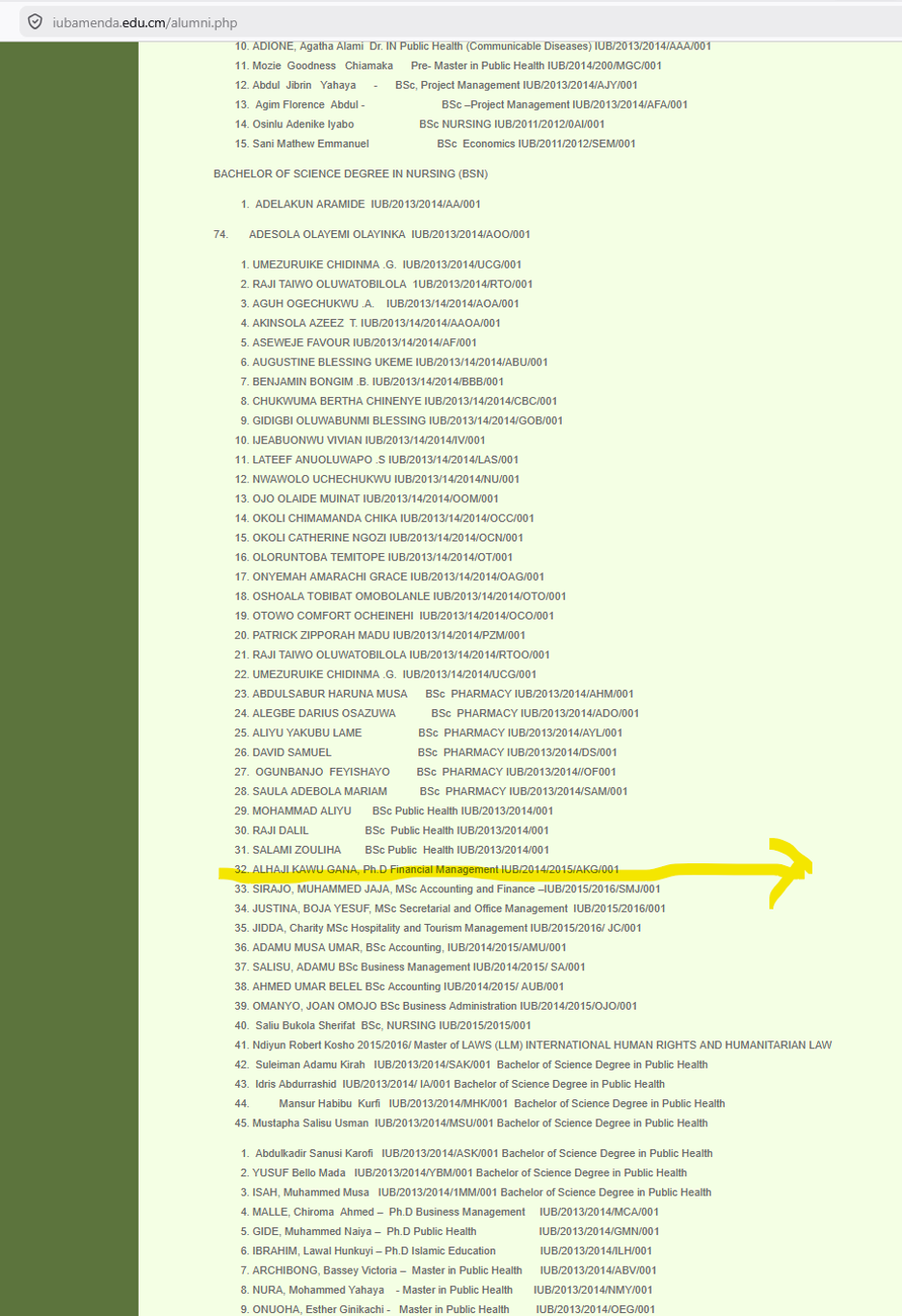
Alhaji Kawu Gana, Adamu’s supervisor, appears in entry 32 as “ALHAJI KAWU GANA, Ph.D Financial Management, IUB/2014/2015/AKG/001.”
Alhaji Kawugana, Adamu’s “supervisor,” appeared here as a student
He is listed as a doctoral student of the institution, under a student registration number, IUB/2014/2015/AKG/001. He does not appear in the discussants column and was not recorded as a discussant, an examiner, or a supervisor of any defence, anywhere in the document. Yet Yakubu Adamu names this same Kawu Gana as the supervisor of his PhD thesis.
Kawugana responded to WikkiTimes
Kawugana responded to WikkiTimes in two separate letters. In the first one dated June 7th, he confirmed supervising Adamu’s thesis, saying he did so “in accordance with the arrangements and academic procedures communicated to me by the institution.” He also disclosed that he holds his own doctoral degree from IUB, the same institution whose doctoral authorisation Cameroon’s regulators have since found to be non-existent.
When WikkiTimes sought to follow up by telephone, Kawugana declined. Over WhatsApp, he directed WikkiTimes to contact Tanko George, whom he described as the programme coordinator at IUB, providing a Cameroonian telephone number.
When WikkiTimes contacted George, he said he was not a coordinator but a teacher at the institution. Under questioning, George said the questions WikkiTimes was raising would be better answered by Mary Fusi. When WikkiTimes put Kawugana’s description of George to Mary Fusi, that he was the programme coordinator, she said George had not worked with the university for approximately three years.
Asked in a second letter what steps he took to verify IUB’s accreditation before supervising a doctoral candidate, Kawugana, on June 8, said his “understanding was that the International University of Bamenda was operating as a recognised higher education institution in Cameroon” and that he “was not aware of any regulatory finding, sanction, or official declaration” at the time.
On the question of whether his own IUB doctorate is subject to the same invalidity finding, Kawugana said he “continues to regard the qualification as valid unless and until an authorised body determines otherwise.”
He listed the IIARD journal article, identical in title and subject to Adamu’s thesis, among his own publications. When asked why Adamu, the doctoral candidate, appeared as second author on a publication derived from his own thesis research, Kawugana said the authorship order “was determined by the contributing authors and reflected the arrangement agreed upon at the time of publication.” He did not explain what that arrangement was.
He offered to provide his supervisory appointment letter, but had not done so by the time of publication. In his final letter, he asked WikkiTimes to send no further correspondence, saying the exchanges were “disrupting his official assignment.”
Adamu ignores WikkiTimes
WikkiTimes sent Yakubu Adamu an email, placed telephone calls, and sent WhatsApp messages to his known number, asking him to respond to the findings in this report and to provide his full thesis. He did not reply to any of them. WikkiTimes also reached out to people close to him, asking them to notify him of the pending interview request. None facilitated a response.
A screenshot of the message sent to Yakubu Adamu via WhatsApp.
What OSINT records tell us about IUB’s thin and inconsistent digital footprint
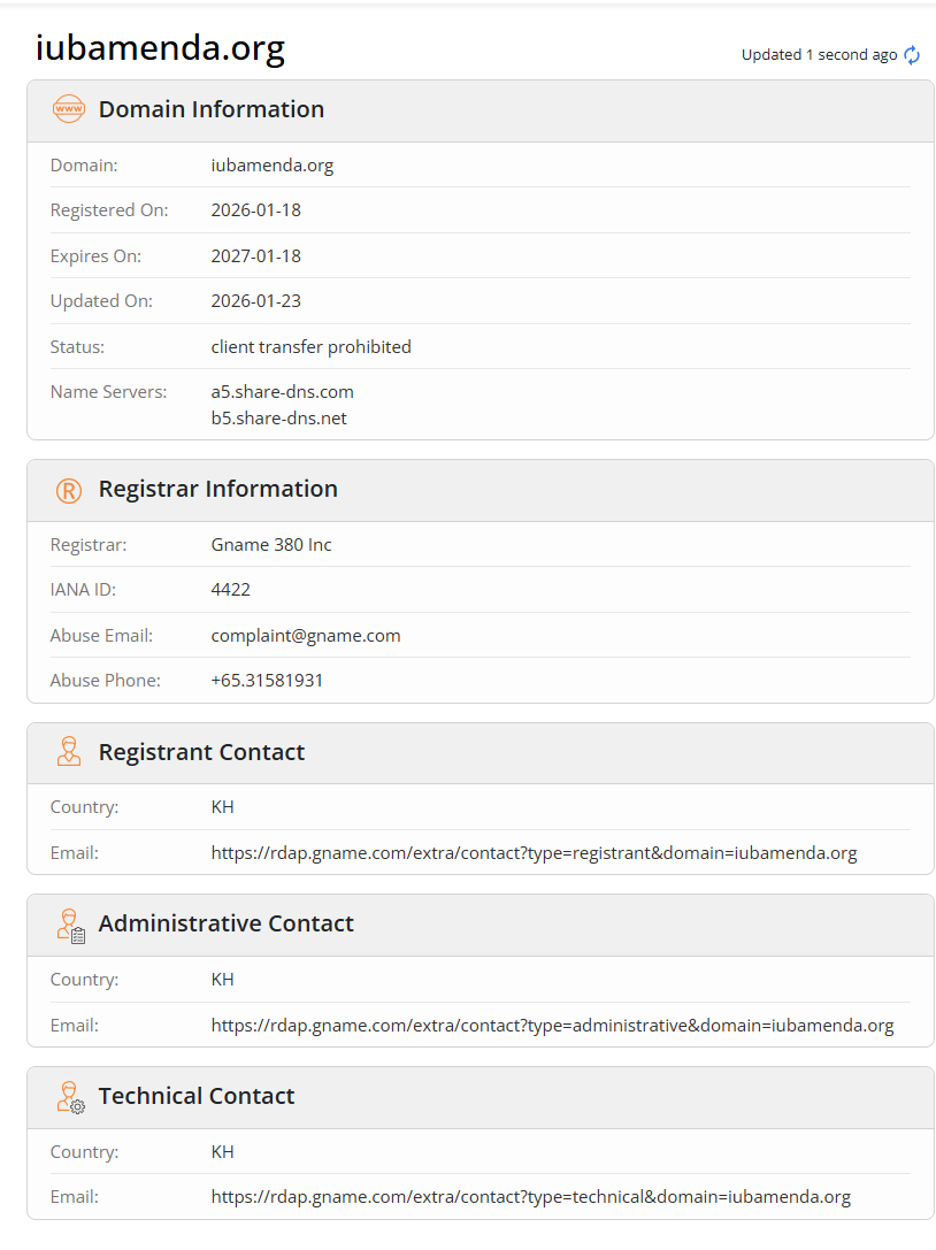
Using Open-Source Intelligence methods, WikkiTimes tested the institution against the records it would leave in the open if it operated as it claims. The institution’s digital footprint is thin and inconsistent. On a page at iubamenda.edu.cm, the university states that its official website is now iubamenda.org.
The university states that its official website is now iubamenda.org.
That address did not load when WikkiTimes followed it, returning a “Server not found” error over several days and across different browsers.
On Facebook, WikkiTimes tracked several pages attributed to the university. On one of the pages, it carries 522 followers and five photographs, and has been mentioned by a user from Sokoto only once. The user in 2016 described the picture as “inspiring,” noting Professor Patrick Chefu Fusi addressing students in a packed room. A second page, created in September 2022, has 173 followers and 11 photos.
A social media user in 2016 described this picture as “inspiring.”
Many of the site’s subpages do not function. For instance, clicking “See admission lists” returns a server error, as of June 1, when WikkiTiems checked.
Clicking “See admission lists” returns a server error, as of June 1, when WikkiTiems checked.
The International University of Bamenda occupies an ambiguous position in higher education indexing systems. It appears in the major directories but carries no substantive ranking data in any of them. On uniRank, which lists it as officially recognised by Cameroon’s Ministry of Higher Education, the institution holds no country rank and no world rank. This profile contrasts sharply with Cameroon’s public universities, including the University of Bamenda and the University of Buea, which carry full ranking scores on the same platform. Times Higher Education only holds a shell entry for IUB: a name and a location, with no ranking position, no impact score, and no published statistics. The institution does not appear in the AD Scientific Index’s Cameroon research-output table, from which both the University of Bamenda and the Catholic University of Cameroon are listed with faculty publication records. Its absence from Webometrics, the research-impact ranking on which Cameroon’s public universities carry full profiles, is consistent with this pattern, though direct verification of that absence was not possible.
The private institution shares part of its name with the University of Bamenda, the public university created in 2011, and the two are easily confused. On examination, the research that appears under the Bamenda name traces to the public university and other Bamenda institutions, not to the institution Adamu names. An absence of indexed research is not, by itself, proof that none was done.
The standing of a degree from the International University of Bamenda in Nigeria with the National Universities Commission (NUC) is unsettled. To verify the degree’s standing, WikkiTimes filed a Freedom of Information request with the NUC. The commission had not responded for several days after the request was sent. Its spokesperson, Mr Okoronkwo Ogbonnaya, directed WikkiTimes to a separate email address and asked that the same request be resubmitted. WikkiTimes did so; there was no response as of press time.
What the Nigerian Law says about fake degrees
The Nigerian law provides for criminal liability where a certificate is found to be forged. Bauchi State operates under the Penal Code, whose Sections 362 to 364 prescribe up to 14 years’ imprisonment for forgery and make the knowing use of a forged document a serious offence.
Section 182(1)(j) of the 1999 Constitution, as amended, provides that a person who presents a forged certificate to the Independent National Electoral Commission is not qualified to contest for public office.
Under Nigerian law, electoral exposure does not depend solely on what a candidate submits to INEC. In the case of Adamu, for instance, acknowledging holding a doctorate from the International University of Bamenda on multiple occasions, including during his screening for nomination as a commissioner, could be costly.
Screenings are formal proceedings in which the declaration of academic credentials carries legal weight. Even if he has not presented his International University of Bamenda doctorate to the Independent National Electoral Commission, those prior acknowledgements establish a pattern of knowing use of the document as genuine, which is precisely the conduct Section 366 of the Bauchi State Penal Code criminalises. He also remains liable for forgery under Sections 362 to 364 — offences that carry up to 14 years’ imprisonment.
Section 182(1)(d) of the 1999 Constitution, as amended, bars any person sentenced to imprisonment for an offence involving dishonesty or fraud from contesting any elective office. The offence of forgery under Section 366 of the Penal Code and the offence of uttering a false document both carry custodial sentences upon conviction.
This story is produced with Support from WikkiTimes Media Foundation and Civic Media Lab.
THE Borno government on Friday reintegrated at least 3,740 repentant members of Boko Haram into society as part of the state’s reintegration model policy.
Abdullahi Ishaq, a retired Brigadier General and Special Adviser to Governor Babagana Zulum on security, made this known at the reintegration ceremony in Maiduguri, according to the News Agency of Nigeria.
Those reintegrated included 720 men, 992 spouses, and 2,050 children who had repented and surrendered to troops, after being deradicalised, disarmed, rehabilitated and trained in various skills acquisition at the Hajj Camp in Maiduguri.
The ICIR reports that the programme is part of government’s efforts to restore peace to the state and other parts of Nigeria facing insurgency.
An investigation by The ICIR revealed that the initiative often backfires and aggravates the nation’s insecurity, as many of those who are deradicalised soon return to the trenches, make brutal comebacks, and unleash further mayhem on society.
Insurgency in Nigeria, which began with the emergence of Boko Haram in Borno State in the early years of this century, has killed thousands of citizens, displaced millions, and orphaned countless children. The violence, including attacks on critical infrastructure, promptly spread to other parts of the country, including Adamawa, Yobe, Abuja, and Kano.
The crisis has since escalated, spawning other armed groups, including Lakurawa, bandits, and the Islamic State West Africa Province (ISWAP)
To date, Nigeria has employed both kinetic and non-kinetic approaches to address insecurity, but there appears to be no immediate end in sight, as the country remains gripped by widespread insecurity.
While many Nigerians continue to oppose the deradicalisation and reintegration of repentant terrorists into society, the government maintains that the process is consistent with international best practices.
NAN reports that the repentant insurgents who were subjected to swearing with the Holy Quran also formed part of Batch-9, low-risk and minor clients in the series of repentants who would be reunited with their various communities in the state.
Ishaq, however, described the event as marking another milestone in the Borno Model Non-Kinetic approach to the fight against terrorism in the North-east region and Borno in particular.
“It has been a success story since 5th July 2021 when the good people of Borno State under the stewardship of our dynamic leader Prof. Babagana Umara Zulum agreed to forgive and accept their sons who are willing to drop arms and embrace peace.
“Today, the Borno Model is adjudged to be one of the most effective non-kinetic programmes in the history of mankind with over 350,000 persons that willingly exited the bush and surrendered to the military,” he said.
Ishaq stated that those released had left the bush and reported to the nearest military location for initial profiling, and those with weapons surrendered to troops.
According to him, some of them left their camps but could not make it to any military location before they were arrested and killed, adding that the lucky ones who made it to the military location were later moved to Hajj Camp for proper documentation, profiling and deradicalisation.
“The camps’ administrators kept them busy with various programmes geared towards deradicalisation and preparing them for life after camp.
“Tuesdays and Thursdays were for Islamic programmes, lectures on hygiene, drug abuse and other fields during Mondays, Wednesdays and Fridays were for skill acquisition programmes such as metal works, carpentry, tailoring, pot making, brick laying, barbing, cap making, repair of phones, solar installation, vulcanising, and repairs of motorcycles”. Ishaq said.
He noted that the women among them were not left out in skill acquisition as they were trained in cattery services, knitting, cap marking, tailoring, soap making to mention a few.
Ishaq said that the state government had provided starter packs for the beneficiaries and their spouses to support them in their post-camp life.
“The Borno Model has reintegrated 8,960 in batches one to eight, and with today’s 720 clients (Batch 9), there would be 9,680 clients. The clients seated in front of you were disarmed, demobilised, thoroughly deradicalised and rehabilitated.
“They are from Bama, Kondugua, MMC, Jere, Mafa, Dikwa, Gwoza, Damboa, Marte, Mongunu, Kukawa, Gbambolu Ngala, Kalabarge and Gubio Local Government Areas. Community leaders, Civilian Joint Task Force (CJTF)/Hunters screened them properly before recommending them for reintegration,” he said.
He, however, urged them to go back to their communities and be law-abiding, participate actively and positively in community work and development programmes.
Earlier, the state Commissioner for Women Affairs and Social Development, Hajiya Zuwaira Gambo, represented by the Permanent Secretary, Babagana Kadai, said the day was not merely a ceremony but a celebration of hope, resilience, reconciliation, and the commitment of the Borno government to restoring peace and rebuilding lives affected by years of insurgency.
“I would like to express our deepest appreciation to His Excellency, Prof. Babagana Umara Zulum, Executive Governor of Borno State, whose visionary leadership, compassion, and dedication to peacebuilding have continued to attract national and international recognition.
“Under Zulum’s leadership, thousands of families displaced by conflict have been resettled, communities have been rebuilt, schools and healthcare facilities have been restored, and opportunities have been created for vulnerable populations to regain their dignity and livelihoods.”
She stated that the Ministry of Women Affairs and Social Development would remain at the forefront of these efforts.
THE UNITED Kingdom has introduced a new £15 million initiative aimed at helping Nigeria attract more private-sector funding, advance key economic changes and promote sustainable growth over the next three years.
The UK Minister for Africa and International Development, Baroness Chapman, made the announcement during an official visit to Nigeria. The visit included meetings in Abuja and Kaduna.
According to the British High Commission, the programme forms part of ongoing efforts to strengthen co-operation between both countries and support Nigeria’s economic development goals.
“The UK Minister for Africa and International Development, Baroness Jenny Chapman, has concluded a two-day visit to Nigeria, during which she announced a new £15 million Growth Programme, deepened cooperation on digital transformation and health, and visited communities benefiting directly from UK investment on the ground.”
The scheme is expected to encourage greater investor confidence, support policy improvements and help move Nigeria toward long-term economic expansion following recent stabilisation efforts.
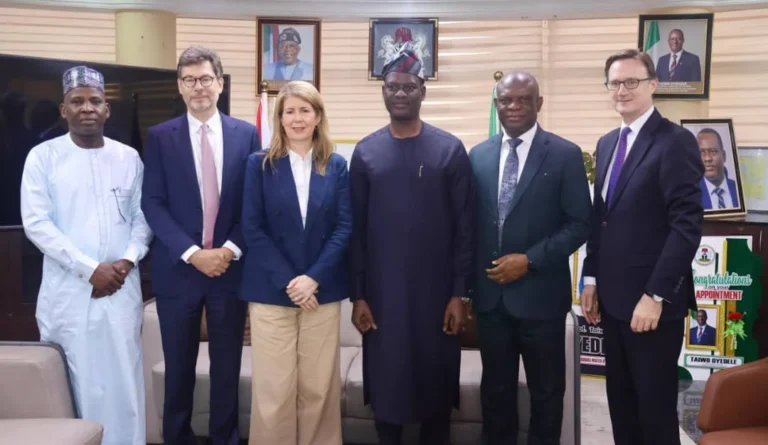
During her stay in Abuja, Chapman held discussions with the Minister of Finance and Coordinating Minister of the Economy, Taiwo Oyedele.
Their talks focused on the new programme and other areas where both nations can work together to promote economic progress.
Alongside the growth initiative, the UK government revealed plans to strengthen collaboration in Nigeria’s technology sector through the State Partnership for Regulatory Innovation in the Digital Economy and Regulatory Transformation (SPRIRET)
The project, which falls under the UK’s Digital Access Programme, will be implemented across five states. It is expected to improve digital regulations, remove obstacles affecting investors and encourage expansion in broadband services, technology-based businesses and emerging digital industries.
Speaking on the partnership, Oyedele highlighted the importance of relations between both nations and the opportunities the new programme presents.
“The UK-Nigeria Growth Programme helps bring this partnership to life by supporting capital market development, technology investment, small businesses and technical assistance.
“We look forward to seeing these opportunities deliver lasting benefits and drive progress for both countries,” Oyedele was quoted in the statement.
He also noted that cooperation between Nigeria and the United Kingdom had grown beyond traditional diplomatic ties and focused on shared economic advancement and development.
Part of the meeting reviewed progress under the Enhanced Trade and Investment Partnership, with attention placed on boosting Nigerian exports through the Developing Countries Trading Scheme, increasing collaboration in financial technology and creating stronger connections between both countries’ capital markets.
The UK minister later travelled to Kaduna, where she met Governor Uba Sani to assess years of cooperation between the state and the UK government. Their discussions explored ways to attract additional investment and expand support for climate-related financing initiatives.
She also visited beneficiaries of UK-backed agricultural projects, including livestock breeders and community animal health workers. In addition, she toured the Unguwan Sanusi Primary Health Care Centre in Kaduna South, a facility that provides medical services to about 20,000 people.
Chapman met with the Minister of Industry, Trade and Investment, Jumoke Oduwole, where discussions centred on strengthening commercial relations between the two countries.
At the conclusion of the visit, she expressed optimism about the future of relations between Nigeria and the United Kingdom.
“This visit has reinforced everything I believe about the UK-Nigeria partnership. That it is deep, it is real, and it is moving in the right direction,” she said.
British officials said the latest programme adds to existing UK investments in Nigeria. Through British International Investment, nearly $800 million has already been committed to sectors such as agriculture, clean energy and manufacturing, demonstrating the UK’s continued interest in supporting Nigeria’s economic development.