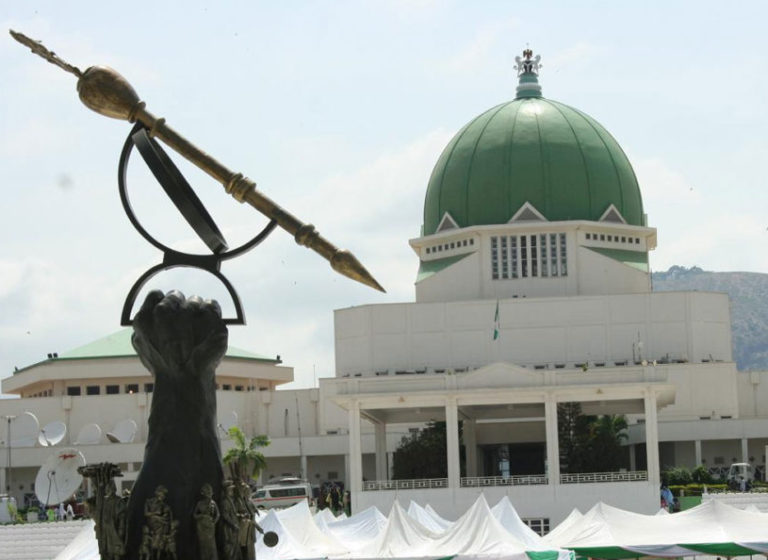
CHAIRMAN of the Senate Committee on Media and Public Affairs Ajibola Basiru has denied reports that N37 billion had been released to the leadership of the National Assembly for the renovation of the National Assembly Complex.
In a statement released on Wednesday, Basiru noted that the National Assembly was not responsible for maintaining the National Assembly building and had not received any funding for its renovation.
“While it is true that an initial appropriation of the above stated sum was made due to the decaying nature of the complex which has not witnessed any major maintenance or overhauling since construction, the said amount was reduced to N9 billion after the breakout of COVID-19 pandemic.
“Even with this reduction, the sum of N9 billion or any amount is yet to be cash backed or released to the National Assembly. None of this amount is even appropriated for the National Assembly bureaucracy or its leadership,” he said.
Basiru stressed that the Federal Capital Development Authority (FCDA) was responsible for the maintenance of the building, adding that the leakages recorded during a rainfall on Tuesday justified the need for urgent renovation of the dilapidated structures in the complex.
The National Assembly Complex was flooded following a heavy downpour on Tuesday.
The sum of N9 billion naira had been approved for the renovation of the complex, which was built in 1999.
THE management of Federal University Oye Ekiti (FUOYE) has raised the alarm over alleged threat on the life of the institution’s Vice-Chancellor Abayomi Fasina.
There was tension in the university on Monday when gun-wielding men invaded the administrative building, claiming they were sent from the Special Fraud Unit (SFU) of the Nigerian Police Force to invite the VC for questioning.
The situation was, however, brought under control when security operatives assigned to the school insisted that the men must provide evidence of clearance from the state commissioner of police and the letter of invitation.
But in a joint statement issued by the Chief Information Officer to the VC Foluso Ogunmodede, and Special Adviser on Media Matters to the VC Wole Balogun, the institution said the incident was a clear case of assault on the VC.
The statement, titled, ‘Threats to the life of the VC of FUOYE — University Community,’ stated that nobody else would be safe if the VC could be assaulted without prior notice or invitation.
The statement noted that the university had, in the past, honoured invitations by agencies of the Nigerian government, stressing that there was no prior notification of invitation on the VC before Monday’s incident.
“Some officers, who claimed to have come from the SFU allegedly to deliver a letter of invitation to the VC, insisted that the delivery must be made in person, this giving a red signal.
“The security personnel in the university suspected foul play when the suspected men could not provide written clearance from the Ekiti State Commissioner of Police, but instead created unnecessary drama by making frantic efforts to find their way to the VC’s office with an obvious intention to whisk him away from the campus.
“The security men attached to the Central Administration Office of the university insisted that the strange men introduced themselves properly and also show incontrovertible evidence of the clearance from the federal security agencies attached to Ekiti State and the university. We have no doubt that these men were on a sinister mission.
“The people who came never contacted us or invited the VC before they came. There is no agency of government that has ever invited us that we did not honour their invitation.
“The ICPC, Senate Committee on Ethics, Privileges and Public Petitions and its counterpart in the House of Representatives have invited us and we honoured all these invitations. So, we do not have any record of evading or not honouring invitations by government agencies.”
While noting that there was no basis for the men to have done what they did, the statement added that “the manner in which they approached the matter showed clearly that they had sinister motives and that this could be a hatchet job.”
“We consider this as a breach of security protocol and threat to the lives of the VC and the university community as a whole.”
The statement noted that some unnamed corrupt individuals were behind the alleged threat on the VC’s life
“We know the source of this sinister agenda! It is simply a case of fighting corruption and corruption fighting back,” the statement said.
THE Secretary-General of the African Continental Free Trade Area (AFCTA) Wamkele Mene has called for understanding among stakeholders in the continent as negotiations on certain ‘grey areas’ drag full implementation of the trade pact.
The AFCTA officially commenced on January 1, 2021 and industry analysts say the pact could grow an estimated $3.4 trillion market. It is also expected that the trade pact will help to harness more than $84 billion untapped intra-African exports, according to a new report by the African-Export-Import Bank (Afreximbank).
Speaking during an interview in Abuja, the secretary-general, Mene, disclosed that currently, the continent was at the initial stage of implementation of the trade pact amid concerns over grey areas in the different phases of implementation.
“Overall, we are in the initial stages of implementation. We are also still negotiating outstanding areas of phase one in trade in goods and trade in services. Phase two which we will start in July to August is intellectual property rights, competition policy, women in trade, digital trade. We want to get it right so that our people can enjoy maximum benefits of the trade pact.” he said.
Mene said there was a need to sort out grey areas so as to boost intra-African trade by reducing trade barriers and creating a level-playing ground among various member nations.
“I think Africans should be patient and understand that we are in the initial stages of a significant endeavour and that is bringing together 38 countries to trade under a single set of rules.”
Citing similarities with the European Union, he said, “It has taken the European Union 72 years to get to this point of market integration that it enjoys today, so it is not easy. What we are doing is a difficult task, it is time-consuming; it will require us to be patient and we shall see the results in the years to come.”
He stressed that it was expected that with the trade pact, in 15 years from now, 97 per cent of products traded in Africa should be in zero duty.
“We want the make sure that we boost Intra Africa trade by reducing these barriers to trade,” he added.
Industry experts say there is a need to clear out grey areas in the trade pact to lessen possible incidences of dumping of goods from Europe on some member countries.
“Rules of origin need to be sorted out clearly. We have had instances where some of our neighbours like the Benin Republic are used as strategic dumping sites for some finished goods which have been rebranded as produced locally,” an associate Consultant to the British Department of International Development (DFID) Celestine Okeke told The ICIR.
Okeke stressed that without proper checks and balances, the liberalisation of trade within the Economic Community of West African State (ECOWAS) trade could be exploited by some African countries to take advantage of the Nigerian market.
Also speaking on the matter, a former President of the Abuja Chamber of Commerce and Industry Adetokunbo Kayode told The ICIR that priority should also be given to the establishment of dispute resolution centres in the African Continental Free Trade Area in order to ensure swift resolution of possible trade disputes.
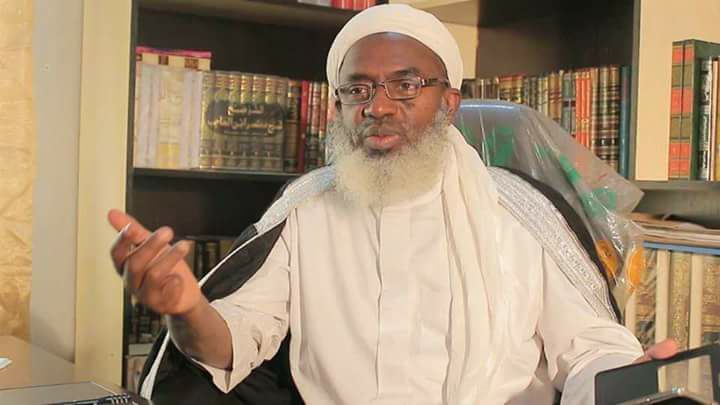
ISLAMIC cleric Ahmad Gumi has accused the Nigerian government of taking sides in what he described as an inter-tribal war going on in the country.
Gumi said this in an interview on Arise TV on Wednesday.
He urged the government to adopt a neutral stance in ongoing conflicts between various ethnic nationalities across the country.
“This is a tribal war going on and with the government taking one side. If you can cross to the other side, listen to their grievances and understand their agitations, government can easily in a very short time cure this problem we are having,” he said.
While admitting that bandits were indulging in atrocious acts, the cleric noted that efforts were not being made to investigate atrocities being committed against them.
He urged well-meaning Nigerians to stay neutral in the inter-tribal war and to avoid the temptation of turning to tribalism or religion to express grievances due to what he described as the fracture in the governmental structure.
While the cleric accused the government of taking sides against the Fulanis, Nigerians feel that the president favours Northerners over other ethnic groups, especially in cases of political appointments.
However, a regional analysis of appointments into leadership positions in Nigeria’s security agencies had shown that 12 out of 16 heads of security outfits hail from the Northern part of the country.
Speaking further on Nigeria’s security situation, Gumi said that the Indigenous People of Biafra (IPOB) was a more dangerous group than the bandits that had been terrorising the Northern part of the country.
Noting that fairness should be applied in comparisons between the two groups, Gumi urged Nigerians to desist from describing all Fulani herdsmen as criminals.
“IPOB is attacking the police, the army, INEC, government institutions, killing our men in service. And the herdsmen are kidnapping children; not to kill them but to get money.
“So how can you compare somebody who is killing our gallant men in the armed forces, directly attacking them, to somebody who is kidnapping children to make money, not to kill them? We need some fairness in what we are doing,” he said.
The cleric further claimed that the perpetrators of the recent kidnap of school children in parts of the country were children as well, who he said had been abandoned by the government to fend for themselves.
“When you look at the kidnappers too, they are children like them. Where is their own school? They are all children of the same age. Let’s go into the bush, get these boys out of this criminality, embrace them as Nigerians, show them the bad ways they are doing,” he said.
THE Chairman of Independent Corrupt Practices and Other Related Offences Commission (ICPC) Bolaji Owasanoye, on Tuesday, called on African countries to facilitate assets recovery at all levels, including the return of artworks and artefacts.
He disclosed this while presenting a paper titled ‘Understanding the Common African Position on Asset Recovery (CAPAR)’ during a virtual Commonwealth regional conference for anti-corruption agencies in Africa.
“In Nigeria, precisely Benin, Edo State, two major artefacts have been returned while the country has recovered between $600 million and $700 million assets in the last six years,” he said.
Owasanoye advocated the strengthening of legal and financial institutions to aid the process of asset recovery, including establishing funds, trusts, and dedicated African escrow accounts to be held by regional financial institutions.
“The reality on the ground is that domestic resource mobilisation cannot improve if corruption is not diminished. Illicit financial flow from the continent is not reversed, and fiscal governance from revenue and expenditure sides is not improved.
“We need to reverse the anomaly of Africa being a net creditor to the world yet burdened by debt,” he stated.
Owasanoye said the policy and advocacy instrument were to assist Africa in identifying, repatriating and effectively managing assets while respecting the sovereignty of member-states.
Last year, Swiss authorities returned $300 million to Nigeria as part of the seizures from the stash of Nigeria’s former dictator, Sani Abacha.
According to the US Department of Justice, another $30 million is expected from Britain. The sum of $144 million stashed in France is also expected to be recovered as part of the recovery of Abacha’s loot.
The ICPC boss urged African countries to implement measures to ensure accountability and transparency so as to boost public confidence in managing recovered assets. He also spoke of the need for civil society organisations and the media to monitor the use of recovered assets.
At the event, the Commonwealth Secretary-General Patricia Scotland highlighted the need for African countries to tackle corruption, noting that social and economic resources were increasingly stretched.
“Corruption leads to illicit financial flows. Africa has lost $1.26 trillion to illicit financial flows, while $50 billion is lost annually by the continent.
“Corruption and illicit financial flows need to be brought to the front burner as they have continued to pose an enormous challenge to the continent,” Scotland said.
The Commonwealth secretary-general urged the anti-corruption agencies to strengthen their oversight function.
“We need to continue to improve and strengthen our capacities. We, at the Commonwealth Secretariat, will greatly work with member countries to realise that goal as well as the United Nations Development Goals,” she added.
A former Chief of Army Staff (COAS) Tukur Buratai has been deployed as Nigeria’s ambassador-designate to the Republic of Benin.
This was contained in a statement posted on the official Facebook handle of the Ministry of Foreign Affairs.
A former Chief of Defense Staff Abayomi Olonisakin was also deployed as Nigeria’s ambassador to the Republic of Cameroon.
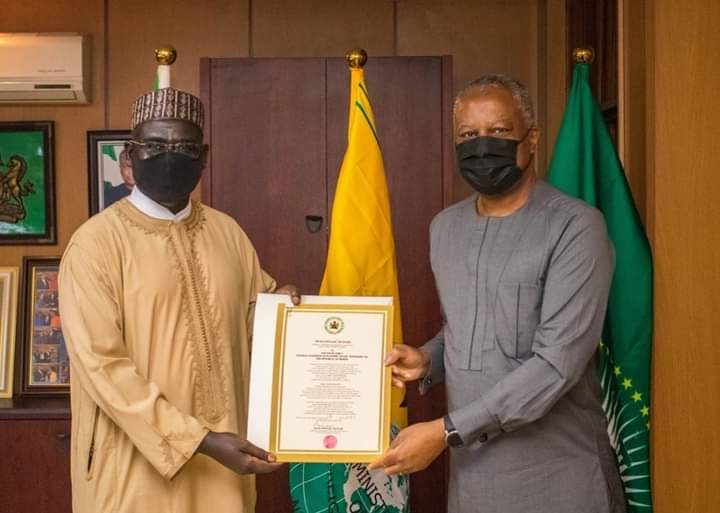
Minister of Foreign Affairs Geoffrey Onyeama handed letters of credence to the former service chiefs.
“Today, the Honourable Minister of Foreign Affairs, H.E. Geoffrey Onyeama presented Letters of Credence to the Ambassador-Designate of Nigeria to the Republic of Cameroon, Amb. Abayomi Gabriel Olonisakin and the Ambassador-Designate of Nigeria to the Republic of Benin, Amb. Tukur Yusufu Buratai,” the post by the Ministry of Foreign Affairs read.
Minister of Foreign Affairs Geoffrey Onyeama and Nigeria’s ambassador to Cameroon Abayomi Olonisikan.
The Senate had, in February, confirmed the immediate past service chiefs as non-career ambassadors following their nomination by President Muhammadu Buhari.
Controversy had trailed the development, with a professor of law and former Executive Chairman of the National Human Rights Commission (NHRC) Chidi Odinkalu saying the appointments did not absolve the former service chiefs from criminal allegations levelled against them.
Odinkalu said ‘a few credible’ countries would not accredit them as ambassadors due to the allegations levelled against them.
He noted that, for example, a member-state of the Organisation for Security and Co-operation in Europe (OSCE) would likely not take the former service chiefs as ambassadors.
“In any OSCE country, for instance, any effort to deploy them as ambassadors would almost be guaranteed to end up in a raucous domestic and diplomatic mess and will be resisted seriously. In all likelihood, they will not pass muster with those countries,” he stated.
According to Odinkalu, the International Criminal Court prosecutor had already decided to initiate formal processes for an investigation into atrocities in Nigeria, including possible or alleged crimes by the Nigerian Army under the command of former COAS Buratai and former Chief of Defense Staff Abayomi Olonisakin.
In November 2020, the International Criminal Court confirmed that it received petitions over the killings of peaceful protesters during the #EndSARS protests by men of the Nigerian Army.
Buratai was particularly accused of ordering the killings of Shiites and young members of the Indigenous People of Biafra (IPOB).
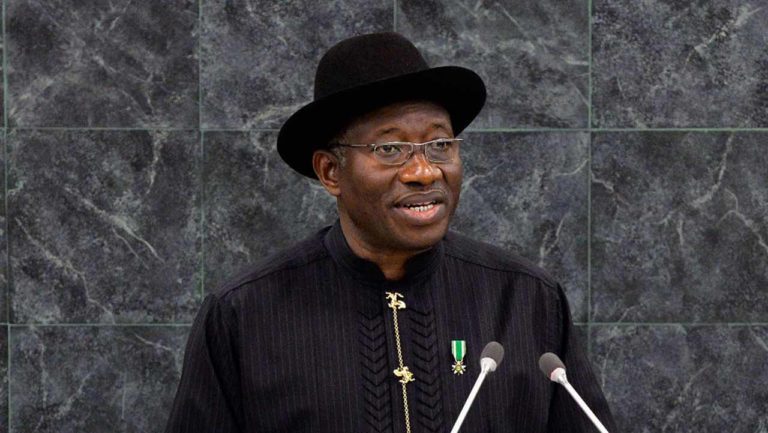
FORMER President Goodluck Jonathan has said Nigeria is being haunted by what he described as the concentration of political leadership along tribal and religious lines.
Jonathan said this in an address at the 13th Joe-Kyari Gadzama Public Lecture which held virtually and physically in Abuja with the theme: ‘Redefining Democracy: Yearnings of the Minority in a Democratic Setting.’
“I believe that from independence, the political evolution of leadership in Nigeria has been too concentrated along tribal and religious lines and that is still haunting us today,” the former president said.
Jonathan further observed that the ‘swelling disenchantment’ that resulted in coups and counter-coups was the fallout of the nation’s inability to manage diversity and downplay differences since the country gained independence.
“It is obvious that calls for fragmentation seem to be getting louder among some segments of our nation,” he added.
Commenting on agitations for self determination in parts of the country, Jonathan noted that where the minority felt they were not relevant, there would be a tendency to fulfil their destiny with a different approach.
According to him, that tendency gave rise to unending agitations and resistance movements across the world.
On federal character in appointments, Jonathan said the Federal Character Commission (FCC) over many decades “may have been doing its best to give everyone fair representation and a fair sense of belonging, but there are still many who feel that this agency of government has not fully addressed the challenges of accommodating minorities.”
Noting that the success recorded by the FCC had been restricted to the civil service, the former president observed that “many believe that the commission does not address inequalities in political appointments and sensitive areas like the military and public sector appointments.”
In an interview with Arise TV, Nigeria’s President Muhammadu Buhari had said his appointments were not based on ethnic or religious considerations but rather hinged on merit.
However, Jonathan said he believed that Nigerian leaders could do more to eliminate ethnic sentiments in the country.
“Looking to the future, I can say that our leaders can do a lot more to eliminate ethnic sentiments in our society, enthrone merit and build a system that gives citizens equal opportunities to excel.
“There has to be a united, strong and cohesive Nigerian nation of patriotic citizens for any structure or system to yield the promise of our shared prosperity,” he said.
Jonathan further stated that several years after independence, Nigeria should be an advanced economy with effective social security systems like countries such as Singapore, Malaysia and the United Arab Emirates (UAE).
But he expressed regrets that the country was lagging behind in economic development.
IMMEDIATE past Nigerian President Goodluck Jonathan has been appointed as the Chancellor of Cavendish University Uganda (CUU).
The university, which was established about 13 years ago, announced Jonathan’s appointment via various social media platforms on Tuesday.
“Welcome aboard Goodluck Jonathan as you take over as the Chancellor of CUU. We look forward to this new era and achieving great things under your leadership,” the university posted on its Facebook and Twitter handles.
Jonathan becomes the third former president to be appointed as chancellor of the university.
The late former President of the United Republic of Tanzania Benjamin Mkapa and former President of the Republic of Zambia Kenneth Kaunda, also late, were the university’s second and pioneer chancellors, respectively.
Before joining politics in 1998, Jonathan worked as an education inspector in the Rivers State Ministry of Education. He also served as a lecturer in the Department of Biological Sciences at the Rivers State College of Education.
He is expected to be installed as the new chancellor of the CUU on August 26, 2021, just in time to preside over the conferment of degrees and award of diplomas and certificates at the university’s 10th Graduation Ceremony, which will take place at Munyonyo Commonwealth Resort on the same date.
THE Peoples’ Democratic Party (PDP) has accused President Muhammadu Buhari’s government of elevating corruption as a new normal.
In a statement by the party’s National Publicity Secretary Kola Ologbondiyan on Tuesday, the PDP alleged that officials were pillaging ministries, department and agencies, looting over N15 trillion while mortgaging the future of the nation with reckless foreign borrowing.
But the PDP failed to name the officials and present evidence on how the alleged officials squirrelled the fund.
The party made the allegation in reaction to Senate President Ahmed Lawan’s claim that the feud between the Eighth National Assembly did not allow Buhari to deliver his electoral promises to Nigerians.
Bukola Saraki and Yakubu Dogara, both APC members before defecting to the PDP in the build-up to the 2019 elections, led the two chambers of the National Assembly: the Senate and House of Representatives, respectively, between 2015 and 2019.
Lawan had said on Monday at a programme to close the First Progressives Youth Conference 2021 in Abuja that some party members elected into the National Assembly constituted barriers to the Buhari government’s agenda.
He said the feud resulted in the party losing its first four years in power.
“When we were voted in 2019 as leaders of the National Assembly, we were conscious of one thing, that our mandate that was given to us by Nigerians in 2015 had suffered disruption and dislocation,” Lawan had said.
“For four years, our government could not perform optimally because of the then crisis between the parliament – the National Assembly – and the Executive arm of government.
“So, APC had already lost four very important years. And, that was supposed to be the years that we should have convinced Nigerians that they took the right decision by voting out a PDP administration in 2015.”
The PDP described Lawan’s claim as a “despicable juvenile excuse for incompetence and corruption that weighed down the Buhari administration.”
It accused the ruling party of wrecking the country’s economy and turning the nation into a beggar and poverty capital of the world.
It also said the APC had excelled in superintending over the escalation of violence and acts of terrorism, which it said had turned the nation into a killing field.
The PDP urged the APC leaders to admit that their party and Buhari presidency were ‘a bunch of failures’ that had brought so many challenges to the country.
“APC leaders should be bold to tell President Buhari and the APC that posterity will not be kind to them for their manifest misrule, which has brought so much devastation to our nation.
“By 2023, history would have listed the Buhari Presidency and the APC as a calamitous era as well as that wind that blew no good in the life of our nation.
“Of course, the APC leaders have admitted that the party is already heading to the dustbin of ignominy as it cannot survive after the Buhari tenure,” the PDP started.
The party, therefore, urged people in the county to support it to take over power from the APC in the 2023 elections.
FARMING used to be traditionally viewed as a male-dominated occupation, with little input from women in supporting their families to grow crops and raise livestock. However, lately, a lot of women are breaking the bounds of this notion and engaging in agricultural production across Nigeria, despite gender-related impediments.
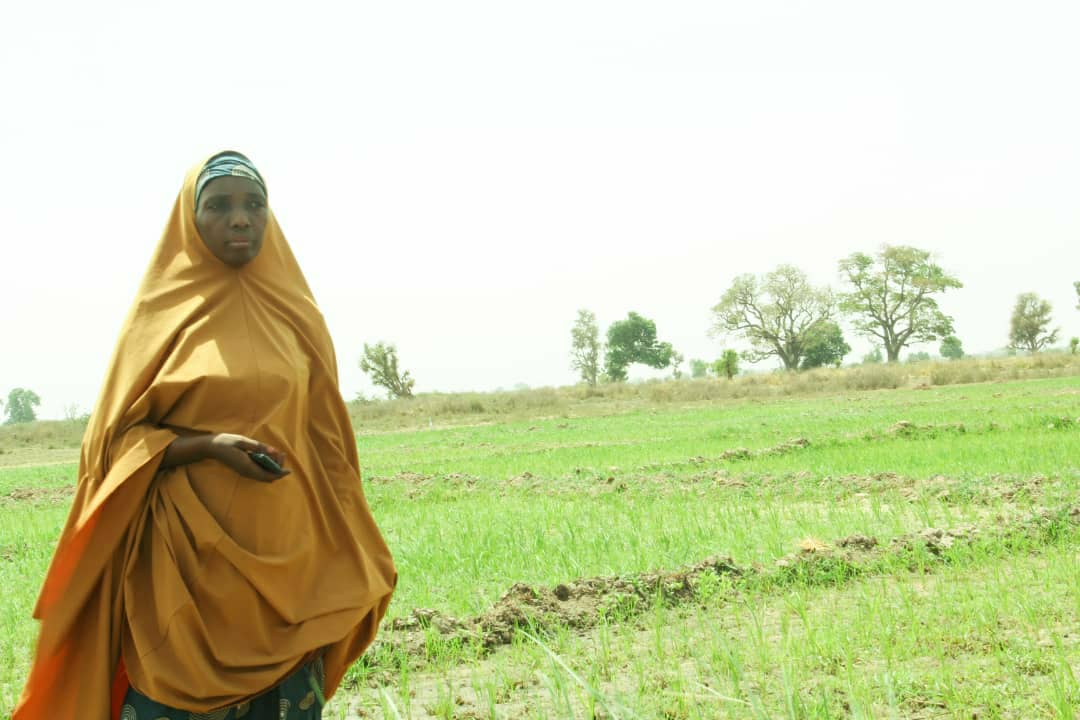
For Bilkisu Yahaya, a happily married, all-year-round rice and onion smallholder farmer in Birnin-Kudu Local Government Area (LGA) of Jigawa State, the challenges are numerous. However, the main worry lies in gaining access to the market for the end product after the whole hard work has been done.
According to Bilkisu, “I farm both in dry and rainy seasons; I also farm rare livestock. Despite all the challenges we face, including lack of inputs, our biggest worry is the middle-men.”
Explaining further, she says, “They exploit us to the high heavens because before they come to the farm, we already have an agreed price. But by the time they get here, they would cut the agreement down to almost fifty per cent, citing access road as an excuse. We are left with no choice than to sell to them that way.”
She adds, “I heard that there is this thing called ‘digital.’ We wish we can be provided with that, even if it’s that alone, to enable us to sell our products directly.”
Hajiya Rabi at her farm in Birnin Kudu LGA
Bilkisu’s allusion to the access road leading to her farm, in the Chimadara area of the State, is not just a mere saying. About 9 kilometres away from Dutse, the state capital, passing through Rungumau, Kwaimawa, Kudai villages, before veering off the main road in Kandi, North-West of Dutse, through Kwadiya, the road that leads to the farm is rough and barely passable. This is worsened by the direct impact of the scorching sun heating up the sandy desert, making access tiring, hot and de-hydrating.
“One might need to pause to catch a breath and have some rest before engaging in any farming activity. This in itself is a threat to productivity and overall output.
“We mostly come here through motorbikes and we have fallen here severally. In fact, I once fell off from one, with a pregnancy. It was tough. Sometimes when we come to some very rough points, we alight, trek the distance while the rider pushes the bike until we cross and then continue the journey,” Bilkisu recounts.
When asked if, as a woman farmer, she has ever received any form of support in terms of farming inputs and agricultural loans to boost her trade, Bilkisu, who went into farming because she had no job after graduating, reveals that she is not even aware if such initiatives or interventions exist.
“I am married and live in the state capital. I should know if anyone is helping the women farmers. No one has ever helped us. Sometimes, when we don’t have money to farm, we borrow and payback after harvesting our farm produce and selling them off,” Bilkisu says.
She further states that only men farmers get the intervention that comes and they, in turn, sell to the women at a low price, saying, “If we were getting direct interventions, our output would have far surpassed what we are producing now.”
Bilkisu started farming by borrowing pieces of farmlands. She eventually used her inheritance to purchase her own land. Now, she develops about two acres of rice farm in her Chimadara paddy.
Young women paid daily after farming on other women’s farms at Ringim Local Government Area
“During the dry season, we farm a lot. Once we remove onion, if we like, we plant rice or carrot. It’s the fertility of the soil that matters.”
Bilkisu, who has lamented the security situation of the area, says sometimes she is scared traversing the area alone, which is why she is always accompanied by her male relatives.
According to her, “There was a day we received news that water had submerged our farms in the night. Having invested so much, I couldn’t wait till the following morning, so I came with my brother. But we fell down severally on the road, and we were scared that someone might follow us from nowhere. We are hoping for any form of intervention. We need help, even if it is the road, it will go a long way. Sometimes, we buy even fertilisers on credit,” she narrates.
Bilkisu says that a lot of women have farms but cannot till, instead they give the farms out due to lack of resources.
“We go through a lot of challenges ranging from lack of capacity building to adverse weather effects and even loss. There was a time I encountered a huge loss that almost made me give up on farming. I am still paying that debt,” she recalls.
She says that in terms of capacity building, agricultural extension workers usually come to interview them but nothing comes out of it.
For Maryam Mohammad, a small-holder women farmer who cultivates about four acres of land in Dutse Local Government Area, her situation is not that different from Bilkisu’s.
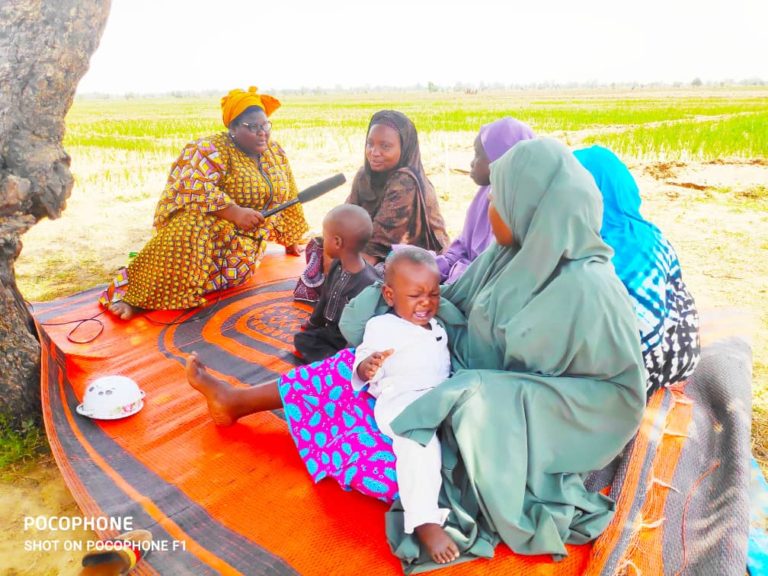
Interviewing Hajia Maryam, a farmer at Kodiya Birnin Kudu Local Government Area of Jigawa State
However, she decries the effect of the COVID-19 pandemic on their farming activities, coupled with the fact that they have challenges assessing the market.
“COVID-19 really affected us. Fertilisers mysteriously disappeared and where we were able to get it, some of the prices were outrageously high. So, our crops suffered, and our livestock were affected by the pandemic. Despite all this, we still farm, but our main challenge is that we don’t know even how to sell our produce after harvesting,” she says.
Maryam does not do dry season farming, which she attributes to lack of seedlings, irrigation machines, irrigation pipes, among others.
Unlike Bilkisu, who is farming on inherited land, another female farmer, Hajiya Maryam, who farms guinea-corn, millet, rice and beans, was given her own piece of farming land by her husband.
Interviewing women farmers at Gumel Local Government Area
Located in the south-west of Dutse, through Minari, Sarari, Jigawar-Tsado and then Sakwaya, the road to Maryam’s farm is not as rough as that of Bilkisu and the security situation is fair, she says. But lack of manpower, farming inputs and implements is limiting their potential.
“Only men get loans here, we don’t. There was only one lady I know that ever got such a loan and it was even because she used the name of a man to enter,” Maryam says.
Agric budget
With a 2021 national budgetary allocation of N280.31 billion, accounting for 2.06 percent of the entire budget, the agriculture financing situation in Nigeria remains a far cry from the prescribed standard set by the 2003 Maputo Declaration on Agriculture and Food Security, pegged at 10 per cent of its member countries’ annual national budget.
This is despite agriculture being the sector with the largest employer of labour in the country, providing jobs for more than one‐thirds (34.65 per cent) of the Nigerian labour force, according to the International Labour Organisation, (ILO).
However, the Mass Agricultural Programme, conceived under the President Muhammadu Buhari post-COVID-19 Economic Sustainability Plan (ESP), is targeted to span the entire agricultural value-chain, from farm to ‘table’, with an estimated cost of N634.98 billion – the largest share of the critical projects in the plan.
The programme is expected to involve between 20,000 and 100,000 hectares of new farmland under cultivation in every state of the federation through a multi‐layered approach. Smallholder farmers are expected to receive support directly or through out‐grower schemes. This will be by way of services and inputs, including land-clearing, ploughing, provision of seeds, saplings, fertilisers, pesticides, as well as extension services and storage to mitigate post‐harvest losses and equipment.
Interestingly, none of the women farmers interviewed in Dutse,Hadejia, Ringim, Kiyawa or Gumel Local Government Area have received any form of support through government schemes to boost their farming.
Some of them say they use their children, brothers, and relatives as manpower to cultivate their farms, while those with little financial capacity employ outside labour for the hard tasks. Even so, the effect of climate change is still telling, especially on the farmlands of those who cannot afford constant irrigation.
The Jigawa State Commissioner for Agriculture Muhammad Alhassan believes the state is not neglecting women farmers as perceived, noting that over 49,000 women have been empowered with livestock since the current administration.
He, however, decries the dubious activities of some individuals who hide under the guise of being farmers in order to access inputs.
“It’s a mindset issue, rooted from societal orientation. Some of them are not real farmers, but people who just want to seize the opportunity in prevalent government programmes. So we try to filter such people out. Otherwise, we have been supporting women as much as we can; sometimes they give me a proposal and I guide them on how to write it and so on,” the commissioner says.
He, however, buttresses that irrespective of gender, his ministry usually gets memos from local government authorities, detailing all their needs, thereby guiding the state to intervene appropriately.
Recall that in October 2019, Jigawa State Governor Muhammad Badaru omitted the ministry of agriculture in the formation of his new cabinet.
The governor, who had appointed 11 commissioners and 15 special advisers, said he was disappointed with the ministry’s performance during his first term, adding that much needed to be done to make the state competitive.
“For agriculture, in the last four years, we remain far below the standard. We have to push in order to improve agriculture significantly and make our agricultural products competitive worldwide,” Governor Badaru had said, then.
For an Agricultural Etymologist in the Department of Crop Protection at Bayero University, (BUK), Kano, Nafi’u Bala Sanda, the solutions to some of these myriad of challenges lies in agri-tech.
Sanda, who opines that the current Federal Government has done much in terms of farming inputs, blames human factors for boycotting the end beneficiaries.
“Do you know that even village heads connive with politicians to collect inputs in the name of end beneficiaries and then divert it? That is why it is not surprising that these women are not getting the inputs they should, especially from the Federal Government,” he says.
As for climate change, he insists agri-tech has come to the rescue, as there are Greenhouses that enable farming in a protected environment, with all productive parameters fully automated, especially temperature control, relative humidity and even softwares fully calibrated to tell the history of soil fertility.
According to him, “Government should start looking that way, especially if we must support our women who are, in any case, the main drivers of smallholder farming. Technology is equating the gender gap; it all depends on the purpose and for those who are ready to do the job.”
Women farmers constitute over 60 per cent of the agriculture labour force and provide inputs and functions that are critical to agriculture.
They carry out about 80 per cent of agricultural production, 60 per cent of agricultural processing activities and 50 per cent of animal husbandry and related activities, yet women have access to less than 20 per cent of agricultural assets.
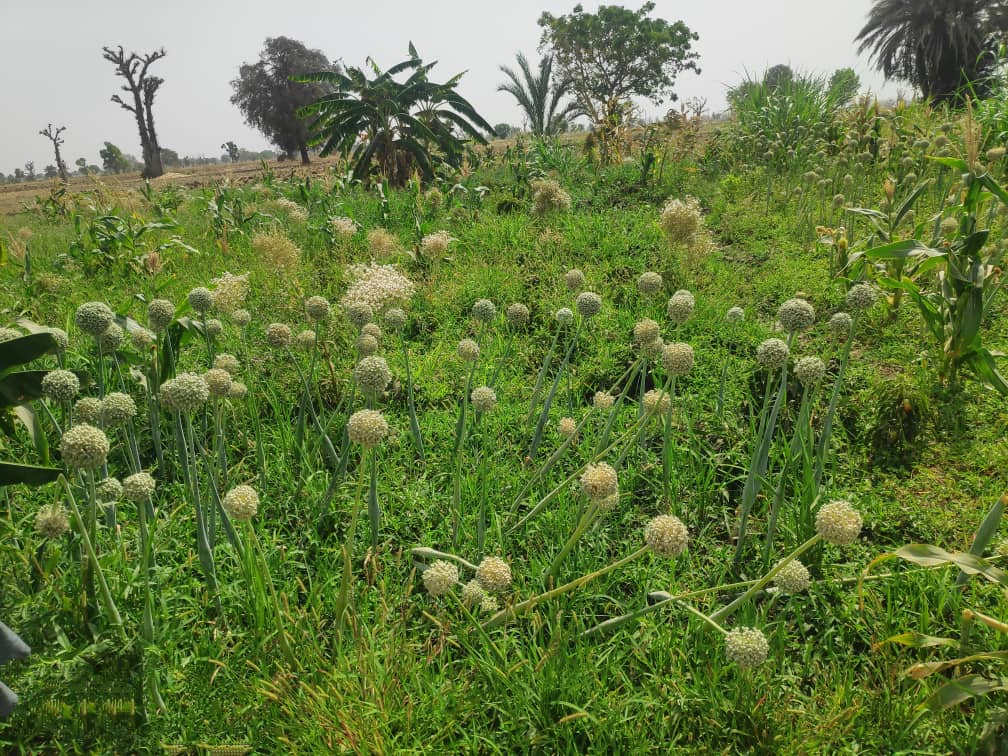
Hajiya Maryam’s onions
Hence, the Small-scale Women Farmers Organisation in Nigeria (SWOFON), has, in its latest charter of demands, called for access to free and subsidised farming inputs, grant support, gender-friendly machinery, storage facilities and adequate community policing for smallholder women farmers in Nigeria.
If realised, for farmers like Bilkisu and Maryam, it will not only make a huge difference for their occupation but will go a long way to inspiring more women farmers, thereby enhancing food security and the nation’s Gross Domestic Product (GDP).
Jigawa is a farming state with more than 80 per cent of its inhabitants engaged in agriculture.