Home Blog Page 1778

We were paid between N1000 and N2000 to counter June 12 protest – Pro-Buhari protester

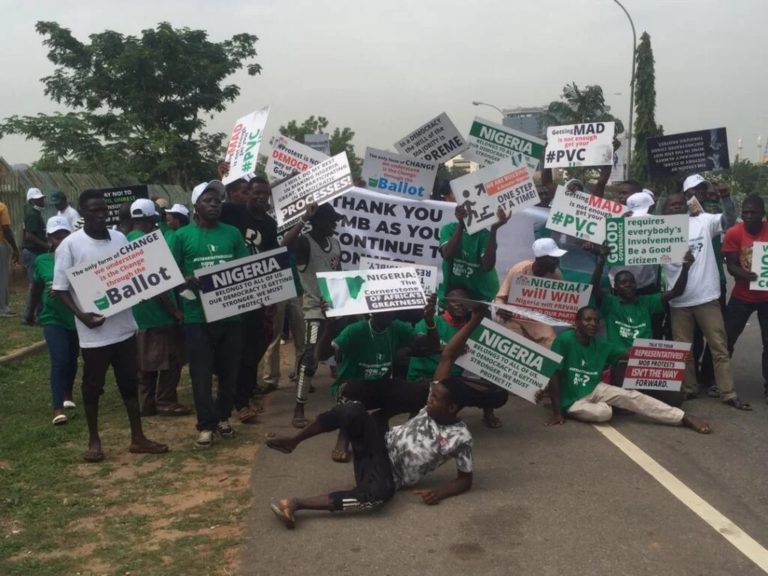
A pro-Buhari protester has revealed that individuals in his group were paid between N1000 and N2000 to join demonstrations against the June 12 protest, which is going on in Abuja and several other cities across the country.

Abdul Yusuf, who was part of the pro-Buhari counter protest, stated this in a video published by Premium Times,

Speaking in Pidgin English, Yusuf said he was invited to Unity Fountain, the venue of the protest in Abuja, by one Mohammed Garuba.

“I dey for my area when they called me to come and protest. They promised to pay us N2000, some N1500 and N1000,” he said.

He added that he would not have put on the ‘#I STAND WITH BUHARI’ branded shirt he was wearing if he had not been promised money.

Hiring protesters to counter an ongoing protest has become a standard practice by government officials and politicians in Nigeria.

During the #EndSARS protests, thugs were seen being ferried to protest venues in Abuja to unleash mayhem and violence on peaceful protesters demanding an end to police brutality.

June 12 protest

The June 12 protest was organised to awaken the Muhammadu Buhari administration to myriads of problem that Nigeria is currently facing.

The organisers of the protest are demanding accountability and better governance from the president.

They are asking Buhari to resign from office if he cannot tackle insecurity and provide good governance in the country.

FG to enforce Oronsanye’s report, claims wage bill increased three-fold in six years


THE Federal Government has informed Nigerians of plans to dust up Steve Oronsanye’s report on the rationalisation of the federal civil service.

Oronsanye, a former head of the civil service of the federation, was directed by the former administration of Goodluck Jonathan to merge agencies with similar roles into one in order to prune down the cost of governance.

The previous government failed to implement the report despite raising similar concerns on spiralling cost of governance at the time.

The rationalisation report, the government said, sought to look at the various ministries, department and agencies of the government with similar responsibilities with a view to pruning down the cost of governance.

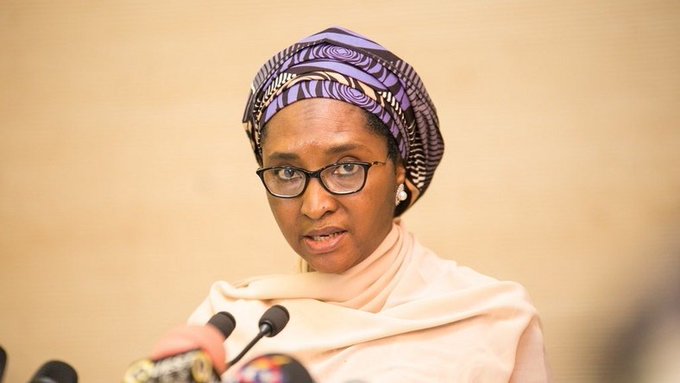
Nigeria’s Finance Minister Zainab Ahmed  confirmed this plan of the Federal Government and expressed concern that the government’s wage bill had increased three-fold since 2015, despite the government placing a ban on employment in the federal civil service.

The minister, however, noted that there had been  replacement of retired federal civil servants, which could have affected the huge wage bill, admitting however that some people gained employment through a process that was not completely approved.

She explained that even with the cap on employment, there was an open window for the replacement of retired directors in federal government agencies.

”The government now found out that what agencies are doing is that if a director retires, based on director salaries, they employ six people to take up the director’s salary,” adding  that, “Many of these agencies do not follow approved processes.”

“It is a problem that the president has decided to address by setting up a Presidential Committee on Salaries that I co-chair with the Minister of Labour and Employment-Chris Ngige. In that committee, we are reviewing Oronsanye’s  report, we are reviewing all the various salaries’ scales in tune with what the Salaries and Wages Commission has.”

The essence is to cut down and streamline the cost of governance, she noted.

She further stressed that delays in the process of payment of most newly intakes into the federal civil service was a result of following unapproved procedures by some government agencies.

“For instance, when they get slight approval from the head of the service to employ 12 people, you discover that in their payroll, they have up to 500 people employed. Before you get registered into the IPPS that captures people for payment, there are several levels of approvals that organisations need to show, including the vacancy while also confirming whether the budget for payments of new intakes is there.”

It is also on record that many states cannot match up with the new minimum wage, prompting some to owe workers, amid post-COVID-19 harsh economic realities and loss of jobs.

“I expect states now to be able to take the matter of minimum wage up with the Constitutional Review Committee. In my opinion, each state should pay according to their own strength,”Minister Zainab emphasised.

According to the CBN, the Federal Government’s personnel cost rose by 18.5 per cent to N1.85 trillion as the minimum wage was increased from N7,500 to N18,000 in 2011, thus accounting for 51 per cent of the Federal government’s retained revenue.

By 2016, personnel spending had gulped about 59 per cent of the Federal Government’s N3.2 trillion revenue.

Police deny reports that 60 persons were killed in Zamfara attack, say ‘only over 30’ died

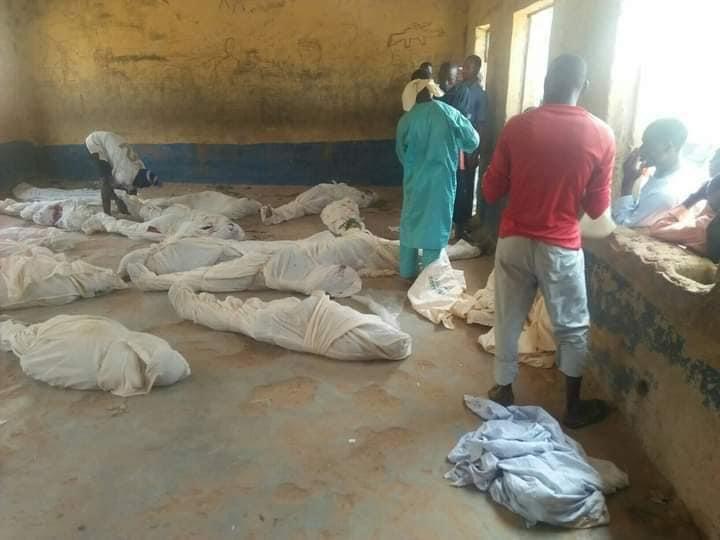
THE Zamfara State Police Command has denied reports that more than 60 people were killed when gunmen suspected to be terrorists attacked Kadawa village in Zurmi Local Area of the state.

Spokesperson of the Zamfara State Police Command Mohammed Shehu, who confirmed the attack in a telephone conversation with The ICIR, said the reported figures were incorrect.

According to Shehu, only ‘over 30’ villagers were killed when terrorists invaded the town.

The attack, which took place on Thursday, was among the latest in a series of deadly attacks and mass kidnappings in Nigeria in recent months.

BBC Hausa Service had earlier reported how gunmen suspected to be terrorists invaded the community around 6:00 pm on Thursday and killed 54 people.

According to an eyewitness spoken to by the BBC, the terrorists rustled cows and looted many shops in the village.


READ ALSO: 

People of North-West are one, yet killing each other – Buhari

Criminals take advantage of my adherence to democratic principles to perpetrate evil ― Buhari

Data puncture Buhari’s claim of lifting 10.5 million Nigerians out of poverty


The eyewitness added that the gunmen also attacked neighbouring villages of Maganya and Jinkirawa after the incident.

He said: “They killed 54 people, all of who are males. Right now, there are no people to perform funeral service for the deceased because the village has been deserted. We are presently conveying the corpses of the deceased to the palace of Emir of Zurmi where the funeral will be held.”

NAN had also reported from some eyewitnesses in the village that the gunmen invaded the village on Thursday afternoon, speaking in foreign languages and shooting at anyone trying to escape the attack.

One of the villagers, who gave his name as Lawali, said 67 bodies were recovered within the village while 26 others were picked up at different locations on the outskirts of the village.

It was also reported that several others were wounded.

NAN also reported that Zamfara State Governor Bello Matawalle, on Friday, called on the people of the state to rise and defend their communities against attacks.

Zamfara, in recent years, has recorded series of attacks by gunmen suspected to be bandits and terrorists, which had resulted in the death of several people.

The state was described as the epicentre of banditry in Northern Nigeria by the former Executive Secretary of the National Health Insurance Scheme Usman Yusuf, in a live webinar organised by The ICIR.

However, the attacks have been condemned by Nigerian President Mohammadu Buhari, who described them as ‘insane’ and warned that the Federal Government had the capacity to crush those promoting insecurity in Nigeria.

In an interview with Arise TV on Thursday, Buhari noted that the situation was giving him concerns. He further observed that the people of the North-West were suffering a lot of casualties as a result of the attacks.

A journalist Yusuf Anka, who has been reporting on happenings in Zamfara State, in a series of tweets shared on his Twitter handle, said that more than 150 people had been killed in the last seven days in the state.

Data puncture Buhari’s claim of lifting 10.5 million Nigerians out of poverty


Nigeria’s President Muhammdu Buhari, on Saturday, claimed that his administration lifted  10.5 million Nigerians out of poverty in the last two years, arguing that various interventionist programmes by his administration had put the economy on the path of sustainable economic growth.

Buhari, who made this claim during his June 12 Democracy day address, said interventions made by the Central Bank of Nigeria (CBN), targeted at agricultural, services, infrastructure, power and health care sectors of the economy had seen appreciable growth in the economy.

According to Buhari, “In the last two years, we have lifted 10.5 million people out of poverty -farmers, small-scale traders, artisans, market women and the like.

“I am very convinced that this 100 million target can be met and this informed the development of a National Poverty Reduction Programme Pwith growth strategy. The specific detail of this accelerated strategy will be unveiled shortly, ”Buhari stated.

However, available data have shown that many Nigerians still live in extreme poverty in the last two years( 2018 or 2019 to 2020 or 2021), despite interventionist efforts by the government.

About 87 million Nigerians lived in extreme poverty in 2017, said World Poverty Clock.

According to the World Poverty Clock, the number rose in 2019. Nigeria had a total population of 205.32 million in 2019, with 105.097 million living in extreme poverty, representing 51 per cent of the population. This means the number of extremely poor people rose from 87 million to 105 million in two years.

An individual is classified as living in extreme poverty if the person earns below $1.90 per day.

The National Bureau of Statistics (NBS) said in a 2020 report, covering September 2018 to October 2019, that 40 per cent of people in the country lived below poverty line of N137,430 ($381.75) a year, representing 82.9 million people.

The NBS did not say that the number of poor Nigerians fell in 2020. It rather said that 67 per cent of household incomes fell by August 2020, as against 2019. This meant more people thrown into poverty.

A 2021 report by Alexander Irwin, Jonathan Lain and Tara Vishwanath, published on World Bank blog, noted that more Nigerians had been pushed into poverty by COVID-19 – even with all the interventions by government.

Contrary to Buhari’s claim on economic growth path, growth in the last five years has been less than two percent – less than 2 6 per cent of population growth- meaning more poverty for Africa’s most populous nation.

Recession has occured in the last two years with the economy exiting in the last quarter of 2020. However, growth was just 0.11 per cent in the fourth quarter of 2020 and 0.5 per cent in the first quarter of 2021. The situation means that more people are not out of poverty due to lack of growth in the economy.

An economist and former director-general of the Abuja Chamber of Commerce and Industry (ACCI)  Chijioke Ekechukwu told The ICIR that the president might have lifted a number of people out of poverty, but probably not up to 10.5 million people.

He said the Anchor Borrowers Programme impacted many rice growers, millers and traders.

However,  data do not justify Buhari’s claim.

From 2018 to 2020, unemployment has risen from 18.8 per cent to 27.1 per cent and then to 33 per cent, according to the NBS. More joblessness means more people in the extreme poverty circle.

The exchange rate has risen from N307/$ in 2019 to N410/$ in 2021.Weakening local currency makes products expensive and reduces incomes. It consequently increases the number of poor people. The exchange rate has weakened 34 per cent in two years, demonstrating that more Nigerians have jumped into extreme poverty.

Nigeria may be the largest economy of the African content, but the average Nigerian is more miserable than many in other countries. The misery index is calculated by adding a country’s inflation and unemployment rates, among others. Nigeria’s inflation rate is over 18 per cent and the country’s joblessness is rising, fuelling misery among the population.

Analysts warn that a holistic approach to tackling poverty should have a national policy appeal and feed into the national budget, the government’s planning and other policies of the government.

“If we don’t have a national policy programme upon which the government feeds into its national budget and other programmes, we may not get it right. The programmes would be knee-Jerk,which do not take us to where we want in terms of growing the economy. For instance, what is the national policy programme on agriculture, poverty reduction, unemployment, and others? This programme should ordinarily feed into the national budget to drive economic growth.”An associate consultant at the British Department of International Development (DFID) and a development analyst Celestine Okeke told The ICIR.

#June12Protest: Police fire teargas at peaceful protesters in Ojota, Lagos

THE Nigerian police, on Saturday morning, fired teargas to disperse protesters who converged peacefully for the June 12 protest in the Ojota area of Lagos State.

A policeman was seen shouting “you are criminals” and pointing his gun towards the protesters in a livestreamed video seen by The ICIR on the Facebook page of Premium Times.

In response to the action of the police, the  protesters chorused, “We are not criminals; we are only fighting for our rights, we are only demanding a better Nigeria.”

“We are organised. We have banners. We are not here for war,” some of the protesters added.

However, moments later, some of the protesters, including journalists who were at the scene to cover the protest, were seen scampering and running for safety.

“You can see them. We are asking for our rights and they are shooting at us,” one of the protesters could be heard saying as the smoke from the teargas canisters covered the screen.

“Later, they will tell us that it is photoshopped,” another protester added.

The organisers of the protest are demanding accountability and better governance from the Muhammadu Buhari-led administration.

The protesters are asking Buhari to resign from office if he cannot tackle insecurity and provide good governance in the country.

Criminals take advantage of my adherence to democratic principles to perpetrate evil ― Buhari


PRESIDENT Muhamamdu Buhari has said that criminals are taking advantage of his adherence to democratic norms to perpetrate evil in the country.

Buhari stated this in his Democracy Day speech on Saturday, noting that some criminals were taking undue advantage of the difficult situation in the country.

He noted that criminals took advantage of his administration’s concentration on the Boko Haram insurgency in the North-East to wreak havoc on other parts of the country.

“When you elected me as your president in 2015, you did so knowing that I will put an end to the growing insecurity, especially the insurgency in the North-East, but the unintended consequences of our scattering them in the North East pushed them further in-country which is what we are now facing and dealing with.”

The president however said that his administration was addressing the security challenges and would soon bring some of the culprits to justice.

“We are, at the same time addressing the twin underlying drivers of insecurity namely poverty and youth unemployment,” he noted.

Buhari, who disclosed that he was worried over the state of insecurity in the country, condoled with the families of victims of various forms of violent crime in the country.

“I also share the pains of families and direct victims of ransom-seeking, kidnapped victims who went through unimaginable trauma in the course of their forced imprisonment.

“Once again, I want to render my sincere and heart-felt condolences to the families and friends of our gallant service men and women who lost their lives in the line of duty and as a sacrifice to keep Nigeria safe,” the president said.


Buhari says fighting corruption is difficult under democracy


FACED with widespread criticisms over concerns that his administration’s anti-corruption campaign is not effective, Nigerian President Muhammadu Buhari has explained that it is not easy to fight corruption under a democratic government.

Buhari made the observation in an interview with the Nigerian Television Authority (NTA) on June 11.

Responding to a question concerning his administration’s faltering campaign against corruption, Buhari observed that during his time as a military head of state, he was able to arrest and jail public officials that were suspected of corruption.

He noted that it was not possible to do the same thing in a democracy.

Seemingly giving an excuse for his inability to live up to expectations on his promise to fight corruption, Buhari said, “I would like to repeat what I used to say. When I was younger in the uniform, when I came, I arrested the President, Vice President, ministers, governors and commissioners and put them under detention and told them that they were guilty until they could prove themselves innocent.

“Now, this is opposite the democratic system as people would like to believe.”

Campaigning ahead of the 2015 presidential election, Buhari had vowed that “anyone who steals Nigeria’s money will end up in Kirikiri Maximum Prisons” and the fight against corruption was among the major agenda of his administration when he assumed office as president on May 29, 2015.

However, about six years after, his anti-corruption efforts have not recorded much success – rather it appears that the level of corruption has increased.

In Transparency International’s 2020 Corruption Perception Index (TI-CPI), released in January, Nigeria slumped to 149 (out of 180), scoring 25 points out of 100.

It was Nigeria’s worst ranking since 2015, placing the country as West Africa’s most corrupt nation after Guinea-Bissau.

In 2019, Nigeria was ranked 146th, with a total score of 26 (out of 100). In 2018 and 2017, the country maintained a CPI score of 27, ranking 144 and 148 respectively.

Nigeria had ranked 136 out of 176 with a score of 27 in 2014 one year before Buhari was elected.

Although the Nigerian government had faulted the Nigeria’s low rating in the 2020 Transparency International Corruption Perception Index claiming that it did not truly reflect the efforts being made to fight against corruption, the latest ranking indicated that corruption had continued to thrive in Nigeria despite the pledge by Buhari and his party, the All Progressives Congress (APC), to fight corruption.

Buhari, in the interview with the NTA, also suggested that some elected political office holders at the state and federal levels are corrupt.

He said, “Nigerians, I think, are very forgetful. I am very pleased that the majority of Nigerians think that this administration, under the circumstance, are (sic) doing their (sic) best but people who misappropriated funds are elected members either at state or federal level.

“You can accuse them or try to prove that when they were elected members of the House of Representatives and they are given ministries and so on, they had only one house and maybe a wife but now they have several houses maybe in Abuja, maybe in Lagos.

“So, rarely, if you try to work out their legitimacy limit, viz-a-viz their expenditure, they will be exposed.”

Although Buhari made a case for the establishment of a special court to prosecute corruption cases, which he said would boost his administration’s anti-graft war, the country’s main anti-corruption agencies, the Economic and Financial Crimes Commission (EFCC), and the Independent Corrupt Practices and Related Offences Commission (ICPC) have been losing corruption cases in court.

Many high profile corruption cases, such as the N1.6 billion fraud allegation involving an ex-presidential aide, Warimapo-Owei Dudafa, were dismissed by courts on the grounds of insufficient evidence.

In an earlier report, The ICIR had noted that, after about five years in office, the Buhari government was yet to deliver on the anti-corruption fight.

The report observed that it was still business as usual, with public officials and politicians continuing to misappropriate public funds with little or no consequence.

Many cases of corruption that have taken place under the Buhari administration are well documented in the media and civil society and international organisations have also reported about unbridled corruption under Buhari’s watch.

The current state of affairs in the country led to Nigeria’s poor ranking on Transparency International’s Corruption Perception Index.

 

Naira responding to market forces, not devalued -Finance minister

NIGERIA’S Finance Minister Zainab Ahmed has said that naira is responding to market forces against the popular perception that it has been devalued.

The minister, who spoke on President Buhari’s six years in office in a monitored television broadcast, noted that weak response of Nigeria’s naira to the United State’s dollar was largely attributed to volatility in the oil price which contributed largely to Nigeria’s reserves

“Let me not use the word ‘devaluation.’ Naira is responding to market forces of demand and supply. We have oil and gas, unfortunately, still the major source of foreign exchange,” she said, noting however that efforts were being made to expand other sources of revenue to strengthen the naira.

 “Right now, we are working at developing alternatives to earning foreign exchange from the mineral sector and supporting businesses that are exporting finished products which means more foreign exchange coming into the country.”

Oil contributes less than 15 per cent to the Gross Domestic Product (GDP), but is responsible for at least 70-85 per cent of revenue and 80-90 per cent of foreign exchange in Africa’s biggest oil producer.

Naira has officially weakened from N306 in 2020 to over N400 in 2021 after oil price volatilities in the COVID-19 market. Dollar exchanged at N592 at the parallel market on June 11.

As a monocultural market, the Nigerian economy has largely been a price taker in the global foreign exchange market due to its inability to earn big from export of finished products.

Zainab stressed that the volatility characterising the oil price at the international market affected Nigeria’s foreign exchange, and  the value of the currency.


READ ALSO:


“This development affects the level of our reserves and affects other key aspects of the economy.”

She further said that the Federal Ministry of Finance and the Central Bank of Nigeria had made a commitment to converge towards a single exchange rate.

“The governor of the central bank and I have made a commitment while we processed the IMF loan of $3.4 billion that we are going to converge towards a single exchange rate. If you remember in the year 2020, we did the initial exchange 2020 budget at 305naira to the US dollar.


“When Covid-19 happened and we are processing all these finances, an adjustment was made for the official exchange rate to be N360. The further requirement was that the monetisation for the foreign exchange, even for the government, is done at the market rate, not the black market rate – NAFEX rate. That is what is happening now. So, when the government earns its money whether from FAAC or from any other sources, it is monetised at the NAFEX rate.”


She explained that the country had now converged to a single exchange rate which would help put the economy on a growth path, gaining investor confidence.


“In a way, we could say we have converged because we are now doing everything at the NAFEX rate. The other rate is the unofficial rate and unorthodox market. That market will improve when the inflow in foreign exchange improves.”

The government is eyeing to converge at the NAFEX rate – the poll rate based on the contributions of 10 banks- to create stability in the market. But this has been difficult due to factors ranging from demand to supply inefficiencies.

Analysts do not agree with the minister as even the CBN Governor Godwin Emefiele, in May 2021, replaced an earlier N379/$ rate with N410/$, admitting that it was no longer feasible and  the bank was running a managed-float system.

Investopedia defines devaluation as a “deliberate downward adjustment of the value of a country’s money relative to another currency, group of currencies, or currency standard.”  The  CBN has deliberately moved official FX rates from N305/$ to N315/$, and to N379/$ to 410/$ in less than two years. This means devaluation.

The minister attributed rising inflation to the exchange rate, with other factors such as transport costs linked to increasing PMS price and an inadequate number of mass transit vehicles and trucks for food and other forms of transportation, noting the government was working on a lasting solution to the concerns.


One of my major economic successes is making Nigerian rice competitive – Buhari

PRESIDENT Muhammadu Buhari, on Friday, said one of his major economic successes since he came to power in May 2015 was making locally-produced rice ‘competitive in the market.’

Buhari said this during an interview aired on the National Television Authority (NTA), stating that the land border closure between Niger and the Benin Republic encouraged Nigerians to go back to farms.

“We closed the borders and stopped the importation of food and gave a stern warning that, ‘let us eat what we produce’ and made sure that imported food can only come through the ports so that imported rice could not compete with local rice.

“So that encouraged a lot of people to go back to the farms. There are people who left air-conditioned offices to go back to the farms and that was positive for Nigeria,” he said.

Nigeria had launched a land border closure in August 2019 to tackle smuggling of rice and other goods, after banning the importation of rice from Benin and all its neighbours in 2016.

The move was intended not only to raise revenue but also to encourage local production of rice.

Buhari also said the decision he took was a major economic success for his administration because it made locally- produced rice available and competitive.

“Now, our own rice is fresh and is available and it is competitive in the market. I think this is one of our major successes,” he said.

Rice is considered a staple food in the country. However, according to a 2021 report by the Institute for Security Studies (ISS), the border closure resulted in new smuggling routes for illegal rice dealers.

Also, the market price for imported rice increased by 60 per cent while locally produced rice has increased by almost 100 per cent.

On the state of infrastructure in the country, Buhari said he was committed to fulfilling his cardinal campaign by providing roads, rail and power.

“That is why I made up my mind that one of my priorities is to make sure that the roads and the rails are rehabilitated. And tell me which country develops without infrastructure, roads, rail and power.

“We have to get this correct, and those who are going about this country know that this administration has tried in terms of rehabilitating roads, in terms of rehabilitating the railway, in terms of increasing power relatively to resources at the time. We have not done badly, for those who want to criticise us should criticise us objectively,’ he said.

When asked if he was satisfied with the state of the economy, Buhari said he was not satisfied but was trying hard to persuade foreign investors to have confidence in the country and create jobs for Nigerians.

“No, I am not, that’s why I am trying even harder to make the people become accountable and to make sure we persuade foreign countries to allow their multinationals to develop more confidence in Nigeria to come and invest.

“That will give us employment, goods and services and the chains rights from the farms will be great and that means lots of employment. And this is our problem-a large population, young population and unemployed population,” he said.

Border closure: Nigerian rice now fresh, available – Buhari

NIGERIA’S President Muhammadu Buhari has said that closure of the borders between Benin Republic and Niger has led to food security in Nigeria.  

Buhari spoke on Friday, June 11, during an exclusive interview with the Nigerian Television Authority (NTA) in Abuja.

It would be recalled that in August 2019, barely three months after signing the African Continental Free Trade Area (AfCFTA), Nigeria closed its borders with neighboring countries such as Benin Republic, Cameroon, Chad and Niger in a bid to stem influx of goods into the country.

President Buhari also directed the Central Bank of Nigeria (CBN) to halt the provision of foreign exchange to businessmen for the importation of food, in a move to encourage the production and consumption of homegrown food.

The border closure was heavily criticised by many, and experts said it violated commercial and freedom of movement treaties signed under the Economic Community of West African States (ECOWAS).

However, the Nigerian president said the temporary closure led to a boost in the country’s revenue through customs levies, created opportunities for job creation and had brought about food security.

“There are people who left air-conditioned office and went back to the farm and that was positive for Nigeria. Now our own rice is fresh and available in the market,” Buhari said.

Although the borders have been reopened, Nigerians have, in recent times, expressed concern about soaring prices of commodities in the market.

Farmers say high cost of inputs, insecurity, farmer-herder crisis and poor logistics are responsible for rising  food inflation in the country.