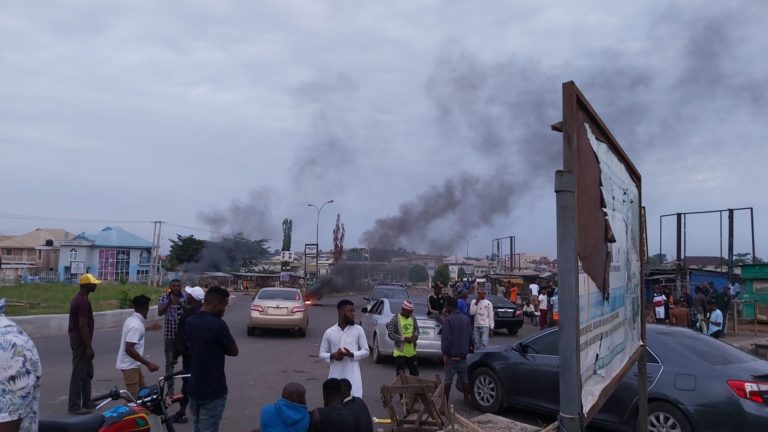
SOME youths are protesting against the midnight raid carried out by operatives of the Economic Financial Crimes Commission in Osogbo, Osun State.
The youth, who stormed the streets of Osogbo to register their displeasures, accused the EFCC operatives of harassing them.
In a video posted on social media, the youth, who assembled around the streets, barricaded some junctions and started a bonfire in many parts of the town.
This is Osogbo First it was SARS Now it’s EFCC that’s causing this disruption
Osun State Police Spokesperson Yemisi Opalola confirmed the incident to The ICIR in a telephone conversation.
Opalola said the youth were protesting after operatives of the EFCC raided their residence and attempted to arrest some persons and seize exotic cars parked inside the residence.
She noted that the EFCC operatives failed to inform the police command before embarking on the raid.
“They did not inform us before they started the raid. We would have advised them on how to properly carry out the operation so that it won’t generate this sort of outrage,” Opalola said.
She noted that the police were trying to appease the protesters to clear the bonfire and barricades to enable residents to go about their lawful duties without fear of harassment.
However, she stated that the EFCC operatives arrested and left with some of the youth during the raid, but did not leave with any of their properties.
Opalola further said that although the police were yet to confirm how many persons were arrested by the EFCC, there was no serious injury or death during the raid.
When asked why the EFCC operatives did not inform the Osun police before commencing the raid, the spokesperson for the commission Wilson Uwujaren told The ICIR that he was yet to receive reports about the operation in Osun State.
THE National Information Technology Development Agency (NITDA) has advised Nigerians to consider adopting other social media platforms as WhatsApp implements a new privacy policy for its users worldwide, except countries under the European Union.
The new policy, which came into force on May 15th this year, grants WhatsApp the right to share users’ data with Facebook and its companies.
The new policy also allows Whatsapp users the liberty to decide whether to give out consent to processing of their data.
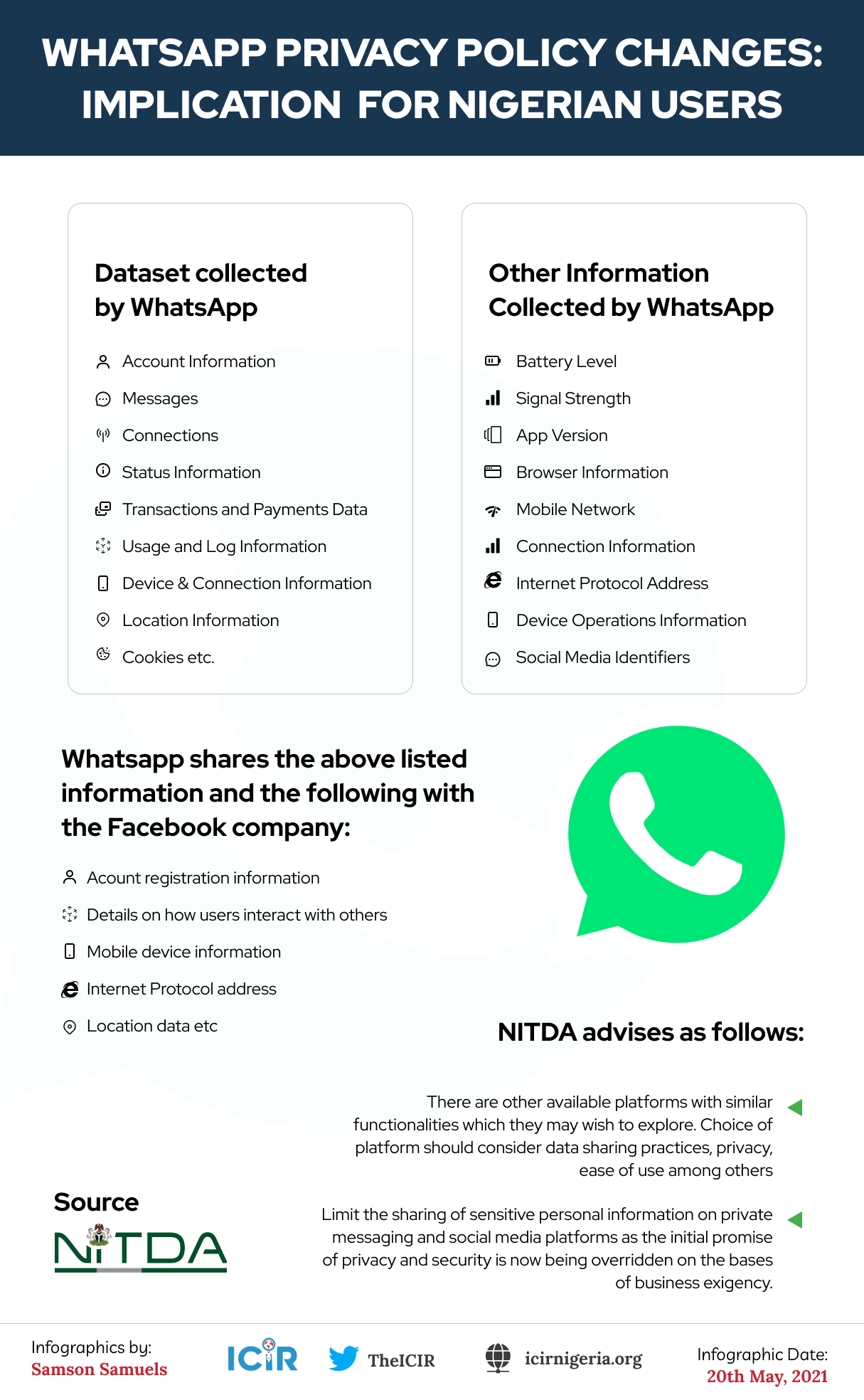
According to a statement on Tuesday by NITDA Head of Corporate Affairs and External Relations Hadiza Umar, data to be collected and shared would include: account information; messages (including undelivered messages, media forwarding); connections; status information; transactions and payments data; usage and log information; device and connection information; location information; and cookies.
Others were: battery level; signal strength; app version; browser information; mobile network; connection information (including phone number, mobile operator or ISP), language and time zone; Internet Protocol address; device operations information and social media identifiers.
Although Facebook, in response to inquires by NITDA on the new policy, had confirmed that private messages shared on WhatsApp consumer version were encrypted and not seen by the company, the metadata (data about the usage of the service), which are also personal information, would be shared with other members of the its subsidiaries.
WHATSAPP PRIVACY POLICY CHANGES_ IMPLICATION FOR NIGERIAN USERS
These data, according to Facebook, would be shared with its companies to further enhance, “operate, provide, improve, understand, customize, support, and market our services and their offerings, including the Facebook Company Products.”
NITDA, however, called on Nigerians to limit the sharing of sensitive personal information on private messaging and social media platforms as the initial promise of privacy and security was now being overridden on the basis of business exigency.
“Nigerians may wish to note that there are other available platforms with similar functionalities which they may wish to explore. Choice of platform should consider data sharing practices, privacy, ease of use among others.”
According to the statement, NITDA noted that it was engaging with Facebook to find a better way of protecting the data of Nigerians.
“We have given them our opinion on areas to improve compliance with the Nigeria Data Protection Regulation (NDPR). We have also raised concerns as to the marked difference between the privacy standard applicable in Europe, under the GDPR and the rest of the world.
“Given the foregoing and other emerging issues around international technology companies, NITDA, with stakeholders, is exploring all options to ensure Nigerians do not become victims of digital colonialism. Our national security, dignity and individual privacy are cherished considerations we must not lose.”
It added that it would work with the Federal Ministry of Communications and Digital Economy to organise a hackathon for Nigerians to pitch solutions that could provide services offering functional alternatives to existing global social platforms.
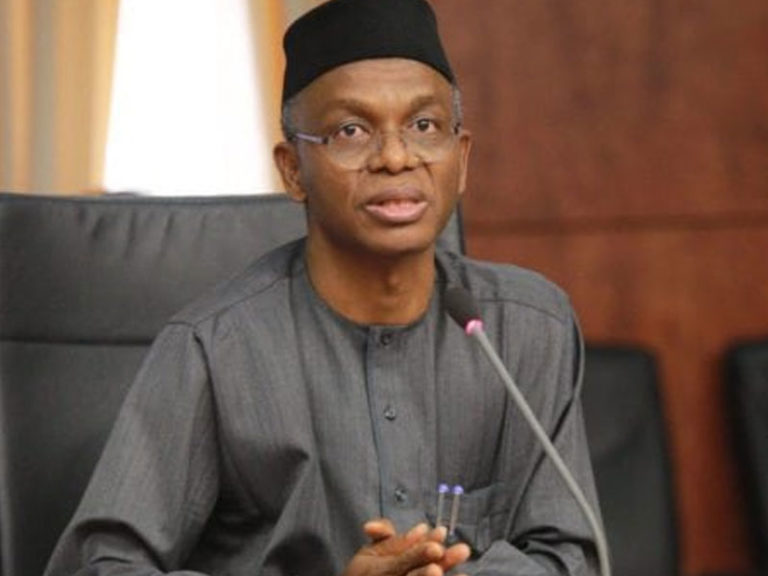
THE Kaduna State government has declared the National President of the Nigeria Labour Congress (NLC)Ayuba Wabba and other protesters wanted.
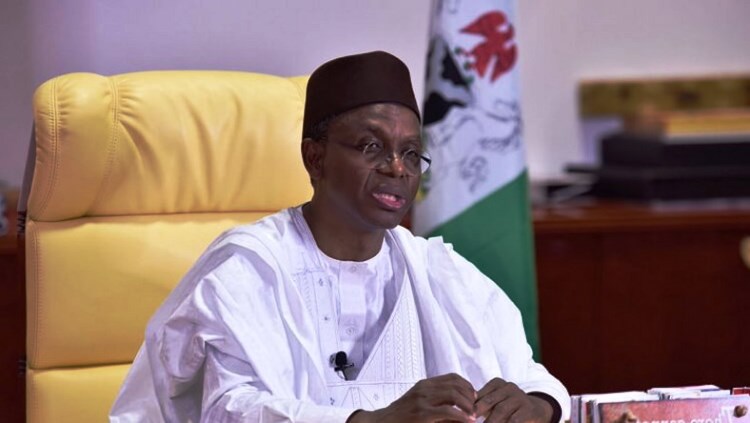
This is contained in a tweet on the official Twitter account of Kaduna State Governor Nasir El Rufai, on Tuesday.
According to El Rufai, Wabba and the other protesters were wanted for economic sabotage and attacks on public infrastructure.
El Rufai also placed a bounty on the NLC president and other protesters, saying that there would be a ‘handsome reward’ for anyone who knew their whereabouts.
“Ayuba Wabba & others of @NLCHeadquarter declared wanted for economic sabotage & attacks on public infrastructure under Miscellaneous Offences Act. Anyone that knows where he is hiding should send a message to @MOJKaduna. KDSG. There will be a handsome reward,” El Rufai wrote.
KADUNA UPDATE: Ayuba Wabba & others of @NLCHeadquarters declared wanted for economic sabotage & attacks on public infrastructure under Miscellaneous Offences Act. Anyone that knows where he is hiding should send a message to @MOJKaduna. KDSG. There will be a handsome reward!
The governor had, in a statement signed by his Special Adviser on Media and Communication Muyiwa Adekeye, condemned the strike action by the union on Monday.
Kaduna State government declared the actions of the NLC ‘unlawful’ while insisting that the union’s action was a ‘campaign of economic and social sabotage.’
“Desperate actions undertaken by the NLC today include unlawful trespass on government facilities, and attempts to prevent officers from signing attendance registers,” the statement read in part.
Kaduna State government said apart from shutting down electricity, the NLC also shut healthcare access for several citizens by closing several hospitals and chasing away patients.
The NLC had, on Monday, commenced five- day warning strike over the sack of thousands of workers and refusal to pay entitlement to retrenched workers in the state.
THE Academic Staff Union of Universities (ASUU), Kaduna State University chapter, has joined the ongoing warning strike by the Nigerian Labour Congress (NLC) in the state.
The ASUU Chairman Peter Adamu, on Monday, ordered all members of the union to take part in the strike action. According to Adamu, the order to join the strike followed a directive from the National Secretariat of ASUU.
“I am directed by the National Secretariat of our great union through the Zonal office Kano, for members to join the warning strike.
“Members should remember that ASUU is an affiliate of Nigeria Labour Congress (NLC) and the principal officers of ASUU were part of the NLC National Executive Council that took the decision on the strike action,” Adamu said.
Adamu urged the ASUU members to join the ongoing strike, noting that they must unite for a ‘just cause’ and an injury to one was an injury to all.
The ASUU National President Biodun Ogunyemi was not available to comment on the directive issued to Kaduna State chapter.
The NLC had commenced five days warning strike over the sack of more than 21,000 workers and the refusal to pay entitlements to about 50,000 workers by the Kaduna State government.
During the first day of the strike, activities in major sectors, including banks, railway, airport, hospitals, among others, were put on hold.
Despite the strike, Kaduna State government has insisted that it will not back down on its decision to ‘rightsize’ the state’s civil service.
Meanwhile, the Nigeria Police Force, on Monday, ordered the deployment of additional police operatives and crime prevention officers to ensure public safety and strengthen security along the Kaduna – Abuja expressway.
THE Nigerian government claims it has discovered about 476 online news websites that are fighting President Muhammadu Buhari’s administration with ‘fake news.’
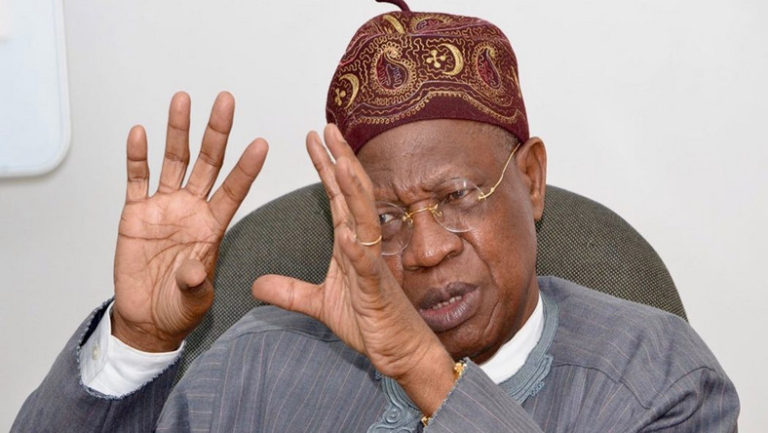
Minister of Information Lai Mohammed said the online publications were set up to fight the government.
The minister told officials of the Nigerian Institute of Public Relations (NIPR) on a courtesy visit to his office in Abuja on May 18 that fake news reports from the anti-government online publications usually went viral because Nigerians were gullible.
“Recently, we unveiled almost 476 online publication sites that are dedicated to daily engaging in churning out fake news to fight the government,” Mohammed said.
The latest ‘fake news,’ according to him, was a report that Buhari was advised by doctors, during a recent medical trip to London, to step down because he could not recognise members of his immediate family.
“I begin to wonder how they can go this far, simply because they know that people are gullible and they will make the fake news to go viral,” the minister added.
Mohammed insisted that fake news was threatening Nigeria’s existence.
The minister’s claims at the parley with the officials of the NIPR was in line with the Nigerian government’s continuing push to regulate social media use in the country through an ‘anti-social media law.’
Mohammed, as minister of information and culture, has been championing the campaign.
On October 27, 2020, while appearing before the House of Representatives Committee on Information, National Orientation, Ethics and Values to defend the 2021 budget proposed by the Ministry of Information and Culture, Mohammed had insisted on the need for the enactment of an anti-social media law.
Addressing the lawmakers, Mohammed warned that Nigeria was sitting on a keg of gunpowder, which could consume the country if the issue of fake news was not urgently addressed.
Making reference to the #EndSARS protests, which were still raging across the country at the time, the minister noted that the next war in Nigeria might be fought on social media platforms.
Buttressing his call for an anti-social media law, Mohammed advanced a claim that the younger people making greater use of social media platforms would not watch televisions, listen to radios or read newspapers.
He described the #EndSARS protest as a ‘war’ that was fought on the social media with ‘smartphone and data’ and maintained the position adopted by the Nigerian government and the Army by suggesting that viral videos and images which depicted the suppression of protesters were photoshopped, and as such, fake news.
”We need a social media policy in Nigeria and we need to empower the various agencies and we need technology to be able to regulate the social media,” Mohammed said.
“The biggest challenge facing Nigeria today is fake news and misinformation.”
Mohammed said the Nigerian government launched a national campaign against fake news after a July 2018 meeting of the National Council on Information deliberated on the matter.
But attempts by the government to enact an anti-social media law have been greeted with stiff resistance from the citizens.
The Social Media Bill, also known as the Protection from Internet Falsehood and Manipulations and for Related matters Bill, 2019, proposed steep fines or jail term for spreading what the government deems as fake news.
The proposed legislation sought to give government regulatory control over conversations on social media platforms, and individuals whose posts are thought to threaten national security or diminish public confidence in the government could be arrested. Authorities could also cut the Internet access of those that violate the regulation.
Penalties for breaking the social media law, according to the draft bill, include a fine of up to ₦300,000 or three years imprisonment for individuals and ₦10 million for corporate organisations.
However, the passage of the Social Media Bill was stalled after it was opposed by Nigerians who feared that it could lead to censorship and a crackdown on dissent.
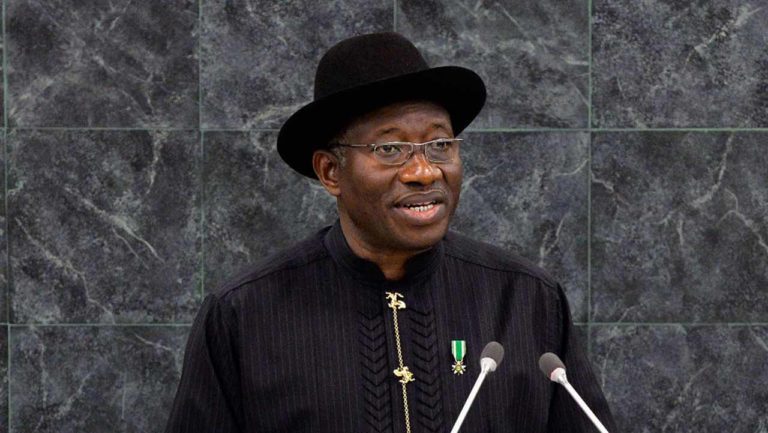
FORMER President of the Federal Republic of Nigeria Goodluck Johnathan has decried the friction between northern and southern governors, urging them to adopt a united front in search for solutions to the issues affecting the country.
Speaking on Sunday at the birthday thanksgiving of the General Overseer of Rock of Ages Christian Assembly International (RACAI) Charles Osazuwa, the ex-president said that a united effort by the governors would go a long way in resolving national issues.
Referring to the inaugural meeting held in Asaba, Delta State last Tuesday, Jonathan described the antagonism between northern and southern governors as uncalled for.
“I don’t really love a situation where the northern governors will meet, then the southern governors will cry foul. Then the southern governors will meet, then the northern governors will cry foul. That will not help our country,” he said.
He urged the governors to unite under the Nigerian Governors Forum to address issues of national concern as they were responsible for the smooth operation of the country.
“The president is just one person in Abuja. It is the states that people fall back to. So if governors of the states meet and dialogue, interrogate things that are good for this country, then we will move forward,” he said.
Governors from the southern region of Nigeria, last Tuesday, held a meeting in Asaba discussing several issues of national concern.
Part of the resolutions reached during the meeting included the banning of open grazing and a call for the review of security appointments in the country. They equally called for the country’s restructuring.
The southern governors also reiterated their commitment to the unity of the country and their support for peaceful coexistence of citizens amid calls for secession from groups in the southern region of Nigeria.
ON October 20, 2020, Olalekan Falaye joined thousands of young Nigerians to peacefully protest against police brutality. Instead, Falaye lost the ability to walk.
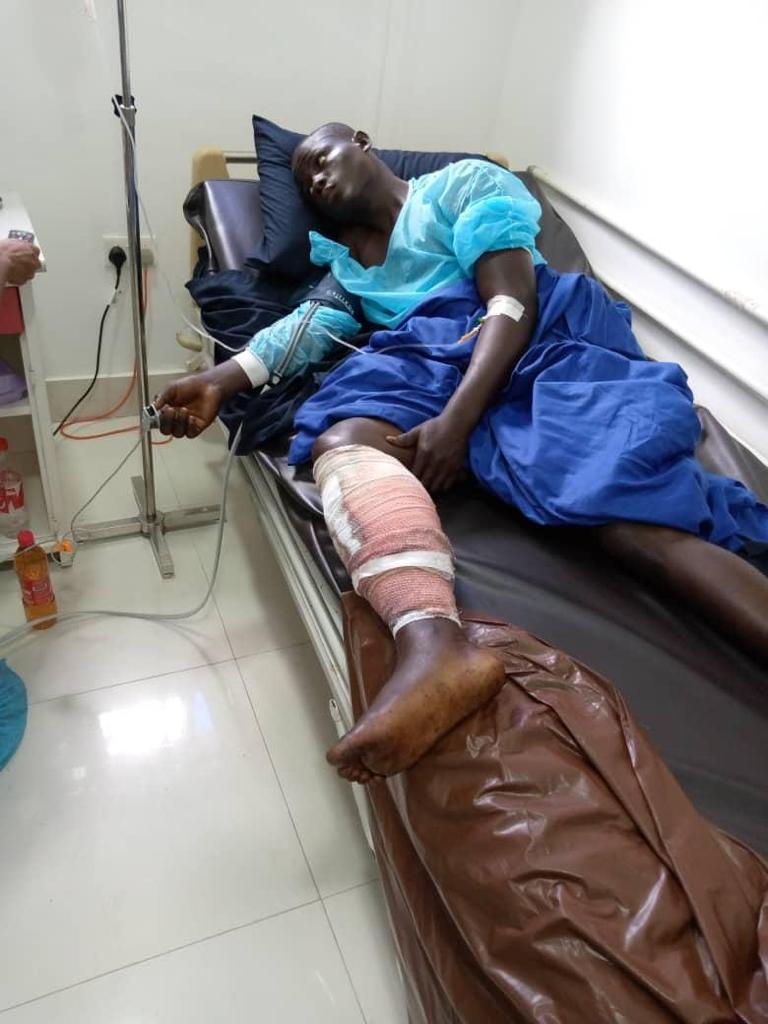
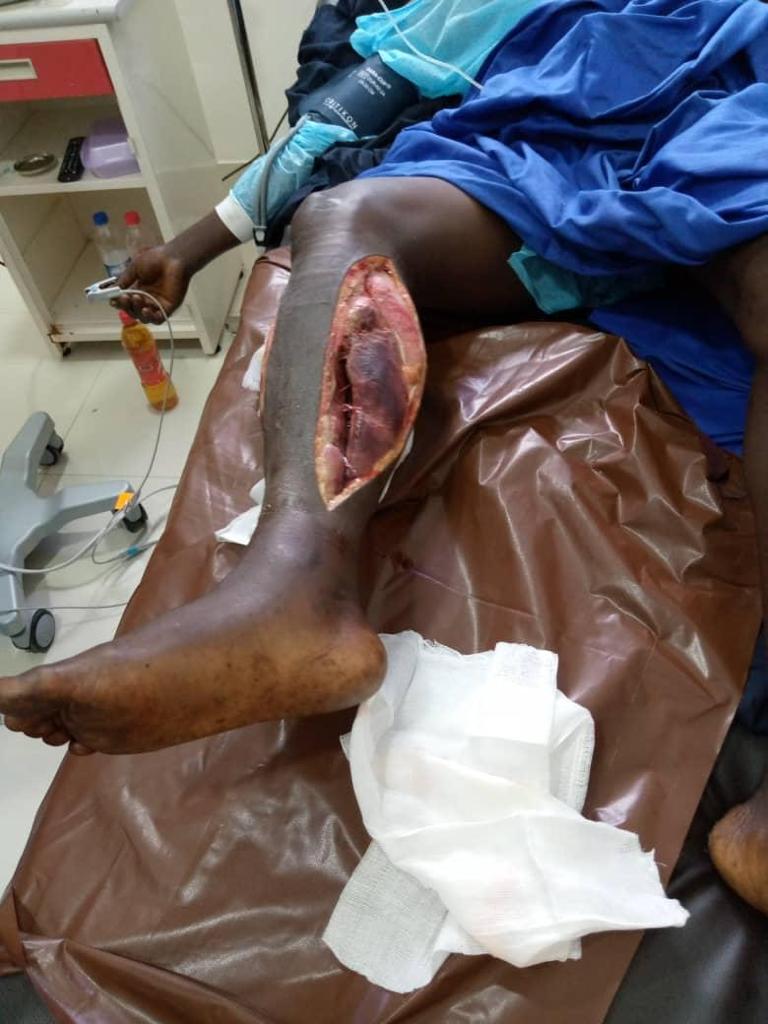
Olalekan Falaye, 23, used to actively move around before soldiers shot at protesters at the Lekki tollgate on October 20, 2020. Now, he cannot walk without a wheelchair. His right leg was amputated as a result of a gunshot injury he sustained on Tuesday, October 20, 2020.
Falaye, who was protesting at the Lekki tollgate during the peaceful #EndSARS protest last year, said he was shot by soldiers. Medical records and photos taken before and during his time at the hospital confirm the gunshot. We interviewed him, fact checked his medical records and verified his story, as part of #MySARSStory – our series of stories documenting brutality and seeking police reform.
Falaye’s revelation is yet another piece of evidence backing the allegation that soldiers shot live ammunition at protesters during the Lekki attack, a claim the Nigerian army continues to deny.
“On Tuesday, I decided to join the protests after I closed from work,” Falaye explained. “It was about 7 pm when we were told the soldiers had arrived, that we should not run but sit down on the floor. The soldiers just started shooting up in the air.”
Falaye’s account checked repeated verifications and even part of the military’s narrative. The Commander of 81 Division of the Nigerian Army, Major-General Ahmed Ibrahim Taiwo, revealed while being cross-examined at the Lagos State Judicial panel that the soldiers deployed to Lekki went with live rounds, contrary to the initial stand that the soldiers only fired blanks.
The Nigerian army continued to insist that its soldiers only shot in the air, but that only accounted for a few minutes after the soldiers arrived at the scene. What followed hours later were heinous human rights violations and extrajudicial killings, according to Falaye’s account and investigations carried out by CNN and Premium Times.
“It got to a point, the soldiers faced us (protesters) and started shooting at us. It was at that point that a bullet met me in my leg. It was a good Samaritan who helped me and carried me to Randville, saving my life,” Falaye claimed.
His medical report from Randville Trauma Centre, where he received initial treatment, confirmed that he was indeed shot at Lekki Toll Gate.
“He sustained this injury as a result of his involvement in the EndSARS protest that occurred at Lekki Toll gate,” his medical report read. “The flesh on his leg was torn open by the bullet.”
Olalekan Falaye being tranfered to Igbobi hospital
The hospital recommended amputation, claiming, “no pulse was felt” on his leg. He was subsequently referred to the National Orthopedic Hospital in Igbobi, Lagos, where the procedure was carried out five days later.
Since Falaye’s mother, Temitope, got the news about her son, she said she’s faced a great financial challenge to get him the necessary medical care. It took a hit on both her savings and capital for her food business. She sold noodles by the roadside and offered cleaning services.
“When I got to Igbobi, they said I should go and bring money for a bed. I opened a (patient’s) card, after which I was given a drug prescription. I spent fifty-something thousand the first day alone, and that only accounts for what I could calculate,” the dejected mother said, adding she was only able to afford some of the medical expenses because of help from her church members and friends.
The mother is grateful that Falaye learnt a trade, but she is worried he might not be able to raise capital to start up a shop after coming out of apprenticeship.
“I need them (the government) to help us because even what to eat has now become so hard,” she said.
Background
Days into the nationwide #EndSARS protests, hoodlums alleged to be sponsored by the government, attacked protesters in different states. At least two people were killed in Abuja following the attack.
Olalekan Falaye_s gunshoot wound
Following this development, some state governors announced curfews. On the same day the curfew was announced in Lagos, October 20, 2020, the Nigerian army clamped down on protesters in Lekki.
Amnesty International alleges at least 12 people were killed during the attack. A popular Nigerian Disc jockey, DJ Switch, said she counted 15 people who were killed, and their corpses taken away in military vans.
The Nigerian army initially denied its men were present at the toll gate, but after the state governor, Babajide Sanwo-Olu, said during an interview with CNN that soldiers were indeed deployed to the scene, the army rescinded its earlier position.
Evidence has since emerged to show that people were killed or maimed during what has now been dubbed as the #LekkiMassacre. Falaye was one of those maimed during the attack.
This story is part of a multimedia project by Tiger Eye Foundation and media partners across Nigeria, documenting police brutality in Nigeria and advocating for police reform.
A former board member of the Nigerian Ports Authority (NPA) Binta Garba has accused the embattled and suspended Managing Director of the agency Hadiza Bala-Usman of financial misappropriation.
In a statement issued on Sunday, Garba noted that she consistently raised concerns and questions about the manner in which the agency was being managed.
Rather than making amends, Bala-Usman, she claimed, orchestrated her removal and that of one other member of the board, John Akpanudoedehe, without the knowledge of the supervisory Ministry of Transportation.
Garba noted that she envisaged the suspension and removal of Usman from the weight of discrepancies that she observed in the agency’s financial records.
“Before my removal, I was not comfortable with the way the board and authority were run. I consistently expressed my discomfort and displeasure with the way the MD was running the place and this, I have no iota of doubt in my mind, made her to orchestrate my removal from the board,” she said.
“Note, I was removed without the knowledge of the supervising ministry/minister of transportation, which was very uncommon.”
But Usman, in a statement on Monday, described Garba’s statement as spurious.
She said since 2016, the NPA had been transparent with all its activities through the “signing of a Memorandum of Understanding with BudgIT Open Budget System Platform and Implementation of a Public Data Dissemination programme.”
“Publishing the tariff regime of the Authority on the website for the whole world to see in line with the vision of transparency and accountability, and conducting the statutory Audit of the backlog of Authority’s financial statements for 2013-2016 and presenting same for approval and submission to the appropriate quarters.”
She noted that the NPA under her engaged internationally renowned auditing firms for the examination of its financial statements up until 2019 with full compliance to all Nigerian laws and the International Financial Reporting Standards. The 2020 financial statement is currently being audited, she said.
The suspended NPA boss wondered why Garba did not withhold her signature when the auditors presented the financial statement to the finance committee of which she was a member.
“Did she seek clarifications on areas that seemed opaqued or suspicious? If she did, what happened? If she was not satisfied with the answers provided by the Auditors, why did she not consider withholding assent to the statement? Why did she not formally document her discontent? Why did she not issue a minority opinion on the statement, instead of now speaking after the fact?”
“All said and done, while I concede to Senator Binta Garba’s right to whatever opinion she desires concerning our relationship when she was a board member, I remind her that those who allow themselves to be used to malign innocent people have their own days of reckoning waiting for them,” she said.
President Muhammadu Buhari approved the suspension of Bala-Usman last week following the recommendation of Minister of Transportation Rotimi Amaechi to set up an administrative panel of inquiry to investigate the management of the agency.
She is being probed for an alleged non-remittance of N165.32 billion operating surplus to the Consolidated Revenue Fund.
TWENTY-SIX persons have been inducted by Dubawa, a verification and fact-checking platform, into its 2021 cohort of fact-checkers to combat misinformation in the West Africa sub-region.
The platform, which was founded by the Premium Times Centre for Investigative Journalism (PTCIJ), announced the commencement of the yearly fellowship in Abuja on Monday.
Now in its third year, the 2021 fellowship is christened Kwame Karikari Fact-Checking and Research Fellowship in honour of Ghanaian Professor, Kwame Karikari.
Twenty-six (26) successful applicants, drawn from over 200 applications in The Gambia, Ghana, Liberia, Nigeria and Sierra Leone, will, from Tuesday, 18th May undergo training that will equip them in combating the widespread regime of misinformation in the West African sub-region.
“Upon completion and evidence of competence after a ten-course module the participants will graduate into the six months in-country fellowship,” Dubawa Programme Manager Adedeji Adekunle, said in a statement sent to The ICIR on Monday.
Adekunle said the training faculty for the programme were drawn from a pool of the leading global experts in the field of fact-checking coming with individual and organisational talents which include: Peter Cunliffe-Jones, founder of Africa Check, and current course co-director/researcher at the University of Westminster in the United Kingdom; Youri van der Weide, researcher and trainer at the global investigative organisation, Bellingcat; and Craig Silverman, author, trainer, and the digital editor, at BuzzFeed.
Others are former Professor of School of Communications, University of Ghana, Legon and Chairman of the Board of the Daily Graphic newspaper in Accra Kwame Karikari; Coordinator of the African Centre for Information and Media Literacy (AFRICMIL) Chido Onumah; DUBAWA Editor Kemi Busari; DUBAWA Programme Manager Deji Adekunle; Ghana Programme Lead for DUBAWA Caroline Anipah; and Executive Director for the PTCIJ Dapo Olorunyomi.
Participants at the course will learn about the accountability journalism ecosystem in the sub-region; how to fix the current information disorder through legal, regulatory responses and through misinformation literacy.
They will also learn fact-checking methodology, the skills and steps involved in fact-checking, ethics of journalism and fact-checking; data presentation and analysis for fact-checking, media literacy, monitoring and analysis of social media content and accounts; investigating websites, as well as freedom of information/right to Information laws in West Africa and the verification of digital tools.
Named after Professor Kwame Karikari, redoubtable media freedom advocate and founder of the Media Foundation for West Africa (MFWA), the fellowship is inspired by the need to tackle the menace of mis- and dis-information within the sub-region and beyond.
DUBAWA is an independent, transparent and non-partisan verification and fact-checking platform, initiated by the Premium Times Centre for Investigative Journalism (PTCIJ) in 2018.
Dubawa aims at instituting a culture of truth and verification in public discourse and journalism through strategic partnerships between the media, government, civil society organisations, technology giants and the public.
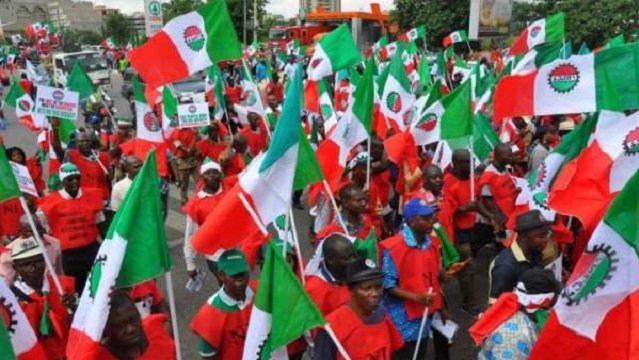
THE five-day warning strike embarked upon by the Kaduna State Council of the Nigerian Labour Congress (NLC) on Monday has paralysed the state.
Socio-economic activities were brought to a halt on Monday, especially in the state capital, where the protesting workers converged.
Schools, banks, railway, airport, hospitals, among other critical facilities, were shut down by the workers.
Power and water supply to various parts of the state were also cut off by the workers.
Joined by its affiliate unions, the NLC embarked on the strike to compel Governor Nasir el-Rufai to reinstate 4,000 workers recently disengaged by the government and pay severance packages of others who had been sacked by the government.
Led by the NLC’s National President Ayuba Wabba, the workers stormed the state secretariat of the union before 8am, carrying different placards against the government, before proceeding to the State House of Assembly and other parts of the state capital.
Many people made panic withdrawals from banks’ Automated Teller Machines (ATMs), while others were seen in markets buying foodstuffs to stock in their homes, according to some residents of the state who spoke with our reporter.
The ICIR reports that many streets in Kaduna recorded very low vehicular movement because of the strike.
Some of the unions participating in the action are: The National Association of Nurses and Midwives; Nigerian Union of Railway Workers; Nigerian Union of Teachers and Non-Academic Staff Union of Educational and Associated Institutions; National Union of Electricity Employees (NUEE; National Union of Banks, Insurance & Financial Institutions Employees; and National Association of Aircraft Pilots and Engineers (NAAPE).
Others are: Association of Nigeria Aviation Professionals (ANAP); Nigeria Union of Petroleum and Natural Gas Workers (NUPENG); National Union of Road Transport Workers (NURTW); Radio, Television, Theatre and Art Workers Union of Nigeria (RATTAWA); National Union of Food Beverage and Tobacco Employees; and Amalgamated Union of Public Corporations Civil Service Technical and Recreational Services Employees (AUPCTRE)
The government has repeatedly said the workers would not be reinstated.
Sack comes after a similar action by government three years ago
Workers’ strike by Kaduna State government is coming exactly three years after the el-Rufai’s government sacked nearly 5,000 of about 16,000 teachers it newly engaged in 2018.
The action is also coming amidst ballooning security crisis in the state.
El-Rufai-led government had, in April this year, carried out disengagement of workers, citing dwindling revenues and the need to invest in infrastructures and other critical sectors in the state.
The sacked workers were drawn from 23 local government areas of the state; the State Universal Basic Education Board (SUBEB) and the state Primary Health Care Agency.
Governor El-Rufai had said he was not elected to pay salaries, which he claimed was taking nearly 90 per cent of monthly federal allocation accruing to the state.
Efforts by the NLC to convince the government to reverse the downsizing failed, hence the decision by union’s National Executive Council Meeting on April 22 to call for a warning strike in the state.
The NLC had, on May 11, directed all workers’ unions in the state to embark on indefinite strike to compel the government to rescind the sack.
The workers, through their unions, promptly directed their members to comply with the order in letters seen by The ICIR.
Human rights lawyers, Femi Falani, condemns sack
Femi Falana (SAN) File Photo for Illustration Purpose
The Interim National Chairman of the Alliance On Surviving COVID-19 And Beyond (ASCAB) Femi Falana has attributed insecurity in the state to unprecedented anti-workers policy of the state government.
Falana, a human rights lawyer and Senior Advocate of Nigeria, said in a statement on Sunday that rather than look for ways to address the economic challenges in the state, the state government had resorted to sacking its workforce.
“The level of insecurity in Kaduna State today is a function of unprecedented, cruel anti-workers policy of the Kaduna State Government, including repeated mass layoffs,” Falana said.
El-Rufai mocks workers, PDP
Responding to call by the opposition Peoples’ Democratic Party’s (PDP) that the government should reverse the sack, el-Rufai, on Saturday, described the party and the NLC’s strike as “Fathers of all hypocrites.”
He said, “Kaduna will wait for you all – the invisible PDP & affiliates like the hypocritical NLC that is yet to implement the National Minimum Wage Act, 2019, for its own employees.”
His claim was corroborated by series of tweets by the state government as reported by The ICIR on Sunday.
While reiterating its decision to ‘rightsize’ the state public service, the government said it was the first to pay the new minimum wage and minimum pension of N30,000 monthly, as well as fund its contributory pension scheme.
It also claimed to have paid over N13 billion inherited arrears of gratuity and death benefits over five years.
“Given the patchy level of compliance with the new minimum wage across the country, how come it is the same Kaduna State that blazed the trail in paying it and has continued paying it at both state and local government levels that some trade unionists are consistently traducing,?” the state queried.
Strike may further worsen insecurity in state
Suspected Bandits.
The ICIR reports that the strike may further worsen insecurity and other socio-economic challenges in the state.
Kaduna State has witnessed increasing banditry and kidnapping in the past months more than any state in Nigeria.
The ICIR had reported in March this year how deaths arising from insecurity were there times higher than what was recorded in the country’s North-East in 2020. Nigeria’s North-East has been the epicentre of insurgency facing the nation in the past decade.
Reports have also shown how bandits in Kaduna State killed 323 people and kidnapped 949 others within three months in the state.
Last month, the state government increased tuition for its tertiary institutions of learning by at least over 300 per cent, in a bid to increase its revenues. The decision received stiff opposition from the students and their parents, forcing the government to put the hike on hold.