THE Manufacturers Association of Nigeria (MAN) has said that its members hardly access many intervention funds set up by the Central Bank of Nigeria (CBN).
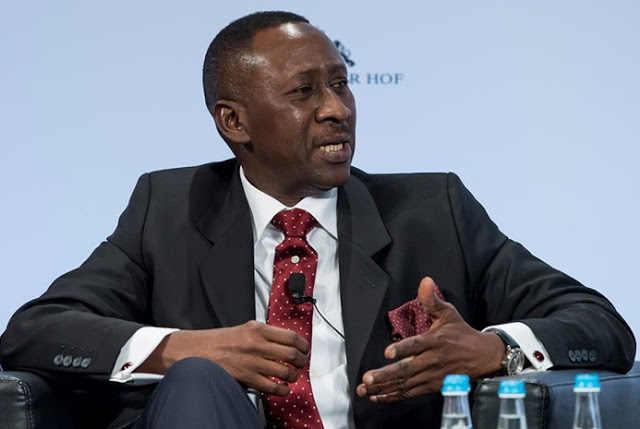
In a statement signed by Segun Ajayi-Kadir, director-general of MAN, on Thursday, the group said despite the availability of several funding windows, manufacturers still suffered the dual challenges of scarcity of investible funds high lending rate.
“Generally, MAN observed through feedbacks from members and interaction with the CBN on several occasions that these facilities and funds have not been adequately accessible to manufacturers due mainly to the prevarication of the participating financial institutions (PFIs) and deposit money banks (DMBs),” the statement made available to The ICIR said.
MAN cited an example with CBN’s N1 Trillion COVID-19 Stimulus for Manufacturing and Import Substitution, which commenced in 2020, saying that only 76 companies had received 300 billion naira, translating to 30 percent of the total.
The N1 Trillion COVID-19 Stimulusor Manufacturing and Import Substitution was instituted in 2020 to sustain manufacturing and improve the output of the sector. It was to be managed by PFIs, which included commercial banks and development finance institutions.
While acknowledging the excellent initiative of the CBN in setting up the N1 trillion COVID-19 facility, MAN noted that most of its members who applied were not able to get it.
The group said that the various CBN funding windows were commendable, but poor implementation hindered attaining the noble objectives of these funds.
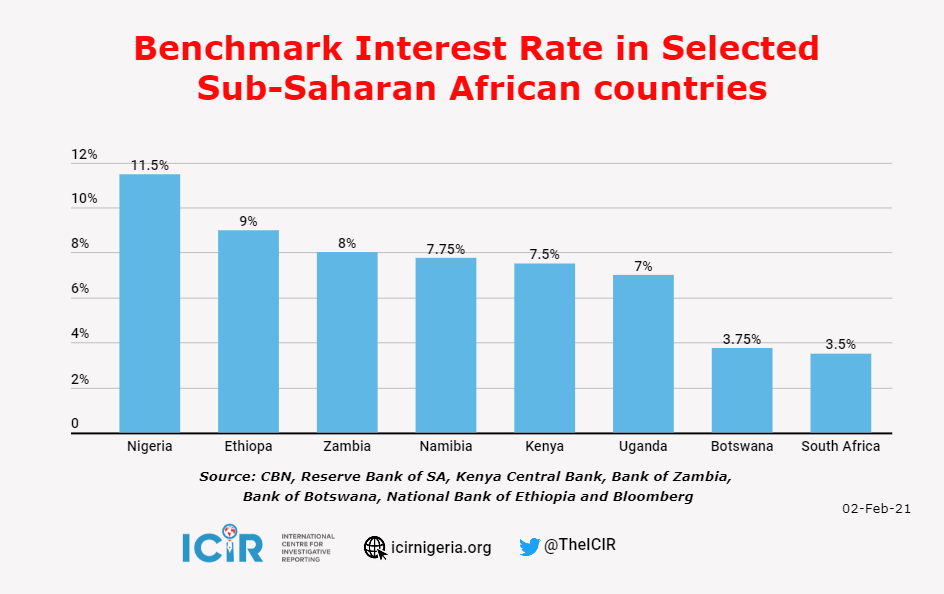
Benchmark Interest Rate in Selected Sub-Saharan African countries
It suggested that the CBN’s strict enforcement should be strict to ensure that the PFIs and DMBs grant transparent and effective access to their intervention funds to manufacturers. “This is especially concerning the N1trillion manufacturing and import substitution facility; the N220 billion Micro, Small and Medium Enterprises Development Fund (MSMED), the 100 billion Health Care and Pharmaceuticals Support Funds and N300 billion Real Sector Support Facility (RSSF).”
It also recommended specific guidelines and timelines for effective and complete disbursement of the intervention funds, saying that there should also be a periodic report of the status of implementation to the CBN to ensure progressive monitoring. It further recommended that PFIs and DMBs who failed to diligently and timeously disburse all the funds allocated be sanctioned.
It likewise urged the CBN to be part of the monitoring process.
Godwin Emefiele, CBN Governor Credit: Financial Times
Naira 4 Dollar Scheme
On the Naira 4 Dollar Scheme recently introduced by the CBN, the association said the scheme should encourage Nigerians working abroad to remit more
into Nigeria and improve the forex inflow. It noted, however, that the apex bank must dimension the inflows, which had historically been 70 percent for family support and 30 percent for other purposes, including real estate, which carried the greater part.
“To yield more of the anticipated inflow for investment in productive activities, the CBN would have to work with the banks and other relevant government agencies to initiate portfolios and measures to point the remitters in that direction,” MAN counselled.
There was also a need to consider where the domestic foreign exchange-earners stood within the context of this scheme.
“For instance, could a manufacturer who exports his product and repatriates his dollar profit get his money in dollars and also benefit from the Dollar 4 Naira Scheme? This way, you can guarantee almost a 100 percent re-investment in production and reap all the attendant benefits and even partly make up for the losses incurred due to the poor implementation of the Export Expansion Grant (EEG). The average manufacturer who is confronted with a lot of infrastructure and macroeconomic challenges is eminently qualified, if not more qualified, to benefit from such a scheme.”
Nigerian manufacturers face many challenges, particularly lack the liquidity to expand operations; Monetary Policy Rate (MPR), which is the benchmark interest rate, is 11.5 percent currently. Still, banks charge as high as 20-30 percent, according to the Lagos Chamber of Commerce and Industry (LCCI).
In 2020, the Interest rate charged to manufacturers averaged 20.75 per cent as against 21.25 percent recorded in 2019, MAN said in a recent economic review.
The cost of funds in Nigeria is high compared with many Sub-Saharan African (SSA) countries. According to their central banks, Nigeria’s MPR is higher when compared with South Africa’s 3.5 percent, Kenya’s 7.5 percent, and Zambia’s 8 percent. In Ethiopia, another SSA nation, the benchmark interest rate is estimated at 9 percent, according to the National Bank of Ethiopia. Botswana’s rate is at 3.75 percent, while Uganda’s is 7 percent. Similarly, while Namibia’s benchmark rate is 7.75 percent, Mali’s is 9.12 percent.
Ibrahim Maigari Ahmadu, the founder of Liverstock247.com, Nigeria’s first livestock online marketing and listing platform, said the interest rate in banks was high, just as there were many gridlocks to access funds.
“Nigerian commercial banks are risk-averse. They put so many bottlenecks on the way when you want to access funds,” he said.
“Interest rate is very high, which is a major inhibiting factor. Collaterisation is structured to knock you out,” he added.
CBN’s position
The CBN has severally threatened to punish commercial banks not disbursing intervention funds or lending to the real sector. In September 2020, it threatened to sanction banks not lending to farmers. The previous year, the apex bank had debited 499 billion naira from accounts of 12 banks not meeting Loan-to-Deposit Ratio (LDR) of 60 percent. The LDR was later raised to 65 percent and banks that did not meet the threshold were sanctioned. However, manufacturers believe the apex bank should move a notch further by strictly monitoring intervention funds domiciled in commercial banks.
THE Nigerian Stock Exchange (NSE), on Wednesday, completed its demutualisation process after receiving approvals from the Securities and Exchange Commission (SEC) and Corporate Affairs Commission (CAC).
With the completion of the process, the NSE becomes a publicly-traded company owned by shareholders. According to Investopedia, an investment online platform, demutualisation occurs when “a company elects to change its corporate structure to a public company, where prior members may receive a structured compensation or ownership conversion rights in the transition, in the form of shares in the company.” Hence the NSE is now owned by shareholders rather than government or other special interests. Therefore, decisions in the stock market are now taken by shareholders rather than the government or other interest groups. Also, the NSE has become an entity that can offer its own shares to the public.
The new status of the NSE brings with it a different structure. Under the demutualisation plan, a new non-operating holding company known as the Nigerian Exchange Group Plc has been created.
The group now has three operating subsidiaries, namely: Nigerian Exchange Limited (NGX Limited), the operating exchange; NGX Regulation Limited (NGX REGCO), the independent regulation company; and NGX Real Estate Limited (NGX RELCO), the real estate company. All the entities have been duly registered at the CAC, the NSE said on Wednesday.
The approvals now enable the shares of NGX Group Plc, which have been registered with the Securities and Exchange Commission (SEC), to be distributed to the membership according to the court-approved Scheme of Arrangement. Hence, ahead of its listing on NGX Limited, the shares of NGX Group Plc will be available for bilateral trades to be executed in line with the Nigerian capital market’s extant rules and regulations, the NSE explained.
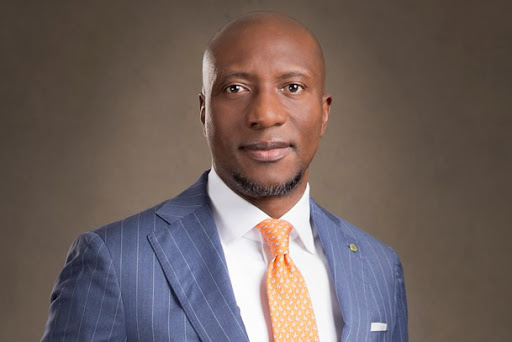
Abimbola Ogunbanjo, NSE Council President, Credit: NSE
The NSE noted that demutualisation was important as it would create new strategic opportunities, enabling the group to realise its vision of becoming Africa’s leading capital market infrastructure provider. “The creation of a holding company and a new capital structure will also enable NGX Group Plc to form new dynamic relationships, drive strategic partnerships and gain capital-raising flexibility.”
Oscar N. Onyema, the new group CEO of NGX Group Plc, said the Nigerian capital markets should play a role commensurate with Nigeria’s status as Africa’s largest economy.
“At the Nigerian Stock Exchange, we have a vision that the new group will become the premier exchange hub for Nigerian businesses and the African economy. We are implementing a series of measures towards this goal, demutualisation being a critical milestone. The completion of demutualisation is a truly significant moment, and we welcome the new possibilities that have opened up for us today,” Onyema said.
Demutualisation, a global practice
The NSE is now the 57th country to demutualise. The first exchange to commence the practice was the Stockholm Stock Exchange in 1993. Since then, several exchanges worldwide, including the London Stock Exchange, Toronto Stock Exchange, the Paris Bourse, Nasdaq, and Hong Kong Stock Exchange, have embraced it.
Why demutualisation?
In a 2002 working paper, Jennifer Elliot of the International Monetary Fund (IMF) noted that competition for liquidity, technology, mergers/alliances and regulatory pressure were some of the reasons why global exchanges scrambled to demutualise.
“The roots of demutualisation can be traced directly to the enormous technological changes that have affected the securities industry in the past fifteen years,” Elliot said. “Technology has been the impetus for demutualisation–services once offered exclusively by the local exchanges are now available elsewhere, creating competition for order flow and listings. Exchanges are now markets competing with other markets…”
Also, a paper authored by the Organisation for Economic Co-operation and Development (OECD) in 2014 with the title ‘Privatisation and
Demutualisation of MENA Stock Exchanges: TO BE OR NOT TO BE?’ explained that demutualising stock exchanges might lead to financial agility and improved decision-making compared to operating mutual or government-owned exchanges.
The paper argued that demutualised exchanges have wider access to capital and could attract foreign investments.
THE federal government says it is not against having conversations with criminal elements in the country but will apply its full weight against them.
Babagana Monguno, national security adviser, said this during a State House Briefing on Thursday in Abuja, the nation’s capital.
The NSA said the criminal elements were not people looking for anything that was genuine or legitimate, but were only out to take calculated measures to inflict pain and violence on innocent people. He said owing to this, government was out to deal with them.
According to Monguno, the terrorists and bandits were not reliable because they might still go back to hurt the society.
“While government is not averse to talking with these entities, it also has to fully apply its weight. You cannot negotiate with people who are unreliable and who will continue to hurt society. We will apply the full weight of the government to deal with these criminals,” Monguno said.
He explained that the government was also focused on the associated dimensions of the banditry and terrorism, including Illegal drugs, flow of small arms and light weapons, and Illegal mining in places like Zamfara State.
He also noted that the highlighted dimensions were some of the scenarios fueling the violence in the North-East, and the federal government was already tackling them.
In the fight against insurgency, banditry and terrorism in Nigeria, state and federal governments have taken measures which some say are counterproductive.
Earlier in 2020, the federal government introduced the Operation Safe Corridor to rehabilitate ‘repentant’ Boko Haram terrorists back to the society.
However, Babagana Zulum, governor of Borno State, recently said that deradicalisation of repentant Boko Haram members was not working because most of them ended up as spies for the terrorist group.
Also, Abubakar Bello, governor of Niger State, has said that some repentant bandits deceived the government into collecting money to buy more weapons for their operations.
Meanwhile, Monguno has reiterated the government’s position on the engagement of foreign mercenaries to fight insurgency in Nigeria.
The NSA said President Muhammadu Buhari’s directive was that Nigeria was not in need of mercenaries.
He stated that the view of the president was that the country had capable personnel and resources to tackle insecurity.
“The president’s view and directive is that we will not engage mercenaries when we have our own people to deal with these problems.
“We have the personnel and resources, and the president has given a new lease of life to the Armed Forces,” Monguno said.
During the administration of President Goodluck Jonathan, Nigeria engaged South African mercenaries to tackle insurgency, The ICIR investigation revealed.
Eeben Barlow, a South African military contractor and chairman of ‘Specialised Tasks, Training, Equipment and Protection International’ had, during an interview with Al Jazeera, said his mercenaries were winning the war against Boko Haram before Buhari terminated their contract immediately after assuming office as president.
“The then-incoming President, Muhammadu Buhari was heavily supported by a foreign government, and one of his first mission as president after May 2015 was to terminate their contract,” Barlow said.
When contacted by The ICIR, the Nigerian government refused to comment on it.
Typically, Oguwike, media aide to Governor Hope Uzodimma, attacked my person, making baseless claims on what he described as my political affiliations, motive for my writings and presumed hatred for President Muhammadu Buhari and the All Progressives Congress (APC).
I will come back to these infantile insinuations shortly. But first things first.
He called me “one Ikechukwu Amaechi.” That is too childish and a gross misapplication of grammar. Until a year ago when Uzodimma poached him from TheNiche, Oguwike was my subordinate in the office. As the Managing Director/Editor-in-Chief, I appointed him editor in 2014 and signed his appointment letter to the chagrin of some senior editorial staff who subsequently left in protest.
But knowing Oguwike’s proclivity for mischief and treachery, addressing me so offhandedly was a deliberate attempt to insult, which speaks to the lack of character that precipitated the rebellion against him at TheNiche.
Since Oguwike’s article, “Imo and quisling commentators,” was published last Thursday, I have received numerous calls from mutual friends who could not believe the rather condescending tone, the manifest hubris and what they perceive as the deleterious effect of power on people even those that only saunter along its corridors.
But anyone who knows Oguwike well will not be surprised. As Michelle Obama, former United States First Lady, famously said, power doesn’t change who you are. It reveals who you are.
The fact that he has gone berserk, literally, dishing out insults to all and sundry who dare cross his path by criticising his principal, no matter how constructive, is true to character.
When Shaka Momodu, Editor of THISDAY on Sunday, wrote an article in February 2020 titled, “That Supreme Court Magic Judgment,” condemning the judgment that sacked Emeka Ihedioha as Imo State governor, Oguwike alleged financial hanky-panky.
Oguwike wrote that “Shaka was comfortable abusing the Supreme Court …. He did so in ways his collaborators, nay paymasters who have been lamenting their loss of power in Imo State … have carried on for more than two weeks now.”
He tarred Chido Nwakanma, a communications strategist, with the same “pen for hire” brush for his February 6, 2020, article in BussinessDay titled, “The hunchback on Hope Uzodinma.”
For daring to criticise his boss, Oguwike accused Nwakanma of joining “the band of cheerleaders and hired writers who dot the country’s landscape.”
“I do not know,” he pontificated, “how much thought Nwakanma has spared evaluating the circumstances that brought his paymasters into office in the first place.”
It smacks of intellectual laziness if the only way Oguwike knows to defend his boss is to accuse anyone with a contrary opinion of being a hack writer even if that is his brief at Douglas House, Owerri.
Now, to the main issues in Oguwike’s diatribe.
He wrote: “There is nobody who does not know that the only problem Ikechukwu has now is President Muhammadu Buhari and the APC …. His, is hatred borne out of allegiance to another political party and benefactors he has psychological attachment to.
“Therefore, he cannot comment objectively on any APC governor or government just as it is an anathema for him to say anything good about Buhari.”
I didn’t know that Oguwike also speaks for Buhari, a job Garba Shehu and Femi Adesina, in my estimation, are doing well and, therefore, don’t need the help of an interloper.
Oguwike’s insipid accusation that I hate Buhari is laughable. Truth is, I don’t, but I loathe what he has done with power. I detest the fact that his bigotry and penchant for nepotism has pushed Nigeria to the precipice. I hate the fact that Buhari’s supremacist agenda is nudging Nigeria to the brink of another civil war. And the depth of my angst is a measure of the profundity of my disappointment.
Oguwike knows that I voted for Buhari in 2015 because I was convinced that the then ruling party – Peoples Democratic Party (PDP) – had become too conceited and undemocratic. When the fact of an impuissant Goodluck Jonathan’s namby-pamby presidency was thrown into the mix, I came to the inevitable conclusion that Nigeria needed a new leadership.
But, less than six months after Buhari mounted the saddle, I found out, regrettably, that it is what it is. Most Nigerians who supported Buhari in 2015 have also come to that inevitable conclusion.
The only difference is that as frustrating and challenging as the Buhari presidency has become, some people believe that since the status quo cannot be changed, it must just be accepted without a whimper. I say no. Buhari must be called out for the harm he is doing a country that gave him his all.
That is also my disposition to Hope Uzodimma, the man who was elected governor of Imo State by seven justices of the Supreme Court, via a judicial fiat that Justice Centus Nweze said “will continue to haunt our (Nigeria’s) electoral jurisprudence for a long time to come.”
Oguwike mentioned my April 29, 2020 article, “Hope Uzodimma’s 100 days of hopelessness,” claiming that some “very senior colleagues” called him to wonder “what commentator could have said a political office holder did nothing in office in 100 days.”
But he should tell his imaginary senior colleagues that his principal, not me, said so.
In his April 27, 2020 speech, a whopper cocktail of falsehood and fairytale, Uzodimma said he had nothing to show for his first 100 days in office because the circumstances of his “historic victory” did not avail him “the luxury of a transition period, which most governors-elect have the privilege of using as a preparatory phase to actual governance.”
He lamented that “the situation was not helped by the sorry state of affairs,” he inherited. “There was no handover note from the previous government to mine. This left me with no definite starting point.”
Uzodimma also claimed he was unable to hit the ground running because he “inherited an empty treasury and a disillusioned, disoriented and dispirited civil service.” Those were his words, not mine.
I agree we are in a post-truth politics era and Oguwike wants to impress. But he should do so with some decorum because post-truth politics poses a serious challenge to the values of truth, and consequently trust, two value propositions in public office without which good governance is a mirage.
When falsehoods in public space are left unchallenged, a lot of things are compromised and the integrity of our politics or what is left of it collapses irredeemably.
Oguwike’s inane allusion to my so-called allegiance to paymasters is pathetic. It is too cheap a blackmail that deserves no response. I don’t know why he is feeling so self-important doing a job I turned down in 2007 – 14 years ago.
So, this is neither about Emeka Ihedioha nor being beholding to some political interests. At stake is the fate of a beleaguered Imo State and its over five million people.
I was in Abuja on January 16, 2020 when Oguwike called to inform me that Uzodimma had offered him appointment. I had nothing against that. They were friends and I gave my blessing. With the Supreme Court ruling, Uzodimma’s governorship had become a fait accompli.
But I have always told him that his principal didn’t win the March 9, 2019 governorship election, having come a distant fourth. That is the crux of the matter.
So, while he remains governor, it is sacrilegious for Uzodimma to continue claiming that the Supreme Court judgment restored the “mandate the good people of Imo State freely” gave him.
Uzodimma was made governor on a platter of doctored election results by seven justices of the Supreme Court, none of whom voted in the election, and who subsequently refused to right their manifest wrong on the grounds that the court lacked powers to sit on appeal in its own judgment.
That is the truth that is haunting Oguwike and his co-travellers on the boulevard of falsehood. A truth Justice Nweze amplified when he disagreed with the Supreme Court heresy by insisting that a judgment or order can be set aside on merit.
“This court once set aside its own earlier judgment and therefore cannot use the time frame to extinguish the right of any person. This court has powers to overrule itself and can revisit any decision not in accordance with justice,” Nweze reminded his colleagues in his minority judgment.
But all that, perhaps, wouldn’t have mattered if Uzodimma is providing good governance. He is not, thus proving that while one can easily obtain power by trick (OBT), governing by deceit and propaganda is a much harder task.
Oguwike said no amount of hate commentary on his principal will make him remove his eyes on the governance ball to reposition Imo State.
That is exactly the wish of every well-meaning Imolite. Unfortunately, there is no ball right now in Uzodimma’s governance field, hence the resort to blatant falsehoods.
Oguwike ranted that Ndi-Imo have seen the construction/reconstruction of roads that will stand the test of time, reforms in the civil service like never before, and claimed they are getting their due from the government without being dehumanised.
Really? Which state is he talking about? The same Imo State where pensioners, old men and women, were beaten mercilessly by thugs for daring to demand payment of their pension arrears?
It is good to hear Uzodimma has turned Imo into a giant construction site and work is ongoing on the dilapidated Owerri-Orlu, Owerri-Okigwe roads. Does that mean that the construction giant, Julius Berger, has mobilised to site after signing a memorandum of understanding on those two roads with Uzodimma last year?
Oguwike wrote about the unprecedented reforms in the civil service without elaborating. Do the reforms entail non-payment of civil servants and teachers or pay cut for those who are lucky to be paid anything at all?
By the way, what has happened to the N2 billion Uzodimma claimed last year he was saving every month for the state through his “painstaking exercise of eradicating the stinking fraud in the public service payroll system?” Is there no longer limits to lies?
Granted, even at the best of times, the job of image-making is a tough call. It is even more so when dealing with a principal with a mountain of baggage.
But by his churlish antics, Oguwike is making a bad situation even worse, wrecking further, rather than remaking Uzodimma’s bad image.
SINCE commencement of the distribution of the AstraZeneca vaccine in Nigeria, out of the 36 states and the Federal Capital Territory (FCT), Lagos, Kano and Abuja have received more than 23 per cent of the total 3.92 million available vaccines.
An analysis of the distribution of the vaccines through data gathered by THE ICIR has revealed that the two states and Abuja got the highest number of doses available.
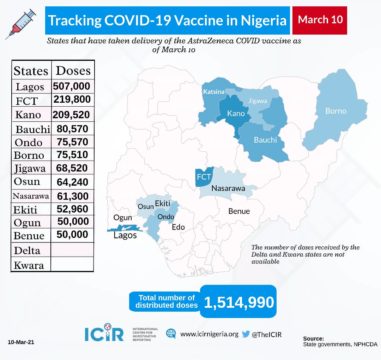
Nigeria had received 3.92 million of the AstraZeneca vaccine last week through the COVAX facility. Lagos state which has the highest number of cases in Nigeria was allocated 507,000 doses of the vaccine while the FCT was allocated 219,800.
Kano state which has recorded 3,852 cases of the deadly virus was allocated 209,520 doses of the vaccines.
The two states and the FCT have received exactly 936, 320 doses out of the 3.92 million AstraZeneca vaccine received by the country as the remaining 2,983,680 doses of the vaccine is being shared among the other 34 states.
As of the the time of filing this report, Ogun state has received 50,000, Bauchi; 80,570, Benue; 50,000, Borno; 75,510, Ekiti; 52,960, Jigawa; 68,520, Nasarawa; 61,300, Ondo; 75,570, Osun; 64240, Yobe; 65,610.
Some states with a lesser number of COVID-19 cases were allocated more vaccines than some with a higher number of cases, The ICIR has observed.
Benue state has recorded 1188 number of COVID-19 cases and was allocated 50,000 doses of the vaccine while Yobe with 293 cases got 65,610 doses.
Also, Ogun state which is the 8th state to record the highest number of cases with 4495 confirmed cases was allocated 50,000 doses of the vaccines while Jigawa with 496 COVID-19 cases has received 68,520 doses.
Like other earlier mentioned, Nassarawa state which has recorded 2283 COVID-19 cases got lesser doses compared to Bauchi that received 80,570 with 1420 cases.
When contacted to find out the criteria used for the distribution, Muhammed Ohittoto, the spokesperson for the National Primary Health Care Development Agency said the agency is not ready to answer such questions yet.
According to Ohitoto, the NPHCDA is still working on the statement that would be released to the general public on the distribution to states across the country.
“Until the official statement is released, I can’t speak on it,” Ohitoto told The ICIR.
However, during a State House briefing on vaccines last Thursday, Faisal Shuaib, executive director of the NPHCDA had said states that are yet to meet safety requirements will not get the vaccine.
According to Shuaib, states must be able to prove that they can properly secure the vaccines before they would be allocated to them.
“For example, we have communicated to the states that they have to wrap up their security around their cold stores because these are very valuable vaccines and we do not want a situation where vaccines are taken to the states and criminal elements take advantage to vandalise these cold stores,” the NPHCDA boss stated
Shuaib also said that the availability of cold stores in the states would also be a factor to be considered in the distribution.
JEROEN Elfers, corporate director, Dairy Development and Milkstream, Royal FrieslandCampina, has said that breeding, backward integration, food safety and farmer-centric programmes are the building blocks to sustainable dairy production in Nigeria.
Elfers said this during his presentation at a webinar organised by the Centre for Nigerian Dutch Dairy Development (CNDDD) monitored by The ICIR.
The webinar with the theme ‘Harnessing the Great Unpolished Diamond of Africa’ was organised to proffer ways to a better dairy industry in Nigeria.
According to Elfers, the building blocks to sustainable productions also included: soil quality, climate, true backward integration, herd management, animal welfare, among others.
Backward integration occurs when a company purchases part of its supply chain.
Elfers noted that the private, public and knowledge sectors must also collaborate to build a strong sustainable dairy sector.
He advised Nigeria to build on the collaboration as it was one of the major factors enhancing the success of the Netherlands, China and Pakistan’s dairy development.
Ben Langat, managing director, FrieslandCampina WAMCO Nigeria Plc, one of the founding partners of the CNDDD, also called for sustainable dairy development to boost nutrition and food security in the country.
Langat said sustainable dairy development would enhance community empowerment, adding that dairy had an impact on poverty reduction.
He said that a Food and Agriculture Organisation (FAO) study showed that milk collection and distribution generated a considerable amount of direct and indirect employment.
He further stated that the increase in malnutrition required the development of high-quality protein for vulnerable populations, saying dairy was an affordable nutrient-dense food.
“This plays a vital role in making high-quality nutrition accessible to the population of the country… The centre is making dairy attractive; linking local and international partners to foster sustainable development,” Langat said.
Langat, who doubles as chairman of CNDDD, disclosed that the centre had established a partnership with the University of Abuja, 2Scale, Rabobank and Van Hall Larenstein University of Applied Sciences, Netherlands to enhance its mission.
Keith Heikes, chief operating officer, URUS, said that Brazil’s experience in the genetic improvement of dairy cattle provided a good roadmap for Nigeria to adopt.
Heikes said that improved genetics was one of the key building blocks of successful dairy development.
Speaking on the new partnerships, Abdulrasheed Na’Allah, vice-chancellor, University of Abuja, said that partnership with the centre would enhance knowledge transfer and exposure for students.
Na’Allah, who was represented by Akeem Oyerinde, deputy dean at the university, said time was apt to strengthen partnerships and innovations that would deepen Nigeria’s dairy sector
CNDDD is an organisation that focusses on improving dairy productivity and sustainability throughout the entire dairy value chain in Nigeria, based on Dutch expertise gained for more than a century.
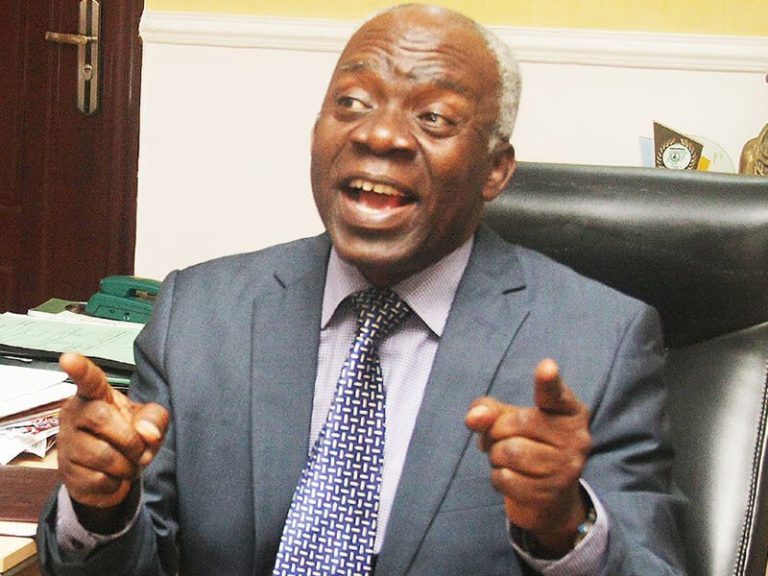
FEMI Falana, a human rights lawyer and Senior Advocate of Nigeria (SAN), says the federal government lacks the right to determine how the loot recovered from James Ibori, former governor of Delta, should be spent.
Falana, who stated this on Wednesday while appearing on Channels Television’s Politics Today, said the recovered funds should be returned to the state from where they were first looted.
He argued that since the said loot left Delta State’s coffers, it was the state that would determine what the funds should be used for.
“Having acknowledged the role of the federal government, the fund has to return to the source. Factually, between 1999 and 2003, the Delta state government, like other state governments in Nigeria, received its statutory allocation on a monthly basis and paid same into the account of the government. From that account, some amount was alleged to have been diverted and taken to the United Kingdom,” he said.
“As the honourable attorney-general had said, the money is over 100 million pounds. What has been released now is the first tranche of 4.2 million pounds. Since the funds left the Delta State government’s coffers, it has to be returned once this fund is recovered.
“The federal government has no locus standi with respect to how the money is spent. That is left for the people of Delta State to monitor the government of that state to ensure that the fund is not relooted.”
While saying that Britain would not decide how recovered looted funds were spent, he noted that the attorney-general of the federation should have worked in sync with the state government to demand damages from the banks holding the illegal funds.
“In fact, the memorandum of understanding referred to by the attorney-general, signed in London, smacks of colonialism. Britain cannot decide on how recovered loot should be spent.
“What I expect the attorney-general or the federal government in the circumstance — is to collaborate with the Delta State government to ensure that the banks that housed the looted wealth of Delta State or the banks involved are made to pay colossal damages and interests for denying the people of Delta State the opportunity to use the money for development.”
The United Kingdom, on Tuesday, signed a memorandum of understanding (MoU) with Nigeria to return 4.2 million pound assets stolen by Ibori, former governor of Delta State.
The funds are expected to be used for the completion of the Second Niger Bridge, Abuja-Kano Road, Lagos-Ibadan Expressway and other key infrastructures in the country.
The federal government has argued that it took possession of the funds because it was actively involved in its recovery process.
But Delta State government has also vowed to seek redress in court.
The House of Representatives has directed that disbursement of the funds be halted pending the determination of its owner by it.
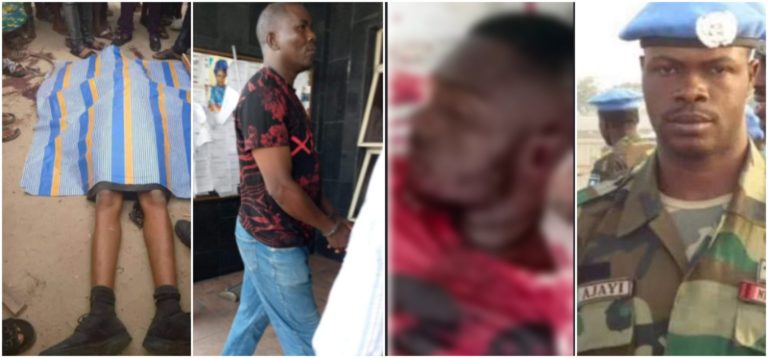
‘’The frantic strides weren’t enough to save this victim. Soon a bullet hit Joseph right inside the car and then another when he attempted to crawl to safety. He died on the spot…’’
On Thursday, April 9, 2020, ten days after Nigeria entered a partial lockdown due to the COVID-19 pandemic, officers of the Nigeria police, army, correctional service and others had extra-judicially killed 13 while enforcing the curfew – the virus had only claimed six lives then. By May 4, when the government eased the lockdown, about 20 persons had been killed in similar circumstances. For three months, investigative journalist, Kemi BUSARI, followed the trails of these arbitrary killings which have left many families devastated, with no hope of justice.
Before she met her untimely death in April 2020, Lovender Elekwachi had served the Nigeria Police for 13 years.
Her journey to the force started on July 1, 2007, when she was recruited. She had risen to the rank of a sergeant and was due for a promotion in 2020 but a fellow officer terminated her life.
Lovender was on duty as a traffic warden at the Eneka Roundabout in Port-Harcourt, South-south Nigeria when she was shot dead by a fellow officer identified as Bitrus Osaiah, also a sergeant.
The 35-year-old mother of one was on duty around 2 p.m. when members of the Rivers State Taskforce on Road Decongestion, Illegal Street Trading and Motor Parks arrived to disperse traders around the roundabout.
Sergeant guns down sergeant
The date was April 23, 2020. Then, the Rivers State Government had just announced a closure of all markets in the state and later a total lockdown.
Soon, the enforcement led to harassment of some traders much to the dissatisfaction of Lovender. Many witnesses who spoke to PREMIUM TIMES said Lovender left her post and attempted to pacify police officers, who accompanied the task force members, to stop carting away the traders’ goods. This move was rebuffed irritably by Osaiah. He reportedly opened fire. Moments later, Lovender dropped dead.
She died about ten metres away from a shop belonging to Udoka Luke, a generator repairer. Luke had abandoned his work to watch the whole episode unfold that afternoon.
Trading around Eneka roundabout
“That day, there was task force packing people’s load over here,” he said. “Everybody was on the run, all the people that sell at the roadside, all of them ran away. Later, those boys that stand (sic) at the side of the road, those agberos (illegal traffic managers), were the ones that start(ed) using coke bottles to throw at the police and the task force.
“As the packing (of goods by Task Force officials) was going on, the policewoman (Lovender) was sitting somewhere there (around the roundabout), she now stands (stood) up to come and help because sometimes, if the task force people come, the police here use to come and defend the owners, they will now leave the goods for them. Immediately she stands (stood) up to go and defend that one that particular day, I saw her, she fell immediately. I was even the one that later rushed and saw that the woman was already dead.”
Horrid images gathered in the during this investigation can be viewed in a separate folder here. These are graphic pictures. Beware!
Luke, corroborated by other witnesses, said the police officers had shot twice towards the irate agberos (touts, mostly disguised as traffic assistants).
Once Osaiah and his colleagues saw that Lovender was dead, they zoomed off. The traders were quick to alert Lovender’s colleagues at the Eneka Police Station some 500 metres away. The officers chased and soon caught up with the fleeing assailant.
Lovendar was shot at this spot
While the task force raid was ongoing, some traders who sell goods at the roadside were arrested and held behind Hilux vans. Joseph Francis, who repairs phones and sells accessories, was one of those arrested.
Francis said the fruit seller, whom the team was harassing at one moment of their operation, was a friend to Lovender and her attempt to rescue this friend led to her death.
Female sellers approached at the junction were not willing to talk for fear of being subjects of attack. One of them who spoke on condition of anonymity said they live in fear of harassment by the task force but that they (task force) had not shown up at the junction since the incident.
Breadwinner gone
Lovender’s parent, Matthew Elekwachi and Mary Elekwachi couldn’t hide their emotions when PREMIUM TIMES visited the family home.
Both parents were in their Izu residence in Etche Local Government when the call announcing the death came in. Rattled, Mr Elekwachi dashed to the roundabout where he met the lifeless body of his daughter.
Mr Matthew, a chief, was proud of her daughter’s last act – compassion towards the traders – at the same time, he is sad the family support is gone.
Matthew
Before her death, Lovender lived around Eneka with her husband and their two-year-old son, Great Chimezie. Her sibling, Goddey Elekwachi, was also living with the family.
Goddey, 25, was nursing the prospect of studying Electrical Electronics at the University of Port-Harcourt and her sister had promised to handle the financial responsibility. The dream is now an impossibility as Goddey had to return to the village.
A visibly sad Mary Elekwachi said her livelihood depends entirely on unfailing aid from Lovender. She fought back tears while the interview lasted.
“Lovendar is (was) very good to me oooo…my son has stopped school because there is no one to train him, there is a house Lovender is building for me. Many things Lovender is doing for me, now nobody to do it again,” she said.
Dejected Mary
Apart from the assistance to her siblings, Lovender had placed her mum on a monthly stipend; she bought a farmland for the mum; she employed labourers to work on her farm at every farming season; she was also building a six-bedroom structure inside their compound for the family to have more comfort. She also enrolled her mum in medical care.
All these are now gone, taken away by a single bullet by a colleague.
The building under construction
The road to justice
All the family wants now is justice. Indeed, they have made some attempts at getting one. In May, 2020, a lawyer engaged by the family, Jerome Okere, wrote the Rivers State Governor, Nyesom Wike, pleading that the family be compensated for their loss. The letter was acknowledged by the Office of the Chief of Staff on June 4 but nothing has been achieved.
Mr Okere is also holding brief for the family in the case filed by the police. He said not much progress has been made.
“The matter was charged to magistrate court and the court declined jurisdiction. They don’t have the power to hear trial matters relating to murder. So, the file was referred to DPP and since then nothing has been done,” he said.
The family said that Lovender’s salary was only paid for three months after her death and that despite they perfecting documentation months ago, her entitlements have not been paid.
Lovendar’s family members
Nnamdi Omoni, the spokesperson of Rivers Police Command asked for ‘consultation time’ to revert when asked questions on these but he couldn’t provide answers after a follow-up.
He advised the family to approach the police ‘’to iron out encumbrances’’.
The PRO said Osaiah, the assailant, has been dismissed from the police. “He has been dismissed and charged to court. He is currently facing trial,” he said.
The family, corroborated by their lawyer, also alleged that the police informed them in August 2020 that they received ‘’orders from above’’ that the case should be transferred to Abuja which they rebuffed. Mr Omoni said he is not aware.
While bureaucracy continues to stall the case, the Elekwachi’s continue to live in double agony; one, that Lovender has not been buried yet due to the lingering case and that justice has not been served.
“The whole justice has been denied…how do I expect justice again? It is assumed that justice has been denied,” a frustrated Matthew said. “I want justice. The person that killed her, if you know what to do (to him) do it,” a more frustrated Mary, addressing the authorities, adds.
Day trigger-happy soldier went on rampage in Warri
The day was April 2, 2020, around 9 a.m. Most businesses in Warri, an oil-producing city in Nigeria’s South-south, were closed due to the lockdown sanctioned by the government.
While the clock was ticking, a gunshot was heard on Bridgeview Road in the Ugbuwague area of the city. Unfamiliar with such a distraction, residents came out. They were met by the sight of a dead body – the body of 28-year-old Joseph Pessu with blood still gushing out.
Joseph
A few minutes before the gunshot, Joseph, driving in a car, had been stopped by soldiers at the Ubeji checkpoint, not very far from his house. One of the soldiers at the checkpoint, identified as Ilekura Ajayi, was reportedly unsatisfied with Joseph’s ‘conduct’.
He was said to have asked Joseph why he wanted to hit him with the car. A mild argument ensued and Joseph drove off.
A while later, the father of two noticed the soldier was chasing him, first on foot and later in a vehicle. Two gunshots followed, one hitting the tire. Joseph kept driving.
His destination was his father’s house in Ugbuwangue. He was about 700 metres away, when he couldn’t move again. The exit from Bridgeview Road had been closed by residents, probably due to the lockdown.
Sensing he might be caught by a hail of bullets from the angry soldier, Joseph hastily hopped down from the vehicle and dashed to the adjoining Mene-Akpata Street. Ajayi pursued with his gun.
The frantic strides weren’t enough to save this victim. Before he could wriggle out of the car, a bullet hit him and then another when he attempted to crawl to safety.
He died on the spot.
Monday pointing to where Joseph’s body was found
Ani Iyonsi, a resident who lives close to the scene witnessed the shooting. “I was at home when I heard the gunshots. They shot him through the back of the car which hit him by the side,” he said.
About three streets away, Joseph’s father, Monday Pessu, was waiting for his son. He had called him earlier to come and assist him to the hospital to check his failing health. It was a journey Joseph never made.
Back to the scene of the shooting, residents had started to gather and a call was put through to Monday who arrived at the scene in no time, despite his health. His first instinct was to attack Ajayi but he was soon calmed by residents now preparing for protest.
Monday hauled the dead body of his son to the back of his Hilux van and then followed some soldiers to the A Division Police Area Command. The body was later deposited at the mortuary. Nothing has been heard from the authorities since then.
Horrid images gathered in the course of this investigation can be viewed in a separate folder here. These are graphic pictures. Beware!
“After it happened, nobody came to me. It was the deputy governor who came for a condolence visit (based on the fact that) we are party members. From then on, nobody came but the matter is in court. I need justice,” the 66-year-old Monday said.
Monday Pessu
The family filed a case against the Nigerian Army claiming damages. The case with suit number FHC/WR/CS/48/2020 was filed at the Warri Division of the Federal High Court. Lawyer to the family, Clem Ade Omotoye said a hearing on the matter was about to commence at the Federal High Court, Warri.
Words not matching actions
Addressing journalists on March 30th, 2020, the spokesperson, Directorate of Defence Media Operations, John Enenche, a Major General, said that the military would not be involved in punishing residents who flout COVID-19 lockdown rules.
“Penalties will be left for the police, it’s not for the military,” he said. “I shouldn’t tell you that this is the penalty for any person that flouts the directive of staying at home, of wandering from one place to the other. It should be with the police because it is their force responsibility. What we normally do is provide aid to civil authorities. But as I speak with you, we now have the legality to work them if they call us.”
Ajayi acted contrary to the words of the top ranks of the Nigeria’s Defence Directorate. Worse still, the army has so far condoned this act.
There is no known investigation or retribution for the erring officer further aggravating discontent within the victim’s family.
Section 106 of Nigeria’s Armed Forces Act states that “ a person subject to service law under this act who, without justification or excuse, unlawfully kills another person… is guilty of murder and liable, on conviction by a court-martial, to suffer death.”
Ajayi, the soldier who killed Joseph
Calls and text messages to the spokesperson of the 6 Division of Nigerian Army, Charles Ekeocha, a major, were not responded to.
Ordinarily, as enshrined in the constitution, the Nigerian military are majorly saddled with the responsibility of protecting the national borders from external aggression but years of military rule and incompetence of the Nigeria police have made the military an added apparatus for maintaining law and order within the state.
Asked if the case was transferred to the police, Delta Command Public Relations Officer of the Nigeria Police, Onome Onovwakpoyeya, requested more details and time but has yet to revert as of press time despite a follow-up.
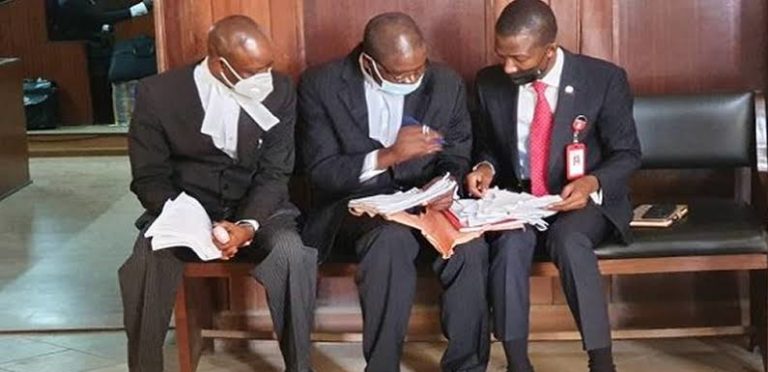
ABDULRASHEED Bawa, chairman of the Economic and Financial Crimes Commission (EFCC), on Wednesday, appeared before an Ikeja High Court to give evidence in a 1.4 billion naira fraud trial involving an oil company, Nadabo Energy. and its chairman, Abubakar Peters.
Bawa testified as the fifth prosecution witness.
Led in evidence by the prosecution counsel, Saidu Ateh, the EFCC boss, during resumed proceedings, narrated to the court how the fraud was perpetrated. Bawa said the defendants allegedly submitted to Petroleum Product Pricing Regulatory Agency (PPPRA) documents showing that they imported 14,000 metric tonnes (MT) of premium motor spirit (PMS), whereas they brought in only 4,850 metric tonnes of the product. Bawa said the defendants allegedly claimed subsidy on 14,000 MT of PMS.
Bawa told the court that he analysed the email correspondences of the defendants and found that they took about six million litres of premium motor spirit (PMS) from the mother vessel, MT Evriduk, into their own chartered vessel, MT St. Vanessa.
He said the email further confirmed that the same quantity was discharged at Port-Harcourt.
“In addition, the email also informed us that one Mr Jideofor Akpan was the agent of the vessel.
“We invited the said Akpan and during the course of our interrogation with him, he confirmed that the first defendant through the second defendant deferred the vessel and paid for it.”
He said Akpan volunteered the statement to the EFCC and also submitted several documents to the agency.
The EFCC boss testified that during the interview, he presented the purported shipping documents, which the defendants submitted, to the PPPRA for payment of subsidy to the defendant.
“We presented it to him to confirm to us whether or not the vessel that he is the agent for had anything to do with the vessel called MT American Express.
“MT American Express is the vessel the defendant claimed to have given the product to his own vessel.
“My Lord, Mr Akpan confirmed to us that MT St. Vanessa had nothing to do with MT American Express, rather, St. Vanessa loaded product from MT Evriduk,” Bawa said.
He further testified that he wrote a letter of investigation to Petrocam, the trader that supplied the defendant with the petroleum product.
The EFCC chairman told the court that a request was made in the letter for all the financial and shipping documents in respect of transactions with Nadabo Energy.
“My lord, Petrocam responded to our letter in writing, attaching all requested documents which include a proforma invoice, commercial invoice, letter of credit and bill of laden,” he said.
Bawa said that the EFCC also wrote a letter of investigations of activities to the Corporate Affairs Commission (CAC) to confirm the registration status of Nadabo Energy.
He said the CAC responded in writing by forwarding certified true copies (CTCs) of all the documents requested.
“On receipt of the response, we studied it and found out that the second defendant (Peters) is a shareholder as well as a director of the first defendant.
“My lord, in furtherance to that, we invited two of the directors and shareholders of the first defendant, namely – Mr Akeem Abalaka and one Mr Sanni.
“They both confirmed to us that although they are linked to the company, they are not involved in the contentious matter before this honourable court,” he said.
During Bawa’s testimony, the EFCC sought to tender to the court, the CTCs of the documents it received from Petrocam and the CAC, but the defence counsel, E.O. Isirameh, objected to the documents which included proforma invoice, letter of credit and other documents relating to the transaction.
The defence also raised objections to the admissibility of the response of the CAC with respect to the investigation of the company.
Isirameh argued that the documents were invalid, saying that they were produced by the prosecutors several years after the subsidy transaction occurred.
Christopher Balogun, presiding judge, adjourned the case until April 28 and 29 for ruling and continuation of hearing.
The EFCC had accused Abubakar Ali Peters and his company Nadabo Energy of allegedly using forged documents to obtain 1.4 billion naira from the federal government as oil subsidy after inflating the quantity of PMS purportedly supplied to 14,000 metric tonnes.
The defendants had pleaded not guilty to the alleged fraud charge.
Bawa, during previous proceedings, had also told the court that, after studying the documents submitted to the PPPRA, where the defendants claimed they imported about 14,000 MT of PMS, the EFCC conducted investigation which revealed the contrary.
Also at the last sitting on February 23, 2021, Justice Balogun had admitted in evidence an email correspondence between Bawa and Ullrich Afini Awani of Global Commodities African as well as the Certificate of Identification.
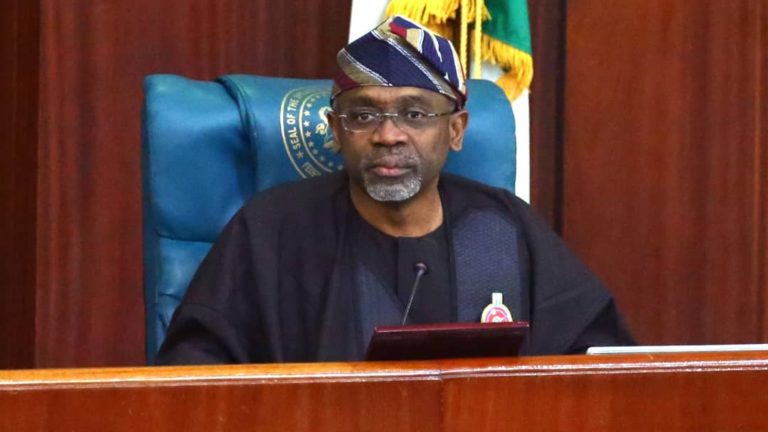
The House of Representatives has directed the federal government to halt the disbursement of 4.2 million pounds James Ibori loot pending the determination of the legitimate owner of the funds.
The directive was contained in a resolution by the House on Wednesday after the adoption of a motion of urgent public importance sponsored by all the lawmakers from Delta State.
According to TheCable, the lawmakers said the sum of 4.2m pounds, being proceeds of crime recovered from Ibori, was being transferred to the coffers of the federal government of Nigeria for appropriation without recourse to Delta State government and/or Parliament.
They argued that the recovered funds belonged to the people of Delta State and as such, should be refunded to the coffers of the state for developmental purposes.
While stating that the total sum recovered was 6.2 million pounds and not 4.2 million pounds as purportedly reported, they contended that if the federal government was allowed to utilise the funds, it would deprive Delta government of their legitimate resources to improve the economy of the state.
“From all indications, information to Delta State indicate that the actual money is 6.2m pounds and federal government should ensure that the total of 6.2m pounds is credited not 4.2m pounds as stated,” they said.
After a unanimous adoption of the motion, the House asked the federal government to stop “forthwith further appropriation and/or disbursement of recovered loot of 4.2 million pounds pending the final determination of the matter by the House.”
The United Kingdom, on Tuesday, signed a memorandum of understanding (MoU) with Nigeria to return 4.2 million pound assets stolen by Ibori, former governor of Delta State.
The funds are expected to be used for the completion of the Second Niger Bridge, Abuja-Kano Road, Lagos-Ibadan Expressway and other key infrastructures in the country.
The federal government had argued that it had taken possession of the funds because it was actively involved in its recovery process.
But Delta State government had also vowed it would be seeking a redress in the court.