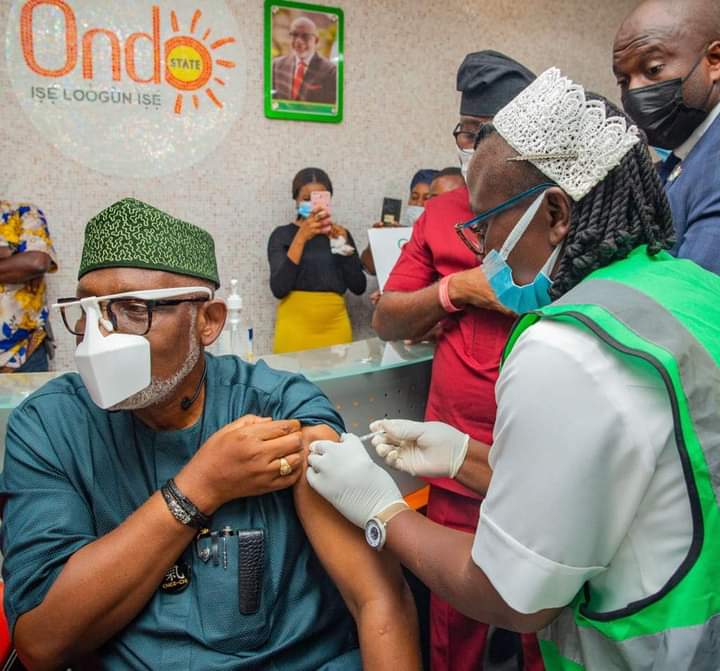
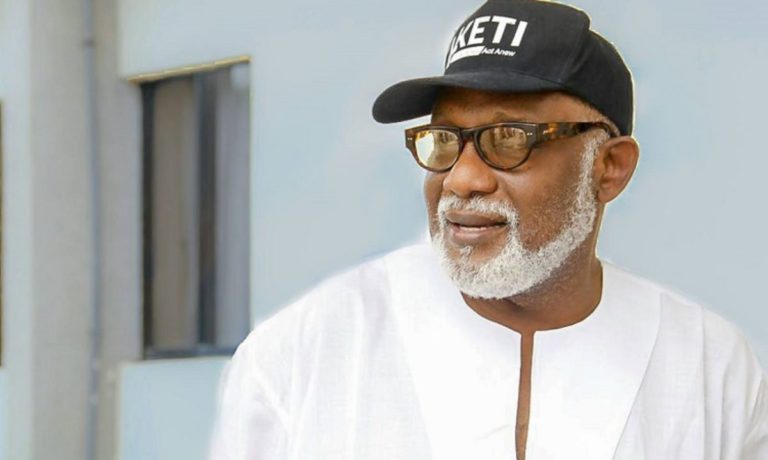
OLUWAROTIMI Akeredolu, Ondo State governor, has taken the first shot of Oxford-AstraZeneca COVID-19 vaccine, assuring the people of the state that it is safe.
The governor, who took the first shot alongside his deputy, Lucky Orimisan Aiyedatiwa, at the Cocoa Conference Center, Governor’s Office, Alagbaka, Akure, On Wednesday, said the state received a total of 73,570 doses of the vaccine from the federal government on Tuesday.
He said in line with the guidelines laid down by the National Primary Health Care Development Agency (NPHCDA), the eligible population for the COVID-19 vaccinations were citizens aged 18 years and above, including pregnant women.
Akeredolu disclosed that the vaccination exercise would be rolled out in four phases, adding that the first recipients would be frontline health workers, COVID-19 rapid response team, laboratory network group, petrol station workers, policemen, and strategic leaders
“In the phase two, the recipients will be older adults aged 50 years and above; those with co-morbidities aged 18-49 years
“The phase three will be those in local government areas with high disease burden who missed phases 1 & 2 while the phase four will be other eligible population as vaccines become more available,” the governor stated.
He assured the people of the state that the Ondo State Cold Chain was fully functional and ready to receive and properly store the COVID-19 vaccine doses.
“Furthermore, to be able to partake of the COVID-19 vaccination, an e-registration link has been created for eligible Nigerians to register. You will be able to put in your details and choose a convenient place and time where you wish to be vaccinated.
“I use this opportunity to implore Ondo State citizens to shun the unfounded rumours about the COVID-19 vaccine. Let me assure you that the vaccines have been tested and certified safe for use by reputable international organizations and NAFDAC.
“While it is true that you are not 100 percent prevented from getting infected after vaccination, you are less likely to get seriously sick or die from the infection if you get it and also less likely to infect other people.” Akeredolu explained.
The governor charged all local government chairmen, traditional rulers, religious leaders and health workers to step up intensive sensitisation activities for the people of the state to register and get themselves vaccinated.
Akeredolu said since the outbreak of the pandemic, his administration had continuously been seeking ways to combat the debilitating effects of the ravaging virus.
“Some of the measures we had put in place include the upgrading of the Infectious Disease Hospital (IDH) with more beds and equipment to admit infected patients, training of our IDH staff on handling of COVID-19 patients, roll-out of radio jingles, television adverts, other sensitisation and awareness tools to the general public,” he said.
“Motivation of our frontline health care workers in the state through the payment of COVID-19 hazard allowance and lately, the inauguration of our state-of-the-art Wahab Adegbenro Molecular and Public Health Laboratory to improve the testing capacity of the State.“
INSTITUTE of Development Studies (IDS), a UK-based research institute, has recommended that international organisations and non-governmental organisations must continue to support social accountability initiatives that advance women’s interest.
The group made this recommendation in a new policy briefing series titled: ‘Strengthening Women’s inclusion in Social Accountability Initiatives,’ published in February and authored by Sohela Nazneen and Maria Fernanda Silva Olivares.
NGOs are urged to design participatory processes that address the barriers to women’s participation, such as time poverty due to domestic work, biased gender norms limiting access to public spaces and others.
“This requires that NGOs and implementing organisations pay attention to details, including setting meeting times and locations that accommodate women so they can balance their paid and care responsibilities at home and travel to these spaces,” the report stated.
Civil society organisations are also charged to provide technical support to women, so they hold public officials accountable through enforcement mechanisms, grievance procedures, and other mechanisms.
To be able to offer support to women, the civil group also must show the capacity to identify key actors at the local level who may be in favour of women’s inclusion and open to challenging gender power dynamics, engage with them from the beginning and connect women beneficiaries to these civil society organisations at the local level, according to the report.
“This will create a strong network that may be able to pressure service providers to be responsive to women’s demands.”
To track what has shifted in the long term, the researchers advised international organisations to develop a benchmark on women’s status and condition at the outset and infuse it with a clear theory of change around women’s inclusion.
Finally, gender discrimination and social norms that limit women’s chance may remain if NGOs fail to provide long-term funding and technical support for institutionalising gender-sensitive processes, the researcher observed.
IDS and MacArthur Foundation supported the research.
CAMEROON has repatriated 5,000 Nigerian refugees out of 9,800 expected back home in the first batch. A total of 46, 000 Nigerian refugees are expected to return home from Cameroon in the long run.
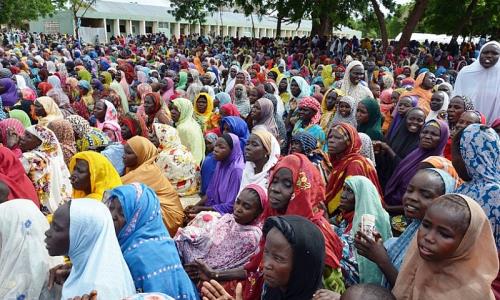
The refugees fled Nigeria in 2014 due to Boko Haram insurgency but have now expressed willingness to return to the resettlement houses built by the Borno State government.
The refugees who had been camped at Minawao, located in Mokolo, far north region of Cameroon, were handed over to Borno State government during a brief ceremony that took place in Amchiide, a border community between Nigeria and Cameroon, close to Banki in Bama Local Government Area of the state on Tuesday.
Paul Atanga Nji, Cameroon’s minister for territorial administration, who led the handover team on behalf of his country, disclosed that President Paul Biya had approved a relief package that included food items and mattresses, blankets and other non-food items as support to all the 5,000 returnees.
Nji also commended Babagana Zulum, governor of Borno State, for constructing over 6,000 urban and low-cost resettlement houses sited in Bama, Banki, Gwoza, Kondugu, Kaga and other parts of the state, noting that most of the housing units had been completed.
Receiving the 5,000 refugees on behalf of Nigeria, Zulum expressed appreciation to Biya and the host communities for accommodating the refugees over the last six years and assured the returnees of his government’s commitment to creating an enabling environment that would enable them to resume a normal life.
“I wish to sincerely convey our deepest appreciation to the government of Cameroon under the distinguished leadership of President Paul Biya for the enormous support to my fellow Nigerians who took refuge in the Minawao camp. We remain eternally grateful,” Zulum said.
The governor later flagged off the presentation of food and non-food items to the returnees. Male heads of families received 30, 000 naira, while each woman was given 10, 000 naira and a fabric.
In February, Zulum had led a Nigerian delegation to Marwa in Cameroon for a meeting on the tripartite agreement signed between Nigeria, Cameroon, and the United Nations High Commissioner for Refugees, over the repatriation of Nigerians in the country.
The tripartite agreement spelt out international best practices on humanitarian issues involving the movement of persons between two or more countries and the roles and limitations of all parties, and the protection of refugees’ rights.
Before that meeting, the governor had held series of talks with Nigeria’s minister of foreign affairs, Geoffrey Onyeama; minister of humanitarian affairs, disaster management and social development, Sadiya Farouq; commissioner, National Commission for Refugees, Migrants and Internally Displaced Persons, Basheer Mohammed, and other relevant ambassadors.
The handover ceremony was attended by top officials from Cameroon, including the governor of the far North Region, Midjiyawa Bakary, officials of the Borno State government, and the United Nations High Commission for Refugees (UNHCR).
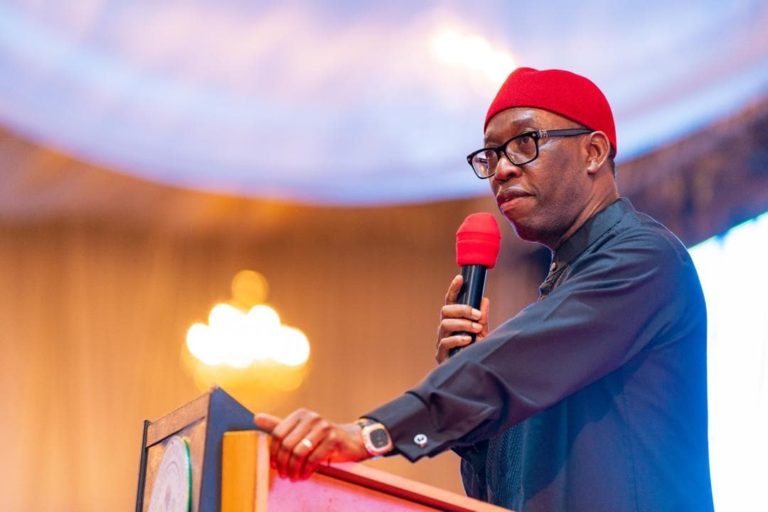
SIX governors of the South-South region have demanded an upward review of the Host Community Trust Fund in the Petroleum Industry Bill (PIB) from 2.5 to 10 percent.
Ifeanyi Okowa, Delta State governor, who also doubles as the chairman of the South-South Governors’ Forum, said this at the end of the forum’s meeting in Port Harcourt on Tuesday.
He said that 2.5 percent allocated to host communities in the PIB currently before the National Assembly was inadequate.
He noted that the 10 percent increase was in the interest of host communities and the nation.
“We are of the view that while we welcome the Host Community Trust Fund, we do believe that 2.5 percent that is appropriated in that bill for the purpose of host community fund is inadequate,” he said.
“We have discussed with our people and collectively as leaders of the people in our various states and as leaders standing in on behalf of our people, we urge the National Assembly to increase the provision in the host community fund from 2.5 per cent to 10 per cent.
“This is in the best interest of our communities and the nation,’’ Okowa said.
“A peaceful environment in the various oil communities would enable us to have greater and seamless production, without any form of disruption, going into the future.
“The governors have also urged President Muhammadu Buhari that in the absence of the board of the Niger Delta Development Commission (NDDC), funds for the commission, beyond the payment of salaries, should be put in an escrow account until he constitutes the board,’’ Okowa said.
“We do know that there is a forensic audit taking place and for that reason, the board has not been constituted.”
The forum resolved that monies being sent to the NDDC should be put in an escrow account until a board was constituted and then proper processes followed in the expenditure of the money.
It added that the NDDC was being run in such a manner that was not beneficial to the people, saying that there was no stakeholder input in the running of the affairs of the commission.
AFTER securing 170 million dollars from investors to expand its customer base, Africa-focused Flutterwave has been valued at 1 billion dollars, putting it in the class of unicorn start-ups.
“We are thrilled to share news of our 170 million dollar #SeriesC funding which will be crucial in improving our technology, product, customer support, and expansion drive,” Flutterwave said on its Twitter handle on Wednesday.
“The company’s valuation is now more than 1 billion dollars. The fundraise brings the total investment in Flutterwave to $225 million,” the company said in a separate statement seen by The ICIR on Wednesday.
It explained that the 170 million dollars would be used to execute an ambitious growth strategy to become a leading global payments company, empowering small and medium enterprises (SMEs) and multinational brands by connecting the highly fragmented African digital payments landscape.
“Flutterwave will invest the new capital in accelerating customer acquisition in existing and international markets, as well as develop complementary and innovative products such as the newly launched Flutterwave Mobile, an app to help accelerate e-commerce growth as a result of the success of the Flutterwave Stores,” it said.
The payment company said the fundraise was coming when Covid-19 had accelerated the shift to digital payments in Africa, contributing to Flutterwave’s exceptional revenue growth of 226 percent compound annual growth rate (CAGR) from 2018-2020.
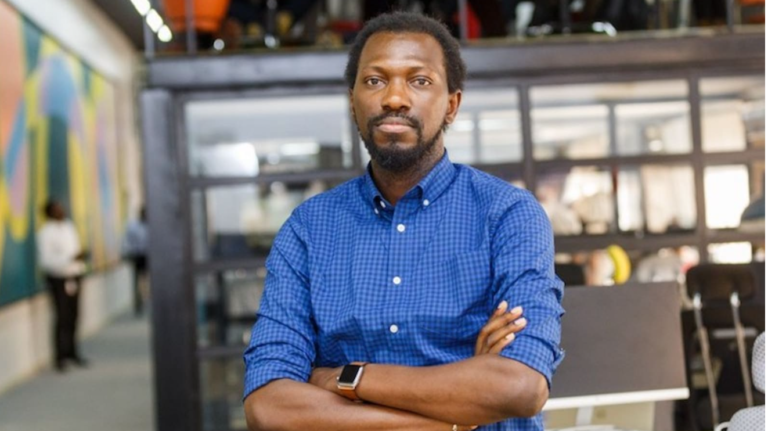
Olugbenga Agboola, founder and CEO of Flutterwave, said success would not be possible without his team, investors, customers, and regulators.
The San Francisco-based fintech is also mulling listing in New York Stock Exchange, Agboola had told Reuters in a telephone interview on Tuesday. The payment processing firm is also eyeing the North African market, particularly Egypt, Morocco and Tunisia, by the second quarter of this year, Agboola said.
New York Stock Exchange (NYSE) listing is important for businesses because the market has leading innovators, and its model leads to lower stock price volatility (fluctuations). The Exchange says that listing on its platform helps reach a worldwide audience, enabling firms to get insights into the markets and their shares.
According to Flutterwave, the Series C funding was raised from investors such as Avenir Growth Capital, Tiger Global and PayPal. Other venture capitalists who participated in the deal included Early Capital Berrywood, Green Visor Capital and Greycroft Capital and Paypal.
Jamie Reynolds, a partner at Avenir Growth Capital, said Flutterwave was at the forefront of innovation in payments technology.
Reynolds said Avenir was excited to support the Flutterwave team as they built the last available payments infrastructure frontier in the world – connecting merchants and consumers intra-Africa and globally.
Scott Shleifer, a partner at Tiger Global Management LLC, said, “We are excited to partner with Flutterwave as they continue building a world-class payments platform. We were impressed by Flutterwave’s focus on customer success and believe the company is well-positioned for sustainable long-term growth.”
Flutterwave has processed over 140 million transactions valued at over 9 billion dollars to date, serving more than 290,000 businesses, including Uber, Flywire, Booking.com, Facebook, among others, the company said.
The firm said its key advantage was international payment processing in 150 currencies and multiple payment modes, including local and international cards, mobile wallets, bank transfers, Barter by Flutterwave, among others.
Why unicorns matter
A unicorn is a private firm whose valuation has hit 1 billion dollars and above. According to CBN Insights, there are 500 unicorns around the world as of March 2021. Economists say unicorns enjoy economies of scale, meaning they enjoy advantages larger businesses have over smaller ones. Such include low cost of operations and unit prices, efficiency and low costs of production factors such as land, labour and capital.
“Larger companies are able to produce more by spreading the cost of production over a larger amount of goods,” said Will Kenton, a behavioural economist and Any Drury, former CEO of OnPoint Learning, both of Investopedia. This is one advantage of facing Flutterwave.
Economists and management experts say unicorns are popular with investors and guarantee them good returns.
Jonathan Low, partner and co-founder of Predictiv and PredictivAsia, explained that unicorns would always draw in eager investors and consumers.
The Road to $1bn valuation
In 2017, the payment processing company raised 10 million dollars in Series A funding. As of that time, it had 10 banking partners across Africa, processing over 14 million transactions worth 1.5 billion dollars, just 12 months after commencing operations. In 2018, the fintech galvanised another 10 million dollars in extended Series A funding.
The fund came mostly from Green Visor Capital, Greycroft Partners, Mastercard, CRE Ventures, Fintech Collective, 4DX Ventures, and Raba Capital. It further raised 35 million dollars in Series B venture capital raise in 2018. In addition to 170 million dollars raised in the Series C round, the firm has galvanised 225 million dollars in funding (in total).
A company’s valuation often involves aggregating its revenue, assets, and cash flow, subtracting them from liabilities such as debts, wages, and taxes. The 1 billion dollar valuation means that Flutterwave’s assets and cash flow/ revenue are at least equal to the valuation.
Fintech business in Nigeria is becoming larger by the day. In October 2020, Stripe, a US fintech firm, acquired Nigerian fintech business Paystack for 200 million dollars. In 2019, Visa acquired a 20 percent stake in Interswitch, a Nigerian payments company. A 2020 Mckinsey report disclosed that between 2014 and 2019, “Nigeria’s bustling fintech scene raised more than 600 million dollars in funding, attracting 25 percent (122 million dollars) of the 491.6 million dollars raised by African tech startups in 2019 alone—second only to Kenya, which attracted 149 million dollars.”
“At the same time, a youthful population, increasing smartphone penetration, and a focused regulatory drive to increase financial inclusion and cashless payments, are combining to create the perfect recipe for a thriving fintech sector,” the report said.
“Nigeria is now home to over 200 fintech standalone companies, plus several fintech solutions offered by banks and mobile network operators as part of their product portfolio.”
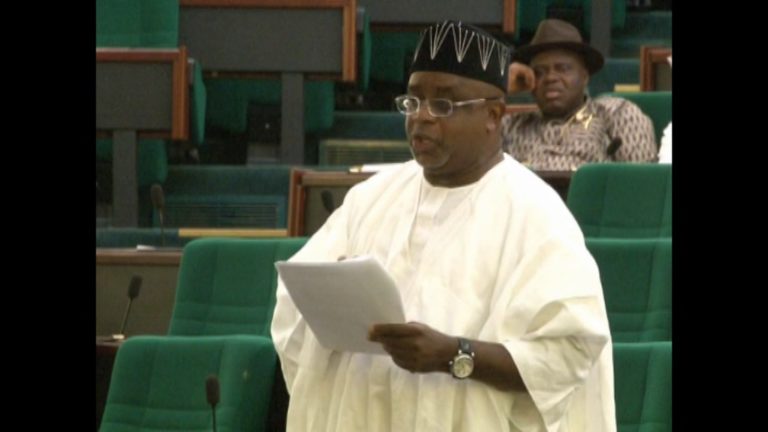
FOLLOWING the protest by the National Labour Congress (NLC), Garba Datti-Babawo, a member of the House of Representatives representing Sabon Gari federal constituency, who sponsored a bill to move the national minimum wage from the exclusive legislative list to concurrent list, has given reasons for presenting the bill before the National Assembly.
Datti-Babawo disclosed the motives behind the bill during a telephone interview with The ICIR on Wednesday, as members of NLC stormed the streets of Lagos, Abuja and Kaduna to protest against the bill.
According to Datti-Babawo, many state governments could not afford to pay the new 30,000 naira minimum wage to their workers, resulting in threats of retrenching workers if they were to pay.
“Since it has been changed to 30,000 naira, you will find out that most of the states could not pay until the federal government intervened by giving them bailouts to pay. Now that there is no bailout, they cannot pay and most of the states are threatening to retrench most of their workers if they have to pay the 30,000 naira,” Datti-Babawo said.
He noted that the aim of the bill was to allow state governments to negotiate with the NLC on how much they could afford to pay their workers in consideration of the their revenue.
“What we are saying is that we should allow them to negotiate what they can pay based on their own resources because the money that goes to the federal government is not the same that goes to the state governments. Even among states, their resources are not the same.
“There are many socio-economic variables based on local peculiarities like the cost of living, housing, cost of school fees transportation, feeding and others. In essence, you will find out that more than 80 percent of local governments, after paying salaries, would not have anything to implement any single capital project, even for drugs for their clinics,” the lawmaker said.
He further argued that the decision on what to pay should be made by state assemblies because it was the assemblies that passed the budget, knew what the states earned and made projections for it.
Datti-Babawo further stated that the federal government should not just sit in Abuja and determine what a local government would pay to its workers, stating that prominent Nigerians and others had supported his position in the bill.
He said instead of employing devices of ‘intimidation,’ the NLC should rather attend the public hearing of the bill and make its contribution.
“NLC president has also written a letter to me which I replied in a five-page letter. In that letter, he said I should not have brought that bill, that I should have sat with them and negotiate, but I said that is not how we operate.
“When we brought this bill, there was a debate of which more than 80 percent of those who contributed were in support. Those are the people that represent the people. We advise them to come for the public hearing if the members are convinced with their argument. Nothing stops them from throwing the bill away.”
When asked if the bill would create an environment for enslaving workers as said by the NLC, Datti-Babawo said even without the bill, state governments were not paying. “Of what good is a law that is not implementable and has no punishment when broken?” he asked.
The lawmaker advised the NLC to change its method of abuses and intimidation, and come out for constructive engagement.
“I am looking at their protests now. The chairman is talking about me, which is a very wrong approach, and he should not talk about me because it is an issue of National Assembly. If it is not a popular bill, it would not be voted for.
“We have also seen how they turned it into a personal issue and this is the method employed by labour all the time when there is something of this nature. They do not engage in constructive dialogue, they resort to insult, they resort to all forms of intimidation which I think would not solve their own problem.
“If we allow it, most of the states would retrench almost 60 percent of their workers. Even NLC Kaduna is attacking me, but I am unperturbed, I do not care because the truth would always prevail,” Datti-Babawo stated.
The ICIR had earlier reported the ongoing protest by the NLC in Abuja and Lagos earlier on Wednesday morning over the minimum wage.
THE Ondo State government has announced an indefinite suspension of all activities of the National Union of Road Transport Workers(NURTW) across the 18 local government areas of the state.
One person was killed on Tuesday during a clash involving some factional members of Ondo State chapter of the NURWT at Oja Oba area of Akure, the state capital.
Following the clash, the state government has suspended the union indefinitely.
A witness said the clash caused pandemonium at Oja Oba and some streets in Akure, as residents ran for their lives following sporadic gunshots by the warring members.
The incident came barely 48 hours after the unionists fought in the Owode area of the state, injuring many people.
Business and social activities were paralysed when the armed unionists faced one other, while vehicular movements were also halted in the affected areas for several hours.
Some vehicles were also said to have been vandalised by the fighters, but the cause of the dispute was still unknown as of the time of filing this report.
While reacting to the matter, senior special sssistant to Governor Rotimi Akeredolu on special duties and strategy, Doyin Odebowale, ordered the NURTW members to immediately vacate all motor parks across the state.
He described the clash as unruly and uncultured behavior, which resulted in violent attacks on members and the innocent residents.
“The indefinite suspension did not affect the Road Transport Employers Association of Nigeria, who comported themselves in a peaceful manner,” the governor’s aide added.
The state government had earlier ordered the suspension of the NURTW and RTEAN for two weeks over a purported plan of their members to engage in violence.
The state police public relations officer, Tee-Leo Ikoro, said the investigation had commenced into the incident and some men of the command had been drafted to the area to restore normalcy.
MANY Nigerians have taken to the social media to express displeasure over the federal government’s proposed spending of 4.2 million pounds recovered Ibori loot on some federal projects.
Many Nigerians on Twitter say the federal government should return the stolen funds to Delta State, which it originally belongs to, rather than spend it on federal projects.
On Tuesday, Abubakar Malami, attorney general of the federation and minister of justice, had announced the imminent return of £4.2 million recovered from James Ibori, a former governor of Delta State, by the government of the United Kingdom.
During his announcement, Malami had said that about 2.2million pounds expected to arrive in Nigeria in two weeks would be spent on the Second Niger Bridge, Abuja-Kano Road, and Lagos-Ibadan Expressway, stressing that the funds would not ne returned to Delta State government.
This announcement sparked several reactions from Nigerians who felt that rather than spend it on the mentione federal projects, it should be returned to the coffers of Delta State government.
While reacting to the announcement, Aisha Yesufu, a social commentator and activist, said the money must go to Delta State and not the federal government.
“The money belongs to the people of Delta State! They must ensure the federal government does not lay its hands on it,” Yesufu said on her Twitter handle @AishaYesufu.
Another Twitter user, who identifies as Sammy @Talk_2_Sammy, said instead of spending the fund on federal projects, it should rather be used on infrastructural development in Delta State where the money originated from.
“This is so wrong. They should have used the money to repair and construct more roads and infrastructure in Delta. The money was stolen from Delta treasury and should be used to develop Delta. It is state money and not federal money,” Sammy wrote on Twitter.
Omoyele Sowore, publisher of Sahara Reporters and activist, also took a similar stance, saying that part of the fund should be used to subsidise exorbitant school fees paid by students of Delta State University.
“Students of higher institutions in Delta must demand that the 4.2m pounds Ibori loot being repatriated from the UK must be spent on schools in the state instead of accepting to pay exorbitant school fees like the N150k being charged at Delta State Uni. It is your money,” said Sowore.
However, some Nigerians said that Delta State government had declared that no money was missing from the state account, hence the recovered loot should not go to the state.
A user, who identifies as Moses Babatunde O @tunmmyzhe, said since a Nigerian court had held that Ibori did not launder the state fund, there was no justification for the money to be returned to Delta State government.
“But in the high court of Delta State, the same Ibori was cleared of money laundering and no government officials were ready to testify against him.
“Delta state, therefore, has no claim to the money since it has always maintained that no money was missing from its coffers,” Babatunde said.
Delta is one of the nine oil-rich states in Nigeria, situated in between Anambra and Edo.
Why recovered loot would not go to Delta state – Malami
On Tuesday evening, Malami featured on Channels Television’s Politics Today to explain why the recovered Ibori loot would not be handed over to Delta State. According to him, the looting was a national crime, and not a sub-national one.
Malami said only the federal government was involved in the recovery of the fund, and the UK and Nigeria had already ‘negotiated’ on how the money would be spent after it had been handed over.
“All the processes associated with the recovery were consummated by the federal government and the federal government is, indeed, the victim of the crime and not sub-national,” he said.
Delta State to challenge FG over recovered loot
The Delta State government has also vowed to challenge the federal government’s position that the recovered loot would not be handed over to its original source.
Ehiedu Aniagwu, Delta State commissioner for information, said this while reacting to reports that the federal government was set to expend the fund on federal projects.
“We would try to take advantage of the legal system to make the federal government correct the injustice they are about to visit on us as a state.
“If they are quite sure that the funds they are about to repatriate left Delta State on account of those who have governed the state in the past, on what basis would they now take the money to another place? Under which law? ” Aniagwu said.
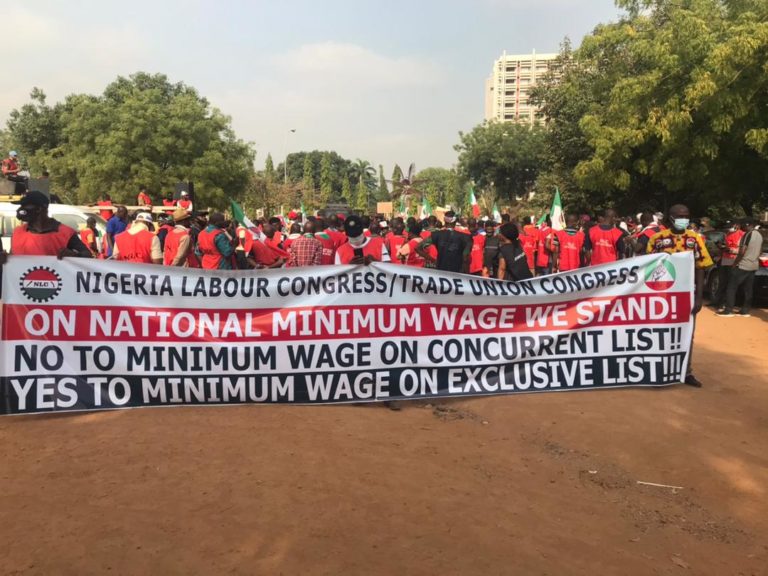
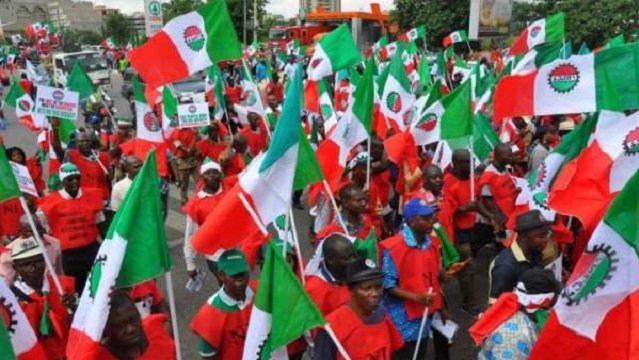
THE Nigeria Labour Congress (NLC) has commenced protests in the Federal Capital Territory (FCT) and Lagos State over issues concerning the implementation of the new minimum wage.
On early Wednesday morning, the union members gathered in numbers at the Unity Fountain in Abuja where they marched to the National Assembly gate.
Also in Ikeja, the capital of Lagos State, members of the labour union took to the streets, marching towards the Lagos State House of Assembly.
Ayuba Wabba, NLC president, had said last week that the union would stage a nationwide protest over a bill seeking to take the national minimum wage away from the exclusive list, allowing state governments to fix it for workers.
The ICIR had reported that Ayuba Wabba, NLC president, had noted there would be a protest by the union over a bill seeking to move the minimum wage from the exclusive legislative list to the concurrent legislative list.
Wabba explained that if the National Assembly succeeded with the change, it would create an avenue for state governments to ‘enslave’ their workers.
“The NEC decided that should the need arise, it has empowered the National Administration Council of the NLC to declare and enforce a national strike action, especially if the legislators continue on the ruinous path of moving the National Minimum Wage from the Exclusive Legislative List to the Concurrent Legislative List,” Wabba said.
The NLC, in a tweet on its official Twitter handle @NLCHeadquarters recently, lambasted Garba Datti-Babawo, member of the House of Representatives representing Sabon Gari federal constituency of sponsoring the bill.
For over one year, the NLC, federal and state governments have battled over the approval and implementation of thenNational minimum wage from 18,500 naira to 30,000 naira.
While some states have adopted the new minimum wage, some others have refused to implement the change in wages.
THE Nigeria Labour Congress (NLC)has said that the proposed nationwide protest over issues concerning the implementation of the new minimum wage will take place on Wednesday.
Benson Upah, NLC head of information, told The ICIR on Tuesday that the proposed strike would take place as earlier announced.
“Yes, the strike is still holding here in Abuja from the Unity Fountain to the National Assembly, while others would hold across state assemblies of the 36 states of the federation,” said Upah.
Ayuba Wabba, NLC president, had said last week that the union would stage a nationwide protest over a bill seeking to take the national minimum wage from the exclusive list and allow state governments to fix them for workers.
According to Wabba, the bill, if allowed to be passed into law, would enable authorities in the states to enslave their workers.
Wabba explained that the directive was part of the resolutions reached at an emergency meeting of the national executive council of the NLC.
“The NEC decided that should the need arise, it has empowered the National Administration Council of the NLC to declare and enforce a national strike action, especially if the legislators continue on the ruinous path of moving the National Minimum Wage from the Exclusive Legislative List to the Concurrent Legislative List.”
“The NEC warned that should the current artificial scarcity persist, that the various leadership structures of the NLC should picket petrol stations found to be inflicting pains on Nigerians,” the NLC president added.
Recall that the NLC and the federal government had spent several months ‘negotiating’ the minimum wage before it was eventually agreed that 30,000 naira would be the least pay for workers in Nigeria.