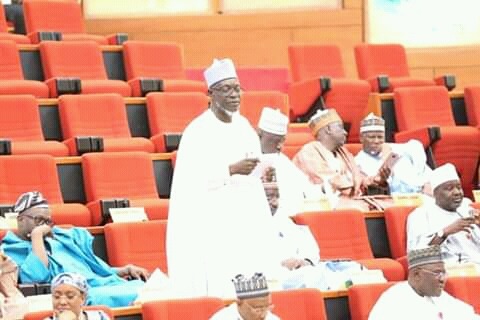
For the second time, Nigerian senators read a bill to abolish casualisation of workers in private and public sectors in Nigeria.
The senators voted Thursday in support of the bill which went through its second reading.
The bill entitled ‘Prohibition of Casualisation in all forms of Employment in the Private and Public Sector in Nigeria and for Related Matters, 2021 (SB. 329)’ had earlier passed the first reading in the red chamber.
Voting on the bill, Biodun Olujimi, senator representing Ekiti South constituency, lamented that the tradition was prevalent in the banking industry and there was an urgent need to have a legal framework that would ensure the practice was eradicated in Nigeria.
Olujimi noted that casualisation of workers emanated from the inability of the government to functionally perform its duties.
“All this boils down to one thing – the government has not done its part well. Creation of jobs is most essential. If we have jobs, nobody will be doing this to our children. And the best way to go is to pass this Bill and let it go for a public hearing,” Olujimi said.
Barau Jibrin, senator representing Kano North, said the bill was necessary to protect Nigerian workers from being poorly treated by businesses seeking to cut costs.
“I stand to support this bill in its entirety. We need to protect our citizens and our youths. Every business wants to cut cost. Those areas that we are talking about, like in developed countries, have strong laws that are used to protect the workers.
“There is a need to look at our laws and review our laws to make sure that we protect our youths. Sometimes this issue of casualisation is not due to necessity but to cut cost,” said Jibrin.
“I am in support that the bill passes for second reading. Some of the issues raised here are already being addressed in the labour laws, but we have to be able to reach a melting point.” Senator Opeyemi Bamidele said.
Ovie Omo-Agege, deputy Senate president, stated that his major concern was how the bill related to the public sector. He urged that the bill be read for the second time so as to enable other senators to make contributions.
Sani Musa, senator representing the Niger East Senatorial District, urged the Senate to be ‘careful’ with the bill because there were some Nigerian sectors that could not operate without casualisation.
“I think we need to be careful with this bill. There is no way you can operate in the aviation industry without casualisation. So, I think we should seriously look into this bill before we go ahead,” Musa said.
After comments and votes from the Senators, the bill was read the second time and referred to the Committee on Employment, Labour and Productivity to report back within four weeks.
The ICIR investigation had revealed how workers were treated in foreign-owned industries in Lagos and Ogun states.
Apart from poor payment, in cases of injuries, the workers were either neglected or poorly treated.
FIGURES from the National Bureau of Statistics (NBS) show that Nigeria’s gross domestic product (GDP) for the fourth quarter of 2020 grew by 0.11 percent, indicating an exit from recession.
The Nigerian economy plunged into its second recession under the present administration of President Muhammadu Buhari in the third quarter of 2020. Recession occurs when there are two consecutive quarters of negative growth. However, recovery happens when economic or GDP growth occurs after recession.
The GDP growth rate measures the economic output or activities of a nation by comparing growth in one-quarter to the previous one.
“Nigeria’s gross domestic product (GDP) grew by 0.11 percent (year-on-year) in real terms in the fourth quarter of 2020, representing the first positive quarterly growth in the last three quarters,” the report read.
The NBS noted that while the growth was weak, the gradual return of economic activities following the ease of restricted movements and limited local and international commercial activities in the preceding quarters was responsible for the positive growth.
On a quarter on quarter basis, real GDP growth was 9.68 percent, indicating a second positive consecutive quarter-on-quarter real growth rate in 2020 after two negative quarters.
“Overall, in 2020, the annual growth of real GDP was estimated at –1.92 percent, a decline of –4.20 percentage points when compared to the 2.27 percent recorded in 2019.”
The report also revealed that an average daily oil production of 1.56 million barrels per day (mbpd) was recorded in the fourth quarter of 2020- 0.11mbpd lower than the production recorded in the third quarter.
STAKEHOLDERS are alarmed that 116.97 million naira has been drawn from the federal government coffers to service the non-existing Office of Chief Economic Adviser to the President (OCEAP) in the last five years.
Eze Onyekpere, lead director, Centre for Social Justice (CSJ), who was reacting to a report by the International Centre for Investigative Reporting (ICIR) on how the non-existing office of President Muhammadu Buhari’s chief economic adviser continued to get budgetary releases after five years, raised the alarm during a radio program, Public Conscience, produced by the Progressive Impact Organisation for Community Development (PRIMORG).
Onyekpere knocked the National Assembly over the report, saying that it was unfortunate that the legislators, who were supposed to scrutinise the budget and play oversight function, approved budgetary allocation for the controversial office of the chief economic adviser to President Buhari.
“The budget itself, when it is prepared as a proposal, goes through the Budget Office of the Federation. There are budget defence sessions, it goes up to the Federal Executive Council before it is now approved and sent to the National Assembly.
“So how come, the EFCC, the ICPC, the Nigerian Police and auditor-general and none of them has caught this mischief in the actual practice of budgeting in Nigeria?,” Onyekpere queried.
He asked that the petition be immediately sent out to the National Assembly and steps taken to make sure that whoever was culpable refunded all the monies spent on the office over the years through the judicial process.
“I think that there should be a next step to make sure that those behind this stealing are punished and the money is returned to the treasury.”
Onyekpere also called for credible Nigerians to be appointed to lead anti-graft agencies in Nigeria, stressing that corruption and impunity had now become part of the everyday experience in the country. He noted that every Nigerian should be worried over such a report because the nation was borrowing heavily to finance the 2021 budget amid other economic challenges.
“What is the bottom line of our lives that we are paying more for fuel, we are paying more for electricity and at the end of the day, we have inflation rate at about 16.4 to 16.5? The naira is getting more useless in terms of value, the salaries and earning power of livelihoods in Nigeria are not increasing.
“We are also one of the capitals of the world in terms of maternal and child death, and they say we have the highest number of poor people in the world. So, we should be bothered because this would not have been so if we have been utilising our money through a value for money approach,” Onyekpere lamented.
On his part, Olugbenga Adanikin, an investigative reporter with The ICIR, said that the corruption report cast a shadow of doubt on President Buhari’s promise to fight corruption when he emerged in 2015.
“President Buhari should act more because we want to see people go to jail. We want to see people who have been indicted, accused and the court has established that these people have been found guilty, to go to jail,” Adanikin advised.
It will be recalled that the National Assembly approved 46.86 million naira in the 2021 budget despite that no known personnel or government official could give accounts of the monies disbursed to OCEAP since 2016.
Between 2016 and 2020, the office has been funded regularly even with no one appointed to it.
Adeyemi Dipeolu, special adviser to the president on economic matters, office of the vice president, denied that he was the one spending the money. But officials tried to pin him to the office of the chief economic adviser, in a bid to cover up.
In a recent corruption rating and report by the Transparency International, Nigeria has dropped to 149 on 2020 Corruption Perception Index, the worst ranking received by Africa’s largest country in recent times. Nigeria also scored 25 out of a possible 100 points
In the last TI rating in 2019, Nigeria was ranked 146th out of the 180 countries surveyed, scoring 26 points out of a possible 100. On a scale of zero to 100 in TI’s rating, zero means ‘Highly Corrupt,’ while 100 stands for ‘Very Clean.’
This means that Nigeria is two steps worse off than she was in 2018 when she scored 27 points to place 144th out of 180 countries.
According to the latest ranking, Nigeria is now the second most corrupt country in West Africa with Guinea-Bissau the only country more corrupt than it in the sub-region.
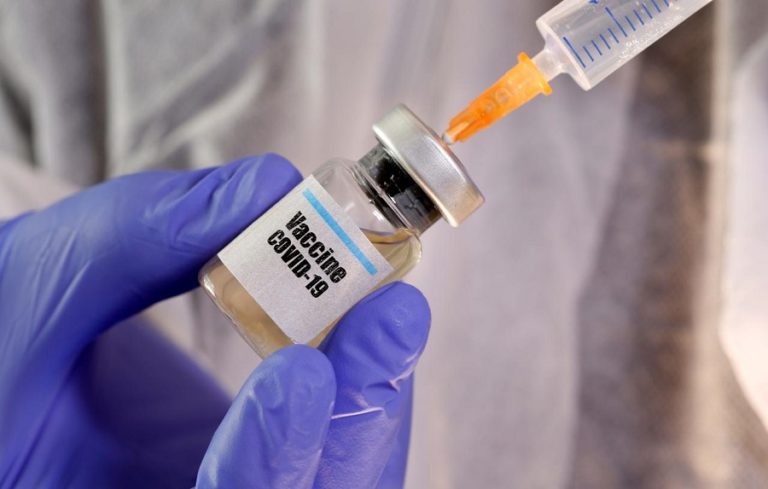
THE National Agency for Food and Drug Administration and Control (NAFDAC) has approved the use of the Oxford/AstraZeneca COVID-19 vaccine in Nigeria.
Mojisola Adeyeye, director-general of NAFDAC, who made the announcement during a live briefing on Thursday, said that the vaccine could be stored at 2 to 8-degree centigrade.
According to her, there were three additional vaccines undergoing evaluation, but the examination on Astrazeneca showed that it was effective against the UK variant of the virus which had been reported in Nigeria.
Adeyeye disclosed that the South African variant had not been reported in Nigeria, adding that the agency had over 30 herbal medicines undergoing review for listing.
The vaccine was recently approved by the World Health Organisation (WHO) for emergency use. Adeyeye said NAFDAChad the dossier of the vaccine and the agency’s Safety Committee went to work immediately after the WHO approval to evaluate its safety and efficacy for Nigerians.
The Oxford/AstraZeneca vaccine, also known as ChAdOx1 nCoV-19, or AZD1222, is a viral vector vaccine. Scientists used an adenovirus, originally derived from chimpanzees, modifying it with the aim of training the immune system to mount a strong response against SARS-CoV-2 (the virus that causes COVID-19).
It is only the second COVID-19 vaccine to have received WHO authorisation, after the Pfizer-BioNTech.
“The WHO listed two versions of the AstraZeneca-Oxford Covid-19 vaccine for emergency use, giving the green light for these vaccines to be rolled out globally through Covax,” the UN health agency said in a statement.
The two versions are being produced by the Serum Institute of India (SII) and by SKBio in South Korea.
Separate reviews were needed for each production process, although the vaccine was the same.
“Countries with no access to vaccines to date will finally be able to start vaccinating their health workers and populations at risk, contributing to the Covax facility’s goal of equitable vaccine distribution,” said Mariangela Simao, WHO assistant director-general.
“But we must keep up the pressure to meet the needs of priority populations everywhere and facilitate global access. To do that, we need two things — a scale-up of manufacturing capacity, and developers’ early submission of their vaccines for WHO review.”
The organisation’s emergency use listing procedure assesses the quality, safety and efficacy of COVID-19 vaccines, and is a prerequisite for vaccines in the WHO co-led Covax facility.
AstraZeneca vaccines from India and South Korea made up almost all of the initial 337.2 million doses lined up for Covax’s first wave of distribution, which will be rolled out in late February.
Some 145 participating economies are set to receive enough doses to immunise 3.3 percent of their collective population by mid-2021.
The first wave includes 240 million SII AstraZeneca doses; 96 million South Korean AstraZeneca doses; and 1.2 million Pfizer doses.
Both vaccines require two injected doses.
“We now have all the pieces in place for the rapid distribution of vaccines,” WHO director-general Tedros Adhanom Ghebreyesus told a press conference recently.
The number of reported COVID-19 cases globally has dropped for a fifth consecutive week, nearly halving from more than five million in the week of January 4, to 2.6 million in the week commencing February 8.
Since its outbreak in March, Nigeria has recorded 149,369 COVID-19 cases with 1,787 fatalities but over 125,722 recoveries. The country is currently experiencing the second wave of the virus with more infections being recorded in the past month than at any other time.
ANYONE who watches the trending video of heavily armed bandits taunting Nigeria and its doddering leadership and emotionally assaulting passengers of the Niger State Transport Authority (NSTA) bus without feeling sorry for the country must be subhuman. The victims were abducted in the Yakila district of the Rafi Local Government Area of Niger State on February 15.
I had goosebumps watching babies crying, women frantically pleading, men humiliated and resigned to fate, and, of course, their tormentors having the fun of their lives, celebrating their successful haul of yet another human cargo that will soon translate into millions of naira in ransom.
Niger State governor, Abubakar Sani Bello, has confirmed the video and the N500 million ransom demanded by the bandits.
VIDEO: Gunmen release video footage of kidnapped persons in Niger State
The video graphically illustrates how low the country has sunk under President Muhammadu Buhari’s watch. It depicts the helplessness of Nigerians in the face of the existential threat they collectively face.
Under Buhari’s watch, it is sorrow, tears and blood, as the Afrobeat legend, Fela, would say. But the consolation is that Nigerians, South of the Niger, have also resolved never to roll over for the hoodlums from the North ever again.
I had resolved last week to stay off the tomfoolery of the Nigerian elite, having come to the inevitable conclusion that they are dyed-in-the-wool hypocrites, set in their adulterous ways. They have no fidelity to the common good.
President Muhammadu Buhari
But it is extremely difficult, if not impossible, to stay aloof when at issue is existential dread – Nigerians are at that dreadful moment when many are increasingly questioning whether their lives have meaning, purpose, or value in their own country.
We are at that scary juncture where, though Fulani bandits have become an existential threat, yet the northern elite, like the ostrich, are burying their heads in the sand, pretending that by so doing the country’s woes will be wished away.
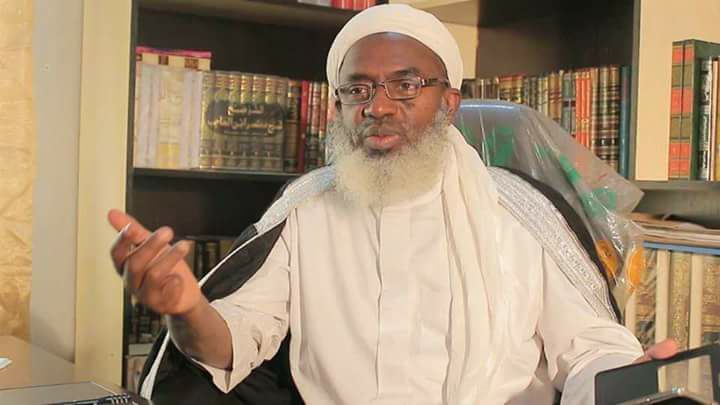
On Tuesday, Islamic cleric, Sheik Ahmad Gumi, the chief ideologue of the Fulani supremacist agenda, was on Africa Independent Television (AIT) where he made the bold-faced claim that bandits learnt kidnapping from Niger Delta militants. That is a lie.
To dissuade Fulani terrorists from maiming and killing fellow citizens, he doubled down on his vexatious demand that they be granted amnesty and handsomely compensated if they magnanimously agree to be persuaded to lay down their arms. To them, we, the lesser mortals, don’t have the right to live, peacefully or otherwise. It is a privilege at their whims and caprices.
The hubris is suffocating. Rather than address insecurity, what you hear from the Northern elite is this condescending admonition to the rest of the country not to provoke their wrath.
Rather than telling their brothers to stop the kidnappings and senseless bloodletting, they are angry that Nigerians have the audacity to call them out. They are enraged that other Nigerians have the guts to push back on their brazen expansionist agenda.
Why would a governor from the South demand that Fulani bandits be flushed out of the forests in his state? They are enraged that non-state actors like Sunday Igbogho would dare challenge the suzerainty of Fulani bandits and defend their people in the face of government’s shameful abdication of its primary responsibility which is the protection of lives and property of the citizens.
They are deploying every trick in the book to deflect the blame from themselves. In all their posturing, they do everything to shield Buhari, the man on whose watch the country is going to the dogs, from any blame.
Sheikh Ahmad Gumi
Curiously, a people that long ago elevated to an art the tendency of blaming the group for the sins of a few are today crying foul that Nigerians are blaming Fulani bandits for the mayhem across the country.
They are now saying that crime has no ethnicity, which is true. But remember the egregious lie of branding the January 15, 1966 coup an Igbo coup? Yes, that is the hypocrisy that rules the land.
They pretend not to know what happened on that fateful day – a group of idealistic army officers, majority of who happened to be Igbo, on their own planned a coup without consulting the ordinary folks on the street. Yet, the Northern elite conveniently branded it Igbo coup for the singular purpose of exacting maximum revenge on the Igbo.
Over 55 years after, that lie has persisted and it is at the root of all the injustices meted out to the Igbo in Nigeria.
Yet, these same people are protesting loudly that Nigerians are calling out those who have turned Nigeria into a huge killing field.
Why shouldn’t those terrorising Nigerians be identified ethnically? If they are Igbo, will the Gumis of this country do otherwise? Now that it has been established beyond doubt that Fulani bandits are behind the carnage in the land, why should we shy away from saying so?
Gumi acknowledges that those he met with in the Zamfara forests are Fulani and those Governor Nasir el-Rufai of Kaduna State went to West African countries to pay ransom after they killed his people in Kaduna were Fulani. Those Governor Bala Mohammed of Bauchi State said should carry Ak-47 rifles are Fulani. Ondo State governor, Rotimi Akeredolu, said this week that the killer herdsmen according to the debriefing from those kidnapped, speak Fulfulde, language of the Fulani. Those who are busy all over the country negotiating the payment of ransom to bandits, or release of arrested bandits, or threatening fire and brimstone whenever moves are made from any quarter to rein in the impunity of herdsmen are Fulani with leaders of Miyetti Allah Cattle Breeders Association of Nigeria (MACBAN) in the lead.
Any country that chooses to pamper bandits and reward, rather than punish criminality, pays a very stiff price. Criminals are emboldened when they are treated with kid gloves.
So, while Gumi is busy demanding amnesty for Fulani bandits, most of them non-citizens, who have made Nigeria a hell for citizens, the bandits struck again on Wednesday.
This time, it was at the Government Science College Kagara in Rafi local government of Niger State. The bandits, who struck at about 2 a.m. killing one student, Benjamin Doma, whisked away 27 others, three teachers and 12 family members.
The Kagara abduction came less than three months after gunmen abducted hundreds of students of Government Secondary School, Kankara in Katsina State.
Though the number of abductees as confirmed by Bello are fewer, this is the first time a student would be killed at the crime scene and teachers taken hostage.
Of course, the governor has not only shut down the school with about 650 students, he has also ordered that all boarding schools in Rafi, Mariga, Munya and Shiroro local government areas of the state be shut until further notice.
Truth be told, the joke is on these Fulani leaders like Sheikh Gumi who are enabling the bandits all in the name of ethnic solidarity. The joke is on the president, a Fulani, under whose watch Nigeria is heading to point of no return, as former head of state, Gen. Abdulsalami Abubakar, put it on Wednesday, while he is fiddling.
With this incessant pillaging of schools in the North, how can parents yield to persuasion to enroll their wards? Yet, this is a region that has the highest number of out of school children globally and the few that agreed to go to school are being kidnapped, killed and dehumanised by bandits. What a tragedy!
The reactions are the same. It is all déjà vu. Bello, pretending to be the tough cookie that he is obviously not, told journalists on Wednesday his government will not pay ransom to the bandits. But he is prepared to support and assist repentant bandits. Who is fooling who?
Senators, making their usual noise, called on Buhari to declare a state of emergency and implement their various recommendations on how to tackle the escalating insecurity across the nation.
Buhari described the kidnapping as brazen and cowardly even as he dispatched a team of security chiefs to Minna, the Niger State capital, to coordinate the ‘rescue’ operation.
His senior special assistant on media and publicity, Garba Shehu, said the president assured the security chieftains of the support of his administration and urged them to do all that can be done to bring an end to the saga and “avoid such cowardly attacks on schools in the future.”
Wasn’t that exactly what he said after the Kankara kidnap saga?
The minister of defence, Major General Bashir Magashi, assured that the Kagara abductees will be rescued with the same strategy used in Kankara. Put simply, they will negotiate with the Fulani bandits and pay hefty ransom to secure the release of the victims. That was the Kankara strategy.
Magashi said Nigerians have a responsibility to ensure adequate security, insisting it is not the responsibility of the military alone.
“We shouldn’t be cowards. Sometimes the bandits come with about three rounds of ammunition and when they fire shots everybody will run. In our younger days, we stood to fight any form of aggression,” he said.
Isn’t that interesting coming from the same government that will shoot down anyone who tries to stand up to the impunity of Fulani bandits? Hypocrisy truly defines the Buhari government.
Feyikemi ‘FK’ Abudu, Odunayo Eweniyi, Damilola Odufuwa and three other Nigerians have been named in the 2021 edition of the Time Magazine Next 100.
The Time Next 100 list released on Wednesday featured 100 persons across the world ‘shaping the future’ in business, entertainment, health and science, sports, activism and other fields.
Other Nigerians named in the list include Olugbenga Agoola, co-founder and chief executive officer of Flutterwave; Ijeoma Oluo, a Nigerian-American writer and Afrobeat singer; David Adeleke, better known by his stage name, Davido
The Trio of Abudu, Eweniyi and Odufuwa were named in the Advocate category for their efforts during the #ENDSARSprotests that rocked Nigeria in October 2020.
According to Times magazine, they raised donations from both Nigeria and the diaspora to organise food and make security arrangements for protesters on the ground. In two weeks, the trio was able to raise more than 387,000 dollars for the protest.
Agboola, CEO of Flutterwave, was named in the Innovation category for his tech support provided to many small businesses amidst the COVID-19 pandemic in 2020.
“Amid lockdown, Flutterwave expanded from specialising in digital cash registers to hosting digital storefronts, helping some 20,000 small businesses suddenly without foot traffic set up online shops, receive payments and arrange delivery options,” the magazine said.
Davido’s selection on the 2021 Times next list was also not unconnected with the #ENDSARS protests in Nigeria.
“Through FEM in 2020, a title that loosely translates to ‘shut up’ in Yoruba, he didn’t know it would become a major #EndSARS protest anthem, as youths banded together to demand the government take action to end police brutality in Nigeria last October. Officials responded by sending politicians to give speeches. We told the government to keep quiet unless they had something sensible to add—the ethos of “FEM” was directly relatable to that moment,” according to his nominee, Laycon.
Oluo, a Nigerian-American writer, was selected for her books on social equality and justice.
MIXED reactions have trailed comments by Bashir Magashi, minister of defence, asking armless Nigerians to defend themselves against armed bandits in the face of growing insecurity in the country.
Magashi had stated this to newsmen at the National Assembly Complex in Abuja on Tuesday.
VIDEO: Don’t be cowards, defend yourself against bandits – Defence Minister tells Nigerians
While wondering why people were ‘running from minor things,’ referring to attacks by bandits, he said that victims of banditry should resist such attacks and signal to the criminals that “even the villagers have the competency and capability to defend themselves.”
He added that the bandits would sometimes carry only a few rounds of ammunition.
“Is it the responsibility of the military alone? It is the responsibility of everybody to keep alert and to find safety when necessary. But we shouldn’t be cowards,” the minister told reporters.
“At times, the bandits will only come with about three rounds of ammunition. When they fire shots, everybody runs. In our younger days, we stand to fight any aggression coming for us.
“I don’t know why people are running from minor things like that. They should stand and let these people know that even the villagers have the competency and capability to defend themselves.”
Magashi, however, noted that the military would always ensure that no Nigerian was hurt.
He said although the security agencies were ‘so stretched,’ they remained “capable of protecting the integrity of this nation and will continue to do it.”
The minister’s comment is coming after dozens of school children and staff were kidnapped from a secondary school in Niger State by rocket-propelled and gun-wielding bandits on Wednesday.
Reacting, Nigerians wondered how they should defend themselves against elements wielding sophisticated weapons. Some lamented that the minister’s statement signalled the failure of security under President Muhammadu Buhari’s administration.
The Minister of Defence said Nigerians should defend themselves against bandits. Yet same man is against the ownership of guns by private citizens.
So pls how do we defend ourselves? With bread knife and korkor shoe?
In saner climes, there would be a resignation letter from the Minister of Defence this morning for the puke he slapped us with yesterday. Again we should give the president an award for how well he has managed to surround himself with cretins.
It's no longer secret as the minister of defence indirectly declared arm struggle to the citizen of zoo saying "you can be a coward when you're killed by a bandit with only 3 round of ammunition" your security is not only for the military. This is the evidence of the statement
Minister of defence be like, "stand up for yourself with a screwdriver and fight against the bandits". That the Nigeria army is fighting for the national integrity that we can't even see with open eyes. pic.twitter.com/nbNWvUPCVQ
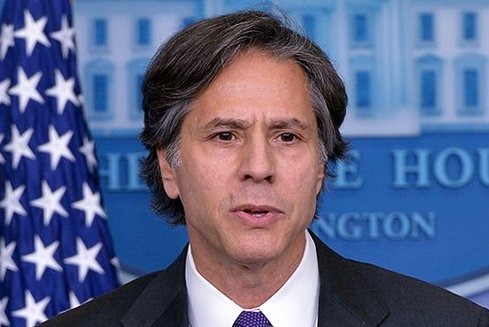
SOME concerned Nigerians have written to Antony Blinken, United States secretary of state, canvassing sanctions on Nigeria over continuous kidnappings and killings by Fulani herdsmen.
The copy of the letter which was made available to The ICIR on Wednesday was signed by 110 Nigerians across the US and 11 countries across the world.
Concerned by the death of Dennis Aduba, who was recently kidnapped and killed by suspected Fulani men on his way to catch his Lagos-Atlanta Delta flight, they implored Blinken to direct his attention to Nigeria to prevent it from sliding into another civil war.
“Secretary Blinken, the existential threat that the situation in Nigeria presents, of which the vicious herdsmen militia’s atrocities are just a part, cannot be overemphasized. It goes far beyond threats to the subregion,” part of the statement read.
They listed some instances of direct threats posed by Fulani militia to American and western allies:
“In 2017, the first US military casualties in West Africa were caused by a Fulani terrorist who killed four US Green Berets in the nation of Niger in an ambush using cows. They were Staff Sgt. Bryan Black, 35; Staff Sgt. Jeremiah Johnson, 39; Staff Sgt. Dustin Wright, 29 and Sgt. La David Johnson, 25.
“Also in 2017, two German Archeologists were abducted by Fulani Herdsmen in Kaduna State, Nigeria.
“In 2018, four American and Canadian citizens were abducted in Nigeria’s Kaduna state by a Fulani group and only released for a ransom.
“In 2019, a British aid worker Faye Mooney who worked for America Humanitarian organization Mercy Corp was killed in Kaduna State as a Fulani group attempted to abduct her.
“In 2020, barely three months ago, US Navy Seals rescued missionary Philip Walton from Nigeria where he was hidden by the Fulani group who abducted him in Niger.
“In 2021 already, Nigerian American Dennis Abuda was killed the same week three Chinesemen were also abducted in southern Nigeria.”
The letter added that the international ramifications of these Fulani militia attacks paled in comparison to the systematic state-sanctioned murder and plunder Nigerians were going through.
The group lamented that “Hordes of Fulani militia from across the region, crisscross international borders at will, descending on innocent Christian communities in north-central and southern Nigeria and against non-Fulani Muslims and Christians in northwest Nigeria leaving a trail of death, destruction, rape, mass displacement and food shortage.”
They noted that tribal and religious tensions were at an all-time high with simultaneous protests across the south against occupation by Fulani marauders as the Fulani-dominated federal government condoned and enabled brazen impunity.
Like the US, Nigeria is a key continental power and strategic partner, but internal schisms and internecine conflicts are its greatest vulnerability and undoing.
Accordingly, the letter asked Blinken to take the situation in Nigeria as a top priority to prevent another genocide 50 years after the horrific Biafra Civil War.
It also urged him to take the issue up with Uzoma Emenike, Nigeria’s incoming ambassador to the US, while elevating this issue at the UN Security Council,
Additionally, the group urged the US to press on allies not to accept letters of credence from Nigeria’s retiring military chiefs who were recently named ambassadors ostensibly to grant them immunity from war crimes.
In 2020, the US had named Nigeria as one of the Countries of Particular Concern (CPC) under its International Religious Freedom Act of 1998 as it was guilty of tolerating religious persecution, but the group noted that the country failed to implement sanctions.
“Two months ago, your predecessor acceded to our request and designated Nigeria a country of particular concern (CPC) for egregious religious persecution. However sanctions against Nigeria were waived.
“We urge the reversal of the waiver until the Fulani-dominated regime of Mjr Gen. Muhammadu Buhari shows appropriate care and concern for the safety and security of its citizens and foreign nationals who have been victimised by his tribesmen.
“Mr Secretary, the tired narrative that this is merely a contest over land by farmers and herders is debunked by all the instances of international victims listed above and should be retired. Climate change affects us all and it is no justification for the horrendous killings and displacement of thousands of people each year.”
BIMA Enagi, senator representing Niger South in the National Assembly, has knocked President Muhammadu Buhari over the manner in which he handles the nation’s security. The senator, who is a member of the All Progressives Congress (APC), said the president was incompetent.
Enagi stated this while contributing to a point of order raised by Sani Musa (APC, Niger East), on the kidnap of school children and staff of a secondary school in Kagara, NigerState, in the early hours of Wednesday.
Musa had disclosed that the terrorists, who whisked the victims away, were dressed in military uniforms. He had noted that the actual number of students abducted was not known, though the school had over 1000 students.
However, an enraged Enagi lamented that security had not improved despite the intervention of the Senate on the matters of insecurity in the country.
He suggested that the constitution should be amended to afford states enough power to deal with security issues in their respective domains.
“As my brother reported, early this morning, terrorists went to a secondary and kidnapped students, small students,” he said.
“The enemies of God, bandits, terrorists, kidnappers are everywhere. Where are we heading to in this country? What else do we need as lawmakers that we are not doing? Can we rightly say that the government is incompetent? Because this issue has been discussed here over and over and there is no improvement.
“It is getting worse, I am sure everybody here has stories to tell about the security challenges. What else are we supposed to do that we are not doing? Are we supposed to amend the laws in this country to give every citizen freedom to carry arms?
“Are we going to amend the constitution to give more powers to the governors who are the security heads in their various states because our government at the centre is showing incompetence in handling insecurity because it is not his son or his daughter that has been kidnapped.
“I expect everybody in government to think like that.”
Also reacting, Ahmad Lawan, president of the Senate, described the kidnap of the students as unfortunate.
Why stating that the kidnap of school children only happened in the northern part of the country, he said the security agencies had challenges with personnel and funds.
“Abduction of students from school happens in the northern part of Nigeria.
“With incidences like this, parents would be scared to take their wards to school, and the efforts of the past and by present leaders at providing education would be defeated.”
He added that “service chiefs have to secure the schools and have to carry the states along.”
GUNMEN have released a video footage of more than 21 kidnapped persons in Niger State.
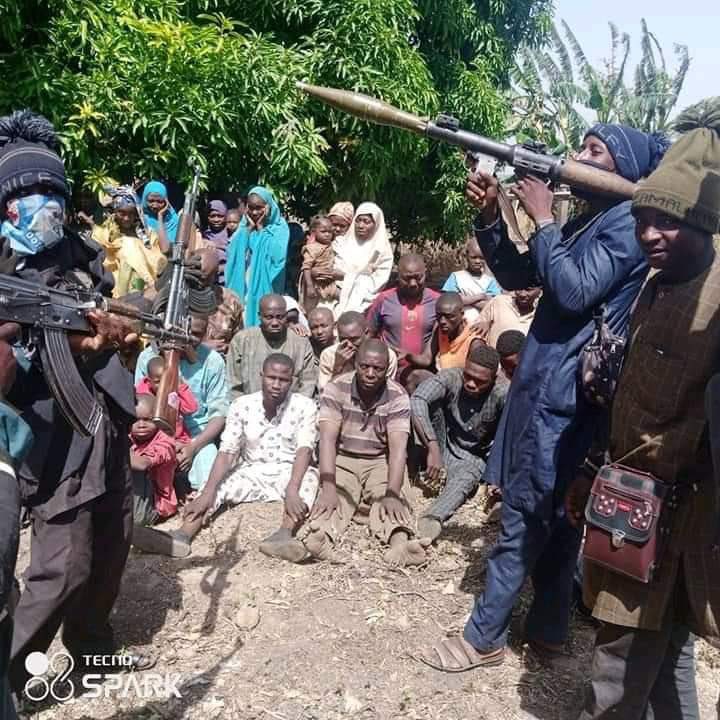
The video footage, which went viral on the social media Wednesday, showed the victims surrounded by the gunmen bearing explosives and sophisticated weapons.
In the video footage, the masked gunmen displayed guns and RPG as they surrounded the victims near a tree in a place that looked like a forest.
Speaking in the video, voices from the background asked the Niger State people to help them out.
“As-salaam Alaykum, people of Niger State we are looking for help. Please because of God, help us. It is 500 million naira that they (kidnappers) requested, please help us,” the voice said in native Hausa language which is largely spoken in some Northern part of Nigeria.
While the speaker was talking, another voice suspected to be one of the gunmen interrupted inadvertently saying, “You can see the condition that they are in.”
In a show of arms, the kidnappers shot while they jubilated, saying they did not go to towns but only operated from villages/bushes to villages/bushes.
On Sunday, 21 passengers were reportedto have been abducted in a mass transit heading to Minna, the state capital.
The passenger bus was said to have been stopped by the gunmen who shot rapidly into the air before ordering everyone to disembark. They were then taken to an unknown location.
Calls and messages sent to Wasiu Abiodun, spokesperson for the Niger State Police Command, were not responded to as of the time of filing this report.
Kidnapping reigns in Niger State
While the passengers remain in the custody of the bandits, some unknown gunmen said to be dressed in military uniforms Tuesday evening attacked and kidnapped schoolboys from all-boys Government Science College (GSC) in Kagara Town, Niger State.
While there has not been an official number of how many students were kidnapped during the attack, about a hundred boys have been reported to be in the custody of the gunmen.
Reacting to the incident, the Niger State government has ordered the immediate closure of all boarding schools in the state.
Abubakar Sanni Bello, governor of Niger State, said this during a meeting with security agencies Wednesday.
According to Bello, the directive was issued to ensure the safety of their lives, following the abduction of the schoolboys in Kankara.
President Muhammadu Buhari has ordered a team of the nation’s security chiefs to coordinate with state officials towards a rescue operation.
Buhari said this in a statement released on the official Twitter handle of the presidency concerning the abduction of the schoolboys.
President Buhari has assured of the support of his administration to the Armed Forces in their brave struggle against terrorism and banditry and urged them to do all that can be done to bring an end to this saga, and avoid such cowardly attacks on schools in the future.
The president also urged the Nigeria Armed Forces to ensure that such ‘cowardly attacks’ on schools were avoided in the future.
How insurgents, bandits target Nigerian schools
The abduction of the schoolboys in Kagara, Niger State, is not the first in recent times, Nigerian states, most especially the northern region, have witnessed several attacks on schools.
On the 14th of April 2014, 276 schoolgirls of Government Girls Secondary School were abducted by the Islamic extremist group, Boko Haram, in Chibok town of Maiduguri in Borno State.
While some of the Chibok schoolgirls have been rescued, the whereabouts of 112 of the remainder remains unknown till date.
Also, on February 19, 2018, more than 100 schoolgirls were kidnapped in Dapchi Town in Yobe state.
Exactly a month ago, on December 17, 344 schoolboys were kidnapped from Government Secondary School, Kankara in Katsina State.
While most of these schoolchildren have been recovered, a lot of them are still missing and Nigerian schools are still being targeted by bandits, terrorists and kidnappers.