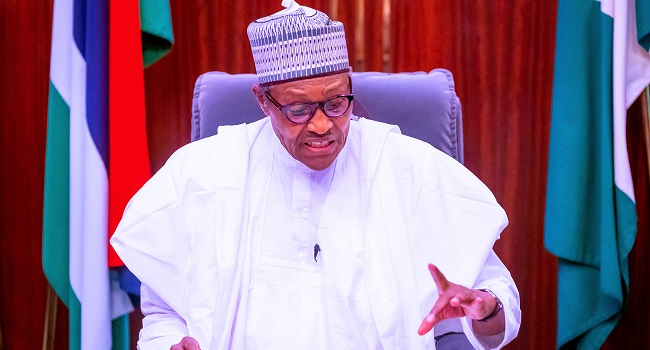
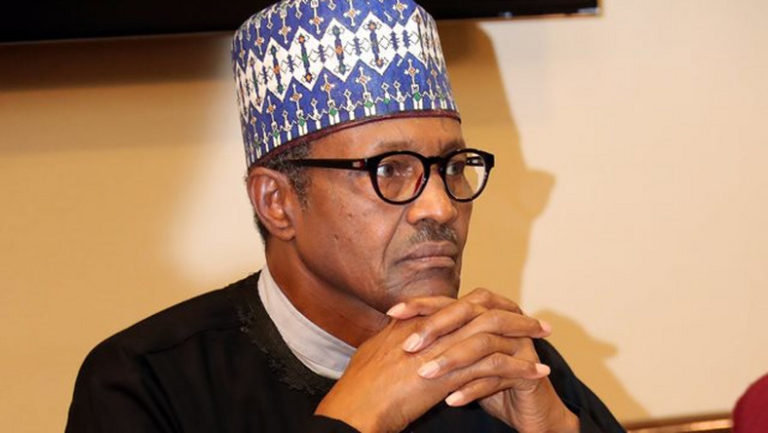
MEMBERS of the People’s Democratic Party (PDP) in the House of Representatives have again called for the impeachment of President Muhammadu Buhari over rising insecurity in the country.
According to Punch newspaper, Kingsley Chinda, leader of the party in the House, accompanied by other serving PDP representatives made the call at a press conference in Abuja on Thursday.
Chinda noted with concern that the president has demonstrated lack of capacity to govern the country, most especially in recently abducted 333 school children from the Government Science Secondary School, Kankara, Katsina State, by Boko Haram, last week Friday.
“We reinstate our call on Nigerians across all tribe, religion and Political party to awaken their representatives and Senators to the realities of the moment and rescue Nigeria from this road to perdition by evoking their constitutional powers under section 43 of the constitution and commence impeachment proceedings against President Muhammadu Buhari for gross incompetence and breach of section 4 (2)(b) of the constitution,” he said.
He also called “on members of the executive council to resolve under section 144 of the constitution that the president is incapable of discharging the functions of the office.”
Earlier this month, the party caucus had called for the impeachment of the president following the killings of more than 43 farmers in Kwashembe Zabarmari axis of Jere Local Government Area of Borno State by Boko Haram.
However, Benjamin Kalu, chairman of the House Committee on media and publicity, dismissed the call, describing it as an unpopular opinion of only the factional opposition leader, Kingsley Chinda.
THE United States has issued a security warning to its citizens residing in and traveling to Nigeria to be security conscious especially during this yuletide season.
This was contained in a holiday security alert statement issued by the Lagos office of the US embassy on Thursday.
In the statement, the embassy said that crime is endemic throughout Nigeria and terrorist organisations and individuals inspired by extremist ideology exist throughout Nigeria.
“The U.S. Embassy in Abuja and Consulate General in Lagos remind U.S. citizens to exercise caution while traveling and residing in Nigeria. Crime is endemic throughout Nigeria, ranging from petty street crime to carjacking, and crime levels tend to increase during the holidays. It is prudent to exercise particular caution during the holiday season and at holiday events,” it said.
“Demonstrations are relatively commonplace in Nigeria and generally affect traffic flow, especially if they progress along major thoroughfares. Criminal and other elements often infiltrate large gatherings. Terrorist organizations and individuals inspired by extremist ideology exist throughout Nigeria. Shopping centers, airports, hotels, clubs, restaurants, places of worship, transportation hubs, street markets, and other public venues frequented by Westerners are common attack targets.”
The embassy charges its citizens to take actions to be aware of their surroundings, keep a low profile, carry proper identification, stay alert in public places and locations frequented by tourists/Westerners, review personal security plans, use caution when driving at night and avoid walking after dark.
Others are to always drive with windows rolled up and the doors locked, review and alter travel routes and times to reduce time and place predictability, avoid large gatherings and protests, exercise caution if unexpectedly in the vicinity of large gatherings or protests, monitor local media for updates and to always keep the doors to your residence locked, even when at home.
Attempts to get the Nigerian police force to react was futile as calls repeatedly put across to Frank Mba, the force spokesperson was not picked or returned as time of filing this report.
He did not reply to an sms that was sent to his phone around 1:27pm.
Emma Okeh, spokesperson for Nigerian Security and Civil Defence Corps (NSCDC), was not available to make comments. His phone was switched off when contacted.
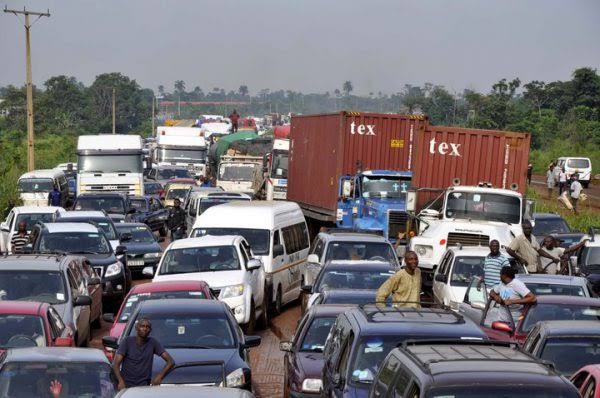
DESPITE deteriorating insecurity, snowballing cost of living and rising cases of COVID-19 in Nigeria, many citizens will travel home this Yuletide to reunite with their family for Christmas and New Year festivities. However, two major concerns that will prevent sizeable number of people from travelling are the poor and unsafe state of the nation’s highways. Senior Investigative Reporter, Marcus Fatunmole, examines some flashpoints in the nation’s roads and how motorists and travellers can arrive at their destinations safely.
A NUMBER of Nigerian roads have described as “death trap,” “highway to hell,” “Road to Death” among others, not necessarily because of many fatal crashes that occur on them, but because of high rate of abduction and robbery they witness.
Citizens like Oluwabukola Lawrence, a resident of Abuja would have to undertake prayer session before embarking on a journey outside the city.
“I’ve been in Abuja for the past three years, and I’ve been afraid to travel by road out of the city. I can’t afford the cost of air ticket. But, this year, I’ve prayed fervently enough; I think I should go and see my parents this Christmas,” she said.
The Abuja-Lokoja and Abuja-Kaduna highways which connect the southern and northern parts of the country have recorded some of the most atrocious criminalities in recent time.
Fully loaded buses have been flagged down at gun points and the passengers abducted but released after payments of ransome.
In some cases, after payment of large ransom, abductees were killed. These are some of the fears of people like Mrs Lawrence who now thinks twice before embarking on any journey on Nigerian roads.
The abduction of hundreds of students of Government Science Secondary School in Kankara, Katsina state on December 11 is the latest most scandalous and appalling incident that climaxed dangerous dimension insecurity is taking under the President Muhammadu Buhari-led government.
Poor condition of the roads, large-scale corruption among security officers on the highways, overspeeding by drivers, faulty vehicles are some of the factors responsible for tragedies on the Nigerian highways.
It is usually easy for marauders to halt moving vehicles, brandish weapons and bolt away with people and valuable materials where roads are bad.
When policemen or soldiers position themselves on roads and collect bribes from motorists, their action prevents road users from differentiating the officers from criminals who dress like them.
Here are some of the dangerous roads below and cases of abductions that have taken place on those roads in recent time.
Abuja–Kaduna Highway
This is arguably the most notorious road for kidnapping in Nigeria. Within the last three years, hundreds of persons have been abducted on the major road that not only links the northern part of the country to the south but to the nation’s capital, Abuja.
On November 15, 2020, nine students of the Ahmadu Bello University Zaria, Kaduna State were kidnapped between Kaduna and Abuja. They were released days later by combined efforts of the Nigerian army and other security agencies, after reports had claimed ransoms were paid.
On September 8, 2019, six people were kidnapped along Abuja – Kaduna highway. The abductees were travelling from Offa, Kwara state.in a commercial vehicle belonging to a company operated by the Offa community.
The abductors would have had another field day on the road on November 27 2020, but for the prompt intervention of the troops of Operation Thunder Strike, according to a statement from the Kaduna State Commissioner for Internal Security and Home Affairs, Samuel Aruwan.
Aruwan said the troop fired shots at the abductors who “escaped with bullet wounds.”
Scores of kidnappings have been reported on the road.
Lokoja-Abuja Road
Gunmen on June 10, 2020 killed two people and abducted several others along the road.
The incident occurred between Acheni and Gegu villages in Kogi state. The state governor, Yahaya Bello, confirmed the incident through his Chief Press Secretary, Mohammed Onogwu.
On February 6, 2020, gunmen in army uniformed kidnapped a Batch A corps member, Mr Samuel Adigun, and eight other persons near Idu village, along the Lokoja-Abuja road.
Adigun was carrying out his one-year mandatory national service in the Abaji area council secretariat at the time.
He boarded a bus from Abaji to Lokoja and was kidnapped where his assailants pounced on him.
Lokoja/Obajana/Kabba Road
Four officials of the Joint Admissions and Matriculation Board were kidnapped on the Lokoja/Obajana/Kabba Road in Kogi State on February 16, 2020.
The officials were on their way to Kabba area of the state in preparation for the mock Unified Tertiary Matriculation Examination when they were apprehended and whisked away.
The Okene-Auchi-Benin, and Okenne-Ajaokuta-Anyingba roads are some of the roads security agencies and FRSC should closely watch during this Yuletide. They are not only notorious for criminalities but also for crashes.
The director, administration at the Nigerian Supreme Council for Islamic Affairs (NSCIA), Mallam Yusuf Chinedozi Nwoha died on the Okene-Benin road on his way to his home state, Imo, to celebrate Sallah festival on July 29, 2020.
Also, gunmen suspected to be kidnappers attacked passengers on the Benin-Okene road, on December 3, 2020. One person was reportedly feared killed, while 25 persons were ferried away by the attackers.
Meanwhile, four gunmen were shot dead on July 19, 2020 by a patrol team of vigilante and police officials who foiled a kidnap attempt along Lokoja-Okene highway.
Benin–Okenne Road
On November 20, 2020, 14 persons, including Chairman of Esan Central Local Government in Edo State, Waziri Edokpa, were kidnapped on their way from Benin to Abuja.
Two policemen attached to Chief Medical Director, Irrua Specialist Hospital, were gruesomely killed when he was abducted by gunmen at Ramat Park, Ikpoba-Okha Local Government Area of the state on August 24, 2020.
The CMD, Prof. Sylvanus Okogbeni, spent days with his abductors before he was released.
Akure-Owo-Akugba Road
This is a route through which many vehicles coming from the southwest drive through to the north. The road has been very dilapidated while many motorists take alternative routes such as Ilesa-Ado-Kabba and Ido-Ani-Ibillo roads.
Nine Lagos-bound passengers were abducted in Ondo state on June 20, 2020. They were travelling in a Toyota Sienna bus and were said to have been abducted at Isua community in Akoko southeast local government area of the state.
In the same state on July 22, 2020, gunmen reportedly kidnapped two passengers traveling along Ugbe Akoko and Uba Akoko road in Akoko North East Local Government Area. One of the victims, Mrs Agnes Akogun, was returning from a business trip when assailants pounced on her and other passengers in a vehicle.
Keffi-Akwanga-Lafia Road
Though this road is known more for accidents than kidnappings, a few incidents of abduction have taken place there in recent time. The road is one of the most dangerous in the country in terms of many bends, uphill and slopes. This makes it a flashpoint for breaking down of articulated vehicles and deadly crashes.
Four women, including wife of chairman of Correspondents’ Chapel of Nigerian Union of Journalists in the state, Yahanasu Abubakar were abducted by bandits on 27th March 2019. The incident occurred along Gudi-Garaku road in Akwanga Local Government Area of the state around 7pm.
Similarly, a catholic priest, Augustine Ashigabu, was kidnapped along the road on April 7, 2020 He regained freedom on April 9.
Many lives have been lost on the road, including many valuables. For instance, about 15 persons died while many others sustained injuries in an accident that occurred on the road on September 15, 2019. A mother, all her three children were wiped off in the accident.
Lagos-Abeokuta, Lagos-Ibadan Expressways:
Until the focus of kidnapping and other crimes shifted to the north, Lagos had been the epicentre of criminalities in Nigeria. The Lagos-Ibadan highway remains a death trap through accidents and attacks. The road is more popular with armed robbery than kidnapping.
Thousands of people travel out of, and into Ogun and Lagos states for festivities more than any state of Nigeria. The states have large population of Christians and Muslims. A distinguishing feature on the roads is tanker fire tragedy.
The southeast and south-south regions in the country are not exempted from insecurity on the highways. On November 19, 2020, transporters operating from commercial city of Onitsha threatened to embark on nationwide strike over allegations that their members were being attacked, robbed, kidnapped and killed on roads across the nation.
The impacts of rising wave of insecurity in the nation have been felt more in both the northeast and northwest. So, motorists and passengers plying roads in the regions have had their very bitter pill of the crisis.
Criminalities fester on roads because other means of transportation like air and rail are either not affordable or available. Travelling by a few trains available in the country has raised some fears in recent times as the trains are also being attacked.
On September 15, 2020, the Abuja – Kaduna train came under attack by hoodlum. They threw stones at the moving train, causing panic. Many reports claimed the train came under attack by gunmen, but the Nigerian Railway Corporation debunked the reports and said it was hoodlums that attacked it.
There have also been high rate road crashes on the nation’s highways. These have largely been blamed on human errors and poor governance. Factors such as bad roads, overspeeding, alcoholism, drug abuse, use of faulty vehicles and desire to maximize gains during the Yuletide promote avoidable accidents and loss of lives.
Road accidents are more common in Nigeria during festivities. On August 1, 2020 – a Sallah day – the FRSC confirmed four persons dead in motor accident on the Lambata – Minna Road in Niger State.
Similarly, on August 24, another Sallah day in 2018, eight people were confirmed dead by traffic officials at Narbodo village, along Bauchi-Jos Expressway.
On Christmas Day in 2019, a family of five died in an accident on Kubwa-Zuba expressway, Abuja, while another five perished in Bonu village along Lambata-Minna road of Gurara Local Government Area of Niger state.
In January 2020, the Nigerian Police confirmed 17 people dead in Mai’adua-Shargalle Road in Mashi Local Government Area of Katsina State.
The FRSC said it recorded 3,947 road crashes and 1,758 deaths in the first quarter of 2020. Bisi Kazeem, the Corps Public Education Officer disclosed this in May 2020.
Similarly, the Corps said in November that it recorded 2,656 road crashes and 1,076 deaths across the country in the third quarter of 2020. Bisi Kazeem attributed most of the crashes and deaths to over speeding.
In what may appear controversial, given the appalling state of the nation’s security, the FRSC said in February 2020, road crashes kill more Nigerians than insurgency. Zonal Commander in Charge of Oyo, Osun and Ondo States, Mr Godwin Ogagaoghene, stated this at an event in Akure Ondo state.
“The number of lives lost annually to road accidents in Nigeria cannot be equated with the loss of lives to Boko Haram insurgency in the northern parts of the country…“Many lives had been lost to road crashes and others road users do see such carnages on daily basis,” he said.
The security operatives usually claim to be doing their best to prevent some of these challenges.
As part of efforts to keep the nation’s highways safe, the Federal Government on December 3, 2020 approved over N117 billion for roads rehabilitation of roads across the country in 2021. The approval was given at the weekly Federal Executive Council Meeting.
Through its publications, the ICIR had suggested how the ransom-driven abductions in the country could be contained. Here is the link to one of the publications: https://www.icirnigeria.org/what-nigeria-must-do-to-deal-with-its-ransom-driven-kidnapping-crisis/
Meanwhile, the FRSC has told the ICIR that the Corps would ensure that presidential directive on social distancing is strictly adhered to, as more people travel during the festivities.
In a statement sent to the ICIR, in response to a request on the Corps plans to further secure the nation’s roads during the festive season, its spokesperson, Mr Bisi Kazeem, an Assistant Corps Marshal, said: “First of all, it’s important to let you know that our approach towards ensuring safety of road users in Nigeria is always, comprehensive, all-encompassing and multifaceted. People must be made to understand that the Corps does not take any season for granted whether festive or not, because we believe that a crash free ride is possible if motorists adhere to safety precautions. That is why we often begin preparation for the end of the year campaign right from the beginning of the year, sensitising motorists and carrying out other safety measures including enforcement.
“For instance, during the rainy season, while some parts of the roads are often affected by erosion, which usually leads to the washing off of the surface area, other roads encounter strange heaps of sand, debris, pot holes and so on that distort smooth use of the road. Part of our work in preparation for the festive season is to audit these roads by deploying our Corps Safety Engineers to go round the roads and organize motor park sensitization, rallies etc.
“This festive season, we are intensifying enforcement on strict compliance to all Presidential directives on physical distancing amongst motorists in the vehicle and provision of sanitisers and running water in terminal.
“The Corps will also engage the motoring public through the National Traffic Radio 107.1 FM for traffic update and real time report of traffic situations across the country for ease of movement.
“The Corps Marshal has also directed Commanding Officers to commence adequate deployment of personnel on all critical corridors and traffic prone areas to facilitate free flow of traffic.
“Our rescue teams will be strategically positioned as all road side clinics and zebra points have been equipped to handle emergency cases.”
Similarly, the Nigerian Security and Civil Defence Corps, NSCDC, urged people in the country to obey all regulations for preventing the COVID-19 pandemic, especially as people would be travelling during the Yuletide.
Speaking with our reporter on the telephone, Public Relations Officer of the organization, Emma Okeh said the Corps would be available across the country during the festivities to protect critical infrastructures and attend to emergencies on highways.
“The Service has deployed the rescue team from the Directorate of Crisis Management to all the major highways, stationed ambulances at the major places to ensure early response to emergency situation.
“We are working in collaboration with the Federal Road Safety Corps, the Nigerian Union of Road Transport Workers, the Federal Fire Service and other sister agencies to curtail incidents of road crash and other emergencies that are associated with the mad rush of people travelling home for the Yuletide period, in addition to deployment of personnel to volatile area and flashpoints, noting that hoodlums capitalize on festive period to carry out their nefarious activities such as vandalization of public utilities and other infrastructures.
He also spoke on the challenges the Corps is facing in handling emergencies on the roads and general security in the country. “Human beings, being what they are, they are the most difficult specie to manage. Just as the Federal Government declared that people should curtail the issue of travelling this year for the Yuletide period, considering the challenges, security-wise, health-wise associated with the recent increase in COVID-19 pandemic, almost all services have the same challenge because after carrying enlightenment programmes trying to sensitize people, there are those who really pay deaf ears to some of these campaigns.
“Some will tell you COVID-19 is meant for the big men and not for ordinary citizens, not knowing that contagion for the pandemic is high. People think the federal government is trying to stop people from travelling for Christmas and the rest.”
He urged the public to listen to the advice of government on protection against the pandemic. He said public adherence to guidelines against the disease had been a major challenge for the NSCDC.
Meanwhile, police spokesperson, Frank Mba, refused to comment on the issues. For 36 hours, Mr Mba failed to respond to messages sent by our reporter to his phone. He also ignored calls put across to him over the developments.
Regular electricity supply is a basic right of every Nigerian. This right is however denied residents of some rural communities in the Southwest region as they currently live in darkness. The Federal Government annually makes budgetary allocations for rural electrification project to supply transformers to boost power generation for the people. SODIQ OJUROUNGBE, visited many communities in the Southwest, and witnessed how lack of electricity has impaired the living standards of the people, inflicting untold hardship on them.
Ogun communities dark, dull and lifeless
TYPICAL of a rustic setting, Oke-Aregba area of Abeokuta, capital of Ogun State, was calm when the reporter arrived at the community. The lockdown curfew imposed by the state was on, so there wasn’t much activity going on. A handful of marketers were seen discussing nation issues and how it affected their humble community. None of the people paid the reporter any attention.
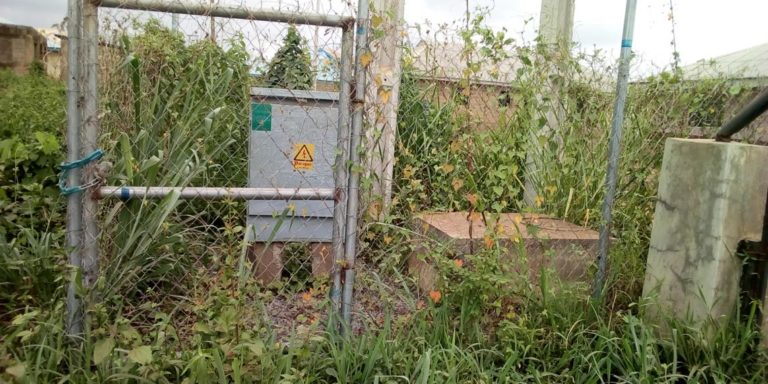
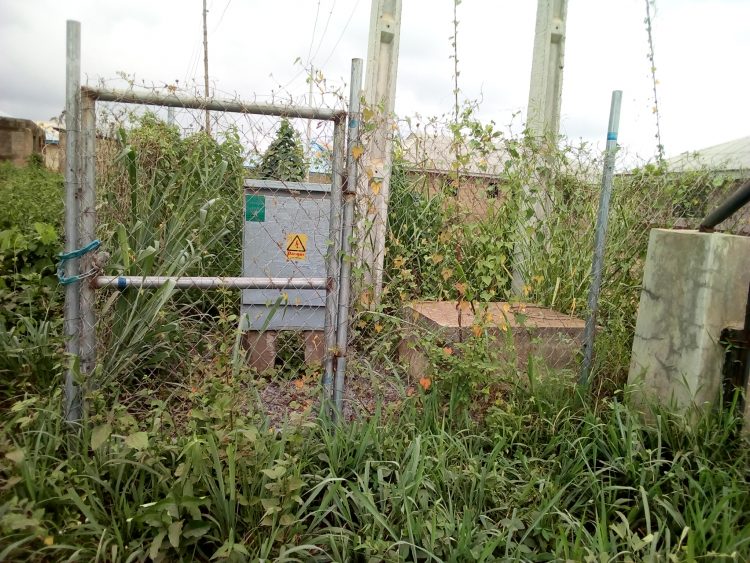
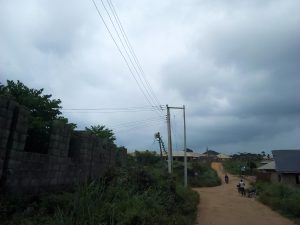
Pole and transformer base erected, but no transformer was brought despite getting fund from FG
It was thus easy for the journalist to move to the location of the two transformers where the Ogun-Osun River Basin Development Authority, the agency responsible for them claimed they were located. On getting to the spots, however, there was nothing to show that transformers were ever allocated to the community. In fact, community residents told the reporter that they have not seen any transformers being installed. They only knew that poles and wires were supplied. Some of them even quipped that they had been contemplating the execution of the project by purchasing transformers by themselves like they had done in the past.
Erected poles with cables, still there was no transformer to supply electricity
Similarly, Sapon community residents told the reporter that they were not aware of the supply of transformers. They said the only transformer they are acquainted with was the old one that had, for years, been used by the whole community. As a result, they said they have been rationing electricity supply among the community residents as a way of shedding load and not overloading the aged transformer.
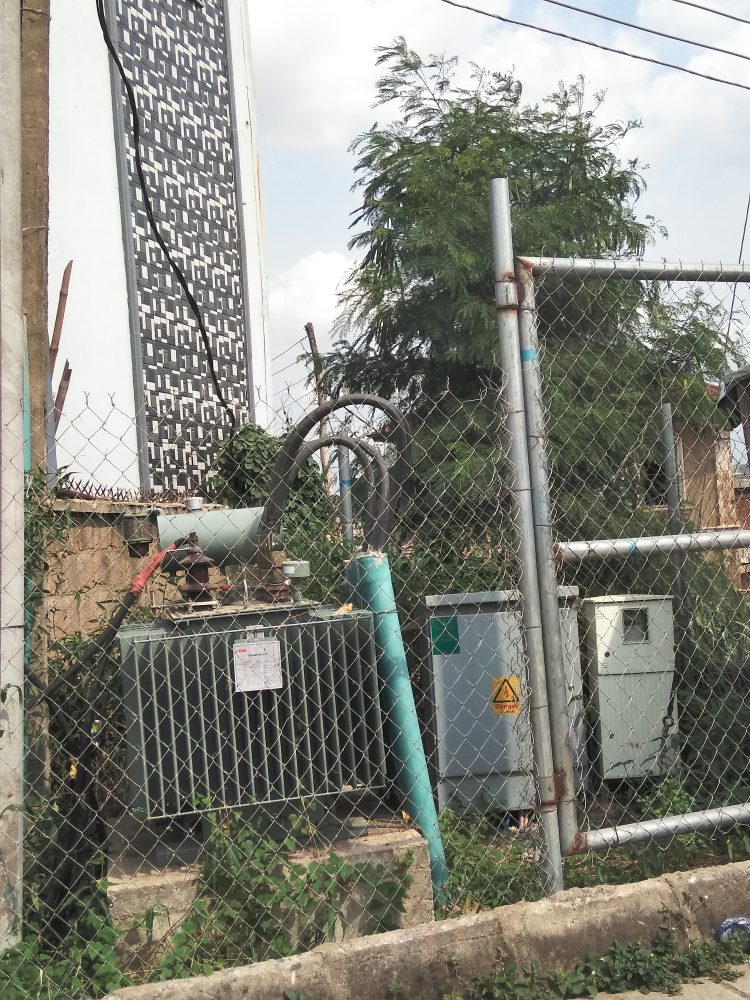
Apart from the general transformer being used by the community, and another one located beside a complex, which reportedly belongs to the Balogun of Egbaland, Alhaji Sikirilai Atobatele, no other transformer was sighted.
In fact, many residents of the community were unaware that another transformer was brought to the community either by the government or any individual. Several of them insisted that the transformer does not belong to the communities as it is being used by a complex building and nearby ten houses, which they claimed are loyalists of the Balogun.
Moving close to the transformer in Sapon, careful observation showed that it was majorly connected to the complex with an electric cable line linking it to the community. And on tracing the number of houses benefitting from it, about fifteen houses tapping electricity from the line that came from the transformer to the community were tracked. Other residents stressed that power supply had not been stable in the community given that the electricity is distributed on a rotational basis to different sections of the communities.
Transformer meant for the residents of Sapon community, but not use by the community
A resident, Adeolu Sulaiman, claimed that for several years, they have not enjoyed electricity beyond five hours. He complained further that the community always spends lots of money for the maintenance of the transformer; adding that there were days the community did not enjoy electricity at all.
“Power supply in this community is not stable at all. We don’t even enjoy it for more than five hours. There are many times they will ask us to contribute money per household just to repair the transformer when it got spoilt,” he intoned angrily.
Another resident, Abiodun Oloyede, who operates a barbing saloon lamented that he depends heavily on generator given there is no stable power supply. He said the transformer often got spoilt within a year far more than the number of days it gets used.
“Our transformer is old and the load on it is too much. Aside that, electricity is shared on rotation basis in this community. Even at that, we still don’t enjoy it the way we are supposed to. Painful part is that we are paying huge electricity tariff for power supply we are not getting, said Oloyede.”
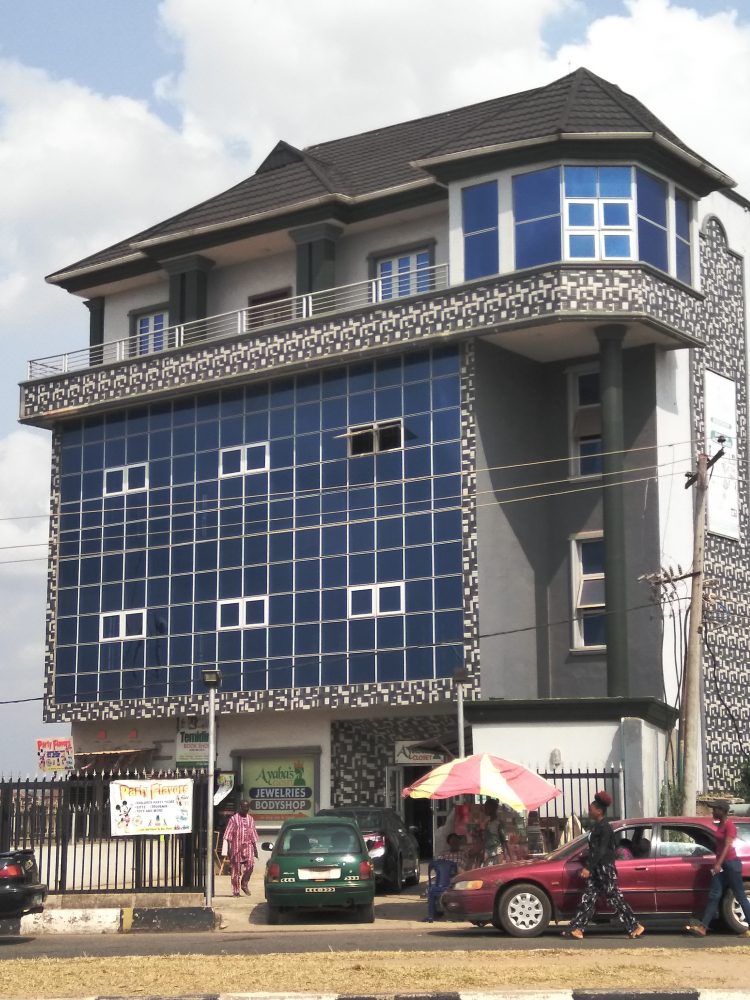
Complex which was reportedly owned by the Balogun of egbaland which is the major building enjoying the transformer
In an interaction with Alhaji Akeem Gbadamosi, Chairman, Imo Community Development Association, Sapon, he reiterated that the community was not aware of any supply of transformer.
He noted that there is only one transformer in the whole community apart from another one beside the Balogun’s complex, which was given to the man by an unidentified politician. He stressed that the community has been managing the only available transformer despite having over 500 houses connected to it.
In his words: “We have spent a lot on this transformer because it is the only one we have in this community. In fact, there’s no other transformer, new or old, brought to our community. That’s why we are suffering power outage here because there is ever no electricity supply. The only transformer we have is already weak. We just keep hoping that one day, government will remember us.”
Then, for about two hours, the reporter traversed the nooks and crannies of the community as guided by residents, to check and sight newly installed or additional transformers. Findings revealed no other transformer was located nowhere else apart from the nearly new 500KVA transformer located beside the Balogun’s complex.
Ogun community: In three decades of darkness
Right from inception, residents of Kajola community, Magboro, in Obafemi Owode Local Government Area of Ogun State have never enjoyed electricity. There is a record of thirty years of life in darkness. Infants born into the community thirty years ago have thus never sighted electricity from the government agency (O-ORBDA). The slight trace of electricity the younger generations are familiar with in the community is spawned from generating sets.
The Ogun community shares boundary with Ikorodu and Arepo -a popular Government Reserve Area in Lagos – and has become a place of hell and agony for the residents who have never had any access to power supply, good roads and other basic amenities.
Records reveal that the community has been in existence for over 30 years as a small village known as Kajola before it later metamorphosed into a new environment for middle class families.
The reporter observed that many expensive looking houses have become abandoned because they are no longer conducive for human habitations. However, bushes have made them safe havens for reptiles.
It was learnt that the owners of the houses abandoned them on realising that there are no assurances that the community can have power in years to come.
Abandoned houses in Ogun community because there was no electricity
Residents even told the reporter in confidence that it was the Progress Community Development Association, Kajola, that facilitated the erection of poles at strategic locations in the community through donations made by landlords in the area. However, those poles were not linked by cables and as such, abandoned due to insufficient funds.
They said that despite several pleas to get the attention of successive Ogun state governments to remember them by giving their community electricity as they rightly deserve, nothing has changed.
Also sharing his views, the chairman of Progress CDA, Victor Adesina, said that not less than 600 houses have become abandoned in the community due to lack of power supply.
Adesina said about 70 residents recently moved out of the community after living there for a short period because they could not cope with no supply.
“Suddenly, we see that many of the houses are being occupied by Hausas who have turned those houses to their own residents,” he stated.
“So, if you see our population, we have more than 2,000 houses in which about 60 to 70 of those who have completed their buildings couldn’t cope with the way of life here. As a result, they left their houses and relocated to other places.”
The CDA chairman further lamented that the community perpetually remains in darkness despite the fact that over N6 million had been spent on power generation. He said it was actually through communal effort via levying themselves that they were able to raise the money to erect the poles, two transformer bases and construction of a tower worth N1.7 million.
Adesina used the medium to appeal to the state governor, Dapo Abiodun to intervene by giving them a transformer, meter cable tension poles and some accessories, which will help in fast-tracking electricity coming to the area.
He said: “with my calculation, the money we have spent is equivalent to six million and still we can’t have light yet. There are days we task one another to contribute N12, 000, N15,000 or N20,000 that was used to raise the project to its current stage. But our greatest need now is the transformer and meter cable that we will use to run it. Our other needs are high tension poles and some accessories. With these provided, we will no longer be left out as we have done two transformer bases.”
Contractors’ face and office unknown
According to the document obtained on this investigation, O-ORDBA claimed to have awarded the contract to a company named Lastak Nigeria Limited to supply eight transformers in Ibadan communities. But till date, all efforts to get the location of the company proved abortive. The company address indicated on the O-ORDBA document shows that it is located along Bashorun-Akobo area in Ibadan, but on visiting the area, neither the company, its name or address rings a familiar bell to anyone in the vicinity.
And for over four hours, this reporter kept engaging people, both those that had lived there for about five to ten years to obtain any information they could share on Lastak Nigeria Limited; but each person said they had neither heard of or knew of any so-called company.
A search was conducted on the Corporate Affairs Commission (CAC) website to get the registration details of the company. The information that popped-up showed that Lastak Nigeria Limited was registered on March 17, 1992. But the address cited on the CAC website is clearly different from the document by O-ORBDA as obtained by this reporter.
Again, this reporter made further efforts to locate the address noted on the CAC around Bodija estate; alas, it turned out that the company address was a residential area. When this reporter got to the area, two security men at the two entrances leading to the supposed address prevented him from moving further since they claimed the name of the company is not known to them.
They insisted it was a government reserved residential area known to all in Ibadan. They also maintained that neither Lastak Nigeria Limited nor any other office is located on that street. Intense research was also done far and near all-around the estate, again, there was no such named company. When asked who owns the building, the security men refused to disclose the owner’s identity, but only insisted that the building is residential and not a company building.
Budgets on paper
Initial findings reveal that the budgets, in many cases, have been mere paper works that do not get to see the light of the day. For instance, the Ogun-Osun River Basin Development Authority (OORBDA), a parastatal of the Federal Ministry of Water Resources and Rural Development (FMWRRD), which covers the whole of the Southwest, including Lagos, in the 2018 budget, is the same agency authorized to supply and install 500KVA transformers for some communities in Oyo and Ogun states.
Records show that for two states, 12 transformers were budgeted for at the sum of N94 million. While N22 million was budgeted for supply of 4 Nos 500KVA transformers to Abeokuta South area of Ogun state, N72 million was allotted for 8 Nos 500KVA transformers in Oyo state.
The difference in the amount points to the general suspicion that the amount approved for projects are decided by lawmakers who nominate the projects and many of them do not reflect market realities.
A preliminary visit to OORBDA Abeokuta office to confirm how much was released for the supply of the 4 Nos 500KVA transformers in Abeokuta South area of Ogun state shows that the government paid N15 million representing 60 percent of the fund as the agency claimed it supplied and installed only two transformers in the state instead of four.
In addition, this reporter also obtained a document on the Ibadan transformer project and it was discovered that N56 million was released out of the N72 million proposed for the project. Moreover, they claimed in the document that the project is 75% completed.
Yet, there is nothing in reality in the communities concerned commensurate with the amount of money purportedly spent to provide transformers.
In Ibadan, a tale of two scenarios
In the document obtained by this reporter O-ORBDA claimed that the contract to distribute and install the 500KVA transformers in Ibadan communities was given to the same faceless company, named Lastak Nigeria Limited.
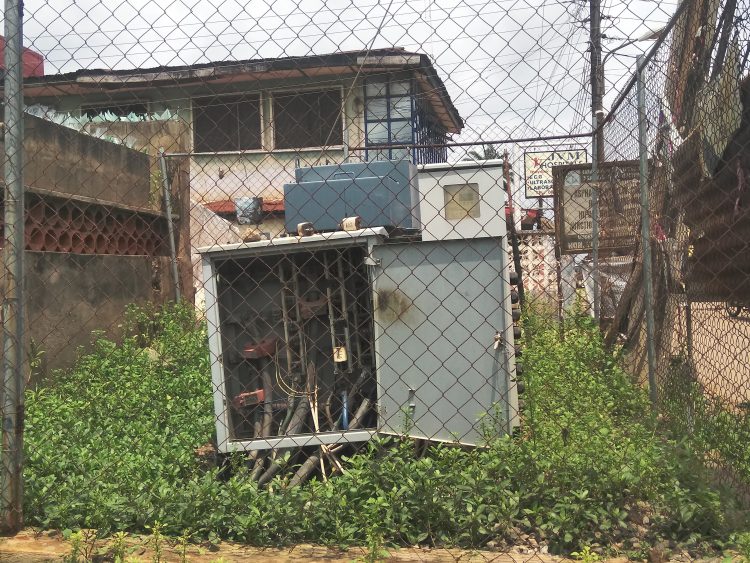
One of the transformers at Vertinary-Mokola
In it, O-ORBDA listed Oke-Ado, Vertinary Mokola, Ita-Ige Junction, Idikan Junction, Age community, First-gate, and Odo-Oba Elere as communities that benefitted from the transformer distribution. It was learnt that the former senator representing Oyo South, Senator Riliwan Akanbi, facilitated the transformers.
But this reporter located only four out of the six communities listed by the authority. The two other communities do not sound familiar even with long-time residents of Ibadan. And, up till the filling of this report, the location still remains unknown and may be non-existent.
A visit to the four locations listed in the document revealed that, indeed, transformers were given to the four listed communities. The transformers have been connected in three of the communities namely Vertinary, Mokola, Idikan Junction and Odo-Oba Elere, while the transformer at Oke-Ado community still remains unconnected months after supply.
Speaking with the residents of the community on why the transformer was connected, they claimed they still have a working transformer in the community. One of the residents, Oladoye Akanni took this reporter to another transformer being used by the community. He claimed the unconnected transformer was brought to the community as a campaign strategy for the supposed politician. He explained that for over two years that the transformer has been brought to the community, nothing has been done to connect it.
This reporter observed that in three of the communities, there are more than three different transformers in each of the locations. Yet, many other communities in Ibadan still suffer power outage due to lack of good transformers.
One of the transformers at Odo-Oba-Elere
Findings reveal that communities like Odo-Ona kekere, Ijokodo, Apete, among others are not enjoying electricity because they don’t have functional transformer to supply electricity to various households.
On another visit to the communities, it was gathered that the transformers in those places got spoilt and had been replaced. The residents lamented that efforts to get the attention of the government in replacing their spoilt transformer were not successful.
At Odo-Ona kekere, residents complained that the two transformers that served them were not working very well. They lamented that they spent a lot of money to maintain the transformer on a monthly basis.
Bashir Adeogun, a barber complained that he spends a lot of money on fuel used for his generator since the power supply in the community is once-in-a-while because the transformers in the community are old and needs to be changed.
Another resident, Marvelous Balogun said, “Since I came to this area, we have not been enjoying electricity. For days, they may not bring the light and when they bring it, within a few hours, it gets turned off again till God knows when.”
At Apete area in Ibadan, residents complained that the community had been plunged into darkness for over six months since the transformer supplying electricity got spoilt. Living has been stressful and painful given what they go through daily due to power problems.
A resident, Oyindamola Oni, told this reporter: “my shop was in Apete because I stayed there. But for six months now, there has not been electricity in this community, I learnt the transformer got spoilt and nothing has been done on it. I’ve moved my make-up shop from Apete to a better place when there was no electricity to run some of my equipment. Even in my house, I spend lots of money on fuel.”
Also sharing his pains, a motorcyclist named Araba complained that he always charges his phone battery from town because he did not have any other means in the community. Araba noted that even before the transformer got spoilt completely, the residents in the area had been suffering from partial blackout.
Unconnected transformer at Oke-Ado despite collecting money for the installation
His words: “I have been living in this area for a long. I can tell you that even before the transformer got completely spoiled, power supply had never been stable in this community. We have not been enjoying electricity here at all. I always charge my phone from the town because for six months, we have not even seen flashlight of electricity. I just don’t know how we will survive in this area especially during this dry season.”
Procurement process negates procurement law
The Public Procurement Act 2007 requires public institutions and other relevant parties to ensure that all public procurements are conducted in a manner that is transparent, timely and equitable and based on the agreed guidelines, thresholds and standards.
However, investigations conducted by this reporter reveal that some of the activities surrounding the procurement and distribution of transformer in the two states negate the Act.
Many of the communities to benefit from the transformers were not carried along in the process of procurement as investigative findings unveil. While the law gives room for community participation on projects coming to them, investigation revealed that the residents did not have any contribution to the process that led to the distribution of the transformers.
Findings by this reporter also revealed that the transformers are not needed in some communities they were taken to. That was why many transformers litter some communities in Ibadan because the projects were brought without getting the residents involved.
Records show that the price for the 4 Nos 500KVA transformers in the two states are different based on the contractor carrying out the project. This is why, for two states, 12 transformers were budgeted for at an overall sum of N94 million, while N22 million was budgeted for supply of 4 Nos 500KVA transformers to Abeokuta South area of Ogun state. Another N72 million was allotted for same 8 Nos 500KVA transformers in Oyo state, respectively.
Also, the Procurement Act mandates that bidding must be transparent and accessible to the public, but reading through the O-ORDBA website, it was seen that no information was released. Information about the contractors for the projects in the two states were not indicated just as efforts to get information from them through the Freedom of Information Act failed, till this reported is published.
Also, the implementation of the procurement in some of the locations grossly negates the process of the Act as findings reveal that one of the communities in Abeokuta, Oke-Aregba, is yet to get the transformer despite releasing money for the project. Information obtained in confidentiality from an anonymous informant hinted that about 60 per cent of the money has been released for the distribution of the two transformers in Abeokuta. Still, some of the locations where transformers were purportedly distributed in Ibadan remain unknown.
O-ORDBA’s delayed response on projects awarded
In the bid to get official information from the O-ORBDA management on the investigations, several Whatsapp and text messages were sent to its Managing Director, Olufemi Odumosu. Till date, he is yet to reply to any.
Not giving up, this reporter sent a message the PRO, O-ORBDA, Saliu Adeniyi, and he replied and advised the journalist to write an official letter to the management stating his request officially.
On 2nd November, 2020, this reporter wrote the first official letter requesting detailed information about the projects in Ibadan. The letter was received by Mrs. Fatimo Adeyemi, one of the secretaries at the MD’s office.
Also, on November 4, 2020, the reporter sent another official letter reminding them of his need for accurate official information about the projects in Ogun state. It was received by another secretary in the office name Mrs. B.A Adekunle.
In the absence of O-ORDBA responses, a Freedom of Information Act request was sent to the authority on November 11, 2020 and it was received by Mrs. Fatimo Adeyemi. As at the time of filing this report, none of the three requests had received a response.
Aside the letters of requests, the reporter also visited the O-ORDBA office on three different occasions. He was told his letter had been received and filed in the logging document at the MD’s office. When he inquired when he will get a response, he was told that his request will be channeled to appropriate quarters and he will be contacted at appropriate time.
This reporter also, contacted the PRO to explain things to him. The PRO explained that he is currently on leave and may not be able to follow up with the requests.
The PRO however gave this reporter the contact of one Mr. Ogundele. But, efforts to get his attention have not been successful, as he did not pick this reporter’s call or reply messages sent to him both on Whatsapp and SMS.
* This investigation is supported by the John D. and Catherine T. MacArthur Foundation and the International Centre for Investigative Reporting.
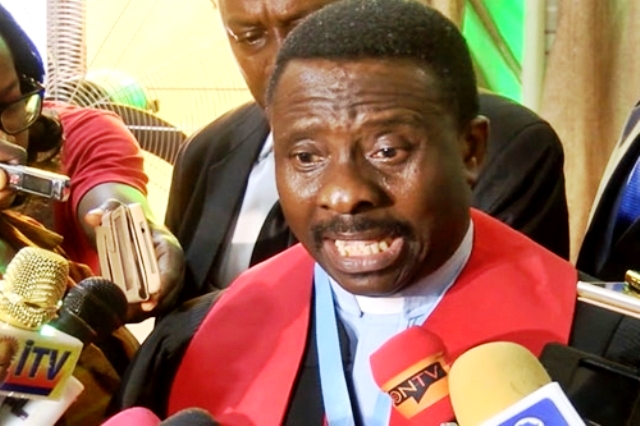
THE Christian Association of Nigeria (CAN), has decried the spate of insecurity especially in the Northern part of the country, saying that criminals now operate in Nigeria in a manner that seems as if the nation’s “security agencies are on holiday.”
This was contained in a statement on Wednesday by Adebayo Oladeji, the special assistant on media and communications to Samson Ayokunle, CAN president, condemning the recent abduction of more than 333 students of Government Secondary School, Kankara in Katsina State, last week Friday.
The statement noted that the audacity by which the incident was carried out on the very day President Muhammadu Buhari arrived in the state should inform the president that security under him has been compromised.
CAN added that the abduction also proved that governments at various levels in the country have not learnt any lesson from the abduction of school children in Chibok, Borno and Dapachi, Yola states respectively.
“The fact that the unfortunate incident happened while the Chief Security Officer of the country and the President, Muhammadu Buhari, is in his home state means these criminals have sent a strong message to him that the security architecture of the country has been compromised under his watch,” CAN said.
“The abduction has also exposed the failure of both the government and the security agencies to learn from the abduction of 276 Chibok schoolgirls in 2014 in Borno State and 110 schoolgirls at the Government Girls’ Science and Technical College in Dapchi, in Yobe State in 2018.
“It also means all stakeholders in the Education sector have learnt nothing from the two historic tragedies despite the fact that our security agencies have failed to secure the release of the remaining Chibok schoolgirls and the only Dapchi schoolgirl, Leah Sharibu, who is still wasting in the den of the terrorists.”
While condemning the failure of the president to appear to honour a recent summon by the House of Representatives for him to explain the degenerating nature of insecurity in the country, CAN called on security operatives to urgently rescue the children before they are used for suicide bombers.
“From all indications, our governments are not bothered about the security of the people despite all the killings that are being recorded daily. The President turned down the invitation of the House of Representatives to explain and rob minds with the legislators on the way out of our deplorable security situation in the country.
“What an attitude of ‘I don’t care!’ President Muhammadu Buhari should remember that history is being written about him with the way he is addressing all these security challenges just as we are talking about the Chibok schoolgirls and the Jonathan administration.
“This was what CAN foresaw long before now when we were calling on the President to sack the service chiefs and by extension to overhaul the security architecture. But he was not ready to listen to the Voice of Wisdom.
“We advise President Buhari to revisit all his electioneering promises on security and compare them with what security has become under his watch. We urge the President to disregard the bad advice from the cheerleaders around him who are saying that all is well so that they might keep their jobs.
“Is there no government in place anymore? Is this the way other governments of the world respond to life-consuming threats as we have?
“The leadership of CAN calls on all relevant security agencies to rise up and liberate all these innocent students before those who are holding them captive begin using them as suicide bombers.”
It called on the international community to come to the aid of Nigeria and help put to a permanent end the siege of terrorists, bandits and criminal herdsmen masquerading and causing mayhem in our country noting that “They shouldn’t wait till when the situation snowballs into a civil war.
The religious body called for the closure of boarding facilities in all private and government schools in the Northern part of the country. It also advised the federal government to direct the Nigerian Security and Civil Defence Corps to provide protection for schools and colleges nationwide especially in the areas where security appears compromised.
“Our hearts go out to the parents of those innocent students and we pray that very soon, they will reunite with their children in Jesus’ name. It is regrettable, disturbing, disheartening and unfortunate that despite the menace of insecurity and its attendant consequences, there’s no one who has the conscience to follow the path of honour.
“CAN calls for the suspension of the boarding facilities in all the private and government schools in the Northern part of the country until the security situation improves. We equally advise the Federal government to direct the Nigerian Security and Civil Defence Corps to provide protection for schools and colleges nationwide especially in the areas where security appears compromised.
“May the Lord divinely intervene in the affairs of our nation which appears to be irredeemable by man.”
On Monday, Boko-Haram had claimed responsibility for the abduction.
Al Jazeera English had quoted AFP news agency saying that Abubakar Shekau, the factionalized leader of the militant sects claimed that his brothers were behind the kidnap in short footage rendered in both Hausa and Arabic languages.
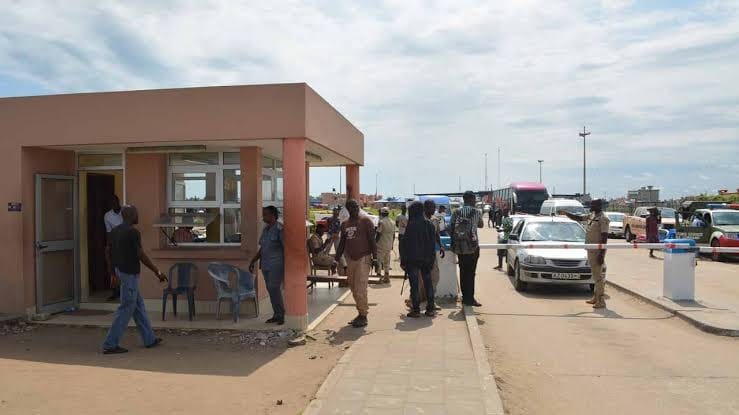
ONE year after closure, the federal government has ordered that four out of all the nation’s land borders be reopened for commercial activities again.
Zainab Ahmed, the minister of finance, budget and national planning, who announced this to newsmen on Wednesday shortly after the weekly federal executive council (FEC) in Abuja, said President Muhammadu Buhari gave the order.
According to the minister, the borders are Seme in Lagos, Illela in Sokoto, Maigatari in Jigawa and Mfun in Cross River.
She added that the borders would be reopened from December 31, 2020.
Bashir Ahmad, the personal assistant to the president on new media also confirmed this in a Twitter post.
In August 2019, President Muhammadu Buhari gave an order for a total closure of the country’s land borders to the movement of goods from neighbouring countries, saying it is high time the country ended snuggling.
The President’s decision has been heavily criticised by experts and neighbouring countries like Benin Republic.
The rise in the price of essential commodities and staple foods in the country have also been attributed to the closure of the country’s land borders.
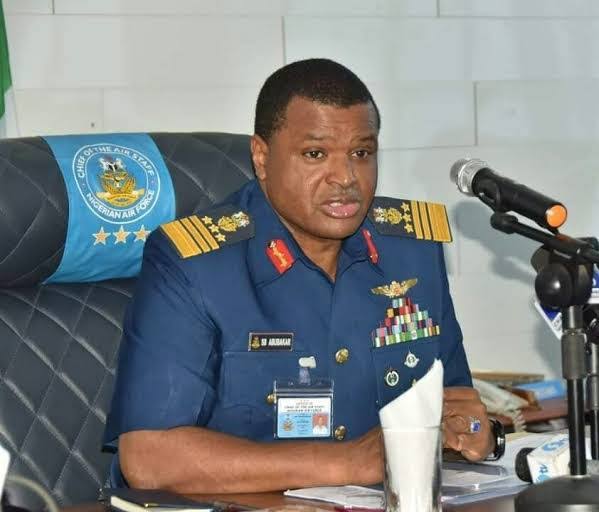
FAMILY of Michael Oyebanji, a former Master Warrant Officer (MWO) in the Nigerian Air Force accused of a N41 million theft, on Wednesday asked the Chief of Air Staff, Air Marshal Sadique Abubakar to confirm the verdict of a General Court Martial (GMC) held against the accused.
Delivering the judgement on September 24, President of the GMC, Air Commodore Nazib Aliyu found Oyebanji guilty of, “Criminal Breach of Trust, Theft, Criminal Conspiracy, Criminal Misappropriation, Making of False Documents and Conduct to the Prejudice of Service Discipline.”
The offenses, he stated contravenes Sections 114 and 103 (d) of the Armed Forces Act Cap A20 Laws of the Federation of Nigeria 2004 and Sections 312, 287, 96 and 309 of the Penal Code Cap P3 Laws of the Federation of Nigeria 2004.
He was arraigned with three others – Flight Lieutenant Sherifi Olawoore, Flying Officer Ademola Adekoya and Warrant Officer Paul Atteh but the accused, the family said is still being held in the air force custody, due to failure of the right authority to validate the decision of the military court on the matter.
They decried the undue and continuous detainment of the accused months after the court-martial, thus denying the accused right to seek justice in a superior court. The court-martial also affirmed right of the accused personnel to appeal judgement of the court-martial, “if they are dissatisfied.”
Oyebanji’s relatives had earlier flawed the court-martial proceeding alleging that most of the charges levelled against the accused were duplicated and mopped-up to bring the officer to disrepute.
“The so-called authority should confirm the judgement so we can proceed to the appeal court instead of holding him back in detention,” says Adeyemi Adeyeye, a clergyman representing the family stated.
“I am not saying Mike is an angel but he won’t be so stupid to steal 41 million. At least there is a process of tracing the proceed of fraud.”
Oyebanji with three other officers had setup the 151 Base Services Group (151 BSG) Multipurpose Cooperative Society, Makurdi, Benue State prior to the allegations.
Setting up the cooperative unit, it was gathered followed due process with permission from a top air force officer identified as Commodore Idowu, but the Air Force Headquarters issued an order to officers who had subscribed to the cooperative group to return to their previous cooperative units.
But following the directive, the relative said the cooperative organisation became distressed as they could no longer service existing loans taken by the officers. Former members of the cooperative, thus left the Oyebanji-run cooperative group, and as a result could not fulfill their commitments, it was gathered.
The incident allegedly led to the crisis and subsequent court-martial against the accused officers.
Oyebanii was accused of a 46 count charge and found guilty of all allegations – a situation the family and the defendant lawyer found suspicious.
Sunday Adukwu, Counsel to the defendant blamed the court-martial for denying the accused of his right to seek redress at the Court of Appeal.
Though Oyebanji was demoted from the post of a WMO to a Corporal, he is still being held in detention against his will. He also questioned the court-martial processes alleging the judgements were predetermined.
“How can he be guilty of all the 46-count charges despite having a lawyer to defend his case? Adukwu queried.
The lawyer cited an instance of two similar charges where Cheque was issued to one Michael Aniete but Oyebanji was still accused of the withdrawal.
Adukwu said failed transactions such as botched cheques were listed among the listed charges and used against his client. According to him, a power generating set procured by the cooperative unit for the purpose of office activities was also listed as an evidence against the accused, despite being procured with a receipt.
Some of these arguments, he noted were disregarded by the military court and listed among the 46 count charges leveled against the accused.
The lawyer, however, insisted his client did not commit the offenses as charged.
He challenged the Airforce to confirm the ruling of the court-martial to ensure his client’s release in order to seek redress in a superior court.
The ICIR contacted the Air Force Director of Public Relations and Information, Air vice-marshal Ibikunle Daramola, to ask the reason for the delay in confirming the court-martial verdict, he promised to ‘find out and get back’ to this reporter. He also acknowledged the right of Oyebanji to approach a superior court but added that the decision of the court-martial would have to be validated before redress.
THE House of Representatives has asked the National Communications Commission (NCC) to extend the 31st December deadline issued to SIM card owners to submit their National Identification Numbers (NIN) to their network providers to prevent blocking.
Ndudi Elumelu, the house minority leader, who moved the motion during Wednesday’s plenary, said two weeks was too short for 200million Nigerians to conclude the process.
Adopting the motion, the house resolved that the exercise should end on January 28, 2021, as against December 30, 2020.
It lauds the intention of the NCC, for security reasons but wants the process to be extended to 10 weeks, considering the difficulty experienced by Nigerians in attaining the NIN.
The Federal Government on Tuesday issued an ultimatum to all telecommunications operators in the country to block all Subscriber Identification Modules (SIMs) without National Identification Number (NIN).
It also ordered the network operators to ask all their subscribers to provide valid NIN to update their records and suspend SIM registration.
This formed parts of the resolutions adopted for immediate implementation by all network operators at an urgent meeting of key stakeholders in the communications industry held in Abuja.
The spokesman for the Ministry of Communications and Digital Economy, Dr. Ikechukwu Adinde, noted in a statement that the meeting was convened on Monday by the Minister, Dr. Isa Pantami.
According to him, the meeting resolved that the submission of NIN by subscribers would take place between December 16 and 30, 2020.
The government stated that after the deadline, all SIMs without NINs should be blocked from the networks while a Ministerial Task Force comprising the minister and all the CEOs, among others, as members would monitor compliance by all networks.
It warned that violations of the directives by any network operator would be met with stiff sanctions, including the possibility of withdrawal of operating licences.
The directive has since sparked a lot of outrage on social media with many questioning its feasibility especially at a time the country is still battling to curtail the outbreak of COVID-19.
Meanwhile, all registered persons can retrieve their NIN by dialling *346# on their registered phone number in all the major networks for a service fee of N20 per dial.
Also, the National Identity Management Commission (NIMC), has announced the license of 173 centres and 30 state government institutions to conduct the enrollment of the National Identity Number (NIN) across Nigeria.
According to the information on its website on Wednesday, NIMC said the license was approved by Isa Pantami, the Minister of Communications and Digital Economy.
“The Minister of Communications and Digital Economy, Isa Ali Ibrahim (Pantami), has approved the licensing of 173 Agents and 30 State Governments/Public Sector Institutions to conduct enrolment of all persons including legal residents into the National Identity Database (NIDB) on behalf of the National Identity Management Commission (NIMC),” the notice read.
“Pursuant to the above, find the list of all the successful firms who satisfied all the evaluation criteria as stated in the Advert for the Expression of Interest (EOI) of each of the respective categories in full.”
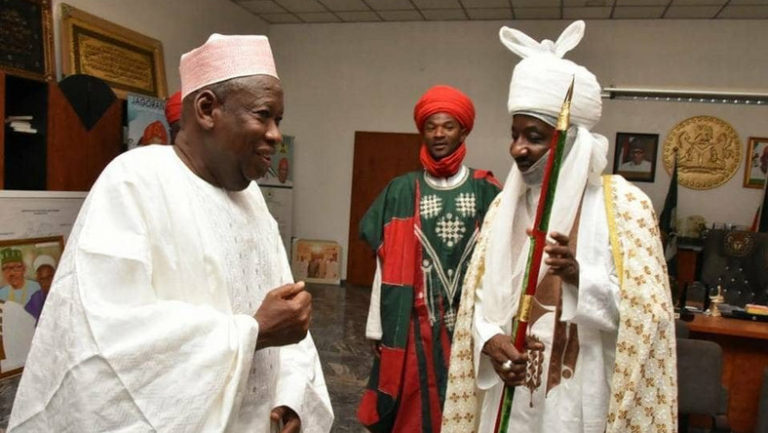
ABDULLAHI Ganduje, the governor of Kano State, says he has no regret for dethroning Lamido Sanusi, former emir of Kano state.
He said this on Tuesday at the public presentation of a book written by a journalist, Bonaventure Philips-Melahon, on Goodluck Jonathan, the former president of Nigeria.
Sanusi, who was dethroned by Ganduje in March for alleged insubordination and disrespect for constituted authorities was appointed the 14th emir of Kano state in 2014 shortly after he was suspended as governor of the Central Bank of Nigeria (CBN) by Jonathan following his allegation that $20 billion was missing from the records of the Nigerian National Petroleum Corporation (NNPC).
According to Sanusi, the money was from crude oil exports by the NNPC between 2011 and 2012 that was not remitted to the Federation Account.
Ganduje, who was the deputy governor to Rabiu Kwankwaso, the then governor of the state, further said that the government knew that Sanusi did not deserve to be the emir of Kano.
He added that he was appointed by Kwankwaso to spite the former president.
“Mr Sanusi was not the best man for the throne at the time he was appointed in June 2014 but was given the throne to spite former President Jonathan.
“He was appointed in order to prove that what Jonathan did to him was wrong and that the people of Kano wanted their son as Emir and therefore they decided to appoint him as Emir.
“But when he was appointed, there were a lot of demonstrations with people burning tyres here and there. But because of government backing, he was sustained on the stool.
“When I became governor, (that’s why you will laugh), I said yes, the Jonathan medicine is an important medicine.
“That medicine, even though I am not a medical doctor, but that medicine would serve the same purpose, for the same disease and for the same patient.
“So I took my Jonathan medicine and decided to save the system, to save the institution and I applied it effectively. So Jonathan and I are on the same page. Actually, I have no regrets” the governor said, apparently alluding to his controversial dethronement of Mr Sanusi.
THE Nigerian Union of Teachers NUT, says it is becoming apparent that the President Muhammadu Buhari-led government can no longer provide security and safety of teachers, students and the educational communities across Nigeria.
The Union called on the Federal, States and Local governments to ensure adequate security and 24 hours surveillance around schools across the country.
The call was made in statement signed and made available to journalists in Abuja by the NUT, Secretary General, Dr Mike Ike Ene .
The Union recounted recent condemnable events of bandits attack on schools and said if not immediately addressed it will affect the 2019/2020 academic calender which has already been disrupted by the six-month long lockdown caused by the Covid- 19 pandemic.
“As such we wish to remind our government at all levels, of their primary responsibility as enshrined in the constitution which is the security of lives and property of the entire Nigerian citizens”
NUT recounted the story of one Mr. Alu Ola Paul , Head teacher with Olagua Primary School Ohordua in Edo State, the national leadership of the NUT said Mr Olagua was kidnapped on his way to work on the 1st of December and released six days later.
In a related development, “on 8th December, 2020, Mrs Gladys Niemogha Belleh and Mrs Blessing Emunefe both of whom are teachers of Ohorhe Sceondary School Effurun in Delta State were kidnapped in their school premises by armed bandits and are yet to be released, thereby throwing both families, students, and the school community into emotional and overall destabilization.
“On 11th of December, 2020, Government Science Secondary School Kankara in katsina State, was invaded by armed bandits with reports that 333 students are yet to be accounted for as at today, this dastardly act has sent shivers through the spine of other members of the entire school community of Katsina state.
“These incidences are sad reminders of previous ugly events in Chibok and Dapchi, where Boko-haram terrorist had attacked and abducted students creating monumental disruption of school activities and impeding our nations educational growth and advancement while subjecting family members and relatives to unimaginable trauma”
As a union, the secretary said NUT will not fold hands and watch enemies of educational development continue to threaten the nations educational system to suffocation.
The Union demands that government must rise to the challenge and take up its responsibility to guarantee and execute the general principle and commitment of providing adequate security to all educational institutions and the nation at large.
The Nigerian Union of Teachers also threatened to down tools till when its members would feel safe to teach and guide students without fear of abduction by faceless Individuals.
“In light of these recent developments, the Nigeria Union of Teachers may be compelled to down tools pending when it is safe for our members to teach and guide our pupils and students without fear of abduction by these faceless enemies of educational prosperity of the Nigerian Nation”
The Teachers also called on government to consider the implementation of Life Insurance and Hazard Allowance to teachers in Basic and Senior Secondary Schools as approved by President Muhammadu Buhari on the occasion of the World Teachers’ Day 2020.