NIGERIA’S capital importation has dropped by over 70 percent in the last 12 months, quarter three report of the Nigerian Capital Importation by the National Bureau of Statistics (NBS) reveals.
The report, published on Tuesday by the NBS showed that the country’s capital importation plunged from $5.63 billion in Q3 2019 to $1.46 billion in the latest report of Q3 2020. However, on a quarterly basis, the latest figure indicates that there was an increase when compared to the second quarter figure ($1.29 billion), representing about a 12.86 percent increase.
The report further revealed that with about 96 percent share of the capital importation, Lagos-82.3 percent, and the Federal Capital Territory (FCT)- 13.4 percent emerged the top two destinations of investments into the country.
The largest amount of capital importation by type was received through “Other investment”, which accounted for 43.75 percent ($639.44 million) of total capital importation, followed by Foreign Direct Investment (FDI), which accounted for 28.38 percent ($414.79 million) and Foreign Portfolio Investment, which accounted for 27.87 percent ($407.25 million) of total capital imported in Q3 2020.
Foreign Portfolio Investment (FPI) is the entry of funds into a country where foreigners deposit money in a country’s bank or make purchases in the country’s stock and bond markets, sometimes for speculation.
According to the report, Capital importation by Production dominated in Q3 2020 reaching $400.09 million of the total capital importation in Q3 2020 on a sectoral basis, while the banking sector came second with a $384 million investment.
The NBS report also showed that the United Kingdom emerged as the top source of capital investment in Nigeria in Q3 2020 with $594.65 million investment, representing about 40.69 percent of the total capital inflow in Q3 2020, while the Netherlands came second with $176.28 million imported investment, representing 12 percent of capital imported into the country in Q3 2020.
FOLLOWING the refusal of the Nigerian President, Muhammadu Buhari to appear before the National Assembly over rising insecurity in the country, the Senate has summoned the Nigerian Defence Minister, Bashir Magashir, Service Chiefs, the Department of State Security and Nigeria Police force.
This followed a motion moved by Bello Mandiya, senator representing Katsina South over the recent invasion and abduction of students from Government Science School, Kankara, Katsina State.
Seconding the motion, Sani Musa, the senator representing Niger East Senatorial District said ‘enough is enough’ adding that the service chiefs must go.
“There is a need for this chamber to draw the attention of Mr. President that enough is enough, these Service Chiefs should go. I am being very honest and talking from the heart. Enough of this thing. I wish the National Assembly will take drastic action on this. We have been appropriating; where are these funds going to?” Musa questioned.
Other Senators, including the minority leader, Eyinnaya Abaribe also passed a vote of no confidence on the service chiefs over their inability to bring an end to insecurity in Nigeria.
Following similar contributions from other Senators, the Senate condemned the attack on the school while urging Buhari to consider and implement the recommendations of the Senate ad-hoc Committee on Nigeria Security Challenges dated March 17, 2020.
Summoning the minster of defence, service chief and others, Ahmed Lawan, the Senate President said the most important responsibility of a government is to protect the lives of its citizens.
“There is nothing more important today for the government to do than securing the lives of citizens of this country. That is the most important function of any government. I could see the level of frustration so to say.
“We as a parliament should never get tired of talking about issues that affect our people. We have our own limitations because of the structure of how government must be carried out. We must never get tired of reporting what is happening to our people. We should think outside the box and continue to engage with the Executive arm of government until the appropriate actions are taken,” Lawan said.
Recall that Buhari refused to honour a summon by the National Assembly to speak on the government’s inability to curb the surge in security crisis across the country.
Abubakar Malami, the Nigerian minister of justice and attorney general of the federation also said the House of Representatives went out of its constitutional bound to have summoned the president.
AGAIN, Nigeria’s inflation rate has peaked at a new height of 14.89 percent in November, data on the Consumer Price Index (CPI) released by the National Bureau of Statistics (NBS) shows.
Nigeria is currently grappling with its economic crisis as it is going through the second recession in four years.
The CPI measures the average change over time in the prices of goods and services consumed by people for day-to-day living.
The consumer price index (CPI), which measures inflation, increased by 14.89 percent (year-on-year) in November 2020. This is 0.66 percent points higher than the rate recorded in October 2020 (14.23 percent).
Also in November, Nigeria entered her worst economic recession in over 3 decades and second experience of recession in four years.
From the report, the headline index increased by 1.60 percent in November 2020, a month-on-month basis. This is 0.06 percentage points higher than the rate recorded in October 2020 (1.54 percent).
In addition, the urban inflation rate also increased by 15.47 percent (year-on-year) from 14.81 percent recorded in October 2020, while the rural inflation rate increased by 14.33 percent in November 2020 from 13.68 percent in October 2020.
The urban index rose by 1.65 percent (on a month-on-month basis) in November, by 0.05, from 1.60 percent recorded in October 2020, while the rural index also rose by 1.56 percent in November 2020, up by 0.08 from 1.48 percent recorded in October 2020.
Food index
When compared to 17.38 percent in October 2020, the composite food index rose sharply by 18.30 percent in November.
“This rise in the food index was caused by increases in prices of bread and cereals, potatoes, yam and other tubers, meat, fish, fruits, vegetables and oils and fats.”
All item less farm produce
“The ”All items less farm produce” or Core inflation, which excludes the prices of volatile agricultural produce stood at 11.05 percent in November, down by 0.09 percent when compared with 11.14 percent recorded in October 2020.”
“On a month-on-month basis, the core sub-index increased by 0.71 percent in November 2020 representing a sharp 0.54 percentage point decrease when compared with 1.25 percent recorded in October 2020.”
“The highest increases were recorded in prices of Passenger transport by air, Medical services, Hospital services, Repair of furniture, Passenger transport by road, Maintenance and repair of personal transport equipment, vehicle spare parts, Hairdressing salons and personal grooming establishments, Pharmaceutical products, Paramedical services, and Motor cars.”
All items inflation
“In November 2020, all items inflation on year on year basis was highest in Bauchi (19.67 percent), Kogi (19.81percent) and Zamfara (17.30 percent), while Abia (13.26 percent), Delta (13.20 percent) and Kwara (12.24 percent) recorded the slowest rise in headline Year on Year inflation.”
“On month on month basis, however, November 2020 all items inflation was highest in Kogi (3.08 percent), Bauchi (2.33 percent) and Oyo (2.25 percent), while River (0.88 percent), Akwa Ibom (0.77 percent) and Nasarawa (0.44 percent) recorded the slowest rise in headline month on month inflation.”
Food inflation
Food inflation on a year on year basis was highest in Kogi (24 percent), Sokoto and Zamfara (20.60 percent), and Ebonyi (20.20 percent), while Abia (16.20 percent), Bauchi (15.60 percent), Gombe and Nasarawa (15.00 percent) recorded the slowest rise.
On a month-on-month basis, however, food inflation was highest in Kogi (3.37 percent), Osun (3.08 percent) and Cross River (2.93 percent), while Akwa Ibom (0.60 percent), Edo (0.43 percent) with Nasarawa recording price deflation or negative inflation (general decrease in the general price level of food or a negative food inflation rate).
BOKO-HARAM has claimed responsibility for the abduction of more than 333 school children in Government Science Secondary School in Kankara, Katsina state on Friday.
Al Jazeera English had quoted AFP news agency saying that Abubakar Shekau, the factionalized leader of the militant sects claimed that his brothers were behind the kidnap in a short footage rendered in both Hausa and Arabic languages.
“I am Abubakar Shekau and our brothers are behind the kidnapping in Katsina,” he said.
This is contrary to an earlier claim by the Katsina state government that the children were abducted by bandits, local armed groups terrorising the Northeast.
Aminu Masiri, Katsina state governor, told newsmen shortly after meeting with President Muhammadu Buhari in Daura, yesterday, that the government is already in talks with the abductors to negotiate the release of the children.
He also noted that security agencies had located the position of the children.
One has escaped
The Nigeria defence headquarters has claimed that one of the kidnapped school children has escaped from the abductors.
John Enenche, the coordinator of defence media operations, said this during his appearance on Channels television’s politics today on Monday.
“Out of that 333, before I came into the studio, one escaped out of wherever they kept them,” he said.0
He also confirmed that three hundred and thirty-three students were still in the hands of the abductors.
“The principal reported that he had 839 in the boarding house; and as at the time they were abducted, shortly after that, some came back and it was about five hundred plus that did not return,” he noted, corroborating the figure earlier released by the Katsina State Government.
Enenche who said the kidnappers ferried the student away from the school via motorcycles, explained that security agencies are working to ensure the students are rescued alive.
A resident opinion
A resident of Kankara had told Channels TV on Monday that the incident was a reprisal attack to a vigilante group who had ruthlessly dealt with the armed group when they attacked a village around the local government the school children were abducted.
“There is something people are yet to know; before the recent abduction of Ƙankara Secondary School students, the bandits had on Wednesday attacked ‘Yar-Kuka village and killed 12 people and abducted an unspecified number of people in the village.
“On Thursday, a vigilante group mobilised and went after the bandits in their hideouts and engaged in burning down the Fulani houses, injuring and killing some of them,” the resident said.
Global uproar
The incident has continued to draw condemnation from several quarters with the UN calling for the unconditional release of the students.
“The Secretary-General calls for the immediate and unconditional release of the abducted children and for their safe return to their families. He reiterates that attacks on schools and other educational facilities constitute a grave violation of human rights. He urges the Nigerian authorities to bring those responsible for this act to justice,” the organisation said in a statement on Monday.
In 2014, Boko-Haram was responsible for the kidnapping of about 276 girls in a government secondary in Chibok, Borno state. Although some of them have regained their freedom, the whereabouts of 113 of them are still unknown till date.
DESPITE a N576m contract for mechanized sweeping of highways in Lagos West Senatorial District, roads are still being swept manually, exposing sweepers and road users to avoidable dangers on the highways, Omolabake Fasogbon reports
It was about 11.00 am on a rainy Saturday, but 52-year old Risikat (not real name) was spotted deeply engrossed in her work along Iyana Ipaja expressway, Lagos. As the light drizzle turned into a steady downpour, Risikat, clad in a green coloured jumpsuit, held her sweeping tools (local broom, a long stick and a plastic packer) as she busily swept the roads and pavements clean and free of debris. She maneuvered her broom gently on the floor, starting from the adjoining roads and gradually advanced to the highway.
As early as 6.00 am daily, Risikat is already on her beat, which she is expected to round off by noon when the person on the afternoon shift takes over. She told this reporter that she was doing her third and last round for the day as she had swept the same spot twice earlier. Despite the exposure to risk and ravaging Covid-19, Risikat was not using any Personal Protective Equipment (PPEs) including a facemask, glove, and boot, except for an unbranded face cap on her head.
She is one of the Lagos Waste Management Agency (LAWMA) sweepers posted to Iyana Ipaja area of Lagos to keep the highway and environs clean.
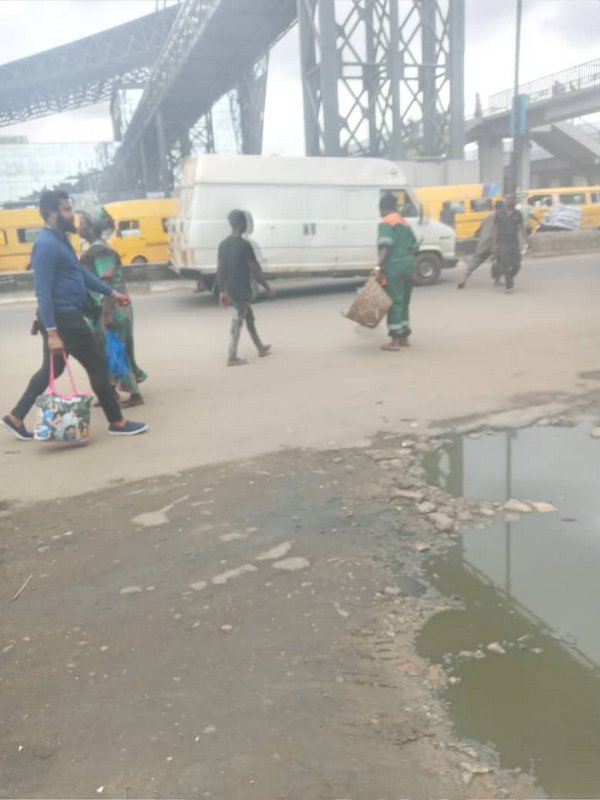
LAWMA sweeper sweeping the highway at Agege motor road, under bridge Oshodi
Occasionally, oncoming vehicles hoot their horns from a distance to alert her to leave the road; while some vehicles that are already close tarry for her to pack accumulated waste into a woven local thrash basket stationed by a corner on the highway. On one of the days this reporter monitored Risikat at her duty post, vehicles waited for her to clear waste (mostly disposed plastic bottles and water sachets) on the road. As traffic built up, it stirred a spontaneous reaction from hasty commercial bus conductors shouting “Mama, kuro lona’’ (Mama, leave the road). The continuous chorus from bus conductors rented the air as impatient drivers fixed their hands on the horn till the road cleared.
In another instance, Risikat, perhaps deep in thought, did not hear the blaring horn of an oncoming vehicle. Luckily, she was saved by a passerby who notified her by a tap on her back. This reporter observed Risikat till noon when she completed her shift. As she was about to join her supervisor and colleagues at their terminal (an open space somewhere by the roadside), this reporter approached her on the risks her job exposes her to, especially the accident that was averted by the good-spirited person that tapped her on the back.
Responding, Risikat, a 52-year-old that looks older than her actual age, said she is used to such highway risks as part of challenges that come with her job. She agreed that sweeping the highway was dangerous, but said that she had no option because it was her major source of livelihood – a job from where she gets money to fund her insecticide business and feed her grown-up but unemployed children.
“My daughter, we are used to such. May God continue to protect us. Except when it rains, we are constantly inhaling fumes and dust every blessed day and as you can see, cough and sneezing have become everyday sickness for me. Worse still is how we are being thrown away from the road by careless and impatient drivers. Many of our colleagues have been killed in the process while some have lost soundness and some part of their body,” Risikat, who limps, said, adding that she lost her walk balance on the job when a motorcycle hit her in the middle of the highway while sweeping.
Risikat’s sorry experiences, amongst others, were the reason the reason Lagos State government decided to discard manual road sweeping and settle for mechanised sweeping of highways and thoroughfares in Lagos West Senatorial District in the interest of humans and the environment.
Of Nigeria’s 774 local government areas, Lagos West Senatorial District is rated to be the largest and most populous; it is home to about half of Lagos residents with a population of over 12 million. It consists of ten of the state’s 20 local governments areas (LGAs): Agege, Ajeromi/Ifelodun, Alimosho, Amuwo – Odofin, Badagry, Ifako – Ijaiye, Ikeja, Mushin, Ojo and Oshodi/Isolo.
Because the district boasts of an attractive profile which makes it a significant spot in Lagos state, it is believed that employing machines to sweep highways will help minimise road-related problems, enabling the government to focus on developmental projects.
Announcing during a press conference on May 2018 that the state had appointed three contractors to manage the sweeping of highways and thoroughfares in Lagos West Senatorial District with the machine, the then Lagos State Commissioner for Environment, Babatunde Durosinmi-Etti, named the three appointed firms: Avatar Global Resources Limited; Waste Care Solutions and Resources Management; and Corporate Solutions Limited.
Also, earlier in 2017, the Executive Secretary of Lagos Environmental Sanitation Corps (LAGESC), Mrs. Idowu Mohammed, said the mechanised trucks would secure the lives of highway sweepers who often are victims of hit-and-run drivers. Muhammed added that the machines would sweep the highways while sweepers will be confined to sweeping of inner streets within the community.
A document from the Public Procurement Agency (PPA), published on BUDGIT website, confirmed the three contractors who received the contract as identified by Durosinmi-Etti. According to the document, the contract was awarded to the three firms at N192 million naira each, totaling N576 million in all.
Investigation showed that a letter of contract was issued to Avatar Global Resources Limited and Waste Care Solutions and Resources Management on July 5, 2018, while that of Corporate Solutions Limited was issued on May 7, 2018. That was during the administration of former Governor Akinwumi Ambode.
In addition to safety, Risikat averred that the idea was well-received by sweepers considering that they will not have to spend money on transportation to get to their place of duty since they would be made to sweep inner streets within their political wards.
“Ambode brought the idea of sweeping the highways with machines and we were all happy about it. Then, the arrangement was that machines would sweep the highways while we will be made to sweep inner streets in our respective political ward. This will also save us the cost of transport as we are not being paid transport allowance even up till now. Again, we were happy that finally, we will be free from vehicle flames, dust, and activities of reckless drivers, not knowing that our hopes were just being raised in vain. We actually learnt they arranged for the machine but I am still sweeping the highway till today,” she lamented.
Avoidable deaths, jarring revelations
With not less than N576m awarded for the sweeping contract, THISDAY findings show that the machines were only test-run in selected areas for a short period. Yet, sweepers continue to fall victims in the hands of reckless motorists. For instance, data from the Lagos State Waste Management Authority (LAWMA) showed that between 2007 and 2010, 57 street sweepers were killed by reckless drivers while carrying out their duties. Since 2010 till now, a number of sad tales, including deaths, have been reported about street sweepers in the course of duty.
In a casual discussion initiated by our reporter at the Lagos State Ministry of Environment (MOE), officials, who did not have an idea of her real identity, spoke freely on the project and why it should better be seen as an idea that is dead on arrival.
“You are talking about machine sweepers in Lagos State. No, no, no! It can’t work. Besides the fact that our roads are not suitable for such machines, politicians won’t let such initiative work because it’s just like depriving them of their livelihood. What will be the lot of those politicians who got the contract of the manual sweeping?” one of them asked rhetorically.
Even when this reporter tried get them to understand that the machines were not out to supplant manual sweeping as the sweepers were supposed to be redeployed to the inner streets as planned, one official insisted that it would not work.
“My sister! Forget it, this is Lagos, she stated”
When asked about the whereabouts of the machines, they hinted that they only sighted some machines in 2018 for a couple of days or weeks sweeping in some parts of Alausa and Ikeja.
“We learnt they were being test run. It wasn’t too long that we stopped seeing them and nobody can say where they are. It could be that they are rusting away somewhere or those who own them have come for them.”
Just like environment ministry officials, a top source in LAWMA who should be in the know if the project still exists feigned ignorance of the sweeper machines, maintaining that politicians may have frustrated the project because of their selfish interest. The source, who obviously had no inkling of the operation of the machine sweepers, admitted that he once heard about it, but neither he nor any of his colleagues he enquired from had an idea of the workings of the machine or could say whether they are functioning or not.
Claims and counters claims
This reporter tried to trace the three contractors who were entrusted with the project to confirm the status of their contracts. Unfortunately, efforts to trace the contractors from the Corporate Affairs Commission (CAC) in Lagos proved abortive, despite several visits to the office. The security man who attended to visitors at the gate directed everyone to Abuja for all manners of transactions. One of the CAC staff who spoke to THISDAY confirmed that activities in CAC had taken a new shape as a result of COVID-19. He disclosed that all activities have been centralized and should he try to assist, it might take donkey years before the search is completed and the result dispatched to Lagos from Abuja.
Upon insistence, he decided to assist with a preliminary search to confirm if the contractors were registered with the CAC. From the CAC record, only two companies (Avatar Global Resources Limited, and Waste Care Solutions and Resources Management) are registered with the commission; while the third contractor (Corporate Solutions Limited) could not be traced at all. Not willing to give up, this reporter then resorted to google search for the contractors’ details. And just like the CAC search reported, there was no record for Corporate Solutions Limited online. This discovery further fueled suspicions, especially how names of contractors were arranged on PPA’s list as well as the inconsistency on the date the award letter was issued by MOE.
For instance, Avatar Global Resources Limited and Waste Care Solutions and Resources Management (contractors registered with CAC) occupied numbers 14 and15 on the contract list and were issued a letter of award on the same day: 05/07/2018. Corporate Solutions Limited, on the other hand, occupied number two on PPA’s list and was issued letter of award on 07/05/2018. This, coupled with ‘similarity’ in the dates the award letters were issued, further raised suspicions as to why the three companies were not issued letter of award on the same day since they were meant to carry out a similar task.
However, this reporter was only able to trace the phone number of the Managing Director of Waste Care Solutions and Resources Management, Mr. Lateef Oluwole Shitta-Bey. On reaching out to him to know what happened to the machine sweeper project awarded to his company by the Lagos State Government in 2018, said that the sweeper machines belong to his company, adding that the tools are still very much in use on Lagos roads.
“The machines are the property of Waste Care and they are still very much working on Lagos highways, he stated.” When asked which part of Lagos the machines are presently operating, he flared up. By the time conversation began, the reporter had not disclosed her identity and he too never bothered to ask.
But when discussions veered into more serious issues, Shitta-Bey angrily requested the identity of the caller. Without waiting for this reporter to introduce herself, the contractor hung up the call and never picked subsequent calls from the line. This was at 3:47 pm on Saturday, October 17.
On Friday, November 6, this reporter called with another line and formally introduced herself as a journalist demanding to know why the machines are not working on the highways. His response, “The machines don’t belong to the government. We were asked to stop working last year on June 1, but our machines have started working back on the highway since August 1, 2020.”
Again, when asked about the locations where the machines are currently operating so that the reporter can confirm the claim, he asked the reporter to do an official email to get further information about the project.
This reporter obliged and did an email on a date he approved that the email should be sent which was November 8. This reporter put forward her enquiries but he still refused to provide relevant details. In replying to the email 14 minutes after, he wrote: “Please direct your enquiry to Lagos State Ministry of Environment or Lagos Waste Management Authority (LAWMA). Thank you.”
It was another brick wall at the environment ministry. When this reporter reached out to the Assistant Director, Public Affairs & Research in the ministry, Adekunle Adesina, and requested to get through to the Commissioner for the Environment and Water Resources, Tunji Bello, he asked that all enquiries be directed through him. He added that the Commissioner was away at the time.
This reporter forwarded the enquiries on November 4 and thereafter put several calls and WhatSapp messages to him, at least to acknowledge the questions sent to him, but he did not pick or reply to the messages. When this reporter called with another line three days after, he picked and said the Commissioner was still not back. But this reporter told him that the Commissioner needed not to be physically available to attend to the questions since questions have been sent electronically, he kept mute for a while and asked the reporter to meet LAWMA.
This reporter then reminded him that the contract was awarded by his ministry and that LAWMA is just a subordinate agency. He thereafter promised to call the reporter back. On November 10, the reporter sent a reminder before he forwarded what he called the Commissioner’s reactions on the issues.
“I have spoken to my boss again on the questions you sent. He said he is not aware of the whole transaction and has no further comments on it.”
Already, this reporter had reached out to previous commissioners who were supposed to be privy to the contract, requesting to know why the machines are not on the highways as designed since the contract was awarded when they were in office under Ambode.
But they seemed to be on the same page with the incumbent Commissioner, claiming to be ignorant of the transactions. For instance, when contacted by phone on November 6, the immediate past Commissioner of Environment, Babatunde Durosinmi-Etti, who announced the award of the road sweeping contracts in 2018, refused to provide any useful insight. Instead, he gave excuses.
“I am not on the cabinet again and I don’t think it is proper for me to talk about it. You know once you are in public service, you are bound by the official secret act. Besides, professionally and ethically, it’s not proper for me to tell you what happened during my tenure. It will be a betrayal of trust.”
Asked why the machines were not found on the highways as proposed, he said he did not know.
“I don’t know. I was in office for just one year and I left office over a year ago. The machines were intact when I left office over a year ago. I don’t really know about the project because the contract was awarded when my predecessor, Dr. Babatunde Adejare was in office. Mind you, the machines do not belong to (the state) government; the service was actually contracted out.”
However, contrary to Babatunde-Etti’s claim that machines were sweeping the highway under his leadership as the Commissioner, findings across 10 highways in Lagos West showed that during the period in question, highways were swept manually as they are till date. Although Bbatunde – Etti claimed that he inherited the project from his predecessor, a document from PPA showed that the contract letter was issued to the contractors in May and July 2018, when he was just four and seven months old in the office as commissioner. Adejare left the office in January of that year. As suggested by Babatunde-Etti, this reporter tried to reach out to Babatunde Adejare, who was the Commissioner for Environment till January 2018. He refused to respond to the WhatsApp and SMS messages sent to him about the project on November 23. He also refused to pick subsequent calls put to him that same day.
To get LAWMA’s reaction, the reporter sent a WhatsApp message to the agency’s Assistant Director, Public Affairs, Akinleye Akeem Kayode on November 24 but he did not respond to the message. The reporter later called him thrice but he did not pick or call her back. After a reminder was sent the next day, Kayode responded, “Your message is clearly understood. Please give me some time to respond”. But he never responded until this report was filed.
Sweepers share ordeals, refuting claims of machines sweeping the highways
Contrary to claims that machine sweepers have returned to the highways after months of hiatus, all the ten major highways in Lagos West Senatorial District visited by our reporters are swept manually. Just like Risikat, who resumes every morning at Iyana Ipaja highway, Kemi (not real name) works on a permanent afternoon shift at Agege Motor Road in Oshodi. Kemi was sighted alongside her male and female colleagues struggling to collect waste in the middle of the highway with their stick-aided broom. But Kemi’s countenance of all drew attention. The single mother of one has personal challenges she was nurturing; obviously, she was not comfortable with her job as a highway sweeper for many reasons. She feels she deserves better as a National Diploma (ND) holder. She confessed to our reporter that sweeping the highway is stressful and dangerous.
This reporter asked to know why machines have not been sweeping the highway since the contracts were given out, looking rather surprised said, with a note of sarcasm, “Machine! I heard about it too in 2018. Till today, I’ve not seen it except if they will bring it tomorrow. I’ve been here since 2019 and I’ve never come across such. As a matter of fact, when they mentioned it, many of us were happy and felt relief had come, not knowing it was a mere propaganda.”
Besides protecting her against risks, Kemi feels leaving the highway to sweep inner streets would be a better idea.
“Ordinarily, I feel ashamed that I’m working as a sweeper, and then sweeping highway. I get to see a lot of my colleagues and each time I see them drive past and say hi, I’m always embittered.”
LAWMA Sweeper sweeping the highway at Majidun-Asolo, Ikorodu, Lagos state
At Majidun-Asolo in Ikorodu, 35-year-old Kudi (not real name) said that she is always putting on her prayer armour each time she is on duty so as not to be a victim of reckless drivers. According to her, despite the C-caution sign mounted on the road to alert drivers that sweepers are at work, there has been a recurrence of accidents involving her colleagues. “Just yesterday, two vehicles ran over the C-caution sign on the road that their tyres even burst. I was right in front of the signpost. In fact, I had a close shave with death; it was only God that saved me.” Like others, Kudi, who has been sweeping for over four years, said she cannot recall anytime a machine was deployed to sweep the area in the past four years.
She confided in this reporter that it would be her greatest joy if machines are made to sweep the highways while they can sweep other roads. “My sister, the workload here is too much for the peanut we are being paid. You can imagine when tractors come to clear the weed, they still dump it on the road for us to sweep. On several occasions, we’ve had to sweep a heap of sand on the road that we do not know who and how they got there,” she added.
At Agbara-Badagry expressway, there was no sweeper in sight for almost 30 minutes that this reporter waited at a spot. It was later that a sweeper turned up, with this reporter hoping that her colleagues would join or maybe a machine sweeper would surface considering how bad the road is. Indeed, no other sweeper joined her and there was no machine in sight.
When this reporter tried to speak with the sweeper, the obviously overworked woman showed no interest in any discussion. As much as this reporter tried to initiate one, she failed to talk but merely waved her hand to show that she was not in the mood.
This reporter engaged one of the shop owners in the area, asking to know whether human or machine sweepers have been regular in the area. The man, who did not give his name, said he has never seen any machine sweeper at work in the area.
“I have never come across machine sweepers all my life, not anywhere and not even on this road. Since the road construction started, the sweepers have not been regular because they don’t have much to do.”
He, however, lamented that drainages in the area have since been converted to waste bins ever since the road construction started. He called on the government to come to their rescue.
A LAWMA sweeper trying to clear waste at the middle of the highway in Sawmill, Badagry Express road
Getting to the Sawmill area of Badagry expressway, this reporter sighted some sweepers on duty and approached the only one among them who was stretching to the middle of the highway. Asked how she has been coping with sweeping the highway, she said, ‘We have been warned to restrict sweeping to the side of the road. But once in a while, when we see the need to sweep the middle of the road, we do with extreme caution but not without the C-caution sign. Asked if there was any time a machine was deployed to sweep the highway, her response like her colleagues in other locations was: No.”
At Toyota bus-stop, extending further to Five Star bus-stop along Oshodi-Apapa Expressway, this reporter neither found LAWMA sweepers nor machines on the route on four different occasions she visited the area. This reporter asked some Guardian Newspapers employees who ply the route almost on a daily basis if they had come in contact with LAWMA sweepers or machine sweeping the area, especially the expressway. None of them answered in the affirmative
At Mile 2 bus-stop, also along Oshodi-Apapa Expressway, Sidikat (not real name) was found seated at the road median snacking on a roasted plantain with a sachet of water. It looked like she was done with a round of sweeping and waiting for a particular time to commence another round. This reporter asked why she chose to rest in the open space despite the heat.
“We don’t have an office; the highway is our office. So we can hang around at any spot to rest.”
Sidikat, who is in her late fifties said further, “My children have asked me to leave the job for long; I ignored them because I still get to feed them from the meagre amount I earn here. My two children are factory workers and they are paid peanuts on a daily basis. The money they earn daily at times is spent on feeding and transport. But I think now it is high time I left. I was almost killed last week by a mad driver. I have lost colleagues on this road, and we are more careful than ever. In fact, I can’t straighten my back again; the job has given me a new posture entirely. Now, I suffer persistent backache. By God’s grace, I’m resigning once I collect my December salary. I will use the money to set up a small business.”
Asked if there were any time machines had swept the express, she said, “Yes, I heard about it during Ambode’s time, but we have not seen it o. Tell them to bring machine o. I can’t come and die over a token. If they redeploy me to sweep the side street, I may not resign so soon.”
At Ojota bus-stop, along Ikorodu expressway, Segun (not real name) was about closing for the day when this reporter approached him. Asked what challenges he faces as a highway sweeper, Segun said, “Haa! Go and ask the women. As a man, I still get to gather myself to prevent emergencies but honestly, I pity the women among us. Often times, they are victims of hit-and-run drivers. As I speak, two of them didn’t report to work today because they are sick. One of them was thrown on the floor by a wheelbarrow pusher last week.”
Asked if he would prefer a machine to sweep the highway, he said, “that will be good o!”
“In fact, they have mentioned it before! If they are not bringing the machine, I would suggest that they should let men sweep the highway and transfer women to the streets. It’s not easy for everyone but men can still cope better with the wahala (stress) here.”
It was lamentations galore at Iyana Oworo, along Berger-Ojodu expressway, as one of the sweepers identified as Bukky complained bitterly about poor remuneration and hazards of the job. “Let them increase our salary and improve our work conditions. What stops us from earning minimum wage? This is the main thing we are talking about. No hazard allowance, no insurance. In fact, my sister, I’m looking for a befitting job in case you can help me get one.”
On her part, Funmi (not real name) in Motorways Ikeja said, “My body is used to the pain, stress and fear of being hit down by a vehicle. I pray that our daily fear won’t come to pass.” She added, there was a particular time they said they brought the machine here but I don’t think it lasted a month according to what I heard. I just resumed here in January so I don’t really know much about it. But since I’ve resumed, we have been sweeping with our broom, not a machine.”
Narrating her ordeal, Seyi (not real name) in Cele bus-stop, along Oshodi-Apapa Expressway, was quick to show this reporter a deep mark on her left thigh, which she said was as a result of a hit by a reckless commercial bus driver while at work. Telling her story, she said, “it all happened within a twinkle of an eye. I was just packing the dirt I gathered and before I could look up, I saw the bus hit me by the thigh but he had escaped even before I shouted. I thought it was something mild, but it was not. I nursed it for close to one month.”
When asked if the state catered for her medical bills when the accident happened, she said it did not. Seyi added that she would appreciate being redeployed to inner roads or streets.
“We don’t have special entitlement as highway sweepers; we earn the same salary as our colleagues that are not sweeping the highways. Yet, we face more risk and work more than them.”
Both MOE and LAWMA failed to answer questions on what protection arrangement they have for their highway sweepers given the vulnerability of their job.
Sweepers’ work conditions against medical prescriptions
A study published on the Malaysian Journal of Medical Science revealed that the most common risks for street sweepers are respiratory symptoms and airway obstruction, which increases as a result of dust inhalation. To reduce sweepers’ exposure to respiratory disease, the study recommends brooms with large handles, modern cleansing equipment, sprinkling water on the street before sweeping, limiting the duration of work to three or four days a week, and using appropriate respiratory protection.
“Furthermore, a periodic assessment of lung function needs to be conducted via spirometry in order to diagnose pulmonary dysfunction early in this financially deprived population. Eventually, if possible, individuals with respiratory problems or significant pulmonary function parameter reductions should be transferred to other municipal departments,” the study recommended.
But these recommendations do not apply to Lagos sweepers. Our reporter gathered that instead of the three to four days recommended by experts, the sweepers work six hours daily for six days of the week.
Although Lagos State Government said in July that it has commenced an insurance policy for all street sweepers towards enhancing better welfare package and improved waste management in the state, that has not happened.
According to LAWMA Managing Director, Ibrahim Odumboni, the insurance policy covers, among others, death while in active service, permanent disability, and medical expenses. However, sweepers who spoke with THISDAY said they had never even gone on government-funded routine medical checkups since they signed work contracts with LAWMA and that they are yet to receive any notification on the insurance policy.
‘Industrial sweeping is cheaper, healthier, safer and faster’
According to experts, the effectiveness of machine sweeping over manual sweeping of roads has been proven globally. It is preferred above manual means to safely remove dirt, debris and litter, nails, amongst others, and provides a healthy, safe, and attractive environment. Beside the carnage arising from highway sweeping, the initiative is considered more environmental friendly given its reliability in ensuring cleaner and safer roads.
In the third quarter of 2019 alone, the Federal Road Safety Corps (FRSC) said it recorded about 419 road traffic crashes in Lagos State with not less than 84 deaths during the said period. According to experts, part of what accounts for accidents on the road are accumulated sand and dirt on the highway, which also reduces the traction of auto tires.
A China-based firm once recommended machine sweeping over manual sweeping, saying sweeping with machine is more economical, efficient and can do the work of six workers. The firm speaks further of the benefits of machine sweeping thus:
“It offers low cost in the sense that it can replace 12-15 manual cleaning, saves a lot of labour wages, welfare benefits and pay rise to deal with the problem. It offers high-security performance and yields high economic returns whereby one can spend only more than 10 yuan per day (charging, consumables, wear). But if it is more than 10 people, wages and benefits, such as at least a thousand yuan, but also to invest in basic cleaning tools and operating costs.”
Corroborating the strengths of mechanized sweeping over manual cleaning, Chief Executive Officer of Shodex Beautification Landmark Ltd, Olusola Adekoya, said the effects of industrial sweepers over manual sweepers cannot be overemphasized, especially in a city like Lagos.
“But for those who are still using traditional cleaning tools, such as a bucket and a mop, the cost of the equipment may feel like a huge barrier to entry. But what they are missing out on is that this industrial cleaning equipment is actually more effective than what they are currently using, and they are indirectly wasting money by sticking to outmoded cleaning tools.
“It is cheaper, healthier, safer and faster. We have lost many sweepers to hit-and-run motorists in the past and it is still happening, but this could have been averted with a mechanical sweeper. The industrial sweeper reduces traffic because it is snap, it reduces the particulate matters in the air by collecting the silt, and yet, the cost of operations is minimal. The adoption of manual sweeping in the present time not only adds to the environmental nuisance but also a waste of manpower and taxpayers’ money.”
* This investigation is supported by the John D. and Catherine T. MacArthur Foundation and the International Centre for Investigative Reporting.
GLOBAL oil prices climbed on Monday, and Nigeria’s crude equivalent rose above $50 per barrel following an increase in global crude oil demand after a rollout of coronavirus vaccines was announced by the US.
Brent crude sold at $50.35 per barrel rising by 38 cents while the US West Texas Intermediate, WTI crude was up by 32 cents to sell at $46.89 per barrel.
The US Food and Drug Administration had granted an emergency authorisation on December 11 to the Pfizer-BioNTech vaccine which had started shipping from Pfizer’s Kalamazoo facility for distribution.
Since the US kicked off its vaccination campaign against COVID-19, it has raised hopes that the pandemic restrictions could end soon and lift global oil demand leading to an increase in oil price.
Brent crude and WTI have gained momentum for six consecutive weeks, their longest stretch of gains since June.
The OPEC+ joint ministerial monitoring committee, JMMC, that monitors compliance among members, will meet on December 16, while OPEC+ will meet on January 4 to study the market after their last decision to limit production rises to 500,000 barrels per day starting next year.
S&P Global Platts Analytics, US-based analytics anticipates that global oil demand could rise by more than 6 million barrels per day in 2021, but indicated that fundamentals for the oil market are not as rosy in the near-term.
Two separate fires occurred at Nigeria’s Qua Iboe crude oil export terminal and at an oil pipeline in Iran on Sunday but the incidents have mostly been contained which according to S&P Global Platts Analytics could affect oil prices.
Qua Iboe is Nigeria’s largest export grade and popular crude among global refiners, with India, the US, Canada, Italy, Spain, Indonesia, and the Netherlands being key buyers.
ADEGBOYEGA Agbaje, a petitioner before the Osun state judicial panel of inquiry on police brutality, human rights violations and related extra-judicial killings, has demanded a N10 million compensation from the police for molesting him.
Adegboyega, who is a market leader in Ikire, the headquarters of Irewole Local Government Area of Osun State, accused operatives of the defunct Special Anti-Robbery Squad (SARS), of arresting him and his wife, Mistura, in handcuffs and paraded them in the market which he claimed exposed him to public ridicule.
He alleged that his house was invaded on August 18, by operatives of SARS, who came to look for his son whom they accused of being a robber.
“I was arrested alongside my wife and handcuffed. We were first taken to a police station in Ikoyi and later to Apomu. We were taken to Osogbo in search of my son. We were handcuffed for about 10 hours before we were released.”
He said due to the incident, he was suspended by the market association but was later reinstated when it was proven that he was unlawfully arrested and was found not guilty of any offence by the same association.
“I was suspended as a market chief because of the arrest and unwarranted scenario by the police. It was believed in the community that I had committed a grievous offence which was why my wife and I were handcuffed.
“I was later reinstated after three months when they saw that I was not guilty of the offence the police arrested me for. I have official letters of both the suspension and my reinstatement.”
Justice Akin Oladimeji (retd.), the chairman of the panel has adjourned the matter till January 8, 2021, for the presentation of the final written address.
Badagry a city surrounded by aquatic splendour and blessed with beautiful lakes and creeks, Badagry is supposed to be a leading center of tourist attraction in the country. But this is not the case for the second largest town in Lagos State, Nigeria’s former capital, as several development projects intended to improve the living conditions of the people and boost the ancient town’s tourism potential have remained abandoned for many years, reports MEDINAT KANABE.
THE announcement, which was promptly backed with action, was music to the ears of indigenes and residents alike. The locals, serenading over the prospect of having an elixir of development sited in their community, dreamed big dreams. That was 12 years ago when the federal government announced that it would site a National Youth Development Centre in Badagry.
Sadly, twelve years after, the centre is yet to be completed let alone take off. One of those hoping to use the yet-to-be-completed centre to develop into sporting stars was Jemila (surname withheld on request). A table tennis enthusiast, Jemila, who has since enlisted in the Nigerian Army, dreamed to be a professional table tennis player – a sport she hoped would transform her to the heights attained by the likes of Fan Zhendong, Ma Long, Wang Liqin, Xu Xin, Liu Guoliang, and other notable stars of the game.
“When the project started, it was so real that people were hopeful. My sister, Jemila, who is now in the Nigeria Army, was interested in the games because her dream was to become a professional tennis player but that opportunity never came because she couldn’t wait her whole life for the completion of the project and had to join the Nigeria Army,” her brother said of Jemila.
Another resident, Mike Akande, 42, said he was 30 years old when that project started. Like Jemila, his ambition was to nurture his talent and become a sporting prodigy.
“I was 30 years old then. I believed I had a chance of becoming a popular sportsman, but look at me now. Nothing works in Badagry; everywhere you turn to is one abandoned project or the other,” he said.
A teacher in one of the public schools told this reporter how he spoke enthusiastically to his students about the project when it just started.
“But all of them have graduated from the university now; some are married and the project is still uncompleted. I thank God that I did not encourage anyone to wait for that project; I would have regretted it,” he said.
In 2008, the federal government, through the office of the Federal Ministry of Youth and Sports Development, laid the foundation for a National Youth Development Centre in Ajara Vetho, Badagry. The centre was to provide people living around Badagry the opportunity to learn one or two indoor or outdoor games and further develop their sporting talents.
The would-be beneficiaries of the project said they were excited about the plan and even donated their lands to facilitate construction. Unfortunately, the project has been abandoned with many families that gladly donated their land to pave way for the project now rueing their decision.
“Right now, my family regrets giving out the land because as the years goes by, my family is becoming larger and the family compound cannot take us anymore. We are managing in the small compound while our land is wasting away,” High Chief Ajo Hunpevi Paul of Ajara Vetho Kingdom said.
The obviously disappointed traditional leader said he feels it is time the government removed whatever structure had been built on the land and returned the land to the family because they will have better use for it.
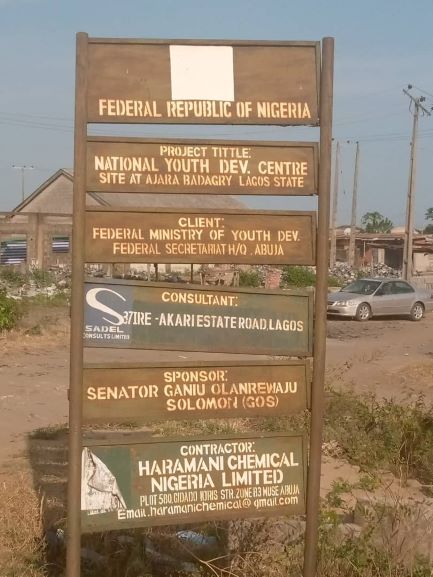
This reporter, who spent five days in the community, found out that the Federal Ministry of Youth and Sports Development awarded the contract to Haramani Chemical Nigeria Ltd, Abuja, in 2008. According to information available, the contractor requested for N384 million and the federal government made an initial payment of N101 million and another N35 million, bringing the total money released to N136 million. When the contractor exhausted the money, the waiting game began; and it has been lamentation galore since then.
The anger of Chief Hunpevi and other locals seemed justified over the turn of events in Badagry, an ancient community that was formerly a middle ground between European traders on the coast and traders from the hinterland.
Located between the city of Lagos and Seme, the border with Benin Republic, Badagry is inhabited largely by the Awori, Egun, Yoruba and Ogu people – all known for their hospitable disposition. In years past, especially during the trans-Atlantic slave trade, the settlement served as a lagoon and an Atlantic port, emerging as a commercial center on the West African coast because of its connecting and navigable lakes, creeks and inland lagoons that facilitated trade and acted as a security bar for residents.
Like Lagos Island, the town is on the bank of inland lagoons, with a system of creeks and waterways that are navigable to Lagos and Porto Novo.
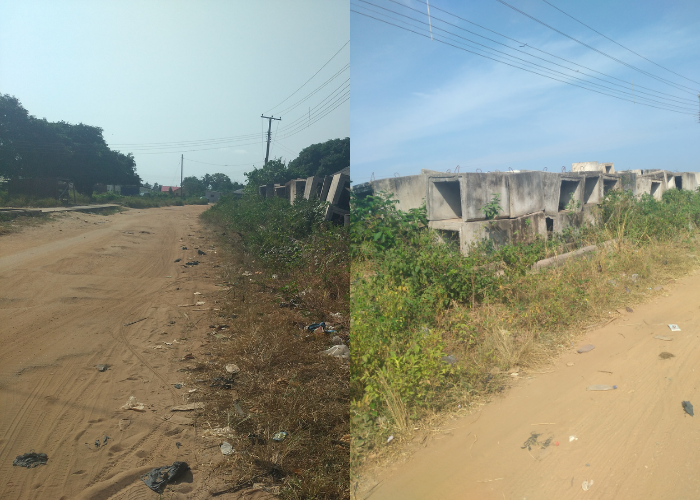
Despite the fact that Badagry is surrounded by lakes, creeks, island, beaches and historical assets, the locals live under deplorable conditions as they are deprived of many basic necessities. It is littered with many abandoned projects, including the National Youth Development Centre, Gberefu Health Care Centre, NIOMR Shrimp Farm, Cultural Industries Centre, Lagos State Vocational School for Fishery, Yafin Road, among others.
A visit to the National Youth Development Centre
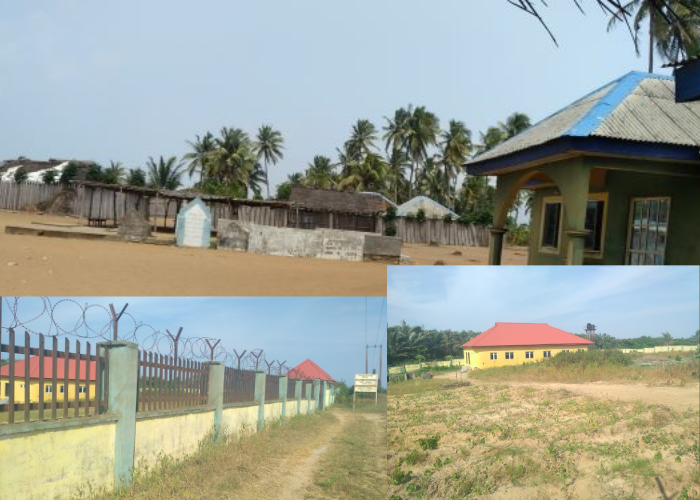
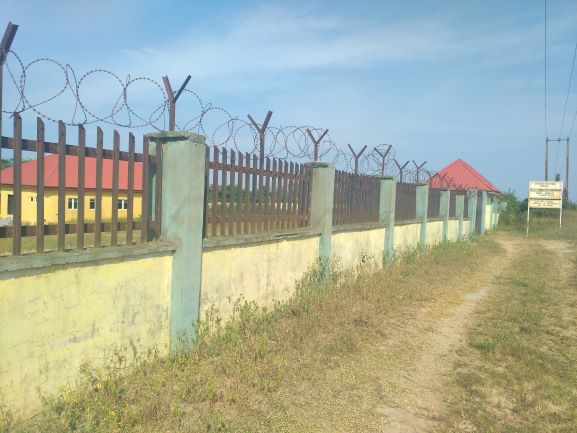
The stench of human waste that greeted this reporter on her visit to the abandoned project site was enough to send one running out of the environment. A lot of care was taken not to step on faeces that littered the environment where the project was sited. More than 15 structures had been erected before the project was abandoned.
Making her way in, this reporter met some young men smoking marijuana that hot afternoon. As this reporter bumped into their enclave, they demanded to know where she was going and asked if they were safe. They informed her that the only person in the environment with authority over the abandoned site was Godwin. It was later learned that Godwin works as a labourer for people who have secured a piece of the land to farm on the abandoned site.
This reporter was only able to access the site after expressing desire to farm there. Godwin quickly helped call Isiaka, the security man at the centre, who is said to be the one in charge of giving out space for farming. Pronto, we settled for N3, 000 to be paid to Isiaka for what seemed like two plots of land and N25, 000 to be paid to Godwin to clear the land, with an added obligation to help get cassava roots to plant. Isiaka insisted on N3, 000 and warned this reporter that on no account should she touch the granites or sand on the land as they belonged to the federal government.
He said the granite and sand have been on the land since it was abandoned and he has made it a point of duty to make sure the building materials are intact. According to him, what belongs to government should not be pilfered.
A visit to Ajara Vetho
After bargaining with Isiaka as a ploy to gain entrance into the abandoned site, this reporter headed straight to Ajara kingdom, another community in Badagry. There, she was attended to by High Chief Ajo Hunpevi Paul after explaining that the King HRM Aholu Ebenezer Ahisu Koshoedo Aholu Dazuno Detoyi 1 of Ajara Vetho Kingdom was taking a rest and may not be able to speak with her because of his age.
He said the youth development centre is just one out of many abandoned projects. “There is another mini stadium that was being built in the community, which was also abandoned,” he said.
Chief Paul traced how the project became abandoned. “At this time, former local government chairman, the late Husitode Moses Dosu, was in office. The place was constructed during his tenure. At that time we were still being governed by Baale; so we engaged the representatives of the Ministry of Youth And Sports Development and what they told us was that they discovered some of our youths have the talent but no place to develop the talent. So, the land was given to them by the local government chairman to build a centre where the youths can be coming to display their talent.
“They said it will be a place for indoor and outdoor games; that’s why you see the lawn tennis court there. Everything was being constructed but after completion, no facility was brought there. We didn’t even know who to contact to report the situation to. The place was then locked up and a security man who didn’t even have access to the building was placed at the entrance. Right now the roofs are gone, the beautiful paintings are no longer visible and when we told them that we should take over the building as a community they said we should do a letter but never told us who to address the letter to.
“The building is dilapidated even though it was never used. Winds blew off the roofs but scavengers removed the windows and catered away with all the aluminium there and the place is now a hideout for hoodlums. It got to a stage when LASRA came to use the building as a registration point but they were moved to the local government. With the way things are going, one day the community will take over the place and make use of our land,” he said.
Asked if he is aware that the abandoned site has been converted to a farmland, he said “yes we know that the place is now used as a farm but we don’t know who is using it. Apart from that, it makes the place look clean and we are embracing farming in the country now but that is not the primary reason why the place was built.”
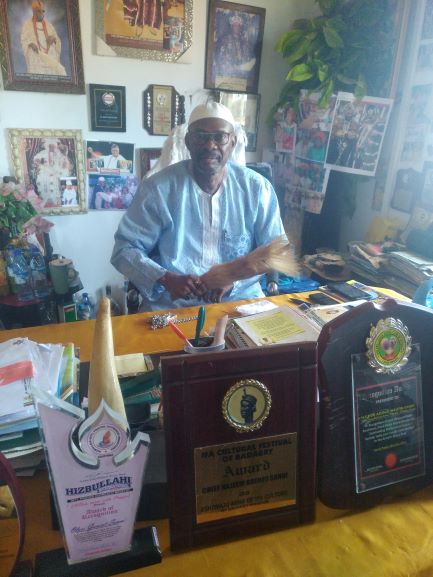
•High Chief Paul (r) and other chiefs at Ajara Vetho Palace
He also admitted that when the community heard that some young boys were using the abandoned site to initiate members into cult groups, the community leaders activated a traditional security called Zangbeto at the entrance. At night, nothing like that (cult initiation) happens there any longer, but during the day they still go there, he added.
He reiterated that the locals are not happy that the place was abandoned because it was built for a purpose but the purpose has been defeated. “If the centre was not abandoned, our youths would have been patronizing the place. They would have by now developed one talent or the other. Even the females among them would have also found love in one of the games and made us proud. Even some adults can go for indoor sports instead of just sitting home during the weekend.”
In search of Sadel consulting
In a bid to find the consultant, Sadel Consulting whose address is written on the signboard as number 37, Ire-Akari Road, Isolo, our reporter went down in search of the office but was shocked to find a Foursquare church at the address. The secretary of the church was said to be in a prayer session with a few members. One member invited this reporter to join the prayer session, which she said would last a while.
When the secretary came out, this reporter told her the mission: in search of Sadel Consulting whose address was the same as the church’s. She explained that the church started about four years ago after buying and demolishing the building that was there and remembered that there was Sadel Consulting where a friend worked as well. She tried to call many people but none could give the address of the new location or a phone number. After asking from building to building, a phone number was gotten that paved way for a conversation with the contractor of the abandoned project.
When this reporter called the Sadel Consulting boss whose name was given as Segun, he said that he was on his way to attend a meeting to discuss the abandoned project. Paucity of fund crippled the project, he said. He added that when people see abandoned projects, they feel that money was released but the contractor had embezzled the money. The problem is that government often puts its hands on too many things at the same time, despite not having enough money to complete the projects, he explained.
“As you are talking to me, I am dressed up for a meeting at the Federal Ministry of Youths And Sports Development in respect of the youth centre projects in Badagry. The project has been abandoned just like many federal government projects because of paucity of funds. But now they have some small money that they want to put into the project and I have been having meetings with them since last week. We are having a meeting with the contractor today trying to bring the project back to life.
“I have also been speaking with the House of Representative member representing Badagry, Babatune Hunpe; so we are on top of it and thank you for your concern and do a good job. Bring about all abandoned projects like that up so that government can do something about it. There is no point starting projects everywhere and not completing them,” Segun said.
Asked if he is sure that work will resume at the project site, he said the ministry is making efforts to revamp the project.
“Right now N90m has been approved to continue the project, but the project requires more than that to be completed. What they are trying to do is to make sure that the project comes alive with the 90 million. Finish some of the projects completely and make sure that they have light and water so that they can start using the environment if the contractor will cooperate.”
For the abandoned youth dev centre project, you need to check the budget of the federal ministry of Sports to see if they have budgeted anything for it in the last 12 years. Your report cannot be complete without that. Even at that, ill ask our data unit to check and see if there have been any releases for the project in the last 12 years.
Yovoyan community and its four abandoned projects
At Yovoyan community alone, there are four abandoned projects, including Gberefu Health Centre, the National Institute of Oceanography and Marine Research (NIOMR), Lagos State Vocational School of Fisheries, and a Skills Acquisition Centre by the federal government.
Baale Gberefu
In 2012, the people of Yovoyan, along Seme expressway way in Badagry, said their joy knew no bounds when the Lagos State government promised and later awarded contracts to build a Primary Health Centre (PHC) in the community. The construction started and was soon completed with the installation of a brand new Mikano power generating set and well-furnished maternity ward. That was the end of the good story, as the hospital never admitted a patient since it was built and equipped before it was abandoned eight years ago.
The residents have to travel over 13 kilometers to receive health care services at the Badagry General Hospital. The PHC, which is supposed to serve three communities (Yard, Yovoyan and Gberefu), is another case of abandoned project after completion.
According to the only cleaner at the PHC, since she started work in the PHC two years ago, there hasn’t been a doctor. “No electricity and because we don’t sleep here, we cannot attend to patients. What we heard is that no doctor wants to be posted here because it is far; the road leading here is bad and there is no electricity. During the peak of the Covid-19, we didn’t get sanitisers or any protective gear,” she lamented.
The building looked abandoned even though the cleaner said she comes every day to work. She admitted that there have never been security personnel to protect the facility. The cleaner added that she has never witnessed supply of drug to the hospital as well.
“I am a cleaner and I come here every day to do my job. Sometimes, we don’t get anyone here for more than a month because the people know that if they come here they will not have a proper care or see a doctor but I still keep the place neat. The brand new Micano generator has never been used, I have never seen some of the rooms opened before, and water has never run in the hospital,” she said.
According to a resident who vows never to visit the hospital, the story of the PHC is a pathetic one. She said she lives in the community; so she knows how much they need the PHC to function well so that people like her can use it.
“This clinic is located inside Yovoyan community, a settlement of Ghanaian migrants, specifically the Ewe people who are fishermen and many of them get injured from the water but they cannot visit the clinic because they will not get proper care,” she said.
The reporter, who noticed maize growing on both sides of the front building, asked a resident why they have turned the place into a farm. Her response was that it is better to farm there than to leave it for grass to grow everywhere.
Another resident who gave his name as Nani pointed out that the community had been in need of a clinic for years. “In this community, we were without a clinic for years. We used to go to Badagry General Hospital for illnesses as little as malaria before this hospital was built and we thought that it would change things but nothing happened.”
The unused PHC at Gberefu (inset The Generator)
An elderly man who didn’t give his name said government is not serious with the health of the people. “How can we go to a hospital and find no doctor on ground? Sometimes they will close the hospital for one year and reopen it again just for a few months before closing it again. This is why our people don’t visit the place.”
Speaking in the local Ghanaian dialect, another elderly woman said she goes to Badagry when she feels sick because she knows that no doctor will attend to her and there are no drugs in the clinic. “Instead of wasting my time to visit the hospital, I go to Badagry General Hospital for treatment. You see, we even take little ailments like malaria to the general hospital because this one close to us isn’t functioning,” she said.
A community health worker at the clinic said when the place was opened, all facilities were brought there. Though not in use, the PHC has a pharmacy, a labour room, a laboratory, six rooms with matrasses, an injection room, consultation room and four toilets but the labour room looked like what has never been used. The pharmacy and laboratory also carry the same story and the beds and air conditioners as well as fans haven’t been used since then. There are four toilets in the building, but users must go into the community to get water before using the facilities because there is no water to serve the hospital. The fridges and freezers that were brought into the hospital since 2014 have also not been used.
What LASG said on the abandoned PHC
The Commissioner for Health in Lagos State, Prof Akin Abayomi, who responded to questions, said the state government is not unaware of the situation where some facilities are underutilised or not used at all as a result of personnel not willing to work in hard-to-reach areas, especially in riverine communities. He promised that the state government is working to prioritise having workers in such hard-to-reach locations.
“There are many places like that and we call them hard-to-reach locations, usually around the riverine areas where we have a lot of challenges in terms of security, access and personnel who are not prepared to be deployed to those kinds of places.
“We have a new strategy for 2021 called hard-to-reach locations being initiated, which is one of our priorities. We will first of all locate good structures in the very remote areas and then have a way of deploying staff there on a rotational basis and then pay hardship allowance. Also increasing our ability to access those places in a safe way and also have the ability to evacuate patients who are in distress,” Abayomi said.
Other projects abandoned by the federal and Lagos State governments
A vocational training school for fishermen, one of the training centers, which have been abandoned for over 30 years, is now being taken over by some people in the community. James Yovoyan who was the tour guide at Yovoyan, said that the Vocational School for Fisheries was built by the Lagos State government in the 70s. He said those who attended the school usually proceeded to the School of Oceanography in Lagos, with many of them becoming captains.
“There were four buildings at this spot but people have converted them to their homes and toilets,” he said.
Also abandoned is the Skill Acquisition Centre initiated by the federal government. Investigations showed that it was used for a period of time before it was abandoned by the federal government without explanation. Yovoyan pointed at where the cold room used to stand with a generator, adding that everything went bad and the buildings collapsed after the place was abandoned.
“Many sailors were trained here, but everything is messed up now. If the schools were still functioning, a lot of people would have become professionals, and become employed but look at our young men, they are here doing nothing. We are already fishermen; all we needed was for some more trainings to enhance our fishing capabilities,” he noted.
A resident who said he worked at the state-owned centre 25 years ago said they resumed work one day and were told that the centre had been moved to the Lagos Bar Beach but they were not asked to resume there.
Another resident who gave his name as Mr Hanson worked with the Federal government owned centre when he was a young man. He explained that both centres had different staff and added that nobody can truly say what happened or why the government decided to stop using the place for fishing an processing of fishes.
Another abandoned project in Yovoyan community is the National Institute of Oceanography and Marine Research, NIOMR. The tour guide, after taking this reporter to see the abandoned site, said the building was abandoned after it was completed. When this reporter asked why projects are being abandoned in the community, he said “if we had electricity, people will not abandon all these projects here. The community people don’t get to have power (electricity supply) except they go to Badagry.
“About four houses in this community have generators; so everyone depends on them when they put it on. We requested for road, electricity and hospital but we have gotten only the hospital, which is now abandoned. So we are waiting for the electricity and road,” he added.
Is this not the same project as the last? Both are NIOMR
The third abandoned project in Yovoyan is the Nigerian Institute for Oceanography and Marine Research, NIOMR. This project, which was also completely built, has never been used before. It has been abandoned for over 10 years now. At the NIOMR office, this reporter met an angry Executive Director, Abiodun Sule, who insisted that NIOMR never abandoned the project. “We are very angry that the project had to stop because we had plans and had put in a lot of manpower to work,” he said.
While giving an explanation into why the project was abandoned, NIOMR Director Research and Aquaculture, Dr Patricia Anyanwu, said the land in Yovoyan was secured for the project through the help of the Lagos State Ministry of Agriculture to develop shrimp farming.
“The Lagos State government leased that land to us, but in 2013 we heard that Lagos state consulted a private developer to set up a deep sea port, which impacted on our community. So they said that we should stop and that they will relocate us.”
She said since the village is a settlement with makeshift houses they felt it would be easy to relocate the settlers and the project but “we have gone there to do all the necessary assessment and it was agreed that we will be relocated to Gberefu but we have been waiting for the relocation since then.
Asked why it is taking so long she said they have asked about the relocation but were told that they cannot be relocated without informing the Lagos state government in case they also have things to do at the proposed relocation site. “So we didn’t abandon it; we are waiting for the promoters of the deep sea port to do the needful. When this is done they will call us, relocate us and compensate us as well,” she noted.
Anyanwu said what they built at Yovoyan is a three bedroom apartment and a shrimp hatchery complex that was already in the level of roofing for the Mari culture as well as ponds. She noted that the project became necessary when the government sand-filled everywhere around the Victoria Island sea and they had to go and start using tanker to get sea water, which isn’t perfect for research as they have to be close to the sea. So Yovoyan was located. She hinted that building started in 2010 and in 2013 we they were told to stop.
“If they had started the project since, a lot of development would have come to the community because the East West Road is passing through Gberefu that can lead to Takwa Bay on the Island which is already on course. If the project is awakened again, it will benefit the community a lot. There will be a lot of fish production because we will partner with them as fishermen. We will teach them about Mari culture and employ some of them as hatchery attendants because they are the ones that will go out to the sea. By the time we finish with the work there and start the shrimp farming, a lot of people around the community will benefit from it,” Anyanwu said.
Yafin Cultural Industries Centre
Another abandoned project is the Cultural Industries Centre, a project of the Federal Ministry of Information and Culture. The project started in 2017 and was completed the same year, but was never put to use. According to the Baale of Yafin, Abiodun Whedoku Patinvoh, some needed equipment for facilitating was also brought but since then it has been abandoned. “We thought that after the 2019 election, it would be opened, but nothing has happened. What we are waiting for now is for the federal government to get us facilitators that will teach our youths but the wait has been since 2017.”
According to a young lady who gave her name as Sherifat, if the project had been put to use, she would not be spending so much going to Badagry to learn fashion designing. “I had to go and learn tailoring in Badagry because I could not wait anymore for the place to be opened. I have been taking transportation to Badagry and it is costing me a lot but I don’t have a choice.”
Another resident, Mercy Ogunsanwo, said Yafin is the closet place for her to learn fashion designing but now she goes to Badagry to learn. “In order to save transport money, I sleep in a church in Badagry from Monday to Friday and go back to my house on Friday evening because my parents cannot afford the everyday transport money.”
Residents lament over abandoned Yafin Road
Abandoned Iyafin Road and Culture Industries Center, Iyafin
Many residents traced the poor state of affairs in Badagry to poor state of major roads that would have opened up the community. One of such important roads is Yafin road, which was abandoned 19 years ago when Bola Ahmed Tinubu was the governor of Lagos State. It was a major road that would have further opened up Yafin and environs. A resident, who didn’t give his name, said he never wanted to live in Yafin but he changed his mind when he saw efforts being put in place to fix the road. He bought a land, developed it and has since settled down there. It is a regrettable decision, he said. “I regret buying the land now because Ansar-ud-deen road where I was considering before coming here now has good roads and we are still waiting for this one to be fixed,” he said.
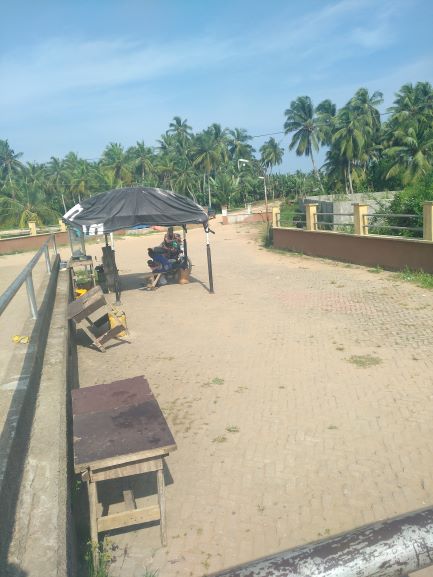
Iyafin Jetty
The major road was abandoned by the contractor, FTS Construction Company, Victoria Island, after the contractor complained that he was not being paid. When Babatunde Raji Fashola became governor, the Baale in Yafin said they wrote to him and in 2011 he promised to fix the road. He did some work but up till now, it is still in the stage that Fashola left it. During the administration of Akinwumi Ambode, nothing was done about the road.
The Baale is, however, optimistic that Governor Babajide Sanwo-Olu will come to the aid of the embattled community. “We have been writing series of letters to remind the present government and Sanwo-Olu responded. But we are still waiting. This road serves more than 1,000 communities in Ogun State. They pass through our jetty during dry season but during rainy season they cannot pass because of the bad road,” he said.
Babatunde Hunpe speaks on all the projects
When our reporter met Babatunde Hunpe, member representing Badagry Federal Constituency at the Federal House of Representatives, said the journalist was the first person to bring the matter up to him since his assumption of office.
“I have written to the Minister of Youth and Sports on the Ajara project and I thought something would have been done by now but since nothing has been done, I am promising you, I am taking it up as a motion.” He promised to check Yovoyan and Iyafin for other projects mentioned.
Also, a Badagry youth representative, Michael Sewanu, said the youth centre at Ajara Vetho was formerly managed by the local government but the council did not pay attention to the place. According to him, the major reason why projects are abandoned is because of the bad road in Badagry. He also blamed lack of continuity and selfishness on the part of political leaders.
Abandoned Iyafin Culture Industries Center
“Almost every infrastructure of the government in Badagry is abandoned, both the ones that are revenue generating and the ones for youth development. During the time of Senator Ganiyu Olarenwaju Solomon, I met him and challenged him at the Badagry Charlet. He promised that if he wins the second term, he would continue but he lost and the person after him didn’t do anything.
“When Gbamgbose Joseph was member representing Badagry Constituency 1 in the Lagos House of Assembly, he claimed that he was very busy and never concerned himself with the project just because they don’t see anything in the youths of Badagry. They see the youths as weapons they can use to win elections, but once they get into office they don’t care what happens to the youths,” Sewanu said.
* This investigation is supported by the John D. and Catherine T. MacArthur Foundation and the International Centre for Investigative Reporting.
THE Kaduna state government has charged residents of the state on the need to adhere strictly to the COVID-19 protocols amidst the increase of new cases in the state.
Amina Mohammed Beloni, the state commissioner for health, who gave the charge during a press briefing on Saturday, said that the state is now recording high infection figures reminiscent of the first wave of COVID-19 spread in April, May and June 2020.
She said the lowering of the infection rate following the first wave encouraged the government to approve the recommendation of the State COVID-19 Task Force for a significant reopening of the state.
“However, we are saddened to report that the conditions that compelled the 75day lockdown of the state are now being replicated. On 26th November 2020, the state recorded 74 positive results from 531 samples.
“The quantum of infections since then suggest both high infection rates and the reality of that a new wave of infections is spreading across the state. As at yesterday, 11th December, the state recorded 117 positive cases from 518 samples. (This translates to almost one in four samples testing positive).
“There is now a veritable danger to lives and livelihoods with the renewed Covid-19 infections. If the spread continues at the current rate, it may challenge and overwhelm the health system despite our efforts to improve the resilience of that sector.”
She noted that the state was able to contain the first wave of the infection because citizens observed and practised the COVID-19 prevention protocols.
While lamenting that people no longer adhere to the provisions put in place to safeguard them from the infection, the commissioner added that if there is a further increase in the numbers of cases, the state will have no option than to close all public places in the state.
“We had previously observed the wholesale abandonment of any compliance with protective measures. We cautioned against this and reminded citizens that the relaxation of lockdown measures did not mean that Covid-19 had been defeated or disappeared. The rising infections is a reminder that Covid-19 remains a potent danger to lives and livelihoods. Anyone who remembers the pains and sacrifices of the lockdown period will not want that to be repeated.
“As part of the consultations that preceded the easing of the Quarantine Order, religious groups, professional and business associations, transporters, traders and other stakeholders assured the government that they and their members would comply with Covid-19 protocols. It is now time for all the stakeholders to discharge their responsibilities, comply with commitments they made and ensure that all their members conduct themselves in ways that advance Covid-19 prevention efforts.
“The Ministry of Health as the lead agency for implementing Covid-19 containment measures will be availing the State Covid-19 Taskforce of all the relevant data to monitor and access the rate of voluntary compliance. If the rate of spread retains or exceeds the current pace, then we will have no option to recommend the temporary closure of public spaces, including schools, markets, offices and places of worship. But there is a less costly way out. And that involves citizens living their lives and conducting themselves in ways that do not spread the disease. That way, lives and livelihoods are protected while public health officers try to contain and manage the disease without causing painful disruptions.”
AMA Onyamia, mother of three was among those who jumped for joy when officials of the Ghana Electoral Commission (EC) in her polling unit announced her candidate as winner of the presidential poll.
It was about 6:53pm Ghanaian time.
Vote counting for the December 7 election was about coming to a close at the 36,622 polling stations across the 275 constituencies nationwide, except for few locations where little delays were recorded.
At that moment, Onyamia didn’t realise her candidate’s fate would largely depend on polls from across the 16 regions in Ghana. She was just excited he won.
Nana Akufo-Addo‘s success at her immediate polling unit was to her a huge victory.
Ama Onyamia, Orange seller at Akumaje Mantse Polling Unit, Greater Accra. Photo Credit: Olugbenga Adakin, The ICIR
Akufo-Addo was later declared the president-elect by jean Adukwei Mensah, Chairperson of the electoral commission two days after the election. He had initiated a Free Senior High School (SHS) policy for all Ghanaian students, during his first inauguration as part of measures to increase access to quality education.
About 424,092 students from the 2017/2018 academic year benefited from the flagship programme. Report says the project costs government about $90 million.
“We want parents to see education as what can transform this nation,” Yaw Osei Adutwum, Deputy Minister of Education told the New York Times last year while justifying rationale for the initiative.
The locals were satisfied with this gesture, aside revitalising of the National Health Insurance Scheme (NHIS) which had suffered setback under the previous administrations.
Onyamia would sell oranges just by the Akumaje Mantse Polling Unit 1 in Jamestown, Odododiodio Constituency, in the Greater Accra Region to support her family take care of their three children who are still in primary schools.
She wanted the free education policy sustained. And she is hopeful at least, one of her daughters would benefit from the initiative before Akufo-Addo, the President-elect completes his second tenure office.
Same reason her sister had to join in the jubilation. Her first daughter is already in the junior secondary school. So, she currently benefits from the initiative.
“The health insurance scheme has been working since he came. Additionally, the free SHS, so Nana is doing a very good job. We want him to continue,” the women said through a fixer engaged by The ICIR.
These are almost similar stories from the locals, taxi drivers and traders who prefer Akufo-Addo is re-elected.
Ebenezer Tetteh, one of the taxi drivers engaged by this reporter was more interested in the free education. In Ghana, especially in the rural communities alot of parents he said, could not afford the cost of sending their wards to schools but the free education reversed the situation.
As he drives his unbranded Toyota towards the Kotoka International Airport, Ebenezer narrated how most of the secondary school students performed excellently well in the last Senior School Certificate Examination (SSCE). These won’t have been possible, he beleived but for the policy. He further shared a story of a boy in a village identified as Adeato who made distinctions in his SSCE examinations.
“As i speak to you, in one village at Adeato, one boy who treks to school, through this policy got 8 As in his SSCE,” Tetteh said with excitement. He was quick to add how the opposition parties queried the project sustainability.
Though, others were of contratry opinion. They believe the president also failed in his campaign promise of tackling corruption.
“He is very corrupt. He is extremely corrupt,” a lady who pleaded anonymous said. She made reference to the controversial Agyapa Gold Royalties Deal which forced Martin Amidu, a man the president-elect personally appointed as Ghana Special Prosecutor to resign over threat to life.
Amidu had raised serious allegation against the gold royalty deal saying it has the potential of being used for illicit financial flow, money laundering and other corrupt activities.
Why Ghana December 7 general election was full of apprehensions
The December 7 Presidential and Parliamentary election in Ghana is one that caused a lot of anxiety.
Though Ghana election is known to be relatively peaceful, at least when compared with its fellow Economic Community of West African States (ECOWAS) country – Nigeria, decision of John Mahama, a former President to contest the poll particularly raised apprehension.
He is a chieftain of the National Democratic Congress (NDC) and presidential flag bearer of the major opposition party in the election.
It could be recalled that Nana Akufo-Addo, the president-elect forfeited Mahama’s chances of seeking re-election in 2016.
Yet, the president-elect polled so much popularity despite Mahama’s political history of being a former Assembly Chairman (Local Government Area), former Lawmaker, ex-Vice President during the administration of the late John Atta Mills before he was endorsed by his party in 2012 and elected as president in 2012.
Four years after, Mahama was defeated by Akufo-Addo during the 2016 election. Mahama got 44.4 per cent of the total valid votes cast while the current president-elect polled 53.5 per cent. Incidentally, four years after the 2016 poll – December 2020, history repeated itself.
Akufo-Addo beat Mahama with 6,730,413 votes about 51.295 per cent of the total valid votes, excluding Techiman-South Constituency to emerge winner of the 2020 election.
These were part of the reasons the electorate raised concerns on the poll prior to its commencement. But as the voting process commenced at about 7am, people came out at their convenient time to exercise their voting right. The voting exercise did not disrupt normal business activities. People still went on with their normal trading activities across the major markets.
So long voters could visit the polling unit before the 5pm deadline, they are entitled to vote.
From 7am to 5pm, voting across the country was very peaceful. Perhaps, reason some quarters described the election as boring and perhaps, the dullest election in Africa in 2020.
The Common Wealth International Observer also adduced to the level of orderliness, serenity and compliance to the COVID-19 guidelines. Right from the airport to the polling units, this reporter also observed the strict adherence to the pandemic safety protocols.
Emmanuel Ugirashebuja, Head of Commonwealth Observer Group with a fellow observer during the Ghana Presidential and Parliamentary Election. Photo Credit: Olugbenga Adanikin, The ICIR.
Is Ghana election truly the most boring poll in 2020?
Findings revealed the electoral officials, security operatives and ultimately the voters were willing to comply to the rules. The electoral umpire particularly engaged COVID-19 ambassadors stationed across the polling units nationwide.
“It is an exceptional effort, very difficult to deal with by some countries but we are really impressed by the measures undertaken by and large,” Emmanuel Ugirashebuja, Head of Commonwealth Observer Group toldThe ICIR during an assessment of the election.
Ugirashebuja, a former President of the East Africa Court of Justice described the election process as impressive.
But at about 5pm things took a twist. By this time vote counting and collations had started, pockets of skirmishes were being recorded in few of the constituency collation centres.
In Odododiodio Constituency, City Engineers Collation Centre about three persons were shot dead. The incident occurred at about day break around Modark Hotel, James Town, Greater Accra Region.
The deceased comprises two males and a female. One of the males, The ICIR gathered is a party agent of the NDC.
Nil Lante Vanderpuye, the NDC parliamentary candidate for Odododiodio Constituency was arrested on the election night and accused of the shooting incident which led to the death of the three casualties. He was later released following interventions from his lawyers.
In two other Constituencies, Senya West and Bawku Central, there were reported cases of attempt to dump fake ballot papers into the ballot boxes.
Similar incident was reported in Asawase Constituency by a lawmaker, Mubarak Muntaka.
“The electoral commission, working closely with the security services thoroughly investigated the incident and identified that a voter unscrupulously and unsuccessfully attempted to put in fake ballots into a parliamentary ballot box,” the commission stated in its reaction to the allegation.
A case of parliamentary votes that mysteriously caught fire in Asutifi South Constituency also dotted the election. The incident which was confirmed by election observers occurred minutes before counting was to commence. All agents at the polling unit were eventually arrested by the police and kept in custody.
As of December 9, the Police officially had announced five deaths as casualty figure, over a dozen injured and other forms of public disturbances reported in 21 locations across country.
Joyce Lomotey, a 35-year-old physically challenged woman displays her voters card at a polling station in Odododiodio Constituency, Accra Ghana. Photo Credit: Olugbenga Adanikin, The ICIR
Political parties’ self-declaration as winner
One of the notable incidents after the Ghana election was the self-declaration by the two major competing parties. 24 hours after the election, the EC was yet to announce winner of the presidential poll. Party chieftains and their loyalists, thus came up with their figures. They stormed the respective party headquarters in jubilation all through the night self-believing their candidates won.
They called for media briefings, churned out statistics justifying why they were convinced of winning the poll, even though no official declaration was made by the electoral body.
Major roads across the city were filled with trains of supporters in a convoy of party loyalists. But, by Wednesday, December 9, Adukwe declared Akufo-Addo winner of this year presidential election. He won his rival with a margin of 515,524 votes.
While Akufo-Addo obtained 6,730,587 votes from the total valid votes cast pegged at 13,434,574, Mahama polled 6,213,182. The winner was declared without collated votes from Techiman-South constituency.
“It is important to note, however, that the difference between the total number of votes between the first and second candidates is 515, 524 votes. As a result, if we are to add the 128,018 full results to the result of the second candidate, it will not change outcome of the election.
“Hence, our declaration of the 2020 presidential result without Techima-South. Indeed, if we are to collate the entire result of the Techima South constituency and add to the percentage of the second candidate, John Mahama, he will obtain 47.83 percent of the total vote cast and Akufo-Addo will obtain 50.8 per cent of the total vote cast.
“It is on that basis that we say the outcome of the election will not change, hence, our declaration of our 2020 presidential election result without Techima south,” Mensah explained.
“On the basis of the foregoing, by the power vested in me, I declare Nana Akufo-Addo President-Elect of the Republic of Ghana,” she declared.
Mahama is from Bole District in Bole-Banboi Constituency, the Savannah Region while Nana Akufo-Addo originates from kyebi, a town and the capital of the East Akim Municipal District in Eastern Region.
Mahama won his constituent with 144,244 votes, but his party has since rejected the overall result declared by the electoral commission.
“I stand before you tonight unwilling to accept the fictionalised results of a flawed election. We will take all legitimate steps to reverse this tragedy of justice,” he declared during a press conference.
Nevertheless, until the court’s ruling, Akufo-Addo remains the winner of the 2020 presidential election, as Ghanians hope the free school education policy is sustained and not abruptly cut short.