Home Blog Page 1946

Fraud allegations rock NAFDAC

THE National Agency for Food and Drug Administration and Control (NAFDAC) is being rocked by series of allegations of fraud and misappropriation of funds.

Management staff of the agency are at the centre of the allegations, which are already subject of various petitions and ongoing investigations ‎by anti-graft agencies and an internal disciplinary panel.

Principal characters in the allegations include a former Director-General of the agency, Paul Orhii, a former Acting DG, Mrs Yetunde Oni, a one-time Acting DG, Ademola Mogbojuri, and the current DG, Prof. Mojisola Adeyeye. ‎

The allegations were brought to the fore by whistle-blower, Mogbojuri, who claimed that he was suspended by Adeyeye, and later transferred out of NAFDAC Abuja headquarters, because he was seen as an ‘obstacle’ to corruption in the agency.

Mogbojuri acted as DG for a period of two months – just before Adeyeye resumed as the substantive DG on November 30, 2017 before he was suspended, over an alleged N500m contract scam. After the suspension, he was transferred to the agency’s Training Institute in Kaduna.

Allegations against DG, Adeyeye

Allegations against Adeyeye, which were backed by documents made ‎available to The ICIR, include using a Guaranty Trust Bank account number – 0116036478 – belonging to one Mr Ayeni Odunayo Adeola, to collect her salaries from November 2017 to July 2018. According to Mogbojuri, the act was to conceal the fact that she was being paid as NAFDAC DG for those months, whereas she was yet to resign from her lecturing job in the United States – a development which means that she was collecting salaries in two places simultaneously.

Also, Adeyeye, allegedly, collected salary from 1st to 30th November, 2017, even though she only resumed work in NAFDAC on November 30th, 2017. A development which meant she collected salary for a period she did not work for.

Although the Assumption/Resumption of Duty Certificate filled by Adeyeye was dated November 3, 2017, she actually resumed duty on November 30, 2017.

A reception was held in her honour at NAFDAC headquarters, in Abuja, on November 30, 2017, to mark her resumption to the office. The ICIR sighted a programme of of activities for the reception.

Adeyeye was also accused of age falsification. Her payslip, a copy of which was seen by The ICIR, indicated that she was born on May 29, 1958 but although the petition against her did not state her real age, it noted that the date stated on the payslip was suspicious, as it suggested that she graduated from the university at the age of 18.

Furthermore, the NAFDAC DG was alleged to have purchased vehicles, including a Toyota Prado sports utility vehicle, for herself, in January 2018, without following due process. ‎

A memo marked ‘secret’ which was dated January 2018, and captioned ‘Memorandum to NAFDAC Tender’s Board For Consideration Of Request For Approval To Award Contract For The Purchase Of One (1) Unit Of Vehicle For NAFDAC Operational Office, Lagos’, which was seen by The ICIR, requested the NAFDAC Tenders Board to approve the award of the contract for supply of a Toyota Prado TX 7-5 AT LS in the total sum of N47,222,222.22 in favour of Messrs Elizade Nigeria Limited.

Another memo, signed by Musa M. Bashir, ‘CEO (Transport)’ and dated January 8, 2018, requested the AD (Procurement) to purchase one Toyota Prado and one Toyota Hilux as operational vehicles for the Lagos formation from Messrs Elizade Nigeria Limited.

Adeyeye collected the sum of N560,000 in lieu of accommodation for 28 days. A memo signed by Mrs Osayi Emem, E, said the payment was due to her in line with PSR 130105. However, it was alleged that Adeyeye was not entitled to the payment, as she had already been paid a lump sum for accommodation allowance for political office holders.

Adeyeye’s defence

The NAFDAC DG dismissed the allegations against her during an interview with The ICIR.

  • Odunayo’s account number sent to IPPIS in error

According to her, Odunayo – whose GTB account number she used to receive salaries from November 2017 to July 2018 – was her husband’s PA, and a volunteer manager in an orphan home she has been running in Nigeria.

Adeyeye said she has been sending money from US to Nigeria for the running of the orphan home through Odunayo, and mistakenly sent his account number to IPPIS when she was asked to submit her account details, upon her appointment as NAFDAC DG.

Adeyeye said the issue had already been investigated by the EFCC, following an alleged petition by Mogbojuri. ‎

She said, “He (Mogbojuri) has taken us to EFCC and Mr Ejiofor went with me. That is his practice, to steal documents and take them to the EFCC.

“Odunayo is my husband’s PA. He has been managing our orphan home since 2007, I usually transfer money from US to Nigeria through his account so when they asked for my account number for IPPIS I mistakenly sent my husband PA’s number to them.

“Odunayo was like a son to me. I would trust him with anything so after two or three months he said there is a strange sum of money coming into his account. It was being paid into his account and when we discovered it, we started correcting it. We had to go to GTB and they corrected it but it took a while to correct it. But they (EFCC) said I must have been paying Odunayo for some contract and when they ‎asked me to bring all the contracts I have signed since I came they couldn’t find anything. What EFCC asked me was why did it take long? And they wanted to find out that government wasn’t paying double. I said if government was paying double they should find out. How can government pay double? Did I give two accounts at the same time? This is what Mogbojuri went to EFCC to allege. The thing was corrected and they started paying money into my account.”

Adeyeye resumed at NAFDAC in November 2017 and The ICIR sighted a letter, dated August 30, 2018, and addressed to the Office of the Accountant General of the Federation, captioned ‘Correction of bank details of the Director General (NAFDAC)’ which requested authorisat‎ion to change Adeyeye’s account details on the IPPIS platform from Odunayo’s account number to her own GTB account.

The ICIR did not ascertain when the correction of Adeyeye’s account details was finally effected on the IPPIS but the August 30, 2018 letter shows that she received her salaries through Odunayo’s bank account for up to eight months after her appointment.

‎* ‘I returned salary paid to me before resumption’

The NAFDAC DG explained that she was paid salary for the month of November 2017 be‎cause, although she resumed work on November 30, 2017, the date on her appointment letter was November 3, 2017, which she said was the date captured on the IPPIS platform.

“In the United States the date that is indicated as the date of appointment is when your salary starts running. November 3 is what is on my appointment letter and it is a tenured appointment,” she said.‎

Although she stressed that she did not see anything wrong with her being paid salary for November 2017, Adeyeye said she returned the money to the Federal Government’s coffers when the matter became an issue.

“When it was said that I got unearned salary, my husband said return the money and I returned it,” she said, adding that she intends to get the money. “I am still getting the money back,” Adeyeye said.

The ICIR, however, could not confirm Adeyeye’s claim that the money was returned. Evidence of return of the salary, which The ICIR requested in an SMS sent to her, was not provided. The SMS was not replied.

‎* Alleged discrepancy in age was caused by settings on IPPIS platform

Responding to allegations that she falsified her age upon her appointment as NAFDAC DG, Adeyeye said she had no reasons to falsify her age since she was a political appointee and her Curriculum Vitae, which was submitted to the Federal Government, already had her age, with date of birth.

She said the software settings on the IPPIS platform, which, according to her, was initially designed solely for civil servants whose retirement age is 60 years, was responsible for the disparities in her age. ‎

According to Adeyeye’s explanations, initially the IPPIS could not accept any age above‎ 60, which was the case with political appointees who were not factored into the settings when the payment platform was designed.

So, according to her, to enrol her on the IPPIS, the IPPIS desk officers said they will have to ‘drop her age down’, or lower her age.

*Toyota Prado‎ purchased directly from seller

Adeyeye denied allegations that the purchase of the Toyota Prado did not follow due process.

“We had need for the vehicle, we didn’t buy it through any contract. We bought it from the seller. Nobody got any profit from it. It was taken to tender,” she said. ‎

‎* NAFDAC top job not ‘compensation’ for husband 

Adeyeye also reacted to Mogbojuri’s claims that she allegedly said she was given the NAFDAC top job as‎ a sort of ‘compensation’ for her husband.

The NAFDAC DG’s husband, Senator Olusola Adeyeye, was Chief Whip during the Eighth Senate.

Dismissing insinuation that her husband’s influence got her the job, she insisted that ‎she was the most qualified among several people that applied for the job.

Adeyeye observed that Mogbojuri, who acted as NAFDAC DG in acting capacity for two months before she came, was scheming to become the substantive Director-General of the agency. She noted that Mogbojuri, being an accountant, was not qualified to head NAFDAC.

“It is an insult for a Director of Finance and Accounts (Mogbojuri) to be managing a food and drug administration agency. I resigned in May and I had a virtual company I turned into an on-site company and rented an office. I put my CV on my business website and it was the CV that kept everybody quiet when I was announced as the DG. I was the best qualified and my CV shows it,” she said.

The ‘N500m contract scam’ allegation against Mogbojuri

Although Mogbojuri allegedly initiated investigations by anti-corruption agencies into the alleged fraudulent practices in NAFDAC, The ICIR also found that he also has allegations hanging on his neck.

Mogbojuri said he is being victimised by Adeyeye because of his ‘anti-corruption’ disposition, and also because she (Adeyeye) wants to cover the up the corrupt acts of some of her predecessors – ex NAFDAC DG, Paul Orhii, and former Acting DG, Yetunde Oni.

But Adeyeye said an investigative panel she set up a week after resuming at NAFDAC discovered that Mogbojuri misappropriated N500m in the two months he served as Acting DG before her appointment.

According to Adeyeye, she had to set up the investigation panel when she met a debt of N3.2bn on resumption in the agency.

Adeyeye said in November 2018, she had to pay an outstanding N3.1bn that was not r‎emitted to the Federal Government from the agency’s revenue.

‎Noting that she met a ‘mess’ when she resumed, Adeyeye said, ‎”I set up an investigation panel on December 3rd or 4th, a week after I came. I met N3.2bn debt and when the then Deputy Director of Finance came and I asked him that I want to look at the books before I start anything. That was when he showed me N3.2bn debt. And he said N500m was the amount spent when Mogbojuri was there for two months. I was floored. I have never heard anything like that, in two months? And I said go to accounts department and get vouchers, let’s see how many of these contracts were awarded.” ‎

‎According to her, out of the N500m spent by Mogbojuri in the two months, she was able to stop contracts worth N144m that have not been financed.

She added, “‎They (investigation panel) did their‎ investigation within a week and submitted their report on December 10. I told them to give me incontrovertible evidence. Then they brought me evidence. Mogbojuri was using letterheads of companies to award contracts. We decided to get in touch with the companies and the companies wrote a letter saying they didn’t know they were given contacts. That is what Mogbojuri did. He was issuing contracts on their behalf.”

Adeyeye further claimed that, after her appointment, be‎fore she eventually resumed, people were calling from NAFDAC “begging me to resume, that Mogbojuri and his boys were looting NAFDAC”.

‎Following the discovery of the ‘N500m contract scam’, Mogbojuri was suspended by Adeyeye in January 2018. He was recalled in July 2018 and subsequently transferred out of the Abuja headquarters to Kaduna, where he currently heads the NAFDAC Training Institute, Kaduna.

But the allegations against Mogbojuri are still being investigated by an internal disciplinary panel. ‎

Mogbojuri’s defence, and counter-allegations‎

When The ICIR spoke with Mogbojuri in the evening of Thursday, October 29, ‎he said he appeared before the panel earlier in the day.

He insisted, in a chat with our correspondent, that he was a victim of witch-hunt owing to his opposition to corruption within the agency.

According to him, his removal as Director of Finance and Accounts (DFA) was a punitive measure that was also aimed at paving the way for misappropriation of funds in NAFDAC. ‎

He alleged that the ‘conspiracy’ against him involved a former DG, Paul Orhii, a former Acting DG, Yetunde Oni, and current ‎DG, Adeyeye. ‎

‎It was Orhii who initially removed Mogbojuri as DFA and moved him to the Planning, Research and Statistics (PRS) department, and later to the Training Institute, Kaduna.

While in Kaduna, Mogbojuri was recalled back to Abuja to serve as the Acting DG after Oni’s retirement. Oni had also acted as DG, for 21 months. When Adeyeye took over from Mogbojuri, he (Mogbojuri) returned to his previous office as DFA. But Adeyeye later moved him back to PRS and later, again to Kaduna, where he is, currently.

‎”They did it (removal as DFA) because they felt I was a stumbling block. That is what the current DG is also doing, because they told her that I am the only person that can stand and tell you the truth. ‎She has reported me to the E‎FCC just because they told her I will not allow her to loot,” he claimed.

Insisting that there was no proof to the allegations against him, he added, “All these allegations against me how come she has not proven them? And how come she has not allowed me to defend myself until today when the panel invited me to the conference room? She has set up several investigative panels to probe me but no report has been produced.

‎”When some Senators called me to say that Adeyeye said I misappropriated N500m in the two months I acted before she came, I thought it was a joke because it did not happen.

“She started investigating me a week after her resumption and even when she travelled after a week and handed over to me, I was not allowed to see the documents. Yetunde Oni acted for 21 months and when I took over some senators told me to probe her, that she has stolen too much.”

Mogbojuri further alleged that most of the contracts involved in the N500m he was accused of misappropriating were ‎awarded by Oni, who he accused Adeyeye of shielding.

He said, “About N200m of the contracts was written by Yetunde Oni, she has left office but was still awarding contracts a‎nd Adeyeye was covering her. When Adeyeye was to give me query she removed the N200m and told me to account for N300m and most of the (N300m) were documents I met on the ground.

“I did not pay any contractor. Most of the contracts I approved Adeyeye cancelled them (when she took over) and those that were approved she did not pay for more than a year.”

He said he was asked to “explain certain things” by the panel at Thursday’s sitting.

But, according to him, members of the panel were people that worked with Oni, and part of the alleged conspiracy against him. ‎

“The people that are probing me, before Adeyeye came, awarded contracts of N236m‎ and it was later subtracted from the N500m they said I misappropriated. The investigation is supposed to take three months. Why is it taking 3 years?‎ The place (NAFDAC) is laden with fraud,” he said.

‎Mogbojuri equally claimed that he was kidnapped, alongside his wife, in the course of the ongoing saga.

Oni’s response

Oni, who had since retired, denied Mogbojuri’s allegations when she was contacted by The ICIR. She equally described Oni as a ‘serial petitioner’.

Oni said, “I left NAFDAC three years ago and I don’t know what documents you have but I don’t have any issues with misappropriation of funds. I rose to the highest rank in NAFDAC and being known as Madam Due Process, I can tell you that NAFDAC will never embark on anything that did not pass through due process.

“‎There has been a lot of discord in NAFDAC lately and that is unfortunate. The man (Mogbojuri) goes about writing petitions and making allega‎tions, when he meets a brick-wall somewhere because there is no substance to the petition he goes to another place to represent the petition.”

She noted that the allegations are distractions that could undermine the agency’s efficiency.

IPPIS platform not responsible for discrepancy in age… Office of Accountant General of the Federation (OAGF)

Meanwhile, the Office of the Accountant General of the Federation has described as false, the claim that the software of the IPPIS platform ‎lowered the age of political appointees who were above 60, in order to enrol them on the payment system.

Adeyeye had explained that the discrepancy in her age was due to a fault in the settings of the platform, but in response to further enquiries by The ICIR, the spokesman of the OAGF, Henshaw Ogubike, said the explanation was ‘fake information’. “This is fake information please,” Ogubike said in an SMS in response to The ICIR’s enquiries. ‎
Four Nigerian journalists shortlisted for Fetisov 2020 Journalism Awards

FOUR Nigerian journalists have been shortlisted for the 2020 Fetisov Journalism Awards.

Fetisov announced a total of 35 entries from 21 countries selected across four categories: contribution to peace, contribution to civil rights, investigative reporting and environmental journalism.

The four Nigerian journalists shortlisted are – Fisayo Soyombo for outstanding investigative reporting on Undercover Investigation on Nigeria’s Criminal Justice System,  Kelechi Iruoma and Ruth Olurounbi, whose joint entry on oil spill pollution in the Niger Delta, was shortlisted under the “excellence in environmental journalism” category.

Philip Obaji of SaharaReporters featured in the “outstanding contribution to peace” category; and Olatunji Ololade of The Nation made it in the “outstanding investigative reporting” category.

Fetisov Journalism Awards seeks to promote “universal human values such as honesty, justice, courage and nobility through the example of outstanding journalists from all over the world.”

According to the organisation, the first, second and third place winners in each category will receive CHF100,000 (US$104,005), CHF20,000 (US$20,801) and CHF10,000 (US$10,400), respectively.

The shortlisted entries also featured two of the International Centre for Investigative Reporting (ICIR) co-founded stories on Undercover Investigation on Nigeria’s Criminal Justice System done by Fisayo Soyombo and a joint entry on how oil pollution continues to kill Nigerians in Delta region done by Kelechukwu Iruoma and Ruth Olurounbi.

It will be recalled that ICIR reporter Amos Abba emerges 3rd place winner of Fetisov journalism award last year in Environmental Journalism category, for his report on  How Nestle Nigeria contaminates water supply of its host community in Abuja, which was published in April, 2019.


62-year-old mother narrates how her son was unjustly killed by police in custody

0

FLORENCE Fasere, 62, has narrated how Seyi Fasere, her first son and a final-year student of Ekiti State University, Ado-Ekiti, was shot dead in police custody by the police in Ilupeju Ekiti in 2013.

The grieving mother told Punch newspapers in an interview that her son was arrested on his way back to school for his final year paper by policemen from Ilupeju police station who were combing the streets to look for armed-robbers who had come from Kogi state to rob a bank at a neighboring town.

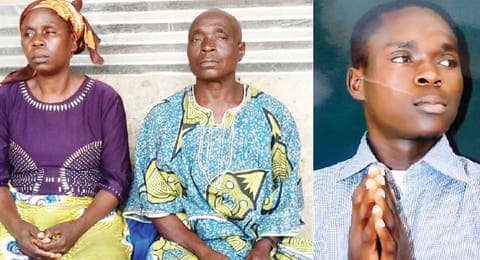
Florence, Joseph and Seyi Fasere. (File: Punch Newspaper)

“I was a trader but I have not been able to work since the police killed my son, my first child. Seyi was shot dead by a policeman, popularly known as Akobi Esu (Devil’s firstborn).

“They said he was an armed robber but my son was not an armed robber. They just wasted his life and the killers are walking freely as if they have not committed any offence,” she said.

“It happened in March 2013. He was killed at a police station at Obalasan in Ilupeju Ekiti. It is very close to Oye Ekiti.

She continues: “My son, Seyi, was a final-year student at Ekiti State University, Ado-Ekiti when the incident happened. He was taking his final examination and had one more examination to take. He had not fully paid his tuition; he still had N100,000 to pay and he said the school management was threatening that he would not be allowed to sit the last examination if he did not pay. He came back home to Ilupeju Ekiti and we were able to raise the money and give it to him.  I think he had an examination to take the following day.

“He went to a barbershop to have a haircut and sent a neighbour to tell me that his younger brother should bring his bag to him at the bus stop – Esinkun. But I told his brother that he could not just leave without returning home to shower and wash off the hair and more importantly, pray before embarking on the journey. I never knew I would not see him alive again. He left around 5:30pm; that was the last time I saw him.

“His brother took his bag to him at the bus stop and I was later told that he saw a woman he knew in the bus going to Ado Ekiti and she asked him to join but he said he would wait for a car. But the woman, who is a septuagenarian, Madam Victoria, told us later that he persuaded him to board the bus because she was also going to Ado Ekiti to visit her children. That was how he boarded the bus and they embarked on the journey. Just three of them were in the bus. 

“When they got to Obalasan, they heard that armed robbers were attacking a bank ahead of them and the driver was said to have asked the old woman if she knew a shortcut so they would not run into the robbery scene. They said she gave the driver the direction of another route. The driver was new on that road so he was said to have asked to be directed. At that time, we started hearing gunshots in Ilupeju because it is not very far from us.  I was worried and I ran to Esinkun where he boarded the bus but I was told that he had left. Later, the driver parked the bus and they hid somewhere so they could wait until the shooting would stop. The woman said she asked Seyi to go and bring their bags because the driver had dropped their bags and turned back.”

According to her, the late Seyi was arrested and was taken to the police station and was shot dead after interrogation despite her son’s plea that he is not an armed robber.

The grieving woman also narrated how she and her husband, Joseph, were physically assaulted and detained by the police when they went to the station to confirm their son’s death.

“The following morning, one of my younger brothers called me and told me that they had killed Seyi at the station. I left and his dad also came from Ado-Ekiti and together with Blessing, his younger brother, we left for the police station.

“Immediately we got there, the policemen there grabbed me and beat me ruthlessly. They slapped me about 0 times and kicked me several times; they removed my slippers and used them to hit my head. Despite what happened, they beat me, humiliated me and put me behind the counter. I was just weeping and crying to God that why would this terrible thing happen to me.

“My husband too was not spared, they slapped him so many times. They removed his shoes and used them to hit his head. They brutalised us and my husband was put in a cell at the police station and not  behind the counter. I fell down there and to compound my sorrow, they brought my son’s corpse and put it before me and asked me to be looking at my son. There is no agony that can be worse than that for a mother. I wept bitterly.

“They said Seyi was an armed robber. They said we did not bring him up well and that was why he became an armed robber. But I was weeping and telling them that my son was not a thief and each time I said that, one of them would slap me.

“They had removed his shirt and tied his hands behind his back. His trousers were worn inside out. That confirmed it that he was arrested before he was killed and he was not killed while shooting at them as they claimed. Will an armed robber tie his two hands behind his back and be shooting? Even if I did not go to school, I know that is not logical but they wasted my son’s life, humiliated me, and labelled my son an armed robber. It is only God that can remove that sorrow from my heart. They offended Seyi’s creator, who is God almighty and I know He will fight for us.

“They killed him around 4am and put his corpse before me from 7am until the time they saw one of the armed robbers who participated in the “robbery. I think the armed robber was shot during a gun battle between them and the police. He was wounded and was in pain. He was found the following morning and residents drew the attention of the police to him and they picked him up. He was begging them to take him to hospital to be treated. He didn’t want to die. He was one of the armed robbers. I heard him say he only distributed guns to the robbers but not a marksman. He said they all came from Kogi State and that he is Ebira.”

They were only allowed to go following the confession of one of the armed robbers that was later caught shortly after her  son was killed.  Seyi was not part of them who

She said her son’s corpse was not released to her for burial until after two years in the mortuary.

“The policemen asked the arrested armed robber if Seyi was one of them and he said he was not a member of their gang. He said six of them came from Kogi State for the operation.

“That was when they asked us to go home. Seyi’s brother, Blessing, was also thoroughly beaten and he was handcuffed and locked up. At a point, they took him in handcuffs to our house to search everywhere. But what would they find in the house of a poor person? They found nothing. They tarnished our image because some people saw how Blessing was handcuffed and led to the house by the police. They heard that the police killed Seyi so they would conclude that my children were armed robbers but God sees everything and I want Him to fight for me. They eventually released us and asked us to go home when they knew Seyi was innocent but they did not admit that they were wrong. The three of us were put on a motorcycle and asked to be taken home to mourn our son.

“They later took his corpse to the mortuary at the Federal Medical Centre, Ido Ekiti. His hands were tied behind his back the way he was killed. We went there a number of times but I became tired at a point. We were asked to go and get his remains from the mortuary after almost three years after the incident. I brought him home and buried him but since then, I have not been okay. The sorrow led to high blood pressure and after the beating, I know that I have not been alright but there is nothing I can do about it,” she said.

Why adding that the situation has traumatised and redirected the course of her life negatively, she expressed her willingness to seek justice for the death of her son from her killers before the recently constituted state’s judicial panel of investigation on police brutality.

Ekiti lifts curfew on state, restriction on worship centers

THE Ekiti state government has lifted the curfew imposed on the State with effect from 6am on Sunday, November 1, 2020.

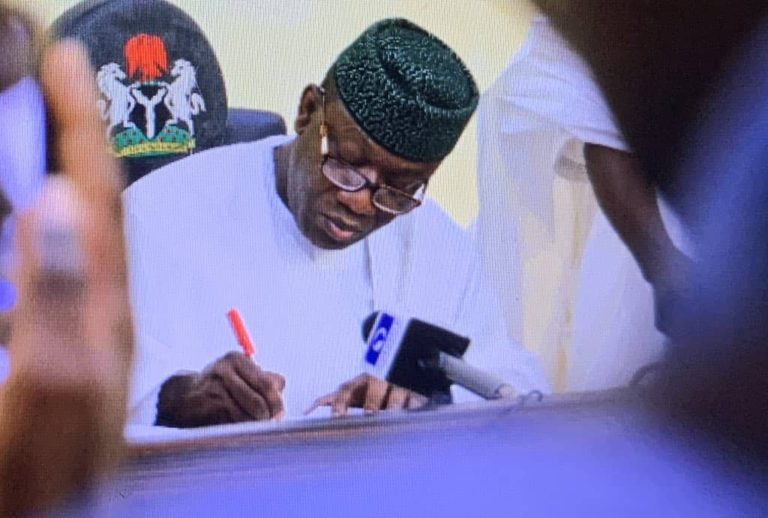
Following the fallout of the #ENDSARS protest in the state, Governor Kayode Fayemi had on October 20th, imposed a curfew in the state.

Akin Omole, the state commissioner for information and values orientation, who revealed this in a statement on Saturday evening said that the decision to lift the curfew was taken after an assessment of the security situation and the restoration of relative peace in the state.

Akin added that Governor Fayemi has also approved the lifting of the restrictions placed on religious gatherings during the coronavirus pandemic with effect from November 1, 2020.

While stressing that churches and mosques are now free to open for worship without restrictions, Omole however emphasized the need for worshippers to continue adhering to the COVID-19 protocols.

He added that religious adherents must wear face-masks, maintain social distancing and properly wash their hands or sanitize their hands before joining their respective congregations.

He charged residents of the state to be law-abiding, vigilant and promptly report suspicious movement to relevant authorities, assuring that the state government would leave no stone unturned towards ensuring the safety of lives and properties of the people in the state.

‘Repentant Boko Haram’: A look at Operation Safe Corridor deradicalisation and rehabilitation camp

By Bamas Victoria   and Judd-Leonard Okafor


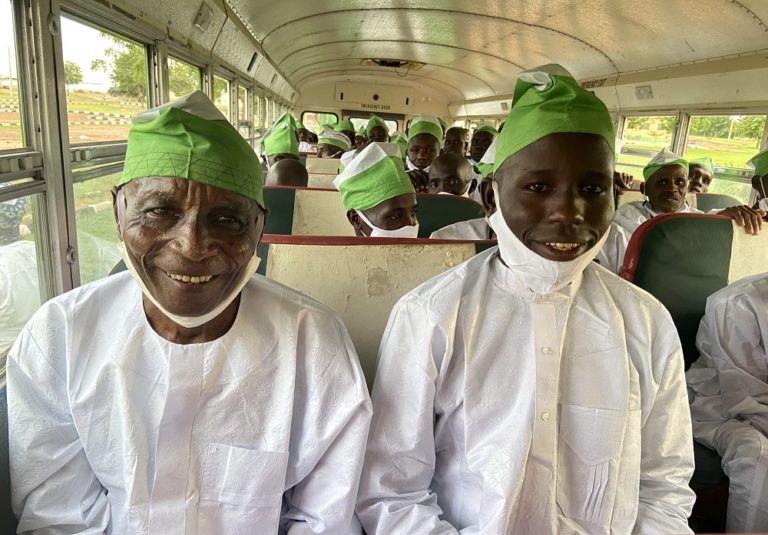
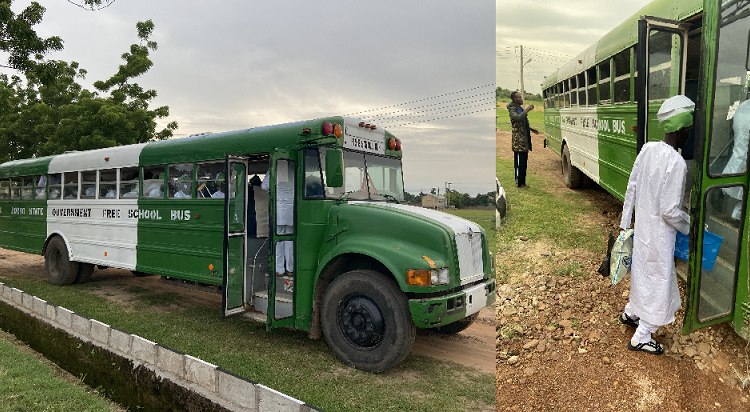
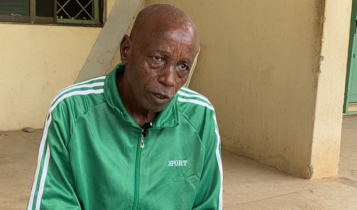
ON the morning of September 6, a 78-year-old man climbed aboard a green-white-green “Borno State Government Free School Bus”. Alkali Musa Kukawa was returning home for the first time since 2014 – to his family, the two wives and 34 children he’d been torn away from.

“I’m happy, I’m so happy,” he says, his voice strained with emotion, tears brimming in his age-worn eyes.

The time in-between had been spent in Boko Haram captivity, then on military camps where he underwent de-radicalisation, was rehabilitated and is now ready to be reintegrated into society. He is not alone.

His 25-year-old son Ali, who had shared captivity and rehabilitation with him, is also coming home.

A total of 300 men who have lived the same experience are also going back to Borno. They have been labelled the “repentant Boko Haram fighters”.

At least 300 more are left behind, and this is their rehabilitation journey.

A total of 300 men who have been labelled the ‘repentant Boko haram’ are going home after several years.

What is Operation SAFE CORRIDOR?

The Boko Haram insurgency in the North East is being fought on many fronts. Nigeria’s response is twofold: a kinetic and a non-kinetic response.

The kinetic is the hard-knock Operation LAFIYA DOLE; the non-kinetic is the soft-slap Operation SAFE CORRIDOR.

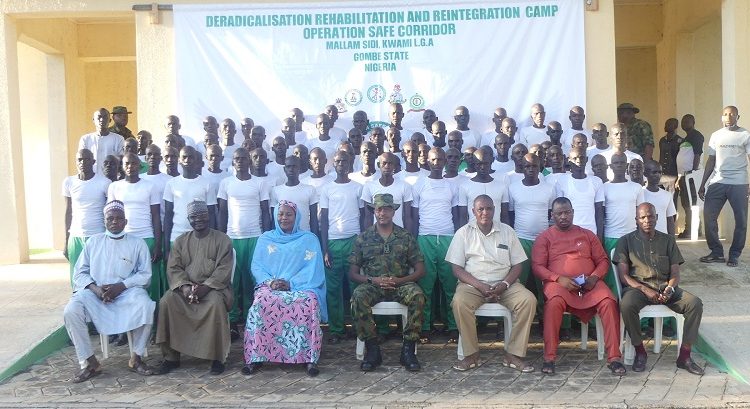
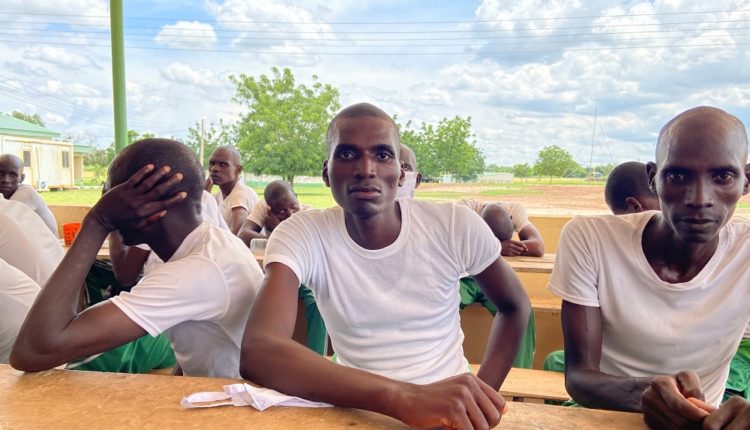
A former orientation camp for National Youth Service Corps in Mallam Sidi, Gombe, has now become the heart of intense efforts to de-radicalise, rehabilitate and re-integrate hundreds of men who had contact with Boko Haram insurgents. The so-called “repentant Boko Haram members” who have been on the news for years.

Operation SAFE CORRIDOR is what its name says: providing repentant members of Boko Haram/Islamic in West Africa State Province a “SAFE CORRIDOR” to return to society. It is different from the amnesty programme that followed the conflict in the Niger Delta. The “repentant” are actually former abductees of Boko Haram and terrorist suspects, and they are “clients”.

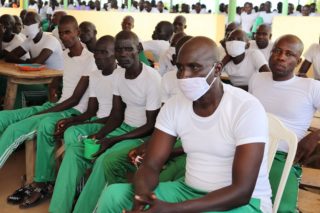
The DRR Camp has so far graduated a few of the clients in batches 2 and 3 since 2016 and a special batch in 2019. That same year, 290 more clients came on 22 November 2019. Kukawa and his son were among that number.

On 14 December, another 316 clients were taken into the camp. Kukawa’s two other sons were among them. The clients known as Batch 4/2019, were 606 in number.

Right place, wrong time and a 15-day Walk

Kukawa, from Maiduguri, was living in a little Cameroonian border town when he was taken hostage by terrorists and taken to Sambisa Forest. He witnessed the weeks before the group split into two factions: Shekau and al-Barnawi.

“One of the factions kept us. I have been praying to God to make a way for me to escape,” he says. “God finally answered my prayer.”

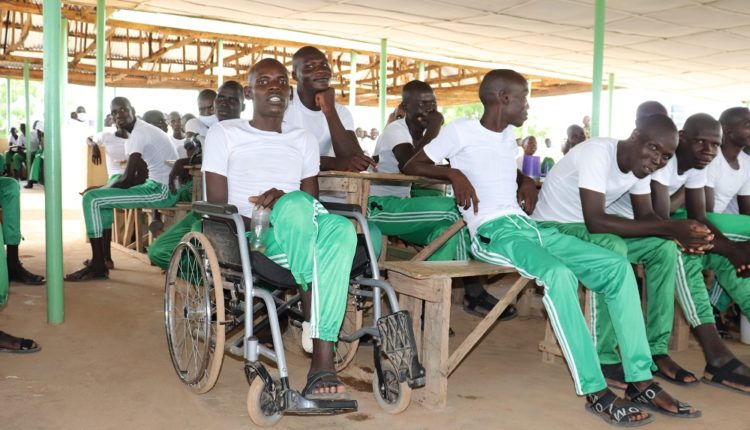
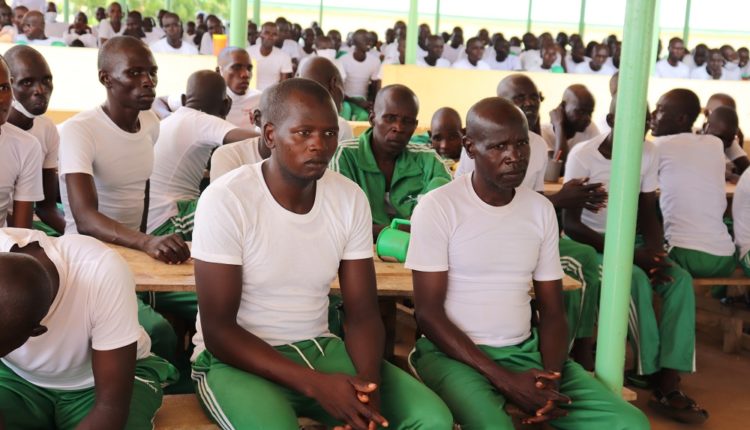
The answer was his son Ali, also taken hostage by the terrorist. He was 25, a father and a husband. Father and son sitting side by side in the camp’s green slacks and white t-shirt narrating their ordeals. It is Friday, a half free day, and sports is scheduled for later in the day.

Alkali Musa Kukawa is in the camp with 3 of his sons.

Ali had been planning an escape ever since the al-Barnawi faction seized them.

“In planning for the escape, I was not escaping to come and surrender,” Ali recalls.

“I was not even aware the government had a clemency deal, neither was I aware of the process.”

Ali had been working for the group after being taken hostage for years. He had risen in profile to leadership among the forced workers. When Abba, a fellow forced worker was in danger, he planned Abba’s escape and got him on a vehicle to Lagos.

Abba was caught, taken to Maiduguri and secured at Giwa Barracks. That’s the location where men who have escaped Boko Haram, or rescued by the army are debriefed. Abba would later work with the army, giving human intelligence on Boko Haram locations, including battles in Sambisa, before his eventual freedom in Maiduguri.

Ali wasn’t going to have it easy. He was already known as working for Boko Haram. On request, Abba connected him to a senior military officer who got him working as an informant. He got asked to go to Maiduguri, but declined.

“I have my father, my mother, my children, my wife and siblings. It will not be possible for me to escape with them all at once. And it will also not be possible for me to leave them behind,” he recalls his response.

A client with an amputated leg and a hand. He was said to have been amputated by the insurgents as punishment.

The eventual escape spanned 15 days of trekking and sprung him and his relations— father, mother, kids, younger siblings—from Boko Haram captivity.

They trekked to Geidam, then boarded a vehicle to Damaturu. He carried his father piggyback when the old man got too weak to walk. Damaturu was selected because he was already marked in Maiduguri.

“It was at Damaturu that I was taken to a place called ‘Guantanamo’ where I spent a week. From there, I was taken to Giwa Barracks, where I spent a year and three months. From Giwa Barracks, they brought me here—to DRR camp.”

DRR not amnesty

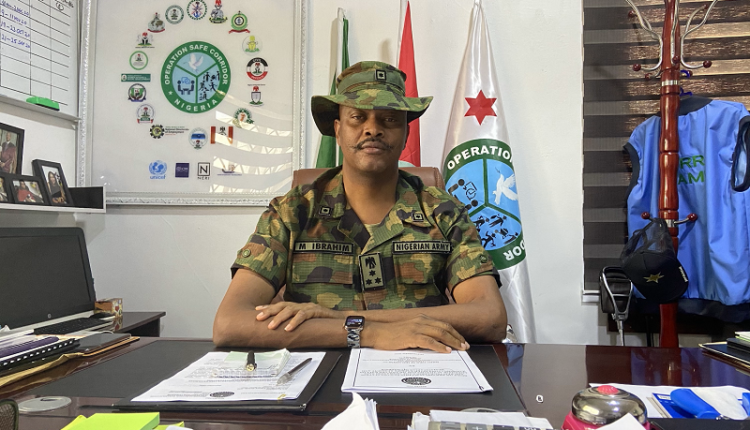
The DRR camp is “a non-kinetic approach to warfare, not an amnesty programme,” says Brigadier-General Musa Ibrahim, Commandant of the De-Radicalisation, Rehabilitation and Re-Integration Camp of Operation SAFE CORRIDOR in Mallam Sidi, Gombe State Nigeria.

“The amnesty programme done in these other parts of the country in comparison to what we are doing in Operation Safe Corridor has no basis for comparison. When you are rehabilitating, de-radicalising and re-integrating. Other are just disarming and resettling.”

Established in 2016, the camp’s personnel are drawn from 17 services, ministries, departments and agencies (SMDAs) to provide the services packed into the rehabilitation process.

  • Office of the National Security Adviser (ONSA)
  •  Defence Headquarters (DHQ) (Defence intelligence, Army, Navy and Air Force)
  •  National Intelligence Agency (NIA) (Information gathering and intelligence support).
  •  Department of State Security (DSS) (Information gathering and intelligence support).
  •  National Drug Law Enforcement Agency (NDLEA) (Drug abuse therapy).
  •  Nigeria Correction Service (NCoS) (Spiritual and psychotherapy, counsellors).
  •  National Orientation Agency (NOA) (Public sensitisation, interpreters and counsellors).
  •  Nigeria Immigration Service (NIS) (Profiling and repatriation of foreign ex-combatants).
  •  Nigeria Security and Civil Defence Corps (NSCDC) (Security and intelligence support).
  •  Federal Ministry of Women Affairs and Social Development (FMWASD) (Family reunion, home visit and follow-up services).
  •  Nigeria Police Force (NPF) (Security, EOD and Intelligence support).
  •  National Identity Management Commission (NIMC) (DNA, Biometry, National ID Card).
  •  National Directorate for Employment (NDE) (Vocational Training Support).
  •  Federal Ministry of Justice (FMoJ) (Administering of Transitional Justice).
  •  Federal Ministry of Human Affairs, Disaster Management and Social Development (FMHADMSD) (Coordination of all Humanitarian Support).
  •  North East Development Commission (NEDC) (Provision of all kind of support).
  •  Operation LAFIYA DOLE (OPLD) (Disarmament and screening of eligible OPSC clients).
Brigadier-General Musa Ibrahim, the third commandant so far of the DRR Camp.

Bringing SMDAs together was a lesson in both sensibilities and geography

Major-General BM Shafa, coordinator of Operation Safe Corridor, Brigadier-General Musa Ibrahim, the third commandant so far of the DRR Camp, put heads together with other authorities to get the camp sited in Gombe.

“Gombe is the centre of the north east. From Gombe, you can go to any part of the north east. Looking at it in this aspect, this is the best place and it wasn’t easy and still not easy,” says Brigadier-General Ibrahim.


Working for good

Getting to work begins even before clients arrive in Mallam Sidi. There is a military detention centre called Joint Investigation Centre on the Giwa Barracks in Maiduguri where the men are sorted.

Category A is for innocents caught in the web of battle.

Category B is those who willingly surrender and are open to rehabilitation.

Category C is hardliners beyond rehabilitation who will remain in Giwa.

The men haven’t seen families in years, and the disconnect is the first step in their psychological first aid, says Nandom Ibrahim, a psychologist working with Operation SAFE CORRIDOR in the DRR Camp for over two years.


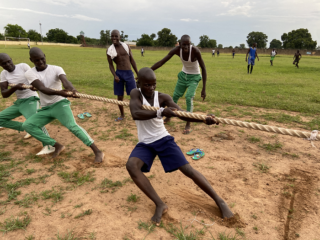
Extracurricular activities like sports are part of the activities at the camp.

Psychological education follows, to help the men recognise the symptoms they are exhibiting. Then they are placed in groups, depending on the severity of their cases.

“The most common psychological problem is stress,” says Nandom. “Stress can lead to depression, anxiety. Worries when you are moved from one place to another. Uncertainties when you are leaving Maiduguri [Giwa] and coming to the DRR Camp. You don’t know what’s going to happen.”

The psychological tools and treatment plans on hand help with post-traumatic stress disorder, life skills, re-integration, anger management, stigma, suicide.

It isn’t just on the camp. Each client is numbered according to what year and batch they came in. The final numbers are serial.

Often the International Office for Migration collects details of each client and reaches out to families left behind. The intent is to organise family visits.

“In interventions in extremism, psychosocial support is very key,” says Ibrahim.

“A lot of them haven’t seen their families for the past five, seven years. That keeps them up. They can’t sleep. One of the common problems here is insomnia. Having organised family visits helps.”


Social workers plug into the family link to temper antisocial behaviour

“The need is for them to know what family is all about the roles of family members, what peace is all about, the fundamental human rights of every citizen – like freedom of religion,” says social worker Emmanuel Bukams.

“Most, when they come, think that apart from Islam, there is no other religion. But everyone can practise his own religion, and they are made to know that. So when they go back, they should be ready to stay with Christians, Muslims or pagans.” They are also realising they too have been victims.

“Only few were members. Majority were victims of circumstances. They were in their villages and were captured and forced into the bush,” says Bukams.

“So, when they found themselves out, they surrendered to the Nigerian Army.”


Surrendered minds

The National Orientation Agency (NOA) is on the ground to work on surrendered minds. It provides counsellors and interpreters, and the ‘WAI brigade’, a limited paramilitary agency to provide limited security.

Civil defenders also provide security, but the bulk – the heavy guns guarding the hostels where the clients live – are the military.

Counsellors teach national core values—patriotism, integrity, religious tolerance, social justice.

They also teach national symbols—anthem, pledge, flag, coat of arms. The National Identity Management Commission provides national ID card, making each client a national, giving them identities that can be traced. Each client leaving the DRR Camp has a national identification number.

Identity matters because not all the clients are Nigerians. The Boko Haram insurgency has plagued the entire Lake Chad region, spanning fringes of Nigeria, Chad, Niger and Cameroon.

Borno’s commissioner for women affairs and social development, Zuwaira Gambo led a delegation to the camp the night before to take the men back early Sunday morning.

When Kukawa was taken hostage, he was in a village on the border with Cameroon. Men taken hostage outside Nigeria are among the serial numbers arriving at Mallam Sidi. Among the over 600 at Mallam Sidi are 14 foreigners – eight from Cameroon, five from Chad and one from Niger.

Nigeria Immigration Service is on ground to sort out their repatriation, says DSP Bulus Vandi Mbaga, head of the NIS department at the camp.

The choice is between repatriating them through the northeast quarter—that is, northeastern states bordering neighbouring countries—or through NIS Headquarters, that is, handing them over to their respective embassies.

NOA also teaches hygiene and current affairs in a bid to help clients understand the past, present and future of Nigeria, says counsellor Caleb Benson, of NOA.

“Most are not educated. That was why it was easy for them to be influenced by Boko Haram when they return to their societies, they can teach their children. They won’t allow their children to do as they have done.”


The drug question

The running supposition is that men who had worked with Boko Haram were induced by drugs.

“When they get in there (in Boko Haram captivity), they will be taught to take drugs to act violently,” supposes Victor Michael, Head of Department of National Drug Law Enforcement Agency at the DRR Camp.

“A normal person can’t act the way they do, if you don’t take the hard drugs. That’s what gives them the highness. Ordinarily, you can’t come to say you want to shoot or kill me, if you are not high.”

NDLEA at DRR works on drug abuse therapy.


Religious ideologies and counter narratives

Mohammed Mala, from Madagali in Adamawa, witnessed the clash of religious ideologies when he was taken hostage.

The terrorists struck on a Friday. He and his father fled. The occupiers announced women in households whose husbands were not available would be taken into Sambisa and forcefully married off.

Mala was leaving behind his grandfather, mother, 17 younger siblings and wife who had given birth a day before the invasion. He and his father returned in the dead of night.

“Traditionalists had taken the Boko Haram fight to be a religious fight. If you are a Muslim, they would not allow you safeguard your life. They will say the insurgents are your associates, they will tie you in a sack and throw you in a lake,” Mala says.

Mohammed Mala R) and his father from Madagali in Adamawa witnessed the clash of religious ideologies when he was taken hostage. The terrorists struck on a Friday.

He relives the story of Askira Uba, of corpses bound and floating in rivers and lakes. One of them was a mother and a child strapped to her back.

“There is death from both sides; We weren’t safe from Boko Haram nor were we safe from the Traditionalist.”

The stay of the terrorists was temporary. The family stayed on, providing shelter to Christians, young women escaping forced marriages until the military came and took over Mubi and Michika. Mala had to leave town.

“If you run towards the hills the insurgents will kill you, because they felt despite living with them during their occupation you did not like or accept them. We had a car at home. The insurgent took the car and forcefully conveyed our family to Sambisa forest using it,” he says.

In the forest, everyone fends for themselves. No provision for food or welfare. Mala was the oldest male. He had to dig wells, farm.

“Sometimes we didn’t have food; we make do with leaves: we boiled and drank them and slept with nothing to eat. During farming season, he ate vegetable soup without ‘tuwo’, because he needed to be strong.

“The insurgents will not force you to join the fight nor would they allow you to come to their sides of the camps in the forest. We are just kept captive. However, if you are fascinated you can choose to join them,” he says.

After four years and four months in the DRR Camp, Rev Staff Sergeant Ayuba Adamu has worked with 10 men forced to convert to Islam. He leads church service for Christian clients and soldiers in the DRR Camp.

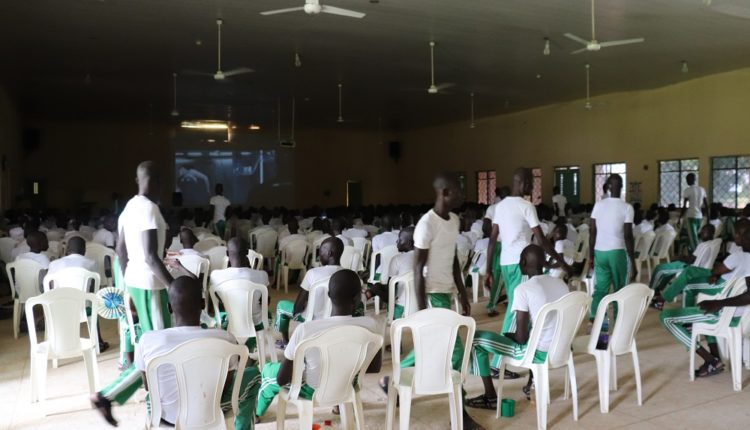
The opening sounds of Glory to God swells through the camp’s multipurpose hall every Sunday morning. The hall also serves as a meeting place, cinema where the clients binge on movies. It is also the haloed ground where they sing the national anthem and pledge, some for the first time in their lives, as they swear allegiance to Nigeria.

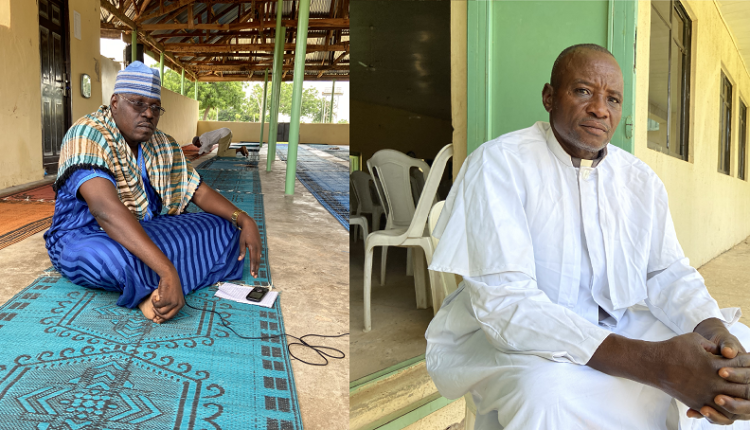
Tafsadeen Suleiman Isah is the camp imam and Rev Staff Sergeant Ayuba Adamu provide spiritual guidiance

“When they come to the camp, some renounce and return to their faith. They need religious guidance to return from the dilemma they found themselves in, because they were forced into a religion they accepted without their consent,” says Adamu.

“We deal with the ignorance in the concept of the counter narrative – that western education, government work, politics is forbidden, as is anything not in line with Islam. We use the bible to counter the narrative, so they know the real meaning of what is democracy, the benefit of living together and what it can bring to them, and tell them the importance of education.”

The point of education is where educationist Mohammed Alhassan steps in. He is Senior Inspector at Nigeria Corrections Services to the Camp. Profiling each client helps determine their level of education, and where to place them in the overall literacy classes offered on the camp, he says.

“It is to prove to them that the western education is important in the life of every individual.”

Tafsadeen Suleiman Isah is the camp imam, bringing together verses from the Qur’an and the Hadith to shed light on misplaced ideologies. He presides over Friday prayers at a mosque in the camp. Clients in white overalls take their spots at the call for prayers, right after lunch.

One goes right to the heart of the society Boko Haram tried to create with a disparate version of Islam.

“Someone is trying to bring Islamic sharia law into the society, and if people refuse to follow him, he goes with his family into the forest – and calls it hijra. Hijra is not like that,” says Isah.

“We brought Qur’anic verses to show them there is no migration after Prophet Muhammad’s migration from Medina to Mecca, and we tell them Prophet Muhammad said any kind of education is compulsory for men and girls.”


Life skills

In 2014, Babagana Mairambi was already in his 50s and looking toward retirement at Bama local government education authority when Boko Haram terrorists captured the council headquarters.

He and his family were taken away.

“I stayed with them but I did not participate in anything they did. Because of my age, they respected my age and did not involve me in their activities,” he says

He spent two years in Sambisa until January 2016 when he made it out of the forest. He was returned to the council Headquarters in Bama, then shunted off to Giwa Barracks.

In May 2016, he was moved into a maximum-security prison in Maiduguri, and spent three years and seven months there. By 14 December 2019, he was moved to the DRR camp.

Before he was taken, he was already eyeing retirement. After years away from society, returning home was uncertain. No hope of his job waiting for him, he had joined up with hundred others in the camp to learn vocational skills.

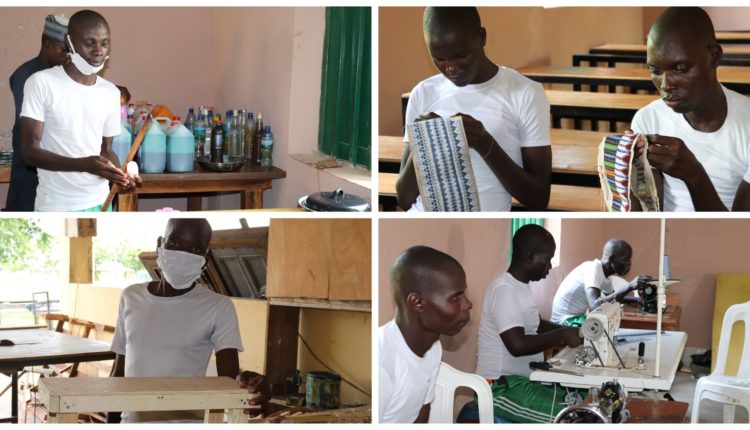
Clients can choose among barbing, cosmetology, cap making, laundry, tailoring, shoemaking, carpentry for vocational skills acquisition.

He chose cosmetology, and has honed skills in making washing soap, bathing soap, air freshener, body lotion and tile cleaners.

“I am 57 now. Even then my retirement was close. I don’t know what the situation will be when I get there,” he says. “If I am to continue, I will continue. But the cosmetology would be an additional business. Even if I retired, I would continue.”

Among vocational skills on offer, farming and fishery are compulsory. Beyond those, clients can choose among barbing, cosmetology, cap making, laundry, tailoring, shoemaking, carpentry.

Mairambi who everyone calls ‘headmaster” is taking it in stride. He knows the camp is a hurdle he has to go through to get back, to the society.

His capture was in broad daylight and his first return was with his family before they were separated—women and children to camp for displaced people, him to Giwa Barracks.

“It was not our intention to be separated. Only because we have stayed there [with Boko Haram] a long time, whether we participated or not, we must go through this barracks [Giwa] before we to our societies.”


Once a Boko, always a Boko

Association, even a flitting one, with Boko Haram spells stigma upon return into society. It is a stain that tarnishes children, women and men in different proportions: children born to rapes and forced marriages; girls and women married off or made pregnant; and men suspected to have worked for the group upon abduction.

The stigma lingers even after release. The men graduating out of DRR camp will have to contend with that burden.

Abdulwahab Usman (M) from Bama in Borno State, was guilty by association.

Abdulwahab Usman from Bama in Borno State, was guilty by association. Usman’s journey to Operation SAFE CORRIDOR started in 2013 when he was arrested on the suspicion of being a Boko Haram member because some of his friends were.

“I was arrested and taken to Giwa barracks. In 2014 Boko haram insurgents came and attacked the barracks and I was held captive and taken to the forest. In the forest I stayed there for 4 years, before my escape in 2018,” he says.

The now 34-year-old says he was in his first year in a college of education training to become a teacher but now his life has taken a different trajectory. Seven years later, he has graduated, not from a college but from the DRR vocational skills acquisition; cosmetology and barbing.

Usman went into captivity alone, but came out with two wives and two children – with one now deceased. He met them after the insurgents raided Gwoza and Mubi.

“I wasn’t arrested with a wife. I married my wife while I was in the forest. Because of the long stay in the forest I became familiar with them. After a while I realized that what the insurgents were doing was not right. We found out the truth. Hence we left them. I escaped along with my family, we went and surrendered in Gwoza.”

From Gwoza he was taken to the DRR camp in Gombe where he is now referred to as the ‘GOC’. He is the leader of the over 600 clients.

“I am a people person, a crowd puller” he explains. “Even when I was in the forest I was a people person. My understanding of some of the things here also came to play. I understand my fellow clients. That was how I was appointed GOC.”

He works with 10 ‘chairmen’ each representing one of the 10 hostels. They report to him and he reports to the camp authorities.

Babagana Mairambi was already in his 50s and looking toward retirement at Bama local government education authority when Boko Haram terrorists captured the council headquarters.

Just like Usman, Mairambi’s captivity has changed his trajectory. He now faces a future that might be riddled with stigmatisation – but he is not shaken as he expects a warm welcome.

“If I hadn’t been taken to Giwa, I’d already have processed my career. My entire community knows how I was captured in the area. I was in the local government headquarters. All the people can bear witness. They are willing to welcome us,” says Mairambi.

His younger brother—left to care for Mairambi’s three wives and 17 children—had already been tagged by IOM and had visited Mairambi on the camp during a family visit. His entire family already knows of his presence in the DRR Camp in Gombe.

That’s one part of the problem solved. The other part of the problem is about men still with Boko Haram.

In a quasi-judicial setup in front of a judge, the men on the camp have sworn allegiance to Nigeria.

Excited to be going home after several years in the system.

Dark Futures Turning Bright

“Here at this camp we have been sensitised and we have sworn, we have been made to understand the things we did not know before, our families have come to visit us,” says Mala.

“The insurgents often told us the Nigerian Government is our enemy. They told us it is about religion, but it is not, but not everyone understands this.

“The people in Sambisa forests, it is not that they don’t want to come out they are just scared that those who have come out have not been released by the government,” says Mala. Sambisa is open to communication, so when news of their release starts getting round, it could change things. “For instance, if I go back and speak at a radio station, they will see that this is how we were treated in Operation SAFE CORRIDOR, this is how we were treated by the soldiers that we have been told are our enemies.

“If they call and find out that I have been released, those who want to come out would come out and that is a success story.

“Those of us who are here we came on our own free will, we were not captured, if it is not because we want to live peacefully, we would not walk all the distance from the forest and surrender to Nigeria’s government.

“We want the government to be just and fair to us and we have promised that we will not allow this insurgency to continue. When we know someone is working for Boko Haram, we would inform the soldiers. There is no way I will be in town and I find out that you are Boko Haram and I did not inform the soldiers to get you arrested, then tomorrow when you come, I will be the one you will kill. If I don’t live peacefully with the people, I too will not have peace.”

“We are all poor people and we have been caught in the system. Our children are going to grow up without a future. We have lost already, should our children also grow up at a loss? We want to be able to put our children in school. Lack of education is part of why this insurgency took root.

“If we were well informed most of us would not do such. Among us here there are those who grew up in villages and have never seen a tarred road before – but now they can read and write letters. They are crying, saying their parents cheated them.”

Each man totes a holdall, containing their new national ID card, a certificate of graduation, five changes of clothes, towels, sanitary products, N20,000 cash.

Ready to graduate

The entire stay for the men ended well before August 2020 but the emergence of COVID-19 delayed their return to Maiduguri. Five have fallen critically ill. The others fill their day with breakfast, lunch and dinner.

In between, they play football in teams and take turns at tug of war. In their downtime, hundreds pack into the multipurpose hall to watch Bollywood blockbusters.

In their downtime, hundreds pack into the multipurpose hall to watch Bollywood blockbusters.

Military operations are top secret. Until now, Operation SAFE CORRIDOR has not been distinct from any other military operation anywhere in the country. Any communication from the military, handled by the Defence Media Organisation, is strategic.

“Once this Boko Haram crisis ceases, there will be no more Operation SAFE CORRIDOR and once there is no Operation SAFE CORRIDOR, there will be no DRR camp. And what do we do? We return the NYSC Camp back to Gombe State Government,” says Brig-Gen Ibrahim.

“We are praying and looking forward to that period,”

Next step, reintegration

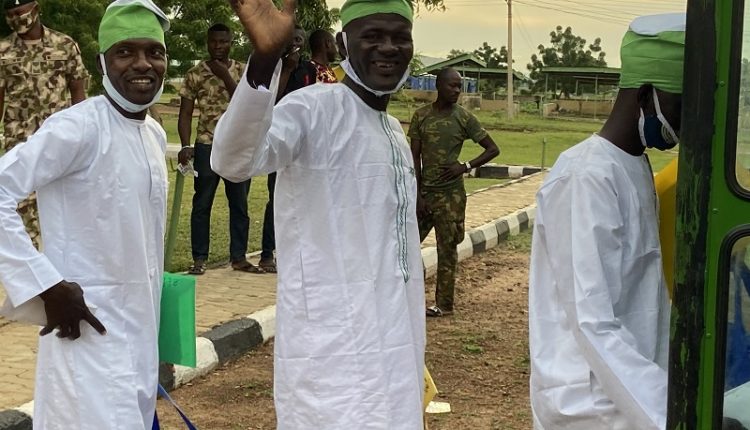
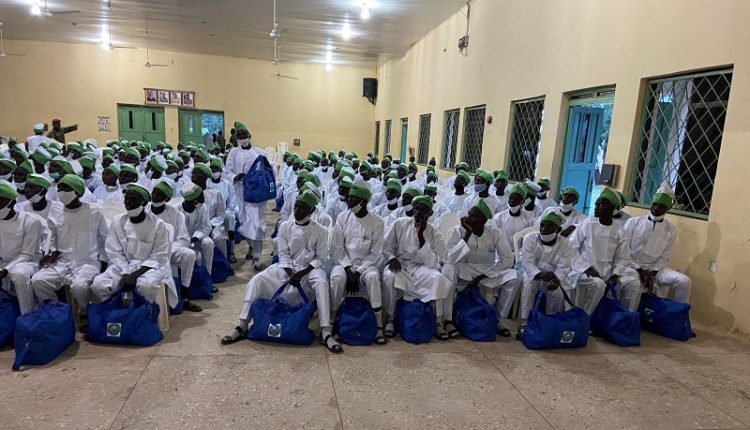
On the morning of 6 September, 300 men fill the multipurpose hall. They are dressed in white robes and green caps. Their feet are encased in white socks and shoes. It is a farewell to the brown trousers and shirts with serial numbers they have been wearing since last year.
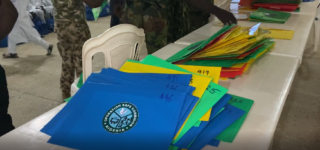
Each man totes a holdall, containing their new national ID card, a certificate of graduation, five changes of clothes, towels, sanitary products, N20,000 cash.

Borno’s commissioner for women affairs and social development Zuwaira Gambo has led a delegation to the camp the night before to take the men back early Sunday morning.

That’s the “reintegration” part of the DRR, and the ministry will be responsible for it. From a transit camp right into individual households, and monitoring regularly the men haven’t fallen out of order.

Since the camp was established, it is yet to receive a report of any graduate client backsliding.

{lastic paper file bags with documents given to each client that has graduated.

“I have sworn and I am saying it, there is no way I will work with a Boko Haram member because he offers me money and let him go,” says Mala.

“If I do that he will definitely come back and kill me. And we will let others know that if someone is a Boko Haram member who keeps the insurgent informed, they should arrest such a person and hand them over to the soldiers.”


Five buses for school children in Borno line up on the grounds of the camp. But it is 300 surrendered and repentant former Boko Haram affiliates and captives who climb aboard. Kukawa and his son Ali are among them, seated side by side in a row. The 78-year-old is finally going home, and is in tears. His son is full of joy. A security van leads the way. The five buses follow in a row. Another security detail is at the end of the convoy that crawls out of the DRR Camp in Mallam Sidi. The men are on their way back to Maiduguri.

There, the journey of their reintegration into society will begin.

All photos by Bamas Victoria and Judd-Leonard Okafor.

US military rescues American held hostage in Nigeria

THE United States Government on Saturday confirmed the rescue of its citizen held captive in a border town between Nigeria and Niger Republic.

The victim was held hostage by an undisclosed armed group believed to have a substantial affiliation within the northern part of the country and Niger.

“U.S. forces conducted a hostage rescue operation during the early hours of 31 October in Northern Nigeria to recover an American citizen held hostage by a group of armed men. This American citizen is safe and is now in the care of the U.S. Department of State. No U.S military personnel were injured during the operation,” Pentagon spokesman Jonathan Hoffman told the Cable News Network in a statement.

“We thank the government of Nigeria for its partnership and support for this mission,” the U.S embassy in Nigeria also tweeted applauding supports of the Nigerian Government.


READ ALSO:

According to another statement attributed to the US Secretary of State, Michael Pompeo, the rescue was conducted Friday night by top military operatives after the force had gathered enough intelligence information.

Reports say six among seven of the abductors were killed by thy US forces.

“The United State is committed to the safe return of all U.S citizens taken captive. We delivered on that commitment last night in Nigeria where some of our bravest and most skilled warriors rescued a U.S citizen after a group of armed men took him, hostage, across the border in Niger,” the statement reads in part.

President Donald Trump on Saturday  praised the Seal officers who carried out the operation during his campaign in Pennsylvania.

The US embassy in Nigeria has always issued travel warning alert for its citizens in the country. The most recent warning – Level 3 alert was issued October 22.

Since 2002, Boko Haram insurgents have been terrorising northern parts of the country, kidnapping mostly locals and aid workers.

On July 22, the Washington Post reported the incident where members of the Islamic sect kidnapped five aid workers in Maiduguri, Borno State.

President Muhammadu Buhari had identified the victims are employees working with the Action Against Hunger, Rich International, International Rescue Committee and officials of the Borno State Emergency Management Agency.

The US government applauded the diplomatic supports enjoyed to ensure the rescue process was a success. It hailed the military officers involved and later assured the rescued victim would be reunited with his family.

It renewed its commitment to protecting the lives of every American citizen, particularly those held hostage.

“We will never abandon any American taken hostage.”

Efforts to get a reaction on inputs of the Nigerian Army in the rescue process from Sagir Musa, Spokesperson for the Army failed.

He did not respond to a text message sent to his line as of the time of this report.

Premium Times’ report discredits claim of governor Sanwo-Olu, Army authorities of no-gun-death in Lekki

Contrary to the claim of the Lagos State government and the Nigerian Army that nobody was killed by soldiers during the Endsars protest at Lekki toll gate on October 20, an investigation by the premium Times has revealed that soldiers and policemen shot at the peaceful protesters and killed many youths.

Through pictorial and video evidence including eyewitness accounts, the newspaper established the fact that many lives were lost through gunshots, while many others sustained gun wounds.

One of the victims is an unidentified man whose body was found about two kilometres away from the Lekki toll gate.

According to the residents  of the riverine community, the corpse was found at Admiralty Way, Lekki Phase 1, floating on the lagoon just behind their houses.

Sources told the Premium Times reporters that the dead body could be one of the victims of the alleged killing  at Lekki toll gate.


READ ALSO:

“The corpse was that of a man. It was already swollen and decomposing. It was shoe-less. The dead man was wearing blue denim jeans trousers and a flimsy white singlet. It also had a rubber band on its left wrist. The man seems to be slightly bearded, but it was hard to tell as a swarm of flies was already gathered around his decomposing face,” the Investigation revealed.

Eyewitnesses said they saw soldiers taking away bodies from the scene after they had been shot dead.

One of the residents said he saw the soldiers pack about 12 to 13 dead bodies from the shooting that evening.

They also confirmed that police officers arrived the scene of the incident and killed some of the protesters immediately after the soldiers left.

The residents identified Raji Ganiyu, the Divisional Police Officer of Maroko Division spotting white attire,  led some police officers to kill more protesters.

“DPO of Maroko we see am face to face wey e blow one person head pull the skull off. Pistol. E wear white and white,” one of the residents narrated in pidgin English.

Another eyewitness interjected, saying the DPO also fired and shot a mentally-ill man in the head at close range.

Sanwo-Olu, Military and Police lie

During an interview with the Cable News Network (CNN), Babajide Sanwo-Olu, the governor of Lagos state had said when he visited the Lekki Tollgate following the attack there was no ‘scratch of blood’ at the scene.

The reporters visited several victims of the attack who sustained gunshots injuries from the scene.

The Nigerian military also said although the soldiers at the scene were invited by the state government, they did not shoot at the protesters.

John Enenche, the Director, Defence Media Operations also said the video footage showing soldiers firing at protesters may not be true.

Adamu Muhammed, the Inspector General of the Police (IGP) also said officers of the police did not shoot at any protester.

The Premium Times’ investigation appears to have put paid to all the inaccurate claims.

INVESTIGATION: Bullets, Blood & Death: Untold Story of what happened at Lekki Toll Gate

BY Nicholas IBEKWE


AT about 6:45 p.m. on October 20, men in military uniform arrived at the Lekki Toll Gate in Lagos in three Toyota Hilux vans and almost immediately began shooting into a crowd of peaceful protesters gathered there waving the Nigerian green-and-white flag and reciting the national anthem.

Protesters and other witnesses at the toll gate claimed several people were injured and killed in the shooting.

A popular Disc Jockey, DJ Switch, who streamed the incident live on Instagram, claimed that the soldiers, after the shooting, took the dead away. She also claimed that a team of police officers arrived later to mop up after the soldiers.

She said the military initially prevented first responders and ambulances from reaching the injured but later allowed them through. She said she saw at least 15 corpses and claimed that security agents took the bodies away.

https://www.youtube.com/watch?v=U7bT8KdxsOE

Several people who watched her Instagram live broadcast claimed they saw protesters being fired upon by soldiers. They said some protesters died of bullet wounds while others were left with mild to critical injuries.

Similarly, a rights group, Amnesty International, claimed 10 people were killed during the shooting at the toll gate, and two others at the Alausa protest ground.

However, the Lagos State Governor, Babajide Sanwo-Olu, who described the shooting as a “dark note in the history of the state” and blamed the shooting on forces beyond the “direct control” of his government, originally said no life was lost in the shooting.

He later admitted that two persons died from the incident, one of them from blunt force trauma.

On Monday, during an interview on CNN, Mr Sanwo-Olu continued to discredit the accounts of witnesses about the number of deaths and wounded from the shooting. He said no bloodstain was found at the scene of the shooting when he visited

“What has happened is that there have been so many footages that were seen, that people have shown, but we have not seen bodies,” he said. “We have not seen relatives, we have not seen anybody truly coming out to say I am a father or a mother to someone and I cannot find that person. Nobody has turned up. I have been to the ground, there is no scratch of blood anywhere there.”

Despite accounts by witnesses and video posted online, the Nigerian Army denied that its personnel fired upon protesters.

The army initially claimed its troops were not at Lekki that night. However, it later admitted that soldiers were deployed on the request of the Lagos State government. The army, however, insists that its personnel did not open fire on the protesters, let alone kill any.

The Lekki Shooting: Checking the facts

Piecing together details of on-the-ground reporting, credible information posted online by citizens, accounts by witnesses and victims as well as information obtained from top military sources, PREMIUM TIMES can now paint a clearer picture of what happened at the Lekki Toll Gate on October 20.

The newspaper’s investigative team set out to unravel what actually happened on the evening of the shooting and the hours that followed.

As this medium gathered evidence for this investigation, Sodiq Adeoye, an employee of research firm SBM Intelligence, informed one of our reporters after the shooting that some residents of Admiralty Way, Lekki Phase 1, a highbrow neighbourhood, about two kilometres from the Lekki Toll Gate, found a body floating in the lagoon just behind their houses.

Mr Adeoyo said the residents suspected the floating body could be one of the protesters fired upon by soldiers and alleged by witnesses to have been carried.

On this newspaper’s request, Mr Adeoye sent a brief time-stamped video of the corpse floating in the water. A Google map coordinate he sent indicated that the body was floating close to Bay Lounge, an upscale restaurant.

At around 6 a.m on Saturday, accompanied by a friend, Deji Ashiru, this reporter drove to the Nigerian Army Post Exchange (NAPEX) Car Park Jetty in Victoria Island, where he and his team hired a boat to search for the body.

As the boat approached the bank of the lagoon, behind the imposing Oriental Hotel, the reporter saw a shanty ahead. The shanty is on the left side of the Lekki Toll Gate if one was travelling from Victoria Island. Due to its proximity to the toll gate, it immediately occurred to the reporter that residents of the community might have witnessed things that happened during the crackdown that was not yet in the public domain. His instinct was right.

He told the driver of the boat to stop his team at the shanty. It seems the residents had been waiting for someone to tell the stories of what they saw on the evening of the shooting because team members had hardly introduced themselves or even disembarked from the boat when they started recounting gruesome details about the evening.

The residents, some of whom suffered bullet wounds and other injuries, during the shooting, alleged that several people were killed and injured by the soldiers. They also corroborated the story told by DJ Switch and other protesters that after the shooting soldiers took bodies of those killed away.

When asked if the protesters were killed and whether they saw soldiers carry bodies away, one of the residents said: “Of course, everyone saw it. Those that were present saw it.

Even the one that died in our presence, wey be say the ekelabe (policemen) carry am go. They shot am there,” another resident said.

“Boss, if you want to camera, you can camera,” said the second speaker who later identified himself as Ray.

“Let me tell you something. This is my country. I am not afraid of anything. Let me say what I saw on that day. I was here from the beginning to the end of everything. What the soldiers and police did was absolutely wrong. Why would soldier come and shoot on us when we were having a peaceful protest,” he said.

When asked if he saw soldiers carry bodies away, Ray responded: “Of course, I saw dead bodies. They packed bodies. They came with their vans. Their trucks.”

Ray, who expressed displeasure that President Muhammadu Buhari did not mention the Lekki shooting in his broadcast to the nation a couple of days ago, said Mr Sanwo-Olu visited the scene of the shooting in the early hours of Wednesday and saw some of the dead.

“Why is Sanwo-Olu denying? Because immediately after when that thing happened Sanwo-Olu himself came. He came. He parked at the toll gate. He saw some dead bodies on the ground. Why is he denying,” he asked.

Ray’s account of the event was also corroborated by other residents of the community.

The residents also alleged that after the soldiers who initially opened fire on the protesters left the scene, police officers led by Raji Ganiyu, a chief superintendent of the police, and the Divisional Police Officer of the nearby Maroko Division, arrived the scene and continued the attack on defiant protesters who stood their ground despite the military attack.

Showing us spent bullet casings they collected at the toll gate after the shooting, they accused the team led by Mr Ganiyu, whom they described as wearing a white native attire on the day, of shooting and killing some protesters, including a mentally ill man who was often seen around the area.

Bullet shells collected from Lekki toll gate by residents of the shanty

“DPO of Maroko we see am face to face wey e blow one person head pull the skull off. Pistol. E wear white and white,” one of them said in Pidgin.

“Na only one him kill?” another resident interjected in Pidgin. “What of the mad boy wey he shoot for our front here. Close range. There was a guy that was abnormal, he was sat at that speaker. He just came immediately, saw the boy, the boy didn’t do anything. He didn’t run, he didn’t harass him, he just removed his pistol and blew the boy’s head,” yet another resident said.

The Maroko Police Division is directly opposite the shanty and on the right of the toll gate.

When reached for comments, Mr Ganiyu declined to respond, saying all requests for comment should be directed to the Lagos Police Public Relation Department.

Also, the police public relation officer, Muyiwa Adejobi, said any question about the shooting incident at Lekki Toll Gate would be decided by the judicial panel of inquiry set up by the state government into alleged atrocities committed by law enforcement officers.

“No comment on this for now,” he said.

The narratives of the residents of the event of Tuesday evening and Wednesday morning correlate with that of DJ Switch.

In a video posted on Instagram three days after the shooting, DJ Switch spoke about the involvement of the police and explained that it was one aspect of the shooting many were not talking about.

“Yes, there were soldiers there,” she said. “Another part that people are not really talking about; the police also came. The SARS people we are talking about also came. Maybe 40-45 minutes after the soldiers left.” she said.

The Lekki Stampede

The residents explained that when the shooting started a stampede occurred. They said some of the protesters ran into the community to take cover from the bullets flying all around them and in the process injured some of the residents of the community.

This reporter spoke to a mother who showed him the bruises on the knee of her daughter, which she claimed she got during the stampede.

They said some of the protesters ran into the lagoon in the panic that ensued. Agboola Kapko, a fisherman who lives in the community, explained how he rescued some protesters who ran into the lagoon.

I dey for that side (points) before dey start to shoot. Many people run enter water. I can’t leave them like that to die so I help many people comot for inside water and they come safe. I carry many people go another way, go put dem and they follow that way go,” he said.

Mr Kakpo’s wife showed our reporter her bruised and swollen hand. She said she sustained the injury when she fell while trying to run from the shooting.

Lekki shooting and the floating corpse

After speaking with several residents at the shanty, our investigative team left in search of the floating corpse. Just about 300 metres after the toll gate on the Lekki-Ikoyi Bridge and about 100 metres from Bay Lounge, they saw the corpse floating near the bank of the lagoon.

The corpse was that of a man. It was already swollen and decomposing. It was shoe-less. The dead man was wearing blue denim jeans trousers and a flimsy white singlet. It also had a rubber band on its left wrist. The man seems to be slightly bearded, but it was hard to tell as a swarm of flies was already gathered around his decomposing face.


“No scratch of blood” – Sanwo-Olu lied

During the CNN interview, Mr Sanwo-Olu, in what appears an attempt to discredit witnesses’ accounts of the shooting, said when he visited the toll gate, he did not find a “scratch of blood.” However, video and photo evidence verified as being from the incident as well as witnesses and victims accounts of the shooting showed the governor’s claim as inaccurate.

One of the photos showed a young man wearing a zip sweatshirt over a Versace t-shirt, with his head lying in a pool of blood. Witnesses said that the man was shot in the head by the police officers who arrived the scene after the soldiers left the scene.

Photo verification tools such as Google and Bing reverse searchers and Tineye indicated that the photo had not previously appeared anywhere else online.

WARNING: Graphic images below. Viewers discretion advised


Photo of man in a pool of blood

In one video footage, some protesters were seen tying a tourniquet to the badly bloodied leg of a victim with a belt. The unidentified man wriggled in pain. He had been shot in the leg.

In yet another video, a bloodied man laid lifeless, with the Nigerian flag on his hand as a man tried to revive him.

In another footage, an elderly man whose cloth was drenched in blood was seen lying beside another person who had suffered bullet wound injuries.

Footages posted on Twitter of the desolation at the Lekki toll gate the morning after the attack indicated a man showing a large patch of bloodstain on the scene of the shooting.

Victims recount ordeal

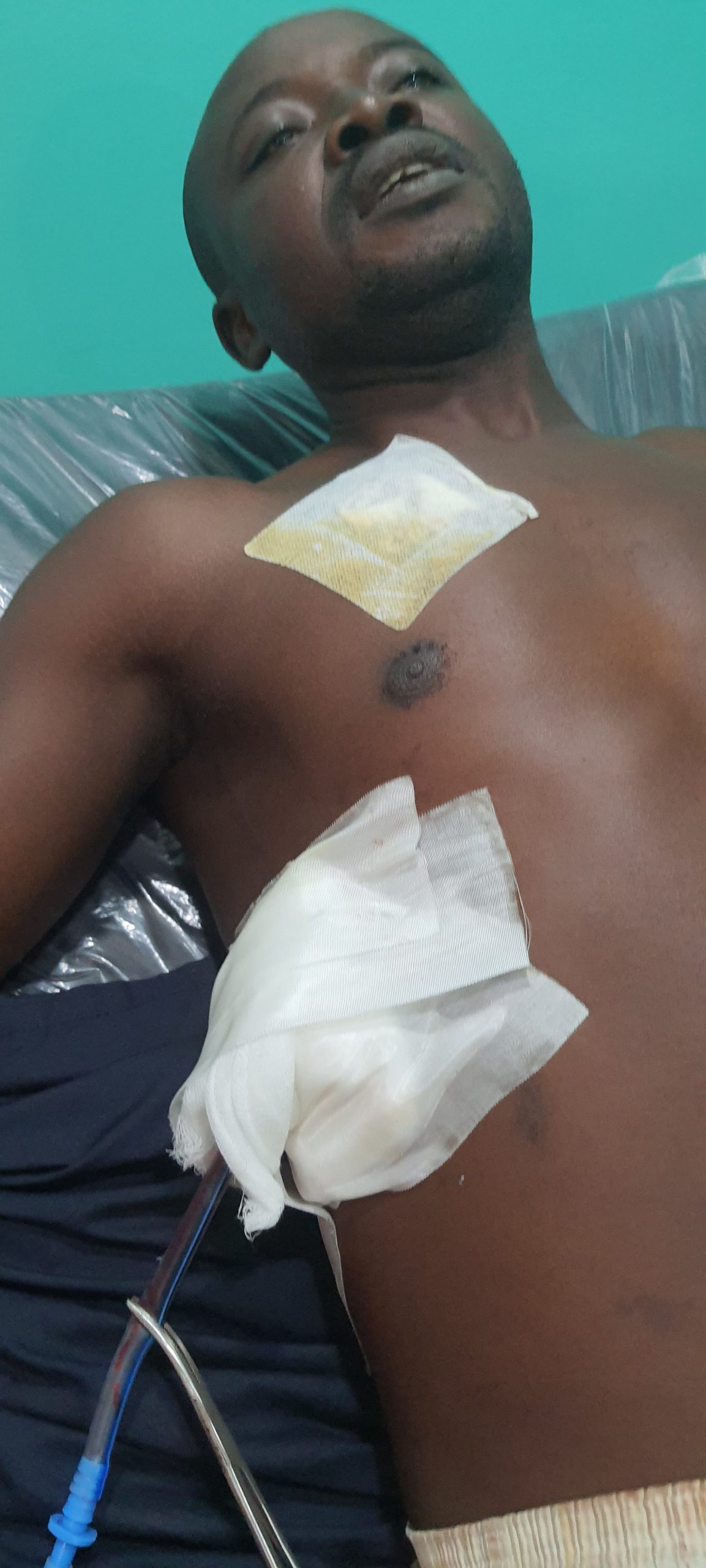
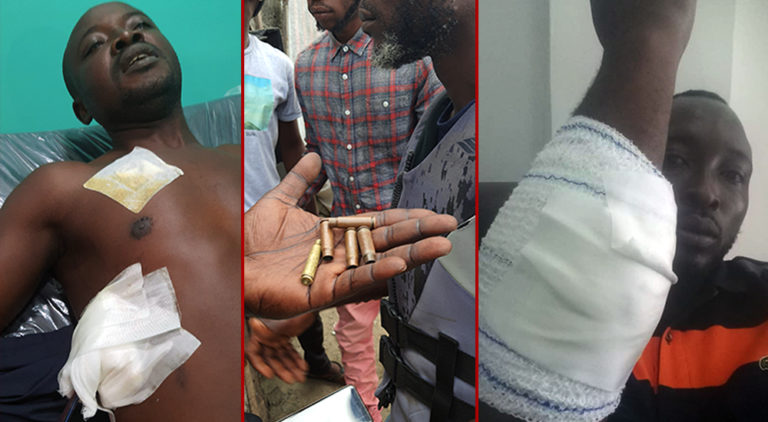
When this reporter visited Nicholas Okpe at the Emergency Unit of Grandville Hospital in Ajah, he could barely sit up. He had a patch on his right chest where a bullet hit him. A tube was attached just under his right rib cage that drains blood and pus into a container placed on the floor. The bullet was still lodged in his chest while the hospital waits for a consultant to further test before deciding how to proceed.

Photo of Nicholas Okpe lying in the ICU of the hospital. He was shot at Lekki toll gate

A doctor at the hospital, who identified herself as Ikemefuna, said Mr Okpe was in a critical state when he was admitted, and said he was lucky to be alive.

“He is getting better. He is not on oxygen anymore. God so good it (the bullet) hit him on the right. It (the bullet) pushed his lung to the side. He still needs further review,” she said.

Grandville Trauma Centre, Ajah

Moved by the prospect of achieving an end to police brutality, Mr Okpe did not just protest, he did more. He volunteered alongside a handful of other youth to clean the protest ground at the end of each day’s protest.

He told me his case was so critical that three hospitals rejected him before Grandville accepted to treat him.

“The first hospital they said they cannot admit me,” he said. “They poured honey where the bullet passed through and plastered and gave me some injection. They said that will sustain me until I get a hospital that can treat me.

“They took me to another hospital, they rejected me. They took me to another they said they were not open. This is the fourth hospital they came to. The man here said they should admit me if not I would have died.”

Mr Okpe said the blood and pus that were drained from him filled the container four times already. He said he was in severe distress.

“I’m passing through a lot of pains. I am always in pain. Anytime I cry out they will just give me painkiller and they will go. When that painkiller expires the pain will come again. My head is just too heavy for me with pains,” he said.

Mr Okpe also said he saw the soldiers took aim at the CCTV cameras at the toll gate before he was hit.

Nicholas Okpe. Mr Okpe says he saw the soldiers took aim at the CCTV cameras at the Lekki toll gate before he was hit.

Lekki Shooting Victim — Raymond Simon

All Raymond Simon wanted to do was help. But his large heart almost cost him his life. Mr Simon told PREMIUM TIMES he was not at the toll gate when the soldiers shot at protesters. A church instrumentalist, he was at a rehearsal that evening. As he was returning home on his motorcycle, he decided to take some of those injured during the shooting to hospitals.

He said he was returning after making the third trip from nearby Reddington Hospital when he was ambushed by police officers at the toll gate who viciously attacked and abducted him.

“After I was stabbed, they abducted me alongside a corpse. They were driving us around the area and I suspect they were looking for where to abandon the corpse. When they got to Ilasan area, they pushed me down. My hands were tied to the back,” he said.

He said the police officers drove off with the other presumably dead person. He later managed to find his way to a hospital where his wound was stitched, and he was given painkillers before being discharged.

Mr Simon said after he was attacked, one of the police officers tried to shoot him but one of his colleagues pushed him away. He said another officer with a bayonet attached to his rifle aimed to stab him in the neck, but he quickly moved his head and the blade hit his chin.

He said his motorcycle was stolen during the attack.

Lekki Shooting Victim — Bassey

A bullet hit Bassey in his right hand as he mingled with other protesters at the toll gate. Unable to reach first responders on time due to the blockade set up by the soldiers, he said some residents of the area close to the toll gate removed the bullet lodged in his left hand.

[Photos of Divine]

Bassey appeared to be in severe pain and in urgent need of medical attention. He gingerly carried the swollen hand, with a huge wound in the spot where he was hit by the bullet, close to his body, as he spoke with this reporter. He said he has not received any treatment worth mentioning since he suffered the injury.

When PREMIUM TIMES returned to the shanty to check Bassey the next day, our reporter was told members of the community had arranged for a motorcycle to take him to St. Nicholas Hospital, Lagos Island. Our reporter went to St. Nicholas Hospital to check on him but was told nobody that fits his description came there for treatment.

Bassey later returned to the shanty on Thursday. Fellow residents said his condition had worsened as he is yet to get proper treatment for his injury.

Lekki Shooting Victim — Patrick Ukala

Mr Ukala was shot in his right arm. He said the bullet is still lodged in his arm and that he had only received first aid and painkillers. He was told by doctors at Grandville to do an X-ray of the arm before the bullet can be removed.

Patrick Ukala was also shot at Lekki toll gate

“I am still walking everywhere looking for where to do x-ray but nowhere yet. They promise that I should come back.”

Abandoned by Lagos Government

His account as well as those of Messers. Okpe, Simon, and Bassey contradict the claim of the Lagos government that protesters who were injured would be treated fully free of charge.

The victims said the state government has not contributed a dime to their treatments. Some of them who were originally treated are now being treated in other hospitals.

Mr Ukala said the bill for their treatment was covered by one Ideh Chukwuma, a filmmaker.

On Sunday when our reporter visited Mr Okpe at Grandville Trauma Centre, he met a team from the Lagos State Ministry of Health, which came with its media crew to interview the victims. Mr Ukala said that was the last he saw of any government official.

“Since the day you saw those people (officials of the Lagos Ministry of Health) there they have never come there neither did they speak with the doctor. Finally, the doctor has asked us to leave.”

He said Mr Okpe was discharged with the bullet still lodged in his chest. He also has not been operated on to remove the bullet in his arm.

When Grandville Trauma Centre was reached for comment, an employee of the hospital who gave her “professional name” as Doctor Adebayo, confirmed that the victims had all been discharged.

“Some that need extra consultations with specialists, we sent them there. We didn’t operate him (Mr Okpe) here. Probably they will operate him wherever he went to,” she said.

Hospitals owners accuse Lagos Government of intimidation

Following the shooting at the Lekki Toll Gate, some hospital owners in Lagos complained to this newspaper that the Lagos State Ministry of Health was using its Health Facility Monitoring and Accreditation Agency (HEFAMAA), the organisation responsible for registering healthcare facilities in the state, to intimidate them.

They said HEFAMAA sent out an online questionnaire requesting details of injured #EndSARS protesters treated at their facilities, a move they said could be used to “arm-twist” them into providing information which might breach doctor-patient confidentiality rule.

They said they were particularly worried about the section of the form requesting their registration number.

Screenshot of the Form

When reached for comment on Wednesday, the spokesperson of the Lagos Ministry of Health, Tunbosun Ogunbanwo, asked for questions to be sent to him via SMS. He is yet to respond days after the inquiry was sent to him.

Link to the form: https://forms.gle/XYY9EEw3ovzqYZiv5

#EndSARS Protests

The protest movement, which is known as #EndSARS, demanded the dissolution of the Special Anti-Robbery Squad (SARS), a tactical unit of the Nigerian Police, whose members were accused of atrocities including extortion, rape, abduction, torture and extrajudicial killings.

The protesters also asked for investigations into the allegations against SARS personnel as well as the immediate suspension of officers accused of committing atrocities.

At least for 10 days, the protests, especially in Lagos and Abuja, were conducted peacefully despite attacks on protesters by persons suspected to be pro-government hoodlums.

Within the period, no fewer than 11 protesters were killed by the police across the country.

In one instance in the Ketu area of Lagos, on October 19, rival street gangs capitalised on the protests to attack one another.

In the morning of October 20, the protests in some parts of Lagos, especially at Orile and Mushin, turned violent after police officers shot some protesters. The Orile and Mushin police stations were razed by angry mobs. At least one police officer was lynched, and several others injured in the riots that ensued.

The curfew

In a move to check the violence that was beginning to spread across the state, at around noon on October 20, Governor Sanwo-Olu announced a state-wide curfew with effect from 4 p.m that day.

The protesters at Alausa and Lekki Toll Gate, which were the epicentres of the demonstrations, defied the curfew but remained peaceful.

Just after 3:30 p.m, officials believed to be from the company managing the toll gate, Lekki Concession Company (LCC), arrived at the toll gate and removed equipment initially thought by activists to be CCTV cameras. Authorities later claimed that the CCTV cameras at the facility remained intact and that its footages would be released to the panel probing the shooting.

LCC officials accused of removing cameras at the Lekki toll gate

Protesters who survived the attack said lights, including streetlights and a large electronic billboard which illuminated the toll gate area, were turned off just before the attack to possibly provide a cover for the brutal assault on peaceful protesters that were to follow.

The advertising company that owns the electronic billboard at the Lekki toll gate, however, said it deactivated its facility in compliance with the curfew declared by Governor Sanwo-Olu, unaware that tragedy would later struck at the location.

This report is published with permission from Premiumtimesng.com

Return to duty posts or face dismissal, PSC warns police officers

0

The Police Service Commission, PSC, has urged some members of the Nigerian Police to return to their duty posts despite the killing of over 22 policemen during the violence that erupted after the #ENDSARS protests, according to a report.

Ikechukwu Ani, spokesperson of the PSC stated the killing of police officers was painful but should not be a reason for police operatives in the country to abandon their duty of protecting the nation.

“The Nigeria Police Force is part of the public service and the public service is guided by the Public Service Rules. If you don’t come to work without permission, the punishment is dismissal if it is proven.

“The police as public servants are guided by the rules; so, they cannot on their own say they won’t go to work. Although, the Police Service Commission is also working to make sure they are protected because they are human beings; their lives also matter,” he said.

Section 030402 of the Public Service Rules lists absence from duty without leave as serious misconduct, which can be investigated and if proved, may lead to dismissal.

Ani also warned against further attacks on police officers, saying it could lead to anarchy.

“It would be an ill-wind that blows nobody any good but it is not a reason for anybody to say he won’t go to work. If you don’t go to work, the Public Service Rules will take its course,” he said.

Several reports indicate that policemen had stayed away from blackspots and their duty posts following the killing of their colleagues by suspected hoodlums who hijacked the #EndSARS protests.

“When you make Nigeria lawless and ungovernable, there would be a situation nobody would be able to control,” Ani stated.

Mohammed Adamu, Inspector-General of Police, IGP last week had ordered the immediate deployment of Nigeran anti-riot police unit of the  Police Mobile Force to protect lives and property of Nigerians.

However, the riot policemen have also failed to respond to incidents of looting and vandalism of public and private property by miscreants in defiance of a directive by the IGP.

Musiliu Smith, the Chairman of PSC also urged the police to restructure their anti-crime strategies, assuring officers and men of the Force of improved welfare.

He stated this when he inspected some of the damaged police formations in the Lagos State Command alongside some retired senior officers.

He emphasised that officers and men of the command should take the ugly incident as one of the challenges and hazards of police job in a “developing country like ours.”

Viral post on FG giving out grants to support Nigerians is a hoax

CLAIM

That the federal government is giving out 3million grants to support Nigerians.

Verdict

The claim is untrue. The website used as the conveyor belt is not only fictitious but also designed to spread false information.

Full Text

A viral ‘forwarded-as-received’ post has been spread across WhatsApp platforms, with the accompanying claim that the federal government is giving out grants to support Nigerians.

The post with a registration link attached to it advanced that the 3 million grant only has 9540 slots available for grabs by Nigerians on a first-come, first-serve basis.

Verification

Although the post did not specify the kind of grant it is, The ICIR visited the website through the acclaimed registration link to confirm the veracity of the claim. 

The first red flag sighted by this reporter was how the ‘Bitly’ shortened link changed to “bonanzaoffers.xyz”. After gaining access to the page, another message popped up, congratulating the reporter for visiting the page and standing a chance to “benefit from the 75 billion federal government grant”. 


The website went further by asking questions on why a visitor would want to apply for the grant; the amount the visitor would like to apply for; and how a visitor knows about the scheme. These questions are accompanied by varying options.


The ICIR ticked ‘start a new business’ and a verification process which took only four seconds emerged. Having been verified, another message popped up, congratulating the reporter for being “successfully shortlisted” to have access to the grant.

But for the grant to be disbursed, the website asked the reporter to share the claim to twelve WhatsApp groups or friends. This, according to the pop-up message, is to enable other Nigerians to benefit from the scheme.However, The ICIR conducted a google search using keywords like “75 billion federal government grants” to ascertain the federal government grants initiative. 

It turned out to be a post-COVID-19 stimulus package for Micros, Small, and Medium Enterprises (MSMEs) termed “ MSME survival fund.”

The scheme is a product of the Economic Sustainability Committee Plan aimed at developing a plan to respond to the challenges posed by the economic shock of the Coronavirus pandemic.

The grant which is scheduled to run for an initial period of three months, starting from September 2020, is handled by the federal ministry of Industry, Trade and Investment. It targets 1.7 million entities and individuals across the country, of which 45 percent of the beneficiary would be female-owned enterprises, 5 per cent for businesses owned by people living with disabilities.

Another federal government’s package of 75billion found by The ICIR during the search was the Nigerian Youth Investment Fund (NYIF) under the auspices of the Federal Ministry of Youth and Sports Development. The initiative which is funded by the central bank of Nigeria will spread over three years to cater to youth-owned businesses and investment needs.

However, the fund is a loan package with an interest rate of 5% per annum and a tenor of 5 years with a moratorium of up to 12 months. The announcement added that an individual or non-registered business could draw up to 250,000 Naira while youth-owned registered businesses could apply for up to 3 Million Naira.

This is the arrangement the phoney website cloned when it asked for the amount an individual would like to apply for within the  range from #200,000 to 3 million.

Who are the impostors?

The ICIR queried the existence of the hoax website through Whois.net to check the website domain information. 

As at the time of filing this report, all forms of information always attached to any website is not available for this website in question. 

 However, while this check can not explicitly state who and where the website was registered, investigation shows the website was created on 08-05-2020 and scheduled to expire a year after. 

Other information about the registrant of the website, such as the phone number and email are also not available. All these show the dubious intention by the unidentified owner(s) of the hoax website.

Conclusion

Based on the above findings, the website is not only fictitious but also designed to spread False Information.